

The financial crisis of 2008–09 took a major toll on US public pension plan investments, and the ensuing Great Recession deepened the challenges facing these plans. As a consequence, many public employers were forced to restructure their retirement schemes, and a recent survey found that since 2011, almost all states changed public pension benefit and contribution formulas to rein in costs (NASRA, 2014a ). Moreover, several states have taken a further step, significantly modifying their plan designs so as to transfer risk from plan sponsors to employees. In particular, several states have offered employees the option to choose which retirement plan they want, with options including defined benefit (DB), defined contribution and hybrid plans.
This paper explores the restructuring of Utah's statewide public employee pension system in 2011, in response to the financial challenges described above. Previously, the Utah Retirement System (URS) provided public employees with a traditional DB plan. Before the 2008–09 financial downturn, Utah's pension system was one of the best-funded statewide pension plans in the country, with an average funded ratio of 95%. With the downturn, however, investments losses led to in a substantial decline in URS's funded ratio which dropped to 83% by 2010.Footnote 1 Consequently, the system's actuaries forecasted that large increases in annual required contributions would be needed to cover the losses. To avoid imposing additional financial strain on taxpayers, the Utah legislature responded by proposing major changes to pension offerings provided to new employees.Footnote 2 Public employees protested these pension reforms and urged lawmakers to ‘proceed with caution’ (Dallof, Reference Dallof2010). The legislator sponsoring the reform, Dan Liljenquist, explained that the goals of the ‘reform were two-fold: one, to make sure that we could meet every penny of the commitment that we had already made to current employees and retirees, and two, to reduce and eventually eliminate the pension-related bankruptcy risk to the state’ (cited in McGuinn, Reference McGuinn2015: 9).Footnote 3
Legislation authorizing the pension reform passed in March 2010 went into effect in July 2011, officially closing the DB plans to new employees and establishing the two-option replacement plan.Footnote 4 The two new pension options were expected to be less generous than the former DB plans and could, therefore, be anticipated to reduce the state's future pension liabilities. Post-reform, new hires could choose one of two new options: a defined contribution (DC) plan, or a hybrid pension plan that incorporated both DB and DC elements (about which we say more below). New hires who failed to make an active choice between plans were automatically enrolled in the hybrid plan after 1 year of employment.
Using administrative data provided by URS that includes all individuals employed between January 1, 2006 and September 30, 2013, we examine how new hires' plan choices differed according to individual and job characteristics. Additionally, we evaluate how the pension reform changed two employee behaviors: contributions to supplemental plans, and turnover patterns. Prior literature has not examined these behavioral responses to public pension changes, focusing instead on differences in funding, contributions, and benefits.Footnote 5 By contrast, our analysis provides evidence from Utah suggesting that it is important not to neglect the effects of retirement plan restructuring on other public employee behavior. Indeed, such outcomes could undermine state governments' ability to deliver services promised to their citizens.
We find that most new hires failed to make an active choice between the available pension plan options, so the default plan assignment mattered. Second, one might have anticipated that the less generous retirement plan would have encouraged new hires to save more through supplemental plans, but this did not occur. Interestingly, those who did actively elect their primary account were also likely to participate in supplemental retirement plans. Third, post-reform, public employee two-year separation rates rose 30%, from 13 to 17 percentage points, although this increase was likely affected by the improving economy and the increased availability of alternative employment opportunities.
In what follows, we begin by reviewing key aspects of Utah's traditional DB plan and comparing them with the two new plans adopted in 2011. Using administrative records provided by URS, we then estimate models of plan choice to evaluate who elected which plan and who defaulted. Inasmuch as both of the new plans are likely to pay less generous retirement benefits than the prior DB pension, we also inquire whether new hires saved more voluntarily to bolster their retirement incomes. Additionally we compare turnover rates for both pre- and post-reform new hires, to assess the impact of retirement plan type on employee retention rates. In a final section, we draw lessons from the Utah reform relevant to other states and municipalities looking to restructure their pension offerings.
Relevant prior studies
We lack the space to review the large literature on pensions and their effect on employee behavior, but we call attention here to a few recent accounts of how public pensions have sought to deal with pressing fiscal challenges. Media reports by Walsh (Reference Walsh2011), Lyman and Walsh (Reference Lyman and Walsh2014), and Greenhouse (Reference Greenhouse2011), among others, have reported on changes in public pension benefit and contribution parameters in the wake of the financial and economic crisis. In the academic literature, Chingos and West (Reference Chingos and West2013), Lachance et al. (Reference Lachance, Mitchell and Smetters2003), and Milevsky et al. (Reference Milevsky, Promislow and David2004) examined specific state pension reforms and their impacts on funding and costs.Footnote 6 More recently, Novy-Marx and Rauh (Reference Novy-Marx and Rauh2015) have suggested that linking public pension payouts to investment performance could alleviate the critical funding shortfalls many states now face.
Particularly pertinent to the present paper is prior research on how pension reforms alter employee behavior. To date, however, most empirical studies have focused on private sector firms and employees, as shown in two reviews by Gustman and Mitchell (Reference Gustman, Mitchell, Bodie and Munnell1992), and Gustman et al. (Reference Gustman, Mitchell and Steinmeier1994); case studies of corporate plan conversions are discussed by Clark and Munzenmaier (Reference Clark and Munzenmaier2001). Yet relatively few private sector firms give employees the opportunity to choose among alternative types of pension plans.Footnote 7 For this reason, prior studies have mainly focused on how pensions affect worker turnover patterns, and they have provided two main findings. First, employees of firms offering pension plans tend to separate less frequently than employees at other firms (Allen et al., Reference Allen, Clark and McDermed1993). Whether this is causal or simply correlational has been difficult to confirm. Second, there appear to be no major differences in turnover rates between employees offered DB versus DC plans (Gustman and Steinmeier, Reference Gustman and Steinmeier1995). This is contrary to what might be expected, since DB plans tend to be more ‘back-loaded’ – meaning that employees with long tenures receive more valuable retirement benefits than short-tenure employees. By contrast, hybrid and DC plans provide more balanced benefits, rewarding employees more equitably with additional years of service. Moreover, retirement wealth accumulated in DC plans is more portable than that accumulated in traditional DB pensions, meaning that DC plans provide greater value than do DB plans to short-term workers who may wish to move to a new employer prior to retirement.
In the public sector, it is somewhat more common to give participants a choice between two or more retirement plans, particularly at public universities. For instance, NASRA (2010) noted that nearly half of all state universities offered faculty choice between a DB and a DC plan. Clark and Hanson (Reference Clark and Hanson2011) reported that five statewide retirement systems covering general public employees or teachers offered a DB/DC choice, two offered a choice between a DB and a hybrid, and one offered a choice between all three plans types. According to Munnell et al. (Reference Munell, Aubry and Cafarelli2014), states launching optional DC plans before the financial crisis did so because these gave workers the opportunity to manage their own money, particularly in rising equity markets. Post-financial crisis, Utah along with Michigan (2010), Rhode Island (2011), and Virginia (2012) have established statewide systems which include hybrid plans.Footnote 8
In the last two decades, many researchers have explored the impact of public sector plan choices on aspects of employee behavior. For instance, Clark et al. (Reference Clark, Ghent and McDermed2006) studied public university faculty members' pension plan choices in North Carolina.Footnote 9 As expected, they found that older individuals were more likely to select the DB option, whereas younger and, potentially, more mobile workers were more likely to select the DC plan. In their study of Oregon's Public Employees Retirement System, Chalmers et al. (Reference Chalmers, Johnson and Reuter2008) evaluated how different plan types influenced older individuals' retirement patterns, and they concluded that a substantial minority of employees did not adequately understand the plans' complex incentives. Goldhaber and Grout (Reference Goldhaber and Grout2013) studied the pension plan preferences of Washington State public school teachers, and they found that, with the exception of age, observable teacher and job characteristics were not significant predictors of new hires' plan choices. Brown and Weisbenner (Reference Brown and Weisbenner2014) examined employees' DB versus DC plan choices in the Illinois State University system, using an administrative dataset linked to a participant survey on plan and worker attributes. They concluded that those preferring the DC plan were predominately men, who also were less risk averse and more financially literate than employees electing other plan options.
Though prior studies have explored which types of workers elected different retirement plans when given a choice, they have not illuminated worker responses along other dimensions. Accordingly, in what follows, we investigate the determinants of plan choice by public sector employees in Utah, along with associations between plan choice and measures of two important behavioral outcomes: post-reform contributions to supplemental plans, and post-reform employment turnover rates.
Public retirement plans in Utah
Utah's public employee pension plans date to the first half of the 20th century with retirement plans introduced for school teachers and firefighters. A statewide teachers' retirement system was established in 1937, followed by the adoption of a plan for state officers and employees in 1947. After a series of modifications, these plans were consolidated in 1963 into the URS.Footnote 10 Today, URS provides retirement benefits for more than 450 public employers including the State of Utah, local governments, school districts, and some employees in higher educational institutions (faculty and other exempt higher education employees are not members of URS.) Most public employees in Utah are also covered by Social Security.Footnote 11
In this section, we describe the various retirement plans offered to public employees in Utah. We first discuss the pre-reform DB plan that covered full time employees prior to 2011. Next, we review the post-reform hybrid and DC plans offered to new hires following these reforms and compare the generosity of the pre- and post-reform pension plans. Finally, we describe URS supplemental retirement savings plans available to employees both pre and post-reform.
The traditional DB plan (Tier I)
Employees hired prior to July 1, 2011, were automatically enrolled into URS Tier I System, a traditional DB plan. The Tier I Retirement System was composed of six different plans: a Public Employees' Contributory Retirement Plan, a Noncontributory Retirement System, a Public Safety Retirement System, a Firefighters' System, a Governors' and Legislators' Retirement Plan, and a Judges' Retirement System.Footnote 12
More than 85% of Tier I members belonged to the Public Employees' Noncontributory Retirement System,Footnote 13 where the employer covered the entire cost of the benefits. At retirement, a worker's benefit amount under this DB plan was derived by calculating 2% of his average monthly earnings from his 3 highest years of earnings, multiplied by his years of service. Thus, a 30-year career worker would have earned a lifetime income stream equal to 60% of his highest 3 years of earnings. After retirement, benefits were indexed by up to a 4% annual cost of living adjustment (NASRA, 2014b ). Retirement ages were defined by a combination of age and service: normal retirement benefits were payable at age 65 with 4 years of service, or 30 years of service at any age. Early retirees could begin benefits at age 60 with 20 years of service, age 62 with 10 years of service, or at any age with 25 years of service; the early retirement payments were reduced by 7% per year under age 60, and 3% per year from 60 to 65. Retirees could choose from six annuity options as well as a partial lump-sum option.
The new plan options (Tier II)
Employees hired after July 1, 2011, were required to choose between a DC plan and a hybrid plan; the election had to be declared prior to the end of their first year of employment; and at that time the choice was final and irrevocable. Plan elections are made online, and employees failing to elect a plan prior by the end of their first year have been automatically enrolled into the default hybrid plan. During their first year of employment, employees are presented with a screen asking them to choose their retirement option each time they log into their retirement account. This screen includes links to educational materials about the plan choices. In order to proceed to view their account, employees must either select a plan or ‘I am not ready to my election at this time’. The date when the plan choice becomes final, or when they are automatically enrolled in the hybrid, is prominently displayed on this page. There is no advantage to the employee associated with the timing of his choice between his hire date and the end of his first year of employment, unless he preferred the DC option, missed the deadline, and was defaulted into the hybrid plan.
URS communication materials for new hires seek to present a balanced assessment of the two plan options, stating that ‘both plans have advantages and disadvantages. The plan that's better for you will depend on your situation’. The webpage for new members outlines various aspects of each plan in detail and directs new employees to additional resources, including a ‘decision guide’ and several online pension benefit estimate calculators.
An employee electing the DC plan receives an annual employer contribution of 10% of his annual earnings into the 401(k) account,Footnote 14 and these employer contributions vest after 4 years of eligible employment. Employees may also make additional contributions to their accounts on a voluntary basis. Distributions are allowed after retirement, separation from employment, or age 59 ½, and the funds may be withdrawn in various ways, at the retiree's discretion. No cost of living adjustments are provided to DC participants.Footnote 15 Pension and employer contributions to the 401(k) account vest after 4 years of service.
The hybrid plan is less generous than the old DB plan along several dimensions. First, the new retirement benefit is determined by multiplying the employee's years of service by 1.5% times the monthly average of his highest-five earnings years. Compared with the old DB plan, the new longer earnings averaging period is likely to lower the benefit. Second, the hybrid plan also requires participants to work for 35 years to qualify for a normal retirement benefit at any age, 5 years longer than under the old DB plan; participants may also take an unreduced retirement benefit at age 65 with 4 years of service. Retirees can take a reduced benefit beginning at age 62 with 10 years of service, or age 60 with 20 years of service; early retirement reduces benefits by about 7% per year between age 60 and 63, and approximately 9% per year for age 64–65. Third, the hybrid plan only permits up to a 2.5% cost of living benefit adjustment each year, depending on the change in the Consumer Price Index, versus a 4% rate under the old plan. Retirees may receive their maximum retirement benefits based on the formula, or they can select from several joint and survivorship options. Employees may also contribute to several voluntary retirement saving plans (to be described below).
The hybrid plan also has another key feature differentiating it from the old model; the contribution rates are variable. That is, the plan's Board of Trustees must set a certified contribution rate each year for the DB portion of the hybrid plan, based on the preceding year's actuarial valuation. Under the Board's funding policy, the certified rate is set as the greater of the previous year's certified rate and the actuarially determined rate. The Board is not required to decrease the rate from the prior year until the plan's actuarial funded ratio exceeds 110%. As long as the employer-certified rate remains below 10% of compensation, employees are not required to make any additional plan contributions. If the rate exceeds 10%, hybrid plan participants must contribute the entire amount needed. Conversely, if the employer's certified DB contribution rate were to fall below 10%, the employer then must contribute the difference between 10% of compensation and the certified rate into participants' 401(k) accounts. For example, in 2014–15, the employer's certified contribution rate was 8.22% of payroll; therefore, the employer contributed 1.78% of payroll into employees' 401(k) accounts that year.Footnote 16 In the 5 years since the plan's introduction, the certified contribution rate has not exceeded 10%, and thus, employees have not been required to contribute to the plan. Nevertheless, there is a possibility that employee contributions could be required in the future, leading to a reduction in take-home wages.
Comparing the Tier I with Tier II systems
Generally speaking, the new Tier II arrangement is anticipated to pay lower benefits, compared with the old Tier I DB plan.Footnote 17 We illustrate the expected difference in retirement benefits assuming the relevant benefit formulas and various age/service thresholds for an unreduced benefit. Depending on the plan type (DB versus hybrid) and years of service, the outcomes may be compared as follows:

Note: In addition, employees in the hybrid plan must pay an additional contribution (receive an additional employer contribution to their 401(k) plan) if the employer's ‘certified contributions’ exceed (fall below) 10% of pay in that year (see text). If the employer's certified contribution rate falls below 10% of pay, the employer contributes the difference into the employee's 401(k). Neither of these possibilities is considered in this comparison.
The hybrid plan also requires more years of service for normal retirement benefits at any age, 35 years compared with the 30 years for the Tier I benefit, and the early retirement reductions are larger in the hybrid plan. In addition, prior to 2011, state and education employees who were in the Tier I DB plan received a 1.5% employer contribution to the 401(k) plan. In other words, the generosity of the Tier II hybrid plan is substantially below that of the old Tier I scheme.
While participants in the new Tier II DC and hybrid might conceivably generate higher retirement benefits if their DC returns proved to be much in excess of what the old DB would have paid,Footnote 18 this seems unlikely. Moreover, the new structure clearly shifts risk from the employer to the employees. In the DC plan, participants bear all investment risk directly. The hybrid option also poses risk to participants for two reasons. First, if the cost of the DB portion of the plan exceeds 10% of payroll, workers will need to cover the excess.Footnote 19 Second, employees also bear the potential cost of mismatched assets and liabilities in the hybrid plan, while not having any control over that plan's asset mix. While the educational materials given to employees plainly state that they will be responsible for contributing to the plan if the contribution rate ever exceeds 10%, there is no mention of the mechanisms affecting this extra contribution. Also, it is unclear whether this potential moral hazard on the part of the plan's investment managers is widely appreciated.Footnote 20
Supplemental plans
Public employees also have the option of contributing to several supplemental retirement saving plans, though state agencies offer no employer match to employee contributions for general state employees.Footnote 21 Currently URS offers a 401(k) plan, a 457 plan, and a traditional as well as a Roth Individual Retirement Account (IRA). All URS members are eligible to participate in the IRA. With the introduction of Tier II, all employers are required to participate in the 401(k) plan and many also participate in the 457 plan. These supplemental plans provide eight core investment options along with target date funds. In addition, a self-directed brokerage account for pre-tax contributions is available through a private money manager.Footnote 22 All employee contributions are immediately vested and thus may be cashed out when employment ends.
Multivariate determinants of public plan choice
New hires in the Tier II system must choose between enrolling in the hybrid plan or in the DC plan within 1 year after their initial employment. As noted above, employees who fail to make an active choice of primary plan option are automatically enrolled into the default hybrid plan. To examine who defaulted, and who chose which plan conditional on making an active choice, we analyze URS administrative records on all individuals who first entered employment with a URS-covered employer between January 1, 2006 and September 30, 2013. These records include information on employee age, sex, employment dates, and retirement plan choice, along with annual earnings, employee contributions to voluntary URS-administered retirement savings plans, service credit, and job classification for the period from January 1, 2006 to October 31, 2014. Because plan choice decisions in the Tier II system do not become final and irrevocable until the end of the first year of employment, we restrict our attention to employees who did not separate from service in their first year on the job. After removing observations where age, gender, or earnings were missing, the resulting sample includes a ‘pre-reform’ group of 38,220 employees hired before July 1, 2011, and a ‘post-reform’ group of 16,095 individuals hired on or after July 1, 2011.Footnote 23
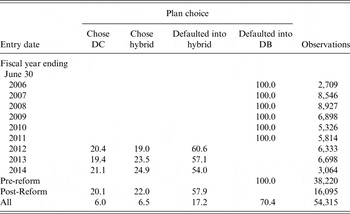
Table 1 reports the plan choices of individuals hired post-reform along with the total number of new hires throughout the 2006–2014 period. Almost 60% of Utah's new hires after the reform took place failed to make an active choice between the two plan options and were therefore defaulted into the hybrid plan. This level of default is consistent with findings from other states that have offered workers a choice of primary retirement plans.Footnote 24 One explanation for why so many people may have defaulted is behavioral inertia (Madrian and Shea, Reference Madrian and Shea2001; Choi et al., Reference Choi, Laibson, Madrian, Metrick and Wise2004; Yang, Reference Yang2005). Another explanation might be that employees actually preferred the hybrid plan over the DC option. That is, some workers may have favored the hybrid plan and simply avoided the transaction cost of making an active choice producing the same outcome as doing nothing. Of course some individuals could have been confused by this choice and unable to determine what was in their best interest. As a result, these employees could have been frozen into inaction. Still others may have overlooked the choice being offered to them, and through ignorance, may not have made an active choice.
Plan choice by newly-hired Utah public employees

Note: The table indicates the percentage of new hires who choose or were defaulted into each plan. Employees who first entered employment with a Utah Retirement Systems-covered employer between January 1, 2006 and September 30, 2013 and did not separate from employment during the first 12 months are included. The pre-reform group includes individuals hired before July 1, 2011 who were automatically enrolled in a traditional defined benefit (DB) plan. The post-reform group includes individuals hired on or after July 1, 2011 who were given the choice between a defined contribution (DC) plan and a hybrid plan. Plan choice elections become final at the end of the first year of employment. Individuals in the post-reform group who did not make an active election during the first year were defaulted into the hybrid plan. The fiscal year ending June 30, 2006 includes only individuals hired during the 6-month period beginning January 1, 2006. The fiscal year ending June 30, 2014 includes only individuals hired during the 3-month period ending September 30, 2013.
In Washington State where public sector workers were given a choice between a traditional DB versus a hybrid plan, Olleman (Reference Olleman2009) found that close to 70% of employees rejected the hybrid plan default, instead actively selecting the traditional DB plan. Brown et al. (Reference Brown, Farrell and Weisbenner2015) examined pension plan defaults by members of the Illinois State Universities Retirement System, where they found that only 27% of their survey respondents reported being defaulted; however, their survey significantly under-sampled defaulters, and the proportion of all employees covered who were defaulted was over half of all those given a choice. Nevertheless, their defaulters were more likely to wish they had chosen an alternative plan compared with those that made an active decision. As the traditional DB plan was no longer offered in Utah, it seems likely that some URS participants defaulted to the hybrid plan because they favored it, while others' choice was likely to have been due to inertia.
Of the approximately 40% of URS new hires who actively elected a retirement plan, just over half selected the hybrid plan, and slightly fewer (48%) chose the DC. We also see that the proportion of individuals actively selecting the hybrid plan increased over time, and the ratio of people defaulting shrank somewhat. This contrasts with the case of Illinois, where Brown and Weisbenner (Reference Brown and Weisbenner2014) found that the proportion of individuals selecting the default grew over time.
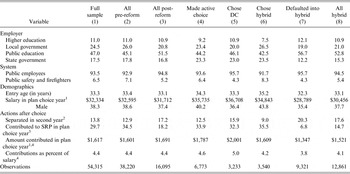
To elucidate some of the demographic and other factors associated with workers' tendency to make an active choice of retirement plan options rather default into a plan, Table 2 presents descriptive statistics for new hires between January 1, 2006 and September 30, 2013. The table first reports characteristics of all sample individuals, and then it highlights a number of subgroups including pre-reform workers, post-reform workers, workers who made an active choice, workers who made a passive choice, and all workers who chose each plan option. For each of these subgroups, we report classifications by employer type and pension system. The largest group is public school employees who comprise 47% of the URS population. Higher education staffers comprise 11% of the sample; university faculties are excluded from this system. Local governmental employees account for almost a quarter of the sample, and state employees constitute 18% of the sample. The majority of the sample is covered by the Public Employees' Retirement System, and an additional 7% are members of the more generous Public Safety and Firefighters' System. Most new hires are women (62%), and the average salary earned in the second calendar year of employment (the ‘plan choice year’) was around $32,000 in 2014 dollars. The average entry age across all workers in our sample is 33.3, although individuals hired after the reform were slightly younger than those hired before the reform.
Descriptive statistics for analysis sample (in % unless otherwise noted)

Note: This table includes employees who first entered employment with a Utah Retirement Systems covered employer between January 1, 2006 and September 30, 2013 and did not separate from employment during the first 12 months. Individuals with missing information are excluded.
1 Salary and contribution amounts are reported in 2014 dollars.
2 Reflects separations reported before November 1, 2014 for individuals hired before September 30, 2012. Separations due to death or disability are excluded. The number of observations for this row is given in the last row of Online Appendix Table 2.
3 SRP, supplemental retirement plan (e.g., 401(k), 457).
4 Among those who contributed in the plan choice year and did not exceed IRS contribution limits.
Separation rates during the second year of employment were four percentage points higher for the post-reform group, at about 17%, versus around 13% for the pre-reform group.Footnote 25 Almost 35% of pre-reform new hires made voluntary contributions to one of the supplemental retirement plans offered by URS during the plan choice year, but only 18% of the post-reform sample contributed to these plans. The average amount contributed by supplemental plan participants was 4.4% of salary and did not differ between the pre-reform and post-reform groups.
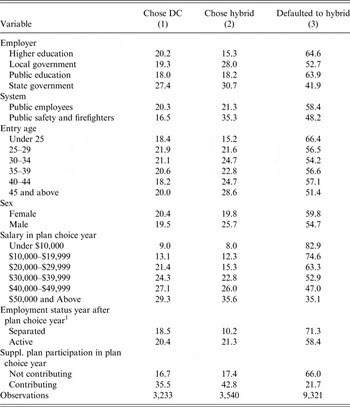
Table 3 categorizes workers by individual and job characteristics, and it also shows the percentage of new hires in each subgroup electing each plan option. A higher proportion of men made an active choice. Women were more likely to opt for the DC plan, among those making an active plan choice. Employees with higher initial salaries were also more likely to make an active choice. Employees working at educational institutions were more likely to default into the hybrid, while general government employees were more likely to make an active choice. Educational employees who made an active choice were more likely to choose the DC plan, while general government employees who made an active choice were more likely to choose the hybrid plan. In summary, defaulters differed from the active choosers in a number of ways. On average, defaulters were 2 years younger, made $6,000 less per year, were much less likely to be employed in state government, and were more likely to be in public education.
Plan choice by group

Note: The table provides the percentage of new hires with a given characteristic who made plan choices given in the column headings. It includes employees who first entered employment with a Utah Retirement Systems-covered employer between January 1, 2006 and September 30, 2013 and did not separate from employment during the first 12 months. Individuals with missing information are excluded.
1 Reflects separations reported before November 1, 2014 for individuals hired before September 30, 2012. The number of observations for this row is given in the last row of Online Appendix Table 2.
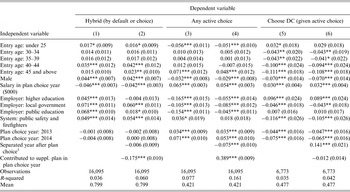
We explore these patterns further using multivariate regression analysis, with results provided in Table 4. Six linear probability models are presented,Footnote 26 with two specifications for each of three dependent variables: (i) enrolled in hybrid plan whether by default or active choice, (ii) made an active choice, and (iii) chose the DC given that an active choice was made. The first specification for each dependent variable includes a vector of individual and job characteristics, while the second specification also controls on two actions taken after the plan choice: whether the new hire separated from employment, and whether the new hire contributed to a supplemental retirement savings plan.
Multivariate estimates of determinants of plan choice (OLS, robust standard errors in parentheses)

***p < 0.01, **p < 0.05, *p < 0.1. Ordinary Least Squares estimation (OLS).
1 Separation data incomplete for individuals hired after September 30, 2012. Constant term also included. Reference categories: entry age 25–29; employer state government; system public employees; plan choice year 2012. The standard errors are not adjusted for multiple comparisons.
The first column presents results for models of whether new hires enrolled in the hybrid plan, either by default or by active choice. Here we see that state government employees (the reference category in this equation) were five–seven percentage points less likely to participate in the hybrid plan than were local government, public education, or higher education employees. Members of the Public Safety and Firefighters' system were also more likely to enroll in the hybrid, as were men and the lower-paid.
Column 3 of Table 4 reports on which newly hired employees made an active election of their retirement plan; the model posits that defaulters differ from participants who made an active choice. Results indicate that new hires age 45+ over were more likely, and those younger than 25 less likely, to make an active choice compared with those age 25–29. Men tended not to make an active selection, while state government employees were significantly more likely to make an active choice compared with those in higher education, local government, or public education. Interestingly, in each succeeding year, new hires were increasingly likely to make an active election, perhaps reflecting growing knowledge about the two plans and their differences.
Column 5 of Table 4 shows which persons making an active selection chose the DC plan. Among these employees, older persons were more likely to select the hybrid plan, perhaps because they expected to be less likely to change jobs in the future. Conditional on making an active choice, men chose the hybrid plan more often, while the higher-paid elected the DC plan. Since, as mentioned previously, the hybrid plan imposes additional uncertainty in employees' take-home pay, it is somewhat surprising that those earning lower compensation selected the hybrid plan. Higher education staffers were nine percentage points less likely to elect the hybrid plan, perhaps indicating their greater anticipated career mobility. Over time, a larger percentage of new hires who made an active choice selected the hybrid plan.
Two additional variables are included in Columns 2, 4, and 6 of Table 4, in an effort to control for factors indicative of additional difficult-to-observe information about new hires. Specifically, we examined whether each participant subsequently contributed to a URS supplemental retirement plan, and whether each separated from employment in the second year on the job. Interestingly, participants who did save in the supplemental plans were also more likely to have made an active pension choice in their first year. In other words, these individuals appear to have been more attentive than average to retirement saving, and possibly to retirement plan features. By contrast, workers leaving employment in their second year were less likely to have made an active plan choice, and when they did, they chose the DC plan more often. Thus, the defaulters are also more likely to anticipate that they will leave public employment.
Did the reform boost supplemental retirement saving?
If new hires understand that the post-reform retirement plans are likely to be less generous than the old DB plan, they may make an effort to save more in the supplemental retirement plans to accumulate sufficient retirement resources.Footnote 27 To test for this, we have calculated participation and contribution patterns in supplemental retirement plan for pre- and post-reform new hires. These are based on employee contributions to URS supplemental plans and do not include employer contributions to the 401(k) plan associated with the hybrid or DC plan.
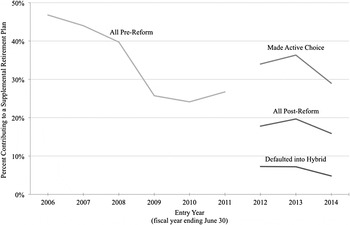
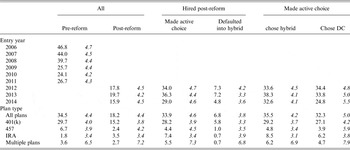
Figure 1 and Table 5 reveal the time path of supplemental plan participation over the period. Of note is the long-term decline in supplemental plan participation throughout the period, most likely attributable to the recession and collapse of the equity markets. Prior to the reform, the proportion of new hires enrolling in supplemental plans fell from over 40% (2006–08) to only about 25% for those hired 2009–11. Post-reform, the proportion of new hires contributing to a supplemental plan continued to fall, to below 20%. The average contribution rate remained relatively stable over the period, at around 4.4%.
Patterns of supplemental retirement plan participation. Source: Authors' analysis of Utah Retirement System (URS) data (see text).

Supplemental retirement plan participation rates with mean contribution rates shown in italics

Note: The table shows the percentage of employees in each group who contributed to one of the Utah Retirement Systems (URS) supplemental retirement savings plans in the calendar year following the year of hire. The average total contribution to all URS supplemental retirement savings plans in the calendar year following the year of hire as a percentage of annual salary for participants is shown in italics. Participants who were reported to have contributed more than the maximum amount allowed by the Internal Revenue based on their age and salary are excluded (n = 55). The pre-reform group includes individuals hired before July 1, 2011 who were automatically enrolled in a traditional defined benefit plan. The post-reform group includes individuals hired on or after July 1, 2011 who were given the choice between a defined contribution (DC) plan and a hybrid plan. Plan choice elections become final at the end of the first year of employment. Individuals in the post-reform group who did not make an active election during the first year were defaulted into the hybrid plan. The fiscal year ending June 30, 2006 only includes individuals hired during the 6-month period beginning January 1, 2006. The fiscal year ending June 30, 2014 only includes individuals hired during the 3-month period ending September 30, 2013.
Figure 1 also shows that employees who defaulted into the hybrid plan post-reform were far less likely to contribute to supplemental accounts, compared with new hires making an active plan choice. Table 5 also shows that defaulters who did make voluntary contributions, saved less on average than did active choosers. Participation rates for those making an active election were actually higher than pre-reform (33% compared with about 25%) while those who defaulted into the hybrid plan were much less likely to save additional amounts (7%). Finally, those who elected the hybrid plan were somewhat more likely to enroll in one of the supplemental saving plans, compared with those choosing the DC, but they contributed less as a percentage of pay, on average, than participants who chose the DC.
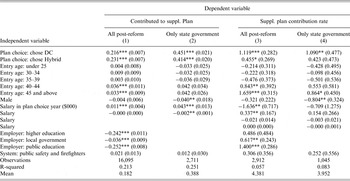
Results from a multivariate linear probability analysis of contributions to the supplemental retirement plan by post-reform hires are presented in Table 6.Footnote 28 As one might expect, more highly paid new hires were more likely to contribute to the supplemental plan, as were older employees.Footnote 29 Nevertheless, age is not significant for state employees. The key finding, however, is that participants making an active election of primary plan were about 22 percentage points more likely to also participate in a supplemental plan, holding other factors constant (Column 1). Some individuals in our sample might be participating in other supplemental plans offered by their employers,Footnote 30 and we have data only on contributions to URS Savings Plans. Accordingly, Column 2 breaks out state employees for whom we observe all participation in employer-provided supplemental retirement plans. Results show even greater differences: those actively choosing their primary plan were 41 percentage points more likely to make supplementary contributions, versus those defaulted into the hybrid plan.
Multivariate estimates of determinants of participation in and contributions to supplemental retirement plans (OLS, standard errors in parentheses)

***p < 0.01, **p < 0.05, *p < 0.1. Ordinary Least Squares estimation (OLS).
Constant term and plan choice year also included. Reference categories: plan choice defaulted into hybrid; entry age 25–29; employer state government; system public employees; choice year 2012. The standard errors are not adjusted for multiple comparisons.
Columns 3 and 4 of Table 6 expand on this analysis by focusing on contribution rates for supplemental plan participants. Contribution rates were positively associated with age and salary, and men contribute less than women. For state employees, however, salary was not significant. Participants in the DC primary plan contributed more than participants in the hybrid plan.
How the reform affected patterns of separation from public employment
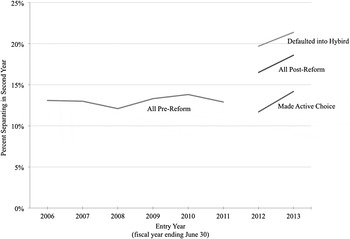
One concern sometimes expressed by public sector employers who alter their retirement plans is that such changes will influence employee separation rates.Footnote 31 We can evaluate this hypothesis in the URS case, since the dataset includes separations reported prior to November 1, 2014 for individuals who remained employed for at least 1 year. Our pre-reform series begins with new hires during the final 6 months of fiscal year 2006, extends through the recession years, and ends with fiscal year 2011. The post-reform data includes employees hired during fiscal year 2012 and the first three months of fiscal year 2013. Inasmuch as there is a 30–60 day lag in reporting, we restrict the sample for this analysis to individuals hired prior to September 30, 2012.Footnote 32 We cannot determine whether separations were employee-initiated quits or employer-initiated terminations.Footnote 33
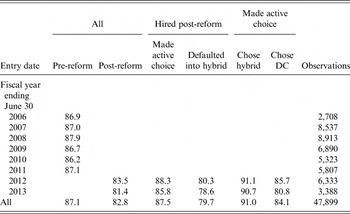
Figure 2 reports the proportion of pre- and post-reform new hires who separated from public employment in the second year of employment; that is, the second-year separation rate conditional on remaining on the job at least 1 year. Table 7 shows that more than 87% of those hired prior to the reform were still employed 2 years later, while fewer than 83% of those hired after the reform remained at the 2-year mark. In other words there was a considerable increase in separation rates after the reform was enacted, of 30% (from 13 to 17 percentage points). It is also interesting that new hires not making an active choice of a pension plan post-reform had considerably higher separation rates, compared with the new hires who elected either the DC or the hybrid plan. That is, people who elected the DC plan had slightly higher separation rates compared with those in the hybrid plan.
Second-year separation rates. Source: Authors' analysis of Utah Retirement System (URS) data (see text).

Second year retention rates

Note: The table shows the percentage of employees in each group who remained employed by Utah Retirement System (URS) covered employer for at least 2 years. Employees who first entered employment with a URS covered employer between January 1, 2006 and September 30, 2012 and did not separate from employment during the first 12 months are included. Therefore, this table reflects retention rates during the second year of employment, given that an individual remained employed through the first year. For example, an individual hired February 1, 2012 is not included in the table unless he or she remained employed through February 1, 2013, and is not counted as remaining for at least 2 years if he or she separated from employment prior to February 1, 2014. Individuals who terminated employment due to death or disability are not included (n = 43).
The pre-reform group includes individuals hired before July 1, 2011 who were automatically enrolled in a traditional defined benefit plan. The post-reform group includes individuals hired on or after July 1, 2011 who were given the choice between a defined contribution (DC) plan and a hybrid plan. Plan choice elections become final at the end of the first year of employment. Individuals in the post-reform group who did not make an active election during the first year were defaulted into the hybrid plan. The fiscal year ending June 30, 2006 only includes individuals hired during the 6-month period beginning January 1, 2006. The fiscal year ending June 30, 2013 only includes individuals hired during the three-month period ending September 30, 2012.
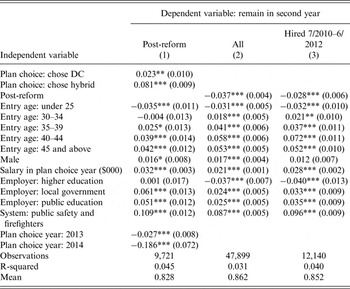
In Table 8, we report estimated coefficients of a model of the factors determining whether an employee remained on the job after 1 year of employment. Three groups are of interest: post-reform hires, the full sample, and individuals hired within 1 year before and after the reform.Footnote 34 Once again, we see that people who defaulted into the hybrid plan behave differently, compared with those making an active choice. Employees who actively elected the hybrid plan were eight percentage points more likely to remain on the job compared with the defaulters, and new hires electing the DC plan were two percentage points more likely to remain on the job versus the defaulters. Moreover, the separation rate post-reform was about four percentage points higher than in pre-reform years. Older employees were less likely to leave public employment, as were men and those with higher annual salaries.
Multivariate estimates of determinants of second-year retention (OLS, robust standard errors in parentheses)

***p < 0.01, **p < 0.05, *p < 0.1. Ordinary Least Squares estimation (OLS).
Constant term also included. Reference categories: plan choice defaulted into hybrid; entry Age 25–29; employer state government; system public employees; plan choice year 2012. The standard errors are not adjusted for multiple comparisons.
While these results are suggestive, it is difficult to determine if the Utah pension reform drove the increase in the 2-year separation from public employment. As noted earlier, the pension reform reduced expected retirement benefits for public employees, which would be consistent with this conclusion. Moreover, if public employment became less desirable, new hires many have been lower-quality workers; in response, job evaluations could have fallen and employer-initiated terminations may have risen. Yet separations could also have risen due to the recovering economy. From January 2009 to July 2011, the unemployment rate in Utah ranged between 6.3% and 8.0%. As the national economy recovered, Utah's unemployment rate dropped rapidly, to 3.7% in 2014, the final year of our sample. A corresponding rise in employment was also observed in the state: comparing the pre-reform with the post-reform period employment rose about 10%.Footnote 35 Accordingly, the state's rapidly-improving economy could have induced more public employees to leave their state and local jobs.
While we cannot precisely estimate the relative importance of these effects, we should conclude that the pension reform was not the only factor in increased public sector employee separation rates. It is clear; however, that separations increased while the retention rate declined around the time of the pension reform.
Conclusion and discussion
State and local governmental pension managers across the USA confront important financial challenges due to low pension funding ratios and rapidly rising contributions required to maintain these plans. In response to this financial challenge, many public sector employers have modified their retirement plans to reduce both their current annual pension costs and future pension liabilities. A few states have implemented more systematic changes, freezing their traditional DB plans and instead offering employees a choice of alternatives that shift investment risk away from employers and onto employees. Utah is a prime example of a state that has fundamentally altered its retirement plan for newly hired workers, by replacing its traditional DB plan with the choice of a hybrid plan or a DC. Our analysis contributes to the relatively limited literature by examining the impact of public retirement plan reform on Utah's public sector workforce.
Similar to other studies, we find that a majority (about 60%) of the URS new hires defaulted into the hybrid plan. Among those who did make an active choice, slightly more than half selected the hybrid plan, and the remainder chose the DC plan. Our analysis goes further in evaluating the impact of public pension reform by examining employee behavior post-reform. Since the new plan options are anticipated to yield less generous benefits than the old DB plan, we evaluate whether new hires saved more, compared with pre-reform employees, and whether the new plan led to higher turnover rates. Our analysis of participation in supplemental saving plans spans the Great Recession, so it is difficult to draw unambiguous conclusions. Nevertheless, we find that, post-reform, fewer new hires enrolled in supplemental retirement plans compared with pre-reform, so they did not respond to lower expected retirement incomes by increasing their retirement saving. Interestingly, however, new hires who did make an active plan choice were also more likely to enroll in the supplemental plan than pre-reform new hires: 33% of individuals making an active choice enrolled in a supplemental plan during the post-reform period, compared with around 25% in the 3 years before the reform was enacted. By contrast, those defaulting into the hybrid plan had lower enrollment rates in supplemental plans. In other words, this analysis suggests that people who are defaulters in one dimension – failing to make a choice of their primary plan – also fail to make an active choice in other areas, like enrolling in a supplemental plan.
We also evaluated whether the less generous retirement system is associated with higher separation rates among new hires, and here we found that four percentage points more new hires left public employment in Utah post-reform, compared with beforehand. We must caveat this conclusion by noting that post-reform turnover could also reflect a recovering labor market compared with the years prior to the plan change. In other words, if job opportunities improved post reform, newly-hired public employees may have had other employment options to consider.
It is also likely that many workers' failure to make active retirement plan choices could spur plan administrators to provide financial education programs and opportunities to learn about the retirement benefits offered. This could enhance their old age provisions, and might also reduce turnover among new hires. As yet we cannot determine precisely how these reforms will influence public employees' retirement patterns, nor do we estimate cost savings to the state or taxpayers associated with the reform in this paper. But we do believe that defaults in pension reforms shape public workers' employment, saving, and turnover behaviors. Consequently, public sector pension managers and policymakers may wish to consider these effects when evaluating future pension reforms.
Supplementary material
To view supplementary material for this article, please visit http://dx.doi.org/10.1017/S1474747215000426