There is now a broad consensus among historians that late medieval England was a highly politicized society. Between the twelfth and the fifteenth centuries, a growing variety of social groups became closely integrated into politics in the narrow sense proposed by Max Weber, namely the struggle for control or influence over a range of mechanisms (administrative, military, fiscal, and judicial) legitimated by the authority of the state.Footnote 1 Building on the already prominent role of the king of England as a legislator and a source of authority, the judicial and fiscal expansion evident between the late twelfth and the mid-fourteenth centuries brought a wider range of publics into direct contact with the royal administration as its objects and consumers, agents, and victims.Footnote 2 Nor was this merely a top-down process. The steady intensification of interactions between local society and royal government was reflected in increased concern on the part of a broad variety of social groups with the activities of the royal government, first becoming visible in the sources in the political crises of the thirteenth century and then moving more clearly into focus in the late fourteenth and fifteenth centuries.Footnote 3 Peasants and townspeople, as well as gentry and nobility, were aware of what the royal government, the king, and the nobility had done in the past; they were informed about what they were doing in the present; and they were increasingly willing to act at moments of political crisis.Footnote 4 Finally, starting in the later fourteenth century but gaining momentum in the crises of the mid-fifteenth century, political actors became aware of the importance of popular opinion and increasingly published manifestos and open letters in the hope of mobilizing it, just as the royal government became increasingly concerned with policing seditious speech.Footnote 5 Late medieval political culture was thus increasingly diverse and changed significantly over time as different groups with different perceptions of what was most important in the nature of government became more or less influential within national politics.
When historians first began to explore late medieval political culture some thirty years ago, what interested them most of all were the beliefs and expectations with regard to government of the nobility and gentry.Footnote 6 The concern of these groups to protect and expand their landed resources and the king's role in policing competition over land lie behind the most forthright theorizations of an English “constitution” that determined the limits of acceptable monarchy.Footnote 7 More recently, the field of inquiry has expanded considerably, with renewed interest in the agenda of rebels, both rural and urban, in the internal political organization of towns and villages and the relationship of these communities with central institutions, and in the broad variety of royal subjects who took recourse to different forms of petitioning.Footnote 8
This explosion of work on different forms of political culture has transformed the field. In the case of the peasantry, although historians still argue for the comparative lack of success of peasant interventions with the royal government, whether through litigation or outright revolt, they underline the extent of the victories on a local level of at least the most powerful part of the peasant population.Footnote 9 It seems clear that the fear of revolt or, perhaps more tellingly, the appeal to the possibility of revolt if good government was not maintained exercised a distinct pressure on politics at the level of the kingdom from the revolt of 1381 until the end of the fifteenth century.Footnote 10 In an urban context, meanwhile, while it has long been clear that mercantile interests exerted a powerful influence on royal politics from an early stage, historians are now moving beyond this insight to argue for the influence, for example, of urban ideas of citizenship, of the correct role of the better sort in defending the common good, and of urban practices of self-government in the formation of national political culture.Footnote 11
Still, until very recently, the varieties of political culture that have emerged most clearly have been those of the dominant portion within each social group. The appeal to the possibility of revolt, for example, a recurrent theme especially after 1381, mostly served to promote those elements of the rebels' demands that they shared with more established political forces, such as noblemen, royal administrators, and the Commons in Parliament: the desire to curtail royal taxation, for example, or to monitor and control royal finance.Footnote 12 In the case of towns, it is the expectations and assumptions of those groups that had the most regular and most direct interaction with royal government––the mercantile elites who provided the senior officers, the mayors, bailiffs and chamberlains, and justices and MPs for these towns––whose conceptions of politics have been most fully explored. Only in the last few years have successful attempts been made, inspired by work on popular mobilization and revolt elsewhere in Europe, to introduce popular movements into the mainstream of research into late medieval political culture.Footnote 13
This article builds on this recent work by considering how the nature of urban society influenced national political culture in a way that went beyond representing the ideas and priorities of local elites. It focuses on a number of aspects of the social and political organization of English provincial towns, in particular a series of phenomena grouped around news, rumor, communal mobilization, and the hue and cry. These phenomena are familiar to urban historians, but their implications for our understanding of English political culture as a whole have yet to be explored.Footnote 14 The focus on provincial towns is a counsel of necessity in an as yet underexplored field. Future research might usefully investigate more fully the political implications of comparable phenomena in rural communities, in which news, rumor, and communal policing were also important, although in different ways, since they lacked the civic governmental institutions, occupational diversity, larger wealth inequalities, and greater density of settlement that characterized even the smallest towns. The objective of the present article is not to provide an exhaustive study of these and comparable phenomena across English society but rather to develop our understanding of the political ideas and the political reflexes of the broader urban population and to consider how such a change of focus affects our view of late-medieval political culture.
In particular, I want to explore the hypothesis that the organization of power was significantly different in late medieval towns from that of noble or even in county-gentry society and that this had consequences, as yet unacknowledged by historians, for late medieval English political culture. Put simply, the merchants and prominent artisan masters who made up the better and middling sorts in towns did not have direct and legitimate access to physical violence in a way that the nobility and much of the gentry did. Certainly, town governments could on occasion collectively raise men and provide ships in reply to formal royal requests for military support, and they could organize self-defense, particularly in border areas.Footnote 15 As we shall see, one major function of the office-holding structures of these towns was internal policing, in a manner which drew in a broader swath of the urban population than the most senior civic offices. Yet in times of unrest, revolt, or civil war, and especially when the rights and wrongs of the case were ambiguous, urban elites could not call directly upon military support in the way that noblemen could.Footnote 16 Power in towns of a few thousand inhabitants was based on different mechanisms than those characteristic of noble and gentry society, which included service in both peace and war and which revolved around the protection and acquisition of the landed resources that were essential for the mobilization of physical force.Footnote 17 Instead, power in provincial towns was an outgrowth of the organization of economic and social life. It passed through habits of obedience and deference, through practices of solidarity and community (religious fraternities, neighborhoods, and guilds), and through structures that first evolved to fulfill social and economic functions (craft organizations, service, the workshop, the household).Footnote 18 These mechanisms left urban leaders more vulnerable to criticism and contestation than members of the nobility or gentry at moments of political and military upheaval, since they were not supposed to be institutions for the mobilization of legitimate violence. In short, they had to negotiate and they had to work harder to convince their fellow townspeople. Often they failed to do so, and often the “commons” reacted in opposition to the course of action chosen by their betters.
By “provincial towns,” I mean specifically to exclude London, whose unique position in England as a major international trading center, its population of perhaps thirty to forty thousand, and its central role in politics of the kingdom set it apart from its nearest domestic rivals.Footnote 19 In such a city, so close to the institutions of royal government at Westminster, the circulation of news and the mobilization of the community could not function in quite the same manner. One might also speculate, for example, that London craft guilds would be able to dispose of resources in terms of manpower that bear comparison with those to be found in European cities of similar size, such as Ghent or Rouen, but that were not at the disposal of the residents of Nottingham or Leicester. This would have changed the nature of mobilization in these towns, even when the issues in question were similar. Yet the balance of different social mechanisms through which conflict was expressed was not the same in each instance. These are differences of degree rather than kind, and we will have cause to consider one town, Norwich, whose presence alongside York and Bristol in the “second division” of English towns with around ten thousand inhabitants qualified it for the European league of grandes villes.Footnote 20 Concentrating on “third division” towns makes it easier to isolate phenomena that cut across craft affiliations or structures such as parish, street, and neighborhood while denying neither their existence nor their importance. Future research could usefully consider how far forms of sociopolitical organization in “second division” towns were similar to or different from those found in smaller ones. Again, the aim is not to provide a total explanation of political culture in English towns but rather to consider how exploring certain social and political institutions in certain towns might improve our understanding of late medieval political culture as a whole.
The circulation of news created a socially diverse, informed public in provincial towns, with knowledge of earlier as well as contemporary political events. This public was not, however, homogenous but was divided by economic interests, by relative standing in formal governmental structures, or simply by the prejudices and differing life histories of individuals. Together with the importance of news and rumor, the continuing strength of mechanisms for communal mobilization such as the hue and cry, which historians have tended to see as declining in the fourteenth century, forms an essential and neglected background for the more thoroughly investigated popular politics of the fifteenth century. This article approaches these issues by focusing on the town of Leicester, with comparative material from Nottingham, Coventry, Colchester, and Norwich.
News, Noise and Political Culture in Fourteenth-Century Leicester
When the rebels entered London on 13 June 1381, one of their first targets was the Savoy palace, the residence of the most powerful man in the kingdom, John of Gaunt, duke of Lancaster.Footnote 21 This event had special importance for Leicester, since the duke was also the lord of the town and since one of his favored residences was Leicester castle. Soon after the sack of the Savoy, a messenger reached the mayor of Leicester, Richard Gamston, telling him that the rebels were approaching Market Harborough, some fifteen miles to the southeast, and that they intended to sack the castle.Footnote 22 It seemed that they would arrive at dawn. According to the chronicler Henry Knighton, a canon of the abbey of St. Mary, Leicester, Gamston hesitated. He was afraid that, if he resisted the rebels, his force would be too weak and he would be defeated but that, if he received them in peace, he could be condemned as a traitor. What should he do? In the event, the mayor called together the ruling elite of the town, “his neighbors, the jurats and other experienced townsmen.”Footnote 23 He then made a proclamation in the king's name that everyone, masters and servants, should assemble the next morning just outside the town at Gartree Hill, the traditional assembly point of Gartree Hundred, ready to defend himself and his neighbors. As dawn broke, says the chronicler, they made a good muster “both of the better sort and others” and awaited events.Footnote 24
Two things are worth pointing out here. The first is that the mayor and senior townsmen of Leicester assembled troops on their own initiative, on receipt of news, without any royal mandate. In a later period, it has been observed that, although towns normally reacted positively, if modestly, to demands for troops issued in the king's name, they might also refuse requests to raise men made by individual noblemen.Footnote 25 In 1381, however, the mayor and senior officers of Leicester took it upon themselves to call the town to arms. The second point is that, even once the townsmen had assembled, it was not clear what they would do. Knighton says that the townsmen sent out scouts, not only to tell them where the rebels might be but also to help them decide “how they should receive them, whether in peace or in war.”Footnote 26 There is no reason to disbelieve the chronicler when he says that they still had not decided whether to resist the rebels or to join them. It appears that the duke of Lancaster's steward was far from convinced of the loyalty of the town, since he loaded carts with his master's goods from the castle and attempted, without success, to have them admitted into the sanctuary of Leicester abbey.Footnote 27 How the population of Leicester would act was unknowable in the abstract. It was a communal decision that had yet to be taken, on the basis not only of recent news but also of their attitude to their lord and their experience of earlier political and military crises.
Leicester's reaction to the events of 1381 took place within a political culture in which news shaped the reaction of the townspeople to external events, both in the short and long terms.Footnote 28 We know from the mayor's accounts that survive in volume from the mid-1330s to the mid-1350s that the citizens of Leicester had long appreciated the value of good information. The need to harvest useful rumores is a constant concern and a recurrent justification for the expenditure of common funds. So, for example, on 11 November 1335, 22½d. was expended to entertain the coroner William Walden and two of his companions, who came from the king's court “narrating rumors (rumores) of the king and of Scotland.”Footnote 29 In the same year, 20d. was expended for wine for the reception by the mayor “and others of the town of Leicester” of two butlers of the king and queen, “coming from Scotland with rumors (cum rumoribus).”Footnote 30 The queen's chamberlain was justly rewarded with 40d. for what seems like an exciting and self-aggrandizing tale of how he had “led the queen to the northern parts on account of a flood of water.”Footnote 31
News of this kind from Scotland or, later, from Gascony was not just valued for entertainment; it also enabled the citizens to anticipate future demands for money and troops.Footnote 32 It was no doubt for eminently practical reasons that the mayor accounted for 2d. expended to reward officials of the Exchequer “coming from the court with rumors (cum rumoribus).”Footnote 33 Those returning from parliament were similarly wined, dined, and pumped for information.Footnote 34
This concern for good information might at first seem to be the affair of the town's merchant elite, not so dissimilar, say, from the concern with up-to-date information found in the letters of fifteenth-century gentry families. Yet this would not be the whole picture. Information was not the monopoly of Leicester's urban elite but spread out through networks that included both ordinary town dwellers and those living in the neighboring countryside. Most simply, all this wining and dining, although it sometimes occurred in the mayor's house, also took place in the tavern, from which information was bound to leak out.Footnote 35 Moreover, Leicester was the county town. This meant that it was an important venue for the publication of royal proclamations, which could vary from recent statutes and mundane administrative decisions to proclamations made at moments of particular political tension.Footnote 36 Finally, Leicester was the market center for its locality, with a Saturday market occupying a large space in the southeast of the town. Here, men and women came to buy and sell corn and beans, sheep and cattle, to visit the shops of artisans and, of course, to talk.Footnote 37
A generation before the Peasants' Revolt, the merchant elite of Leicester were also aware of the potentially seditious effect of public speech, especially when it came to taxation. Samuel Cohn and Douglas Aiton have recently demonstrated through a study of chronicles and the patent rolls that English towns in the early and mid-fourteenth centuries were frequently shaken by revolt and contestation, with a notable phenomenon of attacks on ships loaded with grain for the royal armies in 1347.Footnote 38 In Leicester in the early stages of the Hundred Years' War, although a full scale revolt did not break out, individuals were brought back into line when their words and actions threatened to start a wider movement, resisting the town officials' authority. In 1336, for example, one John de Turneye was condemned by the mayor and community for having called John Hodings, junior, Richard Cook, and others, collectors of the king's tenth, “false taxers” (falsos taxatores) and for saying that they taxed falsely (false taxauerunt) to the damage of them and the mayor and the brothers of the merchant gild.Footnote 39 Such complaints did not go unheeded, and in 1338–39, a “constitution” was passed “by the community,” in the presence not only of the mayor, jurats, and twenty-six named townsmen but also of “many others of the said community then present in full morewenspeche [the assembly of the merchant gild],” which sought to regulate the activities of tax collectors.Footnote 40 Nonetheless, again in 1354, tax collectors were attacked by Thomas del Abbeye and twelve others “with contumacious words … abusing them and charging them falsely that they came in order to rob him.”Footnote 41 The insistence on “falseness” not only suggests the idea that what was said was not “true” in the sense of being correct but also demonstrates a dispute over who was “true” in the sense of being faithful and honorable.Footnote 42 The town authorities hoped to assert that the officers were the “true” men and that those who contested them were “false”; their opponents argued the opposite.
The mayor and senior officers of Leicester had recurrent problems asserting their authority in the mid-fourteenth century. Individuals, even senior members of the town community, took it upon themselves to contest the actions of officials in public, and the officers employed various means to counter this. One of these was to interpret resistance as an unjust raising of the hue and cry. Thus, in 1355, when Mayor John de Petlyng went in person to the tavern of John Cook to accuse him of selling wine contrary to the proclamation and ordinance of the mayor and jurats, Cook said that he would not be judged by Petlyng “but raised the hue (leuauit hutesium) many times on the mayor himself unjustly in the hearing of all those who came with him.”Footnote 43 Another method was to make use of the machinery of policing, as in the town “Portmanmoot.” In Leicester, as in other towns such as Colchester, the Portmanmoot combined two forms of procedure that in other towns, such as Nottingham or Norwich, operated separately.Footnote 44 On the one hand the Portmanmoot received trespass pleas from individuals who alleged either that they had been assaulted, insulted, threatened, or otherwise trespassed against (including but not exclusively by unlawful entry onto their property) or that they were owed money or suffered from illegitimate retention of goods.Footnote 45 If contested, such trespass pleas could lead ultimately to juries being empaneled to determine whether the defendants were guilty and, if appropriate, to award damages, although in practice such cases were often settled out of court. On the other hand, in Leicester, the same court that received trespass pleas also received presentments that in other towns were assigned to a separate “leet,” or frankpledge, court.Footnote 46 This type of presentment built on the ancient institution of the frankpledge, by which males from adolescence onward were to be sworn into groups of about a dozen who mutually guaranteed each other's good behavior.Footnote 47 The Portmanmoot thus received regular presentments from the chief pledges of each of these groups, who were bound to report instances of assault, blood-letting, hamsoken (unauthorized entry), and raising of the hue.Footnote 48 I return to this type of procedure below, especially the obligation to report assault and hue raising. For the time being, however, it is useful to note that the records of this court provide evidence both of the concern of the merchant and prominent artisan masters who ran the town with countering contestation and asserting their authority and of the limited and negotiated nature of that authority.
Only one full roll of the Portmanmoot, covering the year from 29 September 1378, survives for Leicester in contrast with far fuller records for Colchester and Norwich, for example.Footnote 49 Most sessions of this court, thirty-four of which took place over that year, also took advantage of the presence of the town worthies and of sworn jurors to deal with pressing matters that came under the remit of neither leet nor trespass jurisdiction. In 1378–79, the bailiff of this court was Richard Gamston, who would later be mayor during the Peasants' Revolt. Twice, Gamston appears to have made use of the court to counter threats to his authority and personal honor that involved public speech. In the first, it was reported by jurors on oath that, on 23 March 1379, after one William Draycote had drawn his knife and assaulted Roger Veizy (an offense for which he was fined 6d.), he turned to Thomas, a servant of Gamston, who was standing nearby in his master's door, and said, “Careawey, what did you say to that Thomas?”Footnote 50 His exact meaning is not easy to grasp, but Thomas clearly took this as a threat, an insult, or a call to violence, for he replied, “Now is a better time than any.”Footnote 51 This indeed was how the court interpreted it, or rather as a threat specifically against Thomas's master, for it reacted by securing guarantors that Draycote would keep the peace toward Gamston and his servants and tenants rather than toward Thomas specifically. It was Gamston, too, who had to secure pledges to keep the peace toward Draycote. The second case occurred some months later, toward the end of August.Footnote 52 This time it was alleged that John de Langham and Robert Porter spoke “with litigious words and threatening words” to Gamston on the market day.Footnote 53 On this occasion, however, Gamston and his associates seem to have been more magnanimous for the offence was pardoned without further comment.
Leicester, then, was a town in which the authority of officials could not be taken for granted but rested instead on constant negotiation in which their actions could easily be contested by words, by making a scene, or even by small acts of violence. The people of Leicester had the confidence to question the position of their officials and to decide on such critical matters as how to react to the approach of a rebel army in part because they possessed the information to decide on issues of local and national importance and in part because the town government did not have access to any significant stock of independent physical force. Their knowledge of the affairs of the town and of the kingdom was not only determined by short-term rumores but also followed on from years of residence at the hub of a regional news network, as in many English provincial towns. Their opinion was all the more important because little could be achieved without their active cooperation. This applied as much to the king's or their lord's demands for troops or taxes as to a national revolt.
Rumor, Clamor, and Popular Mobilization in Late Medieval Provincial Towns
Leicester's reaction to the events of 1381 was typical of the way that many provincial towns dealt with news of political upheaval in the fourteenth and fifteenth centuries: not just by reacting to isolated events but also by discussion and negotiation, finally taking or not taking action on the basis of the balance of public opinion, itself based on past experience. Yet this was not how late medieval commentators preferred to think of the relationship among news, popular opinion, and collective action, especially revolt. Instead, contemporary writers viewed collective action in towns as a mixture of news and noise swelling into the clamor of the crowd and finally into violence.Footnote 54 This model was encoded in a number of terms in late medieval Middle English and also in medieval Latin and Anglo-Norman, drawing on the inheritance of Latin language and culture. In this semantic structure, popular discontent was imagined as beginning with a disgruntled “murmur,”Footnote 55 which if not disciplined or answered would swell into an audible “clamor,”Footnote 56 “cry,”Footnote 57 or “noise.”Footnote 58 Like most of these terms, the term “rumor” could refer to the noise and tumult of a crowd,Footnote 59 to a riot or rebellion,Footnote 60 or to more or less reliable news, as it did in the Leicester mayor's accounts.Footnote 61 If kept within reasonable limits, “clamor” and “noise” could give rise to a legitimate process of petitioning or “appeal” (literally, calling out), but it could also spill over into unacceptable contestation of legitimate authority.Footnote 62 The “great rumor” of 1377 discussed long ago by Rosamond Faith is but one relatively late example of the perception of a relationship between popular talk and sedition.Footnote 63 In this context, the portrayal of the Great Revolt, or “rumor,” of 1381 by contemporary literary writers and chroniclers as a kind of animalistic brouhaha would have seemed more plausible at the time than it does now to historians, since commonplace ideas preserved in the language of murmur, clamor, cry, noise, and rumor suggested a progression from dissatisfied murmuring, to tumultuous crowd noise, to the final almost organic expression of revolt.Footnote 64
This conception of rumor and revolt was certainly simplistic, as the considerable work of historians on the aims and organization of rural and urban revolts has amply demonstrated.Footnote 65 But it was not simply patronizing fantasy. On the contrary, in certain instances, this conceptual structure can provide a useful model of the nature of popular mobilization in late medieval towns. To explore this further, I focus on two examples that suggest how this model of “rumor” was not so inaccurate in describing the development of certain forms of popular mobilization: one from Coventry in 1424 and another from Nottingham in 1471. These examples are relatively late in our period, but they were probably not so dissimilar from many earlier happenings for which we have less complete information. In a final section, we will consider their background in forms of noise making and popular action usually dealt with under the heading of the “hue and cry.”
The local disturbance in Coventry in 1424 is portrayed in the mayor's register or “Leet Book” as being the result of the disturbing accrual of successive waves of information, each of which has an effect on what is commonly “said” and on the growing restlessness of the townsfolk.Footnote 66 It begins with the arrival of the hermit John Grace, who said that he was licensed to preach. In its account of these events, the Leet Book attempts to establish the good faith of the people of Coventry. It insists that the townsfolk had no reason to doubt John Grace's credentials, since he had preached elsewhere in the region, and that he was “at that tyme a famous man,” that is, a man of good reputation, “among the peopull ther.” Grace preached for five days to crowds in Little Park. Yet, as slowly emerged, the confidence of the townspeople was misplaced, and the ham-fisted interventions of the local clergy made matters worse. On St Andrew's day, “hit was said,” apparently for the first time, that Grace was not in fact licensed to preach. On the same day, “as comen voise was then,” Richard Croseby, the prior of St Mary's, Coventry, intended “to haue denouncyd acursyd all thos that herd the sermon of the said John Grace.” As a result, by Croseby's “gouernance” and the actions of Master John Bredon, friar of Grey Friars, Coventry, who cast “ouerthwart wordes amonges the people,” there was “grett seyng among the people that the priour and frer Bredon wold haue cursid all tho that herdon the said John Grace preche.” The result was a riot. With the angry crowd at the door, Croseby and Bredon refused to leave St Mary's church until the mayor came to them, and a “grett noise rose in the Contre that the comens of Couentre were rysen.”Footnote 67
In some ways these events seem distant from the petty disruptions of fourteenth-century Leicester. Certainly there are differences; for example, in Leicester contestation died down, was headed off, or never fully took form in 1381, as at other times. But there are also common elements that bring together these different forms of popular mobilization. In both of these examples, information and talk led to forms of mobilization that, from the outside, from the perspective of chroniclers, royal justices, or poets, might look like spontaneity but that were in reality grounded in the long-established reflexes of more settled times. What we see is a phenomenon by which oral transmission of information led the population to come together (noisily, we might imagine) in public places, to form a crowd that served to protect the community against an emerging threat: in other words, a phenomenon not so very different from murmur, noise, and clamor as they were implicitly modeled in the late medieval language of rumor. In this case, also, the communal mobilization seems to be effective in mobilizing a substantial proportion of the town population. This was seen from outside as the “comens” of Coventry rising, but their actions were justified by the town's ruling elite in their description of events in the mayor's register.
The second example comes from the town of Nottingham during a more overtly political context, namely the fast-changing political events of the Readeption Crisis of 1469 to 1471.Footnote 68 The town of Nottingham was uncomfortably close to the events of this central crisis of Edward IV's reign. A modestly sized town with perhaps two thousand inhabitants, Nottingham was also a county town with a royal castle.Footnote 69 Edward IV was staying there when his allies were defeated at the battle of Edgecote in July 1469, and it was there, too, that he made the decision to flee the country in mid-September 1470.Footnote 70 Nottingham provided a natural stopping place close to both Yorkshire and Lincolnshire, where revolts broke out in 1469 and 1470 respectively. One consequence of this proximity to events seems to have been a particular attachment of Nottingham's rulers to the Yorkist king. Although they kept their heads down during the brief restoration of the Lancastrian monarch Henry VI, it took only two weeks after Edward's landing at Ravenspur on 14 March 1471 for Nottingham to muster troops and to raise in a single day £26 to support him.Footnote 71 Yet this enthusiasm for the Yorkist cause on the part of Mayor Robert English and the senior officers of the town does not seem to have been universally shared.Footnote 72 Indeed, two months after the earl of Warwick had died at the battle of Barnet, and a month after the Lancastrian Prince Edward had met his end at Tewkesbury, an anti-Yorkist revolt broke out, led by Thomas White, a Nottingham butcher.
Thomas White's activities began on Saturday 15 June, the feast of Corpus Christi, when he assaulted Robert Osteler, a servant of William Conington, a fishmonger.Footnote 73 Early the next day, he and “many other evil-doers” attacked John, servant of William Broksop. They then went through the streets of the town until they reached the mayor's front door, crying out and shouting “Where are the traitors that will resist us? Let them come now, and we will kill them!”Footnote 74 It was at this point that one Thomas Shoemaker, a servant of Thomas Staunton, was killed, although not by White. The assembled mob not only protected the killers but also shot arrows at “the mayor, sheriffs and also at divers other persons, keepers of the king's peace.”Footnote 75 Once the riot had died down, Thomas White went to ground. Summoned twice to appear in the borough court, he did not appear. When he finally did present himself in April 1472, he came armed with a royal pardon. Indeed, the king and his council were not very supportive of the Nottingham civic authorities, despite expensive efforts to curry favor at court over the summer of 1471.Footnote 76 On 13 November 1471, the king's council dismissed the demands of the town authorities to allow them to imprison a number of men, including one of the killers of Thomas Shoemaker.Footnote 77 The council instead instructed the mayor and his fellow justices simply to ensure that the accused found surety for their “good bering” toward the mayor, aldermen, and commonalty.Footnote 78
At first, these events seem more closely linked to national events and the passions that they aroused than those at Coventry or at Leicester. That an apparently anti-Yorkist disturbance broke out so long after the deaths of the earl of Warwick and Prince Edward might suggest either die-hard Lancastrianism or enduring pro-Warwick sentiment among one part of the population. Yet this is perhaps not the whole story. White's activities began the day before with an attack on a single individual, the servant of a fishmonger. Whereas it is possible that this was the result of a political argument, it seems equally likely that what began as a personal or trade dispute only later acquired anti-Yorkist credentials as the disturbance gathered momentum. Intimate knowledge of recent “high political” events provided a legitimating framework for opposition with different origins. The commitment of Nottingham's most prominent office holders to the Yorkist cause paradoxically opened up belated Lancastrian or Neville allegiance as a legitimate cover for violent action with different motivations, in the hopeful expectation of the clemency which Edward IV had offered to his opponents in earlier crises.Footnote 79 In the event, the Yorkist king was indeed happy to protect and pardon the rioters, despite the town government's complaints. English provincial towns were divided by wealth inequalities and differences of economic interest that high political events could thicken and accentuate. The relatively narrow elite that dominated the most senior offices could never be sure that the political consensus of the urban population would follow the line that they dictated. On the contrary, the fact of choosing a camp exposed them to opposition which was not purely political in the sense of pertaining to the state. Even when they supported a now victorious Yorkist king, the power of urban elites was constantly subject to negotiation with the multivocal and contradictory public opinion that characterized urban society.
Noise, Policing, Popular Mobilization, and the Hue and Cry
Moments when public talk and noise making led to communal mobilization and potentially violence would have been familiar to the people of English provincial towns from even more commonplace features of everyday social life. Modern historians have followed Geoffrey Chaucer's lead in drawing attention to the link between late medieval popular politics and such time-honored communal institutions as the raising of the hue and cry, although so far only in rural context.Footnote 80 It is easy to see why: all of our examples above have elements of it. In Nottingham, Thomas White and his fellows went shouting through the streets, gathering support as they did so. In Coventry, waves of news and rumor led to the assembly of an angry crowd, ready to defend the community against the “ouerthwart words” of its resident clergy. In Leicester, the movement in 1381 was more controlled, working through the town officers and public declaration rather than by word of mouth alone, yet how the crowd acted once assembled was determined by an inheritance of small-scale communal action and public knowledge that could contest authority as easily as support it. In each of these cases, news, rumor, and public talk led to communal mobilization that could follow the lead of the town's office-holding elite, resist it, or persuade office holders of the best action to pursue.
Before we draw the link between the hue and cry and the political culture of English towns, however, we first need to look more closely at what exactly it was and how it evolved over time. Indeed, research on the hue and cry to date would seem to suggest that this form of communal mobilization was dying out just at the moment that historians of English political culture have argued for the growth of forms of popular political action that resemble it. Long seen as a customary mechanism of self-policing that was gradually replaced in the later middle ages by the expansion of royal justice and by private forms of prosecution, the study of the hue and cry has recently enjoyed something of a renaissance thanks to the work of Miriam Müller, Sandy Bardsley, Sherri Olson and, in an urban context, A. R. and E. B. DeWindt, Samantha Sagui, and Janka Rodziewicz.Footnote 81 These writers have taken a positive view of the hue and cry as a traditional institution that was more readily available to the poor and, in particular, to women, arguing that its apparent decline was the sign of a weakening in ties of community evident after the Black Death. Following Pollock and Maitland, who even suggested an established form of words for raising the hue (“Out! Out!”), these writers see the hue as a well-defined ritual process.Footnote 82 The hue could be raised, for instance, when an individual felt threatened by another party, for example in fear of assault or rape, or when a person illegitimately entered the home of another, a trespass that is referenced in several jurisdictions as “hamsoken.” The purpose of this cry was to bring the surrounding community to aid. In the king's legislation, this community solidarity was supposed to be compulsory. Royal declarations from the time of Cnut to the statute of Winchester (1285) stressed the obligation to raise the hue and cry on the discovery of a felony and to respond once it was raised.Footnote 83 Nonetheless, it is clear that urban authorities in the late thirteenth and fourteenth centuries had a very different attitude to that of kingly legislators. Indeed, town officials seem to have been far more concerned with policing occasions when somebody “leuauit hutesium” than they were with ensuring that the community properly reacted to the raising of alarm.
Without denying that the raising of the hue and cry was an important social institution in late-medieval towns and villages, it is useful to shift the perspective from the raising of the hue to the policing of it. Some conclusions can be reached already thanks to the thorough study of the Norwich leet courts undertaken by Samantha Sagui. In the six earliest court rolls that survive between 1288 and 1300, it is immediately striking that only unjust raising of the hue is recorded. This makes sense in terms of the operation of the leet court, which involved senior men in each neighborhood reporting obligatorily on a fixed range of offences that had been committed since the last court and fining those responsible.Footnote 84 For these early Norwich rolls, a total of 127 cases of hue raising are reported, all of them “injuste.”Footnote 85 In the same period, some 524 “criminal” cases are reported—assault, bloodshed, and hamsoken, for example—for the vast majority of which no hue was recorded.Footnote 86 Still, given that no instances of just hue raising are reported in these documents, we must suspect that in a substantial proportion of these cases the hue was raised but that this was simply not recorded. There was no need, since it did not result in a fine for the hue raiser. In fact, only the three latest rolls from Norwich, those for 1313, 1375, and 1391, record both just and unjust hue. In these rolls, 70 out of 111 cases (63 percent) in which the hue was raised were recorded as unjustified, but the proportion declines markedly across the three rolls: 72 percent in 1313 but 37 percent in 1375 and 27 percent in 1391. We might conclude that hue was now being more fully investigated and more punctiliously recorded, hence its presence in the record even when justified, were it not for the fact that in these rolls hues represent an even smaller percentage of total criminal cases than between 1288 and 1300, reaching 21 percent (58 out of 272) in 1313, 28 percent (38 out of 136) in 1375, before declining to 13 percent (15 out of 112) in 1391.Footnote 87 Hues were now specifically cited even when they were subsequently found, on inquiry, to be justified, and yet still there are a large number of cases in which some kind of communal alarm was no doubt raised but that did not lead to a record of hue raising, either just or unjust, in the court roll.
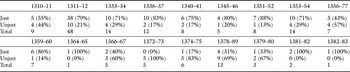
The calendared Colchester records permit a fuller analysis of the development of hue raising and the balance between just and unjust hues between 1310 and 1383 (table 1). These suggest an uneven but nonetheless identifiable decline in the number of hues recorded per year. As the number of hues declines, the proportion of them found to be just remained high, generally hovering around 70 percent or 80 percent. Although the proportion of hues found to be just declines markedly in the 1370s, it recovers again in the rolls for 1379–80, which record far fewer hues per year, although out of a total of six hues, four (67 percent) were found to be just and two (33 percent) unjust. This suggests that, in Colchester, the decline in reporting of hues does not in fact correlate with a decline in the legitimacy of hue raising itself. This corresponds both with the evidence of the later Norwich rolls and of the Leicester Portmanmoot roll of 1378–79, which reports twenty-one hues, all but three of which are found to be just.Footnote 88 That said, the evidence does not point straightforwardly in one direction. In Great Yarmouth evidence for 1366–1381, for example, out of thirty-three cases considered by Janka Rodziewicz, only nine were ruled just (27 percent) and twenty-four unjust (73 percent), which suggests a similarly hawkish attitude toward hue raising to that shown in late thirteenth-century Norwich.Footnote 89
Just and Unjust Hues in Colchester Borough Court Rolls (1310–83)*

* The following analysis is based on the published calendars of the Colchester borough court rolls. Isaac Herbert Jeayes with William Gurney Benham, ed. and trans., Court Rolls of the Borough of Colchester (Colchester, 1921–41), vol. 1, 1310–1352, vol. 2, 1353–1367, vol. 3, 1372–1379. Uncorrected proofs of a fourth volume covering 1379–83, now in Cheltenham, Essex Record Office, have also been used. Incomplete years are excluded (1329–30, 1360–61, 1376–77), since they each lack at least one of the three annual “lawhundred” sessions of the court around Michaelmas, St. Hilary, and Hockday in which hue cases were concentrated.
Too many overlapping phenomena are at work for a purely statistical analysis to offer straightforward answers. Close reading of individual cases, however, offers clues as to the nature of the changing interaction between social practices and the documentary record. In the early Norwich records, there is a strong feeling that the jurors and the court are using the hue to discipline individuals who cause noise and disturbance. For example, in the 1287–88 roll, the jury reported that the smith, Roger de Nedham, “is wont to raise the hue on his servants night and day,” and that he had indeed perpetually done so since the last leet.Footnote 90 Elsewhere, we are told that, at the house of Robert de Rackeheath, “the hue and cry is raised every night.”Footnote 91 We might suspect that this was not the formal bringing out of a crime implied by royal legislation, just a lot of noise and shouting. Similar cases can be found in the records of other towns, which suggest that the hue and cry covered a broad spectrum from communal police action to disorderly behavior, along a spectrum of legitimate or illegitimate public fuss that local courts and jurors sought to police. For example, in Colchester on 1 February 1311, Richard le Cartere was cited “per falsum clamorem” made against William, son of Richard Musse, for damaging a pig.Footnote 92 We might doubt that he had the town bells sounded; he probably just complained loudly and publicly.Footnote 93 Public disputes that led to violence could be interpreted as hue raising, as when the jury found that Clarice la Breweres had “raised the hue without cause (leuauit iniuste vterhesium) on John Whytyng, as he did no hurt to her.”Footnote 94 In fact, it was she who had provoked the incident by hitting him three times with a hen.Footnote 95 It seems unlikely that either party engaged in a formal, ritualized calling out of the community, but it was legally plausible to interpret their actions as raisings of the hue.
As we have seen in Leicester, resistance to officials, notably tax collectors, could also be interpreted as unjust hue raising, although it seems likely that this was not how the alleged hue raisers interpreted their own actions. This practice is in continuity with the use of hue in rural contexts, in which unjust hue-raising citations occur in the context of those who illegitimately resist attempts to distrain them on the part of officers and others.Footnote 96 The Colchester records provide further instances, for example in July 1341, when Philip Rokele and Henry Marchaunt, both established men of the town, were separately presented for having raised the hue on tax collectors attempting to seize their property in lieu of the controversial royal taxes of that year.Footnote 97 What constituted a just or an unjust hue was a matter for negotiation covering a broad range of noise-making and alarm-raising practices.
The presence of the hue, whether just or unjust, in the borough court rolls of a given town, is not evidence of straightforward approval for it but on the contrary demonstrates a desire to police noisy disturbances and communal alarm raising. Consequently, decline in reporting need not signal the decline of the practice of hue raising, but simply that hues were going unreported as part of legitimate or at least tolerated forms of collective policing. Certainly, it would be mistaken to deduce from the changing nature of the documentary evidence around urban clamor and hue that the importance of these forms of collective mobilization was declining.Footnote 98 After all, the private prosecutions for assault, blood-shedding, and trespass that are to be found in the records of Colchester, Leicester, and Nottingham, but that were dealt with by the bailiff's court in Norwich for which only fragmentary records survive, also necessarily drew on the testimony of local jurors to determine who was right and who was wrong, and these local jurors only knew as much as had come to the attention of the neighborhood at the time of an incident.Footnote 99 Common talk and alarm raising at the moment of an affray remained central to these “private” forms of prosecution.
If we take a broader view of what the hue and cry was, regarding it more as a loose but important set of social practices than as a rigidly defined, semilegal, ritual process, then it becomes possible to reintegrate these practices into a broader account of the nature of popular politics in English provincial towns. An established set of social practices specified that, when individuals felt threatened or wronged, they made enough noise to bring out their neighbors both to assist them if necessary and also to bear witness to what was happening. This also meant that, when an individual did make noise, whether consciously wishing to summon his or her neighbors or not, the neighbors did react to this, and that this could later be interpreted (or not) by civic officers or neighbors acting as jurors as a just or unjust raising of the hue. As we have seen, historians have tended to interpret the reduction of reporting of the hue in local court records in the course of the fourteenth century as a decline in the practices that they regulated. Yet the varying levels of concern with deliberate raising of the hue alongside other forms of excessive or disruptive noise making do not suggest a clear decline of these phenomena but rather a varying awareness among particular urban elites at particular times of both the usefulness and disruptiveness of forms of collective mobilization based around rumor, clamor, and the hue and cry. I would suggest that these mechanisms did not die out simply because they ceased to be actively inquired into by the borough court but instead that they continue to emerge in the sources in the context of the late fourteenth- and fifteenth-century popular movements that have recently attracted the attention of historians. From this point of view, the hue takes its place among mechanisms of collective reaction to news and rumor, of common talk and communal mobilization, whose uniting characteristic was their negotiated, multiform, and unbiddable nature.
Conclusion
In recent years, historians have repeatedly stressed the importance of popular opinion in late medieval political culture. They have argued that, after the Peasants' Revolt of 1381, the deposition of Richard II in 1399, and the collapse of Lancastrian kingship in the 1440s and 1450s, political actors at the center came to ascribe new importance to public opinion, both as a threat and as a resource. On the one hand, new attention has been paid to the efforts of the royal government to police seditious words during moments of political instability. On the other, historians have noted an apparently new tendency on the part of would-be rebels to canvas public opinion by circulating written manifestos and bills justifying their actions. Historians have thus described a political culture in which news and information, and the reaction to them on the part of a broad public, took on a new political importance.Footnote 100
In this article I have attempted to develop the implications of the public nature of late medieval politics through an exploration of the social grounding of news, noise, and communal mobilization in the social and political composition of English provincial towns. Understanding the early importance of news and the continuing significance of institutions for communal alarm raising helps to put into perspective the responsiveness (or unresponsiveness) of provincial urban contexts to the kind of political techniques that historians have seen as so important in the politics of the kingdom from the late fourteenth century onwards. Appealing to the public was a risky and unpredictable business that had long been perceived as such by the governing elites of English provincial towns, who spent as much energy policing clamor as they did responding to it. It is useful to reflect that rebels who did make use of these techniques, from Archbishop Scrope to Richard, duke of York, or the earl of Warwick, ultimately failed in their endeavors. News and noise had long been integral to the nature of politics in English towns. The increasingly public politics of the fourteenth- and fifteenth-century English kingdom provided a new context in which long-established practices of news circulation and communal mobilization were expressed, lending their own note to the complex brew of late medieval political culture.