






No CrossRef data available.
Article contents
Interacting with others while reacting to the environment
Published online by Cambridge University Press: 07 July 2022
Abstract
Here, we revise Pietraszewski's model of groups by assigning participant pairs with two triplets, denoting: (1) the type of game that models the interaction, (2) its critical switching point between alternatives (i.e., the game's similarity threshold), and (3) the perception of strategic similarity with the opponent. These triplets provide a set of primitives that accounts for individuals' strategic motivations and observed behaviors.
Information
- Type
- Open Peer Commentary
- Information
- Copyright
- Copyright © The Author(s), 2022. Published by Cambridge University Press
References
Fischer, I. (2009). Friend or foe: Subjective expected relative similarity as a determinant of cooperation. Journal of Experimental Psychology: General, 138(3), 341–350. https://doi.org/10.1037/a0016073.CrossRefGoogle ScholarPubMed
Fischer, I. (2012). Similarity or reciprocity? On the determinants of cooperation in similarity-sensitive games. Psychological Inquiry, 23(1), 48–54. https://doi.org/10.1080/1047840X.2012.658004.CrossRefGoogle Scholar
Fischer, I., Frid, A., Goerg, S. J., Levin, S. A., Rubenstein, D. I., & Selten, R. (2013). Fusing enacted and expected mimicry generates a winning strategy that promotes the evolution of cooperation. Proceedings of the National Academy of Sciences of the USA, 110, 10229–10233. https://doi.org/10.1073/pnas.1308221110.CrossRefGoogle ScholarPubMed
Flood, M., & Dresher, M. (1952). Some experimental games. Research memorandum RM-789. Rand.Google Scholar
McIntosh, H. V. (2010). Conway's Life. In Adamatzky, A. (Ed.), Game of life cellular automata (pp. 17–33). Springer. https://doi.org/10.1007/978-1-84996-217-9.CrossRefGoogle Scholar
Rapoport, A. (1960). Fights, games, and debates. In Fights, games, and debates. University of Michigan Press. https://doi.org/10.3998/mpub.9022.Google Scholar
Rapoport, A., & Chammah, A. M. (1965). Prisoner's dilemma: A study in conflict and cooperation. University of Michigan Press.CrossRefGoogle Scholar
Rapoport, A., & Chammah, A. M. (1966). The game of chicken. American Behavioral Scientist, 10(3), 10–28. https://doi.org/10.1177/000276426601000303.CrossRefGoogle Scholar
Rapoport, A., & Guyer, M. (1966). A taxonomy of 2 × 2 games. General Systems, 11, 203–214.Google Scholar
von Neumann, J., & Morgenstern, O. (2007). Theory of games and economic behavior (60th Anniversary Commemorative Edition, Vol. 9781400829). Princeton University Press. https://doi.org/10.1515/9781400829460.Google Scholar
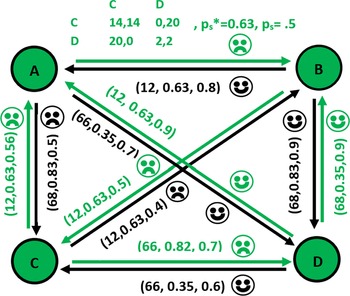
Figure 1. Fundamental bidirectional group interaction types, reflecting the motivations and perceptions within pairs of interacting individuals (A, B, C, and D), each denoted by a unique triplet of elements that comprise: The number of the game the individual assumes he/she is playing in accord to Rapoport and Guyer (1966) taxonomy of two-by-two games (except for the upper pair which shows the entire PD game structure), the similarity threshold of the game (ps*), and the perceived strategic similarity with the opponent (ps). In addition, smiley (whenever ps > ps*) and frowny (whenever ps < ps*) faces denote observed or expected actions derived from the underlying motivations and perceptions. For games 12 (PD) and 66 (chicken) a smiley and a frowny face denote cooperation and defection, for game 68, which is a coordination game, a smiley and a frowny face denote the strategy that maximizes expected payoffs under sufficiently high similarity with the opponent and the strategy that maximize expected payoffs under non-sufficiently high similarity with the opponent.
Target article
Related commentaries (29)
Advantages and limitations of representing groups in terms of recursive utilities
Group? What group? A computational model of the group needs a psychology of “us” (not “them”)
Learning agents that acquire representations of social groups
The labelled container: Conceptual development of social group representations
Aiming to define the primitives that comprise the notion of a group-in-conflict, Pietraszewski proposes to assign agents to one of four triadic interaction types (Generalization, Alliance, Displacement, and Defense), each involving three agents, two of them attacking another agent.
But, although an attack is sometimes an inevitable consequence of a conflict, cooperation is not less critical. Cooperation enables to allocate resources, pool skills and forces, and build coalitions. Moreover, although attacking and cooperating are apparent behaviors, or consequences, they result from different motivations and perceptions, which may exist long before they develop into observable actions. Specifically, groups are comprised of individuals that are simultaneously: (1) motivated by the aspiration to maximize subjectively perceived outcomes, (2) take into account the motivations and expected actions of in- and outgroup members, and (3) apply cognitive skills, such as comparing, interpreting, and planning. Hence, to define the primitives of group behavior, agents should not only be represented by apparent states, but also by their underlying motivations and perceptions.
It is important to note that group boundaries may mean different things. When studying existing groups, defined by social, geographic, or ethnic characteristics, these predefined features also define the groups' boundaries. But, when studying group dynamics and evolution, group boundaries develop as emergent patterns (Fischer et al., Reference Fischer, Frid, Goerg, Levin, Rubenstein and Selten2013; McIntosh, Reference McIntosh and Adamatzky2010).
Regardless of whether group structures are studied as a cause or as an effect, they involve at least two fundamental aspects: (1) the motivations induced by the expectations for material and social outcomes, and (2) the expectations for strategic conduct of friends and foes. As noted by Pietraszewski, a fixed set of payoffs, such as those comprising the prisoner's dilemma (PD) (Axelrod, Reference Axelrod1984; Flood & Dresher, Reference Flood and Dresher1952; Rapoport & Chammah, Reference Rapoport and Chammah1965) or the chicken game (Rapoport & Chammah, Reference Rapoport and Chammah1966) may not always be suitable for the study of specific groups. But this does not imply that a comprehensive set of games is not a proper tool for the study of groups and their actions. On the contrary, over seven decades of theoretical and behavioral game theory research have provided studies of strategic insights and taxonomies of various interaction types (e.g., Rapoport, Reference Rapoport1960; Rapoport & Guyer, Reference Rapoport and Guyer1966; von Neumann & Morgenstern, Reference von Neumann and Morgenstern2007).
To follow on Pietraszewski's notion and identify fundamental group interaction types, we propose to characterize each interaction by two triplets, each associated with the perceptions of one party. Each triplet comprises: the type of game, its defining characteristics, and the strategic perception of the opponent. To provide concise yet strategically detailed game descriptions, we apply Rapoport & Guyer's (Reference Rapoport and Guyer1966) taxonomy of games that reduces social interactions into a set of 78 two-by-two rank-ordered payoff matrices, each exhibiting a set of strategic properties. For the purpose of associating game structures with both interpersonal and intergroup perceptions of the interacting partner (either a friend or a foe), we apply the theory of subjective expected relative similarity (SERS, Fischer, Reference Fischer2009, Reference Fischer2012) that provides both a normative solution and a descriptive, empirically validated, model. Unlike Pietraszewski, we do not assume that the applied model embodies a representation of the mind, but expect it to provide testable and valid hypotheses.
For example, consider two players interacting in a PD game defined by four payoffs: T, R, P, and S (Fig. 1). Each player, consciously or unconsciously, assigns the probability p s to the prospects of the opponent choosing a similar alternative (and the complementary probability 1 − p s to the prospects of the opponent choosing a dissimilar alternative). Comparing the expected values (EV) for the choices of cooperation (Rp s + S(1 − p s)) and defection (Pp s + T(1 − p s)) allows choosing the strategy that provides the higher EV. SERS allows computing a switching point between which of the two alternative strategies of the game should be favored (if such a point exists in the game), namely the similarity threshold of the game, denoted by p s*. For example, considering the PD game and assuming EV(cooperation) = EV(defection), we obtain p s* = (T − S)/(T − S + R − P). By presenting and comparing p s* with p s, as perceived by each individual, we define all fundamental interaction types, comprising also the four types proposed by Pietraszewski. Importantly, the perception of strategic similarity with the opponent may relate to a specific individual or to a specific group, depending on what is modeled or empirically estimated.
Fundamental bidirectional group interaction types, reflecting the motivations and perceptions within pairs of interacting individuals (A, B, C, and D), each denoted by a unique triplet of elements that comprise: The number of the game the individual assumes he/she is playing in accord to Rapoport and Guyer (Reference Rapoport and Guyer1966) taxonomy of two-by-two games (except for the upper pair which shows the entire PD game structure), the similarity threshold of the game (p s*), and the perceived strategic similarity with the opponent (p s). In addition, smiley (whenever p s > p s*) and frowny (whenever p s < p s*) faces denote observed or expected actions derived from the underlying motivations and perceptions. For games 12 (PD) and 66 (chicken) a smiley and a frowny face denote cooperation and defection, for game 68, which is a coordination game, a smiley and a frowny face denote the strategy that maximizes expected payoffs under sufficiently high similarity with the opponent and the strategy that maximize expected payoffs under non-sufficiently high similarity with the opponent.
Merging Rapoport & Guyer's (Reference Rapoport and Guyer1966) taxonomy of games with SERS, we revise Pietraszewski's proposed model, by assigning each pair of participants with two triplets, one per participant. The triplets comprise: (1) the type of game that models the perceived interaction, denoted by a number from Rapoport & Guyer's (Reference Rapoport and Guyer1966) taxonomy, which provides many established game theoretic insights, (2) the similarity threshold of the game, p s* (derived from the exact and continuous payoffs perceived by the player), and (3) the perception of strategic similarity with the opponent, p s. Figure 1 represents all, cooperative and hostile, symmetric, and asymmetric, fundamental interaction types. Among others it also shows the four types proposed by Pietraszewski, all exhibited by the actions of agents A, B, and C. The theoretic example shows agents that assume they are playing one of three games, either PD, chicken, or a coordination game. Sometimes both agents assume they are playing the same game and sometimes they assume they are playing a different game, as reflected by the first element of their assigned triplets. Even when agents play the same game, they may still differ in respect to the exact payoffs, which give rise to different p s* values, denoted by the second element of the triplets. Agents may also differ in their perception of strategic similarity with the opponent, p s, denoted by the third element of the triplets. Hence, even players that assume they play the same game with an identical p s*, may still differ in their perceptions of strategic similarity with the opponent, and choose different actions.
Finally, we point to the possibility of further reducing triplets into pairs of p s* and p s values, which explain and predict all cooperative and competitive actions of group members.
Financial support
This research was supported by ISF grant No. 640/15 - Forecasting Inter-group conflict potentials, The Army Research Office Grant W911NF-18-1-0325, and Princeton University.
Conflict of interest
The authors declare having no conflict of interests.