

Introduction
As of mid-2020, the number of people forcibly displaced from their homes due to persecution, conflict, generalised violence, and violations of human rights exceeds 80 million globally, and 26.3 million of those people are categorised as refugees (UNHCR, 2022). Moreover, as national policies on refugees and their residence status vary greatly, these people often face significant barriers to participation in their new local economies and thus are largely employed in the informal sector, leading to lower earnings and employment rates than economic immigrants (e.g. Dustmann et al., Reference Dustmann, Schönberg and Stuhler2017). Accordingly, the impact that refugees have on the labour market, particularly in terms of employment, may differ significantly from that of voluntary migrants. For example, the involuntary influx of Syrian refugees into Turkey represents a massive, unexpected, and exogenous labour supply shock consisting of largely low-skilled workers, so that the economic response to these refugees can be more negative than to those who migrate voluntarily (Becker and Ferrara, Reference Becker and Ferrara2019). In this respect, analysing the impact of refugees on the economy of the host country, especially on the labour market, is vital for policy prescriptions and adjusting to the new normal. An exogenous increase in the number of employees alleviates the number of job vacancies or induces an inward shift in the Beveridge Curve (Shimer, Reference Shimer2005). While most previous studies investigated the effect of refugees on natives’ employment and unemployment (e.g. Alix-Garcia and Bartlett, Reference Alix-garcia and Bartlett2015; Ruiz and Vargas-Silva, Reference Ruiz and Vargas-Silva2016), no studies have examined the way an influx of a massive refugee population impacts the number of job vacancies or Beveridge Curve in the host country. This article aims to fill this gap by investigating the case of Syrian refugees in Turkey through the methodology outlined by previous studies (e.g. Tumen, Reference Tumen2021).
Approximately 85% of refugees settle in low- and middle-income countries that face significant economic challenges. Turkey is hosting the greatest percentage of Syrian refugees worldwide. Starting with the onset of the Syrian Civil War in 2011, the number of refugees in Turkey rapidly increased and made it the country with the largest refugee population (18%). The number of refugees in Turkey surged from 144,755 in 2012 to 3.65 million in 2021 (see Panel A in Figure 1). Refugees were unevenly dispersed across areas and occupations. They were concentrated in provinces in the southeast up to mid-2014. Thereafter, they began to move west.Footnote 1 The majority of these refugees work in the construction, production, and service sectors. These trends have shaped refugee policy in Turkey and motivated a large body of research examining the economic impacts of refugees.
Panel A – Number of registered Syrian refugees (2012–2021). Panel B – The national job vacancy rate and unemployment rate (2008–2019). Panel C – The Beveridge Curve of Turkey (2008–2019). Panels D and E – The national job vacancy rate and unemployment rate by occupation groups (2009–2018).
Source: This figure displays a graph representing the number of Syrian refugees registered in Turkey from 2012 to 2020, as of December 2020. The data utilized for this graph was obtained from both the UNHCR and the Government of Turkey. See: https://data2.unhcr.org/en/situations/syria/location/113.

In addition to the disproportionate migration of Syrian refugees over the last 9 years, Turkey has also faced a higher unemployment rate and a lower job vacancy rate (JVR) during this period. The unemployment rate in Turkey decreased between 2009 and 2012 but dramatically increased afterward (see Panel B in Figure 1). Many researchers have found that Syrian refugees increase the unemployment rate for native-born workers (e.g. Ceritoglu et al., Reference Ceritoglu, Yunculer, Torun and Tumen2017; Tumen, Reference Tumen2016). Additionally, as illustrated in Panel B in Figure 1, the JVR has decreased throughout much of this period, while the unemployment rate has increased. Therefore, our research aims to investigate the impact of Syrian refugees on the Beveridge Curve, that is, the negative relationship between unemployment and job vacancies in an economy. We expect an excess supply of labour, a labour market shock, to cause a leftward shift of the Beveridge Curve. This is because refugees would search for jobs more aggressively and fill up vacancies more quickly, which in turn improves job matching between employees and available job opportunities. Indeed, when we examine Turkey’s Beveridge Curve in Panel C in Figure 1, we observe such an effect, especially after the arrival of Syrian migrants in the years following 2012. This raises the question of whether the Beveridge Curve shifted outward after 2012 due to decreased efficiency in the process of matching vacancies and native workers. Studies investigating the impact of refugees on citizens’ employment have yielded mixed findings. Refugees may increase competition for low-skilled jobs (e.g. Maystadt and Verwimp, Reference Maystadt and Verwimp2014) and increase job displacement of natives in occupations such as mining, hotels, restaurants, wholesale trade, and agriculture (e.g. Labanca, Reference Labanca2016; Sarvimäki et al., Reference Sarvimäki, Usitalo and Jäntti2019). On the other hand, a handful of studies suggest that refugees have positive effects on the employment of natives in some sectors, including construction and educational services, which see an increase in demand for certain goods and services, thanks to refugees’ consumption (e.g. Labanca, Reference Labanca2016). While some studies indicate that refugees improve citizens’ employment opportunities (e.g. Braun and Mahmoud, Reference Braun and Mahmoud2014; Ruiz and Vargas-Silva, Reference Ruiz and Vargas-Silva2016), others assert that refugees may improve natives’ employment in high-skilled sectors (e.g. Alix-Garcia and Bartlett, Reference Alix-garcia and Bartlett2015) such as government or professional occupations (Ruiz and Vargas-Silva, Reference Ruiz and Vargas-Silva2015) and manufacturing (Peters, Reference Peters2017). Finally, a few studies have found no association between refugee inflows and employment (e.g. Labanca, Reference Labanca2016). Evidenced by previous research, as refugees are typically employed in more labour-intensive and low-skilled occupations in low-technology sectors, they may also influence the JVR and Beveridge Curve differently across occupations (Oţoiu and Țițan, Reference Oţoiu and Țițan2020). Therefore, we also delve into the change in JVRs and Beveridge Curve in nine occupational groups during the same period. Panels D and E in Figure 1 also show a negative reverse correlation between the national JVR and unemployment rate throughout much of the period.Footnote 2 The Beveridge Curve is obtained from the matching function, which depicts the matching of job seekers to job vacancies. If the matching function has a constant return to scale, it becomes a special function called the job-finding rate (JFR) (e.g. Anastasopoulos et al., Reference Anastasopoulos, Borjas, Cook and Lachanski2021). Thus, we considered the JFR as a dependent variable while investigating how refugees affect the Beveridge Curve.
The non-random destination choices of migrants induce an endogeneity concern in our study. To account for the endogeneity of refugee settlement patterns, we used the instrumental variable (IV) approach prevalent in earlier studies (e.g. Aksu et al., Reference Aksu, Erzan and Kırdar2022; Del Carpio and Wagner, Reference Del Carpio and Wagner2015). However, we began with the ordinary least squares (OLS) results to enable readers to compare them with the IV technique. Because OLS may be impacted by the endogeneity of refugee placement decisions, which are likely connected with unobservable factors, it can produce spurious findings. Overall, our results suggest that the JVR in Turkey diminished because of the Syrian refugee inflows, representing a change that is often associated with more efficient matching due to a reduced mismatch between labour demand and labour supply. This also implies that these refugees may have reduced firms’ costs by eliminating the extra time and effort spent recruiting workers to fill vacant jobs. The results also show that the JFR declined in the labour market after the refugee inflow. The results indicate that the Beveridge Curve shifted inwards due to the inflow of Syrian refugees. The underlying reason may be that a new group of workers might have reduced the number of unfilled vacancies and job seekers for the given unemployment rate in the Turkish labour market. Therefore, they might have raised matching efficiency and improved labour market conditions.
The remainder of this article is structured as follows. Section 2 reviews the previous literature in this area and outlines the theoretical perspectives that informed the present study. Section 3 provides an overview of the Syrian refugee inflow into Turkey that began in 2011. Section 4 introduces the data, variables, estimating methods, and study model. Section 5 presents the empirical findings of the IV approach. The final section reports the study’s conclusions and discusses the main findings and their implications.
Literature review
Theoretical perspectives
Labour market activities are often uncoordinated and costly. In this frictional environment, the interaction between companies and workers is indicated by a matching function. As in the production function, the matching function represents the number of successful matches formed in the labour market as the outputs of the function. According to the matching function, the inputs are defined as the number of vacancies announced by the companies (V) and the number of unemployed seeking a job (U). Accordingly, the output, or the number of matches in the labour market (M), can be expressed as follows:
 $$M = Am\left( {U,V} \right){\rm{\;\;}}{M_U},{M_v} \gt 0$$
where m is the matching function and A is the efficiency that converts inputs to output. The underlying idea of the matching function is that the higher the number of unemployed workers (or the number of vacancies advertised), the higher the number of matches. Some studies assert that this matching could be indicated by the Cobb–Douglas function with constant returns to scale (Elsby et al., Reference Elsby, Michaels and Ratner2015; Petrongolo and Pissarides, Reference Petrongolo and Pissarides2001). Therefore, the output – i.e., the number of matches in the labour market (M) – can also be expressed as:
 $${M_{ij}} = {A_{ij}}{U_i}^{{\alpha _{ij}}}{V_j}^{1 - {\alpha _{ij}}}$$
In this approach, the matching function shows the unemployment status of the workers. In addition, the change in the average level of unemployment can be expressed as the difference between the workers who are moving towards unemployment and those who are leaving unemployment. At equilibrium (when the trend towards exiting unemployment and the trend towards entering unemployment are equal), the mean of unemployment is constant. In other words, given the matching function, layoffs (S) are equal to new matches (M). If we divide both sides of this equation by the size of the workforce (L):
 $$S/L = M/L = A{\left( {U/L} \right)^\alpha }{\left( {V/L} \right)^{1 - \alpha }}$$
If the steady-state condition is valid, the equilibrium unemployment rate (
 $u = U/L$
) can be expressed as a function of the equilibrium job vacancies (
 $v = V/L$
). When incorporating the turnover rate (s) as the equation becomes:
 $$M/L = s = A{\left( u \right)^\alpha }{\left( v \right)^{1 - \alpha }}$$
 $$\ln \left( s \right) = \ln \left( A\right) + \alpha \ln \left( u \right) + \left( {1 - \alpha } \right)\ln ()$$
 $$[\ln \left( s \right) - {\rm{ln}}\left( A\right)\left] {/\alpha = {\rm{ln}}\left( u \right) + } \right[\left( {\left( {1 - \alpha } \right)/\alpha } \right){\rm{ln}}\left( v \right)]$$
 $$\ln \left( v \right) = {\rm{\gamma }} - {\rm{\beta }}\ln \left( u \right) + {\varepsilon _t}$$
 ${\rm{\gamma }} = [\ln \left( s \right) - {\rm{ln}}\left( A\right)]/\alpha $
,
 ${\rm{\beta }} = \left( {1 - \alpha } \right)/\alpha $
and
 ${\varepsilon _{\rm{t}}}$
indicate error terms.
This equation demonstrates the Beveridge Curve.
In the real world, when the labour mobility within many other countries or among countries is considered, the unemployed labourers not only respond to the vacancy announcements in their region or country (i) but also may respond to the vacancy announcements in another region or country (j). In such a case, the matching function is indicated as follows:
 $${M_{ij}} = {A_{ij}}{U_i}^{{\alpha _{ij}}}{V_j}^{1 - {\alpha _{ij}}}$$
 $$ln\left( {{u_{i,t}}} \right) = {\gamma _{ij}} - {\beta _{ij}}ln\left( {{v_{j,t}}} \right) + {\varepsilon _{ij,t}}$$
Due to its matching function characteristics, the Beveridge Curve is convex, that is, it is negatively sloped and convex. If we assume that the step-down ratio remains constant during the employment cycle, then unemployment and vacancies are negatively correlated for the economy to move along the curve. While an outward shift of the Beveridge Curve is associated with a disruption in the matching process, an inward shift indicates that the matching process has improved (Petrongolo and Pissarides, Reference Petrongolo and Pissarides2001).
Under the assumption that the matching function has a constant return to scale, an unemployed worker finds a job with probability
 $M = Am\left( {U,V} \right)\;\;{M_U},{M_v} \gt 0$
in a given period (Shimer, Reference Shimer2005; Petrongolo and Pissarides, Reference Petrongolo and Pissarides2001; Hobijn and Sahin, Reference Hobijn and Sahin2013). Then if we divide both sides of equation (3) by unemployment, we get equation (5) which is called the JFR. Thus, we considered the JFR as a dependent variable while investigating how refugees affect the Beveridge Curve as conducted by Anastasopoulos et al. (Reference Anastasopoulos, Borjas, Cook and Lachanski2021)’s article.
 $${{{M_{ij}}} \over {{U_i}}} = {A_{ij}}{\left({{{V_j}} \over {{U_i}}}\right)^{1 - {\alpha _{ij}}}}$$
 $${\rm{JFR}} = \ln \left( {{{{M_{ij}}} \over {{U_i}}}} \right) = \ln {A_{ij}} + \left( {1 - {\alpha _{ij}}} \right)\;{\rm{ln}}\left( {{{{V_j}} \over {{U_i}}}} \right)$$
 $$JFR = ln\left( {{{{M_{ij}}} \over {{U_i}}}} \right) = {\lambda _{ij}}{ - _{ij}}ln\left( {{{{V_j}} \over {{U_i}}}} \right) + {\epsilon _{ij,t}}$$
Studies on the impact of immigration on the Beveridge Curve
Micro- and macroeconomics have paid significant attention to labour matching because it enhances economists’ understanding of the relationship between labour market efficiency and job creation (e.g. Albert, Reference Albert2021; Atalay et al., Reference Atalay, Phongthiengtham, Sotelo and Tannenbaum2020; Mercan and Schoefer, Reference Mercan and Schoefer2020). One approach to studying labour market efficiencies is the Beveridge Curve analysis, which describes the negative correlation of job vacancies with unemployment.
The Beveridge Curve, which indicates negative co-movement between unemployment and vacancies, was introduced by William Beveridge to demonstrate the variation in frictions and mismatches in the labour market. Dow and Dicks-Mireaux (Reference Dow and Dicks-Mireaux1958) formalised the curve, which later underwent a remarkable transformation by Rodenburg (Reference Rodenburg2011). The Beveridge Curve was used to distinguish structural from cyclical unemployment (Jackman et al., Reference Jackman, Pissarides and Savouri1990). Eventually, the theoretical framework of the Beveridge Curve gained popularity with Mortensen and Pissarides’ (Reference Mortensen and Pissarides1994) labour market model. According to their hypothesis, the Beveridge Curve is a downward-sloping steady-state relationship between the vacancy rate and the unemployment rate. Initially, movements along the curve could be expressed by the business cycle and attributed to times of recession or expansion. For instance, while an upward ride along the curve corresponds with higher vacancies and lower unemployment in expansionary times, the opposite occurs when the economy deteriorates. However, some scholars refute this idea, claiming that the distance of the Beveridge Curve to the origin is also affected by business cycle circumstances (Börsch-Supan, Reference Börsch-Supan1991; Wall and Zoega, Reference Wall and Zoega2002) and structural factors influencing the matching of vacant jobs and unemployed workers (Pissarides, Reference Pissarides2013). Such structural factors include changes in the form of layoffs or separations, changes in the labour force composition (movements between inactivity and activity), and changes in matching efficiency. While the former two factors could cause a transitory shift, the latter induces a permanent shift in Beveridge Curve. Solow (Reference Solow2000) argued that the Beveridge Curve’s distance from the origin implies the measurement of labour market inefficiency. For example, as vacancies remain constant and unemployment rises, the Beveridge Curve moves outward, thereby decreasing labour market efficiency and causing mismatches between available vacancies and unemployment. The shifts in the Beveridge Curve and underlying mechanisms that induce such movements have been extensively studied in the economic literature, which has ultimately concluded that the curve varies greatly between countries and changes over time (e.g. Hobijn and Sahin, Reference Hobijn and Sahin2013).
Moreover, exogenous variations in the labour supply affect the location of the Beveridge Curve. Blanchard and Diamond (Reference Blanchard and Diamond1990) were the first to consider the role of labour supply shocks, arguing that there is a positive conditional connection between employment and unemployment. With this identifying conjecture, they indicated that greater labour supply leads to increased matching and a resulting decrease in posted vacancies. Advanced matching encourages new hiring (labour demand), resulting in a rise in vacancies and a decline in unemployment. Accordingly, labour supply shocks induce a counterclockwise rotation in the Beveridge Curve. Recent studies have addressed this issue in the context of job-related migration. Anastasopoulos et al. (Reference Anastasopoulos, Borjas, Cook and Lachanski2021) examined the effect of immigration on the quantitative relationship between the JVR and unemployment rate. They established that the Beveridge Curve in the US cities shifted inwards during a period of increased migration, which could be attributed to increased job matches between workers and available job opportunities, or the changing demographics of the labour market after the Mariel supply shock in 1980. Maffei-Faccioli and Vella (Reference Maffei-Faccioli and Vella2021) investigated the macroeconomics and labour market implications of mixed migration flows in Germany between 2006 and 2019, which included economic migrants, refugees, asylum seekers, and others. They found that these migration shocks increased job vacancies because they spurred the creation of additional jobs and a reduction in unemployment for natives, as estimated by the Beveridge Curve’s inverse relationship. Also, Schiman (Reference Schiman2021) indicated that the inward shift of the Beveridge Curve in Austria was driven by labour supply shock stemming from job-related immigration. The largest impact is found in the locations nearest to the migrant workers’ home countries.
The history of the influx of Syrian refugees into Turkey
The political turmoil in Syria, which began with anti-regime demonstrations in March 2011, precipitated mass population movements from northern Syria to the southeastern provinces of Turkey. According to official figures (see Panel A in Figure 1), the number of registered Syrians in Turkey increased rapidly after 2013 to reach over 2.5 million by 2015. At this time, 10%–12% of these refugees lived in camps, although nearly 90% of them preferred to live outside the camps but still nearby to access the free healthcare, education, food, and other basic services provided by the Turkish government (Erdogan and Unver, Reference Erdogan and Unver2015). There were 4,180,631 registered Syrian refugees globally in 2015, and Turkey hosted approximately 50% of them (UNHCR, 2022). Since that time, border crossings into Turkey have declined somewhat, though migration does continue. Panel A in Figure 1 illustrates that the total number of refugees increased to 3.42 million in 2017, before reaching nearly 3.65 million by the end of February 2021. A 2018 survey indicated that the average age of Syrian refugees was 22.54, compared to 31.7 for the native Turkish population. The Syrian refugee population is also less educated than the general population of Turkey, and disproportionately male (Erdogan, Reference Erdogan2020).
As of 2020, at least 1.2 million Syrians were working in Turkey, a large portion of whom were lower-skilled workers employed in the informal economy, which lacks social security and often pays employees below the minimum wage (Altındag et al., Reference Altındag, Bakis and Rozo2020). Most refugees work in construction, production, service, textiles, or clothing manufacturing (Erdogan, Reference Erdogan2020; Ferris and Kirisci, Reference Ferris and Kirisci2016). Syrian refugees are less frequently employed in agriculture and husbandry (Erdogan, Reference Erdogan2020). A considerable amount of literature has been published on the economic impact of Syrian refugees on the labour market outcomes of native workers in Turkey. Studies established that refugees reduce natives’ informal employment and increase their formal employment (Ceritoglu et al., Reference Ceritoglu, Yunculer, Torun and Tumen2017; Del Carpio and Wagner, Reference Del Carpio and Wagner2015; Tumen, Reference Tumen2016). Moreover, while some researchers have found refugees to have a significantly positive effect on native wages (e.g. Aksu et al., Reference Aksu, Erzan and Kırdar2022; Del Carpio and Wagner, Reference Del Carpio and Wagner2015), others identified no influence on native wages (Ceritoglu et al., Reference Ceritoglu, Yunculer, Torun and Tumen2017; Tumen, Reference Tumen2016). Additionally, previous studies have found that refugees cause natives to quit their jobs in the informal labour market because local businesses and firms prefer refugees since they can pay them a lower wage (Altındag et al., Reference Altındag, Bakis and Rozo2020).
Very few empirical studies investigated Turkey’s Beveridge Curve (e.g. Kanik et al., Reference Kanik, Sunel and Taskin2014; Saglam and Günalp, Reference Saglam and Gunalp2012), and none have specifically examined the effects of Syrian refugees on labour market efficiency within the scope of the Beveridge Curve. After the massive and sudden inflow of Syrian refugees in Turkey, as labour supply shocks increase the number of job searchers, the competition for available positions heightens. This may make it much harder for existing job applicants (the unemployed) to be matched to a vacancy, hence increasing the stock of unemployed natives in response to given vacancies. On the other hand, a greater supply of labour willing to work for lower wages may allow businesses to fill vacancies more quickly, boosting the stock of employment while lowering the stock of vacancies. The labour supply shock reduces wages while increasing labour demand, which may bolster employment, even more, encourage vacancy postings, and reduce the elevated level of unemployment. Consequently, we expect to find a negative coefficient, meaning an inward shift of the Beveridge Curve, which suggests increased efficiency. Furthermore, even when the overall effect of refugees is negative, some sub-occupations may face different consequences of an influx of migrants, both due to job requirements and the characteristics of the refugees and natives employed in these jobs. For this reason, the magnitude of efficiency in the job matching process varies according to the characteristics of individual occupations (e.g., whether labour-intensive or technology-intensive) as well as those occupations’ demographic composition (e.g., whether male- or female-dominated, education level, age structure, etc.). Accordingly, we also investigated the effect of the refugee influx on the JVR and JFR considering nine occupation groups. Our hypotheses according to this framework are as follows:
H1: Syrian refugees lead to a decrease in the JVR in Turkey.
H2: Syrian refugees lead to a decrease in the JVR for sub-occupations in Turkey.
H3: Syrian refugees lead to an inward shift in Beveridge Curve in Turkey.
H4: Syrian refugees lead to an inward shift in Beveridge Curve for sub-occupations in Turkey.
Empirical setting
Data and variables
The present study obtains yearly province-level vacancies and job placement figures from the Turkish Employment Agency (ISKUR) between 2009 and 2018.Footnote 3 As the control variables in the study are available at the NUTS-2 level, the province-level data were aggregated according to the NUTS-2 level regional categorisation for Turkey.Footnote 4 Later, we calculated the national JVR in accordance with EUROSTAT as follows:
 $$JVR = {{Number\;of\;Job\;Vacancies} \over {Number\;of\;Job\;Placement + Number\;of\;Job\;Vacancies}}$$
The ISKUR is a public recruitment institution that works to protect, develop, and promote employment nationally. All foreign individuals in Turkey can work under an employer and access ISKUR services directly through www.iskur.gov.tr, or by visiting the nearest ISKUR Service Center and registering with the ISKUR. After registration, individuals are assigned a vocational counsellor to assist them in the job-finding process. These counsellors assist job seekers with matters such as job search, job placement, career choice, job change, and gaining work experience (Ministry Interior of Turkey, 2022). The number of registered unemployed foreign nationals seeking a job through ISKUR was 23,809 in 2018; 50,532 in 2019; 28,458 in 2020; and 31,552 in 2021 (pre-2018 statistics are not available). Since the employers cannot enter the citizenship information of the applicants into the system, we do not have the exact citizenship information of the applicants. In light of this information, our dataset can be considered representative. More information about Turkish Employment Agency (ISKUR) data is available in Yücel (Reference Yücel2015).
The National JFR is defined as the division of the JVR by the unemployment rate at the NUTS-2 level region (Anastasopoulos et al., Reference Anastasopoulos, Borjas, Cook and Lachanski2021; Shimer, Reference Shimer2005). To analyse the data, we identified the logarithm of the JVR and JFR, both overall and for nine specific occupations.Footnote 5
Most of the control variables that included equations (3) and (4) are obtained from the Turkish Statistical Institute (TurkStat) at NUTS-2 level regions between 2009 and 2018.3 Following the methodology of Anastasopoulos et al. (Reference Anastasopoulos, Borjas, Cook and Lachanski2021), we controlled for the unemployment rate, percentage of workers in education, occupational distribution of workers, growth in the number of workers employed in each occupation, ratio of male workers, growth in the number of male workers, the ratio of female workers, and growth in the number of female workers.
Furthermore, as the civil war influenced production activities in Syria, this country’s trade with Turkey, especially exports to the provinces bordering Syria where the percentage of refugees is greatest, has dramatically increased (Ferris and Kirisci, Reference Ferris and Kirisci2016). This situation could also influence Syrian refugees’ impact on the labour market and the outcomes for natives; thus, following the design of previous studies, we included the logarithm of the NUTS-2 level regional real trade volumes in our models (e.g. Aksu et al., Reference Aksu, Erzan and Kırdar2022; Tumen, Reference Tumen2021).Footnote 6 Moreover, when studying a phenomenon like the Beveridge Curve, it is critical to foreground the macroeconomic context of the period of study; thus, we added the logarithm of the NUTS-2 level real GDP per capita to our analysis.
Lastly, since informal employment is relatively high in the affected regions in Turkey and became more widespread due to the informal employment of Syrians, fewer vacancies may have been posted and filled during the period under investigation. To acknowledge this issue, we incorporated the proportion of individuals working informally in the labour market by utilising data from the Household Labour Force Survey according to both years and occupations.
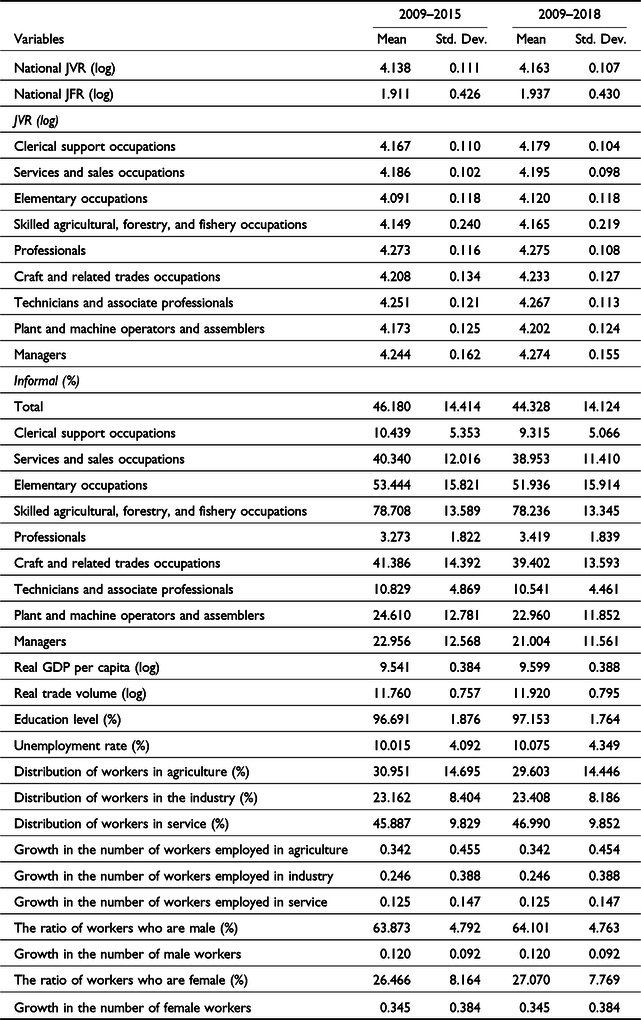
Panel B in Figure 1 demonstrates the negative relationship between the national JVR and the unemployment rate in Turkey throughout much of this period. Table 1 provides descriptive statistics of the variables used in our analysis. The means of all the JVR and JFR variables in the short term were 4.138 and 1.911, respectively. The mean education level was 97%, the unemployment rate was 10%, and the logarithm of real GDP per capita was 9.541. The average ratio of male and female workers was 63.87% and 26.46%. The distributions of workers were nearly 40% in agriculture, 23% in industry, and 46% in service, and the growth in the number of workers employed in these occupations was 34%, 24%, and 12%, respectively. While the mean of total informality was 46%, professionals had the lowest average informality ratio, and skilled agricultural, forestry, and fishery occupations had the highest average informality ratio. In the long term, the means of all the JVR and JFR variables were 4.163 and 1.937, respectively. We observed that other statistics had a similar tendency to these short-term statistics.
Summary statistics for the sample used in the analysis

Econometric model and identification
IV approach
Syrian refugees began arriving in Turkey at the beginning of 2011; thus, until the end of 2012, the density of Syrian refugees in Turkey was close to zero. Between the end of 2012 and mid-2014, most refugees inhabited the provinces bordering Syria, before beginning to move west after this period. Due to these shifts, we could expect to see long-term differences in labour market efficiency. Therefore, we performed analysis for two time periods: between the years 2009–2015 (short term) and 2009–2018 (long term) as in Tumen (Reference Tumen2016, Reference Tumen2021). Table A1 and Figure A1 demonstrate the ratio of the number of registered Syrian refugees to the native population in each NUTS-2 region and province in 2015, respectively.
To address the problem of selection bias (Borjas, Reference Borjas1987; Borjas et al., Reference Borjas, Bronars and Trejo1992) due to the endogeneity of the settlement patterns of Syrian refugees – for example, immigrants are more likely to prefer regions with high economic growth (Gurak and Kritz, Reference Gurak and Kritz2000) – we employed the IV approach, similar to previous studies (e.g. Aksu et al., Reference Aksu, Erzan and Kırdar2022; Del Carpio and Wagner, Reference Del Carpio and Wagner2015). We estimated the following regression:
 $$log{(JV{R_{ry}})_{pt}} = {\rm{\;}}\alpha + {\rm{\gamma }}{P_{pt}} + {f_t}\left( {{D_p}} \right) + g\left( {{X_{pt}}} \right) + {{\rm{\delta }}_p} + {{\rm{\delta }}_t} + {\varepsilon _{pt}}$$
 $$log{(JF{R_{ry}})_{pt}} = {\rm{\;}}\alpha + {\rm{\gamma }}{P_{pt}} + {f_t}\left( {{D_p}} \right) + g\left( {{X_{pt}}} \right) + {{\rm{\delta }}_p} + {{\rm{\delta }}_t} + {\varepsilon _{pt}}$$
where p refers to the province in Turkey and t refers to the year. The dependent variables are the JVR (
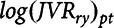 $log{(JV{R_{ry}})_{pt}}$
) and JFR (
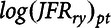 $log{(JF{R_{ry}})_{pt}}$
), and the primary variable of interest is the number of Syrian refugees normalised by the population P of a province γ. D is the high-order polynomial of the inverse distance, and the covariates mentioned earlier are rendered in terms of
 ${X_{pt}}$
.
The instrument substituted for the number of refugees is the travel distance from the Syrian governorate from which each refugee is fleeing to potential Turkish provincial destinations. These resulted in 81 Turkish provinces*13 Syrian governorate pairs. Our instrument was therefore calculated as follows:
 $$I{V_{pt}} = \sum\limits_s {{1 \over {{T_{sp}}}}} {\theta _s}{P_t}$$
where
 ${P_t}$
is the total number of registered Syrians in Turkey in year t,
 ${{\rm{\theta }}_{\rm{s}}}$
is the fraction of refugees in 2013 from each Syrian governorate (s), and
 ${T_{sp}}$
is the distance between the province in Turkey and the Syrian governorate.
Results of the IV approach
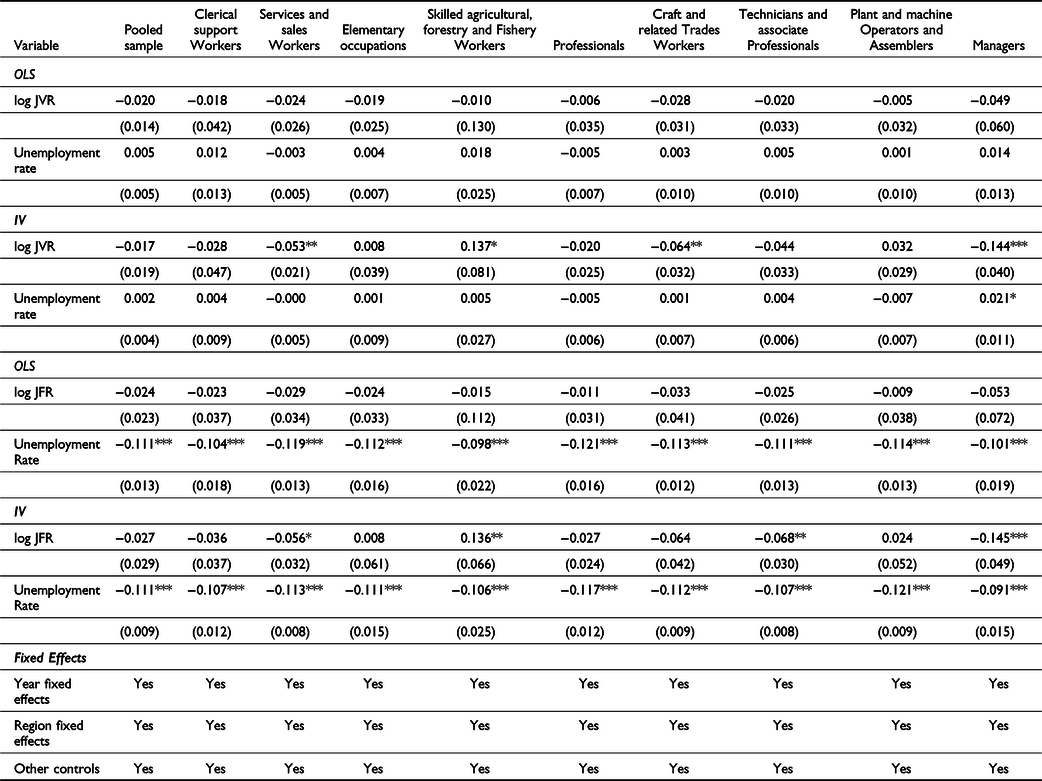
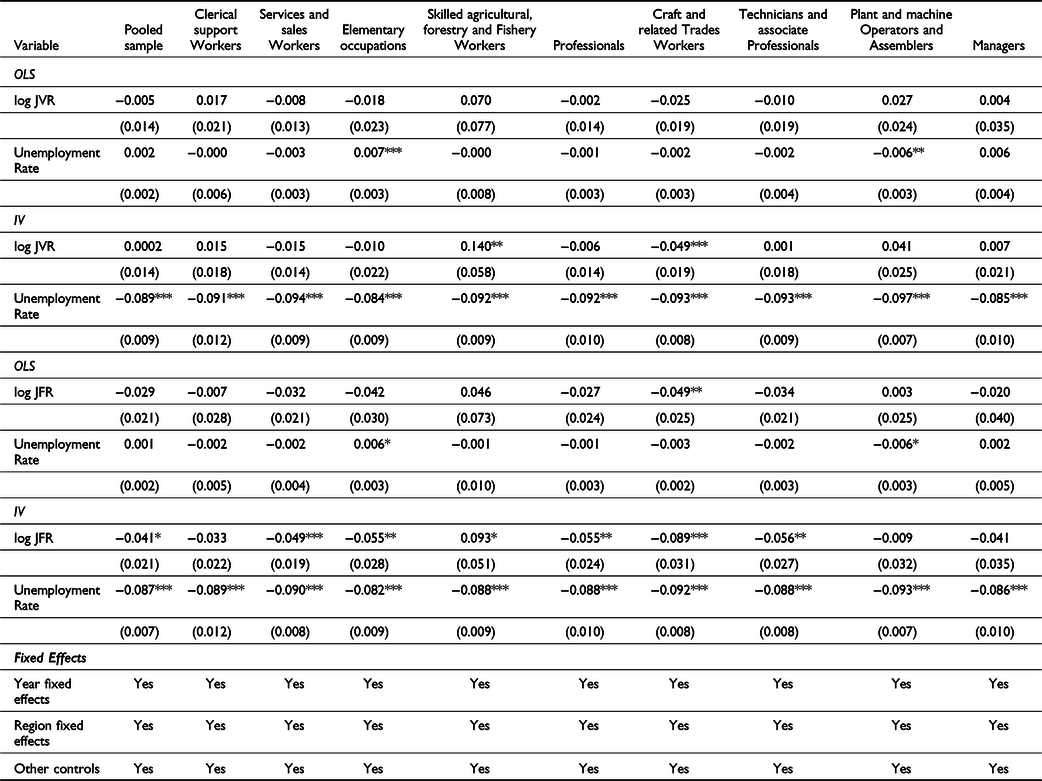
Tables 2 and 3 report the effect of refugees on labour market efficiency in Turkey during the short-term (2009–2015) and long-term (2009–2018) periods, respectively. The first column shows the job vacancies and findings from the whole sample, while the other columns present findings across different occupations. The first and second panels present the JVR and JFR estimates, respectively. For the sake of comparing the OLS and IV approaches, each panel also provides findings obtained from these methods.
The impact of Syrian refugee influx on labour market efficiency (IV, 2009–2015)

Robust standard errors presented in parentheses are clustered at the regional level. The data consist of yearly observations for each NUTS-2 level region between 2009 and 2015. The number of observations is 156 in all regression models, and they include vectors of the NUTS-2 level region and year fixed effects.
***p<0.01, **p<0.05, *p<0.1.
The Impact of Syrian refugee influx on labour market efficiency (IV, 2009–2018)

Robust standard errors presented in parentheses are clustered at the regional level. The data consist of yearly observations for each NUTS-2 level region between 2009 and 2018. The number of observations is 156 in all regression models, and they include vectors of the NUTS-2 level region and year fixed effects.
***p<0.01, **p<0.05, *p<0.1.
The OLS results presented in the first panel of Table 2 show that in no case is the coefficient of the JVR statistically different from zero in the short term, but the signs of these coefficients are negative as expected. Thus, we reject H1 and H2, that is, Syrian refugees did not cause a decrease in the JVR in either the whole sample or across occupations in Turkey. However, OLS cannot tackle the endogeneity problem that arises from the fact that refugees can choose the place in which they settle, hence such an analysis may provide spurious results. Therefore, we estimated Equations 3 and 4 using the IV approach to solve the endogeneity concerns related to OLS and to compute coefficients more accurately. Indeed, the estimates obtained from the IV approach indicate that the massive influx of refugees has a significant negative effect on the JVR for services and sales occupations, craft and related trade occupations, and managerial occupations. This result implies that since job vacancies measure the impact of friction in job matching on employment, the negative impact of a supply shock on job vacancies shows that there is more efficient job matching due to a reduced mismatch between labour demand and supply in these occupations. This finding could also indicate refugees have enabled firms to reduce their costs since they are expending less time and effort to recruit workers and fill vacant jobs. Another remarkable result is that refugees have increased JVRs in skilled agricultural, forestry, and fishery occupations. Similar to the Panel 1 OLS estimates, the impact of refugees on the JFR in Panel 2 of Table 2 is negative, although not significant in all specifications. Regarding IV results in the short term, refugees have also caused an increase in the JFRs for skilled agricultural, forestry, and fishery occupations. This result indicates that refugees cause an outward shift in the Beveridge Curve for these occupations, that is, since the increase in job vacancies is larger than the decrease in the unemployment rate, an outward shift has occurred. The labour market may have tightened to an exceptional degree since unemployment no longer decreased in line with the growth in the supply of openings. In other words, refugees increased job matching inefficiency and exacerbated labour market conditions by augmenting the number of unfilled vacancies and job seekers for the given unemployment rate in these occupations. However, there is a negative causal relationship between services and sales occupations, technicians and associate professionals, and managers and the refugee population in certain regions. During the period under consideration, the unemployment rate was also inversely correlated with the JVR, suggesting an inward shift of the Beveridge Curve for these sectors implying that the inflow of refugees leads to efficiency in the labour market in these occupations by shifting the Beveridge Curve inwards. Strikingly, while managers show significant inward shifts, the shifts in services and sales occupations, technicians, and associate professionals are less pronounced. Another important inference is that the signs of the OLS coefficients mostly coincide with the IV results, but the OLS estimates are considerably smaller and prove insignificant. Considering that the IV approach gives more accurate results, it can be misleading to interpret only the findings obtained from the OLS method.
The OLS estimates in the first panel of Table 3 are statistically indistinguishable from zero in the long term, but the effect of refugees on the JVR for select occupations – namely, clerical support, plant and machine operators, and assemblers, and managers – became positive. According to these results, we reject H1 and H2, that is, Syrian refugees do not induce a decline in JVR both in the whole sample and across occupations in Turkey. However, as OLS cannot solve the endogeneity problem, the coefficients are not reliable, and hence we re-estimated Equations 3 and 4 through the IV approach. The results presented in the same panel propound that the refugee influx does not affect the JVR in the long term, except for in the skilled agricultural, forestry, and fishery occupations, as well as the craft and related trades occupations. The coefficient of the first occupation, 0.140, indicates that a one percentage point increase in the refugee-to-population ratio, in turn, raises skilled agricultural, forestry, and fishery workers’ JVR by 0.140 standard deviations. In contrast, a one percentage point increase in the refugee-to-population ratio reduces the JVR in craft and related trades occupations by 0.049 standard deviations. Furthermore, the OLS estimates of the JFRs presented in the second panel of Table 3 suggest that only the JFR for craft and related trades occupations is significantly negatively correlated with the ratio of refugees in the population. On the other hand, the IV estimates assert that the Beveridge Curve shifted inwards due to the inflow of Syrian refugees between 2009 and 2018. Except for three fields: clerical support, plant and machine operators, and assemblers, and managers, refugees raised job matching efficiency and improved labour market conditions because unfilled job vacancies reduced, and the unemployment rate was inversely correlated with the JVR. While the craft and related trades Beveridge Curve demonstrate the highest inward shift, the curve’s inward movement for the technicians and associate professionals, elementary occupations, professionals, and services and sales occupations is lower. On the other hand, refugees shifted the Beveridge Curve outward in the skilled agricultural, forestry, and fishery occupations, thereby leading to inefficiency in these fields. As the increase in job vacancies is larger than the decrease in the unemployment rate, an outward shift has occurred. Lastly, the signs of the OLS estimate generally coincide with the IV results, but the OLS results are substantially smaller and insignificant. Note that interpreting only the coefficients of the OLS technique can be misleading and lead to inaccurate implications.
The coefficients can also provide evidence of how refugees affect the Beveridge Curve in the short and long term. In the whole sample, the inflow of refugees does not influence the Beveridge Curve in the short term, but they shift the curve inward and cause efficiency in the Turkish labour market in the long term. There is a key difference between the short- and long-term JVR coefficients obtained from the IV method. In the long term, refugees have caused a greater decline in the JVR of the skilled agricultural, forestry, and fishery occupations than in the short term, whereas in the short term, they led to a greater decrease in the JVR of craft and related trade occupations than in the long term. On the other hand, refugees reduced the JVR of services and sales occupations and managers in the short term and the effect was significant, while the sign remained the same in the long term, the significance disappeared.
Moreover, the findings obtained from the IV method show that the effect of refugees on the Beveridge Curve is different in the short term versus the long term. In the short term, the curve for the services and sales professions, as well as for the technicians and associate professionals’ domain, shifted more inward than in the long term. In other words, in the short term, refugees caused greater efficiency in these occupation groups than in the long term. Furthermore, while refugees do not affect the Beveridge Curve in the elementary occupations, professionals, and craft and related trade occupations in the short term, the curve for these fields shifted inwards in the long term, that is, it created greater effectiveness in these occupations. On the contrary, while refugees shifted the curve inward for managerial professions in the short term (causing efficiency), this effect disappeared in the long term. In addition, while refugees did not affect the curve in skilled agricultural, forestry, and fishery occupations in the short term, they shifted the curve outward in these occupation groups and caused inefficiency in the long term.
Conclusion
Since 2011, European countries have experienced a significant inflow of refugees because of the severe conflict in Syria, with Turkey experiencing the greatest migration. Thus, Syrian refugees are at the forefront of political debates across multiple arenas and fields of practice in these countries. In particular, the issue of how refugees influence labour market conditions represents a central question that is largely investigated in labour economics (e.g. Balkan and Tumen, Reference Balkan and Tumen2016; Ceritoglu et al., Reference Ceritoglu, Yunculer, Torun and Tumen2017; Del Carpio and Wagner, Reference Del Carpio and Wagner2015; Tumen, Reference Tumen2016). However, researchers have largely ignored the effects of this migration on labour market efficiency, which is visualised through the Beveridge Curve. While a large and growing body of literature has investigated the factors and events that can cause shifts in the Beveridge Curve (e.g. Crawley and Welch, Reference Crawley and Welch2020; Holmes and Otero, Reference Holmes and Otero2020), few studies have examined the effect of immigration on the quantitative relationship between the JVR and unemployment rate (e.g. Anastasopoulos et al., Reference Anastasopoulos, Borjas, Cook and Lachanski2021; Maffei-Faccioli and Vella, Reference Maffei-Faccioli and Vella2021; Schiman, Reference Schiman2021). In this context, our study is the first to examine the impact of Syrian refugees on the JVR and Beveridge Curve in Turkey. To introduce this association, we conducted an IV approach and used job vacancy and placement statistics from the Turkish Employment Agency (ISKUR) and other variables, particularly the unemployment rate, from the TurkStat at the aggregate NUTS-2 level to investigate these phenomena between 2009–2015 and 2009–2018. In comparison to Holmlund (Reference Holmlund2018), our data have two advantages. Firstly, there are no missing observations in the data. Secondly, vacancies involve the private sector rather than the public sector, where both immigrants and natives frequently apply.
This study is the first attempt to illuminate the link between immigration and JVRs and the Beveridge Curve. The findings indicate that trends in job vacancies are directly related to refugee-induced excess labour supply and that the decrease in job vacancies is particularly severe for low-skilled jobs as well as high-skilled jobs such as managers. Moreover, the results also illustrate more efficient job matching due to a reduced mismatch between demand and supply in the Turkish labour market. These results echo those published by Pholphirul (Reference Pholphirul2013), who documented that immigration reduces short-term job vacancies.
We also found evidence that the refugee shock shifted the Beveridge Curve inward between 2009–2015 and 2009–2018. These results are in line with our expectations and suggest that refugees raise job matching efficiency and improve labour market conditions by reducing the number of unfilled vacancies and job seekers for the given unemployment rate in the Turkish labour market. These findings correspond with the empirical evidence provided by Anastasopoulos et al. (Reference Anastasopoulos, Borjas, Cook and Lachanski2021), who used an IV approach to find an inward shift in the Beveridge Curve due to a reduced mismatch between employees and accessible job opportunities. Our findings are also similar to Schiman (Reference Schiman2021), who asserts that the labour market in Australia became more efficient in matching unemployed job seekers to vacant positions because of labour supply shocks induced by job-related immigration. An earlier study by Ceritoglu et al. (Reference Ceritoglu, Yunculer, Torun and Tumen2017), who delved into the effect of refugee inflows on the job-finding probabilities of native individuals aged 15–64, found negative and statistically significant estimates, further confirming our result.
Finally, the present study offers evidence that the refugee inflow has made finding jobs difficult for natives in most occupation groups, indicating an inward shift of the Beveridge Curve in these occupations. Another noteworthy finding is that the Beveridge Curve shifted outwardly only in the skilled agricultural, forestry, and fishery occupations in both time intervals. This implies that most of the refugees are low-skilled, and as it is easier for them to move within the country as seasonal workers, they generally work more frequently than natives in this low-wage sector (Erdogan, Reference Erdogan2020). In this case, JVRs may increase the supply of labour willing to work for low wages. Thus, greater job vacancies at the same unemployment level will shift the Beveridge Curve to the right and cause inefficiency in this occupational group.
In conclusion, Syrian refugees raise matching efficiency and improve labour market conditions by reducing the number of unfilled vacancies and job seekers for the given unemployment rate in the Turkish labour market. This article provides an in-depth analysis of labour market efficiency which is essential for policy design and implementation. Accordingly, the political debate should move from immigration limitations to redistributive measures that benefit both host communities and immigrants. Moreover, the theoretical framework integrating immigration to the Beveridge curve is an area for future research.
Supplementary material
For supplementary material accompanying this paper visit https://doi.org/10.1017/elr.2023.4
Data availability statement
Code, data, and material data are available on request to the corresponding author.
Funding statement
This study was not funded by any national or international organisation/institution.
Conflict of interest
None.
Nazire Begen is a PhD candidate and research assistant in the Economics Department of Gebze Technical University, Turkey. Currently, she is a Visiting Scholar at the University of California, Merced, USA. Her areas of interest include labour economics, health economics, and international migration.
Murat Anıl Mercan received his PhD in Economics from the University of Wisconsin-Milwaukee. Currently, he is a full professor at Yildiz Technical University, Turkey. His works vary from old age to marriage, and he published in distinguished international academic journals. Also, currently he leads one national scientific project.
Hande Barlin is an Assistant Professor in the Economics Department of Gebze Technical University, Turkey. Previously, she designed and implemented socio-economic development, empowerment, and social inclusion projects and carried out research on regional development and European economics. Currently, her research focuses on labour economics, disadvantaged groups, and social inclusion.