

Introduction
A large number of previous studies have documented that trade liberalisation helps women because trade liberalisation reduces the gender wage gap, most notably in advanced economies (Black & Brainerd, Reference Black and Brainerd2004; Brussevich, Reference Brussevich2018). Three channels have been proposed to rationalise this pattern. The first argument is that trade liberalisation induces domestic firms to reduce discrimination against women due to stronger competition pressures exerted on domestic firms by foreign firms after the trade (Black & Brainerd, Reference Black and Brainerd2004), which in turn causes a larger demand for female workers (Aguayo-Tellez et al., Reference Aguayo-Tellez, Aiola, Juhn and Villegas-Sanchez2013; Chen et al., Reference Chen, Ge, Lai and Wan2013). The second argument is that trade liberalisation leads domestic firms to upgrade their technology and enter the international market. As technologies complement female skills, the result is higher employment of female workers (Juhn et al., Reference Juhn, Ujhelyi and Villegas-Sanchez2014). The third argument is that trade liberalisation induces sectoral labour reallocations (Dix-Carneiro, Reference Dix-Carneiro2014; Ebenstein et al., Reference Ebenstein, Harrison, McMillan and Phillips2014; Gaddis & Pieters, Reference Gaddis and Pieters2017; Utar, Reference Utar2018). Since tradable industries differ in their gender employment compositions, trade-induced sectoral labour reallocations would have gender implications if there remains a considerable amount of between-industry gender segmentations (Gaddis & Pieters, Reference Gaddis and Pieters2017; Menezes-Filho & Muendler, Reference Menezes-Filho and Muendler2011).
However, research on China found that trade liberalisation caused a rise in the gender wage gap, even after accounting for the trade-induced pro-competition effects that have encouraged female employment (Chen et al., Reference Chen, Ge, Lai and Wan2013; Lu & Feng, Reference Lu and Feng2015 in Chinese; Wang et al., Reference Wang, Krisztina and Zhou2020).Footnote 1 What accounts for such contrasting patterns found between other countries and China? Can frictions in the labour market tell the difference? It is widely accepted that the extent to which a nation gains from trade depends crucially on how efficiently resources are allocated across sectors and spaces (Dix-Carneiro, Reference Dix-Carneiro2014; Dix-Carneiro & Kovak, Reference Dix-Carneiro and Kovak2017; Fan, Reference Fan2019; Tombe & Zhu, Reference Tombe and Zhu2019; Topalova, Reference Topalova2010). For example, Dix-Carneiro (Reference Dix-Carneiro2014) studied how costly sectoral switching can influence the effect of trade liberalisation on labour market transitional dynamics. He found that there were sizable welfare losses due to adjustment frictions across sectors. Similarly, Fan (Reference Fan2019) studied the distributional impacts of trade in China but emphasises the role of spatial frictions in driving the impacts. However, to what extent can frictions and distortions in the labour market reverse the effect of trade liberalisation on the gender wage gap is still poorly understood, especially in the Chinese context.Footnote 2 This paper fills this void and revisits the impact of trade liberalisation on the gender wage gap in China. I show that the net effect hinges on the sectoral reallocation channel and highlight sectoral switching costs in the advanced service sector as a specific form of discrimination in the Chinese labour market in driving the contrasting pattern in China. It is reasonable that if the between-sector mobility frictions prevent women from allocating to advanced sectors that offer them higher wages, then trade liberalisation would cause the gender wage gap to increase rather than decrease. I provide empirical evidence in support of this while recognising trade liberalisation fostering female employment via the ‘pro-competition effects’.
Previous studies on the relationship between trade liberalisation and the gender wage gap in China are scarce and suffer from several weaknesses. For example, Chen et al. (Reference Chen, Ge, Lai and Wan2013) examined this question, but their data are firm level and do not control personal demographic characteristics. Moreover, their data are limited in the manufacturing sector and thus cannot capture the sectoral reallocation effect of trade liberalisation. Lu and Feng (Reference Lu and Feng2015, in Chinese) also examined this question, but their measure of trade liberalisation is the province-level trade volume to GDP ratio, thereby facing serious endogenous problems such as omitted variables bias and reversal causality. For instance, there is a possibility that certain unobserved factors simultaneously drive trade volumes and the gender wage gap, which would pollute a clean causal identification. It is also likely that regions with a larger gender wage gap have a comparative advantage in exports and hence generate larger trade flows, rather than the opposite direction in that larger trade flows generate a decline in the gender wage gap. Instead, this paper overcomes these shortcomings. To begin with, this paper draws data from household surveys that document detailed individual demographic and socio-economic characteristics, typically their affiliated industries. The data set documents information on workers not only in the manufacturing sector but also outside manufacturing in non-tradable service industries, which greatly facilitates the testing of the sectoral reallocation channel. Meanwhile, the usage of the local labour market approach allows the implementation of a difference-in-difference (DID) research design, drawing inferences about the causal impact through regional variations in policy exposure driven by national policy change associated with pre-policy industry employment composition differentials.Footnote 3
After addressing the endogeneity problem, this paper finds that the gender wage gap in urban China increased after trade liberalisation, a finding consistent with Lu and Feng (Reference Lu and Feng2015, in Chinese). A 1-standard deviation (SD) increase in regional trade exposure is associated with an increase in the gender wage gap by 3.2%. The estimation results survive a series of robustness checks. The estimation result is not driven by the mismeasurement of regional trade exposure (PNTR), the inclusion of additional individual control variables, the geographic level of aggregation of the gender wage gap, or the breakdown of the pre-policy parallel trend between the high and low trade-exposed regions.
Before proposing a discrimination-based rationale for this empirical finding that highlights sectoral switching costs, I begin by showing that the empirical pattern is not driven by lacking ‘pro-competition’ effects of trade on female employment. In fact, I find that trade liberalisation raised the college wage premium, and the effect is arguably larger for women, thereby contributing to a reduction in the gender wage gap.Footnote 4 This makes sense provided that trade-induced technical upgrading complements female skills (Juhn et al., Reference Juhn, Ujhelyi and Villegas-Sanchez2014). I also corroborate the ‘pro-employment’ effects of trade liberalisation by showing that the gender wage gap decreased in the manufacturing sector and in foreign firms. I then show that trade liberalisation induced labour reallocations across sectors, female employment share declined in manufacturing and increased in the service sector, a finding that aligns with the trade-induced structural transformation literature in China (Erten & Leight, Reference Erten and Leight2021; Feng et al., Reference Feng, Lu and Shen2020). While it is generally acknowledged that trade may reduce the gender wage gap through higher female employment, the opposite pattern emerges when there exist sectoral switching costs that distort the natural process of between-sector labour reallocations. All things being equal, female workers who are initially employed in manufacturing face larger costs in accessing advanced service industries compared to their male counterparts after trade liberalisation, and this incomplete absorption leads to a net rising gender wage gap effect.Footnote 5 I find empirical evidence in support of this, showing varying impacts across sectors. While trade reduces the gender wage gap in manufacturing, it leads to a rise in the gender wage gap in advanced service industries. In contrast, there is no such effect in the low-skilled service industries. This finding is broadly consistent with a discrimination-based explanation of China’s gender wage gap (He & Wu, Reference He and Wu2017; Lee & Wie, Reference Lee and Wie2017).Footnote 6 Finally, I show that female workers who cannot freely shift into advanced service industries are either crowded into low-skilled service industries or become discouraged and leave the labour force. This behavioural trade adjustment is consistent with Yu et al. (Reference Yu, Wu, Li and Guo2021), who also documented a rise in the gender labour force participation gap after trade liberalisation in China.
This paper makes a number of contributions to the literature. The primary contribution is that I empirically examine the role of trade in driving the evolution of the gender wage gap in China while solving the endogeneity problem. The causal impact is obtained by implementing a local labour market approach that exploits trade policy changes rather than trade flows, which are more likely to suffer from endogeneity problems. To the best of my knowledge, this study is the first application of this approach in examining trade reforms on the gender wage gap in China. Secondly, this article shows how trade drives the gender wage gap through its effects on gender-specific industrial labour reallocations, confirming that ‘explained’ factors such as industries and occupations are still important contributing factors of the gender wage gap (Blau & Kahn, Reference Blau and Kahn2017; Goldin, Reference Goldin2014). In so doing, this paper thus complements the Oaxaca–Blinder (OB) decomposition literature.Footnote 7 Moreover, by clarifying how the gendered effects of trade-induced industrial reallocations hinge on sectoral switching costs (a particular type of discrimination),Footnote 8 this paper shows how ‘explained’ factors interact with ‘unexplained’ factors in driving the gender wage gap.
This paper also contributes to a broader literature on how labour market frictions shape the effect of trade shocks on labour market outcomes (Artuc et al., Reference Artuc, Chaudhuri and McLaren2010; Brussevich, Reference Brussevich2018; Dix-Carneiro, Reference Dix-Carneiro2014; Fan, Reference Fan2019; Tombe & Zhu, Reference Tombe and Zhu2019; Topalova, Reference Topalova2010; Yuan, Reference Yuan2020). I empirically examine the sectoral reallocation channel and highlight the sectoral switching costs as adjustment frictions, which distinguishes from existing studies in two respects. First, I stress that it is the sectoral switching costs, rather than inter-regional mobility costs, that matter in driving the net empirical relationship between trade and the gender wage gap.Footnote 9 Mobility costs across regions impact men and women roughly equally, and it is less likely that trade impacts the gender wage gap through asymmetric migration costs facing men and women. In contrast, mobility costs across sectors and occupations are more relevant factors in driving the impact of trade on the gender wage gap in China because they belong to a large set of ‘unexplained’ factors of the gender wage gap (He & Wu, Reference He and Wu2017; Lee & Wie, Reference Lee and Wie2017). Secondly, I highlight reallocations of labour from tradable to non-tradable and from employment to being inactive, rather than from rural to urban sectors as the underlying channel. Lu and Feng (Reference Lu and Feng2015, in Chinese) argued that the increase in the gender wage gap in China after its World Trade Organization (WTO) accession was because rural females occupied positions previously held by their urban counterparts. However, their work does not consider mobility costs across sectors. Even if females can freely move from rural to urban locations, it is hard to expect that rural and urban female workers are perfect substitutes, given persistent severe rural–urban segmentation in China (Facchini et al., Reference Facchini, Liu, Mayda and Zhou2019).
Finally, this paper seeks to contribute in two ways, to the large literature that examines the behavioural responses to trade shocks using microdata (Autor et al., Reference Autor, Dorn, Hanson and Jae2014, Reference Autor, Dorn and Hanson2019; Dai et al., Reference Dai, Huang and Zhang2021; Dix-Carneiro & Kovak, Reference Dix-Carneiro and Kovak2019; Menezes-Filho & Muendler, Reference Menezes-Filho and Muendler2011; Utar, Reference Utar2018). Firstly, whereas most previous papers have investigated the impact of trade with China on outcomes in other countries, this paper instead studies its effects on China’s own labour market. Secondly, unlike prior studies that examine trade shocks on relatively macro-labour market outcomes, this paper releases detailed individual responses (Facchini et al., Reference Facchini, Liu, Mayda and Zhou2019; Han et al., Reference Han, Liu and Zhang2012; Li, Reference Li2018; Lin & Long, Reference Lin and Long2020; Wang et al., Reference Wang, Krisztina and Zhou2020; Yuan, Reference Yuan2020). Exploiting microdata provides more scope for uncovering the underlying mechanisms, thereby providing a benchmark for evaluating the efficacy of government policies that directly target women (Dai et al., Reference Dai, Huang and Zhang2021; Yu et al., Reference Yu, Wu, Li and Guo2021). Compared with Dai et al. (Reference Dai, Huang and Zhang2021), this paper focuses on women’s adjustment. It is thus a complementary study of Yu et al. (Reference Yu, Wu, Li and Guo2021), providing new insights on how labour market frictions magnify the negative effect of trade on women, via changes in the labour supply.
The rest of the paper is arranged as follows. ‘Channels and existing empirical evidence’ briefly reviews the findings of the impact of trade liberalisation on the gender wage gap. ‘Data and descriptive evidence’ shows the data set in use, presents a short narrative of Chinese trade liberalisation, and then offers some descriptive evidence. ‘Identification and empirical specification’ discusses the empirical strategy, proposes the central empirical specification, reports the main regression results, and conducts a series of robustness checks. ‘Discussions’ discusses both the main findings and the underlying mechanisms. ‘Conclusions’ concludes with a summary of the potential drawbacks of this study and presents potential avenues for future research.
Channels and existing empirical evidence
Previous empirical studies on trade and the gender wage gap are mixed, depending on the data in use, countries examined, and labour market institutions. Table 1 lists these some of the findings by country. Reduced discrimination, trade-induced technical change, and sectoral reallocations are the three leading channels. Black and Brainerd (Reference Black and Brainerd2004) documented reductions in the gender wage gap in the US manufacturing sector via reduced discrimination. Aguayo-Tellez et al. (Reference Aguayo-Tellez, Aiola, Juhn and Villegas-Sanchez2013) found that women’s relative wages increased in Mexico because of industrial labour shifts favouring female workers. Juhn et al. (Reference Juhn, Ujhelyi and Villegas-Sanchez2014) documented a reduction in the gender wage gap in Mexico through technical upgrading in exporting firms because technology complements females’ skills. In China, Chen et al. (Reference Chen, Ge, Lai and Wan2013) used enterprise-population-level data and found that trade liberalisation caused a reduction in the gender wage gap because foreign and domestic exporting firms increased female employment.
Effects found in the literature

While there is a consensus on trade narrowing the gender wage gap through increased skill premiums and decreased discrimination, trade liberalisation could also cause the gender wage gap to rise, and this case is usually accompanied by between-group labour substitutions. Sauré and Zoabi (Reference Sauré and Zoabi2014) found that trade led to a rise in the gender wage gap because men move to sectors to replace women, which dilutes the capital-to-labour ratio and reduces female wages because of female skill-capital complementarity. Menon and Rodgers (Reference Menon and Rodgers2009) found that trade liberalisation increased the gender wage gap in India, but the effect is driven by tougher discrimination against women. Besedes et al. (Reference Besedes, Lee and Yang2021) documented that in the US, the simple gender wage gap decreased while the residual wage gap increased after China was granted the PNTR status. They explain this through a view of labour substitution within genders (high-educated women substitute low-educated women). Lu and Feng (Reference Lu and Feng2015, in Chinese) used the Urban Household Surveys (UHS) data and found an increase in the gender wage gap. They argue that rural workers migrate to the urban sector and replace the employment of urban female workers.
Gaddis and Pieters (Reference Gaddis and Pieters2017) and Brussevich (Reference Brussevich2018) test the sectoral reallocation channel. Gaddis and Pieters (Reference Gaddis and Pieters2017) documented a narrowing gender labour force participation and employment gap in Brazil, driven by a stronger negative effect for male workers. They further show that women were not absorbed in the non-tradable sector after being displaced from the tradable sector. Similarly, Brussevich (Reference Brussevich2018) documented a reverse effect in the US, where the gender wage gap increased after trade liberalisation. However, this was because male workers in the manufacturing sector face larger sectoral switching costs than women.
Data and descriptive evidence
-
Data sources
The major data source is the 1992–2009 repeated cross-sectional Chinese UHS, conducted by the Chinese National Bureau of Statistics (NBS); it is conditionally accessible with permission. Its sample is nationwide, covering all provinces. There are several editions of this data set, with some institutions having more complete provincial data. The edition used in this paper is one that contains 18 consecutive years for 18 provinces over the 1992–2009 time period, which is a random sample of the complete data set (Dai et al., Reference Dai, Huang and Zhang2021). The sample covers eastern, western, northwestern, southwestern, and northeastern Chinese provinces and covers 75% of China’s urban residents in 2009.Footnote 10 The data set actually starts from 1988, but this paper examines the 1992–2009 period, since the sampling method and the classification standard both changed in 1992 and the sample size is smaller before 1992. The data set contains information on the basic socioeconomic conditions of Chinese urban residents, including detailed information on earnings, employment, occupation, and consumption, as well as a set of detailed demographic characteristics. Annual wages are deflated to the 2009 yuan using province-level urban consumption price indices (CPI). My sample includes all female workers aged 16–55 years and male workers aged 16–60 years because 55 and 60 are the official retirement ages for women and men in China, respectively. I drop the observations of business employers, self-employed individuals, farm workers, retirees, students, those re-employed after retirement, and workers whose wages are less than one-half of the minimum wage. The resultant sample contains approximately 380 thousand individuals in the 18 years of repeated cross-sectional data. There was a major reform of the data in 2002. As a result, the annual sample size ranges from 5623 to 7333 during the 1992–2001 period and increases to more than 36000 per year after 2002.
Tariff data at the 4-digit industry level are sourced from Pierce and Schott (Reference Pierce and Schott2016) and Erten and Leight (Reference Erten and Leight2021). The Pierce and Schott (Reference Pierce and Schott2016) tariff reduction data are disaggregated at the 8-digit Harmonised System (HS) and are mapped into the International Standard Industry Classification (ISIC) 3.0 system at the 4-digit level and are then matched with the China Industrial Classification (CIC) system at the 2-digit level. Therefore, the resultant tariff reduction data are measured using the Chinese industry classification standards. The processing of the Erten and Leight’s (Reference Erten and Leight2021) data is similar and is easier to handle.
I also use the 1990 China Population Census data to construct the regional trade exposure measure. The Census data contains detailed industry classifications for 328 3-digit industries. Additional information on province control variables comes from various series of Chinese Statistical Yearbooks and the Chinese Statistical Yearbooks of the Labour Force.
-
Trade liberalisation in China
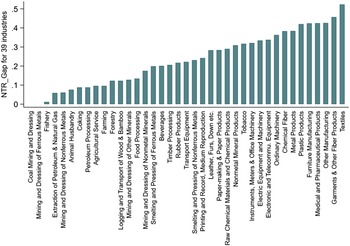
China’s opening up and shift from a centrally planned economy to a market-oriented system in the late 1970s, was accompanied by large inflows of Foreign Direct Investments (FDI) and dramatic tariff reductions in various industries. There are two main episodes of quick trade liberalisation in China. The first large-scale globalisation occurred after Deng Xiaoping’s ‘South Tour’ in 1992, which greatly removed barriers to foreign trade and investment. As a part of this event, China set up 4 Special Economic Zones and 14 Economic and Technological Development Zones in coastal cities to attract investment. Detailed measures included offering preferable tax arrangements, reducing and simplifying administrative procedures, and offering favourable policies to foreign enterprises. The second large-scale trade liberalisation occurred after China’s WTO accession in late 2001. Actually, even before its WTO accession, China had exempted tariffs for export-processing firms on imported materials and intermediates. After its WTO accession, China continued to cut restrictions on trade and investment so that tariffs and non-tariff trade barriers were considerably eliminated. China’s international trade expanded 75.5 times from 1979 to 2009. As a result, China has become the second-largest importer and the largest merchandise exporter in 2010. FDI inflows also grew quickly with the total volume of FDI rising from 11 billion dollars in 1992 to 90 billion dollars in 2009; as such China ranked as the second largest FDI recipient country in the world. In terms of tariff reductions, China started to reduce its domestic tariffs, from 43.2% in 1992 to 15.3% in 2001. The most intensive tariff cuts occurred between 1994 and 1997, and then in 2002. By the end of the period, the median output tariff is only 7.5%, far below the average for countries with comparable income levels to China. Tariff cuts varied greatly across industries, with the largest tariff-cut industries focusing on textiles, garments and other fibre products, and other manufacturing, while industries such as mining have no tariff changes at all. Figure 1 shows the pattern of tariff reductions in 39 2-digit industries in China using the Erten and Leight (Reference Erten and Leight2021) data.
-
Labour market outcomes
Trade exposure by industry.

Table 2 lists the real mean wage by gender, as well as real wages at the 10, 50, and 90 percentiles (P10, P50, and P90). Despite big improvements in the base wage, China experienced an increase in wage inequality during the 1992–2009 period, particularly after China’s WTO accession in 2001 (Ge & Dennis, Reference Ge and Dennis2014; Han et al., Reference Han, Liu and Zhang2012). The average female wages declined from more than 5500 yuan in 2001 to less than 5000 yuan in 2002, unlike the case for male workers. Additionally, both male and female low-skilled workers were negatively affected by China’s WTO accession. The male wage at the 10th percentile of the wage distribution declined by 5.5% after 2001 (from 2366 to 2235 yuan), but the decline was even larger for the low-skilled female workers, with a 25% decline from 2054 to 1532 yuan. In contrast, high-skilled female workers only lost 3.9%, compared with a 10.5% decline for their median counterparts. In contrast, men did not see such declines at the median and at the 90th percentile of the wage distribution, rather the real wage for males at the median and the 90th percentile distribution increased by 9.71% and 13.4%, respectively.
Real wage by gender at different percentiles

Table 3 presents the evolution of the gender wage gap over the 1992–2009 period. The data show a time-varying decline pattern, and it first declined during the 1990s but rose rapidly since 2001 when China entered the WTO and declined after 2008. The increase is smaller for the high-skilled group compared to the low-skilled group, and the increase is as high as 27% from 1992 to 2009 at the 10th percentile of the wage distribution, while the number is only 14% at the 90th percentile.
Gender wage gaps at different percentiles over time

Notes: The gender wage gap is the ratio of real male wages over female wages.
Table 4 lists the evolution of other labour market outcomes among Chinese men and women in terms of education levels, labour market experience, female share in state-owned enterprises (SOE), as well as female employment share in leadership positions, such as a manager. Table 4 indicates that women’s average education years surpassed that of men in 2009, but their labour market experiences were still lagging behind men at that time. In terms of the female share in the SOE sector and in higher positions, despite rapid growth for both, these sectors were still male-intensive in 2009.
Mean socio-economic characteristics by gender

Notes: Standard deviations in parentheses; data are drawn from the UHS data set over the 1992–2009 period.
Identification and empirical specification
-
Identification
The key identification strategy is a local labour market approach. Following Pierce and Schott (Reference Pierce and Schott2016), I take the US Congress’s approval of the Permanent National Trade Relationship (PNTR) with China and its formal implementation in 2001 when China entered the WTO as a quasi-experiment.Footnote 11 This policy change allows implementing a continuous-variable DID research design and its augmented triple-difference (DDD) form to obtain the causal impact.Footnote 12 Specifically, I examine whether relative wage changes between men and women (first difference) are larger in regions with higher trade exposure (second difference) after the imposition of PNTR (third difference). The construction of PNTR is shown in equations 1 and 2, which is a weighted average of the industrial tariff reduction, using regional employment shares in 1990 as weights. Although all regions face the same vector of liberalisation, differences in the regional industry mix generate regional variations in trade exposure:
 $$pnt{r_{p,1999}} = \sum\limits_j {{{{L_{jp,1990}}} \over {{L_{p,1990}}}}} NTR\_Ga{p_j}$$
where
 $$NTR\_Ga{p_j} = non\_PNT{R_j} - PNT{R_j}$$
 $pnt{r_{p,1999}}$
measures regional trade exposure,
 ${L_{jp,1990}}$
is employment of industry j in province p in 1990, while
 ${L_{p,1990}}$
is aggregate employment of province p in 1990. Hence,
 ${L_{jp,1990}}/{L_{p,1990}}{\rm{\;}}$
measures industry
 $j'$
s initial employment share and is used as weights.
 $NTR\_Ga{p_j}$
denotes reductions in tariff rates in industry j, which is the gap between the non-PNTR tariff rate and the PNTR tariff rate.
 $non\_PNT{R_j}$
is the initial tariff rate levied on Chinese goods if the US Congress has not granted China the PNTR status. Therefore,
 $PNT{R_j}$
is the tariff rate after the imposition of the PNTR status in industry j. Hence, a larger size of the
 $pnt{r_{p,1999}}$
variable indicates that province
 $p$
is more exposed to international trade. Figure 2 graphs regional variations in the magnitude of PNTR in 18 Chinese provinces. There are considerable variations of local labour markets in their trade exposure, and the mean gap of PNTR is 0.2323, with a SD of 0.1419.
-
Empirical specification
Trade exposure by province.

I explicitly write the triple-difference (DDD) specification in equation 3:
 $$\ln (wag{e_{ipt}}) = {\beta _0} + {\beta _1}mal{e_i} \cdot pnt{r_{p,1999}} \cdot pos{t_t} + {X_{it}}\theta + {\gamma _{pt}} + {\gamma _{male,t}} + {\gamma _{male,p}} + {\varepsilon _{ipt}}$$
The dependent variable
 $ln\left( {wag{e_{ipt}}} \right)$
is the log real wage of individual
 $i$
in province
 $p$
in year
 $t$
. The key independent variable
 $mal{e_i} \cdot pnt{r_{p,1999}} \cdot pos{t_t}$
is the DDD term, which is an interaction term of three variables, including the male dummy, the regional trade exposure, and a post-policy indicator. The male dummy variable
 $mal{e_i}$
takes 1 if a worker is male and 0 if she is female. Similarly,
 $pos{t_t}$
takes 1 for years from 2001 forward and 0 otherwise.
 ${X_{it}}$
is a set of individual control variables, including age, sex, education, experience, industry, occupation, and ownership structures of the employer (e.g., state-owned or collectively owned).
 ${\rm{\theta }}$
is a vector of coefficients on the personal control variables and denotes the economic return to these socio-economic characteristics.
 ${\gamma _{pt}}$
is the province-by-year fixed effect that controls shocks specific to all individuals in the same province and year,
 ${\gamma _{male,t}}$
is the male-by-year fixed effect that controls shocks specific to male workers in the same year, and
 ${\gamma _{male,p}}$
is the male-by-province fixed effect that controls specific factors that influence males in province
 $p$
.
 ${\beta _0}$
is the intercept term of the regression function while is a random error term.
-
Basic results
Table 5 presents the baseline regression results of equation 3. Columns differ from each other in whether specific control variables are included or not. Each regression includes the male-by-year, province-by-year, and male-by-province fixed effects. Standard errors are clustered at the province-by-year level, thus allowing correlations in standard errors across individuals in the same province–year pair. To interpret the magnitudes, the estimated coefficients are standardised to represent a 1 SD change, that is, the coefficients are always standardised by the cross-region SD in magnitudes of the tariff cut during the time period analysed. Column (1) does not control any personal characteristics, while column (2) controls age variables and columns (5) and (6) control education levels. Neither industry nor occupation variables are included in any specifications, since they are potential outcomes of trade liberalisation.Footnote
13
Estimates of
 ${\beta _1}$
are positive and statistically significant in all columns.
The effect of trade liberalisation on the gender wage gap

Notes: No other individual control variables are included in any columns except for education dummies in columns (5) and (6); The province-by-year, male-by-province, and male-by-year fixed effects are included in all columns; standard errors in parentheses are clustered at the province-by-year level.
***p < 0.01.
The estimated effects are also economically significant. The coefficients range from 0.032 to 0.039 depending on specifications, suggesting that trade liberalisation is associated with an increase in the gender wage gap. The triple-difference coefficient in the baseline specification in column (1) suggests that moving regions from low to high whose gap in trade exposure is 1 SD (0.14) increases the gender wage gap by 3.9% on average after 2001. To intuitively illustrate the coefficients, I give an example to show how male and female wage evolves after trade liberalisation in regions with different trade exposure. For example, the two provinces of Guangdong and Shandong reveal the difference in PNTR is roughly 0.5 points. I first predict the male and female wages in both provinces both before and after the WTO accession. For example, considering 2005 and 1998 as 2 years after and ahead of the trade policy change, respectively, the log real average wage rate in Guangdong in 2005 and 1998 were (8.7853, 8.2938) for men and (8.4683, 8.2928) for women, respectively. Keep in mind that the latter coordinates in both brackets represent wages in 1998. Likewise, mean male and female wages in Shandong in 2005 and 1998 were (8.8248, 8.3074) and (8.5140, 9.2928), respectively. Thus, if I conduct a DID on wages in each province, the resultant difference between the two provinces is one-half of the regression coefficient, that is, [(8.7853−8.2938)–(8.4683−8.2928)]-[(8.8248−8.3074)–(8.5140−8.2928)] = (0.316−0.2962) = 0.198 = 0.039 × 0.5.
-
Robustness checks
This section tests the robustness of the estimation results by trying several alternative specifications. Specifically, I perform a set of four different tests to see whether the estimation results are driven by measurement errors of PNTR, omissions of additional personal control variables, or the geographic level of aggregation of the gender wage gap. I then conduct a clean event study test of the pre-policy parallel trend assumption at the end of this section and demonstrate that the pre-policy parallel trend hypothesis is satisfied.
All estimation results are presented in the online appendix.
Discussions
-
On the college wage premium
Voluminous research has documented a rise in skill premiums as a salient outcome of trade liberalisation (Cravino & Sotelo Reference Cravino and Sotelo2019; Han et al., Reference Han, Liu and Zhang2012; Juhn et al., Reference Juhn, Ujhelyi and Villegas-Sanchez2014; Wang et al., Reference Wang, Krisztina and Zhou2020). There is also evidence that the return to college is higher for women than men in China (Peng, Reference Peng2011, in Chinese). However, whether this female college wage premium is linked with trade liberalisation is unclear. It is probable that trade liberalisation leads to a higher skill premium for women, provided that trade-induced technical change complements female skills (Beaudry & Lewis, Reference Beaudry and Lewis2014; Juhn et al., Reference Juhn, Ujhelyi and Villegas-Sanchez2014). I empirically test this conjecture using equation 4:
 $$\eqalign{ {\rm{ln}}\left( {wag{e_{ipt}}} \right) & = {\beta _0} + {\beta _1}femal{e_i}*pnt{r_{p,1999}}*pos{t_t}*colleg{e_i} + {\beta _2}pnt{r_{p,1999}}*pos{t_t}* \cr & \;colleg{e_i} + {\beta _3}femal{e_i}*pnt{r_{p,1999}}*pos{t_t} + {\beta _4}femal{e_i}*pnt{r_{p,1999}}* \cr & colleg{e_i} + {X_{it}}\theta + {\alpha _{female,p}} + {\alpha _{female,\;t}} + {\alpha _{pt}} + {\varepsilon _{ipt}} \cr} $$
The dependent variable is the log real wage rate of worker
 $i$
in province
 $p$
in year t. The key independent variable is an interaction term of four variables: a female dummy
 $femal{e_i}$
, a province trade exposure measure
 $pnt{r_{p,1999}}$
, a post-policy binary variable
 $pos{t_t}$
, and a college dummy
 $colleg{e_i}$
. The college dummy variable indicates whether one has a college education or not.
 ${X_{it}}$
is a set of individual control variables.
 ${\alpha _{female,p}},$
 ${\alpha _{female,t}}$
, and
 ${\alpha _{pt}}$
are female-by-province, female-by-year, and province-by-year fixed effects, respectively. is a random error term. Standard errors are clustered at the province-by-year level.
 ${\beta _1}$
is the coefficient of interest, and I expect it to be positive.
Table 6 reports the estimation results of equation 4. As expected,
 ${\beta _1}$
is positive and statistically significant at conventional levels, indicating that trade liberalisation improves women’s relative status by generating a larger college wage premium for them.
-
On sectoral reallocation between manufacturing and service
The effect of trade liberalisation on the gender college premium gap

Notes: Individual control variables are included in the estimation; ‘College workers’ represents individuals who have attended specialised 2-year or 3-year colleges (with or without successful graduation) or received post-secondary education from college equivalent training programmes; The regression includes year and province fixed effects; standard errors in parentheses are clustered at the province-by-year level.
**p < 0.05.
So far, this paper has kept silent on why trade liberalisation leads to an increase in the gender wage gap, because the present evidence indicates that it actually reduces the gender wage gap. I thus speculate that trade raises the gender wage gap through its effect on labour reallocation across sectors, considering that trade fosters the process of structural transformation (Erten & Leight, Reference Erten and Leight2021; Teignier, Reference Teignier2018). Following Yu et al. (Reference Yu, Wu, Li and Guo2021), I empirically test both effects of trade on gender-biased labour sectoral reallocations and within-industry gender compositions. I pay special attention to the transition between manufacturing and low-skilled service industries as tariff reductions are concentrated in female-intensive industries,Footnote 14 and these industries are also recognised as low-skill intensive.
Empirical specifications are presented in equations 5 and 6. The dependent variable in equation 5 is a binary variable indicating whether an individual is employed in a low-skilled service industry or in manufacturing while the independent variable is the same as that in the main specification.Footnote
15
The dependent variable in equation 6 is the female employment ratio of province
 $p$
in industry
 $k$
in year
 $t$
. The estimation results by skills are reported in Table 7 and Table 8:
 $$\eqalign{ 1\left( {industr{y_{ipt}} = k} \right) & = {\beta _0} + {\beta _1}mal{e_i}*pnt{r_p}*pos{t_t} + {\beta _2}pnt{r_p}*pos{t_t} + {X_{it}}\theta \cr & + {\gamma _{male,t}} + {\gamma _{male,p}} + {\varepsilon _{ipt}} \cr} $$
 $$\eqalign{ Female\;rati{o_{kpt}} & = {\beta _0} + {\beta _1}pnt{r_p}*pos{t_t} + {\beta _2}pnt{r_p}*pos{t_t}*frati{o_{1990}} \cr & + {X_{it}}\theta + {\gamma _{male,t}} + {\gamma _{male,p}} + {\varepsilon _{ipt}} \cr} $$
The effect of trade liberalisation on sectoral reallocations

Notes: Low-skilled service industries include real estate, land exploration and water conservancy, social services, transportation, wholesale and retail trade; ‘College’ denotes college and above, ‘Middle’ denotes high school graduates, while ‘Low’ denotes below high school; all regressions include year, province, male-by-province, and male-by-year fixed effects; standard errors in parentheses are clustered at the province-by-year level.
*p < 0.1 and ***p < 0.01.
The effect of trade liberalisation on changes in female employment ratios between two sectors

Notes: The female ratio data are drawn from the Chinese Statistical Yearbook of the Labour Force and are matched with the PNTR data; fratio90 denotes the 1990 industrial female employment ratio and is drawn from the 1990 Census data; there are 29 provinces and 4 years in the regression (1999, 2000, 2006, and 2012), as the data are only available in these years for each province in the Statistical Yearbook of Chinese Labour Force; year and industry fixed effects are included in both regressions; standard errors in parentheses are clustered at the province level.
*p < 0.1 and ***p < 0.01.
Several patterns emerge behind the regression results in Table 7. First, trade liberalisation shifts workers from manufacturing to service industries, as seen from the coefficients on pntr_post. Middle- and low-skilled female workers are more likely to be employed in the low-skilled service industries and less likely to be employed in manufacturing after trade liberalisation, particularly the low-skilled. Second, there is no gender difference for middle- and low-skilled workers in the pattern of sectoral shifts (see coefficients on the male_pntr_post variable in columns (1)–(3)), despite a slightly larger effect for the college-educated (i.e., college men have a higher probability of getting employed outside manufacturing). Third, coefficients on the male_pntr_post variable in columns (4)–(6) suggest that male workers are in general less likely to be employed in low-skilled service industries compared with their female counterparts, particularly the low-skilled.
While Table 7 provides the first evidence in support of the sectoral reallocation channel, Table 8 further corroborates it by examining the effect of trade liberalisation on the female employment share in these two sectors, using the residential service industry as an example of the low-skilled service sector. Data are drawn from four waves of the Chinese Statistical Yearbooks of the Labour Force and the 1990 population Census. To exclude the possibility that the effect of trade liberalisation on the female employment ratio is driven by unobserved forces correlating with an industry’s initial gender compositions, I interact pntr post with the industry’s 1990 female employment ratio.
As expected, Table 8 shows that trade liberalisation leads to a decrease in the female employment ratio in manufacturing and an increase in the residential service industry, despite its 10% significant level in manufacturing.
-
Test discrimination and uncover sectoral switching costs
Why does trade liberalisation foster the structural transformation process and generate a larger college premium for women but still lead to an increase in the gender wage gap? I try to reconcile these seemingly contradictory empirical findings by offering a discrimination-based explanation. I first test the existence of discrimination towards women in China and show that trade liberalisation indeed intensifies it. Equations 7, 8, and 9 are the respective econometric specifications. Equation 7 is the standard Mincer regression, and its error term is used as a proxy for discrimination and will be included in equation 9. Equation 8 is a setting aiming at capturing sources of the female schooling premium.Footnote
16
The coefficient of interest is
 ${\beta _1}$
in equations 8 and 9:
 $${\rm{ln}}\left( {wag{e_{it}}} \right) = {\alpha _0} + {\alpha _1}Eduyr{s_{it}} + {\alpha _2}Femal{e_{it}} + \beta {X_{it}} + {\gamma _i} + {\gamma _t} + {e_{it}}$$
 $${\rm{ln}}\left( {wag{e_{it}}} \right) = {\beta _0} + {\beta _1}Femal{e_i}*Eduyr{s_{it}} + {\beta _2}Eduyr{s_{it}} + {X_{it}}\theta + {\gamma _i} + {\gamma _t} + {\mu _{it}}$$
 $${\rm{ln}}\left( {wag{e_{it}}} \right) = {\beta _0} + {\beta _1}Femal{e_i}*Eduyr{s_{it}} + {\beta _2}Eduyr{s_{it}} + {X_{it}}\theta + \widehat {{e_{it}}} + {\gamma _i} + {\gamma _t} + {\vartheta _{it}}$$
Table 9 reports the regression results of these three equations. Column (4) reports the estimation results of equation 7, with no control variables except for the female dummy. The coefficient on the female dummy in column (4) suggests a gender wage gap of 0.262. Column (3) also reports the estimation results of equation 7 but includes a host of individual-level control variables. With control variables, the gender wage gap reduces to 0.210. Column (2) reports the estimation results of equation 8, while column (1) reports the estimation results of equation 9. When discrimination (the ue term) is included, the gender gap in the return to education vanishes. The coefficient on Female × Eduyrs is indistinguishable from zero in column (1), compared with female premium in the return to education of 1.5% in column (2). This means that, if there had been no discrimination, female wages would have been higher.
Test discrimination against women

Notes: All columns include year and province fixed effects; standard errors in parentheses are clustered at the province-by-year level.
***p < 0.01.
Equation 10 then tests whether trade liberalisation intensifies discrimination against women, with the dependent variable being the residual form of the Mincer regression. The estimation results are reported in Table 10:
 $$residua{l_{ipt}} = {\beta _0} + {\beta _1}mal{e_i}*pnt{r_p}*pos{t_t} + {\beta _2}pnt{r_p}*pos{t_t} + {\gamma _{it}} + {\gamma _{ip}} + {\varepsilon _{ipt}}$$
The effect of trade liberalisation on discrimination against women

Notes: Columns (2) and (4) replace the province–year fixed effect with pntr_post, the interaction term of the PNTR measure and the post-2001 dummy; Columns (3) and (4) use the residual wage as the dependent variable, which is measured as the residual term of the Mincer function, the independent variables in the Mincer function include age, age squared, experience, experience squared, education level, industry, occupation, ownership of the employer, and the region dummy; all regressions include year, province, male-by-year, and male-by-province fixed effects; standard errors in parentheses are clustered at the province-by-year level.
**p < 0.05 and ***p < 0.01.
The first two columns in Table 10 report the estimation results of the full specification, while columns (3) and (4) replace the raw wage with the residual wage. Demographic characteristics in the first two columns include age, age squared, experience, and experience squared. Positive coefficients in the last two columns indicate that trade intensifies the discrimination towards women.
While trade liberalisation intensifies discrimination, we know little about the specific types of discrimination by solely relying on the UHS data that contain very little information on the employer.Footnote 17 Instead, I circumvent this drawback and uncover the sectoral switching costs by exploiting heterogeneous effects for workers from different industries. As a complementary study, I offer additional suggestive evidence on the sectoral switching costs by revealing heterogeneous effects for workers from distinct occupations and ownership types.
Classifying the industries into manufacturing, basic service, and advanced service, Table 11 reports the effects of trade liberalisation on the gender wage gap for workers in different sectors. It shows that, quite surprisingly, the gender wage gap drops in manufacturing but increases in advanced service industries (though insignificant in the regression without control variables). Meanwhile, there is no effect in the basic service sector. These divergent sectoral-specific empirical patterns are easy to reconcile with the sectoral reallocation channel, suggesting that female workers displaced from the manufacturing sector cannot be fully absorbed in high-skilled service industries, due in large part to sectoral switching costs.
Heterogeneous effects of trade on the gender wage gap by industries

Notes: Demographics include age, experience, and their squared forms, and sex; control variables include education level, occupation, and employer ownership; all regressions include male-by-province, male-by-year, province and year fixed effects; basic service industries include electricity supply, transportation, wholesale and retail trade, catering and accommodation, residential service, and other services; advanced service industries include scientific research and technical service, finance, real estate, business service, public utilities, education, healthcare, and governments; standard error in parentheses are clustered at the province-by-year level.
*p < 0.1, **p < 0.05, and ***p < 0.01.
Grouping workers into managers, professionals, staff, and production workers, Table 12 further reports the effect of trade liberalisation on the gender wage gap for workers in different occupations. The coefficients on the male_pntr_post variable indicate that professionals experience an evident increase in the gender wage gap, while the effect for staff and production workers is negligible. Managers experience a decrease in the gender wage gap, as evidenced by column (2) in the bottom panel in Table 12. The heterogeneous occupational effects in Table 12 suggest that between-firm discrimination (women holding different occupations) rather than within-firm discrimination (women performing different tasks within the same firm) may be more relevant in China.
Heterogeneous effects of trade on the gender wage gap by occupations

Notes: Demographics include age, experience and their squared forms, and sex; control variables include education, industry, and employer ownership types; all regressions include male-by-province, male-by-year, and province and year fixed effects; standard error in parentheses are clustered at the province-by-year level.
*p < 0.1, **p < 0.05, and ***p < 0.01.
While Tables 11 and 12 examine the heterogeneous effects across industries and occupations, Table 13 reports the heterogeneous effects across different ownership types. Classifying employers into state-owned enterprises (SOE), collectively, individually, and privately owned enterprises (CIP), and joint-venture, stockholding, and foreign-owned enterprises (JSF), Table 19 shows that the gender wage gap increases in the CIP sector but decreases in the JSF sector and increases slightly (insignificant in the without-controls regression) in the SOE sector. The discrepancy between domestic and foreign firms suggests that discrimination sources mainly from domestic labour market distortions.
-
On individual responses
Heterogeneous effects of trade on the gender wage gap by ownership types of the employer

Notes: Demographic characteristics include age, experience, and their squared forms, and sex; control variables include education, industry, and occupation; all regressions include male-by-province, male-by-year, province, and year fixed effects; standard errors in parentheses are clustered at the province-by-year level.
*p < 0.1, **p < 0.05, and ***p < 0.01.
Before closing this article, this subsection further reveals the underlying mechanisms by exploring how females adjust their labour supply decisions when facing negative labour market shocks. Theoretically, women can either self-insure themselves by working longer or instead becoming discouraged and leaving the labour force (Dai et al., Reference Dai, Huang and Zhang2021; Yu et al., Reference Yu, Wu, Li and Guo2021). Equation 11 explicitly tests this conjecture, and the dependent variable LFP is a dummy variable indicating the labour force participation status of a worker. LFP takes 1 if the worker is employed, searching for jobs after unemployment, or self-employed, and 0 if he is in the household or early retired:
 $$LF{P_{ipt}} = {\beta _0} + {\beta _1}mal{e_i}*pnt{r_p}*pos{t_t} + {\beta _2}pnt{r_p}*pos{t_t} + \gamma {X_{it}} + {\gamma _{male,\;t}} + {\gamma _{male,p}} + {\varepsilon _{ipt}}$$
Table 14 reports the estimation results of equation 11. Samples in columns (1) and (2) include those who are employed and unemployed but are actively searching for jobs, while columns (3) and (4) only comprise those who are employed. The coefficients are all positive and are statistically significant from zero, indicating that trade liberalisation triggers an increase in the gender labour force participation gap. The robustness of the coefficients for both specifications reveals that females respond by dropping out of the labour force rather than searching more intensively in the labour market.
The effect of trade liberalisation on the labour force participation rate

Notes: Columns (1) and (2) include those who are employed and are actively searching for jobs; Columns (3) and (4) only comprise those who are employed; LFP is a dummy variable indicating the status of labour force participation; LFP takes 1 if the employment status of the worker is employment, unemployment, or self-employed, and 0 if the worker is in the household or early retired; students and the disabled are excluded from the sample; all regressions include year, province, male-by-year, and male-by-province fixed effects; standard errors in parentheses are clustered at the province-by-year level.
*p < 0.1 and ***p < 0.01.
Similarly, given that the UHS data also records information on reasons for labour force non-participation, I examine which response is more likely to happen among the trade-induced unemployed in urban China. Equation 12 is the empirical specification, which is a probit discrete choice model. The dependent variable is an indicator variable representing housework, early retirement, at school, or working part-time:
 $${{\rm{Probit}}\left( {{Y_{ipt}} = 1} \right) = {\beta _0} + {\beta _1}femal{e_i}*pnt{r_p}*pos{t_t} + {\beta _2}pnt{r_p}*pos{t_t} + {\gamma _{female,t}} + {\gamma _{female,\;p}} + {\varepsilon _{ipt}}}$$
Table 15 presents the estimation results of equation 12. It indicates that trade liberalisation has shifted women from the labour market to the household. It is a plausible case that women choose to work in the household when labour market opportunities are reduced, provided that women have comparative advantages in doing household chores. There is little evidence showing that male and female workers differ in their schooling and part-time working decisions, even though female workers are more likely to retire earlier.
Reasons for why labour force non-participation

Notes: Demographic variables include age, experience and their squared forms, and sex; all columns include year, province, male-by-year, and male-by-province fixed effects; standard errors in parentheses are clustered at the province-by-year level.
*p < 0.1 and ***p < 0.01.
Conclusions
Trade liberalisation generates distributional effects among different subgroups within a nation. This paper studies the impact of trade liberalisation on the gender wage gap in urban China. Adopting a local labour market approach as the identification strategy, this paper finds a positive gender wage gap effect of trade liberalisation, which is in contrast to most empirical findings in the literature. A 1-SD increase in trade exposure leads to a 3.2% increase in the gender wage gap.
To reconcile the contrasting findings of China and other countries, this paper proposes a discrimination-based explanation after a comprehensive assessment of alternative explanations proposed in the literature. This paper highlights that the effect reverses because trade-induced sectoral reallocations are impeded by asymmetric sectoral switching costs facing men and women, which preclude women from being absorbed in sectors that benefit them the most. While trade liberalisation partly reduces the gender wage gap through its effect on the skill premium, the net effect is reversed by uneven sectoral switching costs. As a result, females are more likely to be hired in low-skilled service industries or to choose labour market non-participation after trade liberalisation. The negative effects are further amplified by additional behavioural labour supply responses because women prefer to withdraw from the labour market and take on more household chores.
This study carries strong implications for policies pursuing gender equality, as gender equity matters greatly for long-run sustainable economic growth and children’s development (Duflo, Reference Duflo2012). While trade liberalisation may improve women’s welfare, distortions in the labour market prevent females from reaping the additional benefits. Labour market reforms such as targeted eliminations of discrimination against women are potentially efficient policy measures in reducing gender wage gaps. In addition, employment protections for unemployed women are also useful policy tools.
Despite potential contributions to the literature, this paper still falls short in several aspects. Firstly, the data used are household level that contain very limited information on workers’ employers, leaving explorations into detailed reallocation processes infeasible (Yahmed, Reference Yahmed2022). Moreover, lacking employer–employee-matched data also make revealing the detailed within-firm discrimination process beyond the scope of this paper (Card et al., Reference Card, Cardoso and Kline2016). Secondly, this paper views workers as independent individuals, thus neglecting the role of the family in deciding personal labour supply decisions, which may shed light on more detailed working mechanisms (Aguayo-Tellez et al., Reference Aguayo-Tellez, Aiola, Juhn and Villegas-Sanchez2013; Keller & Utar, Reference Keller and Utar2022). Lastly, the absence of information on rural residents in the UHS data prevents the researcher from studying how trade liberalisation would affect the rural gender wage gap and whether or not the effect would differ between urban and rural sectors.
Supplementary material
To view supplementary material for this article, please visit https://doi.org/10.1017/elr.2023.25
Competing interests
The author declared no potential conflicts of interest with respect to the research, authorship and/or publication of this article.
Haopeng Sun is a doctoral candidate in Economics at Shanghai University of Finance and Economics. His research interests lie at the intersection of trade and labour economics. He is particularly interested in understanding how institutional arrangements in labour markets influence the impacts of trade on household outcomes. His recent work tries to explore how the China two-child policies have affected households’ consumption behavior and household balance sheet outcomes.