

Introduction
The health of workers is a fundamental factor in the sustainable development of any society. The World Health Organization (WHO) defines occupational health as the promotion and maintenance of the highest degree of physical, mental, and social well-being of workers in all occupations (WHO 2021). This definition highlights the multidimensionality of the concept, which goes beyond the mere absence of illness to include a state of complete well-being.
Scientific literature has shown that working conditions, occupational hazards, and work organisation have a significant influence on workers’ health (Marmot and Wilkinson Reference Marmot and Wilkinson1999; Siegrist Reference Siegrist1996). These foundational contributions established the theoretical basis to understand how adverse work environments can generate both psychological and physiological strain. More recent evidence has reinforced and extended these findings, showing that psychosocial working conditions – particularly job stress – are consistently associated with a wide range of health outcomes, including depression, cardiovascular disease, and general morbidity (Hasin et al Reference Hasin, Johari, Jamil, Nordin and Hussein2023; Kivimäki et al Reference Kivimäki, Virtanen, Elovainio, Kouvonen, Väänänen and Vahtera2006; Rugulies et al Reference Rugulies, Aust and Madsen2017).
In addition to job stress, employment conditions related to working time and job arrangements have also been identified as significant determinants of health. Full-time employment is often associated with greater income stability and access to employment benefits. However, it may also entail higher exposure to work-related stressors, such as work overload and time constraints. In contrast, part-time employment can offer greater flexibility and improved work–life balance, but may also be associated with job insecurity, lower income, and limited access to benefits (Tilly Reference Tilly1996). Strikingly, more recent research highlights that the implications of part-time employment are highly heterogeneous, depending on whether this work is voluntary or involuntary. Gender and institutional context also play a role (Baumann et al Reference Baumann, Cabib, Eyjólfsdóttir and Agahi2022; Benach et al Reference Benach, Vives, Amable, Vanroelen, Tarafa and Muntaner2014).
Analysing how working conditions influence the health of workers, considering both physical and psychosocial risks, is a matter of great relevance from a business and social point of view. This issue becomes particularly relevant in the context of older workers, a group whose participation in the labour market is steadily increasing due to demographic ageing and policy initiatives aimed at extending working lives. Older workers are more likely to face health problems and may react differently to occupational stressors compared with younger employees. This makes it essential to understand how employment quality affects their health trajectories and capacity to remain active in the labour force (Eurofund 2021; Mc Carthy et al Reference Mc Carthy, Cronly and Perry2017; OECD 2019).
Despite the extensive literature documenting how employment conditions are associated with health, major methodological challenges remain. In particular, concerns about endogeneity – such as selection into employment types, reverse causality, and time-varying confounding – continue to complicate causal interpretation in observational settings, despite significant advances in recent longitudinal and causal inference studies (Blaikie et al Reference Blaikie, Eisenberg-Guyot, Andrea, Owens, Minh, Keil and Hajat2023; Matilla-Santander et al Reference Matilla-Santander, Matthews, Gunn, Muntaner, Kreshpaj, Wegman, Néstor, Hernando-Rodriguez, Albin, Balogh, Davis and Bodin2023; Ross and Mirowsky Reference Ross and Mirowsky1995; Waldron Reference Waldron1980).
Moreover, relatively few studies fully exploit individual fixed-effects (FE) models to account for unobserved, time-invariant personal characteristics, such as genetic predisposition or personality traits. While the literature widely acknowledges the importance of these factors, many empirical studies do not fully exploit within-person variation. Labour precariousness has also been associated with poorer health – particularly mental health – but much of the evidence relies on cross-sectional data or limited longitudinal designs and rarely distinguishes between contemporaneous and lagged effects. In addition, chronic diseases tend to receive less attention than mental health outcomes. Research on the work–health relationship has primarily focused on mental health and cardiovascular outcomes, while other chronic health problems (such as diabetes, arthritis, or cancer) have been comparatively neglected. Furthermore, many studies rely on self-reported measures, which may be subject to reporting bias, rather than on validated instruments or medical records.
This study contributes to the literature in several ways. First, it employs longitudinal panel models covering a 12-year period (six waves) with individual fixed effects, which control for unobserved heterogeneity and strengthen attempts to analyse the relationship between employment conditions and health. Secondly, the analysis incorporates lagged variables to establish temporal precedence and to better identify the direction of the relationship between employment and health, while explicitly comparing contemporaneous and lagged effects. This approach also allows us to capture distinct temporal dynamics in the development of chronic diseases, which typically emerge over longer periods. Thirdly, we explore potential bidirectionality in the employment–health relationship, addressing the possibility that not only do working conditions affect health but also that health status may influence employment outcomes. Fourthly, we cover new dimensions of health – including depression and a broad set of up to 14 chronic conditions as a measure of multimorbidity – using data from a representative sample of 14 European countries. Finally, we employ validated indicators of mental health (EURO-D scale) and job stress (Karasek job content), ensuring rigour and conceptual and methodological comparability with future research.
This work is structured as follows. The section titled “Theoretical framework and previous evidence” presents the theoretical framework and the available empirical evidence. The next section, describes the methodology used in the study, while in the last section titled, the results will be presented, ending with the discussion and main conclusions of the study.
Theoretical framework and previous evidence
Theoretical framework
The academic literature has identified several channels through which employment conditions influence the health status of workers, whether through physical, psychosocial, or socioeconomic pathways. Various studies have shown that working conditions, both physical and psychosocial, have a significant impact on the physical and mental health of workers, which in turn affects their productivity, well-being, and quality of life (Kivimäki et al Reference Kivimäki, Virtanen, Elovainio, Kouvonen, Väänänen and Vahtera2006; Marmot et al Reference Marmot, Bosma, Hemingway, Brunner and Stansfeld1997; Siegrist Reference Siegrist1996, Reference Siegrist2009). In this context, the Demand-Control-Support Model, developed by Karasek and Theorell (Reference Karasek and Theorell1990), asserts that psychological and physical damage (particularly cardiovascular risk) arises in jobs classified as ‘high strain’. These are characterised by a combination of high psychological demands and low decision latitude (control) over their own tasks. The addition of social support (Johnson and Hall Reference Johnson and Hall1988) acts as a buffer, with low support amplifying the negative health consequences of job strain. This model explains how the organisation of work (pace, autonomy, relationships) can result in adverse effects on health status.
Alternatively, the Effort–Reward Theory (Siegrist Reference Siegrist1996) postulates that the imbalance between the effort invested in work and the rewards received (salary, recognition, job security) generates stress and increases the risk of physical and mental illness. Specifically, this lack of reciprocity generates a low perceived gain, causing strong negative emotions (Siegrist Reference Siegrist2009) with adverse long-term implications for the worker’s health (Siegrist and Li Reference Siegrist and Li2016). These include a poor self-perception of health (Shimazu and de Jonge Reference Shimazu and de Jonge2009), the development of coronary heart disease (Bosma et al Reference Bosma, Peter, Siegrist and Marmot1998; Dragano et al Reference Dragano, Siegrist, Nyberg, Lunau, Fransson, Alfredsson, Bjorner, Borritz, Burr, Erbel, Fahlén, Goldberg, Hamer, Heikkilä, Jöckel, Knutsson, Madsen, Nielsen, Nordin and consortium2017; Gilbert-Ouimet et al Reference Gilbert-Ouimet, Trudel, Brisson, Milot and Vézina2014; Peter et al Reference Peter, Siegrist, Hallqvist, Reuterwall and Theorell2002), higher levels of anxiety and depression (Rugulies et al Reference Rugulies, Aust and Madsen2017), and mental illness in general (Ndjaboué et al Reference Ndjaboué, Brisson, Vézina, Blanchette and Bourbonnais2014).
Working conditions and inequalities in health status are also related through multidimensional microeconomic mechanisms (Benach et al Reference Benach, Muntaner and Santana2007). From a microeconomic perspective, working conditions are a factor that affects the production of a company. A healthy and safe working environment can improve worker productivity, reduce absenteeism, and decrease the costs associated with occupational illnesses and injuries (Böckerman et al Reference Böckerman, Ilmakunnas and Johansson2011; Goetzel et al Reference Goetzel, Gibson, Short, Chu, Waddell, Bowen, Lemon, Fernandez, Ozminkowski, Wilson and DeJoy2010). On the other hand, precarious working conditions, such as exposure to physical or psychosocial risks, can have negative effects on workers’ health, which in turn can reduce their productivity and increase costs for the company and society in general (Leigh Reference Leigh2011). Inequalities in occupational health manifest themselves differently in different groups of workers. Low-income workers and those with precarious contracts experience a higher burden of disease (Benach et al Reference Benach, Vives, Amable, Vanroelen, Tarafa and Muntaner2014). These inequalities are also accentuated by factors such as gender, race, and educational level (Artazcoz et al Reference Artazcoz, Borrell and Benach2001; Link and Phelan Reference Link and Phelan1995; Messing and Stellman Reference Messing and Stellman1998; Williams and Collins Reference Williams and Collins2001). Marmot (Reference Marmot2004) and Wilkinson (Reference Wilkinson2005) highlight that low-quality employment and low income (or lack of social benefits) act as primary social determinants. Precarious employment restricts access to material resources (adequate housing, quality nutrition, leisure opportunities, and access to quality healthcare services) and life control. In this sense, lack of income and security undermines the sense of control over one’s life, contributing to chronic stress and less healthy behaviours. This framework, based on the social determinants of health, explains how inequality in the labour market is directly translated into health inequality. Employment conditions shape health, not only through the immediate hazards faced during work (psychosocial and physical channels) but also through the resources and social position they confer outside of work (socioeconomic channel).
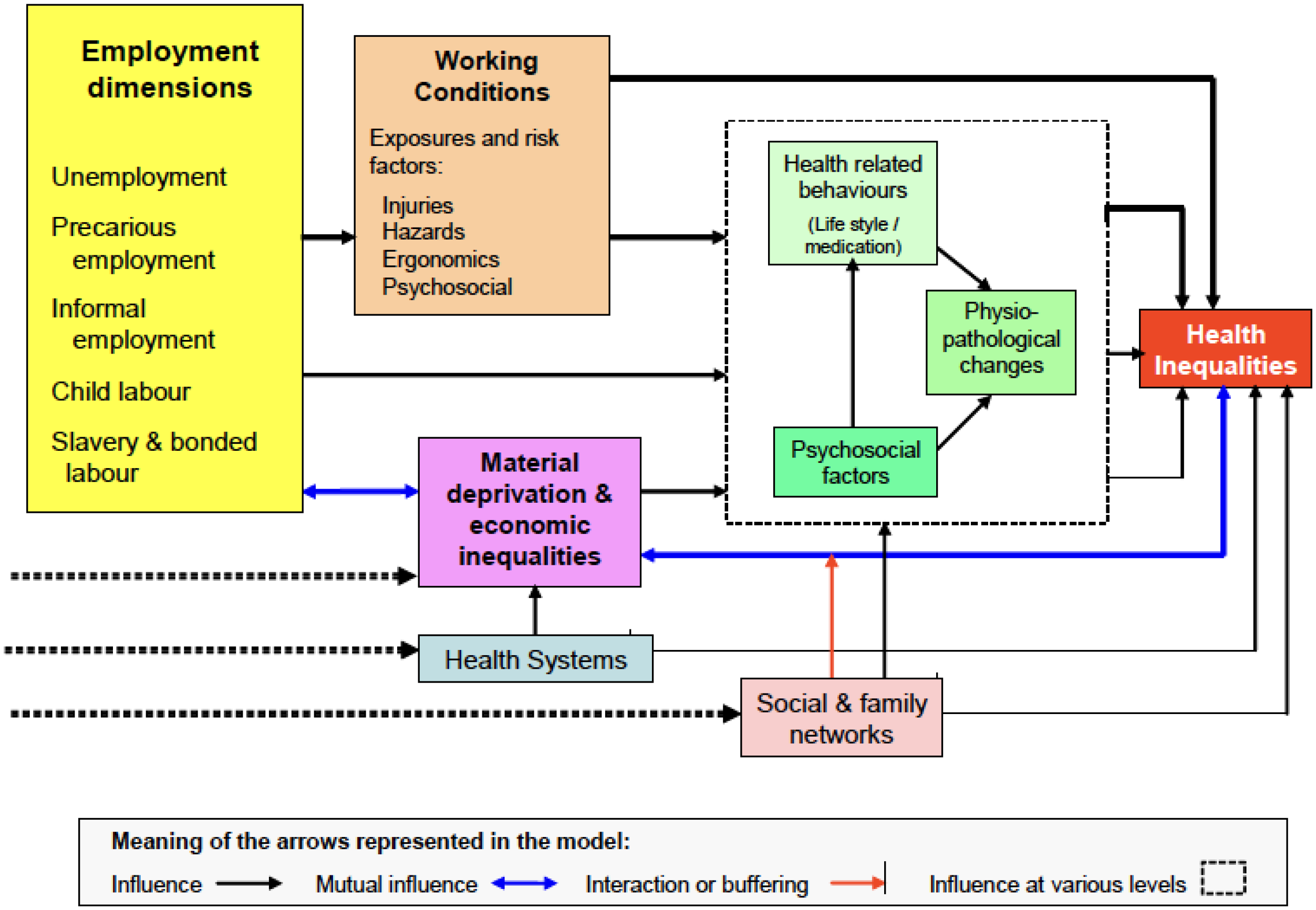
Figure 1 shows the pathways through which the different dimensions of employment and inequalities in workers’ health are related. Workers in low-quality jobs often face greater physical risks, increasing the likelihood of occupational injuries and illnesses (Siegrist Reference Siegrist1996). In addition, exposure to stressful work environments and a lack of control over work can lead to mental and cardiovascular health problems (Marmot et al Reference Marmot, Bosma, Hemingway, Brunner and Stansfeld1997). As far as economic restrictions are concerned, low wages and job insecurity limit access to resources that are essential for health, such as nutritious food, adequate housing, and medical care (Lynch et al Reference Lynch, Smith, Kaplan and House2000). Likewise, the lack of health insurance coverage and the difficulty in affording medicines and medical treatments further aggravate health inequalities. Psychosocial factors such as job insecurity, discrimination, and lack of recognition at work can also lead to chronic stress, anxiety, and depression (Wilkinson and Pickett Reference Wilkinson and Pickett2009). Likewise, these negative psychosocial factors can weaken the immune system and increase vulnerability to disease.
Micro-theoretical relationships of employment and health inequalities.
Source: Benach et al Reference Benach, Muntaner and Santana2007
Workers’ health can also be considered a human capital asset that affects their ability to generate income and participate in the labour market. Workers in good health are more likely to have stable employment, earn higher wages, and enjoy greater labour mobility (Currie and Madrian Reference Currie, Madrian, Ashenfelter and Card1999; Grossman Reference Grossman1972). In contrast, workers with health problems may face difficulties in finding and keeping jobs, which can result in lower participation in the labour market and greater dependence on social assistance programmes (García-Gómez et al Reference García-Gómez, Jones and Rice2010).
Previous evidence
The relationship between employment conditions and the health status of workers has been widely examined in the literature, although results vary depending on methodological approaches, labour market contexts, and workers’ characteristics. Nevertheless, a substantial body of evidence consistently shows that working conditions, particularly job stress, have effects on both mental and physical health. A recent systematic literature review by Hasin et al (Reference Hasin, Johari, Jamil, Nordin and Hussein2023) synthetises contemporary findings and concludes that job stress is consistently associated with negative health outcomes, such as cardiovascular disorders.
Evidence from previous studies reinforces the role of work stress in physical disease. Kivimäki et al (Reference Kivimäki, Leino-Arjas, Luukkonen, Riihimäi, Vahtera and Kirjonen2002) conducted a prospective cohort study of industrial employees in Finland and found that workers with high job strain – defined as high demands and low control – had a 2.2-fold higher risk of cardiovascular mortality compared to those with low strain. Job stress was also associated with increased total serum cholesterol five years later. In a larger meta-analysis, Kivimäki et al (Reference Kivimäki, Virtanen, Elovainio, Kouvonen, Väänänen and Vahtera2006) showed that job strain is associated with a 50% increased risk for coronary heart disease, confirming earlier findings of the literature and establishing job stress as a significant cardiovascular risk factor. Rugulies et al (Reference Rugulies, Framke, Sørensen, Svane-Petersen, Alexanderson, Bonde, Farrants, Flachs, Magnusson, Nyberg, Kivimäki and Madsen2020) examined the long-term effects of persistent and changing job strain on the risk of coronary heart disease in a Danish cohort. The authors found that workers who experienced continuous high job strain had a significantly elevated risk of developing coronary heart disease compared with those consistently exposed to low strain. Importantly, transitions from low to high strain were also associated with increased coronary heart disease risk, underscoring the harmful effects of deteriorating psychosocial working conditions.
The consequences of stress appear to be particularly pronounced among older workers (aged 50 and over). Ageing is associated with diminished physiological reserve, reduced capacity for recovery, and the accumulation of pre-existing health conditions, all of which amplify the impact of work-related stressors. Hannes et al (Reference Zacher, Feldman and Schulz2014) develop a conceptual model and emphasise that older employees exhibit heightened vulnerability to chronic stress, especially in physically or cognitively demanding occupations. Moreover, a meta-analytic review by Ng and Feldman (Reference Ng and Feldman2010) suggests that, although older workers tend to report slightly lower levels of overall work stress – potentially reflecting better job self-selection, greater emotional regulation, or the exit of highly stressed individuals from the labour market – the stressors they do encounter may have more severe psychological and physiological consequences. Consistent with this view, Mc Carthy et al (Reference Mc Carthy, Cronly and Perry2017) found that high quantitative and cognitive job demands significantly increased symptoms of depression and anxiety among older workers (50–69 years) in Southern Ireland. In the same study, greater job control acted as a protective factor, attenuating the adverse effects of these demands. For physical health, von Bonsdorff et al (Reference von Bonsdorff, Kulmala, Törmäkangas, Seitsamo, Leino-Arjas, Nygård, Ilmarinen and Rantanen2014) analysed a cohort of Finnish public sector employees aged 44 to 58 and demonstrated that continuous job strain in midlife predicts longer and more frequent hospitalisations in later life, more than two decades after initial exposure. Similarly, Magnusson et al (Reference Magnusson, Westerlund, Chungkham, Vahtera, Rod, Alexanderson, Goldberg, Kivimäki, Stenholm, Platts, Zins and Head2018) found that chronic job strain among individuals aged 50 to 75 is associated with substantial losses in Healthy Life Expectancy, underscoring the long-term implications of adverse psychosocial work environments.
Beyond job stress, the literature also highlights the role of employment conditions (particularly job insecurity, unstable schedules and part-time or non-standard work arrangements) in shaping health trajectories. However, empirical evidence on part-time employment remains mixed. Some studies suggest that part-time work may be associated with better self-perceived health for certain groups, particularly women with family responsibilities, for whom reduced working hours may facilitate work–life balance (Bartoll et al Reference Bartoll, Cortès and Artazcoz2014). However, other research points to significant health risks. Empirical studies show that job insecurity, reduced autonomy, and limited control over working hours are linked to a higher likelihood of both physical and psychological health problems (Kim and von dem Knesebeck Reference Kim and von dem Knesebeck2015; Rosenthal et al Reference Rosenthal, Carroll-Scott, Earnshaw, Santilli and Ickovics2012; Virtanen et al Reference Virtanen, Kivimäki, Elovainio, Vahtera and Ferrie2003).
Recent institutional evidence further highlights the structural nature of part-time employment in Europe. A substantial proportion of part-time workers report that they would prefer to work more hours, but are unable to do so. This suggests that part-time employment often reflects involuntary or underemployed forms of work, rather than purely individual preferences (Eurofound 2021, 2023; Eurostat 2018; OECD 2024). At the same time, the incidence and implications of part-time employment vary considerably across countries, reflecting differences in labour market institutions, social protection systems, and employment regulation. More recent evidence reinforces these findings (Benach et al Reference Benach, Vives, Amable, Vanroelen, Tarafa and Muntaner2014), showing that precarious forms of part-time employment – characterised by low job security, limited control, and poorer working conditions – are consistently associated with heightened risks of mental and physical health problems.
Despite the existing evidence, significant gaps remain in the literature. Several reviews emphasise that a large proportion of studies on working conditions and health rely on cross-sectional designs, which considerably limits causal inference. Benach et al (Reference Benach, Vives, Amable, Vanroelen, Tarafa and Muntaner2014), Kim and von dem Knesebeck (Reference Kim and von dem Knesebeck2015), and de Oliveira et al (Reference de Oliveira, Saka, Bone and Jacobs2023) explicitly note that the predominance of non-longitudinal evidence makes it difficult to establish the temporal ordering between exposure and subsequent health deterioration. Similarly, while Rosenthal et al (Reference Rosenthal, Carroll-Scott, Earnshaw, Santilli and Ickovics2012) rely on cross-sectional survey data, Manning and Petrongolo (Reference Manning and Petrongolo2008) use panel data, but do not fully address unobserved heterogeneity or potential selection into part-time or lower-quality jobs, which restricts the causal interpretation of their findings.
Moreover, sample limitations are recurrent throughout the literature. Several influential studies – such as Kivimäki et al (Reference Kivimäki, Leino-Arjas, Luukkonen, Riihimäi, Vahtera and Kirjonen2002), based on industrial workers, and Virtanen et al (Reference Virtanen, Ferrie, Singh-Manoux, Shipley, Stansfeld, Marmot, Ahola, Vahtera and Kivimäki2011), using a cohort of British civil servants – draw on samples restricted by occupation or region. Although methodologically rigorous, these designs limit the generalisability of results to broader labour markets or more precarious segments of the workforce. Similarly, Mc Carthy et al (Reference Mc Carthy, Cronly and Perry2017) analyse a sample of older workers recruited through primary care, which constrains generalisability across different occupational groups. Hannes et al (Reference Zacher, Feldman and Schulz2014) also use data derived from selected occupational contexts and age groups, further limiting the extent to which their findings can be extrapolated to the wider labour market. Finally, Ng and Feldman (Reference Ng and Feldman2010) emphasise that substantial sample heterogeneity across studies – particularly regarding gender composition, occupational mix, and job quality – complicates the identification of systematic patterns in the relationship between work stress and health.
A related limitation concerns the restricted geographical scope of many studies and the institutional contexts in which they are embedded. Evidence on the health effects of part-time work, for instance, varies substantially across welfare-state regimes. Baumann et al (Reference Baumann, Cabib, Eyjólfsdóttir and Agahi2022) show that part-time employment in late careers tends to be associated with stable or even favourable health trajectories in social-democratic and corporatist contexts, such as Sweden and Germany, where statutory rights to reduced hours and strong social protections mitigate the risks associated with reduced working time. In contrast, in liberal welfare regimes, such as the United States, part-time trajectories display greater heterogeneity and are more frequently linked to poorer health outcomes, particularly among older workers and women. These cross-national differences underscore that findings derived from country-specific samples – whether from Finland (Magnusson et al Reference Magnusson, Westerlund, Chungkham, Vahtera, Rod, Alexanderson, Goldberg, Kivimäki, Stenholm, Platts, Zins and Head2018; Kivimäki et al Reference Kivimäki, Leino-Arjas, Luukkonen, Riihimäi, Vahtera and Kirjonen2002; von Bonsdorff et al Reference von Bonsdorff, Kulmala, Törmäkangas, Seitsamo, Leino-Arjas, Nygård, Ilmarinen and Rantanen2014), the United States (Rosenthal et al Reference Rosenthal, Carroll-Scott, Earnshaw, Santilli and Ickovics2012), or other distinct institutional settings – may not be readily generalisable to labour markets operating under different welfare-state arrangements or regulatory environments. Consequently, geographical and institutional specificity must be considered when interpreting results on employment conditions and health.
There are also significant concerns about the measurement of health and the validity of key indicators. Many studies rely on self-reported assessments – such as general self-rated health, ad hoc stress measures, or non-validated psychological well-being scales – which raises risks of reporting bias. For instance, Virtanen et al (Reference Virtanen, Kivimäki, Elovainio, Vahtera and Ferrie2003) use self-reported morbidity and job insecurity, and Rosenthal et al (Reference Rosenthal, Carroll-Scott, Earnshaw, Santilli and Ickovics2012) rely on subjective mental health assessments, both of which may reflect stress-related reporting effects. Reviews such as Hasin et al (Reference Hasin, Johari, Jamil, Nordin and Hussein2023) note the lack of standardisation in health assessments, limiting the precision with which specific mechanisms can be identified. Furthermore, Ng and Feldman (Reference Ng and Feldman2010), Kivimäki et al (Reference Kivimäki, Nyberg, Batty, Fransson, Heikkilä, Alfredsson, Bjorner, Borritz, Burr, Casini, Clays, De Bacquer, Dragano, Ferrie, Geuskens, Goldberg, Hamer, Hooftman, Houtman, Joensuu, Jokela, Kittel, Knutsson, Koskenvuo, Koskinen, Kouvonen, Kumari, Madsen, Marmot, Nielsen, Nordin, Oksanen, Pentti, Rugulies, Salo, Siegrist, Singh-Manoux, Suominen, Väänänen, Vahtera, Virtanen, Westerholm, Westerlund, Zins, Steptoe and Theorell2012), and Benach et al (Reference Benach, Vives, Amable, Vanroelen, Tarafa and Muntaner2014) highlight that central constructs – such as work stress, job strain, job quality, and job insecurity – are measured using heterogeneous and non-standardised indicators, thereby hampering comparability across studies and limiting the identification of mechanisms linking employment conditions to health.
In addition to measurement limitations, a key methodological issue in this literature entails identifying causal relationships between employment conditions and health outcomes. Concerns related to endogeneity – such as selection into employment types, reverse causality, and time-varying confounding – have long been recognised in the literature (Ross and Mirowsky Reference Ross and Mirowsky1995; Waldron Reference Waldron1980). In response to these challenges, a growing body of literature has adopted increasingly explicit causal inference frameworks to analyse the relationship between employment conditions and health. For example, Blaikie et al (Reference Blaikie, Eisenberg-Guyot, Andrea, Owens, Minh, Keil and Hajat2023) apply a causal mediation approach to examine the extent to which employment quality mediates educational inequalities in mental health. Similarly, Matilla-Santander et al (Reference Matilla-Santander, Matthews, Gunn, Muntaner, Kreshpaj, Wegman, Néstor, Hernando-Rodriguez, Albin, Balogh, Davis and Bodin2023) use a target trial emulation framework to estimate the causal effect of transitions from precarious to standard employment on mortality outcomes.
Other longitudinal studies have focused more specifically on the issue of selection and reverse causality. Using British panel data, Dawson et al (Reference Dawson, Veliziotis, Pacheco and Webber2015) show that poorer mental health may increase the likelihood of transitioning into temporary employment, highlighting the importance of accounting for health-related selection effects. Pirani and Salvini (Reference Pirani and Salvini2015), using longitudinal data on Italian workers, also examine the relationship between temporary employment and health while accounting for potential endogeneity and employment instability. Likewise, Gibbons and Salkever (Reference Gibbons and Salkever2019) analyse the causal effects of employment on mental health outcomes among individuals with severe mental illness, further illustrating the complexity of identifying causal mechanisms in observational data.
Taken together, these limitations underscore the need for methodologically robust longitudinal analyses, more diverse and representative samples, and greater use of validated or clinically derived health measures. Strengthening these dimensions would substantially improve causal inference and help clarify the pathways through which employment conditions shape health outcomes across the life course and especially among mature workers.
Methodology
Data and study sample
Microdata from six waves over 12 years was retrieved from the European Survey on Health, Aging, and Retirement in Europe (SHARE) (Börsch-Supan et al Reference Börsch-Supan, Brandt, Hunkler, Kneip, Korbmacher, Malter, Schaan, Stuck and Zuber2013). SHARE is a multidisciplinary, longitudinal, and cross-national cohort study for exploring the effects of health, social, economic, and environmental factors in middle and late adulthood. The database collects data from individuals aged 50 or older in 27 countries and is constructed on probability samples. We extracted data from the last six available waves of SHARE: Wave 4 (2011), Wave 5 (2013), Wave 6 (2015), Wave 7 (2017), Wave 8 (2020), Footnote 1 and Wave 9 (2022), observing individuals at six different points in time. These six waves represented the most recently gathered data in the project. The SHARE protocol was approved by the University of Mannheim Ethics Committee and the Max-Planck Society for the Advancement of Science Ethics Committee. The procedures followed the guidelines and ethical standards of the Declaration of Helsinki.
As the target of the study encompasses the active population in the labour market, the sample was restricted to people who presented an employed or self-employed status. Retired people, unemployed people, individuals unable to work, and homemakers were excluded from the analysis. Participants who had missing data on the dependent variables (health outcomes) were also excluded because the literature suggests that the best option is to remove participants with such missing values rather than to impute these values (Colin and Trivedi Reference Colin and Trivedi2022). People who participated in at least three consecutive waves were considered. Analyses were based on 14 countries (Austria, Germany, Sweden, Spain, Italy, France, Denmark, Greece, Switzerland, Belgium, Czech Republic, Poland, Slovenia, and Estonia) and included a total of 2,963 observations.
Variables
Health outcomes
The dependent variables were mental health and chronic conditions.
(1) Mental health. This variable is based on the depressive symptoms of the individual and was measured using the EURO-D indicator of SHARE. This tool is a 12-item scale developed and validated to assess and cross-nationally compare depression symptoms in middle-late age in Europe (Prince et al Reference Prince, Reischies, Beekman, Fuhrer, Jonker, Kivela, Lawlor, Lobo, Magnusson, Fichter, Oyen, Roelands, Skoog, Turrina and Copeland1999). Questions are based on 12 domains: depressed mood, pessimism, suicidal tendency, guilt, sleep, interest, irritability, appetite, fatigue, concentration, pleasure, and crying. The scale’s scoring system is from 0 to 12, with higher scores representing greater depressive symptoms. A score of 4 or more points is considered a case of depression (Prince et al Reference Prince, Reischies, Beekman, Fuhrer, Jonker, Kivela, Lawlor, Lobo, Magnusson, Fichter, Oyen, Roelands, Skoog, Turrina and Copeland1999). The internal reliability of the questionnaire is high, with a Cronbach’s alpha of 0.89 (Castro-Costa et al Reference Castro-Costa, Dewey, Stewart, Banerjee, Huppert, Mendonca-Lima, Bula, Reisches, Wancata, Ritchie, Tsolaki, Mateos and Prince2008).
(2) Chronic conditions. Respondents are asked whether they have, at the time of the interview, a specified chronic condition. The variable used was the total number of chronic diseases the individual declared to have. The list included high blood pressure, diabetes, cancer, lung disease, heart problems, stroke, arthritis, psychiatric disorder, asthma, osteoporosis, high cholesterol, Parkinson’s disease, cataracts, ulcers, and kidney disease. While this approach does not account for differences in clinical severity across conditions, it is widely used in the epidemiological and health economics literature as a standard indicator of multimorbidity, particularly in large-scale survey data (Barnett et al Reference Barnett, Mercer, Norbury, Watt, Wyke and Guthrie2012; Dobrow Reference Dobrow2009; Fortin et al Reference Fortin, Stewart, Poitras, Almirall and Maddocks2012).
Employment conditions
Two variables with information about working conditions were collected. This allowed us to incorporate the environment to which an individual was exposed into the analysis. The type of work was differentiated into full-time or part-time work, with a dummy variable coded 0 and 1, respectively. Job stress was also included. For this variable, we took the summary score of the Karasek Content (Karasek Reference Karasek1979) provided by SHARE. It shows how stressful a respondent’s job is, with higher scores indicating more stress felt by the respondent in their job. This instrument is widely used to measure job content and assess the relationship between working conditions and workers’ health (Bouillon-Minois et al Reference Bouillon-Minois, Trousselard, Mulliez, Adeyemi, Schmidt, Thivel, Ugbolue, Borel, Moustafa, Vallet, Clinchamps, Zak, Occelli and Dutheil2023; Hoang et al Reference Hoang, Corbière, Negrini, Pham and Reinharz2013; La Torre et al Reference La Torre, Barletta, Marte, Paludetti, Faticoni, Barone, Rocchi, Picchioni, Previte, Serruto, Deriu, Ajassa, Campagna, Antonelli and Matroianni2022).
Covariates
Only time-varying covariates were included in the analysis. A justification for this approach is found in Subsection “Statistical and econometric analysis”. These covariates include sociodemographic variables, as well as measures of social relationships and health behaviours. Within sociodemographic variables, data on age and income were collected. The income variable was expressed as the earnings before any taxes and contributions, at the household level. As a measure of social relationships, the loneliness condition of the respondent was included. This variable showed more intra-variability than marital status and is itself strongly linked to both mental and physical health outcomes (e.g. loneliness has been demonstrated as an independent risk factor for morbidity and mortality) (Holt-Lunstad Reference Holt-Lunstad2021; Mushtaq Reference Mushtaq2014). To assess loneliness, SHARE employs the Three-Item Loneliness Scale (TIL) (Hughes et al Reference Hughes, Waite, Hawkley and Cacioppo2004), a shortened version of the Revised UCLA Loneliness Scale (R-UCLA) (Russell et al Reference Russell, Peplau and Cutrona1980). The TIL includes three questions asking how often respondents feel they lack companionship, feel left out, and feel isolated from others. Scores range from 3 to 9, with higher scores indicating greater levels of loneliness. For health behaviours, physical exercise was included. Physical exercise was based on two questions about the weekly frequency of vigorous activity (sports, heavy work) and moderate activity (gardening, walking). This measure was coded 1 if the respondent participated in vigorous or moderate physical activity or exercise once a week or more (‘physically active’); otherwise, it was coded 0.
Statistical and econometric analysis
As we use SHARE microdata from six waves over 12 years, a panel design was applied in the analysis. Using longitudinal data allows us to exploit within-person variation in both work and health indicators over time. All models include individual FE to control for time-invariant unobserved heterogeneity – such as personality traits, genetic predispositions, or baseline job characteristics – that might confound the relationship between working conditions and health. This approach isolates the association between within-person changes in predictors and within-person changes in outcomes over time, providing stronger associational evidence (Colin and Trivedi Reference Colin and Trivedi2022). The fixed effects in the model are eliminated by subtracting the individual means, leading to the mean-difference model:
 $({y_{it}} - \;{\bar y_i})\; = \;({x_{it}} - {\bar x_i})'\beta \; + \;({\varepsilon _{it}} - \;{\varepsilon _i})$
In this sense, our within-type fixed effects model can be expressed as:
 ${Y_{it}}\; = \;{\alpha _i}\; + {\beta _1}{X_{1,it}}\; + {\beta _2}{X_{2,it}}\; + \; \ldots \; + \;{\beta _k}{X_{k,it}} + \;{\upsilon _{it}}$
where Y it is each health outcome, α i is the individual-specific effect (captures everything that is invariant over time for each unit), and X are the regressors that vary over time within each unit and provide information (job stress, type of work, age, income, loneliness condition, and physical activity). Variables such as gender, country, firm size, or industry cannot be included directly (they do not vary and are absorbed by the FE). Based on Equation (2), we implemented two model specifications. First, we estimated basic models, where both the dependent and independent variables were expressed at the time t. These models capture the co-movement between changes in working conditions and simultaneous changes in health, serving as a descriptive exploration of how both aspects evolve jointly over time. Second, to assess temporal ordering, we re-estimated FE models predicting health levels from prior employment conditions between waves. In this specification, health at wave t was regressed on work-related conditions observed at t−1. This specification introduces temporal precedence, as the exposure precedes the measurement of the health outcome, thereby reducing the risk of simultaneity and providing a more robust assessment of temporal ordering (Falkenström et al Reference Falkenström, Solomonov and Rubel2020; Wunsch et al Reference Wunsch, Russo, Mouchart and Orsi2020). In both specifications, the model of depression was estimated using a FE logit model, which exploit within-person variation in binary health outcomes across waves. Coefficients of this logit model were presented as odds ratios (OR). Chronic conditions were modelled with a linear FE model. Footnote 2 Standard errors were clustered at the individual level to account for serial correlation within individuals across waves.
Robustness analyses were conducted by comparing alternative model specifications and examining temporal ordering to assess potential bidirectionality between variables. To explore possible reverse causality and to analyse which link is more plausible (employment conditions→health, or health→employment conditions), we re-estimated the same specification with the dependent and explanatory variables reversed. This approach addresses the concern that individuals in poorer health may be more likely to transition into more precarious employment conditions. In this alternative specification, working conditions are treated as dependent variables, while health indicators serve as explanatory variables. Although the baseline models assess whether changes in working conditions are associated with subsequent health outcomes, the reversed models examine whether changes in health are associated with subsequent changes in working conditions. If the original specification yields statistically significant associations while the reversed specification does not, the results can be interpreted as suggestive of a predominant direction of association (Kroesen and Van Cranenburgh Reference Kroesen, Van Cranenburgh, Potoglou and Spinney2024).
The analytical sample includes 2,963 observations across up to six waves, forming an unbalanced panel that reflects entry and attrition over time. Attrition bias was taken into account. The analysis was restricted to respondents observed in at least three consecutive waves to ensure sufficient within-person variation for the FE estimations and to reduce potential bias due to sporadic participation. Although this restriction improves data consistency and minimises random attrition, selective attrition may remain a concern. In this sense, there could be an accentuation of a composition bias toward healthier individuals, since those in poorer health are more likely to drop out of the panel over time, which could lead to a healthier analytical sample. In other words, even though everyone has participated in at least three waves, the fact that they reached those three already implies a certain selection: we are observing those who survived and stayed longer. As a further robustness check, the initial characteristics (at Wave 4) of this subsample were compared with those of the general sample. By comparing the baseline descriptives of those who remain versus those who leave early, it can be observed whether the individuals who drop out are, for example, sicker, which would confirm the presence of selective attrition bias. All analyses were performed using Stata version 16.0 (StataCorp 2020).
Results
Descriptive results
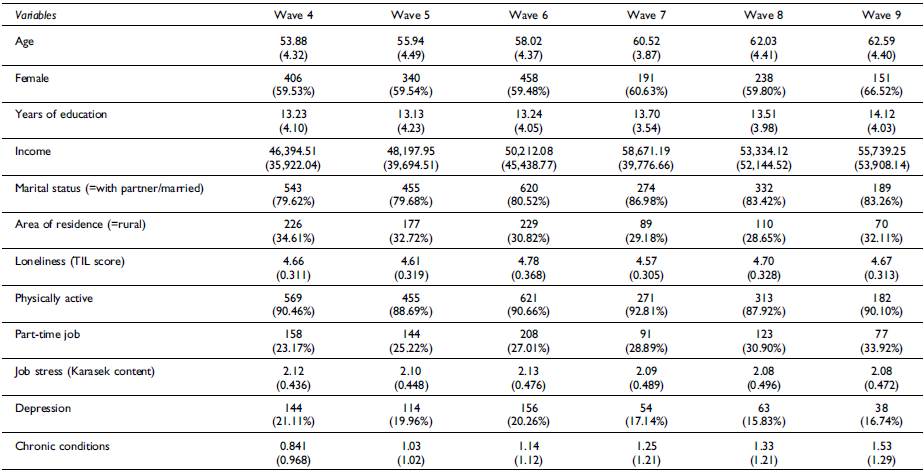
Descriptive statistics in Table 1 were used to explore the sample characteristics. Continuous variables were expressed as means and standard deviations (SDs), and categorical variables were expressed as frequencies and percentages. A total of 2,963 observations were included. At the baseline (Wave 4), more than half were female (59.3%), and the average age of participants was approximately 54 years. On average, respondents reported 0.84 chronic conditions, and 21% were depressed. The mean number of years of education was 13.23, and the average annual household income amounted to EUR 46,394. Regarding employment characteristics, 23.2% of the sample were employed part-time, while the mean job stress score – measured using the Karasek Job Content scale – was 2.12.
Descriptive statistics of the sample
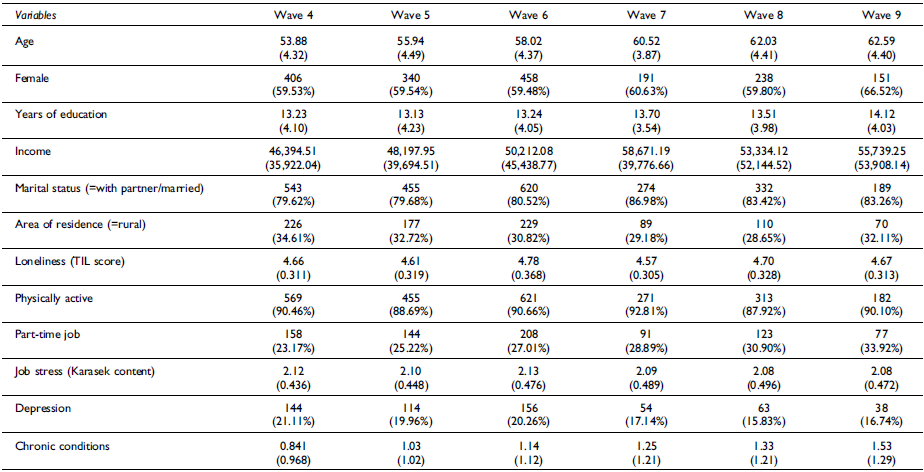
Table 1. Long description
The table presents descriptive statistics of a sample across six waves, detailing various variables. It includes six columns labeled Wave 4 through Wave 9 and rows for different variables such as Age, Female, Years of education, Income, Marital status, Area of residence, Loneliness, Physically active, Part-time job, Job stress, Depression, and Chronic conditions. Each row provides mean values and standard deviations for continuous variables, and frequencies and percentages for categorical variables. For example, the average age increases from 53.88 in Wave 4 to 62.59 in Wave 9. The percentage of females fluctuates slightly, starting at 59.3% in Wave 4 and ending at 65.52% in Wave 9. The mean years of education range from 13.23 to 14.12. Income values are presented in euros, showing an increase from EUR 46,394.51 in Wave 4 to EUR 55,739.25 in Wave 9. Marital status, area of residence, loneliness scores, physical activity, part-time job employment, job stress scores, depression rates, and chronic conditions are also detailed across the waves. Notable trends include an increase in the average age and income over the waves, and variations in the percentages of females, part-time job employment, and depression rates.
Source: Authors’ own elaboration.
Note: Continuous variables were expressed as means and standard deviations (SDs), and categorical variables were expressed as frequencies and percentages.
Fixed-effects (FE) results
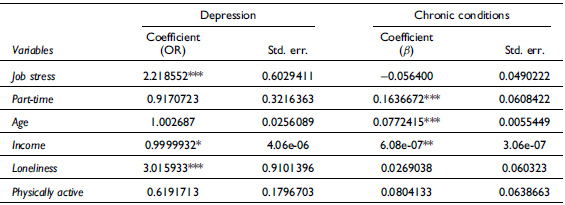
Table 2 shows the effect of working conditions on depression and chronic conditions. Job stress shows a positive and statistically significant effect on the mental health outcome (OR = 2.22, p < 0.01). This indicates that, for the same individual, periods of higher job stress are associated with more than twice the odds of developing depression compared to periods of lower stress. Within this model, the loneliness variable also has a very strong effect (OR = 3.02, p < 0.01), indicating that people who feel lonely are approximately three times more likely to suffer from depression (a result consistent with the health economics literature) (Holt-Lunstad Reference Holt-Lunstad2021; Mushtaq Reference Mushtaq2014). The other variables (part-time work, age, and physical activity) are not significant, suggesting that, once individual heterogeneity is controlled for, their relationship with depression is not that strong.
Estimated contemporaneous effects of employment conditions on health outcomes
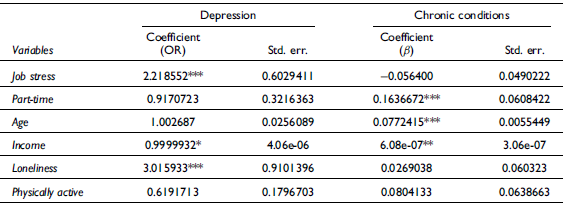
Table 2. Long description
A table comparing the effects of employment conditions on depression and chronic conditions. The table has six rows and six columns. The columns are labeled as Variables, Depression Coefficient (OR), Depression Std. err., Chronic conditions Coefficient (β), and Chronic conditions Std. err. The rows are labeled as Job stress, Part-time, Age, Income, Loneliness, and Physically active. Row 1: Job stress, 2.218552, 0.6029411, -0.056400, 0.0490222. Row 2: Part-time, 0.9170723, 0.3216363, 0.1636672, 0.0608422. Row 3: Age, 1.002687, 0.0256089, 0.0772415, 0.0055449. Row 4: Income, 0.9999932, 4.06e-06, 6.08e-07, 3.06e-07. Row 5: Loneliness, 3.015933, 0.9101396, 0.0269038, 0.060323. Row 6: Physically active, 0.6191713, 0.1796703, 0.0804133, 0.0638663. The table shows the coefficients and standard errors for the effects of various employment conditions on depression and chronic conditions. Notable trends include the strong positive effect of job stress and loneliness on depression, and the significant effect of part-time work and age on chronic conditions.
Source: Authors’ own elaboration.
Note: (*) significant at 90% level; (**) significant at 95% level; (***) significant at 99% level. Coefficients from the depression model are expressed as odds ratios (OR), since the dependent variable is binary and it was modelled as a logit.
Analysing the chronic disease model, it shows that part-time employment is positively and significantly associated with multimorbidity (β = 0.164, p < 0.01). This suggests that, on average, when the individual is observed working part-time rather than full-time, the expected number of reported chronic conditions significantly increases by approximately 0.16. However, job stress is not significant, indicating that contemporary work stress does not appear to be directly associated with the number of chronic conditions reported. Age also has a positive effect (β = 0.077, p < 0.01), which is consistent with the expected pattern of accumulation of chronic conditions with age.
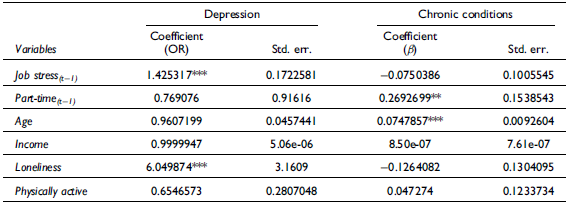
Taken together, these results support the hypothesis that working conditions are related to health outcomes. Specifically, job stress affects mental health, and part-time employment is associated with differences in chronic conditions within individuals over time. Our results also show that work stress is strongly associated with depression, but not necessarily with chronic conditions in the short term. The fact that chronic conditions do not respond significantly to contemporary work stress may reflect their more cumulative and long-term nature, in contrast to mental health, which is more sensitive to current factors in the work environment. This is precisely what we analyse in Table 3, where including temporal precedence reduces the risk of simultaneity and provides a more robust test of directionality. For the mental health model, the first lag of employment conditions (t–1) was used, whereas for the chronic conditions model a two-period lag (t–2) was employed. This distinction is based on the notion that chronic conditions typically develop more slowly and take longer to manifest compared to mental health outcomes. Nevertheless, these lagged specifications should be interpreted as providing evidence on temporal ordering, rather than definitive causal identification.
Estimated effects of employment conditions on health outcomes with temporal precedence
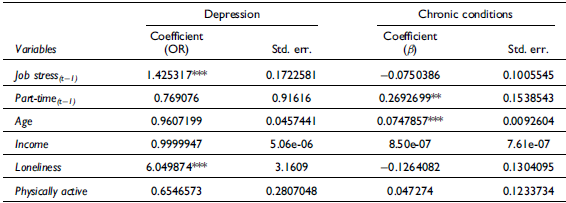
Table 3. Long description
A table comparing the effects of employment conditions on depression and chronic conditions. The table has 6 rows and 6 columns. The columns are labeled as Variables, Depression Coefficient (OR), Depression Std. err., Chronic conditions Coefficient (β), and Chronic conditions Std. err. The rows are labeled as Job stress (t-1), Part-time (t-1), Age, Income, Loneliness, and Physically active. Row 1: Job stress (t-1), Depression Coefficient (OR) 1.425317 ***, Depression Std. err. 0.1722581, Chronic conditions Coefficient (β) -0.0750386, Chronic conditions Std. err. 0.1005545. Row 2: Part-time (t-1), Depression Coefficient (OR) 0.769076, Depression Std. err. 0.91616, Chronic conditions Coefficient (β) 0.2692699 **, Chronic conditions Std. err. 0.1538543. Row 3: Age, Depression Coefficient (OR) 0.9607199, Depression Std. err. 0.0457441, Chronic conditions Coefficient (β) 0.0747857 ***, Chronic conditions Std. err. 0.0092604. Row 4: Income, Depression Coefficient (OR) 0.9999947, Depression Std. err. 5.06e-06, Chronic conditions Coefficient (β) 8.50e-07, Chronic conditions Std. err. 7.61e-07. Row 5: Loneliness, Depression Coefficient (OR) 6.049874 ***, Depression Std. err. 3.1609, Chronic conditions Coefficient (β) -0.1264082, Chronic conditions Std. err. 0.1304095. Row 6: Physically active, Depression Coefficient (OR) 0.6546573, Depression Std. err. 0.2807048, Chronic conditions Coefficient (β) 0.047274, Chronic conditions Std. err. 0.1233734.
Source: Authors’ own elaboration.
Note: (*) significant at 90% level; (**) significant at 95% level; (***) significant at 99% level. Coefficients from the depression model are expressed as odds ratios (OR), since the dependent variable is binary. In the chronic diseases model, employment conditions are lagged two periods (t−2). In the depression model, employment conditions are lagged one period (t−1).
Results from Table 3 show that job stress still has a significant and positive association with the likelihood of poor mental health (OR = 1.42, p < 0.01). This means that, for the same individual, a one-unit increase in the job-stress scale at the previous wave is associated with 42% higher odds of experiencing depression in the subsequent wave. In other words, when an individual reports higher job stress in prior periods, their probability of depression later rises substantially, even after accounting for person-specific and temporal effects. For chronic conditions, although job stress remains statistically non-significant, part-time work continues to show a positive and significant association (β = 0.27, p < 0.05), reinforcing the previous result reported in Table 2. This coefficient indicates that, for the same individual, working part-time two waves earlier is associated with an increase of about 0.27 additional chronic conditions relative to periods of full-time employment, holding constant with all other time-varying characteristics. Considering that the mean number of chronic conditions in the sample is between 0.84 and 1.20 across waves, this effect represents roughly one-third of the sample mean, suggesting a substantively meaningful difference in long-term health status associated with part-time work.
Robustness analysis
To validate the previous estimates, a robustness analysis was carried out, and alternative models were built to explore potential bidirectionality. Table 4 examines the reverse causality hypothesis – that is, whether health outcomes influence subsequent employment conditions. The two dependent variables considered were job stress (estimated with a linear FE model) and part-time status (estimated with a FE logit model). The health regressors were lagged one period (t–1) to capture temporal precedence.
Reverse causality results: effects of health outcomes on employment conditions

Table 4. Long description
A table examining the reverse causality hypothesis, specifically whether health outcomes influence subsequent employment conditions. The table has two main sections: Job stress and Part-time. Each section includes coefficients, standard errors, and variables. The variables considered are Depressive symptoms and Chronic conditions, both lagged one period. For Job stress, the coefficients are 0.0030536 for Depressive symptoms with a standard error of 0.0083735, and -0.0249474 for Chronic conditions with a standard error of 0.0239187. For Part-time, the coefficients are 1.132302 for Depressive symptoms with a standard error of 0.1361157, and 0.8668533 for Chronic conditions with a standard error of 0.2922723.
Source: Authors’ own elaboration.
Note: (*) significant at 90% level; (**) significant at 95% level; (***) significant at 99% level. Coefficients from the part-time logit model are expressed as odds ratios (OR), since the dependent variable is binary.
Analysing job stress, among the health variables, neither depressive symptoms nor chronic conditions significantly predicted subsequent job stress. Regarding part-time employment, none of the lagged health indicators showed significant effects on the probability of being employed part-time. These results highlight that the relationship between employment conditions and health may be purely unidirectional. Our evidence suggests that adverse employment conditions are associated with subsequent health deterioration, consistent with a predominant direction from employment to health.
To assess potential attrition bias, we compared the descriptive statistics of the full sample (Table A1) with those of the subsample, including individuals observed in at least three consecutive waves (Table 1). The mean baseline values of the health outcomes (Wave 4) were almost identical across both groups. This similarity suggests that selective attrition is unlikely to substantially bias the results, as those who remained in the panel do not appear to differ systematically in their health status from those who dropped out earlier.
Discussion and conclusion
This article provides empirical evidence of the association between employment conditions and both mental and physical health outcomes among older workers in Europe. Our findings are consistent with previous research, documenting the detrimental effects of working conditions on workers’ health. Taken together, the literature converges on the conclusion that job conditions constitute a significant risk factor for both short- and long-term health. These results align with established theoretical frameworks, such as the Demand–Control Model (Karasek and Theorell Reference Karasek and Theorell1990) and the Effort–Reward Imbalance model (Siegrist Reference Siegrist1996), which emphasise the role of psychosocial stressors in shaping health trajectories.
Our results reinforce the argument that poor job quality, such as job stress, has tangible and persistent effects on health. Consistent with previous evidence (Hannes et al Reference Zacher, Feldman and Schulz2014), we find that job stress is particularly detrimental to mental health in later working life: older workers exposed to high stress are more than twice as likely to develop depressive symptoms, even after controlling for time-invariant individual characteristics. This finding is particularly relevant in light of national estimates in Spain suggesting that eliminating job insecurity could have prevented approximately 170,000 cases of depression in 2020 (Gobierno de España 2023). Furthermore, our results reveal that part-time employment is associated with a higher number of chronic conditions, echoing earlier studies demonstrating the health risks of certain forms of part-time work (Rosenthal et al Reference Rosenthal, Carroll-Scott, Earnshaw, Santilli and Ickovics2012; Virtanen et al Reference Virtanen, Kivimäki, Elovainio, Vahtera and Ferrie2003). It is important to emphasise that part-time employment is a heterogeneous category whose meaning and implications vary across institutional and labour market contexts. In European settings, differences in welfare regimes, labour market structures, and gender norms may shape both the prevalence of part-time work and the conditions under which it occurs. As a result, part-time employment may reflect voluntary flexibility in certain contexts. However, in others it may be associated with more constrained or precarious arrangements. At the same time, existing evidence suggests that a substantial share of part-time employment in Europe is involuntary or driven by the inability to find full-time work (Eurofound 2021, 2023; Eurostat 2018; OECD 2024). Given this, our results should be understood as capturing an average association of part-time work within the European context, of which involuntary arrangements constitute a significant proportion. Finally, the absence of evidence for reverse causality enhances confidence in a predominant causal pathway running from employment conditions to health, rather than the opposite.
This study makes important contributions to the literature. To our knowledge, it is the first to empirically examine the employment–health relationship using a large, harmonised longitudinal panel covering 14 European countries. By applying individual FE models over a 12-year period, the analysis isolates within-person variation and accounts for unobserved heterogeneity. This improves causal inference relative to previous research which, as reviewed in Subsection “Previous evidence”, has predominantly relied on cross-sectional data or, even when panel data were available, has not adequately addressed unobserved heterogeneity. The inclusion of lagged variables also allows us to examine temporal precedence and to distinguish between contemporaneous and delayed effects, providing new evidence on the long-term dynamics linking employment conditions to chronic health outcomes. Additionally, we expand the scope of existing literature by jointly considering validated indicators of mental health and a wide range of chronic diseases, while also testing for potential bidirectional processes. Unlike much of the previous literature, our mental health outcomes are based on validated instruments, which increases the reliability of the measurements and the accuracy of our estimates. Together, these contributions offer a more comprehensive understanding of how employment quality shapes health trajectories among ageing European workers.
Despite these strengths, several limitations should be acknowledged. To begin with, particular caution must be displayed when interpreting part-time employment. The literature highlights substantial heterogeneity depending on whether part-time work is voluntary or involuntary. Institutional contexts also play a role in this heterogeneity. In some cases, part-time employment may reflect preferences for flexibility, rather than labour market disadvantage. Due to data limitations, we are unable to distinguish between these forms. Therefore, the estimated association should be interpreted as an average effect across different employment situations. While our use of individual FE models partially mitigates this concern – by absorbing time-invariant factors such as persistent preferences for reduced working hours (Wooldridge Reference Wooldridge2010) – we cannot rule out the presence of time-varying selection into different types of part-time work. Nevertheless, in the European context, a substantial share of part-time employment is involuntary or reflects the inability to secure full-time work (Eurofound 2021, 2023; Eurostat 2018; OECD 2024). As a result, our estimates may be more strongly influenced by these constrained forms of part-time employment. The observed relationship may reflect the prevalence of more disadvantaged forms of part-time employment. Future research would benefit from more detailed data that allows for a clearer distinction between voluntary and involuntary forms of part-time employment. It would also be useful to examine how these associations may vary across gender and institutional contexts.
Another factor to consider is how our measurement of multimorbidity based on chronic conditions relies on self-reported information, rather than clinical or medical records. Recall bias or underreporting may be a concern (Althubaiti Reference Althubaiti2016; Stansfeld and Candy Reference Stansfeld and Candy2006). Future studies should combine survey data with administrative or medical records. Moreover, the use of a count of chronic conditions entails equal weighting across diseases and does not capture differences in severity, which should be considered when interpreting the results. While the individual FE model effectively controls for time-invariant unobserved heterogeneity, it does not eliminate all sources of endogeneity, particularly those arising from time-varying unobserved confounders. Although our models include a set of theoretically grounded, time-varying covariates, the possibility of residual confounding cannot be fully ruled out. Accordingly, our results should be interpreted as providing strengthened – rather than definitive – causal evidence.
Our analyses explored potential reverse causality and found evidence consistent with a dominant employment-to-health direction. Nevertheless, future studies should apply models explicitly designed to capture bidirectional effects and assess whether similar patterns are held in other contexts. By replicating the analysis using alternative datasets in different institutional or cultural contexts, a crucial step would be taken in assessing the robustness and external validity of the findings. Finally, because the sample focuses on European populations, our findings may not be generalisable to other geographical contexts, particularly those with different welfare regimes, labour regulations or healthcare systems.
Overall, our findings highlight the central role of employment quality in shaping health trajectories in later life. As working lives are extended, ensuring that employment conditions remain supportive of both physical and mental well-being becomes increasingly important. Poor-quality or highly stressful jobs are associated with adverse health outcomes and may undermine the capacity of older workers to remain active in the labour force. These results underscore the importance of policies aimed at improving job quality, including interventions that reduce psychosocial risks, enhance job security, and promote supportive working environments. In this context, improving employment conditions is not only a matter of individual well-being but also a key element for sustaining labour market participation and the long-term viability of social protection systems in ageing societies.
Supplementary material
The supplementary material for this article can be found at https://doi.org/10.1017/elr.2026.10079.
Data availability statement
The SHARE data are available for scientific research after registration at www.share-project.org.
Funding statement
This work was supported by the Chair of Family Business and Grupo de Investigación Jean Monnet de Competencia y Desarrollo at the University of A Coruña.
Competing interests
None.




 Open access

