



Psychiatry is currently grappling with profound conceptual and practical challenges around diagnosis, formulation and treatment, particularly in relation to neurodevelopmental conditions such as attention-deficit hyperactivity disorder (ADHD) and autism spectrum disorder (ASD). Reference Szymaniak, Bell, Shivakumar and Malhi1,Reference Cortese, Daley, Hollis, Rae, Ani and Asherson2,Reference Baron-Cohen3,Reference Amass4 Recent debate in the media has amplified professional uncertainty about the nature of these conditions, their boundaries with normal variation and their appropriate place within psychiatric practice. Some have argued for greater diagnostic equity, where stigmatising diagnostic labels (e.g. ‘autistic’) are corrected with morally neutral neurobiological terminology ‘mirroring the intricate fabric of the human brain’. Reference Arjmand, Guldager and Wegener5 This editorial argues that many of these dilemmas arise from the erosion of a diagnostic hierarchy and that rethinking this would bring greater clarity to clinical decision-making, ethical reasoning and, ultimately, to health policy.
Historically, psychiatric formulation has been guided, explicitly or implicitly, by a hierarchy that prioritises: first, organic disorders; second, substance-related conditions; third, major psychoses and mood disorders; fourth, common mental disorders; and, finally, personality and behavioural variants. Although never absolute, this hierarchy (seen for example in DSM-III and ICD-10) provided a framework for determining diagnostic precedence, treatment urgency and degrees of personal responsibility. Its gradual displacement by flatter, checklist-based diagnostic systems has emphasised diagnostic reliability but at the expense of meaning, resulting in reductionist diagnostic lists that also fail to contextualise the lived experience of the person. Reference Mai6
ADHD and the problem of diagnostic elevation
ADHD is a diagnosis that is vulnerable to over-elevation in this hierarchy because of how its neurodevelopmental aetiology is understood. However, placing ADHD within ‘organic disorders’ exemplifies how hierarchical thinking can be misapplied and create clinical paradoxes.
Should ADHD be prioritised over other psychiatric conditions? One scenario involves those with a history of ADHD who develop psychotic symptoms while taking stimulants (see Case 1). Reference Gudbrandsdottir, Sigurdsson, Albertsson, Jonsdottir and Ingimarsson7
Case 1
A 35-year-old woman, with a son and a sister already diagnosed and treated for ADHD, seeks out the diagnosis for herself and starts stimulants. After a 6-month period she develops emerging psychotic symptoms, including a belief that she is being monitored by cameras in her home. Now, the referring doctor and patient believe she is developing, in addition, a primary affective psychosis requiring the prescription of an antipsychotic medication under a general psychiatrist. When stopping the stimulant is proposed as a first and necessary step to rule out a drug-induced psychosis the patient disagrees, disengages and is referred elsewhere.
Rather than stimulant withdrawal being treated as the primary intervention, which would be consistent with standard psychiatric reasoning, the clinician feels pressured to maintain the treatment on the basis that ADHD is an underlying ‘organic’ condition requiring ongoing management and that antipsychotic treatment should be added as a secondary measure. This inversion of clinical priorities risks diagnostic confusion and patient harm.
Diagnostic confusion may arise in other ways. A lack of differential diagnostic thinking allows the concept of ADHD to expand at the expense of clinical holism. In a second scenario, worsening symptoms of inattention in a child with ADHD become misevaluated (see Case 2).
Case 2
A 13-year-old boy with ADHD fractures his elbow trying to ascend a high wall. Orthopaedic surgery requires internal fixation with a plate which the boy finds painful and difficult. Over 3 months his attention, impulsivity and conduct worsen and he becomes increasingly irritable and aggressive to his parents. The dose of ADHD medication is increased, while the boy is referred to a psychological trauma programme and his parents to a non-violent resistance course. After 3 months his elbow wound bursts, releasing pus. The metal plate is removed and the boy receives antibiotics for osteomyelitis. The elevated inattention, impulsivity symptoms and conduct problems disappear and he returns to his behavioural baseline.
Rather than attend carefully to the history and mental state examination in the process of making a differential diagnosis, there is ADHD diagnostic overshadowing of a more basic psychiatric syndrome (delirium). This generates spurious biopsychosocial treatments.
Within a diagnostic hierarchy, such dilemmas are more readily resolved. In Case 1, psychosis, regardless of context, represents a major mental illness that demands immediate attention. Substances and medications that can precipitate or exacerbate this presentation must be addressed first, with the psychotic phenomenology subsequently carefully assessed. ADHD can be re-evaluated once the acute condition has stabilised. In Case 2, we see that the ADHD symptoms of inattention and impulsivity have a differential diagnosis. Any significant change in mental state should be assessed using holistic clinical methods, and not ensnared or overshadowed by ADHD or a view that diagnoses are equally placed problems.
This approach neither denies the reality of ADHD nor minimises patient distress; rather, it restores proportionality to the diagnosis and safety to clinical reasoning.
Heterogeneity in autism and the need for stratification
Similar issues arise in relation to autism. The broadening of ASD diagnostic criteria has increased recognition and support but has also obscured important clinical distinctions.
Children or adults with autism spectrum diagnoses can face confusing choices about whether or not to regard their identities as disabilities.
Case 3
A 14-year-old schoolgirl experiences exam anxiety impairing her ability to perform, and she also struggles with social anxiety when in groups of her peers. She functions well in one-to-one relationships and in her academic work. Her school wishes to support her and asks her parents to seek an autism spectrum diagnosis to enable resources to be released via an Education Health and Care Plan. The girl and her parents see her difficulties as personality traits that wax and wane and are unsure whether she fits the broader diagnosis of ASD. However, they feel forced to pursue a diagnostic route to gain access to educational support that would not otherwise be forthcoming.
In this scenario, a personality or constitutional variation with an environment mismatch that requires some help is being inappropriately framed as a neurological condition, or as a problem needing no help at all.
Baron-Cohen and Frith Reference Baron-Cohen3,Reference Amass4 have recently proposed distinctions between kinds of autism that articulates a concern long familiar to clinicians: that the autism spectrum encompasses individuals with profoundly different needs, capacities and prognoses. Baron-Cohen proposes a ‘type 1’ autism that broadly corresponds to classic autism and is often associated with significant intellectual disability, language impairment, epilepsy and identifiable genetic or other neurological conditions. ‘Type 2’ autism (or what in part Frith calls ‘sensitivity’), by contrast, describes individuals without intellectual disability, often diagnosed later in life, whose difficulties lie primarily in social communication, sensory processing and cognitive style.
Neurodevelopmental conditions and personality variation
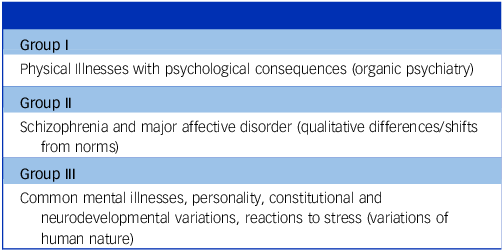
This grouping has important implications for psychiatric practice. If much of ADHD and ‘type 2’ autism/‘sensitivity’ can be conceptualised like personality or constitutional variants (representing spectra of stable patterns of attention, cognition and social relating, interacting with environmental demands over a life course), then we need to stratify kinds of neurodevelopmental disorder. The stratification that has been taught since the time of Jaspers and Schneider (see Table 1) can be updated to our current challenges. Reference Owen8 Its basic structure is very simple. There are three levels of diagnostic kinds, with the third level (group III) representing variations of human nature where no clear demarcations between normality and abnormality can be expected. By contrast, the first level (group I) represents conditions where more basic levels of mind/brain organisation are disordered and where it is possible to speak of brain diseases or brain syndromes distinct from (rather than variant from) normality.
Diagnostic hierarchy (adapted from Jaspers/Schneider)

Table 1 Long description
A textbox containing the following text: This grouping has important implications for psychiatric practice. If much of ADHD and type 2 autism/sensitivity can be conceptualised like personality or constitutional variants (representing spectra of stable patterns of attention, cognition and social relating, interacting with environmental demands over a life course), then we need to stratify kinds of neurodevelopmental disorder. The stratification that has been taught since the time of Jaspers and Schneider (see Table1) can be updated to our current challenges. Its basic structure is very simple. There are three levels of diagnostic kinds, with the third level (group III) representing variations of human nature where no clear demarcations between normality and abnormality can be expected. By contrast, the first level (group I) represents conditions where more basic levels of mind/brain organisation are disordered and where it is possible to speak of brain diseases or brain syndromes distinct from (rather than variant from) normality.
Note that Table 1 is not a gradation of severity and it is not a restriction of biological causes to group I (biological causation can apply across the groups). Furthermore, the scheme does not render group III undeserving of support or clinical attention. Indeed, a presentation of a neurodevelopmental disorder at this level can be severe and a failure to grasp a group III diagnosis can result in poor clinical management and outcome. Rather, it places diagnosis appropriately within a stratification of diagnostic kinds, where a group III formulation emphasises psychological understanding, environmental adaptation, skills development and meaning-making over medical ‘cure’ or long-term pharmacological intervention.
Clinical and ethical practice, with policy implications
Re-establishing a diagnostic stratification offers several advantages. It improves clinical management and safety by clarifying which conditions are closer to basic levels of mind/brain organisation (e.g. dementia, delirium, Rett syndrome – all group I disorders) and which kinds of interventions should be prioritised. Ethically, it supports more consistent reasoning about autonomy, responsibility and mental capacity. From a policy perspective, it helps differentiate conditions that require intensive medical and multidisciplinary social support from those often better addressed through education and employment adaptation, alongside community-based interventions.
Importantly, recognising forms of ADHD and ‘type 2 autism’/‘hypersensitivity’ as personality or constitutional variants does not imply neglect. These variants can cause significant suffering, especially when there are additional stressors. They call for thoughtful, sustained interventions. Fostering good habits, self-knowledge and realistic self-expectations should be a part of this, with the thoughtful selection of environments to reduce person–environment mismatch. Psychological therapies can be helpful. Medication can be judiciously used for both symptom relief and associated morbidities where there is demonstrable impairment. A central aim is to promote agency rather than dependency.
Reflections on the diagnostic hierarchy
The current uncertainties surrounding ADHD and autism are not just technical or local diagnostic controversies: they reflect a deeper conceptual debate within psychiatry about stratification of diagnosis in general. The diagnostic hierarchy needs to be rethought as a practical tool for structuring differential diagnosis that helps clinicians navigate complexity without losing proportion. The number of levels within the hierarchy, the relationships between them and how discrete they are, are matters for clinical conceptual analysis and further research. However, by re-establishing a new model of diagnostic stratification we may improve formulation, clarify rights and responsibilities, safeguard patients and make better decisions about treatment. Psychiatry needs more knowledge of causal factors and it may need fewer diagnoses, but first it needs better structured clinical diagnostic thinking.
Author contributions
All authors contributed to the writing and editing of this editorial.
Funding
This research received no specific grant from any funding agency, commercial or not-for-profit sectors.
Declaration of interest
None.



eLetters
No eLetters have been published for this article.