




No CrossRef data available.
ON THE UPPER FIRST-EXIT TIMES OF COMPOUND G/M PROCESSES
Published online by Cambridge University Press: 22 June 2005
Abstract
For a compound process with exponential jumps at renewal times, we determine, in closed form, the density of the first time an upper linear boundary is crossed. It is shown how simple formulas for the Laplace transform and the first two moments can be directly derived from this density.
Information
- Type
- Research Article
- Information
- Probability in the Engineering and Informational Sciences , Volume 19 , Issue 3 , July 2005 , pp. 397 - 403
- Copyright
- © 2005 Cambridge University Press
1. INTRODUCTION
Let

be two independent and identically distributed (i.i.d.) sequences of positive random variables, where the Xn have the common distribution function F and the En are exp(λ) distributed. Let

. We consider the compound G/M process

and its upper first-exit time

In [4], the following identity for the Laplace transform of TU(β) was derived:

where Sn = X1 + ··· + Xn. In this article, we present an alternative approach, leading to a direct formula for the (possibly defective) density ψ(t|β) of TU(β). There seems to be no closed-form result on this density in the literature. The following theorem fills this gap.
Theorem. Let F have the density f on [0,∞). The nth convolution of f with itself is denoted by f*n. Let

TU(β) has the density

h(·; t) is, of course, the density of Y(t) on (0,∞); formula (1.2) represents ψ(t|β) as a weighted convolution of h(·; t + β) with f.
First-exit problems for compound processes continually attract much attention due to their importance in queuing theory, insurance mathematics, sequential analysis, and related fields. For example, TU(β) can be viewed as the ruin time of the surplus process of an insurance with premiums arriving continuously at unit rate, initial capital β, and exponentially distributed claims made at renewal times. In the compound Poisson case, elegant results for the corresponding boundary crossing times have recently been obtained in [6,7,8,9]; see also [5], for more references, and the monograph [1].
The proof of (1.2) is based on a reflection argument and Kendall's formula for lower skip-free Lévy processes (see [2, p.66, Thm.1] and the recent proof in [3]). In [10], a companion formula for the density of TU(β) in the compound Poisson case has been derived.
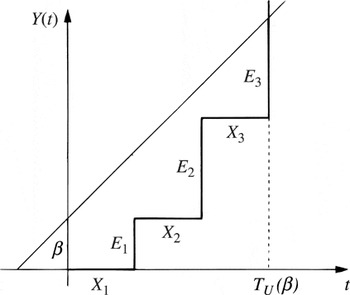
In Figure 1 a typical sample path of Y is depicted in which the first jump (at time X1) does not cross the upper boundary.

Y stopped at TU(β).
The theorem is proved in Section 2. The explicit result for the density can be used to give an alternative proof of the Laplace transform formula (1.1) and also to derive the first moments of TU(β) in the case λE [X1] < 1. This is carried out in Section 3.
2. PROOF OF THE THEOREM
Conditional on X1, we have almost surely

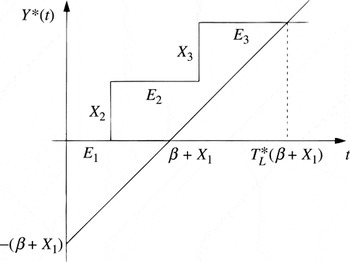
Consider the compound Poisson process Y*(t), t ≥ 0, with jump times E1,E1 + E2,E1 + E2 + E3,… and jump sizes X2,X3,…. The corresponding lower first-exit time is denoted by TL*(β) = inf{t ≥ 0|Y*(t) = −β + t}. A little reflection shows that

see Figure 2.

Y* stopped at TL*(β + X1).
By Kendall's formula, the density of TL*(β + X1) on (β + X1,∞), conditional on X1, is

Thus, the conditional density of TU(β), given X1, is

Deconditioning, we obtain (1.2).
3. LAPLACE TRANSFORM AND MOMENTS OF TU(β)
We now show how (1.1) can be directly deduced from our formula for the density. By (1.2), we have, for every ξ ≥ 0,

The first term on the right-hand side of (3.1) is equal to e−λβE(e−(ξ+λ)S1), which is the summand in the series (1.1) for n = 1. Now, let

. The second term on the right-hand side of (3.1) can be transformed as follows:

where the last equality follows from symmetry. The right-hand side of (3.2) is the same as the sum on the right-hand side of (1.1) minus its first term. This yields (1.1).
Let us now assume that ρ = λE [X1] < 1. This implies that TU(β) is almost surely finite; in fact, E [TU(β)k] < ∞ for all

. These moments can also be computed directly from the density (1.2). First, let k = 1. By (1.2),

Since ψ(t|β) is a proper density, integrating (1.2) yields

where

is the Laplace transform of X1. By (3.2),

Furthermore,

Formula (3.6) of [10] gives

Therefore, by (3.3)–(3.5),

where μ = E [X1]. By (3.1) and (3.6), we finally obtain

The second moment E [TU(β)2] can be computed similarly. Start from

The second integral in (3.10) can be written as

The last two double integrals on the right-hand side of (3.11) are given by (3.8) and (3.4). The first one is equal to

By [10], the inner integral in (3.12) is given by

where μ2 = E [X12]. Combining all these calculations, we arrive at

Instead of using our density formula, the moments can also be derived by standard martingale arguments as follows. Let

, and ν = inf{n ≥ 1|Zn ≥ β}. Then TU(β) = Sν. Clearly, φ(s) = E(esZ1) < ∞ for s < λ, and Mn = esZnφ(s)−n, n ≥ 0, is a martingale. As E(Z1) > 0, the stopping rule ν is almost surely finite and has finite moments of all orders. Since the Ej are exponential, the overshoot Zν − β is exp(λ) distributed and independent of ν. The optional stopping theorem yields

that is,

Now, we can immediately get E(ν) by taking the derivative of the last equation, yielding

and then setting s = 0. We obtain

Therefore, by Wald's equation,

Finally, E(TU(β)2) = E(Sν2) can be found using the martingale

.
References
REFERENCES
Asmussen, S.
(2000).
Ruin probabilities. Advanced Series on Statistical Science and
Applied Probability Vol. 2.
Singapore:
World Scientific.CrossRef
Borovkov, K. &
Burq, Z.
(2001).
Kendall's identity for the first crossing time
revisited.
Electronic Communications in Probability
6:
91–94.Google Scholar
Perry, D.,
Stadje, W., &
Zacks, S.
(1999).
Contributions to the theory of first-exit times for some compound
processes in queueing theory.
Queueing Systems
33:
369–379.Google Scholar
Perry, D.,
Stadje, W., &
Zacks, S.
(2002).
Hitting and ruin probabilities for compound processes and the cycle
maximum of M/G/1.
Stochastic Models
18:
553–564.Google Scholar
Picard, P. &
Lefèvre, C.
(1994).
On the first crossing of the surplus process with a given upper
barrier.
Insurance Mathematics and Economics
14:
163–179.Google Scholar
Picard, P. &
Lefèvre, C.
(1998).
The moments of ruin time in the classical risk model with discrete
claim size distribution.
Insurance Mathematics and Economics
23:
157–172.Google Scholar
Picard, P. &
Lefèvre, C.
(1999).
Corrigendum to: The moments of ruin time in the classical risk model
with discrete claim size distribution.
Insurance Mathematics and Economics
25:
105–107.Google Scholar
Picard, P. &
Lefèvre, C.
(2001).
On the probability of (non)-ruin in infinite time.
Scandinavian Actuarial Journal,
148–161.CrossRef
Stadje, W. &
Zacks, S.
(2003).
Upper first-exit times of compound Poisson processes
revisited.
Probability in the Engineering and Informational Sciences
17:
459–465.Google Scholar
Y stopped at TU(β).
Y* stopped at TL*(β + X1).
 You have
Access