



1. Introduction
The claim that predication relations are established uniformly within the syntactic context of clausal structure has been central (although not undisputed)Footnote 2 to work in generative grammar. According to Chomsky (Reference Chomsky1981: 29–30), this claim follows from the Projection Principle, which insists that lexical properties must be satisfied in the same way at all levels of representation. One reason, among others, why such a view may be considered desirable is the simplicity it confers upon the syntax–semantics interface: Meaning maps transparently into syntactic structure in that the same semantic relation (of predication) always maps onto the same syntactic, configurational relation.Footnote 3 The specific construction discussed in this article presents a difficulty for this view since it involves two phrases in a semantic, but not syntactic, subject–predicate relation. This discussion concerns the syntax of the predication relation established between Mary and his best friend in sentences like the following, involving the verbs see-in and find-in.Footnote 4
(1) John sees/finds [PP in [DP Mary]] [DP his best friend].
Modern Hebrew has an identical construction that involves the verbs ra'a-bé ‘see-in’, maca-bé ‘find-in’, shown in (2) below. The argument advanced here holds equally for the Hebrew construction. Unless specified otherwise, the reader may take all empirical observations made here with regard to the English see-in construction as valid also for the corresponding construction found in Hebrew.Footnote 5
(2) Dan ra'a/maca [PP bé [DP Dina]] [DP xavera tova].
Dan saw/found in Dina friend good
‘Dan saw/found in Dina a good friend.’
As shown by the brackets in (1) and (2), the main verb in these sentences is followed by two phrases: a PP headed by the preposition in/bé and a DP. In both sentences it is the DP embedded within the PP (i.e. Mary/Dina) which is semantically construed as subject of the following predicate DP (his best friend/xavera tova).
2. Predication
The predicative nature of the second DP and of the construction as a whole, is evident, first of all, from the overall understanding of sentences like (1) and (2): A simple paraphrase of (1) is John considers Mary his best friend. Clearly, if the second DP in (1) is used as a predicate then it cannot be referential. Indeed, unlike e.g. his best friend in His best friend visited me yesterday, this DP in (1) is clearly non-referential.
Additional evidence in favor of viewing the see-in construction in (1)–(2) as involving predication comes from contrasts like that in the following Hebrew example.
(3) [Dani] roé[bé-Dinaj][et ha-‘oyev ha-gadol bé-yoter šel *acmoi/acmaj].
Dan.masc sees in-Dina.femacc the-enemy the-big most ŠEL himself/herself
‘Dan sees in Dina *his own/her own worst enemy.’
Being the subject of predication, Dina in (3) induces an opacity effect as a result of which binding of acmo ‘himself’ by Dan becomes impossible. Such an effect is absent in a sentence like (4), which involves no predication relation and is identical to (3) in terms of constituent linear order of (i.e. DPSubj – V – PP – DP).Footnote 6
(4) [DP Dani] siper [PP le-Dina] [DP et kol ha-sipurim al acmoi].
Dan told to-Dina acc all the-stories about himself
‘Dan told Dina all the stories about himself.’
In making our claim regarding (1)–(2) as involving predication, we have to acknowledge the fact that the form see-in can also be employed in sentences which do not involve a relation of predication between the two relevant DPs. The example in (5) is useful as an illustration of this point.
(5) John sees in Mary (a) true genius.
While the DP a true genius can be used to refer to an individual who happens to have the property in question (i.e. being a genius), the DP true genius can only refer to the property itself and not to the individual. Consequently, when it comes to predicating this property of some individual, only a true genius, but not true genius, can be used:
(6) Mary is *true genius/a true genius.
It follows that a sentence like John sees in Mary true genius, although perfectly acceptable, could not be viewed as involving a predication relation between Mary and true genius. This (non-predicative) way of employing see-in comes out much more sharply in a sentence like (7).
(7) John sees in Mary (only) her good properties/qualities (and ignores the bad ones).
Clearly, a DP like (only) her good properties/qualities could not possibly be viewed as predicated of Mary in (7) (compare *Mary is (only) her good properties/qualities). It follows that the possibility of a non-predicative use of see-in must be admitted. However, my claim is that certain DPs – although certainly admitting a non-predicative use (like any DP) – fit into the relevant position in the see-in construction much more naturally and easily as predicates than as non-predicates. DPs such as his best friend or the Hebrew xavera tova ‘a good friend’ seem to be good examples of this kind: When embedded within the see-in construction in the relevant position, they rule out a non-predicative construal. Therefore, when such DPs occur in the see-in construction, this construction is construed as involving a predication relation. A clear implication of this overall picture is that examples like the following should be highly infelicitous.
(8)
(a) #John sees in Mary [many good qualities and his best friend].
(b) #John found in Mary [a good friend and good qualities].
The rather extreme strangeness of (8a–b) is the effect of a clash between the two ways of employing see-in/find-in, each of which being imposed, or strongly favored, by one of the two DPs coordinated in the bracketed position. Specifically, while his best friend/a good friend strongly favors a predicative construal within the see-in construction, the DP (many) good qualities is only compatible with a non-predicative construal in the context of this construction. Since the most plausible account of what is wrong in such cases is the one based on the idea of a clash between two ways of employing see-in/find-in, the phenomenon attested in (8a–b) provides further evidence in favor of the view that in sentences like (1) or (2) this verb does indeed give rise to a relation of predication between the two relevant DPs. In other words, if no predication were involved, a clash of the kind observed in (8a–b) would be unexpected.
As (9a–b) show, the effect of conflict between the two ways of employing ra'a-bé ‘see-in’ is just as sharp in the corresponding Hebrew sentences.
(9)
(a) #Dan ro’é bé Dina (harbé) txunot tovot ve xavera tova.
Dan sees in Dina many qualities good and friend good
‘#Dan sees in Dina many good qualities and a good friend.’
(b) #Dan ro’é bé Dina xavera tova ve (harbé) txunot tovot.
Dan sees in Dina friend good and many qualities good
‘#Dan sees in Dina a good friend and many good qualities.’
It follows from the above that the unacceptability attested in (8)–(9) depends on the nature of each of the coordinated DP in the position of the second complement of see. Thus, (10) below is fairly acceptable despite the fact that the DP a husband for Jane is compatible with a predicative construal, as shown in (11a).
(10) Mrs Bennet saw in Bingley a husband for Jane and the possibility of advancement for the whole family.
(11)
(a) I consider Bingley a husband for Jane.
(b) *I consider Bingley the possibility of advancement for the whole family.
The explanation offered here for this fact is that a husband for Jane is more flexible than his best friend/a good friend and allows for a non-predicative construal in the context of the see-in construction. Consequently, it can be conjoined with the possibility of advancement for the whole family which, as (11b) shows, is generally compatible only with a non-predicative construal.Footnote 7
I thus conclude that simple see-in/find-in sentences such as (1) and (2) involve a predication relation between the DP complement of in (construed as the subject of predication) and the DP that follows it.
3. Against a clausal analysis of the predicative see-in construction
In what follows, I argue that the PP and the DP following see/find in the predicative constructions manifest syntactic properties characteristic of complements. Given the correctness of this claim, the two DPs that are semantically related as subject and predicate cannot be viewed as forming a clausal structure. I will consider first the PP and then the DP.
Beginning with the PP (i.e. in Mary in (1)), one relevant piece of evidence is the fact that this phrase involves the preposition in (or the Hebrew bé ‘in’ in (2)) as the only admissible choice of preposition after the verb see. The restriction illustrated in (12), by which other locative prepositions are ruled out, is an instance of subcategorization imposed by the verb.Footnote 8
(12) *John sees on/at/about Mary his best friend.
An additional insight into the nature of the preposition in/bé in this construction can be gained through a comparison with the English think-of construction discussed by Williams (Reference Williams1980). As Williams observes with regard to examples like (13), there is good reason to think that in this sentence ‘think-of has been reanalyzed as a complex verb’ (Williams Reference Williams1980: 204).
(13) John thinks of Bill as silly.
In support of this claim, Williams offers the following examples:
(14)
(a) Bill was thought of ___ as silly.
(b) Who do you think of ___ as silly?
(c) *Of whom do you think ___ as silly?
As (14a–c) show, in predication structures that involve displacement of the understood subject, the form of may remain in place, thus giving rise to the phenomenon known as ‘preposition stranding’, as in (14a–b). In fact, the form of not only may, but actually must, remain in place, as shown by (14c). Williams’ (Reference Williams1980) suggestion that the two forms think and of have been ‘reanalyzed as a complex verb’ provides a plausible account of this fact.Footnote 9 As the examples in (15) demonstrate, the case of see-in/find-in is radically different.
(15)
Specifically, the form in in this construction is, undoubtedly, syntactically and morphologically, an entity independent of the verb see/find and so, unlike with think and of above, there is no reason to regard see/find and in as reanalyzed as a complex verb. Clear indication to this effect is provided by (15c), where in and the following DP form a constituent which undergoes movement. The ungrammatical (15a, b), on the other hand, are cases where the preposition in is stranded due to the fronting of its complement.
Finally, that in and Mary in (1) form a constituent is also demonstrated by (16), where these two items have undergone rightward movement. Think-of in (17a, b) contrasts with see-in/find-in with regard to the admissibility of such movement.
(16) John sees/finds his best friend [in Mary].
(17)
(a) I think [of John] as a good friend.
(b) *I think as a good friend [of John].
There is thus another reason to think that, unlike think-of, the see-in construction does not involve reanalysis. Rather, being syntactically and morphologically an independent entity, the form in is a lexically selected head of a PP complement of see/find.Footnote 10 The DP complement of in (or bé) is construed as subject of the following predicate DP, in violation of the well-known c-command constraint on predication (Williams Reference Williams1980: 203–204).
The main potential analysis of the see-in construction that we wish to rule out can be represented as in (18a), where [Mary] and [his best friend] from a (small) clause.
(18)

Given the evidence considered so far, one major shortcoming of (18a) is that in this structure the preposition in and the DP Mary do not form a constituent. However, as the examples in (15c) and (16) above indicate, the see-in construction certainly involves such a constituent as part of its structure. An alternative analysis of this construction that does involve such a constituent is (18b). However, (18b) is inadequate because it represents the PP in Mary as internal to a (small) clause. In this way (18b) is unable to account for the attested effect of the (local) subcategorizational restriction imposed by the verb on the head of this PP, as demonstrated in (12) above. Note that, in any case, if what one wants to defend, when dealing with the see-in construction, is the general hypothesis about the uniformity of predication as universally involving a clausal structure, then (18b) is evidently not a desirable analysis: In (18b) Mary and its understood predicate his best friend do not form a clause.
The difficulties pointed out for (18a–b) are avoided by the analyses represented in (19). The structure and derivations represented in (19) are compatible with the hypothesis about the syntactic uniformity of predication, while maintaining the PP in Mary as a constituent within the structure.
(19)

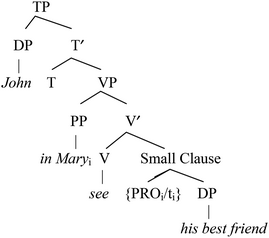
In (19), Mary functions as the complement within a PP headed by in, thus forming a constituent with this preposition, either as the result of movement/Raising into PP (to the extent that a Raising operation into the complement-of-P position is generally admissible), or without such movement, with PRO, instead of a trace, as the subject of a small clause.Footnote 11 The DP his best friend is analyzed in (19) as the predicate of a small clause whose subject position is occupied by PRO, understood to be controlled by Mary, or by a trace of movement that has Mary as its antecedent.
Below I will consider facts regarding the predicate DP of the see-in construction that can serve as evidence against any clausal approach to this construction, including the two variants represented in (19). First, however, let us consider the specific variant of a clausal analysis involving the choice of PRO as subject of the small clause. Under this analysis, (19) is an extension of a strategy familiar in the generative tradition from the analysis of secondary, or adjunct, predication (see e.g. Chomsky Reference Chomsky1981; Stowell Reference Stowell1981, 1982).
(20)
(a) John arrived [PRO asleep].
(b) Mary ate the meat [PRO raw].
One obvious difficulty with this analysis is that it is incompatible with familiar generalizations regarding the distribution of PRO (Chomsky Reference Chomsky1981). As is well known, PRO is ruled out from the subject position of complement small clauses, as shown by contrasts like the following:
(21)
(a) John cannot imagine [Mary drunk].
(b) *John cannot imagine [PRO drunk].
In view of such contrasts (independently of one's favorite theory of the distribution of PRO), one does not expect PRO to be admitted in (19) as subject of the complement of see.
Note now that both potential analyses of the see-in construction represented in (19) and, indeed, any clausal analysis of this construction, including those represented in (18a–b) and discussed above, encounters considerable difficulties deriving from facts related to the status of the predicate DP.Footnote 12 Specifically, under any variant of the clausal approach to the see-in construction, this DP is necessarily analyzed as a clause-internal predicate, as opposed to being a complement (i.e. direct object) of see-in. However, this is untenable in view of certain clear indications regarding its status as a lexically selected argument and syntactic complement.
Thus, other than its being an obligatory component of the see-in construction (compare *John sees in Mary __), the predicate DP manifests a typical characteristic of selected complements: Its categorial identity is strictly and arbitrarily restricted to DP, as shown in (22).
(22) *John sees/finds in Mary intelligent.
The ungrammaticality of (22) is due to a simple violation of a subcategorization restriction imposed by the main verb (see/find) on the predicate phrase. The application to this phrase of this strictly local restriction is a clear indication of its status as a complement.Footnote 13
The Hebrew see-in construction lends additional support for this view of the predicative complement, specific to the grammar of Hebrew: When it happens to be a definite DP, this complement must be preceded by the accusative marker et, as (23) illustrates. This example contrasts with (2), where the predicative DP complement is indefinite and no Accusative marking by et is admissible.
(23) Dan roé/mocé bé Dina *(et) ha-xavera haxi tova šel-o.
Dan sees/finds in Dina acc the-friend most good his
‘Dan sees/finds in Dina his best friend.’
In this respect the predicate phrase in (23) manifests properties typical of direct objects of verbs, thus differing from (definite) DPs functioning as predicates. As (24) shows, the predicate phrase within a clausal structure, if it happens to be a definite DP, can never be associated with accusative marking by et.
(24) Dina hi/hayta (*et) ha-xavera haxi tova šel-o.
Dina she/was acc the-friend most good his
‘Dina is/was his best friend.’
One might object that (24) is potentially of limited relevance for this discussion since it involves a non-embedded clause and no potential Case assigner. However, such an objection would miss the simple fact that (24) involves a non-Case marked predicate DP which, given the grammaticality of (24), can be taken to show that a predicate DP in a clausal structure, unlike the predicate DP in the see-in construction, does not need to be marked for Accusative Case.
Nevertheless, for the sake of completeness, it would be useful to consider the corresponding facts in embedded contexts. After all, Accusative Case marking ‘into’ what may plausibly be viewed as small clause complements is, actually, not impossible. Thus, arguably, (25), with Dan preceded by the accusative marker et, could be a case of this kind, where Dan holéx ‘Dan walk/walking’ is plausibly analyzed as a small clause complement of ra'a ‘see’.
(25) Ra'it-i et [Dan holéx].
saw-I acc Dan walk/walking
‘I saw Dan walk/walking.’
What must be considered now are the facts regarding Accusative Case marking of the DP predicate of an embedded small clause.Footnote 14
One verb which can plausibly be assumed to involve a small clause complement, in which a DP can be the predicate of this small clause, is ti'er le-acmo ‘imagine’.
(26) Ta'ar-u le-acme-xem [et Dina (*et) roš memšala].
imagine.placc Dina acc prime minister
‘Imagine Dina as prime minister.’
In (26) the predicate DP roš memšala ‘prime minister’ (unlike Dina) is indefinite and, therefore, could not be preceded by the accusative marker et. The question is whether a definite DP in this position can, or must, be preceded by this Case marker. As (27) shows, the answer is negative on both counts (i.e. neither can nor must).
(27) Ta'ar-u le-acme-xem [et Barak Obama (*et) nesi arcot ha-brit].
imagine.placc Barak Obama acc the President of the U.S.
‘Imagine Barak Obama as President of the U.S.’
Taken together, (24) and (27) provide a simple illustration of the fact that a small clause predicate DP, in either an embedded or a non-embedded context, not only does not need Accusative Case marking by et but actually rejects it. On the other hand, the DP predicate in the see-in construction must be marked by et when it is definite.
On the assumption that see-in sentences involve an embedded small clause, the question that must be addressed is why the predicate DP of this small clause must be marked for Accusative Case. As just observed, such need for Case marking of the predicate DP is otherwise never attested in clausal structures. The only potential explanation of this fact regarding the see-in construction could be that such Case marking is obligatory, not because it satisfies a need of the DP in question (obviously, as observed, such need does not exist), but rather, because it satisfies a need of the higher verb see-in to assign (or, ‘discharge’) its Accusative Case. An account along these lines would, necessarily, have to invoke some principle that would make it obligatory for (certain) verbs to discharge their Accusative Case feature. To the best of my knowledge, such principle has never been suggested, for the good reason that it would have no empirical support.Footnote 15
Thus, as the following example shows, the verb see, under a ‘transitive’ interpretation (i.e. involving an implicit object), is perfectly admissible without the occurrence of a DP complement to which Accusative Case could be assigned.
(28) Dan roé tov afilu ba-xošex.
Dan sees well even in the darkness
‘Dan sees well even in the darkness.’
Needless to say, these questions and difficulties would never arise if the DP predicate of the see-in construction is viewed as a complement (i.e. a direct object).
4. A non-clausal analysis of the predicative see-in construction
I conclude that the predicative see-in construction is one where the verb see or find is followed by two complements, a PP headed by in/bé and a DP understood as predicated of the DP complement of in/bé. An analysis of (1) (or the Hebrew (2)) compatible with standard assumptions in current minimalist theory, and with the empirical evidence presented in this article, must involve a structure along the lines of (29).
(29)
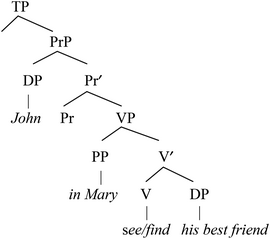
In this structure, the PP headed by in and the predicate DP are both represented as arguments of the main verb see/find, both satisfying, in their respective positions, all requirements of subcategorization and selection imposed by the main verb prior to the application of any displacements (such as, for example, the head movement of the verb).Footnote 16 On the analysis represented in (29), see-in/find-in are, semantically, three-place predicates whose second argument (i.e. the DP complement of in) is understood as the subject of the third. Cases of this kind have been noted before and there is no shortage of proposals in the literature regarding how the relation between the two last arguments of these verbs can be formally expressed.Footnote 17
What is special about the see-in construction is that the empirical motivation for such an analysis is far stronger in this case than in other cases that have traditionally been analyzed as involving an embedded predication structure (e.g. small clause structures with verbs like consider, see e.g. Chomsky Reference Chomsky1981; Stowell Reference Stowell1981, 1982). The arguments advanced here concerned, first, the PP headed by in/bé. Arbitrarily selected by the main verb, in/bé must be viewed as the head of a complement PP. Consequently, the DP complement of in/bé could not possibly form a clause with the DP predicated of it. As for the predicate DP, it was shown to be subject to a selectional restriction and Case marking in a way typical of complements rather than clause-internal predicates.
The understood subject of this construction, being internal to PP, does not c-command (or m-command) the predicate DP. This construction thus constitutes a deviation from well-known structural restrictions on predication. As suggested earlier, such deviation is not entirely unnatural given that the predication relation established in the see-in construction is an outcome of the individual lexical-semantic content of see-in/find-in and is in this sense lexically governed.


