



1 Introduction
Ergodic optimization aims to describe properties of dynamically invariant maximizing measures. In its most basic form, the main constituent components are: a continuous map T of a compact metric space X; the space
 ${\mathcal M}(X,T)$
of T-invariant Borel probability measures endowed with the weak* topology; a continuous function
 $f\colon X\to {\mathbb R}$
. Elements of
 ${\mathcal M}(X,T)$
that attain the supremum
 $$ \begin{align}\Lambda_T(f)=\sup\bigg\{\!\!\int f\,{d}\mu\colon\mu\in {\mathcal M}(X,T)\bigg\}\end{align} $$
are called f-maximizing measures. The set of f-maximizing measures, denoted by
 ${\mathcal M}_{\mathrm {\max }}(f)$
, is non-empty and contains ergodic measures. For a given dynamical system
 $(X,T)$
, we aim to establish properties of elements of
 ${\mathcal M}_{\mathrm {\max }}(f)$
for a ‘typical’ f in a Banach space of real-valued functions on X.
Earlier results in ergodic optimization, especially those by Hunt and Ott [Reference Hunt and Ott24, Reference Hunt and Ott25] and Bousch [Reference Bousch4], suggested the possibility of maximizing measures for typical functions being unique and supported on periodic orbits. It has been conjectured that for typical dynamical systems and typical functions in suitable Banach spaces, the maximizing measure is unique and supported on a periodic orbit. For a more precise statement known as the TPO (typically periodic optimization) conjecture, see [Reference Jenkinson27, Conjecture 4.11], [Reference Jenkinson28, Conjecture 7.3], and [Reference Yuan and Hunt45, Conjecture 1]. For results toward a resolution of this conjecture in a variety of settings, see [Reference Bochi3, Reference Jenkinson27, Reference Jenkinson28] and the references therein.
In ergodic optimization, the regularity of functions is crucial. For
 $(X,T)$
with some expanding or hyperbolic behavior and a Hölder continuous f, the Mañé–Conze–Guivarc’h lemma characterizes f-maximizing measures via their supports [Reference Bousch4, Reference Bousch5, Reference Contreras, Lopes and Thieullen18, Reference Morris33]. The analysis of functions in the space
 $C(X)$
of real-valued continuous functions on X endowed with the supremum norm
 $\|\cdot \|_{C^0}$
is completely different: the Mañé–Conze–Guivarc’h lemma is not valid, but duality arguments are available.
Recall that dense
 $G_\delta $
sets are countable intersections of open dense subsets and a property that holds for a dense
 $G_\delta $
set is said to be generic. For an expanding map of the circle, Bousch and Jenkinson [Reference Bousch and Jenkinson6] proved that the maximizing measure is unique and fully supported (charging any non-empty open set) for generic continuous functions. Brémont [Reference Brémont8] proved that if
 $(X,T)$
has the property that measures supported on periodic orbits (closed orbit measures) are dense in
 ${\mathcal M}(X,T)$
and the entropy function is upper semicontinuous, then the maximizing measure is unique and has zero entropy for generic continuous functions. For expanding maps of the circle, the Bowen specification property [Reference Bowen7] holds and so closed orbit measures are dense [Reference Sigmund40]. Moreover, the entropy function is upper semicontinuous. Hence, the result of Brémont [Reference Brémont8] applies together with that of Bousch and Jenkinson [Reference Bousch and Jenkinson6]: the maximizing measure is unique, fully supported, has zero entropy, and is not strongly mixing for generic continuous functions.
Morris [Reference Morris34] unified the result of Bousch and Jenkinson [Reference Bousch and Jenkinson6] and that of Brémont [Reference Brémont8], proving that for
 $(X,T)$
with the Bowen specification property and for a generic continuous function, the maximizing measure is unique, fully supported, has zero entropy, and is not strongly mixing [Reference Morris34, Corollary 2]. In contrast to Morris’s result, Shinoda [Reference Shinoda37, Theorem A] proved that for a dense set of continuous functions on a topologically mixing Markov shift, there exist uncountably many, fully supported ergodic maximizing measures with positive entropy, which are actually Bernoulli and hence strongly mixing. For an analogous result on expanding Markov interval maps with holes, see [Reference Shinoda and Takahasi38].
1.1 Statements of the results
In the context of symbolic dynamics, our main result below generalizes and unifies Morris’s result [Reference Morris34, Corollary 2] and Shinoda’s one [Reference Shinoda37, Theorem A] concerning entropies and supports of maximizing measures for continuous functions, to include a wide class of non-Markov shifts without the Bowen specification property. For a subshift
 $\Sigma $
, let
 $h_{\mathrm {top}}(\Sigma )$
denote its topological entropy, and for a shift-invariant Borel probability measure
 $\mu $
on
 $\Sigma $
, let
 $h(\mu )$
denote its measure-theoretic entropy. Let
 $h_{\mathrm {spec}}^\bot (\Sigma )$
denote the obstruction entropy to specification on
 $\Sigma $
(see §2.3).
Theorem A. Let
 $\Sigma $
be a subshift that satisfies
 $h_{\mathrm {spec}}^\bot (\Sigma )<h_{\mathrm {top}}(\Sigma )$
. For any
 $H\in [h_{\mathrm {spec}}^\bot (\Sigma ),h_{\mathrm {top}}(\Sigma ))$
, the following statements hold.
-
(a) The set
 $\mathscr {R}_{H }=\{f\in C(\Sigma )\colon h(\mu )\leq H \text { for all} \mu \in {\mathcal M}_{\mathrm {max}}(f)\}$
is dense
$G_\delta $
.
-
(b) For any
$f\in C(\Sigma )\setminus \mathscr {R}_H$
and any neighborhood U of f in
$C(\Sigma )$
, there exists
$g\in U$
such that the set
$\{\mu \in {\mathcal M}_{\mathrm {\max }}(g)\colon h(\mu )>H\}$
contains uncountably many, fully supported ergodic measures.






Several remarks are in order on the meaning and the scope of Theorem A. First of all, the condition
 $h_{\mathrm {spec}}^\bot (\Sigma )<h_{\mathrm {top}}(\Sigma )$
together with the obstruction entropy to specification was introduced by Climenhaga and Thompson in the series of papers [Reference Climenhaga and Thompson14–Reference Climenhaga and Thompson16] on the thermodynamic formalism for dynamical systems with non-uniform specification. It implies that for any
 $H\in [h_{\mathrm {spec}}^\bot (\Sigma ),h_{\mathrm {top}}(\Sigma ))$
, the language
 $\mathcal L(\Sigma )$
of the shift space admits a decomposition
 $\mathcal L(\Sigma )={\mathcal C}^p\mathcal G{\mathcal C}^s$
into a prefix
 ${\mathcal C}^p$
, a ‘good’ core
 $\mathcal G$
and a suffix
 ${\mathcal C}^s$
, such that on a ‘fattened’
 $\mathcal G$
, there is a specification and the exponential growth rate of the cardinality of
 ${\mathcal C}^p\cup {\mathcal C}^s$
per word length does not exceed H. See §2.2 for a formal definition. The condition
 $h_{\mathrm {spec}}^\bot (\Sigma )<h_{\mathrm {top}}(\Sigma )$
implies the intrinsic ergodicity of
 $\Sigma $
[Reference Climenhaga and Thompson15, Theorem C], that is, the uniqueness of the measure of maximal entropy.
In the case where
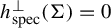 $h_{\mathrm {spec}}^\bot (\Sigma )=0$
, one can take
 $H=0$
. By Theorem A(a), the set
 $\mathscr {R}_{0}=\{f\in C(\Sigma )\colon h(\mu )=0 \text { for all} \mu \in {\mathcal M}_{\mathrm {max}}(f)\}$
is dense
 $G_\delta $
, which in part generalizes Morris’s result [Reference Morris34, Corollary 2]. By Theorem A(b), any
 $f\in C(\Sigma )\setminus \mathscr {R}_0$
is approximated by another for which there exist uncountably many, fully supported ergodic measures with positive entropy. This in part generalizes Shinoda’s result [Reference Shinoda37, Theorem A]. By virtue of the constant H, analogous statements hold in the case
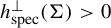 $h_{\mathrm {spec}}^\bot (\Sigma )>0$
as stated in Theorem A.
Theorem A does not assert the non-mixingness or Bernoulliness of the maximizing measures. Combining an argument in the proof of [Reference Morris34, Corollary 2] with [Reference Parthasarathy36, Theorem 3.4], one can show that if closed orbit measures are dense in the space of ergodic measures, then any maximizing measure of a generic continuous function is not strongly mixing. We do not know if the uncountably many maximizing measures in Theorem A(b) are Bernoulli.
As a consequence of the variational principle and the result of Jenkinson [Reference Jenkinson27, Theorem 3.7], the set
 $C(\Sigma )\setminus \mathscr {R}_{H }$
is non-empty. It is difficult to exhibit a pathological continuous function as in Theorem A(b) for which there exist uncountably many maximizing measures that are fully supported and have positive entropy. Trivial examples with this property are functions that are homologous to a constant. The Mañé–Conze–Guivarc’h lemma implies that any continuous function that is not homologous to a constant and has a fully supported maximizing measure cannot be Hölder continuous.
The next theorem provides a sufficient condition for the density of such pathological continuous functions. Let
 $\Sigma $
be a subshift and let
 $\sigma $
denote the left shift acting on
 $\Sigma $
. We say ergodic measures on
 $\Sigma $
are entropy dense if for any non-ergodic measure
 $\mu \in {\mathcal M}(\Sigma ,\sigma )$
, any
 $\varepsilon>0$
, and any neighborhood U of
 $\mu $
in
 ${\mathcal M}(\Sigma ,\sigma )$
, there exists an ergodic measure
 $\nu \in U$
such that
 $h(\nu )>h(\mu )-\varepsilon $
. Clearly, the entropy density implies the density of ergodic measures.
Theorem B. Let
 $\Sigma $
be a subshift with positive topological entropy and
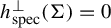 $h_{\mathrm {spec}}^\bot (\Sigma )=0$
. Suppose that ergodic measures on
 $\Sigma $
are entropy dense. Then, there exists a dense subset
 $\mathscr {D}$
of
 $C(\Sigma )$
such that for any
 $f\in \mathscr {D}$
,
 ${\mathcal M}_{\mathrm {\max }}(f)$
contains uncountably many fully supported ergodic measures with positive entropy.
There is a wealth of examples of symbolic dynamics to which Theorem A or Theorem B applies: piecewise monotonic maps [Reference Hofbauer19], some coded shifts including S-gap shifts [Reference Lind and Marcus32], multidimensional
 $\beta $
-transformations [Reference Buzzi9, Reference Buzzi10], and so on. See §4 for more details on these applications.
We will provide two examples of intrinsically ergodic subshifts to which Theorem A applies but Theorem B does not. One is a subshift without the entropy density (see §4.2). The other example is a subshift with positive obstruction entropy to specification, which is stated as follows.
Theorem C. For any integer
 $N\geq 3$
, there exists a subshift
 $\Sigma $
on N symbols such that
 $(1/6)\log (N-1)\leq h_{\mathrm {spec}}^\bot (\Sigma )\leq \log (N-1)<h_{\mathrm {top}}(\Sigma )$
.
Theorem C has an independent interest. Any transitive Markov shift is intrinsically ergodic [Reference Parry35], and its obstruction entropy to specification is
 $0$
. As in §4, for example, there are a number of intrinsically ergodic non-Markov shifts for which the obstruction entropy to specification is
 $0$
. Intrinsically ergodic subshifts with positive obstruction entropy to specification have received little attention and should be investigated further. Under the hypothesis of Theorem A, measures whose entropy does not exceed the obstruction entropy to specification play no role in search of measures of maximal entropy, but they do play roles in problems concerning rare events not captured by measures of maximal entropy, such as large deviations and multifractal analysis.
1.2 Structure of the paper
For proofs of parts (a) and (b) in Theorem A, we develop ideas of Morris [Reference Morris34, Theorem 1.1, Corollary 2] and Shinoda [Reference Shinoda37, Theorem A], respectively, both related to approximations of ergodic measures. On the one hand, a key observation is that the assumption of the Bowen specification property in [Reference Morris34, Corollary 2] can actually be weakened to the property that any ergodic measure can be approximated by another with arbitrarily small entropy. On the other hand, a key ingredient in the proof of [Reference Shinoda37, Theorem A] is the construction of paths of fully supported ergodic measures of positive entropy in arbitrarily small neighborhoods of maximizing measures. This construction relies on Sigmund’s result [Reference Sigmund42].
The rest of this paper consists of four sections. The most critical component is Proposition 2.4 that provides two different kinds of approximations of ergodic measures in the weak* topology. The proof of Proposition 2.4 relies on the thermodynamic formalism for subshifts with non-uniform specification [Reference Climenhaga and Thompson15] and the zero temperature limit [Reference Baraviera, Leplaideur and Lopes1] summarized in §2. In §3, we combine results in §2 with part of the proof of [Reference Morris34, Theorem 1.1] and a duality argument in [Reference Israel26] to complete the proofs of Theorems A and B. In §4, we provide examples of application of these two theorems: any transitive piecewise monotonic interval map; some coded shifts including S-gap shifts; some multidimensional
 $\beta $
-transformations. In §5, we prove Theorem C by ‘fattening’ S-gap shifts.
2 Preliminaries
This section contains preliminary results needed for the proof of Theorem A. In §2.1, we begin by introducing basic terminologies in symbolic dynamics. In §2.2, we recall the result of Climenhaga and Thompson [Reference Climenhaga and Thompson15] on the thermodynamic formalism for subshifts with non-uniform specification. In §2.3, we introduce the obstruction entropy to specification and in §2.4, recall the notion of ground states in zero temperature limit. Section 2.5 states and proves Proposition 2.4 that is a key ingredient in the proofs of Theorems A and B.
2.1 Subshift, word, language
Let
 $\mathcal A$
be a non-empty finite discrete set, called an alphabet. A finite string
 $w=w_1w_2\cdots w_n$
of elements of
 $\mathcal A$
is called a word of length n from
 $\mathcal A$
. For convenience, we introduce an empty word
 $\emptyset $
by the rules
 $\emptyset w=w\emptyset =w$
for any word w from
 $\mathcal A$
and
 $\emptyset \emptyset =\emptyset $
. The word length of w from
 $\mathcal A$
is denoted by
 $|w|$
and the word length of the empty word is set to be
 $0$
. Let
 ${\mathbb N}$
denote the set of positive integers and set
 ${\mathbb N}_0={\mathbb N}\cup \{0\}$
.
Given a collection
 $\mathcal L$
of words from
 $\mathcal A$
and the empty word, we consider its decomposition: collections of words
 ${\mathcal C}^p$
,
 $\mathcal G$
,
 ${\mathcal C}^s\subset \mathcal L$
such that
 ${\mathcal C}^p\mathcal G{\mathcal C}^s=\mathcal L$
. This means that every word in
 $\mathcal L$
can be written as a concatenation of a prefix (from
 ${\mathcal C}^p$
), a ‘good’ core (from
 $\mathcal G$
), and a suffix (from
 ${\mathcal C}^s$
). Given such a decomposition, we consider for every
 $M\in {\mathbb N}$
, the following ‘fattened’ set of good words:
 $$ \begin{align*}\mathcal G^M=\{uvw\in\mathcal L\colon u\in{\mathcal C}^p, v\in\mathcal G, w\in{\mathcal C}^s,\ |u|,|w|\leq M\}.\end{align*} $$
Note that
 $\mathcal L=\bigcup _{M\in {\mathbb N}}\mathcal G^M$
. This gives a filtration of the language.
Let
 $\mathcal A^{{\mathbb N}}$
and
 $\mathcal A^{{\mathbb Z}}$
denote the one-sided and the two-sided Cartesian product topological spaces of
 $\mathcal A$
, respectively. The topologies of these two spaces are metrizable with the Hamming metric d: for distinct points
 $x=(x_i)_i$
,
 $y=(y_i)_i$
,
 $d(x,y)=2^{-\min \{|i|\colon x_i\neq y_i\}}.$
The left shift acts continuously on these spaces. A shift-invariant closed subset of
 $\mathcal A^{{\mathbb N}}$
or
 $\mathcal A^{{\mathbb Z}}$
is called a subshift over the alphabet
 $\mathcal A$
, or a subshift on
 $\#\mathcal A$
symbols. A language of a subshift
 $\Sigma $
, denoted by
 $\mathcal L(\Sigma )$
, is the set of the empty word
 $\emptyset $
and words from
 $\mathcal A$
that appear in some elements of
 $\Sigma $
. For a subshift
 $\Sigma $
and
 $n\in {\mathbb N}_0$
, let
 $\mathcal L_n(\Sigma )$
denote the set of elements of
 $\mathcal L(\Sigma )$
with word length n. For a subset
 ${\mathcal D}$
of
 $\mathcal L(\Sigma )$
, put
 $$ \begin{align*}{\mathcal D}_{n}={\mathcal D}\cap\mathcal L_n(\Sigma).\end{align*} $$
Note that
 $\mathcal L_0(\Sigma )={\mathcal D}_0=\{\emptyset \}$
, the singleton consisting of the empty word.
2.2 Thermodynamic formalism with non-uniform specification
Let
 $\Sigma $
be a subshift and let
 $\sigma $
denote the left shift acting on
 $\Sigma $
. For
 $n\in {\mathbb N}$
and
 $w=w_1\cdots w_n\in \mathcal L_n(\Sigma )$
, define an n-cylinder
 $$ \begin{align*}[w]=\{(x_i)_{i}\in\Sigma\colon x_i=w_{i}\text{ for } i=1,\ldots, n\}.\end{align*} $$
Let
 $\phi \in C(\Sigma )$
and let
 ${\mathcal D}\subset \mathcal L(\Sigma )$
. For
 $n\in {\mathbb N}$
, define
 $$ \begin{align*}\Lambda_n({\mathcal D},\phi)=\sum_{w\in {\mathcal D}_n }\sup_{[w]}\exp S_n\phi,\end{align*} $$
where
 $S_n\phi =\sum _{i=0}^{n-1}\phi \circ \sigma ^i,$
and put
 $$ \begin{align*}h({\mathcal D},\phi)=\limsup_{n\to\infty}\frac{\log\Lambda_n({\mathcal D},\phi)}{n}.\end{align*} $$
In the case where
 $\phi \equiv 0$
, let us abbreviate
 $h({\mathcal D})=h({\mathcal D},\phi )$
. Note that
 $h(\mathcal L(\Sigma ))$
equals
 $h_{\mathrm {top}}(\Sigma )$
. The quantity
 $h(\mathcal L(\Sigma ),\phi )$
is called the topological pressure and denoted by
 $P(\phi )$
. The variational principle [Reference Walters43] asserts that
 $$ \begin{align*}P(\phi)=\sup\bigg\{h(\mu)+\int\phi\,{d}\mu\colon\mu\in {\mathcal M}(\Sigma,\sigma)\bigg\}.\end{align*} $$
Elements of
 ${\mathcal M}(\Sigma ,\sigma )$
that attain this supremum are called equilibrium states for the potential
 $\phi $
. Since
 $(\Sigma ,\sigma )$
is expansive, the entropy function
 $\mu \in {\mathcal M}(\Sigma ,\sigma )\mapsto h(\mu )$
is upper semicontinuous. So, (the minus of) the free energy
 $\mu \in {\mathcal M}(\Sigma ,\sigma )\mapsto h(\mu )+\int \phi \,{d}\mu $
is upper semicontinuous and equilibrium states always exist. The uniqueness is an issue.
The Bowen specification property allows us to glue pieces of orbits together to form one orbit. This property can be used to show the uniqueness of equilibrium states. Since the Bowen specification property does not always hold for non-Markov shifts, a number of weaker conditions have been introduced and their consequences have been investigated (see [Reference Kwietniak, Ła̧cka and Oprocha31] and the references therein). Climenhaga and Thompson [Reference Climenhaga and Thompson15] introduced the following condition and, under it, proved that the measure of maximal entropy is unique and satisfies a certain Gibbs property. We say a collection of words
 $\mathcal G\subset \mathcal L(\Sigma )$
has (W)-specification if there exists an integer
 $t\geq 0$
, called a gap size, such that for all
 $m\geq 2$
and all
 $v^{(1)},\ldots ,v^{(m)}\in \mathcal G$
, there exist
 $w^{(1)},\ldots ,w^{(m-1)}\in \mathcal L(\Sigma )$
such that
 $v^{(1)}w^{(1)}v^{(2)}w^{(2)}\cdots w^{(m-1)}v^{(m)}\in \mathcal L(\Sigma )$
and
 $|w^{(i)}|\leq t$
for
 $ i=1,\ldots , m-1$
.
Theorem 2.1. [Reference Climenhaga and Thompson15, Theorem C]
Let
 $\Sigma $
be a subshift and let
 $\phi \in C(\Sigma )$
be Hölder continuous. Suppose there exist collections of words
 ${\mathcal C}^p$
,
 $\mathcal G$
,
 ${\mathcal C}^s\subset \mathcal L(\Sigma )$
such that
 $\mathcal L(\Sigma )={\mathcal C}^p\mathcal G{\mathcal C}^s$
, and the following two conditions hold:
-
(a)
$\mathcal G^M$
has (W)-specification for all
$M\in {\mathbb N}$
; -
(b) the collections
${\mathcal C}^p$
,
${\mathcal C}^s$
satisfy
$$ \begin{align*}\sum_{n=1}^\infty\Lambda_n({\mathcal C}^p\cup{\mathcal C}^s,\phi)e^{-P(\phi)n}<\infty.\end{align*} $$


Then, the equilibrium state for the potential
 $\phi $
is unique and has the weak Gibbs property: there exists
 $K>0$
and for each
 $M\in {\mathbb N}$
, there exists
 $K_M>0$
such that for all
 $n\in {\mathbb N}$
and all
 $w\in \mathcal G^M\cap \mathcal L_n(\Sigma )$
, we have
 $$ \begin{align}K_M\leq\frac{\mu_\phi([w])}{\exp( -P(\phi)n+\sup_{[w]}S_n\phi )}\leq K.\end{align} $$
Remark 2.2. More general potential functions than those in Theorem 2.1 were treated in [Reference Climenhaga and Thompson15, Theorem C], but we will not need them in this paper.
2.3 Obstruction entropy to specification
For a subshift
 $\Sigma $
, we define
 $$ \begin{align}h_{\mathrm{spec}}^\bot(\Sigma)=\inf \left\{ \begin{array}{@{}l@{}} h({\mathcal C}^p\cup{\mathcal C}^s)\colon\mathcal L(\Sigma)={\mathcal C}^p\mathcal G{\mathcal C}^s\text{ and}\\ \mathcal G^M\text{ has (W)-specification for all }M\in{\mathbb N}\end{array} \right\}\kern-2pt, \end{align} $$
and call this number the obstruction entropy to specification on
 $\Sigma .$
Note that
 $h_{\mathrm {spec}}^\bot (\Sigma )\leq h_{\mathrm {top}}(\Sigma )$
. By Theorem 2.1 with
 $\phi \equiv 0$
, the strict inequality
 $h_{\mathrm {spec}}^\bot (\Sigma )< h_{\mathrm {top}}(\Sigma )$
implies the intrinsic ergodicity of
 $\Sigma $
.
As is evident from equation (2.2), the lower estimate of
 $h_{\mathrm {spec}}^\bot (\Sigma )$
is much harder than the upper one: to show
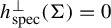 $h_{\mathrm {spec}}^\bot (\Sigma )=0$
, we only have to exhibit for any
 $\varepsilon>0$
, one decomposition for which
 $h({\mathcal C}^p\cup {\mathcal C}^s)<\varepsilon $
, whereas to show
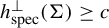 $h_{\mathrm {spec}}^\bot (\Sigma )\geq c$
for some
 $c>0$
, we must verify
 $h({\mathcal C}^p\cup {\mathcal C}^s)\geq c$
for any decomposition
 $\mathcal L(\Sigma )={\mathcal C}^p\mathcal G{\mathcal C}^s$
for which
 $\mathcal G^M$
has (W)-specification for all
 $M\in {\mathbb N}$
.
2.4 Entropy in zero temperature limit and continuity of equilibrium states
Let
 $\Sigma $
be a subshift and let
 $f\in C(\Sigma )$
. We say
 $\mu \in {\mathcal M}(\Sigma ,\sigma )$
is a ground state for the potential f if there exists a net
 $(\mu _\beta )_{\beta \geq 0}$
in
 ${\mathcal M}(\Sigma ,\sigma )$
such that:
-
•
$\mu _\beta $
is an equilibrium state for the potential
$\beta f$
for all
$\beta \geq 0$
; -
•
$\mu _\beta \to \mu $
in the weak* topology as
$\beta \to \infty $
.


The term ‘ground state’ has been borrowed from statistical mechanics as an analogy: since the parameter
 $\beta $
may be viewed as the inverse of temperature, taking the limit
 $\beta \to \infty $
is called the zero temperature limit [Reference Baraviera, Leplaideur and Lopes1].
For the reader’s convenience, we include a proof of the next lemma on the zero temperature limit and the continuity of equilibrium states, which can be found in [Reference Baraviera, Leplaideur and Lopes1], for example.
Lemma 2.3. Let
 $\Sigma $
be a subshift and let
 $\mu \in {\mathcal M}(\Sigma ,\sigma )$
be a ground state for the potential
 $f\in C(\Sigma )$
. Let
 $(\mu _\beta )_{\beta \geq 0}$
be a net in
 ${\mathcal M}(\Sigma ,\sigma )$
such that
 $\mu _\beta $
is an equilibrium state for the potential
 $\beta f$
for all
 $\beta \geq 0$
, and
 $\mu _\beta \to \mu $
in the weak* topology as
 $\beta \to \infty $
. Then,
 $\mu $
is f-maximizing, and satisfies
 $$ \begin{align*}h(\mu)=\mathrm{sup}\{h(\nu)\colon\nu\in {\mathcal M}_{\mathrm{\max}}(f)\}=\mathrm{\max}\{h(\nu)\colon\nu\in {\mathcal M}_{\mathrm{\max}}(f)\}\end{align*} $$
and
 $$ \begin{align*}\lim_{\beta\to\infty} h(\mu_\beta)=h(\mu).\end{align*} $$
Moreover, if
 $\mu _\beta $
is the unique equilibrium state for the potential
 $\beta f$
for all
 $\beta \geq 0$
, then
 $\beta \mapsto \mu _\beta $
is continuous.
Proof. For all
 $\beta \geq 0$
, we have
 $h(\mu _\beta )+\beta \int f\,{d}\mu _\beta \geq h(\mu )+\beta \int f\,{d}\mu $
. Dividing both sides by
 $\beta>0$
and letting
 $\beta \to \infty $
yields
 $\int f\,{d}\mu _\beta \to \int f\,{d}\mu =\Lambda _\sigma (f)$
. Hence,
 $\mu $
is f-maximizing. Since
 ${\mathcal M}_{\mathrm {\max }}(f)$
is closed, the supremum in the statement of the lemma is attained.
The upper semicontinuity of the entropy function gives
 $\limsup _{\beta \to \infty } h(\mu _\beta )\leq h(\mu ).$
If there were
 $\nu \in {\mathcal M}_{\mathrm {\max }}(f)$
such that
 $h(\mu )<h(\nu )$
, then for all sufficiently large
 $\beta>0$
, we would have
 $$ \begin{align*}h(\nu)+\beta\int f\,{d}\nu=h(\nu)+\beta\int f\,{d}\mu>h(\mu_\beta)+\beta\int f\,{d}\mu_\beta,\end{align*} $$
in contradiction to the assumption that
 $\mu _\beta $
is an equilibrium state for the potential
 $\beta f$
. Finally, we claim
 $\liminf _{\beta \to \infty } h(\mu _\beta )\geq h(\mu )$
, for otherwise, we would reach a contradiction by applying the same argument to a subsequence of
 $(\mu _\beta )_{\beta \geq 0}$
.
Let
 $\beta _0\geq 0$
. Let
 $(\mu _{\beta _n})_{n\in {\mathbb N}}$
be any convergent subsequence of
 $(\mu _{\beta })_{\beta \geq 0}$
such that
 $\beta _n\to \beta _0$
as
 $n\to \infty $
. Let
 $\mu $
denote the limit measure. Since the pressure continuously depends on the potential [Reference Walters43] and the entropy function is upper semicontinuous, we have
 $$ \begin{align*}P(\beta_0f)=\lim_{n\to\infty}P(\beta_nf)=\lim_{n\to\infty}\bigg(h(\mu_{\beta_n})+\beta_n\int f\,{d}\mu_{\beta_n}\bigg)\leq h(\mu)+\beta\int f\,{d}\mu\end{align*} $$
and, therefore,
 $\mu =\mu _{\beta _0}$
, which completes the proof of the continuity.
2.5 Two approximations of ergodic measures
The next proposition is a key ingredient in the proof of Theorem A.
Proposition 2.4. Let
 $\Sigma $
be a subshift that has a language decomposition
 $\mathcal L(\Sigma )={\mathcal C}^p\mathcal G{\mathcal C}^s$
such that
 $h({\mathcal C}^p\cup {\mathcal C}^s)<h_{\mathrm {top}}(\Sigma )$
and
 $\mathcal G^M$
has (W)-specification for all
 $M\in {\mathbb N}$
. For each
 $\mu \in {\mathcal M}(\Sigma ,\sigma )$
that is ergodic and satisfies
 $h(\mu )>h({\mathcal C}^p\cup {\mathcal C}^s)$
, the following statements hold.
-
(a) For any
$\delta>0$
and any open subset U of
${\mathcal M}(\Sigma ,\sigma )$
that contains
$\mu $
, there exists an ergodic measure
$\nu \in U$
such that
$h(\nu )<\delta $
. -
(b) For any open subset V of
${\mathcal M}(\Sigma ,\sigma )$
that contains
$\mu $
, there exists a Lipschitz continuous function
$f\colon \Sigma \to {\mathbb R}$
such that:-
(i) for any
$\beta \geq 0$
, there exists a unique equilibrium state for the potential
$\beta f$
, which has the weak Gibbs property, denoted by
$\mu _{\beta f}$
; -
(ii)
$\beta \in [0,\infty )\mapsto \mu _{\beta f}\in {\mathcal M}(\Sigma ,\sigma )$
is continuous and injective; -
(iii) for all sufficiently large
$\beta>0$
, we have
$\mu _{\beta f}\in V$
and
$h(\mu _{\beta f})$
converges as
$\beta \to \infty $
to a constant in
$(h({\mathcal C}^p\cup {\mathcal C}^s),h_{\mathrm {top}}(\Sigma )]$
.
-






Proposition 2.4 provides two different kinds of approximations of ergodic measures with entropy greater than
 $h({\mathcal C}^p\cup {\mathcal C}^s)$
. In statement (a), the measure
 $\mu $
is approximated in the weak* topology by measures with arbitrarily small entropy. In statement (b),
 $\mu $
is approximated in the weak* topology by a ground state with positive entropy in the zero temperature limit.
Corollary 2.5. Let
 $\Sigma $
be a subshift that satisfies
 $h_{\mathrm {spec}}^\bot (\Sigma )<h_{\mathrm {top}}(\Sigma )$
. If
 $h_{\mathrm {spec}}^\bot (\Sigma )\leq H<h_{\mathrm {top}}(\Sigma )$
, then for any
 $\mu \in {\mathcal M}(\Sigma ,\sigma )$
that is ergodic and satisfies
 $h(\mu )>H$
, the following statements hold.
-
(a) For any open subset U of
${\mathcal M}(\Sigma ,\sigma )$
that contains
$\mu $
and for any
$\delta>0$
, there exists
$\nu \in U$
that is ergodic and satisfies
$h(\nu )<\delta $
. -
(b) For any open subset V of
${\mathcal M}(\Sigma ,\sigma )$
that contains
$\mu $
, there exists a homeomorphism
$t\in [0,1]\mapsto \nu _t\in V$
onto its image such that for any
$t\in [0,1]$
,
$\nu _t$
is ergodic, fully supported, and satisfies
$h(\nu _t)>H$
.





Proof. Part (a) follows from Proposition 2.4(a). Since measures with the weak Gibbs property in equation (2.1) are fully supported, part (b) follows from Proposition 2.4(b).
Corollary 2.5(a) will be used in the proof of Theorem A(a) to show the density of ergodic measures with arbitrary small entropy. Corollary 2.5(b) will be used in the proof of Theorem A(b) to deduce the abundance of paths of fully supported ergodic measures with positive entropy.
The rest of this subsection is entirely dedicated to a proof of Proposition 2.4. We begin by approximating ergodic measures with sufficiently large entropy with a collection of cylinders.
Lemma 2.6. Let
 $\Sigma $
be a subshift, let
 $\mu \in {\mathcal M}(\Sigma ,\sigma )$
be ergodic with positive entropy, and let
 $f_1,\ldots ,f_m$
be a finite collection of elements of
 $C(\Sigma )$
. For any
 $\varepsilon \in (0,h(\mu ))$
, there exists
 $N\in {\mathbb N}$
such that for each integer
 $k_0\geq N$
, there exists a subset
 $\mathcal P_{k_0}=\mathcal P_{k_0}(\mu ,f_1,\ldots ,f_m,\varepsilon )$
of
 $\mathcal L_{k_0}(\Sigma )$
such that for every
 $w\in \mathcal P_{k_0}$
, we have
 $$ \begin{align} e^{-k_0(h(\mu)+\varepsilon)}\leq \mu([w])\leq e^{-k_0(h(\mu)-\varepsilon)}\end{align} $$
and
 $$ \begin{align}\max_{x\in [w]}\max_{1\leq \ell\leq m }\bigg|\frac{S_{k_0}f_\ell(x)}{k_0}- \int f_\ell\,{d}\mu\bigg|<\varepsilon. \end{align} $$
Moreover, we have
 $$ \begin{align}\tfrac{1}{2}e^{(h(\mu)-\varepsilon)k_0} \leq \#\mathcal P_{k_0}\leq e^{(h(\mu)+\varepsilon)k_0}.\end{align} $$
Furthermore, if
 $w_1\cdots w_{k_0+1}\in \mathcal P_{k_0+1}$
, then
 $w_1\cdots w_{k_0}\in \mathcal P_{k_0}$
.
Proof. Since the collection of
 $1$
-cylinders in
 $\Sigma $
generates the Borel sigma-algebra of
 $\Sigma $
, it follows from the Shannon–McMillan–Breiman theorem and the Birkhoff ergodic theorem that for
 $\mu $
-almost every
 $x\in \Sigma $
, we have
 $$ \begin{align*}\lim_{k_0\to\infty}\frac{\log\mu([x_1\cdots x_{k_0}])}{k_0} =-h(\mu)\end{align*} $$
and
 $$ \begin{align*}\lim_{k_0\to\infty}\frac{S_{k_0}f_\ell(x)}{k_0}=\int f_\ell\,{d}\mu \ \text{ for }1\leq \ell\leq m.\end{align*} $$
For each
 $x\in \Sigma $
for which the above two equalities hold, let
 $N(x)\in {\mathbb N}$
denote the minimal integer such that
 $$ \begin{align*}\sup_{k_0\geq N(x)}\bigg|\frac{\log\mu([x_1\cdots x_{k_0}])}{k_0} +h(\mu)\bigg|<\varepsilon\end{align*} $$
and
 $$ \begin{align*}\sup_{k_0\geq N(x)}\max_{1\leq \ell\leq m }\bigg|\frac{S_{k_0}f_\ell(x)}{k_0}-\int f_\ell\,{d}\mu\bigg|<\frac{\varepsilon}{2}.\end{align*} $$
There exist a Borel set
 $\Sigma _0\subset \Sigma $
and
 $N\in {\mathbb N}$
such that
 $\mu (\Sigma _0)=1/2$
and
 $N(x)=N$
for all
 $x\in \Sigma _0$
. For an integer
 $k_0\geq N$
, we set
 $$ \begin{align}\mathcal P_{k_0}=\{w\in\mathcal L_{k_0}(\Sigma)\colon[w]\cap \Sigma_0\neq\emptyset\}.\end{align} $$
For each
 $w\in \mathcal P_{k_0}$
, we have equations (2.3) and (2.4). From equation (2.3) we obtain equation (2.5). The last assertion of Lemma 2.6 is a direct consequence of the definition of
 $\mathcal P_{k_0}$
in equation (2.6).
Given a subshift
 $\Sigma $
that has a language decomposition
 $\mathcal L(\Sigma )={\mathcal C}^p\mathcal G{\mathcal C}^s$
with
 $h({\mathcal C}^p\cup {\mathcal C}^s)<h_{\mathrm {top}}(\Sigma )$
and an ergodic measure
 $\mu \in {\mathcal M}(\Sigma ,\sigma )$
with
 $h(\mu )>h({\mathcal C}^p\cup {\mathcal C}^s)$
, we would like to apply Lemma 2.6 and connect elements of
 $\mathcal P_{k_0}$
with a uniform gap size to construct a subshift, and implement the thermodynamic formalism in §2.2. However, elements of
 $\mathcal P_{k_0}$
cannot be connected since they may be out of the good core
 $\mathcal G$
. To fix this point, we use the next lemma that extracts words in
 $\mathcal G$
of length approximately
 $k_0$
from many elements of
 $\mathcal P_{k_0}$
.
Lemma 2.7. Let
 $\Sigma $
be a subshift that has a language decomposition
 $\mathcal L(\Sigma )={\mathcal C}^p\mathcal G{\mathcal C}^s$
with
 $h({\mathcal C}^p\cup {\mathcal C}^s)<h_{\mathrm {top}}(\Sigma )$
. Let
 $\mu \in {\mathcal M}(\Sigma ,\sigma )$
be ergodic with
 $h(\mu )>h({\mathcal C}^p\cup {\mathcal C}^s)$
. Let
 $f_1,\ldots ,f_m$
be a finite collection of elements of
 $C(\Sigma )$
. If
 $\varepsilon \in (0,h(\mu ))$
is sufficiently small, then for any
 $M\geq 1$
, there exist an integer
 $k\geq M$
and a subset
 $\mathcal Q_k=\mathcal Q_k(\mu ,f_1,\ldots ,f_m,\varepsilon )$
of
 $\mathcal G_k$
such that
 $$ \begin{align} \frac{\log\#\mathcal Q_k}{k}> h(\mu)-\varepsilon \end{align} $$
and
 $$ \begin{align}\max_{ x\in [v]}\max_{1\leq \ell\leq m }\bigg|\frac{S_{k}f_\ell(x)}{k}- \int f_\ell\,{d}\mu\bigg| < \varepsilon\quad \text{for all }v\in\mathcal Q_k.\end{align} $$
Proof. Set
 $\underline {h}(\mu )=(h(\mu )-h({\mathcal C}^p\cup {\mathcal C}^s))/2$
. Let
 $M\geq 1$
and
 $$ \begin{align*}\varepsilon\in(0,\min\{\underline{h}(\mu),\sqrt{\underline{h}(\mu)}/2,\sqrt[3]{\underline{h}(\mu)},1/3\}).\end{align*} $$
Let
 $N\in {\mathbb N}$
be given by Lemma 2.6. For each
 $k_0\geq N$
, let
 $\mathcal P_{k_0}=\mathcal P_{k_0}(\mu ,f_1,\ldots ,f_m,\varepsilon ^3)$
be the subset of
 $\mathcal L_{k_0}(\Sigma )$
given by Lemma 2.6. We may assume N is sufficiently large so that
 $$ \begin{align}\#({\mathcal C}_{n}^p\cup{\mathcal C}_{n}^s)\leq e^{(h({\mathcal C}^p\cup{\mathcal C}^s) +\varepsilon^3 ) n}\quad \text{for }n\geq N.\end{align} $$
For each
 $w\in \mathcal P_{k_0}$
, we fix a decomposition
 $$ \begin{align*}w=p(w)c(w)s(w),\ \ p(w)\in{\mathcal C}^p, c(w)\in \mathcal G, s(w)\in{\mathcal C}^s.\end{align*} $$
These three words can be the empty word. For
 $a,b\in {\mathbb N}_0$
with
 $a+b\leq k_0$
, define
 $$ \begin{align*}\mathcal Q_{k_0}^p(a)=\{ w\in\mathcal P_{k_0}\colon |p(w)|=a\} \quad \text{and}\quad \mathcal Q_{k_0}^s(b)=\{w\in\mathcal P_{k_0}\colon |s(w)|=b\}.\end{align*} $$
We set
 $$ \begin{align*}\mathcal Q_{k_0}(a,b)=\mathcal Q_{k_0}^p(a)\cap\mathcal Q_{k_0}^s(b).\end{align*} $$
The language decomposition
 $\mathcal L(\Sigma )={\mathcal C}^p\mathcal G{\mathcal C}^s$
implies
 $\mathcal P_{k_0}=\bigsqcup _{a,b\in {\mathbb N}_0,a+b\leq k_0}\mathcal Q_{k_0}(a,b)$
.
We construct a subset of
 $\mathcal P_{k_0}$
that has a definite fraction in exponential scale and consists of words with relatively short prefixes in
 ${\mathcal C}^p$
and suffixes in
 ${\mathcal C}^s$
. By equation (2.9), for
 $a=N,\ldots ,k_0$
, we have
 $$ \begin{align*}\#\{p(w)\colon w\in\mathcal P_{k_0},\ |p(w)|=a\}\leq e^{h({\mathcal C}^p\cup{\mathcal C}^s)+\varepsilon^3 )a}.\end{align*} $$
By equation (2.3) with
 $\varepsilon $
replaced by
 $\varepsilon ^3$
, for each
 $w\in \mathcal P_{k_0}$
with
 $|p(w)|=a$
,
 $$ \begin{align*}\begin{aligned}\#\{v\in\mathcal L_{k_0-a}(\Sigma)\colon p(w)v\in\mathcal P_{k_0}\}&\leq\frac{\mu([p(w)])}{\min\{\mu([p(w)v])\colon v\in\mathcal L_{k_0-a}(\Sigma)\colon p(w)v\in\mathcal P_{k_0} \}}\\ &\leq\frac{e^{-a(h(\mu)-\varepsilon^3)}}{e^{-k_0(h(\mu)+\varepsilon^3)}}\leq e^{(k_0-a)h(\mu) +2\varepsilon^3 k_0}.\end{aligned}\end{align*} $$
Multiplying these two estimates yield
 $$ \begin{align*}\begin{aligned}\#\mathcal Q_{k_0}^p(a)&\leq e^{(h({\mathcal C}^p\cup{\mathcal C}^s)+\varepsilon^3)a}e^{(k_0-a)h(\mu)+2\varepsilon^3 k_0}\\&\leq e^{(h(\mu)+3\varepsilon^3)k_0}e^{-2\underline{h}(\mu)a} \ \text{ for }a=N,\ldots,k_0.\end{aligned}\end{align*} $$
Since
 $\varepsilon <\min \{\sqrt {\underline {h}(\mu )},1/3\}$
, for all sufficiently large
 $k_0$
, we have
 $$ \begin{align}\begin{aligned}\sum_{a=\lfloor\varepsilon^2 k_0/\underline{h}(\mu)\rfloor}^{k_0}\#\mathcal Q_{k_0}^p(a)& \leq e^{(h(\mu)+3\varepsilon^3)k_0} \sum_{a=\lfloor \varepsilon^2 k_0/\underline{h}(\mu)\rfloor}^{k_0} e^{-2\underline{h}(\mu)a} \leq e^{(h(\mu)-\varepsilon^2)k_0}.\end{aligned}\end{align} $$
Similarly, by the last assertion of Lemma 2.6 and equation (2.5) with
 $\varepsilon $
replaced by
 $\varepsilon ^3$
, for
 $b=0,\ldots ,k_0-N$
, we have
 $$ \begin{align*}\#\{p(w)c(w)\colon w\in \mathcal P_{k_0},\ |s(w)|=b\}\leq\#\mathcal P_{k_0-b}\leq e^{(h(\mu)+\varepsilon^3)(k_0-b) }.\end{align*} $$
By equation (2.9), for each
 $b=N,\ldots ,k_0$
and each
 $w\in \mathcal P_{k_0}$
with
 $|s(w)|=b$
,
 $$ \begin{align*}\#\{v\in {\mathcal C}^s_b\colon p(w)c(w)v\in\mathcal P_{k_0}\}\leq e^{(h({\mathcal C}^p\cup{\mathcal C}^s)+\varepsilon^3)b}.\end{align*} $$
If
 $k_0\geq 2N$
, then multiplying these two estimates yield
 $$ \begin{align*}\begin{aligned}\#\mathcal Q_{k_0}^s(b)&\leq e^{(h(\mu)+\varepsilon^3)(k_0-b) }e^{(h({\mathcal C}^p\cup{\mathcal C}^s)+\varepsilon^3)b}\\ &=e^{(h(\mu)+\varepsilon^3)k_0 }e^{-2b\underline{h}(\mu)}\ \text{ for }b=N,\ldots, k_0-N.\end{aligned}\end{align*} $$
Since
 $\varepsilon <\min \{\sqrt {\underline {h}(\mu )},1/3\}$
, for all sufficiently large
 $k_0\geq 2N$
, we have
 $$ \begin{align}\begin{aligned}\sum_{b=\lfloor\varepsilon^2 k_0/\underline{h}(\mu)\rfloor}^{k_0-N}\#\mathcal Q_{k_0}^s(b) &\leq e^{(h(\mu)+\varepsilon^3)k_0 }\sum_{b=\lfloor\varepsilon^2 k_0/\underline{h}(\mu)\rfloor}^{k_0}e^{-2b\underline{h}(\mu) }\leq e^{(h(\mu)-\varepsilon^2)k_0 }.\end{aligned}\end{align} $$
Let
 $\mathcal A$
be the alphabet of
 $\Sigma $
. By equation (2.9),
 $$ \begin{align}\sum_{b=k_0-N+1}^{k_0}\#\mathcal Q_{k_0}^s(b) &\leq\sum_{b=k_0-N+1}^{k_0} (\#\mathcal A)^{k_0-b}e^{(h({\mathcal C}^p\cup{\mathcal C}^s)+\varepsilon^3)b}\nonumber\\&\leq(\#\mathcal A)^{N}\sum_{b=k_0-N+1}^{k_0}e^{h({\mathcal C}^p\cup{\mathcal C}^s) b}\leq N(\#\mathcal A)^{N}e^{h({\mathcal C}^p\cup{\mathcal C}^s) k_0}.\end{align} $$
Combining equations (2.10), (2.11), (2.12) and the first inequality in equation (2.5) with
 $\varepsilon $
replaced by
 $\varepsilon ^3$
, and then using
 $\varepsilon <\min \{\sqrt [3]{\underline {h}(\mu )},1\}$
, for all sufficiently large
 $k_0\geq 2N$
, we have
 $$ \begin{align*}\begin{aligned} \sum_{a,b=0}^{\lfloor\varepsilon^2 k_0/\underline{h}(\mu)\rfloor-1}\#\mathcal Q_{k_0}(a,b)&\geq\#\mathcal P_{k_0}-\sum_{a=\lfloor\varepsilon^2 k_0/\underline{h}(\mu)\rfloor}^{k_0}\#\mathcal Q_{k_0}^p(a)-\sum_{b=\lfloor\varepsilon^2 k_0/\underline{h}(\mu)\rfloor}^{k_0} \#\mathcal Q_{k_0}^s(b)\\ &\geq \frac{1}{2}e^{(h(\mu)-\varepsilon^3)k_0}-2e^{(h(\mu)-\varepsilon^2)k_0}-N(\#\mathcal A)^{N}e^{h({\mathcal C}^p\cup{\mathcal C}^s) k_0}\\ &\geq e^{(h(\mu)-2\varepsilon^3)k_0}.\end{aligned}\end{align*} $$
Moreover, since
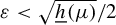 $\varepsilon <\sqrt {\underline {h}(\mu )}/2$
and
 $k_0\geq 2$
, there exist
 $a_0$
,
 $b_0\in {\mathbb N}_0$
such that
 $a_0+b_0\leq 2\varepsilon ^2 k_0/\underline {h}(\mu )\leq k_0/2\leq k_0-1$
and
 $$ \begin{align}\#\mathcal Q_{k_0}(a_0,b_0)\geq\frac{e^{(h(\mu)-2\varepsilon^3)k_0}}{(\varepsilon^2 k_0/\underline{h}(\mu))^2}.\end{align} $$
We now set
 $$ \begin{align*}k=k_0-a_0-b_0\quad \text{and}\quad \mathcal Q_k=\{c(w)\colon w\in\mathcal Q_{k_0}(a_0,b_0) \}.\end{align*} $$
For all sufficiently large
 $k_0\geq 2N$
, by
 $ \varepsilon <\min \{\underline {h}(\mu ),1/2\}$
, we have
 $$ \begin{align}M\leq\bigg(1-\frac{\varepsilon}{\underline{h}(\mu)}\bigg)k_0<\bigg(1-\frac{2\varepsilon^2}{\underline{h}(\mu)}\bigg)k_0\leq k\leq k_0,\end{align} $$
and from equations (2.9) and (2.13),
 $$ \begin{align*} \#\mathcal Q_k\geq\frac{\#\mathcal Q_{k_0}(a_0,b_0)}{\#{\mathcal C}^p_{a_0}\#{\mathcal C}^s_{b_0} }> e^{(h(\mu)-\varepsilon)k_0}.\end{align*} $$
Since
 $k\leq k_0$
, rearranging this inequality yields equation (2.7).
Let
 $f_1,\ldots ,f_m$
be a finite collection of elements of
 $C(\Sigma )$
. For any
 $v\in \mathcal Q_k$
, there exist
 $u\in {\mathcal C}^p_{a_0}$
,
 $w\in {\mathcal C}^s_{b_0}$
such that
 $uvw\in \mathcal Q_{k_0}(a_0,b_0)$
. Fix
 $y\in [uvw]$
. For all
 $1\leq \ell \leq m$
, we have
 $$ \begin{align*}\bigg|\frac{S_{k}f_\ell(\sigma^{a_0}y)}{k}-\frac{S_{k_0}f_\ell(y)}{k}\bigg|\leq\frac{a_0+b_0}{k}\|f_\ell\|_{C^0}\leq\frac{2\varepsilon^2 k_0 }{\underline{h}(\mu)k }\|f_\ell\|_{C^0},\end{align*} $$
and by equation (2.4) with
 $\varepsilon $
replaced by
 $\varepsilon ^3$
,
 $$ \begin{align*}\bigg|\frac{S_{k_0}f_\ell(y)}{k}-\int f_\ell\,{d}\mu\bigg|\leq\frac{k_0\varepsilon^3}{k}+\frac{k_0-k}{k} \|f_\ell\|_{C^0}.\end{align*} $$
Combining these two inequalities and using
 $k/k_0\geq 1-2\varepsilon ^2 /\underline {h}(\mu )$
in equation (2.14), we have
 $$ \begin{align}\begin{aligned}\bigg|\frac{S_{k}f_\ell(\sigma^{a_0}y)}{k}-\int f_\ell\,{d}\mu\bigg|&<\frac{k_0\varepsilon^3}{k}+\frac{k_0-k}{k}\| f_\ell\|_{C^0}+\frac{2\varepsilon^2 k_0}{\underline{h}(\mu)k}\|f_\ell\|_{C^0} < \frac{\varepsilon}{2}\end{aligned}\end{align} $$
provided
 $\varepsilon $
is sufficiently small depending on
 $\mu $
and
 $f_1,\ldots ,f_m$
. Since each
 $f_\ell $
is uniformly continuous, if
 $k_0$
is sufficiently large, then for all
 $x\in [v]$
and
 $1\leq \ell \leq m$
, we have
 $$ \begin{align}\bigg|\frac{S_{k}f_\ell(x)}{k}-\frac{S_{k}f_\ell(\sigma^{a_0}y)}{k}\bigg|<\frac{\varepsilon}{2}.\end{align} $$
Combining equations (2.15) and (2.16), we obtain equation (2.8).
We are in a position to complete the proof of Proposition 2.4.
Proof of Proposition 2.4(a)
Let
 $\mu \in {\mathcal M}(\Sigma ,\sigma )$
be ergodic with
 $h(\mu )>h({\mathcal C}^p\cup {\mathcal C}^s)$
. Let U be an open subset of
 ${\mathcal M}(\Sigma ,\sigma )$
that contains
 $\mu $
. Let
 $f_1,\ldots ,f_m$
be a finite collection of elements of
 $C(\Sigma )$
and let
 $\varepsilon \in (0,h(\mu ))$
be such that
 $$ \begin{align} \bigg\{\nu\in {\mathcal M}(\Sigma,\sigma)\colon\max_{1\leq \ell\leq m }\bigg|\!\int f_\ell\,{d}\nu- \int f_\ell\,{d}\mu\bigg|<3\varepsilon \bigg\}\subset U. \end{align} $$
By Lemma 2.7, if
 $\varepsilon $
is sufficiently small, then there exists an arbitrarily large integer k and a subset
 $\mathcal Q_k=\mathcal Q_k(\mu ,f_1,\ldots ,f_m,\varepsilon )$
of
 $\mathcal G_k$
for which equations (2.7) and (2.8) hold. Pick
 $v\in \mathcal Q_k$
. If
 $\Sigma $
is one-sided, define
 $$ \begin{align*}\Omega=\{vw^{(1)}vw^{(2)}vw^{(3)}\cdots\in\Sigma\colon|w^{(j)}|\leq t\ \text{ for } j\in{\mathbb N}\}.\end{align*} $$
If
 $\Sigma $
is two-sided, define
 $$ \begin{align*}\Omega=\{x=\cdots vw^{(-2)}vw^{(-1)}vw^{(0)}vw^{(1)}v\cdots\in\Sigma\colon|w^{(j)}|\leq t\ \text{ for }j\in{\mathbb Z}, [x_0]\supset [v]\}.\end{align*} $$
In other words,
 $\Omega $
is the set of points in
 $\Sigma $
whose symbol sequences are alternate concatenations of v and elements of
 $\mathcal L(\Sigma )$
with word lengths not exceeding t. Since the gap size t for the specification of
 $\mathcal G$
is independent of k, the topological entropy of the subshift
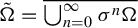 $\tilde \Omega =\overline {\bigcup _{n=0}^\infty \sigma ^{n}\Omega }$
converges to
 $0$
as
 $k\to \infty $
.
Let
 $x\in \Omega $
. We have
 $x=v^{(1)}w^{(1)}v^{(2)}w^{(2)}\cdots $
or
 $x=\cdots w^{(-1)}v^{(0)}w^{(0)}v^{(1)}\cdots $
, and
 $[x_0]\supset [v_0]$
according to whether
 $\Sigma $
is one-sided or two-sided, where
 $v^{(j)}\in \mathcal Q_k$
and
 $|w^{(j)}|\leq t$
. From equation (2.8), for all j, we have
 $$ \begin{align*} \begin{split}\max_{x\in[v^{(j)}w^{(j)}]}\max_{1\leq \ell\leq m }\bigg|S_{|v^{(j)}w^{(j)}|}f_\ell(x)-|v^{(j)}w^{(j)}|\int f_\ell \,d\mu\bigg|&\leq|v^{(j)}|\varepsilon+2|w^{(j)}|\cdot\|f_\ell\|_{C^0}\\&\leq2|v^{(j)}w^{(j)}|\varepsilon.\end{split} \end{align*} $$
The last inequality holds for all sufficiently large k. It follows that there exists
 $N\geq 1$
that is independent of
 $x\in \Gamma $
such that for all
 $n\geq N$
, we have
 $$ \begin{align*}\max_{1\leq \ell\leq m }\bigg|\frac{S_nf_\ell(x)}{n}-\int f_\ell\,{d}\mu\bigg|<3\varepsilon.\end{align*} $$
We obtain the same estimate for all
 $x\in \tilde \Omega $
and all sufficiently large
 $n\geq N$
. Consequently, for any measure
 $\nu \in {\mathcal M}(\tilde \Omega ,\sigma |_{\tilde \Omega })$
, we have
 $$ \begin{align*}\max_{1\leq \ell\leq m }\bigg|\!\int f_\ell\,{d}\nu-\int f_\ell\,{d}\mu\bigg|<3\varepsilon.\end{align*} $$
By the Krein–Milman theorem, the same inequality remains valid for all
 $\nu \in {\mathcal M}(\tilde \Omega ,\sigma |_{\tilde \Omega })$
. Together with equation (2.17), we obtain
 ${\mathcal M}(\tilde \Omega ,\sigma |_{\tilde \Omega })\subset U$
. It follows that U contains a shift-invariant ergodic measure with arbitrarily small entropy. The proof of Proposition 2.4(a) is complete.
Proof of Proposition 2.4(b)
Let
 $\mu \in {\mathcal M}(\Sigma ,\sigma )$
be ergodic with
 $h(\mu )>h({\mathcal C}^p\cup {\mathcal C}^s)$
. Let V be an open subset of
 ${\mathcal M}(\Sigma ,\sigma )$
that contains
 $\mu $
. Let
 $f_1,\ldots ,f_m$
be a finite collection of elements of
 $C(\Sigma )$
and let
 $\varepsilon \in (0,h(\mu )/3)$
be such that
 $$ \begin{align}\bigg\{\nu\in {\mathcal M}(\Sigma,\sigma)\colon\max_{1\leq \ell\leq m }\bigg|\!\int f_\ell\,{d}\nu- \int f_\ell\,{d}\mu\bigg|<3\varepsilon \bigg\}\subset V.\end{align} $$
By Lemma 2.7, if
 $\varepsilon $
is sufficiently small, then there exists an arbitrarily large integer k and a subset
 $\mathcal Q_k=\mathcal Q_k(\mu ,f_1,\ldots ,f_m,\varepsilon )$
of
 $\mathcal G_k$
for which equations (2.7) and (2.8) hold. We take a subset
 $\mathcal Q_k'$
of
 $\mathcal Q_k$
such that
 $h(\mu )-3\varepsilon <(1/k)\log \#\mathcal Q_k'<h_{\mathrm {top}}(\Sigma )-\varepsilon $
. Let
 $t\geq 0$
be a gap size for the (W)-specification of
 $\mathcal G$
. If
 $\Sigma $
is one-sided, then define
 $$ \begin{align*}\Gamma=\{v^{(1)}w^{(1)}v^{(2)}w^{(2)}v^{(3)}w^{(3)}\cdots\in\Sigma\colon v^{(j)}\in\mathcal Q_k', |w^{(j)}|\leq t\ \text{ for } j\in{\mathbb N}\}.\end{align*} $$
If
 $\Sigma $
is two-sided, then define
 $$ \begin{align*}\Gamma=\{x=\cdots w^{(-1)}v^{(0)}w^{(0)}v^{(1)}\cdots\in\Sigma\colon v^{(j)}\in\mathcal Q_k', |w^{(j)}|\leq t\ \text{ for } j\in{\mathbb Z}, x\in[v_0]\}.\end{align*} $$
In other words,
 $\Gamma $
is the set of points in
 $\Sigma $
whose symbol sequences are alternate concatenations of elements of
 $\mathcal Q_k'$
and that of
 $\mathcal L(\Sigma )$
with word lengths not exceeding t. Since the topological entropy of the subshift
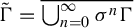 $\tilde \Gamma =\overline {\bigcup _{n=0}^\infty \sigma ^{n}\Gamma }$
is strictly smaller than
 $h_{\mathrm {top}}(\Sigma )$
,
 $\tilde \Gamma $
is a proper subset of
 $\Sigma $
. Define
 $f\colon \Sigma \to {\mathbb R}$
by
 $$ \begin{align*}f(x)=-\min\{d(x,y)\colon y\in\tilde\Gamma\},\end{align*} $$
where d denotes the Hamming metric on
 $\Sigma $
(see §2.1).
We claim that f is Lipschitz continuous. Indeed, for any pair
 $x,y$
of distinct points in
 $\Sigma $
, take
 $i_0,i_1,i_2\in {\mathbb N}$
with
 $d(x,y)=2^{-i_0}$
,
 $f(x)=-2^{-i_1}$
,
 $f(y)=-2^{-i_2}$
. If
 $i_1\leq i_0$
or
 $i_2\leq i_0$
, then
 $i_1=i_2$
and so
 $f(x)-f(y)=0$
. Otherwise,
 $|f(x)-f(y)|= |2^{-i_1}-2^{-i_2}|< 2^{-i_0+1}=2d(x,y)$
. The Lipschitz continuity of f implies
 $$ \begin{align}\sup_{n\in{\mathbb N}}\max\{S_nf(x)-S_nf(y)\colon x_i=y_i\ \text{ for }i=1,\ldots,n\}<\infty.\end{align} $$
By virtue of equation (2.18), the same argument as in the proof of Proposition 2.4(a) shows
 ${\mathcal M}(\tilde \Gamma ,\sigma |_{\tilde \Gamma })\subset V$
. Clearly,
 $\Lambda _\sigma (f)=0$
and, hence, any f-maximizing measure belongs to
 ${\mathcal M}(\tilde \Gamma ,\sigma |_{\tilde \Gamma })$
. If
 $\varepsilon $
is sufficiently small and k is sufficiently large, then
 $$ \begin{align}h_{\mathrm{top}}(\tilde\Gamma)\geq h(\mu)-4\varepsilon>h({\mathcal C}^p\cup{\mathcal C}^s).\end{align} $$
Let
 $\nu _0\in {\mathcal M}(\tilde \Gamma ,\sigma |_{\tilde \Gamma })$
be an ergodic measure of maximal entropy for the subshift
 $\tilde \Gamma $
. Note that
 $$ \begin{align*}\limsup_{n\to\infty}\sup_{x\in\Sigma}\frac{S_n f(x)}{n}=\sup_{x\in\Sigma}\limsup_{n\to\infty}\frac{S_nf(x)}{n}=\Lambda_\sigma(f)=0.\end{align*} $$
Combining this with equation (2.20), for all
 $\beta \geq 0$
, we get
 $$ \begin{align*}\begin{aligned}h({\mathcal C}^p\cup{\mathcal C}^s)+\beta\cdot\limsup_{n\to\infty}\sup_{x\in\Sigma}\frac{S_nf(x)}{n} &=h({\mathcal C}^p\cup{\mathcal C}^s)<h_{\mathrm{top}}(\tilde\Gamma)\\ &=h(\nu_0)=h(\nu_0)+\int \beta f\,{d}\nu_0\leq P(\beta f).\end{aligned}\end{align*} $$
This estimate implies
 $$ \begin{align*}\sum_{n=1}^\infty\Lambda_n({\mathcal C}^p\cup{\mathcal C}^s,\beta f)e^{-P(\beta f)n}<\infty.\end{align*} $$
By Theorem 2.1, the equilibrium state for the potential
 $\beta f$
is unique, denoted by
 $\mu _{\beta f}$
, and has the weak Gibbs property in equation (2.1). This verifies condition (i).
The continuity of the map
 $\beta \in [0,\infty )\mapsto \mu _{\beta f}\in {\mathcal M}(\Sigma ,\sigma )$
follows from Lemma 2.3. To prove the injectivity of the map, let
 $0\leq \beta _1<\beta _2$
and suppose
 $\mu _{\beta _1f}=\mu _{\beta _2f}$
by contradiction. Since f is non-positive and non-constant, we have
 $P(\beta _1f)>P(\beta _2f)$
. By the weak Gibbs property of
 $\mu _{\beta _1f}$
,
 $\mu _{\beta _2f}$
, and equation (2.19), there exists a constant
 $K\geq 1$
such that for all
 $n\geq 1$
,
 $w\in \mathcal G_n$
, and
 $x\in [w]$
, we have
 $$ \begin{align*}K^{-1}\leq \frac{\exp(-P(\beta_1f)n+\beta_1S_nf(x))}{\exp(-P(\beta_2f)n+\beta_2S_nf(x))}\leq K.\end{align*} $$
This is equivalent to
 $$ \begin{align}|(\beta_1-\beta_2)S_nf(x)-n(P(\beta_1f)-P(\beta_2f))|\leq C\end{align} $$
for some constant
 $C>0$
independent of n, w, x. By the ergodicity of
 $\nu _0$
, equation (2.20), and
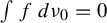 $\int f\,{d}\nu _0=0$
, one can use the set
 $\mathcal Q_k(\nu _0,f,\delta )$
given by Lemma 2.7 for a sufficiently small
 $\delta>0$
and a sufficiently large
 $k\in {\mathbb N}$
to show that for all sufficiently large
 $n\in {\mathbb N}$
, there exists
 $w\in \mathcal G_n$
such that
 $\sup _{x\in [w]}|(1/n)S_nf(x)|<\delta $
. This and equation (2.21) together imply
 $P(\beta _1f)=P(\beta _2f)$
, which is a contradiction, and thus verifies condition (ii).
By Lemma 2.3, any ground state for the potential f belongs to
 ${\mathcal M}_{\mathrm {\max }}(f)$
and so belongs to
 ${\mathcal M}(\tilde \Gamma ,\sigma |_{\tilde \Gamma })$
. By Lemma 2.3 and equation (2.20), we obtain
 $\lim _{\beta \to \infty }h(\mu _{\beta f})= h(\nu _0)=h_{\mathrm {top}}(\tilde \Gamma )>h({\mathcal C}^p\cup {\mathcal C}^s)$
, which verifies condition (iii). The proof of Proposition 2.4(b) is complete.
3 On the proofs of Theorems A and B
We are almost ready to proceed to proving the main results on ergodic optimization. After recalling some functional analytic ingredients in §3.1, we complete the proof of Theorem A in §3.2. In §3.3, we complete the proof of Theorem B.
3.1 Functional analysis
The proof of Theorem A(b) relies on the result of Israel [Reference Israel26,
 $\S$
V], who proved an approximation theorem about tangent functionals to convex functions and used it for lattice systems in statistical mechanics to prove the existence of a dense set of continuous interactions for which there exist uncountably many ergodic equilibrium states. Below, we recall his result and some other auxiliary ones.
For a Banach space V with a norm
 $\|\cdot \|$
, let
 $V^*$
denote the set of real-valued bounded functionals on V. For each
 $\mu \in V^*$
, let
 $\|\mu \|$
denote the norm
 $$ \begin{align*}\|\mu\|=\sup\{|\mu(f)|\colon f\in V,\ \|f\|=1\}.\end{align*} $$
Let
 $\Lambda $
,
 $\mu \in V^*$
. We say:
-
•
$\mu $
is tangent to
$\Lambda $
at
$f\in V$
if
$\mu (f)\leq \Lambda (f+g)-\Lambda (f)$
holds for all
$g\in V$
; -
•
$\mu $
is bounded by
$\Lambda $
if
$\mu (f)\leq \Lambda (f)$
holds for all
$f\in V$
; -
•
$\Lambda $
is convex if
$\Lambda (tf+(1-t)g)\leq t\Lambda (f)+(1-t)\Lambda (g)$
holds for all f,
$g\in V$
, and
$t\in [0,1]$
.











The following is a version of the theorem of Bishop and Phelps [Reference Bishop and Phelps2].
Theorem 3.1. [Reference Israel26, Theorem V.1.1]
Let V be a Banach space, and let
 $\Lambda \in V^*$
be convex and continuous. For any
 $\mu _0\in V^*$
that is bounded by
 $\Lambda $
, any
 $f_0\in V$
, and any
 $\varepsilon>0$
, there exist
 $\mu \in V^*$
and
 $f\in V$
such that
 $\mu $
is tangent to
 $\Lambda $
at f, and
 $$ \begin{align*}\|\mu-\mu_0\|\leq\varepsilon\quad \text{ and }\quad \|f-f_0\|\leq\frac{1}{\varepsilon}(\Lambda(f_0)-\mu_0(f_0)+s),\end{align*} $$
where
 $s=\sup \{\mu _0(g)-\Lambda (g)\colon g\in V\}\leq 0$
.
For a continuous map T of a compact metric space X, the functional
 $\Lambda _T\in C(X)^*$
given by equation (1.1) is convex and continuous. The next lemma characterizes maximizing measures in terms of
 $\Lambda _T$
. Recall that the set of real-valued bounded linear functionals on
 $C(X)$
can be identified with the set of (finite) signed Borel measures on X by the Riesz representation theorem.
Lemma 3.2. [Reference Brémont8, Lemma 2.3]
Let T be a continuous map of a compact metric space X and let
 $f\in C(X)$
. A bounded linear functional
 $\mu \in C(X)^*$
is tangent to
 $\Lambda _T$
at f if and only if
 $\mu $
belongs to
 ${\mathcal M}(X,T)$
and is f-maximizing.
If T is a continuous map of X, then for any
 $\mu \in {\mathcal M}(X,T)$
, there exists a unique Borel probability measure
 $b_{\mu }$
on
 ${\mathcal M}(X,T)$
such that
 $b_\mu ({\mathcal M}^{\mathrm {e}}(X,T))=1$
and
 $\mu =\int _{{\mathcal M}^{\mathrm {e}}(X,T)} \nu \,{d}b_\mu (\nu )$
, where
 ${\mathcal M}^{\mathrm {e}}(X,T)$
denotes the set of elements of
 ${\mathcal M}(X,T)$
that are ergodic. We call
 $b_\mu $
the barycentre of
 $\mu $
. Put
 $$ \begin{align*}\mathrm{supp}(b_\mu) =\bigcap\{F\colon F\subset {\mathcal M}(X,T)\text{, closed, }b_\mu(F)=1\}.\end{align*} $$
Since
 ${\mathcal M}(X,T)$
has a countable base, we have
 $b_\mu (\mathrm {supp}(b_\mu ))=1$
.
Lemma 3.3. Let T be a continuous map of a compact metric space X.
-
(a) If there exists a constant
$C\geq 0$
such that
$h(\nu )\leq C$
for all
$\nu \in \mathrm {supp}(b_\mu )$
, then
$h(\mu )\leq C$
. -
(b) Let
$f\in C(X)$
,
$\mu \in {\mathcal M}_{\mathrm {\max }}(f)$
. Then,
$\mathrm {supp}(b_\mu )$
is contained in
${\mathcal M}_{\mathrm {\max }}(f)$
.








Proof. Part (a) is a consequence of the Jacobs theorem [Reference Walters43]. For a proof of part (b), see [Reference Shinoda37, Proposition 6], for example.
The next lemma asserts that the barycentre map
 $\mu \mapsto b_\mu $
from
 ${\mathcal M}(X,T)$
to the set of Borel probability measures on
 ${\mathcal M}(X,T)$
is isometric.
Lemma 3.4. [Reference Israel26, Corollary IV.4.2]
Let T be a continuous map of a compact metric space X. For all
 $\mu _1$
,
 $\mu _2\in {\mathcal M}(X,T)$
, we have
 $$ \begin{align*}\|b_{\mu_1}-b_{\mu_2}\|=\|\mu_1-\mu_2\|.\end{align*} $$
3.2 Proof of Theorem A
Let
 $\Sigma $
be a subshift with
 $h_{\mathrm {spec}}^\bot (\Sigma )<h_{\mathrm {top}}(\Sigma )$
and suppose
 $h_{\mathrm {spec}}^\bot (\Sigma )\leq H<h_{\mathrm {top}}(\Sigma )$
. For each
 $n\in {\mathbb N}$
, define
 $$ \begin{align*}O_n=\bigg\{\mu\in \overline{{\mathcal M}^{\mathrm{e}}(\Sigma, \sigma)}: 0\leq h(\mu)<H+\frac{1}{n}\bigg\}\end{align*} $$
and
 $$ \begin{align*} U_n=\{f\in C(\Sigma)\colon \overline{{\mathcal M}^{\mathrm{e}}(\Sigma,\sigma)}\cap {\mathcal M}_{\mathrm{\max}}(f)\subset O_n\}.\end{align*} $$
Clearly, the set
 $\mathscr {R}_H$
in Theorem A is contained in
 $\bigcap _{n=1}^\infty U_n.$
Conversely, let
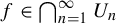 $f\in \bigcap _{n= 1}^\infty U_n$
. The entropy of any ergodic measure in
 ${\mathcal M}_{\mathrm {\max }}(f)$
does not exceed H and by Lemma 3.3, the entropy of any non-ergodic measure in
 ${\mathcal M}_{\mathrm {\max }}(f)$
does not exceed H either. Hence, we obtain
 $\mathscr {R}_H=\bigcap _{n= 1}^\infty U_n.$
By the upper semicontinuity of the entropy function,
 $O_n$
is an open subset of
 $\overline {{\mathcal M}^{\mathrm {e}}(\Sigma , \sigma )}$
. From Corollary 2.5(a),
 $O_n$
is a dense subset of
 $\overline {{\mathcal M}^{\mathrm {e}}(\Sigma , \sigma )}$
. By [Reference Morris34, Theorem 1.1],
 $U_n$
is an open and dense subset of
 $C(\Sigma )$
. Therefore,
 $\mathscr {R}_H$
is dense
 $G_\delta $
as required in Theorem A(a).
To prove Theorem A(b), pick
 $f_0\in C(\Sigma )\setminus \mathscr {R}_H$
. By Lemma 3.3(a), there exists an ergodic measure
 $\unicode{x3bb} \in {\mathcal M}_{\mathrm {\max }}(f_0)$
with
 $h(\unicode{x3bb} )>H$
. Let
 $\varepsilon \in (0,1/2)$
and put
 $$ \begin{align*}R=\bigg\{\nu\in {\mathcal M}(\Sigma,\sigma)\colon \int f_0\,{d}\nu\geq\Lambda_\sigma(f_0)-\varepsilon^2\bigg\}.\end{align*} $$
By Corollary 2.5(b) applied to
 $\unicode{x3bb} $
, there exists a homeomorphism
 $t\in [0,1]\mapsto \nu _t\in R\cap {\mathcal M}^{\mathrm {e}}(\Sigma ,\sigma )$
onto its image such that
 $\nu _t$
is fully supported and satisfies
 $h(\nu _t)>H$
for all
 $t\in [0,1]$
. Let m denote the Lebesgue measure on
 $[0,1]$
and define a Borel probability measure
 $\hat m$
on
 ${\mathcal M}^{\mathrm {e}}(\Sigma ,\sigma )$
by
 $$ \begin{align*}\hat m(\cdot)=m\{t\in[0,1]\colon \nu_t\in\cdot\}.\end{align*} $$
We have
 $\hat m(R\cap {\mathcal M}^{\mathrm {e}}(\Sigma ,\sigma ))=1$
. Put
 $\mu _0=\int _{{\mathcal M}^{\mathrm {e}}(\Sigma ,\sigma )}\nu \,{d}\hat m(\nu )$
. Then,
 $\mu _0$
belongs to R and is bounded by
 $\Lambda _\sigma $
as an element of
 $C(\Sigma )^*$
. Note that
 $b_{\mu _0}=\hat m$
. By Theorem 3.1, there exist
 $f\in C(\Sigma )$
and
 $\mu \in C(\Sigma )^*$
such that
 $\mu $
is tangent to
 $\Lambda _\sigma $
at f, and
 $$ \begin{align} \|\mu-\mu_0\|\leq\varepsilon\quad \text{and}\quad \|f-f_0\|_{C^0}\leq\frac{1}{\varepsilon}\bigg(\Lambda_\sigma(f_0)-\int f_0\,{d}\mu_0\bigg)\leq\varepsilon. \end{align} $$
By Lemma 3.2,
 $\mu $
belongs to
 ${\mathcal M}(\Sigma ,\sigma )$
and is f-maximizing.
Take an open subset U of
 ${\mathcal M}(\Sigma ,\sigma )$
such that
 $\mathrm {supp}(b_\mu )\subset U$
and
 ${b_{\mu _0}(U\setminus \kern -0.5pt\mathrm {supp}(b_\mu ))<\varepsilon }$
. Since
 ${\mathcal M}^{\mathrm {e}}(\Sigma ,\sigma )$
is a metric space, it is a normal space. By the Urysohn lemma, there exists a function
 $g\in C({\mathcal M}(\Sigma ,\sigma ))$
such that
 $\|g\|_{C^0}=1$
,
 $g\equiv 0$
on
 ${\mathcal M}(\Sigma ,\sigma )\setminus U$
, and
 $g\equiv 1$
on
 $\mathrm {supp}(b_\mu )$
. We have
 $$ \begin{align*}\begin{aligned}b_{\mu_0}(\mathrm{supp}(b_\mu))&> b_{\mu_0}(U)-\varepsilon>b_{\mu_0}(g)-\varepsilon\geq b_\mu(g)-2\varepsilon\\ &\geq b_\mu(\mathrm{supp}(b_\mu))-2\varepsilon=1-2\varepsilon>0.\end{aligned}\end{align*} $$
To deduce the third inequality, we have used
 $\|b_{\mu }-b_{\mu _0}\|=\|\mu -\mu _0\|\leq \varepsilon $
from Lemma 3.4 and the first inequality in equation (3.1). Since
 $b_{\mu _0}$
is non-atomic, it follows that the set
 $\{\nu _t\colon t\in [0,1],\ \nu _t\in \mathrm {supp}(b_\mu )\}$
contains uncountably many elements, which belong to
 ${\mathcal M}_{\mathrm {\max }}(f)$
by Lemma 3.3. Since
 $f_0\in C(\Sigma )$
and
 $\varepsilon \in (0,1/2)$
are arbitrary, the proof of Theorem A(b) is complete.
3.3 Proof of Theorem B
Let
 $\Sigma $
be a subshift that satisfies
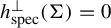 $h_{\mathrm {spec}}^\bot (\Sigma )=0$
and suppose that ergodic measures on
 $\Sigma $
are entropy dense. Recall that
 $$ \begin{align*}\mathscr{R}_0=\{f\in C(\Sigma)\colon h(\mu)=0 \text{ for all }\mu\in {\mathcal M}_{\mathrm{\max}}(f)\},\end{align*} $$
and let
 $f\in \mathscr {R}_0$
. There exists an ergodic measure
 $\mu \in {\mathcal M}_{\mathrm {\max }}(f)$
with
 $h(\mu )=0$
. From the entropy density and the affinity of the entropy function,
 $\mu $
is approximated in the weak* topology by ergodic measures with positive entropy. Taking these approximating measures and repeating the argument in the proof of Theorem A(b) in §3.2, one can show that f is in the closure of functions for which there exists a maximizing measure with positive entropy. Hence,
 $\mathscr {R}_0$
has empty interior. Then, the desired statement is a direct consequence of Theorem A(b).
4 Examples and applications
In this section, we provide examples of non-Markov symbolic dynamical systems to which Theorem A or Theorem B applies.
4.1 Piecewise monotonic maps and their coding spaces
We say
 $T\colon [0,1]\to [0,1]$
is a piecewise monotonic map if there exist finitely many non-degenerate closed subintervals
 $I_1,\ldots ,I_k$
of
 $[0,1]$
with disjoint interiors such that
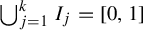 $\bigcup _{j=1}^k I_j=[0,1]$
, and the restriction of T to the interior of
 $I_j$
is strictly monotone and continuous for every
 $1\leq j\leq k$
. The intervals
 $I_j$
are called monotonic pieces of T. Given a piecewise monotonic map T with k monotonic pieces
 $I_1,\ldots ,I_k$
, let
 $X_T=\bigcap _{n=0}^\infty T^{-n}(\bigcup _{j=1}^k (I_j\setminus \partial I_j))$
and define
 $\pi \colon X_T\to \{1,\ldots ,k\}^{\mathbb {N}}$
by
 $T^n(\pi (x))\in I_{(\pi (x))_{n+1}}\setminus \partial I_{(\pi (x))_{n+1}}$
for every
 $n\geq 0$
. The closure of
 $\pi (X_T)$
in the full shift space
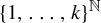 $\{1,\ldots ,k\}^{\mathbb {N}}$
is a subshift, called the coding space of T and denoted by
 $\Sigma _T$
. Notice that
 $\pi \circ T|_{X_T}=\sigma \circ \pi $
, where
 $\sigma $
denotes the left shift acting on
 $\Sigma _T$
. We say T is transitive if there is
 $x\in [0,1]$
such that
 $\{T^n(x)\colon n\ge 0\}$
is dense in
 $[0,1]$
. It is easy to see that if T is transitive, then
 $\pi $
is injective. If, moreover, T has positive topological entropy, then
 $h_{\mathrm {top}}(\Sigma _T)>0$
.
Continuous topologically mixing piecewise monotonic maps and their coding spaces have the Bowen specification property (see e.g. [Reference Buzzi9]), while piecewise monotonic maps with discontinuities and their coding spaces rarely have that. Typical examples of such maps are as follows:
-
• (the
$(\alpha ,\beta )$
-transformation)
$T_{\alpha ,\beta }(x)=\beta x+\alpha -\lfloor \beta x+\alpha \rfloor $
(
$\alpha \in [0,1)$
,
$\beta>1$
); -
• (the
$(-\beta )$
-transformation)
$T_{-\beta }(x)=-\beta x+\lfloor \beta x\rfloor +1$
(
$\beta>1$
).






The map
 $T_{0,\beta }$
is called the
 $\beta $
-transformation. From the general result of Buzzi [Reference Buzzi9, Theorem 1.5] it follows that: for each fixed
 $\alpha\in[0,1)$
the set of
 $\beta>1$
for which
 $\Sigma_{T_{\alpha,\beta}}$
has Bowen's specification property is of zero Lebesgue measure; the set of
 $\beta>1$
for which
 $\Sigma_{T_{-\beta}}$
has Bowen's specification property is of zero Lebesgue measure.
Proposition 4.1. If
 $T\colon [0,1]\to [0,1]$
is a transitive piecewise monotonic map with positive topological entropy, then
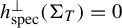 $h_{\mathrm {spec}}^\bot (\Sigma _T)=0$
.
The original idea in our proof of Proposition 4.1 is due to Climenhaga [Reference Climenhaga12]. We will use a Markov diagram [Reference Hofbauer19], a directed graph whose vertices are closed subsets of the coding space. For the rest of this subsection, let
 $T\colon [0,1]\to [0,1]$
be a transitive piecewise monotonic map with positive topological entropy and k monotonic pieces. In what follows, we use the notation
 $[ \cdot ]$
to denote cylinders in the coding space
 $\Sigma _T$
. Let C be a non-empty closed subset of
 $\Sigma _T$
such that
 $C\subset [i]$
holds for some
 $i\in \{1,\ldots ,k\}$
. We say a non-empty closed subset D of
 $\Sigma _T$
is a successor of C if there exists
 $j\in \{1,\ldots ,k\}$
such that
 $D=[j]\cap \sigma C$
. If D is a successor of C, we write
 $C\to D$
. We set
 $\mathcal {D}_0=\{[1],\ldots ,[k]\}$
, and define
 ${\mathcal D}_1$
,
 ${\mathcal D}_2,\ldots $
by the recursion formula
 $$ \begin{align*}\mathcal{D}_{n+1}=\mathcal{D}_n\cup \{D\colon D\text{ is a successor of some }C\in\mathcal{D}_n\}.\end{align*} $$
We set
 $$ \begin{align*}\mathcal{D}=\bigcup_{n= 0}^\infty\mathcal{D}_n.\end{align*} $$
The directed graph
 $({\mathcal D},\to )$
is called a Markov diagram associated with
 $\Sigma _T$
.
For a set
 ${\mathcal C}\subset {\mathcal D}$
, let
 $\Sigma _{\mathcal C}$
denote the set of paths
 $C_1\to C_2\to \cdots $
that contains infinitely many edges and all whose vertices are contained in
 ${\mathcal C}$
. We define a map
 $\Psi \colon \Sigma _{\mathcal {D}}\to \{1,\ldots ,k\}^{{\mathbb N}}$
as follows. For each vertex
 $C_1$
or each path
 $C_1\to \cdots \to C_{n}$
in the diagram
 $({\mathcal D},\to )$
, define
 $$ \begin{align*}(C_1\cdots C_{n})=x_1\cdots x_{n}\in\{1,\ldots,k\}^n,\end{align*} $$
where
 $x_i\in \{1,\ldots ,k\}$
and
 $C_i\subset [x_i]$
for
 $i=1,\ldots ,n$
. For
 $(C_n)_{n=1}^\infty \in \{1,\ldots ,k\}^{\mathbb N}$
, define
 $$ \begin{align*} \Psi((C_n)_{n=1}^\infty)\in \bigcap_{n=1}^\infty[(C_1\cdots C_{n})].\end{align*} $$
Note that
 $\Sigma _{\mathcal D}$
is a Markov shift over the countably infinite alphabet
 ${\mathcal D}$
,
 $\Psi (\Sigma _{\mathcal D})=\Sigma _T$
, and
 $\Psi $
is a semiconjugacy between the left shift on
 $\Sigma _{\mathcal D}$
and
 $\sigma \colon \Sigma _T\to \Sigma _T$
. The next lemma follows from [Reference Hofbauer20, Theorems 10, 11].
Lemma 4.2. [Reference Hofbauer and Raith23, pp. 224, 226]
There exist a subset
 ${\mathcal C}$
of
 ${\mathcal D}$
and a finite subset
 $\mathcal {F}$
of
 $\mathcal {C}$
such that:
-
(a) for any pair
$(C,C')$
of vertices in
${\mathcal C}$
, there is a path that leads from C to
$C'$
; -
(b)
$C\in \mathcal {C}$
and
$C\rightarrow D$
imply
$D\in \mathcal {C}$
; -
(c)
$\Psi (\{(C_n)_{n=1}^\infty \in \Sigma _{\mathcal {C}}\colon C_1\in \mathcal {F}\}) =\Psi (\Sigma _{\mathcal {C}})=\Sigma _T$
.



Proof of Proposition 4.1
Let
 ${\mathcal C}$
be a subset of
 ${\mathcal D}$
and
 $\mathcal F\subset {\mathcal C}$
be a finite set for which the conclusion of Lemma 4.2 holds. Let
 $H>0$
and let
 $N> (4/H)\log 2$
be an integer with
 $\mathcal {F}\subset \mathcal {D}_N$
. We now define
 ${\mathcal C}^p$
,
 $\mathcal G$
,
 ${\mathcal C}^s\subset \mathcal L(\Sigma _T)$
by
 $$ \begin{align*}\begin{aligned}{\mathcal C}^p&=\{\emptyset\},\\ \mathcal G&=\{\emptyset\}\cup\bigcup_{n=1}^\infty \{(C_1\cdots C_{n})\colon C_1\to\cdots\to C_{n},\ C_1,C_{n}\in \mathcal{D}_N\cap\mathcal{C}\},\\ {\mathcal C}^s&=\{\emptyset\}\cup\bigcup_{n=1}^\infty \left\{\begin{array}{@{}l@{}} (C_1\cdots C_{n})\colon C_1\to\cdots \to C_{n}\\ C_1\in \mathcal{D}_{N+1},\ C_i\in\mathcal{C}\setminus\mathcal{D}_N\text{ for }1\leq i\leq n\end{array}\right\}.\end{aligned}\end{align*} $$
Let
 $w\in \mathcal {L}(\Sigma _T)\setminus \{\emptyset \}$
. By Lemma 4.2(c), there exists
 $(C_n)_{n=1}^\infty \in \Sigma _{\mathcal {C}}$
such that
 $\Psi ((C_n)_{n=1}^\infty )\in [w]$
and
 $C_1\in \mathcal {F}$
. Set
 $i_0=\sup \{1\le i\le |w|\colon C_i\in \mathcal {D}_N\}$
. Since
 $C_1\in \mathcal F\subset {\mathcal D}_N$
, we have
 $i_0\geq 1$
. Set
 $u=(C_1\cdots C_{i_0})$
and
 $v=(C_{i_0+1}\cdots C_{|w|})$
. By Lemma 4.2(b), we have
 $u\in \mathcal G$
,
 $v\in {\mathcal C}^s$
and
 $w=uv$
, which implies
 $\mathcal {L}(\Sigma _T)\subset {\mathcal C}^p\mathcal G{\mathcal C}^s=\mathcal G{\mathcal C}^s$
. The reverse inclusion is obvious.
For each
 $M\in {\mathbb N}$
, by the finiteness of
 $\#{\mathcal D}_{M+N}$
and Lemma 4.2(a), there exists
 $t_M\in {\mathbb N}$
such that for any pair of vertices in
 $\mathcal {D}_{M+N}\cap \mathcal {C}$
, there is a path not containing more than
 $t_M$
edges and leading from one vertex to the other. Let
 $u,v\in \mathcal G^M$
. By the above definition of
 $\mathcal G$
, there exist two paths
 $C_1\to \cdots \to C_{|u|}$
and
 $D_1\to \cdots \to D_{|v|}$
such that
 $C_{|u|}\in \mathcal {D}_{M+N}\cap \mathcal {C}$
and
 $D_1\in \mathcal {D}_{N}\cap \mathcal {C}$
. Hence, there is a path
 $C_{|u|}\to \cdots \to D_1$
not containing more than
 $t_M$
edges, which implies that
 $\mathcal G^M$
has (W)-specification with gap size
 $t_M$
.
Notice that for all
 $q\in {\mathbb N}$
, the number of paths starting at each vertex in
 ${\mathcal D}\setminus {\mathcal D}_N$
not containing more than
 $qN$
edges and all whose vertices are contained in
 $\mathcal {D}\setminus \mathcal {D}_N$
does not exceed
 $2^q$
(see the proof of [Reference Hofbauer20, Corollary 1(i)]). Hence, for each integer
 $n=(q-1)N+r$
with
 $q,r\in {\mathbb N}$
,
 $q\geq 2$
,
 $0\leq r\leq N-1$
, we have
 $(q-1)N\leq n< qN$
and
 $\#{\mathcal C}^s_n \le 2^{q}\#\mathcal {D}_{N+1}.$
If n is sufficiently large, then
 $$ \begin{align*}\frac{\log\#{\mathcal C}^s_n}{n} \le \frac{q\log 2}{n}+\frac{\log \#\mathcal{D}_{N+1}}{n}\le \frac{2\log 2}{N}+\frac{H}{2}<H.\end{align*} $$
Since
 $H>0$
is arbitrary,
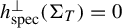 $h_{\mathrm {spec}}^\bot (\Sigma _T)=0$
holds.
By Proposition 4.1, if T is a transitive piecewise monotonic interval map with positive topological entropy, then
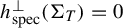 $h_{\mathrm {spec}}^\bot (\Sigma _T)=0$
. The entropy density for
 $\Sigma _T$
follows from the density of shift-invariant closed orbit measures in the space of ergodic measures [Reference Shinoda and Yamamoto39, Proposition 3.1]. The latter condition is equivalent to the density of T-invariant closed orbit measures in the space of ergodic measures [Reference Yamamoto44, Theorem A]. The density of closed orbit measures has been verified for a wide class of transitive piecewise monotonic maps with positive topological entropy (see e.g. [Reference Hofbauer21–Reference Hofbauer and Raith23, Reference Shinoda and Yamamoto39, Reference Sigmund41]). Hence, Theorem B applies to the coding spaces of these piecewise monotonic maps. It has been conjectured that the density of closed orbit measures holds for any transitive piecewise monotonic map with positive topological entropy [Reference Hofbauer and Raith23].
4.2 Coded shifts
Let
 $\mathcal A$
be a finite subset of
 ${\mathbb N}$
. Let
 $\mathcal A^0$
denote the singleton consisting of the empty word
 $\emptyset $
. For each
 $n\in {\mathbb N}$
, let
 $\mathcal A^n$
denote the set of words from
 $\mathcal A$
with word length n. Put
 $\mathcal A^*=\bigcup _{n=0}^\infty \mathcal A^n$
. Let
 ${\mathcal H}$
be a countable subset of
 $\mathcal A^*$
that contains the empty word. The coded shift
 $\Sigma _{{\mathcal H}}$
generated by
 ${\mathcal H}$
is the two-sided subshift whose language is
 $$ \begin{align*} \overline{\{w^{(1)} w^{(2)}\cdots w^{(k)}\colon w^{(1)},\ldots, w^{(k)}\in{\mathcal H}, k\in{\mathbb N}\}}, \end{align*} $$
where
 $\overline {\{\cdot \}}$
denotes the closure under the operation of passing to subwords.
The coded shift
 $\Sigma _{\mathcal H}$
has the following natural language decomposition
 $\mathcal {L}(\Sigma _{\mathcal H})=\mathcal {C}^p\mathcal {G}\mathcal {C}^s$
for which
 $\mathcal G^M$
has (W)-specification for all
 $M\in \mathbb {N}$
:
 $$ \begin{align} \mathcal{C}^p&=\bigcup_{n=1 }^\infty i_n^s({\mathcal H} ),\nonumber\\ \mathcal{G}&=\bigcup_{k=1}^\infty\{w^{(1)}\cdots w^{(k)}\colon w^{(1)},\ldots,w^{(k)}\in {\mathcal H} \},\\ \mathcal{C}^s&=\bigcup_{n=1 }^\infty i_n^p({\mathcal H} ),\nonumber \end{align} $$
where
 $i_n^s$
(respectively
 $i_n^p$
) denotes the map that extracts the last (respectively the first) n symbols of a word
 $w\in \mathcal A^*$
, and satisfies
 $i_n^s(w)=\emptyset $
if
 $|w|<n$
(respectively
 $i_n^p(w)=\emptyset $
if
 $|w|<n$
). When
 ${\mathcal H}$
is a finite set, clearly
 $h({\mathcal C}^p\cup {\mathcal C}^s)=0$
holds, and
 $\Sigma _{{\mathcal H}}$
is a sofic shift [Reference Kucherenko, Schmoll and Wolf30]. Every transitive sofic shift is a coded shift [Reference Lind and Marcus32, §13.5].
Coded shifts with countably infinite generators are sources of interesting examples. Well-known examples are S-gap shifts [Reference Lind and Marcus32] and the Dyck shift [Reference Krieger29]. As shown below, there exist intrinsically ergodic coded shifts for which the entropy density fails. For more details on coded shifts, see [Reference Climenhaga and Thompson14, Reference Kucherenko, Schmoll and Wolf30].
4.2.1 S-gap shifts
Let S be an infinite subset of
 ${\mathbb N}_0$
. An S-gap shift [Reference Lind and Marcus32] is a two-sided subshift on
 $\{1,2\}$
defined by the rule that the number of
 $2$
terms between consecutive
 $1$
terms is an integer in S. To be more precise, for
 $a\in \mathcal A$
and
 $n\in {\mathbb N}$
, let
 $a^n$
denote the n-fold concatenation of a and put
 $a^0=\emptyset $
, the empty word. The S-gap shift is the coded shift generated by
 $\{2^n1\colon n\in S\}\cup \{\emptyset \}$
. Generic S-gap shifts do not have the Bowen specification property [Reference Climenhaga and Thompson14, §3.3]. The topological entropy of the S-gap shift is
 $\log \unicode{x3bb} $
, where
 $\unicode{x3bb} $
is the unique solution to the equation
 $1=\sum _{n\in S}x^{-n-1}$
(see [Reference Lind and Marcus32, Exercise 4.3.7]). The natural decomposition equation (4.1) immediately gives
 $\#{\mathcal C}^p_n=1=\#{\mathcal C}^s_n$
for all
 $n\in {\mathbb N}$
, and so the obstruction entropy to specification is
 $0$
. Hence, Theorem A applies to any S-gap shift. Since ergodic measures on any S-gap shift are entropy dense [Reference Climenhaga, Thompson and Yamamoto17], Theorem B applies to any S-gap shift.
4.2.2 Coded shifts without the entropy density
Kucherenko et al [Reference Kucherenko, Schmoll and Wolf30, Example 1] considered a coded shift
 $\Sigma $
on
 $\{1,2\}$
generated by
 $\{1^{i}2^{i}\colon i\in I\}\cup \{\emptyset \}$
, where I is an infinite subset of
 ${\mathbb N}$
. The natural decomposition equation (4.1) implies
 $h(\mathcal {C}^p\cup \mathcal {C}^s)=0$
and
 $0=h_{\mathrm {spec}}^\bot (\Sigma )<h_{\mathrm {top}}(\Sigma )$
, and so Theorem A applies. Theorem B does not apply since ergodic measures are not dense in
 ${\mathcal M}(\Sigma , \sigma )$
and, consequently, the entropy density fails. Indeed, if both
 $1$
and
 $2$
appear in
 $x\in \Sigma $
infinitely many times, then we have
 $$ \begin{align*}\lim_{n\to\infty}\frac{1}{n}\#\{0\leq i\leq n-1\colon x_i=1\}=\frac{1}{2},\end{align*} $$
provided the limit exists. For
 $a\in \{1,2\}$
, define
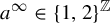 $a^\infty \in \{1,2\}^{\mathbb Z}$
by
 $(a^\infty )_i=a$
for all
 $i\in {\mathbb Z}$
, and for
 $x\in \Sigma $
, let
 $\delta _x$
denote the unit point mass at x. From the above observation and the Birkhoff ergodic theorem, it follows that any non-ergodic measure of the form
 $(1-t)\cdot \delta _{1^\infty }+t\cdot \delta _{2^\infty }$
,
 $t\in (0,1/2)\cup (1/2,1)$
cannot be approximated by ergodic ones.
4.3 Multidimensional
$\beta $
-transformations

Let
 $\Sigma $
be a subshift. We say
 $w=w_1\cdots w_{|w|}\in \mathcal L(\Sigma )$
is a left constraint if there exists
 $v\in \mathcal L(\Sigma )$
such that
 $w_2\cdots w_{|w|}v\in \mathcal L(\Sigma )$
and
 $wv\notin \mathcal L(\Sigma )$
. A right constraint is defined analogously. Let
 ${\mathcal C}^\ell $
,
 ${\mathcal C}^{r}$
denote the collections of left constraints, right constraints, respectively. If
 $\Sigma $
is topologically transitive, then
 ${\mathcal C}^\ell $
,
 ${\mathcal C}^{r}$
form a complete list of obstructions to specification [Reference Climenhaga11, Theorem 1.6(1)]. Combining [Reference Climenhaga11, Theorems 1.1, 1.4, 1.6] yields the following statement.
Proposition 4.3. Let
 $\Sigma $
be a subshift.
-
(a) Suppose
$\Sigma $
is topologically transitive. If
$h({\mathcal C}^\ell \cup {\mathcal C}^r)<h_{\mathrm {top}}(\Sigma )$
, then
$h_{\mathrm {spec}}^\bot (\Sigma )<h_{\mathrm {top}}(\Sigma )$
holds and Theorem A applies. -
(b) Suppose
$\Sigma $
is one-sided and topologically exact: for any
$w\in \mathcal L(\Sigma )\setminus \{\emptyset \}$
, there exists
$N\in {\mathbb N}$
such that
$\sigma ^N[w]=\Sigma $
. If
$h({\mathcal C}^\ell )<h_{\mathrm {top}}(\Sigma )$
, then
$h_{\mathrm {spec}}^\bot (\Sigma )<h_{\mathrm {top}}(\Sigma )$
holds and Theorem A applies.






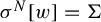


Proposition 4.3(b) applies to many of the piecewise affine transformations investigated by Buzzi [Reference Buzzi9]. These are maps on
 $[0,1)^d$
,
 $d\in {\mathbb N}$
given by
 $T(x)=Bx+b$
mod
 ${\mathbb Z}^d$
, where
 $B\colon {\mathbb R}^d\to {\mathbb R}^d$
is an expanding linear map and
 $b\in {\mathbb R}^d$
. The coding space
 $\Sigma _T$
of T is defined as in the case of piecewise monotonic maps in §4.1, using the collection of maximal open subsets of
 $(0,1)^d$
on which
 $T(x)-Bx$
is constant. Buzzi showed that
 $h({\mathcal C}^\ell )<h_{\mathrm {top}}(\Sigma _T)$
and that
 $\Sigma _T$
is topologically exact if either: (i) all eigenvalues of B exceed
 $1+\sqrt {d}$
in absolute value; or (ii) B, b have all integer entries. Since the maps with
 $d=1$
are almost the
 $\beta $
-transformations, the maps with
 $d\geq 2$
are called multidimensional
 $\beta $
-transformations.
For the coding spaces of multidimensional
 $\beta $
-transformations, little is known when the obstruction entropy specification is
 $0$
, or when the entropy density holds and Theorem B applies.
5 Subshifts with positive obstruction entropy to specification
This last section is devoted to Theorem C. In §5.1, we introduce fat S-gap shifts by modifying the definition of S-gap shifts. In §5.2, we complete the proof of Theorem C by showing that any fat S-gap shift on N symbols,
 $N\geq 3$
has positive obstruction entropy to specification.
5.1 Fat S-gap shifts
Let S be an infinite subset of
 $\mathbb {N}_0$
. A fat S gap shift is a two-sided subshift on
 $\{1,\ldots ,N\}$
,
 $N\geq 2$
defined by the rule that the lengths of the words between consecutive
 $1$
terms are integers in S. More precisely, the fat S-gap shift
 $\Sigma _{S,N}$
on N symbols is the coded shift generated by
 $$ \begin{align}{\mathcal H}=\{w1\colon w\in \{2,\ldots,N\}^n,\ n\in S\}\cup\{\emptyset\}.\end{align} $$
Note that
 $\Sigma _{S,2}$
is nothing but an S-gap shift, whose obstruction entropy to specification is
 $0$
.
For all
 $S\subset {\mathbb N}_0$
and
 $N\geq 2$
, we clearly have
 $\Sigma _{S,N}\supset \{2,\ldots ,N\}^{{\mathbb Z}}$
and, thus,
 $h_{\mathrm {top}}(\Sigma _{S,N})\geq \log (N-1).$
The next lemma asserts that this inequality is strict if
 $N\geq 3$
.
Lemma 5.1. For any infinite set
 $S\subset {\mathbb N}$
and any integer
 $N\geq 3$
, we have
 $$ \begin{align*}h_{\mathrm{top}}(\Sigma_{S,N})>\log (N-1).\end{align*} $$
Proof. The original idea of the proof of this lemma is due to Climenhaga [Reference Climenhaga13]. For ease of notation, we set
 $l_n=\#\mathcal {L}_n(\Sigma _{S,N})$
. The radius of convergence of the power series
 $F(x)=\sum _{n=1}^{\infty }l_nx^n$
equals
 $e^{-h_{\mathrm {top}}(\Sigma _{S,N})}$
. For
 $k,n\in {\mathbb N}$
, we set
 $$ \begin{align*}A_n^k=\#\{w^{(1)}\cdots w^{(k)}\colon w^{(1)},\ldots,w^{(k)}\in\mathcal{H}\setminus\{\emptyset\},\ |w^{(1)}|+\cdots+ |w^{(k)}|=n\}.\end{align*} $$
Then, it is not difficult to prove the following properties:
-
(i)
$\sum _{k=1}^{\infty } A_n^k\le l_n$
; -
(ii)
$A_n^1=(N-1)^{n-1}$
if
$n-1\in S$
and
$A_n^1=0$
otherwise; -
(iii)
$A_n^{k+\ell }=\sum _{m=1}^{n-1}A_{n-m}^kA_m^\ell $
for
$k,\ell \in {\mathbb N}$
.






We introduce a power series
 $F_k(x)= \sum _{n=1}^{\infty } A_n^kx^n$
. Then property (iii) gives
 $F_{k}(x)=F_{k-1}(x)F_1(x)=\cdots =F_1(x)^k$
. For all
 $x\ge 0$
, we have
 $$ \begin{align*}\sum_{k=1}^{\infty}F_1(x)^k =\sum_{k=1}^{\infty}F_k(x) =\sum_{n=1}^{\infty}\sum_{k=1}^{\infty}A_n^kx^n \le F(x),\end{align*} $$
where the last inequality follows from property (i). Let
 $x_0$
denote the unique positive solution to the equation
 $$ \begin{align*}N-1=\sum_{n\in S}((N-1)x)^{n+1}\quad \text{for }0<x<\frac{1}{N-1}.\end{align*} $$
By property (ii), we have
 $$ \begin{align*}F_1(x_0)=\sum_{n=1}^{\infty} A_n^1x_0^n =\dfrac{1}{N-1}\sum_{n\in S}((N-1)x_0)^{n+1}=1,\end{align*} $$
which implies that
 $F(x_0)$
diverges. Hence, the radius of convergence of
 $F(x)$
does not exceed
 $x_0$
and we obtain
 $h_{\mathrm {top}}(\Sigma _{S,N})\ge \log x_0^{-1}>\log (N-1)$
, as required.
5.2 Proof of Theorem C
Let
 $S=\{2^n\colon n\in \mathbb {N}\}$
and let
 $N\geq 3$
be an integer. We consider the fat S-gap shift
 $\Sigma =\Sigma _{S,N}$
. Lemma 5.1 gives
 $h_{\mathrm {top}}(\Sigma )>\log (N-1)$
. Applying the natural decomposition of coded shifts in equation (4.1), we immediately get
 $h(\mathcal {C}^p\cup \mathcal {C}^s)=\log (N-1)$
and, hence,
 $h_{\mathrm {top}}(\Sigma )>\log (N-1)\geq h_{\mathrm {spec}}^{\perp }(\Sigma )$
.
Let
 $\mathcal {L}(\Sigma )=\tilde {\mathcal {C}}^p\tilde {\mathcal {G}}\tilde {\mathcal {C}}^s$
be an arbitrary decomposition such that
 ${\tilde {\mathcal {G}}}^M$
has (W)-specification for all
 $M\in \mathbb {N}$
. The definition of
 $\Sigma $
gives
 $w1w\in \mathcal L(\Sigma )$
for all
 $w\in \{2,\ldots ,N\}^*$
. For each
 $w\in \{2,\ldots ,N\}^*\setminus \{\emptyset \}$
, we fix a decomposition
 $$ \begin{align*}w1w=p(w1w)\cdot c(w1w)\cdot s(w1w),\ \ p(w1w)\in\tilde{\mathcal{C}}^p, c(w1w)\in\tilde{\mathcal{G}}, s(w1w)\in\tilde{\mathcal{C}}^s.\end{align*} $$
Since
 $1$
appears in
 $w1w$
only once, it appears in only one of the three words
 $p(w1w)$
,
 $c(w1w)$
,
 $s(w1w)$
, which can be the empty word
 $\emptyset $
. We will use the following simple estimates on word lengths for
 $r\in \{p,s\}$
:
 $$ \begin{align}0\leq|r(w1w)|\leq |w|\ \text{ if }1\text{ does not appear in }r(w1w);\end{align} $$
 $$ \begin{align}|w|+1\leq|r(w1w)|\leq 2|w|+1\ \text{ if }1\text{ appears in }r(w1w).\end{align} $$
We estimate
 $h(\tilde {\mathcal {C}}^p\cup \tilde {\mathcal {C}}^s)$
from below by constructing a countably infinite family of finite-to-one maps that take values in
 $\tilde {\mathcal {C}}^p\cup \tilde {\mathcal {C}}^s$
. We need some notation introduced in §4.2.
Case 1:
 $\tilde {\mathcal {G}}\subset \{2,\ldots ,N\}^{\ast }$
. For each
 $k\in {\mathbb N}$
, we define a map
 $\Phi _k\colon \{2,\ldots ,N\}^{2^k}\mapsto \bigcup _{n=2^k+1}^{2^{k+1}+1} (\tilde {\mathcal {C}}^p_n\cup \tilde {\mathcal {C}}^s_n)$
by
 $$ \begin{align}\Phi_k(w)= \begin{cases} s(w1w) & \text{if }1\text{ appears in }s(w1w),\\ p(w1w) & \text{otherwise.} \end{cases}\end{align} $$
For any
 $w\in \{2,\ldots ,N\}^{2^k}$
,
 $1$
does not appear in
 $c(w1w)$
since
 $\tilde {\mathcal {G}}\subset \{2,\ldots ,N\}^{\ast }$
. By equation (5.3), if
 $1$
appears in
 $p(w1w)$
, then
 $2^k+1\leq |p(w1w)|\leq 2^{k+1}+1$
and if
 $1$
appears in
 $s(w1w)$
, then
 $2^k+1\leq |s(w1w)|\leq 2^{k+1}+1$
. Hence,
 $\Phi _k$
is well defined.
For any
 $w\in \{2,\ldots ,N\}^{2^k}$
,
 $1$
appears in
 $\Phi _k(w)$
by the definition in equation (5.4). This implies that
 $\Phi _k$
is injective and so
 $$ \begin{align*}\#\bigg(\bigcup_{n=2^\ell+1}^{2^{k+1}+1}(\tilde{\mathcal{C}}^p_n\cup\tilde{\mathcal{C}}^s_n)\bigg) \ge \#\Phi_k(\{2,\ldots,N\}^{2^k}) \ge\#\{2,\ldots,N\}^{2^k}= (N-1)^{2^k}.\end{align*} $$
Pick
 $n_k\in \{2^k+1,\ldots , 2^{k+1}+1\}$
such that
 $$ \begin{align*}\#(\tilde{\mathcal{C}}^p_{n_k}\cup\tilde{\mathcal{C}}^s_{n_k}) \ge \frac{(N-1)^{2^k}}{2^k+1}. \end{align*} $$
Since
 $\liminf _{k\to \infty }n_k=\infty $
, we have
 $$ \begin{align} h(\tilde{\mathcal{C}}^p\cup\tilde{\mathcal{C}}^s) &\ge \limsup_{l\rightarrow\infty} \frac{\log \#(\tilde{\mathcal{C}}^p_{n_k}\cup\tilde{\mathcal{C}}^s_{n_k})}{n_k}\nonumber\\ &\ge \limsup_{l\rightarrow\infty} \frac{1}{n_k}\log \frac{(N-1)^{({n_k-1})/{2}}}{n_k}=\frac{\log (N-1)}{2}. \end{align} $$
Case 2:
 $\tilde {\mathcal {G}}\not \subset \{2,\ldots ,N\}^{\ast }$
. We modify the argument in Case 1. Fix
 $u\in \tilde {\mathcal {G}}\setminus \{2,\ldots ,N\}^{\ast }$
for which there exist
 $m\geq 2$
,
 $u^{(0)}$
,
 $u^{(m)}\in \{2,\ldots ,N\}^{*}$
,
 $u^{(1)},\ldots ,u^{(m-1)}\in \{2,\ldots ,N\}^*\setminus \{\emptyset \}$
such that
 $$ \begin{align}u=u^{(0)}1u^{(1)}1\cdots u^{(m-1)}1u^{(m)}.\end{align} $$
Let
 $t\geq 0$
be a gap size for the (W)-specification of
 $\tilde {\mathcal {G}}$
. For each
 $k\in {\mathbb N}$
, let
 $$ \begin{align} a_k=2^k-2t-|u^{(m)}|-1.\end{align} $$
In what follows, we assume k is sufficiently large so that
 $$ \begin{align}\frac{2a_k}{3}>2^{k-1}.\end{align} $$
Define a map
 $\Psi _k\colon \{2,\ldots ,N\}^{a_k}\mapsto \bigcup _{n=a_k-2^{k-1}}^{2a_k+1}(\tilde {\mathcal {C}}^p_n\cup \tilde {\mathcal {C}}^s_n)$
by
 $$ \begin{align}\Psi_k(w)= \begin{cases} s(w1w) & \text{if }1\text{ appears in }s(w1w),\\ p(w1w) & \text{otherwise.} \end{cases}\end{align} $$
Compare equation (5.9) and equation (5.4). To see that
 $\Psi _k$
is well defined, let
 $w\in \{2,\ldots ,N\}^{a_k}$
. By equation (5.3), if
 $1$
appears in
 $p(w1w)$
, then
 $a_k+1\leq |p(w1w)|\leq 2a_k+1$
and if
 $1$
appears in
 $s(w1w)$
, then
 $a_k+1\leq |s(w1w)|\leq 2a_k+1$
. If
 $1$
appears in
 $c(w1w)$
, then the definition in equation (5.9) gives
 $\Psi _k(w)=p(w1w)$
and the lemma below yields
 $a_k-2^{k-1}\leq |p(w1w)|\leq a_k$
. Hence,
 $\Psi _k$
is well defined.
Lemma 5.2. If
 $w\in \{2,\ldots ,N\}^{a_k}$
and
 $1$
appears in
 $c(w1w)$
, then
 $a_k-2^{k-1}\leq |p(w1w)|\leq a_k$
.
Proof. The upper bound follows from equation (5.2). For the lower bound, note that there exist
 $v,v'\in \{2,\ldots ,N\}^{\ast }$
such that
 $$ \begin{align*}c(w1w)=v1v'.\end{align*} $$
We have
 $w1w=p(w1w)\cdot v1v'\cdot s(w1w)$
, and so v is a subword of w and
 $|p(w1w)|=|w|-|v|$
. It suffices to show that
 $|v|\leq 2^{k-1}$
.
By equation (5.7), we have
 $$ \begin{align} |v|\le |w|= a_k<2^k-2t-|u^{(m)}|. \end{align} $$
Since
 $u,c(w1w)\in \tilde {\mathcal {G}}$
, there exists
 $u'\in \mathcal L(\Sigma )$
such that
 $|u'|\le t$
and
 $uu'c(w1w)\in \mathcal {L}(\Sigma )$
, and hence,
 $1u^{(m)}u'v1\in \mathcal {L}(\Sigma )$
. If
 $1$
does not appear in
 $u'$
, then it does not appear in
 $u^{(m)}u'v$
either. Since
 $\Sigma $
is the coded shift generated by
 ${\mathcal H}$
in equation (5.1), it follows that
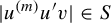 $|u^{(m)}u'v|\in S$
. By equation (5.10), we have
 $$ \begin{align*}|v|\leq|u^{(m)}u'v|\leq|u^{(m)}|+|u'|+|w|< 2^k-t\leq2^k.\end{align*} $$
Since
 $S\cap [2^{k-1}+1,2^k-1]=\emptyset $
, we obtain
 $|v|\leq 2^{k-1}$
as required. If
 $1$
appears in
 $u'$
, then let
 $t'\in [1,|u'|]$
be the largest integer such that
 $i_{t'}^s(u')$
does not contain
 $1$
. We have
 $t'\leq |u'|\leq t$
,
 $1i_{t'}^s(u')v1\in \mathcal {L}(\Sigma )$
, and
 $1$
does not appear in
 $i_{t'}^s(u')v$
. Since
 $\Sigma $
is the coded shift generated by
 ${\mathcal H}$
in equation (5.1), this implies
 $|i_{t'}^s(u')v|=t'+|v|\in S$
. Again by equation (5.10), we obtain
 $$ \begin{align*}|v|\leq t'+|v|\leq t+|w|<2^k.\end{align*} $$
Since
 $S\cap [2^{k-1}+1,2^k-1]=\emptyset $
, we obtain
 $|v|\leq 2^{k-1}$
, as required.
Lemma 5.3. The map
 $\Psi _k$
is at most
 $(N-1)^{2^{k-1}}$
to
 $1$
.
Proof. Let
 $w,w'\in \{2,\ldots ,N\}^{a_k}$
,
 $w\neq w'$
, and suppose
 $\Psi _k(w)=\Psi _k(w')$
. The definition in equation (5.9) implies that
 $1$
appears in neither
 $s(w1w)$
nor
 $s(w'1w')$
, and
 $\Psi _k(w)=p(w1w)$
,
 $\Psi _k(w')=p(w'1w')$
.
If
 $1$
does not appear in
 $c(w1w)$
and appears in
 $c(w'1w')$
, then by equations (5.2), (5.3), we get
 $|p(w1w)|\geq a_k+1$
and
 $|p(w'1w')|\leq a_k$
, and so
 $\Psi _k(w)\neq \Psi _k(w')$
, which is a contradiction. If
 $1$
appears in
 $c(w1w)$
and does not appear in
 $c(w'1w')$
, then we also obtain a contradiction. If
 $1$
appears in neither
 $c(w1w)$
nor
 $c(w'1w')$
, then it appears in both
 $p(w1w)$
and
 $p(w'1w')$
, and so
 $w=w'$
, which is a contradiction. Therefore,
 $1$
appears in both
 $c(w1w)$
and
 $c(w'1w')$
. By Lemma 5.2, there exists
 $n\in \{a_k-2^{k-1},\ldots , a_k\}$
such that
 $i^p_{n }(w)=i^p_{n }(w')$
. Therefore,
 $\Psi _k$
is at most
 $(N-1)^{2^{k-1}}$
to
 $1$
.
By Lemma 5.3, we have
 $$ \begin{align*}\begin{aligned}\#\bigg(\bigcup_{n=a_k-2^{k-1}}^{2a_k+1}(\tilde{\mathcal{C}}^p_n\cup\tilde{\mathcal{C}}^s_n)\bigg)&\ge\#\Psi_k(\{2,\ldots,N\}^{a_k})\\ &\geq \#\{2,\ldots,N\}^{a_k}(N-1)^{-2^{k-1}}= (N-1)^{a_k-2^{k-1}}.\end{aligned}\end{align*} $$
Hence, there exists
 $n_k\in \{a_k-2^{k-1},\ldots , 2a_{k}+1\}$
such that
 $$ \begin{align*}\#(\tilde{\mathcal{C}}^p_{n_k}\cup \tilde{\mathcal{C}}^s_{n_k})\geq \frac{(N-1)^{a_k-2^{k-1}} }{ a_k+2+2^{k-1} }\ge \frac{(N-1)^{ {a_k}/{3} } }{ 5a_k/3+2 }\geq\frac{(N-1)^{({n_k-1})/{6}}}{5n_k+2}.\end{align*} $$
For the last inequality, we have used equation (5.8). Since
 $\lim _{k\to \infty }n_k=\infty $
, we have
 $$ \begin{align} h(\tilde{\mathcal{C}}^p\cup\tilde{\mathcal{C}}^s) &\ge \limsup_{k\to\infty} \frac{\log \#(\tilde{\mathcal{C}}^p_{n_k}\cup\tilde{\mathcal{C}}^s_{n_k})}{n_k}\nonumber\\ &\ge\limsup_{k\to\infty}\frac{1}{n_k}\log\frac{(N-1)^{({n_k-1})/{6}}}{5n_k+2}\geq\frac{\log (N-1)}{6}.\end{align} $$
Since
 $\mathcal {L}(\Sigma )=\tilde {\mathcal {C}}^p\tilde {\mathcal {G}}\tilde {\mathcal {C}}^s$
is an arbitrary decomposition such that
 ${\tilde {\mathcal {G}}}^M$
has (W)-specification for all
 $M\in \mathbb {N}$
, from equations (5.5) and (5.11), we obtain
 $h_{\mathrm {spec}}^{\perp }(\Sigma )\geq (1/6)\log (N-1).$
The proof of Theorem C is complete.
Acknowledgments
We thank the referee for their careful reading of the manuscript and giving valuable suggestions. M.S. was supported by the JSPS KAKENHI 21K13816. H.T. was supported by the JSPS KAKENHI 25K21999. K.Y. was supported by the JSPS KAKENHI 21K03321. This work was supported by the Research Institute for Mathematical Sciences, an International Joint Usage/Research Center located in Kyoto University.



