1 Introduction
In 2009, D’Anna et al. introduced the following construction, which has received considerable attention [Reference D’Anna, Finocchiaro, Fontana, Fontana, Kabbaj, Olberding and Swanson6]. Let R and S be two commutative rings with identity, let J be an ideal of S, and let
$f:R\to S$
 be a ring homomorphism. They introduced the following subring

of
$R\times S$
 , called the amalgamated algebra of R with S along J with respect to f. The construction can be studied in the frame of pullback constructions. In fact, if
$\pi : S \to S/J$
 is the canonical projection and
$\check {f}= \pi \circ f$
 , then
$R\bowtie ^fJ = \check {f} \times _{S/J} \pi $
 (for definition and details, see [Reference D’Anna, Finocchiaro, Fontana, Fontana, Kabbaj, Olberding and Swanson6, Section 4]). It has proved its worth providing numerous (counter)examples in commutative ring theory, for example, [Reference Azimi1–Reference D’Anna5, Reference D’Anna, Finocchiaro and Fontana7], etc.
In this article, for a lattice homomorphism
$f:L\to K$
 , and an ideal J of K, we introduce a similar structure for lattices called the amalgamated lattice, and denoted by
$L\bowtie ^fJ$
 . Then, we study some of its basic properties and connect properties related to elements and ideals of amalgamated lattice
$L\bowtie ^fJ$
 with the properties related to L, J, and f. We expect that this new construction will facilitate the development of new examples in lattice theory with the desired properties, as has been the case in ring theory.
This article is organized as follows. In Section 2, after a brief review of some necessary background on lattices, we introduce the amalgamated lattice and illustrate the definition with two examples. Section 3 is devoted to the study of some properties of elements of amalgamated lattices. In particular, we consider when an element of amalgamated lattice is a zero-divisor, irreducible, or an atom and when the amalgamated lattice is atomic. Section 4 is dedicated to the study of ideals of lattices. Theorem 4.2, which is one of the main results of this article, characterizes prime ideals of amalgamated lattices. More precisely, we prove that the prime ideals of
$L\bowtie ^fJ$
 are of the type
$\frak {p}^{\prime _f} :=\{(p,f(p)\vee i)\mid p\in \frak {p}, i\in J\}$
 or
$\overline {\frak {q}}^f:= \{(a,f(a)\vee i) \mid a\in L, i\in J, f(a)\vee i\in \frak {q}\}$
 , in which
$\frak {p}$
 is a prime ideal of L, and
$\frak {q}$
 is a prime ideal of K not containing J.
2 The construction
In this section, we introduce the amalgamated lattice. To facilitate the reading of the article, we first recall some preliminary definitions and notations on lattices. The undefined terminology in this article is the same as that in [Reference Grätzer9].
Definition 2.1 An algebra
$\mathcal {L} = (L,\wedge ,\vee )$
 is called a lattice if it satisfies the following conditions for all
$a,b,c\in L$
 :
-
(1) $a\wedge a=a$
 ,
$a\vee a=a$
;
-
(2) $a\wedge b=b\wedge a$
,
$a\vee b=b\vee a$
; -
(3) $(a\wedge b)\wedge c = a\wedge (b\wedge c) $
,
$(a\vee b)\vee c = a\vee (b\vee c)$
; -
(4) $a\wedge (a\vee b)= a \vee (a\wedge b)=a$
.


Remark 2.2 [Reference Grätzer9, Theorem I.1.1]
Let the algebra
$\mathcal {L} = (L,\wedge ,\vee )$
 be a lattice. For any
$a,b\in L$
 , set
$a\leq b$
 if and only if
$a\wedge b=a$
 . Then, as a poset,
$(L,\leq )$
 is a lattice, that is, each pair of elements has a greatest lower bound (
$\text {glb}$
 ) and a least upper bound (
$\text {lub}$
 ). Conversely, every lattice as a poset is a lattice as an algebra. Define
$a\wedge b = \text {glb} (a,b)$
 and
$a\vee b = \text {lub} (a,b)$
 .
We use “lattice” to refer either to an algebra satisfying conditions (1)–(4) above or to a poset where any two elements have a
$\text {glb}$
 and
$\text {lub}$
 , and pass freely between the two notions. Also, we shall denote the lattice
$\mathcal {L} = (L,\wedge ,\vee )$
 only by L, in the interests of notational simplicity.
A homomorphism f of the lattice L into the lattice K is a map
$f:L\to K$
 satisfying
$f(a\wedge b)= f(a)\wedge f(b)$
 and
$f(a\vee b)= f(a)\vee f(b)$
 . A sublattice I of L is called an ideal of L if
$i \in I$
 and
$a \in L$
 imply that
$i \wedge a \in I$
 . A lattice L is said to be bounded if there are elements
$0,1\in L$
 such that
$0 \wedge a = 0$
 and
$a \vee 1 = 1$
 , for all
$a \in L$
 . It is called distributive if, for all elements
$a,b,c\in L$
 ,

or equivalently,

Throughout this article, L and K are two distributive bounded lattices, J is a proper ideal of
$K,$
 and
$f:L\to K$
 is a lattice homomorphism that preserves bounds. Notice that J is a sublattice of K. In the sequel, when we speak of a lattice property on J, we mean the property on the structure inherited from K.
Next, we present the key definition that underpins the new structure introduced in this article. In the following,
$\wedge $
 and
$\vee $
 in
$L \times K$
 are defined componentwise.
Definition 2.3 Let L and K be two distributive bounded lattices, J be a proper ideal of K, and
$f:L\to K$
 be a lattice homomorphism. We call the sublattice

of
$L \times K$
 , the amalgamated lattice of L with K along J with respect to f.
Note that the distributivity of lattices ensures that
$L \bowtie ^f J$
 is closed under meets and is therefore a sublattice of
$L \times K$
 .
Remark 2.4 Let
$\alpha :L\to C$
 ,
$\beta : K \to C$
 be homomorphisms of distributive lattice. We call the sublattice
$ \alpha \times _C \beta := \{ (a,b) \in L \times K \mid \alpha (a) = \beta (b) \}$
 of
$L \times K$
 , the pullback of
$\alpha $
 and
$\beta $
 . As amalgamated algebra can be studied in the frame of pullback constructions, it is natural to ask if the same fact is true for amalgamated lattice? One needs to find appropriate translation of the canonical projection
$\pi : S \to S/J$
 (mentioned in the beginning of the first section) to the lattices. At this point, we do not know the answer.
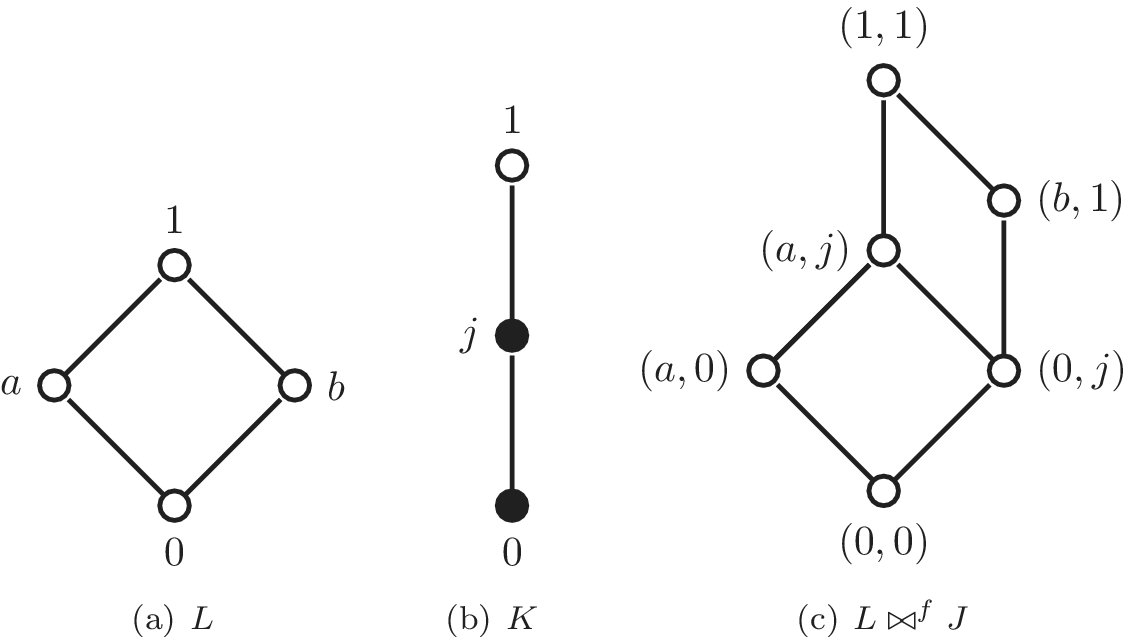
Example 2.5 Let L and K be lattices represented by Figure 1, and
$J=\{0,j\}$
 (denoted by black points in the figure). Let f be as follows:
$f(0)=f(a)=0$
 and
$f(b)=f(1)=1$
 . The amalgamated lattice
$L \bowtie ^f J$
 is illustrated in Figure 1.
The lattice construction described in Example 2.5.

Figure 1 Long description
The figure consists of three panels labeled a, b, and c.
Panel a, labeled L, is a diamond-shaped lattice. At the bottom is an open circle node labeled 0. Moving upward, the structure splits into two branches: a left node labeled a and a right node labeled b. Both branches converge at a top open circle node labeled 1.
Panel b, labeled K, is a vertical linear chain of three nodes. At the bottom is a solid black node labeled 0. In the middle is a solid black node labeled j. At the top is an open circle node labeled 1.
Panel c, labeled L bowtie super f J, is a more complex lattice structure.
* At the base is an open circle node labeled (0, 0).
* Moving upward to the left is a node labeled (a, 0).
* Moving upward to the right from the base is a node labeled (0, j).
* From (a, 0), a line connects upward to a node labeled (a, j).
* From (0, j), two lines branch upward: one to (a, j) and one to a node labeled (b, 1).
* From (a, j), a line connects upward to the top node labeled (1, 1).
* From (b, 1), a line also connects upward to the top node labeled (1, 1).
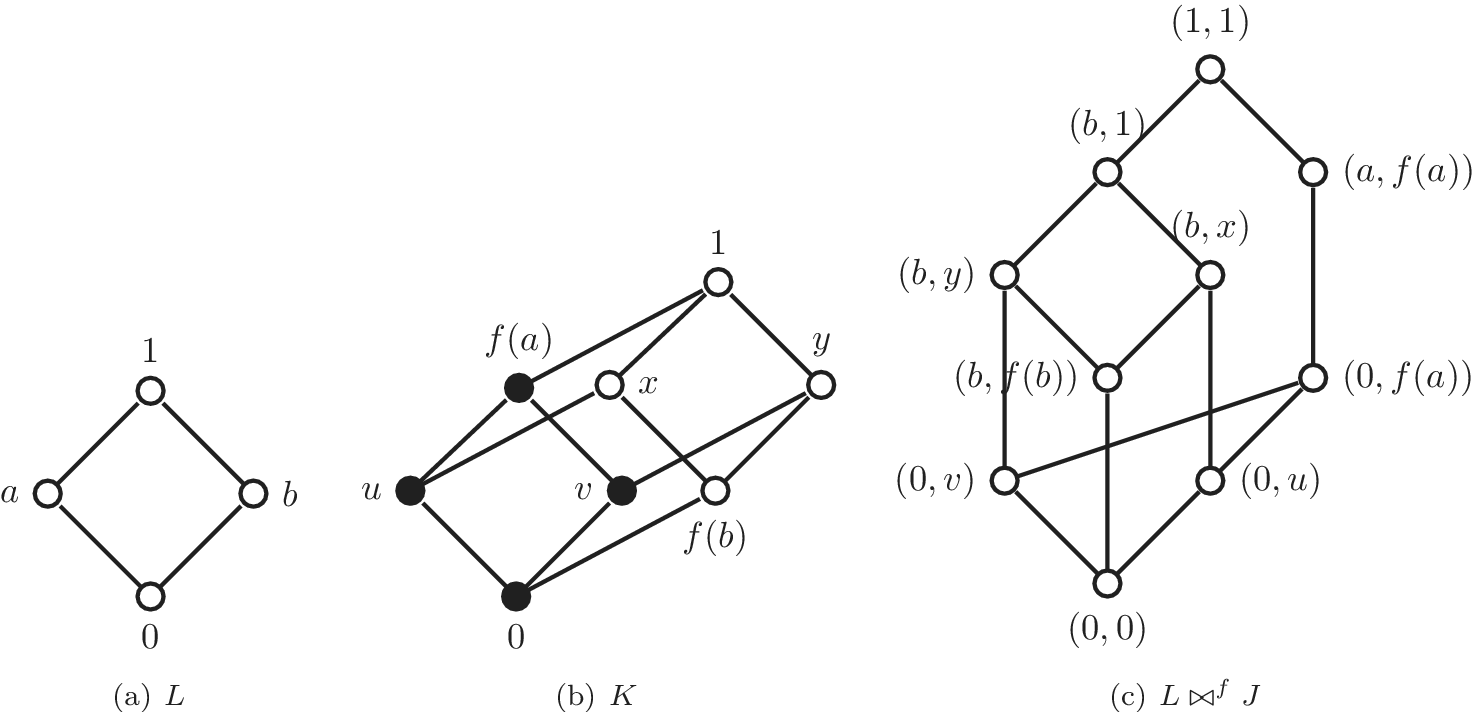
Example 2.6 Let L,
$K,$
 and f be as represented by Figure 2, and
$J=\{0,u,v, f(a)\}$
 (denoted by black points in the figure). Note that K is the direct product of L with the chain
$\{0,1\}$
 . The representation of
$L \bowtie ^f J$
 shown in Figure 2 follows directly from the definition: one computes all pairs
$(a, f(a) \vee i)$
 with
$a \in L$
 and
$i \in J$
 . The resulting Hasse diagram is obtained by routine (though somewhat lengthy) case computations.
The lattice construction described in Example 2.6.

Figure 2 Long description
The figure consists of three panels labeled a, b, and c from left to right.
Panel a, labeled L, shows a diamond-shaped lattice. At the bottom is a white node labeled 0. Moving upward, the lattice splits into two white nodes labeled a on the left and b on the right. Both nodes connect to a single white node at the top labeled 1.
Panel b, labeled K, shows a more complex three-dimensional lattice structure. At the bottom is a black node labeled 0. Moving upward, it connects to a black node labeled u on the left and a black node labeled v in the center. Above u is a black node labeled f(a). Above v is a white node labeled f(b). To the right of the central structure is a white node labeled y. At the top, a white node labeled 1 connects to f(a), x, and y. A white node labeled x is positioned between f(a) and y.
Panel c, labeled L bowtie super f J, shows a complex lattice with coordinate-style labels. At the bottom is a white node (0, 0). Moving upward, it connects to white nodes (0, v) on the left and (0, u) on the right. Above (0, v) are nodes (b, f(b)) and (b, y). Above (0, u) is node (0, f(a)). Further up, the structure includes nodes (b, x), (b, 1), and (a, f(a)). At the very top is a single white node labeled (1, 1). Lines connect these nodes to form a multi-layered geometric lattice.
3 Some basic properties regarding elements
This section is dedicated to the study of some basic properties related to the elements of amalgamated lattice. More precisely, we investigate when an element of
$L \bowtie ^f J$
 is a zero-divisor, join-irreducible, or an atom. We also characterize when the amalgamated lattice is atomic and compute the length of
$L \bowtie ^f J$
 . The definitions in this chapter are from [Reference Grätzer9], with the exception of the definition of the zero-divisor, which is from [Reference Estaji and Khashyarmanesh8].
Definition 3.1 An element
$a\in L$
 is said to be a zero-divisor if there exists a nonzero element
$b \in L$
 such that
$a\wedge b=0$
 . The set of zero-divisors of L is denoted by
$\text {Z}(L)$
 .
The following notation makes the next result more readable:

Theorem 3.2 We always have the inclusion
$Z_2 \subseteq \text {Z}(L\bowtie ^f J)\subseteq Z_1\cup Z_2$
 , where the second inclusion is an equality, if at least one of the following conditions hold:
-
(1) $f(\text {Z}(L))\wedge J=0$
and, for some
$x\in L$
,
$f(x)=0$
. -
(2) For any $j\in J$
, there exists
$r\notin \text {Z} (L)$
such that
$f(r) \wedge j=0$
.


Proof The first inclusion is clear:
$(a,f(a)\vee i) \wedge (0,j)=0$
 . Now assume that
$(a,f(a)\vee i)\in \text {Z}(L\bowtie ^f J)$
 . Then
$(a,f(a)\vee i)\wedge (b,f(b)\vee j)=0$
 for some nonzero element
$(b,f(b)\vee j)\in L\bowtie ^f J$
 . Hence,
$a\wedge b{\kern-1pt}={\kern-1pt}0$
 and
${(i\wedge f(b)){\kern-1pt}\vee{\kern-1pt} (j\wedge (f(a){\kern-1pt}\vee{\kern-1pt} i)){\kern-1pt}={\kern-1pt}0}$
 . If
$b=0$
 , then
$j\neq 0$
 and
$j\wedge (f(a)\vee i)=0$
 . When this is the case,
$(a,f(a)\vee i)\in \text {Z}_2$
 . Otherwise,
$a\in \text {Z}(L)$
 , and
$(a,f(a)\vee i)\in \text {Z}_1$
 . This proves the second inclusion.
To complete the proof, it is enough for us to show that
$Z_1 \subseteq \text {Z}(L\bowtie ^f J)$
 under the validity of (1) or (2). Let
$(a,f(a)\vee i)\in L\bowtie ^f J,$
 where
$a\in \text {Z}(L)$
 and
$i\in J$
 . Then there is a nonzero element
$b\in L$
 such that
$a\wedge b=0$
 .
(1) If
$a\neq 0$
 , we have
$(a,f(a)\vee i)\wedge (b,f(b))=0$
 , since
$b\in \text {Z} (L)$
 . So assume that
$a=0$
 and
$x\in L$
 with
$f(x)=0$
 . Then
$(0,i)\wedge (x,0)=0$
 .
(2) Let
$t\notin \text {Z}(L)$
 such that
$f(t)\wedge i=0$
 . We have
$t\wedge b\neq 0$
 and
$(a,f(a)\vee i)\wedge (t\wedge b,f(t\wedge b))=0$
 .
We say that
$L\bowtie ^f J$
 has the condition
$\star $
 if the equality
$\text {Z}(L\bowtie ^f J)= Z_1\cup Z_2$
 holds. The next example shows that the condition
$\star $
 does not necessarily hold and the assumption “
$\exists x\in L$
 ,
$f(x)=0$
 ” in part (1) of the theorem above is not superfluous.
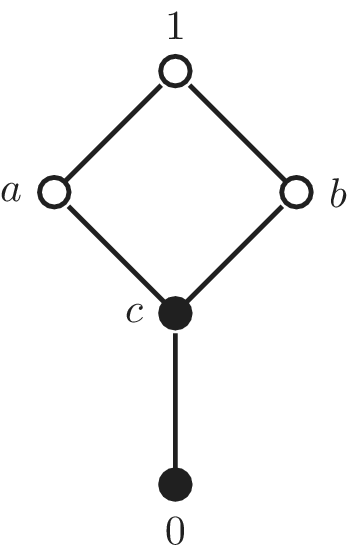
Example 3.3 Let
$L=K$
 be the lattice represented by Figure 3, f is the identity homomorphism, and
$J=\{0,c\}$
 (denoted by black points in the figure). Then a direct verification yields:

We have
$0\in \text {Z} (L)$
 , which implies
$(0,c)\in \text {Z}_1$
 , while
$(0,c)\notin \text {Z} (L\bowtie ^f J)$
 . Hence, condition
$\star $
 does not hold. It is easy to see on the figure that neither assumption (1) nor (2) of Theorem 3.2 holds.
$L=K$
 .

We are now going to investigate when an element of
$L \bowtie ^fJ$
 is an atom, and when
$L \bowtie ^fJ$
 is atomic. Let us recall the definition.
Definition 3.4 A nonzero element
$a\in L$
 is said to be an atom if there is no
$ b\in L$
 such that
$0 < b < a$
 . The set of all atoms of L is denoted by
$\mathcal A(L)$
 . The lattice L is said to be atomic if, for every
$0\neq a\in L,$
 there exists an element
$b\in \mathcal A(L)$
 such that
$b\le a$
 .
Theorem 3.5
$(a,f(a)\vee i)\in \mathcal {A} (L \bowtie ^f J)$
 if and only if either
-
(1) $a=0$
and
$ i\in \mathcal {A} (K)$
, or, -
(2) $i=0$
,
$a\in \mathcal {A} (L)$
, and for any
$j\in J$
,
$j\le f(a)$
implies
$j=0$
.


Proof (
$\Rightarrow $
 ) Assume that
$(a,f(a)\vee i)\in \mathcal {A} (L \bowtie ^f J)$
 . Consider two cases:
$a=0$
 and so
$(a,f(a)\vee i)=(0,i)\in \mathcal {A} (L \bowtie ^f J)$
 . If
$ i\notin \mathcal {A} (K)$
 , then there exists
$ b\in K$
 such that
${0 < b < i}$
 . As J is an ideal of K,
$b\in J$
 . Thus,
$0<(0,b)<(0,i)$
 , absurd. Next, assume that
$a\neq 0$
 . As
$(0,i)<(a,f(a)\vee i)\in \mathcal {A} (L \bowtie ^f J)$
 , we have
$i=0$
 . In the same way, for any
$j\in J$
 with the property
$j\le f(a)$
 , we have
$j=0$
 . Finally, suppose (on the contrary) that
$a\notin \mathcal {A} (L)$
 . Then there exists
$ b\in L$
 such that
$0 < b < a$
 . Hence, since f is a homomorphism,
$f(b)\le f(a)$
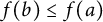 . Thus,
$0<(b,f(b))<(a,f(a))\in \mathcal {A} (L \bowtie ^f J)$
 , a contradiction.
(
$\Leftarrow $
 ) The first case is clear. To prove the second case, assume that
$a{\kern-1pt}\in{\kern-1pt} \mathcal {A} (L)$
 , and for any
$j{\kern-1pt}\in{\kern-1pt} J$
 ,
$j{\kern-1pt}\le{\kern-1pt} f(a)$
 implies
$j{\kern-1pt}={\kern-1pt}0$
 . We show that
$(a,f(a))\in \mathcal {A} (L \bowtie ^f J)$
 . Let
$(b,f(b)\vee j) <(a,f(a))$
 . Then
$b<a\in \mathcal {A} (L)$
 , and so
$b=0$
 . Hence,
$(0, j)<(a,f(a))$
 , hence that
$j\le f(a)$
 . Our assumption now implies
$j=0$
 , as desired.
It is worth noting that, in Example 2.5,
$(0,j)$
 and
$(a,0)$
 are atoms of
$L \bowtie ^f J$
 illustrating cases (1) and (2) of the theorem, respectively.
Theorem 3.6 The lattice
$L \bowtie ^f J$
 is atomic if and only if:
-
(1) for any nonzero element $i\in J,$
there exists
$j\in \mathcal {A} (K)$
such that
$j\le i$
, and -
(2) for any nonzero element $a\in L,$
either there exists
$j\in \mathcal {A} (K)$
such that
$j\le f(a)$
, or, there exists
$b\in \mathcal {A} (L)$
such that
$b\le a$
and for any
$k\in J$
,
$k\le f(b)$
implies
$k=0$
.


Proof (
$\Rightarrow $
 ) Assume that
$L \bowtie ^f J$
 is atomic. To prove (1), let
$i\in J$
 be a nonzero element. By assumption, there exists
$(b,f(b)\vee j) \in \mathcal {A} (L \bowtie ^f J)$
 such that
$(b,f(b)\vee j) \le (0,i)$
 . Then
$b=0$
 ,
$j\le i,$
 and by Theorem 3.5,
$j\in \mathcal {A} (K)$
 , as desired.
Next, to prove (2), let
$a{\kern-1pt}\in{\kern-1pt} L$
 be a nonzero element, and take
${(b,f(b){\kern-1pt}\vee{\kern-1pt} j) {\kern-1pt}\in{\kern-1pt} \mathcal {A} (L \bowtie ^f J)}$
 with the property
$(b,f(b)\vee j) \le (a,f(a))$
 . Theorem 3.5 now leads to two cases:
${b=0}$
 ,
$j\in \mathcal {A} (K)$
 ; or
$b\in \mathcal {A} (L)$
 such that for any
$k\in J$
 ,
$k\le f(b)$
 implies
$k=0$
 . Note that in either case
$b\le a$
 and when
$b=0$
 ,
$j\le f(a)$
 .
(
$\Leftarrow $
 ) Assume that (1) and (2) hold, and let
$(a,f(a)\vee i) \in L \bowtie ^f J$
 be a nonzero element. If
$a=0$
 , take
$j\in \mathcal {A} (K)$
 such that
$j\le i$
 . Then
$(0,j)\in \mathcal A (L \bowtie ^f J)$
 and
$(0,j)\le (a,f(a)\vee i)$
 . Next, let
$a\neq 0$
 and seek a desired element using Theorem 3.5 and assumption (2): If there exists
$j\in \mathcal {A} (K)$
 such that
$j\le f(a)$
 , then
$(0,j)$
 is what we need. If there exists
$b\in \mathcal {A} (L)$
 with properties given in (2), then
$(b,f(b))$
 is the desired element.
Corollary 3.7 If the lattices L and K are atomic, then the lattice
$L \bowtie ^f J$
 is atomic.
Proof Condition (1) of Theorem 3.6 trivially holds by assumption. It remains to show that condition (2) holds. Let
$0\neq a\in L$
 . If there exists
$j\in \mathcal {A} (K)$
 with
$j \le f(a)$
 , we are done. Otherwise, by assumption, we may pick
$b\in \mathcal {A} (L)$
 such that
$b\le a$
 , and this b has requirements of condition (2).
We shall now describe the irreducible elements of
$L \bowtie ^f J$
 . An element
$a\in L$
 is said to be join-irreducible, if
$a = b \vee c$
 implies that
$a = b$
 or
$a =c$
 . It is meet-irreducible, if
$a = b \wedge c$
 implies that
$a = b$
 or
$a =c$
 . We extend this definition to an arbitrary ideal I of the lattice L, instead of L itself, such that it is compatible with the usual definition.
Definition 3.8 Let I be an ideal of L. We say that an element
$a\in L$
 is I-join-irreducible if for any
$i,j\in I$
 ,
$a =i \vee j$
 implies
$a = i$
 or
$a =j$
 . We call it I-meet-irreducible if for any
$i,j\in I$
 ,
$a =i \wedge j$
 implies
$a = i$
 or
$a =j$
 . When
$I=L$
 , we simply say join-irreducible instead of L-join-irreducible. The same notation applies for meet-irreducible.
Proposition 3.9
$(a,f(a)\vee i)$
 is a join-irreducible element of
$L \bowtie ^f J$
 if and only if either
-
(1) $a=0$
and i is a join-irreducible element of K, or, -
(2) $i\le f(a)$
and a is a join-irreducible element of L.


Proof (
$\Rightarrow $
 ) Let
$(a,f(a)\vee i)$
 be a join-irreducible element of
$L \bowtie ^f J$
 . Observe that
$(a,f(a)\vee i)=(a,f(a))\vee (0, i)$
 . Two cases arise: if
$(a,f(a)\vee i)=(0,i)$
 , then
${a=0}$
 and i should be join-irreducible; if
$(a,f(a)\vee i)=(a,f(a))$
 , then
$i\le f(a)$
 and a should be join-irreducible.
The other implication is an easy routine comparison of elements and omitted.
The case of meet-irreducibly is more complicated. The following proposition investigates a very special case. We will denote the lower bound of the lattice L, by
$0_L$
 .
Proposition 3.10
$(0,0) \in L \bowtie ^f J$
 is meet-irreducible if and only if (1)
$0_L$
 is meet-irreducible, (2)
$0_K$
 is J-meet-irreducible, and (3) for all
$ 0\neq a\in L$
 , and all
$ 0\neq i\in J$
 ,
$f(a)\wedge i \neq 0$
 .
Proof (
$\Rightarrow $
 ) Let
$(0,0)$
 be a meet-irreducible element of
$L \bowtie ^f J$
 . (1) is a consequence of the fact that equality
$a\wedge b =0$
 leads to
$(a,f(a))\wedge (b,f(b)) =0$
 . Similarly,
${i\wedge j =0}$
 , for
$i,j\in J$
 , leads to
$(0,i))\wedge (0,j) =0$
 and this proves (2). Suppose, contrary to (3), that there exists
$0\neq a\in L$
 , and all
$0\neq i\in J$
 with the property
$f(a)\wedge i = 0$
 . Hence,
$(a,f(a))\wedge (0,i) =0$
 , hence that
$a=0$
 or
$i=0$
 , a contradiction.
(
$\Leftarrow $
 ) Let conditions (1)–(3) hold and let
$(a,f(a)\vee i)\wedge (b,f(b)\vee j)=0$
 . Then
${a\wedge b=0}$
 and so, by condition (1), we may let
$a=0$
 . We also have
$i\wedge f(b)=0$
 and
$i\wedge j=0$
 . If
$i=0$
 , then
$(a,f(a)\vee i)=0$
 , as desired. Otherwise, condition (2) implies
$j=0$
 and condition (3) implies
$b=0$
 . Thus,
$(b,f(b)\vee j)=0$
 .
A poset P is said to be of length n (in formula,
$l (P) = n$
 ), where n is a natural number, if and only if there is a chain in P of length n and all chains in P are of length
${\le n}$
 . The width of a poset P is n (in formula,
$width (P) = n$
 ), where n is a natural number, if and only if there is an antichain in P of n elements and all antichains in P have
$\le n$
 elements.
In the following, as an application of Proposition 3.9, we compute the length of the lattice
$L \bowtie ^f J$
 , regarded as a poset under the partial ordering of the lattice. The following proposition is needed.
Proposition 3.11 [Reference Grätzer9, Corollary II.1.14]
Every maximal chain of the finite distributive lattice L is of length
$|\mathcal J(L)|$
 , where
$\mathcal J(L)$
 denotes the set of all nonzero join-irreducible elements of L.
Theorem 3.12 Let
$L \bowtie ^f J$
 be a finite distributive lattice. Then
$l(L \bowtie ^f J)=l(L)+l(J).$

Proof By Proposition 3.11,
$l(L \bowtie ^f J)=|\mathcal J(L \bowtie ^f J)|$
 , and Proposition 3.9,
$\mathcal J(L \bowtie ^f J)$
 is the union of the following disjoint sets:

Note that
$|A|= \mathcal |J(L)|$
 and
$|B|= \mathcal |J(J)|$
 . Therefore,
$|\mathcal J(L \bowtie ^f J)|= |A|+ |B| =|\mathcal J(L)|+|\mathcal J(J)|$
 . Proposition 3.11 now completes the proof.
It is natural to ask if we have an equality similar to that of Theorem 3.12 for width instead of length. One can easily see that
$\textit{width} (L) \le \textit{width} (L \bowtie ^f J)$
 and
$\textit{width} (J) \le \textit{ width} (L \bowtie ^f J)$
 . But the situation is quite different for the case of upper bound of
$\textit{width} (L \bowtie ^f J)$
 . As the following example shows, it is possible that
$\textit{width} (L \bowtie ^f J)$
 is an arbitrary positive integer, while
$\textit{width} (L) = \textit{width} (J) =1$
 .
Example 3.13 Let
$L=K$
 be the chain
$\{0=a_0, a_1, \dots ,a_{2n},1\}$
 , f be the identity homomorphism, and
$J=\{0=a_0, a_1, \ldots ,a_{2n}\}$
 . Then
$L \bowtie ^f J$
 has the following antichain of
$n+1$
 elements:

Indeed, for
$0 \le i < j \le n$
 , we have
$a_i < a_j$
 and
$a_{2n-i}> a_{2n-j}$
 ; hence
$(a_i, a_{2n-i})$
 and
$(a_j, a_{2n-j})$
 are incomparable.
4 Some basic properties regarding ideals
In this section, we prove one of our main results. Namely, we characterize prime ideals of amalgamated lattice
$L\bowtie ^fJ$
 . Recall that a sublattice I of the lattice L is an ideal of L if and only if
$i \in I$
 ,
$a \in L,$
 and
$a\le i$
 imply that
$a\in I$
 [Reference Grätzer9, Lemma I.3.1]. Also a proper ideal I of L is called prime if
$a \wedge b \in I$
 implies that
$a \in I$
 or
$b \in I$
 . For a lattice L, the set of prime ideals of L (resp. prime ideals containing I) will be denoted by
$\text {Spec} (L)$
 (resp.
$\text {V}(I)$
 ).
We start with a proposition that makes the proof of the main result more easy and readable.
Proposition 4.1 Let
$\frak {p}$
 be an ideal of L and
$\frak {q}$
 be an ideal of
$f(L)\vee J$
 . Then the following hold:
-
(1) $\frak {p}^{\prime _f} :=\{(p,f(p)\vee i)\mid p\in \frak {p}, i\in J\}$
is an ideal of
$L\bowtie ^fJ$
. -
(2) $\overline {\frak {q}}^f:= \{(a,f(a)\vee i) \mid a\in L, i\in J, f(a)\vee i\in \frak {q}\}$
is an ideal of
$L\bowtie ^fJ$
. -
(3) If $\frak {p}\in \mathrm{Spec}(L)$
, then
$\frak {p}^{\prime _f} \in \mathrm{Spec}(L\bowtie ^fJ)$
. -
(4) If $\frak {q}\in \mathrm{Spec}(f(L)\vee J)$
, then
$\overline {\frak {q}}^f \in \mathrm{Spec}(L\bowtie ^fJ)$
. -
(5) If $\frak {q}\in \mathrm{Spec}(f(L)\vee J)$
, then
$\overline {\frak {q}}^f \subseteq \frak {p}^{\prime _f}$
, where
$\frak {p} = f^{-1}(\frak {q})$
. -
(6) If $\frak {q}\in \mathrm{Spec}(f(L)\vee J)\cap \text {V} (J)$
, then
$\overline {\frak {q}}^f = \frak {p}^{\prime _f}$
, where
$\frak {p} = f^{-1}(\frak {q})$
. -
(7) If $\frak {q}\in \mathrm{Spec}(f(L)\vee J)\setminus \text {V} (J)$
, then
$\overline {\frak {q}}^f \subsetneq \frak {p}^{\prime _f}$
, where
$\frak {p} = f^{-1}(\frak {q})$
.


Proof The proof of (1)–(4) is straightforward. To prove (5), let
$(a,f(a)\vee i)\in \overline {\frak {q}}^f$
 , that is,
$f(a)\vee i \in \frak {q}$
 . Then
$f(a) \in \frak {q}$
 , since
$\frak {q}$
 is an ideal. Hence,
$a\in \frak {p}$
 , hence that
$(a,f(a)\vee i)\in \frak {p}^{\prime _f}$
 . Thus,
$\overline {\frak {q}}^f \subseteq \frak {p}^{\prime _f}$
 .
Next, let
$J\subseteq \frak {q}$
 . For any
$(a,f(a)\vee i)\in \frak {p}^{\prime _f}$
 , we have
$f(a)\in \frak {q}$
 . Then
$f(a)\vee i \in \frak {q}$
 and so
$(a,f(a)\vee i)\in \overline {\frak {q}}^f$
 . Thus,
$\frak {p}^{\prime _f}\subseteq \overline {\frak {q}}^f$
 , and (6) proved. Finally, let
$J \nsubseteq \frak {q}$
 , and take
$b\in J\setminus \frak {q}$
 . Then
$(0,b)\in \frak {p}^{\prime _f}\setminus \overline {\frak {q}}^f$
 .
The next theorem, which is a complete characterization of
$\text {Spec} (L\bowtie ^fJ)$
 , is the main theorem of this article. We preserve the notation of Proposition 4.1.
Theorem 4.2 The prime ideals of
$L\bowtie ^fJ$
 are of the type
$\frak {p}^{\prime _f}$
 or
$\overline {\frak {q}}^f$
 , for
$\frak {p}$
 in
$\mathrm{Spec}(L)$
 and
$\frak {q}$
 varying in
$\mathrm{Spec}(f(L)\vee J)\setminus \text {V}(J)$
 .
Proof By Proposition 4.1,
$\frak {p}^{\prime _f}$
 and
$\overline {\frak {q}}^f$
 are prime ideals if so are
$\frak {p}$
 and
$\frak {q}$
 . We show that these are the only ones. Let
$\mathcal {P}$
 be an arbitrary prime ideal of
$L \bowtie ^f J$
 , and set

We prove that either
$\mathcal {P}=\frak {p}^{\prime _f}$
 and
$\frak {p} \in \text {Spec} (L)$
 , or
$\mathcal {P}=\overline {\frak {q}}^f$
 and
$\frak {q} \in \text {Spec} (f(L)\vee J)$
 . Consider two cases:
Case 1. Assume that
$J \subseteq \frak {q}$
 . Let us first show that
$\mathcal {P}=\frak {p}^{\prime _f}$
 . Trivially,
$\mathcal {P}\subseteq \frak {p}^{\prime _f}$
 . For the converse, let
$(a,f (a)\vee i)\in \frak {p}^{\prime _f}$
 , that is,
$a\in \frak {p}$
 . Then, for some
$j\in J$
 ,
$(a,f (a)\vee j)\in \mathcal {P}$
 . Therefore,
$(a,f (a))\le (a,f (a)\vee j) \in \mathcal {P}$
 . On the other hand,
$i\in J \subseteq \frak {q}$
 , which implies
$ i = f (b)\vee j$
 , such that
$ (b,f (b)\vee j)\in \mathcal {P}$
 . Thus,
$(0,i)\le (b,f (b)\vee j)\in \mathcal {P}$
 . Therefore,
$(a,f (a)\vee i)= (a,f (a)) \vee (0,i) \in \mathcal {P}$
 , as desired.
Next, we prove that
$\frak {p} \in \text {Spec} (L)$
 . Let
$a,b\in L$
 with
$a\wedge b \in \frak {p}$
 . Hence, there exists
$j\in J$
 such that
$(a\wedge b,f (a\wedge b)\vee j)\in \mathcal {P}$
 , hence that
$(a\wedge b,f (a\wedge b))\in \mathcal {P}$
 . Thus, we may assume that
$(a,f (a))\in \mathcal {P,}$
 which implies
$a\in \frak {p}$
 .
Case 2. Assume that
$J \nsubseteq \frak {q}$
 . We first show that
$\mathcal {P}=\overline {\frak {q}}^f$
 . It is easy to see that
$\mathcal {P}\subseteq \overline {\frak {q}}^f$
 . For the converse, let
$(a,f (a)\vee i)\in \overline {\frak {q}}^f$
 , that is,
$f (a)\vee i\in \frak {q}$
 . Then there exists
${(b,f (b)\vee j)\in \mathcal {P}}$
 such that
$ f(a)\vee i = f (b)\vee j$
 . Suppose contrarily that
$(a,f (a)\vee i)\notin \mathcal {P}$
 . For
$k\in J\setminus \frak {q}$
 , we have
$(0,k)\notin \mathcal {P}$
 , by definition of
$\frak {q}$
 . Thus,
$(0,k)\wedge (a,f (a)\vee i) \notin \mathcal {P}$
 , since
$\mathcal {P}$
 is prime. Therefore,

contradicting the fact that
$(b,f (b)\vee j)$
 belongs to the ideal
$\mathcal {P}$
 .
Finally, we prove that
$\frak {q} \in \text {Spec} (f(L)\vee J)$
 . Let
${(a,f (a)\vee i) \wedge (b,f (b)\vee j) \in \frak {q}}$
 . Then
$(a\wedge b, (f (a)\vee i) \wedge (f (b)\vee j)) \in \overline {\frak {q}}^f = \mathcal {P}$
 . Hence, we may assume that
$(a,f (a)\vee i) \in \mathcal {P}$
 , hence that
$f (a)\vee i \in \frak {q}$
 , as desired.
Acknowledgements
The author is grateful to the referee for his/her careful reading of the article and valuable suggestions.
Competing interests
The author states that there are no competing interests.