






1. Introduction
Let  $\Omega$ be a bounded domain in
 ${{\mathbb {R}}}^{N}$. We study the asymptotical behaviour for
 $m$ tending to infinity of some positive solutions of the following semi-linear problem
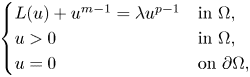
 \begin{equation} \begin{cases} L(u)+u^{m-1}=\lambda u^{p-1} & \text{in}\ \Omega,\\ u=0 & \text{on}\ \partial \Omega, \end{cases} \end{equation}
where  $L(v)=-\textrm {div}(M(x)\nabla v):{H^{1}_0(\Omega )}\to {H^{-1}(\Omega )}$ is a linear operator in divergence form. The matrix
 $M(x)=(m_{ij}(x))$ is symmetric, bounded and positive definite, i.e., there exist positive constants
 $0<\alpha <\beta$ such that
 \begin{equation} \alpha|\xi|^{2} \leq M(x)\xi \cdot\xi \leq \beta |\xi|^{2}. \end{equation}
The exponents  $p$,
 $m$ such that
 \begin{equation} 2< p\leq 2^{*}< m, \quad \text{where}\ 2^{*}=\begin{cases}\dfrac{2N}{N-2} & \text{for}\ N>2,\\ 2^{*}={+}\infty & \text{for}\ N=1,2. \end{cases} \end{equation}
and  $\lambda$ is a positive parameter.
In order to perform our asymptotical analysis, we first study (1.1) for  $m$ large but fixed and we prove the following result.
Theorem 1.1 Assume conditions (1.2) and (1.3). Then, there exists  $\underline {\lambda }>0$ such that for each
 $\lambda >\underline {\lambda }$ there is
 $m_0>2^{*}$ such that for every
 $m\geq m_0$, problem (1.1) has, at least, two positive solutions
 ${u_m}\not \equiv {z_m}\in {H^{1}_0(\Omega )}\cap L^{m}(\Omega )$.
The solutions  $u_{m}$ and
 $z_{m}$ are found as nontrivial critical points of the functional
 \begin{equation} J_m(v):=\frac{1}{2}{{\int_{\varOmega}}}M(x)\nabla v\cdot \nabla v+\frac{1}{m}\|v\|_m^{m}-\frac{\lambda}{p}\|v^{+}\|_p^{p}. \end{equation}
As  $m$ does not satisfy any bound from above [see (1.3)] we are naturally lead to study
 $J_{m}$ defined on
 $H^{1}_{0}(\Omega )\cap L^{m}(\Omega )$, and we show that
 $J_{m}$ has a global minimum point
 $u_{m}$ at a negative level, and another critical point, found applying the Ambrosetti-Rabinowitz Theorem at a positive minimax level, that is
 $z_{m}$. Even at this stage we can see some crucial difference between these two solutions: the existence of a nontrivial global minimum point
 $u_{m}$ follows assuming the weaker hypothesis on
 $p$
 \begin{equation} 2< p < m; \end{equation}
while, in order to have the existence of  $z_{m}$ at a positive action level we need (1.3).
Then we perform the asymptotical analysis of the solutions found for  $m\to + \infty$. In this study a crucial role will be played by an
 $L^{\infty }(\Omega )$ a priori bound, which will prevent any blow up of the sequences of
 $u_{m}$ and
 $z_{m}$ even when
 $p=2^{*}$. This marks a strong difference with the well-known explosion phenomenon for the Lane-Emden problem in bounded domain when
 $p$ approaches
 $2^{*}$ for
 $N\geq 3$, as shown in [Reference Atkinson and Peletier4, Reference Brézis and Peletier6, Reference Han11, Reference Rey13], and even with the finite asymptotical behaviour of the
 $L^{\infty }(\Omega )$ norm of least energy solution in dimension 2 as obtained in [Reference Adimurthi and Grossi1]. Here, we see a completely different scenario which is more related with the results obtained in [Reference Dall'Aglio and Orsina7] and in [Reference Boccardo and Murat5] in the case of a datum
 $f(x)$ in the place of the nonlinearity
 $u^{p-1}$.
The absence of blowing up family of solution is due to the fact the diverging exponent is the one that involves the ‘absorbing term’  $u^{m-1}$ on the left-hand side instead of the ‘reaction one’
 $u^{p-1}$ on the right-hand side.
As a consequence of the a priori bounds we are able to show the following result
Theorem 1.2 There exist  $u,\,z\in {\mathscr K}:=\{v\in H^{1}_0(\Omega ):0\leq v(x) \leq 1\},$ such that
 $u,\,z\not \equiv 0$, and
 $u_{m}\rightharpoonup u$ weakly in
 ${H^{1}_0(\Omega )}$,
 $z_{m}\to z$ strongly in
 ${H^{1}_0(\Omega )}$ and the convergence is for both
 $u_{m}$ and
 $z_{m}$ strongly in every Lebesgue space. Moreover,
 $u$ and
 $z$ satisfy the following variational inequalities
 \begin{equation} \int_\Omega M(x)\nabla w \cdot\nabla (v-w)\geq \lambda \int_{\Omega} \,w^{p-1}(v - w),\quad \forall\, v\in {\mathscr K}, \end{equation}
In addition, there exist  $g_{u},\,g_{z}\in L^{\infty }(\Omega )$, such that
 \[ 0\leq g_{u},\, g_{z}\leq \lambda \quad g_{u}(x)[1-u(x)]=0,\ g_{z}(x)[1-z(x)]=0 \ \text{a. e. in}\ \Omega, \]
and it results
 \begin{equation} L(u)+g_{u}=\lambda u^{p-1},\quad L(z)+g_{z}=\lambda z^{p-1},\quad\text{in}\ \Omega. \end{equation}
Theorem 1.2 will be proved as a consequence of theorems 4.1 and 4.4 and it shows that problem (1.1) works as a nonlinear penalization procedure to obtain solutions of the variational inequality (1.6) (see [Reference Boccardo and Murat5, Reference Dall'Aglio and Orsina7]). The role of the functions  $g_{u}$ and
 $g_{z}$ appearing in the limit equation (1.7) is well described by the equalities
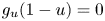 $g_{u}(1-u)= 0$ and
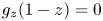 $g_{z}(1-z)= 0$ almost everywhere. Indeed, these conditions tell us that
 $g_{u}$ and
 $g_{z}$ weight the set in which
 $u\equiv 1$ and
 $z\equiv 1$, respectively.
In the convergence procedure we can see other difference between the behaviour of  $u_{m}$ and
 $z_{m}$: First of all, we do not need to prove that
 $u_{m}$ strongly converges in
 ${H^{1}_0(\Omega )}$ to a non-trivial limit
 $u$ and even more we get this limit for every
 $p>2$; on the other hand, we need to show that
 $z_{m}$ strongly converges to
 $z$ in
 ${H^{1}_0(\Omega )}$ in order to show that
 $z$ is not trivial. Moreover, this is obtained by a comparison with the minimax value of the limit functional
 \[ J_{\infty}:=\frac{1}{2}{{\int_{\varOmega}}}M(x)\nabla v\cdot \nabla v-\frac{\lambda}p{{\int_{\varOmega}}} |v|^{p}, \]
and the assumption  $p\leq 2^{*}$ is crucial at this point (see for more details remarks 4.5 and 4.6).
However, the main difference between the two asymptotical behaviours concerns the function  $g_{u}$ and
 $g_{z}$. Indeed, while it is quite simple to show that
 $g_{u}$ is not trivial thanks to an a priori uniform bound on the level of the global minimum point
 $u_{m}$ of
 $J_{m}$, the analogous analysis on
 $g_{z}$ seems to be really delicate and strongly depending on the domain and on the exponent
 $p$. For example, when
 $\Omega$ is star-shaped and
 $p=2^{*}$ then
 $g_{z}$ must be not trivial and the same occurs when
 $\Omega$ is a ball and
 $p\to 2^{*}$ from below or
 $p\to 2$ from above (see proposition 4.8); but whether or not
 $g_{z}$ is trivial for a general
 $p\in (2,2^{*})$ remains an open question: we can only prove an abstract result (see proposition 4.10) when the domain
 $\Omega$ is a ball that actually shows that
 $g_{z}$ may be trivial or not (see for more details remark 4.11).
The paper is organized as follows: in § 2 we show the existence of  $u_{m}$ and
 $z_{m}$ for fixed
 $m$ (sufficiently large), in § 3 the crucial a-priori bounds and in § 4 we perform the asymptotical analysis.
2. Existence results for fixed  $m$

We denote with  $\|\cdot \|_r$ the norm in the Lebesgue space
 $L^{r}(\Omega )$ for
 $1\leq r\leq \infty$ and with
 $\|\cdot \|$ the usual norm in the Sobolev space
 ${H^{1}_0(\Omega )}$. We will study problem (1.1) by variational methods, so that we consider the functional space
 $X_m:={H^{1}_0(\Omega )}\cap L^{m}(\Omega )$ endowed with the norm
 $\|\cdot \|_{X_m}=\|\cdot \|+\|\cdot \|_m$ and the functional
 $J_m\,:\,X_m\to {{\mathbb {R}}}$ defined in (1.4). A solution of problem (1.1) is a nonzero critical point of
 $J_m$, i.e., a function
 $w\in X_m$,
 $w(x)>0$, a.e.
 $x\in \Omega$, such that the following equation is satisfied for every
 $v\in X_m$
 \begin{equation} {{\int_{\varOmega}}}M(x)\nabla w\cdot\nabla v+{{\int_{\varOmega}}} |w|^{m-2}w\,v-\lambda {{\int_{\varOmega}}} |w|^{p-2}w\,v=0 \end{equation}
We will prove theorem 1.1 as a consequence of two existence results, the first one is concerned with the existence of the minimal solution  $u_{m}$
Theorem 2.1 Assume conditions (1.2) and (1.5). Then, there exists  $\underline {\lambda }_{1}>0$ such that for each
 $\lambda >\underline {\lambda }_{1}$ there is
 $m_0>2^{*}$ such that for every
 $m\geq m_0$, problem (1.1) has a nonnegative, minimal solutions
 ${u_m} \in {H^{1}_0(\Omega )}\cap L^{m}(\Omega ),\ u_{m}\not \equiv 0$ with
 \begin{equation} J_m({u_m})\leq{-}\delta<0. \end{equation}
Remark 2.2 Let us observe that  $\underline {\lambda }_{1}>0$ is explicitly given in (2.11).
Proof. From Hölder and Young inequalities we obtain
 \begin{align*} J_m(v) & \geq \frac{\alpha}{2}\|v\|^{2}+\frac{1}{m}\|v\|_m^{m}-\frac{\lambda}{p}\|v\|_{m}^{p}|\Omega|^{1-p/m}\\ & \geq \frac{\alpha}{2}\|v\|^{2}+\frac{1}{2m}\|v\|_m^{m}-\frac{m-p}{p^{2}m}|\Omega|\lambda^{\frac{m}{m-p}} 2^{\frac{p}{m-p}}, \end{align*}
which implies that  $J_m$ is coercive in
 $X_m$. Moreover, if
 $v_m\rightharpoonup v$ in
 $X_m$, then
 $v_m\to v$ almost everywhere (up to a subsequence), so that
 $v_m\to v$ strongly in
 $L^{p}(\Omega )$ thanks to Egorov Theorem; this fact, and the weak lower semicontinuity of the norm in
 $X_m$ imply that
 $J_m$ is weakly lower semicontinuous. Then, there exists a global minimum point
 ${u_m}$ of
 $J_m$. In order to prove (2.2), for any function
 $\psi \in {H^{1}_0(\Omega )}\cap L^{\infty }(\Omega )$, we consider the one variable, positive, real function
 $g_{m}(t)$ defined by
 \begin{equation} g_{m}(t)=\frac{a}{t^{p-2}}+ b_m t^{m-p},\quad a= \frac{\beta}{2} \frac{\| \psi\|^{2}}{\|\psi\|_p^{p}},\quad b_m= \frac{1}{m} \frac{\displaystyle \| \psi\|_m^{m}}{\displaystyle \|\psi\|_p^{p}}. \end{equation}
Note that  $m>p>2$ implies that
 $\mathop {\lim }\limits _{t\to 0} g(t)=\mathop {\lim }\limits _{t\to +\infty } g(t)=+\infty$ so that,
 $g$ attains its global minimum at the point
 $T_m$ given by
 \begin{equation} T_m=\left[\frac{p-2}{m-p} \frac{a}{b_m}\right]^{\frac{1}{m-2}}=\left[\frac{\beta}2\frac{m(p-2)}{m-p}\|\psi\|^{2}\right]^{\frac 1{m-2}} \|\psi\|_{m}^{-\frac{m}{m-2}}. \end{equation}
Notice that
 \begin{equation} J_m(T_m\psi)<0\; \Leftrightarrow\; \lambda>\lambda_{m}(\psi):=p\min_{(0,+\infty)}g_{m}=pg_{m}(T_{m}) \end{equation}
where  $g_{m}(T_{m})$ is given by
 \begin{align*} g_{m}(T_m)&=\left(\frac{p-2}{m-p} \right)^{\frac{2-p}{m-2}}\frac{a^{\frac{m-p}{m-2}}}{b_m^{\frac{2-p}{m-2}}} +\left( \frac{p-2}{m-p} \right)^{\frac{m-p}{m-2}} \frac{a^{\frac{m-p}{m-2}}}{b_m^{\frac{2-p}{m-2}}}\\ &=a^{\frac{m-p}{m-2}} b_m^{\frac{p-2}{m-2}} \left[\left(\frac{p-2}{m-p} \right)^{\frac{2-p}{m-2}} + \left(\frac{p-2}{m-p} \right)^{\frac{m-p}{m-2}} \right]\\ &=a^{\frac{m-p}{m-2}} b_m^{\frac{p-2}{m-2}}\left(\frac{p-2}{m-p} \right)^{\frac{2-p}{m-2}}\frac{m-2}{m-p}. \end{align*}
Notice that it results
 \begin{equation} \lim_{m\to+\infty} \lambda_{m}(\psi)=p \frac{\beta}{2} \frac{\|\psi\|^{2}\|\psi\|_\infty^{p-2}}{\|\psi\|_p^{p}} =: \Lambda(\psi), \end{equation}
and, taking into account (2.3) and (2.4), one has
 \begin{equation} \lim_{m\to+\infty}T_m =\lim_{m\to+\infty}\left[\frac 1{b_{m}}\right]^{\frac 1{m-2}}=\lim_{m\to+\infty}\left[\frac{1}{m} \frac{\displaystyle \| \psi\|_m^{m}}{\displaystyle \|\psi\|_p^{p}}\right]^{-\frac{1}{m-2}}=\frac{1}{\|\psi\|_{\infty}}. \end{equation}
Moreover, again recalling (2.3)
 \begin{align} \lim_{m\to+\infty}\left[T_{m}\|\psi\|_{m}\right]^{m}&=\lim_{m\to+\infty}\left[ (p-2)\frac{\beta}{2}\frac{m}{m-p} \right]^{\frac{m}{m-2}}\|\psi\|^{\frac{2m}{m-2}}\|\psi\|_{m}^{-\frac{2m}{m-2}}\nonumber\\ &=\frac{\beta}2(p-2)\|\psi\|^{2}\|\psi\|_{\infty}^{{-}2}. \end{align}
This, joint with (1.4) and (2.7) yields
 \[ \lim_{m\to+\infty} J_{m}(T_{m}\psi)=J_{\infty}(T_{\infty}\psi)=\frac{\|\psi\|_{\infty}^{{-}2}}2 {{\int_{\varOmega}}}M(x)\nabla \psi\cdot\nabla \psi-\lambda\frac{\|\psi\|_{\infty}^{{-}p}}p\|\psi\|_{p}^{p}, \]
where  $J_{\infty }$ is defined by
 \begin{equation} J_{\infty}(v)=\frac{1}{2}{{\int_{\varOmega}}}M(x)\nabla v\cdot\nabla v -\frac{\lambda}p\|v\|_{p}^{p} . \end{equation}
Notice that, due to (1.5)  $J_{\infty }$ may not be finite, but we are computing
 $J_{\infty }$ only on
 $\psi \in {H^{1}_0(\Omega )}\cap L^{\infty }(\Omega )$. Moreover, it is easy to see that
 \begin{equation} J_{\infty}(T_{\infty}\psi)<0 \;\Leftrightarrow\; \lambda >\Lambda(\psi). \end{equation}
Then,  $\underline {\lambda }_{1}$ given by
 \begin{equation} \underline{\lambda}_{1}:=\inf_{\psi\in H^{1}_{0}(\Omega)\cap L^{\infty}(\Omega)}\Lambda(\psi)=\inf_{\psi\in H^{1}_{0}(\Omega)\cap L^{\infty}(\Omega)}p \frac{\beta}{2} \frac{\|\psi\|^{2} \|\psi\|_\infty^{p-2}}{\|\psi\|_p^{p}} \end{equation}
is well defined as  $\Lambda (\varphi _{1})$ is finite where
 $\varphi _{1}$ is the positive eigenfunction associated with the first positive eigenvalue of the laplacian operator with homogeneous Dirichlet boundary conditions,
 $\lambda _{1}^\textrm {Dir}$. Moreover,
 $\underline {\lambda }_{1}$ is positive as
 \[ {{\int_{\varOmega}}} |\psi^{p}|={{\int_{\varOmega}}} |\psi|^{p-2}|\psi|^{2}\leq \|\psi\|_{\infty}^{p-2}{{\int_{\varOmega}}} |\psi|^{2}\leq \lambda_{1}^\textrm{Dir}\|\psi\|_{\infty}^{p-2}\|\psi\|^{2} \]
so that  $\underline {\lambda _{1}}\geq p\frac {\beta }2\lambda _{1}^\textrm {Dir}$. Thus, for every
 $\lambda > \underline {\lambda }_{1}$, we can fix
 \begin{equation} \psi_{0}\in {H^{1}_0(\Omega)}\cap L^{\infty}(\Omega)\quad\text{such that}\quad \Lambda(\psi_{0})<\lambda \end{equation}
yielding (2.10). Taking into account (2.8), we can find  $\sigma >0$ and sufficiently small and
 $m_1 >2^{*}$ such that for
 $m\geq m_1 >2^{*}$
 \begin{equation} J_{m}(T_{m}\psi_{0})\leq J_{\infty}(T_{\infty}\psi_{0})+\sigma=J_{\infty}\left(\frac{\psi_{0}}{\|\psi_{0}\|_{\infty}}\right)+\sigma<0 \end{equation}
and the conclusion follows choosing  $-\delta =J_{\infty }(\psi _{0}/\|\psi _{0}\|_{\infty }).$
Finally, it is possible to obtain  $u_{m}\geq 0$ by considering the modified functional
 \[ J(v)=\frac{1}{2}{{\int_{\varOmega}}}M(x)\cdot \nabla v\cdot \nabla v+\frac{1}{m}{{\int_{\varOmega}}} |v|^{m}-\frac{\lambda}{p}{{\int_{\varOmega}}} (v^{+})^{p}. \]
The same argument of the proof of theorem 2.1 yields a nonnegative minimum point  $u_{m}$.□
Remark 2.3 Let us point out that the existence of  $u_{m}$ does not require
 $m$ sufficiently large. On the other hand, the assumption on
 $m$ sufficiently large is crucial to obtain the a priori upper bound on the level of the minimum point
 $u_{m}$.
Moreover, concerning the exponent  $p$, the existence of the minimum point
 $u_{m}$ also holds for
 $p$ super-critical (with respect to the Sobolev embeddings).
The existence of the second nontrivial solution is given by the following existence result.
Theorem 2.4 Assume conditions (1.2) and (1.3). Then, there exists  $\underline {\lambda }\geq \underline {\lambda }_{1}>0$ [see (2.11)] such that for each
 $\lambda >\underline {\lambda }$ there is
 $m_0>\max \{2^{*},m_{1}\}$ (
 $m_{1}$ introduced in theorem 2.1), such that for every
 $m\geq m_0$, problem (1.1) has a nonnegative, critical point
 ${z_m} \in {H^{1}_0(\Omega )}\cap L^{m}(\Omega )$ with
 ${z_m}\not \equiv 0$ and
 ${z_m}\not \equiv {u_m}$.
Proof. We will obtain the existence of  $z_{m}$ by applying the Ambrosetti-Rabinowitz theorem [Reference Ambrosetti and Rabinowitz3]. First of all, note that
 \begin{align*} J_{m}(v)&\geq\frac{1}{2}\|\nabla v\|_{2}^{2}+\frac{1}{m}\|v\|_{m}^{m}-\lambda\frac{\mathscr S^{p/2}}p|\Omega|^{1-p/2^{*}}\|\nabla v\|_{2}^{p}\\ &=\frac{1}{m}\|v\|_{m}^{m}+\|\nabla v\|_{2}^{2}\left(\frac{1}{2}-\lambda\frac{\mathscr S^{p/2}}p|\Omega|^{1-p/2^{*}}\|\nabla v\|_{2}^{p-2}\right). \end{align*}
Now, fix  $r_{\lambda }$ such that
 \[ r_{\lambda}:=\min\left\{1,\left(\frac{p}{4\lambda{\mathscr S^{p/2}}|\Omega|^{1-p/2^{*}}} \right)^{1/p-2}\right\} \]
and consider  $v\in X_{m}$ such that
 $\|v\|_{X_{m}}=r_{\lambda }$. In case
 $r_{\lambda }\leq 1$ one obtains (for
 $m\geq 4$)
 \begin{align} J_{m}(v)&\geq \frac{1}{m}\|v\|_{m}^{m}+\frac{1}{4} \|\nabla v\|_{2}^{2}\geq\frac{1}{m}\left(\|v\|_{m}^{m}+\|\nabla v\|_{2}^{m}\right)\nonumber\\ &\geq\frac{1}{m2^{m-1}}\left(\|v\|_{m}+\|\nabla v\|_{2} \right)^{m}=\frac{1}{m2^{m-1}}r_{\lambda}^{m}=:\rho_{m,\lambda}. \end{align}
In this way we have proved that there exists  $r_{\lambda }$ and
 $\rho _{m,\lambda }$ such that
 \[ J_{m}(v)\geq \rho_{m,\lambda}\quad \forall v\in X_{m}: \|v\|_{X_{m}}=r_{\lambda}. \]
Then, we can consider the family of paths
 \[ \Gamma_m=\left\{\gamma:[0,1]\to X_m,\,:\gamma \text{is continuous and}\ \gamma(0)=0,\ \gamma(1)=T_{m}\psi _{0} \right\}. \]
where  $T_{m}$ and
 $\psi _{0}$ are defined in (2.4) and (2.12) respectivley and
 \[ c_m:=\inf_{\Gamma_m}\max_{[0,1]}J_m(\gamma(t)). \]
Notice that in order to have 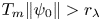 $T_m\|\psi _{0}\| > r_\lambda$ it is sufficient to have that
 \[ \lambda >\frac{\alpha}{4\sigma} \frac{1}{\| \psi\|^{p-2}} \left[\frac{2(m-p) \| \psi\|_m^{m}}{m(p-2) \beta \|\psi\|^{2}} \right]^{\frac{p-2}{m-2}} \]
where 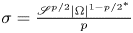 $\sigma = \frac {{\mathscr S^{p/2}}|\Omega |^{1-p/2^{*}}}{p}$. Since the right-hand side in the last inequality tends as
 $m$ goes to
 $+\infty$ to
 \[ R \equiv \frac{\alpha}{4\sigma} \left[\frac{\|\psi\|_\infty}{\|\psi \|}\right]^{p-2}, \]
it follows that for every  $\lambda >R$, there exists
 $m_2(\lambda )>2^{*}$ such that if
 $m\geq m_2(\lambda )$, then
 $T_m\|\psi \|_{X_{m}} > r_\lambda$, consequently, every path
 $\gamma \in \Gamma _m$ crosses the set
 $\|v\|_{X_{m}}=r_\lambda$, and we obtain
 \[ c_m\geq \rho_{m,\lambda}, \]
[where  $\rho _{m,\lambda }$ is defined in (2.14)]. Therefore, the geometrical hypotheses of the Mountain Pass Theorem are fulfilled provided that
 \begin{equation} m \geq m_0\equiv \max \{ m_1(\lambda), m_2(\lambda)\} ,\quad \lambda\geq \underline{\lambda}_{2} \equiv \max \{\underline{\lambda}_{1} ,R \}. \end{equation}
It is only left to show that  $J_m$ satisfies the Palais-Smale condition, this is a straightforward argument; indeed, take a sequence
 $w_n$ satisfying
 \begin{equation} {J_m}(w_n)\stackrel{n\to +\infty}{\longrightarrow} c_m ,\quad J'_m(w_n)\stackrel{n\to +\infty}{\longrightarrow} 0 \quad \text{in } X_m^{*}, \end{equation}
where  $X_m^{*}$ denotes the dual space of
 $X_m$. As
 ${J_m}$ is coercive in
 $X_m$, the first convergence in (2.16) implies that
 $w_n$ is bounded in
 $X_m$, then, up to a subsequence, there exists
 $w\in X_m$ such that
 \[ w_n \rightharpoonup w\quad \text{in}\ X_m, \]
which means that  $w_n \rightharpoonup w$ in
 $L^{m}(\Omega )$ and in
 $H_0^{1}(\Omega )$. Thus, by the Rellich theorem,
 $w_n$ is strongly convergent to
 $w$ in
 $L^{2}(\Omega )$ and then, by interpolation, we deduce also the strong convergence of
 $w_n$ in
 $L^{r}(\Omega )$ for all
 $r\in [2,m)$. Now, taking
 $w_n-w\in H_0^{1}(\Omega ) \cap L^{m}(\Omega ) \subset H_0^{1}(\Omega ) \cap L^{m'}(\Omega ) \subset X_m^{*}$ (since
 $m>2$) as test function in (2.16), we obtain
 \begin{align*}
&{{\int_{\varOmega}}}M(x)\nabla w_n \cdot\nabla (w_n-w) +
{{\int_{\varOmega}}} |w_n|^{m-2} w_n (w_n - w)\\ &\quad - \lambda
{{\int_{\varOmega}}} |w_n|^{p-2} w_n (w_n-w) \to 0.
\end{align*}
Observing that the strong convergence of  $w_n$ in
 $L^{p}(\Omega )$ implies that the third adding term is tending to zero and, by subtracting the term
 \[ {{\int_{\varOmega}}}M(x)\nabla w \cdot\nabla (w_n-w) + {{\int_{\varOmega}}} |w|^{m-2} w (w_n - w), \]
which is converging to zero thanks to the weak convergence of  $w_n$ in
 ${H^{1}_0(\Omega )}$, we get
 \[ \lim_{n\to +\infty}{{\int_{\varOmega}}} | \nabla (w_n-w)|^{2} + {{\int_{\varOmega}}} \left[ |w_n|^{m-2} w_n -|w|^{m-2} w \right] (w_n - w)= 0 , \]
from which the strong convergence of  $w_n$ to
 $w$ in
 $X_m$ is deduced. Then, the Ambrosetti-Rabinowitz theorem implies the existence of a mountain pass critical point
 $z_m$ with critical level
 $J_m({z_m})=c_m\geq 0>J_m({u_m})$. Then,
 ${z_m}$ and
 ${u_m}$ are distinct solutions of problem (1.1). Finally, arguing as at the end of theorem 2.1 it is possibile to obtain that
 $z_{m}\geq 0$.□
Remark 2.5 Let us observe that the result holds for every  $2< p\leq 2^{*}$ and for
 $m$ sufficiently large. This assumption on
 $p$ is crucial to show that zero is a strict local minimum so that
 $c_{m}>0$ for every
 $m$ fixed.
Remark 2.6 Notice that for  $m$ sufficiently large
 $\rho _{m,\lambda }$ defined in (2.14) converges to zero as
 $m\to +\infty$, so that we do not have an immediate a priori bound from below on the action level of the critical point
 $z_{m}$.
3. A priori bounds
Let’s first show the following a priori  $L^{\infty }$-estimate that will be fundamental in the asymptotical analysis.
Proposition 3.1 Assume conditions (1.2) and (1.5). Then every positive solution  $w$ of problem (1.1) satisfies the following estimate
 \begin{equation} \| w\|_\infty \leq \lambda ^{\frac{1}{m-p}}. \end{equation}
Proof. For every  $t, \varepsilon >0$, let
 $\psi _\varepsilon$ the function given by
 \[ \psi_\varepsilon (s) = \left\{\begin{array}{@{}ll} 0, & s< t,\\ \dfrac{s-t}{\varepsilon} , & t< s< t+\varepsilon ,\\ 1, & t+\varepsilon \leq s. \end{array}\right. \]
Let us introduce the notation  $E_t=\{ x\in \Omega :w(x)>t\}$ and take
 $v=\psi _\varepsilon (w)$ as test function in (2.1) yielding
 \begin{align*} \int_{E_t} w^{m-1} \psi_\varepsilon (w)&\leq \int_{\{x\in \Omega : t< w(x)< t+\varepsilon\}} M(x) \nabla w \cdot\nabla \psi_\varepsilon (w)\\ &\quad+ \int_{E_t} w^{m-1} \psi_\varepsilon (w)= \lambda \int_{E_t} w^{p-1} \psi_\varepsilon (w)\leq \lambda \int_{E_t} w^{p-1} . \end{align*}
Passing to the liminf as  $\varepsilon$ goes to zero and applying the Fatou Lemma and Hölder inequality,
 \[ \int_{E_t} w^{m-1} \leq\lambda \int_{E_t} w^{p-1}\leq\lambda \left[\int_{E_t} w^{m-1} \right]^{\frac{p-1}{m-1}} |E_t|^{\frac{m-p}{m-1}} . \]
That implies
 \begin{equation} t^{m-1} |E_t|\leq \int_{E_t} w^{m-1} \leq\lambda^{\frac{m-1}{m-p}}|E_t|. \end{equation}
Consequently, taking into account that  $|E_t|\not = 0$ for every
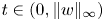 $t\in (0,\|w\|_\infty )$ we obtain
 \[ t\leq \lambda ^{\frac{1}{m-p}},\quad\forall t\in (0,\|w\|_\infty) \]
and hence (3.1) is proved.□
Remark 3.2 The same conclusion of proposition 3.1 would hold for every solution of problem (1.1); the hypothesis on positiveness is actually not needed. In addition, notice that the nonlinearity  $u^{m-1}$ satisfies all the hypotheses of theorem 1 in [Reference Vázquez15], then it actually holds that
 $u_{m}>0$ and
 $z_{m}>0$.
Remark 3.3 The a priori bound (3.1) prevents any blow-up phenomenon on a sequence of positive solutions of problem (1.1), as we will see in the following.
In addition to proposition 3.1 we can also show the following.
Proposition 3.4 Assume conditions (1.2) and (1.5). Then every solution  $w$ of problem (1.1) satisfies the following estimates
 \begin{align} \|w\|_m^{m} &\leq \lambda^{\frac{m}{m-p}}|\Omega|, \end{align}
 \begin{align} \alpha\|w\|^{2}+\|w\|_m^{m} &\leq |\Omega|\lambda^{\frac{m}{m-p}}. \end{align}
Proof. Taking  $w$ as test function in (2.1) and using (1.2) we obtain
 \begin{equation} \int_{\Omega}|w|^{m} \leq \lambda \int_{\Omega} |w|^{p}\leq \lambda \left[\int_{\Omega} |w|^{m} \right]^{p/m}\ |\Omega |^{1-\frac{p}{m}}, \end{equation}
which implies that
 \[ \left[\int_{\Omega}|w|^{m} \right]^{1-p/m} \leq \lambda|\Omega|^{1-\frac{p}{m}}, \]
and (3.3) is clearly deduced. Now, we choose again  $v=w$ in (2.1), to get from Hölder inequality and (3.3) that
 \[ \alpha\int_{\Omega} |\nabla w|^{2}+\int_{\Omega}|w|^{m} \leq\lambda\left[\lambda^{\frac{m}{m-p}}\right]^{\frac{p}{m}} |\Omega |^{\frac{p}{m}} |\Omega |^{1-\frac{p}{m}} =\lambda^{\frac{m}{m-p}} |\Omega | \]
□
4. Asymptotical analysis
Let us start this section studying the convergence of the sequence of solutions of minimum points  $\{u_{m}\}$
Theorem 4.1 Assume (1.2) and (1.5). There exists  $\underline {\lambda }_{1}$ such that for every
 $\lambda >\underline {\lambda }_{1}$, there exists
 $u\in H^{1}_{0}(\Omega )\cap L^{\infty }(\Omega )$ such that
 $u\not \equiv 0$,
 $u_{m}\rightharpoonup u$ weakly in
 ${H^{1}_0(\Omega )}$, strongly in every Lebesgue space and
 $u$ satisfies
 \begin{align} &u\in {\mathscr K}:=\{v\in H^{1}_0(\Omega):0\leq v(x) \leq 1\}, \end{align}
 \begin{align} &\int_\Omega M(x)\nabla u \cdot\nabla (v-u) \geq \lambda \int_{\Omega} \,u^{p-1}(v - u),\quad \forall\ v\in {\mathscr K}. \end{align}
In addition, there exists  $g_{u}\in L^{\infty }(\Omega )$, such that
 \begin{equation} 0\leq g_{u}\leq \lambda,\quad g_{u}\not \equiv 0,\quad g_{u}(x)[1-u(x)]=0,\ \text{a. e. in}\ \Omega, \end{equation}
and it results
 \begin{equation} \int_\Omega M(x)\nabla u \cdot\nabla \varphi+{{\int_{\varOmega}}}g_{u}\varphi= \lambda \int_{\Omega} \,u^{p-1}\varphi ,\quad \forall \varphi\in {H^{1}_0(\Omega)}. \end{equation}
Remark 4.2 The properties of the function  $g_{u}$ expressed in (4.3) show that
 $g_{u}$ weights the set where
 $u\equiv 1$, as
 $g_{u}(x)=0$ for almost every
 $x\in \{x\in \Omega : u(x)<1\}$ and
 $g_{u}$ is not trivial.
Proof. We first apply theorem 2.1 to obtain a sequence of minimum points  $u_{m}$ of
 $J_{m}$ satisfying (2.2). From (2.2) and (3.1) we deduce that there exists
 $u\in {H^{1}_0(\Omega )}\cap L^{\infty }(\Omega )$ with
 $0\leq u(x)\leq 1$ such that
 $u_{m}\rightharpoonup u$ weakly in
 ${H^{1}_0(\Omega )}$, strongly in
 $L^{q}(\Omega )$ for
 $q\in [1,+\infty )$. Moreover, from (2.2) we also deduce that
 \[ J_{\infty}(u_{m})=\frac{1}{2}{{\int_{\varOmega}}}M(x)\nabla u_{m}\cdot \nabla u_{m}- \frac{\lambda}p{{\int_{\varOmega}}}u_{m}^{p}\leq{-}\delta<0. \]
Then, as  $u_{m}\rightharpoonup u$ weakly in
 ${H^{1}_0(\Omega )}$, and strongly in
 $L^{q}(\Omega )$ for every
 $q\in [1,+\infty )$.
 \[ 0>{-}\delta\geq \liminf_{m\to+\infty}J_{m}(u_{m})\geq \frac{1}{2}{{\int_{\varOmega}}}M(x)\nabla u \cdot \nabla u-\frac{\lambda}p{{\int_{\varOmega}}}u^{p} \]
which implies that  $u\not \equiv 0$. Let now
 $v$ be any element in
 ${\mathscr K}$, and let
 $\theta$ be any real number such that
 $0 < \theta < 1.$ Using
 $\theta \,v-{u_m}$ as test function in (2.1) we obtain
 \begin{align} &\int_\Omega M(x)\nabla {u_m} \cdot (\theta \nabla v - \nabla {u_m}) + \int_\Omega\,{u_m} ^{m-1}(\theta v - {u_m}) \notag\\ & \quad = \lambda\int_{\Omega} \,{u_m}^{p-1}(\theta v - {u_m} ). \end{align}
We write the second term as
 \begin{align*} \int_\Omega {u_m}^{m-1}(\theta v - {u_m} ) &=\int_{\{x: 0\leq{u_m} (x) < \theta v\}}{u_m}^{m-1}(\theta v - {u_m})\\ &\quad+\int_{\{x: {u_m}(x)\geq \theta v\}}{u_m}^{m-1}(\theta v - {u_m} ), \end{align*}
where the first term of the right-hand side is bounded by
 \[ {u_m}^{m-1}(\theta v - {u_m})\leq[\theta v]^{m-1}(\theta v + \theta v)\leq 2 \theta^{m}, \]
which tends to zero when  $n$ tends to infinity because
 $\theta < 1$; while
 \[ {u_m}^{m-1}(\theta v - {u_m}) \leq 0 \quad \text{on} \quad \{x : {u_m} (x) \geq\theta v\}; \]
and this implies that
 \[ {\limsup_{m\to \infty}} \int_\Omega {u_m}^{m-1} (\theta v - {u_m} ) \leq 0. \]
Now we write (4.5) as
 \begin{align*} &\theta\int_\Omega M(x)\nabla {u_m} \cdot\nabla v + \int_{\{x : 0\leq{u_m}(x)< \theta v\}}{u_m}^{m-1}(\theta v - {u_m})\\ &\quad \geq \lambda \int_{\Omega} \,{u_m}^{p-1}(\theta v - {u_m}) +\int_\Omega M(x)\nabla{u_m} \cdot \nabla {u_m}, \end{align*}
we pass to the limit as  $n\to \infty$ and we observe that thanks to (1.2) we can exploit the weak lower semicontinuity of the norm to obtain
 \[ \theta\int_\Omega M(x)\nabla u \cdot \nabla v \geq \lambda\int_{\Omega} \,u^{p-1}(\theta v - u ) +\int_\Omega M(x)\nabla u \cdot\nabla u, \]
for any  $v$ in
 ${\mathscr K}$ and any
 $\theta$ with
 $0 < \theta < 1$. Letting
 $\theta$ tend to 1 we get (4.2).
In order to prove the second part of the result, we take into account (3.1) and we deduce that there exists  $g_{u}\in L^{\infty }(\Omega )$ such that (up to a subsequence)
 $\{(u_{m})^{m-1}\}\stackrel {*}{\rightharpoonup } g_{u}$ weakly-star in
 $L^{\infty }(\Omega )$. As a consequence, we obtain that
 $g_{u}\geq 0$; in addition, considering
 $\chi _{E}$ the characteristic function of the set
 $E:=\{x\in \Omega : g_{u}>\lambda \}$ and exploiting again (3.1) we get
 \[ \lambda^{\frac{m-1}{m-p}}|E|\geq {{\int_{\varOmega}}}u_{m}^{m-1}\chi_{E}\Longrightarrow \lambda |E|\geq \int_{E} g_{u}>\lambda |E| \]
showing that
 \[ g_{u}\leq \lambda. \]
Taking  $\varphi \in {H^{1}_0(\Omega )}$ as test function in (2.1) and passing to the limit we get that
 $u$ satisfies (4.4). Finally, let us take as test function in (4.4)
 $v-u$ with
 $v\in {\mathscr K}$. We obtain, that the equation
 \[ {{\int_{\varOmega}}}M(x)\nabla u\cdot \nabla (v-u)+{{\int_{\varOmega}}}g_{u}(v-u)-\lambda{{\int_{\varOmega}}}u^{p-1}(v-u)=0 \]
is satisfied for every  $v\in {\mathscr K}$. Then, using (4.2) we deduce that
 \[ {{\int_{\varOmega}}}g_{u}(u-v)\geq 0\quad \forall\ v\in {\mathscr K}. \]
Then, we can take a sequence  $v_{j}\in {\mathscr K}$ such that
 $v_{j}\to 1$ in
 $L^{1}(\Omega )$ obtaining
 \[ {{\int_{\varOmega}}}g_{u}(u-1)\geq 0 \]
and this immediately implies that  $g_{u}(1-u)\equiv 0$, as
 $g_{u}\geq 0$ and
 $u\leq 1$. In order to conclude, it is only left to show that
 $g_{u}\not \equiv 0$. To this aim, we take into account that
 $J_{\infty }(u)\leq -\delta <0$, to get
 \[ \lambda {{\int_{\varOmega}}}u^{p}\geq p\delta+\frac{p}2{{\int_{\varOmega}}}M(x)\nabla u\cdot \nabla u. \]
On the other hand, choosing  $\varphi =u$ in (4.4) we get
 \[ \lambda {{\int_{\varOmega}}}u^{p}={{\int_{\varOmega}}}g_{u}u+{{\int_{\varOmega}}}M(x)\nabla u\cdot \nabla u \]
so that
 \[ {{\int_{\varOmega}}}g_{u}u\geq p\delta+\left(\frac{p}2-1\right){{\int_{\varOmega}}}M(x)\nabla u\cdot \nabla u \]
and since  $g_{u},\,u\geq 0,\, u\not \equiv 0$, this shows that
 $g_{u}\not \equiv 0$, or equivalently
 $|\{x\in \Omega : u(x)=1\}|>0$.□
Remark 4.3 Let us point out that the previous result holds for every  $p>2$, so that the nontrivial limit solution
 $u$ exists even for
 $p>2^{*}$.
The previous results show that, a similar phenomenon to the one observed in [Reference Boccardo and Murat5, Reference Dall'Aglio and Orsina7] also occurs for this nonlinear problem. Now, let us move to the study of the asymptotic behaviour of the sequence of the critical points  $z_{m}$, showing the following result.
Theorem 4.4 Assume (1.2) and (1.3). There exists  $\underline {\lambda }\geq \underline {\lambda }_{1}$ such that for every
 $\lambda >\underline {\lambda }$, there exists
 $z\in H^{1}_{0}(\Omega )\cap L^{\infty }(\Omega )$ such that
 $z\not \equiv 0$,
 $z_{m}\to z$ strongly in
 ${H^{1}_0(\Omega )}$ and in every Lebesgue space. The function
 $z$ satisfies
 \begin{align} &z\in {\mathscr K}:=\{v\in H^{1}_0(\Omega):0\leq v(x) \leq 1 \}, \end{align}
 \begin{align} &\int_\Omega M(x)\nabla z \cdot\nabla (v-z) \geq \lambda \int_{\Omega} \,z^{p-1}(v - z),\quad \forall\ v\in {\mathscr K}. \end{align}
In addition, there exists  $g_{z}\in L^{\infty }(\Omega )$, such that
 \begin{equation} 0\leq g_{z}\leq \lambda, \quad g_{z}(x)[1-z(x)]=0,\ \text{a. e. in}\ \Omega, \end{equation}
and it results
 \begin{equation} \int_\Omega M(x)\nabla z\cdot\nabla \varphi+{{\int_{\varOmega}}}g_{z}\varphi=\lambda \int_{\Omega} \,z^{p-1}\varphi ,\quad \forall\ \varphi\in {H^{1}_0(\Omega)}. \end{equation}
Proof. We first apply theorem 2.4 to obtain the existence of a sequence of critical points  $z_{m}$ of
 $J_{m}$ for
 $m$ sufficiently large; then we follow the same argument as in the proof of theorem 4.1 getting the existence of a function
 $z\in {\mathscr K}$ such that
 $z_{m}\rightharpoonup z$ weakly in
 ${H^{1}_0(\Omega )}$ and strongly in every Lebesgue space; in addition
 $z$ satisfies (4.7). Now, taking
 $z_{m}-z$ as test function (2.1) yields
 \begin{align}
&{{\int_{\varOmega}}}M(x)\nabla z_{m}\cdot(\nabla
z_{m}-\nabla z)+{{\int_{\varOmega}}}
|z_{m}|^{m-1}(z_{m}-z)\nonumber\\ &\quad -\lambda
{{\int_{\varOmega}}} |z_{m}|^{p-1}(z_{m}-z)=0.
\end{align}
Let us observe that
 \[ \left|{{\int_{\varOmega}}} |z_{m}|^{m-1}(z_{m}-z)\right|\leq {{\int_{\varOmega}}} |z_{m}|^{m-1}|z_{m}-z|\leq \lambda^{\frac{m-1}{m-p}}{{\int_{\varOmega}}} |z_{m}-z|\to 0 \]
and the same argument shows that the last term in (4.10) goes to zero. Using this information in (4.10) we get
 \[ {{\int_{\varOmega}}}M(x)\cdot \nabla z_{m}(\nabla z_{m}-\nabla z)\to 0 \]
yielding
 \begin{align*} \alpha{{\int_{\varOmega}}} |\nabla z_{m}-\nabla z |^{2}&\leq {{\int_{\varOmega}}}M(x)\cdot \nabla z_{m}(\nabla z_{m}-\nabla z)- {{\int_{\varOmega}}}M(x)\cdot\nabla z (\nabla z_{m}-\nabla z)\\ &=o(1)+{{\int_{\varOmega}}}M(x)\cdot\nabla z_{m}(\nabla z_{m}-\nabla z) \end{align*}
so that  $z_{m}\to z$ strongly in
 ${H^{1}_0(\Omega )}$. In order to show that
 $z\not \equiv 0$, let us consider again the functional
 $J_{\infty }$ introduced in (2.9). Notice that there exists
 $\overline {T}$ and
 $\psi \in {H^{1}_0(\Omega )}\cap L^{\infty }(\Omega )$ such that
 \[ J_{m}(\overline{T}\psi)<0 \quad \text{and}\quad J_{\infty}(\overline{T}\psi)<0 \]
and the corresponding set of paths
 \[ \Gamma_\infty=\left\{\gamma:[0,1]\to {H^{1}_0(\Omega)},\,:\gamma\ \text{is continuous and}\ \gamma(0)=0, \,J_{\infty}(\gamma(1))<0 \right\}. \]
Moreover, we define the mountain pass value
 \[ c_\infty:=\inf_{\Gamma_\infty}\max_{[0,1]}J_\infty(\gamma(t)). \]
We claim that  $\Gamma _{m}\subset \Gamma _{\infty }$. Indeed, take
 $\gamma \in \Gamma _{m}$ then
 $\gamma$ is evidently continuous in
 ${H^{1}_0(\Omega )}$ as it is continuous in
 ${H^{1}_0(\Omega )} \cap L^{m}(\Omega )$, and
 $\gamma (0)=0$. Moreover, as
 $\gamma (1)=T_{m}\psi$ with
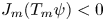 $J_{m}(T_{m}\psi )<0$, it is sufficient to notice that
 $J_{\infty }(T_{m}\psi )< J_{m}(T_{m}\psi )<0$ to obtain that
 $\gamma \in \Gamma _{\infty }$. As a consequence, we get
 \[ \max_{[0,1]}J_{m}(\gamma(t))\geq \max_{[0,1]}J_{\infty}(\gamma(t)) \quad (\text{because}\ J_{\infty}(\gamma)\leq J_{m}(\gamma)\ \text{for every}\ \gamma). \]
Then
 \begin{equation} c_{m}=\inf_{\Gamma_{m}}\max_{[0,1]}J_{m}(\gamma(t))\geq c_{\infty}=\inf_{\Gamma_{\infty}}\max_{[0,1]}J_{\infty}(\gamma(t))\geq \rho_{\infty} \end{equation}
because  $\Gamma _{m}\subset \Gamma _{\infty }$ and where
 $\rho _{\infty }>0$ can be obtained as
 \[ J_{\infty}(u)\geq \frac{1}{2}\|u\|^{2}-C_{0}\|u\|^{p}\geq \rho_{\infty}>0 \]
for  $\|u\|$ sufficiently small. Therefore,
 \[ J_{m}(z_{m})= c_{m}\geq \rho_{\infty}>0. \]
Then, exploiting (3.1) and recalling that  $z_{m}\to z$ strongly in
 ${H^{1}_0(\Omega )}$ and in every Lebesgue space, we can pass to the limit to obtain that
 \[ J_{\infty}(z)\geq \rho_{\infty}>0 \]
yielding that  $z\not \equiv 0$. Finally, the existence of
 $g_{z}$ satisfying (4.8) and (4.9) can be proved as in the proof of theorem 4.1.□
Remark 4.5 Notice that the strong  ${H^{1}_0(\Omega )}$ convergence can be also proved in an analogous way for the sequence of minimum points
 $u_{m}$. However, while in the proof of theorem 4.4 this strong convergence is crucial to show that
 $z$ is not trivial, in theorem 4.1 the weak convergence in
 ${H^{1}_0(\Omega )}$ is sufficient to obtain that
 $u\not \equiv 0$.
Remark 4.6 Notice that theorem 4.4 holds for  $p\leq 2^{*}$. This marks another difference between the asymptotic behaviour of
 $u_{m}$ and
 $z_{m}$. Indeed,
 $p\leq 2^{*}$ is not needed to pass to the limit, but it is crucial to obtain that
 $z\not \equiv 0$.
Remark 4.7 Let us point out that  $g_{u}\not \equiv 0$ for every
 $p>2$. While, we cannot show that
 $g_{z}\not \equiv 0$ for any
 $2< p\leq 2^{*}$, we can only produce some partial result which aims to show that
 $g_{z}$ could be trivial or not depending on
 $p$ and on the domain.
Proposition 4.8 Assume  $M(x)=Id$. The following conclusions hold
(1) Let
$\Omega$ be star-shaped, $p=2^{*}$, then $g_{z}\not \equiv 0$.(2) Suppose that
$\Omega =B_{1}(0)$, $N\geq 3$ and $p=2^{*}-\epsilon$. Then, for $\epsilon >0$ sufficiently small $g_{z}\not \equiv 0$.(3) Suppose that
$\Omega$ is a smooth bounded convex domain in ${{\mathbb {R}}}^{2}$. Then, for $p >2$ sufficiently large $g_{z}\not \equiv 0$.


Proof. Conclusion (1). Suppose by contradiction that  $g_{z}\equiv 0$, then
 $z$ is a positive solution to the problem
 \[ \begin{cases} -\Delta z=\lambda z^{2^{*}-1} & \text{in}\ \Omega\\ z>0 & \text{in}\ \Omega\\ z=0 & \text{on}\ \partial\Omega \end{cases} \]
which cannot be by the Pohozaev identity (see [Reference Pohozaev12, Reference Struwe14]).
Conclusion (2). It is known that (see [Reference Adimurthi and Yadava2, Reference Erbe and Tang10]) there exists a unique positive radially symmetric solution  $U_{\lambda }=\lambda ^{-1/p-2}U$, where
 $U:B_{1}(0)\mapsto {{\mathbb {R}}}$ is the unique positive solution of the problem
 \begin{equation} \begin{cases} -\Delta U= U^{p-1} & \text{in}\ B_{1}(0)\\ U=0 & \text{on}\ \partial B_{1}(0). \end{cases} \end{equation}
Moreover, as shown in [Reference Atkinson and Peletier4]  $\|U_{\lambda }\|_{\infty }\to +\infty$ as
 $\epsilon \to 0^{+}$. Then, for
 $\epsilon >0$ sufficiently small
 $U_{\lambda }>1$ is a set of positive measure, but
 $z\leq 1$ in the whole
 $\Omega$, so that
 $g_{z}\not \equiv 0$.
Conclusion (3). We argue as in the proof of case  $(2)$: let
 $u_{p}$ be a positive solution of
 \begin{equation} \begin{cases} -\Delta u_{p}= \lambda u_{p}^{p-1} & \text{in}\ \Omega\\ u_{p}>0 & \text{in}\ \Omega\\ u_{p}=0 & \text{on}\ \partial\Omega. \end{cases} \end{equation}
with  $\lambda =1$; then exploiting the result contained in [Reference De Marchis, Grossi, Ianni and Pacella9]
 $u_{p}$ is unique for
 $p$ sufficiently large. So that
 $u_{\lambda ,p}= \lambda ^{-\frac 1{p-2}}u_{p}$ is the unique, positive solution of problem (4.13). But, as shown in [Reference Adimurthi and Grossi1]
 \[ \|u_{\lambda,p}\|_{\infty}=\lambda^{-\frac{1}{p-2}}\|u_{p}\|_{\infty}\to \sqrt{e}\ \text{as}\ p\to+\infty \]
then, again  $u_{\lambda ,p}>1$ in a set of positive measure, for
 $p$ sufficiently large, so that
 $g_{z}\not \equiv 0$ in this case too.□
Moreover, an analogous result holds for  $p$ approaching 2 from above.
Proposition 4.9 Let  $\Omega$ be any smooth bounded convex domain in
 ${{\mathbb {R}}}^{N}$ with
 $N\geq 2$. Assume that
 $M(x)=Id$. Then there exists
 $p_{0}>2$ such that for every
 $p\in (2,p_{0}) g_{z}\not \equiv 0$.
Proof. The result can be obtained following the argument in lemma 3.9 in [Reference Damascelli and Pacella8]. Indeed, consider  $u_{p}$ a positive solution of problem (4.13) with
 $\lambda =1$, and
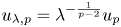 $u_{\lambda ,p}= \lambda ^{-\frac {1}{p-2}}u_{p}$ solution of problem (4.13) for a given
 $\lambda >\underline {\lambda }$. Then, it is possible to show that, taking
 $p_{n}$ a sequence converging to 2 from above, it results that
 $M_{n}:=\|u_{p_{n}}\|_{\infty }\to +\infty$ as
 $n\to +\infty$, and
 $M_{n}^{p_{n}-2}\to \lambda _{1}$; then
 \[ \lim_{n\to+\infty}\|u_{\lambda,p_{n}}\|^{p_{n}-2}_{\infty}=\lim_{n\to+\infty}\lambda^{{-}1}\|u_{p_{n}}\|^{p_{n}-2}_{\infty}=\frac{\lambda_{1}}{\lambda} \]
so that  $\|u_{\lambda ,p_{n}}\|_{\infty }\to +\infty$ too. Moreover, for
 $p\in (2,p_{0})$ this solution is unique, yielding again that
 $g_{z}\not \equiv 0$, as
 $\|z\|_{\infty }\leq 1$.□
Unfortunately, we cannot show that  $g_{z}\not \equiv 0$ for a generic
 $p\in (2,2^{*})$, and we conjecture that this may depend on the domain and on the exponent
 $p$, let us give some partial observations in this direction.
Proposition 4.10 Assume that  $M(x)=Id$. Moreover, suppose that there exists
 $\lambda >0$ and
 $R>0$ such that taking
 $\Omega =B_{R}(0)$, the open ball of radius
 $R$ centred at zero, the following conditions are satisfied
(a)
$\lambda >\underline {\lambda }$(b)
$\left (\frac {1}{\lambda R^{2}}\right )^{\frac 1{p-2}} U(0)>1$.

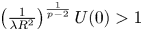
Then  $g_{z}\not \equiv 0$.
Proof. Assume by contradiction that  $g_{z} \equiv 0$, then
 $z$ is a solution to the problem
 \begin{equation} \begin{cases} -\Delta z=\lambda z^{p-1} & \text{in}\ \Omega\\ z=0 & \text{on}\ \partial \Omega. \end{cases} \end{equation}
with  $\Omega =B_{R}(0)$. Then, taking into account theorem (see [Reference Adimurthi and Yadava2, Reference Erbe and Tang10])
 \[ z(x)=U_{\lambda,R}:=\left(\frac 1{\lambda R^{2}}\right)^{\frac{1}{p-2}} U\left(\frac{x}R\right) \]
where  $U$ is defined in (4.12); indeed
 $U_{\lambda ,R}$ is defined in
 $B_{R}(0)$, vanishes at the boundary and solves
 \[ -\Delta U_{\lambda,R}=\lambda^{-\frac{1}{p-2}}R^{-\frac{2}{p-2}-2}(-\Delta U)\left(\frac{x}R\right) =\lambda^{-\frac{1}{p-2}}R^{-\frac{2}{p-2}-2}\left[U\left(\frac{x}R\right)\right]^{p-1}=\lambda U_{\lambda,R}^{p-1} \]
In addition, recalling (4.6) and hypothesis (b)
 \[ 1\geq z(0)=\max_{B_{R}(0)} z=\left(\frac{1}{\lambda R^{2}}\right)^{\frac{1}{p-2}} U(0)>1 \]
yielding the conclusion.□
Remark 4.11 Unfortunately, we are not able to give an example in which proposition 4.10 applies showing that  $g_{z}\not \equiv 0$ in the subcritical regime as well. With this respect, let us observe that hypotheses (a) and (b) go in opposite directions, as (b) requires
 $\lambda$ sufficiently small, while in theorem 2.4 we have seen if (a) is satisfied then
 $\lambda >\underline {\lambda }_{1}$, that is
 \[ \lambda>\underline{\lambda}_{1}:=\inf_{H^{1}_{0}(\Omega)\cap L^{\infty}(\Omega)}\Lambda(\varphi),\quad \Lambda(\varphi):=\frac{p}{2} \frac{\|\varphi \|^{2}\|\varphi\|^{p-2}_{\infty}}{\|\varphi\|_{p}^{p}}. \]
For example, supposing that there exists  $\varphi$ defined in
 $B_{1}(0)$ such that
 $\Lambda (\varphi )<\lambda$, then
 $\varphi _{R}(x):=\varphi (x/R)$ defined in
 $B_{R}(0)$ satisfies
 \[ \Lambda(\varphi_{R})=\frac{1}{R^{2}}\frac{p}{2} \frac{\|\varphi \|^{2}\|\varphi\|^{p-2}_{\infty}}{\|\varphi\|_{p}^{p}}=\frac{1}{R^{2}}\Lambda(\varphi) \]
then, in order to have  $g_{z}\not \equiv 0$ in
 $B_{R}(0)$, we would need
 \[ \lambda>\frac{1}{R^{2}}\Lambda(\varphi),\quad\text{and}\quad \left(\frac{1}{\lambda R^{2}}\right)^{\frac{1}{p-2}}U(0)>1 \]
which are equivalent to
 \[ \Lambda(\varphi)<\lambda R^{2}<\left[U(0)\right]^{p-2}. \]
On the other hand, let us observe that  $\Lambda (U)=\frac {p}2[U(0)]^{p-2}$, so that choosing
 $\varphi =U$ would imply that the assumptions of proposition 4.10 cannot be satisfied. So that finding an optimal
 $\varphi$ such that the interval
 $(\Lambda (\varphi ), [U(0)]^{p-2})$ is not empty seems to be a delicate question.
Acknowledgments
Research partially supported by: PRIN-2017-JPCAPN Grant: ‘Equazioni differenziali alle derivate parziali non lineari’, by project Vain-Hopes within the program VALERE: VAnviteLli pEr la RicErca and by the INdAM-GNAMPA group. L. Maia was partially supported by FAPDF, CAPES and CNPq grant 309866/2020 -0.


