Electric drives are essential for technological processes in the dairy industry. They ensure the operation of key equipment such as separators and pumps, which directly influence the quality and efficiency of milk processing. The dairy industry transforms milk into cream, butter, cheese and yoghurt. Electric drives, which convert electrical energy into mechanical energy, power milk separators, pumps, milking machines as well as cooling and pasteurisation systems. Their reliability affects both productivity and product quality, as these systems operate in harsh environments where precision and continuous operation are critical.
Since 2022, the war in Ukraine has caused frequent voltage sags, outages and greater reliance on backup or local alternative power sources, especially in the south and east. Unstable power supply can lead to motor overheating, reduced efficiency and accelerated wear, which negatively impacts continuity and product quality in dairy production. These operational challenges, combined with increasing harmonic distortion in the power grid due to nonlinear loads such as inverters and automation systems, highlight the need for targeted technical solutions. In particular, this study provides a detailed classification of electric drives used in dairy production, considering functional purpose, motor type, technical characteristics and sensitivity to power supply disturbances. This classification enables the identification of critical points and the development of appropriate stabilisation solutions (Kuldeep and Kuri, Reference Kuldeep and Kuri2020; Singh et al., Reference Singh, Yash, Shubham, Indragandhi, Vijayakumar, Saravanan and Subramaniyaswamy2020; Hou et al., Reference Hou, Chu and Fei2021; Kumar et al., Reference Kumar, Ramesh, Kasilingam, Ragul and Bharatiraja2021; Joshi and Jain, Reference Joshi and Jain2022; Viciana et al., Reference Viciana, Arrabal-campos, Alcayde, Baños and Montoya2023).
Previous studies have identified several key factors affecting the efficiency and reliability of electric drives in industrial systems. Voltage instability, including sags, surges and asymmetry, reduces motor efficiency, increases wear and causes operational disruptions (Biluk et al., Reference Biluk, Shareyko, Fomenko, Havrylov, Savchenko and Hruban2020; Biliuk et al., Reference Biliuk, Shareyko, Savchenko, Havrylov, Mardziavko and Fomenko2022; Marignetti and Rubino, Reference Marignetti and Rubino2023; Szelag-sikora et al., Reference Szelag-sikora, Sikora, Oleksy-gebczyk, Wietecha and Danielska2025). Similarly, harmonic distortion from nonlinear loads and automation equipment contributes to power losses and decreases reliability. These issues affect pumping, cooling and motor-driven systems, directly influencing milk transport, milking and pasteurisation processes (Vovk, Reference Vovk2020; Bondarenko and Lysychenko, Reference Bondarenko and Lysychenko2022; Kuznetsov et al., Reference Kuznetsov, Spirtsev, Shlykov, Herashchenko and Kryvenko2025). Technical solutions to mitigate these problems include stabilisation through uninterruptible power supply (UPS) systems, automatic transfer switches (ATS), inverters and voltage filters. These interventions improve operational continuity, protect equipment and enhance process reliability. Research on harmonic filtering and voltage regulation shows that targeted measures can significantly improve the energy efficiency and stability of electric drives (Sanjan et al., Reference Sanjan, Gowtham, Bhaskar, Subramaniam, Almakhles, Padmanaban and Yamini2020; Zhang and Yan, Reference Zhang and Yan2020; Tabora et al., Reference Tabora, Tostes, Bezerra, De Matos, Filho, Soares and Rodrigues2021). Advanced analytical methods and innovative technologies further support these interventions. Gonzalez-Abreu et al. (Reference Gonzalez-Abreu, Osornio-rios, Jaen-cuellar, Delgado-prieto, Antonino-daviu and Karlis2022) emphasised that spectral analysis and machine learning enable accurate detection of harmonic distortion and transient processes in electric drives, contributing to strategies that reduce energy losses and enhance equipment durability. Afonso et al. (Reference Afonso, Tanta, Pinto, Monteiro, Machado, Sousa and Monteiro2021) provided an overview of power electronics technologies, including active filters and voltage regulators, which ensure stable operation of electric drives in industrial environments. Moreover, Singh et al. (Reference Singh, Yash, Shubham, Indragandhi, Vijayakumar, Saravanan and Subramaniyaswamy2020) demonstrated that Internet-of-things-based real-time power quality monitoring systems enable rapid detection of voltage and frequency deviations, facilitating prompt parameter adjustments and minimising the risk of operational disruptions.
However, previous research mostly addresses general industrial settings and does not specifically examine the unique challenges of dairy plants under unstable electricity in Ukraine. The effects of extreme operating environments, including martial law and frequent outages, have received limited attention. Building on this understanding, the present study analyses electric drives in dairy production through a combined approach: classifying drives by functional purpose, motor type and operational characteristics; assessing their sensitivity to power supply disturbances; and evaluating stabilisation strategies. This method provides a practical framework to ensure reliability, efficiency and continuity in milk processing, addressing gaps identified in the literature.
The purpose of this study was to integrate insights from previous research with practical analysis, identify critical points in the operation of electric drives and explore technical solutions to optimise performance under unstable power conditions.
Materials and methods
This study employed a structured methodological framework combining system analysis, quantitative power quality assessment and comparative evaluation of technical stabilisation solutions for electric drives used in dairy production. Within this framework, the study consisted of four consecutive analytical stages: (i) system analysis of the dairy power supply to model interactions between subsystems, (ii) assessment of power quality parameters, (iii) classification of electric drives and identification of their sensitivity to power disturbances and (iv) comparative evaluation of stabilisation and backup solutions.
The objective of the methodology was to assess the impact of unstable power supply on the operational stability of electric drives in dairy plants and to identify technically and economically feasible mitigation solutions under conditions of grid instability. The system analysis method was applied to map the functional interactions between energy sources, stabilisation devices, electric drives and technological processes, enabling identification of critical stability points and cause-and-effect relationships. The study was conducted using a methodological approach that included methods of system analysis, evaluation of technical solutions and identification of evaluation criteria for electric drives. System analysis was specifically used to model the interdependencies between components, simulating how disturbances in voltage, phase balance, or harmonics propagate through the power supply system and affect drive performance (Sanjan et al., Reference Sanjan, Gowtham, Bhaskar, Subramaniam, Almakhles, Padmanaban and Yamini2020; Zhang and Yan, Reference Zhang and Yan2020; Tabora et al., Reference Tabora, Tostes, Bezerra, De Matos, Filho, Soares and Rodrigues2021). The methodology was developed to assess the impact of unstable power supply on key technological processes of the dairy plant, such as milking, milk cooling, pumping liquids and transporting materials, as well as to identify the best technical solutions that ensure the reliability and efficiency of electric drives. It is important to note that the Ukrainian energy infrastructure, especially in the south and east, has been significantly affected by military operations, leading to frequent power disruptions, voltage instability and limited access to repair and maintenance.
The method of system analysis of technical systems was the basis of the study, helping to construct a functional model of the dairy power supply system and quantify the interactions between subsystems. At this stage, the power supply system was decomposed into subsystems including the external grid, stabilisation and backup equipment, electric drives and technological processes. The interactions between these subsystems were modelled to understand how disturbances propagate, how drives respond to voltage deviations and which points are critical for operational continuity. The sequence of operations was analysed, and potential critical stability points were identified. Cause-and-effect analysis was employed to identify the causes of drive instability, systemising factors such as voltage sags, phase misalignment or harmonic distortion and their impact on equipment performance (Afonso et al., Reference Afonso, Tanta, Pinto, Monteiro, Machado, Sousa and Monteiro2021; Gonzalez-Abreu et al., Reference Gonzalez-Abreu, Osornio-rios, Jaen-cuellar, Delgado-prieto, Antonino-daviu and Karlis2022). These methods helped to structure the complex power supply system and identify critical stability points. Regional differences in grid reliability and emergency power measures were incorporated into the model to simulate realistic operational scenarios.
Technical solutions, such as UPS, ATS and voltage filters, were analysed not only based on technical characteristics but also according to their feasibility under resource constraints. The analysis involved a direct comparison of these solutions against the identified power quality disturbances and the operational requirements of specific dairy equipment. The identification of these solutions was guided by literature review (Sanjan et al., Reference Sanjan, Gowtham, Bhaskar, Subramaniam, Almakhles, Padmanaban and Yamini2020; Singh et al., Reference Singh, Yash, Shubham, Indragandhi, Vijayakumar, Saravanan and Subramaniyaswamy2020; Tabora et al., Reference Tabora, Tostes, Bezerra, De Matos, Filho, Soares and Rodrigues2021), manufacturer specifications, Ukrainian energy statistics and practical considerations for farms with limited access to replacement equipment and backup generators. Adaptation strategies included selecting equipment with multifunctional capabilities, prioritising solutions that could be locally maintained and adjusting operational parameters to ensure compatibility with unstable grids (Biliuk et al., Reference Biliuk, Shareyko, Tubaltsev, Havrylov, Savchenko and Fomenko2021, Reference Biliuk, Shareyko, Savchenko, Havrylov, Fomenko and Tubaltsev2023; Szafraniec et al., Reference Szafraniec, Halko, Miroshnyk, Figura, Zharkov and Vershkov2021). The system model was used to simulate the effect of each technical solution on subsystem interactions and evaluate their impact on drive stability under different power disturbance scenarios.
Evaluation criteria for electric drives were explicitly defined and integrated into the system model. These criteria enabled both quantitative and qualitative assessment of drive performance under simulated grid disturbances. Specifically, the evaluation criteria included tolerance to voltage deviations, sensitivity to phase unbalance, resistance to harmonic distortion and operational reliability under intermittent power supply (Sanjan et al., Reference Sanjan, Gowtham, Bhaskar, Subramaniam, Almakhles, Padmanaban and Yamini2020; Zhang and Yan, Reference Zhang and Yan2020).
Each criterion was assessed by analysing equipment specifications and evaluating and modelling failure scenarios, such as phase failure or power surges. Special attention was given to the practical adaptation of solutions under wartime constraints, including limited availability of replacement equipment, variable access to backup generators, reliance on locally sourced stabilisation methods and energy rationing measures.
The data sources for the study included a wide range of materials to ensure the reliability and validity of the analysis. Analytical reports from leading manufacturers of electric drives and stabilisation systems, such as Danfoss (VLT® AutomationDrive FC 301/FC 302, 2025), Siemens (Siemens Corporation: 1LA7 060-2AA10, 2025), Schneider Electric (Altistart 48 soft, 2014), Eaton (Eaton 9PX 5-11kVA, 2025), Riello (Sentryum, 2025), Socomec (ATyS A, 2025), ABB (TruONE® ATS, 2025), Grundfos (Grundfos submersible motor, 2025), Xylem (Lowara) (Lowara CEA(M) end suction centrifugal pumps, 2025), Bitzer (2025), DeLaval (2025) and Westfalia Surge (HAGRA, 2025), provided technical specifications of the equipment, including data on performance, resistance to unstable power supply and energy efficiency. General information on energy consumption patterns in Ukrainian dairy enterprises was also considered to analyse the frequency and nature of energy failures. These inputs were used to calibrate the system model and simulate operational scenarios for dairy electric drives under unstable supply conditions.
The analysis of the power supply parameters was performed systematically, following a formal method. Specifically, parameters such as average phase-to-phase voltage, total harmonic distortion (THD), zero-phase and reverse-sequence unbalance and voltage sags were measured and analysed according to EN 50160 (2022) standard. Each parameter was compared with the corresponding standard limit, and deviations were analysed to determine their potential impact on the operation of three-phase asynchronous motors (Zhang and Yan, Reference Zhang and Yan2020). System analysis was applied to correlate deviations in these parameters with subsystem interactions and predict the response of electric drives to grid disturbances.
The principal types of electric drives were classified to determine their sensitivity to power failures. Electric drives employed in the dairy industry were classified by functional purpose, motor type and technical specifications (power, voltage, speed). The classification was integrated into the system model to evaluate which drives are most critical and require stabilisation under different disturbance scenarios (Sanjan et al., Reference Sanjan, Gowtham, Bhaskar, Subramaniam, Almakhles, Padmanaban and Yamini2020; Tabora et al., Reference Tabora, Tostes, Bezerra, De Matos, Filho, Soares and Rodrigues2021).
A combination of quantitative and qualitative methods was employed to process the data in a sequential manner. Quantitative analysis included the statistical processing of measured power supply parameters, such as voltage, frequency, phase unbalance and harmonic distortion, over the entire observation period, with the results compared against the standard limits specified in EN 50160 (2022).
Qualitative analysis was subsequently applied to interpret the quantitative results by identifying cause-and-effect relationships between power quality deviations and the operational behaviour of electric drives (Singh et al., Reference Singh, Yash, Shubham, Indragandhi, Vijayakumar, Saravanan and Subramaniyaswamy2020; Afonso et al., Reference Afonso, Tanta, Pinto, Monteiro, Machado, Sousa and Monteiro2021; Gonzalez-Abreu et al., Reference Gonzalez-Abreu, Osornio-rios, Jaen-cuellar, Delgado-prieto, Antonino-daviu and Karlis2022). These analyses were incorporated into the system model to simulate operational outcomes and assess stabilisation effectiveness.
By integrating the data obtained and applying system analysis and cause-and-effect modelling methods, a generalised functional model of the dairy’s power supply was developed, mapping interactions between energy sources, stabilisation equipment, electric drives and technological processes. This model was investigated to identify critical stability points, such as external grid instability or voltage asymmetry, and assess their impact on performance. The model allowed simulation of subsystem interactions under different voltage deviations and phase unbalance scenarios to predict drive behaviour.
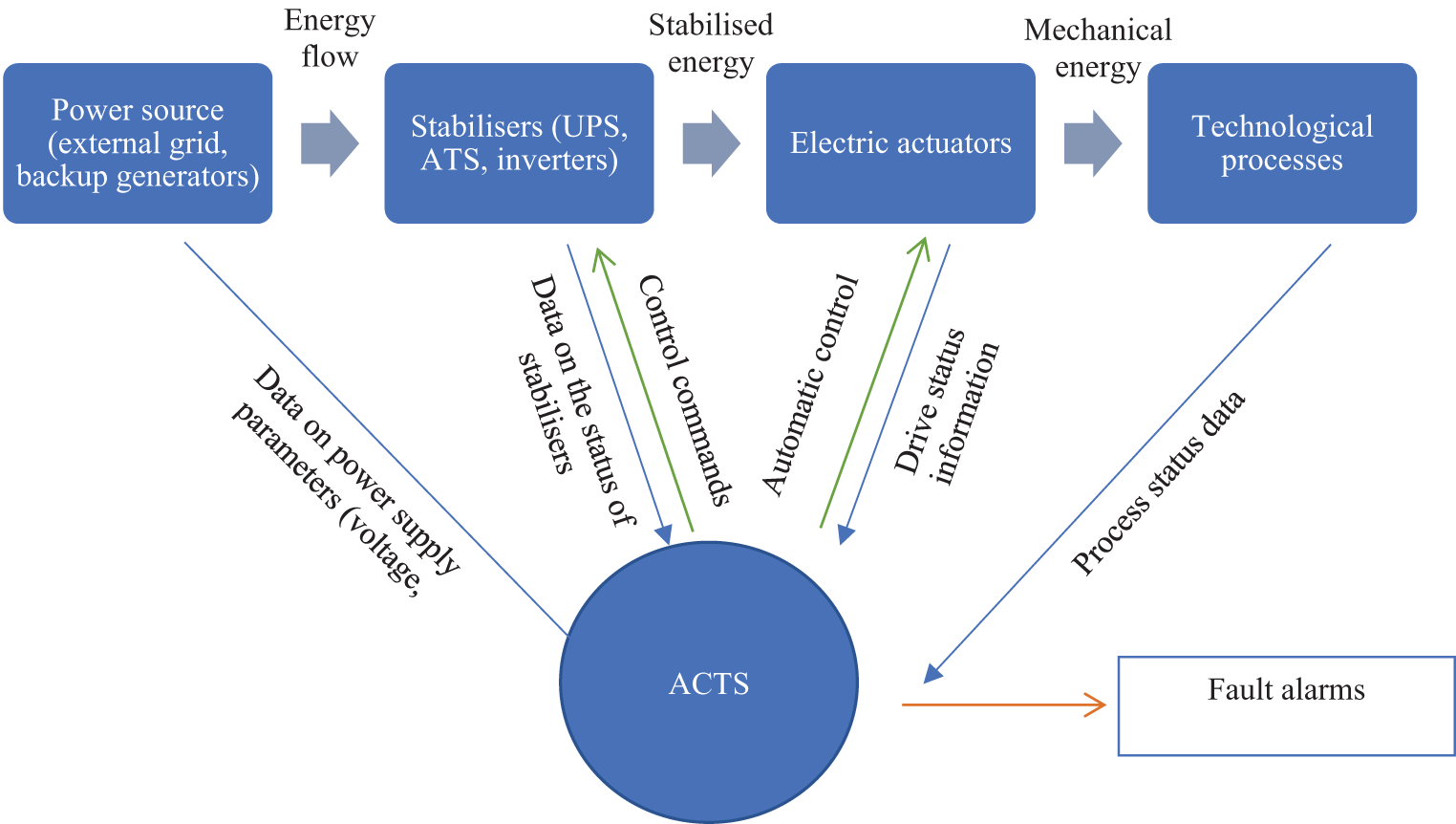
To visualise the interaction of the components, the study used a schematic diagram of the integration of the drives with the automated control system (ACS), which demonstrates the energy and data flows, as well as the monitoring and automatic control algorithms. This diagram reflects the system analysis outcomes, showing how stabilisation devices and ACS interact with drives to mitigate the effects of power disturbances.
Results and discussion
Table 1 summarises the main types of electric drives in dairy production and their applications.
Classification of electric drives in dairy production

Table 1 Long description
The table classifies five types of dairy-production equipment by purpose, motor type, typical power and operating ratings, sensitivity to power failures, and example products. Pumps use asynchronous motors around 0.75 to 7.5 kilowatts at 380 volts and are highly affected by voltage sags and phase loss, reducing performance or stopping. Milking machines use asynchronous or synchronous motors around 1 to 5 kilowatts; unstable supply can cause uneven vacuum pulsation, with synchronous options needing more advanced stabilisation. Refrigeration compressors use asynchronous motors around 2 to 15 kilowatts and are highly sensitive to overvoltage and phase imbalance that can lead to overload or overheating. Cooling fans use asynchronous motors around 0.5 to 2 kilowatts and have moderate sensitivity; disruptions can reduce airflow and raise milk temperature above the target range. Conveyors and auxiliary equipment use asynchronous motors around 0.3 to 5 kilowatts with simpler control, but phase loss and impulse surges can stop processes, so basic protection is recommended. Examples listed include Lowara and Grundfos pumps, DeLaval and Westfalia milking systems, Bitzer and Copeland compressors, GEA fans, and Siemens motors for conveyors and washers.
Source: Compiled by the authors of this study based on VLT® AutomationDrive FC 301/FC 302 (2025); 1LA7: General purpose, Eff2, aluminium frame TEFC IEC motors (2025); Altistart 48 soft starters catalogue (2014); Eaton 9PX 5-11kVA UPS technical specification (2025); Sentryum (2025); ATyS A–ATyS C: Automatic transfer switching equipment from 125 to 3200 A with split ATS controller (2025); TruONE® ATS: Automatic transfer switches (2025); Grundfos submersible motor guide: MS/MMS application–installation–maintenance 60Hz, single-phase and three-phase motors (2025); End suction centrifugal pumps: Lowara CEA(M) end suction centrifugal pumps (2025); Bitzer (2025); DeLaval (2025); HAGRA (2025).
To increase the stability of equipment operation in dairy production under unstable conditions, it is recommended to implement technical solutions, which are presented in greater detail in Table 2.
Technical solutions to improve the stability of electric drives in the dairy industry

Table 2 Long description
The table links common power-quality problems in dairy equipment to technical fixes and their operational effects, with approximate performance indicators. For pumps, voltage sags, phase loss, and speed instability are addressed with UPS units, inverters, and automatic transfer switching, reducing pump stops by about ninety percent and cutting downtime from about two hours per month to under ten minutes per month, while also improving energy use. Coolers face voltage surges, instability, and phase asymmetry; UPS units, voltage filters, inverters, and transfer switches improve temperature control to about plus or minus half a degree and reduce harmonic distortion to under five percent, with accident frequency dropping from several per year to about one or fewer per year. Milking machines use UPS, inverters, and transfer switching to maintain vacuum pulsation stability and continuity, reducing downtime from about one hour per day to under five minutes per day and improving pulsation consistency. Conveyors and auxiliary systems use similar measures to reduce stoppages by about eighty-five percent and cut downtime from about one and a half hours per month to under five minutes per month, while improving automation reliability. Overall, UPS solutions mainly cover short interruptions and voltage dips, inverters stabilize speed and reduce energy use, and transfer switches support continuity during longer outages by switching to backup power. Quantitative values are approximate and may vary by site conditions, load, and equipment sizing.
Source: Compiled by the authors of this study based on VLT® AutomationDrive FC 301/FC 302 (2025); 1LA7: General purpose, Eff2, aluminium frame TEFC IEC motors (2025); Altistart 48 soft starters catalogue (2014); Eaton 9PX 5-11kVA UPS technical specification (2025); Sentryum (2025); ATyS A–ATyS C: Automatic transfer switching equipment from 125 to 3200 A with split ATS controller (2025); TruONE® ATS: Automatic transfer switches (2025); Grundfos submersible motor guide: MS/MMS application–installation–maintenance 60Hz, single-phase and three-phase motors (2025); End suction centrifugal pumps: Lowara CEA(M) end suction centrifugal pumps (2025); Bitzer (2025); DeLaval (2025); HAGRA (2025).
Implementation of UPS, inverters, ATS and voltage filters not only improves voltage stability and reduces downtime but also has a measurable impact on equipment lifespan. Based on operational data and literature (Vovk, Reference Vovk2020; Mehta and Basak, Reference Mehta and Basak2021; Bondarenko and Lysychenko, Reference Bondarenko and Lysychenko2022), these solutions can reduce motor downtime by approximately 50–90% and extend motor life by 20–30%. These improvements were observed across pumps, milking machines, cooling systems and conveyors, demonstrating that integrated stabilisation measures directly enhance both productivity and equipment reliability.
Conveyors, auxiliary equipment, pumps, milking machines and cooling systems were analysed collectively to reduce redundancy. The analysis focused on how power instabilities, such as voltage sags, impulse surges and phase failures, affect real-time performance and productivity (Voloshina et al., Reference Voloshina, Panchenko, Boltyansky and Titova2020; Kumar et al., Reference Kumar, Ramesh, Kasilingam, Ragul and Bharatiraja2021). For instance, a voltage sag below 360 V can reduce pump output by 15–20% or cause temporary shutdown, while phase failure can stop conveyors or milking machines within seconds if stabilisation is absent. UPS systems provide short-term coverage (10–15 minutes), while backup generators have a start-up delay of 5–15 seconds, highlighting the critical need for integrated stabilisation.
One example of the application of our analysis approach from Table 1 is the milk separator-disinfector, representing an integrated separation and treatment unit conceptually similar to industrial centrifugal separators used in modern dairy processing lines (Tetra Pak, 2025). The primary element of this equipment is a drum with a rotor that provides centrifugal separation of milk, equipped with cleaning plates arranged with a gap of 1–2 mm that guide low-energy laser radiation for milk processing (Romankiewicz et al., Reference Romankiewicz, Reguła, Różański, Potempska, Gaze, Knutel, Wojtko, Drozdovych and Kawa2023; Adamkulova et al., Reference Adamkulova, Zhakshylykova, Asanov, Akylbekova and Mambetkazieva2025). The drum lid is made of optically transparent material, ensuring uniform laser exposure to maintain a controlled milk layer (<1.5 mm) during processing. Such technological solutions are consistent with modern approaches to improving product safety and shelf life (Device for extended milk storage life, 2018). This example illustrates how the technical analysis approach can be applied to evaluate the stability requirements and protection measures for auxiliary equipment in dairy production.
The impact of voltage sags and phase failures on pumps, milking machines, cooling systems, conveyors and auxiliary equipment is critical. Pumps are primary components; asynchronous motors are widely used due to their reliability, low cost and ease of maintenance (Grundfos submersible motor guide, 2025; Lowara CEA(M) end suction centrifugal pumps, 2025). Our analysis showed that voltage sag or phase failure reduces pumping capacity or triggers shutdowns within seconds, corroborating Vovk (Reference Vovk2020) and Bondarenko and Lysychenko (Reference Bondarenko and Lysychenko2022). Similar conclusions were reported by Tabora et al. (Reference Tabora, Tostes, Bezerra, De Matos, Filho, Soares and Rodrigues2021), highlighting the importance of stabilisation systems.
Milking machines automate vacuum and pulsator functions. Both asynchronous and synchronous motors are used; asynchronous motors in budget models, synchronous in premium systems (DeLaval, 2025; HAGRA, 2025). Voltage instability affects pulsation consistency, causing animal stress and reduced yield. Integration with ACS enables real-time adjustment, reducing downtime from ∼ 1 hour/day to < 5 minutes/day, maintaining pulsation stability within ±1 cycle/minute (Panchenko et al., Reference Panchenko, Voloshina, Sadullozoda, Boltyansky and Panina2022, Reference Panchenko, Voloshina, Fatyeyev, Rezvaya and Mudryk2024; Viciana et al., Reference Viciana, Arrabal-campos, Alcayde, Baños and Montoya2023).
Cooling systems, including compressors and fans, require stable voltage to maintain milk temperature (4–6°C). Asynchronous motors for compressors are sensitive to voltage surges, phase asymmetry and power instability (Gonzalez-Abreu et al., Reference Gonzalez-Abreu, Osornio-rios, Jaen-cuellar, Delgado-prieto, Antonino-daviu and Karlis2022; Bitzer, 2025; Kuznetsov et al., Reference Kuznetsov, Spirtsev, Shlykov, Herashchenko and Kryvenko2025). Fans, though less powerful, are affected by unstable supply (Afonso et al., Reference Afonso, Tanta, Pinto, Monteiro, Machado, Sousa and Monteiro2021; Goolak et al., Reference Goolak, Gubarevych, Gorobchenko, Nevedrov and Kamchatna-stepanova2022). Deployment of UPS, voltage filters, inverters and ATS reduces temperature fluctuations from ±2°C to ±0.5°C and decreases energy consumption by up to 25%.
Conveyors and auxiliary equipment automate feed transport, mixing and washing. Lower-power asynchronous motors with simple control can be disrupted by phase failures or voltage surges (Singh et al., Reference Singh, Yash, Shubham, Indragandhi, Vijayakumar, Saravanan and Subramaniyaswamy2020; Siemens Corporation: 1LA7 060-2AA10, 2025). UPS and inverters maintain stable operation, improving automation reliability by 30–50% and reducing downtime from 1.5 hours/month to <5 minutes/month. ATS integration ensures continuity during prolonged outages
The economic impact of power supply instability on small to medium-sized dairy farms is significant (Samoichuk et al., Reference Samoichuk, Kiurchev, Oleksiienko, Palyanichka and Verholantseva2016; Muratbayev et al., Reference Muratbayev, Tokayev, Stefanyk, Tussupov and Bilyalov2023). Operational costs increase due to energy inefficiency, equipment wear and downtime. For instance, voltage sags and phase failures can reduce pump and milking machine efficiency by 10–20%, leading to increased energy consumption and reduced milk output. Based on observed data and literature estimates (Vovk, Reference Vovk2020; Bondarenko and Lysychenko, Reference Bondarenko and Lysychenko2022), energy inefficiency and equipment failures can account for up to 15–25% of additional operational costs, depending on farm size and reliance on automated systems (Chen et al., Reference Chen, Belwal, Xu, Ma, Li, Li, Xiao and Luo2023, Reference Chen, Xu, Han, Ma, Zhou, Guo, Li and Luo2024). Implementing UPS, inverters and ATS solutions mitigates these losses, reducing downtime from hours to minutes per month and improving overall energy efficiency by 10–25%, which translates into measurable cost savings and more consistent production.
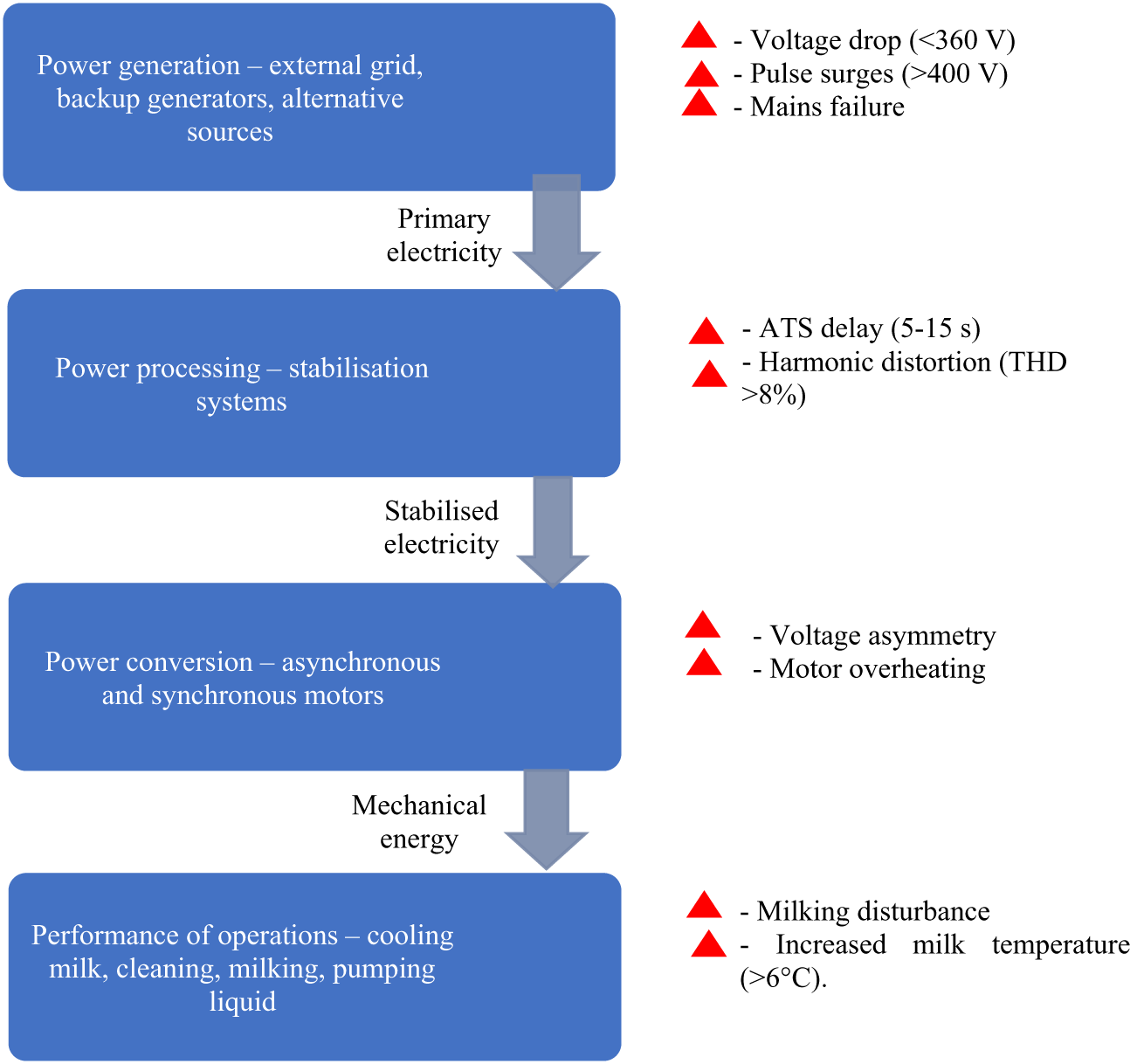
A generalised functional model of energy supply was applied, covering energy sources, stabilisation systems, electric drives and technological processes (Arevalo, Reference Arevalo2022; Oliván et al., Reference Oliván, Bruna, Matute, Mareca and Cervero2022). This allows assessing component interactions, identifying critical stability points and determining their impact on productivity (Fig. 1)..
Generalised functional model of energy supply for a dairy plant, developed by the authors based on system analysis and cause-and-effect modelling.

Figure 1 Long description
The flowchart illustrates the energy supply process for a dairy plant. It begins with 'Power generation' involving external grid, backup generators and alternative sources, producing 'Primary electricity'. This electricity undergoes 'Power processing' through stabilisation systems, resulting in 'Stabilised electricity'. The next step is 'Power conversion' using asynchronous and synchronous motors, generating 'Mechanical energy'. Finally, 'Performance of operations' includes cooling milk, cleaning, milking and pumping liquid. Issues noted include voltage drop, pulse surges, mains failure, ATS delay, voltage asymmetry, motor overheating, milking disturbance and increased milk temperature.
Diagram of equipment integration with the automated control system.

Figure 2 Long description
The flowchart illustrates the integration of equipment with an automated control system. It begins with a 'Power source (external grid, backup generators)' leading to 'Stabilisers (UPS, ATS, inverters)' through an arrow labeled 'Energy flow'. From the stabilisers, energy flows to 'Electric actuators' and then to 'Technological processes', indicating a transition from stabilised energy to mechanical energy. A central element labeled 'ACTS' is connected to various components. Arrows indicate 'Data on power supply parameters (voltage)' and 'Data on the status of stabilisers' flowing into ACTS. 'Control commands' and 'Automatic control' flow from ACTS to the stabilisers and electric actuators, respectively. 'Drive status information' flows from electric actuators to ACTS. 'Process status data' flows from technological processes to ACTS, which also sends 'Fault alarms' to an external component.
The primary energy source is the external power grid (380 V, 50 Hz), often subject to voltage drops, surges, or blackouts. Backup generators compensate but have a 5–15-second start-up delay. Stabilisation systems, including UPS, ATS, inverters and voltage filters, ensure continuity, stabilise voltage and frequency and reduce harmonic distortion (THD < 5%). The factual data show that the regulatory limit of 2% for voltage THD, set by EN 50160:2022 (2022), is periodically exceeded, reflecting the presence of significant asymmetry in the system. This situation leads to additional currents in the neutral conductor, increased active losses in the grid, increased heating of equipment and errors in the operation of electricity meters (Marignetti et al., Reference Marignetti, Di Stefano, Rubino and Conti2020; Rubino et al., Reference Rubino, Rubino and Carbonaro2020).
Pumps, milking machines and cooling systems are highly sensitive to voltage sags and phase failures. Proper integration of UPS, ATS and inverters mitigates shutdowns, reduces energy losses and maintains productivity (Vovk, Reference Vovk2020; Mehta and Basak, Reference Mehta and Basak2021; Bondarenko and Lysychenko, Reference Bondarenko and Lysychenko2022; Balasubbareddy et al., Reference Balasubbareddy, Ram, Sangu, Biswas, Islam, Chaujar and Jaksic2023; Toirov et al., Reference Toirov, Jumaeva, Mirkhonov, Urokov and Ergashev2023). ACS integration allows real-time control, reducing downtime and ensuring technological process stability.
The study confirms that harmonising energy supply, stabilisation systems and electric drives ensures process continuity. The combined use of UPS, ATS, inverters and voltage filters addresses voltage sags, surges, phase failures and harmonic distortion, reducing downtime, improving energy efficiency, extending motor service life and increasing milk yield and quality.
In the context of Ukraine’s energy infrastructure since 2022, the study demonstrates the necessity of integrated stabilisation systems for dairy production (Alhasheem et al., Reference Alhasheem, Mattavelli and Davari2020; Elnady et al., Reference Elnady, Adam and Alshabi2022; Thentral et al., Reference Thentral, Palanisamy, Usha, Bajaj, Zawbaa and Kamel2022; Guo and Xu, Reference Guo and Xu2023; Zhang et al., Reference Zhang, Hu, Meng, Zhou, Luo and Li2023; Tulyaganov and Umarov, Reference Tulyaganov and Umarov2024). Previous research demonstrates the general benefits of voltage stabilisation, harmonic suppression and active filters. However, these studies often do not consider the specific operational requirements of dairy equipment or constraints imposed by a wartime environment.
This study contributes by integrating stabilisation systems with ACS in the dairy context, showing that real-time monitoring, adaptive control and harmonisation of drives significantly reduce the impact of unstable energy supply. The literature confirms these findings: Salvino et al. (Reference Salvino, Gomes and Bezerra2022) highlight neural network-based optimisation for pumping systems; Manoj et al. (Reference Manoj, Khampariya and Pilla2022) demonstrate performance gains of active filters and frequency converters; Arevalo (Reference Arevalo2022) validates intelligent monitoring systems for reducing equipment failures. Complementing these results, this study focuses on practical implementation for dairy production, considering the interaction of high-speed drives, milking machines and cooling systems under extreme conditions.
Conclusions
The findings emphasise the necessity of a comprehensive stabilisation approach for electric drives in dairy plants operating under unstable energy supply conditions. Implementation of UPS, ATS, inverters, voltage filters and integration with ACSs ensures continuity of production, reduces milk spoilage, extends equipment lifespan and improves energy efficiency. These results underscore the adaptability of technical solutions to specific industry requirements and highlight their critical role in maintaining productivity under crisis conditions. By considering the historical and social context of war-affected energy infrastructure, the study underlines the urgency of integrating specialised solutions for dairy equipment to ensure sustainability, energy efficiency and high product quality in challenging situations.
The analysis revealed that power supply instability poses a major threat to dairy production, causing equipment shutdowns, reduced productivity, milk spoilage and accelerated wear of electric drives. System analysis methods enabled the development of a functional model of the dairy shop's power supply, identifying critical points such as external grid instability, voltage asymmetry and harmonic distortion, which have the greatest impact on equipment performance. Power quality parameters, assessed according to EN 50160:2022, showed average phase voltages of 0.22–0.24 kV (occasionally exceeding the 0.23 kV limit), zero-sequence asymmetry up to 3% (above the 2% norm) and THD of 0.8–1.6%, with peaks for the second and fourth harmonics, partially compensated by a stable grid frequency of 50.0–50.1 Hz.
Technical solutions demonstrated significant benefits: UPSs compensate for short-term interruptions, ensuring continuity of sensitive equipment; inverters optimise speed and reduce energy consumption by 10–25%, especially for pumps and compressors sensitive to voltage sags; ATSs provide fast switching to backup power within 10–50 milliseconds, minimising downtime; and voltage filters reduce harmonic distortion to <5%, reducing wear on conveyor motors. Overall, these solutions reduce downtime by 50–90%, save energy by 10–25% and extend motor life by 20–30%. Integration with ACSs enables real-time monitoring, automatic control and alarm generation in case of failures, maintaining process continuity.
Given the context of the ongoing war in Ukraine, where local power grids are damaged and energy supply is frequently interrupted, these findings highlight the critical importance of adapting technical solutions to crisis conditions. The instability of infrastructure, limited access to energy resources and frequent blackouts amplify the risks for dairy production, making the implementation of stabilisers, backup systems and automated monitoring not only a matter of efficiency but of operational survival.
A limitation of the study is the theoretical nature of the analysis, which was based on illustrative data and did not include experimental measurements in real dairy production conditions. Future research should experimentally test the effectiveness of the proposed technical solutions across various dairy farms to assess their ability to ensure uninterrupted power supply, reduce dependence on an unstable external grid and increase energy efficiency.
Competing interests
The authors have not stated any conflicts of interest.