




1 Introduction
1.1 Overview
In [Reference Steinberg9, Section 14], R. Steinberg proved a theorem stating that the exterior powers of the irreducible reflection representation of a Euclidean reflection group are again irreducible and pairwise non-isomorphic (see also [Reference Bourbaki1, Chapter V, Section 2, Exercise 3]). For Weyl groups, the exterior powers of the standard reflection representation are well studied (see, for example, [Reference Curtis, Iwahori and Kilmoyer2, Reference Geck and Pfeiffer4, Reference Henderson5, Reference Sommers8]).
The proof of Steinberg’s theorem relies on the existence of an inner product which stays invariant under the group action. In a previous paper [Reference Hu6], the author extended Steinberg’s result to a more general context where the inner product may not exist. Let W be a group and
$S= \{s_1, \dots , s_k\}$
 be a set of generators of W. We say a representation
$\rho : W \to \operatorname {GL}(V)$
 is a reflection representation of
$(W,S)$
 if each of the generators
$s_i$
 acts by a generalized reflection, and denote by
$\alpha _i$
 the chosen reflection vector (see Section 2.1 for related notions). The main theorem in [Reference Hu6] reads:
Theorem 1.1 [Reference Hu6, Theorem 1.2]
Let
$(V,\rho )$
 be an n-dimensional irreducible reflection representation of
$(W,S)$
 over a field
$\mathbb {F}$
 of characteristic 0, with reflection vectors
$\alpha _1, \dots , \alpha _k$
 . Suppose

Then the W-modules
$\{\bigwedge ^d V \mid 0 \le d \le n\}$
 are irreducible and pairwise non-isomorphic.
As pointed out in [Reference Hu6], usually there is no W-invariant bilinear form on the reflection representation, so that our result is not a trivial generalization.
The first aim of this article is to show that the assumption (1.1) can be removed.
Theorem 1.2 Let
$(V,\rho )$
 be an n-dimensional irreducible reflection representation of
$(W,S)$
 over a field
$\mathbb {F}$
 of characteristic 0. Then the W-modules
$\{\bigwedge ^d V \mid 0 \le d \le n\}$
 are irreducible and pairwise non-isomorphic.
The readers may find that the proof of Theorem 1.2 is similar to that of Theorem 1.1 [Reference Hu6, Theorem 1.2]. The proof here simplifies the proof in [Reference Hu6] a little bit. See Section 4 for more details.
The major contribution of this article is the second main result, stating that the exterior powers of two different reflection representations are also different. To be precise, we have
Theorem 1.3 Let
$(V_\iota , \rho _\iota )$
 ,
$\iota = 1, 2$
 , be two irreducible reflection representations of
$(W,S)$
 over a field
$\mathbb {F}$
 of characteristic 0, with dimensions
$n_1$
 and
$n_2$
 , respectively. Suppose
$\bigwedge ^{d_1} V_1 \simeq \bigwedge ^{d_2} V_2$
 as W-modules for some integers
$d_1, d_2$
 with
$1 \le d_\iota \le n_\iota - 1\ (\iota = 1, 2)$
 . Then
$d_1 = d_2$
 ,
$n_1 = n_2$
 , and
$V_1 \simeq V_2$
 as W-modules.
Remark 1.4 Note that
$\bigwedge ^0 V$
 is the one-dimensional W-module with trivial W-action. While
$\bigwedge ^n V$
 carries the one-dimensional representation
$\det \circ \rho $
 for any n-dimensional representation
$(V,\rho )$
 of W, and different
$\rho $
 ’s might share the same determinant
$\det \circ \rho $
 (for example, if each generator
$s_i$
 is of order two, then
$\det \circ \rho (s_i) = -1$
 for any reflection representation
$(V,\rho )$
 and any i). Thus, in Theorem 1.3 the range
$1 \le d_\iota \le n_\iota -1$
 is the best we can expect.
By combining the results in Theorems 1.2 and 1.3, immediately we have the following corollary, which allows us to construct numerous pairwise non-isomorphic irreducible representations for the group W.
Corollary 1.5 Suppose we have a family of irreducible reflection representations
$\{V_i \mid i \in I\}$
 of
$(W,S)$
 . Then
$\{\bigwedge ^d V_i \mid i \in I, 1 \le d \le \dim V_i - 1\}$
 is a family of simple W-modules, and they are pairwise non-isomorphic.
1.2 Motivation and application
The motivation of this work (as well as the previous [Reference Hu6]) comes as follows. Suppose W is a Coxeter group with the finite set S of defining generators. In another paper [Reference Hu7] by the author, all the reflection representations (over
$\mathbb {C}$
 ) of
$(W,S)$
 are determined. The most essential thing in this process is the classification of isomorphism classes of the so-called generalized geometric representations (that is, those reflection representations admitting a basis formed by the reflection vectors). In [Reference Hu7], such representations are classified using the characters of the first integral homology group of simple graphs which are closely related to the Coxeter graph. Moreover, “most” of them are irreducible. While if a generalized geometric representation is reducible, then it has a semisimple quotient, each of whose direct summand is an irreducible reflection representation of some parabolic subgroup. Therefore, the results in this article are applicable, and then we obtain a large class of irreducible representations which are non-isomorphic to each other.
For example, if
$(W,S)$
 is the affine Weyl group of type
$\widetilde {A}_n$
 , that is,

(regard
$n+1$
 as
$0$
 ), then the Coxeter graph is a cycle. The corresponding first homology group with integral coefficients is isomorphic to
$\mathbb {Z}$
 , and its characters are parameterized by
$\mathbb {C}^\times $
 , and so are the generalized geometric representations. For
$x \in \mathbb {C}^\times $
 , the corresponding generalized geometric representation, denoted by
$V_x$
 , is an (
$n+1$
 )-dimensional
$\mathbb {C}$
 -vector space with basis
$\{\alpha _0, \alpha _1, \dots , \alpha _n\}$
 , and the W-action can be defined by

All of these representations are irreducible except when
$x = 1$
 . If
$x = 1$
 , the representation
$V_1$
 is nothing but the geometric representation in the sense of [Reference Bourbaki1, Chapter V, Section 4], and it admits an n-dimensional simple quotient
$V_1 / U$
 where
$U := \langle \alpha _0 + \alpha _1 + \cdots + \alpha _n \rangle $
 . The quotient
$V_1 / U$
 is also a reflection representation. Applying Theorems 1.2 and 1.3 yields uncountably many simple modules for the affine Weyl group W:

1.3 Outline of this article
The paper is organized as follows. In Section 2, we recollect the basic definitions and some preliminary results. In Section 3, we recollect some basic results on exterior powers of reflection representations. In Sections 4 and 5, we prove Theorems 1.2 and 1.3, respectively.
2 Preliminaries
Throughout this article, we work over a field
$\mathbb {F}$
 of characteristic 0. We require
${\operatorname {char} \mathbb {F} = 0}$
 only to ensure the exterior powers of an irreducible representation are semisimple (see Remark 3.7). In fact, the notions of reflections and reflection representations can be defined over fields of arbitrary characteristic.
For any positive integer k, we denote
$[k] := \{1,2, \dots , k\}$
 . For a fixed representation
$\rho : W \to \operatorname {GL}(V)$
 and an element
$s \in W$
 , we also denote simply by s the linear map
$\rho (s) \in \operatorname {GL}(V)$
 if there is no ambiguity.
2.1 Reflections and reflection representations
Definition 2.1 [Reference Hu6, Definition 2.1]
Let V be a finite-dimensional vector space over
$\mathbb {F}$
 .
-
(1) A linear map $s:V \to V$
 is called a generalized reflection (and reflection for short) if s is diagonalizable and
$\operatorname {rank}(s - \operatorname {Id}_V) = 1$
.
-
(2) Suppose s is a reflection on V. The hyperplane $H_s : = \ker (s - \operatorname {Id}_V)$
, which is fixed pointwise by s, is called the reflection hyperplane of s. Let
$\alpha _s$
be a nonzero vector in
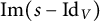
$\operatorname {Im}(s - \operatorname {Id}_V)$
. Then,
$s \cdot \alpha _s = \lambda _s \alpha _s$
for some
$\lambda _s \in \mathbb {F} \setminus \{1\}$
, and
$\alpha _s$
is called a reflection vector of s.






Note that if s is an invertible map, then
$\lambda _s \ne 0$
 .
The following lemma is immediate.
Lemma 2.2 [Reference Hu6, Lemma 2.2]
Let s be a reflection on V and
$\alpha _s$
 be a reflection vector. Then there exists a nonzero linear function
$f : V \to \mathbb {F}$
 such that
$s \cdot v = v + f(v) \alpha _s$
 for any
$v \in V$
 .
The main object of our study, reflection representation, is defined as follows.
Definition 2.3 Let W be a group endowed with a finite set of generators
$S = \{ s_1, \dots , s_k\}$
 . A representation
$(V,\rho )$
 of W over
$\mathbb {F}$
 is called a reflection representation of
$(W,S)$
 if the linear map
$\rho (s_i) \in \operatorname {GL}(V)$
 is a reflection on V for any
$i \in [k]$
 .
2.2 Digraphs
Digraphs will be helpful to investigate the structure of reflection representations. In what follows we recall some relevant basic definitions.
By definition, a directed graph (or digraph for short)
$G = (I,A)$
 consists of a set I of vertices and a set A of arrows, where each arrow in A is an ordered binary subset
$(i,j)$
 of I. We also denote by
$i \to j$
 the arrow
$(i,j)$
 . For our purpose, we only consider finite digraphs without loops and multiple arrows, that is, (1) I is a finite set, (2) there is no arrow of the form
$i \to i$
 and (3) each arrow
$i \to j$
 occurs at most once in A.
Suppose
$i,j \in I$
 are two vertices of a digraph G. A walk in G from i to j is a sequence of vertices

such that
$i_{m-1} \to i_m$
 is an arrow in A for each
$m \in [l]$
 .
An undirected walk in G from i to j is an alternating sequence

of vertices
$i_0, i_1, \dots , i_l \in I$
 and arrows
$a_1, \dots , a_l \in A$
 such that either
$a_m = i_{m-1} \to i_m$
 or
$a_m = i_m \to i_{m-1}$
 for each
$m \in [l]$
 .
A digraph G is called weakly connected if for any two vertices
$i,j$
 there exists an undirected walk from i to j. In other words, G is weakly connected if the undirected graph obtained by forgetting the directions of all arrows in A is connected. Moreover, G is called strongly connected if for any two vertices
$i,j$
 there exists two walks, one from i to j and the other from j to i.
Suppose
$J \subset I$
 is a subset of the vertices of G. We define a digraph
$G(J)$
 , called the sub-digraph spanned by J, to be the digraph
$(J, A(J))$
 with the set J of vertices, and the set
$A(J) : = \{i \to j \mid i,j \in J, \text { and } i \to j \text { is an arrow in } A\}$
 of arrows.
Definition 2.4 Let
$G = (I,A)$
 be a digraph and
$J, J' \subseteq I$
 be subsets of vertices. Suppose there exist vertices
$i \in J$
 and
$j \in J'$
 such that
$i \to j$
 is an arrow in A and
$J \setminus \{i\} = J' \setminus \{j\}$
 . Then we say
$J'$
 is obtained from J by a move-forward, and J is obtained from
$J'$
 by a move-back. We also say uniformly that J or
$J'$
 is obtained from the other by a move.
Intuitively, we obtain
$J'$
 from J by moving the vertex i to the vertex j along the arrow
$i \to j$
 .
The following lemma is essentially [Reference Hu6, Lemma 4.3].
Lemma 2.5 Let
$G=(I,A)$
 be a weakly connected digraph. Let
$J, J' \subseteq I$
 be two subsets with the same cardinality. Then
$J'$
 can be obtained from J by finite steps of moves.
Proof Forgetting the directions of arrows in A, this lemma follows from [Reference Hu6, Lemma 4.3].
Digraphs and reflection representations are related via the following definition.
Definition 2.6 Let W be a group endowed with a finite set of generators
$S = \{ s_1, \dots , s_k\}$
 , and
$(V,\rho )$
 be a reflection representation of
$(W,S)$
 . For each
$i \in [k]$
 , let
$\alpha _i$
 be an arbitrarily chosen reflection vector of
$s_i$
 . For any subset
$I \subseteq [k]$
 , we define the associated digraph
$G_I$
 to be a digraph
$(I,A)$
 where I is the set of vertices and

is the set of arrows. We also denote simply by G the associated digraph
$G_{[k]}$
 .
Clearly, for subsets
$J \subseteq I \subseteq [k]$
 , the digraph
$G_J$
 is the sub-digraph
$G_I(J)$
 of
$G_I$
 spanned by J.
Immediately we have the following fact about the associated digraph.
Lemma 2.7 If
$i \to j$
 is an arrow in the digraph
$G_I$
 , then
$\alpha _j$
 belongs to the subrepresentation generated by
$\alpha _i$
 .
Proof By definition, we have
$s_j \cdot \alpha _i \ne \alpha _i$
 . In view of Lemma 2.2, the vector
$\alpha _i - s_j \cdot \alpha _i$
 is a nonzero multiple of
$\alpha _j$
 . But this vector lies in the subrepresentation generated by
$\alpha _i$
 .
2.3 Some numerical lemmas
We will need the following lemmas.
Lemma 2.8 Let
$n_1, n_2, d_1, d_2$
 be positive integers and
$1 \le d_\iota \le n_\iota - 1$
 for
$\iota = 1,2$
 . Suppose
$\frac {d_1}{n_1} = \frac {d_2}{n_2}$
 and
$\binom {n_1}{d_1} = \binom {n_2}{d_2}$
 . Then
$n_1 = n_2$
 and
$d_1 = d_2$
 .
Proof Without loss of generality, we may assume
$n_1 \le n_2$
 and
$d_\iota \le \frac {n_\iota }{2}$
 for
$\iota = 1, 2$
 . Suppose
$n_1 < n_2$
 . Then
$d_1 < d_2$
 . Then we have
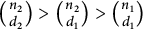
$\binom {n_2}{d_2}> \binom {n_2}{d_1} > \binom {n_1}{d_1}$
 which is a contradiction. Therefore,
$n_1 = n_2$
 and hence
$d_1 = d_2$
 .
Lemma 2.9 Let
$n_1, n_2, d_1, d_2$
 be positive integers and
$1 \le d_\iota \le n_\iota - 1$
 for
$\iota = 1,2$
 . Suppose

and

Then
$n_1 = n_2$
 and
$d_1 = d_2$
 .
Proof By direct computations, for
$\iota = 1, 2$
 we have

By Equations (2.1) and (2.2), we then have

Adding the Equations (2.1) and (2.2) together yields

We combine Equations (2.3) and (2.4), then we obtain

By Lemma 2.8 we have
$n_1 = n_2$
 and
$d_1 = d_2$
 .
3 Exterior powers of reflection representations
In this section we recollect some first results about exterior powers. Let W be a group endowed with a set of generators
$S = \{ s_1, \dots , s_k\}$
 as before. Suppose
$(V,\rho )$
 is an n-dimensional representation of W. The action
$\bigwedge ^d \rho $
 of W on the dth exterior power
$\bigwedge ^d V$
 (
$0 \le d \le n$
 ) is given by

In particular,
$\bigwedge ^0 V$
 is the one-dimensional W-module with trivial action, and
$\bigwedge ^n V$
 carries the one-dimensional representation
$\det \circ \rho $
 . If
$\{v_1, \dots , v_n\}$
 is a basis of V, then

is a basis of
$\bigwedge ^d V$
 . In particular,
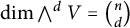
$\dim \bigwedge ^d V = \binom {n}{d}$
 . For more details about exterior powers, see, for example, [Reference Fulton and Harris3].
Suppose further that
$(V,\rho )$
 is a reflection representation and
$\alpha _i$
 is a chosen reflection vector of
$s_i$
 with eigenvalue
$\lambda _i$
 (
$\ne 1$
 ) for each
$i \in [k]$
 (see Definitions 2.1 and 2.3). We also denote by
$H_i$
 the reflection hyperplane of
$s_i$
 . For each
$i \in [k]$
 and
$0 \le d\le n$
 , we define

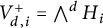
to be the eigen-subspaces of
$s_i$
 in
$\bigwedge ^d V$
 , for the eigenvalues
$1$
 and
$\lambda _i$
 , respectively.
Retain the notations
$W, V, s_i, \alpha _i$
 , etc.
Lemma 3.1 [Reference Hu6, Lemma 3.2 and Corollary 3.3]
Let
$i \in [k]$
 and
$0 \le d \le n$
 .
-
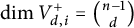
(1) We have $V^+_{d,i} = \bigwedge ^d H_i$
and
$\dim V^+_{d,i} = \binom {n-1}{d}$
. Here we regard
$\binom {n-1}{n} = 0$
if
$d = n$
. -
(2) Extend the reflection vector $\alpha _i$
arbitrarily to a basis of V, say,
$\alpha _i, v_2, \dots , v_n$
. Then,
$V^-_{d,i}$
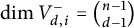
has a basis $$\begin{align*}\{\alpha_i \wedge v_{i_1} \wedge \dots \wedge v_{i_{d-1}} \mid 2 \le i_1 < \dots < i_{d-1} \le n\}.\end{align*}$$In particular, $\dim V^-_{d,i} = \binom {n-1}{d-1}$
. Here we regard
$\binom {n-1}{-1} = 0$
if
$d = 0$
.
-
(3) As a vector space, $\bigwedge ^d V = V^+_{d, i} \bigoplus V^-_{d, i}$
. In particular, the only possible eigenvalues of
$s_i$
on
$\bigwedge ^d V$
are
$1$
and
$\lambda _i$
.










Lemma 3.2 [Reference Hu6, Proposition 3.5]
Suppose the reflection vectors
$\alpha _1, \dots , \alpha _m$
 (
$m \le k$
 ) are linearly independent. We extend these vectors to a basis of V, say,

-
(1) If $0 \le d < m$
, then
$\bigcap _{1 \le i \le m} V^-_{d,i} = 0$
. -
(2) If $m \le d \le n$
, then
$\bigcap _{1 \le i \le m} V^-_{d,i}$
has a basis $$\begin{align*}\{\alpha_1 \wedge \dots \wedge \alpha_m \wedge v_{i_{m+1}} \wedge \dots \wedge v_{i_d} \mid m+1 \le i_{m+1} < \dots < i_d \le n \}.\end{align*}$$In particular, if $d = m$
, then
$\bigcap _{1 \le i \le m} V^-_{d,i}$
is one-dimensional with a basis vector
$\alpha _1 \wedge \dots \wedge \alpha _m$
.





Lemma 3.3 Suppose
$m \le d$
 ,
$m \le k-1$
 , and the reflection vectors
$\alpha _1, \dots , \alpha _m$
 are linearly independent. Suppose
$\alpha _{m+1}$
 is a linear combination of
$\alpha _1, \dots , \alpha _m$
 . Then
$\bigcap _{1 \le i \le m+1} V_{d,i}^- = \bigcap _{1 \le i \le m} V_{d,i}^- \ne 0$
 (that is,
$s_{m+1} \cdot v = \lambda _{m+1} v$
 for any
$v \in \bigcap _{1 \le i \le m} V_{d,i}^-$
 ).
Proof The fact that
$\bigcap _{1 \le i \le m} V_{d,i}^- \ne 0$
 follows from Lemma 3.2. Moreover, the subspace
$\bigcap _{1 \le i \le m} V_{d,i}^-$
 admits a basis of the form

where
$\{\alpha _1, \dots , \alpha _m, v_{m+1}, \dots , v_n\}$
 is a basis of V.
Suppose
$\alpha _{m+1} = c_1 \alpha _1 + \dots + c_m \alpha _m$
 ,
$c_i \in \mathbb {F}$
 . Without loss of generality, we may assume further
$c_1 \ne 0$
 . Then for any basis vector in (3.1) we have

Note that this is a nonzero vector, and that
$\{\alpha _{m+1}, \alpha _2, \dots , \alpha _m, v_{m+1}, \dots , v_n\}$
 is also a basis of V. By Lemma 3.2 again, we have

Therefore,
$\bigcap _{1 \le i \le m} V_{d,i}^- \subseteq V_{d,m+1}^-$
 , and thus
$\bigcap _{1 \le i \le m+1} V_{d,i}^- = \bigcap _{1 \le i \le m} V_{d,i}^-$
 .
Lemma 3.4 [Reference Hu6, Proposition 3.6]
If
$0 \le d, d' \le n$
 are integers and
$\bigwedge ^d V \simeq \bigwedge ^{d'} V$
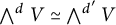 as W-modules, then
$d = d'$
 .
Remark 3.5 Lemma 3.4 holds for any representation on which some element
$s \in W$
 acts by a reflection, not necessary a reflection representation. See [Reference Hu6, Proposition 3.6] for details.
Lemma 3.6 [Reference Hu6, Corollary 3.8]
If the representation
$(V,\rho )$
 is irreducible, then the W-module
$\bigwedge ^d V$
 is semisimple for any
$d = 0, 1, \dots , n$
 .
Remark 3.7 Recall that
$\operatorname {char} \mathbb {F}$
 is assumed to be
$0$
 . This is used in the proof of Lemma 3.6. See [Reference Hu6, Lemma 3.7 and Corollary 3.8] for details.
4 Proof of Theorem 1.2
In this section we give the proof of Theorem 1.2.
Recall that W is a group endowed with a set of generators
$S = \{ s_1, \dots , s_k\}$
 , and
$(V,\rho )$
 is an n-dimensional irreducible reflection representation of
$(W,S)$
 over a field
$\mathbb {F}$
 of characteristic 0. We denote by
$\alpha _i$
 the chosen reflection vector of
$s_i$
 as before, and by
$\lambda _i$
 (
$\ne 1$
 ) the corresponding eigenvalue, for each
$i \in [k]$
 .
By Lemma 3.4, the W-modules
$\{\bigwedge ^d V \mid 0 \le d \le n\}$
 are pairwise non-isomorphic. Therefore, to prove Theorem 1.2, it suffices to show that
$\bigwedge ^d V$
 is a simple W-module for each d. But we have seen in Lemma 3.6 that
$\bigwedge ^d V$
 is semisimple, so the problem reduces to proving

Recall in Definition 2.6 that a digraph
$G_I$
 is associated with the reflection representation
$(V,\rho )$
 and an arbitrary subset
$I \subseteq [k]$
 . We have the following lemma.
Lemma 4.1 There exists a subset
$I \subseteq [k]$
 such that
-
(1) the digraph $G_I$
is weakly connected, and -
(2) $\{\alpha _i \mid i \in I\}$
is a basis of V.


Proof Suppose we have found a subset
$J \subseteq [k]$
 such that
-
(a) the digraph $G_J$
is weakly connected, and -
(b) $\{\alpha _i \mid i \in J\}$
is linearly independent.


For example, any singleton
$\{j\} \subseteq [k]$
 is such a subset.
If
$\lvert J \rvert = n$
 (the dimension of V), then we are done. Otherwise, suppose
$\lvert J \rvert < n$
 . Let
$V_J := \bigoplus _{i \in J} \mathbb {F} \alpha _i$
 , which is a proper subspace of V. Since V is a simple W-module, there exists
$j \in J$
 and
$i_0 \in [k]$
 such that
$s_{i_0} \cdot \alpha _j \notin V_J$
 . By Lemma 2.2,
$s_{i_0} \cdot \alpha _j$
 is of the form

for some
$x \in \mathbb {F}$
 . Then we must have
$x \ne 0$
 and
${i_0} \notin J$
 , otherwise
$s_{i_0} \cdot \alpha _j$
 would belong to
$V_J$
 . Now let
$J' = J \sqcup \{{i_0}\}$
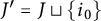 . Then the associated digraph
$G_{J'}$
 is also weakly connected since we have an arrow
$j \to {i_0}$
 . Moreover, the set of vectors
$\{\alpha _i \mid i \in J'\}$
 is linearly independent since
$\alpha _{i_0} \notin \bigoplus _{i \in J} \mathbb {F} \alpha _i$
 . Therefore, the subset
$J'$
 satisfies the conditions (a) and (b). Moreover, we have
$\lvert J' \rvert = \lvert J \rvert + 1$
 . By induction on cardinality, there exists a subset
$I \subseteq [k]$
 satisfying (1) and (2).
The following corollary of Lemma 4.1 will be used in Section 5.
Corollary 4.2 (See also [Reference Hu6, Claim 5.2])
Suppose
$(V,\rho )$
 is an n-dimensional irreducible reflection representation of
$(W,S)$
 with reflection vectors
$\{\alpha _i \mid i \in [k]\}$
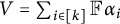
 . Then the space V is spanned by
$\{\alpha _i \mid i \in [k]\}$
 , that is,
$V = \sum _{i \in [k]} \mathbb {F} \alpha _i$
 . In particular,
$n \le k$
 .
Let I be obtained as in Lemma 4.1. Without loss of generality, we may assume
${I = [n]}$
 , the first n indices of
$[k]$
 (note that we have
$n \le k$
 by Lemma 4.1). The vectors
$\{\alpha _i \mid i \in I\}$
 form a basis of V. For each fixed d with
$0 \le d \le n$
 , the set of vectors

is a basis of
$\bigwedge ^d V$
 .
For any set of distinct indices
$1 \le i_1, \dots , i_d \le n$
 , by Lemma 3.2, the intersection
$\bigcap _{1 \le j \le d} V_{d, i_j}^-$
 of the d eigen-subspaces is one-dimensional,

Suppose now
$\varphi \in \operatorname {End}_W (\bigwedge ^d V)$
 is an endomorphism. Then
$\varphi $
 preserves the subspace
$\bigcap _{1 \le j \le d} V_{d, i_j}^-$
 . Therefore,

Notice that
$\alpha _{i_{\sigma (1)}} \wedge \dots \wedge \alpha _{i_{\sigma (d)}} = \operatorname {sign}(\sigma ) \alpha _{i_1} \wedge \dots \wedge \alpha _{i_d}$
 for any permutation
$\sigma \in \mathfrak {S}_d$
 , and hence that
$\gamma _{i_1, \dots , i_d}$
 depends only on the set
$\{i_1, \dots , i_d\}$
 , not on the order of the indices. To prove the statement (4.1), it suffices to show that the coefficients
$\gamma _{i_1, \dots , i_d}$
 are independent of the choice of the indices
$\{i_1, \dots , i_d\}$
 . The following result is essentially the same as [Reference Hu6, Claim 5.5].
Lemma 4.3 Let
$J = \{i_1, \dots , i_d\}$
 ,
$J' = \{j_1, \dots , j_d\}$
 be two subsets of I, both consisting of d elements. Suppose
$J'$
 can be obtained from J by a move (see Definition 2.4) in the digraph
$G_I$
 . Then
$\gamma _{i_1, \dots , i_d} = \gamma _{j_1, \dots , j_d}$
 .
Proof Without loss of generality, we may assume that
$d \le n-1$
 ,
$J=\{1, \dots , d\}$
 ,
$J' = \{1,2, \dots , d-1, d+1\}$
 , and
$d \to d+1$
 is an arrow in
$G_I$
 . Then
$s_{d+1} \cdot \alpha _d \ne \alpha _d$
 .
For
$i = 1, \dots , d$
 , by Lemma 2.2 we assume that

Then
$c_d \ne 0$
 . We have

Hence,

This also equals

Note that
$c_d \ne 0$
 , and that the vectors involved in the summations above are linearly independent. Thus, we have the desired equality
$\gamma _{1, \dots , d} = \gamma _{1, \dots , d-1, d+1}$
 by comparing the coefficients of
$\alpha _1 \wedge \dots \wedge \alpha _{d-1} \wedge \alpha _{d+1}$
 .
In general, for two subsets J and
$J'$
 of I, if both of them consist of d elements, then, since
$G_I$
 is weakly connected, one can be obtained from the other by finite steps of moves by Lemma 2.5. Therefore, the coefficients
$\gamma _{i_1, \dots , i_d}$
 are constant among all choices of the distinct indices
$1 \le i_1, \dots , i_d \le n$
 .
The proof of Theorem 1.2 is completed.
Remark 4.4 We cannot expect the digraph
$G_I$
 in Lemma 4.1 to be strongly connected. For example, let
$S = \{s_1, s_2, s_3\}$
 consist of 3 elements, and
$V = \mathbb {F} \alpha _1 \oplus \mathbb {F} \alpha _2$
 be a two-dimensional vector space. Define three reflections on V by

Then the corresponding reflection vectors are
$\alpha _1$
 ,
$\alpha _2$
 , and
$\alpha _3:= - \alpha _1 - \alpha _2$
 , respectively. The associated digraph
$G_{[3]}$
 is as follows:

In this digraph, each sub-digraph spanned by two vertices is not strongly connected.
5 Proof of Theorem 1.3
This section is devoted to proving Theorem 1.3.
Recall that W is a group endowed with a set of generators
$S = \{ s_1, \dots , s_k\}$
 , and
$(V_\iota , \rho _\iota )$
 ,
$\iota = 1, 2$
 , are two irreducible reflection representations. We use the following notations.

Suppose

is an isomorphism of W-modules, where
$d_1, d_2$
 are certain integers satisfying
$1 \le d_\iota \le n_\iota -1$
 (
$\iota = 1,2$
 ). As in Section 3, for each
$i \in [k]$
 we denote by

the eigen-subspaces of
$s_i$
 .
Before giving the rigorous proof, let us talk a little more about Theorem 1.3 informally. A priori, an isomorphism
$f : V_1 \to V_2$
 of reflection representations gives an isomorphism
$\bigwedge ^d f : \bigwedge ^d V_1 \to \bigwedge ^d V_2$
 via

It is not difficult to see that
$f(\alpha _i) = z_i \beta _i$
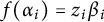 for some
$z_i \in \mathbb {F}^\times $
 . Then we have

Conversely suppose in Theorem 1.3 that
$d = d_1 = d_2$
 , and that the isomorphism
$\psi : \bigwedge ^d V_1 \to \bigwedge ^d V_2$
 is given by an isomorphism
$f : V_1 \to V_2$
 . Suppose further that we are able to show for any indices
$i_1, \dots , i_d \in [k]$
 that

(This is indeed the case, see Section 5.3.) Since the map f is of the form
$f(\alpha _i) = z_i \beta _i$
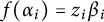 , we have
$\zeta _{i_1, \dots , i_d} = z_{i_1} \cdots z_{i_d}$
 , and

This indicates that

We would be close to find the desired isomorphism f if we can prove (5.1) (this is essentially Lemma 5.9).
We divide the proof of Theorem 1.3 into the following five steps, presented in Sections 5.1 to 5.5 respectively:
-
Step 1. Show that $d_1 = d_2$
,
$n_1 = n_2$
, and
$\lambda _i = \mu _i$
for each
$i \in [k]$
. -
Step 2. Show that the linear independence of a set of reflection vectors in $V_1$
is equivalent to that in
$V_2$
. -
Step 3. Show that the two reflection representations have the same associated digraphs.
-
Step 4. Define a linear isomorphism $f: V_1 \to V_2$
of vector spaces. -
Step 5. Show that f is an isomorphism of W-modules.


5.1 A preliminary numerical result
Proposition 5.1
$d_1 = d_2$
 ,
$n_1 = n_2$
 . Moreover,
$\lambda _i = \mu _i$
 for each
$i \in [k]$
 .
Proof Note that the element
$s_1 \in S$
 acts by reflections on both
$V_1$
 and
$V_2$
 . Since
$\bigwedge ^{d_1} V_1 \simeq \bigwedge ^{d_2} V_2$
 as W-modules, we have

Then we have by Lemma 3.1(1)(2)

Notice that
$1 \le d_\iota \le n_\iota - 1$
 for
$\iota = 1,2$
 . By Lemma 2.9, Equations (5.2) imply
$d_1 = d_2$
 ,
$n_1 = n_2$
 .
By Lemma 3.1(3), we have
$\bigwedge ^{d_1} V_1 = V_{1,d_1,i}^+ \bigoplus V_{1,d_1,i}^-$
 for each
$i \in [k]$
 , and the only possible eigenvalues of
$s_i$
 on
$\bigwedge ^{d_1} V_1$
 are
$1$
 and
$\lambda _i$
 . But
$\dim V_{1,d_1,i}^- = \binom {n_1 - 1}{d_1 -1} \ne 0$
 since
$1 \le d_1 \le n_1 -1$
 . Thus
$\lambda _i$
 is indeed an eigenvalue. Similarly, the only eigenvalues of
$s_i$
 on
$\bigwedge ^{d_2} V_2$
 are
$1$
 and
$\mu _i$
 . Thus we must have
$\lambda _i = \mu _i$
 .
Remark 5.2 From the proof of Proposition 5.1, we see that the results hold for two representations
$(V_1,\rho _1)$
 ,
$(V_2,\rho _2)$
 on which
$\rho _1(s)$
 and
$\rho _2(s)$
 are both reflections for some element
$s \in W$
 , not necessary to be reflection representations.
In view of Proposition 5.1, we denote

from now on. Note that we have
$1 \le d \le n-1$
 by assumption. However, Theorem 1.3 for the case
$d = 1$
 is trivial. Thus we may assume
$2 \le d \le n-1$
 .
5.2 Preliminary results on linear independence of reflection vectors
This subsection aims to prove Propositions 5.5 and 5.6, which transfer linear independence property of reflection vectors in
$V_1$
 to those with the same indices in
$V_2$
 . Recall that
$k = \lvert S \rvert $
 is the number of chosen generators of the group W, and
$\alpha _i$
 ,
$\beta _i$
 (
$i \in [k]$
 ) are the reflection vectors of the generator
$s_i$
 in the space
$V_1$
 and
$V_2$
 , respectively. By Corollary 4.2, the n-dimensional vector space
$V_1$
 is spanned by
$\alpha _1, \dots , \alpha _k$
 , and we have
$n \le k$
 .
Lemma 5.3 Suppose
$\{\alpha _1, \dots , \alpha _n\}$
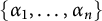 is a basis of
$V_1$
 . Then we have decompositions of vector spaces

and

Proof The vector space
$\bigwedge ^d V_1$
 has a basis

Note that by Lemma 3.2 the vector
$\alpha _{i_1} \wedge \dots \wedge \alpha _{i_d}$
 is a basis vector of the one-dimensional space
$\bigcap _{1 \le j \le d} V_{1,d,i_j}^-$
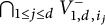 , which is the intersection of eigen-subspaces of
$s_{i_j}$
 ’s in
$\bigwedge ^d V_1$
 . Therefore, we have a decomposition of vector space

Since
$\psi : \bigwedge ^{d} V_1 \xrightarrow {\sim } \bigwedge ^{d} V_2$
 is an isomorphism of W-modules, we have

for any set of indices
$1 \le i_1 < \dots < i_d \le n$
 , and hence

as claimed.
Recall that the number d satisfies
$d+1 \le n$
 . We have the following lemma which is a “weak version” of Proposition 5.6.
Lemma 5.4 Suppose
$1 \le j_1, \dots , j_{d+1} \le k$
 . If
$\alpha _{j_1}, \dots , \alpha _{j_{d+1}}$
 are linearly independent, then so are
$\beta _{j_1}, \dots , \beta _{j_{d+1}}$
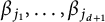 .
Proof Suppose otherwise that
$\beta _{j_1}, \dots , \beta _{j_{d+1}}$
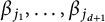 are linearly dependent and the subset
$\{\beta _{j_1}, \dots , \beta _{j_{h}}\}$
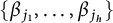 (
$h \le d$
 ) is a maximal linearly independent set. Then there exists a nonzero vector v in
$\bigwedge ^d V_2$
 of the form
$v = \beta _{j_1} \wedge \dots \wedge \beta _{j_{h}} \wedge v_{h+1} \wedge \dots \wedge v_d$
 . By Lemma 3.2, we have

Note that for any index i such that
$h+1 \le i \le d+1$
 ,
$\beta _{j_i}$
 is a linear combination of
$\beta _{j_1}, \dots , \beta _{j_{h}}$
 . Then by Lemma 3.3, we have

As in the proof of Lemma 5.3, since
$\psi : \bigwedge ^{d} V_1 \xrightarrow {\sim } \bigwedge ^{d} V_2$
 is an isomorphism of W-modules, we have

Note that
$\psi ^{-1} (v)$
 is a nonzero vector. However, the intersection
$\bigcap _{1 \le i \le d+1} V_{1,d,j_i}^-$
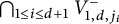 is zero by Lemma 3.2. This is absurd.
Proposition 5.5 Suppose
$1 \le j_1, \dots , j_n \le k$
 . If
$\{\alpha _{j_1}, \dots , \alpha _{j_n}\}$
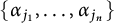 is a basis of
$V_1$
 , then
$\{\beta _{j_1}, \dots , \beta _{j_n}\}$
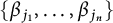 is a basis of
$V_2$
 , and vice versa.
Proof Without loss of generality, we may assume
$j_1 = 1$
 ,
$j_2 = 2$
 ,
$\dots $
 ,
$j_n = n$
 . Then
$\{\alpha _1, \dots , \alpha _n\}$
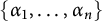 is a basis of
$V_1$
 . Suppose the space
$U := \mathbb {F} \langle \beta _1, \dots , \beta _n \rangle $
 spanned by
$\beta _1, \dots , \beta _n$
 is a proper subspace of
$V_2$
 , and
$m := \dim U < n$
 . We may assume further that
$\{\beta _1, \dots , \beta _m\}$
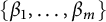 is a basis of U.
For any indices
$1 \le i_1 < \dots < i_d \le n$
 , there exists an index
$i_{d+1} \in [n] \setminus \{i_1, \dots , i_d\}$
 since
$d \le n-1$
 . Note that the vectors
$\alpha _{i_1}, \dots , \alpha _{i_d}, \alpha _{i_{d+1}}$
 are linearly independent. By Lemma 5.4,
$\beta _{i_1}, \dots , \beta _{i_d}, \beta _{i_{d+1}} \in U$
 are linearly independent as well. In particular,
$\beta _{i_1} \wedge \dots \wedge \beta _{i_d} \ne 0$
 and we have by Lemma 3.2 that

But then by Lemma 5.3, we have

which is a contradiction. Thus, we must have
$U = V_2$
 ,
$m = n$
 , and
$\{\beta _1, \dots , \beta _n\}$
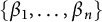 is a basis of
$V_2$
 .
As a corollary, we have the following proposition.
Proposition 5.6 Suppose
$h \le n$
 and
$1 \le i_1, \dots , i_h \le k$
 . If
$\alpha _{i_1}, \dots , \alpha _{i_h}$
 are linearly independent, then so are
$\beta _{i_1}, \dots , \beta _{i_h}$
 . In particular, if
$\alpha _i$
 and
$\alpha _j$
 are not proportional for some
$1 \le i \ne j \le k$
 , then so are
$\beta _i$
 ,
$\beta _j$
 .
Proof Recall Corollary 4.2 that
$V_1$
 is spanned by
$\alpha _1, \dots , \alpha _k$
 . Thus there exist reflection vectors
$\alpha _{i_{h+1}}, \alpha _{i_{h+2}}, \dots , \alpha _{i_{n}}$
 such that
$\alpha _{i_1}, \dots , \alpha _{i_h}, \alpha _{i_{h+1}}, \dots , \alpha _{i_{n}}$
 form a basis of
$V_1$
 . Then use Proposition 5.5.
5.3 Coincidence of the associated digraphs
Recall in Definition 2.6 that a digraph is associated with any subset
$I \subseteq [k]$
 and any reflection representation. For
$\iota = 1, 2$
 , we denote temporarily by
$G_\iota $
 the associated graph to the full set
$[k]$
 and the representation
$(V_\iota ,\rho _\iota )$
 . In this subsection, we will prove that
$G_1 = G_2$
 .
For two distinct indices
$i, j \in [k]$
 , we set

Then
$j \to i$
 is an arrow in
$G_1$
 ,
$G_2$
 if and only if
$x_{ji}$
 ,
$y_{ji} \ne 0$
 , respectively.
For distinct indices
$1 \le i_1, \dots , i_d \le k$
 , if
$\alpha _{i_1} \wedge \dots \wedge \alpha _{i_d} \ne 0$
 , that is, if
$\alpha _{i_1}, \dots , \alpha _{i_d}$
 are linearly independent, then by Proposition 5.6, the vectors
$\beta _{i_1}, \dots , \beta _{i_d}$
 are linearly independent as well. Moreover, we have by Lemma 3.2

Therefore, since
$\psi : \bigwedge ^d V_1 \xrightarrow {\sim } \bigwedge ^d V_2$
 is an isomorphism of W-modules, it holds

By convention, we define
$\zeta _{i_1, \dots , i_d} := 0$
 if
$\alpha _{i_1} \wedge \dots \wedge \alpha _{i_d} = 0$
 .
Remark 5.7 Note that the coefficients
$\zeta _{i_1, \dots , i_d}$
 are independent of the order of
$i_1, \dots , i_d$
 , that is,
$\zeta _{i_1, \dots , i_d} = \zeta _{i_{\sigma (1)}, \dots , i_{\sigma (d)}}$
 for any permutation
$\sigma \in \mathfrak {S}_d$
 (as
$\gamma _{i_1, \dots , i_d}$
 in Section 4).
Lemma 5.8 Suppose
$i, j \in [k]$
 and
$i \ne j$
 . There exist distinct indices
$i_2, \dots , i_{d} \in [k]$
 such that
-
(1) $\alpha _{i}, \alpha _j, \alpha _{i_2}, \dots , \alpha _{i_{d}}$
are linearly independent if
$\alpha _i, \alpha _j$
are not proportional; -
(2) $\alpha _i, \alpha _{i_2}, \dots , \alpha _{i_{d}}$
are linearly independent if
$\alpha _i, \alpha _j$
are proportional (thus in this case the vectors
$\alpha _j, \alpha _{i_2}, \dots , \alpha _{i_{d}}$
are linearly independent as well).





Proof The existence of the required indices is ensured by the facts that
$d+1 \le n$
 and that
$V_1$
 is spanned by all the reflection vectors (Corollary 4.2).
The following lemma is the key in this subsection.
Lemma 5.9 Suppose
$i, j \in [k]$
 and
$i \ne j$
 . Let
$i_2, \dots , i_{d} \in [k]$
 be any indices satisfying the conditions (1)(2) in Lemma 5.8. Then we have

Proof We consider

which also equals

If
$\alpha _i, \alpha _j$
 are not proportional, then
$\alpha _i, \alpha _j, \alpha _{i_2}, \dots , \alpha _{i_d}$
 are linearly independent by our assumption, and then so are
$\beta _i, \beta _j, \beta _{i_2}, \dots , \beta _{i_d}$
 by Proposition 5.6 (or Lemma 5.4). Therefore, the vectors occurring in (5.4) and (5.5) are nonzero and linearly independent. By comparing the coefficients of
$\beta _j \wedge \beta _{i_2} \wedge \dots \wedge \beta _{i_d}$
 in (5.4) and (5.5) we see that the desired Equation (5.3) holds.
If
$\alpha _i, \alpha _j$
 are proportional, then so are
$\beta _i, \beta _j$
 by Proposition 5.6, and the summations in (5.4) and (5.5) vanish, that is,

As pointed out in Lemma 5.8, the vectors
$\alpha _j, \alpha _{i_2}, \dots , \alpha _{i_d}$
 are linearly independent, and so are
$\beta _j, \beta _{i_2}, \dots , \beta _{i_d}$
 by Proposition 5.6. Therefore, we have Equation (5.3) again by comparing the two equations above.
Note that in Equation (5.3) the coefficients
$\zeta _{i, i_2, \dots , i_d}$
 and
$\zeta _{j, i_2, \dots , i_d}$
 are nonzero. Therefore we have the following corollary.
Corollary 5.10 Suppose
$i, j \in [k]$
 and
$i \ne j$
 . Then
$x_{ij}$
 and
$y_{ij}$
 are equal or not equal to zero simultaneously, that is, either
$x_{ij} = y_{ij} = 0$
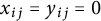 or
$x_{ij} y_{ij} \ne 0$
 .
By the definition of the associated digraphs
$G_1$
 and
$G_2$
 , Corollary 5.10 implies
Corollary 5.11
$G_1 = G_2$
 .
From now on, we recover the notation
$G = G_{[k]}$
 to indicate uniformly the digraphs
$G_1$
 and
$G_2$
 , and
$G_I$
 to be the sub-digraph spanned by a subset
$I \subseteq [k]$
 (see Definition 2.6).
We will also need the following corollary of Lemma 5.9.
Corollary 5.12 Let
$i, j, i_2, \dots , i_d \in [k]$
 be as in Lemma 5.9. Suppose
$x_{ij} \ne 0$
 and
$y_{ji} \ne 0$
 (equivalently,
$y_{ij} \ne 0$
 and
$x_{ji} \ne 0$
 ). Then we have

5.4 The linear isomorphism f from
$V_1$
to
$V_2$


Remember that our final goal is to find an isomorphism
$f : V_1 \xrightarrow {\sim } V_2$
 of W-modules. For this, let us introduce some notations.
By applying Lemma 4.1 to the reflection representation
$(V_1, \rho _1)$
 , we choose and fix a subset
$I \subseteq [k]$
 such that
-
(1) $G_I$
is weakly connected, and -
(2) $\{\alpha _i \mid i \in I\}$
is a basis of
$V_1$
.


Then by Proposition 5.5,
$\{\beta _i \mid i \in I\}$
 is a basis of
$V_2$
 .
For two indices
$i, j \in I$
 such that
$i \ne j$
 and either
$i \to j$
 or
$j \to i$
 is an arrow in
$G_I$
 , we define

By Corollary 5.12, we have
$\frac {y_{ij}}{x_{ij}} = \frac {x_{ji}}{y_{ji}}$
 if both
$i \to j$
 and
$j \to i$
 are arrows. So the element
$z_{ij} \in \mathbb {F}^\times $
 is well defined. We have the following lemma.
Lemma 5.13 Let
$h \ge 1$
 be an integer and

be an undirected walk in
$G_I$
 . For any
$p \in [h]$
 and any distinct indices
$j_2, \dots , j_{d} \in I \setminus \{i_0, i_p\}$
 (if
$i_0 = i_p$
 then we regard
$\{i_0, i_p\} = \{i_0\}$
 ) we have

Note that
$\lvert I \setminus \{i_0, i_p\} \rvert \ge n - 2 \ge d - 1$
 . Therefore such indices
$j_2, \dots , j_{d}$
 exist. Note also that
$\{\alpha _j \mid j \in I\}$
 is a basis for
$V_1$
 . Thus
$\zeta _{i_0, j_2, \dots , j_d}$
 and
$\zeta _{i_p, j_2, \dots , j_d}$
 are nonzero.
Proof We prove by induction on p. Suppose first that
$p = 1$
 . Then the desired equality
$z_{i_0 i_1} = \zeta _{i_1, j_2, \dots , j_d} / \zeta _{i_0, j_2, \dots , j_d}$
 follows from Corollary 5.12.
Suppose now
$p \ge 2$
 . The induction hypothesis reads

For distinct indices
$j_2, \dots , j_d \in I \setminus \{i_0, i_p\}$
 given arbitrarily, we have three cases.
Case one:
$i_{p-1} \notin \{j_2, \dots , j_d\}$
 . By the same arguments as in the beginning case “
$p = 1$
 ”, we have

whenever
$a_p = i_{p-1} \to i_p$
 or
$a_p = i_p \to i_{p-1}$
 . Therefore by induction hypothesis we have

as claimed in Equation (5.6).
Case two:
$i_{p-1} \in \{j_2, \dots , j_d\}$
 and
$i_0 \ne i_p$
 . We may assume
$i_{p-1} = j_2$
 . Then
$i_0$
 ,
$i_p$
 ,
$i_{p-1}$
 (
$= j_2$
 ),
$j_3$
 ,
$\dots $
 ,
$j_d$
 are distinct. We have

by applying induction hypothesis to the indices
$i_p, j_3, \dots , j_d$
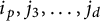 , and

by the same arguments as in the beginning case “
$p=1$
 ”. Therefore,

Note that
$\zeta _{i_0, i_p, j_3, \dots , j_d} = \zeta _{i_p, i_0, j_3, \dots , j_d}$
 (see Remark 5.7). Therefore Equation (5.7) reduces to

which is what we want.
Case three:
$i_{p-1} \in \{j_2, \dots , j_d\}$
 and
$i_0 = i_p$
 . Then our goal Equation (5.6) becomes

We can still assume
$i_{p-1} = j_2$
 . Note that in this case
$i_0$
 (
$= i_p$
 ),
$i_{p-1}$
 (
$= j_2$
 ),
$j_3, \dots , j_d$
 are distinct d indices. But
$d \le n-1$
 , so there exists an extra index
$j \in I \setminus \{i_0, j_2, j_3, \dots , j_d\}$
 . Similar to the former cases, we have

and

Therefore, we have

which is exactly Equation (5.8).
Now we are ready to construct a linear map f from
$V_1$
 to
$V_2$
 . Such a map is determined by vectors
$\{f(\alpha _i) \in V_2 \mid i \in I\}$
 since
$\{\alpha _i \in V_1 \mid i \in I\}$
 is a basis of
$V_1$
 . Because
$\alpha _i$
 and
$\beta _i$
 are the reflection vectors of
$s_i$
 in
$V_1$
 and
$V_2$
 , respectively, we are excepted to have

Below we propose a choice of the coefficients
$z_i$
 .
From now on we fix an index
$i_0 \in I$
 and set
$z_{i_0} := 1$
 . For any other index
$i \in I$
 , we choose an undirected walk in
$G_I$
 from
$i_0$
 to i, say,

where
$i_0, i_1, \dots , i_l \in I$
 . Then
$z_i$
 is defined to be

We need to show that
$z_i$
 such defined is independent of the choice of the undirected walk (but it does depend on the choice of the beginning vertex
$i_0$
 ).
Proposition 5.14 Fix
$i_0 \in I$
 as above. For each
$i \in I$
 , the value of
$z_i$
 only depends on i, not on the choice of the undirected walk from
$i_0$
 to i.
Proof Suppose there exist two undirected walks in
$G_I$
 from
$1$
 to i, say (
$h> l$
 ),


By convention, we also denote
$i_{h} := i_0$
 . We need to show

By definition we have
$z_{i_{j-1} i_j} = z_{i_j i_{j-1}}^{-1}$
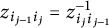 . Thus our goal becomes

By extending the first undirected walk (5.9) by the reverse of (5.10), we have an undirected walk in
$G_I$
 from
$i_0$
 to
$i_0$
 ,

By taking
$p = h$
 in Lemma 5.13, we have that

for any distinct indices
$j_1, \dots , j_d \in I \setminus \{i_0, i_h\}$
 . This equality is what we want.
By Proposition 5.14, we have a well defined linear map
$f: V_1 \to V_2$
 by setting

Since
$z_i \in \mathbb {F}^\times $
 and
$\{\alpha _i \mid i \in I\}$
 ,
$\{\beta _i \mid i \in I\}$
 are bases of
$V_1$
 ,
$V_2$
 respectively, the map f is clearly an isomorphism of vector spaces. It remains to show that f is a homomorphism of W-modules.
5.5 The map f is a W-isomorphism
To show that f is a homomorphism of W-modules, it suffices to show

We split the proof into two parts (Propositions 5.15 and 5.16), depending on whether
$h \in I$
 or
$h \notin I$
 .
Proposition 5.15 For any
$h, i \in I$
 , we have
$f(s_h \cdot \alpha _i) = s_h \cdot f(\alpha _i)$
 .
Proof In this case we have

and

Therefore, we need to show

If
$x_{ih} = 0$
 , then
$y_{ih} = 0$
 by Corollary 5.10, and thus Equation (5.11) holds trivially. Suppose otherwise that
$x_{ih} \ne 0$
 . Then
$i \to h$
 is an arrow. Recall that the coefficient
$z_i$
 is computed by taking arbitrarily an undirected walk in
$G_I$
 from the fixed
$i_0$
 (
$\in I$
 ) to i, say,

If we set
$i_{l+1} = h$
 and
$a_{l+1} = i \to h$
 , then the extended undirected walk

goes from
$i_0$
 to h. Therefore, by the definitions of
$z_i$
 and
$z_{ih}$
 in Section 5.4, we have
$z_h = z_i z_{ih} = z_i y_{ih} / x_{ih}$
 which is exactly Equation (5.11).
Proposition 5.16 For any
$i \in I$
 and
$h \in [k] \setminus I$
 , we have
$f(s_h \cdot \alpha _i) = s_h \cdot f(\alpha _i)$
 .
The rest of this subsection is devoted to proving Proposition 5.16. Since
$\{\alpha _l \mid l \in I\}$
 is a basis for
$V_1$
 , and so is
$\{\beta _l \mid l \in I\}$
 for
$V_2$
 by Proposition 5.5, we write

Then we have

and

Therefore, to prove Proposition 5.16 it suffices to show for any
$j \in I$
 that

For this, we need the following lemma.
Lemma 5.17 Suppose
$h \in [k] \setminus I$
 ,
$j \in I$
 . We write
$\alpha _h = \sum _{l \in I} a_l \alpha _l$
 ,
$\beta _h = \sum _{l \in I} b_l \beta _l$
 as above. If
$a_j \ne 0$
 , then for any distinct
$i_2, \dots , i_d \in I \setminus \{j\}$
 , we have

Note that both
$\zeta _{j, i_2, \dots , i_d}$
 and
$\zeta _{h, i_2, \dots , i_d}$
 are nonzero, because both of the two sets
$\{\alpha _j, \alpha _{i_2}, \dots , \alpha _{i_d}\}$
 and
$\{\alpha _h, \alpha _{i_2}, \dots , \alpha _{i_d}\}$
 are linearly independent sets.
Proof Since
$a_j \ne 0$
 , the vectors
$\alpha _h, \alpha _{i_2}, \dots , \alpha _{i_d}$
 are linearly independent. We write
$I = \{j, i_2, \dots , i_d, i_{d+1}, \dots , i_n\}$
 . Then

The image under
$\psi $
 of the left hand side of Equation (5.13) is

Moreover, the image under
$\psi $
 of the right hand side of Equation (5.13) equals

The equality of (5.14) and (5.15) gives
$\zeta _{j, i_2, \dots , i_d} a_j = \zeta _{h, i_2, \dots , i_d} b_j$
 .
Now we are ready to complete the proof of Proposition 5.16.
Proof of Proposition 5.16
As we mentioned, it suffices to prove Equation (5.12) for any
$j \in I$
 . We have three cases.
Case one:
$a_j = 0$
 . Then
$\{\alpha _h\} \cup \{\alpha _l \mid l \in I \setminus \{j\}\}$
 is a linearly dependent set. Then
$\{\beta _h\} \cup \{\beta _l \mid l \in I \setminus \{j\}\}$
 is also linearly dependent. Otherwise, it would be a basis for
$V_2$
 , contradicting Proposition 5.5. Therefore, we have
$b_j = 0$
 , and hence Equation (5.12) holds trivially.
Case two:
$a_j \ne 0$
 and
$j = i$
 . In this case Equation (5.12) reduces to

If
$\alpha _h$
 and
$\alpha _j$
 are proportional, then
$\alpha _h, \alpha _{i_2}, \dots , \alpha _{i_d}$
 are linearly independent for any distinct
$i_2, \dots , i_d \in I \setminus \{j\}$
 . If
$\alpha _h$
 and
$\alpha _j$
 are not proportional, then
$a_{j'} \ne 0$
 for some
$j' \in I \setminus \{j\}$
 . There exist
$d-1$
 distinct indices
$i_2, \dots , i_d \in I \setminus \{j, j'\}$
 since
$d \le n - 1$
 . In both cases, we have by Lemma 5.9 that

By Lemma 5.17, we also have

Therefore
$x_{jh} a_j = y_{jh} b_j$
 as desired.
Case three:
$a_j \ne 0$
 and
$i \ne j$
 . By the same arguments as in case one, we have
$b_j \ne 0$
 . We may further assume
$x_{ih} y_{ih} \ne 0$
 by Corollary 5.10, otherwise Equation (5.12) reduces to “0 = 0”. Suppose

is an undirected walk in
$G_I$
 from
$i_0$
 to i, and

is an undirected walk in
$G_I$
 from i to j. Their concatenation is an undirected walk from
$i_0$
 to j. Note that there exist
$d-1$
 distinct indices
$i_2, \dots , i_d \in I \setminus \{i, j\}$
 since
$d \le n - 1$
 . Then by definitions of
$z_i$
 and
$z_j$
 and Lemma 5.13, we have

Also note that
$\alpha _h, \alpha _i, \alpha _{i_2}, \dots , \alpha _{i_d}$
 are linearly independent since
$a_j \ne 0$
 . Then by Lemma 5.9, we have

Moreover, by Lemma 5.17 we also have

Multiplying Equations (5.16), (5.17), and (5.18) together, we obtain

This is exactly Equation (5.12).
By Propositions 5.15 and 5.16,
$f : V_1 \to V_2$
 is a homomorphism of W-modules. We have finished the proof of Theorem 1.3.
Acknowledgements
The author is deeply grateful to an anonymous referee for useful suggestions which helped to improve this paper. The author is supported by the Fundamental Research Funds for the Central Universities.
Declarations of interest
The author has no relevant interests to declare.



