1. Beyond the acknowledgment of entanglement
Relationality and entanglement have been widely and increasingly championed in the feminist literature on multispecies ethics, politics, cultures, ecologies, and justice.Footnote 1 Relational ethics and autonomy have likewise received significant attention within feminist bioethics.Footnote 2 Whether applied to intra- or inter-species contexts, this emphasis on the enmeshed reality of our lives has served to challenge Liberal individualism, the pernicious human/animal and human/nature dualisms, and the unjust politicsFootnote 3 that they underwrite. As some critical proponents have observed, however, the acknowledgment of relationality and entanglement is not enough (Giraud Reference Giraud2019; Opperman Reference Opperman2020). More is required for living together well than the recognition or celebration of the ways in which our lives and even our very being cannot be meaningfully disentangled from each other (Kirksey and Chao Reference Kirksey, Chao, Chao, Bolender and Kirksey2022). We need more nuanced understandings of the kinds of relationality and entanglement to cultivate and those to be avoided or, as is often the case, uprooted.
Indeed, there is widespread recognition, especially among Indigenous scholars, that something is profoundly wrong with multispecies relationality under/of the “dominant political, economic, and ecological orders” (Mitchell Reference Mitchell2023, 2) and that this relational disruption/dysfunction is key to understanding interspecies, intraspecies, and intergenerational injustice.Footnote 4 Meissner and Smith (Reference Meissner and Frederick Smith2024), for example, describe climate change as relational crisis.Footnote 5 Having witnessed the violence and injustice of climate disaster firsthand, Celermajer et al. (Reference Celermajer, David Schlosberg, Makere Stewart-Harawira, Tschakert, Verlie and Winter2021, 134–35) emphasize that “we cannot afford to allow [multispecies justice] to remain an idealist notion … the litmus test for the work scholars do in developing the conception of [multispecies justice] must be its capacity to help us more ethically navigate the real world we face.” This paper focuses on the colonial, multispecies dimensions of relational disruption and repair in context. For in order for multispecies justice scholarship to pass this test, more analyses of these ethics/politics in place and on the land are needed.Footnote 6
Towards these ends, I consider the practical application of the metaphor of “good boundaries” as an ideological and ethical touchstone for working towards better interspecies relationships and multispecies cultures. I undertake this project close to home in the context of my family’s farm. Working across a spectrum of liminal forms of animal life, my analysis centers our relationships on this land with rats, mice, and deer. I do so with awareness of both the multispecies and colonial politics at play here on “the property,” in the “homestead,” and under the guise of “stewardship” via the racialized categories of “pests,” “vermin,” and “invasive species” which serve to obscure ecological imperialism.Footnote 7 Ultimately, I conclude that the metaphor of good boundaries helps generate better multispecies entanglements by (i) growing our capacity for ecological thinking, (ii) directing our attention to moral failure, and at times (iii) disrupting anthropocentric colonial ideologies and practices. At its heart, the invocation of good boundaries is an invitation to remain in relationship and do better by each other. Though practising them is often a humbling experience, good boundaries serve as a bridge towards transformative multispecies justice by providing us with tools to build cultures of reciprocity and mutual flourishing from the ground up.
2. Background
2.1 A farm
Located in Brewster, New York, and on unceded land within the traditional territories of the Wappinger and Munsee Lenape peoples, Ryder Farm has been in my paternal grandmother’s family since 1794. These 128 acres in the corner of Putnam County once belonged to the South Precinct of the Highland Patent in the British colony of New York. Later known as the Philipse Patent after its first owner, Adolphus Philipse, its origins are a paradigmatic example of settler colonial land theft (Smith Reference Smith2010). In a nutshell: in 1697, Philipse purchased a 15,000-acre strip of land (of already dubious provenance) along the Hudson River and then proceeded to obtain a royal patent for that parcel and, under extremely suspect circumstances, an additional 190,000 acres extending from the Hudson all the way to Connecticut (MacCracken Reference MacCracken1956). Indeed, one folk story claims Philipse himself cut down the original tree marking the eastern boundary of the smaller parcel and rode all day to the Connecticut border to find and mark a similar tree, thereby usurping the additional acreage (Humphrey Reference Humphrey2004).Footnote 8
The land grab flew largely under the radar for the decades leading up to Philipse’s death, when his heirs started making trouble by attempting to evict the Wappingers’ European tenants in the 1750s (Humphrey Reference Humphrey2004). First informally and then formally in 1762 and 1765, the Wappingers sought legal recourse in the colonial courts to reclaim their land but were repeatedly denied (Smith Reference Smith2010; Frazier Reference Frazier1992; Humphrey Reference Humphrey2004). Refusing to accept this verdict, Wappinger delegates traveled to London to take their case directly to the Crown in 1766. Although the party was not granted an audience with the King, they did meet with royal authorities who found sufficient evidence to demand the New York Council reopen the case (MacCracken Reference MacCracken1956; Handlin and Mark Reference Handlin and Mark1964). Despite the overwhelming evidence (even in the eyes of many colonists), in 1767 the courts ruled in favor of the Philipses on the grounds that to do otherwise would be to set an untenable precedent. In the words of their attorney: “Twill open a Door to the greatest Mischiefs, inasmuch as a great part of the Lands in this Province are supposed to lie under much the Same Situation; and upon the whole intimated, that it would therefore, by no means do, to give Heed to the present Complaint” (Handlin and Mark Reference Handlin and Mark1964, 240). Many Wappingers fought and died in the American Revolution against the British alongside the colonists, whose victory resulted not in justice for the Tribe but further denial and displacement (Frazier Reference Frazier1992; Stockbridge-Munsee Community 2024). This state of affairs continues to this day.
It is too easy to relegate stories like these to the distant past. Most settlers nowadays are removed from royal land patents by over two hundred years of real estate transactions. (A tenuous buffer.) Ryder Farm does not have that questionable luxury. The Wappingers were still fighting in the courts and on the battlefield less than 30 and 20 years, respectively, prior to Eleazer Ryder’s purchase of this land in 1794. This is not ancient history; the seizure and subsequent dissolution of the Philipse Patent in the middle years of the revolution are the precise conditions that allowed tenant farmers like the Ryders to purchase the deeds to “their” land. I share this part of the farm’s history because, as I will shortly elaborate upon,Footnote 9 our relationships to this land and, thereby, those we share it with have been and continue to be heavily influenced by colonial ideologies, institutions, and structures.
From Eleazer Ryder the land passed to Colonel Stephen Ryder, from whom the three extant branches of cousins currently managing Ryder Farm descend.Footnote 10 The farm was incorporated in the early twentieth century, resulting in the unusual arrangement wherein most family members (∼70) are also shareholders. Indeed, until 2020, the annual shareholders’ meeting of Ryder Farm Incorporated (RFI) coincided with our family reunion. The Board of RFI is likewise composed entirely of family, myself included. In the 1970s, the farm went organic and has never looked back. Today Ryder Farm survives because of New York State’s agricultural tax assessment program, which exempts us from paying taxes on the vast majority of our acreage for so long as it remains in agricultural production (including agroforestry).Footnote 11 In 2021, in partnership with the Westchester Land Trust, RFI applied for and was awarded a competitive grant from the State for the purchase of the farm’s development rights in order to establish a conservation easement.Footnote 12 The easement is designed to safeguard agriculture but forecloses the possibility of residential or commercial development in perpetuity.
2.2 An animal policy
While the conservation easement may ultimately represent my most lasting impact on the land we know today as Ryder Farm, the first project I spearheaded as a board member was an overhaul of RFI’s animal policy. I have learned—and am still learning—so much about what it means to do engaged interspecies ethics through the drafting, passage, and implementation of this document. As we shall see, RFI’s animal policy and the discourse around good interspecies boundaries on Ryder Farm are deeply entwined. Before turning to the policy, however, it is important to clarify that multispecies ethics and politics on the farm are not limited to animals. As Celermajer et al. (Reference Celermajer, Sria Chatterjee, Stefanie Fishel, Anne O’Brien, Srinivasan, Schlosberg and Waldow2020, 477) articulate, “the puzzle of who or what, within this ‘multispecies world’—animals, micro-organisms, forests, rivers, soils and more—ought to fall within the ambit of justice are precisely what needs to be worked through, and ought to remain contentious.” My primary focus on animals here stems from how actual conversations/practices on the farm have emerged and evolved—the metaphor of good boundaries has not yet been applied beyond animals. This focus is not meant to imply that the metaphor is only or especially suitable for navigating our relationships with/as animals. Furthermore, as shall become apparent, thinking ecologically via good boundaries requires that we attend to more than the farm’s animals.
Ironically, animals have not been a central part of the operation of Ryder Farm since the early twentieth century. In the modern history of the farm, we had not been in the business of raising animals for meat. We grew organic vegetables, herbs, and flowers. This left animals at the periphery where they have not always thrived. As a result, animal issues had become a contentious topic. In fact, it was conflict surrounding the introduction of beef cattle to the farm that prompted the creation of RFI’s first animal policy. To my knowledge, it is not a common practice of small farms to have a written animal policy. This document took the form of eight bullet points geared towards the welfare of domesticated farm animals. Interestingly, it concluded with: “In a farming operation involving animals, exploitation is inevitable; its benefits to humans underlie the whole project. However, [RFI] intends to be mindful of and to promote the animals’ quality of life. Exploitation of the kind that is routine in industrial-scale farming should be unknown here.” While there is refreshing honesty in these words, I (and others) felt strongly that the farm could do better. Several areas of growth were identified. Beyond the somewhat disturbing, if well-intentioned, exploitation clause, the policy’s welfare provisions and framework were deemed insufficient. For a relational ethicist like myself—that is, someone who sees ethics as grounded fundamentally (if not exclusively) in our relationships to othersFootnote 13 —the welfare framework was limiting. The original policy recognized that we ought to attend to the wellbeing of animals under our care but had nothing to say about, for example, what was owed to animals who outlive their “usefulness” to the farming operation or who share the land with us.
A new mission statement and framework were proposed and approved by the Board and shareholders:
We recognize that a farm is inherently an interspecies community. Whether domesticated, wild, or liminal, non-human animals have been and always will be integral members of the Ryder Farm. As the caretakersFootnote 14 of this land, we commit ourselves to living together wellFootnote 15 with our animal cohabitants. Striving to do so is a vital part of what it means to tend to and balance, as best we can, the familial, ecological, financial, historical, and spiritual well-being of The Farm.
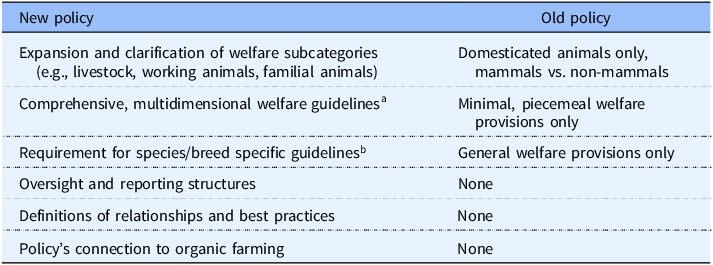
The framework itself was roughly organized around the categories of domesticated, liminal, and wild animals.Footnote 16 From there, further details included: (see Table 1). It took over a year of conversations to iron out these points. Overall, what emerged was an animal policy that is designed to grow and change, is intentionally pluralistic, and has dialogue built into its structure.
New Policy vs. Old Policy

a It’s possible these were influenced by Nussbaum’s (Reference Nussbaum2007) capabilities approach. One funny thing about doing engaged philosophy is that your work is undoubtedly informed by the literature, but specific authors rarely come up in the moment, which makes citational practices tricky when writing about it later.
b This was informed by conversations I was having around that time with Paul Thompson regarding chickens.
Indeed, writing and getting the policy passed was only ever a starting point. The real ethical work lies in implementing it together over time. As Bellacasa (Reference Bellacasa2010, 160) remarks in the context of permaculture ethics, “‘should’ doesn’t work without a transformation of ethos.” In the long run, I aim to make the implementation of this policy far less dependent upon me or any other individual. For this to happen, however, the guidelines and values espoused therein need to become more than words on a page; they must become part of our culture.
2.3 A metaphor
The central metaphor of concern in this paper—good boundaries—emerged from the work of taking RFI’s animal policy from page to practice. Initially, this was unintentional. When navigating interspecies dynamics in real life, I reach for stories and metaphors over structured arguments, which tend to be ill-suited for constructive dialogue. Often these stories/metaphors are quite context-specific. Sometimes, however, they start to repeat. When they do, I pay attention.Footnote 17
I first noticed myself repeatedly using the rhetoric of good boundaries in the context of conversations around rats/mice in residential buildings. The exchange would go like this:
Me: What if we tried to find a solution that didn’t involve killing rats and mice?
Interlocutor: Well, what do you expect us to do instead? Give the rodents free rein?!
Me: No, we’re allowed to have boundaries. We can work on setting good boundaries.
Eventually, I started wondering why I kept coming back to this rhetoric and what I meant by it. Given that I was not advocating for completely rodent-free domiciles—anyone who lives on a farm will tell you this is impossible—I knew that the boundaries I had in mind were not entirely literal. They were physical, yes, but social, psychological, and ecological as well.
The metaphorical nature of these boundaries emerged clearly for me when I started thinking about how people invoke this rhetoric in intraspecies contexts. When someone tells you they are trying to set good or better boundaries with the people in their life, they usually mean that they are working on the dynamics of their relationships. Sometimes good/better boundaries are equated with health, that of the individuals and the relationship itself (Radden Reference Radden1996). Relationships with “bad” boundaries are linked to dysfunction, toxicity, and abuse. Power disparities are often taken into consideration as well, for example, as with a parent or employer. When this is the case, we are told that good boundaries help safeguard us from exploitation. Either way, good boundaries are associated with having respect for yourself and for others.
What people generally do not mean by setting good boundaries is ending a relationship. Quite the opposite, putting in the time and energy to rework your boundaries with someone is an attempt to salvage that relationship. Likewise, intentionally setting good boundaries at the start of a relationship is born of a desire to see it go the distance. One recent popular self-help book wastes no time by distinguishing between good boundaries and “goodbyes” in the title (TerKeurst Reference TerKeurst2022). While some may experience the communication of a boundary as rejection or rebuke, this defensive reaction belies the reality of the situation. What I want to emphasize is that, somewhat ironically, the invocation of the metaphor of good boundaries always contains an invitation to stay or to enter.Footnote 18 Boundaries are thus intended as tools for navigating relational dynamics, their goal being to help ensure mutual flourishing and respect, i.e., reciprocity. This dovetails well with multispecies ethics/justice wherein “one of the principal implications…is that any conception of the individual, be it the individual being, or the individual species, needs to be recast as essentially constituted within relationships” (Celermajer et al. Reference Celermajer, Sria Chatterjee, Stefanie Fishel, Anne O’Brien, Srinivasan, Schlosberg and Waldow2020, 478).
3. Notes on methods
3.1 On engaged philosophy
Why have I invoked the metaphor of “good boundaries” in the interspecies contexts I will discuss? Because it is useful. Or, at least, because it appears to be. Indeed, it was my repeated use of the metaphor that drew my philosophical attention and not the other way around. I helped seed a new linguistic practice, and now I want to understand if and how it could be praxis. In this regard, my methods are ground up rather than top down.Footnote 19 I frame what I do on the farm as engaged rather than applied ethics because I endeavor not to select theories and graft them onto this land. Instead, I am interested in what theories grow here organically. At the risk of straining the metaphor, it must be noted that organic produce is still the product of cultivation. One day I may forage theories sprouting from logs like mushrooms, but for now the process feels distinctly interactive. I resonate with how Bawaka Country et al. (Reference Bawaka Country, Sandie Suchet-Pearson, Laklak Burarrwanga, Ganambarr-Stubbs, Ganambarr and Maymuru2015, 270) describe “practising relational research [as requiring] researchers to open themselves up to the reality of their connections with the world, and consider what it means to live as part of the world, rather than distinct from it.”Footnote 20 This is what I mean by the practical application of the metaphor of good boundaries, “the ethical not as an abstract sphere but embedded in actual practices” (Bellacasa Reference Bellacasa2010, 159). Working with theory here feels like having my hands in the soil. The more abstract considerations inform but do not dictate this process. In other words, I did not settle into my armchair with the goal of developing a working metaphor for producing good multispecies politics. Rather, I became aware of a metaphor that seemed to be doing good work but was as yet underexamined and asked myself: what could the analysis of this metaphor and its uses in context reveal about what lies beyond the mere acknowledgment of relationality and entanglement?
3.2 Towards decolonization
It cannot be overlooked that a key feature of the soil on the farm is settler colonialism.Footnote 21 From the beginning, one of the questions guiding my engaged philosophy on the farm has been: how can doing environmental philosophy on the land where the heart is most vulnerable shed unique light on the pursuit of multispecies politics and decolonial justice? Relatedly, my intention for the animal policy was always for it to serve as a launching point for more intersectional politics on the farm. Working on interspecies relationality requires us to attend to our intraspecies relationships and politics.Footnote 22 It is worth remembering, however, that the projects of multispecies and decolonial justice may not always converge, at least as pursued by non-Indigenous practitioners (Tuck and Yang Reference Tuck and Yang2012). It is essential that we remain vigilant to potential conflicts or even incommensurabilities.
This concern is particularly relevant with regards to boundaries, both metaphorical and literal. As the history of the farm demonstrates, settler colonialism has always manipulated boundaries in order to serve its own ends. This is evident not only in how those in power choose to draw the lines but in the nature of property itself. Property rights grant owners exclusive authority to use land as they see fit. The farm’s deed makes this abundantly clear:
...one hundred and thirty acres more or less TO HAVE AND TO HOLDFootnote 23 unto him the said party… assigns all and singular the above Granted premises together with all and singular the buildings, fences, woods, orchards, and fruit trees of every kind with every privilege and appurtenance thereunto belonging or in any wise appertaining to the sole and only proper use of the said party...
The exclusive rights that my family is understood to have to this land—and our neighbors to theirs—is only possible due to the continued enforcement of this colonial legal framework in direct opposition to all other types of claims.Footnote 24 Indeed, to this day it is common for the farm to be referred to as “the property,” for example, “The property is beautiful this time of year,” and, “Let’s walk the property today.” This is an important part of where the “good boundaries” we will be discussing unfold.
Property rights, however, do more than set the stage. The framework of property also shapes how we relate to the land, the home, and those with whom we share them. In addition to setting literal boundaries dictating how animals can move through the world (and us with them), property is conceptually significant here. Most straightforwardly, this comes across in determinations about the kinds of entities that can—and cannot—be considered property (Murdock Reference Murdock2020). Colonial understandings of property were/are heavily influenced by the Lockean notion that property comes to be by removing “resources” from a state of nature and “mixing” one’s labor with them (Tuck and Yang Reference Tuck and Yang2012; Murray Reference Murray2022). With regards to land, such labor (e.g., agriculture) was thought to result in improvements (Cronon Reference Cronon2003). The labor of improvement was understood as a distinctly human endeavor to such an extent that the failure to partake in it had the effect of eroding one’s humanity and personhood (Murray Reference Murray2022). To be fully human was to have the right kind of relationship to natural resources and, thus, property.Footnote 25 In this way, property was conceptually linked from the start to colonial understandings of humanity and nature.
As with property lines, these distinctions were designed to be stark. Indeed, their exclusivity was economically incentivized via commodification under capitalism (Cronon Reference Cronon2003). In this schema, you either were the kind of being who could/did own property (i.e., a person) or you were (at least at serious risk of becoming) property. Conveniently, settlers regarded the Indigenous peoples of the Northeast area as having failed to improve their environs from a state of nature (Cronon Reference Cronon2003). On these grounds, colonists justified not only seizing Indigenous land and nonhuman relations but dehumanizing Indigenous peoples themselves (Tuck and Yang Reference Tuck and Yang2012; Murray Reference Murray2022). Indigenous animals, of course, never had a chance; as “wild” beings in a state of nature, they were resources—potential property—from the start. Settler colonialism has always been a multispecies affair. Domesticated animals were already locked in as property via the process of human-guided “improvements” over generations, otherwise known as animal husbandry.Footnote 26 To have and to hold, indeed.
It is vital that we do not allow these colonial, anthropocentric concepts, ideologies, and values to sneak in via the metaphor of good boundaries. Remember, the human/nature and human/animal dualisms were among those noted in the introduction as at odds with the kinds of relationality and entanglement we seek. Even if the intention of setting good boundaries with animals is to invite them to enter/stay, we must be prepared to dig below the surface for conceptual carryover in the form of dualistic, property-based, or resource-oriented thinking. “The work of recasting justice to include the more-than-human needs to be understood as self-consciously decolonizing and deconstructive of liberal hegemony” (Celermajer et al. Reference Celermajer, David Schlosberg, Makere Stewart-Harawira, Tschakert, Verlie and Winter2021, 129). As descendants of Eleazer, we cannot forget that the farm of today represents a settler colonial ancestral fantasy—an “unbroken” line of familial ownership stretching 230 years into the past and projected forwards even further—at the direct expense of Indigenous futurities on this land (Tuck and Yang Reference Tuck and Yang2012; Whyte Reference Whyte2018).
4. Good boundaries in context
4.1 Rats and mice
The interspecies applications of the metaphor of good boundaries first registered for me in the context of rodents, rats (Rattus norvegicus) and mice (Mus musculus) specifically. This has a lot to do with the characteristics of the Corn Crib, that is, the building I call home on Ryder Farm. For a structure originally designed to store corn, it has an impressive variety of rodents. There are mice in the stove, squirrels in the ceiling, chipmunks in the walls, and goodness knows who running around underneath. The rats—with the exception of my domesticated companions (also Rattus norvegicus)—mostly prefer to scurry about in the barn across the driveway. Needless to say, it is a decidedly stimulating environment for my cat.
In their wild forms of life, Rattus norvegicus—commonly known as the “brown rat” or “Norway rat”—and Mus musculus—commonly known as the “house mouse”—are both generally categorized as commensal species. Contrasted with parasitism and mutualism, commensalism is a form of symbiosis wherein one species benefits from the association—in terms of food, shelter, etc.—and the other is neither harmed nor benefitted. Another common designation for the brown rat and house mouse is “synanthrope,” a term which applies to species in commensal relationships with humans specifically and that entails physical proximity. Framed as “wild animals who live amongst us,” Donaldson and Kymlicka’s (Reference Donaldson and Kymlicka2011, 63) concept of liminal animals roughly aligns with synanthropes, though without any assumptions about who benefits whom and to what degree. Liminality is simply a political and ecological fact of life.Footnote 27 Importantly, liminality is not fixed by species membership; individual liminal animals may further entangle themselves with or move away from humans over the course of their lives. Here, as elsewhere, it is important not to reduce animal lives/lifeways to abstract forms of life or as unified oppressed groups under identical political arrangements (Petitt Reference Petitt2023). The flexibility and variety of interspecies relationality across members of a species is especially pertinent to rats and mice.
The brown rat is a relative newcomer on the scene, having only arrived in Europe in the early to mid-eighteenth century and the Americas between the late eighteenth and early twentieth centuries depending upon the region (O’Connor Reference O’Connor2013). On the heels of European colonization, brown rats have become one of the most successful synanthropic vertebrate species in the world (DeStefano Reference DeStefano2010). They have also been domesticated as companion animals, subjects of laboratory experimentation, and food for other animals. It was the brown rat’s cousin Rattus rattus—commonly known as the “black rat” or “ship rat”—who is typically (though erroneously) credited with transmitting the Black Death, but Europeans and their colonial counterparts easily shifted the stigma of plague onto the brown rat as this species supplanted its smaller, darker relative.Footnote 28 As a result, brown rats are generally regarded as vermin, i.e., beings deemed not only expendable but repugnant. Farmers in particular have a historically fraught relationship with wild rats, who gravitate towards grain stores and livestock feed. In my personal experience, however, farmers’ general outlook on rats is pragmatic rather than fanatical. The expectation is the prevention or elimination of “infestations” rather than a completely rat-free farm.
By comparison, the house mouse has a much longer synanthropic history on both sides of the Atlantic. Their spread across Europe dates back to the Iron Age, roughly following the adoption of more sedentary lifestyles and agricultural practices. House mice were first introduced to North America by Viking ships in the tenth century. Their numbers and range were further bolstered by waves of European colonization beginning in the sixteenth century (Agwamba and Nachman Reference Agwamba and Nachman2023). Like the brown rat, the house mouse was domesticated for companionship, laboratories, and food. Despite their name, house mice will happily make their homes in barns and other structures, though they will typically keep their distance from rats due to the risk of predation. Unlike brown rats, however, the house mouse is not generally known to survive apart from humans and our built structures. As their name suggests, our homes (and outbuildings) are their habitats. Though also regularly regarded as vermin, house mice have less stigma attached to them than rats.Footnote 29
As with many farmhouses, in the Corn Crib we practice commonsense boundaries with mice, rats, and other rodents by securing anything edible or nestable in glass jars, freestanding cupboards, and hanging baskets. I learned the hard way that not even toilet paper is safe in the cabinets beneath the window seat where the chipmunks occasionally run sprints. Disposing of waste is also approached thoughtfully. Trash is always placed in secured containers, and compost piles are located far away from any dwellings. None of this rids the farm of rats/mice. Instead, the idea is to make the human home a passing-through place for rodents rather than their primary dwelling. Or, if we are to share dwellings, then rats/mice are incentivized by the lack of readily available sustenance to go outside rather than inside to forage. The stove, for example, is located in an exterior corner of the Corn Crib where I suspect the mice have easy access through old floorboards to the outdoors. That said, it seems someone has recently chewed through some important wires, rendering the oven, if not the stovetop, inoperable. When I replace the appliance, I plan to seal whatever holes I can find with the hope of limiting future access to the kitchen. For both the mice and me, “being able to exert certain capabilities is a matter of connecting with and responding to the signals of other creatures” (Celermajer et al. Reference Celermajer, Sria Chatterjee, Stefanie Fishel, Anne O’Brien, Srinivasan, Schlosberg and Waldow2020, 483).
This unspoken rodent code has not always worked flawlessly. In addition to damaged appliances, there are new people living on the farm every growing season, not all of whom are familiar with best practices for living alongside rats/mice. At times this has resulted in an “infestation.” As best as I can tell, a situation qualifies as an infestation when rodent numbers increase to the point where (a) their behavior becomes bolder—i.e., they feel themselves quite at home—and, relatedly, (b) humans notice them more. Most recently, a rat infestation occurred as the result of trash bags being regularly stored in an exterior stairwell of the old farmhouse. The humans involved were not aware that this practice would be a beacon for rats akin to waving searchlights in the night sky.
What happened next was heartbreaking. Given the extent of the infestation, it was determined that the only solution was to employ rodenticide. Rodenticide is an umbrella term given to pesticides designed to kill rodents. Typically, they take the form of poison delivered via bait stations. Ranging from anticoagulants to neurotoxins, these poisons result in slow, torturous deaths. Only someone—something—deemed vermin could be casually and routinely subjected to this kind of death.Footnote 30 Terms like “vermin” and “pest” “[implicate] political valuations that strike at the heart of what Achille Mbembe calls ‘necropolitics,’ or ‘the power and the capacity to dictate who may live and who must die’” (Lee Reference Lee, Chao, Bolender and Kirksey2022, 160). Rodenticides, however, do not just painfully kill rats, mice, and other rodents. All such poisons pose some degree of risk to other animals, wild and domesticated alike. This is largely because the target rodents survive long enough after ingestion to be predated or scavenged, resulting in fatalities and adverse health impacts up the food chain (Kovacs Reference Kovacs2019; US Environmental Protection Agency (EPA) 2022). Rodenticides have also been linked to water contamination (Regnery et al. Reference Regnery, Robert Schulz, Bachtin and Brinke2020). Lee (Reference Lee, Chao, Bolender and Kirksey2022, 171) describes these “disastrous, cascading ecological consequences” using Deborah Bird Rose’s (Reference Rosen.d.) concept of “double death,” that is, death not only of individual organisms but of resilience, renewal, and “temporal, fleshy, metabolic relationships across generations and species.” In addition to being inhumane, the application of rodenticides on the farm conflicts with our responsibilities as “caretakers” of this land.
The events surrounding this infestation’s origins and “resolution” were the inspiration for the sections of the animal policy pertaining to liminal animals. The new language stipulated that “RFI and its tenants agree to respect such non-human cohabitants of Farm dwellings and structures by living peacefully alongside and doing no intentional, unnecessaryFootnote 31 harm to them.” It also acknowledged some liminal species have historically had more fraught relationships with the humans with whom they live in close proximity, especially in agricultural settings. Rats, mice, ants, etc. occasionally compete with humans for resources and living spaces, resulting in conflict. Therefore, “RFI and its tenants recognize that there will be times when they may need to take concerted action to maintain appropriate boundaries with the members of certain liminal/synanthropic species.” The policy specifies that “such boundaries are best maintained proactively and preventatively” and that “non-toxic, non-lethal deterrents are likewise to be actively and consistently implemented.” While the potentially lethal deterrent of employing house or barn cats is explicitly permitted—following in the long tradition of human-feline synanthropic agricultural relationsFootnote 32 —“the casual use of lethal, toxic substances as preventatives is not to be tolerated.” RFI’s animal policy also outlines what actions are permissible—and in what orderFootnote 33 —when preventative efforts are insufficient.
What are we to make of the policy’s inclusion of (some) lethal deterrents and exclusion of lethal “solutions”? Donna Haraway (Reference Haraway2008, 81) writes, “I do not think we can nurture living until we get better at facing killing.” What does it mean to face the killing of liminal animals? Through the lens of good boundaries, we might ask: What are we doing, relationally speaking, when we cultivate human-feline partnerships or hire an exterminator? Are we still issuing an invitation? In the case of the former, extending an additional invitation to a domesticated (or feral) individual/community modifies the scope—and stakes—of murine liminality. The terms of the relationship, however, remain roughly the same; we are still cohabitants, though some of us may experience increased anxiety/fear and decreased mobility.Footnote 34
In the case of extermination, however, the invitation has been rescinded. Instead, there is an attempt to violently sever ties. Though we may be tempted to take the metaphor a step further and call such killing a “hard” boundary, when it comes to ending human relationships severing ties does not usually involve killing someone. (And when it does, something has gone very wrong indeed.) Rather, killing under these (and most) circumstances entails extinguishing both a partnership and a partner. This locates killing outside of the realm of good boundaries. It is what happens when good boundaries fail or are refused.
Must killing entail extinguishing a partnership? This is a fascinating question and one that has arisen for me twice in the last year while reviewing articles about how Indigenous and decolonial philosophy can inform the field of animal ethics.Footnote 35 What I’ve learned is that taking life does not necessarily equate to killing or killing to violence across all worldviews/metaphysics. This can be hard for those of us with(in) colonial worldviews/forms of life to conceive. Compassionate euthanasia of the terminally ill or imminently dying may be the closest we get. In contemporary American society there are many who do not regard euthanasia as a violent practice. Some might even hesitate to call it killing. Reciprocity, responsibility, respect, and consent underscore many Indigenous worldviews/metaphysics when it comes to harvest and hunting (Kimmerer Reference Kimmerer2013; Reo et al. Reference Reo, Kyle Whyte, Jodi Brandt and Elliott2017). Taking life can be a way to maintain or even strengthen relationships between beings and communities.Footnote 36 This is the opposite of what I see happening on the farm when killing is employed as a means of asserting a “boundary” (i.e., dominance).Footnote 37 That is not to say the metaphor of good boundaries could not accommodate forms of relationality that persist beyond death.Footnote 38 Killing to maintain “boundaries” (i.e., control), whether physical or ecological, however, is antithetical to being in relationship.
Framing killing as the enactment of a “hard boundary” also elides the power dynamics involved. In any multispecies relationships we must ask ourselves who is empowered to sever the relationship and how. The rats/mice discussed in this section demonstrate many forms of agency, but that does not mean that it’s easy or even possible for them to leave their relationship with humans if they’re unhappy. Brown rats and house mice have evolved to live in and around our built structures; like most liminal animals, they have no viable alternatives for habitats. We must not delude ourselves into thinking that we enter into or violently end multispecies relationships on equal footing. While the metaphor of good boundaries does not always help us prevent these deaths, it prompts us to question their “necessity” and, ultimately, to experience them as instances of moral failure, that is, when the sense that “I must” converges with the realization that “I can’t” (Tessman Reference Tessman2015).
While still in what we might call its “beta phase” of testing, the revised policy guidelines for liminal animals—with their emphasis on coexistence and proactive, rather than reactive, strategies—have been successful to date. Since then, there have not, to my knowledge, been any rodent infestations on the farm. Out of an abundance of caution, we have also recently been experimenting with fertility control for rats/mice.Footnote 39 Unlike rodenticide, rodent birth control is nontoxic and does not endanger other animals or the environment. So far, it seems to be working in keeping numbers low and interspecies encounters few and far between.Footnote 40
Yet a softened version of vermin mentality lingers. Rats and mice may be begrudgingly accepted as a reality of farm life, but the idea that they do not “belong” in our dwellings persists. On the farm, at least, I would argue that this way of thinking about liminal animals is linked to homestead mentality. In the North American context, the phenomenon of homesteading has deeply colonial roots. In addition to the Lockean land politics previously discussed, the structure of the homestead itself was conceived of as the last bulwark against “savage wilderness.” Within its sturdy walls lay a distinctly human domain. The homestead was/is a physical instantiation of the human/nature dualism.Footnote 41 This philosophy is reflected in remarks like those I have heard around the farm about rats/mice, e.g., “They’re fine if they’re outside, but if they come inside, they’re forfeiting their lives.” Our homestead, the Sycamores, was built in 1795. In addition to the trees it was named for, The Sycamores serves as Ryder Farm’s crown jewel and we are fiercely protective of it as a family. This is decidedly our ancestral home; rarely is thought given to the generations of rodents who may feel similarly.
This is the ideology that good boundaries are attempting to work against in the context of rats, mice, and other liminal animals on the farm, in addition to making tangible positive impacts on their lives. By reframing such animals as cohabitants rather than interlopers, home shifts away from homestead and towards ecosystem. It becomes a place where we can learn how to ask (and listen to) what rats and mice want/need from interspecies cohabitation. What boundaries of theirs should we be working to recognize and respect? Bawaka Country et al. (Reference Bawaka Country, Sandie Suchet-Pearson, Laklak Burarrwanga, Ganambarr-Stubbs, Ganambarr and Maymuru2015, 275) explain, “A methodology of attending requires more than listening closely, being radically open to feelings and messages, it also requires relating to the world in a different way, understanding ourselves in a different way. And once you do that, you have to act in a different way, with a different kind of ethics.”Footnote 42 While still a work in progress, I feel hopeful that the metaphor of good boundaries—in addition to longer periods of uninterrupted “peace”—will continue to soften vermin/homestead mentality and open up humans on the farm to increasingly robust forms of multispecies homemaking. At the very least, I like to think I’m doing my small part in the rodent paradise that is the Corn Crib.
Practicing good boundaries with liminal animals as “intimacy without mastery” (Celermajer et al. Reference Celermajer, Sria Chatterjee, Stefanie Fishel, Anne O’Brien, Srinivasan, Schlosberg and Waldow2020, 491) also erodes the human/nature dualism from the other direction, i.e., from “inside out.” Learning to connect the way we relate to rats/mice (e.g., with rodenticide) in the Sycamores with life beyond its walls helps to grow our capacity for ecological thinking on the farm. By “ecological thinking” I do not mean simply taking environmental impacts into consideration. Rather, thinking ecologically is the bare minimum of relational ethics, i.e., the acknowledgment that humans are not separate from but inextricably interconnected with other living beings/the land—at home, in the “wild,” and everywhere in between. Human homes are ecosystems; the larger surrounding ecosystem is (all of) our home (Celermajer et al. Reference Celermajer, Sria Chatterjee, Stefanie Fishel, Anne O’Brien, Srinivasan, Schlosberg and Waldow2020, Reference Celermajer, David Schlosberg, Makere Stewart-Harawira, Tschakert, Verlie and Winter2021). With liminal animals, good boundaries leverage the opening created by the farm’s commitment to organic farming into a more holistic understanding of how our choices—even the most mundane and domestic of them—take shape within this web of relations.
4.2 Deer
The metaphor of good boundaries is most straightforwardly helpful on the farm in our dealings with the liminal animals who share our dwellings. Matters are considerably messier when the degree of liminality decreases and vermin mentality shifts to—or mingles with—that of stewardship and invasion. With “wild” animals, good boundaries take on even richer ecological dimensions but encounter greater colonial pitfalls. I offer my own experience of working towards good boundaries with deer on Ryder Farm partially as a cautionary tale. That said, I believe the metaphor could avoid these hazards and even prove transgressive if more consciously decoupled from colonial frameworks of environmental stewardship.
As previously mentioned, RFI’s first animal policy was adopted in response to a proposal to introduce beef cattle. I was not involved in the development of this policy. Although no actual cattle were acquired at the time, the resulting familial conflict was divisive enough that I left the board and took a break from the farm for a number of years. When I returned, the policy that greeted me was troubling, to say the least, so I began drafting another. This new policy did not have the votes to pass unless it included provisions for hunting and raising animals for slaughter. As Celermajer et al. (Reference Celermajer, David Schlosberg, Makere Stewart-Harawira, Tschakert, Verlie and Winter2021, 133–34) reflect, “actually realising [multispecies justice] aspirations within existing institutions and normative frameworks forces an engagement with questions of strategy and power.” Once again, I had to choose between being part of the conversation about how this could be managed or letting someone else do the work. This time the choice was a simple one, though my feelings about it were anything but. In the end, I decided that my own feelings mattered less than those of the animals in question, who would be living (and dying) on the farm regardless of my involvement.Footnote 43
Deer, specifically white-tailed deer, Odocoileus virginianus, came onto my boundaries radar due to a conflict over whether deer hunting was an essential service for the farm and in line with RFI’s mission and values. This conflict emerged in the wake of transitioning the organic produce operation from a Ryder cousin to our resident nonprofit at the time. Prior to this, the farmer—who had always been a family member—took lead on deer logistics. This made sense given that the most obvious, though certainly not the only, impact deer have historically had on the farm has been to our agricultural operation(s) in the form of significant crop losses. In fact, my grandfather used to refer to deer as “overgrown rats.”Footnote 44 What this meant in practice was that the farmer coordinated deer hunting via nuisance permits, i.e., licenses granted to farmers to hunt deer outside of the regular season. When the nonprofit took over the growing operation, however, they opted not to obtain a nuisance permit. The trouble here was that the new farmer was not responsible for thinking about the farm as a whole (the nonprofit leased a small percentage of the overall acreage). Absent their involvement, however, there was not another structure in place to navigate our relationship with deer.
Some kind of structure is necessary, however, due to the high number of deer who call this region home and the resulting impacts on agriculture, ecology, and the deer’s quality of life. As in much of North America, white-tailed deer are regarded as “overabundant” in New York.Footnote 45 Overabundance is typically defined as when a population of animals exceeds the carrying capacity of their environment, i.e., the ability of the environment to sustainably support them. This is not a claim about the total number of deer but population density relative to “available” habitat.Footnote 46 In the Northeast, humans and deer habitat overlap to such an extent that the latter have become functionally synanthropic. It must be noted, however, that carrying capacity itself is a metaphor.Footnote 47 As a theoretical construct, it has both ardent critics and significant ideological baggage due to its widespread adoption by eugenicists. That said, regardless of how we frame their relative abundance, the tangible impacts to deer are the same—malnutrition, starvation, disease, and suffering.Footnote 48
There were also our familial obligations to the forest—the majority of the farm—to consider. The severity of the impact of white-tailed deer on forest regeneration and ecological functioning cannot be overstated. Some conservation organizations go so far as to claim that they are an equal or greater threat to forests than climate change, especially in the Northeast (Pursell et al. Reference Pursell, Weldy and White2016).Footnote 49 Deer overabundance results in the overgrazing of the forest floor, leaving the understory mostly open and/or dominated by “invasive” plant species (DiTommaso et al. Reference DiTommaso Antonio, Parker, Cone and Agrawal2014; Averill et al. Reference Averill, David Mortensen, Susan Kalisz, Norman Bourg, Alejandro Royo, David Apsley, Douglas Boucher, Antonio DiTommaso, Masson and Nuzzo2018). In addition to threatening the longevity of forests in the long term, without herbaceous plants, shrubs, saplings, etc. many other animals lose their habitat (Côté et al. Reference Côté, Thomas Rooney, Dussault and Waller2004; Blossey et al. Reference Blossey, Hare and Waller2024). In fact, deer overabundance has even been linked significantly to the widespread decline of songbird and insect populations (deCalesta Reference deCalesta1994). In this way, our responsibility to the deer and the land converge—it is to the benefit of neither to neglect the health of forested habitats on the farm.
Due to these ecological impacts, in addition to being regarded by many as pests/vermin, deer are sometimes even framed as an invasive species (Foster Reference Foster2023).Footnote 50 The tension of labeling a native species as invasive resolves in light of the colonial politics underlying this terminology. The stakes of invasive species in mainstream conservation discourse are commonly framed in terms of ecological crisis, extinction, and collapse (Mitchell Reference Mitchell2023). This framing valorizes ecological collectives and “natives” (conceived strategically and dualistically) while targeting invasive species “for the sake of the ecosystem” towards particular human interests (Celermajer et al. Reference Celermajer, Sria Chatterjee, Stefanie Fishel, Anne O’Brien, Srinivasan, Schlosberg and Waldow2020; Fink Reference Fink2023; Mitchell Reference Mitchell2023). The racial discourse of invasive species goes beyond anti-immigrant rhetoric to the biopolitics of settler colonialism as a structure of invasion and form of biological imperialism, through which settlers seek to replace existing worlds/ecologies with their own (Bang et al. Reference Bang, Lawrence Curley, Marin, Suzukovich III and Strack2014; Mitchell Reference Mitchell2023). Here the concept of invasive species functions to help (re)construct land and identity such that “white settler colonialism hinges on the ‘alien’ in the environment as the condition of possibility for the white nativist” (Fink Reference Fink2023, 821).Footnote 51 In this context, it makes sense to frame deer as invasive, i.e., a threat to the “ecosystem services” upon which settler lifeways, economies, and futurities rely.
Whether native or non-native, so-called invasive species are undeniably entangled with colonialism, but they too suffer as a result. The rhetoric/concept of invasive species tends to reinforce these harms/injustice. Fortunately, we have other options. Fink (Reference Fink2023) offers the alternative framework of “alienated species” to signal the continual alienation of these species from their original life-worlds under colonial capitalism. Her approach is informed by Anishinaabeg understandings of “‘invasive’ species as a symptom of colonial relations of separation, domination, and exploitation … [who] do not inherently lead to negative outcomes” (Fink Reference Fink2023, 824). Similarly, Bang et al. (Reference Bang, Lawrence Curley, Marin, Suzukovich III and Strack2014, 47) explain how they “began referring to these plants formerly named ‘invasive species’ to ‘plants that people lost their relationships with.’” Finally, Reo et al.’s (Reference Reo, Kyle Whyte, Jodi Brandt and Elliott2017, 218) article highlighting Indigenous agency in responding to invasive species, concludes with this question: “What does a ‘kincentric ecology’ of invasive species look like, or if none exists, how could such an understanding be cultivated?” Regardless of rhetoric, our ecological framing of deer must not obscure settler colonialism nor our resulting obligations to deer as beings who have lost many of their relations and become alienated from their pre-colonial life-worlds.
Indeed, our responsibility deepens when we consider the root cause of their abundance. White-tailed deer populations have risen relative to available habitat in part due to the extirpation of their natural predators, namely wolves and mountain lions.Footnote 52 The loss of these predators was the direct result of colonial human activities, for example, hunting,Footnote 53 timbering, farming, industry, etc., including those of my ancestors on this land. Many of these activities also reduced the amount and quality of “available” habitat. These habitat losses—both direct and relative to population—experienced by white-tailed deer qualifies as interspecies and environmental injustice.Footnote 54 As historical antagonists and aspiring contemporary partners, the Ryder family shares in the responsibility for finding and implementing solutions so that justice may be served. As Blossey et al. (Reference Blossey, Hare and Waller2024, 9) explain, “The return of large predators, where feasible, will not absolve us of our responsibilities of trying to correct problems we created in the first place. Doing nothing to address the deer crisis will condemn many organisms to continued suffering, death and sometimes local or global extinction.” How might we live up to this responsibility and can the metaphor of good boundaries help?
Unfortunately, given that feeding deer is prohibited in New York and sterilization efforts have yet to prove successful or economical (Merrill et al. Reference Merrill, Cooch and Curtis2006; Gamborg et al. Reference Gamborg, Sandøe and Palmer2020), options for lessening the suffering of deer in high-density areas are limited in practice to hunting. Indeed, hunting has historically been the chosen method for managing the deer “problem” on the farm. In more recent years, we have cultivated a relationship with an immediate neighbor, who has been hunting deer—primarily by bow—on Ryder Farm for more than four decades. Over his long tenure, the deer have become quite astute. When the hunter is active, deer quickly learn which fields and pastures are not safe and begin to avoid them. Deer have even learned to identify the hunter’s truck by sight/sound and run as soon as they hear him coming up the driveway. When this happens, the hunter turns around and goes home without firing a shot. In the agricultural context at least, deer hunting can operate not only as “population control” but as a serious deterrent. It was this particular detail that initially prompted me to think about how we might go about setting and maintaining good boundaries with deer on the farm. I wondered if killing was truly necessary for such a deterrent to work.
After mulling all this over in the midst of conflict, I decided to write an essay considering the conditions under which a vegan like myself could support deer hunting on the farm. They were narrow, but they did exist, namely bow huntingFootnote 55 guided by relationalFootnote 56 and ecologicalFootnote 57 intimacy. My defense of bow hunting took as its starting point that RFI is not a vegan entity. (Neither was our resident nonprofit.) We are ethically pluralistic in this regard. To repeat, the animal policy was not going to pass without provisions for hunting and slaughter. And so I thought it cannot be the killing of deer alone that forms the ethical objection here. Once more, I was choosing to be part of the conversation to help shape it rather than abstain on principle. I wrote:
...no one at Ryder Farm advocates for the wanton or inhumane killing of animals. That’s not what we are about. Animals are only to be killed for nourishment or, in extenuating circumstances, to maintain good boundaries. Thus, any hunting that we practice or sponsor on the Farm must not be for sport but for food or in response to serious boundary encroachment.
Did deer hunting as it had been practiced on the farm for the past few decades align with RFI’s mission and values? Yes. Did it qualify as an essential service? Arguably, yes. Should it? In both cases, I was unsure. Looking back on it, I can see that in my eagerness to build on the limited common ground available I missed one of the most important lessons of maintaining good boundaries under conditions of historical injustice—don’t settle for the status quo.
The overarching goal of this paper is to help grow our understanding of which kinds of multispecies relationality to cultivate and which to avoid/uproot. Good boundaries need not always be the best imaginable boundaries for the metaphor to serve as an ethical touchstone in this regard. Boundaries are not black and white, all good or all bad. Neither are they static; they are invitations issued and reissued again and again. Good boundaries are always being renegotiated. When negotiated under unjust circumstances, however, the work of good boundaries must not allow us to become too comfortable with the status quo. This is particularly true when partners are asymmetrically (dis)advantaged relative to each other. One goal of good interspecies boundaries is to keep us (relatively advantaged human partners) attuned to recognizing injustice and opportunities for transformation alike. My essay might have asked a number of hard questions, but it skirted at least one big one. Namely, how might an ethically pluralistic community delineate common ground that does not merely default to the larger societal norm?
This oversight—or strategic conservativism, depending on how you look at it—had a lot to do with how the metaphor of good boundaries itself manifested in the essay. Justifying deer hunting as a response to “serious boundary encroachment” contains no small degree of colonial sneak. The homestead is the easiest part of the colonial equation to push against, relatively speaking, but it is decidedly the smallest piece of the puzzle. I can imagine a farm where our residences are transformed into enthusiastically interspecies domains but the deed to the property and the exclusive land rights it guarantees are left unexamined. This is because, settler colonialism—at least in the United States—does not need the homestead to maintain itself anymore. Homesteading served its primary purpose by facilitating the theft of lands from Indigenous peoples.Footnote 58 Most settler families do not even have a homestead these days. With the land successfully carved up, the real power lies with deeds/titles and the laws that underwrite them. Our relationships to liminal animals with whom we share the land represent some of our best opportunities for undermining colonial understandings and institutions of property. This is why I have tried to emphasize the ecological dimensions of good boundaries across both contexts. To pursue interspecies and decolonial justice alongside each other, animal ethics alone will not be enough. We need to be thinking about animals not only as propertyFootnote 59 but on and in relation to property.
This is not, however, what is advanced by the idea of killing in response to “serious boundary encroachments.” Instead of undermining anthropocentric, proprietary relationships to land, this framing encourages a stewardship approach to ecological engagement.Footnote 60 Under this model, human stewards are traditionally imagined/positioned as those with the most knowledge, agency, and right to act upon the land (Palmer Reference Palmer and Berry2006). The farm is something to be managed in a top-down way rather than a home to be cared for with and alongside others (Taylor Reference Taylor2017). Boundary encroachments are identified and “dealt with” by those with the proper authority, not approached as opportunities for dialogue and renegotiation. Even (non-Indigenous) stewardship models that reject the traditional element of human dominion retain some degree of human exceptionalism/separation (Warren Reference Warren1994; Taylor Reference Taylor2017).Footnote 61 Moreover, stewardship orientations generally encourage the scapegoating of alienated species, thereby letting settler colonial structures (and those who benefit from them) off the hook (Fink Reference Fink2023). For while stewardship entails accepting a mantle of responsibility, it does so by strategically positioning settlers as the ones with the authority to issue or rescind invitations to “our” land. Thus, approaching our relationship to deer through the framework of stewardship reinforces the colonial dynamics of the farm.
To be frank, I no longer agree with what I wrote about killing wildlife under extenuating circumstances for the purposes of maintaining “good boundaries.” It might be a boundary, but I do not think it is a good one. Deer hunting may very well be the only option available to the farm at this time (apart from inaction), but it does not truly address the historical injustices of habitat loss and predator extirpation, even if it is successful at reducing net suffering. I do appreciate, however, the way my intervention at the time broadened the exercise of facing killing beyond deer. As the conflict deepened, the idea of weapons on the farm arose as a point of logistical and ideological contention. In the case of the latter, putting deer hunting into conversation with larger discourses of sustainable agriculture proved revealing. Weapons are necessary for nearly all meat-eating practices. At the table they may be removed spatially, but not in essence. Closer to home, weapons are already present on the farm in the form of agriculture. Even vegetable farming involves loss of animal life. Small-scale organic farming makes this particularly tangible. Your hands become weapons when you squish grubs between your fingers as you weed. The spade you use is a weapon when it bisects the worm. The traps on the edge of the field are weapons to the rodents they ensnare for the crime of nibbling. And, as I have experienced quite viscerally, the brush-hog is a weapon of mass destruction to those who flee or fall before its blades. Farming is a messy business in more ways than one. We can hide this reality—and risk obscuring key moments of ethical reflection and intervention—or we can work to be transparent about it. The mess of killing will be part of the ethical weft and warp of the farm regardless.
All the same, driving home one night through the woods shortly after my essay made its initial rounds, I slowed my car to a stop. The deer stood illuminated half in, half out of the brush. She stared warily at me for a moment and then sprang quietly across the asphalt to be swallowed by the inky forest. Not three miles from the farm, I wondered if we might be headed back there together. I thought about what my words might cost her. Here was that feeling of moral failure again. A reminder to keep my high beams on to better glimpse her face/soul.
5. Inviting ourselves to do better from the ground up
Ultimately, the metaphor of good boundaries offers a critical, adaptive framework with relationality at its core. Its intraspecies origins give a leg up to thinking about nonhuman animals as equal partners by emphasizing mutual wellbeing and respect. Likewise, the sensitivity to exploitation and power disparities in the original intraspecies context translates clearly and readily to multispecies relationships. A refrain of good boundaries can thereby serve as a potent reminder that we are the ones at risk of overstepping the boundaries we seek to set. In this way, the invitation we are extending by way of good boundaries is just as much to ourselves as to others. With such boundaries, we invite ourselves to do better than we have in the past.
In the liminal contexts explored in this paper, the framework of good boundaries generates better multispecies entanglements by growing our capacity for ecological thinking, directing our attention to moral failure, and, at times, disrupting anthropocentric, colonial ideologies and practices. To be clear, any anticolonial progress made in the multispecies contexts I’ve discussed is insufficient for decolonization, which is fundamentally about the repatriation of land (Tuck and Yang Reference Tuck and Yang2012). As an earlier section heading indicated, the closest we come here is working towards decolonization. Absent external forces, however, these changes must come from the farm’s culture itself. Here and elsewhere, the work of setting and maintaining good boundaries aims at “finding ways forward that take into account the diverse stakes and understandings, against the background of historical legacies of injustice and the possibilities available in the present” (Celermajer et al. Reference Celermajer, David Schlosberg, Makere Stewart-Harawira, Tschakert, Verlie and Winter2021, 132). Insofar as good boundaries are potentially transformative, they are working from the bottom up rather than the top down. This comes with certain limitations, as well as advantages. Sometimes all good boundaries can do is point out moral failure and drive us to work harder in the future. The advantage is that it’s a framework that can be applied immediately in contexts where people feel motivated to rework the terms of their interspecies relationships.
For, in the end, good boundaries are just one piece of the puzzle. The metaphor was never intended to be the whole answer to the question of which kinds of relationality and entanglement to cultivate and those to be avoided/uprooted. Good boundaries may serve multispecies justice, but they do not constitute it. Rather, the metaphor functions primarily as an ethical touchstone for reworking our interspecies relationships—and, thereby, cultures—from the ground up. Though no stranger to heartbreak, good boundaries make it harder to ignore where we fall short. Even if we achieve our larger transformative goals, navigating these boundaries will always be a work in progress.
Acknowledgments
Many thanks to Sue Donaldson and Will Kymlicka for their thoughtful feedback on an earlier (and much longer) version of this article, as well as to Zachary Piso for helping me make those difficult cuts and to the Decolonizing Death Café writing group, especially Shelbi Nahwilet Meissner, for supporting me through the revision process. I also want to acknowledge Avalon Bunge and another (anonymous) local expert for their extensive and extremely helpful insights on deer and deer hunting in New York. Lastly, my deepest gratitude, as always, to all the beings—past, present, and future—who call the farm home.
Julia D. Gibson (Jules) is Core Faculty in Environmental Studies at Antioch University New England. Their research takes shape where the boundaries between feminist, decolonial, and ecological thought grow pleasantly and productively murky. Their work has appeared in Environmental Philosophy, Environmental Humanities, the International Journal of Feminist Approaches to Bioethics, and the Journal of Agricultural and Environmental Ethics. They received their PhD in Philosophy from Michigan State University.