The present article concerns a corpus of some forty Latin texts, virtually unknown to students of the Latin language, which were composed at Rome between c. 425 and c. 675. The texts in question are written accounts (passiones) of the martyrdoms of Christians who were allegedly arrested, tried and executed at Rome in the period before the peace of the Church in AD 312, or, in a few cases, during the principate of Julian ‘the Apostate’ (361–3).Footnote 1 Some of the passiones concern well-known Roman martyrs such as Agnes, Laurence or Sebastian, but many are concerned with martyrs scarcely known outside Rome. These passiones are pure fiction, and are worthless as historical evidence for the martyrdoms they purport to describe; they have rightly been neglected by historians of the later Roman Empire. But they have also been unduly neglected by students of the Latin language, presumably because they are not easily accessible: they are available for the most part in editions dating from the fifteenth, sixteenth and seventeenth centuries, in collections which are available only in major libraries, and not always there. Only on extremely rare occasions has a passio been the subject of a modern critical edition.Footnote 2 Yet, because they are primary witnesses to the changes which the language underwent during the three centuries in question, these passiones deserve to be better known, not least because of the paucity of surviving Latin texts composed at Rome itself during these centuries.
During the past generation, our knowledge of Late Latin has increased exponentially, largely thanks to the many publications of J. N. Adams,Footnote 3 and his work has opened the way for many other important publications in the field.Footnote 4 We now have a much clearer idea of the ways in which Latin was changing in late antiquity, evidenced particularly in ‘informal’ or ‘sub-elite’ texts, arguably as a reflex of spoken or ‘vulgar’ Latin. (The ‘elite’ Latin written by highly educated authors during this period – Boethius, say, or Cassiodorus – is inevitably conservative, and less susceptible to influence from changes in the spoken language.) The texts on which analysis of informal Latin has hitherto been based were, for the most part, composed at places other than Rome itself, or by authors who were not themselves Romans – for example, the so-called Itinerarium Aetheriae (southern Gaul?), the Itinerarium Antonini Placentini (Piacenza) or the Historia Apollonii regis Tyrii (Italy?). The passiones martyrum offer the opportunity of studying Latin texts composed at Rome itself between the fifth and seventh centuries. The passiones in question are listed in the Appendix below, along with the approximate dates which have been assigned to them by modern scholars. In what follows, I first describe various features which have been identified in Late Latin texts, some of which may reflect the influence of spoken Latin, and all of which may reflect the influence of the Latin Bible, and then comment on the occurrence of these features in the Roman passiones martyrum themselves.
The characteristics of Late Latin
(i) The influence of biblical Latin
The framework within which the Latin of the passiones must be evaluated is provided by the Latin Bible (both the so-called ‘Old Latin’ versions, and the ‘vulgate’ translation of Jerome, both of which were laid under contribution by authors of the passiones), particularly the four gospels, with their narratives of the arrest, trial and execution of Jesus, and the Acts of the Apostles, which contain accounts of the arrest and trial of SS Peter and Paul. These biblical texts provided the model for narratives of the arrest, trial and execution of the various Roman martyrs; unsurprisingly, the language of the passiones is pervaded throughout by biblical phraseology. For example, when after brutal torture a martyr gives up the ghost, the expression repeatedly used is that used to describe the death of Jesus (emisit spiritum, Matt 27:50); frequently, like Jesus, the martyr cries out loudly at the moment of death (clamavit Iesus voce magna, Matt 27:46); after death, the martyr's renown lasts up to the present day (usque in hodiernum diem, Matt 27:8, 28:15). And so on. Given the pervasive debt to biblical phraseology, it is only to be expected that the syntax of the passiones would reveal a similar indebtedness to the Latin Bible. This possibility must constantly be born in mind when considering aspects of the language of the passiones.
Unfortunately, it is not possible accurately to quantify the amount of influence which the gospel narratives exerted on the passiones, save to say that it was very considerable.Footnote 5 But it is possible to form some impression of the extent of this influence by considering sentence-beginnings. As with the gospels, the syntax of the passiones is paratactic rather than hypotactic: sentences are linked together by the repeated use of (what amount to) biblical formulas. Four kinds of sentence-beginnings are prominent in narrative passages of the gospels, as well as in Late Latin texts such as the Roman passiones martyrum. These may be listed as follows:
(a) sentences frequently begin with Et;Footnote 6
(b) sentences begin with Qui (employed as a nominative, not as a relative, pronoun);Footnote 7
(c) sentences frequently begin with a finite verb. This is an aspect of the ‘rightward orientation’ seen in late Latin syntax, where ‘finite verbs, particularly in main clauses, move leftwards towards the beginning of the clause’,Footnote 8 whereas words dependent on the verb – nominal direct objects, object pronouns, infinitives, the acc. + inf. construction etc. – move rightwards;Footnote 9
(d) sentences frequently begin with Tunc (and other temporal adverbs and adverbial expressions such as In eodem tempore).Footnote 10
These four features characterise the narrative style of the Vulgate Bible, and the New Testament in particular. Consider, for example, a narrative passage from the gospel of Matthew (Matt 4:1–11), in which I have laid out the text as continuous prose, rather than per cola et commata (as in the Stuttgart edition of the Vulgate), and have highlighted the four repetitive features (initial et, nominative qui, finite verbs and tunc) in bold:
Tunc Iesus ductus est in desertum ab Spiritu ut temptaretur a diabolo. Et cum ieiunasset quadraginta diebus et quadraginta noctibus, postea esuriit. Et accedens temptator, dixit ei: ‘Si Filius Dei es, dic ut lapides isti panes fiant.’ Qui respondens dixit: ‘Scriptum est, non in pane solo vivet homo sed in omni verbo quod procedit de ore Dei.’ Tunc adsumit eum diabolus in sanctam civitatem et statuit eum supra pinnaculum templi. Et dixit ei: ‘Si Filius Dei es, mitte te deorsum. Scriptum est enim quia angelis suis mandabit de te et in manibus tollent te, ne forte offendas ad lapidem pedem tuum.’ Ait illi Iesus: ‘Rursum scriptum est, non temptabis Dominum Deum tuum.’ Iterum adsumit eum diabolus in montem excelsum valde, et ostendit ei omnia regna mundi et gloriam eorum. Et dixit illi: ‘Haec tibi omnia dabo si cadens adoraveris me.’ Tunc dicit ei Iesus: ‘Vade, Satanas. Scriptum est, Dominum Deum tuum adorabis et illi soli servies.’ Tunc reliquit eum diabolus. Et ecce angeli accesserunt et ministrabant ei.
In this brief passage of nineteen sentences, five sentences begin with Et, one sentence with nominative Qui, five with finite verbs (Scriptum est (× 3), ait, vade), and four with tunc; that is, fifteen of nineteen sentences (some 79 per cent) have such beginnings.Footnote 11
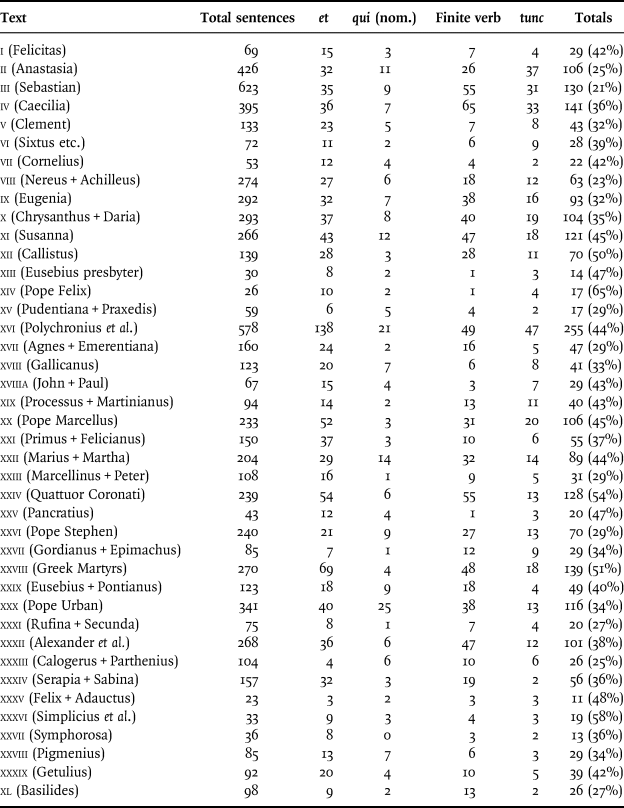
The recurrence of these same four features at the beginnings of sentences in the Roman passiones martyrum can provide a very rough index of the extent to which the authors of these texts have been influenced by biblical narrative. Statistics pertaining to these four kinds of sentence-beginning in the passiones are given in Table 1. The figures in this table are intended simply as a rough indication of the authors’ indebtedness to biblical style; they cannot be regarded as absolute, since there is bound to be disagreement about (for example) what constitutes a sentence.Footnote 12 However, they provide in sum a clear indication of the pervasive influence of biblical style on the Roman passiones martyrum. And this influence must continually be borne in mind when evaluating the Late Latin features which characterise these texts. In the following paragraphs, I identify and discuss a number of features which together provide an indication of the ways in which the Latin language, written (and by implication spoken) at Rome, developed from the early fifth to the late seventh century.
The beginnings of sentences.

(ii) Clause structure
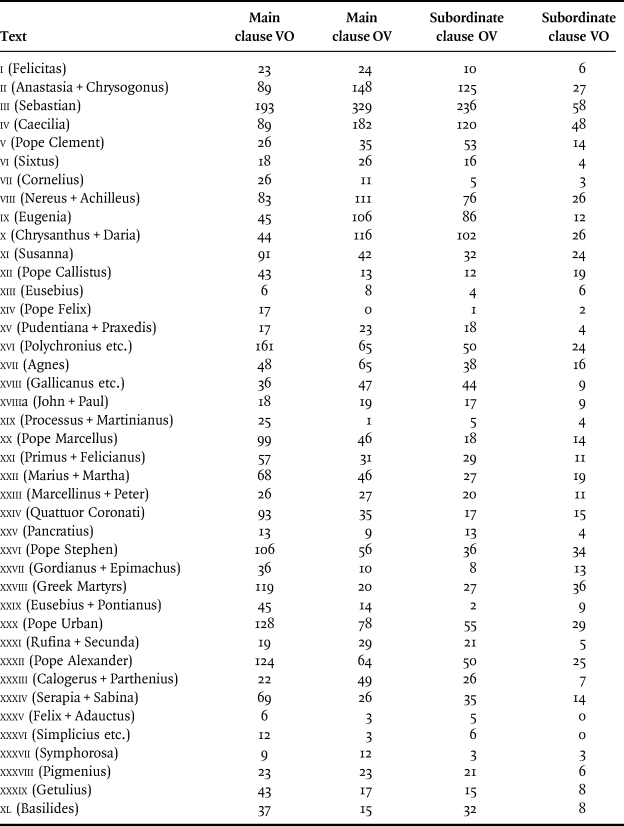
We may begin by considering the syntax of clauses, both main and subordinate. In Classical Latin prose, the optimal syntactical arrangement was for the main verb to be placed at the end of the sentence, and for the object of the verb to be placed before it, as specified in a much-quoted sentence of Quintilian: verbo sensum cludere multo, si compositio patiatur, optimum est (Inst. 9. 4. 26).Footnote 13 This arrangement prevailed both in the main clause (the sequence denoted as OV) and in subordinate clauses, where the sequence OV is also usual.Footnote 14 In later Latin texts, however, there is a noticeable rightward shift of the object,Footnote 15 including all verb satellites (nominal direct objects, object pronouns – whether accusative or dative, prepositional expressions, infinitives dependent on a verb, acc. + inf. constructions),Footnote 16 with a corresponding leftward shift of the finite verb itself, so that the normal sequence becomes VO in main clauses.Footnote 17 Lieven Danckaert, basing himself on a larger corpus of data than has hitherto been assembled by students of Latin clause structure, has qualified this observation by noting that there is no ‘major landslide towards a prominent VO-order’ in Late Latin texts, and that in texts composed after AD 200, clauses with VO-order amount to 30 per cent or less of the total, ‘with the conspicuous exception of five texts, viz. (in chronological order) the Itinerarium Egeriae, Augustine's sermons, samples of the Vulgate, Pompeius’ commentary on Donatus, and the Itinerarium of Antoninus’.Footnote 18 According to Danckaert's statistics, these five Late Latin texts exhibit the order VO in 50 to 80 percent of cases. The discrepancy is probably to be explained in terms either of the educational level of the authors (Egeria/Aetheria and Antoninus) or that of the intended audience (Augustine and Jerome).Footnote 19 In Latin texts composed by well-educated, or elite, authors, whose training was founded on the study of Classical Latin texts in both prose and verse, but particularly on Sallust and Cicero, the classical sequence OV is maintained; but in the writings of less well-educated, or sub-elite,Footnote 20 authors, the sequence VO becomes predominant, especially in main clauses. (In subordinate clauses, however, OV-order continues to prevail.)Footnote 21 This shift was due in some measure to the influence of spoken Latin, but may also have been determined in Christian writings by the influence of the Latin Bible, especially the New Testament, where ‘VO is the predominating order in both types of clauses’.Footnote 22 In Table 2, I record the occurrences of VO and OV-order, in both main and subordinate clauses, in the late Roman passiones martyrum.Footnote 23
Clause structure.

(iii) Placement of the auxiliary (incl. coepi) and complementary infinitive
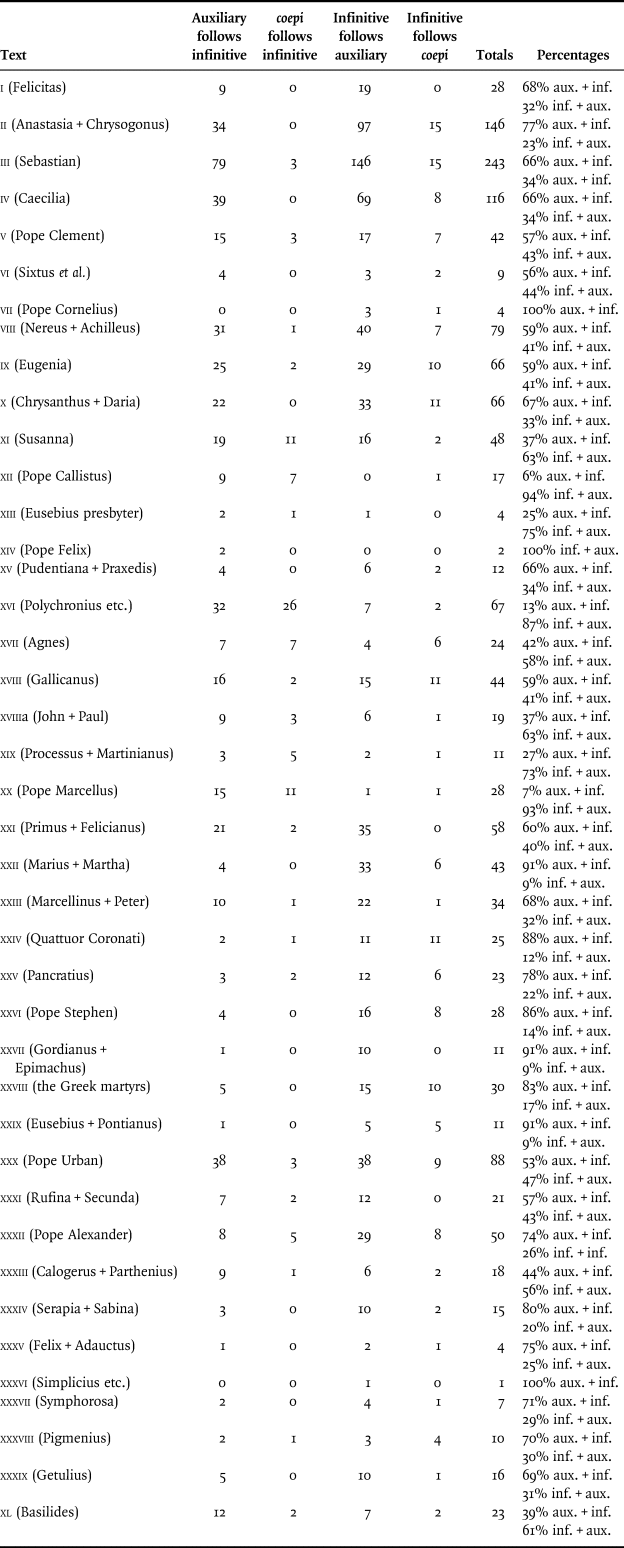
Another aspect of the ‘rightward shift’ of word order in Late Latin texts may be seen in the placement of the infinitive when construed with a modal auxiliary, especially with forms of coepi. Whereas in earlier Latin anteposition of the infinitive is usual, in later Latin texts the auxiliary normally precedes the infinitive.Footnote 24 Postposition of the infinitive is ‘overwhelmingly preferred’ in the Latin New Testament,Footnote 25 and in Romance languages, the sequence auxiliary + infinitive is normal. The question therefore arises as to whether it is possible to observe a marked distinction between the usage in elite Latin texts and in subliterary texts.Footnote 26 The evidence which the late Roman passiones martyrum contribute to this question is set out in Table 3.Footnote 27
Placement of auxiliary (incl. coepi) and complementary infinitive.

(iv) Placement of the dependent genitive
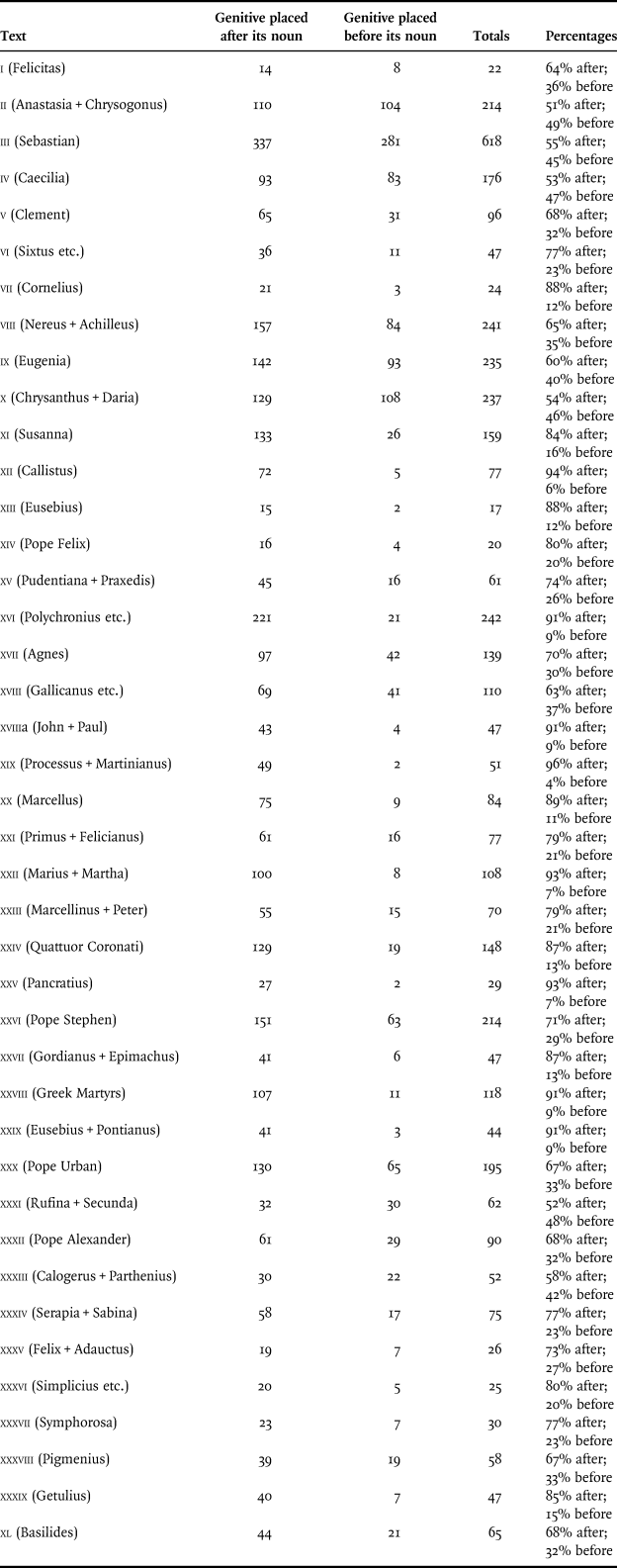
The ‘rightward shift’ of word order witnessed in Late Latin texts is also to be seen in the placement of dependent genitives: whether, that is, the genitive precedes the noun which it modifies, or follows it. Attention was first drawn to this important feature of Late Latin syntax by Adams (Reference Adams1976b: 73–83), and has subsequently come to figure prominently in discussions of Latin word order.Footnote 28 Whereas in Classical Latin authors such as Caesar and Sallust the genitive is placed before its noun in approximately 50 per cent of cases, in informal texts of the Late Latin period one finds an almost ‘mechanical placement of the genitive after its noun’.Footnote 29 Figures for the placement of the genitive in the Roman passiones martyrum are set out in Table 4.
Placement of the genitive.

(v) Constructions with verba dicendi/sentiendi
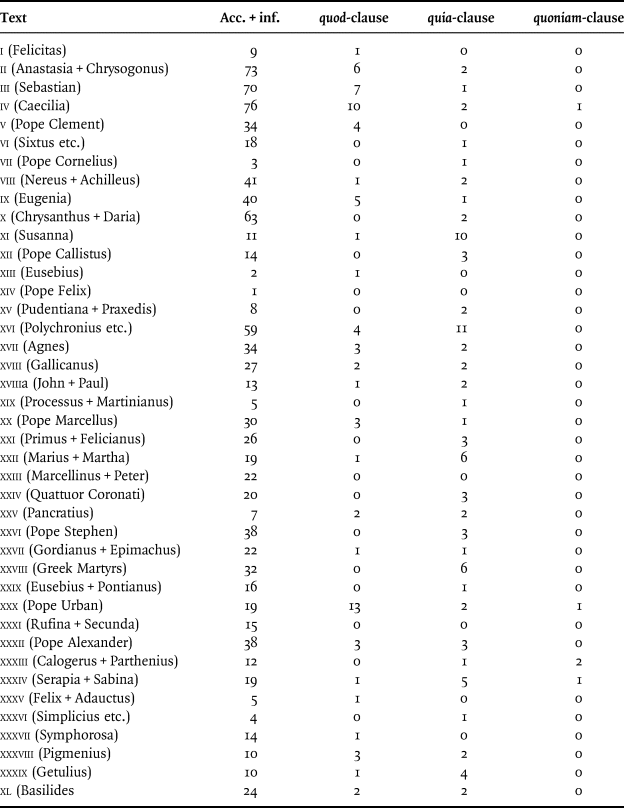
In Classical Latin, the complement or object of active verbs of saying, perceiving, showing, believing, declaring etc. was expressed with the accusative + infinitive construction (abbreviated AcI by some commentators). Even in non-literary or sub-elite Latin, such as the Vindolanda tablets and the letters of Claudius Terentianus, the acc. + inf. was used to the virtual exclusion of quod/quia clauses (Adams Reference Adams, Kiss, Mondin and Salvi2005). From the fifth century onwards, however, the acc. + inf. construction began to be replaced by clauses beginning with quod or quia (or very rarely quoniam), particularly in cases where the complement followed the higher verb. (Where the complement preceded the higher verb, however, the acc. + inf. construction tended to be retained.) József Herman was able to demonstrate, on the basis of samples from Cyprian, Lucifer of Cagliari, the Peregrinatio Aetheriae and Salvian, that in positions following the verb, quod/quia clauses outnumber acc. + inf. by a factor of 2:1, and that these quod/quia clauses were almost never placed before the verbum sentiendi vel dicendi.Footnote 30 Eventually, in Medieval Latin, the construction of quia clauses with verba dicendi became the norm. In the Latin Bible the acc. + inf. construction is exceptionally rare, and is usually replaced by quod, quia or quoniam clauses.Footnote 31 Even in authors who had received a traditional classical education, such as Gregory the Great, the quia/quod constructions encroach on the acc. + inf. in cases where the dependent clause follows the higher verb.Footnote 32 The employment in the Roman passiones martyrum of these various constructions with verbs of saying, perceiving etc. is recorded in Table 5.
Constructions with verba dicendi/sentiendi.

(vi) The indirect object of verbs of speaking
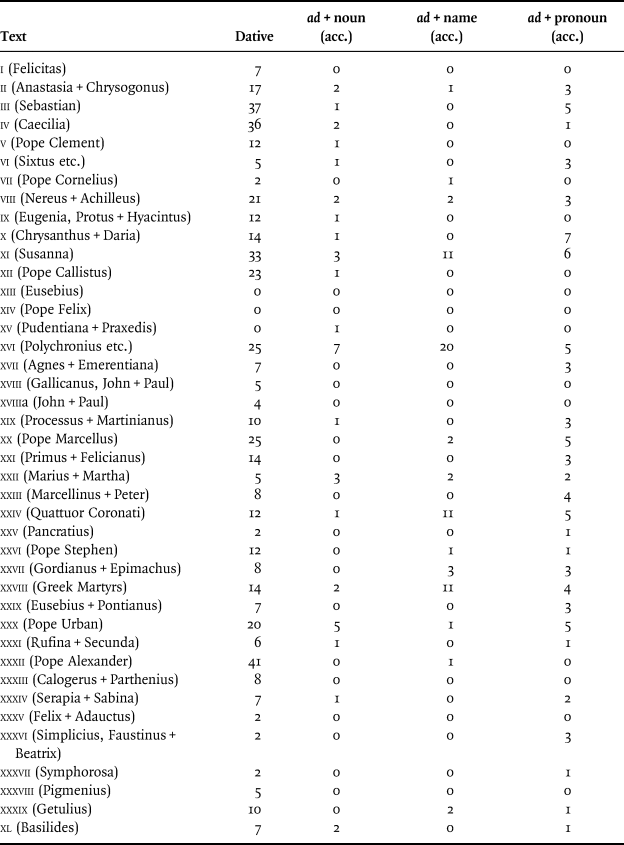
In Classical Latin, the indirect object of verbs of speaking was normally expressed by the dative of the noun or pronoun in cases involving direct address, whereas the construction with ad + acc. was used for address to an audience where projection of the voice towards the listeners is implied.Footnote 33 In Latin texts of a later period, especially from the fifth century onwards, there is a much higher incidence of constructions with ad + acc. This higher incidence has traditionally been explained in terms of influence from spoken Latin, inasmuch as the construction with ad, used to mark an indirect nominal object, continued into the Romance languages, whereas the dative construction was lost.Footnote 34 The development is already to be seen in the Latin Bible, particularly in the Old Testament.Footnote 35 But the process by which ad + acc. came to replace the dative was far from straightforward. In some later Latin texts, the Historia Apollonii for example, there were evidently perceived differences between various verbs of speaking, notably between dico and aio (aio is not suitable for address to an audience). By the same token, there were apparently differences depending on whether the preposition ad was construed with a name, a noun or a pronoun (ad + the pronoun is is normally used with aio, whereas ille is used with the dative).Footnote 36 It is obviously not possible to reflect all this complexity in a single table; in Table 6, I record occurrences in the Roman passiones martyrum of constructions involving verbs of saying, construed either with the dative, or with ad + noun (acc.), ad + name (acc.) and ad + pronoun (acc.).Footnote 37
The indirect object of verbs of speaking.

(vii) Constructions with the preposition in
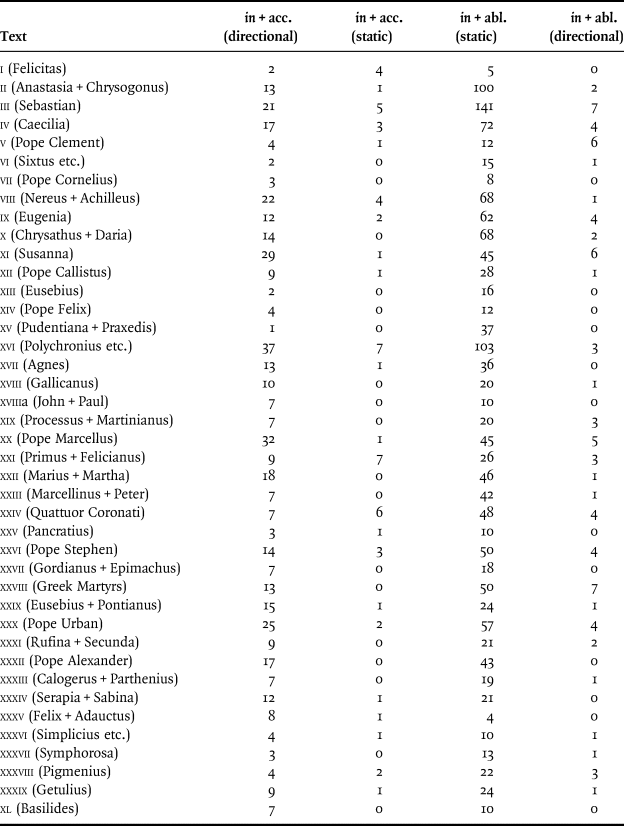
In Classical Latin a clear distinction is made between directional and static use of the preposition in: if it expresses ‘motion towards’ (directional), it is construed with the accusative; if it expresses ‘place at’ (static), it is construed with the ablative.Footnote 38 In Late Latin texts, again perhaps as a reflex of spoken Latin, the classical distinction is often neglected.Footnote 39 The extent to which there is confusion between in (directional) and in (static) in the Roman passiones martyrum may be seen in Table 7.
Constructions with the preposition in.

(viii) Irregular use of suus and eius
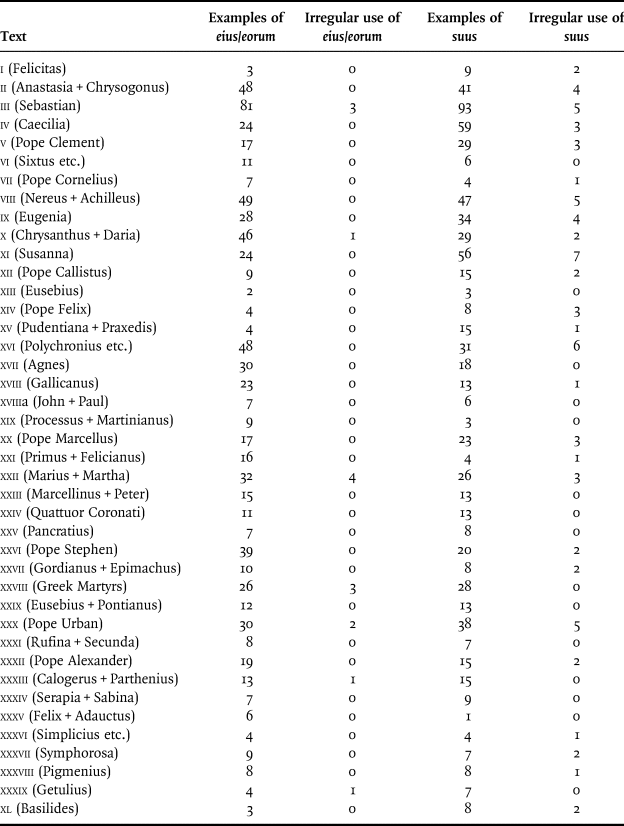
In Classical Latin, there is a clear distinction between reflexive and non-reflexive forms of the third-person pronoun, such that the possessive pronoun suus is used when the possessor, whether singular or plural, is the same as the grammatical subject of the verb (reflexive), whereas eius (and its plural forms, eorum and earum) is used of a possessor other than the grammatical subject of the verb (non-reflexive).Footnote 40 By the Late Latin period, however, this clear distinction was often lost sight of, so that suus was sometimes used non-reflexively where eius would be expected, and (less frequently) eius/eorum were used reflexively where suus would be expected.Footnote 41 In the Romance languages, which represent the continuation of spoken Latin, the third-person pronoun eius had fallen out of use altogether, and this development is clearly seen in Merovingian charters of the seventh and eighth centuries. The Roman passiones martyrum fall chronologically between these points; the confusion in these texts between the reflexive and non-reflexive uses of the third-person pronoun – what is described as ‘irregular’ use – is set out in Table 8.
Irregular use of eius and suus.

(ix) Analytic passives
In Classical Latin, periphrastic passive and deponent forms of the verb were constructed with the appropriate form of esse together with a past participle. In particular, the perfect was formed with a past participle and the present tense of esse (e.g. clausum est); but such forms existed alongside constructions involving a past participle and the past tense of esse (e.g. clausum fuit), and it was the forms with fu- which survived into Romance as the perfect tense (e.g. Ital. la porta fu chiusa). The result was that clausum est came to be recognised as a present tense, and over time replaced the passive form clauditur (e.g. Ital. la porta è chiusa).Footnote 42 In Late Latin texts, however, the perfect is usually constructed with sum (not fui) + past participle, but in other tenses and moods of the passive, fu- forms of esse come to predominate: fueram rather than eram, fuissem rather essem, fuero rather than ero, and fuerim rather than sim.Footnote 43 The various forms of the periphrastic passive and deponent which are found in the Roman passiones martyrum are recorded in Table 9.Footnote 44
Analytic passives.

(x) Third-person pronouns
In Classical Latin, the determinative third-person pronoun is had a function distinct from that of the demonstrative third-person pronoun ille, the latter having clear deictic force. But over time, ille lost its deictic force and came to replace is as the usual third-person pronoun; and it was ille which survived into Romance, whereas is eventually disappeared. The tendency is observable already in the first century, in the Epistulae of Seneca, and in the speech of the freedmen in the Satyrica of Petronius;Footnote 45 and in the letters of Claudius Terentianus (early second century), ille markedly outnumbers is.Footnote 46 It has been shown that Augustine, in literary works such as the Confessiones and De civitate Dei, prefers is, but that in his Sermones, delivered to a popular audience, ille is preferred to is.Footnote 47 The preferences of the authors of the Roman passiones martyrum are recorded in Table 10.
Third-person pronouns.

(xi) Other linguistic phenomena
Finally, there are several linguistic phenomena evidenced in the passiones martyrum which do not fall under the previous headings, and which may conveniently be grouped together:
(a) Use of the enclitic -que. Whereas use of initial Et to link clauses and sentences paratactically may indicate influence from the Latin Bible, as we have seen, the use of enclitic -que to link words and clauses suggests the model of elite Latin prose;Footnote 48 it is, in other words, a feature of literary rather than spoken Latin.
(b) Final placement of adverbs. In Classical Latin prose, the adverb is normally positioned before the verb it modifies, except in certain instances where an adverb is construed in the superlative, in which case it may be positioned at the end of the clause for especial emphasis.Footnote 49 Failure to observe this convention may suggest an author inadequately trained in Classical Latin prose. In any event, the placement of an adverb at the end of a clause is presumably a (minor) aspect of the rightward movement of verb satellites, mentioned earlier.
(c) Construction of ablative absolute clauses with a quia or quod clause. In certain Late Latin texts, an ablative absolute construction may be formed from a past participle such as audito or comperto, followed by a quia or quod clause, as in the following sentence from the Vulgate New Testament (Acts 4:13: comperto quod homines essent sine litteris). Although the construction is frequently to be found in Christian-Latin authors, it occurs (rarely however) in classical authors such as Sallust, Livy and Tacitus.Footnote 50
(d) The use of infinitive + habeo to express futurity. The Classical Latin forms of the future tense did not survive into Romance; Romance forms of the future tense developed from habeo + infinitive constructions.Footnote 51 As J. N. Adams has pointed out on several occasions, it is the sequence infinitive + habeo which develops into the Romance future (cantare habeo > Ital. cantero, Fr. chanterai, etc.).Footnote 52 The construction is found sporadically in Late Latin texts.
(e) Left-detached constructions. When a nominative phrase at the beginning of a sentence stands outside the construction, it is referred to by philologists as ‘left-detached’ (earlier scholars referred to this construction as the nominativus pendens).Footnote 53 In such constructions, the detached element is ‘resumed by a pronoun … expressing the syntactic function of the dislocated element in the predication’.Footnote 54 Such constructions have been associated with the spoken language, in which a speaker first announces the subject, and then expresses the message, linking the message to the announced subject by means of a reference back. Such constructions are found both in Early and Late Latin texts, but it is not clear that they always reflect a spoken idiom.
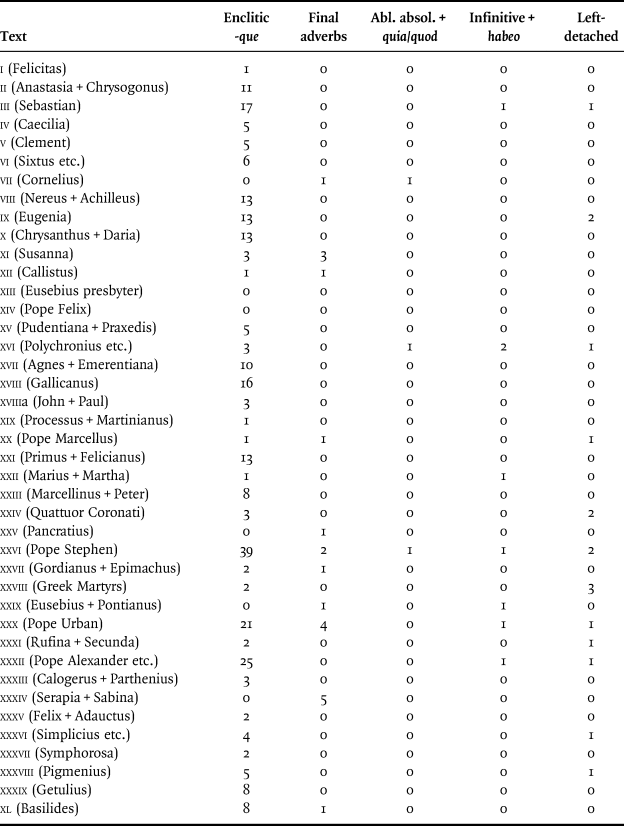
In Table 11, I have recorded occurrences of each of these five linguistic phenomena in the Roman passiones martyrum.
Other linguistic phenomena.
Occurrences of the following linguistic phenomena are recorded in this table:
(a) use of enclitic -que
(b) final placement of adverbs
(c) ablative absolutes constructed with quia or quod clauses
(d) use of infinitive + habeo to express futurity
(e) left-detached sentences

Comment: the Roman Passiones Martyrvm
It remains to discuss the occurrence of these various linguistic features as they are recorded in the accompanying tables.
(i) The influence of biblical Latin
As stated above, the influence of the Latin Bible on the Roman passiones martyrum is pervasive: not only in the large numbers of biblical quotations which they contain (from both Vetus Latina and Vulgate versions), but also in the ways that the arrest, trial and execution of Christian martyrs are modelled on those of Christ in the gospels and of SS Peter and Paul in biblical Acts. Given this wider framework of influence, it is not surprising that the wording of the passiones should also be biblical throughout. One aspect of this influence is shown in Table 1, where it is seen that proportions of sentence-beginnings characteristic of gospel narrative (sentences beginning with Et, nominative Qui, finite verbs, Tunc) range from about one fifth (iii: 21%) to one half and more (xii: 50%; xxiv: 54%; xxviii: 51%). Although none of these figures approaches that recorded for the narrative passage from the gospel of Matthew quoted above (4:1–11), where nearly four fifths (79%) of all sentences were seen to begin with one of the characteristic formulas, the debt to this aspect of biblical language is nevertheless striking. Overall, more than a third of all sentences in the passiones martyrum begin with these formulas (2,582/7,192: 35.9%). These statistics probably have little meaning in themselves, and certainly cannot be used (say) to assess increase or decrease in dependency on the Latin Bible over the three centuries during which the texts were composed, but they serve as a crude indication of the extent to which the authors of the passiones martyrum were influenced by biblical language. This influence must always be borne in mind when evaluating other aspects of the language of the passiones martyrum treated in the following paragraphs.
(ii) Clause structure
As we have seen, in main clauses in Classical Latin, it was normal to place the main verb at the end of the clause following the (subject and) object, the sequence denoted as OV.Footnote 55 In Late Latin texts, however, especially those composed by authors who had not received the highest training in Latin, and perhaps increasingly as a reflex of spoken Latin, the object tends to be placed at the end of the clause, following the verb (the sequence denoted as VO). In subordinate clauses, on the other hand, the classical order OV continues to prevail. These tendencies are well illustrated by the Roman passiones martyrum (see Table 2). In texts certainly composed before c. 500 (ii–vi, viii–x), the sequence OV predominates in main clauses, often by a substantial margin (roughly 2:1). By the same token, OV-order also predominates in subordinate clauses in these texts, by a similar (or even larger) proportion than that attested in main clauses (e.g. ii (5:1), viii (3:1), ix (7:1), x (4:1)). But it will be noted that these texts – especially those by Arnobius Iunior (iii–iv) as well as nos. ii and viii–x – were composed by authors who were evidently beneficiaries of a high level of training in Latin; their Latin, in other words, may be described as ‘elite’. After c. 500, the picture is distinctly different. With very few exceptions – nos. xv, xvii, xviii and xxxiii, whose anonymous authors appear to have been well educated – in texts composed after c. 500 the sequence VO in main clauses comes to predominate, usually by a proportion of 2:1 or 3:1, and sometimes by even larger proportions (e.g. xxviii (6:1)). In subordinate clauses, however, the sequence OV continues to be preferred, usually by a proportion of 2:1 or more (e.g. no. xxxii (50:25)). The only significant exception to this general tendency in subordinate clauses is seen in nos. xxvii and xxviii, where the sequence VO predominates over the more usual OV. (These two texts probably date from the first half of the seventh century.) In sum, the structure of main clauses in the Roman passiones martyrum shows a distinct tendency towards VO-order in the period after c. 500; but that of subordinate clauses remains largely OV.
(iii) Placement of the auxiliary (incl. coepi) and complementary infinitive
It was customary in Classical Latin to place the infinitive before the auxiliary with which it was construed; but in Late Latin, it became increasingly common for the infinitive to be placed after its auxiliary. For example, postposition of the infinitive is usual in the Latin New Testament. And similar postposition was also presumably a feature of spoken Latin, to judge from the syntax of modern Romance languages (Fr. je voudrais aller, Ital. vorrei andare etc.). The Roman passiones martyrum reflect this tendency, on the whole (see Table 3). In those texts which can be dated fairly securely to the fifth century, and which were evidently composed by educated authors, in approximately 60–70% of cases the infinitive is placed after the auxiliary: iii: 66%; iv: also 66% (and recall that both iii and iv were composed by the one educated author, Arnobius Iunior); v: 57%; viii: 59%; ix: 59%; and x: 67%. In texts probably composed in the seventh century, the proportion of postpositioning of infinitives rises dramatically to approximately 80–90%: xxii: 91%; xxiv: 88%; xxvi: 86%; xxviii: 83%; xxix: 91%; and xxxiv: 80%. However, there are no grounds for supposing a steady progression in postpositioning from the fifth century through the seventh, for several texts dating probably from the late fifth and early sixth centuries reveal the opposite tendency: xii, with only 6% of infinitives after the auxiliary, as against 94% before; xvi, with 13% after and 87% before; and xx, with 7% after and 93% before. It is difficult to explain exceptions such as these three in terms of the educational level or conservatism of the texts’ authors, for in other respects the syntax of these three passiones reveals the ‘rightward shift’ (VO-order, genitive placed after its noun etc.) seen in other Late Latin texts.
(iv) Placement of the dependent genitive
Another measurable aspect of the ‘rightward shift’ in Latin syntax is illustrated in Table 4, namely the placement of the dependent genitive in relation to its noun. As may be seen from the table, up until c. 500 AD, especially in authors who had evidently received higher training in Latin, the proportion of placement before the noun (as in Classical Latin) to placement after is approximately half and half: for example, ii (51% after, 49% before), iii (55% after, 45% before), iv (53% after, 47% before) and x (54% after, 46% before). That is to say, the proportions remain virtually the same as in Classical Latin prose (roughly 50:50). After about AD 500, however, there is a pronounced shift to placement of the dependent genitive after its noun, with proportions of postposition regularly reaching 80%, and often 90% and more: xi (84% after), xii (94% after), xvi (91% after), xix (96% after), xxii (93% after), xxiv (87% after), xxv (93% after), xxviii (91% after), etc. Only rarely is the half-and-half proportion of pre- and postposition found in texts that are probably to be dated to the seventh century: xxxi (52% after, 48% before) and xxxiii (58% after, 42% before). In no Roman passio does placement of the genitive before its noun exceed 50%. Possibly the two exceptions to the general tendency (xxxi and xxxiii) are to be explained in terms of the education of the authors in question. But in all other cases the ‘rightward shift’ seen in the placement of the genitive is clearly attested.
(v) Constructions with verba dicendi/sentiendi
In Classical Latin, verbs of saying, perceiving etc. were construed with the accusative + infinitive; but these acc. + inf. constructions were ultimately replaced, probably as a reflex of spoken Latin, by dependent clauses beginning with quod or quia, particularly when these clauses follow the head verb. This much seems clear from the fact that the acc. + inf. construction does not survive into the Romance languages. As we have seen, the process of replacement is already to be seen in the Latin Bible, where acc. + inf. constructions are rare, and are usually replaced by quod or quia clauses. One might expect, therefore, that the Roman passiones martyrum – which in other respects are heavily influenced by the language of the Latin Bible – would show a high proportion of quod and quia clauses construed with verba dicendi/sentiendi. Surprisingly, as is clear from Table 5, the opposite is the case: the use of acc. + inf. constructions vastly outnumbers the use of quod and quia clauses in virtually all passiones, dating from the early fifth century through to the late seventh and beyond, sometimes by a proportion of 10:1 or more: ii (73:8), iii (70:8), iv (76:12), viii (41:3), ix (40:6), x (63:2), etc. Only in one passio – the Passio S. Susannae (xi), arguably to be dated to the second half of the fifth century – does the use of quod and quia clauses reach parity with that of acc. + inf. constructions (11:11). It would appear that, at least in respect of this syntactical feature, the authors of passiones martyrum departed from the stylistic model of the Latin Bible and adhered closely to the practice of Classical Latin authors.
(vi) The indirect object of verbs of speaking
In Classical Latin, there was a clear distinction between the use of constructions with verbs of speaking in ad + acc. when projection of the voice (to an audience) was implied, whereas in normal conversation the indirect object was expressed by the dative. But in Late Latin, the distinction tended to be lost, and constructions with ad + acc. became more frequent, probably as a reflex of spoken Latin (the dative construction did not survive into Romance). However, this general tendency towards constructions with ad + acc. is not attested in the Roman passiones martyrum (see Table 6): in these texts constructions with the dative vastly outnumber those in ad + acc., not only in fifth-century texts composed by well-educated authors, but in texts of the sixth and seventh centuries as well, as, for example, in Arnobius Iunior, Passio S. Sebastiani (iii): 37 dative, 6 ad + acc.; Passio S. Caeciliae (iv): 36 dative, 3 ad + acc. There are only four passiones in which constructions with ad + acc. outnumber those with the dative: xvi (32 ad + acc. as against 25 dative), xxii (7 ad + acc. as against 5 dative), xxiv (17 ad + acc. as against 12 dative), and xxviii (17 ad + acc. against 15 dative). Furthermore, in these four texts, as will be seen from Table 6, the ad + acc. construction is mostly used with a personal name, so it cannot be argued that projection of the voice is implied. Nor does the evidence of Table 6 suggest that there was a chronological progression over three centuries towards the use of ad + acc. constructions, for the dative construction still overwhelmingly outnumbers ad + acc. in texts probably composed in the seventh century (e.g. xxxii: 41 examples of the dative against 1 ad + acc.). The most probable explanation of these figures is that the authors of the four passiones in which ad + acc. constructions predominate (xvi, xxii, xxiv, xxviii) had received a lower level of training in Latin, and were more susceptible to influence from the spoken language than were their better-educated contemporaries.
(vii) Constructions with the preposition in
Whereas in Classical Latin it was normal to construe the preposition in with the accusative to denote direction towards a place, but in with the ablative to denote static position within the place, this clear distinction was often confused in Late Latin, possibly as a reflex of spoken Latin. It will be seen from Table 7 that there is a small amount of confusion between these constructions in the Roman passiones martyrum, even in authors who were beneficiaries of a high level of education: note, for example, that Arnobius Iunior in the Passio S. Sebastiani (iii) uses in + acc. with static sense × 5 (against × 21 used correctly with directional sense), and then in + abl. × 7 with directional sense (as against × 141 used correctly with static sense); similar proportions are seen in nos. ii, v, viii, ix and x. There are larger proportions of confusion between static and directional meanings of in in some of the passiones, notably nos. xvi, xxi, xxiv, and xxviii (these are texts by authors who, as we have seen, were beneficiaries of a lower level of Latin training, and may have been subject to influence from spoken usage). However, it is fair to say that, by and large, the authors of the passiones martyrum – from the fifth century through the seventh – construed the preposition in correctly as to directional and static sense. Certainly there is no evidence in these texts that ‘prepositions are used indiscriminately with the accusative and ablative’.Footnote 56
(viii) Irregular use of eius and suus
As we have seen, there was in Classical Latin a clear distinction between reflexive and non-reflexive usage of the possessive pronoun, with suus being used reflexively when the subject of the verb is identical with the possessor, but eius (and its plural forms) being used non-reflexively when the subject of the verb is not the possessor. In Late Latin texts, even those composed by highly literate authors such as Jerome, the distinction was often overlooked. In spoken Latin, eius and its plural forms must at some point have fallen out of use, for eius does not survive into the Romance languages: a development which is reflected in Merovingian Latin texts of the seventh and eighth centuries, where eius has been entirely replaced by suus. However, to judge from the data in Table 8, this development is not attested in the Roman passiones martyrum. Although there is occasional irregular use of suus (in cases where eius would be expected), even in the well-educated authors of nos. ii–v and viii–x, and likewise in the less well-educated authors of nos. xi, xvi, xx and xxx, on the whole the authors of the passiones martyrum maintained the Classical Latin distinction between reflexive and non-reflexive use of the possessive pronoun, even in texts composed well into the seventh century, and roughly contemporary with the Merovingian texts in which the distinction had been lost. In this respect at least, the passiones show a conservative tendency against the trend of contemporary (and spoken) Latin.
(ix) Analytic passives
In Classical Latin, passive and deponent forms of the present tense were formed with desinences in -r/-ur (e.g. clauditur), and the perfect was formed with the past participle of the verb combined with the present tense (conjugated appropriately) of the verb esse (e.g. clausus est). In Late Latin, the perfect tense continued to be formed with the present tense of esse, but other tenses (and moods) were usually formed from the past tense of esse – from the so-called fu- forms (fuit, fuerat, fuerit, fuisset, fuisse). Over time present passive and deponent forms with the desinences -r/-ur disappeared (they do not survive into Romance), and were replaced by analytic forms consisting of the past participle and the present tense of esse, so that (e.g.) clausus est came to be treated as if it were an adjective construed with the present form of esse. As a reflex of this development, presumably, perfect forms were constructed with the past tense of esse (e.g. clausus fuit), and these forms survived into Romance (e.g. Ital. il negozio fu chiuso). Some, but not all, of these developments are witnessed in the Roman passiones martyrum (Table 9). As in Classical Latin, the perfect tense is regularly formed with the past participle + the present form of esse; analytic passives constructed with the past tense of esse (clausus fuit) are exceptionally rare (ix (× 2), xvi (× 2), xxx (× 2); scattered single occurrences elsewhere) and are vastly outnumbered by forms of the type amatus est (844 occurrences). On the other hand, all other tenses, both indicative and subjunctive, are regularly constructed with fu- forms (amatus fuerat/fuerit/fuisset/fuisse), whereas forms constructed with past participle + -es forms (erat/sit/esset/esse) are much less common. Leaving aside the perfect tense (amatus est/fuit), the fu- forms outnumber the es- forms by a factor of roughly 3:1 (296:105). In other words, the construction of analytic passives in the passiones martyrum is wholly consonant with the practice observed elsewhere in Late Latin texts.
(x) Third-person pronouns
Beginning as early as the first century AD, and developing more prominently in Late Latin, was a tendency for the demonstrative third-person pronoun ille (and its oblique cases – illius, illi etc.) to lose deictic force and ultimately to replace the simple determinative pronoun is (and its oblique cases – eius, eo etc.), with the result that forms of is did not survive into Romance. In light of the Romance development, the preference for ille over is is presumably to be regarded as an aspect of the influence of the spoken language on Late Latin. The evidence of the Roman passiones martyrum suggests that this development was not straightforward. The statistics presented in Table 10 indicate that the preference for forms of ille did not embrace all grammatical cases. In the nominative case (both singular and plural), ille and illi – and of course the corresponding feminine and neuter forms – appear to have replaced is and ii almost entirely. This tendency is already marked in the passiones martyrum of well-educated fifth-century authors: for example, ii (8 ille, 1 is; 7 illi, 0 ii); iii (19 ille, 1 is; 7 illi, 0 ii); iv (14 ille, 0 is; 5 illi, 0 ii); viii (2 ille, 0 is; 2 illi, 0 ii); ix (4 ille, 0 is; 1 illi, 0 ii); and x (4 ille, 0 is; 4 illi, 0 ii). And the tendency continues through the sixth and seventh centuries: see, for example, xxxii (6 ille, 0 is; 3 illi, 0 ii) and xxxiv (2 ille, 0 is; 3 illi, 0 ii). With the oblique cases of these pronouns, however, the situation is the reverse: oblique cases of is (both singular and plural) vastly outnumber oblique cases of ille, to the point that certain plural forms such as illorum almost never occur. Even counting nominative cases – of which, as we have just seen, forms of is/ii occur rarely if at all – forms of is outnumber those of ille by a factor of 5–10:1. Possibly this phenomenon is to be explained in terms of the conservatism of well-educated (and even of less well educated) authors. But it is also possible that the avoidance of the monosyllabic and weak nominative forms is and ii is a parallel development to the avoidance of monosyllabic and weak forms of the verb eo (i, is, it etc.), which came to be replaced by compound forms (abeo, exeo) and the verb vado.Footnote 57
(xi) Other linguistic phenomena
Finally there are various features which help to throw light on the question of whether the Roman passiones martyrum belong to the conservative tradition of Classical Latin, or whether, like other sub-elite or informal texts, they reflect the influence of spoken Latin (Table 11). (Here, too, the possible influence of biblical Latin must always be borne in mind.) First, the use of enclitic -que, which is a marker of literary rather than spoken Latin (enclitic -que is not preserved in the Romance languages). Of the forty-one passiones martyrum, all but a few show frequent, and often excessive, use of -que (note, for example, the figures for nos. xxvi and xxxii, both probably to be dated to the first half of the seventh century). The few exceptions are either texts which are very short (vii, xiii–xiv, xxv), or show the influence of spoken Latin in other ways. The other four features recorded in Table 11 are less determinative. A few texts have examples of adverbs positioned at the end of clauses: xi (× 3), xxvi (× 2), xxx (× 3) and xxxiv (× 5); in the remaining thirty-seven texts, final adverbs occur only sporadically, if at all. The hybrid construction of an ablative absolute with a quia clause also occurs only sporadically, and is not found in thirty-eight of the forty-one texts. The construction of the infinitive with a form of habeo, which is an obvious reflex of spoken Latin and anticipates the conjugations of the future tense in Romance languages, occurs twice in one text (xvi), with single occurrences in five other texts, but is not found at all in thirty-five of the forty-one texts. Left-detached sentences are rarely found in the passiones martyrum: there are three examples in one text (xxviii), two in another (xxvi), and single occurrences in eight others; but in thirty-one of the forty-one texts there is no example. In sum, the phenomena recorded in Table 11 shed little light on the question of influence from spoken Latin; if anything, they reveal that a majority of the Roman passiones martyrum are composed not in informal (sub-elite) Latin, but in formal Latin of a conservative nature.
In any overall assessment of the language of the Roman passiones martyrum, several considerations need to be borne in mind. With the exception of two of these texts (iii–iv), which have been attributed convincingly to Arnobius Iunior, who was resident at the monastery of S. Sebastiano on the Via Appia between c. 430 and c. 450, the remainder are anonymous. Most of the anonymous authors were apparently resident in Rome; many will have been custodians either of the urban titulus-churches or suburban cemeteries which housed the martyrs’ remains. In a few cases, the shrines in question were located at some distance from Rome, on one or other of the arterial roads which led into the city: nos. xxxi (Via Cornelia, ninth mile), xxxii (Via Nomentana, seventh mile), xxxvii (Via Tiburtina, ninth mile), xxxix (Via Salaria, thirtieth mile), xl (Via Aurelia, twelfth mile). The anonymous authors, in other words, were either from Rome itself, or from its immediate vicinity. Then there is the question of dating. Most of the texts can be dated only approximately – either by means of internal references to papal sponsorship of building works at the shrines, which is known from historical sources such as the Liber pontificalis; or from supposed allusions to historical events recorded in contemporary sources, such as allusions in nos. xiii–xiv to the papal schism of 498–514; or from apparent verbal debts in the texts to earlier passiones. On the basis of evidence such as this, a very rough chronology can be established for all of the passiones. A few texts can thus be dated fairly reliably to the fifth century: nos. ii, iii–iv (whose author is known from other sources), v and viii–x. From the late fifth century onwards, however, dating becomes far less reliable, and datings from the sixth and seventh centuries are more or less conjectural. The relative chronology of the passiones must therefore be used with extreme caution as an index of developments in the Latin language.Footnote 58 Equally uncertain is the question of the educational level of the anonymous authors. Arnobius Iunior was evidently the beneficiary of a high level of education, presumably at the hands of a rhetor in Africa whence he came; and a similar level of education may be assumed from the fifth-century authors of nos. ii, v and viii–x, to judge from the quality of their Latin, their frequent reminiscences of Vergil and Ovid, their learned vocabulary (use of unusual agentive nouns in -or, Greek loanwords etc.), and so on. But similar assumptions cannot be made for authors of passiones which were arguably composed after c. 500. It is in texts composed after c. 500 that the influence of spoken Latin becomes more readily detectable.
Another factor which needs to be borne in mind when assessing the evidence of the accompanying tables is the nature of the manuscript transmission of these Roman passiones martyrum. No text is preserved in a manuscript contemporary with the presumed date of composition. In many cases they are preserved in manuscript passionals dating from no earlier than the ninth century, and often much later; and it is a characteristic of compilers of such passionals to revise the texts they include according to their own sense of style. Furthermore, this tendency to revision was prompted by the nature of the texts themselves. Whereas the text of a Classical Latin author such as Vergil would be copied conscientiously ad litteram – and the same is true of Late Latin hagiographical texts by authors such as Jerome and Sulpicius Severus – texts composed in sub-elite Latin such as (most of) the passiones martyrum would be subject to scribal interference of various kinds.Footnote 59 Such interference would be most likely to occur in the copying of local prepositions (in + acc. vs abl.), possessive pronouns (eius vs suus), analytic passives (es- forms vs fu- forms) and third person pronouns (is vs ille): Tables 7–10. (Scribal interference seems to occur less frequently with larger syntactic constructions, such as the acc. + inf. construction.) Unfortunately, it is not possible to exert any control over scribal interference of this sort: the passiones martyrum are typically transmitted in huge numbers of manuscripts (e.g. nos. iii: 500+ MSS, and xvii: 450+ MSS), which throw up many thousands of variants. Even if it were feasible to collate all manuscripts of a single passio (it is not), it is practically impossible to distinguish in detail what is authorial from what is scribal. The prospective editor can hope to establish a text that is grammatically sincere, but can have no confidence in having determined the author's ipsissima verba at every point.Footnote 60
It must also be stressed that the statistics in the tables provide at most a very rough indication of developments in the language. Table 2, for example, broadly illustrates developments in constituent order, in both main and subordinate clauses, from OV to VO-order; but these crude statistics cannot, of course, take account of ‘pragmatic’ determinants in individual sentences (focus, emphasis, topic, placement of pronouns, ellipsis etc.) which have been much discussed recently by students of Latin syntax belonging to what might be called the ‘Amsterdam school’ (Panhuis, Pinkster, Spevak and others).Footnote 61 It remains to be seen whether fine-grained syntactical analysis of ‘pragmatic’ determinants in the passiones martyrum would alter the crude picture presented by the statistics in Table 2. Similarly with the statistics for genitive placement in Table 4: once again the crude statistics take no account of numerous factors determining placement which have been analysed so thoroughly by McLachlan – information structure, grammatical function of the genitive (i.e. whether possessive, partitive, subjective), discontinuity, lexical category (noun, pronoun), animacy (human referent), presence of the preposition, distinction between narrative and dialogue, number of the genitive (singular or plural), and so on.Footnote 62 Finally, the statistics presented in Table 6 concerning the indirect object of verbs of speaking (whether construed with the dative or with ad + acc.) are clearly susceptible of much more fine-grained analysis as to whether the addressee is a single person or a larger audience (i.e. whether projection of the voice is implied), whether the verb in question is aio or dico or some other verb, whether in cases where the indirect object is a pronoun, whether that pronoun is is or ille, and so on. And no doubt the statistics presented in the remaining tables could be the subject of further refinement.
The various evidence set out in the accompanying tables nevertheless helps to illustrate linguistic developments during the Late Latin period. In texts composed before c. 500 (ii–vi, viii–x), OV-order predominates in main clauses by a proportion of roughly 2:1, but after that date – and with the exception of a very few texts (xv, xvii–xviii, xxxiii) – VO-order predominates in main clauses by proportions of 2:1 or 3:1, and sometimes by as much as 6:1 (Table 2). Analogous to this development is the tendency to place the infinitive after the auxiliary (Table 3): in fifth-century texts (iii–v, viii–x), the infinitive is placed after the auxiliary in just over half of the cases (c. 60%), but in seventh-century texts (xxii, xxiv–xxvi, xxviii–xxix, xxxiv), the proportion rises to as much as 80–90%. Similarly with the placement of dependent genitives in relation to their nouns (Table 4): before c. 500, about half the genitives are placed before their noun, and half after; but after that date, there is a dramatic shift to placement of the genitive after its noun, with figures reaching 80–90% and more. Possibly these developments reflect the influence of spoken Latin; possibly they also reflect deterioration in the standard of Latin education available after the beginning of the sixth century.
But in other respects, the passiones martyrum are surprisingly conservative. Whereas in many Late Latin texts, constructions with verbs of saying/thinking come increasingly to involve quod and quia clauses, the passiones largely maintain constructions with acc. + inf. (Table 5). So, too, with verbs of speaking involving an indirect object: constructions with the dative are largely preferred to constructions with ad + acc. (Table 6). Although some Late Latin texts show a preference for forms of ille over is, the passiones show a marked preference for forms of is in all cases except the nominative (Table 10). And, with few exceptions, in paratactic constructions the passiones martyrum retain the literary use of the enclitic -que, although its use eventually disappeared from spoken Latin.Footnote 63
Several considerations arise. Although some features elsewhere associated with the influence of spoken Latin – VO-order in main clauses, placement of the infinitive after the auxiliary, placement of the dependent genitive after its noun – are well attested in the passiones martyrum, particularly in those dating from the sixth and seventh centuries, in other respects they preserve the practices of Classical Latin authors (retention of acc. + inf. constructions with verbs of saying/thinking, use of the dative as indirect object of verbs of speaking, use of the enclitic -que). In view of these conservative practices, it would seem inappropriate to describe the Latin of the Roman passiones martyrum as sub-elite or informal. Obviously the authors of these texts were influenced to some extent by developments in the spoken language, particularly during the period after c. 500. But the differences between texts composed before and after c. 500 are probably best explained in terms of educational attainment: some custodians of martyrial shrines – the presumed authors of the later passiones martyrum – were simply less well educated than authors such as Arnobius Iunior. But they were nevertheless well enough educated to use acc. + inf. constructions and the dative case with verbs of speaking, however they may have spoken in daily conversation. In sum, the passiones martyrum provide valuable evidence for developments in the Latin language at Rome itself during the period roughly 425 to 675, but their evidence must be used with caution.Footnote 64
Appendix: Texts and editions
i. Passio SS. Felicitatis et septem filiorum eius [BHL 2853; CPL 2187]: ed. B. Mombritius, Sanctuarium, cur. monachi Solesmenses, 2 vols., Paris 1910, i, p. 549; ed. Acta Sanctorum, Iulii iii [1723], pp. 12–13; ed. K. Künstle, Hagiographische Studien über die Passio Felicitatis, Paderborn 1894, pp. 60–3; trans. with commentary, Lapidge (Reference Lapidge2018) 45–53. [date: c. 420]
ii. Passio SS. Anastasiae et Chrysogoni [CPL 2163]: ed. H. Delehaye, Étude sur le légendier romain. Les saints de novembre et de décembre, Brussels 1936, pp. 221–49; ed. and trans. P. Moretti, La ‘Passio Anastasiae’. Introduzione, testo critico, traduzione, Rome 2006; trans. with commentary, Lapidge (Reference Lapidge2018) 54–87. [date: c. 425]
iii. Arnobius Iunior, Passio S. Sebastiani [BHL 7543; CPL 2229]: ed. Acta Sanctorum, Ianuarii ii [1643], pp. 265–78; trans. with commentary, Lapidge (Reference Lapidge2018) 88–137. [date: 430–50]
iv. Arnobius Iunior, Passio S. Caeciliae [BHL 1495; CPL 2171]: ed. H. Delehaye, Étude sur le légendier romain. Les saints de novembre et de décembre, Brussels 1936, pp. 194–220; trans. with commentary, Lapidge (Reference Lapidge2018) 138–64 [date: c. 450]
v. Passio S. Clementis papae [BHL 1848; CPL 2177]: ed. B. Mombritius, Sanctuarium, i, pp. 341–4; ed. C. Narbey, Supplément aux Acta Sanctorum pour les vies de saints de l’époque mérovingienne, 2 vols., Paris 1899–1912, ii, pp. 333–6; ed. A. Fábrega Grau, Pasionario hispánico (siglos vii–xi), 2 vols., Madrid 1953–5, ii, pp. 40–6; collated with: Bamberg, Staatsbibliothek, Misc. Hist. 139 (?Bamberg, s. xii2/4), fos. 73v–76r; Cambridge, Corpus Christi College 9 (Worcester, s. xi med.), fos. 170r–172r; Munich, Bayerische Staatsbibliothek, Clm. 4554 (Benediktbeuern, s. viii3/4), fos. 42v–45v; and Paris, Bibliothèque nationale de France, lat. 5299 (?Saint-Germain, s. ix2/4), fos. 95v–101r; trans. with commentary, Lapidge (Reference Lapidge2018) 165–79. [date: c. 450]
vi. Passio SS. Sixti papae, Laurentii et Hippolyti (passio vetus) [BHL 7811]: ed. P. A. de Lagarde, Hippolyti Romani quae feruntur omnia graece, Leipzig 1858, pp. xiii–xvi; ed. G. N. Verrando, ‘Passio SS. Xysti, Laurentii et Yppoliti. La trasmissione manoscritta delle varie recensioni della cosidetta Passio vetus’, Recherches augustiniennes 25 (1991) 181–221; trans. with commentary, Lapidge (Reference Lapidge2018) 180–94. [date: 450–500]
vii. Passio S. Cornelii papae [BHL 1958; CPL 2180]: ed. Mombritius, Sanctuarium, i, p. 373; collated with Paris, Bibliothèque nationale de France, lat. 5299 (?Saint-Germain, s. ix2/4), fos. 79v–81v; trans. with commentary, Lapidge (Reference Lapidge2018) 195–200. [date: 450–500]
viii. Passio SS. Nerei et Achillei [BHL 6058–66; CPL 2214]: ed. Acta Sanctorum, Maii iii [1680], pp. 6–13; trans. with commentary, Lapidge (Reference Lapidge2018) 201–27. [date: 450–500]
ix. Passio SS. Eugeniae, Proti et Hyacinthi [BHL 2267; CPL 2184]: ed. Mombritius, Sanctuarium, ii, pp. 391–7, collated with: St Gallen, Stiftsbibliothek, 577 (St Gallen, s. ix/x), pp. 515–34, and London, British Library, Add. 29630 (Spain [?Burgos], s. xii), fos. 141v–148r; trans. with commentary, Lapidge (Reference Lapidge2018) 228–49. [date: 475–500]
x. Passio SS. Chrysanthi et Dariae [BHL 1787; CPL 2171a]: ed. Mombritius, Sanctuarium, i, pp. 271–8; ed. Acta Sanctorum, Octobris xi [1861], pp. 469–84; ed. J. Floss, ‘Die Passion, die Uebertragung, und die Wunder der hh. Chrysanthus und Daria’, Annalen des historischen Vereins für den Niederrhein 20 (1869) 156–70; trans. with commentary, Lapidge (Reference Lapidge2018) 250–69. [date: c. 475–500]
xi. Passio S. Susannae [BHL 3937; CPL 2237]: ed. Mombritius, Sanctuarium, ii, pp. 553–9; ed. Acta Sanctorum, Februarii iii [1658], pp. 61–4 (cc. 1–23), and Augusti ii [1735], pp. 631–2 (cc. 24–9); collated with Karlsruhe, Badische Landesbibliothek, Aug. perg. 32 (Reichenau, s. ix2/4), fos. 10v–14r; trans. with commentary, Lapidge (Reference Lapidge2018) 270–86. [date: c. 450–500]
xii. Passio S. Callisti papae [BHL 1523; CPL 2173]: ed. Mombritius, Sanctuarium, i, pp. 268–71; ed. Acta Sanctorum, Octobris vi [1794], pp. 439–41; collated with Karlsruhe, Badische Landesbibliothek, Aug. perg. 32 (Reichenau, s. ix2/4), fos. 22v–24r; trans. with commentary, Lapidge (Reference Lapidge2018) 287–96. [date: c. 480–500]
xiii. Passio S. Eusebii presbyteri [BHL 2740]: ed. Mombritius, Sanctuarium, i, p. 459; ed. Acta Sanctorum, Augusti iii [1737], pp. 166–7; collated with Karlsruhe, Badische Landesbibliothek, Aug. perg. 32 (Reichenau, s. ix2/4), fo. 15r, and Paris, Bibliothèque nationale de France, lat. 5299 (?Saint-Germain, s. ix2/4), fos. 73r–74v; trans. with commentary, Lapidge (Reference Lapidge2018) 297–302. [date: 498–506]
xiv. Passio S. Felicis II papae [BHL 2857]: ed. Mombritius, Sanctuarium, i, pp. 550–1; ed. G. N. Verrando, ‘Liberio – Felice. Osservazioni e rettifiche di carattere storico-agiografico’, Rivista di storia della Chiesa in Italia 35 (1981) 91–125; collated with Karlsruhe, Badische Landesbibliothek, Aug. perg. 32 (Reichenau, s. ix2/4), fos. 5v–6r, and Paris, Bibliothèque nationale de France, lat. 5299 (?Saint-Germain, s. ix2/4), fos. 36r–37v; trans. with commentary, Lapidge (Reference Lapidge2018) 303–6. [date: 498–506]
xv. Passio SS. Pudentianae et Praxedis [BHL 6988–9; CPL 2224]: ed. Acta Sanctorum, Maii iv [1685], pp. 299–300; trans. with commentary, Lapidge (Reference Lapidge2018) 307–15. [date: 498–506]
xvi. Passio SS. Polychronii, Parmenii, Abdon, Sennen, Sixti II papae, Laurentii et Hippolyti (passio recentior) [CPL 2219]: ed. H. Delehaye, ‘Recherches sur le légendier romain. La Passion de S. Polychronius’, Analecta Bollandiana 51 (1933) 34–98, at 72–98; trans. with commentary, Lapidge (Reference Lapidge2018) 316–47. [date: 506–14]
xvii. Passio SS. Agnetis et Emerentianae [BHL 156; CPL 2159]: ed. Acta Sanctorum, Ianuarii ii [1643], pp. 351–4; trans. with commentary, Lapidge (Reference Lapidge2018) 348–62. [date: 498–514]
xviii. Passio SS. Gallicani, Iohannis et Pauli (Recension A) [CPL 2193; BHL 3236 (cc. 1–8), 3238 (cc. 9–14)]: ed. Mombritius, Sanctuarium, i, pp. 569–72, collated with St Gallen, Stiftsbibliothek, 563 (NE Francia, s. ix med.), pp. 236–48, and Paris, Bibliothèque nationale de France, lat. 10861 (S. England [?Canterbury], s. ix1), fos. 64v–68v; trans. with commentary, Lapidge (Reference Lapidge2018) 363–77. [date: c. 514–550]
xviiia. Passio SS. Iohannis et Pauli (Recension B) [BHL 3242]: ed. Acta Sanctorum, Iunii v [1709], pp. 159–60; trans. with commentary, Lapidge (Reference Lapidge2018) 377–80. [date: 550–600]
xix. Passio SS. Processi et Martiniani [BHL 6947; CPL 2223]: ed. P. Franchi de’ Cavalieri (1953) 1–52, at 47–52; trans. with commentary, Lapidge (Reference Lapidge2018) 380–9. [date: c. 500–50]
xx. Passio S. Marcelli papae [BHL 5234]: ed. Mombritius, Sanctuarium, ii, pp. 169–73; ed. Acta Sanctorum, Ianuarii ii [1643], pp. 5–9; collated with Paris, Bibliothèque nationale de France, lat. 5299 (?Saint-Germain, s. ix2/4), fos. 8r–15v; trans. with commentary, Lapidge (Reference Lapidge2018) 390–410. [date: c. 500–50]
xxi. Passio SS. Primi et Feliciani [BHL 6922; CPL 2222]: ed. Acta Sanctorum, Iunii ii [1698], pp. 152–4; trans. with commentary, Lapidge (Reference Lapidge2018) 411–19. [date: c. 550–600 (?)]
xxii. Passio SS. Marii et Marthae [BHL 5543; CPL 2208]: ed. Acta Sanctorum, Ianuarii ii [1643], pp. 216–19; trans. with commentary, Lapidge (Reference Lapidge2018) 420–35. [date: c. 550–600 (?)]
xxiii. Passio SS. Marcellini et Petri [BHL 5230; CPL 2206]: ed. Acta Sanctorum, Iunii i [1695], pp. 171–3; trans. with commentary, Lapidge (Reference Lapidge2018) 436–47. [date: c. 560–600]
xxiv. Passio SS. Quattuor Coronatorum [BHL 1836–7; CPL 2248a]: ed. W. Wattenbach, ‘Passio SS. Quatuor Coronatorum’, Sitzungsberichte der Kaiserlichen Akademie der Wissenschaften, philosophisch-historische Classe [Wien] 10 (1853), pp. 115–26 [= Watt.1]; ed. W. Wattenbach, ‘Passio Sanctorum iv Coronatorum’, in Untersuchungen zur römischen Kaisergeschichte, ed. M. Büdinger, Leipzig 1870, pp. 321–38 [= Watt.2]; ed. W. Wattenbach, ‘Über die Legende von den heiligen Vier Gekrönten’, Sitzungsberichte der königlich Preussischen Akademie der Wissenschafen zu Berlin (1896) 1292–1302 [= Watt.3]; ed. Acta Sanctorum, Novembris iii [1910], pp. 765–79 [H. Delehaye]; trans. with commentary, Lapidge (Reference Lapidge2018) 448–67. [date: c. 600]
xxv. Passio S. Pancratii [BHL 6421; CPL 2215]: ed. Acta Sanctorum, Maii iii [1680], p. 21; trans. with commentary, Lapidge (Reference Lapidge2018) 468–76. [date: c. 600]
xxvi. Passio S. Stephani papae [BHL 7845; CPL 2236]; ed. Acta Sanctorum, Augusti i [1733], pp. 139–44; trans. with commentary, Lapidge (Reference Lapidge2018) 477–93. [date: c. 600–50]
xxvii. Passio SS. Gordiani et Epimachi [BHL 3612]: ed. Acta Sanctorum, Maii ii [1680], pp. 552–3; trans. with commentary, Lapidge (Reference Lapidge2018) 494–9. [date: c. 600–650 (?)]
xxviii. Passio SS. martyrum Graecorum [BHL 3970; CPL 2209]: ed. Acta Sanctorum, Novembris iv [1925], pp. 93–9; trans. with commentary, Lapidge (Reference Lapidge2018) 500–16. [date: c. 600–c. 650]
xxix. Passio SS. Eusebii et Pontiani [BHL 2742; CPL 2185]: ed. Acta Sanctorum, Augusti v [1741], pp. 115–16; trans. with commentary, Lapidge (Reference Lapidge2018) 517–25. [date: c. 600–c. 700]
xxx. Passio S. Vrbani papae [BHL 8372, 8374–6; CPL 2247]: ed. Mombritius, Sanctuarium, ii, pp. 644–6 [cc. 1–10 = BHL 8376]; ed. Acta Sanctorum, Maii vi [1688], pp. 11–13 [cc. 11–19 = BHL 8372, 8374–6]; trans. with commentary, Lapidge (Reference Lapidge2018) 526–50. [date: c. 650–c. 700]
xxxi. Passio SS. Rufinae et Secundae [BHL 7359; CPL 2227]: ed. Acta Sanctorum, Iulii iii [1723], pp. 28–9; trans. with commentary, Lapidge (Reference Lapidge2018) 551–6. [date: c. 600–c. 680]
xxxii. Passio SS. Alexandri, Euentii et Theoduli [BHL 266; CPL 2160]: ed. Acta Sanctorum, Maii i [1680], pp. 375–9; trans. with commentary, Lapidge (Reference Lapidge2018) 557–72. [date: c. 600–c. 650]
xxxiii. Passio SS. Calogeri et Parthenii [BHL 1534; CPL 2174]: ed. Sanctorum, Maii iv [1685], pp. 302–4; trans. with commentary, Lapidge (Reference Lapidge2018) 573–81. [date: c. 600–50 (?)]
xxxiv. Passio SS. Serapiae et Sabinae [BHL 7586 (cc. 1–11) + 7407 (cc. 12–15); CPL 2234]: ed. Acta Sanctorum, Augusti vi [1743], pp. 500–4; trans. with commentary, Lapidge (Reference Lapidge2018) 582–92. [date: c. 600–c. 700]
xxxv. Passio SS. Felicis et Adaucti [BHL 2280]: ed. L. Surius, De probatis sanctorum historiis iv [1579], pp. 1012–13; trans. with commentary, Lapidge (Reference Lapidge2018) 593–7. [date: c. 600–25 (?)]
xxxvi. Passio SS. Simplicii, Faustini et Beatricis [BHL 7790]: ed. Acta Sanctorum, Iulii iii [1723], pp. 36–7; trans. with commentary, Lapidge (Reference Lapidge2018) 598–602. [date: c. 600–c. 700]
xxxvii. Passio SS. Symphorosae et septem filiorum eius [BHL 7971; CPL 2238]: ed. Mombritius, Sanctuarium, ii, pp. 552–3; ed. Acta Sanctorum, Iulii iv [1725], pp. 358–9; trans. with commentary, Lapidge (Reference Lapidge2018) 603–7. [date: c. 600–c. 700 (?)]
xxxviii. Passio S. Pigmenii [BHL 6849; CPL 2218]: ed. H. Delehaye, Étude sur le légendier romain, pp. 259–63; trans. with commentary, Lapidge (Reference Lapidge2018) 608–16. [date: c. 600–c. 700 (?)]
xxxix. Passio S. Getulii [BHL 3524]: ed. Mombritius, Sanctuarium, i, pp. 586–7; ed. Acta Sanctorum, Iunii [1698], pp. 265–6; ed. M. G. Mara, I martiri della Via Salaria, Rome 1964, pp. 134–47; trans. with commentary, Lapidge (Reference Lapidge2018) 617–24. [date: c. 725]
xl. Passio S. Basilidis [BHL 1018; CPL 2168]: ed. Mombritius, Sanctuarium, i, pp. 153–5; trans. with commentary, Lapidge (Reference Lapidge2018) 625–32. [date: c. 650–c. 700 (?)]