1 Introduction
In topological dynamical systems theory, an interesting behavior of a dynamical system
 $(X,f)$
is often inherited from topological properties of X and from the properties of the mapping f. One of the commonly studied properties in the theory of topological dynamical systems is transitivity of dynamical systems
 $(X,f)$
. In this paper, we are interested in transitive topological dynamical systems
 $(X,f)$
, where X is a continuum and f is a homeomorphism. We say that a continuum X admits a transitive homeomorphism if there is a homeomorphism f on X such that
 $(X,f)$
is transitive. In the literature, there are many examples of continua that admit a transitive homeomorphism (such as the circle, the pseudo-arc, the Sierpiński carpet, or the Lelek fan). It is often the case that when constructing a non-trivial continuum X that admits a transitive homeomorphism, the continuum X should have a complicated topological structure. Our main focus in this paper is to present various techniques that allow us to construct examples of simple continua that admit transitive homeomorphisms. Then, we demonstrate how they can be applied to show that the Cantor fan admits a transitive homeomorphism.
We present two different techniques for constructing a transitive dynamical system
 $(X,f)$
on a compact metric space (or a continuum) X.
-
• Our technique using quotient spaces. For a given compact metric space X and for a given family
 $\mathcal F$
of continuous functions on X, we construct a transitive dynamical system
$(Y,f)$
(depending on X and
$\mathcal F$
) by defining Y as a quotient space of the topological product
$X\times C$
, where C is a Cantor set obtained as an infinite product of a finite set. The transitive mapping f on the space Y is then defined using the family
$\mathcal F$
as well as the shift map on C. We use this technique to present two different proofs that there is a transitive homeomorphism on the Cantor fan.
-
• Our technique using closed relations on compact metric spaces. When constructing a dynamical system with closed relations
$(X,F)$
, two standard topological dynamical systems
$(X_F^+,\sigma _F^+)$
and
$(X_F,\sigma _F)$
are constructed at the same time. This is a new way of constructing topological dynamical systems with interesting properties. Therefore, it is only natural to study the properties of
$(X,F)$
that imply interesting topological or dynamical properties of the systems
$(X_F^+,\sigma _F^+)$
and
$(X_F,\sigma _F)$
, where
$\sigma _F$
is a homeomorphism while
$\sigma _F^+$
is usually not. Here, we show that the shift homeomorphism on
$X_F$
is transitive if and only if the shift map on
$X_F^+$
is transitive. We also study closed relations on X that are unions of graphs of continuous functions. Then, we apply these results to obtain two transitive homeomorphisms on the Cantor fan.At the end, we also study
$\sigma $
-transitivity of dynamical systems with closed relations. One of the results we prove is that
$\sigma $
-transitivity of
$(X,F)$
is equivalent to the transitivity of the dynamical system
$(X_F^+,\sigma _F^+)$
. We conclude the paper by giving an illustrative example showing that there is a transitive function f on a Cantor fan X such that
$\varprojlim (X,f)$
is a Lelek fan.


In the second technique, the homeomorphism is uniquely defined just by defining the relation F, while in the first technique, the homeomorphism is uniquely defined by defining two things: the family
 $\mathcal F$
of continuous functions on X and the shift map on the Cantor set.
As already mentioned, to construct an interesting dynamical system
 $(X,\varphi )$
, where X is a continuum and
 $\varphi $
a homeomorphism, the continuum X often needs to have some complicated topological structure (see [Reference Banič, Erceg and Kennedy3–Reference Boroński and Oprocha8, Reference Hoehn and Mouron14, Reference Mouron22–Reference Mouron25, Reference Oprocha27, Reference Seidler28], where examples of such continua are obtained). In this paper, we are interested in the transitivity of such dynamical systems
 $(X,\varphi )$
. To date, many transitive dynamical systems on continua have been constructed. For example, on a circle, any irrational rotation is a transitive homeomorphism. In [Reference Kennedy16], Kennedy, and in [Reference Minc and Transue21], Minc and Transue constructed independently transitive homeomorphisms on the pseudo-arc. Minc and Transue’s construction is based on inverse limits of unit intervals. In [Reference Činč and Oprocha11], Činč and Oprocha constructed a complete space of transitive homeomorphisms with various additional dynamical properties on the pseudo-arc. This generalizes the results from [Reference Kennedy16, Reference Minc and Transue21]. In [Reference Handel12], Handel constructed transitive homeomorphisms on the pseudo-circle. In [Reference Martínez-de-la-Vega, Martínez-Montejano and Mouron20], Martínez-de-la-Vega, Martínez-Montejano, and Mouron constructed a transitive mapping (actually mixing) on Ważewski’s universal dendrite, which, after taking the inverse limit, produces a mixing homeomorphism on a hereditarily decomposable tree-like continuum by using the shift, and in [Reference Boroński and Oprocha8], Boroński, and Oprocha constructed a transitive homeomorphism on the Sierpiński carpet. In [Reference Banič, Erceg and Kennedy3], Banič, Erceg, and Kennedy present a transitive homeomorphism on the Lelek fan. Their homeomorphism has non-zero entropy. In [Reference Oprocha27], motivated by [Reference Banič, Erceg and Kennedy3], Oprocha constructed a transitive homeomorphism on the Lelek fan; the entropy of his homeomorphism is zero.
In this paper, we develop various techniques that are applied to study transitive mappings on the Cantor fan. We use our techniques to obtain four different elementary proofs of the following theorem.
Theorem 1.1. There is a transitive homeomorphism on the Cantor fan.
Using closed relations on compact metric spaces, we also prove the following theorem.
Theorem 1.2. There is a transitive function f on a Cantor fan X such that
 $\varprojlim (X,f)$
is a Lelek fan. In addition, the shift map on
 $\varprojlim (X,f)$
is a transitive homeomorphism.
We believe that our techniques can be applied to produce other homeomorphisms and mappings to study dynamical properties of other compact metric spaces.
We proceed as follows. In §2, the basic definitions and results that are needed later in the paper are presented. In §3, we construct various dynamical systems using quotient spaces of topological products
 $X\times C$
, where X is a compact metric space and C is a Cantor set. Here, we give our first two (of four) proofs of Theorem 1.1. In §4, we study dynamical systems with closed relations. Using this, we give two additional proofs of Theorem 1.1. In §5, we study
 $\sigma $
-transitivity of dynamical systems with closed relations. Then we prove Theorem 1.2.
2 Definitions and notation
The following definitions, notation, and well-known results are needed in the paper.
Definition 2.1. Let X and Y be metric spaces, and let
 $f:X\rightarrow Y$
be a function. We use
 $\Gamma (f)=\{(x,y)\in X\times Y \ | \ y=f(x)\}$
to denote the graph of the function f.
Definition 2.2. Let X be a metric space,
 $x\in X$
, and
 $\varepsilon>0$
. We use
 $B(x,\varepsilon )$
to denote the open ball centered at x with radius
 $\varepsilon $
.
Definition 2.3. We use
 $\mathbb N$
to denote the set of positive integers and
 $\mathbb Z$
to denote the set of integers.
Definition 2.4. Let X be a non-empty compact metric space and let
 ${F}\subseteq X\times X$
be a relation on X. If
 ${F}$
is closed in
 $X\times X$
, then we say that
 ${F}$
is a closed relation on X.
Definition 2.5. A continuum is a non-empty compact connected metric space. A subcontinuum is a subspace of a continuum, which is itself a continuum.
Definition 2.6. Let X be a continuum. We say that X is a Cantor fan if X is homeomorphic to the continuum
 $\bigcup \nolimits _{c\in C}A_c$
, where
 $C\subseteq [0,1]$
is a Cantor set and for each
 $c\in C$
,
 $A_c$
is the convex segment in the plane from
 $(0,0)$
to
 $(c,-1)$
.
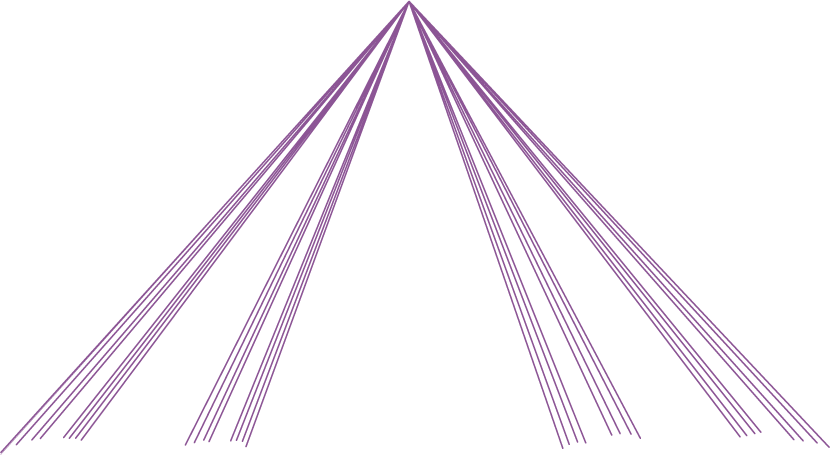
The Cantor fan.

Definition 2.7. Let X be a Cantor fan and let Y be a subcontinuum of X. A point
 $x\in Y$
is called an end-point of the continuum Y if for every arc A in Y that contains x, x is an end-point of A. The set of all end-points of Y will be denoted by
 $E(Y)$
.
Definition 2.8. Let X be a Cantor fan and let Y be a subcontinuum of X. We say that Y is a Lelek fan if
 ${\mathop {\mathrm {Cl}}\nolimits }(E(Y))=Y$
.
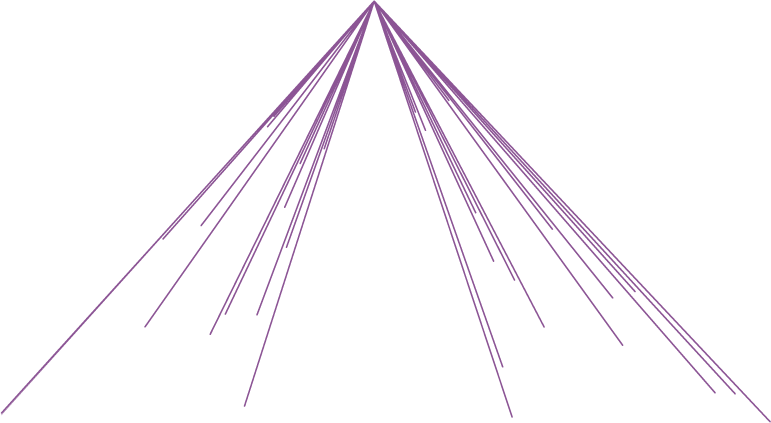
The Lelek fan.

The Lelek fan was constructed by Lelek in [Reference Lelek18]. An interesting property of the Lelek fan X is the fact that the set of its end-points is a dense one-dimensional set in X. It is also unique, that is, it is the only non-degenerate smooth fan with a dense set of end-points. This was proved independently by Bula and Oversteegen in [Reference Bula and Overseegen9] and by Charatonik in [Reference Charatonik10]. They proved that any two non-degenerate subcontinua of the Cantor fan with a dense set of endpoints are homeomorphic. See [Reference Nadler26] for more information about continua, fans, and their properties.
Definition 2.9. Let X be a non-empty compact metric space and let
 ${F}$
be a closed relation on X. Then, we call
 $$ \begin{align*} X_F^m=\bigg\{(x_1,x_2,\ldots ,x_{m+1})\in \prod_{{i={1}}}^{{m{+1}}}X \ \bigg| \ \text{ for each } i\in{\{{1,2},\ldots ,m\}}, (x_{i},x_{i+1})\in {F}\bigg\} \end{align*} $$
for each positive integer m, the mth Mahavier product of
 ${F}$
, we call
 $$ \begin{align*} X_F^+=\bigg\{(x_1,x_2,x_3,\ldots )\in \prod_{{i={1}}}^{\infty}X \ \bigg| \ \text{ for each positive integer } i, (x_{i},x_{i+1})\in {F}\bigg\} \end{align*} $$
the Mahavier product of
 ${F}$
, and we call
 $$ \begin{align*} X_F=\bigg\{(\ldots,x_{-1},{x_0}{;}x_1,x_2,\ldots )\in \prod_{i={-\infty}}^{\infty}X \ \bigg| \ \text{ for each integer } i, (x_{i},x_{i+1})\in {F}\bigg\} \end{align*} $$
the two-sided Mahavier product of
 ${F}$
.
Definition 2.10. Let X be a non-empty compact metric space and let
 ${F}$
be a closed relation on X. The function
 $\sigma _F^{+} : {X_F^+} \rightarrow {X_F^+}$
, defined by
 $$ \begin{align*} \sigma_F^{+} ({x_1,x_2,x_3,x_4},\ldots)=({x_2,x_3,x_4},\ldots) \end{align*} $$
for each
 $({x_1,x_2,x_3,x_4},\ldots )\in {X_F^+}$
, is called the shift map on
 ${X_F^+}$
. The function
 $\sigma _F : {X_F} \rightarrow {X_F}$
, defined by
 $$ \begin{align*} \sigma_F (\ldots,x_{-3},x_{-2},x_{-1},{x_0};x_1,x_2,x_3,\ldots )=(\ldots,x_{-3},x_{-2},x_{-1},{x_0},x_1;x_2,x_3,\ldots ) \end{align*} $$
for each
 $(\ldots ,x_{-3},x_{-2},x_{-1},{x_0};x_1,x_2,x_3,\ldots )\in {X_F}$
, is called the shift map on
 ${X_F}$
.
Observation 2.1. Note that
 $\sigma _F$
is always a homeomorphism, while
 $\sigma _F^+$
may not be a homeomorphism.
Definition 2.11. Let
 $(X,f)$
be a dynamical system. We say that
 $(X,f)$
is:
-
(1) transitive if for all non-empty open sets U and V in X, there is a non-negative integer n such that
$f^n(U)\cap V\neq \emptyset $
; -
(2) dense orbit transitive if there is a point
$x\in X$
such that its trajectory
$\mathcal {O}^{\oplus }_f(x)=\{x,f(x),f^2(x),f^3(x),\ldots \}$
is dense in X. We call such a point x a transitive point in
$(X,f)$
.


Definition 2.12. Let
 $(X,f)$
be a dynamical system. We say that the mapping f is transitive if
 $(X,f)$
is transitive.
Observation 2.2. It is a well-known fact that if X has no isolated points, then
 $(X,f)$
is transitive if and only if
 $(X,f)$
is dense orbit transitive. Also, if f is a homeomorphism, then
 $(X,f)$
is transitive if and only if
 $(X,f^{-1})$
is transitive. See [Reference Akin1, Reference Kolyada and Snoha17] for more information about transitive dynamical systems.
Definition 2.13. Suppose X is a compact metric space. If
 $f:X \to X$
is a continuous function, the inverse limit space generated by f is the subspace
 $$ \begin{align*} \varprojlim(X,f)=\bigg\{(x_{1},x_{2},x_{3},\ldots ) \in \prod_{i=1}^{\infty} X \ \bigg| \ \text{ for each positive integer } i,x_{i}= f(x_{i+1})\bigg\} \end{align*} $$
of the topological product
 $\prod _{i=1}^{\infty } X$
. The function
 $\sigma : \varprojlim (X,f) \rightarrow \varprojlim (X,f)$
, defined by
 $$ \begin{align*} \sigma (x_1,x_2,x_3,x_3,\ldots )=(x_2,x_3,x_4,\ldots ) \end{align*} $$
for each
 $(x_1,x_2,x_3,\ldots )\in \varprojlim (X,f)$
, is called the shift map on
 $\varprojlim (X,f)$
.
The following theorem is a well-known result proved in [Reference He and Liu13], and it also easily follows from the results from [Reference Li19].
Theorem 2.3. Let
 $(X,f)$
be a dynamical system. If
 $(X,f)$
is transitive and
 $\sigma :\varprojlim (X,f)\rightarrow \varprojlim (X,f)$
is the shift map on
 $\varprojlim (X,f)$
, then also
 $(\varprojlim (X,f),\sigma )$
is a transitive dynamical system.
Observation 2.4. For any dynamical system
 $(X,f)$
, the shift map
 $\sigma $
on
 $\varprojlim (X,f)$
is a homeomorphism from
 $\varprojlim (X,f)$
to
 $\varprojlim (X,f)$
.
3 Transitive homeomorphisms on quotient spaces
In this section, we give our first two proofs of Theorem 1.1. We start the section with some well-known results that are needed later. To make the paper more reader friendly, we give their proofs (since the proofs are elementary and short).
Definition 3.1. Let X be a compact metric space and let
 $\sim $
be an equivalence relation on X. We use:
-
(1)
$[x]$
to denote the equivalence class
$\{y\in X \ | \ y\sim x\}$
of the element x for any
$x\in X$
; -
(2)
$X/_{\sim }$
to denote the quotient space
$\{[x] \ | \ x\in X\}$
; -
(3) q to denote the natural quotient mapping
$X\rightarrow X/_{\sim }$
, which is defined by
$q(x)=[x]$
for any
$x\in X$
; -
(4) and for any
$U\subseteq X/_{\sim }$
, we define
$$ \begin{align*} U \text{ is open in } X/_{\sim}\,\Longleftrightarrow\, q^{-1}(U) \text{ is open in } X. \end{align*} $$


Observation 3.1. Let X be a compact metric space and let
 $\sim $
be an equivalence relation on X. Then, the following hold.
-
(1) The quotient map q is a continuous surjection.
-
(2) If the quotient space
$X/_{\sim }$
is a Hausdorff space, then it is a metrizable compactum. Therefore, in this case,
$X/_{\sim }$
is a continuum, if it is connected.


Definition 3.2. Let X be a compact metric space, let
 $\sim $
be an equivalence relation on X, and let
 $f:X\rightarrow X$
be a function such that for all
 $x,y\in X$
,
 $$ \begin{align*} x\sim y \Longleftrightarrow f(x)\sim f(y). \end{align*} $$
Then, we let
 $f^{\star }:X/_{\sim }\rightarrow X/_{\sim }$
be defined by
 $ f^{\star }([x])=[f(x)] $
for any
 $x\in X$
.
The following theorem is a well-known result. Since its proof is short, we give it for the completeness of the paper.
Theorem 3.2. Let X be a compact metric space, let
 $\sim $
be an equivalence relation on X, and let
 $f:X\rightarrow X$
be a function such that for all
 $x,y\in X$
,
 $$ \begin{align*} x\sim y \Longleftrightarrow f(x)\sim f(y). \end{align*} $$
Then, the following hold.
-
(1)
$f^{\star }$
is a well-defined function from
$X/_{\sim }$
to
$X/_{\sim }$
. -
(2) If f is continuous, then
$f^{\star }$
is continuous. -
(3) If f is a homeomorphism, then
$f^{\star }$
is a homeomorphism. -
(4) If f is transitive, then
$f^{\star }$
is transitive.


Proof. To see that
 $f^{\star }$
is a well-defined function from
 $X/_{\sim }$
to
 $X/_{\sim }$
, let
 $x,y\in X$
be such that
 $x\sim y$
. It follows that
 $$ \begin{align*} f^{\star}([x])=[f(x)]=[f(y)]=f^{\star}([y]). \end{align*} $$
Next, suppose that f is continuous. To show that
 $f^{\star }$
is continuous, let U be an open set in
 $X/_{\sim }$
. We show that
 $(f^{\star })^{-1}(U)$
is open in
 $X/_{\sim }$
by showing that
 $q^{-1}((f^{\star })^{-1}(U))$
is open in X. Since
 $f^{\star }\circ q=q\circ f$
, it follows that
 $$ \begin{align*} q^{-1}((f^{\star})^{-1}(U))=(f^{\star}\circ q)^{-1}(U)=(q\circ f)^{-1}(U). \end{align*} $$
Since f and q are continuous, it follows that
 $q^{-1}((f^{\star })^{-1}(U))$
is open in X. Therefore,
 $f^{\star }$
is continuous. Now, suppose that f is a homeomorphism. To see that
 $f^{\star }$
is bijective, let
 $g:X/_{\sim }\rightarrow X/_{\sim }$
be defined by
 $ g([x])=[f^{-1}(x)] $
for any
 $x\in X$
. Note that g is a well-defined function (since
 $g=(f^{-1})^{\star }$
). It follows that for each
 $x\in X$
,
 $$ \begin{align*} f^{\star}(g([x]))=&f^{\star}([f^{-1}(x)])=[f(f^{-1}(x))]=[x], \\ g(f^{\star}([x]))=&g([f(x)])=[f^{-1}(f(x))]=[x]. \end{align*} $$
Therefore,
 $f^{\star }$
is bijective and
 $(f^{\star })^{-1}=g$
. The proof that g is continuous is similar to the proof that
 $f^{\star }$
is continuous. We leave the details to the reader. Since
 $f^{\star }$
and
 $(f^{\star })^{-1}$
are both continuous, it follows that
 $f^{\star }$
is a homeomorphism. Finally, suppose that f is transitive. Let U and V be any non-empty open sets in
 $X/_{\sim }$
. We prove that there is a non-negative integer n such that
 $(f^{\star })^n(U)\cap V\neq \emptyset $
. Since the quotient map is a continuous surjection, it follows that
 $q^{-1}(U)$
and
 $q^{-1}(V)$
are non-empty open subsets of X. Let n be a non-negative integer such that
 $f^n(q^{-1}(U))\cap q^{-1}(V)\neq \emptyset $
and let
 $x\in f^n(q^{-1}(U))\cap q^{-1}(V)$
. We show that
 $[x]\in (f^{\star })^n(U)\cap V$
. It follows from
 $x\in q^{-1}(V)$
that
 $q(x)\in q(q^{-1}(V))$
and, therefore,
 $[x]\in V$
. Also, it follows from
 $x\in f^n(q^{-1}(U))$
that
 $q(x)\in q(f^n(q^{-1}(U)))$
and, therefore,
 $[x]\in q(f^n(q^{-1}(U)))$
. To show that also
 $[x]\in (f^{\star })^n(U)$
, we prove that
 $q(f^n(q^{-1}(U)))=(f^{\star })^n(U)$
:
 $$ \begin{align*} (f^{\star})^n(U)=\ & \{(f^{\star})^n([t]) \ | \ [t]\in U\}=\{[f^n(t)] \ | \ q(t)\in U\} \\ =\ & \{q(f^n(t)) \ | \ q(t)\in U\}=q(f^n(\{t \ | \ q(t)\in U\}))=q(f^n(q^{-1}(U))). \end{align*} $$
This completes the proof.
Let X be a set and let n be a positive integer. For each positive integer i and for each point
 $\mathbf x=(x_1,x_2,x_3,\ldots )\in \prod _{k=1}^{\infty }X$
(or for each
 $i\in \{1,2,3,\ldots , n\}$
and for each point
 $\mathbf x=(x_1,x_2,x_3,\ldots ,x_n)\in \prod _{k=1}^{n}X$
or for each integer i and for each point
 $\mathbf x=({\ldots ,x_{-2},x_{-1}},{x_0;x_1,x_2,\ldots })\in \prod _{k=-\infty }^{\infty }X$
), we use
 $\mathbf x(i)$
to denote the ith coordinate
 $x_i$
of the point
 $\mathbf x$
. For all positive integers i and j (or for all
 $i,j\in \{1,2,3,\ldots , n\}$
or for all integers i and j) such that
 $i\leq j$
, we use
 $[i,j]$
to denote the set
 $\{i, i+1,i+2,\ldots ,j\}$
and
 $\pi _{[i,j]}$
to denote the projection
 $\pi _{[i,j]}:\prod _{k=1}^{\infty }X\rightarrow \prod _{k=i}^{j}X$
(or the projection
 $\pi _{[i,j]}:\prod _{k=1}^{n}X\rightarrow \prod _{k=i}^{j}X$
or the projection
 $\pi _{[i,j]}:\prod _{k=-\infty }^{\infty }X\rightarrow \prod _{k=i}^{j}X$
) that is defined by
 $ \pi _{[i,j]}(x_1,x_2,x_3,\ldots )=(x_i,x_{i+1},x_{i+2},\ldots , x_{j}) $
for any
 $(x_1,x_2,x_3,\ldots )\in \prod _{k=1}^{\infty }X$
(or
 $ \pi _{[i,j]}(x_1,x_2,\ldots ,x_n)=(x_i,x_{i+1},\ldots , x_{j}) $
for any
 $(x_1,x_2,\ldots ,x_n)\in \prod _{k=1}^{n}X$
or
 $ \pi _{[i,j]}({\ldots ,x_{-2},x_{-1},x_0};{x_1,x_2,\ldots })=(x_i,x_{i+1},x_{i+2},\ldots , x_{j}) $
for any
 $(\ldots ,x_{-2},x_{-1},x_0; {x_1,x_2,\ldots })\in \prod _{k=-\infty }^{\infty }X$
). For
 $i=j$
, we use
 $\pi _i$
to denote the projection
 $\pi _{[i,i]}$
.
For a non-empty compact metric space X, we use
 $p_1:X\times X\rightarrow X$
and
 $p_2:X\times X\rightarrow ~X$
to denote the standard projections defined by
 $p_1(s,t)=s$
and
 $p_2(s,t)=t$
for all
 $(s,t)\in X\times X$
.
Definition 3.3. For each positive integer n, we use the following.
-
(1)
$C_n$
to denote the topological product
$C_n=\prod _{k=1}^{\infty }\{1,2,3, \ldots ,n\},$
where
$\{1,2, 3,\ldots , n\}$
is equipped with the discrete topology. We also use
$\sigma _n$
to denote the shift map
$\sigma _n:C_n\rightarrow C_n$
, defined by for any
$$ \begin{align*} {\sigma_n(\mathbf x)}=\sigma_n(\mathbf x(1),\mathbf x(2),\mathbf x(3),\ldots)=(\mathbf x(2),\mathbf x(3),\mathbf x(4),\ldots) \end{align*} $$
$\mathbf x\in C_n$
.
-
(2)
$D_n$
to denote the topological product
$ D_n=\prod _{k=-\infty }^{\infty }\{1,2,3,\ldots ,n\}, $
where the set
$\{1,2,3,\ldots , n\}$
is equipped with the discrete topology. We also use
$\tau _n$
to denote the shift map
$\tau _n:D_n\rightarrow D_n$
, defined by for any
$$ \begin{align*} {\tau_n(\mathbf x)}=\tau_n({\ldots,\mathbf x(-1),\mathbf x(0)};{\mathbf x(1),\mathbf x(2),\ldots})=({\ldots,\mathbf x(-1),\mathbf x(0),\mathbf x(1)};{\mathbf x(2)},\ldots) \end{align*} $$
$\mathbf x\in D_n$
.


Observation 3.3. Note that for each positive integer
 $n\geq 2$
,
 $C_n$
and
 $D_n$
(equipped with the product topologies) are Cantor sets and that the shift maps
 $\sigma _n$
and
 $\tau _n$
are transitive. Also, note that for each positive integer n,
 $\tau _n$
is a homeomorphism while
 $\sigma _n$
is not.
Definition 3.4. Let X be a compact metric space, let n be a positive integer, and let
 $f_1,f_2,f_3,\ldots ,f_n:X\rightarrow X$
be any functions. Then, we use:
-
(1)
$(f_1,\ldots ,f_n)_{C_n}$
to denote the mapping from
$C_n\times X$
to
$C_n\times X$
, which is defined by for any
$$ \begin{align*} (f_1,\ldots,f_n)_{C_n}(\mathbf x,t)=(\sigma_n(\mathbf x), f_{\mathbf x(1)}(t)) \end{align*} $$
$(\mathbf x,t)\in C_n\times X$
. We call
$(f_1,\ldots ,f_n)_{C_n}$
a sorting function with respect to the first projection of
$C_n$
;
-
(2)
$(f_1,\ldots ,f_n)_{D_n}$
to denote the mapping from
$D_n\times X$
to
$D_n\times X$
, which is defined by for any
$$ \begin{align*} (f_1,\ldots,f_n)_{D_n}(\mathbf x,t)=(\tau_n(\mathbf x), f_{\mathbf x(1)}(t)) \end{align*} $$
$(\mathbf x,t)\in D_n\times X$
. We call
$(f_1,\ldots ,f_n)_{D_n}$
a sorting function with respect to the first projection of
$D_n$
.


In Example 3.4, we demonstrate how the defined sorting functions work.
Example 3.4. Let
 $n=2$
, let
 $X=[0,1]$
, and let
 $f_1,f_2:[0,1]\rightarrow [0,1]$
be defined by
 $f_1(t)=t$
and
 $f_2(t)=t^2$
for any
 $t\in [0,1]$
. Then, for
 $\mathbf x=(1,2,1,2,1,\ldots )$
,
 $\mathbf x(1)=1$
and it follows that for each
 $t\in [0,1]$
,
 $$ \begin{align*} (f_1,f_2)_{C_2}(\mathbf x,t)&=(\sigma_2(\mathbf x), f_{\mathbf x(1)}(t))\\ &=(\sigma_2(1,2,1,2,1,\ldots), f_1(t))=((2,1,2,1,\ldots), {t}), \end{align*} $$
and for
 $\mathbf x=(\ldots , 2,1;2,1,\ldots )$
,
 $\mathbf x(1)=2$
and it follows that for each
 $t\in [0,1]$
,
 $$ \begin{align*} (f_1,f_2)_{D_2}(\mathbf x,t)&=(\tau_2(\mathbf x), f_{\mathbf x(1)}(t))\\ &=(\tau_2(\ldots, 2,1;2,1,\ldots), f_2(t))=((\ldots, 2,1,2;1,\ldots), {t^2}). \end{align*} $$
Proposition 3.5. Let X be a compact metric space, let n be a positive integer, and let
 $f_1,f_2,f_3,\ldots ,f_n:X\rightarrow X$
be any functions. Then, the following hold.
-
(1) If
$f_1$
,
$f_2$
,
$f_3, \ldots , f_{n}$
are continuous, then
$(f_1,\ldots ,f_n)_{C_n}$
and
$(f_1,\ldots ,f_n)_{D_n}$
are continuous. -
(2) If
$f_1$
,
$f_2$
,
$f_3, \ldots , f_{n}$
are surjective, then
$(f_1,\ldots ,f_n)_{C_n}$
and
$(f_1,\ldots ,f_n)_{D_n}$
are surjective. -
(3) If
$f_1$
,
$f_2$
,
$f_3, \ldots , f_n$
are homeomorphisms, then
$(f_1,\ldots ,f_n)_{D_n}$
is a homeomorphism.


Proof. Suppose that the functions
 $f_1$
,
 $f_2$
,
 $f_3, \ldots , f_n$
are continuous. First, we prove that
 $(f_1,\ldots ,f_n)_{C_n}$
is continuous. Let W be an open set in X and let V be an open set in
 $C_n$
such that
 $\mathop {\mathrm {diam}}\nolimits (V)<1$
and such that for some
 $k\in \{1,2,3,\ldots ,n\}$
,
 $\pi _1(V)=\{k\}$
(this can be done since
 $\{1,2,3,\ldots ,n\}$
is equipped with the discrete topology). Fix such an element k. Also, let
 $U=V\times W$
. To see that
 $(f_1,\ldots ,f_n)_{C_n}$
is continuous, we prove that
 $(f_1,\ldots ,f_n)_{C_n}^{-1}(U)$
is open in
 $C_n\times X$
. Observe that
 $$ \begin{align*} (f_1,\ldots,f_n)_{C_n}^{-1}(U)=(f_1,\ldots,f_n)_{C_n}^{-1}(V\times W)=\sigma_n^{-1}(V)\times f_{k}^{-1}(W). \end{align*} $$
Since the functions
 $\sigma _n$
and
 $f_k$
are continuous, it follows that
 $(f_1,\ldots ,f_n)_{C_n}^{-1}(U)$
is open in
 $C_n\times X$
.
The proof that
 $(f_1,\ldots ,f_n)_{D_n}$
is continuous is analogous to the proof above—we leave it for the reader.
Now, suppose that the functions
 $f_1$
,
 $f_2$
,
 $f_3, \ldots , f_n$
are surjective. To show that
 $(f_1,\ldots ,f_n)_{C_n}$
is surjective, let
 $(\mathbf x,t)\in C_n\times X$
be any point. Since
 $\sigma _n$
is surjective, there is a point
 $\mathbf t \in C_n$
such that
 $\sigma _n(\mathbf t)=\mathbf x$
. Choose such a point
 $\mathbf t$
. Then, for each
 $x\in f_{\mathbf t(1)}^{-1}(t)$
,
 $$ \begin{align*} (f_1,\ldots,f_n)_{C_n}(\mathbf t,{x})=(\sigma_n(\mathbf t), f_{\mathbf t(1)}({x}))=(\mathbf x,t); \end{align*} $$
therefore,
 $(f_1,\ldots ,f_n)_{C_n}$
is surjective since
 $f_{\mathbf t(1)}^{-1}(t)\neq \emptyset $
.
The proof that
 $(f_1,\ldots ,f_n)_{D_n}$
is surjective is analogous to the proof above that
 $(f_1,\ldots ,f_n)_{C_n}$
is surjective—we leave it for the reader.
Finally, suppose that
 $f_1$
,
 $f_2$
,
 $f_3, \ldots , f_n$
are homeomorphisms. It follows from item (1) that
 $(f_1,\ldots ,f_n)_{D_n}$
is a continuous function. To see that
 $(f_1,\ldots ,f_n)_{D_n}$
is a bijection, let
 $h=(f_1,\ldots ,f_n)_{D_n}$
and let
 $g:D_n\times X\rightarrow D_n\times X$
be defined by
 $$ \begin{align*} g(\mathbf x,t)=(\tau_n^{-1}(\mathbf x), f_{\tau_n^{-1}(\mathbf x)(1)}^{-1}(t)) \end{align*} $$
for any
 $(\mathbf x,t)\in D_n\times X$
. Observe that for each
 $(\mathbf x,t)\in D_n\times X$
,
 $$ \begin{align*} g(h(\mathbf x,t))&=g(\tau_n(\mathbf x), f_{\mathbf x(1)}(t))\\ &=(\tau_n^{-1}(\tau_n(\mathbf x)), f_{\tau_n^{-1}(\tau_n(\mathbf x))(1)}^{-1}(f_{\mathbf x(1)}(t)))=(\mathbf x,t),\\ h(g(\mathbf x,t))&=h(\tau_n^{-1}(\mathbf x), f_{\tau_n^{-1}(\mathbf x)(1)}^{-1}(t))\\ &=(\tau_n(\tau_n^{-1}(\mathbf x)), f_{\tau_n^{-1}(\mathbf x)(1)}(f_{\tau_n^{-1}(\mathbf x)(1)}^{-1}(t)))=(\mathbf x,t). \end{align*} $$
It follows that
 $(f_1,\ldots ,f_n)_{D_n}$
is a bijection. Since
 $(f_1,\ldots ,f_n)_{D_n}$
is a continuous bijection from a compact metric space onto itself, it is a homeomorphism.
In the following subsections, we examine separately the quotient spaces
 $C_n\times X$
and
 $D_n\times X$
. We will use the notion of different types of concatenation that is defined in the following definition.
Definition 3.5. Let X be a compact metric space, let n and m be positive integers, and let
 $\mathbf x\in \prod _{k=1}^{n}X$
,
 $\mathbf y\in \prod _{k=1}^{m}X$
,
 $\mathbf z\in \prod _{i=1}^{\infty }X$
, and
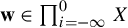 $\mathbf w\in \prod _{i=-\infty }^{0}X$
. Then, we define:
-
(1) the concatenation
$\mathbf x\oplus \mathbf y\in \prod _{k=1}^{m+n}X$
of
$\mathbf x$
and
$\mathbf y$
as follows:
$$ \begin{align*} \mathbf x\oplus \mathbf y=(\mathbf x(1),\mathbf x(2),\mathbf x(3),\ldots,\mathbf x(n),\mathbf y(1),\mathbf y(2),\mathbf y(3),\ldots,\mathbf y(m)); \end{align*} $$
-
(2) the concatenation
$\mathbf x\oplus \mathbf z\in \prod _{k=1}^{\infty }X$
of
$\mathbf x$
and
$\mathbf z$
as follows:
$$ \begin{align*} \mathbf x\oplus \mathbf z=(\mathbf x(1),\mathbf x(2),\mathbf x(3),\ldots,\mathbf x(n),\mathbf z(1),\mathbf z(2),\mathbf z(3),\ldots); \end{align*} $$
-
(3) the concatenation
$\mathbf w\oplus \mathbf x\in \prod _{k=-\infty }^{0}X$
of
$\mathbf w$
and
$\mathbf x$
as follows:
$$ \begin{align*} {\mathbf w}\oplus {\mathbf x}=({\ldots, \mathbf w(-3),\mathbf w(-2),\mathbf w(-1), \mathbf w(0)},{\mathbf x(1),\mathbf x(2),\mathbf x(3),\ldots, \mathbf x(n)}); \end{align*} $$
-
(4) the concatenation
$\mathbf w\oplus \mathbf z\in \prod _{k=-\infty }^{\infty }X$
of
$\mathbf w$
and
$\mathbf z$
as follows:
$$ \begin{align*} {\mathbf w}\oplus {\mathbf z}=({\ldots, \mathbf w(-3),\mathbf w(-2),\mathbf w(-1),\mathbf w(0)};{\mathbf z(1),\mathbf z(2),\mathbf z(3),\ldots}). \end{align*} $$


3.1 The quotient spaces of
$C_n\times X$

Definition 3.6. Let X be a compact metric space, let n be a positive integer, let
 $\mathbf x\in \prod _{k=1}^{n}X$
and
 $\mathbf y\in \prod _{k=1}^{\infty }X$
, and let
 $\varepsilon>0$
. We say that
 $ |{\mathbf x} - {\mathbf y}|_n<\varepsilon , $
if:
-
(1) for each
$k\in \{1,2,3,\ldots ,n\}$
,
$\mathbf x(k)=\mathbf y(k)$
and -
(2)
$\sum \nolimits _{k=n}^{\infty } {\mathop {\mathrm {diam}}\nolimits (X)}/{2^k}<\varepsilon $
.


Definition 3.7. Let X be a compact metric space, let n be a positive integer, and let
 $f_1,f_2,f_3,\ldots ,f_n:X\rightarrow X$
be any functions. Also, let i and j be integers such that
 $i\leq j$
and let
 ${\mathbf x}\in \prod _{k=i}^{j}\{1,2,3,\ldots ,n\}$
. Then, we use
 $f_{{\mathbf x}}$
to denote the function
 $f_{{\mathbf x}}:X\rightarrow [0,1]$
, defined by
 $$ \begin{align*} f_{{\mathbf x}}(t)=(f_{{\mathbf x}(j)}\circ f_{{\mathbf x}(j-1)}\circ f_{{\mathbf x}(j-2)}\circ \cdots \circ f_{{\mathbf x}(i+2)}\circ f_{{\mathbf x}(i+1)}\circ f_{{\mathbf x}(i)})(t) \end{align*} $$
for any
 $t\in X$
.
Definition 3.8. Let
 $(X,d)$
be a compact metric space, let n be a positive integer, and let
 $f_1,f_2,f_3,\ldots ,f_n:X\rightarrow X$
be any functions. Also, let U be a dense open set in X such that for each
 $j\in \{1,2,3,\ldots ,n\}$
,
 $f_j(U)\subseteq U$
. We say that the n-tuple
 $(f_1,f_2, f_3, \ldots ,f_n)$
has property
 $\mathcal L(U)$
if for each
 $\varepsilon>0$
, for each
 $x\in U$
, and for each
 $z\in X$
, there are non-negative integers
 $k_1$
,
 $k_2$
,
 $k_3$
,
 $\ldots $
,
 $k_n$
such that
 $$ \begin{align*} d((f_1^{k_1}\circ f_2^{k_2}\circ f_3^{k_3} \circ \cdots \circ f_n^{k_n})(x),z)<\varepsilon. \end{align*} $$
We say that the n-tuple
 $(f_1,f_2, f_3, \ldots ,f_n)$
has property
 $\mathcal L$
if there is an open set U in X such that the n-tuple
 $(f_1,f_2, f_3, \ldots ,f_n)$
has property
 $\mathcal L(U)$
.
Theorem 3.6. Let X be a compact metric space that does not have any isolated points, let n be a positive integer, and let
 $f_1,f_2,f_3,\ldots ,f_n:X\rightarrow X$
be any homeomorphisms. If the n-tuple
 $(f_1,f_2, f_3, \ldots ,f_n)$
has property
 $\mathcal L$
, then
 $(f_1,\ldots ,f_n)_{C_n}$
is a transitive continuous surjection.
Proof. Let U be an open set in X such that the n-tuple
 $(f_1,f_2, f_3, \ldots ,f_n)$
has property
 $\mathcal L(U)$
. To prove that
 $(f_1,\ldots ,f_n)_{C_n}$
is a transitive continuous surjection, let
 $h=(f_1,\ldots ,f_n)_{C_n}$
. It follows from Proposition 3.5 that h is a continuous surjection. We show that h is transitive by constructing a transitive point in
 $(C_n\times X,h)$
. Let
 $\{(\mathbf x_i,t_i) \ | \ i \text { is a positive integer}\}$
be a countable dense subset of
 $C_n\times X$
. Also, for each positive integer i, let
 $\varepsilon _i>0$
be such that
 $\lim _{i\to \infty }\varepsilon _i=0$
. For each positive integer i, let
 $m_i$
be a positive integer and let
 $\hat {\mathbf x}_i\in \prod _{k=1}^{m_i}\{1,2,3,\ldots ,n\}$
be such that
 $ | \hat {\mathbf x}_i-\mathbf x_i|_{m_i}<\varepsilon _i. $
Note that for each positive integer i, such elements
 $m_i$
and
 $\hat {\mathbf x}_i$
do exist since
 $\{(\mathbf x_i,t_i) \ | \ i \text { is a positive integer}\}$
is a dense subset of
 $C_n\times X$
and since
 $C_n\times X$
is equipped with the product topology. For each
 $x\in U$
, for each
 $z\in X$
, and for each
 $\varepsilon>0$
, let
 $k_1(x,z,\varepsilon )$
,
 $k_2(x,z,\varepsilon )$
,
 $k_3(x,z,\varepsilon ), \ldots , k_n(x,z,\varepsilon )$
be positive integers such that
 $$ \begin{align*} d((f_1^{k_1(x,z,\varepsilon)}\circ f_2^{k_2(x,z,\varepsilon)}\circ f_3^{k_3(x,z,\varepsilon)} \circ \cdots \circ f_n^{k_n(x,z,\varepsilon)})(x),z)<\varepsilon, \end{align*} $$
and let
 $$ \begin{align*} &Y(x,z,\varepsilon)\\ &\quad =(\underbrace{n,n,\ldots ,n}_{k_n(x,z,\varepsilon)},\underbrace{n-1,n-1,\ldots ,n-1}_{k_{n-1}(x,z,\varepsilon)}, \underbrace{n-2,n-2,\ldots ,n-2}_{k_{n-2}(x,z,\varepsilon)},\ldots , \underbrace{1,1,\ldots ,1}_{k_1(x,z,\varepsilon)}). \end{align*} $$
Now, we inductively define points
 ${\mathbf w}_i$
in
 $C_n$
(based on i being even or odd) as follows. Let
 $x_0\in U$
and let
 $\hat {\mathbf w}_1=Y(x_0,t_1,\varepsilon _1),$
let
 $\hat {\mathbf w}_2=\hat {\mathbf w}_1\oplus \hat {\mathbf x}_1$
, and let
 $\hat {\mathbf w}_3=\hat {\mathbf w}_2\oplus Y (f_{\hat {\mathbf w}_2}(x_0),t_2,\varepsilon _2).$
Note that since
 $f_{\hat {\mathbf w}_2}(U)\subseteq U$
, it follows that
 $f_{\hat {\mathbf w}_2}(x_0)\in U$
. Let i be any positive integer and suppose that
 $\hat {\mathbf w}_1$
,
 $\hat {\mathbf w}_2$
,
 $\hat {\mathbf w}_3, \ldots , \hat {\mathbf w}_{2i-1}$
have already been defined. Then, we define
 $\hat {\mathbf w}_{2i}$
and
 $\hat {\mathbf w}_{2i+1}$
as follows:
 $ \hat {\mathbf w}_{2i}=\hat {\mathbf w}_{2i-1}\oplus \hat {\mathbf x}_i $
and
 $ \hat {\mathbf w}_{2i+1}=\hat {\mathbf w}_{2i}\oplus Y (f_{\hat {\mathbf w}_{2i}}(x_0),t_{i+1},\varepsilon _{i+1}). $
Next, for each positive integer i, let
 $ \mathbf w_i=\hat {\mathbf w}_{i}\oplus (1,1,1,\ldots ). $
Note that the sequence
 $(\mathbf w_i)$
is convergent in
 $C_n$
and let
 $ \mathbf w=\lim _{i\to \infty }\mathbf w_i. $
Finally, we show that
 $(\mathbf w,x_0)$
is a transitive point in
 $(C_n\times X,h)$
. Let V be a non-empty open set in
 $C_n$
, let W be a non-empty open set in X, and let
 $U_0=V\times W$
. We show that there is a positive integer k such that
 $h^k(\mathbf w,x_0)\in U_0$
. Let
 $k_0$
be a positive integer such that
 $B((\mathbf x_{k_0},t_{k_0}),\varepsilon _{k_0})\subseteq U_0$
. Also, let i and k be any positive integers such that
 $ \pi _{[1,i]}(\sigma _n^{k}(\mathbf w))=\hat {\mathbf x}_{k_0}. $
Note that k is the length of
 $\hat {\mathbf w}_{2k_0-1}$
. Then,
 $h^k(\mathbf w,x_0)\in U_0$
and we are done.
Observation 3.7. Note that
 $(f_1,\ldots ,f_n)_{C_n}$
from Theorem 3.6 is not a homeomorphism. This follows from the fact that
 $\sigma _n$
is not a homeomorphism.
Definition 3.9. Let m and n be positive integers, and let
 $\mathbf y\in C_n$
. We use
 $\mathbf y[m]$
to denote
 $ \mathbf y[m]=(\mathbf y(m),\mathbf y(m-1),\mathbf y(m-2),\ldots , \mathbf y(1)). $
Definition 3.10. Let X be a compact metric space, let m and n be positive integers, let
 $\mathbf y\in C_n$
, and let
 $f_1,f_2,f_3,\ldots ,f_n:X\rightarrow X$
be any homeomorphisms. We use
 $f_{\mathbf y[m]}^{-1}$
to denote the function
 $f_{\mathbf y[m]}^{-1}:{X}\rightarrow {X}$
defined by
 $$ \begin{align*} f_{\mathbf y[m]}^{-1}(t)= (f_{\mathbf y(m)}^{-1}\circ f_{\mathbf y(m-1)}^{-1}\circ f_{\mathbf y(m-2)}^{-1}\circ \cdots \circ f_{\mathbf y(1)}^{-1})(t) \end{align*} $$
for each
 $t\in {X}$
.
Observation 3.8. Let X be a compact metric space, let n be a positive integer, and let
 $f_1,f_2,f_3,\ldots ,f_n:X\rightarrow X$
be any homeomorphisms. Note that for each point
 $\mathbf x\in \varprojlim (C_n\times X,(f_1,\ldots ,f_n)_{C_n})$
, there are uniquely determined points
 $\mathbf a,\mathbf b\in C_n$
and
 $t\in X$
such that
 $$ \begin{align*} \mathbf x= ((\mathbf a,t), (\mathbf b[1]\oplus \mathbf a,f_{\mathbf b[1]}^{-1}(t)), (\mathbf b[2]\oplus \mathbf a,f_{\mathbf b[2]}^{-1}(t)), (\mathbf b[3]\oplus \mathbf a,f_{\mathbf b[3]}^{-1}(t)),\ldots). \end{align*} $$
Theorem 3.9. Let X be a compact metric space, let n be a positive integer, and let
 $f_1,f_2,f_3,\ldots ,f_n:X\rightarrow X$
be any homeomorphisms. Then,
 $\varprojlim (C_n\times X, (f_1,\ldots ,f_n)_{C_n})$
is homeomorphic to
 $C_n\times X$
.
Proof. Note that
 $C_n\times X$
is homeomorphic to
 $(C_n\times C_n)\times X$
. We show that the inverse limit
 $\varprojlim (C_n\times X,(f_1,\ldots ,f_n)_{C_n})$
is homeomorphic to
 $(C_n\times C_n)\times X$
. For each
 $\mathbf x\in \varprojlim (C_n\times X,(f_1,\ldots ,f_n)_{C_n})$
, let
 $\mathbf a_{\mathbf x},\mathbf b_{\mathbf x}\in C_n$
and
 $t_{\mathbf x}\in X$
be such that
 $$ \begin{align*} \mathbf x= ((\mathbf a_{\mathbf x},t_{\mathbf x}), (\mathbf b_{\mathbf x}[1]\oplus \mathbf a_{\mathbf x},f_{\mathbf b_{\mathbf x}[1]}^{-1}(t_{\mathbf x}) ), (\mathbf b_{\mathbf x}[2]\oplus \mathbf a_{\mathbf x},f_{\mathbf b_{\mathbf x}[2]}^{-1}(t_{\mathbf x})),\ldots). \end{align*} $$
Let
 $T:\varprojlim (C_n\times X,(f_1,\ldots ,f_n)_{C_n})\rightarrow (C_n\times C_n)\times X$
be defined by
 $ T(\mathbf x)= ((\mathbf a_{\mathbf x},\mathbf b_{\mathbf x}),t_{\mathbf x}) $
for each
 $\mathbf x\in \varprojlim (C_n\times X,(f_1,\ldots ,f_n)_{C_n})$
. Clearly, T is a homeomorphism.
Definition 3.11. Let X be a compact metric space, let n be a positive integer, and let
 $f_1,f_2,f_3,\ldots ,f_n:X\rightarrow X$
be any homeomorphisms. We use
 $\sigma _{(f_1,\ldots ,f_n)_{C_n}}$
to denote the shift homeomorphism on
 $\varprojlim (C_n\times X,(f_1,\ldots ,f_n)_{C_n})$
.
Theorem 3.10. Let X be a compact metric space, let n be a positive integer, and let
 $f_1,f_2,f_3,\ldots ,f_n:X\rightarrow X$
be any homeomorphisms. If the n-tuple
 $(f_1, f_2, f_3,\ldots , f_n)$
has property
 $\mathcal L$
, then the shift homeomorphism
 $\sigma _{(f_1,\ldots ,f_n)_{C_n}}$
is transitive.
Proof. By Theorem 3.6, the function
 $(f_1,\ldots ,f_n)_{C_n}$
is transitive. It follows from Theorem 2.3 that
 $\sigma _{(f_1,\ldots ,f_n)_{C_n}}$
is transitive.
Definition 3.12. Let X be a compact metric space, let n be a positive integer, let
 $f_1$
,
 $f_2$
,
 $f_3$
,
 $\ldots ,f_n:X\rightarrow X$
be any homeomorphisms, and let
 $\sim $
be an equivalence relation on
 $(C_n\times C_n)\times X$
. Then, we define a relation
 $\sim _{(f_1,\ldots ,f_n)_{C_n}}$
on
 $\varprojlim (C_n\times X, (f_1,\ldots ,f_n)_{C_n})$
by
 $$ \begin{align*} \mathbf x\sim_{(f_1,\ldots,f_n)_{C_n}} \mathbf y \Longleftrightarrow\, \mathbf x=\mathbf y \text{ or } ((\mathbf a_{\mathbf x},\mathbf b_{\mathbf x}),t_{\mathbf x})\sim ((\mathbf a_{\mathbf y},\mathbf b_{\mathbf y}),t_{\mathbf y}) \end{align*} $$
for all
 $\mathbf x,\mathbf y\in \varprojlim (C_n\times X,(f_1,\ldots ,f_n)_{C_n})$
.
Observation 3.11. Observe that the defined relation
 $\sim _{(f_1,\ldots ,f_n)_{C_n}}$
is an equivalence relation on
 $\varprojlim (C_n\times X,(f_1,\ldots ,f_n)_{C_n})$
.
Theorem 3.12. Let X be a compact metric space, let n be a positive integer, let
 $f_1$
,
 $f_2$
,
 $f_3, \ldots , f_n:X\rightarrow X$
be any homeomorphisms, and let
 $\sim $
be an equivalence relation on
 $(C_n\times C_n)\times X$
. Then, the inverse limit
 $\varprojlim (C_n\times X,(f_1,\ldots ,f_n)_{C_n})/_{\sim _{(f_1,\ldots ,f_n)_{C_n}}}$
is homeomorphic to
 $(C_n\times C_n)\times X/_{\sim }$
.
Proof. Let
 $\varphi :\varprojlim (C_n\times X,(f_1,\ldots ,f_n)_{C_n})/_{\sim _{(f_1,\ldots ,f_n)_{C_n}}}\rightarrow (C_n\times C_n)\times X/_{\sim }$
be defined by
 $ \varphi ([\mathbf x])=[T(\mathbf x)] $
for any
 $\mathbf x\in \varprojlim (C_n\times X,(f_1,\ldots ,f_n)_{C_n})$
, where T is the homeomorphism from the proof of Theorem 3.9. Then,
 $\varphi $
is a well-defined function, which is a homeomorphism.
Theorem 3.13. Let X be a compact metric space, let
 $\sim $
be an equivalence relation on X, let n be a positive integer, and let
 $f_1,f_2,f_3,\ldots ,f_n:X\rightarrow X$
be any homeomorphisms. If the n-tuple
 $(f_1, f_2, f_3, \ldots , f_n)$
has property
 $\mathcal L$
, then there is a transitive homeomorphism on the quotient space
 $$ \begin{align*} \varprojlim(C_n\times X,(f_1,\ldots,f_n)_{C_n})/_{\sim_{(f_1,\ldots,f_n)_{C_n}}}. \end{align*} $$
Proof. By Theorem 3.10,
 $\sigma _{(f_1,\ldots ,f_n)_{C_n}}$
is a transitive homeomorphism on the inverse limit
 $\varprojlim (C_n\times X,(f_1,\ldots ,f_n)_{C_n})$
. Therefore, by Theorem 3.2, the function
 $\sigma _{(f_1,\ldots ,f_n)_{C_n}}^{\star }$
is a transitive homeomorphism on the quotient space
 $\varprojlim (C_n\times X,(f_1,\ldots ,f_n)_{C_n}) /_{\sim _{(f_1,\ldots ,f_n)_{C_n}}}$
.
Next, we construct, using Theorems 3.12 and 3.13, a transitive homeomorphism on the Cantor fan. First, we prove Lemmas 3.14 and 3.15.
Lemma 3.14. Let
 $\varepsilon>0$
, let
 $x\in (0,\tfrac 23]$
, and let
 $z\in [0,\tfrac 23]$
. Then, there are positive integers k and n such that
 $$ \begin{align*} |(\tfrac{1}{2})^{{k}/{2^n}}\cdot x^{{1}/{2^n}}- z | < \varepsilon. \end{align*} $$
Proof. Note that the set
 $\{{k}/{2^n} \ | \ k \text { and } n \text { are positive integers}\}$
is dense in
 $[0,\infty )$
. Therefore,
 $\{(\tfrac 12)^{{k}/{2^n}} |\, k \text { and } n \text { are positive integers}\}$
is dense in
 $[0,1]$
. For each positive integer n, we choose a positive integer
 $k_n$
as follows.
-
(1) If
$z>0$
, then for each positive integer n, let
$k_n$
be such a positive integer that for each positive integer k,
$| (\tfrac 12)^{{k_n}/{2^n}}-z |\leq | (\tfrac 12)^{{k}/{2^n}}-z |. $
-
(2) If
$z=0$
, then for each positive integer n, let
$k_n$
be a positive integer such that
$(\tfrac 12)^{{k_n}/{2^n}} \leq {1}/{2^n}. $


Then,
 $ \lim _{n\to \infty }(\tfrac 12)^{{k_n}/{2^n}}=z$
. Since
 $\lim _{n\to \infty }x^{{1}/{2^n}}=1$
, it follows that
 $$ \begin{align*} \lim_{n\to \infty} ((\tfrac{1}{2})^{{k_n}/{2^n}}\cdot x^{{1}/{2^n}}) =\lim_{n\to \infty} (\tfrac{1}{2})^{{k_n}/{2^n}}\cdot \lim_{n\to \infty}x^{{1}/{2^n}} = z \cdot 1=z \end{align*} $$
and hence there is a positive integer n such that
 $ |(\tfrac 12)^{{k_n}/{2^n}}\cdot x^{{1}/{2^n}}- z| < \varepsilon. $
Choose any such n and let
 $k=k_n$
.
Definition 3.13. We use
 $f_1$
,
 $f_2$
, and
 $f_3$
to denote the homeomorphisms
 $f_1,f_2,f_3:[0,1]\rightarrow [0,1]$
that are defined by
 $$ \begin{align*} f_1(t)=\sqrt {t},\quad f_2(t)=\begin{cases} \frac{1}{2}t\text{;} & t\leq \frac{2}{3} \\ 2{t}-1\text{;} & t\geq \frac{2}{3} \end{cases},\quad\text{and}\quad f_3(t)=f_1^{-1}(t) \end{align*} $$
for any
 $t\in [0,1]$
.
Lemma 3.15. Let
 $\varepsilon>0$
, let
 $x\in (0,1)$
, and let
 $z\in [0,1]$
. Then, there are positive integers k, m, and n such that
 $$ \begin{align*} |f_1^{m+n}(f_2^k(f_3^{m}(x)))- z| < \varepsilon. \end{align*} $$
Proof. We consider the following possible cases.
(1)
 $z=1$
. Let
 $m=k=1$
and let
 $y=f_1^{m}(f_2^k(f_3^{m}(x)))$
. Then,
 $y\in (0,1)$
. Also, let n be a positive integer such that
 $|f_1^n(y)-1|<\varepsilon $
. Then,
 $$ \begin{align*} |f_1^{m+n}(f_2^k(f_3^{m}(x)))- z| = |f_1^{n}(y)- z| = |f_1^{n}(y)- 1| < \varepsilon. \end{align*} $$
(2)
 $z<1$
. Let m be a positive integer such that both
 $f_3^{m}(x)<\tfrac 23$
and
 $f_3^{m}(z)<\tfrac 23$
. Since the map
 $f_1^m$
is uniformly continuous, there is a
 $\delta>0$
such that for all
 $p,q\in [0,1]$
,
 $$ \begin{align*} |p-q|<\delta\Longrightarrow |f_1^m(p)-f_1^m(q)|<\varepsilon. \end{align*} $$
Choose and fix such a
 $\delta>0$
. By Lemma 3.14, there are positive integers k and n such that
 $$ \begin{align*} |(\tfrac{1}{2})^{{k}/{2^n}}\cdot (f_3^{m}(x))^{{1}/{2^n}}- f_3^{m}(z)| < \delta. \end{align*} $$
Choose and fix such positive integers k and n. Note that
 $f_1^{n}(f_2^k(f_3^{m}(x)))= (\tfrac 12)^{{k}/{2^n}}\cdot (f_3^{m}(x))^{{1}/{2^n}}$
and that
 $z=f_1^m(f_3^{m}(z)).$
Therefore,
 $$ \begin{align*} |f_1^{m+n}(f_2^k(f_3^{m}(x)))- z| = |f_1^m((\tfrac{1}{2})^{{k}/{2^n}}\cdot (f_3^{m}(x))^{{1}/{2^n}}) - f_1^m (f_3^{m}(z))| < \varepsilon.\\[-35pt] \end{align*} $$
Observation 3.16. Note that it follows from Lemma 3.15 that the
 $3$
-tuple
 $(f_1, f_2,f_3)$
has property
 $\mathcal L$
.
Definition 3.14. Let n be a positive integer. If
 $n\geq 2$
, then we use
 $\sim $
to denote the equivalence relation on
 $(C_{n}\times C_{n})\times [0,1]$
, defined by
 $$ \begin{align*} ((\mathbf x_1,\mathbf x_2),t)\sim((\mathbf y_1,\mathbf y_2),s) \Longleftrightarrow\, ((\mathbf x_1,\mathbf x_2),t)=((\mathbf y_1,\mathbf y_2),s)\quad \text{or}\quad s=t=1 \end{align*} $$
for all
 $((\mathbf x_1,\mathbf x_2),t),((\mathbf y_1,\mathbf y_2),s)\in (C_{n}\times C_{n})\times [0,1]$
.
Observation 3.17. Observe that for each positive integer
 $n\geq 2$
,
 $((C_{n}\times C_{n})\times [0,1])/_{\sim }$
is a Cantor fan.
Here is our first proof of Theorem 1.1.
Proof. (Our first proof of Theorem 1.1) It follows from Theorem 3.12 that
 $ \varprojlim (C_3\times X,(f_1,f_2,f_3)_{C_3})/_{\sim _{(f_1,f_2,f_3)_{C_3}}} $
is homeomorphic to
 $((C_3\times C_3)\times [0,1])/_{\sim }$
and it is, therefore, a Cantor fan. Since
 $f_1$
,
 $f_2$
, and
 $f_3$
have property
 $\mathcal L$
, it follows from Theorem 3.13 that there is a transitive homeomorphism on
 $\varprojlim (C_3\times X,(f_1,f_2,f_3)_{C_3})/_{\sim _{(f_1,f_2,f_3)_{C_3}}}$
.
3.2 The quotient spaces of
$D_n\times X$

Theorem 3.18. Let X be a compact metric space that does not have any isolated points, let n be a positive integer, and let
 $f_1,f_2,f_3,\ldots ,f_n:X\rightarrow X$
be any homeomorphisms. If the n-tuple
 $(f_1, f_2, f_3, \ldots ,f_n)$
has property
 $\mathcal L$
, then
 $(f_1,\ldots ,f_n)_{D_n}$
is a transitive homeomorphism.
Proof. By Theorem 3.10, the shift homeomorphism
 $\sigma _{(f_1,\ldots ,f_n)_{C_n}}$
on the inverse limit
 $\varprojlim (C_n\times X,(f_1,\ldots ,f_n)_{C_n})$
is transitive. Therefore,
 $\sigma _{(f_1,\ldots ,f_n)_{C_n}}^{-1}$
is transitive. We show that
 $(f_1,\ldots ,f_n)_{D_n}$
is transitive by showing that
 $(f_1,\ldots ,f_n)_{D_n}$
and
 $\sigma _{(f_1,\ldots ,f_n)_{C_n}}^{-1}$
are topological conjugates. Let the homeomorphism T from
 $\varprojlim (C_n\times X,(f_1,\ldots ,f_n)_{C_n})$
to
 $(C_n\times C_n)\times X$
be defined as in the proof of Theorem 3.9 by
 $ T(\mathbf x)=((\mathbf a_{\mathbf x},\mathbf b_{\mathbf x}),t_{\mathbf x}) $
for each
 $\mathbf x\in \varprojlim (C_n\times X,(f_1,\ldots ,f_n)_{C_n})$
. Also, let
 $S:(C_n\times C_n)\times X\rightarrow D_n\times X$
be defined by
 $$ \begin{align*} S((\mathbf a,\mathbf b),t)=(({\ldots, \mathbf b(3),\mathbf b(2),\mathbf b(1)};{\mathbf a(1),\mathbf a(2),\mathbf a(3),\ldots}),t) \end{align*} $$
for each
 $((\mathbf a,\mathbf b),t)$
. Clearly, S is a homeomorphism. One can easily check that
 $$ \begin{align*} (f_1,\ldots,f_n)_{D_n}(\mathbf x,t)=(S\circ T\circ \sigma_{(f_1,\ldots,f_n)_{C_n}}^{-1}\circ T^{-1}\circ S^{-1})(\mathbf x,t) \end{align*} $$
for each
 $(\mathbf x,t)\in D_n\times X$
.
Theorem 3.19. Let X be a compact metric space, let n be a positive integer, and let
 $f_1,f_2,f_3,\ldots ,f_n:X\rightarrow X$
be any homeomorphisms. If
 $f_1$
,
 $f_2$
,
 $f_3$
,
 $\ldots , f_n$
have property
 $\mathcal L$
, then there is a transitive homeomorphism on
 $D_n\times X/_{\sim }$
for any equivalence relation
 $\sim $
on
 $D_n\times X$
for which
 $$ \begin{align*} (\mathbf x_1,t_1)\sim (\mathbf x_2,t_2)\Longleftrightarrow\, (f_1,\ldots,f_n)_{D_n}(\mathbf x_1,t_1)\sim (f_1,\ldots,f_n)_{D_n}(\mathbf x_2,t_2) \end{align*} $$
for all
 $(\mathbf x_1,t_1),(\mathbf x_2,t_2)\in D_n\times X$
.
Proof. Let
 $\sim $
be an equivalence relation on
 $D_n\times X$
, for which
 $$ \begin{align*} (\mathbf x_1,t_1)\sim (\mathbf x_2,t_2) \Longleftrightarrow\, (f_1,\ldots,f_n)_{D_n}(\mathbf x_1,t_1)\sim (f_1,\ldots,f_n)_{D_n}(\mathbf x_2,t_2) \end{align*} $$
for all
 $(\mathbf x_1,t_1),(\mathbf x_2,t_2)\in D_n\times X$
. By Theorem 3.18,
 $h=(f_1,\ldots ,f_n)_{D_n}$
is a transitive homeomorphism on
 $D_n\times X$
. By Theorem 3.2,
 $h^{\star }$
is a transitive homeomorphism on
 $D_n\times X/_{\sim }$
.
Definition 3.15. We use
 $\sim $
to denote the equivalence relation on
 $D_3\times [0,1]$
, defined by
 $$ \begin{align*} (\mathbf x,t)\sim(\mathbf y,s) \Longleftrightarrow\, (\mathbf x,t)=(\mathbf y,s)\quad \text{or}\quad s=t=1 \end{align*} $$
for all
 $(\mathbf x,t),(\mathbf y,s)\in D_3\times [0,1]$
.
Observation 3.20. Observe that
 $(D_3\times [0,1])/_{\sim }$
is a Cantor fan.
We conclude this section by giving our second proof of Theorem 1.1.
Proof. (Our second proof of Theorem 1.1) Let
 $f_1$
,
 $f_2$
, and
 $f_3$
be the homeomorphisms from Definition 3.13. Recall that
 $f_1$
,
 $f_2$
, and
 $f_3$
have property
 $\mathcal L$
. Also, note that
 $$ \begin{align*} (\mathbf x_1,t_1)\sim (\mathbf x_2,t_2)\Longleftrightarrow\, (f_1,f_2,f_3)_{D_3}(\mathbf x_1,t_1)\sim (f_1,f_2,f_3)_{D_3}(\mathbf x_2,t_2) \end{align*} $$
for all
 $(\mathbf x_1,t_1),(\mathbf x_2,t_2)\in D_3\times [0,1]$
. Therefore, by Theorem 3.19, there is a transitive homeomorphism on
 $(D_3\times [0,1])/_{\sim }$
.
4 Transitive homeomorphisms on Mahavier products of closed relations
Here, we study relationships between
 $X_F$
and
 $X_F^+$
. In §4.1, we show that the shift homeomorphism on
 $X_F$
is transitive if and only if the shift map on
 $X_F^+$
is transitive. In §4.2, we study closed relations on X that are unions of graphs of continuous functions. Then, we apply our results to obtain transitive homeomorphisms on the Cantor fan.
4.1 Two-sided Mahavier products
Theorems 4.1 and 4.5 are the main results of §4.1, where a relation between
 $X_F$
and
 $X_F^+$
is established.
Theorem 4.1. Let X be a compact metric space and let F be a closed relation on X. Then,
 $\varprojlim (X_F^{+},\sigma _F^+)$
is homeomorphic to the two-sided Mahavier product
 $X_F$
. Also, the inverse of the shift map
 $\sigma _F$
on
 $X_F$
is topologically conjugate to the shift map on
 $\varprojlim (X_F^{+},\sigma _F^+)$
.
Proof. Note that for any
 $\mathbf x\in \varprojlim (X_F^{+},\sigma _F^+)$
, there are unique points
 $\mathbf a\in X_F^+$
and
 $\mathbf b\in X_{F^{-1}}^+$
such that
 $ \mathbf x=(\mathbf a,(\mathbf b(1))\oplus \mathbf a, (\mathbf b(2),\mathbf b(1))\oplus \mathbf a, (\mathbf b(3),\mathbf b(2),\mathbf b(1))\oplus \mathbf a, \ldots ). $
Note that in this case,
 $(\mathbf b(1),\mathbf a(1))\in F$
. So, for each
 $\mathbf x\in \varprojlim (X_F^{+},\sigma _F^+)$
, let
 $\mathbf a_{\mathbf x}\in X_F^+$
and
 $\mathbf b_{\mathbf x}\in X_{F^{-1}}^+$
be such that
 $ \mathbf x=(\mathbf a_{\mathbf x},(\mathbf b_{\mathbf x}(1))\oplus \mathbf a_{\mathbf x}, (\mathbf b_{\mathbf x}(2),\mathbf b_{\mathbf x}(1))\oplus \mathbf a_{\mathbf x}, (\mathbf b_{\mathbf x}(3),\mathbf b_{\mathbf x}(2),\mathbf b_{\mathbf x}(1))\oplus \mathbf a_{\mathbf x}, \ldots ). $
Let
 $\varphi :\varprojlim (X_F^{+},\sigma _F^+)\rightarrow X_{F}$
be defined by
 $$ \begin{align*} \varphi(\mathbf x)=({\ldots, \mathbf b_{\mathbf x}(3),\mathbf b_{\mathbf x}(2),\mathbf b_{\mathbf x}(1)}; {\mathbf a_{\mathbf x}(1),\mathbf a_{\mathbf x}(2),\mathbf a_{\mathbf x}(3),\ldots}) \end{align*} $$
for any
 $\mathbf x\in \varprojlim (X_F^{+},\sigma _F^+)$
. Then,
 $\varphi $
is a homeomorphism. Next, let
 $\sigma $
be the shift map on
 $\varprojlim (X_F^{+},\sigma _F^+)$
. Then, one can easily check that
 $\sigma _F^{-1}=\varphi \circ \sigma \circ \varphi ^{-1}$
.
Next, we give an example of a dynamical system
 $(X,f)$
such that
 $(\varprojlim (X,f),\sigma )$
is transitive while
 $(X,f)$
is not (
 $\sigma :\varprojlim (X,f)\rightarrow \varprojlim (X,f)$
is the shift map on
 $\varprojlim (X,f)$
).
Example 4.2. Let
 $f:[0,1]\rightarrow [0,1]$
be defined by
 $f(t)=0$
for any
 $t\in [0,1]$
. Then,
 $\varprojlim ([0,1],f)=\{(0,0,0,\ldots )\}$
and it follows that
 $(\varprojlim ([0,1],f),\sigma )$
is transitive. Since f is not surjective,
 $( {[0,1]},f)$
is not a transitive dynamical system.
However, the following holds.
Proposition 4.3. Let X be a compact metric space, let
 $f:X\rightarrow X$
be a continuous surjection, and let
 $\sigma :\varprojlim (X,f)\rightarrow \varprojlim (X,f)$
be the shift map on
 $\varprojlim (X,f)$
. The following statements are equivalent.
-
(1) The dynamical system
$(X,f)$
is transitive. -
(2) The dynamical system
$(\varprojlim (X,f),\sigma )$
is transitive.


Proof. The implication from statement (1) to statement (2) follows from Theorem 2.3. To prove the implication from statement (2) to statement (1), suppose that
 $(\varprojlim (X,f),\sigma )$
is transitive. By Observation 2.2, also
 $(\varprojlim (X,f),\sigma ^{-1})$
is transitive since
 $\sigma $
is a homeomorphism. Let U and V be any non-empty open sets in X, and let
 $W_U=U\times \prod _{k=2}^{\infty }X$
and
 $W_V=V\times \prod _{k=2}^{\infty }X$
. Also, let
 $\mathbf x\in W_U\cap \varprojlim (X,f)$
. Since
 $(\varprojlim (X,f),\sigma ^{-1})$
is transitive, there is a non-negative integer n such that
 $(\sigma ^{-1})^n(\mathbf x)\in W_V\cap \varprojlim (X,f)$
. It follows that for such an n,
 $f^n(\mathbf x(1))\in V$
; therefore,
 $f^n(\mathbf x(1))\in f^n(U)\cap V$
and
 $f^n(U)\cap V\neq \emptyset $
follows.
Example 4.4. Let
 $X=[0,1]$
and let
 $F=\{(t,1) \ | \ t\in [0,1]\}$
. Then,
 $X_F^+=\{(t,1,1,1,\ldots ) | \ t\in [0,1]\}$
and
 $X_F=\{(\ldots ,1,1,1;1,1,1,\ldots )\}$
. Note that in this case,
 $\sigma _F$
is transitive but
 $\sigma _F^+$
is not since it is not surjective.
Theorem 4.5. Let X be a compact metric space and let F be a closed relation on X. The following statements are equivalent.
-
(1) The map
$\sigma _F^+$
is transitive. -
(2) The homeomorphism
$\sigma _F$
is transitive and
$\sigma _F^+$
is surjective.


Proof. Let
 $\sigma $
be the shift map on
 $\varprojlim (X_F^{+},\sigma _F^+)$
. First, suppose that
 $\sigma _F^+$
is transitive. It follows that
 $\sigma _F^+$
is surjective. By Theorem 2.3,
 $\sigma $
is also transitive. By Theorem 4.1,
 $\sigma $
is topologically conjugate to
 $\sigma _F^{-1}$
; therefore,
 $\sigma _F^{-1}$
is transitive. It follows that
 $\sigma _F$
is transitive.
Now, suppose that
 $\sigma _F$
is transitive and that
 $\sigma _F^+$
is surjective. Since
 $\sigma _F^{-1}$
is transitive, it follows from Theorem 4.1 that
 $\sigma $
is transitive. Since
 $\sigma _F^+$
is surjective, it follows from Proposition 4.3 that
 $\sigma _F^+$
is transitive.
4.2 Unions of graphs of continuous functions
Theorems 4.8 and 4.13 are the main results of this sections. After proving them, we apply them to obtain transitive homeomorphisms on the Cantor fan. First, we prove the following lemma.
Lemma 4.6. Let X be a compact metric space and let
 $\{f_{\alpha } \ | \ \alpha \in \Lambda \}$
be a collection of continuous functions from X to X such that
 $F=\bigcup \nolimits _{\alpha \in \Lambda }\Gamma (f_{\alpha })$
is closed in
 $X\times X$
. Then, for each open set U in
 $\prod \nolimits _{k=1}^{\infty }X$
and for each
 $\mathbf x\in U\cap X_F^+$
,
 $$ \begin{align*} \mathbf x(1)\in \mathop{\mathrm{Int}}\nolimits (\pi_1(U\cap X_F^+)). \end{align*} $$
Proof. Let U be an open set in
 $\prod _{k=1}^{\infty }X$
such that
 $U\cap X_F^+\neq \emptyset $
and let
 $\mathbf x\in U\cap X_F^+$
. Also, let n be a positive integer and let
 $U_1$
,
 $U_2$
,
 $U_3, \ldots , U_n$
be open sets in X such that
 $$ \begin{align*} \mathbf x\in \bigg(U_1\times U_2\times U_3\times \cdots \times U_{n-1}\times U_n\times \prod_{k=n+1}^{\infty}X\bigg) \cap X_F^+\subseteq U\cap X_F^+. \end{align*} $$
Next, let
 $\alpha _1,\alpha _2,\alpha _3,\ldots ,\alpha _{n-1}\in \Lambda $
be such that
 $\mathbf x(k+1)=f_{\alpha _k} (\mathbf x(k))$
for each integer
 $k\in \{1,2,3,\ldots , n-1\}$
and let
 $V_n=U_n$
. Since
 $f_{\alpha _{n-1}}$
is continuous at the point
 $\mathbf x(n-1)$
, there is an open set
 $V_{n-1}$
in X such that
 $\mathbf x(n-1)\in V_{n-1}\subseteq U_{n-1}$
and
 $f_{\alpha _{n-1}}(V_{n-1})\subseteq {V_n}$
. Since
 $f_{\alpha _{n-2}}$
is continuous at the point
 $\mathbf x(n-2)$
, there is an open set
 $V_{n-2}$
in X such that
 $\mathbf x(n-2)\in V_{n-2}\subseteq U_{n-2}$
and
 $f_{\alpha _{n-2}}(V_{n-2})\subseteq V_{n-1}$
. Continuing inductively, we construct open sets
 $V_1$
,
 $V_2$
,
 $V_3, \ldots , V_n$
in X such that for each
 $k\in \{1,2,3,\ldots , n-1\}$
,
 $\mathbf x(k)\in V_k\subseteq U_k $
and
 $f_{\alpha _{k}}(V_{k})\subseteq V_{k+1}$
.
Finally, we show that
 $\mathbf x(1)\in \mathop {\mathrm {Int}}\nolimits (\pi _1(U\cap X_F^+))$
. Since
 $\mathbf x(1)\in V_1$
and
 $V_1$
is open in X, it suffices to see that
 $V_1\subseteq \pi _1(U\cap X_F^+)$
. Let
 $x\in V_1$
. To see that
 $x\in \pi _1(U\cap X_F^+)$
, let
 $y_1=x$
, for each
 $k\in \{2,3,\ldots ,n\}$
, let
 $y_k=f_{\alpha _{k-1}}(x_{k-1})$
, for each
 $k>n$
, let
 $y_k=f_{\alpha _{1}}(x_{k-1})$
, and let
 $\mathbf y=(y_1,y_2,y_3,\ldots )$
. Then,
 $\mathbf y\in U\cap X_F^+$
and, therefore,
 $\mathbf y(1)\in \pi _1(U\cap X_F^+)$
. It follows that
 $x\in \pi _1(U\cap X_F^+)$
.
The following observation follows directly from the proof of Lemma 4.6.
Observation 4.7. Let X be a compact metric space, let
 $\{f_{\alpha } \ | \ \alpha \in \Lambda \}$
be a collection of continuous functions from X to X such that
 $F=\bigcup \nolimits _{\alpha \in \Lambda }\Gamma (f_{\alpha })$
is closed in
 $X\times X$
, let U be an open set in
 $\prod _{k=1}^{\infty }X$
, let
 $\mathbf x\in U\cap X_F^+$
, and for each positive integer k, let
 $\alpha _k\in \Lambda $
be such that
 $\mathbf x(k+1)=f_{\alpha _k} (\mathbf x(k))$
. Then, there are a positive integer m and open sets
 $U_1$
,
 $U_2$
,
 $U_3, \ldots , U_m$
in X such that:
-
(1)
$\mathbf x\in (U_1\times U_2\times U_3\times \cdots \times U_{m-1}\times U_m\times \prod \nolimits _{k=m+1}^{\infty }X)\cap X_F^+\subseteq U\cap X_F^+$
and -
(2) for each
$k\in \{1,2,3,\ldots , m-1\}$
,
$ f_{\alpha _{k}}(U_{k})\subseteq U_{k+1}. $


Definition 4.1. Let X be a compact metric space, let F be a closed relation on X, and let
 $x\in X$
. Then, we define
 $$ \begin{align*} {\mathcal U}^{\oplus}_F(x) = \{y\in X \ | \ \text{ there are } n\in {\mathbb N} \text{ and } {\mathbf x}\in X_F^{n} \text{ such that } \mathbf x(1)=x, \mathbf x(n)=y \} \end{align*} $$
and we call it the forward impression of x by F.
Theorem 4.8. Let X be a compact metric space, let F be a closed relation on X, let
 $\{f_{\alpha } \ | \ \alpha \in A\}$
be a non-empty collection of continuous functions from X to X such that
 $F^{-1}=\bigcup \nolimits _{\alpha \in A}\Gamma (f_{\alpha })$
, and let
 $\{g_{\beta } \ | \ \beta \in B\}$
be a non-empty collection of continuous functions from X to X such that
 $F=\bigcup \nolimits _{\beta \in B}\Gamma (g_{\beta })$
. If there is a dense set D in X such that for each
 $s\in D$
,
 ${\mathop {\mathrm {Cl}}\nolimits }(\mathcal U^{\oplus }_F(s))=X$
, then
 $(X_F^+,\sigma _F^+)$
is transitive.
Proof. Let U and V be open sets in
 $\prod _{k=1}^{\infty }X$
such that
 $U\cap X_F^+\neq \emptyset $
and
 $V\cap X_F^+\neq \emptyset $
, let
 $\mathbf x\in U\cap X_F^+$
, and let for each positive integer k:
-
(1)
$\alpha _k\in A$
be such that
$\mathbf x(k)=f_{\alpha _k}(\mathbf x(k+1))$
and -
(2)
$\beta _k\in B$
be such that
$\mathbf x(k+1)=g_{\beta _k}(\mathbf x(k))$
.


Also, let m be a positive integer and let
 $U_1$
,
 $U_2$
,
 $U_3, \ldots , U_m$
be non-empty open sets in X such that:
-
(1)
$\mathbf x\in (U_1\times U_2\times U_3\times \cdots \times U_{m-1}\times U_m\times \prod \nolimits _{k=m+1}^{\infty }X)\cap X_F^+\subseteq U\cap X_F^+$
and -
(2) for each
$k\in \{1,2,3,\ldots , m-1\}$
,
$ g_{\beta _{k}}(U_{k})\subseteq U_{k+1}. $


Such an integer and such sets do exist by Observation 4.7. By Lemma 4.6,
 $\mathbf x(1)\in \mathop {\mathrm {Int}}\nolimits (\pi _1(U\cap X_F^+))$
. Let
 $V_1 = U_1\cap \mathop {\mathrm {Int}}\nolimits (\pi _1(U\cap X_F^+))$
. Then,
 $V_1$
is open in X,
 $V_1\subseteq U_1$
, and
 $\mathbf x(1)\in V_1$
. Next, let
 $V_2$
be an open set in X such that
 $V_2\subseteq U_2$
,
 $\mathbf x(2)\in V_2$
, and
 $f_{\alpha _1}(V_2)\subseteq V_1$
. Since
 $f_{\alpha _1}:X\rightarrow X$
is continuous, it follows that such a set
 $V_2$
does exist. Continuing inductively, we construct open sets
 $V_1$
,
 $V_2$
,
 $V_3, \ldots , V_m$
in X such that for each
 $k\in \{1,2,3,\ldots , m-1,m\}$
,
 $V_k\subseteq U_k$
,
 $\mathbf x(k)\in V_k$
, and for each
 $k\in \{1,2,3,\ldots , m-1\}$
,
 $f_{\alpha _k}(V_{k+1})\subseteq V_{k}$
.
Next, let
 $d_m\in V_m\cap D$
,
 $d_{m-1}=f_{\alpha _{m-1}}(d_m)$
,
 $d_{m-2}=f_{\alpha _{m-2}}(d_{-1}), \ldots , d_{2}=f_{\alpha _{2}}(d_3)$
, and
 $d_{1}=f_{\alpha _{1}}(d_2)$
. Also, let
 $\mathbf d\in X_F^+$
be such a point that
 $\mathbf d( {1})=g_{\beta _m}(d_m)$
and let
 $$ \begin{align*} \mathbf x'=(d_1,d_2,d_3,\ldots,d_m)\oplus \mathbf d. \end{align*} $$
Note that
 $\mathbf x'\in (U_1\times U_2\times U_3\times \cdots \times U_{m-1}\times U_m\times \prod \nolimits _{k=m+1}^{\infty }X)\cap X_F^+$
is such a point that
 $\mathbf x'(m)\in U_m\cap D$
. Also, note that
 $\mathbf x'\in U\cap X_F^+$
. Since for each
 $s\in D$
,
 ${\mathop {\mathrm {Cl}}\nolimits }(\mathcal U^{\oplus }_F(s))=X$
, it follows that
 ${\mathop {\mathrm {Cl}}\nolimits }(\mathcal U^{\oplus }_F(\mathbf x'(m)))=X$
.
It follows from Lemma 4.6 that
 $\mathop {\mathrm {Int}}\nolimits (\pi _1(V\cap X_F^+))\neq \emptyset $
. Therefore, it follows from
 ${\mathop {\mathrm {Cl}}\nolimits }(\mathcal U^{\oplus }_F(\mathbf x'(m)))=X$
that there are a positive integer
 $\ell $
and a point
 $\mathbf y\in X_F^{\ell }$
such that
 $\mathbf y(1)=\mathbf x'(m)$
and
 $\mathbf y(\ell )\in \mathop {\mathrm {Int}}\nolimits (\pi _1(V\cap X_F^+))$
. Finally, let
 $\mathbf z\in V\cap X_F^+$
be such that
 $\mathbf z(1)=\mathbf y(\ell )$
and let
 $$ \begin{align*} \mathbf w=(\mathbf x'(1),\mathbf x'(2),\mathbf x'(3),\ldots,\mathbf x'(m),\mathbf y(2),\mathbf y(3),\mathbf y(4),\ldots,\mathbf y(\ell),\mathbf z(2),\mathbf z(3),\mathbf z(4),\ldots). \end{align*} $$
Then,
 $\mathbf w\in U\cap X_F^+$
and
 $(\sigma _F^+)^{m+\ell {-2}}(\mathbf w)=\mathbf z\in V\cap X_F^+$
. Therefore,
 $(\sigma _F^+)^{m+\ell {-2}}(U\cap X_F^+)\cap (V\cap X_F^+)\neq \emptyset $
and it follows that
 $(X_F^+,\sigma _F^+)$
is transitive.
Example 4.9. Let F be the union of the graphs of functions
 $f_1,f_2,f_3:[0,1]\rightarrow [0,1]$
, defined by
 $f_1(x)=1$
,
 $f_2(x)=x^2$
, and
 $f_3(x)=x^{1/3}$
for each
 $x\in [0,1]$
. Then,
 $\sigma _F^+ : X_F^+ \rightarrow X_F^+$
is not transitive since the open set
 $U=[0, .01) \times (.99, 1] \times [0,1] \times [0,1]\times [0,1]\times \cdots $
has the property that
 $\sigma _F^+ (U) = (1, 1, 1, \ldots )$
. Note that each
 $\mathcal U^{\oplus }_F(x)$
is dense in
 $[0,1]$
for each
 $x\in (0,1)$
, and while F is the union of the graphs of continuous functions defined on
 $[0,1]$
,
 $F^{-1}$
is not the union of the graphs of continuous functions defined on
 $[0,1]$
.
The following well-known result, which is presented in Lemma 4.10, is used later in the paper.
Lemma 4.10. For each
 $x\in (0,1)$
, the set
 $\{x^{{2^m}/{3^n}} \ | \ m \text { and } n \text { are positive integers}\}$
is dense in
 $[0,1]$
.
Proof. An irrational rotation on a circle produces a dense orbit of any point on a circle. This translates to the fact that for any irrational number
 $\gamma $
, the set
 $$ \begin{align*} \{m-n\cdot \gamma \ | \ m \text{ and } n \text{ are positive integers}\} \end{align*} $$
is dense in
 $\mathbb R$
. Therefore, the set
 $$ \begin{align*} \bigg\{m-n\cdot \frac{\ln 3}{\ln 2} \ \bigg| \ m \text{ and } n \text{ are positive integers}\bigg\} \end{align*} $$
is dense in
 $\mathbb R$
, since
 ${\ln 3}/{\ln 2}$
is irrational. Thus, the set
 $$ \begin{align*} \{m\cdot \ln 2-n\cdot \ln 3 \ | \ m \text{ and } n \text{ are positive integers}\} \end{align*} $$
is dense in
 $\mathbb R$
. Therefore, the set
 $$ \begin{align*} \{e^{m\cdot \ln 2-n\cdot \ln 3} \ | \ m \text{ and } n \text{ are positive integers}\} \end{align*} $$
is dense in
 $[0,\infty )$
and it follows that the set
 $$ \begin{align*} \bigg\{\frac{2^m}{3^n} \ \bigg| \ m \text{ and } n \text{ are positive integers}\bigg\} \end{align*} $$
is dense in
 $[0,\infty )$
. Let
 $x\in (0,1)$
and let
 $a,b\in (0,1)$
be such that
 $a<b$
. Then,
 $\ln a<\ln b<0$
and
 $\ln x<0$
. So
 $0< {\ln b}/{\ln x} < {\ln a}/{\ln x}$
. Let m and n be positive integers such that
 $$ \begin{align*} \frac{\ln b}{\ln x}<\frac{2^m}{3^n}<\frac{\ln a}{\ln x}. \end{align*} $$
Such integers m and n do exist since
 $\{{2^m}/{3^n} \ | \ m \text { and } n \text { are positive integers}\}$
is dense in
 $[0,\infty )$
. Then,
 $\ln a< ({2^m}/{3^n}) \cdot \ln x<\ln b$
and, therefore,
 $\ln a<\ln x^{{2^m}/{3^n}} <\ln b$
. It follows that
 $a<x^{{2^m}/{3^n}}<b$
.
In the following example, we show that, in general, there are closed relations F on compact metric spaces X such that
 $(X_F^+,\sigma _F^+)$
is not transitive even though there is a dense set D in X such that for each
 $s\in D$
,
 ${\mathop {\mathrm {Cl}}\nolimits }(\mathcal U^{\oplus }_F(s))=X$
.
Example 4.11. Let
 $$ \begin{align*} F=\{(x,y)\in [0,1]\times [0,1] \ | \ y=x^2 \text{ or } y=x^{\tfrac{1}{3}}\}\cup\{(0,1),(1,0)\}. \end{align*} $$
Then, F is a closed relation on
 $[0,1]$
such that:
-
(1) for each
$x\in (0,1)$
,
$\mathcal U^{\oplus }_F(x)$
is dense in
$[0,1]$
(by Lemma 4.10); -
(2) for each
$x\in (0,1)$
,
$\mathcal U^{\oplus }_F(x)\cap \{0,1\}=\emptyset $
.


Let
 $U= ((0,1)\times \prod \nolimits _{k=2}^{\infty }[0,1])\cap X_F^+$
and
 $V= ([0, ({1}/{100}))\times (({99}/{100}),1]\times \prod _{k=3}^{\infty } [0,1])\cap X_F^+$
. Then,
 $U\neq \emptyset $
,
 $V\neq \emptyset $
, and
 $\pi _1(V)=\{0\}$
. Therefore, for each non-negative integer n,
 $(\sigma _F^+)^n(U)\cap V=\emptyset $
and it follows that the dynamical system
 $([0,1]_F^+, \sigma _F^+)$
is not transitive.
In the following example, we demonstrate how Theorem 4.8 may be used to obtain a well-known result.
Example 4.12. Let
 $f:[0,1]\rightarrow [0,1]$
be the tent-map defined by
 $f(x)=2x$
, if
 $x\leq \tfrac 12$
, and
 $f(x)=2-2x$
, if
 $x\geq \tfrac 12$
. Also, let
 $F=\Gamma (f)^{-1}$
. It is a well-known fact that the inverse limit of closed intervals
 $[0,1]$
with a tent map as a bonding function is a Knaster continuum. Since
 $[0,1]_F^+$
is the inverse limit of closed intervals with a tent map as a bonding function, it is the Knaster continuum. It is also a well-known fact that the shift homeomorphism on
 $[0,1]_F^+$
is transitive. Note that this follows easily also from Theorem 4.8 since:
-
(1)
$F^{-1}$
is the graph of f; -
(2) F is the union of graphs of two continuous functions; and
-
(3) there is a dense subset of
$[0,1]$
with a dense forward impression.


Definition 4.2. Let X be a compact metric space (with metric d) and let F be a closed relation on X. We use
 $D_F$
to denote the metric on
 $X_F$
and
 $D_F^{+}$
to denote the metric on
 $X_F^{+}$
:
 $$ \begin{align*} D_F(\mathbf x,\mathbf y)=\sum_{k=-\infty}^{\infty}\frac{d(\mathbf x(k),\mathbf y(k))}{2^{|k|}} \quad\text{and}\quad D_F^+(\mathbf x,\mathbf y)=\sum_{k=1}^{\infty}\frac{d(\mathbf x(k),\mathbf y(k))}{2^k} \end{align*} $$
for all
 $\mathbf x,\mathbf y\in X_F$
and
 $\mathbf x,\mathbf y\in X_F^+$
.
Theorem 4.13. Let X be a compact metric space, let n be a positive integer, and for each
 $k\in \{1,2,3,\ldots ,n\}$
, let
 $f_k:X\rightarrow X$
be a homeomorphism. Let
 $F=\bigcup \nolimits _{k=1}^n\Gamma (f_k)$
and assume that for each
 $x\in X$
and for all
 $i,j\in \{1,2,3,\ldots ,n\}$
,
 $$ \begin{align*} f_i(x)=f_j(x)\quad\text{and}\quad i\neq j \Longrightarrow F(x)=\{x\}. \end{align*} $$
Then,
 $X_F$
is homeomorphic to
 $X_F^+$
.
Proof. Without any loss of generality, we assume that the diameter of X is less than or equal to 1. Let
 $ A=\{a\in X \ | \ \text { for each } k\in \{1,2,3,\ldots ,n\}, f_k(a)=a\}$
and let
 $A^{\star }=\{(\ldots ,a,a;a,a,a,\ldots ) \ | \ a\in A\}.$
Note that A is a closed subset of X and that
 $A^{\star }$
is a closed subset of
 $X_F$
. Also, note that for each
 $\mathbf x\in X_F\setminus A^{\star }$
, there is a unique function
 $m_{\mathbf x}:\mathbb Z\rightarrow \{1,2,3,\ldots ,n\}$
such that for each
 $k\in \mathbb Z$
,
 $\mathbf x (k+1)=f_{m_{\mathbf x}(k)}(\mathbf x(k))$
. For each
 $\mathbf x\in X_F$
, we define
 $x_1=f_{m_{\mathbf x}(0)}(\mathbf x(0))$
,
 $x_2=f_{m_{\mathbf x}(-1)}(x_1)$
,
 $x_3=f_{m_{\mathbf x}(1)}(x_2)$
,
 $x_4=f_{m_{\mathbf x}(-2)}(x_3)$
, and for each positive integer k, we define
 $$ \begin{align*} x_{k+1}=\begin{cases} f_{m_{\mathbf x}(\frac{k}{2})}(x_k) \text{;} & k \text{ is even},\\ f_{m_{\mathbf x}(-(k+1)/2)}(x_k) \text{;} & k \text{ is odd}. \end{cases} \end{align*} $$
Then, we define the function
 $T:X_f\rightarrow X_F^+$
by
 $$ \begin{align*} T(\mathbf x)=\begin{cases} (x_1,x_2,x_3,\ldots)\text{;} & \mathbf x\in X_F\setminus A^{\star}, \\ (\mathbf x(1),\mathbf x(2),\mathbf x(3),\ldots) \text{;} & \mathbf x\in A^{\star}. \end{cases} \end{align*} $$
Let
 $\mathbf x\in X_F$
be any point. We show that T is continuous at the point
 $\mathbf x$
. Let
 $\varepsilon>0$
. We consider the following two possible cases.
(1)
 $\mathbf x\in X_F\setminus A^{\star }$
. Let m be a positive integer such that
 $\sum _{k=m}^{\infty } {1}/{2^k} < {\varepsilon }/{3}$
. Note that for each
 $i\in \{-m,-m+1,-m+2,\ldots ,m-2,m-1,m\}$
and for each
 $k\in \{1,2,3,\ldots ,n\}\setminus \{m_{\mathbf x}(i)\}$
,
 $f_k(\mathbf x(i))\neq \mathbf x(i+1)$
. Let
 $$ \begin{align*} U=\bigg(\prod_{k=-\infty}^{-m-1}X\bigg)\times \bigg(\prod_{k=-m}^{m}U_k\bigg) \times \bigg(\prod_{k=m+1}^{\infty}X\bigg), \end{align*} $$
where for each
 $k\in \{-m,-m+1,-m+2,\ldots ,m-2,m-1,m\}$
,
 $U_k$
is open in X, such that
 $U\cap A^{\star }=\emptyset $
and such that for each
 $\mathbf y\in U\cap X_F$
,
 $\mathbf y(i+1)=f_{m_{\mathbf x}(i)}(\mathbf y(i))$
for each
 $i\in \{-m,-m+1,-m+2,\ldots ,m-2,m-1\}$
. Let
 $T(\mathbf x)=(x_1,x_2,x_3,\ldots )$
. Then,
 $x_1=f_{m_{\mathbf x}(0)}(\mathbf x(0))$
and for each positive integer k,
 $$ \begin{align*} x_{k+1}=\begin{cases} f_{m_{\mathbf x}(\frac{k}{2})}(x_k) \text{;} & k \text{ is even},\\ f_{m_{\mathbf x}(-(k+1)/2)}(x_k) \text{;} & k \text{ is odd}. \end{cases} \end{align*} $$
Also, for each
 $\mathbf y\in U\cap X_F$
, if
 $T(\mathbf y)=(y_1,y_2,y_3,\ldots )$
, then
 $y_1=f_{m_{\mathbf x}(0)}(\mathbf y(0))$
and for each positive integer
 $k\in \{1,2,3,\ldots ,2m+2\}$
,
 $$ \begin{align*} y_{k+1}=\begin{cases} f_{m_{\mathbf x}(\frac{k}{2})}(y_k) \text{;} & k \text{ is even},\\ f_{m_{\mathbf x}(-(k+1)/2)}(y_k) \text{;} & k \text{ is odd}. \end{cases} \end{align*} $$
Let
 $\delta _1>0$
be such that for each
 $\mathbf y\in U\cap X_F$
,
 $$ \begin{align*} d(\mathbf x(0),\mathbf y(0))<\delta_1 \Longrightarrow \sum_{k=1}^{2m+2}\frac{d(x_k,y_k)}{2^k} < \frac{\varepsilon}{3}, \end{align*} $$
where
 $T(\mathbf y)=(y_1,y_2,y_3,\ldots )$
. Such a
 $\delta _1$
does exist since all the functions
 $f_1$
,
 $f_2$
,
 $f_3, \ldots , f_m$
are continuous. Also, let
 $\delta>0$
be such that for all
 $\mathbf y\in X_F$
,
 $$ \begin{align*} D_F(\mathbf x,\mathbf y)<\delta \Longrightarrow \mathbf y\in U\cap X_F \quad\text{and}\quad d(\mathbf x(0),\mathbf y(0))<\delta_1. \end{align*} $$
Therefore, for each
 $\mathbf y\in X_F$
such that
 $D_F(\mathbf x,\mathbf y)<\delta $
,
 $$ \begin{align*} D_F^+(T(\mathbf x),T(\mathbf y))\leq \sum_{k=1}^{2m+2}\frac{d(x_k,y_k)}{2^k}+\sum_{k=2m+3}^{\infty}\frac{1}{2^k}<\frac{\varepsilon}{3}+\frac{\varepsilon}{3}<\varepsilon, \end{align*} $$
where
 $T(\mathbf y)=(y_1,y_2, {y}_3,\ldots )$
.
(2)
 $\mathbf x\in A^{\star }$
. Let m be a positive integer such that
 $\sum \nolimits _{k=m}^{\infty } {1}/{2^k} < {\varepsilon }/{3}$
and let
 $a\in A$
be such that
 $\mathbf x=(\ldots ,a,a;a,a,a,\ldots )$
. Since all the functions
 $f_1$
,
 $f_2$
,
 $f_3, \ldots , f_m$
are continuous and since for each
 $k\in \{1,2,3,\ldots , m\}$
,
 $f_k(a)=a$
, there is a
 $\delta _1>0$
such that for each
 $\mathbf y\in X_F^+$
,
 $$ \begin{align*} d(\mathbf y(0),a)<\delta_1 \Longrightarrow \sum_{k=1}^{m-1}\frac{d(\mathbf y(k),a)}{2^k}<\frac{\varepsilon}{3}. \end{align*} $$
Choose and fix such a
 $\delta _1$
. Also, let
 $\delta>0$
be such that for each
 $\mathbf y\in X_F$
,
 $$ \begin{align*} D_F(\mathbf x,\mathbf y)<\delta \Longrightarrow d(\mathbf y(0),a)<\delta_1. \end{align*} $$
Therefore, for each
 $\mathbf y\in X_F$
such that
 $D_F(\mathbf x,\mathbf y)<\delta $
,
 $$ \begin{align*} &D_F^+(T(\mathbf x),T(\mathbf y))=D_F^+((a,a,a,\ldots),T(\mathbf y))\leq\\& \sum_{k=1}^{m-1}\frac{d(a,y_k)}{2^k}+\sum_{k=m}^{\infty}\frac{1}{2^k}<\frac{\varepsilon}{3}+\frac{\varepsilon}{3}<\varepsilon, \end{align*} $$
where
 $T(\mathbf y)=(y_1,y_2, {y}_3,\ldots )$
.
We have just proved that T is continuous. Note that since all the functions
 $f_1$
,
 $f_2$
,
 $f_3, \ldots , f_m$
are surjective, also T is surjective. Finally, we prove that T is injective. Let
 $\mathbf x,\mathbf y\in X_F$
be such that
 $T(\mathbf x)=T(\mathbf y)$
and let
 $$ \begin{align*} T(\mathbf x)=(x,g_1(x),g_2(g_1(x)),\ldots)\quad\text{and}\quad T(\mathbf y)=(y,h_1(x),h_2(h_1(x)),\ldots), \end{align*} $$
where for each positive integer k,
 $g_k,h_k\in \{f_1,f_2,f_3,\ldots ,f_n\}$
. It follows that
 $x=y$
. First, suppose that
 $g_1(x)\hspace{-0.5pt}=\hspace{-0.5pt}x$
. Then,
 $\mathbf x\hspace{-0.5pt}\in\hspace{-0.5pt} A^{\star }$
. Since
 $h_1(y)\hspace{-0.5pt}=\hspace{-0.5pt}g_1(x)$
, it follows that
 $h_1(y)\hspace{-0.5pt}=\hspace{-0.5pt}y$
and, therefore,
 $\mathbf y\in A^{\star }$
. Therefore,
 $\mathbf x=\mathbf y$
. Next, suppose that
 $g_1(x)\neq x$
. Then,
 $h_1(y)\neq y$
and it follows that
 $\mathbf x,\mathbf y\in X_F\setminus A^{\star }$
. Since for each
 $x\in X$
and for all
 $i,j\in \{1,2,3,\ldots ,n\}$
,
 $$ \begin{align*} f_i(x)=f_j(x)\quad \text{and}\quad i\neq j \Longrightarrow F(x)=\{x\}, \end{align*} $$
it follows that for each positive integer k,
 $g_k=h_k$
. Therefore,
 $\mathbf x=\mathbf y$
. We have just proved that T is a continuous bijection from the compactum
 $X_F$
to the metric space
 $X_F^+$
. Therefore, it is a homeomorphism.
We conclude this section by giving various examples.
Example 4.14. Let
 $X={[0,1]}$
and let
 $ F=\{(x,x^2) \ | \ x\in [0,1]\}\cup \{(x,x^{\tfrac 13}) \ | \ x\in [0,1]\}. $
Note that
 $X_F^+$
is the topological suspension of the Cantor set (see [Reference Nadler26, p. 42] for the definition of the topological suspension). By Theorem 4.13,
 $X_F$
is homeomorphic to
 $X_F^+$
and by Theorem 4.8,
 $\sigma _F^+$
is transitive, since for
 $D=(0,1)$
, the set
 $\mathcal U^{\oplus }_F(s)$
is dense in X (by Lemma 4.10) for each
 $s\in D$
. It follows from Theorem 4.5 that
 $\sigma _F$
is a transitive homeomorphism on
 $X_F$
.
In the following examples, transitive homeomorphisms on the Cantor fan are obtained. These are our third and fourth variant of the proof of Theorem 1.1.
Example 4.15. (Our third proof of Theorem 1.1)
Let
 $X=[0,1]\cup [2,3]$
, let
 $$ \begin{align*} f_1(x)=\begin{cases} x^2\text{;} & x\in [0,1],\\ (x-2)^{\tfrac{1}{3}}+2\text{;} & x\in [2,3], \end{cases}\quad\text{and}\quad f_2(x)=\begin{cases} x+2\text{;} & x\in [0,1],\\ x-2\text{;} & x\in [2,3] \end{cases} \end{align*} $$
for each
 $x\in X$
, and let
 $ F=\Gamma (f_1)\cup \Gamma (f_2); $
see Figure 3.
The relation F from Example 4.15.

Let
 $D=(0,1)\cup (2,3)$
. Then, D is dense in X and for each
 $s\in D$
,
 ${\mathop {\mathrm {Cl}}\nolimits }(\mathcal U^{\oplus }_F(s))=X$
(a slight modification of Lemma 4.10 would give this result—we leave the details for the reader). Therefore, by Theorem 4.8,
 $\sigma _F^+$
is transitive. It follows from Theorem 4.13 that
 $X_F$
is homeomorphic to
 $X_F^+$
, and from Theorem 4.5 that
 $\sigma _F$
is a transitive homeomorphism on
 $X_F$
.
Next, we use this to obtain a transitive homeomorphism on the Cantor fan. For each
 $\alpha :\mathbb Z\rightarrow \{1,2\}$
and for each
 $t\in X$
, let
 $ g(\alpha ,t)=(\ldots ,t_{-1} {,}t_0 {;} t_1,t_2,\ldots ), $
where
 $t_0=t$
and for each integer k,
 $t_k=f_{\alpha (k)}(t_{k-1})$
. Note that g is a homeomorphism from
 $C\times ([0,1]\cup [2,3])$
onto
 $X_F$
, where
 $C=\{1,2\}^{\mathbb Z}$
is a Cantor set. For all
 $\mathbf x,\mathbf y\in X_F$
, we define
 $$ \begin{align*} \mathbf x\sim \mathbf y\Longleftrightarrow \, \mathbf x = \mathbf y \text{ or for each integer } k, {\{\mathbf x(k),\mathbf y(k)\}\subseteq} \{0,2\}. \end{align*} $$
Note that
 $X_F{/}_{\sim }$
is a Cantor fan and that for all
 $\mathbf x,\mathbf y\in X_F$
,
 $\mathbf x\sim \mathbf y $
if and only if
 $\sigma _F(\mathbf x)\sim \sigma _F(\mathbf y)$
. By Theorem 3.2, the function
 $\sigma _F^{\star }:X_F{/}_{\sim }\rightarrow X_F{/}_{\sim }$
, defined by
 $ \sigma _F^{\star }([x])=[\sigma _F(x)] $
for each
 $x\in X$
, is a transitive homeomorphism.
Example 4.16. (Our fourth proof of Theorem 1.1)
Let
 $X=[-1,1]$
and let
 $F=\Gamma (f_1)\cup \Gamma (f_2)$
, where
 $f_1:[-1,1]\rightarrow [-1,1]$
and
 $f_2:[-1,1]\rightarrow [-1,1]$
are defined by
 $$ \begin{align*} f_1(x)=-x\quad\text{and}\quad f_2(x)=\begin{cases} x^{\tfrac{1}{3}}\text{;} & x\in [-1,0],\\ x^2\text{;} & x\in [0,1] \end{cases} \end{align*} $$
for each
 $x\in X$
; see Figure 4.
The relation F from Example 4.16.

Let
 $D=(-1,0)\cup (0,1)$
. Then, D is dense in X and for each
 $s\in D$
,
 ${\mathop {\mathrm {Cl}}\nolimits }(\mathcal U^{\oplus }_F(s))=X$
(a slight modification of Lemma 4.10 would give this result—we leave the details for the reader). Therefore, by Theorem 4.8,
 $\sigma _F^+$
is transitive. It follows from Theorem 4.13 that
 $X_F$
is homeomorphic to
 $X_F^+$
, and from Theorem 4.5 that
 $\sigma _F$
is a transitive homeomorphism on
 $X_F$
. Finally, we show that
 $X_F$
is a Cantor fan by showing that
 $X_F^+$
is a Cantor fan. By [Reference Ingram15, Example 2.7, p. 22],
 $X_G^+$
, where
 $G=\{(x,x) \ | \ x\in [-1,1]\}\cup \{(x,-x) \ | \ x\in [-1,1]\}$
, is a Cantor fan. Obviously,
 $X_F^+$
and
 $X_G^+$
are homeomorphic. Therefore,
 $X_F^+$
is a Cantor fan.
5 Sigma transitivity
In this section, we state and prove our second main result—Theorem 1.2. First, we introduce the notion of
 $\sigma $
-transitivity of CR-dynamical systems and show that under certain minor conditions, the CR-dynamical system
 $(X,F)$
is
 $\sigma $
-transitive if and only if the dynamical system
 $(X_F^+,\sigma _F^+)$
is transitive. First, we define a
 $\sigma $
-transitive CR-dynamical system. Note that for any continuous function f on a compact metric space X, f is uniquely determined by its graph
 $\Gamma (f)$
. Therefore, by giving the pair
 $(X,\Gamma (f))$
, the dynamical system
 $(X,f)$
is uniquely determined. Since the graph
 $\Gamma (f)$
is an example of a closed relation on X, this motivates the following definition, where we define CR-dynamical systems using closed relations F on X.
Definition 5.1. Let X be a compact metric space and let F be a closed relation on X. Then, we say that
 $(X,F)$
is a dynamical system with a closed relation or a CR-dynamical system.
Definition 5.2. Let
 $(X,F)$
be a CR-dynamical system. We say that
 $(X,F)$
is
 $\sigma $
-transitive if there is a countable collection
 $\mathcal U=\{U_1,U_2,U_3,\ldots \}$
of open sets in
 $\prod _{i=1}^{\infty }X$
such that:
-
(1) for each positive integer j, there is a positive integer
$m_j$
and there are open sets
$U_1^j$
,
$U_2^j$
,
$U_3^j, \ldots , U_{m_j}^j$
in X such that
$ U_j=U_1^j\times U_2^j\times U_3^j\times \cdots \times U_{m_j}^j \times \prod _{i=m_j+1}^{\infty }X; $
-
(2) for each open set V in
$\prod _{i=1}^{\infty }X$
such that
$V\cap X_F^+ \neq \emptyset $
and for each
$\mathbf t\in V\cap X_F^+$
, there is a positive integer j such that
$\mathbf t\in U_j\subseteq V$
; -
(3) there is a sequence
$(\mathbf x_j)$
of points in
$X_F^+$
such that for each positive integer j:-
(a)
$\mathbf x_j\in U_j$
and -
(b) there is a positive integer
$\ell _j> m_j$
such that
$ \pi _{\ell _j}(\mathbf x_j)=\pi _{1}(\mathbf x_{j+1}). $
-


We use the following well-known observation to prove Lemma 5.2.
Observation 5.1. Let X be a compact metric space with cardinality greater than 1. Then, the topological product
 $\Pi _{i=1}^\infty X$
does not contain any isolated points.
Lemma 5.2. Let
 $(X,F)$
be a CR-dynamical system with the cardinality of X greater than 1. If
 $(X,F)$
is
 $\sigma $
-transitive with
 $\mathcal U=\{U_1,U_2,U_3,\ldots \}$
, as in Definition 5.2, then for each positive integer j, there are infinitely many positive integers k such that
 $U_k \subset U_j$
.
Proof. Assume
 $(X,F)$
is a CR-dynamical system with the cardinality of X greater than 1, and assume
 $(X,F)$
is
 $\sigma $
-transitive with
 $\mathcal U=\{U_1,U_2,U_3,\ldots \}$
, as in Definition 5.2. Suppose j is a positive integer and
 $\mathbf t \in U_j \cap X_F^+ $
. Since no element of
 $\Pi _{i=1}^\infty X$
is isolated in
 $\Pi _{i=1}^\infty X$
, there is an element
 $\mathbf y_1 \in U_j \setminus \{\mathbf t \}$
. Now,
 $U_j \setminus \{\mathbf y_1 \}$
is an open set such that
 $\mathbf t \in U_j \setminus \{\mathbf y_1 \}$
, and thus there is a positive integer
 $j_1 \neq j$
such that
 $\mathbf t \in U_{j_1} \subset U_j $
. Similarly,
 $U_j \setminus \{\mathbf y_1 , \mathbf t \}$
is a non-empty open set in
 $\Pi _{i=1}^\infty X$
. Let
 $ \mathbf y_2 \in U_j \setminus \{\mathbf y_1 , \mathbf t \} $
. Then, there is a positive integer
 $j_2 \not \in \{j, j_1 \} $
such that
 $\mathbf t \in U_{j_2} \subset U_{j_1} \setminus \{\mathbf y_1, \mathbf y_2 \} \subset U_j $
. A simple induction argument finishes the proof.
Definition 5.3. Let X be a compact metric space, let m and n be positive integers, and let
 $(x_{1}, x_{2},x_3,\ldots ,x_{n}) \in \prod _{k=1}^{n}X$
and
 $(y_{1},y_{2}, y_3,\ldots , y_{m} ) \in \prod _{k=1}^{m}X$
be such that
 $x_{n}=y_{1}$
. Then, we define
 $(x_{1}, x_{2},x_3,\ldots , x_{n})\star (y_{1}, y_{2}, y_{3}, \ldots , y_{m})$
by
 $$ \begin{align*} (x_{1}, x_{2}, x_{3},\ldots , x_{n})\star (y_{1}, y_{2},y_{3}, \ldots , y_{m}) = (x_{1}, x_{2},x_{3},\ldots , x_{n}, y_{2}, y_{3},\ldots , y_{m}). \end{align*} $$
The following observation easily follows.
Observation 5.3. Let
 $(X,F)$
be a
 $\sigma $
-transitive CR-dynamical system with
 $(\mathbf x_j)$
,
 $(m_j)$
,
 $(\ell _j)$
, and
 $\mathcal U=\{U_1,U_2,U_3,\ldots \}$
as in Definition 5.2. Also, let
 $s_0=0$
and
 $s_k= \Sigma _{j=1}^k {(}\ell _j -1{)}$
for each positive integer k, and let
 $$ \begin{align*} \mathbf x=\pi_{[1,\ell_1]}(\mathbf x_1)\star \pi_{[1,\ell_2]}(\mathbf x_2)\star \pi_{[1,\ell_3]}(\mathbf x_3)\star\cdots. \end{align*} $$
Then,
 $\mathbf x \in X_F^+$
and
 $(\sigma _F^+)^{s_k}(\mathbf x) \in U_k$
for each non-negative integer k.
We also need the well-known result from Observation 5.4.
Observation 5.4. Let
 $(X,f)$
be a dynamical system. The following statements are equivalent.
-
(1)
$(X,f)$
is transitive. -
(2) There is a point
$x\in X$
such that
$f(x)$
is a transitive point in
$(X,f)$
.


Theorem 5.5. Let
 $(X,F)$
be a CR-dynamical system. If
 $(X,F)$
is
 $\sigma $
-transitive, then
 $(X_F^+,\sigma _F^+)$
is transitive.
Proof. Let
 $(X,F)$
be a CR-dynamical system such that
 $(X,F)$
is
 $\sigma $
-transitive with
 $\mathcal U=\{U_1,U_2,U_3,\ldots \}$
,
 $(\mathbf x_j)$
,
 $(m_j)$
, and
 $(\ell _j)$
as in Definition 5.2. Also, let
 $s_0=0$
and
 $s_k= \Sigma _{j=1}^k \ell _j-1$
for each positive integer k, and let
 $$ \begin{align*} \mathbf x=\pi_{[1,\ell_1]}(\mathbf x_1)\star \pi_{[1,\ell_2]}(\mathbf x_2)\star \pi_{[1,\ell_3]}(\mathbf x_3)\star\cdots. \end{align*} $$
Additionally, let
 ${\theta }=\sigma _F^+$
. By Observation 5.4, it suffices to show that there is a point
 $\mathbf z\in X_F^+$
such that
 $\theta (\mathbf z)$
is a transitive point in
 $(X_F^+,\theta )$
. Note that
 $\ell _1>1$
and let
 $\mathbf z=\theta ^{\ell _1 -2}(\mathbf x)$
. We show that
 $\theta (\mathbf z)$
is dense in
 $(X_F^+,\theta )$
by showing that
 ${\theta }^{\ell _1 -1}(\mathbf x)$
is a transitive point in
 $(X_F^+ , {\theta })$
. To that end, let V be an open set in
 $\Pi _{i=1}^\infty X$
such that
 $V \cap X_F^+ \neq \emptyset $
. Then, there is a positive integer n such that
 $ U_n \subset V$
. By Lemma 5.2, there is a positive integer k such that
 $k>n$
and
 $U_k \subset U_n$
. Therefore, by Observation 5.3,
 ${\theta }^{s_k}(\mathbf x) \in U_k$
. Now,
 $s_k - (\ell _1-1)> 0$
and
 ${\theta }^{s_k}(\mathbf x) ={\theta }^{s_k - (\ell _1-1)}({\theta }^{\ell _1 -1}(\mathbf x)) \in U_k \subset U_n$
. Thus, we have shown that
 ${\theta }^{\ell _1 -1}(\mathbf x)$
is a transitive point in
 $(X_F^+ , {\theta })$
.
Next, we present an example showing that there is a continuum X and a closed relation F on X such that:
-
(1)
$X_F^+$
has an isolated point; -
(2)
$(X_F^+,\sigma _F^+)$
is dense orbit transitive; and -
(3)
$(X,F)$
is not
$\sigma $
-transitive.


Example 5.6. Let
 $X=[0,1]$
, let
 $F=\{(0,1),(1,1)\}$
, and let
 $\sigma =\sigma _F^+$
. Then,
 $$ \begin{align*} {X_F^+}=\{(0,1,1,\ldots),(1,1,1,\ldots)\} \end{align*} $$
and
 $\sigma (0,1,1,1,\ldots )=\sigma (1,1,1,\ldots )=(1,1,1,\ldots )$
. The point
 $(0,1,1,\ldots )$
is transitive in
 $({X_F^+},\sigma )$
since its orbit equals
 ${X_F^+}$
:
 $$ \begin{align*} \{(0,1,1,\ldots),\sigma(0,1,1,\ldots),\sigma^2(0,1,1,\ldots),\ldots\}=\{(0,1,1,\ldots),(1,1,1,\ldots)\}. \end{align*} $$
Next, we show that
 $(X,F)$
is not
 $\sigma $
-transitive. Suppose
 $(X,F)$
is
 $\sigma $
-transitive with
 $\mathcal U=\{U_1,U_2,U_3,\ldots \}$
and sequence
 $(m_j)$
as in Definition 5.2. We show that
 $(X,F)$
is not
 $\sigma $
-transitive by showing that it does not hold that there are a sequence
 $(\mathbf x_j)$
of points in
 $X_F^+$
and a sequence of positive integers
 $(\ell _j)$
such that for each positive integer j,
 $\ell _j>m_j$
,
 $\mathbf x_j\in U_j$
, and
 $\pi _{\ell _j}(\mathbf x_j)=\pi _1(\mathbf x_j)$
.
Let
 $$ \begin{align*} \mathcal U_0=\{U\in \mathcal U \ | \ (0,1,1,\ldots)\in U, (1,1,1,\ldots)\not \in U\} \end{align*} $$
and let
 $$ \begin{align*} \mathcal U_1=\{U\in \mathcal U \ | \ (0,1,1,\ldots)\not \in U, (1,1,1,\ldots) \in U\}. \end{align*} $$
Note that each of the collections
 $\mathcal U_0$
and
 $\mathcal U_1$
is infinite. Therefore, there is a positive integer j such that
 $U_j\in \mathcal U_1$
and
 $U_{j+1}\in \mathcal U_0$
. It follows that if
 $\mathbf x_j \in U_j\cap X_F^+$
, then
 $\mathbf x_j =(1,1,1,\ldots )$
and, therefore, for each positive integer
 $\ell $
, there is no
 $\mathbf x_{j+1} \in U_{j+1} \cap X_F^+ $
such that
 $\pi _1(\mathbf x_{j+1})=\pi _{\ell }(\mathbf x_j)$
since
 $\pi _{\ell }(\mathbf x_j)=1$
while
 $\pi _1(\mathbf x_{j+1})=0$
.
We use the well-known result from Observation 5.7 to prove the converse of Theorem 5.5.
Observation 5.7. Let
 $(X,f)$
be a dynamical system. If
 $(X,f)$
is transitive, then for each transitive point x in
 $(X,f)$
and for each positive integer n,
 $f^n(x)$
is also a transitive point in
 $(X,f)$
.
Theorem 5.8. Let
 $(X,F)$
be a CR-dynamical system. If
 $(X_F^+,\sigma _F^+)$
is transitive, then
 $(X,F)$
is
 $\sigma $
-transitive.
Proof. Let
 $\sigma =\sigma _F^+$
and suppose that
 $(X_F^+,\sigma )$
is transitive. By Observation 2.2, the dynamical system
 $(X_F^+,\sigma )$
is dense orbit transitive. Let
 $$ \begin{align*} \mathbf x=(x_1,x_2,x_3,\ldots)\in X_F^+ \end{align*} $$
be a transitive point in
 $(X_F^+,\sigma )$
and let
 $\mathcal B$
be a countable base for
 $\prod _{i=1}^{\infty }X$
such that for each
 $B\in \mathcal {B}$
, there are a positive integer m and open sets
 $B_1$
,
 $B_2$
,
 $B_3, \ldots , B_{m}$
in X such that
 $ B=B_1\times B_2\times B_3\times \cdots \times B_{m}\times \prod _{i=m+1}^{\infty }X. $
Also, let
 $$ \begin{align*} \mathcal U=\{B\in \mathcal B \ | \ B \cap {X_F^+}\neq\emptyset\}=\{U_1,U_2,U_3,\ldots\}. \end{align*} $$
For each positive integer j, let
 $m_j$
be a positive integer and let
 $U_1^j$
,
 $U_2^j$
,
 $U_3^j, \ldots , U_{m_j}^j$
be open sets in X such that
 $ U_j=U_1^j\times U_2^j\times U_3^j\times \cdots \times U_{m_j}^j \times \prod _{i=m_j+1}^{\infty }X. $
Then, the following hold.
(1) Obviously, item (1) from Definition 5.2 holds.
(2) Let V be any open set in
 $\prod _{i=1}^{\infty }X$
and let
 $\mathbf t\in V\cap X_F^+$
. Since
 $\mathcal B$
is a base for
 $\prod _{i=1}^{\infty }X$
, there is a positive integer j such that
 $\mathbf t\in U_j\subseteq V$
. Therefore, item (2) from Definition 5.2 is satisfied.
(3) We construct sequences
 $(\ell _j)$
and
 $(\mathbf x_j)$
satisfying item (3) from Definition 5.2 inductively.
-
(a) Let
$j=1$
. Then, let k be such a positive integer that
$\sigma ^{k}(\mathbf x)\in U_1$
. Such a positive integer k does exist since
$\mathbf x$
is a transitive point in
$(X_F^+,\sigma )$
. Let
$\mathbf x_1=\sigma _F^{k}(\mathbf x).$
-
(b) Let
$j=2$
. Then, let
$\ell _1$
be a positive integer such that
$\ell _1>m_1$
and
$\sigma ^{\ell _1-1}(\mathbf x_1)\in U_2$
. Such a positive integer
$\ell _1$
does exist since, by Observation 5.7,
$\mathbf \sigma ^{m_1}(x_1)$
is also a transitive point in
$(X_F^+,\sigma )$
. Let
$ \mathbf x_2=\sigma ^{\ell _1-1}(\mathbf x_1). $
Note that
$\ell _1>m_1$
,
$\pi _{\ell _1}(\mathbf x_1)=\pi _1(\mathbf x_2)$
,
$\mathbf x_1 \in U_1$
, and
$\mathbf x_2 \in U_2$
. -
(c) Let
$j>1$
be a positive integer and suppose that we have already constructed positive integers
$\ell _1 , \ell _2, \ldots , \ell _{j-1}$
and points
$\mathbf x_{1}, \mathbf x_2, \ldots \mathbf x_{j}$
in
$X_F^+$
so that for each
$k < j $
, we have
$\ell _{k}>m_{k}$
,
$\pi _{\ell _{k}}(\mathbf x_{k})=\pi _1(\mathbf x_{k+1})$
, and
$\mathbf x_k \in U_k$
, and that we also have
$\mathbf x_j \in U_j$
. Then, we construct
$\ell _{j}$
and
$\mathbf x_{j+1}$
as follows. Let
$\ell _{j}$
be a positive integer such that
$\ell _j>m_j$
and
$\sigma ^{\ell _{j}-1}(\mathbf x_{j-1})\in U_{j}$
. Such a positive integer
$\ell _j$
does exist since, by Observation 5.7,
$\sigma ^{m_{j-1}}(\mathbf x_{j-1})$
is also a transitive point in
$(X_F^+,\sigma )$
. Let
$ \mathbf x_{j+1}=\sigma ^{\ell _j -1}(\mathbf x_{j}). $
Note that
$\ell _j>m_j$
,
$\pi _{\ell _j}(\mathbf x_j)=\pi _1(\mathbf x_{j+1})$
, and
$\mathbf x_{j+1} \in U_{j+1}$
.


The sequences
 $(\ell _j )$
and
 $(\mathbf x_j)$
were constructed in such a way that item (3) from Definition 5.2 is satisfied.
It follows that
 $(X,F)$
is
 $\sigma $
-transitive.
Our next goal is to prove Theorem 1.2, which is one of our main results. First, we prove the following lemma that will be needed in its proof.
Lemma 5.9. For each
 $x\in (0,1]$
, the set
 $$ \begin{align*} \{(\tfrac{1}{2})^{({3^{h}-1})/{2^{k+1}}}\cdot x^{{3^{h}}/{2^k}} \ | \ k \text{ and } h \text{ are positive integers}\} \end{align*} $$
is dense in
 $[0,1]$
.
Proof. Let
 $x\in (0,1]$
. Note that the set
 $\{(\tfrac 12)^{({3^{h}-1})/{2^{k+1}}} \ | \ k \text { and } h \text { are positive integers}\}$
is dense in
 $[0,1]$
. Therefore, we assume in the rest of the proof that
 $x<1$
. We prove the lemma by showing that
 $$ \begin{align*} \{\ln((\tfrac{1}{2})^{({3^{h}-1})/{2^{k+1}}}\cdot x^{{3^{h}}/{2^k}}) \ | \ k \text{ and } h \text{ are positive integers}\} \end{align*} $$
is dense in
 $(-\infty ,0]$
. First, note that
 $$ \begin{align*} \ln \bigg(\bigg(\frac{1}{2}\bigg)^{({3^{h}-1})/{2^{k+1}}} \cdot x^{{3^{h}}/{2^k}}\bigg) = \ln \bigg(\frac{1}{2}\bigg)^{({3^{h}-1})/{2^{k+1}}} + \ln x^{{3^{h}}/{2^k}}= {\frac{3^{h}-1}{2^{k+1}}}\cdot \ln\frac{1}{2}+ {\frac{3^{h}}{2^k}}\cdot \ln x \end{align*} $$
and let
 $a=\ln \tfrac 12$
and
 $b=\ln x$
. Then,
 $a<0$
and
 $b<0$
, and it follows that
 $$ \begin{align*} &\ln\bigg(\bigg(\frac{1}{2}\bigg)^{({3^{h}-1})/{2^{k+1}}}\cdot x^{{3^{h}}/{2^k}}\bigg)\\ &\quad = {\frac{3^{h}-1}{2^{k+1}}}\cdot a + {\frac{3^{h}}{2^k}}\cdot b={\frac{3^{h}}{2^{k}}}\cdot \frac{a}{2}+ {\frac{3^{h}}{2^k}}\cdot b-\frac{a}{2^{k+1}}={\frac{3^{h}}{2^{k}}}\cdot \bigg(\frac{a}{2}+b\bigg)-\frac{a}{2^{k+1}}. \end{align*} $$
To conclude the proof, we show that for all
 $a<0$
and
 $b<0$
,
 $$ \begin{align*} \bigg\{{\frac{3^{h}}{2^{k}}}\cdot \bigg(\frac{a}{2}+b\bigg) - \frac{a}{2^{k+1}} \ \bigg| \ k \text{ and } h \text{ are positive integers}\bigg\} \end{align*} $$
is dense in
 $(-\infty ,0]$
. Let
 $c<d\leq 0$
and let
 $d'= ({c+d})/{2}$
. A similar argument as in the proof of Lemma 4.10 proves that the set
 $\{{3^h}/{2^k} \ | \ h \text { and } k \text { are positive integers}\}$
is dense in
 $[0,\infty )$
. Let k and h be positive integers such that
 $$ \begin{align*} \frac{d'}{(a/2)+b} < \frac{3^h}{2^k} < \frac{c}{(a/2)+b} \quad\text{and}\quad {0<}\frac{-a}{2^{k+1}}<\frac{d-c}{2} \end{align*} $$
(note that
 ${1}/{(({a}/{2}) +b)} < 0$
). Then,
 $c< ({3^h}/{2^k}) (({a}/{2}) +b)<d'$
, and it follows that
 $$ \begin{align*} c<c-\frac{a}{2^{k+1}}<\frac{3^h}{2^k}\bigg(\frac{a}{2}+b\bigg) - \frac{a}{2^{k+1}}<d' - \frac{a}{2^{k+1}}{<}\frac{c+d}{2}+\frac{d-c}{2}=d. \end{align*} $$
This completes the proof.
Definition 5.4. We use I to denote
 $I=[0,1]$
and H to denote
 $$ \begin{align*} H= \{(x,\sqrt x) \ | \ x\in [0,1]\}\cup \{(x,\tfrac{1}{2}x^3) \ | \ x\in [0,1]\}. \end{align*} $$
We also use
 $f_0$
and
 $f_1$
to denote the functions
 $f_0,f_1:I\rightarrow I$
that are defined by
 $f_0(x)=\tfrac 12x^3$
and
 $f_1(x)=\sqrt x$
for any
 $x\in I$
.
Theorem 5.10.
 $I_H^+$
is a Cantor fan.
Proof. It follows from [Reference Banič, Erceg and Kennedy2, Example 1, p. 7] that
 $I_G^+$
, where
 $G=\{(x,x) \ | \ x\in I\}\cup \{(x,\tfrac 12x) \ | \ x\in I\}$
is a Cantor fan. Obviously, the function
 $\varphi :I_G^+\rightarrow I_H^+$
, defined by
 $$ \begin{align*} \varphi(x_1,x_2,x_3,\ldots)=(x_1,g_1(x_1),g_2(g_1(x_1)),g_3(g_2(g_1(x_1))),\ldots) \end{align*} $$
for any
 $(x_1,x_2,x_3,\ldots )\in I_G^+$
, where for each positive integer k,
 $g_k=f_0$
if
 $x_{k+1}=\tfrac 12x_k$
and
 $g_k=f_1$
if
 $x_{k+1}=x_k$
, is a homeomorphism.
Observation 5.11. For each
 $x\in (0,1]$
,
 $ f_1^k(f_0^h(x))= (\tfrac 12)^{({3^{h}-1})/{2^{k+1}}}\cdot x^{{3^{h}}/{2^k}}. $
Theorem 5.12. The shift map
 $\sigma _{H}^{+}$
is a transitive continuous surjection.
Proof.
 $\sigma _{H}^{+}$
is a continuous surjection. To show that it is transitive, we show that the CR-dynamical system
 $(I,H)$
is
 $\sigma $
-transitive. To do this, let
 $\mathcal B$
be a countable base for
 $\prod _{i=1}^{\infty }I$
such that for each
 $B\in \mathcal {B}$
, there are a positive integer m and open sets
 $B_1$
,
 $B_2$
,
 $B_3, \ldots , B_{m}$
in I such that
 $ B=B_1\times B_2\times B_3\times \cdots \times B_{m}\times \prod _{i=m+1}^{\infty }I. $
Also, let
 $$ \begin{align*} \mathcal U=\{B\in \mathcal B \ | \ B \cap I_H^+\neq\emptyset\}=\{U_1,U_2,U_3,\ldots\}. \end{align*} $$
For each positive integer j, let
 $m_j$
be a positive integer and let
 $U_1^j$
,
 $U_2^j$
,
 $U_3^j, \ldots , U_{m_j}^j$
be open sets in I such that
 $ U_j=U_1^j\times U_2^j\times U_3^j\times \cdots \times U_{m_j}^j\times \prod _{i=m_j+1}^{\infty }I. $
Then, the following hold.
(1) Obviously, item (1) from Definition 5.2 is satisfied.
(2) Let V be any open set in
 $\prod _{i=1}^{\infty }I$
and let
 $\mathbf t\in V\cap I_H^+$
. Since
 $\mathcal B$
is a base for
 $\prod _{i=1}^{\infty }I$
and since
 $\mathbf t\in I_H^+$
, there is a positive integer j such that
 $\mathbf t\in U_j\subseteq V$
. Therefore, item (2) from Definition 5.2 is satisfied.
(3) Let j be a positive integer and let
 $ \mathbf x_j'\hspace{-0.6pt}=\hspace{-0.6pt}(x_1^j,x_2^j,x_3^j,\ldots )\hspace{-0.6pt}\in\hspace{-0.6pt} (U_j\hspace{-0.6pt}\cap\hspace{-0.6pt} I_H^+)\hspace{-0.5pt}\setminus\hspace{-0.5pt} \{(0,0,0, \ldots )\}. $
Also, let
 $({g}_1^{{(j)}},{g}_2^{{(j)}},{g}_3^{{(j)}},\ldots )\in \{f_0,f_1\}^{\mathbb N}$
be such a sequence that for each positive integer n,
 $ x_{n+1}^j={g}_n^{{(j)}}(x_{n}^j). $
Next, let
 $V_{m_j{-1}}^{j}$
be an open set in
 $[0,1]$
such that
 $ x_{m_j-1}^j\in V_{m_j-1}^{j}\subseteq U_{m_j-1}^{j} $
and for each
 $x\in V_{m_j-1}^j$
,
 ${g}_{m_j-1}^{{(j)}}(x)\in U_{m_j}^{j}$
. Note that such a set
 $V_{m_j-1}^{j}$
does exist since
 ${g}_{m_j-1}^{{(j)}}$
is continuous. Next, let
 $V_{m_j-2}^{j}$
be an open set in I such that
 $ x^j_{m_j-{2}}\in V^j_{m_j-{2}}\subseteq U^j_{m_j-{2}} $
and for each
 $x\in V^j_{m_j-{2}}$
,
 ${g}_{m_j-{2}}^{{(j)}}(x)\in {V_{m_j-1}^{j}}$
. Again, such a set
 $V^j_{m_j-{2}}$
does exist since
 ${g}_{m_j-{2}}^{{(j)}}$
is continuous. We continue inductively. Finally, suppose that we have already constructed the sets
 $V_{m_j}^{j}$
,
 $V_{m_j-1}^{j}$
,
 $V_{m_j-2}^{j}, \ldots , V_{2}^{j}$
. Then, we construct the set
 $V_{1}^{j}$
as follows. Let
 $V_{1}^{j}$
be an open set in
 $[0,1]$
such that
 $ x_1^j\in V_{1}^{j}\subseteq U_{1}^{j} $
and for each
 $x\in V_{1}^{j}$
,
 ${g}_{1}^{{(j)}}(x)\in V_{2}^{j}$
. Such a set
 $V_{1}^{j}$
does exist since
 ${g}_{1}^{{(j)}}$
is continuous.
Next, we define the sequence
 $(\mathbf x_k)$
of points in
 $I_H^+$
such that item (3) from Definition 5.2 is satisfied as follows.
-
• Let
$x_1\in V_1^1\cap (0,1]$
and let
$y_1={g}_{m_1-1}^{{(1)}}(\ldots {g}_3^{{(1)}}({g}_2^{{(1)}}({g}_1^{{(1)}}(x_{{1}})))\ldots )$
. Then,
$y_1\in V_{m_1}^1{\cap (0,1]}$
. By Lemma 5.9, the set is dense in
$$ \begin{align*} \{(\tfrac{1}{2})^{({3^{h}-1})/{2^{k+1}}}\cdot y_1^{{3^{h}}/{2^k}} \ | \ k \text{ and } h \text{ are positive integers}\} \end{align*} $$
$[0,1]$
. Therefore, there are positive integers
$k_1$
and
$h_1$
such that
$ (\tfrac 12)^{({3^{h_1}-1})/{2^{k_1+1}}}\cdot y_1^{{3^{h_1}}/{2^{k_1}}} \in V_1^2. $
Fix such positive integers
$k_1$
and
$h_1$
. Then, let let
$$ \begin{align*} \mathbf y_1 &= (x_1, {g}_1^{{(1)}}(x_1), {g}_2^{{(1)}}({g}_1^{{(1)}}(x_1)),\ldots , {g}_{m_1-{2}}^{{(1)}}(\ldots {g}_3^{{(1)}}({g}_2^{{(1)}}({g}_1^{{(1)}}(x_1)))\ldots){,}y_1, \\ &f_0(y_1),f_0^2(y_1),f_0^3(y_1),\ldots,f_0^{h_1}(y_1), \\ &f_1(f_0^{h_1}(y_1)),f_1^2(f_0^{h_1}(y_1)),f_1^3(f_0^{h_1}(y_1)),\ldots ,f_1^{k_1}(f_0^{h_1}(y_1))), \end{align*} $$
$\ell _1=m_1+h_1+k_1$
, and let
$\mathbf x_1\in I_H^+$
be any point such that
$ \pi _{[1,\ell _1]}(\mathbf x_1)=\mathbf y_1. $
Note that
$\mathbf y_1$
is an element of the finite Mahavier product
$ I_H^{m_1+h_1+k_1-1}$
. Also, note that
$\mathbf x_1\in U_1$
and that
$\pi _{\ell _1}(\mathbf x_1)\in V_1^2\cap (0,1]$
.
-
• Let
$x_2=\pi _{\ell _1}(\mathbf x_1)$
and let
$y_2={g}_{m_2-1}^{{(2)}}(\ldots {g}_3^{{(2)}}({g}_2^{{(2)}}({g}_1^{{(2)}}(x_{2})))\ldots )$
. Then,
$y_2\in V_{m_2}^2{\cap (0,1]}$
. By Lemma 5.9, the set is dense in I. Therefore, there are positive integers
$$ \begin{align*} \{(\tfrac{1}{2})^{({3^{h}-1})/{2^{k+1}}} \cdot y_2^{{3^{h}}/{2^k}} \ | \ k \text{ and } h \text{ are positive integers}\} \end{align*} $$
$k_2$
and
$h_2$
such that
$ (\tfrac 12)^{({3^{h_1}-1})/{2^{k_1+1}}}\cdot y_2^{{3^{h_1}}/{2^{k_1}}}\in V_1^3. $
Fix such positive integers
$k_2$
and
$h_2$
. Then, let let
$$ \begin{align*} \mathbf y_2&=(x_2, {g}_1^{{(2)}}(x_2), {g}_2^{{(2)}}({g}_1^{{(2)}}(x_2)),\ldots , {g}_{m_2-{2}}^{{(2)}}(\ldots {g}_3^{{(2)}}({g}_2^{{(2)}}({g}_1^{{(2)}}(x_2)))\ldots){,}y_2, \\ &f_0(y_2),f_0^2(y_2),f_0^3(y_2),\ldots,f_0^{h_2}(y_2), \\ &f_1(f_0^{h_2}(y_2)),f_1^2(f_0^{h_2}(y_2)),f_1^3(f_0^{h_2}(y_2)),\ldots ,f_1^{k_2}(f_0^{h_2}(y_2))), \end{align*} $$
$\ell _2=m_2+h_2+k_2$
, and let
$\mathbf x_2\in I_H^+$
be any point such that
$ \pi _{[1,\ell _2]}(\mathbf x_2)=\mathbf y_2. $
Note that
$\mathbf y_2$
is an element of
$I_H^{m_2+h_2+k_2-1}$
. Also, note that
$\mathbf x_2\in U_2$
and that
$\pi _{\ell _2}(\mathbf x_2)\in V_1^3\cap (0,1]$
.


Continuing inductively, we construct the sequence
 $(\mathbf x_k)$
such that item (3) from Definition 5.2 is satisfied.
It follows that
 $(X,F)$
is
 $\sigma $
-transitive.
Note that
 $\sigma _H^+$
from Theorem 5.12 is not a homeomorphism. Next, we show that the inverse limit
 $\varprojlim (I_H^+,\sigma _H^+)$
is homeomorphic to the Lelek fan. We need the following definition.
Observation 5.13. Observe that for any
 $\mathbf x\in I_H\setminus \{(\ldots ,0,0,0;0,0,\ldots )\}$
, there are unique sequences
 $(a_1,a_2,a_3,\ldots ), (b_1,b_2,b_3,\ldots )\in \{f_{0},f_{1}\}^{\mathbb N}$
and a unique point
 $t\in (0,1]$
such that
 $$ \begin{align*} \mathbf x=(\ldots ,a_2^{-1}(a_1^{-1}(t)),a_1^{-1}(t); t,b_1(t),b_2(b_1(t)),b_3(b_2(b_1(t))),\ldots). \end{align*} $$
Definition 5.5. Let
 $g_0$
and
 $g_1$
be the functions
 $g_0,g_1:[0,\infty )\rightarrow [0,\infty )$
, defined by
 $g_0(x)=\tfrac 12x^3$
and
 $g_1(x)=\sqrt x$
for any
 $x\in [0,\infty )$
. For any
 $ \mathbf h=(h_1,h_2, h_3,\ldots )\in \{g_{0},g_{1}\}^{\mathbb N}, $
we use
 $$ \begin{align*} \overrightarrow{\mathbf h}(t)=(t,h_1(t),h_2(h_1(t)),h_3(h_2(h_1(t))),\ldots) \end{align*} $$
and
 $$ \begin{align*} \overleftarrow{\mathbf h}(t)=(\ldots ,h_{3}^{-1}(h_{2}^{-1}(h_{1}^{-1}(t))),h_{2}^{-1}(h_{1}^{-1}(t)),h_{1}^{-1}(t)) \end{align*} $$
for any
 $t\in I$
.
Observation 5.14. Observe that for any
 $\mathbf x\in I_H\setminus \{(\ldots ,0,0,0;0,0,\ldots )\}$
, there are unique sequences
 $\mathbf a, \mathbf b\in \{g_{0},g_{1}\}^{\mathbb N}$
and a unique point
 $t\in (0,1]$
such that
 $$ \begin{align*} \mathbf x=\overleftarrow{\mathbf a}(t)\oplus \overrightarrow{\mathbf b}(t). \end{align*} $$
Next, we show that
 $I_H$
is a fan by showing that
 $I_H$
is a subcontinuum of a Cantor fan.
Lemma 5.15.
 $I_H$
is a subcontinuum of a Cantor fan.
Proof. Let
 $g_0$
and
 $g_1$
be the functions
 $g_0,g_1:[0,\infty )\rightarrow [0,\infty )$
, defined by
 $g_0(x)=\tfrac 12x^3$
and
 $g_1(x)=\sqrt x$
for any
 $x\in [0,\infty )$
. For all
 $\mathbf a,\mathbf b\in \{g_0,g_1\}^{\mathbb N}$
, let
 $$ \begin{align*} A_{\mathbf a,\mathbf b}=\{\overleftarrow{\mathbf a}(t)\oplus \overrightarrow{\mathbf b}(t) \ | \ t\in [0,1]\}. \end{align*} $$
Note that for all
 $\mathbf a,\mathbf b\in \{g_0,g_1\}^{\mathbb N}$
,
 $A_{\mathbf a,\mathbf b}$
is an arc from
 $(\ldots ,0,0,0;0,0,\ldots )$
to
 $\mathbf e_{\mathbf a,\mathbf b}=\overleftarrow {\mathbf a}(1)\oplus \overrightarrow {\mathbf b}(1)$
in the Hilbert cube
 $$ \begin{align*} \cdots \times [0,\sqrt[3]{2\sqrt[3]{2}}]\times [0,\sqrt[3]{2}]\times [0,1]\times [0,1]\times [0,1] \times \cdots{.} \end{align*} $$
Also, note that for all
 $\mathbf a,\mathbf b,\mathbf a',\mathbf b'\in \{g_0,g_1\}^{\mathbb N}$
,
 $$ \begin{align*} (\mathbf a,\mathbf b)\neq (\mathbf a',\mathbf b') \Longrightarrow A_{\mathbf a,\mathbf b}\cap A_{\mathbf a',\mathbf b'}=\{(\ldots,0,0,0;0,0,\ldots)\}. \end{align*} $$
Let
 $X=\bigcup \nolimits _{(\mathbf a,\mathbf b)\in \{g_0,g_1\}^{\mathbb N}}A_{\mathbf a,\mathbf b}$
and let
 $E(X)=\{\mathbf e_{\mathbf a,\mathbf b} \ | \ (\mathbf a,\mathbf b)\in \{g_0,g_1\}^{\mathbb N}\}$
. Next, we show that
 $E(X)$
is homeomorphic to the Cantor set
 $\{g_0,g_1\}^{\mathbb N}\times \{g_0,g_1\}^{\mathbb N}$
(here,
 $\{g_0,g_1\}$
is equipped with the discrete topology while the sets
 $\{g_0,g_1\}^{\mathbb N}$
and
 $\{g_0,g_1\}^{\mathbb N}\times \{g_0,g_1\}^{\mathbb N}$
are equipped with the product topologies). Let
 $\varphi :\{g_0,g_1\}^{\mathbb N}\times \{g_0,g_1\}^{\mathbb N}\rightarrow E(X)$
be defined by
 $\varphi (\mathbf a,\mathbf b)=\mathbf e_{\mathbf a,\mathbf b}$
for any
 $(\mathbf a,\mathbf b)\in \{g_0,g_1\}^{\mathbb N}\times \{g_0,g_1\}^{\mathbb N}$
. Note that
 $\varphi $
is a bijection. To see that
 $\varphi $
is a homeomorphism, we only need to see that it is continuous (since every continuous bijection from a compact space to a metric space is a homeomorphism). To see that
 $\varphi $
is continuous, let
 $(\mathbf a,\mathbf b)\in \{g_0,g_1\}^{\mathbb N}\times \{g_0,g_1\}^{\mathbb N}$
and let
 $(\mathbf a_n,\mathbf b_n)$
be a sequence in
 $\{g_0,g_1\}^{\mathbb N}\times \{g_0,g_1\}^{\mathbb N}$
such that
 $\lim _{n\to \infty }(\mathbf a_n,\mathbf b_n)=(\mathbf a,\mathbf b)$
. Since the sequences
 $(\mathbf a_n)$
and
 $(\mathbf b_n)$
are coordinate-wise converging to
 $\mathbf a$
and
 $\mathbf b$
, respectively, it follows that
 $\lim _{n\to \infty }\mathbf e_{\mathbf a_n,\mathbf b_n}=\mathbf e_{\mathbf a,\mathbf b}$
. Therefore,
 $\varphi $
is a homeomorphism and it follows that X is a Cantor fan. Since
 $I_H$
is a subcontinuum of X, it follows that
 $I_H$
is a subcontinuum of a Cantor fan.
Lemma 5.16. Let
 $\mathbf x\in I_H\setminus \{(\ldots ,0,0,0;0,0,\ldots )\}$
. If there is an integer k such that
 $\mathbf x(k)=1$
, then
 $\mathbf x\in E(I_H)$
.
Proof. Let
 $x\in (0,1]$
and let
 $\mathbf a, \mathbf b\in \{f_{0},f_{1}\}^{\mathbb N}$
such that
 $\mathbf x=\overleftarrow {\mathbf a}(x)\oplus \overrightarrow {\mathbf b}(x)$
. Suppose that
 $\mathbf x\not \in E(I_H)$
. Let A be the maximal arc in
 $I_H$
with one end-point being
 $(\ldots ,0,0,0;0,0,\ldots )$
such that
 $\mathbf x\in A$
. Also, let
 $\pi _0(A)=[0,e]$
. It follows that
 $x\leq e$
. Since the point
 $\mathbf x$
is not an end-point of
 $I_H$
, it follows that
 $x<e$
. Let
 $\mathbf e=\overleftarrow {\mathbf a}(e)\oplus \overrightarrow {\mathbf b}(e)$
. Note that for each positive integer k,
 $ \mathbf x(k)<\mathbf e(k). $
If there is an integer k such that
 $\mathbf x(k)=1$
, then
 $\mathbf e(k)>1$
, which is a contradiction. Therefore, for each integer k,
 $\mathbf x(k)<1$
. This completes the proof.
Theorem 5.17. The two-sided Mahavier product
 $I_H$
is a Lelek fan.
Proof. Our strategy is to show that the set of endpoints of
 $I_H$
is dense in
 $I_H$
. Let
 $\mathbf x=(\ldots ,x_{-2},x_{-1};x_{0},x_{1},x_{2},\ldots )\in I_H$
be any point and let
 $\varepsilon>0$
. Also, let m be a positive integer such that
 $\sum _{k=m}^{\infty } {1}/{2^k} < {\varepsilon }/{3}$
. For each integer
 $k\in \{-m,-m+1, -m+2,\ldots , m-2,m-1,m\}$
, let
 $g_k\in \{f_0,f_1\}$
be such that
 $x_{k+1}=g_k(x_k)$
. Next, let for each integer
 $k\in \{-m,-m+1,-m+2,\ldots , m-2,m-1,m\}$
,
 $V_k$
be an open set in I such that
 $$ \begin{align*} \mathbf x\in\bigg(\prod_{k=-\infty}^{-m-1}I\bigg)\times V_{-m}\times V_{-m+1}\times \cdots \times V_{m-1}\times V_{m}\times \bigg(\prod_{i=m+1}^{\infty}I\bigg)\subseteq B \bigg(\mathbf x,\frac{\varepsilon}{3}\bigg). \end{align*} $$
Without loss of generality, we may assume that for each integer
 $k\in \{-m,-m+1, -m + 2, \ldots , m-2,m-1\}$
,
 $g_k(V_k)\subseteq V_{k+1}$
.
By Lemma 5.9, the set
 $\{(\tfrac 12)^{({3^{h}-1})/{2^{k+1}}} \ | \ k \text { and } h \text { are positive integers}\}$
is dense in
 $[0,1]$
and by Observation 5.11,
 $f_1^k(f_0^h(1))= (\tfrac 12)^{({3^{h}-1})/{2^{k+1}}}$
. Let
 $h_0$
and
 $k_0$
be positive integers such that
 $f_1^{k_0}(f_0^{h_0}(1))\in V_{-m}$
. We define
 $\mathbf e$
as follows:
-
(1)
$\mathbf e(-m-h_0-k_0)=1$
; -
(2) for each
$k\leq -m-k_0-h_0$
, let
$\mathbf e(k-1)=f_1^{-1}(\mathbf e(k))$
; -
(3) for each
$k\!\in \!\{-m-k_0-h_0,-m-k_0-h_0+1,-m-k_0-h_0+2,\ldots ,-m-h_0-1\}$
, let
$\mathbf e(k+1)=f_0(\mathbf e(k))$
; -
(4) for each
$k\in \{-m-h_0,-m-h_0+1,-m-h_0+2,\ldots , -m-1\}$
, let
$\mathbf e(k+1)=f_1(\mathbf e(k))$
; -
(5) for each
$k\in \{-m,-m+1,-m+2,\ldots , m-2,m-1\}$
, let
$\mathbf e(k+1)=g_k(\mathbf e(k))$
; -
(6) for each
$k\geq m$
, let
$\mathbf e(k+1)=f_0(\mathbf e(k))$
.


By Lemma 5.16,
 $\mathbf e\in E(I_H)$
and it follows from its construction that
 $$ \begin{align*} &D_H(\mathbf x,\mathbf e)\\ &\quad =\sum_{k=-\infty}^{-m-1}\frac{|x_k-\mathbf e(k)|}{2^{|k|}} +\sum_{k=-m}^{m}\frac{|x_k-\mathbf e(k)|}{2^{|k|}} + \sum_{k=m+1}^{\infty}\frac{|x_k-\mathbf e(k)|}{2^{k}} <\frac{\varepsilon}{3}+\frac{\varepsilon}{3}+\frac{\varepsilon}{3}=\varepsilon. \end{align*} $$
We have just proved that the set of end-points of
 $I_H$
is dense in
 $I_H$
, therefore,
 $I_H$
is a Lelek fan.
We conclude this paper by giving a proof of our second main result, Theorem 1.2.
Proof. Let
 $X=I_H^+$
. We have proved in Theorem 5.10 that X is a Cantor fan. Let
 $f=\sigma _H^+$
. By Theorem 5.12, the mapping f is a transitive continuous surjection. It follows from Theorem 4.1 that the inverse limit
 $\varprojlim \{X,f\}$
is homeomorphic to the two-sided Mahavier product
 $I_H$
, which is by Theorem 5.17 a Lelek fan. Therefore, the inverse limit
 $\varprojlim \{X,f\}$
is a Lelek fan. In addition, by Theorem 2.3, the shift map on
 $\varprojlim \{X,f\}$
is a transitive homeomorphism.
To our knowledge, there are two known fans that admit a transitive homeomorphism, the Lelek fan and the Cantor fan. The Cantor fan may be the ‘simplest’ non-degenerate one-dimensional continuum (that is, not a simple closed curve) that admits a transitive homeomorphism. Therefore, the following open problems are a good place to finish the paper.
Problem 5.18. Are the Cantor fan and the Lelek fan the only fans (see [Reference Banič, Erceg and Kennedy2, Definition 9, p. 5] for the definition of a fan) that admit a transitive homeomorphism?
Problem 5.19. Is there ‘a simpler’ non-degenerate one-dimensional continuum (that is, not a simple closed curve) that admits a transitive homeomorphism?
Acknowledgements
The authors thank the anonymous referees for careful reading. Their comments helped us to improve our paper significantly. This work is supported in part by the Slovenian Research Agency (research projects J1-4632, BI-US/22-24-086, BI-HR/23-24-011, and BI-US/22-24-094, and research program P1-0285).