1. INTRODUCTION
During the eighteenth century London was the largest city in England, growing from c. 575,000 in 1700 to c. 675,000 in 1750.Footnote 1 This article will examine a custom that impacted upon thousands of Londoners (and thousands more from outside the metropolis): clandestine marriage in the Rules of Fleet Prison. For most of the early modern period, according to canon law, Church of England marriages had to be performed in the parish church of the bride or groom after three publications of banns on Sundays during divine service. Purchasing a marriage licence meant banns did not have to be published, and allowed choice of the location and time of the wedding. Marriages that did not fulfil these conditions were generally deemed ‘clandestine’.Footnote 2 Clandestine marriages grew in importance in England from the early seventeenth century, particularly in London.Footnote 3 In addition, more marriages were taking place outside of the home parish of either the bride or the groom.Footnote 4 By the early eighteenth century Fleet marriages and clandestine unions in general were ubiquitous, becoming the ‘default choice’.Footnote 5 Despite its popularity, the custom was controversial, with secular and religious bodies seeking to regulate or prohibit it. This culminated in Hardwicke's Act (1753), which banned all clandestine marriages.
This article seeks to provide a new perspective on clandestine marriage, specifically at the Fleet, and build on previous research into the subject. Jeremy Boulton has already shown that clandestine marriage was a major feature of London life by the seventeenth century. He argues that much of its appeal lay in a popular desire to enjoy the private marriages that the elite had.Footnote 6 R. L. Brown and R. B. Outhwaite have both examined the Fleet's increasing popularity over the first half of the eighteenth century, as well as why it attracted contemporary criticism.Footnote 7 David Lemmings, Miles Ogburn and Rebecca Probert have detailed the legal and social context behind the contemporary criticism and abolition of clandestine marriage.Footnote 8 Gill Newton challenged many of the traditional negative assumptions about clandestine marriage in the later seventeenth and early eighteenth centuries, statistically examining its significance.Footnote 9 In general (with the exception of Newton) these studies relied mainly on qualitative sources for their assessment of the Fleet. Here, a quantitative analysis of a sample of the Fleet registers will be carried out for the first time. Rather than utilise historical perceptions of the Fleet, it will examine who married there, how representative they were of the London population and show how important the Fleet was to marriage patterns in eighteenth-century England.
The Fleet Prison was located just west of the Walls of the City of London, off what is now Farringdon Street. So how did its chapel become the main base for clandestine marriages by the early eighteenth century? Centres of clandestine marriage tended to be in extra-parochial areas, considered to be outside the jurisdiction of any particular parish. Marriages there did not have to obey the usual customs because of their presumed exemption from ecclesiastical jurisdiction. Extra-parochial areas were usually in places that had previously been religious houses or were the location of a prison or hospital chapel. Chaplains of the Tower of London performed clandestine marriages from 1546 until the early seventeenth century. After the mid-seventeenth century the most popular locations for clandestine marriage were Holy Trinity Minories and St James Duke's Place, both former sites of religious houses. Located just east of the City, they had escaped the Great Fire (1666) when many other churches in the vicinity had been destroyed.Footnote 10 Boulton calculated that 42 per cent of all weddings in London took place in these two parishes during the 1670s.Footnote 11 The Marriage Duty Act (1695) transformed marriage patterns, allowing couples to marry by licence in the church of their choice. Marriages outside of either the bride's or groom's home parish were no longer ‘clandestine’, merely ‘irregular’ (although a special licence from the Archbishop of Canterbury meant the marriage was not irregular). Priests who performed ceremonies outside of the terms of the law could be fined £100, and grooms who flouted it £10.Footnote 12 The Fleet, where clandestine marriages had been performed in the prison chapel since the early seventeenth century, now enjoyed a ‘virtual monopoly’ of such weddings as its clergy claimed not to be subject to the Marriage Duty Act.Footnote 13 There were other places to marry clandestinely in London, chiefly Alexander Keith's private chapel in Mayfair (built 1730) and two centres in Southwark: the Liberty of the Mint and the King's Bench Prison.Footnote 14 However, from c. 1700 to 1754 the Fleet was the chief centre for clandestine marriage.Footnote 15 After 1710 Fleet marriages extended outside of the prison into taverns and marriage houses in its rules (the area under its jurisdiction), and the prison chapel stopped being used for marriages in 1712.Footnote 16 The Fleet became a popular recreational area with a coffee house, tap room, racket courts and a kitchen.Footnote 17 Marrying at the Fleet became commonplace. According to Tony Benton, by the 1720s over 4,000 Fleet weddings took place annually, and by the 1740s over 6,500.Footnote 18 By the 1740s Boulton suggests over half of London weddings took place at the Fleet.Footnote 19
As this article will show, the people who married clandestinely at the Fleet were not just the poor and desperate. They were (with some exceptions) broadly representative of wider metropolitan society, and came from a wide geographical area. Simply put, during the first half of the eighteenth century the Fleet became important and vital because of its sheer normalcy. Every year thousands of people wanted to marry without parental or parish involvement. This was part of a broader idea that it was up to the couple themselves, not the Church, to determine if they were married.Footnote 20 It was also indicative of the fact that ecclesiastical control over private life was diminishing. The popularity of Fleet marriages also shows the increasing desire for privacy in early modern England. Instead of marrying in full view of their family and neighbours at a parish church, people sought to marry at a location and time of their own choosing. Finally, it could be argued that the Fleet was an expression of the commercialisation of English society, with convenience and anonymity being offered in return for a fee. Fleet weddings show that for a significant proportion of England's population, marriage was not a public sacrament but a private matter between two individuals.
There was a tension between these popular attitudes to clandestine marriage and the ‘moral panic’ about the custom that emerged in the later seventeenth and early eighteenth centuries. Why did this occur? After all, clandestine marriage was legal under church law – indeed from the twelfth century all that was theoretically required for a valid marriage was the exchange of vows. Despite this, ecclesiastical and secular authorities attempted to penalise clandestine marriage – from 1666 to 1718 there were ten bills introduced into Parliament to try to stop it.Footnote 21 The controversy continued, with Anglican priest Henry Gally arguing in 1750 that ‘Clandestine Marriages, as they are productive of many Evils in Society, have always been discountenanced in well constituted Governments.’Footnote 22 Popular prints illustrated the perils of clandestine marriages. For example, the fifth panel of William Hogarth's A Rake's Progress (1732–1733) depicts its main character, Tom Rakewell, marrying an old woman clandestinely in Marylebone as part of his descent into imprisonment at the Fleet for debt and eventually committal to London's Bethlem Hospital, England's most notorious mental asylum, also known as Bedlam.Footnote 23
The Fleet as a location symbolised the problem of clandestine marriage, and became the subject of opprobrium. This stemmed from the fact that by the mid-eighteenth century, as this article will show, the Fleet was attracting huge numbers of people, and not just from London. Part of the Fleet's negative reputation lay in the fact that it was also being used as a debtor's prison, housing around 300 inmates in cramped, squalid conditions, overseen by a corrupt warden who ran it for profit.Footnote 24 Fleet marriages were associated with shady and bawdy activity, and had a reputation for irregularity and attracting marginal and debauched figures, as well as bigamous unions, or ones with a large age gap between the bride and groom.Footnote 25 The Fleet ministers also had a reputation for unsavoury behaviour. It was said that they would backdate registers to legitimise children and that some parsons kept ‘professional husbands’ on hand to marry to pregnant women.Footnote 26 The reliability of the Fleet's registers was questioned and the Old Bailey rejected them as too unreliable to use as evidence.Footnote 27 Many of those tropes have been disproved by Newton, who showed that levels of premarital pregnancy among women who married clandestinely were overestimated and that clandestine marriage was not especially associated with significant age differences or very youthful partners.Footnote 28
The Fleet and clandestine unions were associated with ‘secret’ marriages that took place without parental permission or knowledge. This challenged the parental ability to control marriage (probably the single most important method for the transmission of property) and therefore preserve family wealth.Footnote 29 This was a particular concern for elite and middling families. For them matrimony was often a matter of economic calculation, with financial negotiations becoming a major part of marital arrangements from the later seventeenth and early eighteenth centuries. As Lemmings notes, the ‘marriage competition was being played for increasingly high stakes’ in terms of land and wealth.Footnote 30 It was this economic consideration that was at the heart of the establishment's opposition to clandestine marriage. The campaign against irregular marriage ended with the passing of Hardwicke's Act in June 1753. The legislation came into effect in March 1754, putting an end to clandestine marriage.Footnote 31 It aimed to ‘channel marriages into a standard form’ and meant that for the vast majority of people in England the only legal form of marriage would be a public one within an Anglican church.Footnote 32 Fleet marriages were no more.
2. THE DATASET: AN OVERVIEW
Two three-year samples (1710–1712 and 1750–1752, referred to hereafter as c. 1711 and c. 1751, respectively) were taken from the Fleet registers. Every marriage from the registers for these years was entered into a database, although to save time names were not recorded.Footnote 33 This does not include all of the marriages that took place in the Fleet, as the registers are ‘by no means complete’.Footnote 34 The numbers of marriages should be regarded as minima. The first sample was begun in 1710 because this was the year Fleet marriages expanded from the prison chapel to marriage houses within its jurisdiction, as well as the fact that before this date occupational details for grooms were recorded less than one third of the time.Footnote 35 The second sample was begun in 1750 to capture the final full three calendar years of Fleet marriages before Hardwicke's Act was passed, as well as to maximise the period between the two samples.Footnote 36 Despite their poor reputation, Fleet parsons tried to make the ceremonies as solemn as possible, and their registers recorded more detail (such as groom's occupation and the parishes of the participants) than many contemporary parochial registers.Footnote 37 Where given, the grooms’ occupations (unfortunately no occupations were recorded for brides) were coded to E. A. Wrigley's PST (primary, secondary, tertiary) system, which is essentially a directory that ascribes occupational descriptors a numerical code. This categorises occupations, making it easier to compare datasets.Footnote 38 This allows a quantitative examination of which occupational groups married at the Fleet. This can be compared to occupational information from parochial baptism registers to see how similar they are. In the future, the Fleet has the potential to elucidate London's occupational structure for the first half of the eighteenth century, as it is the only city-wide source for occupations until the Rose Act (1812) required occupation of fathers to be included in all parochial baptism registers.
Geographic origins of the bride and groom, where given, were coded to Roger Kain and Richard Oliver's digitised boundary map polygons to standardise place names. Following the 1710 Commission for Building Fifty New Churches several new parishes were created in London from the 1710s to 1730s by splitting them off from other parishes. These new parishes were joined with the previous ones for this article. For example, St Giles-in-the-Fields (from which St George Bloomsbury was created), was reconstituted into its original parish boundaries, so that the same geographical areas were being compared. City parishes that were united under the 1670 Rebuilding Act (for example, St Anne Blackfriars and St Andrew by the Wardrobe) were joined together into the same unit. ‘London’ was defined as the built-up area covered by John Rocque's 1746 map of the metropolis, digitised by the ‘Old Bailey Online’ project.Footnote 39 This means that it can be shown which areas were most likely to have high numbers marrying at the Fleet, and what its geographical pull was. Furthermore, it can show what differences there were in this respect between brides and grooms, as well as how far afield marital partners originated from. Unfortunately, as Brown suggests, it is impossible to determine if these locations were always their residence. They may be referring to an individual's birthplace or even place of settlement (the parish to which an individual ‘belonged’ under the Poor Law, responsible for their upkeep if they needed to claim poor relief).Footnote 40 For the purpose of this article, it will be assumed that the geographic locations in the Fleet registers are referring to the premarital residences of the bride and groom.
For c. 1711 there were 7,548 marriages in the database and 13,949 in c. 1751. Combining this with Brown's figures shows that Fleet marriages were increasing in popularity over the first half of the eighteenth century.Footnote 41 The numbers who married at the Fleet increased disproportionally to population growth in London and England. The level of detail varied. Information about premarital status was missing for 8 per cent of grooms and 6 per cent of brides in c. 1711 and for 6 per cent of grooms and 5 per cent of brides in c. 1751. For both samples there was occupational information for over 85 per cent of grooms.Footnote 42 The Fleet was less consistent with reporting the origins. For c. 1711, 65 per cent of grooms and 88 per cent of brides gave a residence that could be identified. In c. 1751, 86 per cent of grooms and 53 per cent of brides provided this information. For grooms, the difference is due to the high numbers in the earlier period who gave their ship as a residence rather than a geographic location (see below). In c. 1711 18 per cent of grooms gave their residence as a ship, but only 0.04 per cent in c. 1751. This reflects a change in recording as well as the spike in ships docked in and around London associated with the War of the Spanish Succession (1701–1714). High numbers of sailors married at the Fleet, because they did not have the time to wait to post banns.Footnote 43 In addition, 4 per cent of grooms in both samples gave only an army unit as a residence, rather than a geographical place.
3. PREMARITAL STATUS OF FLEET BRIDES AND GROOMS
Given its size, high levels of mortality and in-migration of young people, London had a higher crude marriage rate than the rest of England, with a higher incidence of remarriage and a more youthful age structure.Footnote 44 Using marriage licences, Vivian Brodsky Elliott has found that London widows in the early seventeenth century remarried quickly, within a median of 9 months compared to 19 months for England.Footnote 45 That study is based on evidence skewed towards the social elite but it does show the historic buoyancy of the London marriage market.
The Fleet had a reputation for attracting widows and widowers who wanted to remarry against the wishes of their family.Footnote 46 To test this, the combinations of premarital statuses of couples marrying at the Fleet were calculated for both samples. Over half of Fleet marriages (57 per cent for both samples) were between a bachelor and a spinster, around 20 per cent between a bachelor and a widow, around 10 per cent between a widower and a spinster and 15 per cent between a widower and a widow. This was broadly comparable to Boulton's figures for three London parishes for the later seventeenth and early eighteenth centuries. Two of these parishes (St James Duke's Place and St Katherine by the Tower) were centres of clandestine marriage, although the other (St Paul Shadwell) was not.Footnote 47 There were proportionally fewer first marriages at the Fleet than in all of these other parishes. This suggests that the Fleet was indeed a popular place for remarriage. Widows may have preferred its relative privacy (compared to a parish church) because although remarriage of widows was both legally and scripturally acceptable, it was still occasionally the focus of criticism or scorn. According to S. Collins, early modern English widows faced disapproval for two main reasons: the belief that once the husband died the wife should remain virtuous and not remarry, and cynicism and jokes about women who did remarry based around their presumed relative sexual experience compared to that of their new husband.Footnote 48
There were differences in premarital status between Londoners and non-Londoners. In c. 1711 36 per cent of Londoner brides were widows, compared to 27 per cent for non-Londoners (in total 34 per cent of brides were widows). In c. 1751 the percentage of widowed brides was 36 per cent for Londoners and 28 per cent for non-Londoners (in total 33 per cent of brides were widows). London brides at the Fleet were more likely to be widows, suggesting that the non-Londoners who married at the Fleet may have been more representative of the population at large. The proportion of widowed brides at the Fleet was higher than in one of the poorest parishes in London, St Dunstan Stepney (where unfortunately the premarital status of the groom was seldom recorded).Footnote 49 In 1710–1712 one quarter of brides here were widows, and 19 per cent in 1750–1752. Therefore, it is likely that widows, in particular from London, did marry at the Fleet in higher numbers. The proportion of grooms who were widowed was lower than the proportion of widowed brides as well as fairly constant over the first half of the eighteenth century. Among Londoners, in both samples around one quarter of grooms were widowers. However, for non-Londoners the proportions for the same periods were near-identical. Metropolitan grooms were probably not more likely to be widowed than those from outside of London.
4. ORIGINS OF BRIDES AND GROOMS AT THE FLEET
Brown and Gregory Clark state that people travelled from around London, and perhaps further afield, to marry at the Fleet. Neither calculated the proportion of people who married at the Fleet who were Londoners, and where the non-Londoners came from.Footnote 50 This article will show what proportion of total marriages in each London parish would have been at the Fleet. Furthermore, this section will show where the non-Londoners who married at the Fleet came from, and the approximate proportion of marriages (at the county level) that occurred there. Finally, the differences in the geographic origins between the brides and grooms who married at the Fleet will be examined.
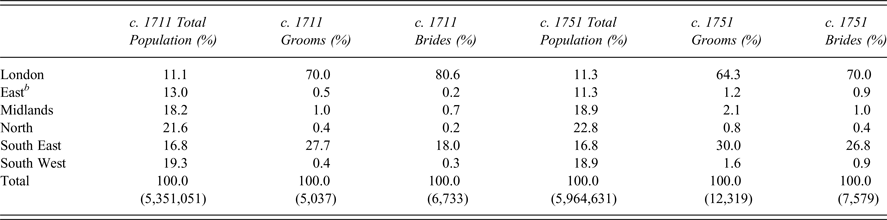
In general, the further a county was from London, the lower the numbers of brides and grooms from there who married at the Fleet.Footnote 51 Table 1 compares the breakdown of England's population by region to the proportion of brides and grooms who married at the Fleet from those regions. In c. 1711 and c. 1751 at least two thirds of Fleet brides and grooms whose origin could be identified came from London. In c. 1751 more people came from outside of London (and not just the surrounding counties) to marry at the Fleet. In both periods at least 90 per cent who married at the Fleet came from London and the South East. Table 1 also suggests that grooms came from further afield to marry at the Fleet than brides.
Regional origins of Fleet grooms and brides compared to share of English population, 1710–1712 and 1750–1752 a

a In this table figures are rounded to one decimal place to show the differences between the regions with proportions lower than 1 per cent.
b ‘East’ is Cambridgeshire, Huntingdonshire, Lincolnshire, Norfolk, and Suffolk; ‘Midlands’ is Derbyshire, Herefordshire, Leicestershire, Northamptonshire, Oxfordshire, Rutland, Shropshire, Staffordshire, Warwickshire, and Worcestershire; ‘North’ is Cheshire, Cumberland, Durham, Lancashire, Northumberland, Westmorland, and Yorkshire (all ridings); ‘South East’ is Bedfordshire, Berkshire, Buckinghamshire, Essex, Hampshire, Kent (excluding parts in London), Middlesex (excluding parts in London), Surrey (excluding parts in London), and Sussex; ‘South West’ is Cornwall, Devon, Dorset, Gloucestershire, Somerset, and Wiltshire.
Sources: E. A. Wrigley, ‘Rickman revisited: the population growth rates of English counties in the early modern period’, Economic History Review 62 (2009), 721; The National Archives, UK (hereafter TNA), Fleet Chapels Marriage Registers, 1710–1712: MSS RG7/7, 10, 18, 20, 23–9; 1750–1752: MSS RG7/216, 224–5, 229–30, 233, 239–41, 245–7, 249–53, 255–7, 260–2, 264–8.
People from outside of England also married at the Fleet. Possibly these individuals were not travelling to London specifically to marry there. They may have been in London for other reasons and decided to marry while visiting, with the Fleet offering the most convenient location. In c. 1711 there were ten grooms from Wales, one groom from Scotland (Edinburgh) and five from outside of Great Britain (one each from Amsterdam, Hamburg, St Kitts in the Caribbean, Newfoundland, and Mumbai). All but one of the brides in c. 1711 came from England. The exception was Joanna Andrews, a spinster from Pembroke, who married Charles Hogg, a bachelor sailor serving on the HMS Canterbury, on 21 January 1711.Footnote 52 In c. 1751 there were 21 grooms from Wales and 13 from Scotland (with one from the Orkney Islands). Twenty-three grooms came from outside of Great Britain; 19 from Ireland, two from France, one from Flanders, and one from Boston, Massachusetts. Among the brides in this period there were seven from Wales, nine from Scotland, seven from Ireland, and one each from Flanders and France.
Hundreds of Fleet grooms gave a ship as their place of residence. In c. 1711 1,367 sailors reported only a ship (in c. 1751 only six did). There were around 400 ship names recorded in the c. 1711 sample. Several dozen of their crew members married at the Fleet. For example, there were 39 grooms from the HMS Salisbury Prize. They were all married at the Fleet between 19 January and 10 June 1710, with five marrying on 26 March alone. Double or triple marriages were common at the Fleet, especially among shipmates.Footnote 53 The majority, around three quarters, of ships could be identified as Royal Navy vessels. Of the rest, around 5 per cent were merchantmen, 0.6 per cent Indiamen, 0.4 per cent colliers, 0.4 per cent foreign ships (one each from Denmark, Spain, and Norway, and two from the Dutch Republic), and one privateer (the suitably named Ambuscade). The remainder of the ships could not be classified. When the origin of these sailors’ brides was specified, 96 per cent came from London. Over half came from five parishes (St Dunstan Stepney, St Paul Shadwell, St John of Wapping, St Mary Whitechapel and St Botolph without Aldgate), all of which were located in the East End, an area associated with maritime trades. Many of these may have been hasty weddings between sailors and women they met while docked in London. Keith claimed that it was common for there to be two or three hundred clandestine marriages per week when the fleet came in.Footnote 54 Some of these sailors may have been from the East End but upon signing on for maritime service, gave their ship as a residence.
In c. 1711, 323 grooms specified just their military units and in c. 1751, 600 did. The majority of soldiers who married at the Fleet came from two infantry units: the Grenadier Guards (32 per cent in c. 1711 and 47 per cent in c. 1751) and the Coldstream Guards (around 20 per cent for both samples). The vast majority of these grooms were private soldiers. In c. 1711, 7 per cent were non-commissioned officers and 1 per cent officers. In c. 1751 non-commissioned officers accounted for 1 per cent and there were no officers. The origins of the wives of grooms who only gave a military unit were skewed towards the west of London. In both c. 1711 and c. 1751 just over half of the wives of soldiers came from four West End parishes (St Martin in the Fields, St Giles in the Fields, St James Westminster, and St Margaret Westminster). The explanation for this may have been that the Household Cavalry and Foot Guards had their London base at Horse Guards, a short distance from these parishes.
The origins of Londoners who married at the Fleet will be examined at the parochial level in order to determine what regions of the city were most represented. This requires some idea of the population of London's parishes in c. 1711 and c. 1751. Using parish registers to calculate this is problematic. Mortality spikes due to disease outbreaks and the traffic in corpses across London that varied over time would distort populations using burials.Footnote 55 Baptism registers are problematic because of variations in the sex ratio and incidence of non-conformists. London's marital practices varied from parish to parish and could produce inaccurate populations. There is, however, another source available. In 1739 William Maitland calculated counts of houses for every London parish.Footnote 56 As there were no accurate local figures for people per household for the eighteenth century, the Maitland household counts were adjusted using the numbers of people per household from the 1801 Census. For the parishes where Maitland did not provide counts, populations were calculated based on the population density of surrounding parishes. Using this approach gives London a population of 599,767 in 1739, not too far from the accepted figure (based on an annual growth rate of 0.321 per cent between 1700 and 1750) of 651,604.Footnote 57 Parish populations for c. 1711 and c. 1751 could not be created by applying the 1739 proportions to the population of London in these years. Over this period not all parts of London were growing – the City within the Walls was stagnant. Growth outside of the Walls was the major factor in London's overall population growth.Footnote 58 So, while the City within the Walls’ absolute population may not have declined it was decreasing compared to other areas of London. The populations for parishes in the City within the Walls in 1739 were held steady while assuming other areas of London were growing at the same rate. Although it is improbable that all areas of London grew constantly, calculating individual growth rates for each parish would be problematic given the issues with early modern metropolitan vital records detailed above. Furthermore, the aim of this exercise was not to calculate exact parish populations but give some idea of their relative share. To test the accuracy of the Maitland-derived populations, they were compared to those produced by the ‘Locating London's Past’ project, which used a different methodology.Footnote 59 These estimated parish populations were very closely correlated with those used in this article for both c. 1711 (R2 = 0.965, P < 0.001) and c. 1751 (R2 = 0.960, P < 0.001). This suggests that the distribution of London population using the Maitland figures is fairly robust.
The c. 1711 and c. 1751 population of each parish was compared to the number of grooms and brides from there. They correlated with the Fleet in c. 1711 (grooms R2 = 0.929, P < 0.001; brides R2 = 0.950, P < 0.001) and c. 1751 (grooms R2 = 0.961, P < 0.001; brides R2 = 0.937, P < 0.001). This suggests that the origins of the brides and grooms at the Fleet reflected London's geographical population structure. When the numbers of grooms and brides at the Fleet from each parish was compared, there was high correlation in both periods (c. 1711 R2 = 0.946, P < 0.001; c. 1751 R2 = 0.956, P < 0.001). This shows that the origins of Londoners marrying at the Fleet did not vary significantly between the two samples. Finally, there was correlation between the numbers from each parish when the brides and grooms were compared from the same years (grooms R2 = 0.937, P < 0.001; brides R2 = 0.923, P < 0.001), suggesting that the proportion of brides and grooms from each parish was broadly similar.
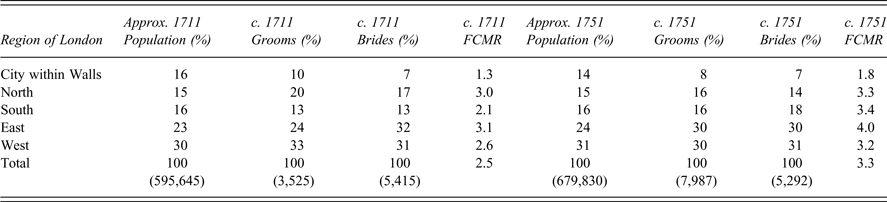
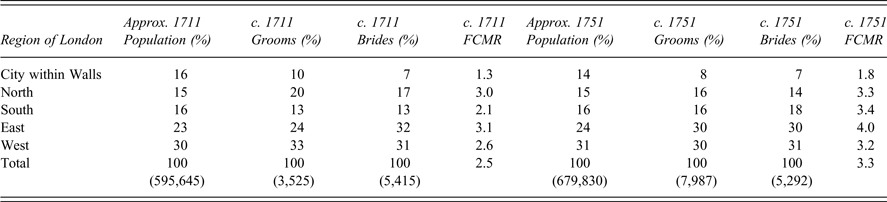
Table 2 breaks down the origin of Londoners who married at the Fleet. It shows the City within the Walls was under-represented. This may be because this area was generally wealthier than other parts of London, and people from the highest social statuses may have been less likely to use the Fleet, which was more associated with ‘plebeian weddings’. Brown suggests that the professional and aristocratic ranks may have preferred to use Keith's Mayfair chapel.Footnote 60 The smaller size of parishes there (the mean size of parishes in the City within the Walls in the eighteenth century was 0.010 miles2, compared to 0.522 miles2 in other parts of London) may have made people more closely tied to their church, and want to get married there. There would have been less pressure on resources in these churches, giving greater flexibility in choice of marriage time. To test this, the parish's size was compared to the numbers of people from there who married at the Fleet. Parishes from London's periphery were excluded, as their large size and comparatively low population density distorted the results. There was significant correlation between the two variables for c. 1711 (grooms R2 = 0.542, P < 0.001; brides R2 = 0.552, P < 0.001) and c. 1751 (grooms R2 = 0.593, P < 0.001; brides R2 = 0.714, P < 0.001). Aside from the City within the Walls, the Fleet matched London's population topography well. The main exception is the eastern region, which was over-represented. As the East End was heavily involved in the maritime trade, this may reflect the predilection of sailors to use the Fleet. This also extends to women in the East End. The eastern suburbs are not over-represented for grooms in c. 1711 because sailors’ parishes were not entered, just their ships. This may also explain the fact that in c. 1751 grooms from south of the Thames more closely mirrored the overall population structure, as many of the area's residents were involved in the maritime trade. There are high numbers of grooms from the northern suburbs in the c. 1711 sample. This may be due to the area's high numbers of craftsmen and manufacturers, groups possibly more likely to use the Fleet (see below).Footnote 61
Origins of Fleet grooms and brides from London and the Fleet Crude Marriage Rate per 1,000, a 1710–1712 and 1750–1752
a The Fleet Crude Marriage Rate per 1,000 (FCMR) figures should be regarded as minima.
Source: TNA Fleet Chapels Marriage Registers, 1710–1712: MSS RG7/7, 10, 18, 20, 23–9; 1750–1752: MSS RG7/216, 224–5, 229–30, 233, 239–41, 245–7, 249–53, 255–7, 260–2, 264–8.
St Dunstan Stepney (including parts of the parish split off after 1729) was the origin of the highest proportion of Londoners who married at the Fleet – around 10 per cent of brides and grooms for both samples. This is no surprise given the large population of the parish (around 65,000 by 1750 – or a little under one tenth of London's population at the time). However, how important was Fleet marriage to a parish relative to its population? This can be determined by calculating ‘Fleet Crude Marriage Rates per 1,000’ (hereafter FCMR) for each London parish based on the populations using Maitland's figures. The FCMR shows the crude number of marriages per 1,000 in an area that were at the Fleet. London's total FCMR in c. 1711 was 2.5 per 1,000 and 3.3 per 1,000 in c. 1751. Assuming that eighteenth-century London had a crude marriage rate of ten per 1,000 annually (higher than the national norm – Wrigley suggests the crude marriage rate in England at this time was 8.6 per 1,000),Footnote 62 this means that the proportion of Londoners who married at the Fleet was one quarter in c. 1711 and one third in c. 1751. These figures should be regarded as minima, given that the Fleet registers are incomplete and that origin could not be determined for many of the people who married there. It is likely that many more Londoners married at the Fleet than these figures suggest. If it is assumed that these people with unspecified locations came from London in the same proportion as those with specified locations, then it means there are at least 2,400 Londoners ‘missing’ from c. 1711 and about 5,400 from c. 1751. Adding these people raises the FCMR to at least 3.2 per 1,000 in c. 1711 and 4.6 per 1,000 in c. 1751.
In c. 1711, 41 per cent of London parishes had an FCMR over 2 per 1,000, and 31 per cent were under 1 per 1,000. In c. 1751 these figures were 57 per cent and 23 per cent, respectively. In general, the parishes with the highest FCMR were East End parishes such as St John of Wapping (4.3 per 1,000 in c. 1711 and 5.0 per 1,000 in c. 1751) and St Mary Whitechapel (4.1 per 1,000 in c. 1711 and 5.9 per 1,000 in c. 1751). Compared to nearby parishes east of the Walls, Holy Trinity Minories had a fairly low FCMR of 0.2 per 1,000 in c. 1711. This parish had been a major centre of clandestine marriage in the seventeenth century. Although its popularity for such ceremonies had waned by the early eighteenth century, perhaps it still retained its reputation for convenient marriages, meaning its residents did not marry at the Fleet in high numbers. In c. 1751 the parish's FCMR was 1.0 per 1,000. Parishes with the lowest FCMR were in the City within the Walls such as St Martin Outwich or the united parishes of All Hallows Bread Street and St John the Evangelist, both of which were just 0.005 miles2 in size. An exception to this was St Benet Paul's Wharf and St Peter near Paul's Wharf (FCMR of 3.5 per 1,000 in c. 1711 and 2.9 per 1,000 in c. 1751). However, this parish was located a stone's throw from the Fleet so perhaps its residents found the convenience of clandestine marriage too much to ignore.
As for the origins of brides and grooms from outside of London – among grooms in c. 1711, the most common origin was Chelsea (4 per cent of grooms with a specified location), located just west of London. Much of this was due to the Royal Chelsea Hospital; 186 grooms described themselves as ‘pensioners’, ‘hospitallers’, or ‘invalids’ of Chelsea. Even when they are excluded, 0.5 per cent of grooms came from Chelsea. The next most popular locations were Brentford (0.7 per cent), Fulham (0.5 per cent) and Kensington (0.5 per cent). The most popular location for brides from outside of London in c. 1711 was also Chelsea (0.6 per cent), followed by Brentford (0.5 per cent), Kensington (0.4 per cent) and Fulham (0.4 per cent). The picture was similar in c. 1751. The most popular location for grooms from outside of London was again Chelsea (1 per cent of grooms, but 0.6 per cent once Chelsea pensioners were removed), followed by Brentford (0.5 per cent), Islington (0.5 per cent) and Kensington (0.5 per cent). The most popular origin for brides in c. 1751 was also Chelsea (1 per cent of brides with specified locations). Next were Woolwich (0.6 per cent), Brentford (0.5 per cent), and Islington (0.5 per cent). Clearly people from London's periphery were marrying at the Fleet in high numbers during the first half of the eighteenth century.
To determine the relative importance of the Fleet to marriage, patterns in each English county will now be considered. Wrigley's county populations for 1700, 1750, and 1801 were used to calculate county populations for c. 1711 and c. 1751. These figures were combined with Wrigley and Schofield's suggested national crude marriage rate of 7.5 per 1,000 in 1710–1712 and 8.2 per 1,000 in 1750–1752 to indicate how many marriages there were in England and in each county.Footnote 63 In 1711 there were around 40,000 marriages in England and in 1751 around 50,000. At least 6 per cent of the marriages in England took place at the Fleet in c. 1711, and at least 10 per cent in c. 1751. Using brides and grooms who specified their location, the percentage of marriages at the Fleet at the county level was calculated.Footnote 64 Some counties, mainly ones a distance from London like Cornwall and Westmorland, barely figured. Just one person from Rutland was in the database: Joseph Stanger, a bachelor musician from the village of Braunston who wed Ellenor Nix, a spinster from Leicestershire, on 20 September 1710.Footnote 65 In c. 1711 there were 14 counties where less than 0.1 per cent of the county's marriages took place at the Fleet. For eight counties (the Home Counties plus Oxfordshire) more than 1 per cent of marriages were at the Fleet in c. 1711. In Middlesex around one third of marriages were at the Fleet, in Surrey one quarter. In Kent (7 per cent), Hertfordshire (6 per cent), and Essex (5 per cent) at least one in 20 marriages occurred at the Fleet. In c. 1751 Fleet marriages had a wider geographical impact. Bar Rutland, all English counties had more than 0.1 per cent of their marriages at the Fleet. For 13 counties (the south-east corner of England from Oxfordshire and Cambridgeshire down to Hampshire and Kent) more than 1 per cent of marriages in c. 1751 were at the Fleet. In Middlesex and Surrey over 40 per cent of marriages were at the Fleet and in Hertfordshire and in Kent around 15 per cent were. Clearly, in the mid-eighteenth century the Fleet was drawing people in from the areas around London in considerable numbers. One of the reasons that people were willing to do this was that in the provinces it was harder to find a priest who would conduct a clandestine marriage (as well as have a more private wedding), so couples travelled to London because the Fleet offered guaranteed availability.Footnote 66 Contemporary evidence of this is shown by a 1753 pamphlet, which stated such is the ‘Delicacy of English Women, that in the Country they will travel ten Miles from their own Parishes to be married in a Place where they are not known.’Footnote 67
For both samples around 70 per cent of the people who married at the Fleet came from less than five miles away. Grooms travelled from slightly further than brides. In c. 1711, the median distance for grooms was 1.7 miles, and for brides it was 1.6 miles. In c. 1751, when the Fleet was drawing in customers from a wider area, the median distance for grooms and brides was 1.9 miles and 1.7 miles, respectively. In terms of marital distance, in c. 1711 nearly two thirds of couples were from the same place or parish and 94 per cent from within ten miles of each other. In c. 1751 the percentage of couples from the same parish was nearly three quarters and 94 per cent of couples came from within ten miles of each other. The mean distance between couples in c. 1711 was 6.4 miles and 5.2 miles in c. 1751 (the median distance was zero). In c. 1711 the couple who came from the furthest away were Charles Walker (a bachelor gentleman from Mumbai) who married Ann Seegood (a spinster from St Sepulchre without Newgate, London) on 11 December 1711.Footnote 68 In c. 1751 the couple with the highest marital distance were Cornelius Morris (a widower from Fermanagh, Ireland) who married Sarah Banister (a spinster from St James Clerkenwell, London).Footnote 69 Such examples were the exception rather than the rule. The majority of couples who married at the Fleet came from London and its surrounding areas.
5. OCCUPATION OF GROOMS AT THE FLEET
The occupational background of the people who married at the Fleet has not been explored in detail. According to Gillis, the Fleet had the reputation that relatively few wealthy people married there, and that people who married there were mostly of the ‘middling sort’ although not necessarily from the lowest social strata.Footnote 70 Brown argued that by the eighteenth century ‘the Fleet became and remained the centre of matrimony for the lower classes of London’.Footnote 71 There has been little quantitative evidence to support these assertions. The cost of marrying at the Fleet averaged 7s 6d, not dissimilar to marrying by banns in a church – although at the Fleet the bride and groom could save money by not having to entertain guests and friends after the ceremony.Footnote 72 Marriage by common licence was more expensive – it usually cost at least 10s, as well as parish charges between 5s and 10s (with additional fees for marrying outside of one's own parish church, outside of canonical times or on days with no divine service) and 12s 6d in stamp duties.Footnote 73 The Fleet's rise in popularity came at a time when metropolitan wages were increasing in real terms, making Londoners less money conscious.Footnote 74 Therefore, it was not the case that just those who could not afford to marry elsewhere married at the Fleet. The Fleet registers only gave the groom's occupation, which is unfortunate given that the majority of married women in London (and probably the rest of England) remained in employment.Footnote 75
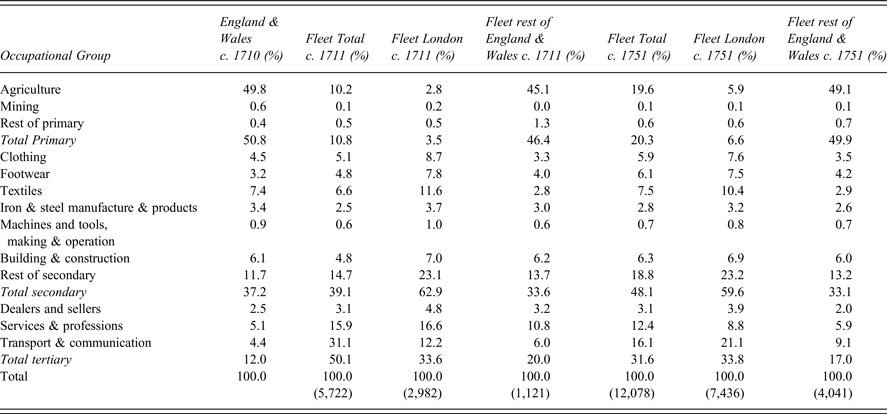
Table 3 compares the occupations of grooms who married at the Fleet to the national picture. It shows how representative the Fleet may have been of the overall male occupational structure. Given that so many Londoners married at the Fleet, the primary sector is under-represented. In 1710 the primary sector (that is, that which makes direct use of natural resources – in England at this time the sector mainly consisted of agriculture) employed over half of the male workforce of England and Wales while it accounted for around 10 per cent of Fleet grooms in c. 1711 and 20 per cent in c. 1751. When London is excluded, around half of Fleet grooms were employed in the primary sector. The reason that there appears to be a surprisingly high percentage (5.9 per cent) of Londoners employed in agriculture in c. 1751 was the 294 London grooms described as ‘husbandman’. It is unlikely they actually were. Many of the ‘husbandmen’ came from wholly built-up parishes (that is, not on the periphery of the metropolis). Parishes on London's periphery could be home to husbandmen. However, most of the agriculture in these places was small market gardens, whose workers tended to be described as ‘gardeners’. It is possible that ‘husbandman’ was being used as a synonym for labourer here, or that they had recently moved to London and were giving their previous occupation. If these metropolitan husbandmen are excluded from the agricultural sector, its share of the occupations of London grooms in c. 1751 falls to 1.9 per cent.
Fleet occupational male patterns compared to the rest of England and Wales a

a Labourers from the Fleet were reallocated according to the proportions of the rest of the occupational groups. The figures in fourth, fifth, seventh, and eighth columns do not include the grooms who gave their location as a ship or military unit. Figures are rounded to one decimal place here to show the differences between the regions with proportions lower than 1 per cent.
Sources: L. Shaw-Taylor and E. A. Wrigley, ‘Occupational structure and population change’, http://www.campop.geog.cam.ac.uk/research/projects/occupations/abstracts/paper26.pdf [updated 27 November 2015], 8, 22; TNA Fleet Chapels Marriage Registers, 1710–1712: MSS RG7/7, 10, 18, 20, 23–9; 1750–1752: MSS RG7/216, 224–5, 229–30, 233, 239–41, 245–7, 249–53, 255–7, 260–2, 264–8.
The secondary sector (manufacturing) accounted for around 40 per cent of grooms who married at the Fleet in c. 1711 and around half in c. 1751. If London grooms are considered it appears that occupations in clothing, footwear, and textiles were all heavily represented at the Fleet. Wig makers appear to have been an occupation that appeared in high numbers at the Fleet, accounting for 2 per cent of London grooms with occupations in both samples. The tertiary sector (services) was the most over-represented at the Fleet compared to the nation's overall occupational structure. This was largely due to the high numbers of grooms employed in the military (6 per cent in c. 1711 and 5 per cent in c. 1751) and in ocean transport (27 per cent in c. 1711 and 10 per cent in c. 1751) who married at the Fleet. In c. 1711 over half of grooms who married at the Fleet were employed in the tertiary sector, with around one third in transport and communication. By c. 1751 the proportion employed in the tertiary sector was around one third – the difference was mostly due to lower numbers of sailors marrying at the Fleet.
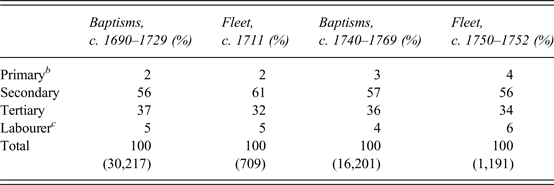
The male occupations of Londoners at the Fleet will now be compared to another source, parochial baptism registers.Footnote 76 This will show if any groups tended to marry there in higher numbers. Table 4 shows that the occupational structure revealed by baptism registers was similar to the subset of grooms from the same parishes in the Fleet for both periods. There were, however, some groups that were statistically significantly over- and under-represented at the Fleet. Shoemakers appeared in high numbers at the Fleet in c. 1711 – being over-represented by 2.4 per cent in compared to the baptism registers.Footnote 77 In c. 1751 clothing manufacture (mostly tailors) was over-represented by 1.7 per cent in the Fleet.Footnote 78 Domestic servants were likewise over-represented in the Fleet, by 4.0 per cent in c. 1711. They may have chosen to marry at the Fleet to keep it secret from their employers, as marriage was usually grounds for dismissal for a domestic servant.Footnote 79 Dealers and sellers, a higher status occupational group, were under-represented at the Fleet by 3.2 per cent in c. 1711 and 3.3 per cent in c. 1751. This may be because many in this group lived in the City within the Walls, an area under-represented in the Fleet.
Occupational structure of grooms in the Fleet marriage registers compared to fathers in Baptism registers from the same parishes, 1710–1712 and 1750–1752 a

a The samples were reweighted by parish according to their populations in 1711 and 1751 as calculated using the Maitland population shares.
b Excluding husbandmen for Fleet grooms.
c Including husbandmen for Fleet grooms.
Source: TNA Fleet Chapels Marriage Registers, 1710–12: MSS RG7/7, 10, 18, 20, 23–9; 1750–1752: MSS RG7/216, 224–5, 229–30, 233, 239–41, 245–7, 249–53, 255–7, 260–2, 264–8.
There was high correlation between the occupations of bachelors and widowers,Footnote 80 with some differences. For both samples widowers were slightly more likely to be employed in the secondary sector, particularly in clothing, shoemaking, and textiles. Likewise, dealers and sellers were more likely to be widowers. Services and professions, however, were more likely to be bachelors. This is due to employment in the armed forces and domestic service, which was skewed towards bachelors. In both samples over 90 per cent of grooms employed in domestic service were bachelors. The majority of domestic servants in England shifted out of the occupation as they aged.Footnote 81 Therefore, it is unsurprising that the majority of domestic servants were bachelors. The higher numbers of bachelors in transport and communication is due to sailors, around 85 per cent of whom were bachelors in both samples. The final major difference between bachelors and widowers occurred for labourers in c. 1711, who were more likely to be widowers. This may be due to the demands of the British military in the War of the Spanish Succession, with unskilled young men who may have otherwise been labourers being enlisted into the armed forces.Footnote 82
6. TIMING OF FLEET MARRIAGES
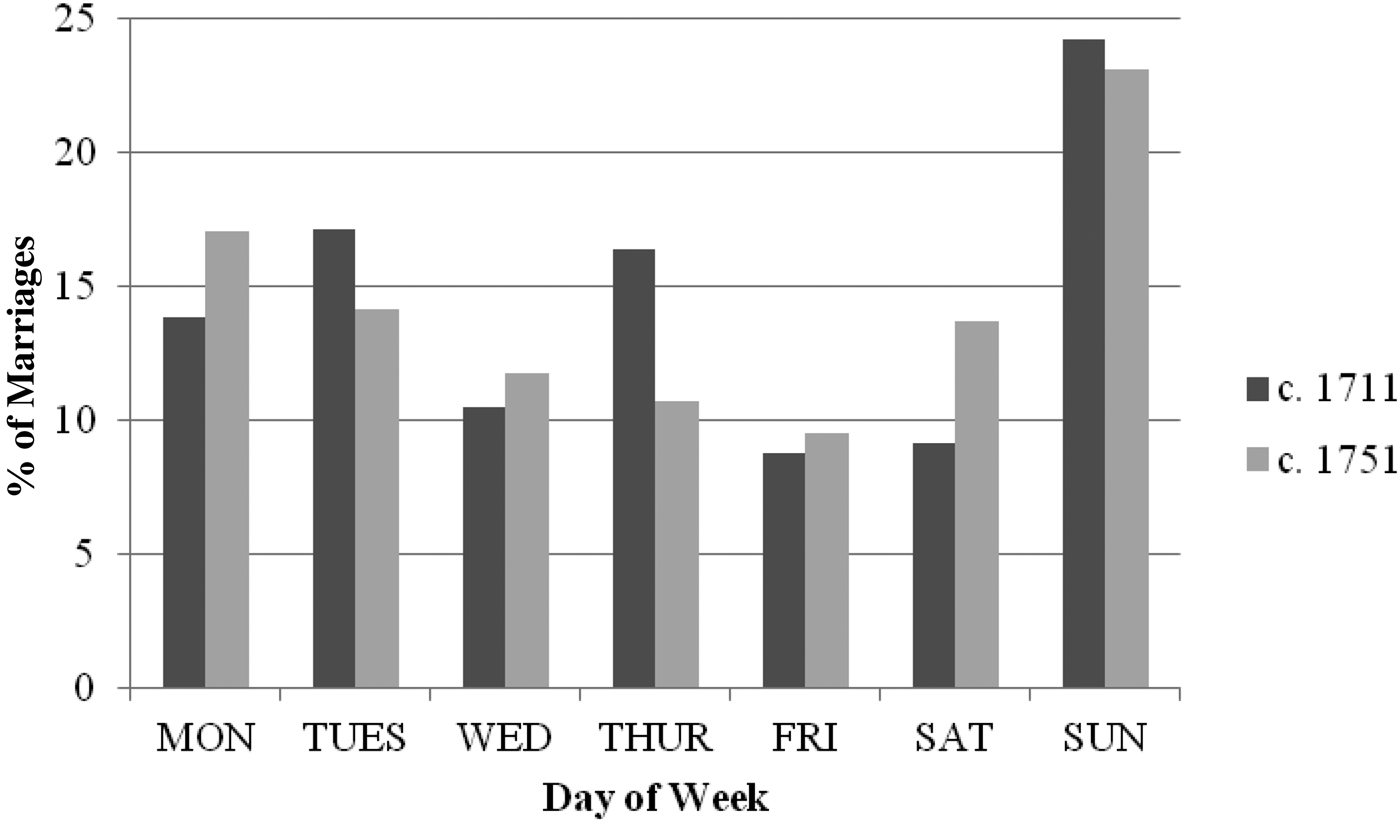
The final issue to be considered is the timing of Fleet marriages. Boulton found that weddings by licence, generally associated with a desire for privacy, rarely took place on Sundays (whereas banns weddings were more likely to).Footnote 83 On no day were parish churches ‘closed’ for weddings, but Boulton's study of three seventeenth-century London parishes found that Fridays and Saturdays tended to be the least popular. After the mid-seventeenth century, mid-week marriages gained in popularity.Footnote 84 Figure 1 shows that Sundays remained the most favoured day for Fleet marriages, with around one quarter of them taking place then. Fridays were the least popular day to marry at the Fleet. The groom's occupation did not have much of an impact on the day of marriage, although the tertiary sector was less likely to marry on Sunday than other sectors.Footnote 85 Although people could marry whenever they wanted at the Fleet, the traditional marriage day of Sunday remained the most popular.
Marriages at the Fleet by day of week, c. 1710–1712 and c. 1750–1752. Source: TNA Fleet Chapels Marriage Registers, 1710–1712: MSS RG7/7, 10, 18, 20, 23–9; 1750–1752: MSS RG7/216, 224–5, 229–30, 233, 239–41, 245–7, 249–53, 255–7, 260–2, 264–8.

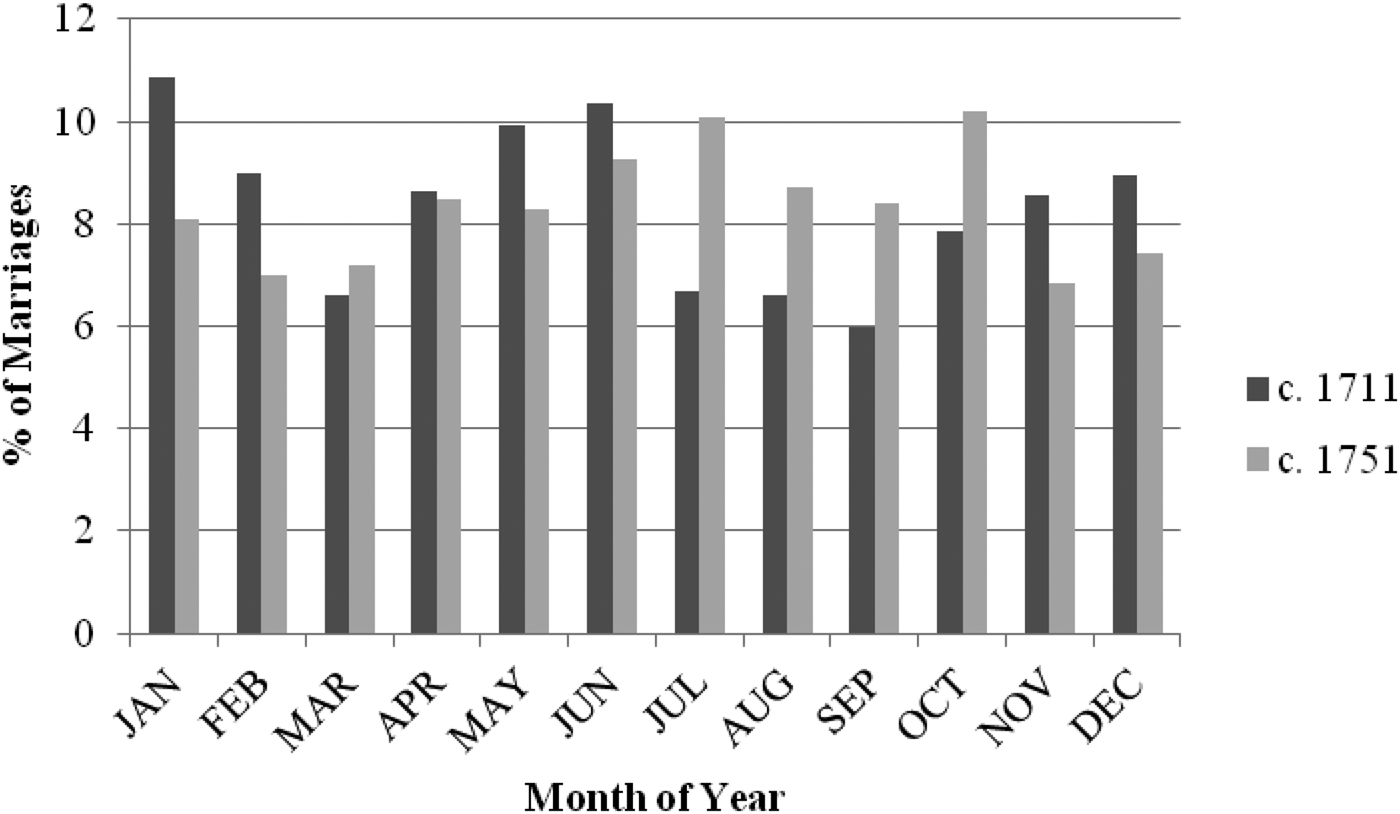
Figure 2 shows Fleet marriages were spread fairly evenly across the year. In c. 1711 there were slightly more marriages in winter, while in c. 1751 summer was the most popular season. This may have been due to the War of the Spanish Succession. By winter the campaigning season was over, giving military personnel the chance to return home. Forty per cent of sailors and 43 per cent of soldiers in c. 1711 married during winter. In c. 1751, when Britain was no longer at war, the tendency was no longer evident. Otherwise no occupations showed a marked tendency towards marrying at a particular time of the year. When distance travelled to the Fleet was compared to seasonality, the distance travelled to the Fleet tended to be lower during winter (a median of 1.5 miles in c. 1711 compared to 1.7 miles for the rest of the year and a median of 1.7 miles in c. 1751 compared to 1.9 miles for the rest of the year). This reflects the difficulty of travelling long distances at this time, when England's roads would be in a poor condition.
Marriages at the Fleet by month of year, c. 1710–1712 and c. 1750–1752. Source: See Figure 1.

7. CONCLUSION
This article has shown the popularity of the Fleet during the first half of the eighteenth century, and its huge importance to marriage in London and England. People from across London married at the Fleet, in numbers very closely correlated with the population sizes of their parishes. Not all areas of the city had people who married at the Fleet in equal numbers. People from the City within the Walls were less likely to marry there. Residents of the East End married at the Fleet in large numbers, and in c. 1751 in some parishes there (for example St Mary Whitechapel), over half of their marriages took place at the Fleet. Not just Londoners married at the Fleet – around one third of those who married at the Fleet were from outside of the city. However, they came mostly from areas close to London. Around nine out of ten people who married at the Fleet were from south-eastern England, with around 70 per cent of the people who married there coming from within five miles.
This article has also shown that the Fleet was particularly popular for second marriages, especially for widows. The Fleet's reputation as a favoured location for the marriage of sailors has also been confirmed. It is also clear that people with other occupations such as soldiers and domestic servants married at the Fleet in relatively high numbers. Overall, the occupational distribution of Fleet grooms from London broadly correlated with the city's overall pattern. This shows that far from being a refuge for the poor, the people who married at the Fleet were fairly representative of London's socio-occupational structure. Fleet marriages were also numerous. In total at least 6 per cent of marriages in England in c. 1711 were at the Fleet, and at least 10 per cent in c. 1751. During the early eighteenth century at least one third of London marriages took place at the Fleet, and over half by the 1750s.
The Fleet's ubiquity poses two key questions: why was it so popular and what does it reveal about contemporary attitudes to marriage? As stated above, the Fleet had a poor reputation. One of its chief critics, Gally, argued in 1750 that ‘preventing clandestine Marriages … will greatly conduce to the Peace and good Order of this Nation’.Footnote 86 In the 1753 parliamentary debates before the passing of Hardwicke's Act Sir Dudley Ryder called Fleet marriages, ‘an evil by which many of our best families have often suffered’.Footnote 87 These concerns were more rooted in the fear that the quick, easy and private Fleet marriages challenged ‘patriarchal and class-based hierarchies of property, authority and identity’.Footnote 88 For most people, the Fleet did not pose this kind of threat.
One of the main benefits of the Fleet was its sheer convenience compared to a parish wedding. A 1753 pamphlet states, ‘the cheapest, the easiest, and the most open shop of marriage is the most frequented’. This is echoed by another pamphlet published that year; ‘the Number of Couples, who chuse to be joined in the Fleet … shews that there is much Inconvenience attending the regular Forms’.Footnote 89 Unlike banns marriage, Fleet marriages needed no prior arrangement and could be conducted whenever the participants wished, often late at night (although despite having the freedom to marry on any day of the week, Sundays still remained the most popular). They also were far shorter than church weddings, stripping out all but the essentials of the ceremony. The Fleet offered the flexibility of a licensed marriage but was cheaper and did not require literacy, prior organisation or at least four weeks residence in a parish or chapelry.Footnote 90 Cost and convenience alone do not fully explain the appeal of the Fleet. Many would have married at the Fleet because of the privacy it offered, which meant the ordeal of the charivari could be avoided, which may have particularly appealed to widows.Footnote 91 London itself contributed to the Fleet's appeal. In many of the highly-populated suburban parishes there would have been huge pressures on clerical time, making it difficult to arrange parochial weddings. As many of the residents of the metropolis were not native Londoners they may have also felt no particular attachment to their local parish. London was also home to the largest and busiest port in the country, and high numbers of sailors were shown to have used the Fleet. After Hardwicke's Act denied access to the Fleet many sailors would continue to avoid the parish church by making their own marriages without clergy.Footnote 92 It should be remembered that thousands of people who married at the Fleet travelled from outside of London and so would have incurred travel and lodging costs, probably outweighing the savings they made in marriage fees choosing the Fleet.Footnote 93 For such groups the attraction of the Fleet may have also rested in secrecy and convenience but it also may have been part of a ‘day out’ in the capital (the Fleet also provided leisure activities aside from matrimony). Even after Hardwicke's Act, people married surreptitiously in London until as late as 1821.Footnote 94
The popularity of clandestine marriage, and the Fleet, reveals that in the seventeenth and eighteenth centuries people wanted to set the terms of their own marriages. This echoes Boulton's point that clandestine marriage appealed because it gave people a chance to replicate the private marriages of the elite.Footnote 95 The importance of the Fleet also showed that the local Anglican parish church was not seen to be the only pathway to marriage. The Fleet would certainly have hosted many weddings of non-conformists. Although it is impossible to tell what proportion of people who married at the Fleet were not members of the established church, it is likely many would have found marrying at the Fleet more appealing than in an Anglican church. As Brown notes, although the Fleet was staffed by priests, marriages there were more of a personal matter than a sacrament.Footnote 96 After Hardwicke's Act increasing numbers married by licence, showing that the ability to set the terms of one's marriage remained appealing.Footnote 97
The public resentment to Hardwicke's Act showed just how important clandestine marriages were for many. Some even claimed it would lead to fornication among the poor as they would not marry unless they could have clandestine weddings.Footnote 98 The end of clandestine marriage was even seen to threaten national stability. Keith argued that ‘the door to propagation should always stand half-open; yea, ready on all occasions to fly wide open, and welcome in all comers … the welfare and prosperity of Britain, was, and always would be, the multitude, the stock and increase of its inhabitants’. Any abolition of clandestine marriages, Keith warned, would result in population decline, and the lack of people would then lead to influx of new settlers, who would eject present inhabitants from lands and properties as the ‘Danes and Saxons the ancient Britains’.Footnote 99 Keith's dire predictions never came to pass – the impact of Hardwicke's Act was not as drastic as its critics claimed.Footnote 100 Keith's exaggerated claims about the importance of clandestine marriage were proved to be incorrect. However, what this article shows is the huge importance and popularity of the Fleet, and the fact that the people who married there were generally no different from those who married anywhere else in eighteenth-century England.
ACKNOWLEDGEMENTS
Kind thanks to Jeremy Boulton, Amy Erickson, Catherine Field, Gill Newton, and Leigh Shaw-Taylor, as well as the editors and three anonymous referees of Continuity and Change, for their invaluable comments and advice in the preparation of this article. The data collection for this article was made possible by a generous grant from the LeverhulmeTrust awarded to L. Shaw-Taylor, E. A.Wrigley, and R. M. Smith for 'The occupational structure of England and Wales c. 1379 to c. 1729' research project.