Whey is the most important dairy by-product in consideration of its volume and nutritional aspect. It contains a huge amount of milk solids, including whey proteins and essential amino acids like methionine, cystine and lysine, minerals, water-soluble vitamins and lactose (Pires et al., Reference Pires, Marnotes, Rubio, Garcia and Pereira2021). The nutritional and functional attributes of whey are well known. The bioactives present in whey can support several health benefits, like immune-enhancing properties, anti-hypertensive and anti-oxidative (Pillai et al., Reference Pillai, Morya and Kasankala2024). Despite immense nutritional and functional benefits, whey remains mainly unutilised and is being disposed of by many organizations, creating concern regarding environmental pollution as whey has a high biological oxygen demand value (BOD, 45,000 ppm) (Rocha-Mendoza et al., Reference Rocha-Mendoza, Kosmerl, Krentz, Zhang, Badiger, Miyagusuku-Cruzado, Mayta-Apaza, Giusti, Jiménez-Flores and García-Cano2021). Disposal of whey means loss of nutrients that are high-quality and suitable for human intake. Hence, whey utilization in food processing systems is a real concern for the dairy processing organizations due to the enhanced cost of whey treatments before disposal and the worldwide implementation of strict anti-pollution regulations (El-Aidie and Khalifa, Reference El-Aidie and Khalifa2024).
Pearl millet, a sustainable agricultural crop, has good disease resistance and can grow in low-rainfall areas (Shrestha et al., Reference Shrestha, Hu, Shrestha and Doust2023). The grain is a high-energy cereal with good amino acid balance (Satyavathi et al., Reference Satyavathi, Ambawat, Khandelwal and Srivastava2021). However, it remains largely underutilised due to its limited palatability and the presence of anti-nutritional components (Priya et al., Reference Priya, Lakhawat, Yadav, Gacem, Abbas, Yadav, Park, Jeon and Mishra2023). Several processing practices, including milling, cooking and germination, can improve the nutritive traits of pearl millet (Meena et al., Reference Meena, Meena, Joshi and Dhotre2024). Among these, fermentation is considered as the most effective treatment (Yousaf et al., Reference Yousaf, Hou, Liaqat and Shen2021) as it can cause a reduction in the anti-nutrients along with a simultaneous increase in nutrition and palatability (Tanwar et al., Reference Tanwar, Panghal, Kumari and Chhikara2025).
Barley comprises about 10%–17% protein, 11%–34% total dietary fibre, and 4%–9% β-glucan (Raj et al., Reference Raj, Shams, Pandey, Dash, Singh and Bashir2023). However, only 2% of the barley crop is used for food, with the majority processed for malting and animal feed (Lukinac and Jukić, Reference Lukinac and Jukić2022). Barley has recently gained huge attention and consideration, due to its potential health benefits. Barley phytochemicals have been reported to be useful in the management of various diseases, including elevated blood cholesterol, diabetes and colon cancer (Zhang et al., Reference Zhang, Huan, Juan, Xinghua, Yansheng, Ying, David, Xiang and Quancai2023).
Colorectal cancer (CRC) is a major global health concerns (Sung et al., Reference Sung, Ferlay, Siegel, Laversanne, Soerjomataram, Jemal and Bray2021). It is the third most prevalent cancer worldwide and is responsible for numerous deaths, with its incidence projected to reach 1.6 million new cases per year by 2040 (Eileen et al., Reference Eileen, Melina, Gini, Lorenzoni, Cabasag, Mathieu and Freddie2022). Epidemiological studies reveal that the occurrence of colon cancer is linked to food habits in humans. A high-fiber and low-fat diet is beneficial for colon cancer (Liang et al., Reference Liang, Song, Hu, Wu, Li, Dong, Liang and Wang2022). Ingestion of fermented dairy and food products represents a promising preventive and therapeutic approach against colon cancer (Verma and Shukla, Reference Verma and Shukla2015; Hendler and Zhang, Reference Hendler and Zhang2018; Emami et al., Reference Emami, Salehi, Hassanzadeh, Mansourian, Mohammadzadeh and Maghool2022; Piccioni et al., Reference Piccioni, Marcello, Marcello, Veronica, Annunziata, Antonio, Francesco and Giuseppe2023). Several mechanisms explain the efficacy of Lactobacillus spp.in the management of colon cancer, such as modulation of the gut microbiota, short-chain fatty acids (SCFAs) production, binding of dietary carcinogens and enhancement of the immune system (Tripathy et al., Reference Tripathy, Dash, Kancharla, Kolli, Mahajan, Senapati and Jena2021; Liang et al., Reference Liang, Song, Hu, Wu, Li, Dong, Liang and Wang2022). One of the potential mechanism underlying the preventive effect of fermented foods against colon cancer is the reduction in faecal enzyme activity of β-glucuronidase. β-glucuronidase is an enzyme produced by faecal bacteria that converts procarcinogens into potential carcinogens from available substrates (Verma and Shukla, Reference Verma and Shukla2013). Bacterial β-glucuronidase is known as a marker of procarcinogenic activity, as the enzyme plays a vital role in the initiation of CRC owing to its broad substrate specificity and ability to hydrolyse various glucuronides (Lyra et al., Reference Lyra, Lahtinen, Ouwehand, Salminen, von Wright, Lahtinen and Ouwehand2012).
Most of the fermented lactic culture-containing food products available globally are milk-based, and limited efforts are made to prepare fermented foods by utilising a combination of milk and cereals. The mixture of milk and cereal can provide a synergistic effect and improved nutrition, ultimately leading to a new generation of functional foods with better sustainability. Milk is enriched with fibre, whereas the protein quality of cereals will be enhanced. Limited work has been done in the area of milk-cereal-based fermented product development and evaluation of its nutritional attributes (Ganguly et al., Reference Ganguly, Sabikhi and Singh2021, Reference Ganguly, Sabikhi and Singh2022); there is scope for further research in this area.
Mathematical models are standard tools for predicting the growth, death and survival of microorganisms in a certain substrate. The modelling process usually starts with first-order models that represent mathematical equations depicting the growth or survival curves of microorganisms and may be explained in terms of total count, substrate levels, level of metabolites or toxin production (McMeekin et al., Reference McMeekin, Olley, Ratkowsky and Ross2002). The continuous logistic equation, as modified by Fujikawa et al. (Reference Fujikawa, Kai and Morozumi2004), is the most common and explanatory model for expressing the growth dynamics of an organism in a finite substrate. Lactobacillus spp. are very choosy microorganisms requiring a supply of complex nutrients for growth (Gomes and Malcata, Reference Gomes and Malcata1999). Hence, substrate composition considerably affects the fermentation process, ultimately affecting model parameters. However, limited research has been carried out to estimate the growth of lactobacilli in a composite substrate and express them through mathematical models. Some studies have indicated the favourable effect of probiotic and fermented milk consumption on colon cancer (Verma and Shukla, Reference Verma and Shukla2015; Liang et al., Reference Liang, Song, Hu, Wu, Li, Dong, Liang and Wang2022), but limited work has been conducted for the estimation of the beneficial effect of a composite fermented product. L. acidophilus NCDC 13 is an indigenous strain which had isolated from fermented milk in India (Arora et al., Reference Arora, Anastasovska, Gibson, Tuohy, Sharma, Bell and Frost2012). The strain had been subjected to in vitro acid tolerance, bile tolerance and surface hydrophobicity (Kushal et al., Reference Kushal, Anand and Chander2005). The organism had been used in animal experimentations and found to survive in the gastrointestinal tract of mice (Kushal et al., Reference Kushal, Anand and Chander2006). However, the health-beneficial attributes of the strain have not been established through clinical trials for confirmation.
The objectives of this research work were: (i) to express the growth and decay curves of Lactobacillus acidophilus (NCDC-13) in a substrate consisting dairy by-products (whey and skim milk) and underutilised cereals (pearl millet and barley) through an appropriate mathematical model, (ii) to evaluate the effect of fermented substrates on murine faecal enzymes and faecal microbial profiles and (iii) to convert the fermented substrate into a sour-spicy beverage and characterise the product in terms of its physical, chemical and sensory parameters.
The significance of this research lies in utilisation of dairy by-products and underutilised cereals for the preparation of a cost-effective functional fermented beverage for a wide segment of society, contributing to sustainability food production systems and addressing food security and environmental pollution issues. The fermented beverage can be prepared industrial level with available production facilities.
Materials and methods
Preparation and maintenance of lactic starter
A lactic acid bacteria culture, Lactobacillus acidophilus NCDC 13, was obtained from the National Collection of Dairy Cultures (NCDC) of the National Dairy Research Institute, Karnal (India) and was utilised in the study. Whey (paneer whey) with 6% total solids, 0.25% fat and pH 5.5 was combined with skimmed milk (0.15% fat, 9% total solids; pH 6.7) after filtering at a 60:40 (v/v) ratio to obtain a whey-skim milk mixture (WSM). The blend was maintained at a pH of 6.8 using KOH (25% w/v aqueous solution). Pearl millet bought from the local market was cleaned, washed and soaked in water at a 1:3 (w/v) ratio for 24 h at ambient temperature. The germinated pearl millet grains were dried at 55°C–60°C for 8 h, followed by grinding and sieving through a 52-mesh sieve to obtain germinated pearl millet flour (GPMF). Liquid barley malt extract (LBME) with a specific gravity of 1.398, 80.5% solids (refractometer), pH 5.72, 5.17% protein (dry basis) and 1.453% ash was procured from Malt Company (India) Limited, Gurgaon, India. All other chemicals were purchased from standard manufacturers.
Preparation of lactic fermented composite substrate
A multipurpose composite fermented substrate was made by the incorporation of GPMF (4.73%, w/v) and LBME (3.27%, w/v) into WSM (60:40, v/v); the blend was heat-treated at 95°C for 10 min, followed by cooling at 37°C. The growth characteristics of L. acidophilus NCDC 13 (1% inoculum, corresponding to 106 CFU/mL) were studied in the substrate at 37°C at 2 h intervals until the death phase occurred. The enumeration of lactic culture was performed in salicin (0.5% w/v) modified MRS medium (HiMedia, Mumbai) using the pour-plate approach reported by Haughbty et al. (Reference Haughbty, Maturin, Koening and Marshall1993), with peptone water (0.9% NaCl, 0.1% peptone) as diluent. A mathematical model, as per the provided equation, was utilised to represent cell growth to evaluate its suitability.
 \begin{equation} \frac{X = ({X_0}{X_{max}}e{(^{{\mu _{max}}t)}})}{({X_{max}} - {X_0} + {X_0}{e^{({\mu _{max}}t)}}})\end{equation}
where X = cell concentration at time t, X 0 = initial cell count, X max = maximum attainable cell count, μmax = maximum specific growth rate as projected by the model and t = time. This equation signifies both the exponential (X < X max) and the stationary stage (X = X max) of growth. The term (1-X/X ma x) indicates that microorganisms hinder their own growth due to competition for the resources of carbon and nitrogen obtained from the fermentation substrate or due to the accumulation of inhibitory components. The kinetic parameters of Eqn (1) were estimated using the advanced non-linear curve fitting function of the OriginPro 8.0 software package (OriginLab Corporation, USA). Bacterial growth curves were generated from the experimental data as well as predicted data obtained by using the logistic equation. The suitability of the selected equation for predicting microbial growth was validated based on the coefficient of determination (Adj. R 2 > 0.95), reduced chi-square (χ 2 < 0.5) values and random nature of residuals (Singh et al., Reference Singh, Mishra and Saha2011).
Stability of lactobacilli in the composite substrate
The stability of the lactic culture was estimated in the fermented substrate under refrigerated conditions. The lactobacilli count was determined at 4-day intervals over a 30-days until the count declined to 6 log CFU/mL. The decline in the lactic organism was correlated with time and expressed through an appropriate mathematical model.
In vivo animal bioassay
Swiss albino male mice (six per group; total 18) with an average weight of 17–18 g were kept in the Small Animal House of ICAR–NDRI (Karnal) in polypropylene cages with proper ventilation and were provided with water (ad libitum). A synthetic diet (Table 1) was provided at 5 g per day to each animal. Animals were kept at 24°C ± 2°C with a 12 h light/12 h dark cycle at 60 ± 5% relative humidity. All animals were given a basal diet for 5 days for adjustment, after which they were classified into various groups. For faecal microorganisms analysis, the group was classified into three groups: Group 1 (fed on a basal diet), Group 2 (fed on an unfermented substrate) and Group 3 (fed the group was on a fermented substrate) and feeding was done for 21 days. The animals were divided into two groups for faecal enzymes analysis, Group 1 (fed on unfermented substrate) and Group 2 (fed on fermented substrate) and feeding period was divided into three stages: baseline 1 – pre-feeding period, basal diet (15 days); baseline 2 – Feeding period, respective diets (15 days); baseline 3 – post-feeding period, basal diet (15 days). Approved study protocols, as well as maintenance of animals, were practiced according to the rules and regulations of the animal ethical committee of the National Dairy Research Institute (Registration No.: 1705/GO/Re/SL/13/CPCSEA).
Composition of the synthetic diet (g/kg of diet)

Faecal samples were freshly collected from the rectum by rectal stimulation (Lee et al., Reference Lee, Park, Jang, Baek, Kim, Huh, Choi, Chung, Kim, Lee and Ha2011) and immediately transferred into aseptic bags and stored at 4°C for analysis immediately afterward. The effect of lactic bacteria on faecal enzyme β-glucuronidase (fβG) activity, which supports the transformation of pro-carcinogens to probable carcinogens, was analysed as described by Marteau et al. (Reference Marteau, Pochart, Flourie, Pellier, Santos, Desjeux and Rambande1990) with modification. The activity of β-glucuronidase was assessed based on the detection of the released concentration of p-nitrophenol from the p-nitrophenyl-β-D-glucuronide substrate by the enzyme, by comparing the intensity of the yellow colour of the released compound spectrophotometrically. The faecal sample (1 g) was added to 30 mL buffer (0.1 mol/l Na2HPO4, 0.15 moL/l NaCl, pH 7.4) and combined for 5 min. A 2 mL sample was mixed with 1 mL of a solution (0.13 moL/l) of the p-nitrophenyl β-D-glucuronide (PNDG) substrate made in the above-said buffer for reaction at 37°C. The reaction was stopped after 5 min by adding 0.5 mL of a cold 1 M Na2CO3/l solution. The absorbance of the supernatant was observed at 405 nm after centrifugation for 10 min at 4000 g and 4°C. The enzyme activity was expressed in terms of absorbance in μmol substrate/g of faeces.
Enumeration of faecal microorganisms (lactobacilli and coliforms) was carried out by the pour-plate technique at weekly intervals for 21 days. Faeces samples (1 g) of were thoroughly homogenised in 99 mL of 0.1% peptone water, and serial dilutions were prepared up to 109/g of sample. Lactobacilli and coliform count were taken using Lactobacillus MRS Agar and Violet Red Bile Agar (VRBA) (Himedia, Mumbai), respectively. The plates were incubated at 37°C for 48 h and 37°C for 24 h for lactobacilli and coliform count, respectively and the results were expressed in log CFU/g of faecal sample (Jood et al., Reference Jood, Khetarpaul and Goyal2012). For faecal enzyme and faecal microbial profiles, a sample from one animal was subjected to three replicate analyses.
Conversion of the substrate to fermented beverage and its characterisation
The fermented composite beverage was prepared by the incorporation of pectin stabiliser (0.64%, w/v), salt, spices (cumin and black pepper), with 30% (v/v) potable water into the fermented substrate. The product was analysed as follows: pH by pH meter (Labindia, Maharashtra, India; AOAC (Association of Official Analytical Chemists), 1995), viscosity by Viscostar plus viscometer (Fungilab, Barcelona, Spain), colour parameter using a colorFlex EZ spectrophotometer (Hunter Lab, Reston, VA); compositional parameters like fat, protein, moisture, ash, total dietary fibre were estimated as per standard protocol (AOAC (Association of Official Analytical Chemists), 1995); starch by anthrone-sulphuric acid procedure (Raghuramulu et al., Reference Raghuramulu, Nair and Kalyanasundaram2003); phytic acid was obtained by phytic acid estimation kit, Megazyme International Limited, Wicklow, Ireland (Ganguly et al., Reference Ganguly, Sabikhi and Singh2022); polyphenol was estimated by Prussian blue spectrophotometric method (Ganguly et al., Reference Ganguly, Sabikhi and Singh2022); mineral content was analysed using Atomic Absorption Spectroscopy (Hitachi Z-5000 Series, Tokyo, Japan) in sample extracts obtained through the dry-ashing technique (Ganguly et al., Reference Ganguly, Sabikhi and Singh2022); sensory attributes of product on a 9-point hedonic scale, where 1 = dislike extremely, 2 = dislike very much, 3 = dislike moderately, 4 = dislike slightly, 5 = neither like nor dislike, 6 = like slightly, 7 = like moderately, 8 = like very much and 9 = like extremely (Stone et al., Reference Stone, Sidel, Oliver, Woosley and Singleton1974) by a panel of 20 scientists and students from the Dairy Technology Division. The total energy was computed using the following formula:
Energy value (kcal) = % Protein × 4 + % Carbohydrate × 4 + % Fat × 9.
Mathematical and statistical analysis
The advanced non-linear curve fitting function of the OriginPro software package version 8.0 (Origin Lab Corporation, Northampton, MA) was used to model the bacterial growth and decay curve with time. The experimental data were subjected to analysis of variance (ANOVA) using SPSS 16.0 Software (SPSS Inc., Chicago, IL). The comparison of the mean values was performed using Duncan’s multiple range test. Statistical significance was taken at a 95% level of significance.
Results and discussion
Mathematical modelling of the growth curve of a Lactobacillus organism in the composite substrate
Lactobacillus acidophilus (NCDC 13) grew well in the composite substrate, as observed in our previous study (Ganguly and Sabikhi, Reference Ganguly and Sabikhi2012). Fig. 1 represents the growth characteristics of the NCDC 13 strain in a composite substrate. An exponential growth stage was observed in 12.00–13.00 for the organism in the optimised substrate. The stationary stage was observed after incubation for 14 h. Cell population stayed constant (13.64 ± 0.02 and 13.52 ± 0.04 log CFU/mL) during the stationary stage (14.00–15.00). The cell densities (12.72 ± 0.04 log CFU/mL) decreased significantly (P ≤ 0.01) after the completion of the stationary phase. Since fermentations were conducted without pH control, organic acid production from metabolic activity led to a reduction in pH of the medium. The respective cell count and pH observed after the exponential stage were 13.1 ± 0.05 log CFU/mL and 4.5–4.6. The criteria considered for the determination of the end of fermentation were pH of 4.5–4.6.
Growth characteristics of Lactobacillus acidophilus NCDC-13 in composite substrate. Changes in Lactobacilli count (log cfu/mL) and pH. A – Lag phase, B – Exponential phase, C – Stationary phase, D – Death phase.

Table 2A lists the kinetic parameters of the logistic equation estimated from the Origin software. The maximum specific growth rate obtained by the logistic equation was 0.18 h−1 for L. acidophilus (NCDC 13) in the specific substrate of the study. The suitability in predicting the growth curve by logistic equations was validated by the coefficient of determination (Adj. R 2 −0.95) and reduced χ 2 (χ 2 − 0.311), respectively. Both of these parameters (R 2 > 0.95 and χ 2 < 0.5) indicated the suitability of the model for the prediction of data. Additionally, the residuals obtained were random, which is desirable. Based on these observations, the suitability of the logistic equation for modelling the growth curve in the composite substrate was established. Charalampopoulos et al. (Reference Charalampopoulos, Pandiella and Webb2003) also used logistic equations to describe the growth of four probiotic strains of Lactobacillus sp. in cereal substrate. They observed a maximum specific growth rate for L. acidophilus in malt, barley and wheat medium of 0.19, 0.18 and 0.15 (h−1), respectively.
Numerical values of model parameters of bacterial growth and decay curve

where X 0 – initial cell concentration (Log cfu/ml), X max – maximum attainable cell concentration (Log cfu/ml) and μ max – maximum specific growth rate (h−1). A and B – model parameters in decay curve equivalent to initial cell concentration (Log cfu/mL) and decay rate (1/h).
Stability of lactobacilli organisms in the composite substrate during storage
The lactobacilli count decreased from 12.70 ± 0.05 to 6.36 ± 0.35 log CFU/mL by the end of the 30 days of storage period, which was statistically highly significant (P < 0.01) (Fig. 2). Although a ∼6 log count reduction was observed after 30 days of storage, the substrate contained more than 106 CFU/mL organisms and could be considered effective. The decreasing trend of lactobacilli organisms was described by Eqn (2), an exponential model applied to explain the change of cell viability with time.
 \begin{equation}y = a{e^{bx}}\end{equation}
Changes in lactobacilli count (log CFU/mL) during storage in composite substrate.

where y – Lactobacilli count in log CFU/mL at a time (x); a and b – model constants. The kinetic parameters of Eqn. (2) were projected from the origin software and are depicted in Table 2B. The decay rate of the organism in the substrate was estimated at 0.02 (h−1). The suitability for predicting the decay curve by an exponential equation was validated by a coefficient of determination (Adj. R 2 – 0.99) and reduced χ 2 (χ 2 – 0.033). Both these parameters (R 2 > 0.95, χ 2 < 0.5) and the random nature of residuals indicated the suitability of the model for the prediction of data.
Effect of fermented composite substrate on faecal enzymes
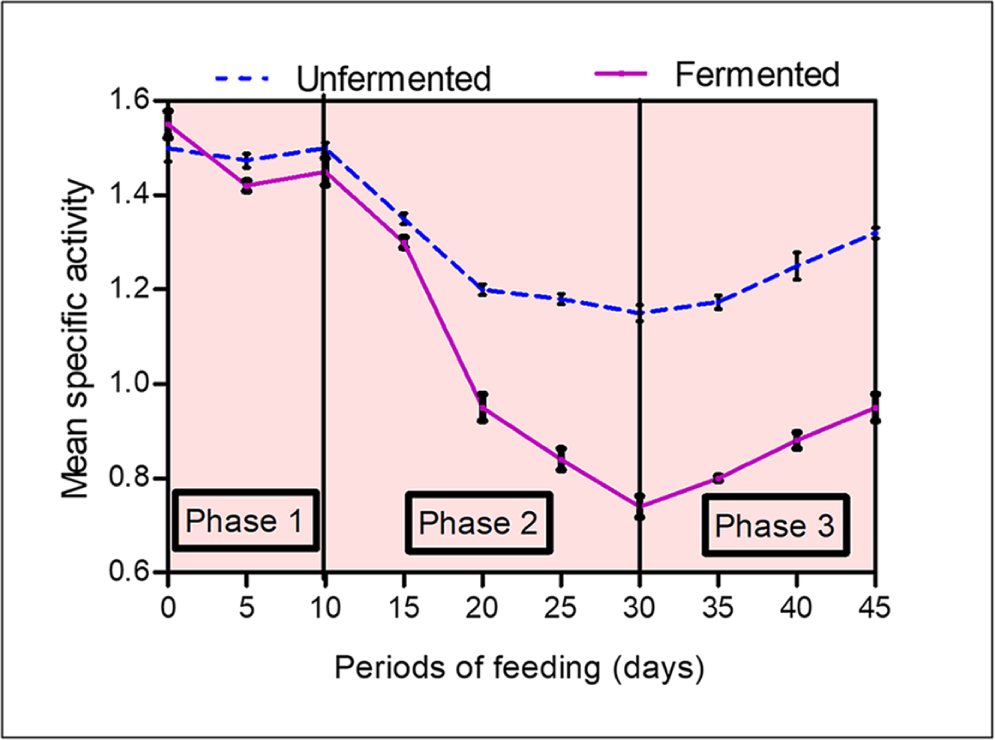
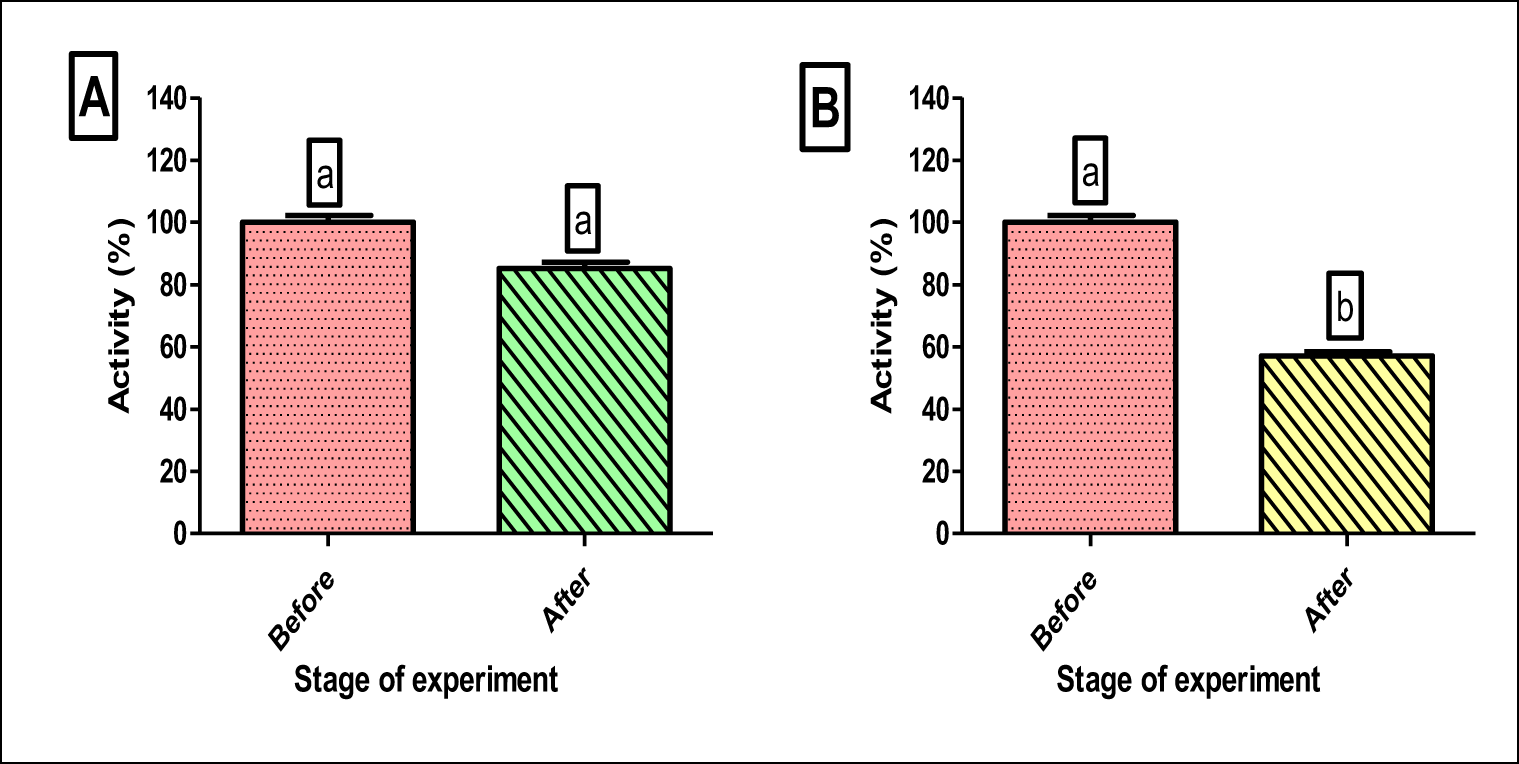
The influence of feeding fermented and unfermented substrate to mice on β-glucuronidase enzyme is depicted in Fig. 3. During the pre-feeding stage (baseline 1), no distinct trend in enzyme activity was observed. During the feeding stage (baseline 2), similar enzyme activity on day 0 was observed for both the control and experimental groups, followed by a decrease in both groups (depicted by the absorbance values). The decrease was more prominent in the group fed with fermented substrates. A highly significant (P < 0.01) decline in enzyme activity was noticed in the fermented group after 15 days of feeding, ∼ 18.5% (unfermented) and 42.9% (fermented) (Fig. 4). In the third stage (baseline 3), discontinuation of feeding resulted in an increase in enzyme activity in both groups, but an increase was more prominent in unfermented group.
Faecal β-glucuronidase activities as μmol PNDG metabolised/h/g faeces for mice before feeding, during feeding and after the withdrawal of respective substrate. UF – unfermented substrate; F – fermented substrate, average of 6 mice and 3 trials; baseline 1 – pre-feeding period; baseline 2 – Feeding period; baseline 3 – post-feeding period.

Effect of feeding of unfermented and fermented substrate on faecal enzyme (β-glucuronidase activity) in mice. A – Unfermented, B – Fermented. Before: before the feeding experiment started, After: at the end of 15 days feeding.

Consumption of fermented dairy and food products has been associated with a reduced risk of colon cancer (Liang et al., Reference Liang, Song, Hu, Wu, Li, Dong, Liang and Wang2022; Emami et al., Reference Emami, Salehi, Hassanzadeh, Mansourian, Mohammadzadeh and Maghool2022; Piccioni et al., Reference Piccioni, Marcello, Marcello, Veronica, Annunziata, Antonio, Francesco and Giuseppe2023). Sabikhi and Mathur (Reference Sabikhi and Mathur2004) observed a decrease in β-glucuronidase activity as a result of feeding functional Edam cheese containing Bifidobacterium bifidum ATCC 15696. Kushal et al. (Reference Kushal, Anand and Chander2006) observed that the supplementation of diet with Lactobacillus acidophilus NCDC-13 and Bifidobacterium bifidum NCDC-255 or coculture of these two strains as free and entrapped cells resulted in reduced faecal enzyme activity when compared with the pre-study level. Lacticaseibacillus rhamnosus GG or Lactobacillus acidophilus administration resulted in a significant decline in the activity of β-glucuronidase in rats treated with 1,2-dimethylhydrazine dihydrochloride (DMH) (Verma and Shukla, Reference Verma and Shukla2013). Similarly, another research work reported inhibition of the activity of β-glucosidase and β-glucuronidase due to administration of L. acidophilus KFRI342 using the DMH model (Chang et al., Reference Chang, Shim, Cha, Reaney and Chee2012). Furthermore, B. longum was observed to decrease these two faecal enzyme activities in normal rats (Lee et al., Reference Lee, Park, Jang, Baek, Kim, Huh, Choi, Chung, Kim, Lee and Ha2011). Several clinical trials have reported similar inhibitory consequences of administering beneficial lactic organisms on these carcinogenic enzymes in human subjects (Lee et al., Reference Lee, Rheem, Yun, Ahn, Joung, Lee, Oh, Chun, Rheem, Yea, Lim, Cha and Kim2013).
The possible mechanism for reducing faecal enzyme activity might be the implantation of beneficial Lactobacilli spp. in the gut, which is suggested to suppress the pathogenic and oncogenic microbial communities in the colon. Bifidobacteria and lactobacilli generally have lower activities of these harmful enzymes, whereas β-glucuronidase is produced in high amounts by Enterobacteria and Clostridia spp (Wollowski et al., Reference Wollowski, Rechkemmer and Pool-Zobel2001). The reduction in enzyme activity in the unfermented group might be due to the presence of fibres and non-digestible carbohydrates in the substrate, which imparted beneficial effects by decreasing the coliform count and supporting the growth of beneficial microbes in the colon (Fu et al., Reference Fu, Zheng, Gao and Xu2022).
Faecal microorganisms analysis
This part of the study was done to observe the consequences of regular consumption of milk-cereal-based fermented composite products on the profile of intestinal microbiota in mice. The results of faecal microbial dynamics are reported in Fig. 5. The faecal lactobacilli count increased during the initial days of feeding (P < 0.05) in the control group, followed by a non-significant change, indicating no definite trend in the control group. In the unfermented and fermented groups, a significant (P < 0.05) increase in lactobacilli count up to the 21st day of feeding was noticed; a greater improvement was observed in the fermented group. The overall increase at the termination of the study was 1.01, 2.53, and 3.48 log counts in the control, unfermented and fermented groups, respectively. Coliforms were reduced non-significantly (P < 0.05) in the group fed on the basal diet (control), and at the end of 21 days of feeding, the reduction was approximately 0.05 log count. In the unfermented and fermented groups, the initial coliform counts were 8.88 ± 0.01 log CFU/g and 8.89 ± 0.05 log CFU/g, respectively, which reduced to 6.47 ± 0.01 log CFU/g (P < 0.05) and 5.31 ± 0.04 log CFU/g (P < 0.01), respectively, at the end of 21 days.
Dynamics of fecal microorganisms: A. Coliform count, B. Lactobacilli count. UF, unfermented substrate; F-, fermented substrate; n = 6.

The unfermented group also exhibited improvement in the faecal microbial profile, which might be due to the presence of fibre in the unfermented product. The regular intake of dietary fibre may stimulate the growth of beneficial microbiota and reduce harmful organisms in the colon (Fu et al., Reference Fu, Zheng, Gao and Xu2022; Gill et al., Reference Gill, Rossi, Bajka and Whelan2021; Scheppach et al., Reference Scheppach, Luehrs and Menzel2001). A rise in the fibre level decreased (P < 0.05) the coliform and enterobacteria counts, and at the same time, an increment (P < 0.05) was observed in the lactobacilli-to-enterobacteria ratio in piglets (Hermes et al., Reference Hermes, Molist, Ywazaki, Nofrarias, Gomez de Segura, Gasa and Perez2009). Similarly, feeding galacto-oligosaccharides (GOS) (Mohammed et al., Reference Mohammed, Sahi, Ameer and Fusheng2011), inulin and oligofructose (Videla et al., Reference Videla, Vilaseca, Antolin, Garcia-Lafuente, Guarner, Crespo, Casalots, Salas and Malagelada2001) or treatment with germinated barley foodstuff (Fukuda et al., Reference Fukuda, Kanauchi, Araki, Andoh, Mitsuyama, Takagi, Toyonaga, Sata and Fujiyama2002) exhibited beneficial effects on the intestinal microflora composition of rats. Studies have reported alterations in faecal microbial profiles due to the intake of lactic-fermented products in humans (De Filippis et al., Reference De Filippis, Pasolli and Ercolini2020; Taylor et al., Reference Taylor, Lejzerowicz, Poirel, Shaffer, Jiang, Aksenov, Litwin, Humphrey, Martino, Miller-Montgomery and Dorrestein2020). Several investigators (Kushal et al., Reference Kushal, Anand and Chander2006; McNulty et al., Reference McNulty, Yatsunenko, Hsiao, Faith, Muegge, Goodman, Henrissat, Oozeer, Cools-Portier, Gobert, Chervaux, Knights, Lozupone, Knight, Duncan, Bain, Muehlbauer, Newgard, Heath and Gordon2011) observed an increment in lactobacilli number with a concomitant decrease in coliforms after oral administration of lactobacilli in mice, indicating probable survival and implantation of lactobacilli in the intestine. Indigenous food mixtures containing Lactobacilli spp. resulted in an increment in faecal lactobacilli counts (P < 0.05) in mice during 42 days of feeding, with a reduction in coliform counts (Sindhu and Khetarpaul, Reference Sindhu and Khetarpaul2003). Regular yogurt consumption by healthy subjects has been associated with improved composition and diversity of gut microbiota (Lisko et al., Reference Lisko, Johnston and Johnston2017; Le Roy et al., Reference Le Roy, Kurilshikov, Leeming, Visconti, Bowyer, Menni, Fachi, Koutnikova, Veiga, Zhernakova and Derrien2022). Similar beneficial effects in gut microbiome profile had been reported due to consumption of other fermented dairy and food products such as fermented milk (Veiga et al., Reference Veiga, Pons, Agrawal, Oozeer, Guyonnet, Brazeilles, Faurie, van Hylckama Vlieg, Houghton, Whorwell and Ehrlich2014), Kefir (Yılmaz et al., Reference Yılmaz, Enver Dolar and Özpınar2019), cheese (Firmesse et al., Reference Firmesse, Alvaro, Mogenet, Bresson, Lemée, Le Ruyet, Bonhomme, Lambert, Andrieux, Doré and Corthier2008) and fermented sauerkraut (Nielsen et al., Reference Nielsen, Garnås, Jensen, Hansen, Olsen, Ritz, Krych and Nielsen2018).
The ability of lactobacilli to influence the intestinal bacterial profile may be attributed to the end products of fermentation (Leeuwendaal et al., Reference Leeuwendaal, Stanton, O'Toole and Beresford2022). The generation of SCFA as the end products of fermentation may affect the gut microbiome profile by influencing pH and mucus concentration (Leeuwendaal et al., Reference Leeuwendaal, Stanton, O'Toole and Beresford2022). The increment in the number of faecal lactobacilli and the decline in coliforms indicate an improved profile of gut microflora in mice. The reduction in the number of coliform bacteria in faeces could be the responsible for the decline in faecal enzyme activity (Taylor et al., Reference Taylor, Lejzerowicz, Poirel, Shaffer, Jiang, Aksenov, Litwin, Humphrey, Martino, Miller-Montgomery and Dorrestein2020), which was highly significant and more sustained in mice fed with the fermented substrate containing lactobacilli than the unfermented substrate.
Characterization of fermented beverage
The fermented beverage had a sour–spicy taste. The pH and viscosity of the product were 4.2 and 11.5 cp, respectively, with an L* value of 53.47. The average total solids, fat, protein, ash, starch and fibre contents of the beverage were 11, 0.3, 2, 0.61, 1 and 1.4%, respectively. The total energy content of the product was 37.63 kcal per 100 mL of product. The average phytic acid and polyphenol contents were 15.28 and 8.28 mg per 100 mL of product, respectively. The Ca, Fe, Mg and Zn levels of 100 mL of product were 33.28, 0.16, 0.90 and 0.30, mg, respectively. The sensory score, with a mean score of colour and appearance 7.7, flavour 7.5, consistency 7.5 and overall acceptability 7.5, revealed that the product was sensory acceptable to the panelists (Table 3).
Characteristics of fermented whey-cereal-based composite beverage

Mean ± SE, n = 3.
Conclusion
The lactic fermented substrate prepared from underutilised cereals and dairy by-products using Lactobacillus acidophilus NCDC 13 resulted in a significant (P < 0.05) enhancement in faecal lactobacilli with a concomitant decline in faecal coliform and β-glucuronidase enzyme activity (42.9%) in the mice model. The fermented substrate was converted into a beverage, and the product was sensorially acceptable to panellists. The outcome of this study highlights the potential utilisation of dairy by-products and underutilised cereals to develop a cost-effective, functional fermented product, contributing to the sustainability of the food production system.
Acknowledgements
The authors are grateful to NAIP (C-1800) for funding the project.
Competing interests
The authors declare that they have no conflicts of interest.
Data availability statement
Research data will be shared upon reasonable request.