1 Introduction
Let
$p\geq 3$
 be a prime throughout this article. The p-adic Mal’cev–Neumann field
${\mathbb{L}} _p:= W(\overline {{\mathbb{F}} }_p)(\!(p^{\mathbb{Q}} )\!)$
 , constructed in [Reference PoonenPoo93], is the unique minimal spherically complete extension of the field
${\mathbb{C}} _p$
 of p-adic complex numbers. An element
$f\in {\mathbb{L}} _p$
 can be written uniquely in the form

and
$\operatorname {\mathrm {supp}}(f)=\{q\in {\mathbb{Q}} \colon r_q\neq 0\}$
 is a well-ordered subset of
$({\mathbb{Q}} ,\leq )$
 . Thus, an element
$f=\sum _{q\in {\mathbb{Q}} }[r_q]p^q$
 of
${\mathbb{L}} _p$
 is completely determined by its support
$\operatorname {\mathrm {supp}}(f)$
 and the set
$\{r_q\}_{q\in {\mathbb{Q}} }$
 of its coefficients.
The spherically complete condition is crucial in non-Archimedean functional analysis (see [Reference SchneiderSch02, Proposition 9.2] for a concrete example). In arithmetic geometry, it also serves as an intermediate hypothesis in Scholze and Weinstein’s classification of p-divisible groups over the ring
$\mathcal { O}_{{\mathbb{C}} _p}$
 of integers of
${\mathbb{C}} _p$
 (cf. [Reference Scholze and WeinsteinSW13, Proposition 5.2.5]). Besides the importance of spherical completeness, it is surprising that not much arithmetic of
${\mathbb{L}} _p$
 is investigated. We summarize several results from the literature:
-
(1) In [Reference LampertLam86], Lampert introduced the notion of p-adic Mal’cev–Neumann series. In particular, he proved that the elements in ${\mathbb{L}} _p$
 , satisfying that the accumulating points of the support are all rational, form an algebraically closed field (cf. [Reference LampertLam86, Theorem 2]).
-
(2) In [Reference PoonenPoo93], Poonen gave a rigorous construction of the field ${\mathbb{L}} _p$
and systematically studied various aspects of this field. In particular, a necessary condition for an element of
${\mathbb{L}} _p$
to be algebraic over
${\mathbb{Q}} _p$
, which is claimed by Lampert in [Reference LampertLam86, p. 282], is proved in [Reference PoonenPoo93, Corollary 8]. -
(3) Based on an idea of Lampert, Kedlaya proposed a transfinite Newton algorithm (cf. [Reference KedlayaKed01, Proposition 1]) to prove the algebraic closeness of ${\mathbb{L}} _p$
effectively, which is extracted in [Reference Wang and YuanWY21, Algorithm 1]. -
(4) In [Reference KedlayaKed17, Theorem 13.4], Kedlaya gave a necessary and sufficient condition for an element in ${\mathbb{L}} _p$
to be a p-adic complex number, in terms of the so-called “p-quasi-automatic elements.” -
(5) The truncated expansions of roots of unity in ${\mathbb{L}} _p$
are studied in [Reference Wang and YuanWY21, Theorem 3.3] and [Reference Wang and YuanWY23, Theorem 1.6]. Based on these results, the uniformizers of the p-adic false Tate curve extensions
${\mathbb{K}} _p^{m,n}:= {\mathbb{Q}} _p\left (\zeta _{p^m},p^{1/p^n}\right )$
for
$(m,n)\in \left (\{2\}\times {\mathbb{Z}} _{\geq 1}\right )\cup \left ({\mathbb{Z}} _{\geq 3}\times \{1\}\right )$
are constructed (cf. [Reference Wang and YuanWY21, Reference Wang and YuanWY24]). -
(6) On the field ${\mathbb{L}} _p$
, we can define a canonical Frobenius map by the formula $$ \begin{align*}\varphi\colon \sum_{q\in{\mathbb{Q}}}[r_q]p^q\longmapsto \sum_{q\in{\mathbb{Q}}}[r_q^p]p^q.\end{align*} $$
In [Reference EfimovEfi24], Efimov proved that $\varphi $
acts on the systems of
$p^n$
-th roots of unity by taking inverse. Note that one can view the complex conjugation as the Frobenius automorphism of
${\mathbb{C}} $
, and the result of Efimov justifies that the Frobenius
$\varphi $
can be viewed as the complex conjugation on
${\mathbb{L}} _p$
.


The purpose of this article is to answer several natural questions concerning the arithmetic of the field
${\mathbb{L}} _p$
 , which we make precise in the following.
1.1 Criterion of algebraicity
By [Reference LampertLam86, p. 282] and [Reference PoonenPoo93, Corollary 8], if
$f\in {\mathbb{L}} _p$
 is algebraic over
${\mathbb{Q}} _p$
 , then it satisfies the following conditions:
-
(1) there exists a positive integer N such that $\text {supp}(f)\subseteq \frac {1}{N}{\mathbb{Z}} [1/p]$
; -
(2) there exists a positive integer k such that $r_q\in {\mathbb{F}} _{p^k}$
for all
$q\in \text {supp}(f)$
.


An element
$f\in {\mathbb{L}} _p$
 satisfying the above conditions is called hyper-algebraic. The set
${\mathbb{L}} _p^{\text {ha}}$
 of hyper-algebraic elements in
${\mathbb{L}} _p$
 forms an algebraically closed field containing
${\mathbb{Q}} _p$
 . As a result, all p-adic algebraic numbers are hyper-algebraic, that is,
$\overline {{\mathbb{Q}} }_p\subseteq {\mathbb{L}} _p^{\text {ha}}$
 . Our first result is a clarification of relations among the fields
${\mathbb{L}} _p^{\text {ha}}$
 ,
$\overline {{\mathbb{Q}} }_p$
 , and
${\mathbb{C}} _p$
 .
Theorem A (cf. Theorem 3.3)
The field
${\mathbb{L}} _p^{\mathrm {ha}}$
 is strictly larger than
$\overline {{\mathbb{Q}} }_p$
 , and it is neither complete nor a subfield of
${\mathbb{C}} _p$
 .
For a hyper-algebraic element
$\alpha \in {\mathbb{L}} _p^{\text {ha}}$
 , we introduce two new invariants of
$\alpha $
 , called the hyper-tame index
${\mathfrak{T}} _\alpha $
 and hyper-inertia index
${\mathfrak{F}} _\alpha $
 , defined to be the minimal integers N and k in the conditions given by Poonen, respectively. For a p-adic algebraic number
$\alpha \in \overline {{\mathbb{Q}} }_p$
 , its hyper-algebraic invariants
${\mathfrak{T}} _\alpha $
 and
${\mathfrak{F}} _\alpha $
 are closely related to its usual arithmetic invariants.
Theorem B (cf. Propositions 4.1 and 4.4 and Theorem 4.10)
Let
$\alpha $
 be a p-adic algebraic number.
-
(1) The hyper-algebraic invariants ${\mathfrak{T}} _\alpha $
and
${\mathfrak{F}} _\alpha $
do not exceed
$[{\mathbb{Q}} _p(\alpha )\colon {\mathbb{Q}} _p]$
. -
(2) Suppose ${\mathbb{Q}} _p(\alpha )/ {\mathbb{Q}} _p$
is an abelian extension of degree n. Denote by
$\mathbf{f} _{{\mathbb{Q}} _p(\alpha )}$
the local conductor of
${\mathbb{Q}} _p(\alpha )$
over
${\mathbb{Q}} _p$
. Then-
(a) If $\mathbf{f} _{{\mathbb{Q}} _p(\alpha )}=0$
, then
${\mathfrak{T}} _\alpha =1$
and
${\mathfrak{F}} _\alpha =n$
. -
(b) If $\mathbf{f} _{{\mathbb{Q}} _p(\alpha )}\geq 1$
, then
${\mathfrak{T}} _\alpha \mid p-1$
and $$ \begin{align*}{\mathfrak{F}}_\alpha\mid\begin{cases} \mathrm{lcm}(2,n), & \text{ if }\mathbf{f}_{{\mathbb{Q}}_p(\alpha)}=1,2; \\ \mathrm{lcm}\left(2\cdot p^{ \mathbf{f}_{{\mathbb{Q}}_p(\alpha)}-1},n\right), & \text{ if }\mathbf{f}_{{\mathbb{Q}}_p(\alpha)}\geq 3. \end{cases}\end{align*} $$
-


Remark 1.1 The proof of this result is based on our computation of the truncated expansion of
$\zeta _{p^n}$
 (cf. [Reference Wang and YuanWY21, Reference Wang and YuanWY23], and also see Example 2.5 for the precise formula).
Remark 1.2 For
$\alpha \in {\mathbb{L}} _p$
 , we denote by
$[C_{\frac {1}{p-1}}(\alpha )]$
 the coefficient of index
$\frac {1}{p-1}$
 of the canonical expansion of
$\alpha $
 . Based on the truncated expansion of
$\zeta _{p^n}$
 (cf. Example 2.5), we conjecture that for any integer
$n\geq 2$
 and
$p^n$
 -th primitive root of unity
$\zeta _{p^n}$
 , there exists another
$p^n$
 -th primitive root of unity
$\zeta _{p^n}^\prime $
 with
$C_{\frac {1}{p-1}}(\alpha )=0$
 such that
$\zeta _{p^n}^{p^{n-1}}=\left (\zeta _{p^n}^\prime \right )^{p^{n-1}}$
 .
If this conjecture holds,Footnote
1
then
${\mathfrak{F}} _{\zeta _{p^n}}=2$
 for every
$n\geq 2$
 , and consequently
${\mathfrak{F}} _\alpha $
 divides
$\text {lcm}(2,n)$
 for all ramified cases in the above theorem. See the proof of Proposition 4.6 for more details. Note that this conjecture is true when
$n=2$
 (cf. Lemma 4.8).
Our third result is to give a criterion for hyper-algebraic element to be tamely ramified over
${\mathbb{Q}} _p$
 .
Theorem C (cf. Theorem 4.12)
Let
$\alpha \in {\mathbb{L}} _p^{\mathrm {ha}}$
 be a hyper-algebraic element in
${\mathbb{L}} _p$
 . Then
${\mathbb{Q}} _p(\alpha )$
 is tamely ramified over
${\mathbb{Q}} _p$
 if and only if
$\operatorname {\mathrm {supp}}(\alpha )\subseteq \frac {1}{{\mathfrak{T}} _\alpha }{\mathbb{Z}} $
 . In this situation, we have
${\mathfrak{T}} _\alpha ={\mathfrak{e}} _\alpha $
 ,
${\mathfrak{f}} _\alpha \mid {\mathfrak{F}} _\alpha $
 , and
${\mathfrak{F}} _\alpha \mid c$
 , where
$c:= \mathrm {ord}_{\mathrm {lcm}({\mathfrak{e}} _\alpha ,p^{{\mathfrak{f}} _\alpha }-1)}p$
 and
${\mathfrak{f}} _\alpha $
 (resp.
${\mathfrak{e}} _\alpha $
 ) is the inertia degree (resp. the ramification index) of the extension
${\mathbb{Q}} _p(\alpha )/{\mathbb{Q}} _p$
 .
Remark 1.3 It seems that our method for abelian and tamely ramified extensions can hardly be generalized to general extensions. For these two special cases, the key ingredient is to find an extension K over
$\mathbb {Q}_p(\alpha )$
 , which is generated by certain more “controllable” elements. In the abelian case, we use the cyclotomic extension by the local Kronecker–Weber theorem while in the tamely ramified case, we used the radical extension by Lemma 4.13. However, in general, we don’t know how to find such a more “controllable” field.
1.2 Distinguishing roots of irreducible polynomial over
$\mathbb {Q}_p$

The canonical expansion of an element in
${\mathbb{L}} _p$
 is fairly an analogy of the polar coordinate of a complex number. In fact, the support
$\operatorname {\mathrm {supp}}(f)$
 of
$f\in {\mathbb{L}} _p$
 corresponds to the modulus of a complex number while the set
$\{r_q\}_{q\in {\mathbb{Q}} }$
 of coefficients of the expansion of f corresponds to the argument of a complex number. As a result, such an expansion can be used to make a distinction of roots of polynomials over
${\mathbb{Q}} _p$
 .
Given a p-adic algebraic number
$\alpha $
 , the usual arithmetic invariants (i.e., the degree, ramification index, and inertia degree of the extension
${\mathbb{Q}} _p(\alpha )/{\mathbb{Q}} _p$
 ) of
$\alpha $
 are determined by its minimal polynomial over
${\mathbb{Q}} _p$
 . Thus, the usual arithmetic invariants can not be used to distinguish the conjugates of
$\alpha $
 under the action of absolute Galois group of
$\overline {{\mathbb{Q}} }_p$
 . We observe that in general the minimal polynomial of
$\alpha $
 over
${\mathbb{Q}} _p$
 is insufficient to determine the exact value of
${\mathfrak{T}} _\alpha $
 and
${\mathfrak{F}} _\alpha $
 .
Example 1.4 (cf. Example 4.5)
Let
$\alpha _1=p^{1/p}$
 and
$\alpha _2=p^{1/p}\cdot \zeta _p$
 , where
$\zeta _p\in \overline {{\mathbb{Q}} }_p$
 is a p-th primitive root of unity. Then
$\alpha _1$
 and
$\alpha _2$
 share the same minimal polynomial
$T^p-p$
 over
${\mathbb{Q}} _p$
 , but
${\mathfrak{T}} _{\alpha _1}={\mathfrak{F}} _{\alpha _1}=1$
 while
${\mathfrak{T}} _{\alpha _2}=p-1$
 and
${\mathfrak{F}} _{\alpha _2}=2$
 .
Thus, it provides the possibility to make a distinction of root of a polynomial using these two new invariants.
On the other hand, for a p-adic algebraic number
$\alpha $
 , its classical arithmetic invariants are related to the hyper-algebraic invariants of all its conjugates. The above example suggests that it makes sense to consider the hyper-algebraic invariants of all conjugate of
$\alpha $
 at the same time. Let
${\mathfrak{T}} (\alpha )$
 (resp.
${\mathfrak{F}} (\alpha )$
 ) be the set of hyper-tame indices (resp. hyper-inertia indices) of all the conjugates of
$\alpha $
 , equipped with the partial order defined by divisibility. A small-scale numerical experiment indicates the following heuristic patterns:
-
(1) The degree of the minimal polynomial of $\alpha $
over
$\mathbb {Q}_p$
is always an upper bound of
${\mathfrak{F}} (\alpha )$
in
${\mathbb{Z}} _{>0}$
with respect to the order defined by divisibility. -
(2) The p-power-free part of the ramification index of the field ${\mathbb{Q}} _p(\alpha )$
over
${\mathbb{Q}} _p$
is always the unique minimal element in
${\mathfrak{T}} (\alpha )$
.


1.3 Related works
We mention some potential approaches to study the canonical expansion of general p-adic algebraic numbers in
${\mathbb{L}} _p^{\text {ha}}$
 :
-
(1) In [Reference KedlayaKed17, Theorem 13.4], Kedlaya gives a characterization of the canonical expansion of elements of ${\mathcal{O}} _{{\mathbb{C}} _p}$
in
${\mathbb{L}} _p$
in terms of the so-called “p-quasi-automatic elements.” Extracting additional arithmetic information from these logic-derived objects could offer a fresh perspective on comprehending the hyper-algebraic invariants. -
(2) In [Reference LisinskiLis23], Lisinski uses a variant of Newton algorithm to give an upper bound of the order type of $\operatorname {\mathrm {supp}}(\alpha )$
for element
$\alpha $
in
$\overline {{\mathbb{F}} _p(\!(t)\!)}\subset \overline {{\mathbb{F}} }_p(\!(t^{\mathbb{Q}} )\!)$
. Besides that, Lisinski also designs an algorithm to give upper bounds for the characteristic p analog of hyper-algebraic invariants for elements in
$\overline {{\mathbb{F}} _p(\!(t)\!)}\subset \overline {{\mathbb{F}} }_p(\!(t^{\mathbb{Q}} )\!)$
. It is possible to develop a mixed-characteristic analog of Lisinski’s results for
$\overline {{\mathbb{Q}} }_p\subset {\mathbb{L}} _p$
and to compare with Proposition 4.1 of this article. -
(3) Inspired by the pioneering work [Reference Dong, He, Jin, Schremmer and YuDon+24] of Dong–He–Jin–Schremmer–Yu, which using machine learning approach to study the geometry of affine Deligne–Lusztig varieties, we wonder if the machine learning method can help to identify hidden structures in the canonical expansion of a p-adic algebraic number in ${\mathbb{L}} _p^{\text {ha}}$
.


2 Preliminaries on field of Mal’cev–Neumann series
In this section, we recall the definition and some basic properties of Mal’cev–Neumann fields following [Reference PoonenPoo93].
Definition 2.1 [Reference PoonenPoo93, Section 3]
Let R be a commutative ring and G be an ordered group.
-
(1) For any $f\in \text {Hom}_{\mathbf {Set}}(G,R)$
, we define the support of f to be $$ \begin{align*}\text{supp}(f)=\{g\in G\colon f(g)\neq 0\}.\end{align*} $$
-
(2) Define the set of Mal’cev–Neumann series over R with value group G to be
$$ \begin{align*}R(\!(G)\!):= \{f\in \text{Hom}_{\mathbf{Set}}(G,R)\colon \text{supp}(f) \text{ is well-ordered}\}.\end{align*} $$
By introducing a formal variable t, we also denote by $R(\!(t^G)\!)$
the set
$R(\!(G)\!)$
. The elements in
$R(\!(G)\!)$
will also be written as
$\sum _{g\in G}r_gt^g$
, where
$r_g\in R$
for all
$g\in G$
.


Proposition 2.2 [Reference PoonenPoo93, Lemma 1 and Corollary 2]
Let R be a commutative ring and G be an ordered group.
-
(1) With identity $1\cdot t^0$
and addition as well as multiplication given by $$ \begin{align*}\sum_{g\in G}a_g t^g+\sum_{g\in G}b_g t^g:=\sum_{g\in G}(a_g+b_g)t^g,\ \sum_{g\in G}a_g t^g\cdot\sum_{g\in G}b_g t^g:=\sum_{g\in G}\left(\sum_{h\in G}a_h b_{g-h}\right)t^g,\end{align*} $$
$R(\!(t^G)\!)$
forms a commutative ring. -
(2) If R is a field, then so does $R(\!(t^G)\!)$
. Moreover, with the map $$ \begin{align*}v\colon R(\!(t^G)\!)\longrightarrow G\cup\{\infty\},\ f\longmapsto \begin{cases}\min\mathrm{supp}(f),& \text{ if }f\neq 0\\\infty,& \text{ if }f=0,\end{cases}\end{align*} $$
$R(\!(t^G)\!)$
becomes a valued field with value group G and residue field R.


Theorem 2.3 [Reference PoonenPoo93, Propositions 3 and 5 and Corollary 3]
Let k be a perfect field of characteristic p and G be an ordered group containing
${\mathbb{Z}} $
 as a subgroup. Besides that, let

where
$W(k)$
 is the ring of Witt vectors of k. Then
-
(1) ${\mathcal{N}} $
is a maximal ideal of
$W(k)(\!(t^G)\!)$
, which makes
$W(k)(\!(p^G)\!):= W(k)(\!(t^G)\!)/{\mathcal{N}} $
a field,Footnote
2
called the p-adic Mal’cev–Neumann field. -
(2) Every element in $W(k)(\!(p^G)\!)$
can be uniquely (and formally) written as $$ \begin{align*}\sum_{g\in G}[r_g]p^g,\end{align*} $$
where $r_g\in k$
for all
$g\in G$
and
$[\cdot ]\colon k\longrightarrow W(k)$
is the Teichmüller lift. -
(3) For $f=\sum _{g\in G}[r_g]p^g$
, define the support of f to be $$ \begin{align*}\mathrm{supp}(f)=\{g\in G\colon r_g\neq 0\}.\end{align*} $$
Then the map
$$ \begin{align*}v\colon W(k)(\!(G)\!)/{\mathcal{N}}\longrightarrow G\cup\{\infty\},\ f\mapsto \begin{cases} \min\mathrm{supp}(f), & \text{ if }f\neq 0 \\\infty,& \text{ if }f=0 \end{cases}\end{align*} $$
makes $W(k)(\!(G)\!)/{\mathcal{N}} $
a mixed-characteristic valued field with value group G and residue field k.


Example 2.4 Let
${\mathbb{L}} _p:= W(\overline {{\mathbb{F}} }_p)(\!(p^{\mathbb{Q}} )\!)$
 be the p-adic Mal’cev–Neumann field with value group
${\mathbb{Q}} $
 and residue field
$\overline {{\mathbb{F}} }_p$
 . It can be shown that
${\mathbb{L}} _p$
 is complete and algebraically closed (cf. [Reference PoonenPoo93, Proposition 6 and Theorem 1]). Moreover,
${\mathbb{L}} _p$
 is the unique (up to non-canonical isomorphism) minimal spherically complete extension of
${\mathbb{C}} _p$
 (cf. [Reference PoonenPoo93, Corollary 6]), with transcendence degree
$2^{\aleph _0}$
 over
${\mathbb{C}} _p$
 (cf. [Reference PoonenPoo93, Corollary 9]).
2.1 Newton algorithm on
${\mathbb{L}} _p$

In [Reference KedlayaKed01], Kedlaya gives a constructive proof of the algebraic closeness of
${\mathbb{L}} _p$
 by using a transfinite Newton algorithm, which we extract in the following.
For a non-constant polynomial
$P(T)=\sum _{i=0}^n a_{n-i}T^i\in {\mathbb{L}} _p[T]$
 , denote by
$\text {Newt}\left (P\right )$
 the Newton polygon of P, that is, the lower boundary of the convex hull of the set of points
$(i,v_p(a_i))$
 for
$i=0,1,\ldots ,n$
 . We write
$s_{\max }^P$
 for the slope of the segment of
$\text {Newt}\left (P\right )$
 with the largest slope and
$m_{\max }^P$
 the left endpoint of this segment. Besides that, call

the residue polynomial of P, where for any
$s\in {\mathbb{Q}} $
 , the map
$C_s\colon {\mathbb{L}} _p\longrightarrow \overline {{\mathbb{F}} }_p$
 is given by
$\sum _{q\in {\mathbb{Q}} }[r_q]p^q\longmapsto r_s$
 .
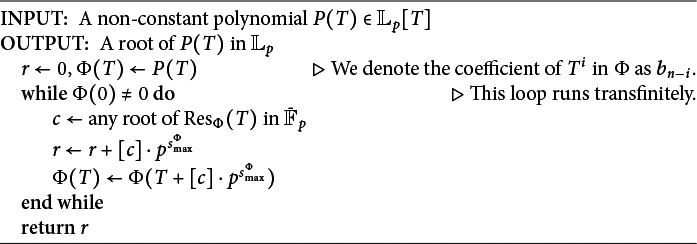
We extracted Kedlaya’s proof into Algorithm 1.
Transfinite Newton algorithm for 𝕃 p .

Algorithm 1 Long description
The pseudocode is structured as follows.
* INPUT. A non-constant polynomial P(T) in L sub p [T].
* OUTPUT. A root of P(T) in L sub p.
* Initialization. r is set to 0 and Phi(T) is set to P(T). A comment to the right notes that the coefficient of T super i in Phi is denoted as b sub n minus i.
* While Loop. while Phi(0) is not equal to 0 do. A comment notes this loop runs transfinitely.
* Loop Body.
1. c is assigned as any root of Res sub 0 (T) in F sub p.
2. r is updated to r plus [c] times p super omega.
3. Phi(T) is updated to Phi(T plus [c] times p super omega).
* End While.
* Return r.
We refer to [Reference Wang and YuanWY21] for a full explanation of this algorithm.
Let
$r=\sum _{\omega }[c_\omega ]p^{k_\omega }\in {\mathbb{L}} _p$
 , with ordinal
$\omega $
 runs through the well-ordered set
$\operatorname {\mathrm {supp}}(r)$
 , be a root of
$P(T)$
 given by the above algorithm. For the convenience of later discussion, we call
$r_\omega =\sum _{r<\omega }[c_\omega ]p^{k_\omega }$
 the
$\omega $
 -th approximation of r,
$P_\omega =P(T+r_\omega )$
 the
$\omega $
 -th approximation polynomial and
$\text {Res}_{P_\omega }(T)$
 the
$\omega $
 -th residue polynomial.
Example 2.5 [Reference Wang and YuanWY21, Reference Wang and YuanWY23]
Let
$\zeta _{2(p-1)}\in W({\mathbb{F}} _{p^2})$
 be a
$2(p-1)$
 -th primitive root of unity.
-
(1) There exist a p-th root of unity, whose canonical expansion in ${\mathbb{L}} _p$
is given by $$ \begin{align*}\zeta_p=\sum_{k=0}^{p-1}\frac{\zeta_{2(p-1)}^k}{k!}p^{\frac{k}{p-1}}+\sum_{k=p}^\infty [c_k]p^{\frac{k}{p-1}},\end{align*} $$
where $c_k\in {\mathbb{F}} _{p^2}$
for all
$k\geq p$
. By changing the choice of
$\zeta _{2(p-1)}$
, every p-th primitive root of unity can be expanded in the above form. -
(2) For $n\geq 2$
, there exists a
$p^n$
-th root of unity, whose (non-canonical) expansion in
${\mathbb{L}} _p$
is partially given by $$ \begin{align*} \zeta_{p^n}= & \sum_{k=0}^{p-1}\frac{(-1)^{nk}}{k!}\zeta_{2(p-1)}^k p^{\frac{k}{p^{n-1}(p-1)}}+\sum_{k=0}^{p-1}\frac{(-1)^{n(k+1)}}{k!}\zeta_{2(p-1)}^{k+1}p^{\frac{k+p}{p^{n-1}(p-1)}}\left(\sum_{l=n}^\infty p^{-1/p^l}\right) \\ & \quad-\sum_{k=1}^{p-1}\frac{(-1)^{n(k+1)}}{k!}\left(\sum_{l=1}^k \frac{1}{l}\right)\zeta_{2(p-1)}^{k+1}p^{\frac{k+p}{p^{n-1}(p-1)}} \\ & \quad+\frac{1}{2}\zeta_{2(p-1)}^2p^{\frac{2}{p^{n-2}(p-1)}}\left(\sum_{l=n}^\infty p^{-1/p^l}\right)^2+\frac{(-1)^n}{2}\zeta_{2(p-1)}^3 p^{\frac{2}{p^{n-2}(p-1)}-\frac{p-2}{p^n(p-1)}} \\ & \quad +\text{ terms with higher valuation}\dots. \end{align*} $$


3 Field of hyper-algebraic elements in
${\mathbb{L}} _p$

3.1 Hyper-algebraic elements
Definition 3.1 We call an element
$f=\sum _{q\in {\mathbb{Q}} }[r_q]p^q\in {\mathbb{L}} _p$
 hyper-algebraic, if it satisfies:
-
(1) there exists a positive integer N such that $\text {supp}(f)\subseteq \frac {1}{N}{\mathbb{Z}} [1/p]$
; -
(2) there exists a positive integer k such that $r_q\in {\mathbb{F}} _{p^k}$
for all
$q\in \text {supp}(f)$
.


Denote by
${\mathbb{L}} _p^{\text {ha}}$
 the set of all hyper-algebraic elements in
${\mathbb{L}} _p$
 .
By [Reference PoonenPoo93, Corollary 8], we know the following proposition.
Proposition 3.2 The set
${\mathbb{L}} _p^{\mathrm {ha}}$
 forms an algebraically closed field. As a consequence, all p-adic algebraic numbers are hyper-algebraic, that is,
$\overline {{\mathbb{Q}} }_p\subseteq {\mathbb{L}} _p^{\mathrm {ha}}$
 .
We clarify the relations among the fields
${\mathbb{L}} _p^{\text {ha}}$
 ,
$\overline {{\mathbb{Q}} }_p$
 , and
${\mathbb{C}} _p$
 .
Theorem 3.3
-
(1) The fields ${\mathbb{L}} _p^{\mathrm {ha}}$
and
${\mathbb{C}} _p$
do not contain each other. In particular,
${\mathbb{L}} _p^{\mathrm {ha}}$
contains
$\overline {{\mathbb{Q}} }_p$
as a proper subfield. -
(2) The field ${\mathbb{L}} _p^{\mathrm {ha}}$
is not complete, and its completion is a proper subfield of
${\mathbb{L}} _p$
.


Proof Consider the following element of
${\mathbb{L}} _p^{\text {ha}}$
 :

If
$\alpha \in {\mathbb{C}} _p$
 , then there exists a p-adic algebraic number
$\beta \in \overline {{\mathbb{Q}} }_p$
 that
$v_p(\alpha -\beta )>2$
 . This shows that the canonical expansion of
$\beta $
 in
${\mathbb{L}} _p^{\text {ha}}$
 has the form

Thus,
$\operatorname {\mathrm {supp}}(\beta )$
 has accumulation value
$\sqrt {2}$
 . However, this is impossible: Lampert showed in [Reference LampertLam86, Theorem 2] that the set

is an algebraically closed field. Since the support of every p-adic rational number lies in
${\mathbb{Z}} \subset {\mathbb{Q}} $
 ,
$\overline {{\mathbb{Q}} }_p$
 is a subfield of
${\mathcal{A}} $
 . On the other hand,
$\beta $
 does not belong to
${\mathcal{A}} $
 . This contradiction shows that
${\mathbb{L}} _p^{\text {ha}}$
 is not contained in
${\mathbb{C}} _p$
 . In particular,
${\mathbb{L}} _p^{\text {ha}}$
 contains
$\overline {{\mathbb{Q}} }_p$
 as a proper subfield.
To show that
${\mathbb{L}} _p^{\text {ha}}$
 is not complete and does not contain
${\mathbb{C}} _p$
 , we can consider the sequence
$\left (\sum _{k=1}^n p^{k-1/k}\right )_{n\geq 1}$
 in
$\overline {{\mathbb{Q}} }_p\subseteq {\mathbb{L}} _p^{\text {ha}}$
 , which clearly converges in
${\mathbb{C}} _p$
 but has non-hyper-algebraic limit
$\sum _{k=1}^\infty p^{k-1/k}$
 in
${\mathbb{L}} _p$
 : the p-power-free part of the denominators of elements of its support is unbounded.
To prove
${\mathbb{L}} _p^{\text {ha}}$
 is not dense in
${\mathbb{L}} _p$
 , we consider the element
$\gamma =\sum _{k=1}^\infty p^{-\frac {1}{p^k-1}}$
 in
${\mathbb{L}} _p$
 . If it lies in the completion of
${\mathbb{L}} _p^{\text {ha}}$
 , then there exists an element
$\delta \in {\mathbb{L}} _p^{\text {ha}}$
 that
$v_p(\gamma -\delta )>~1$
 . This leads to a contradiction if we consider the canonical expansion of
$\delta $
 in
${\mathbb{L}} _p^{\text {ha}}$


The p-power-free parts of the denominators of elements of
$\operatorname {\mathrm {supp}}(\delta )$
 are unbounded, suggesting that
$\delta $
 is not hyper-algebraic.
3.2 Hyper-tame index and hyper-inertia index
Definition 3.4 Let
$\theta =\sum _{q\in {\mathbb{Q}} }[r_q]p^q\in {\mathbb{L}} _p^{\text {ha}}$
 be a hyper-algebraic element in
${\mathbb{L}} _p$
 .
-
(1) Denote by ${\mathfrak{T}} _\theta $
the minimal positive integer e such that
$\text {supp}(\theta )\subseteq \frac {1}{e}{\mathbb{Z}} [1/p]$
. We call it the hyper-tame index of
$\theta $
. -
(2) Denote by ${\mathfrak{F}} _\theta $
the minimal positive integer f such that
$r_q\in {\mathbb{F}} _{p^f}$
for all
$q\in \text {supp}(\theta )$
. We call it the hyper-inertia index of
$\theta $
.


We call them the hyper-algebraic invariants of
$\theta $
 .
The following lemmas collect several basic properties of the hyper-tame and hyper-inertia indices.
Lemma 3.5 Let
$\alpha =\sum _{q\in {\mathbb{Q}} }[r_q]p^q$
 be a hyper-algebraic element in
${\mathbb{L}} _p$
 . Then one has
-
(1) the hyper-tame index ${\mathfrak{T}} _\alpha $
is coprime to p; -
(2) if the set of coefficients $\{r_q\}_{q\in {\mathbb{Q}} }$
is contained in a finite field
${\mathbb{F}} _{p^s}$
, then s is a multiple of
${\mathfrak{F}} _\alpha $
; -
(3) if the support $\operatorname {\mathrm {supp}}(\alpha )$
is contained in the set
$\frac {1}{N}{\mathbb{Z}} [1/p]$
for some positive integer N, then N is a multiple of
${\mathfrak{T}} _\alpha $
.


Proof
-
(1) For any positive integer N, the sets $\frac {1}{pN}{\mathbb{Z}} [1/p]$
and
$\frac {1}{N}{\mathbb{Z}} [1/p]$
are identical. -
(2) One has
$$ \begin{align*}\{r_q\}_{q\in{\mathbb{Q}}}\subseteq {\mathbb{F}}_{p^{{\mathfrak{F}}_\alpha}}\cap{\mathbb{F}}_{p^s}={\mathbb{F}}_{p^{\gcd({\mathfrak{F}}_\alpha,s)}}.\end{align*} $$
The result follows from the minimality of ${\mathfrak{F}} _\alpha $
. -
(3) By the first assertion, we may assume that N is coprime to p. Suppose the contrary that $N=d\cdot {\mathfrak{T}} _\alpha +r$
with
$d\in {\mathbb{Z}} _{\geq 1}$
and
$r\in \{1,\ldots ,{\mathfrak{T}} _\alpha -1\}$
. Take
$q\in \operatorname {\mathrm {supp}}(\alpha )$
. Then the inclusion
$q\in \frac {1}{{\mathfrak{T}} _\alpha }{\mathbb{Z}} [1/p]\cap \frac {1}{N}{\mathbb{Z}} [1/p]$
allows us to write $$ \begin{align*}q=\frac{a_1\cdot p^{v_1}}{{\mathfrak{T}}_\alpha}=\frac{a_2\cdot p^{v_2}}{N},\end{align*} $$
where $a_1,a_2,v_1,v_2\in {\mathbb{Z}} $
with
$a_1,a_2$
coprime to p. By comparing the p-adic valuation, we get
$v_1=v_2$
. Since $$ \begin{align*}a_2\cdot p^{v_2}=(d\cdot {\mathfrak{T}}_\alpha+r)\cdot q=d\cdot a_1\cdot p^{v_1}+r\cdot q=d\cdot a_1\cdot p^{v_2}+r\cdot q,\end{align*} $$
we obtain that $q=\frac {a_2-d\cdot a_1}{r}\cdot p^{v_2}\in \frac {1}{r}{\mathbb{Z}} [1/p]$
, which contradicts the minimality of
${\mathfrak{T}} _\alpha $
.


Lemma 3.6 Let
$\alpha ,\beta \in {\mathbb{L}} _p^{\mathrm {ha}}$
 be two hyper-algebraic elements in
${\mathbb{L}} _p$
 . Then one has
-
(1) ${\mathfrak{T}} _{\alpha +\beta }\mid \mathrm {lcm}({\mathfrak{T}} _\alpha ,{\mathfrak{T}} _\beta )$
,
${\mathfrak{F}} _{\alpha +\beta }\mid \mathrm {lcm}({\mathfrak{F}} _\alpha ,{\mathfrak{F}} _\beta )$
. -
(2) ${\mathfrak{T}} _{\alpha \cdot \beta }\mid \mathrm {lcm}({\mathfrak{T}} _\alpha ,{\mathfrak{T}} _\beta )$
,
${\mathfrak{F}} _{\alpha \cdot \beta }\mid \mathrm {lcm}({\mathfrak{F}} _\alpha ,{\mathfrak{F}} _\beta )$
. In particular, if
$\alpha $
is algebraic over
${\mathbb{Q}} _p$
and
${\mathbb{Q}} _p(\alpha )$
is unramified over
${\mathbb{Q}} _p$
, then
${\mathfrak{T}} _{\alpha \cdot \beta }\mid {\mathfrak{T}} _\beta $
and
${\mathfrak{F}} _{\alpha \cdot \beta }\mid \mathrm {lcm}({\mathfrak{f}} _\alpha ,{\mathfrak{F}} _\beta )$
. -
(3) ${\mathfrak{T}} _{1/\alpha }={\mathfrak{T}} _\alpha $
,
${\mathfrak{F}} _{1/\alpha }={\mathfrak{F}} _\alpha $
for
$\alpha \neq 0$
.



Proof The first and the second assertions follow from the definition of addition and multiplication on
${\mathbb{L}} _p$
 . In particular, if
${\mathbb{Q}} _p(\alpha )$
 is unramified over
${\mathbb{Q}} _p$
 , then
${\mathbb{Q}} _p(\alpha )=\text {Frac}W({\mathbb{F}} _{p^{{\mathfrak{f}} _\alpha }})$
 . As a result, every element in
${\mathbb{Q}} _p(\alpha )$
 has the form
$\sum _{k>\!\!\!>-\infty }[\zeta _k]p^k$
 , where
$\zeta _k\in {\mathbb{F}} _{p^{{\mathfrak{f}} _\alpha }}$
 for all k. This shows that
${\mathfrak{T}} _\alpha =1$
 and
${\mathfrak{F}} _\alpha ={\mathfrak{f}} _\alpha $
 .
For the third assertion, the result is trivial when
$\vert \operatorname {\mathrm {supp}}(\alpha )\vert =1$
 . Now we suppose
$\vert \operatorname {\mathrm {supp}}(\alpha )\vert \geq 2$
 and write
$\alpha =[\zeta ]p^{v_p(\alpha )}-A$
 for some
$\zeta \in \overline {{\mathbb{F}} }_p$
 with
$v_p(A)>v_p(\alpha )$
 . Then
$\zeta \in {\mathbb{F}} _{p^{{\mathfrak{F}} _\alpha }}$
 ,
${\mathfrak{T}} _A\mid {\mathfrak{T}} _\alpha $
 and
${\mathfrak{F}} _A\mid {\mathfrak{F}} _\alpha $
 . The result follows from the expansion

where
$v_p\left ([\zeta ^{-1}]p^{-v_p(\alpha )}\cdot A\right )>0,\ {\mathfrak{T}} _{[\zeta ^{-1}]p^{-v_p(\alpha )}\cdot A}\mid {\mathfrak{T}} _\alpha \text { and }{\mathfrak{F}} _{[\zeta ^{-1}]p^{-v_p(\alpha )}\cdot A}\mid {\mathfrak{F}} _\alpha $
 .
Corollary 3.7 For any positive integer
$e,f\geq 1$
 , the set

is a subfield of
$\ {\mathbb{L}} _p^{\mathrm {ha}}$
 . In particular, for any
$\alpha \in {\mathbb{L}} _p^{\mathrm {ha}}$
 , we have
${\mathbb{Q}} _p(\alpha )\subset {\mathbb{L}} _p^{\mathrm {ha}}({\mathfrak{T}} _\alpha ,{\mathfrak{F}} _\alpha )$
 .
4
p-adic algebraic numbers in
${\mathbb{L}} _p^{\text {ha}}$

The objective of this section is to investigate the hyper-algebraic invariants of p-adic algebraic numbers.
4.1 Hyper-algebraic invariants of general p-adic algebraic numbers
As observed in [Reference PoonenPoo93, Corollary 8], there are two special types of automorphisms in
$\text {Aut}_{{\mathbb{Q}} _p}({\mathbb{L}} _p)$
 :
-
(1) For any $g\in {\mathcal{G}} _{{\mathbb{F}} _p}:= \text {Gal}\left (\overline {{\mathbb{F}} }_p/{\mathbb{F}} _p\right )$
, it can be viewed as an element of
$\text {Aut}_{{\mathbb{Q}} _p}({\mathbb{L}} _p)$
by the formula $$ \begin{align*}g\cdot\sum_{q\in{\mathbb{Q}}}[r_q]p^q=\sum_{q\in{\mathbb{Q}}}[g(r_q)]p^q,\ \text{for any }\sum_{q\in{\mathbb{Q}}}[r_q]p^q\in{\mathbb{L}}_p.\end{align*} $$
Since ${\mathbb{Q}} _p\subsetneq {\mathbb{L}} _p$
is fixed by this action of
${\mathcal{G}} _{{\mathbb{F}} _p}$
, it indeed gives rise to a group homomorphism
${\mathcal{G}} _{{\mathbb{F}} _p}\longrightarrow {\mathcal{G}} _{{\mathbb{Q}} _p}$
, which is a section of the natural morphism
${\mathcal{G}} _{{\mathbb{Q}} _p}\longrightarrow {\mathcal{G}} _{{\mathbb{F}} _p}$
. -
(2) For any group homomorphism $\xi \colon {\mathbb{Q}} /{\mathbb{Z}} \longrightarrow \overline {{\mathbb{F}} }_p^\times $
, the following formula $$ \begin{align*}\lambda_\xi\colon \sum_{q\in{\mathbb{Q}}}[r_q]p^q\longmapsto \sum_{q\in{\mathbb{Q}}}[\xi(q)r_q]p^q,\ \text{for any }\sum_{q\in{\mathbb{Q}}}[r_q]p^q\in{\mathbb{L}}_p\end{align*} $$
also gives an element of $\text {Aut}_{{\mathbb{Q}} _p}({\mathbb{L}} _p)$
.


These two types of automorphisms can be used to show that the hyper-algebraic invariants of p-adic algebraic numbers are bounded from above by their degrees over
${\mathbb{Q}} _p$
 .
we first prove this assertion for the hyper-inertia index.
Proposition 4.1 For every p-adic algebraic number
$\alpha $
 , one has
${\mathfrak{F}} _\alpha \leq [{\mathbb{Q}} _p(\alpha )\colon {\mathbb{Q}} _p]$
 .
Proof As we have mentioned, the action of
${\mathcal{G}} _{{{\mathbb{F}} }_p}$
 on
${\mathbb{L}} _p$
 sends p-adic algebraic numbers to their conjugates under the action of
${\mathcal{G}} _{{\mathbb{Q}} _p}$
 . As a result, one has

for any
$\alpha \in \overline {{\mathbb{Q}} }_p$
 .
Suppose there exists
$\alpha \in \overline {{\mathbb{Q}} }_p$
 that
${\mathfrak{F}} _\alpha>[{\mathbb{Q}} _p(\alpha )\colon {\mathbb{Q}} _p]$
 . Thus, there exists a rational number
$q_0\in \operatorname {\mathrm {supp}}(\alpha )$
 such that the minimal finite field containing
$C_{q_0}(\alpha )$
 is
${\mathbb{F}} _{p^r}$
 with
$r>[{\mathbb{Q}} _p(\alpha )\colon {\mathbb{Q}} _p]$
 . Consider the set

The cardinality of this set is the minimal positive integer d that
$C_{q_0}(\alpha )=C_{q_0}(\alpha )^{p^d}$
 , which is the same as the minimal positive integer d that
$C_{q_0}(\alpha )\in {\mathbb{F}} _{p^d}$
 . This shows that
$r=d$
 , that is,
$\left \lvert \{g(C_{q_0}(\alpha ))\colon g\in {\mathcal{G}} _{{\mathbb{F}} _p}\}\right \rvert =r$
 . Since the following map is surjective:

we know that
$\left \lvert \{g(\alpha )\colon g\in {\mathcal{G}} _{{\mathbb{F}} _p}\}\right \rvert \geq r$
 , which contradicts to (4.1).
In the rest of this section, we are going to show that the hyper-tame index of a p-adic algebraic number is also bounded from above by its degree over
${\mathbb{Q}} _p$
 . To this end, we need to introduce the notion of admissible maps. Denote by
$\mathbf {Set}$
 (resp.
$\mathbf {Ab}$
 ) the category of sets (resp. abelian groups).
Definition 4.2 Let M be a subset of
${\mathbb{Q}} /{\mathbb{Z}} $
 . A map
$f\colon M\longrightarrow \overline {{\mathbb{F}} }_p^\times $
 is called admissible, if it can be extended to a (non necessarily unique) group homomorphism
$\widetilde {f}\in \text {Hom}_{\mathbf {Ab}}\left ({\mathbb{Q}} /{\mathbb{Z}} ,\overline {{\mathbb{F}} }_p^\times \right )$
 .
For any
$\alpha \in {\mathbb{L}} _p$
 , we denote by
$\text {Hom}_{\mathbf {Set}}^{\text {adm}}\left (\operatorname {\mathrm {supp}}(\alpha )/{\mathbb{Z}} ,\overline {{\mathbb{F}} }_p^\times \right )$
 the set of all admissible maps from
$\operatorname {\mathrm {supp}}(\alpha )/{\mathbb{Z}} $
 to
$\overline {{\mathbb{F}} }_p^{\times }$
 . If
$\alpha =\sum _{q\in {\mathbb{Q}} }[r_q]p^q\in \overline {{\mathbb{Q}} }_p$
 and
$f\in \text {Hom}_{\mathbf {Set}}^{\text {adm}}\left (\operatorname {\mathrm {supp}}(\alpha )/{\mathbb{Z}} ,\overline {{\mathbb{F}} }_p^\times \right )$
 , then we have

for any extension
$\widetilde {f}\in \text {Hom}_{\mathbf {Ab}}\left ({\mathbb{Q}} /{\mathbb{Z}} ,\overline {{\mathbb{F}} }_p^\times \right )$
 . Note that for any group homomorphism
$\xi \colon {\mathbb{Q}} /{\mathbb{Z}} \longrightarrow \overline {{\mathbb{F}} }_p^\times $
 ,
$\lambda _\xi $
 maps p-adic algebraic numbers to their conjugates under the action of
${\mathcal{G}} _{{\mathbb{Q}} _p}:= \text {Gal}\left (\overline {{\mathbb{Q}} }_p/{\mathbb{Q}} _p\right )$
 . This gives us an injective map:

Lemma 4.3 Let A be a subset of
${\mathbb{Q}} $
 and let
$\langle A/{\mathbb{Z}} \rangle $
 be the subgroup of
${\mathbb{Q}} /{\mathbb{Z}} $
 generated by
$A/{\mathbb{Z}} $
 . Then
-
(1) One has a bijection:
$$ \begin{align*}\mathrm{Hom}_{\mathbf{Ab}}\left(\langle A/{\mathbb{Z}}\rangle,\overline{{\mathbb{F}}}_p^\times\right)\longrightarrow\mathrm{Hom}^{\mathrm{adm}}_{\mathbf{Set}}\left(A/{\mathbb{Z}},\overline{{\mathbb{F}}}_p^\times\right).\end{align*} $$
-
(2) If $\mathrm {Hom}^{\mathrm {adm}}_{\mathbf {Set}}\left (A/{\mathbb{Z}} ,\overline {{\mathbb{F}} }_p^\times \right )$
is a finite set, then
$A\subseteq \frac {1}{N}{\mathbb{Z}} [1/p]$
, where
$N=\left \lvert \text {Hom}_{\mathbf {Ab}}\left (\langle A/{\mathbb{Z}} \rangle ,\overline {{\mathbb{F}} }_p^\times \right )\right \rvert $
.


Proof
-
(1) By restricting the morphisms in $\text {Hom}_{\mathbf {Ab}}\left (\langle A/{\mathbb{Z}} \rangle ,\overline {{\mathbb{F}} }_p^\times \right )$
to
$A/{\mathbb{Z}} $
, we obtain an injection $$ \begin{align*}\iota\colon\text{Hom}_{\mathbf{Ab}}\left(\langle A/{\mathbb{Z}}\rangle,\overline{{\mathbb{F}}}_p^\times\right)\longrightarrow\text{Hom}_{\mathbf{Set}}\left(A/{\mathbb{Z}},\overline{{\mathbb{F}}}_p^\times\right).\end{align*} $$
we are left to show that the image of this map is exactly $\text {Hom}^{\text {adm}}_{\mathbf {Set}}\left (A/{\mathbb{Z}} ,\overline {{\mathbb{F}} }_p^\times \right )$
.For any $f\in \text {Hom}^{\text {adm}}_{\mathbf {Set}}\left (A/{\mathbb{Z}} ,\overline {{\mathbb{F}} }_p^\times \right )$
, any extension
$\widetilde {f}\in \text {Hom}_{\mathbf {Ab}}\left ({\mathbb{Q}} /{\mathbb{Z}} ,\overline {{\mathbb{F}} }_p^\times \right )$
of f has image f by the injection
$\iota $
. This implies that
$\text {Hom}^{\text {adm}}_{\mathbf {Set}}\left (A/{\mathbb{Z}} ,\overline {{\mathbb{F}} }_p^\times \right )$
is contained in the image of
$\iota $
.For any $h=\iota (a)\in \text {Hom}_{\mathbf {Set}}\left (A/{\mathbb{Z}} ,\overline {{\mathbb{F}} }_p^\times \right )$
with some
$a\in \text {Hom}_{\mathbf {Ab}}\left (\langle A/{\mathbb{Z}} \rangle ,\overline {{\mathbb{F}} }_p^\times \right )$
, a extends uniquely to a group homomorphism
$\widetilde {a}\in \text {Hom}_{\mathbf {Ab}}\left ({\mathbb{Q}} /{\mathbb{Z}} ,\overline {{\mathbb{F}} }_p^\times \right )$
. This is because
$\overline {{\mathbb{F}} }_p^\times $
is divisible, and consequently injective in
$\mathbf {Ab}$
. Since
$\widetilde {a}\mid _{A/{\mathbb{Z}} }=a\mid _{A/{\mathbb{Z}} }=\iota (a)=h$
, we know that h is admissible. -
(2) The following proof is given by Lahtonen (cf. [Reference LahtonenLah24]). Let $N=\vert \text {Hom}_{\mathbf {Ab}}\left (\langle A/{\mathbb{Z}} \rangle ,\overline {{\mathbb{F}} }_p^\times \right )\vert $
. Suppose there exists a rational number
$q\in {\mathbb{Q}} $
that
$q+{\mathbb{Z}} \in \langle A/{\mathbb{Z}} \rangle $
and
$q\notin \frac {1}{N}{\mathbb{Z}} [1/p]$
. We write
$q=\frac {u}{p^r\cdot v}$
, where
$u,v\in {\mathbb{Z}} _{\geq 1}$
,
$r\in {\mathbb{Z}} _{\geq 0}$
with
$\gcd (u,v)=\gcd (p,v)=1$
. Since
$q\notin \frac {1}{N}{\mathbb{Z}} [1/p]$
, one knows that v does not divide N.Notice that the element $z^\prime := \frac {u}{v}+{\mathbb{Z}} $
has order v in
$\langle A/{\mathbb{Z}} \rangle \subseteq {\mathbb{Q}} /{\mathbb{Z}} $
. Fix a v-th primitive root
$\zeta _v$
of unity in
$\overline {{\mathbb{F}} }_p^\times $
, then the map
$z^\prime \longmapsto \zeta _v$
induces a morphism d in
$\text {Hom}_{\mathbf {Ab}}\left (\langle z^\prime \rangle ,\overline {{\mathbb{F}} }_p^\times \right )$
with order v. Since
$\overline {{\mathbb{F}} }_p^\times $
is injective in
$\mathbf {Ab}$
, d extends to a morphism
$\widetilde {d}\in \text {Hom}_{\mathbf {Ab}}\left (\langle A/{\mathbb{Z}} \rangle ,\overline {{\mathbb{F}} }_p^\times \right )$
. The order of
$\widetilde {d}$
in
$\text {Hom}_{\mathbf {Ab}}\left (\langle A/{\mathbb{Z}} \rangle ,\overline {{\mathbb{F}} }_p^\times \right )$
, which divides N by Lagrange’s theorem, is a multiple of v. This contradicts the assertion that v does not divide N. Thus,
$\langle A/{\mathbb{Z}} \rangle \subset \frac {1}{N}{\mathbb{Z}} [1/p]/{\mathbb{Z}} $
, which allows us to conclude the proof.


Proposition 4.4 For every p-adic algebraic number
$\alpha $
 , one has
${\mathfrak{T}} _\alpha \leq [{\mathbb{Q}} _p(\alpha )\colon {\mathbb{Q}} _p]$
 .
Proof we can set A in Lemma 4.3 (2) to be
$\operatorname {\mathrm {supp}}(\alpha )$
 , and we obtain
$\operatorname {\mathrm {supp}}(\alpha )\subseteq \frac {1}{N}{\mathbb{Z}} [1/p]$
 , where

By Lemma 4.3 (1), we have
$N=\left \lvert \text {Hom}^{\text {adm}}_{\mathbf {Set}}\left (\operatorname {\mathrm {supp}}(\alpha )/{\mathbb{Z}} ,\overline {{\mathbb{F}} }_p^\times \right )\right \rvert $
 . Thus,
${\mathfrak{T}} _\alpha \leq N\leq [{\mathbb{Q}} _p(\alpha )\colon {\mathbb{Q}} _p]$
 , as promised.
Unlike the usual inertia degree and tamely ramification index,
${\mathfrak{T}} _\alpha $
 (resp.
${\mathfrak{F}} _\alpha $
 ) does not always divide
$[{\mathbb{Q}} _p(\alpha )\colon {\mathbb{Q}} _p]$
 for a general p-adic algebraic number
$\alpha $
 . Moreover, these hyper-algebraic invariants are not stable under the action of
${\mathcal{G}} _{\mathbb {Q}_p}$
 . This is illustrated by the following example.
Example 4.5 Let
$\alpha _1=p^{1/p}$
 and
$\alpha _2=p^{1/p}\cdot \zeta _p$
 , where
$\zeta _p\in \overline {{\mathbb{Q}} }_p$
 is a p-th primitive root of unity. Then
$\alpha _1$
 and
$\alpha _2$
 are conjugate under the action of
${\mathcal{G}} _{{\mathbb{Q}} _p}$
 , but
${\mathfrak{T}} _{\alpha _1}={\mathfrak{F}} _{\alpha _1}=1$
 , while
${\mathfrak{T}} _{\alpha _2}=p-1$
 ,
${\mathfrak{F}} _{\alpha _2}=2$
 . In particular, neither
${\mathfrak{T}} _{\alpha _2}$
 nor
${\mathfrak{F}} _{\alpha _2}$
 divides
$[{\mathbb{Q}} _p(\alpha _2)\colon {\mathbb{Q}} _p]=p$
 .
In fact, the only nontrivial assertion in this example is the calculation of the hyper-algebraic invariants of
$\alpha _2$
 . By Example 2.5,
$\zeta _p$
 can be expanded as

with
$c_k\in {\mathbb{F}} _{p^2}$
 for all
$k\in {\mathbb{N}} $
 and
$c_1\notin {\mathbb{F}} _p$
 . As a result,
$\alpha _2$
 can be expanded as

and the result follows immediately.
4.2 Hyper-algebraic invariants of abelian extensions
Let
$\zeta _{p^n}$
 be the
$p^n$
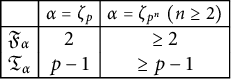
 -th root of unity in Example 2.5. It is easy to see that

Table 1 Long description
The table consists of two columns of data under a header row.
Header Row:
- The first column is blank.
- The second column header is alpha equals zeta sub p.
- The third column header is alpha equals zeta sub p super n where n is greater than or equal to 2.
First Data Row:
- The first column contains the symbol fraktur F sub alpha.
- The second column value is 2.
- The third column value is greater than or equal to 2.
Second Data Row:
- The first column contains the symbol fraktur T sub alpha.
- The second column value is p minus 1.
- The third column value is greater than or equal to p minus 1.
The following proposition gives a precise form of the above observations.
Proposition 4.6 For any integer
$n\geq 1$
 and any
$p^n$
 -th primitive root of unity
$\zeta _{p^n}$
 , we have
${\mathfrak{T}} _{\zeta _{p^n}}=p-1$
 and

The key to prove this proposition is the following lemma.
Lemma 4.7 Let
$\alpha \in {\mathbb{L}} _p^{\mathrm {ha}}$
 with
$v_p(\alpha )=0$
 . Then there exists a p-th root
$\beta $
 of
$\alpha $
 in
${\mathbb{L}} _p^{\mathrm {ha}}({\mathfrak{T}} _\alpha ,p\cdot {\mathfrak{F}} _\alpha )$
 . In particular, if
$C_{\frac {1}{p-1}}(\beta )=0$
 , then
$\beta $
 belongs to
${\mathbb{L}} _p^{\mathrm {ha}}({\mathfrak{T}} _\alpha ,{\mathfrak{F}} _\alpha )$
 .
Proof we apply the transfinite Newton algorithm on the equation
$T^p-\alpha =0$
 to get a root
$\beta $
 . Set
$\beta =\sum _{\omega }[c_\omega ]\cdot p^{k_\omega }$
 , where the ordinal
$\omega $
 runs through the well-ordered set
$\operatorname {\mathrm {supp}}(\beta )$
 . Recall that for any ordinal
$\omega $
 , let
$\beta _\omega =\sum _{\rho <\omega }[c_\rho ]\cdot p^{k_\rho }$
 and

The first step is easy: since
$\beta _0=0$
 and
$\Phi _0(T)=T^p-\alpha $
 , the Newton polygon
$\text {Newt}\left (\Phi _0\right )$
 consists of a single horizontal segment with residue polynomial given by

which splits in
${\mathbb{F}} _{p^{{\mathfrak{F}} _\alpha }}$
 . This shows that
$\beta _1\in {\mathbb{L}} _p^{\text {ha}}({\mathfrak{T}} _\alpha ,{\mathfrak{F}} _\alpha )$
 and
$v_p(\beta _1)=0$
 .
For any
$\omega \geq 1$
 , since
$v_p(\beta _\omega )=v_p(\beta _1)=0$
 , we know that
$v_p(\binom {p}{k}\beta _\omega ^k)=1$
 for all
$k=1,2,\ldots ,p-1$
 . This implies that
$\text {Newt}\left (\Phi _\omega \right )$
 is determined by the point
$(p,v_p(\beta _\omega ^p-\alpha ))$
 for every
$\omega \geq 1$
 .
Since
$k_\omega \in {\mathbb{Q}} $
 increases monotonically with respect to the ordinal
$\omega $
 , we set
$\omega _0$
 to be the minimal ordinal
$\rho $
 that satisfies
$k_\rho \geq \frac {1}{p-1}$
 .
-
(1) Suppose $\omega <\omega _0$
and
$\beta _\rho \in {\mathbb{L}} _p^{\text {ha}}({\mathfrak{T}} _\alpha ,{\mathfrak{F}} _\alpha )$
for every
$\rho \leq \omega $
. Then
$\text {Newt}\left (\Phi _\omega \right )$
consists of a single segment with slope
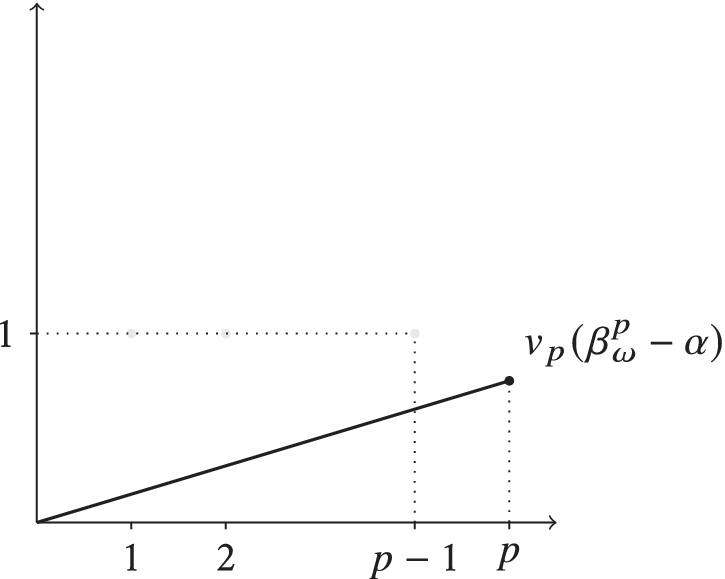
$k_\omega =s_{\max }^{\Phi _\omega }=\frac {1}{p}v_p(\beta _\omega ^p-\alpha )<\frac {1}{p-1}$
. Figure 1$\text {Newt}\left (\Phi _{\omega }\right )$
,
$1\leq \omega <\omega _0$
.Since $\beta _\omega ^p-\alpha \in {\mathbb{L}} _p^{\text {ha}}({\mathfrak{T}} _\alpha ,{\mathfrak{F}} _\alpha )$
by Corollary 3.7, we know that $$\begin{align*}v_p(\beta_\omega^p-\alpha)\in \operatorname{\mathrm{supp}}(\beta_\omega^p-\alpha)\subseteq \frac{1}{{\mathfrak{T}}_\alpha}{\mathbb{Z}}[1/p].\end{align*}$$
This implies that $k_\omega =\frac {1}{p}v_p(\beta _\omega ^p-\alpha )$
also belongs to
$\frac {1}{{\mathfrak{T}} _\alpha }{\mathbb{Z}} [1/p]$
. The residue polynomial of
$\Phi _\omega (T)$
is given by $$ \begin{align*}\text{Res}_{\Phi_\omega}(T)=T^p+C_{v_p(\beta_\omega^p-\alpha)}(\beta_\omega^p-\alpha),\end{align*} $$
where $C_{v_p(\beta _\omega ^p-\alpha )}(\beta _\omega ^p-\alpha )\in {\mathbb{F}} _{p^{{\mathfrak{F}} _\alpha }}$
. Thus, any root of this residue polynomial lies in
${\mathbb{F}} _{p^{{\mathfrak{F}} _\alpha }}$
. This shows that
$\beta _{\omega +1}\in {\mathbb{L}} _p^{\text {ha}}({\mathfrak{T}} _\alpha ,{\mathfrak{F}} _\alpha )$
. Since the case of limit ordinals is self-indicating, we can show by transfinite induction that
$\beta _{\omega }\in {\mathbb{L}} _p^{\text {ha}}({\mathfrak{T}} _\alpha ,{\mathfrak{F}} _\alpha )$
for all
$\omega \leq \omega _0$
. -
(2) Now we deal with $\omega =\omega _0+1$
.-
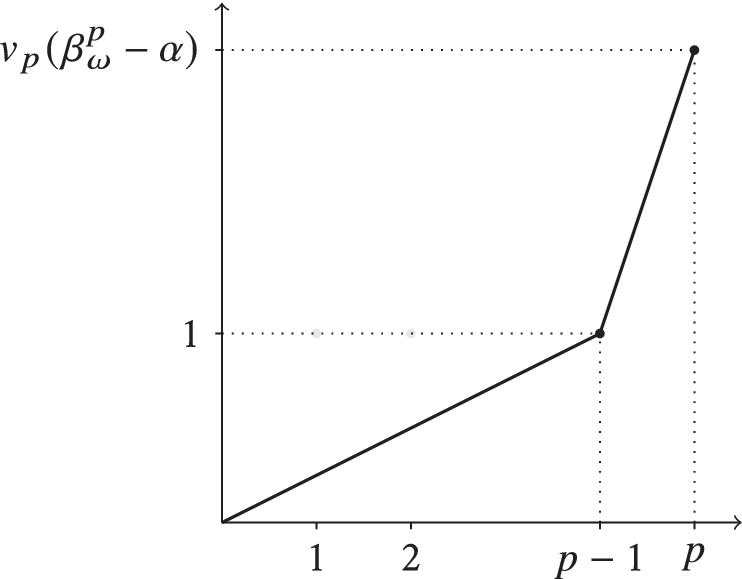
(a) If $k_{\omega _0}=s_{\max }^{\Phi _{\omega _0}}=\frac {1}{p-1}$
, then
$\text {Newt}\left (\Phi _{\omega _0}\right )$
consists of a single segment with slope equals to $$ \begin{align*}k_{\omega_0}=\frac{1}{p-1}=\frac{1}{p}v_p(\beta_{\omega_0}^p-\alpha)\in \frac{1}{{\mathfrak{T}}_\alpha}{\mathbb{Z}}[1/p].\end{align*} $$
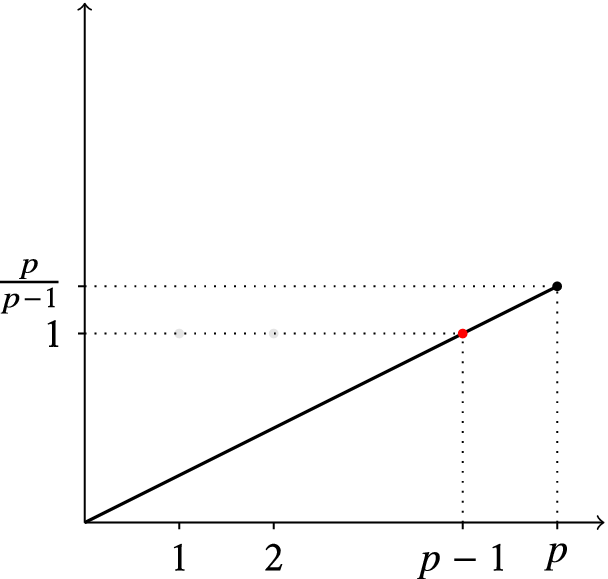
Since this segment contains the point (Figure 2) $(p-1,1)$
, one knows that $$ \begin{align*}\text{Res}_{\Phi_{\omega_0}}(T)=T^p+C_0(\beta_{\omega_0})^{p-1}T+C_{v_p(\beta_{\omega_0}^p-\alpha)}(\beta_{\omega_0}^p-\alpha)\in{\mathbb{F}}_{p^{{\mathfrak{T}}_\alpha}}[T],\end{align*} $$
whose root lies in ${\mathbb{F}} _{p^{p\cdot {\mathfrak{F}} _\alpha }}$
. In this case, one has
$\beta _{\omega _0+1}\in {\mathbb{L}} _p^{\text {ha}}({\mathfrak{T}} _{\alpha },p\cdot {\mathfrak{F}} _\alpha )$
. -
(b) If $k_{\omega _0}=s_{\max }^{\Phi _{\omega _0}}>\frac {1}{p-1}$
, then
$\text {Newt}\left (\Phi _{\omega _0}\right )$
consists of two segments, where the vertexes of the segment with maximal slope is given by
$(p-1,1)$
and
$(p,v_p(\beta _{\omega _0}^p-\alpha ))$
. Thus, $$ \begin{align*}k_{\omega_0}=\frac{v_p(\beta_{\omega_0}^p-\alpha)-1}{p-(p-1)}\in \frac{1}{{\mathfrak{T}}_\alpha}{\mathbb{Z}}[1/p]\end{align*} $$
and one has
$$ \begin{align*}\text{Res}_{\Phi_{\omega_0}}(T)=C_0(\beta_{\omega_0})^{p-1}T+C_{v_p(\beta_{\omega_0}^p-\alpha)}(\beta_{\omega_0}^p-\alpha),\end{align*} $$
whose root lies in ${\mathbb{F}} _{p^{{\mathfrak{F}} _\alpha }}$
. In this case, one has
$\beta _{\omega _0+1}\in {\mathbb{L}} _p^{\text {ha}}({\mathfrak{T}} _{\alpha },{\mathfrak{F}} _\alpha )$
.
Figure 2$\text {Newt}\left (\Phi _{\omega _0}\right )$
, if
$k_{\omega _0}=\frac {1}{p-1}$
.Figure 3$\text {Newt}\left (\Phi _{\omega _0}\right )$
, if
$k_{\omega _0}>\frac {1}{p-1}$
. -
-
(3) For the case of $\omega>\omega _0$
, we have (Figure 3)
$k_\omega>\frac {1}{p-1}$
. With the same calculation as above, one can prove by transfinite induction that for any ordinal
$\omega \geq \omega _0+1$
,
$\beta _\omega \in {\mathbb{L}} _p^{\text {ha}}({\mathfrak{T}} _\alpha ,{\mathfrak{F}} _{\beta _{\omega _0+1}})$
.


The result follows.
Additionally, we need the following auxiliary lemma.
Lemma 4.8 For any
$p^2$
 -th primitive root of unity
$\zeta _{p^2}$
 , there exists another
$p^2$
 -th primitive root of unity
$\zeta _{p^2}^\prime $
 and a p-th root of unity
$\xi _c$
 (not necessarily primitive) that
$\zeta _{p^2}=\zeta _{p^2}^\prime \cdot \xi _c$
 and
$C_{\frac {1}{p-1}}(\zeta _{p^2}^\prime )=0$
 .
Proof Fix a
$2(p-1)$
 -th primitive root of unity
$\tilde {\zeta }_{2(p-1)}$
 . Let

By choosing
$\zeta _{2(p-1)}$
 in the expansion of the
$p^2$
 -th primitive root of unity given by Example 2.5 (see also [Reference Wang and YuanWY21, Theorem 3.3]) in
${\mathcal{W}} $
 , we get
$p-1$
 different
$p^2$
 -th primitive roots of unity
$r_0,r_1,\ldots ,r_{p-2}$
 , satisfying
$[C_{\frac {1}{p(p-1)}}(r_k)]=\tilde {\zeta }_{2(p-1)}^{2k+1}$
 and
$[C_{\frac {1}{p-1}}(r_k)]=0$
 for every
$k\in {\mathbb{N}} _{<p-1}$
 .
Similarly, for every
$c\in \{0\}\cup {\mathcal{W}} $
 , there exists a p-th root of unity (not necessarily primitive)
$\xi _c$
 that
$v_p\left (\xi _c-1-c\cdot p^{\frac {1}{p-1}}\right )> \frac {1}{p-1}$
 . Thus, for any
$k\in {\mathbb{N}} _{<p-1}$
 and
$c\in \{0\}\cup {\mathcal{W}} $
 ,
$r_k\cdot \xi _c$
 is a
$p^2$
 -th primitive root of unity, satisfying
$[C_{\frac {1}{p(p-1)}}(r_k\cdot \xi _c)]=\tilde {\zeta }_{2(p-1)}^{2k+1}$
 and
$[C_{\frac {1}{p-1}}(r_k\cdot \xi _c)]=c$
 . This enumerates all
$p(p-1)\, p^2$
 -th primitive roots of unity. The result follows.
Proof of Proposition 4.6
The case of
$n=1$
 follows immediately from [Reference Wang and YuanWY21, Proposition 3.4].
Let
$\zeta _{p^2}$
 be any
$p^2$
 -th primitive root of unity. By Lemma 4.8, there exists another
$p^2$
 -th primitive root of unity
$\zeta _{p^2}^\prime $
 and a p-th root of unity
$\xi _c$
 (not necessarily primitive) that
$\zeta _{p^2}^p=\zeta _{p^2}^\prime \cdot \xi _c$
 and
$C_{\frac {1}{p-1}}(\zeta _{p^2}^\prime )=0$
 . By applying Lemma 4.7, we have

Since
$\xi _c\in {\mathbb{L}} _p^{\text {ha}}(p-1,2)$
 , we know that
$\zeta _{p^2}\in {\mathbb{L}} _p^{\text {ha}}(p-1,2)$
 . On the other hand, by [Reference Wang and YuanWY21, Theorem 3.3], one has
${\mathfrak{T}} _{\zeta _{p^2}}\geq p-1$
 and
${\mathfrak{F}} _{\zeta _{p^2}}\geq 2$
 . This implies that
${\mathfrak{T}} _{\zeta _{p^2}}=p-1$
 and
${\mathfrak{F}} _{\zeta _{p^2}}=2$
 .
when
$n\geq 3$
 , we can set
$\alpha =\left (\zeta _{p^n}\right )^p$
 in Lemma 4.7 inductively to get the result. One should notice that when
$n\geq 3$
 , we no longer know if the analog of Lemma 4.8 holds for
$\zeta _{p^n}$
 . Thus, the hyper-inertia index is multiplied by p when n increases by
$1$
 .
Corollary 4.9 For any positive integer
$m=r\cdot p^{v_p(m)}$
 with
$\gcd (r,p)=1$
 and any m-th primitive root of unity
$\zeta _m$
 , one has
-
(1) If $v_p(m)=0$
, then
${\mathfrak{T}} _{\zeta _m}=1$
and
${\mathfrak{F}} _{\zeta _m}=\text {ord}_r p$
. -
(2) If $v_p(m)\geq 1$
, then
${\mathfrak{T}} _{\zeta _m}\mid p-1$
and $$ \begin{align*}{\mathfrak{F}}_{\zeta_m}\mid\begin{cases} \mathrm{lcm}(2,\mathrm{ord}_rp), & \text{ if }v_p(m)=1,2; \\ \mathrm{lcm}\left(2\cdot p^{v_p(m)-1},\mathrm{ord}_rp\right), & \text{ if }v_p(m)\geq 3. \end{cases}\end{align*} $$


Proof It suffices to note that any r-th root of unity lies in
$W({\mathbb{F}} _{p^{\text {ord}_rp}})$
 .
with the power of the local Kronecker–Weber theorem, we can generalize this result to those p-adic algebraic numbers that generate abelian extensions over
${\mathbb{Q}} _p$
 .
Theorem 4.10 Let
$\alpha \in \overline {{\mathbb{Q}} }_p$
 be a p-adic algebraic number with
${\mathbb{Q}} _p(\alpha )/ {\mathbb{Q}} _p$
 an abelian extension of degree n. Denote by
$\mathbf{f} _{{\mathbb{Q}} _p(\alpha )}$
 the local conductor of
${\mathbb{Q}} _p(\alpha )$
 over
${\mathbb{Q}} _p$
 . Then
-
(1) If $\mathbf{f} _{{\mathbb{Q}} _p(\alpha )}=0$
, then
${\mathfrak{T}} _\alpha =1$
and
${\mathfrak{F}} _\alpha =n$
. -
(2) If $\mathbf{f} _{{\mathbb{Q}} _p(\alpha )}\geq 1$
, then
${\mathfrak{T}} _\alpha \mid p-1$
and $$ \begin{align*}{\mathfrak{F}}_\alpha\mid\begin{cases} \mathrm{lcm}(2,n), & \text{ if }\mathbf{f}_{{\mathbb{Q}}_p(\alpha)}=1,2; \\ \mathrm{lcm}\left(2\cdot p^{ \mathbf{f}_{{\mathbb{Q}}_p(\alpha)}-1},n\right), & \text{ if }\mathbf{f}_{{\mathbb{Q}}_p(\alpha)}\geq 3. \end{cases}\end{align*} $$


To prove this theorem, the following effective form of the local Kronecker–Weber theorem is needed.
Lemma 4.11 Let
$K/{\mathbb{Q}} _p$
 be an abelian extension of degree n with conductor
$\mathbf{f} _K$
 and let
$m=\left (p^{n}-1\right )p^{\textbf {f}_K}$
 . Then
$K\subseteq {\mathbb{Q}} _p(\zeta _m)$
 .
Proof By [Reference GuillotGui18, Lemma 4.11] and its proof, there exists
$s\geq 1$
 that

It follows that
$K\subseteq {\mathbb{Q}} _p\left (\zeta _{(p^s-1)p^{\textbf {f}_K}}\right )$
 by the proof of [Reference GuillotGui18, Theorem 13.27]. On the other hand, we have
$K\subseteq {\mathbb{Q}} _p\left (\zeta _{(p^n-1)p^{v_p(n)+2}}\right )$
 by [Reference Koenigsmann and StockKS22, Theorem 3.1]. Since

we have
$K\subseteq {\mathbb{Q}} _p(\zeta _m)$
 .
Proof of Theorem 4.10
Let
$m=\left (p^{n}-1\right )p^{{\textbf {f}}_{{\mathbb{Q}} _p(\alpha )}}$
 . By Lemma 4.11, we know that
$\alpha \in {\mathbb{Q}} _p(\zeta _m)$
 .
Note
$\text {ord}_{p^{n}-1}p=n$
 . By Corollary 4.9, we know that

and

Since
$\alpha \in {\mathbb{Q}} _p(\zeta _m)\subseteq {\mathbb{L}} _p^{\text {ha}}({\mathfrak{T}} _{\zeta _m},{\mathfrak{F}} _{\zeta _m})$
 , the result follows.
4.3 Criterion for tamely ramified extensions
Theorem 4.12 Let
$\alpha \in {\mathbb{L}} _p^{\text {ha}}$
 be a hyper-algebraic element in
${\mathbb{L}} _p$
 . Then
${\mathbb{Q}} _p(\alpha )$
 is tamely ramified over
${\mathbb{Q}} _p$
 if and only if
$\operatorname {\mathrm {supp}}(\alpha )\subseteq \frac {1}{{\mathfrak{T}} _\alpha }{\mathbb{Z}} $
 . In this situation, we have
${\mathfrak{T}} _\alpha ={\mathfrak{e}} _\alpha $
 ,
${\mathfrak{f}} _\alpha \mid {\mathfrak{F}} _\alpha $
 and
${\mathfrak{F}} _\alpha \mid c$
 , where
$c:= \mathrm {ord}_{\mathrm {lcm}({\mathfrak{e}} _\alpha ,p^{{\mathfrak{f}} _\alpha }-1)}p$
 and
${\mathfrak{f}} _\alpha $
 (resp.
${\mathfrak{e}} _\alpha $
 ) is the inertia degree (resp. the ramification index) of the extension
${\mathbb{Q}} _p(\alpha )/{\mathbb{Q}} _p$
 .
The proof of this theorem is based on the subsequent lemma, which is generally standard in local field theory (cf. [Reference LangLan94, Proposition II.5.12]), albeit presented here with slightly greater explicitness.
Lemma 4.13 Let
$\alpha \in \overline {{\mathbb{Q}} }_p$
 be a p-adic algebraic number with
${\mathbb{Q}} _p(\alpha )$
 tamely ramified over
${\mathbb{Q}} _p$
 . Then there exists a
${\mathfrak{e}} _\alpha $
 -th root
$\zeta _e\in \overline {{\mathbb{F}} }_p$
 of unity that

where
${\mathbb{Q}} _{p^{{\mathfrak{f}} _\alpha }}:= W({\mathbb{F}} _{p^{{\mathfrak{f}} _\alpha }})\left [\frac {1}{p}\right ]$
 is the maximal unramified extension of
${\mathbb{Q}} _p$
 in
${\mathbb{Q}} _p(\alpha )$
 .
Proof Let
${\mathcal{O}} _K$
 be the ring of integer of
$K:= {\mathbb{Q}} _p(\alpha )$
 with a uniformizer
$\pi _K$
 . Suppose
$\pi _K^{{\mathfrak{e}} _\alpha }=p\cdot u$
 , where u is a unit in
${\mathcal{O}} _K^\times $
 .
Note that the polynomial
$T^{{\mathfrak{e}} _\alpha }-\overline {u}\in {\mathbb{F}} _{p^{{\mathfrak{f}} _\alpha }}[T]$
 has simple roots by the condition
$\gcd ({\mathfrak{e}} _\alpha ,p)=1$
 . Hensel lemma implies that there is a
${\mathfrak{e}} _\alpha $
 -th root v of u in
${\mathcal{O}} _K^\times $
 . If we set
$\pi _K^\prime := \pi _K\cdot v^{-1}$
 , then this element is also a uniformizer of K. Since
$\pi _K^\prime $
 is a
${\mathfrak{e}} _\alpha $
 -th root of p, we have
$\pi _K^\prime =p^{1/{\mathfrak{e}} _\alpha }\cdot [\zeta _e]$
 for some
${\mathfrak{e}} _\alpha $
 -th root
$\zeta _e$
 of unity in
$\overline {{\mathbb{F}} }_p$
 .
Proof of Theorem 4.12
If
$\text {supp}(\alpha )\subseteq \frac {1}{{\mathfrak{T}} _\alpha }{\mathbb{Z}} $
 , we can write
$\alpha =\sum _{k>\!\!\!>-\infty }^{+\infty }[r_k]\cdot p^{\frac {k}{{\mathfrak{T}} _\alpha }}$
 , where
$r_k\in {\mathbb{F}} _{p^{{\mathfrak{F}} _\alpha }}$
 for all k. Thus,
$\alpha $
 lies in
${\mathbb{Q}} _{p^{{\mathfrak{F}} _\alpha }}\left (p^{\frac {1}{{\mathfrak{T}} _\alpha }}\right )$
 , where
${\mathbb{Q}} _{p^{{\mathfrak{F}} _\alpha }}:= W({\mathbb{F}} _{p^{{\mathfrak{F}} _\alpha }})\left [\frac {1}{p}\right ]$
 is the unique unramified extension of
${\mathbb{Q}} _p$
 with residue field
${\mathbb{F}} _{p^{{\mathfrak{F}} _\alpha }}$
 . Since
${\mathfrak{T}} _\alpha $
 is coprime to p (cf. Lemma 3.5), the field
${\mathbb{Q}} _{p^{{\mathfrak{F}} _\alpha }}\left (p^{\frac {1}{{\mathfrak{T}} _\alpha }}\right )$
 is tamely ramified over
${\mathbb{Q}} _p$
 , implying that
${\mathbb{Q}} _p(\alpha )$
 is also tamely ramified over
${\mathbb{Q}} _p$
 .
Conversely, if
${\mathbb{Q}} _p(\alpha )/{\mathbb{Q}} _p$
 is tamely ramified, then we have

for some
${\mathfrak{e}} _\alpha $
 -th root
$\zeta _e\in \overline {{\mathbb{F}} }_p$
 of unity by Lemma 4.13. Let

with
$c_k\in {\mathbb{Q}} _{p^{{\mathfrak{f}} _\alpha }}$
 for
$k=0,\ldots ,{\mathfrak{e}} _\alpha -1$
 . If we set
$c_k=\sum _{i>-\infty }\left [c_i^{(k)}\right ]p^i\in {\mathbb{Q}} _{p^{{\mathfrak{f}} _\alpha }}$
 with
$c_i^{(k)}\in {\mathbb{F}} _{p^{{\mathfrak{f}} _\alpha }}$
 , then

This shows that
$\operatorname {\mathrm {supp}}(\alpha )\subseteq \frac {1}{{\mathfrak{e}} _\alpha }{\mathbb{Z}} $
 . Thus,

To prove the second assertion, notice that the inclusion
$\alpha \in {\mathbb{Q}} _{p^{{\mathfrak{F}} _\alpha }}\left (p^{\frac {1}{{\mathfrak{T}} _\alpha }}\right )$
 implies
${\mathfrak{e}} _\alpha \mid {\mathfrak{T}} _\alpha $
 and
${\mathfrak{f}} _\alpha \mid {\mathfrak{F}} _\alpha $
 . On the other hand, if any coefficient
$c_i^{(k)}\cdot \zeta _e^k$
 in (4.2) is nonzero, then it is a
$\text {lcm}({\mathfrak{e}} _\alpha ,p^{{\mathfrak{f}} _\alpha }-1)$
 -th root of unity, that is,
$c_i^{(k)}\cdot \zeta _e^k\in {\mathbb{F}} _{p^c}$
 . As a result, one conclude by Lemma 3.5 that
$\alpha \in {\mathbb{L}} _p^{\text {ha}}({\mathfrak{e}} _\alpha ,c)$
 .
Compared to Proposition 4.1, the constant c in Theorem 4.12 does provide a better bound for the hyper-inertia index in the tamely ramified case.
Lemma 4.14 Let
$c:= \mathrm {ord}_{\mathrm {lcm}({\mathfrak{e}} _\alpha ,p^{{\mathfrak{f}} _\alpha }-1)}p$
 be the constant in Theorem 4.12. Then c divides
$\mathrm {lcm}(\phi ({\mathfrak{e}} _\alpha ),{\mathfrak{f}} _\alpha )$
 , where
$\phi $
 is Euler’s totient function.
Proof Let
$e_0:= \frac {{\mathfrak{e}} _\alpha }{\gcd ({\mathfrak{e}} _\alpha ,p^{{\mathfrak{f}} _\alpha }-1)}$
 , then
$\text {lcm}({\mathfrak{e}} _\alpha ,p^{{\mathfrak{f}} _\alpha }-1)=e_0\cdot (p^{{\mathfrak{f}} _\alpha }-1)$
 , with
$e_0$
 a factor of
${\mathfrak{e}} _\alpha $
 that coprime to
$p^{{\mathfrak{f}} _\alpha }-1$
 and p. The Chinese remainder theorem implies that

Since
$e_0$
 is a factor of
${\mathfrak{e}} _\alpha $
 , we have
$\text {ord}_{e_0}p$
 divides
$\text {ord}_{{\mathfrak{e}} _\alpha }p$
 . The result follows from Euler’s theorem.
Acknowledgements
The authors would like to express their gratitude to Haotian Liu, Yicheng Tao, and Hongteng Xu for the useful discussion. The authors also thank Will Sawin for his answer on Mathoverflow (cf. [Reference SawinSaw24]), which motivates the formulation of Lemma 4.11 in this work, and thank the anonymous referee for the careful reading and valuable suggestions that help to improve the presentation of this article. Special thanks to Beijing PARATERA Tech Corp., Ltd. for providing a part of the HPC resources for the numerical experiment at the early stage of this research.