




No CrossRef data available.
Article contents
ON THE ASYMPTOTIC POWER OF THE VARIANCE RATIO TEST
Published online by Cambridge University Press: 31 January 2003
Abstract
The variance-ratio (VR) test statistic, which is based on k-period differences of the data, is commonly used in empirical finance and economics to test the random walk hypothesis. We obtain the asymptotic power function of the VR test statistic when the differencing period k is increasing with the sample size n such that k/n → δ > 0. We show that the test is inconsistent against a variety of mean-reverting alternatives, confirm the result in simulations, and then characterize the functional form of the asymptotic power in terms of δ and these alternatives.
Information
- Type
- Research Article
- Information
- Copyright
- © 2003 Cambridge University Press
1. INTRODUCTION
The random walk is one of the most important models in empirical finance and economics, and several tests have been developed to detect deviations from this model. Parsimonious tests of this model have been developed for low frequency autocorrelations in the data, such as slow mean-reverting processes, by employing multiple horizon data. One of the popular tests of this genre is based on the variance ratio (VR) statistic, which is the sample variance of k-period differences, xt − xt−k, of the time series xt, divided by k times the sample variance of the first difference, xt − xt−1, for some integer k. Under the null hypothesis that the series xt is a random walk, the corresponding population variance ratio, given by PVR(k) = Var(xt − xt−k)/[kVar(xt − xt−1)] , is 1 for any value of k. Arguably, the VR statistic has become the primary tool for testing the random walk hypothesis for low frequency series (see, e.g., among many others, Campbell and Mankiw, 1987; Cochrane, 1988; Lo and MacKinlay, 1988; Poterba and Summers, 1988). The use of the VR statistic can be advantageous when testing against several interesting alternatives to the random walk model, most notably those hypotheses associated with mean reversion. In fact, a number of authors (e.g., Lo and Mackinlay, 1989; Faust, 1992; Richardson and Smith, 1991) have found that the VR statistic has optimal power against such alternatives.1
The practical implementation of the VR statistic is, however, less straightforward. The statistical significance has been assessed using conventional asymptotic theory, that is, for fixed k and the sample size n increasing to infinity. Unfortunately, the underlying asymptotic theory provides a poor approximation to the small sample distribution of the VR statistic. In fact, rather than being normally distributed (when standardized by

), the statistics are severely biased and right skewed for large k, which makes application of the statistic problematic. A seemingly attractive solution to this problem is to use the result of Richardson and Stock (1989). They derive the asymptotic distribution of the VR statistic under the random walk null, assuming that both k and n increase to infinity but in such a way that k/n converges to a positive constant δ that is strictly less than 1. They show that the VR statistic, without any normalization, converges to a functional of Brownian motion. This new distribution provides a far more robust approximation to the small sample distribution of the VR statistic. Most current applications of the VR statistic cite the k/n → δ result as justification for using Monte Carlo distributions (i.e., set at k = δn) as representative of the VR statistic's sampling distribution.
This paper provides another look at the VR statistic and its statistical properties.2
Perron and Vodounou (2001) also look at the VR statistic's properties under the Richardson and Stock (1989) framework. Their approach, however, is different to the extent that they keep the data span, n, fixed and then take a continuous-time limit within this span. In other words, rather than assuming n → ∞, they assume the sampling frequency of the data goes to zero.
The paper is organized as follows. In Section 2, we define the VR statistic, review the existing literature on its asymptotic distribution, and provide the main theoretical result regarding its lack of power. Section 3 then explores some of the practical implications of this result, in particular, through simulation evidence for relevant alternative models to the random walk theory.
2. THE VR STATISTIC'S POWER
Given n + 1 observations x0,x1,…,xn of a time series, the VR statistic with a positive integer k(< n) as differencing period is defined as

In the usual fixed k asymptotic treatment, under the null hypothesis that the {xt} follow a random walk with possible drift, given by

where μ is a real number and {εt} is a sequence of zero mean independent random variables, it is possible to show (see, e.g., Lo and MacKinlay, 1988) that

where σk2 is some simple function of k. This result extends to the case where the {εt} are a martingale difference series with conditional heteroskedasticity (see, e.g., Campbell, Lo, and MacKinlay, 1997), though the variance σk2 has to be adjusted a little. The fixed k asymptotic distribution is well known to fare badly when k is large relative to n (see Lo and MacKinlay, 1989).
As an alternative to the fixed k asymptotics, Richardson and Stock (1989) develop an alternative approach under k → ∞, n → ∞, and k/n → δ > 0 asymptotics. Under the assumption that {xt} follows (1), where {εt} is a conditionally heteroskedastic martingale difference series, they show that

where W(λ) is standard Brownian motion. Thus, whereas the VR statistic converges to one under the fixed k treatment, here it has a nondegenerate limiting distribution. Clearly this distribution is nonnormal and instead can be characterized by a functional of Brownian motions. Through Monte Carlo simulations, Richardson and Stock (1989) demonstrate that this alternate theory provides a much better approximation to the small sample distribution of the VR statistic.
Of course, the problems of generating consistent tests when the statistic converges to a nondegenerate distribution are well known. In fact, as we show in Theorem 1, which follows, under a wide class of mean-reverting models, the VR statistic converges to a positive multiple of the limiting distribution in (2) when k/n → δ > 0. This implies that the resulting test based on the VR statistic will be inconsistent for such alternatives when k is a constant fraction of the sample size n. In practical terms, this means that no matter how large the sample size, the probability of detecting such an alternative is bounded below some number strictly less than one, which is clearly an undesirable property.
THEOREM 1. Let {et} and {ut} be two series of zero mean independent processes with finite variance σe2 and σu2, respectively, which are independent of each other. Define the process {yt} by yt = λyt−1 + ut where |λ| < 1. Let rt = μ + rt−1 + et and

If k → ∞, n → ∞, and k/n → δ > 0, then

where W(λ) is standard Brownian motion.
Proof of Theorem 1. Let

. Thus,

By (A.6) of Richardson and Stock (1989, p. 346) for α > δ,

where W(α) is standard Brownian motion. Because {yt} is a stationary process, it is trivially true that

Hence, by (5)–(7).

Furthermore, by the weak law of large numbers,

The same argument as that employed in Richardson and Stock (1989, p. 329) then yields the required result. █
Theorem 1 shows that the test based on the VR statistic when k is a fraction of the sample size will result in an inconsistent test for mean-reverting alternatives of the form (3). Such mean-reverting alternatives are of the kind often imposed in finance applications (see, e.g., Poterba and Summers, 1988; Fama and French, 1988). The variable xt contains a permanent (i.e., random walk) component rt and a temporary (i.e., stationary) component yt. It is also obvious from (4) that when the variance of the innovations of the temporary component, σu2, is small relative to σe2 the test based on the VR statistic will have power that is barely larger than the nominal size of the test in detecting the alternative even in infinitely large sample sizes.
A limiting result for VR similar to (4) in Theorem 1 can actually be obtained under much more general conditions on {rt} and {yt}. One can allow both the first difference series {rt − rt−1} and {yt} to be arbitrary stationary processes instead of the independent process {et} and the autoregressive process of order one, respectively, that was imposed in Theorem 1. Thus, the VR statistic can be shown to be inconsistent for a very wide range of alternatives that might be of interest in detecting mean reversion if k is a fraction of the sample size.
3. POWER IMPLICATIONS
The theorem in Section 2 shows that the VR statistic is inconsistent against meaningful alternatives as k → ∞, n → ∞, and k/n → δ > 0. Moreover, equation (4) provides the form for the asymptotic power function. In this section, we explore the implications of these results for the VR statistic's power.
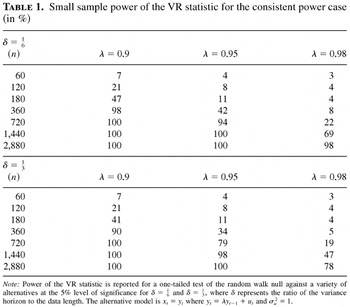
As a first step, Table 1 reports the small sample power of the VR statistic for the relevant case in which its power is consistent. In particular, we consider the alternative model described in Theorem 1 under the assumption that σe2 = 0, that is, there is no permanent component to xt. As seen from the table, as n increases, the power approaches 100%. Interestingly, this increase is greater for smaller δ, which is consistent with Theorem 1's main implication that, for consistency, k/n → 0. Intuitively, in small samples, even consistent alternatives are hard to distinguish, and the large k problem is attenuated.
Small sample power of the VR statistic for the consistent power case (in %)

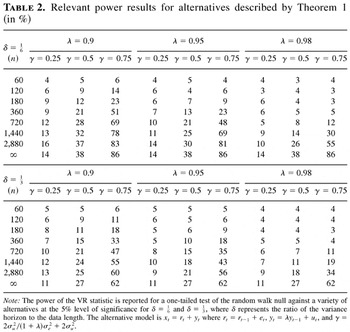
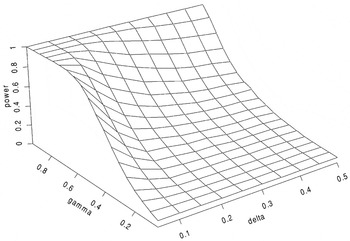
Table 2 reports the relevant power results for a variety of alternatives described by Theorem 1. Several observations are in order. First, the table reports small sample power for n ranging from 60 through 2,880 observations and also the asymptotic power level. As Theorem 1 shows, and Table 2 demonstrates, the small sample power of the VR statistic is clearly limited, supporting its inconsistency as a test statistic. Second, even though there is some increase in power as n increases, the gains are very limited for alternative specifications with substantial permanent components. For example, when the share of the variance captured by the mean-reverting component, γ, is only 0.25 and 0.5, respectively, the power is 14% and 38% as n → ∞. Third, these power gains are worse for larger δ, which is consistent with the requirement that k/n → 0. As an illustration, for γ equal to 0.25, 0.5, and 0.75, respectively, the power is 14%, 38%, and 86% for δ = 1/6 versus only 11%, 27%, and 62% for δ = 1/3. To get a more complete picture of this point, Figure 1 graphs the three-dimensional relation between power, γ, and δ. As borne out by the figure, lower δ's increase power, with varying impact depending on the permanent component's importance (i.e., level of γ). For a fixed value of γ, the drop-off in the power, as δ increases, is quite dramatic. Finally, note that the mean-reversion parameter, λ, has no effect upon the asymptotic distribution as the VR statistic is consistent against pure mean-reversion alternatives (e.g., see Table 1). Table 2, however, shows that λ is important in small samples.
Relevant power results for alternatives described by Theorem 1 (in %)


Asymptotic power versus γ and δ. Asymptotic power of the VR statistic is shown for a test of the random walk null against a specific alternative model at the 5% level of significance for a range of δ's and γ's, where δ represents the ratio of the variance horizon to the data length and γ represents the proportion of the variance due to the mean-reverting component. In particular, the alternative model is xt = rt + yt where rt = rt−1 + et, yt = λyt−1 + ut, and γ = 2σu2/((1 + λ)σe2 + 2σu2).
On the one hand, these results are fairly discouraging for developing tests against slow mean-reverting alternatives. Given a fixed δ, the VR statistic will have limited success. Within the Richardson and Stock (1989) framework, however, Perron and Vodounou (2001) do manage to characterize the maximal possible power by taking a continuous-time limit given a fixed data span, n. On the other hand, and in contrast to the Perron and Vodounou (2001) result, Theorem 1 suggests an alternative approach in which k is allowed to increase with n but at a slower rate. This guarantees consistency against a wide range of alternatives. Practically, this means that, for power purposes, k cannot be too large in small samples.
The practical issue of how to then adjust the size of the statistics for a given k in small samples remains an important question. Nevertheless, Chen and Deo (2001) provide a possible solution to this issue. They show that one way to alleviate the small sample skewness of linear combinations of positive random variables is to use power transformations. Because VR statistics can be characterized as such a linear combination, their approach allows the researcher to apply the variance ratio in small samples across a wide array of unknown distributions. The transformed VR statistic will maintain its consistent power, yet it approximates the small sample distribution much more closely. This particular problem deserves future analysis.
References
REFERENCES
Campbell, J.,
A. Lo, &
A. MacKinlay
(1997)
The Econometrics of Financial Markets.
Princeton:
Princeton University Press.
Campbell, J. &
N.G. Mankiw
(1987)
Are output fluctuations transitory?
Quarterly Journal of Economics
102,
857–880.Google Scholar
Chen, W. &
R. Deo
(2001)
On Power Transformations of Linear Combinations of Positive Random
Variables to Improve Normality.
Working paper,
New York University.
Cochrane, J.
(1988)
How big is the random walk in GNP?
Journal of Political Economy
96,
893–920.Google Scholar
Daniel, K.
(2001)
The power and size of mean reversion tests.
Journal of Empirical Finance
8,
493–535.CrossRefGoogle Scholar
Fama, E. &
K. French
(1988)
Permanent and temporary components of stock prices.
Journal of Political Economy
96,
246–273.CrossRefGoogle Scholar
Faust, J.
(1992)
When are variance ratio tests for serial dependence optimal?
Econometrica
60,
1215–1226.Google Scholar
Lo, A. &
A.C. MacKinlay
(1988)
Stock market prices do not follow random walks: Evidence from a
simple specification test.
Review of Financial Studies
1,
41–66.CrossRefGoogle Scholar
Lo, A. &
A.C. MacKinlay
(1989)
The size and power of the variance ratio test in finite samples: A
Monte Carlo investigation.
Journal of Econometrics
40,
203–238.CrossRefGoogle Scholar
Perron, P. &
C. Vodounou
(2001)
The Variance Ratio Test: An Analysis of Size and Power Based on a
Continuous-Time Asymptotic Framework.
Working paper,
Boston University.
Poterba, J. &
L. Summers
(1988)
Mean reversion in stock returns: Evidence and implications.
Journal of Financial Economics
22,
27–60.CrossRefGoogle Scholar
Richardson, M. &
T. Smith
(1991)
Tests of financial models with the presence of overlapping
observations.
Review of Financial Studies
4,
227–254.CrossRefGoogle Scholar
Richardson, M. &
T. Smith
(1994)
A unified approach to testing for serial correlation in stock
returns.
Journal of Business
67,
371–399.CrossRefGoogle Scholar
Richardson, M. &
J. Stock
(1989)
Drawing inferences from statistics based on multi-year asset
returns.
Journal of Financial Economics
25,
323–348.CrossRefGoogle Scholar
Small sample power of the VR statistic for the consistent power case (in %)
Relevant power results for alternatives described by Theorem 1 (in %)
Asymptotic power versus γ and δ. Asymptotic power of the VR statistic is shown for a test of the random walk null against a specific alternative model at the 5% level of significance for a range of δ's and γ's, where δ represents the ratio of the variance horizon to the data length and γ represents the proportion of the variance due to the mean-reverting component. In particular, the alternative model is xt = rt + yt where rt = rt−1 + et, yt = λyt−1 + ut, and γ = 2σu2/((1 + λ)σe2 + 2σu2).
 You have
Access
- 34
- Cited by