



1. Introduction
A hypergraph
 $G = (V, E)$
is a set of vertices
 $V$
together with a set of edges
 $E \subset 2^V$
. A hypergraph is
 $k$
-uniform if every edge has size
 $k$
. The degree of a vertex
 $v \in V$
, denoted by
 $d(v)$
, is the number of edges it appears in; in a hypergraph with maximum degree
 $\Delta$
, each vertex appears in at most
 $\Delta$
edges.
An independent set in
 $G$
is a set of vertices
 $I \subset V$
such that
 $I$
contains no edge. Let
 $\mathcal {I}(G)$
denote the family of all independent sets in
 $G$
. The independence polynomial of
 $G$
is defined by
 \begin{equation*}Z_G(\lambda ) = \sum _{I \in \mathcal {I}(G)} \lambda ^{\left \vert I \right \vert }.\end{equation*}
This polynomial plays an important role in mathematics, physics and computer science [Reference Davies and Perkins1, Reference Heilmann and Lieb3, Reference Jain, Perkins, Sah and Sawhney4, Reference Scott and Sokal7–Reference Weitz10]. A key property for understanding this polynomial is the largest radius of a disk-shaped zero-free region(ZFR), a region in
 $\mathbb {C}$
where
 $Z_G$
has no zero. We refer the reader to the introduction of [Reference Galvin, McKinley, Perkins, Sarantis and Tetali2] for a survey of how knowledge of the zeros of
 $Z_G$
can lead to interesting results about independent set.
When
 $G$
is a graph with maximum degree
 $\Delta$
, the ZFRs for
 $Z_G$
are well-understood [Reference Peters and Regts6, Reference Shearer8]. Specifically, Shearer [Reference Shearer8] showed that
 $Z_G$
has no zero inside the disk
 $\left \vert \lambda \right \vert \lt \frac {(\Delta - 1)^{\Delta - 1}}{\Delta ^{\Delta }}$
, and this bound is the best possible.
In a recent paper [Reference Galvin, McKinley, Perkins, Sarantis and Tetali2], Galvin, McKinley, Perkins, Sarantis and Tetali studied the zeros of
 $Z_G$
when
 $G$
is a general hypergraph with given maximum degree
 $\Delta$
. They showed that
 $Z_G$
has no zero inside the disk
 $\left \vert \lambda \right \vert \lt \frac {\Delta ^\Delta }{(\Delta + 1)^{(\Delta + 1)}}$
. Furthermore, for each uniformity
 $k \geq 2$
, they constructed a family of
 $k$
-uniform hypergraphs with arbitrarily large maximum degree
 $\Delta$
such that
 $Z_G$
has a zero
 $\lambda$
with
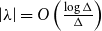
 $\left \vert \lambda \right \vert \lt O_k\left (\frac {\log \Delta }{\Delta }\right )$
, thereby showing that their bound is tight up to a logarithmic factor if we place no additional assumption on
 $G$
.
A hypergraph is linear if each pair of edges intersect in at most one vertex. The aforementioned constructions in [Reference Galvin, McKinley, Perkins, Sarantis and Tetali2, Section 4] are far from linear, since they contain edges that intersect in
 $(k - 1)$
vertices. In [Reference Galvin, McKinley, Perkins, Sarantis and Tetali2, Conjecture 3], Galvin, McKinley, Perkins, Sarantis and Tetali conjectured that their lower bound on the maximum radius of the zero-free disk for
 $Z_G$
can be improved under the additional assumption that
 $G$
is linear.
Conjecture 1.1.
For each
 $k \geq 2$
, there exists a constant
 $C_k \gt 0$
such that the following is true. If
 $G$
is a
 $k$
-uniform, linear hypergraph with maximum degree
 $\Delta$
and if
 \begin{equation*}\left \vert \lambda \right \vert \leq C_k \Delta ^{-\frac {1}{k - 1}}\end{equation*}
then
 $Z_G(\lambda ) \neq 0$
.
This conjecture is motivated by results on asymptotic enumeration in [Reference Mousset, Noever, Panagiotou and Samotij5]. Galvin, McKinley, Perkins, Sarantis and Tetali verified this conjecture when
 $G$
is a hypertree [Reference Galvin, McKinley, Perkins, Sarantis and Tetali2, Theorem 4],
In this note, we disprove Conjecture1.1 in any uniformity
 $k \geq 3$
. Our counterexample shows that the radius of the disk-shaped ZFR
 $\left \vert \lambda \right \vert \lt \frac {\Delta ^\Delta }{(\Delta + 1)^{(\Delta + 1)}}$
is tight up to a logarithmic factor even if we assume that
 $G$
is a
 $k$
-uniform linear hypergraph.
Theorem 1.2.
For each uniformity
 $k \geq 3$
and
 $\Delta \gt 100k^2$
, there exists a
 $k$
-uniform linear hypergraph
 $G$
with maximum degree
 $\Delta$
, such that
 $Z_{G}$
has a negative real zero
 $\lambda$
with
 $\lambda \in [-\frac {6k \log \Delta }{\Delta }, 0]$
.
2. The counterexample
We begin by describing a general construction.
Definition 2.1.
Let
 $G = (V, E)$
be a hypergraph. We define
 $S_G$
as the hypergraph whose vertex set is
 $V \sqcup E$
, and whose edge set is
 $\{e \cup \{e\}\,:\, e \in E\}$
.

We begin by showing a basic property of
 $S_G$
.
Proposition 2.2.
If
 $G = (V, E)$
is a
 $(k - 1)$
uniform linear hypergraph with maximum degree
 $\Delta$
, then
 $S_G$
is a
 $k$
uniform linear hypergraph with maximum degree
 $\Delta$
.
Proof. Each edge in
 $S_G$
has the form
 $e \cup \{e\}$
for some
 $e \in E$
, and
 $\left \vert e \cup \{e\} \right \vert = \left \vert e \right \vert + 1 = k$
. So
 $S_G$
is
 $k$
uniform.
For any pair of distinct edges
 $e_1 \cup \{e_1\}$
and
 $e_2 \cup \{e_2\}$
in
 $S_G$
, we have
 \begin{equation*}\left \vert (e_1 \cup \{e_1\}) \cap (e_2 \cup \{e_2\}) \right \vert = \left \vert e_1 \cap e_2 \right \vert \leq 1.\end{equation*}
Thus
 $S_G$
is linear.
Finally, each vertex in
 $V$
has the same degree in
 $G$
and
 $S_G$
, while each element in
 $E$
has degree
 $1$
in
 $S_G$
. Therefore, the maximum degree of
 $S_G$
is the same as the maximum degree of
 $G$
.
In the next two lemmas, we give an explicit formula for the independence polynomial
 $Z_{S_G}$
of
 $S_G$
and prove that it has a zero close to the origin whenever
 $G$
satisfies a mild expansion property.
Lemma 2.3.
Let
 $G = (V, E)$
be a hypergraph. For each set of vertices
 $S \subset V$
, let
 $E(S)$
denote the edges of
 $G$
with at least one vertex in
 $S$
, and write
 $e(S) = \left \vert E(S) \right \vert$
. Then we have
 \begin{equation*}Z_{S_G}(\lambda ) = \sum _{S \subset V} \lambda ^{\left \vert V \right \vert - \left \vert S \right \vert } (1 + \lambda )^{e(S)}.\end{equation*}
Proof. Classifying the independence sets of
 $S_G$
based on their intersections with
 $V \subset V(S_G)$
, we have
 \begin{equation*}Z_{S_G}(\lambda ) = \sum _{S \subset V} \sum _{I \in \mathcal {I}(S_G)\,:\, I \cap V = V \backslash S} \lambda ^{\left \vert I \right \vert }.\end{equation*}
A set of vertices
 $I \subset V \sqcup E$
with
 $I \cap V = V \backslash S$
is independent in
 $S_G$
if and only if
 $J \,:\!=\, I \cap E$
is contained in
 $E(S)$
. So we have
 \begin{equation*}\sum _{I \in \mathcal {I}(S_G)\,:\, I \cap V = V \backslash S} \lambda ^{\left \vert I \right \vert } = \lambda ^{\left \vert V \backslash S \right \vert } \sum _{J \subset E(S)} \lambda ^{\left \vert J \right \vert } = \lambda ^{\left \vert V \backslash S \right \vert } (1 + \lambda )^{e(S)}\end{equation*}
and the lemma follows.
Lemma 2.4.
Let
 $G = (V, E)$
be a hypergraph with
 $n \geq 3$
vertices. Assume that
 $n$
is odd. Furthermore, assume that for some
 $\alpha \in [3\log n, n]$
, we have
 $e(S) \geq \alpha \left \vert S \right \vert$
for any
 $S \subset V$
. Then
 $Z_{S_G}$
has a negative real zero in the interval
 \begin{equation*}\left [-\frac {3 \log n}{\alpha }, 0\right ].\end{equation*}
Proof. Set
 $\lambda _0 = -\frac {3\log n}{\alpha }$
. As
 $Z_{S_G}(0) = 1$
, it suffices to show that
 $Z_{S_G}(\lambda _0) \lt 0$
.
By Lemma2.3, we have the identity
 \begin{equation*}Z_{S_G}(\lambda _0) = \sum _{S \subset V} \lambda _0^{\left \vert V \right \vert - \left \vert S \right \vert } (1 + \lambda _0)^{e(S)}.\end{equation*}
We isolate the term with
 $S = \emptyset$
and obtain
 \begin{equation*}Z_{S_G}(\lambda _0) = \lambda _0^{\left \vert V \right \vert } \left (1 + \sum _{S \subset V, S \neq \emptyset } \lambda _0^{-\left \vert S \right \vert } (1 + \lambda _0)^{e(S)}\right )\end{equation*}
Since
 $0 \leq 1 + \lambda _0 \leq e^{\lambda _0}$
, for each
 $S \subset V$
we can estimate
 \begin{equation*}\left \vert \lambda _0^{-\left \vert S \right \vert } (1 + \lambda _0)^{e(S)} \right \vert \leq \left \vert \lambda _0 \right \vert ^{-\left \vert S \right \vert } e^{\lambda _0 e(S)} \leq \alpha ^{\left \vert S \right \vert } e^{-3 \log n \cdot \left \vert S \right \vert }.\end{equation*}
Thus we have
 \begin{equation*}\left \vert \sum _{S \subset V, S \neq \emptyset } \lambda _0^{-\left \vert S \right \vert } (1 + \lambda _0)^{e(S)} \right \vert \leq \sum _{k = 1}^n \binom {n}{k} \alpha ^{k} e^{-3 \log n \cdot k} \leq \sum _{k = 1}^n \frac {1}{k!} \left (\frac {\alpha }{n^2}\right )^k.\end{equation*}
where the second inequality uses the estimate
 $\binom {n}{k} \leq \frac {n^k}{k!}$
.
We assume that
 $\alpha \leq n$
, so
 $\left (\frac {\alpha }{n^2}\right )^k \lt \frac {1}{n}$
for each
 $k \geq 1$
. This leads to
 \begin{equation*}\left \vert \sum _{S \subset V, S \neq \emptyset } \lambda _0^{-\left \vert S \right \vert } (1 + \lambda _0)^{e(S)} \right \vert \leq \frac {1}{n}\sum _{k = 1}^n \frac {1}{k!} \lt \frac {e}{n} \lt 1.\end{equation*}
Thus we conclude that
 \begin{equation*}1 + \sum _{S \subset V, S \neq \emptyset } \lambda _0^{-\left \vert S \right \vert } (1 + \lambda _0)^{e(S)} \gt 0\end{equation*}
so
 $Z_{S_G}(\lambda _0) \lt 0$
, as desired.
Our main theorem is an easy corollary of this result. Indeed, for any
 $(k - 1)$
uniform hypergraph
 $G$
we can show that
 $e(S) \geq \frac {\delta (G) \left \vert S \right \vert }{k - 1}$
for any
 $S \subset V$
. So when
 $\delta (G) \geq \Delta (G) - 1$
, one can take
 $\alpha = \frac {\Delta (G) - 1}{k - 1}$
in Lemma2.4. We give an explicit construction of such a hypergraph.
Lemma 2.5.
For any uniformity
 $k \geq 2$
and
 $\Delta \geq k$
, there exists a
 $k$
uniform,
 $\Delta$
regular linear hypergraph
 $H_{k, \Delta }$
on at most
 $2k \Delta$
vertices.
Proof. We take a prime
 $p$
in
 $[\Delta, 2\Delta ]$
, which exists by Chebyshev’s theorem. Let
 $H_{k, \Delta }$
be the hypergraph on the vertex set
 $V = [k] \times \mathbb {Z}_p$
with an edge
 $\{(i, a + id)\,:\, i \in [k]\}$
for each pair
 $(a, d) \in \mathbb {Z}_p \times [\Delta ]$
. The number of vertices in
 $H_{k, \Delta }$
is
 $\left \vert V \right \vert = kp \leq 2 \Delta k$
.
Any vertex
 $(i, x) \in V$
is contained precisely in the edges corresponding to
 $(a, d) \in \mathbb {Z}_p \times [\Delta ]$
with
 $a \equiv x - id \pmod {p}$
. As there is exactly one
 $a \in \mathbb {Z}_p$
corresponding to each
 $d \in [\Delta ]$
,
 $H_{k, \Delta }$
is
 $\Delta$
regular.
The size of the intersection between two distinct edges corresponding to
 $(a, d)$
and
 $(a', d')$
is the number of solutions
 $i \in [k]$
to the linear congruence equation
 $a + id \equiv a' + id' \pmod {p}$
. As
 $k \leq \Delta \leq p$
, there is at most one solution
 $i \in [k]$
to this linear congruence equation, so every pair of hyperedges in
 $H_{k, \Delta }$
intersect in at most one vertex. Therefore,
 $H_{k, \Delta }$
is a linear hypergraph.
Proof of Theorem
1.2. Let
 $H = H_{(k - 1), \Delta }$
be the
 $(k - 1)$
uniform linear hypergraph constructed in Lemma2.5. If
 $H$
has an even number of vertices, we remove an arbitrary vertex
 $v$
of
 $H$
together with any edge containing the vertex. Thus, we obtain a
 $(k - 1)$
uniform linear hypergraph
 $H$
with an odd number of vertices, maximum degree
 $\Delta$
, and minimum degree at least
 $(\Delta - 1)$
. By Proposition2.2,
 $G = S_H$
is a
 $k$
uniform linear hypergraph with maximum degree
 $\Delta$
.
Let
 $n \leq 2k \Delta$
be the number of vertices in
 $H$
. For any vertex subset
 $S$
of
 $H$
, the
 $(k - 1)$
uniformity of
 $H$
implies that the number of edges in
 $G$
with at least one vertex in
 $S$
is lower bounded by
 \begin{equation*}e(S) \geq \frac {1}{k - 1} \sum _{v \in S} d(v) \geq \frac {\Delta - 1}{k - 1} \left \vert S \right \vert .\end{equation*}
By our assumptions
 $\Delta \gt 100k^2$
and
 $n \leq 2k \Delta$
, we can check that
 \begin{equation*}\frac {\Delta - 1}{k - 1} \gt \frac {\Delta }{k} \gt 10 \sqrt {\Delta } \gt 10 \log \Delta \gt 3 \log (2k\Delta ) \geq 3 \log (n).\end{equation*}
Furthermore, we have
 $\frac {\Delta - 1}{k - 1} \leq \Delta - 1 \lt n$
. So we can apply Lemma2.4 with
 $\alpha = \frac {\Delta - 1}{k - 1}$
. We conclude that
 $Z_{G}$
has a negative real zero
 $\lambda$
with
 \begin{equation*}-\lambda \leq \frac {3\log n}{(\Delta - 1) / (k - 1)} \leq \frac {3 k \log (2\Delta k)}{\Delta } \leq \frac {6k \log \Delta }{\Delta }\end{equation*}
where the last two inequalities follow from
 $\Delta \gt 100k^2$
. So
 $G$
satisfies the requirements of Theorem 1.2.
Acknowledgements
I am supported by the Craig Franklin Fellowship in Mathematics at Stanford University. I thank Professor Nima Anari and Professor Will Perkins for many helpful discussions and comments. I also thank the anonymous referee for valuable feedbacks on the manuscript.


