Implications
The need for alternative protein sources in livestock production is a crucial topic. The high prices of raw materials used in diet formulation, as well as public opinion regarding the environmental sustainability of animal production are prompting research into new protein sources. The results of the present study show that total substitution of soya bean meal with black soldier fly larva meal in the diet of Lohmann Brown Classic laying hens does not alter overall egg quality and improves parameters such as yolk weight and carotenoid content.
Introduction
It is widely accepted that by 2050 the world will host 9 billion people, prevalently concentrated in regions subject to food insecurity. To accommodate this population, current animal-derived product supply will need to almost double. Eggs are an inexpensive source of high-quality protein, essential vitamins and minerals (Miranda et al., Reference Miranda, Anton, Redondo-Valbuena, Roca-Saavedra, Rodriguez, Lamas, Franco and Cepeda2015). The global population of laying hens grew by 3.3 billion between 1993 and 2013. Global egg production increased by 30.2 million tons in the same period, reaching 68.3 million tons in 2013 (Leeson, Reference Leeson2010). The United Nations’ Food and Agriculture Organization estimates that egg production will reach 89 million tons in 2030 (faostat3.fao.org/home/E).
Appropriate nutrition of hens is a pre-requisite for optimal egg production. Nutritionists design diets to meet laying hens’ energy, protein, mineral and vitamin requirements which depend on maintenance, BW and level of egg production. Specific calcium, choline, vitamin A and vitamin D requirements have been demonstrated fundamental for hens (Leeson, Reference Leeson2010). In developing countries, protein-rich feed ingredients are generally plant-based, including oil cake, leguminous seeds such as soya beans, and grain such as corn. However, the price of soya bean meal rose to 389 US dollars per metric ton (http://ycharts.com/indicators) in April 2017. Feed price has a large impact on egg production costs, amounting to 55% to 60% in cage housing systems (International Eggs Commission (IEC), Reference Islam, Khalil, Männer, Raila, Rawel, Zentek and Schweigert2015). Chronic shortages of feed resources due to land scarcity and climate change could also have profound implications for feed and food production. Finding alternative sustainable feed options is therefore an urgent priority.
Insects are an increasingly attractive feed resource (Makkar et al., Reference Makkar, Tran, Heuzé and Ankers2014) for chickens and hens (Biasato et al., Reference Biasato, De Marco, Rotolo, Renna, Lussiana, Dabbou, Capucchio, Biasibetti, Costa, Gai, Pozzo, Dezzutto, Bergagna, Martínez, Tarantola, Gasco and Schiavone2016); indeed, insects are a natural food source for poultry. Their nutritional value has been well documented for larvae and/or prepupae of the moth (Cirina forda), black soldier fly (Hermetia illucens), housefly maggot and mealworm (Tenebrio molitor) raised on different substrates, such as rotting fruit and vegetables, coffee bean pulp, distillers grains, fish offal and particularly animal manure and human excreta (van Huis et al., Reference van Huis, Van Itterbeeck, Klunder, Mertens, Halloran, Muir and Vantomme2013; Makkar et al., Reference Makkar, Tran, Heuzé and Ankers2014). Among the major insect species studied, we chose the black soldier fly as total soya bean meal substitute in this study because besides other main constituents, it is a good source of Ca (50 to 80 g/kg dry matter) and P (6 to 15 g/kg dry matter) (Gutiérrez et al., Reference Gutiérrez, Ruiz and Vélez2004; St-Hilaire et al., Reference St-Hilaire, Cranfill, McGuire, Mosley, Tomberlin, Newton, Sealey, Sheppard and Irving2007) which are important for layers. The aim of the present study was to determine the effect on egg nutritional composition of completely replacing soya bean meal in hen feed with black soldier fly (H. illucens) meal.
Material and methods
Experimental design
The birds were treated humanely according to the principles of the EC Directive 2010/63 on the protection of animals used for experimental and other scientific purposes. The experimental procedures were approved by the Ethical Animal Care and Use Committee of the Department of Veterinary Medicine and Animal Production of the University of Napoli Federico II (Italy) (prot. N. 2017/0017676).
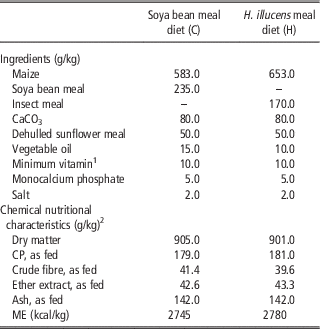
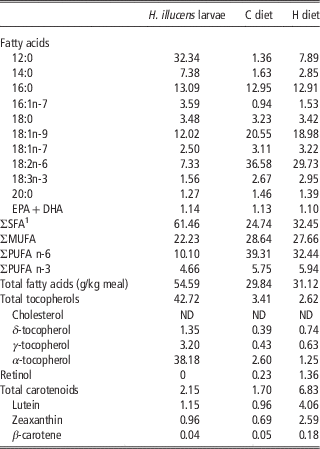
Lohmann Brown Classic laying hens were raised on a private farm in Southern Italy. A total of 108, 24-week-old hens (average live weight 1.78±0.15 kg) were divided into two groups (54 hens/group). Up to 45 weeks of age (along an experimental period of 21 weeks), the hens were housed in the same building in modified cages (800 cm2/hen), under controlled conditions of temperature and humidity. The hens of each group were distributed in three cages (18 hens/cage) and each cage was divided by two internal transects into three equal areas, to obtain nine replicates of six hens per group. The two groups were fed two isoproteic and isoenergetic diets, differing in the ingredients used as main protein source. The control diet (C) was based on soya bean meal and was administered to the control group (SBM); the experimental diet (H) was based on defatted meal made from H. illucens larvae (Hermetia Deutschland GmbH & Co, Baruth/Mark, Germany), which completely replaced soya bean meal, and was administered to the experimental group (HIM). The list of ingredients and the chemical nutritional characteristics of diets C and H are summarized in Table 1. Metabolizable energy of the diets was calculated according to NRC (1994) procedure of estimation and the values for the apparent metabolizable energy for the insect meal used in the present trial were obtained from the studies of De Marco et al. (Reference De Marco, Martínez, Hernandez, Madrid, Gai, Rotolo, Belforti, Bergero, Katz, Dabbou, Kovitvadhi, Zoccarato, Gasco and Schiavone2015) in broilers. Fatty acid (FA) composition and cholesterol, tocopherol and carotenoid content of C and H are reported in Table 2 together with the profile of H. illucens larvae, obtained by the methods described below. The diets, formulated to meet hen requirements according to the Lohmann Brown Classic Management Guide, and fresh water were administered each day ad libitum. The recorded feed intake was 125.13 and 108.04 g/day per hen for SBM and HIM, respectively (as reported by Marono et al., Reference Marono, Piccolo, Loponte, Di Meo, Attia, Nizza and Bovera2017). The dark-light cycle was 9 : 15 h. After 2 weeks of adaptation to the new diets (starting 26 weeks after onset of deposition), collection of eggs was begun.
Formulation (g/kg) and chemical nutritional characteristics (g/kg) of the diets used in the trial

ME=calculated metabolizable energy.
Soya bean meal based (control diet, C) and H. illucens-based meal (H).
1 Per kilogram of diet: vitamin A (retinyl acetate) 20 000 IU, vitamin E (dl-α-tocopheryl acetate) 80 mg, vitamin D3 (cholecalciferol) 6000 IU, vitamin B1 (thiamine monophosphate) 3 mg, vitamin B2 (riboflavin) 12 mg, vitamin B6 (pyridoxine hydrochloride) 8 mg, vitamin B12 (cyanocobalamin) 0.04 mg, vitamin K3 (menadione) 4.8 mg; vitamin H (d-biotin) 0.2 mg, vitamin PP (nicotinic acid) 48 mg, folic acid 2 mg, calcium pantothenate 20 mg, manganous oxide 200 mg, ferrous carbonate 80 mg, cupric sulphate pentahydrate 20 mg, zinc oxide 120 mg, basic carbonate monohydrate 0.4 mg, anhydrous calcium iodate 2 mg, sodium selenite 0.4 mg, choline chloride 800 mg, 4-6-phitase 1800 FYT, dl-methionine 2600 mg, canthaxanthin 8 mg.
2 As analysed.
Fatty acid composition (g/100 g total fatty acids), cholesterol (mg/kg meal), tocopherol and carotenoid content (mg/kg meal) of experimental diets with soya bean protein source (control diet, C) and H. illucens larva protein source (H), and profile of H. illucens larva meal

ND=Not detected; EPA=eicosapentaenoic acid; DHA=docosahexaenoic acid; SFA=saturated fatty acids; MUFA=monounsaturated fatty acids; PUFA=polyunsaturated fatty acids.
1 Σ included 13:0, 14:1n-5, 15:0, 16:1n-9, anteiso-17:0, 17:0, 16:3n-4, 17:1, 18:3n-6, 18:3n-4, 18:4n-3, 20:1n-11, 20:1n-9, 20:2n-6, 20:3n-6, 20:4n-6, 20:3n-3, 20:5n-3, 22:0 and 22:6n-3 which were detected but not reported because they were below 1 g/100 g total fatty acids.
Egg quality determination
A total of 87 eggs (44 for SBM group and 43 for HIM) were collected on eight different sampling days during the whole experimental period (21 weeks) and frozen until analyses. A 24 h defrosting time at 4°C was necessary in order to conduct physical and chemical analyses. In all, 42 eggs (21 for each experimental group) were randomly allotted for the evaluation of weight, and egg, yolk and albumen quality for morphological and chemical traits, whereas the other 45 eggs were utilized for other analyses, not considered here. Whole, shell, yolk and albumen weights were recorded. Yolk pH was measured at two points using a pH-meter (Columbus, OH, USA). Yolk colour measurement was performed with a Dr Lange Spectro-colour® colorimeter (Keison International Ltd., Chelmsford, Essex, UK) equipped with Spectral qc 3.6 software, according to the Commission Internationale de L’Eclairage (CIE) system (CIE, 2004) and expressed as lightness (L*), redness index (a*) and yellowness index (b*). Yolk diameter was measured manually with a calliper.
Samples of yolk and albumens were characterized chemically for moisture, CP (N×6.25) and ash content according to methods of the Association of Official Analytical Chemists (AOAC, 2012). Total lipid content of samples was determined according to Folch et al. (Reference Folch, Lees and Sloane Stanley1957), and FAs in lipid extract were trans-esterified to methyl esters by base-catalyzed trans-esterification (Christie, Reference Christie1982). Fatty acid composition was determined by gas chromatography using a Varian GC 430 gas chromatograph (Varian Inc., Palo Alto, CA, USA). Fatty acids were quantified via calibration curves, using tricosanoic acid (C23:0, 0.4 mg/ml) (Supelco, Bellefonte, PA, USA) as internal standard. Fatty acids were identified and then quantified via calibration curves, using tricosanoic acid (C23:0; 0.4 mg/ml) as internal standard.
Yolk cholesterol content was determined. Briefly, 0.2 ml of lipid extract was spiked with 0.5 ml 5α-cholestane (0.2 mg/ml prepared in chloroform) (Supelco) as internal standard. After solvent evaporation, 5 ml KOH (0.5 M in methanol) was added and left in a 95°C bath for 40 min to promote lipid saponification. Finally, 4 ml distilled water and 2 ml n-hexane were added. The upper phase was then transferred directly to a vial for GC analysis using the Varian GC 430 gas chromatograph (Varian Inc.), equipped with a flame ionization detector and a Supelco SACTM fused silica capillary column (30 m×0.25 mm i.d., 0.25-μm film; Supelco), purchased from Agilent Technologies (Santa Clara, CA, USA). A sample of 1 μl was injected with a 1 : 100 split ratio at 300°C. Oven temperature was programmed to rise from 130°C to 290°C in 8 min (20°C/min) then remain at 290°C for 11 min. The detector was set at 300°C. Helium was used as carrier gas at a constant flow of 1.3 ml/min.
The carotenoid and vitamin E content of feeds and yolks was determined in the lipid extracts, adjusting the methods previously described by Majchrzak et al. (Reference Majchrzak, Fabian and Elmadfa2006) and Prates et al. (Reference Prates, Quaresma, Bessa, Fontes and Alfaia2006). Lipid extracts were saponified by the method already described for cholesterol but without the warm bath. Indeed, saponification was achieved keeping the samples at room temperature overnight. Unsaponified matter was then resuspended in 200 μl chloroform/methanol (1 : 1) solution. Finally, 20 μl of each sample was quantified using a Prostar HPLC instrument (Varian Inc.) with UV-DAD and a C18 reverse phase column (ChromSep HPLC Columns SS 250 mm×4.6 mm with ChromSep guard column Omnispher 5 C18). The mobile phases were (A) methanol : acetonitrile : water (5 : 85 : 10) and (B) methanol : ethylacetate (70 : 30). Flow conditions were 90 : 10 of mobile phases A and B, respectively, at 1 ml/min for 18 min, followed by 50 : 50 (1 ml/min) for 2 min, followed by 0 : 100 at 1.5 ml/min for 10 min. Carotenoids (lutein, zeaxanthin and β-carotene) were detected at 450 nm, vitamin A (retinol) at 325 nm and tocopherols (α, γ and δ) at 292 nm. All molecules were quantified using an external calibration curve with concentrations ranging from 0.005 to 0.17 µg/ml, 0.02 to 0.5 µg/ml and 0.01 to 0.97 µg/ml for carotenoids, retinol and tocopherols, respectively. Results were expressed as mg/kg total lipids.
Statistical analysis
To test the effect of the diet, the data were analysed by one-way ANOVA by PROC GLM of SAS statistical software (SAS, 2004), with the following linear model:
 $$Y_{{iz}} \,{\equals}\,\mu {\plus}\alpha _{i} {\plus}e_{{iz}} $$
where Y iz is the dependent variable of the z th observation; µ the overall mean; α i the fixed effect of the i th diet (i=C, H) and e iz the random error. Each egg from the two experimental groups was considered a biological replicate.
Results
Chemical characterizations of H. illucens larva meal and of the two experimental diets (C and H) are reported in Table 2. Linoleic (18:2n-6, LA), oleic (18:1n-9) and palmitic (16:0) acids were the major FAs in both feeds, amounting to 70% and 62% of total FAs in C and H, respectively. The H diet was mostly distinguished by a higher content of lauric acid (12:0) than the control diet, which in turn was higher in 18:2n-6. The H diet was 8% higher in saturated fatty acids and 6% lower in polyunsaturated n-6 fraction (PUFA n-6) than the control diet, while PUFA n-3 was slightly higher in H than C. Cholesterol was not detected in H. illucens larva meal. Comparing vitamin and carotenoid content, H was lower in total tocopherols than the control diet, with half the amount of α-tocopherol, despite the high content of this vitamin in the insect meal.
Regarding retinol content, H. illucens meal did not contain vitamin A, while diet H had higher retinol than the control diet. Diet H was also four times richer in total carotenoids than diet C, especially lutein which was more than three times richer than in C.
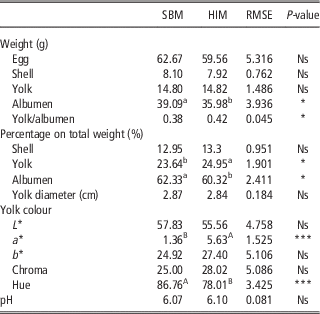
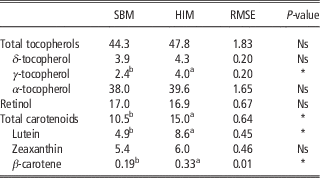
The effects of the diets on egg characteristics of Lohmann Brown Classic hens are shown in Table 3. Whole egg weights, shell weights and yolk diameter were not significantly affected by diet, whereas albumens from the HIM group were significantly lighter and the yolks from this same group of hens slightly heavier than those from the SBM group. The ratio yolk to albumen was 0.38 and 0.42 in SBM and HIM, respectively. The yolks of eggs from the HIM group were redder (P<0.01) than those of the control group. The chemical composition of yolks and albumens was unaffected by dietary treatments (Table 4). With regard to tocopherols and carotenoids, egg yolks of the HIM group were richer (P<0.05) in γ-tocopherol (+66.7%), lutein (+75.5%), β-carotene (+73.7%) and total carotenoids (+42.8%) than those of the control group (Table 5).
Morphological and physical characteristics and pH of eggs from hens fed soya bean meal diet (SBM) and H. illucens larva meal diet (HIM)

Values are given as average with RMSE (root mean square error).
Ns=not significant.
a,bValues with different superscripts in the same row differ significantly for P<0.05 (*).
A,BValues with different superscripts in the same row differ significantly for P<0.001 (***).
Proximate composition (g/kg) of eggs (yolk and albumen) from hens fed soya bean meal diet (SBM) and H. illucens larva meal diet (HIM)

Values are given as average and root mean square error (RMSE).
Tocopherol and carotenoid content (mg/kg yolk) of yolks from eggs of hens fed soya bean meal diet (SBM) and H. illucens larva meal diet (HIM)

Values are given as average and root mean square error (RSME).
a,bValues in the same row with different superscripts differ significantly for P<0.05 (*).
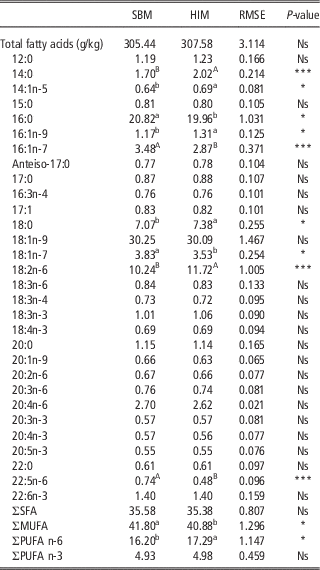
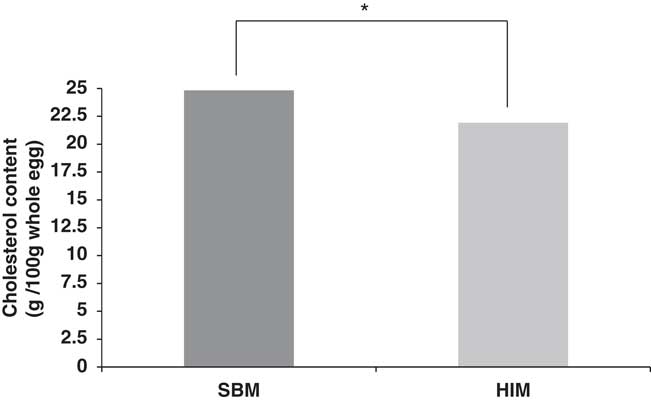
Fatty acid composition of SBM and HIM yolks is shown in Table 6. Globally, yolks of both groups were extremely rich in 18:1n-9, 16:0, 18:0 (stearic acid), 18:2n-6, 18:1n-7 and 16:1n-7 that accounted for around 73% of total FAs. Interestingly, diet significantly affected all FAs except oleic acid, the main constituent of the yolk lipid fraction. Significantly higher contents of LA (+14.4%) and 18:0 (+4.4%) were found in HIM than SBM yolks, whereas HIM yolks were poorer in 16:0 and 16:1n-7 than SBM yolks, with a reduction of 4.1% and 17.5%, respectively. The differences in 18:2n-6 and 16:1n-7 seemed to determine the significant difference in monounsaturated fatty acids and PUFA n-6 fractions found depleted of 2.2% and 6.7%, respectively, in HIM yolks compared with SBM ones. Regarding the products of desaturase/elongase enzyme activity involved in the conversion of LA, no differences in 18:3n-6 or 20:4n-6 contents were found between groups, but significantly less 22:5n-6 (−35.1%), that is the final product of this bioconversion, was recorded in HIM than SBM. At the same time, none of the elongation and desaturation products of 18:3n-3, such as 20:5n-3 (eicosapentaenoic acid) and C22:6n-3 (docosahexaenoic acid), was significantly affected, being stable below 2% of total FAs. Finally, cholesterol was about 11.7% lower in HIM yolks: we recorded 21.92 and 24.84 g/100 g of whole egg in HIM and SBM yolks, respectively, corresponding to 44.98 and 42.13 g/100 g of total lipids.
Fatty acid profiles (g/100 g total fatty acids) of yolks from eggs of hens fed soya bean meal diet (SBM) and H. illucens larva meal diet (HIM)

SFA=saturated fatty acids; MUFA=monounsaturated fatty acids; PUFA=polyunsaturated fatty acids.
Values are given as average and root mean square error (RMSE).
Fatty acids below 0.5 g/100 g total fatty acid are not reported in the table but were included in the Σ calculation.
Ns=not significant.
a,bValues with different superscripts in the same row differ significantly for P<0.05 (*).
A,BValues with different superscripts in the same row differ significantly for P<0.001 (***).
Discussion
Little information on the effects of insect meal, especially derived from black soldier flies, in the diets of laying hens are available in literature. Most of the experiments published focused on laying performance, weights of egg components and colour, but rarely on egg FA and chemical composition (Agunbiade et al., Reference Agunbiade, Adeyemi, Ashiru, Awojobi, Taiwo, Oke and Adekunmisi2007; Amao et al., Reference Amao, Oladunjoye, Togun, Olubajo and Oyaniyi2010; Makkar et al., Reference Makkar, Tran, Heuzé and Ankers2014; Al-Qazzaz et al., Reference Al-Qazzaz, Ismail, Akit and Idris2016). Many studies remark that meal made from larvae of H. illucens (Al-Qazzaz et al., Reference Al-Qazzaz, Ismail, Akit and Idris2016) and larvae of the moth Cirina forda (Amao et al., Reference Amao, Oladunjoye, Togun, Olubajo and Oyaniyi2010) can be a good source of protein at different substitution levels (up to 75% using the latter larvae) in the feed of laying hens, without any adverse effect on yolk weight. On the other hand, albumen weight is reported to be significantly reduced by 50% C. forda meal substitution, whereas only a slight decrease was obtained with total replacement (Amao et al., Reference Amao, Oladunjoye, Togun, Olubajo and Oyaniyi2010). The present results confirmed that albumen is the egg compartment most susceptible to the new protein sources.
The increase in yolk proportion in eggs from hens fed diet H is simply a consequence of the lower albumen proportion.
The effect of insect meal on yolk colour is unclear. Data from previous research indicated no effect (Agunbiade et al., Reference Agunbiade, Adeyemi, Ashiru, Awojobi, Taiwo, Oke and Adekunmisi2007; Amao et al., Reference Amao, Oladunjoye, Togun, Olubajo and Oyaniyi2010) or slight discoloration when 5% of H. illucens meal was added to the diet of an Arabian strain of hen; however, as different colour evaluation methods were used, the data cannot be directly compared. In both studies, the authors explained this pattern by the fact that insects are not plants, and therefore do not contain the carotene or xanthophyllous pigments needed for egg colour. However, the results summarized in Table 3 disagree with this finding, as yolks of eggs from the HIM group were significantly redder. Furthermore, our data found a clear explanation and confirmation in the total carotenoid content of insect meal and the diet containing insect meal. HIM yolks were found to be rich in β-carotene and lutein, pigments responsible for an orange–yellow colour. Both pigments, as well as retinol and zeaxanthin, are transferred intact to the egg against a concentration gradient, so they can build up to higher levels in the egg than their availability in the feed would predict, as reported by Moreno et al. (Reference Moreno, Díaz-Gómez, Nogareda, Angulo, Sandmann, Portero-Otin, Serrano, Twyman, Capell, Zhu and Christou2016). Considering the carotenoid composition of the two diets and the yolks, a discrepancy clearly emerged, especially for zeaxanthin which doubled in HIM eggs and increased sevenfold in SBM eggs. Egg yolks are known to contain predominantly lutein and are poor sources of pro-vitamin A molecules, such as β-carotene, presumably because they are utilized by the hen (Surai et al., Reference Surai, Speake and Sparks2001) or efficiently stored in the liver (Moreno et al., Reference Moreno, Díaz-Gómez, Nogareda, Angulo, Sandmann, Portero-Otin, Serrano, Twyman, Capell, Zhu and Christou2016). The carotenoid profiles reported in the present study confirm this pattern. Looking at the accumulation patterns, both lutein and zeaxanthin were transported against a concentration gradient in both groups, although HIM eggs seemed to accumulate them less than SBM eggs, suggesting that these carotenoids are assimilated less efficiently from H. illucens meal than from soya bean meal. Moreno et al. (Reference Moreno, Díaz-Gómez, Nogareda, Angulo, Sandmann, Portero-Otin, Serrano, Twyman, Capell, Zhu and Christou2016) demonstrated that different mechanisms and contexts (e.g. competition, matrix effects and bioavailability) affect transfer and absorption of carotenoids, and the presence of α-tocopherol in feed is one of such factor, as reported by Islam et al. (Reference Johnson2016). Soya bean meal contains twice as much α-tocopherol as the insect meal, which could be the reason for higher accumulation in SBM than in HIM eggs since, according to Islam et al. (Reference Johnson2016), dietary α-tocopherol enhances the bioavailability of lutein. Nevertheless, in the context of human health, eggs from birds fed with H. illucens meal prove to be a better source of carotenoids, especially lutein, which play a role in the prevention of cataract and age-related macular degeneration, as well as heart disease and stroke (Ribaya-Mercado and Blumberg, Reference Ribaya-Mercado and Blumberg2004), while improving cognitive function in the elderly (Johnson, 2012).
The egg composition results obtained are relatively consistent with those of Shin et al. (Reference Shin, Xun, Nakamura and He2013) in terms of total protein and total lipid contents, both being unaffected by the diet, so a total replacement of soya bean with H. illucens meal may be feasible. To confirm this assertion, a closer look at composition was considered necessary, so the FA composition of the meals and yolks was analysed. St-Hilaire et al. (Reference St-Hilaire, Cranfill, McGuire, Mosley, Tomberlin, Newton, Sealey, Sheppard and Irving2007) and Oonincx et al. (Reference Oonincx, van Broekhoven, van Huis and van Loon2015) reported that the lipid content of insects depends largely on their diet and stage of development. Regardless the insect growing substrates, 12:0, 16:0 and 18:1n-9 FAs are reported to be the most abundant in black soldier flies (St-Hilaire et al., Reference St-Hilaire, Cranfill, McGuire, Mosley, Tomberlin, Newton, Sealey, Sheppard and Irving2007; Oonincx et al., Reference Oonincx, van Broekhoven, van Huis and van Loon2015) and the present results are in line with these findings. The FA composition of the two experimental diets was influenced by their specific ingredients. In particular, soya bean was responsible for the high linoleic acid content of diet C, whereas a higher quantity of maize in diet H may explain the difference between the FA composition of H. illucens larvae and feed containing it.
Modifications in the FA composition of egg yolks can be obtained by feeding laying hens diets with different levels and types of lipid sources, as indicated by Grobas et al. (Reference Grobas, Méndez, Lázaro, de Blas and Mateos2001) and Pál et al. (Reference Pál, Dublecz, Husvéeth, Wágner, Bartos and Kovács2002). However, not all the differences in yolk FA profile can be attributed to dietary components and the present results are in line with this concept. First of all, 12:0 drastically decreased in HIM yolks, despite the fact that it was abundant in H meal and the diet containing it. In turn, yolk 16:0 and 18:0 almost doubled compared with dietary content, irrespective of the diet used. It is also known that laying hens have remarkable desaturase and elongase activities that transform 18:2n-6 and 18:3n-3 into their specific derivatives. According to Grobas et al. (Reference Grobas, Méndez, Lázaro, de Blas and Mateos2001), most of the increase in n-6 FAs, especially 20:4n-6 and 22:5n-6, as well as increases in 20:5n-3, 22:5n-3 and 22:6n-3, may be due to small increases in the dietary concentration of 18:2n-6 and 18:3n-3, respectively, which enhance enzyme activities. Hence, considering the lower 18:2n-6 content in diet H, the higher values of the same FA found in HIM with respect to SBM eggs and the significantly lower values of its corresponding FAs, 20:3n-6 and 22:5n-6, it seems possible to speculate that the enzyme activity of the HIM group was slightly lower. Again, as found for carotenoids, the overall FA composition of HIM yolks was broadly similar to that of the control group. Finally, it is currently accepted that yolk cholesterol level is largely regulated by endogenous origin and not by cholesterol absorption of dietary origin. In the present study, despite the absence of cholesterol in the two experimental meals, cholesterol was found in eggs from both experimental groups (Figure 1) in a concentration in line with the value (15 g/kg of yolk) proposed by Han et al. (Reference Han, Sung, Yoon, Lee and Kim1993), thus confirming that cholesterol level in yolks is primarily derived from a balance between biosynthesis and excretion of cholesterol and cholesterol by-products (Sutton et al., Reference Sutton, Muir and Mitchell1984). Interestingly, HIM eggs showed cholesterol depletion in line with the reduction in serum levels of cholesterol in laying hens fed H. illucens as exclusive protein source in the trial conducted by Marono et al. (Reference Marono, Piccolo, Loponte, Di Meo, Attia, Nizza and Bovera2015). In this recent study, hens fed an insect-meal-based diet showed lower serum concentrations of cholesterol, namely 108 mg/dl against 134 mg/dl found in hens fed a soya bean-based diet. This reduction in serum cholesterol seemed to depend on the ability of chitin, a natural constituent of insect exoskeleton, to attract negatively charged bile acids and free FAs (Prajapati and Patel, Reference Prajapati and Patel2010). Notably, the cholesterol reduction in yolk was much less (−11.7%) than that occurring in serum (−20%), thus confirming the importance of a basal level of cholesterol required for egg formation and embryo development. Nevertheless, this reduction could be useful for human nutrition, especially for hypercholesterolemic subjects who need to reduce their dietary cholesterol intake (Shin et al., Reference Shin, Xun, Nakamura and He2013).
Cholesterol content (g/100 g whole egg) of eggs of hens fed soya bean meal (SBM) and Hermetia illucens larva meal (HIM). Root mean square error: 1.73, *P<0.05.

In conclusion, H. illucens larva meal seems suitable for total substitution of soya bean meal in diets of Lohmann Brown Classic laying hens. Indeed, yolk composition was not negatively affected by the new protein source and all the analytical parameters analysed showed similar or better performance than in eggs from laying hens fed a diet based on soya bean meal as protein source. Yolks from hens fed H. illucens-based meal did not differ in overall FA composition, whereas they showed higher carotenoid content and an interesting reduction in cholesterol. In any case, some metabolic ways, such as the accumulation of carotenoid and the desaturase/elongase activities, seemed to be slightly inhibited by dietary inclusion of insect meal, hence the specific role of this protein source on these metabolic patterns of laying hens needs to be further investigated.
Acknowledgement
This research did not receive any specific grant from funding agencies in the public, commercial, or not-for-profit sectors. Authors acknowledge all the technicians of DISPAA-Section of Animal Science of the University of Firenze who supported the present work with their technical assistance.