






1 Introduction
In this article, we carry out a study on the following fourth-order p-Laplace hyperbolic problem having Kirchhoff-type weak damping and logarithmic source:
 $$ \begin{align} \left\{\begin{array}{@{}lll} u_{tt}-{\operatorname*{div}}(|\nabla u|^{p-2}\nabla u)+\sigma (\|\nabla u\|_{2}^{2} )u_t+\Delta^{2}u &\\ \quad =|u|^{q-2}u\log|u|,&(x,t)\in \Omega\times(0,T_{\mathrm{max}}),\\ u=0,\quad\frac{\partial u}{\partial \eta}=0,&(x,t)\in\partial\Omega\times(0,T_{\max}),\\ u(x,0):=u_{0}(x)\in H_{0}^{2}(\Omega)\cap W_{0}^{1,p}(\Omega),\quad u_{t}(x,0) & \\ \quad :=u_{1}(x)\in L^{2}(\Omega),&x\in\Omega, \end{array}\right. \end{align} $$
where
 $\Omega \subset \mathbb {R}^{n}$
is an open bounded domain with smooth boundary
 $\partial \Omega $
;
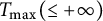 $T_{\max }(\le +\infty )$
denotes the maximal existence time of (1.1); and
 $p,q>2$
are constants. The Kirchhoff coefficient
 $\sigma (\|\nabla u\|_{2}^{2} ):=a+b\|\nabla u\|_{2}^{2}$
, where
 $\|\cdot \|_{s}:=(\int _\Omega |\cdot |^{s}\mathrm {d}x)^{\frac {1}{s}}$
denotes the
 $L^{s}(\Omega )$
norm for
 $1\leq s\leq \infty $
, and
 $a,b$
are positive constants. High-order hyperbolic equations find extensive application in numerous fields, for instance, physics, ecology, architecture, fluid mechanics, and so on. During the motion process, the phenomenon where the energy of the system gradually dissipates as a result of the interaction between the system itself and the external environment is termed damping. Generally, damping can be classified into strong damping, weak damping, and the structural damping falling between the two. For the Kirchhoff damping
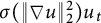 $\sigma (\| \nabla u \| _{2}^{2} )u_t$
, it has been firstly proposed in [Reference Lange and Perla Menzala12] by Lange and Menzala in the elastic beam equation
 $$ \begin{align*}u_{tt}+\Delta^2u+\sigma(\|\nabla u\|_{2}^{2})u_t=0,\quad(x,t)\in \mathbb{R}^{n}\times(0,T_{\mathrm{max}}).\end{align*} $$
This type of damping mimics the u-dependent mean friction mechanism that operates on an object. After that, Cavalcanti et al. added the memory term
 $-({g*\Delta u})(t)$
to the above equation in [Reference Cavalcanti, Domingos Cavalcanti and Ma4]. The global existence and energy decay estimate of the solutions were obtained for any unbounded set and bounded set through the Galerkin estimate and multiplier method. In the Kirchhoff damping where
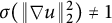 $\sigma (\|{\nabla u}\|_2^2) \ne 1$
, the majority of the literature is centered around the long-time dynamic behavior of the solutions to quasilinear wave equations and fourth-order wave equations (see, e.g., [Reference da Silva9]).
The impact of the logarithmic source on the characteristics of solutions for the semilinear wave equations has garnered extensive attention. Yang and Fang in [Reference Yang and Fang19] studied the Dirichlet initial-boundary value problem for a class of semilinear wave equations
 $$ \begin{align*}{u_{tt}}-\Delta u+\sigma({\|{\nabla u}\|_2^2}){|u_t|^{\gamma-2}}{u_t} = {|u|^{p-2}}u\log|u|,\quad(x,t)\in\Omega\times(0,T_{\max}).\end{align*} $$
They achieved the well-posedness of weak solutions. The global solution of the equation was acquired for
 $p<\gamma $
, and the finite time blow-up solution was obtained for
 $p>\gamma $
. They also investigated a semilinear wave equation featuring Kirchhoff damping and a logarithmic source (see [Reference Yang and Fang20])
 $$ \begin{align*}u_{tt}-\Delta u+\sigma(\|\nabla u\|_{2}^{2})u_t=|u|^{q-2}u\mathrm{log}|u|,\quad q>2,\ (x,t)\in\Omega\times(0,T_{\max}).\end{align*} $$
By enhancing the Faedo–Galerkin method in conjunction with the potential well theory, they established the local existence and global existence of solutions, along with decay estimates of the energy. Simultaneously, relying on the contradiction argument, they demonstrated that there are blow-up solutions for negative initial energy. When the source term is superlinear, Zhang and Li in [Reference Zhang, Li, Zhang and Hu21] studied the asymptotic stability and blow-up of the wave equation
 $$ \begin{align*}{u_{tt}}-\Delta u+\sigma({\|{\nabla u}\|_2^2}){|{u_t}|^{m-2}}{u_t}={|u|^{p - 2}}u,\quad(x,t)\in\Omega\times(0,T_{\max}),\end{align*} $$
where
 $\sigma ({\|{\nabla u}\|_2^2}):=\|{\nabla u}\|_2^{2l}$
. They discovered that when the initial energy is small, the asymptotic stability of energy is achieved for polynomial degenerate damping. Moreover, they provided some sufficient conditions for the solution to blow-up in finite time when
 $p>m+lp$
by employing the potential well theory. For other relevant equations, the interested readers can refer to [Reference Cavalcanti, Domingos Cavalcanti and Jorge Silva3, Reference Chueshov8, Reference Lian and Xu13, Reference Lv, Yuan and Lin15, Reference Narciso17].
Ma and Fang in [Reference Ma and Fang16] studied the Dirichlet initial-boundary value problem for semilinear equation
 $$ \begin{align*}{u_{tt}}-\Delta u-\Delta{u_t}=u\log{| u |^2},\quad(x,t)\in\Omega\times(0,T_{\max}).\end{align*} $$
By employing the potential well theory and the logarithmic Sobolev inequality, the global solvability, energy decay, and infinite blow-up were obtained. For other relevant research about potential well method or equations involving logarithmic sources, the interested readers can refer to [Reference AI-Gharabli and Messaoudi1, Reference AI-Gharabli and Messaoudi2, Reference Cazenave and Haraux5–Reference Chen and Tian7, Reference Di, Shang and Song10, Reference Ibrahim and Lyaghfouri11, Reference Lian and Xu13, Reference Yan and Sun18, Reference Zhang, Liu and Hu22, Reference Zhang, Liu and Hu23].
It can be verified through the above references that the logarithmic sources not only can influence the stability of the solutions of the constant coefficient wave equations but also have an effect on the singularity of the solutions. The interaction among different dampings and the viscoelastic terms has a profound impact on the property of the weak solutions. To the best of our knowledge, the quasilinear hyperbolic equation (1.1) with Kirchhoff nonlocal damping has seldom been taken into consideration previously. Inspired by the works [Reference Ma and Fang16, Reference Yang and Fang19–Reference Zhang, Li, Zhang and Hu21], we aim to investigate the global existence, decay estimate, and blow-up of weak solutions to (1.1). The p-Laplacian can contribute to the existence of global solutions, whereas the logarithmic source can result in the blow-up of solutions, which can be reflected in the relationship between p and q. When addressing these issues, the Kirchhoff nonlocal damping term, p-Laplacian, and logarithmic source pose significant challenges in applying the potential well method. In the proof of the well-posedness of weak solutions, the Kirchhoff damping term requires stronger regularity of the approximation solutions in the Galerkin procedure. When the initial energy is less than or equal to the depth of the potential well and Nehari’s initial energy is nonnegative, the traditional Aubin–Lions lemma is ineffective in the approximation. Hence, it is necessary to modify the Faedo–Galerkin approximation technique, utilize the density theory and the compactness theory to obtain the existence of global weak solutions and their energy decay estimates. The traditional convexity method is also unsuccessful in handling the blow-up of solutions even if the initial energy is negative, and the difficulty stems from the introduced Kirchhoff damping. Consequently, it is necessary to construct new auxiliary functions and prove the differential inequalities to demonstrate the existence of the blow-up solution. The logarithmic source renders some embedding inequalities inapplicable in certain exponential regions. For example, the Sobolev space
 $W_{0}^{1,p}(\Omega )$
cannot be embedded into
 $L^{q+\mu }(\Omega )$
directly when
 $q+\mu <p$
. Therefore, it is necessary to add other conditions so that
 $W_{0}^{1,p}(\Omega )\hookrightarrow L^{p+\mu }(\Omega )\subset L^{q+\mu }(\Omega )$
.
In the next section, we provide the definition of the weak solution and some crucial lemmas. In Section 3, we prove the well-posedness of the weak solution of (1.1). Section 4 is concerned with the global solvability, decay estimates, and blow-up of the solutions to (1.1) when
 $q>p$
. Section 5 investigates the global existence and decay estimate of the solutions to (1.1) when
 $q=p$
. Then, in Section 6, we prove that the weak solution of (1.1) is globally bounded when
 $q<p$
.
2 Preliminary lemmas
Firstly, we introduce some notations. The norms in
 $H^{2}_{0}(\Omega )$
and
 $W_{0}^{1,p}(\Omega )$
are defined by
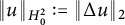 $\|u\|_{H^{2}_{0}}:=\|\Delta u\|_{2}$
and
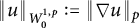 $\|u\|_{W_{0}^{1,p}}:=\|\nabla u\|_{p}$
, respectively. The inner product in
 $L^{2}(\Omega )$
is denoted by
 $(f,g):=\int _{\Omega } f(x)g(x)\mathrm {d}x$
. We define
 $H:=(H_{0}^{2}(\Omega )\cap W_{0}^{1,p}(\Omega ))\times L^2(\Omega )$
. We have inequalities
 ${\lambda _{1}}\|u\|_{2}^{2}\leq \|\Delta u\|_{2}^{2}$
and
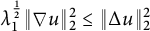 $\lambda _{1}^{\frac {1}{2}}\|\nabla u\|_{2}^{2}\leq \|\Delta u\|_{2}^{2}$
, where
 $\lambda _{1}$
denotes the first eigenvalue of the operator
 $\Delta ^2$
subject to null Dirichlet condition. For any
 $u\in H_{0}^{2}(\Omega )\cap W_{0}^{1,p}(\Omega )$
, we define
 $$ \begin{align*} \text{the potential well functional } J(u)&:=\frac{1}{2}\|\Delta u\|_{2}^{2}+\frac{1}{p}\|\nabla u\|_{p}^{p} \\ &\quad -\frac{1}{q} \int_{\Omega}|u|^q\log |u|\mathrm{ d}x +\frac{1}{q^2}\|u\|_{q}^{q},\\ \text{the Nehari functional }I(u)&:=\|\Delta u\|_{2}^{2}+\|\nabla u\|_{p}^{p}-\int _{\Omega}|u|^q\log|u|\mathrm{d}x,\\ \text{the energy functional }E(t)&:=E(u(t),u_{t}(t))=\frac{1}{2}\|u_{t}\|_{2}^{2}+J(u). \end{align*} $$
The initial energy is
 $E(0)=\frac {1}{2}\|u_{1}\|_{2}^{2}+J(u_{0})$
. Because
 $ E'(t)=-\sigma (\|\nabla u\|_{2}^{2})\|u_t\|_{2}^{2}\le 0$
,
 $E(t)$
is decreasing with respect to t. By the definitions of
 $J(u), I(u),$
and
 $E(t)$
, we get
 $$ \begin{align*} E(t)=\frac{1}{2}\|u_{t}\|_{2}^{2}+J(u)=\frac{1}{2}\|u_{t}\|_{2}^{2}+\frac{q-2}{2q}\|\Delta u\|_{2}^{2}+\frac{q-p}{pq}\|\nabla u\|_{p}^{p}+\frac{1}{q^2}\|u\|_{q}^{q} +\frac{1}{q}I(u). \end{align*} $$
Next, we define the potential well
 $\mathcal {W}:=\mathcal {W}_1\cup \mathcal {W}_2$
, where
 $$ \begin{align*} \mathcal{W}_1&:=\left\{(u,u_t)\in (H_{0}^{2}(\Omega)\cap W_{0}^{1,p}(\Omega))\setminus\{0\}\times L^2(\Omega)\setminus\{0\}|I(u)>0,E(t)< d\right\},\\ \mathcal{W}_2 &:=\left\{(u,u_t)\in (H_{0}^{2}(\Omega)\cap W_{0}^{1,p}(\Omega))\setminus\{0\}\times L^2(\Omega)\setminus\{0\}|I(u)>0,E(t)= d\right\}, \end{align*} $$
and the outside of potential well
 $\mathcal {V}_0:=\left \{(u,u_t)\in H|I(u)<0,\|\Delta u\|_{2}^{2}\neq 0,\|u_t\|_{2}^{2}\neq 0 \right \}$
, and the Nehari manifold
 $\mathcal {N} :=\left \{u\in H_{0}^{2}(\Omega )\cap W_{0}^{1,p}(\Omega )|I(u)=0,\|\Delta u\|_{2}^{2}\neq 0\right \}$
. The potential well depth is defined by
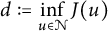 $d:= \mathop {\inf }\limits _{u\in \mathcal {N}}J(u)$
. Define two specific constants
 $$ \begin{align} r(\alpha):=\left ( {\mathrm{e}\alpha}{B_{\alpha}^{-q-\alpha}}\right ) ^{\frac{1}{q+\alpha-2}},\quad M:=\frac{q-2}{2q}\left( {\mathrm{e}\alpha}{B_{\alpha}^{-q-\alpha}}\right ) ^{\frac{2}{q+\alpha-2}}, \end{align} $$
where
 $\alpha $
is a positive constant and
 $B_{\alpha }$
is the embedding constant of
 $H_{0}^{2}(\Omega )\hookrightarrow L^{q+\alpha }(\Omega )$
.
There are the embedding results, which will play an important role in the proof of the main results:
 $$ \begin{align*}H_{0}^{2} (\Omega) \hookrightarrow L^{q+\alpha} (\Omega),\quad H_{0}^{2}(\Omega)\hookrightarrow L^{2(q+\alpha-1)}(\Omega),\quad H_{0}^{2}(\Omega) \hookrightarrow L^{2(q+\alpha-2)\frac{q-1}{q-2} } (\Omega),\end{align*} $$
provided
 $$\begin{align}\left\{\begin{array}{@{}llll} 2<q<\displaystyle\frac{2n-4}{n-4},\ 0<\alpha<\left(\displaystyle\frac{2n-4}{n-4}-q\right)\displaystyle\frac{q-2}{q-1},&\text{for}\ n>4,\\ 2<q<+\infty, \ 0<\alpha<+\infty, &\text{for}\ n\le 4. \end{array}\right.\end{align} $$
Secondly, we give the definition of the weak solution for (1.1), which will be proved in Theorem 3.1 of the present article.
Definition 2.1 A function
 $u(x,t)$
is called a weak solution of problem (1.1) for
 $(x,t)\in \Omega \times [0,T] (0<T<+\infty )$
in the sense of
 $u\in C([0,T];H_{0}^{2}(\Omega )\cap W_{0}^{1,p}(\Omega ))$
,
 $u_{t}\in L^{\infty }([0,T];H_{0}^{1}(\Omega )\cap L^2(\Omega ))$
, such that
 $u(x,0)=u_{0}(x)$
,
 $u_{t}(x,0)=u_{1}(x)$
for
 ${x\in \Omega }$
, and
 $$ \begin{align} \int_{\Omega}u_t\phi\mathrm{d}x&+\int_0^t\int_\Omega(\Delta u\Delta\phi+|\nabla u|^{p-2}\nabla u\cdot \nabla\phi)\mathrm{d}x\mathrm{d}s\nonumber\\ &+\int_0^t\sigma(\|\nabla u\|_{2}^{2})\int_\Omega u_s\phi\mathrm{d}x\mathrm{d}s=\int_0^t\int_\Omega|u|^{q-2}u\phi\log|u|\mathrm{d}x\mathrm{ d}s+\int_{\Omega}u_1\phi\mathrm{d}x \end{align} $$
for any test function
 $\phi \in H_{0}^{2}(\Omega )\cap W_{0}^{1,p}(\Omega )$
and a.e.
 $t\in [0,T]$
.
Thirdly, we present several lemmas, which will be utilized in the proof of the main results.
Lemma 2.1 Let
 $u \in H_{0}^{2}(\Omega )\cap W_{0}^{1,p}(\Omega )$
,
 $\|\Delta u\|_{2}^{2}\neq 0$
,
 $q\ge p$
. There exists a unique
 ${\lambda _{*}>0}$
such that
 $$ \begin{align} I(\lambda u)>0 \text{ for }0<\lambda<\lambda_{*};\quad I(\lambda u)=0 \text{ for }\lambda=\lambda_{*};\quad I(\lambda u)<0 \text{ for }\lambda>\lambda_{*}. \end{align} $$
Proof By the definition of
 $I(u)$
, we have
 $$ \begin{align*} I(\lambda u)=\lambda^{q}\left(\lambda^{2-q}\|\Delta u\|_{2}^{2}+\lambda^{p-q}\|\nabla u\|_{p}^{p}-\int_{\Omega}|u|^{q}\log|\lambda u|\mathrm{d}x\right). \end{align*} $$
Let
 $K(\lambda ):=\lambda ^{2-q}\|\Delta u\|_{2}^{2}+\lambda ^{p-q}\|\nabla u\|_{p}^{p}-\int _{\Omega }|u|^{q}\log |\lambda u|\mathrm {d}x \nonumber $
. It is easy to get that
 $\lim _{\lambda \rightarrow 0^{+}}K(\lambda )=+\infty $
,
 $\lim _{\lambda \rightarrow +\infty } K(\lambda )=-\infty $
, and
 $K(\lambda )$
is strictly decreasing with respect to
 $\lambda $
in
 $(0,+\infty )$
. Therefore, there exists a unique
 $\lambda _{*} \in (0,+\infty )$
such that
 $K(\lambda _{*} u)=0$
;
 $K(\lambda u)>0$
for
 $0<\lambda <\lambda _{*}$
; and
 $K(\lambda u)<0$
for
 $\lambda>\lambda _{*}$
. From
 $I(\lambda u)=\lambda ^{q}K(\lambda )$
, we get (2.3).
From definitions of
 $J(u)$
and
 $I(u)$
, we have
 $I(\lambda u)=\lambda \frac {\mathrm {d}}{\mathrm {d}\lambda }J(\lambda u)$
. Then
 $J(\lambda u)$
is strictly increasing in
 $(0,\lambda _{*})$
and strictly decreasing in
 $(\lambda _{*},+\infty )$
, respectively. It takes its maximum at
 $\lambda =\lambda _{*}$
.
Here is the logarithmic inequality:
 $$ \begin{align} s^q{\log}s\le\frac{1}{\mathrm{e}\alpha}s^{q+\alpha},\ \text{for any }s>0,\ \alpha >0. \end{align} $$
Lemma 2.2 Let
 $u\in H_{0}^{2}(\Omega )\cap W_{0}^{1,p}(\Omega )$
and
 $\|\Delta u\|_{2}\neq 0$
. For any
 $\alpha $
defined in (2.1) satisfying
 $(\mathcal {H})$
, we have the results: (i) if
 $0<\|\Delta u\|_{2}\le r(\alpha )$
, then
 $I(u)\ge 0$
and (ii) if
 $I(u)<0$
, then
 $\|\Delta u\|_2>r(\alpha )$
.
Proof Using (2.4) and the embedding
 $H_{0}^{2}(\Omega )\hookrightarrow L^{q+\alpha }(\Omega )$
, we get
 $$ \begin{align} I(u)&\ge\|\Delta u\|_{2}^{2}-\int_{\Omega}|u|^{q}\log|u|\mathrm{d}x\ge\|\Delta u\|_{2}^{2}-\frac{1}{\mathrm{e}\alpha} \|u\|_{q+\alpha}^{q+\alpha}\nonumber\\ &\ge\|\Delta u\|_{2}^{2}\left(1-\frac{1}{\mathrm{e}\alpha}B_{\alpha}^{q+\alpha}\|\Delta u\|_{2}^{q+\alpha-2}\right). \end{align} $$
Consequently, if
 $0<\|\Delta u\|_{2}\le r(\alpha )$
, then
 $I(u)\ge 0$
. Moreover, if
 $I(u)<0$
, it is evident that
 $\|\Delta u\|_2>r(\alpha )$
.
Lemma 2.3 Let
 $(\mathcal {H})$
hold and
 $q\ge p$
. The potential well depth
 $d> M$
, where M is defined in (2.1).
Proof It follows from Lemma 2.2 and definitions of
 $I(u)$
and
 $J(u)$
that
 $$ \begin{align} J(\lambda_{*}u)=\frac{(q-2)\lambda_{*}^{2}}{2q}\|\Delta u\|_{2}^{2}+\frac{(q-p)\lambda_{\ast}^{p}}{pq}\|\nabla u\|_{p}^{p}+\frac{\lambda_{*}^{q}}{q^2}\|u\|_{q}^{q}. \end{align} $$
Just like the proof for Lemma 2.2, we get
 $$ \begin{align*}0=I(\lambda_{*}u)\ge\lambda_{*}^2\|\Delta u\|_{2}^{2}\left(1-\lambda_{*}^{q+\alpha-2}\frac{1}{\mathrm{e}\alpha}B_{\alpha}^{q+\alpha}\|\Delta u\|_{2}^{q+\alpha-2}\right).\end{align*} $$
It follows from (2.5) that
 $\left ( {\mathrm {e}\alpha }{B_{\alpha }^{-q-\alpha }}\right )^{\frac {1}{q+\alpha -2}}\le \lambda _{*}\|\Delta u\|_{2}$
. Hence, we get
 $J(\lambda _*u)>\frac {q-2}{2q}\left ({\mathrm {e}\alpha }{B_{\alpha }^{-q-\alpha }}\right )^{\frac {2}{q+\alpha -2} }$
. Therefore, by the definitions of M and d, we have
 $d>M$
.
Lemma 2.4 For any
 $u\in H_{0}^{2}(\Omega )\cap W_{0}^{1,p}(\Omega )$
, if
 $\int _{\Omega }|u|^q\log |u|\mathrm {d}x\ge 0$
and there exists a constant
 $D>0$
such that
 $\|\Delta u\|_{2}\le D$
, then
 $$ \begin{align*}\|u\|_{2}^{2}\le K_1\left [ \left ( \int_{\Omega}|u|^q\log|u|\mathrm{d}x \right )^{\frac{2}{q}}+\|\Delta u\|_{2}^{\frac{4}{q}} \right ],\quad \text{where } K_1:=\lambda_1^{-1}D^{2-\frac{4}{q}}.\end{align*} $$
Proof Using the embedding inequality
 $\lambda _1\|u\|_{2}^{2}\le \|\Delta u\|_{2}^{2}$
, we have
 $$ \begin{align*} \|u\|_{2}^{2}&\le\lambda_1^{-1}\|\Delta u\|_{2}^{2}\le\lambda_1^{-1}D^{2-\frac{4}{q}}\|\Delta u\|_{2}^{\frac{4}{q}}\le K_1\left [ \left ( \int_{\Omega}|u|^q\log|u|\mathrm{d}x \right )^{\frac{2}{q}}+\|\Delta u\|_{2}^{\frac{4}{q}} \right ]. \end{align*} $$
Lemma 2.5 Let
 $(\mathcal {H})$
hold. For any
 $u\in H_{0}^{2}(\Omega )\cap W_{0}^{1,p}(\Omega )$
and
 $2\le s\le q$
, if
 $\int _{\Omega }|u|^q\log |u|\mathrm {d}x\ge 0 $
, then
 $$ \begin{align}\left(\int_{\Omega}|u|^q\log|u|{\mathrm{d}}x\right)^{\frac{s}{q}}\le K_2\left( \int_{\Omega}|u|^q\log|u|{\mathrm{d}}x+\|\Delta u\|_{2}^{2} \right), \end{align} $$
where
 $K_2:=\max \left \{1,B_{\alpha }^2(\mathrm {e}\alpha )^{-\frac {2}{q+\alpha }}\right \}$
and
 $B_\alpha $
is defined in (2.1).
Proof If
 $\int _{\Omega }|u|^q\log |u|\mathrm {d}x\ge 1$
, then
 $$ \begin{align*}\left(\int_{\Omega}|u|^q\log|u|\mathrm{d}x\right)^{\frac{s}{q}}\le\int_{\Omega}|u|^{q}\log|u|{\mathrm{d}}x\le\int_{\Omega}|u|^q\log|u|{\mathrm{d}}x+\|\Delta u\|_{2}^{2}.\end{align*} $$
If
 $\int _{\Omega }|u|^q\log |u|\mathrm {d}x < 1$
, then we denote
 $\Omega _1:=\left \{ x\in \Omega ||u|>1\right \}$
and, for any
 $\beta \in (0,2)$
,
 $$ \begin{align*} \left(\int_{\Omega}|u|^q\log|u|\mathrm{d}x\right)^{\frac{s}{q}} &\le \left( \int_{\Omega_1}|u|^q\log|u|\mathrm{d}x\right)^{\frac{\beta}{q}} \\ &\le \left(\frac{1}{\mathrm{e}\alpha}\int_{\Omega}|u|^{q+\alpha}\mathrm{d}x\right)^{\frac{\beta}{q}}\\& =(\mathrm{e}\alpha)^{-\frac{\beta}{q}}\|u\|_{q+\alpha}^{\frac{(q+\alpha)\beta}{q}}. \end{align*} $$
Choosing
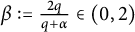 $\beta :=\frac {2q}{q+\alpha }\in (0,2)$
and using the embedding
 $H_{0}^{2}(\Omega )\hookrightarrow L^{q+\alpha }(\Omega )$
, we get
 $$ \begin{align*}\left(\int_{\Omega}|u|^q\log|u|dx\right)^{\frac{s}{q}}&\le(\mathrm{e}\alpha)^{-\frac{2}{q+\alpha}}\|u\|_{q+\alpha}^{2}\le B_{\alpha}^2(\mathrm{ e}\alpha)^{-\frac{2}{q+\alpha}}\|\Delta u\|_{2}^{2}\\&\le\int_{\Omega}|u|^q\log|u|\mathrm{d}x+B_{\alpha}^2(\mathrm{e}\alpha)^{-\frac{2}{q+\alpha}}\|\Delta u\|_{2}^{2}.\end{align*} $$
Summarizing the above two cases, we get (2.7).
3 Well-posedness of weak solution
In this section, our focus is on the well-posedness of the solution as defined in Definition 2.1.
Theorem 3.1 Let initial data
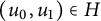 $\left ( u_0,u_1 \right ) \in H $
and
 $(\mathcal {H})$
hold. There exists a positive time
 $T_0$
such that problem (1.1) admits a unique weak solution
 $u(x,t)$
in
 $\Omega \times [0,T_0]$
in the sense of
 $u \in C([0,T_0];H_{0}^{2}(\Omega )\cap W_{0}^{1,p}(\Omega ))$
,
 $u_{t}\in L^{\infty }([0,T_0];H_{0}^{1}(\Omega ))\cap L^2(\Omega )$
,
 $u(x,0)=u_{0}(x)$
,
 $u_{t}(x,0)=u_{1}(x)$
in
 $\Omega $
, and for any test function
 $\phi \in H_{0}^{2}(\Omega )\cap W_{0}^{1,p}(\Omega )$
and a.e.
 $t\in [0,T_0]$
,
 $$ \begin{align*} \int_{\Omega}u_t\phi\mathrm{d}x&+\int_0^t\int_\Omega(\Delta u\Delta\phi+|\nabla u|^{p-2}\nabla u\cdot \nabla\phi)\mathrm{d}x\mathrm{d}s\\ &+\int_0^t\sigma(\|\nabla u\|_{2}^{2})\int_\Omega u_s\phi\mathrm{d}x\mathrm{d}s=\int_0^t\int_\Omega|u|^{q-2}u\phi\log|u|\mathrm{d}x\mathrm{ d}s+\int_{\Omega}u_1\phi\mathrm{d}x. \end{align*} $$
The following cases only have one that holds:
(i)
 $T_{\max }=+\infty $
, which means the weak solution is globally existent.
(ii)
 $T_{\max }<+\infty $
, which indicates the weak solution undergoes blow-up in a finite time in this regard
 $$ \begin{align*}\lim\limits_{t\rightarrow T_{\max}^{-}}\left(\|u_t\|_{2}^{2}+\|\Delta u\|_2^2+\|\nabla u\|_p^p\right)=+\infty.\end{align*} $$
Proof We divided the proof into five steps.
Step 1. Approximation. Let
 $\left \{\omega _j \right \}_{j=1}^{\infty }$
be an orthonormal basis in
 $H_{0}^{2}(\Omega )\cap W_{0}^{1,p}(\Omega )$
, which are the eigenfunctions of
 $\Delta ^2$
with the boundary value conditions in (1.1). We define the finite-dimensional space
 $V_m:=\mathrm {span}\left \{\omega _1,\omega _2,\ldots ,\omega _m\right \}$
,
 $m\in \mathbb {Z}^+$
, and construct the approximate solution
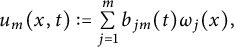 $u_m(x,t):=\sum \limits _{j=1}^{m} b_{jm}(t)\omega _j(x),$
where
 $u_m(x,t)$
satisfies the following Cauchy problem:
 $$ \begin{align} \int_\Omega (u_{mtt}\omega_j+\Delta u_m\Delta\omega_j&+|\nabla u_m|^{p-2}\nabla u_m\cdot \nabla\omega_j)\mathrm{d}x\nonumber\\ &+\sigma(\|\nabla u_m\|_{2}^{2})\int_\Omega u_{mt}\omega_j\mathrm{d}x=\int_\Omega |u_m|^{q-2}u_m\omega_j\log|u_m|\mathrm{d}x, \end{align} $$
 $$ \begin{align} u_m(x,0)&:=u_{0m}=\sum_{j=1}^{m} b_{jm}(0)\omega_j(x)\rightarrow u_0\quad\mathrm{in} \ H_{0}^{2}(\Omega)\cap W_{0}^{1,p}(\Omega), \end{align} $$
 $$ \begin{align} u_{mt}(x,0)&:=u_{1m}=\sum_{j=1}^{m} b_{jm}'(0)\omega_j(x)\rightarrow u_1\quad\mathrm{in} \ L^{2}(\Omega). \end{align} $$
By standard methods in ODEs, we prove the existence and uniqueness of solution to approximate problem (3.1)–(3.3) on some of intervals
 $[0,T_m)$
for
 $0<T_m <+\infty $
.
Step 2. Priori estimate I. Define a function
 $$ \begin{align} \overline{E}_m(t) :=\frac{1}{2}\|u_{mt}\|_2^2+\frac{1}{2}\|\Delta u_m\|_2^2+\frac{1}{p}\|\nabla u_m\|_p^p. \end{align} $$
Multiplying (3.1) by
 $b_{jm}'(t)$
, summing on
 $j=1,2,\ldots ,m,$
and integrating with respect to t from
 $0$
to
 $t(\le T_m)$
, we obtain
 $$ \begin{align} &\overline{E}_m(t)+\int_{0}^{t}\sigma(\|\nabla u_m(s)\|_2^2)\|u_{ms}(s)\|_2^2\mathrm{d}s\nonumber\\& \quad =\overline{E}_m(0)+\int_0^t\int_\Omega|u_m(s)|^{q-2}u_m(s)u_{ms}(s)\log|u_m(s)|\mathrm{d}x\mathrm{d}s. \end{align} $$
From (3.2)–(3.4), we have
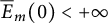 $\overline {E} _m(0)<+\infty $
. On the other hand, by (3.5), Young’s inequality, and the embedding
 $H_0^2(\Omega )\hookrightarrow L^{2(q+\alpha -1)}(\Omega )$
, we arrive at
 $$ \begin{align} \int_{\Omega}|u_m|^{q-2}u_mu_{mt}\log|u_m|\mathrm{d}x &\le\frac{1}{\mathrm{e}\alpha}\int_{\Omega}|u_m|^{q+\alpha-1}|u_{mt}|\mathrm{d}x\nonumber\\ &\le\frac{1}{2\varepsilon_{1}\alpha^2\mathrm{e}^2}\int_{\Omega}|u_m|^{2(q+\alpha-1)}\mathrm{d}x+\frac{\varepsilon_1}{2}\|u_{mt}\|_2^2\nonumber\\ &\le\frac{B_1^{2(q+\alpha-1)}}{2\varepsilon_{1}\alpha^2\mathrm{e}^2}\|\Delta u_m\|_2^2+\frac{\varepsilon_1}{2}\|u_{mt}\|_2^2, \end{align} $$
where
 $\alpha $
is defined in
 $(\mathcal {H})$
and
 $B_1$
is the embedding constant of
 $H_0^2(\Omega )\hookrightarrow L^{2(q+\alpha -1)}(\Omega )$
. Replacing (3.6) in (3.5) and using
 $\sigma (s)\ge a$
, we have
 $$ \begin{align*} &\overline{E}_m(t)+\left ( a-\frac{\varepsilon_1}{2} \right ) \int_0^t\|u_{ms}(s)\|_2^2\mathrm{d}s\\\le&\ \overline{E}_m(0)+\frac{B_1^{2(q+\alpha-1)}}{2\varepsilon_{1}\alpha^2\mathrm{e}^2}\int_0^t\|\Delta u_{m}\|_2^{2(q+\alpha-1)}\mathrm{d}s\\\le&\ \overline{E}_m(0)+\frac{B_1^{2(q+\alpha-1)}}{2\varepsilon_{1}\alpha^2\mathrm{e}^2}\int_0^t\left(\|u_{ms}(s)\|_2^2+\|\Delta u_{m}\|_2^2+\|\nabla u_m\|_p^p \right )^{q+\alpha-1}\mathrm{d}s\\\le&\ \overline{E}_m(0)+\frac{B_1^{2(q+\alpha-1)}}{2\varepsilon_{1}\alpha^2\mathrm{e}^2}p^{q+\alpha-1}\int_0^t\overline{E} _m^{q+\alpha-1}(s)\mathrm{d}s, \end{align*} $$
where
 $q+\alpha -1>1$
. We take
 $\varepsilon _1$
small enough that
 ${\varepsilon _1}<2a$
. Then by Gronwall’s inequality, there exists a constant
 $C_{T_0}>0$
such that
 $$ \begin{align} \|u_{mt}\|_2^2+\|\Delta u_{m}\|_2^2+\|\nabla u_m\|_p^p+\int_0^t\|u_{ms}(s)\|_2^2\mathrm{d}s\le C_{T_0},\quad\text{for all } m\in N_+. \end{align} $$
Hence,
 $$ \begin{align} &\{u_m\}\ \text{is uniformly bounded in}\ L^{\infty}([0,T_0];H_0^2(\Omega)), \end{align} $$
 $$ \begin{align} &\{u_m\}\ \text{is uniformly bounded in}\ L^{\infty}([0,T_0];W_0^{1,p}(\Omega)), \end{align} $$
 $$ \begin{align} &\{u_{mt}\}\ \text{is uniformly bounded in}\ L^{\infty}([0,T_0];L^{2}(\Omega)), \end{align} $$
 $$ \begin{align} &\{u_{mt}\}\ \text{is uniformly bounded in}\ L^2([0,T_0]\times\Omega). \end{align} $$
Step 3. Priori estimate II. Define
 $z_m:=u_{m_1}-u_{m_2}$
for any
 $m_1$
,
 $m_2\in \mathbb {Z}^+$
. By (2.2), we get
 $$ \begin{align*} &\int_\Omega z_{mtt}\omega_j\mathrm{d}x+\int_\Omega\Delta z_m\Delta\omega_j\mathrm{d}x+\int_\Omega|\nabla u_{m_1}|^{p-2}\nabla u_{m_1}\cdot\nabla\omega_j\mathrm{ d}x\\ &-\int_\Omega|\nabla u_{m_2}|^{p-2}\nabla u_{m_2}\cdot\nabla\omega_j\mathrm{d}x+\sigma(\|\nabla u_{m_1}\|_2^2)\int_{\Omega}u_{{m_1}{t}}\omega_j\mathrm{ d}x \\ & \quad -\sigma(\|\nabla u_{m_2}\|_2^2)\int_{\Omega}u_{{m_2}{t}}\omega_j\mathrm{d}x\\ =&\int_{\Omega}|u_{m_1}|^{q-2}u_{m_1}\omega_j\log|u_{m_1}|\mathrm{d}x-\int _{\Omega}|u_{m_2}|^{q-2}u_{m_2}\omega_j\log|u_{m_2}|\mathrm{d}x, \end{align*} $$
where the initial data
 $(z_{0m},z_{1m}):=(u_{0m_1}-u_{0m_2},u_{1m_1}-u_{1m_2})\in H$
. Replacing
 $\omega _j$
by
 $z_{mt}$
in the above equation, we get
 $$ \begin{align*} &\frac{1}{2}\frac{\mathrm{d}}{\mathrm{d}t}(\|z_{mt}\|_2^2+\|\Delta z_m\|_2^2)+\sigma(\|\nabla u_{m_1}\|_2^2)\|z_{mt}\|_2^2\\ &+\int_{\Omega}\left(|\nabla u_{m_1}|^{p-2}\nabla u_{m_1}-|\nabla u_{m_2}|^{p-2}\nabla u_{m_2} \right)\cdot\nabla z_{mt}\mathrm{d}x\\ =&\left[\sigma(\|\nabla u_{m_2}\|_2^2)-\sigma(\|\nabla u_{m_1}\|_2^2)\right] \int_{\Omega}u_{{m_2}t}z_{mt}\mathrm{ d}x+\int_{\Omega}|u_{m_1}|^{q-2}u_{m_1}z_{mt}\log|u_{m_1}|\mathrm{d}x\\ &-\int_{\Omega}|u_{m_2}|^{q-2}u_{m_2}z_{mt}\log|u_{m_2}|\mathrm{d}x. \end{align*} $$
For all x,
 $y\in \mathbb {R}^{n}$
and
 $p>2$
, using
 $2^{2-p}|x-y|^p\le \left ( |x|^{p-2}x-|y|^{p-2}y\right )\cdot (x-y)$
, we have
 $$ \begin{align} \frac{\mathrm{d}}{\mathrm{d}t}\left(\frac{1}{2}\|z_{mt}\|_2^2+\frac{1}{2}\|\Delta z_m\|_2^2+\frac{1}{2^{p-2}p}\|\nabla z_m\|_p^p \right )\le I_1+I_2+I_3, \end{align} $$
where the notations are defined as
 $$ \begin{align*} &I_1 :=-\sigma(\|\nabla u_{m_1}\|_2^2)\|z_{mt}\|_2^2,\quad I_2 :=\left( \sigma(\|\nabla u_{m_2}\|_2^2)-\sigma(\|\nabla u_{m_1}\|_2^2)\right )\int_{\Omega}u_{{m_2}t}z_{mt}\mathrm{d}x,\\ &I_3 :=\int_{\Omega}\left( |u_{m_1}|^{q-2}u_{m_1}\log|u_{m_1}|-|u_{m_2}|^{q-2}u_{m_2}\log|u_{m_2}| \right)z_{mt}\mathrm{d}x. \end{align*} $$
Now, let us estimate
 $I_1$
,
 $I_2$
, and
 $I_3$
. First, from
 $\sigma (s)\ge a$
, we have
 $$ \begin{align} I_1\le -a\|z_{mt}\|_2^2. \end{align} $$
Using
 $\sigma (s)=a+bs\in C^1([0,+\infty ))$
, and Hölder’s and Young’s inequalities, we have
 $$ \begin{align} I_2&\le b|\|\nabla u_{m_1}\|_2-\|\nabla u_{m_2}\|_2|(\|\nabla u_{m_1}\|_2+\|\nabla u_{m_2}\|_2)\int_{\Omega}|u_{{m_2}t}||z_{mt}|\mathrm{d}x\nonumber\\ &\le b\|\nabla z_{m}\|_2(\|\nabla u_{m_1}\|_2+\|\nabla u_{m_2}\|_2 )\int_{\Omega}|u_{{m_2}t}||z_{mt}|\mathrm{d}x\nonumber\\ &\le2b\lambda_1^{-\frac{1}{4}}C_{T_0}^{\frac{1}{2}}\|\nabla z_{m}\|_2\|u_{{m_2}t}\|_2\|z_{mt}\|_2 \nonumber\\ &\le\frac{b^2\lambda_1^{-\frac{1}{2}}C_{T_0}}{\varepsilon_2}\|\nabla z_{m}\|_2^2\|u_{{m_2}t}\|_2^2+\varepsilon_2\|z_{mt}\|_2^2. \end{align} $$
Using Hölder’s inequality again, we obtain
 $$ \begin{align} I_3\le\|G(u_{m_1})-G(u_{m_2})\|_2\|z_{mt}\|_2, \end{align} $$
where
 $G(s):=|s|^{q-2}s\log |s|$
. From (2.4) and the Mean Value theorem, there exists a constant
 $\xi _1\in (0,1)$
such that
 $$ \begin{align} &\|G(u_{m_1})-G(u_{m_2})\|_2\le\left \| G'(\xi_1u_{m_1}+(1-\xi_1)u_{m_2})z_m \right \|_2 \nonumber\\ \le&\left \| \left [ 1+(q-1)\log|\xi_1u_{m_1}+(1-\xi_1)u_{m_2}| \right ] {\left [ \xi_1u_{m_1}+(1-\xi_1)u_{m_2} \right ] }^{q-2}z_m \right \| _2\nonumber\\ \le& \left \| \left [ {|\xi_1u_{m_1}+(1-\xi_1)u_{m_2}|}^{q-2} +\frac{q-1}{\mathrm{e}\alpha}{|\xi_1u_{m_1}+(1-\xi_1)u_{m_2}|}^{q+\alpha-2}\right ]z_m \right \|_2\nonumber\\ \le& \left \| \left ( |u_{m_1}|+|u_{m_2}| \right )^{q-2} |z_m| \right \|_2+\frac{q-1}{\mathrm{e}\alpha}\left \| ( \left|u_{m_1}|+|u_{m_2}| \right )^{q+\alpha-2} z_m \right \|_2. \end{align} $$
Applying Hölder’s inequality, the embedding
 $H_0^2(\Omega )\hookrightarrow L^{2(q-1)}(\Omega ),$
and the inequality
 $|a+b|^r\le 2^{r-1}\left ( |a|^r+|b|^r \right ) $
,
 $r\ge 1,$
to the right side of (3.16), we get
 $$ \begin{align} \left\|\left(|u_{m_1}|+|u_{m_2}|\right )^{q-2}z_m\right \| _2^2 &\le\||u_{m_1}|+|u_{m_2}|\|_{2(q-1)}^{2(q-2)}\|z_{m}\|_{2(q-1)}^{2}\nonumber\\ &\le 2^{\frac{(2q-3)(q-2)}{q-1}}\left( \|u_{m_1}\|_{2(q-1)}^{2(q-1)}+\|u_{m_2}\|_{2(q-1)}^{2(q-1)}\right ) ^{\frac{q-2}{q-1}}\|z_{m}\|_{2(q-1)}^{2}\nonumber\\ &\le C_1\left(\|\Delta u_{m_1}\|_{2}^{2(q-1)}+\|\Delta u_{m_2}\|_{2}^{2(q-1)}\right) ^{\frac{q-2}{q-1}}\|\Delta z_{m}\|_{2}^{2}, \end{align} $$
where
 $C_1:=2^{\frac {(2q-3)(q-2)}{q-1}}B_2^{2(q-1)}$
and
 $B_2$
is the embedding constant of
 $H_0^2(\Omega )\hookrightarrow L^{2(q-1)}(\Omega )$
. Similarly, for
 $q^* :=2(q+\alpha -2)\frac {q-1}{q-2}$
, we arrive at
 $$ \begin{align} &\left \|\left(|u_{m_1}|+|u_{m_2}|\right)^{q+\alpha-2}z_m\right\|_2^2\nonumber\\ &\quad \le 2^{\frac{(q^*-1)(q-2)}{q-1}}B_3^{2(q+\alpha)-2}|\Omega|^{\frac{\alpha}{(q+\alpha-2)(q-1)}}\left ( \|\Delta u_{m_1}\|_{2}^{q^*}+\|\Delta u_{m_2}\|_{2}^{q^*}\right ) ^{\frac{q-2}{q-1}}\|\Delta z_{m}\|_{2}^{2}. \end{align} $$
Denoting
 $C_2:=2^{\frac {(q^*-1)(q-2)}{q-1}}B_3^{2(q+\alpha )-2}|\Omega |^{\frac {\alpha }{(q+\alpha -2)(q-1)}}$
and substituting (3.16)–(3.18) into (3.15) and using Young’s inequality, we get
 $$ \begin{align} I_3&\le\frac{1}{2}C_1^{\frac{1}{2}}\left ( \|\Delta u_{m_1}\|_{2}^{2(q-1)}+\|\Delta u_{m_2}\|_{2}^{2(q-1)} \right )^{\frac{q-2}{2(q-1)}}\left(\|\Delta z_{m}\|_{2}^2+\|z_{mt}\|_2^2 \right)\nonumber\\ &\quad+\frac{q-1}{2\mathrm{e}\alpha}C_2^{\frac{1}{2}}\left(\|\Delta u_{m_1}\|_{2}^{q^*}+\|\Delta u_{m_2}\|_{2}^{q^*}\right)^{\frac{q-2}{2(q-1)}}\left(\|\Delta z_{m}\|_{2}^2+\|z_{mt}\|_2^2\right ). \end{align} $$
Now replacing (3.13), (3.14), and (3.19) into (3.12), choosing
 $\varepsilon _2<a,$
we have
 $$ \begin{align*} &\frac{\mathrm{d}}{\mathrm{d}t}\left(\frac{1}{2}\|z_{mt}\|_2^2+\frac{1}{2}\|\Delta z_m\|_2^2+\frac{1}{2^{p-2}p}\|\nabla z_m\|_p^p\right)\\ \le&(\varepsilon_2-a)\|z_{mt}\|_2^2+\frac{1}{2}\max\left\{C_1^{{\frac{1}{2}}},\frac{q-1}{2\mathrm{e}\alpha}C_2^{\frac{1}{2}}\right\}\left\{\left[\|\Delta u_{m_1}\|_{2}^{2(q-1)}+\|\Delta u_{m_2}\|_{2}^{2(q-1)}\right]^{\frac{q-2}{2(q-1)}}\right.\\ &+\frac{b^2\lambda_1^{-\frac{1}{2}}C_{T_0}}{\varepsilon_2}\|\nabla z_{m}\|_2^2\|u_{{m_2}t}\|_2^2+\left.\left(\|\Delta u_{m_1}\|_{2}^{q^*}+\|\Delta u_{m_2}\|_{2}^{q^*}\right)^{\frac{q-2}{2(q-1)}}\right\}\left(\|\Delta z_{m}\|_{2}^2+\|z_{mt}\|_2^2\right)\\ \le& \frac{b^2\lambda_1^{-\frac{5}{2}}C_{T_0}^2}{\varepsilon_2}\|\Delta z_{m}\|_2^2+C_3\left(\|\Delta z_{m}\|_{2}^2+\|z_{mt}\|_2^2 \right )\\ \le& C_4\left(\frac{1}{2}\|z_{mt}\|_2^2+\frac{1}{2}\|\Delta z_m\|_2^2+\frac{1}{2^{p-2}p}\|\nabla z_m\|_p^p\right), \end{align*} $$
where the positive constants are defined as
 $$ \begin{align*}C_3:=\frac{1}{2}\max\left\{ C_1^{{\frac{1}{2}}},\frac{q-1}{2\mathrm{e}\alpha}C_2^{\frac{1}{2}}\right \}\left [2^{\frac{q-2}{2(q-1)}}C_{T_0}^{\frac{q-2}{2}}+2^{\frac{q^*(q-2)}{4(q-1)}}C_{T_0}^{\frac{q^*(q-2)}{4(q-1)}}\right],\end{align*} $$
 $$ \begin{align*}C_4:=\max\left\{ 2,p2^{p-2}\right\}\max\left\{ 1,\frac{b^2\lambda_1^{-\frac{5}{2}}C_{T_0}^2}{\varepsilon_2}+C_3\right\}.\end{align*} $$
By Gronwall’s inequality, there exists a constant
 $\overline {C}_{T_0}>0$
such that
 $$ \begin{align} \|z_{mt}\|_2^2+\|\Delta z_m\|_2^2+\|\nabla z_m\|_p^p\le \overline{C}_{T_0}\left(\|z_{1m}\|_2^2+\|\Delta z_{0m}\|_2^2+\|\nabla z_{0m}\|_p^p\right),\quad \text{for all } m\in N_+. \end{align} $$
Step 4. Passing to the limit. It follows from (3.8)–(3.11) that there exists a function u and a subsequence of
 $\{ u_m\}_{m=1}^{\infty }$
(still denoted by it) such that
 $u_m \overset {*}{\rightharpoonup } u$
in
 $L^{\infty }([0,T_0];H_0^2(\Omega ))$
,
 $u_m \overset {*}{\rightharpoonup } u$
in
 $ L^{\infty }([0,T_0];W_0^{1,p}(\Omega ))$
,
 $ u_{mt} \overset {*}{\rightharpoonup } u_t$
in
 $L^{\infty }([0,T_0];L^{2}(\Omega ))$
, and
 $ u_{mt}\rightharpoonup u_t$
in
 $L^2([0,T_0];L^2(\Omega ))$
. The estimate (3.20) guarantees the limit for the Kirchhoff damping. From (3.20) and taking (3.2) and (3.3) into account, we deduce
 $ z_m(0):=u_{m_1}(0)-u_{m_2}(0) \rightarrow 0$
in
 $H_0^2(\Omega )\cap W_0^{1,p}(\Omega )$
,
 $z_{mt}(0):=u_{{m_1}t}(0)-u_{{m_2}t}(0) \rightarrow 0$
in
 $L^{2}(\Omega )$
, and
 $\|z_{mt}\|_2^2+\|\Delta z_m\|_2^2+\|\nabla z_m\|_p^p \rightarrow 0$
. Hence,
 $$ \begin{align} u_m \rightarrow u\ \mathrm{in}\ C^0([0,T_0];H_0^2(\Omega)\cap W_0^{1,p}(\Omega) ),\quad u_{mt} \rightarrow u_t \ \mathrm{in}\ C^0([0,T_0];L^{2}(\Omega)). \end{align} $$
Considering the convergence in (3.21), we have
 $u_m\rightarrow u$
, a.e. in
 $\Omega \times (0,T_0)$
. Hence,
 $ \sigma (\| \nabla u_m\|_2^2)\rightarrow \sigma (\|\nabla u\|_2^2)$
for
 $t\in (0,T_0)$
. On the other hand, using (2.4), (3.8), and (3.9), the embedding
 $H_{0}^{2}(\Omega )\hookrightarrow L^{2(q+\alpha -1)}(\Omega )$
, and the inequality
 $ |x^{q-1}\log x| \le [\mathrm {e}(q-1)]^{-1}$
for
 $x\in (0,1)$
, we get
 $$ \begin{align} \int_{\Omega}(|u_m|^{q-2}u_m\log|u_m|)^2\mathrm{d}x\le&[\mathrm{e}(q-1)]^{-2}|\Omega|+\int_{\{x\in\Omega||u_m|>1\}}(|u_m|^{q-2}u_m\log|u_m|) ^2\mathrm{ d}x\nonumber\\ \le&[\mathrm{e}(q-1)]^{-2}|\Omega|+\left(\frac{1}{\mathrm{e}\alpha}\right)^2\| u_m\|_{2(q+\alpha-1)}^{2(q+\alpha-1)}\nonumber\\ \le&[\mathrm{e}(q-1)]^{-2}|\Omega|+\frac{B_1^{2(q+\alpha-1)}}{{(\mathrm{e}}\alpha)^2}\|\Delta u_m\|_2^{2(q+\alpha-1)}\nonumber\\ \le&[\mathrm{e}(q-1)]^{-2}|\Omega|+\frac{B_1^{2(q+\alpha-1)}}{(\mathrm{e}\alpha)^2}C_{T_0}^{q+\alpha-1}. \end{align} $$
Then
 $|u_m|^{q-2}u_m\log |u_m|\overset {*}{\rightharpoonup }|u|^{q-2}u\log |u|$
in
 $L^{\infty }([0,T_0];L^2(\Omega ))$
. Integrating (3.1) over
 $(0,t)$
, we obtain
 $$ \begin{align*} \int_{\Omega}u_{mt}\omega_j\mathrm{d}x&+\int_0^t\int_\Omega(\Delta u_m\Delta\omega_j+|\nabla u_m|^{p-2}\nabla u_m\cdot \nabla\omega_j)\mathrm{d}x\mathrm{d}s\\ &+\int_0^t\sigma(\|\nabla u_m\|_{2}^{2})\int_\Omega u_{ms}\omega_j\mathrm{d}x\mathrm{d}s \\ &\quad =\int_0^t\int_\Omega|u_m|^{q-2}u_m\omega_j\log|u_m|\mathrm{d}x\mathrm{ d}s+\int_{\Omega}u_{1m}\omega_j\mathrm{d}x. \end{align*} $$
Therefore, from (3.1) and the conditions (3.2) and (3.3) about the initial data, we pass the limit to the above equation and get the local weak solution satisfying
 $u(x,0):=u_0(x)$
,
 $u_t(x,0):=u_1(x)$
in
 $\Omega $
.
The uniqueness of the weak solution can be acquired through the method in the work [Reference Lions14].
Step 5. Extension of local weak solutions. By using contradiction argument, we suppose that
 $T_{\max }<+\infty $
and
 $\lim _{t \rightarrow T_{\max }^{-}} (\|u_t\|_{2}^{2}+\|\Delta u\|_2^2+\|\nabla u\|_p^p)<+\infty $
. Then there would be a sequence
 $\{t_j\}_{j=1}^{\infty }$
and a constant
 $K>0$
such that
 $t_j\rightarrow T_{\max }$
as
 $j\rightarrow \infty $
and
 $\|u_t\|_{2}^{2}+\|\Delta u\|_2^2+\|\nabla u\|_p^p<K$
. For each
 $j\in N_+$
, there exists a unique solution of (1.1) on
 $[ t_j,t_j+T^*]$
, where
 $u(x,t_j)$
is the initial datum and
 $T^*>0$
only depends on K. It can be found out that there is a contradiction, that is, for large
 $j\in N_+$
,
 $T_{\max }<t_j+T^*$
.
4 Case
 $q>p$

The diffusion
 ${\operatorname *{div}}(|\nabla u|^{p-2}\nabla u)$
and the reaction
 $|u|^{q-2}u\log |u|$
play crucial roles in determining the existence of global and blow-up solutions. When
 $q>p$
, we state that the reaction term is prevailing.
Theorem 4.1 Let
 $q>p$
. If
 $ (u_0,u_1) \in \mathcal {W}_1$
and
 $(\mathcal {H})$
hold, then problem (1.1) possesses a unique global solution u as defined in Definition 2.1. The energy function
 $E(t)$
satisfies
 $$ \begin{align} E(t)+\displaystyle\int_0^t\sigma(\|\nabla u\|_2^2)\|u_s(s)\|_2^2\mathrm{d}s\le E(0). \end{align} $$
Moreover, there is the decay estimate of energy function
 $$ \begin{align} E(t)\le\frac{C_5}{L+t},\quad\text{for all } 0\le t<+\infty, \end{align} $$
where L is a positive constant and
 $$ \begin{align*} &C_4:=\frac{(1+\sigma_1)qd}{(q-2)\lambda_1}+d+\frac{d}{a}+\frac{1}{2}\|u_0\|_2^2+\frac{1}{2}\|u_1\|_2^2,\\ &C_5:=\frac{1}{q}C_4+\frac{(q-2)\lambda_*^q}{2q(\lambda_*^q-\lambda_*^2)}C_4+\frac{(q-p)\lambda_*^q}{pq(\lambda_*^q-\lambda_*^p)}C_4+\frac{C_4}{q^2\log\lambda_*}+\frac{d}{2a}+Ld>0. \end{align*} $$
In particular, if
 $E(0)<M$
(M is defined in (2.1)), then there are positive constants
 $C_8$
and
 $C_{9}$
such that
 $E(t)$
satisfies the exponential decay estimate
 $$ \begin{align} E(t)\le C_8\mathrm{e}^{-C_9t},\quad \text{for all } 0\le t<+\infty, \end{align} $$
where the constants are defined as
 $$ \begin{align*} &{C_6}:={1-\varepsilon_3-\frac{\varepsilon_3(1+\sigma_1)q}{\lambda_1(q-2)}}, \quad C_8:= {\left(E(0)+\varepsilon_3\int_{\Omega}u_0u_1dx\right)}/{C_6},\\ &{C_7}:={1+\varepsilon_3+\frac{\varepsilon_3(1+\sigma_1)q}{\lambda_1(q-2)}},\quad C_9:= {\beta\varepsilon_3}/{C_7}, \end{align*} $$
and
 $\beta $
is a small constant satisfying
 $$ \begin{align} \beta<p,\quad \frac{\beta}{2}-1+\frac{\beta B_0^q}{q^2}\left(\frac{2qE(0)}{q-2}\right )^{\frac{q-2}{2}}+\frac{{B_{\alpha}^{q+\alpha}}}{\mathrm{e}\alpha}\left( \frac{2qE(0)}{q-2}\right)^{\frac{q+\alpha-2}{2}}<0, \end{align} $$
and
 $\varepsilon _3$
is a small constant satisfying
 $C_6,C_8>0$
and
 $$ \begin{align} \varepsilon_3+\frac{\beta\varepsilon_3}{2}-a<0,\quad E(0)+\varepsilon_3\int_{\Omega}u_0u_1\mathrm{d}x\ge0. \end{align} $$
Proof We divide the proof into five steps.
Step 1. Global existence for the case of
 $(u_0,u_1)\in \mathcal {W}_1$
. Let the sequences
 $\{\omega _j\}_{j=1}^{+\infty }$
,
 $\{u_{0m}\}_{m=1}^{+\infty }$
,
 $\{u_{1m}\}_{m=1}^{+\infty }$
,
 $\{u_{m}\}_{m=1}^{+\infty }$
be the same as those stated in the proof of Theorem 3.1. By the definitions of
 $I(u)$
,
 $E(t)$
, and
 $J(u)$
, we obtain
 $$ \begin{align} J(u_m)&=\frac{q-2}{2q}\|\Delta u_m\|_{2}^{2}+\frac{q-p}{pq}\|\nabla u_m\|_{p}^{p}+\frac{1}{q^2}\left \| u_m \right \|_{q}^{q} +\frac{1}{q}I(u_m),\quad \text{for all } 0\le t<+\infty.\\ E_m(t)&=\frac{1}{2}\|u_{mt}\|_{2}^{2}+J(u_m),\quad \text{for all } 0\le t<+\infty.\nonumber \end{align} $$
Multiplying both sides of (3.1) by
 $b^{\prime }_{jm}(t)$
, summing over
 $j=1,2,\ldots ,m,$
and integrating it from
 $0$
to t, for sufficiently large m, we have
 $$ \begin{align} &E_m(t)+\int_{0}^{t}\sigma(\|\nabla u_m\|_2^2)\|u_{ms}(s)\|_2^2\mathrm{d}s\le E_m(0)<d, \quad \text{for all } 0\le t<+\infty, \end{align} $$
 $$ \begin{align} &E_m(t)=\frac{1}{2}\|u_{mt}\|_{2}^{2}+J(u_m)\le E_m(0)<d,\quad \text{for all } 0\le t<+\infty. \end{align} $$
We claim that
 $(u_m,u_{mt})\in \mathcal {W}_1$
for large m. By contradiction argument, if it was false, then there would be a constant
 $t_0$
such that
 $(u_m(t_0),u_{mt}(t_0))\in \partial \mathcal {W}_1$
, and hence
 $I(u_m(t_0))=0$
or
 $E(u_m(t_0),u_{mt}(t_0))=d$
. Obviously, (4.7) means that the second equation is impossible. On the other hand, if the first equation holds, then we have
 $u_m(t_0)\in \mathcal {N} $
. By the definition of potential depth d, we have
 $J(u_m(t_0))\ge d$
, which contradicts (4.8). Thus,
 $(u_m,u_{mt})\in \mathcal {W}_1$
for sufficiently large m and
 $0\le t<+\infty $
. Using (4.6) and (4.8), we get
 $$ \begin{align} \frac{q-2}{2q}\|\Delta u_m\|_{2}^{2}+\frac{q-p}{pq}\|\nabla u_m\|_{p}^{p}+\frac{1}{q^2}\left \| u_m \right \|_{q}^{q}<d,\quad\text{for all }0\le t<+\infty. \end{align} $$
By using
 $2<p<q$
, (4.7), and (4.9), we get
 $$ \begin{align} u_m \text{ is uniformly bounded}\ &\mathrm{in}\ L^{\infty}((0,\infty);H_0^2(\Omega)), \end{align} $$
 $$ \begin{align} u_m \text{ is uniformly bounded}\ &\mathrm{in}\ L^{\infty}((0,\infty);W_0^{1,p}(\Omega)), \end{align} $$
 $$ \begin{align} u_{mt} \text{ is uniformly bounded}\ &\mathrm{in}\ L^{\infty}((0,\infty);L^{2}(\Omega)), \end{align} $$
 $$ \begin{align} u_{mt} \text{ is uniformly bounded}\ &\mathrm{in}\ L^2((0,\infty);L^2(\Omega)). \end{align} $$
From (4.10)–(4.13), there exists a function u and a subsequence still denoted by
 $\{u_{m}\}_{m=1}^{+\infty }$
such that
 $$ \begin{align} u_m& \overset{*}{\rightharpoonup}u\ \mathrm{in}\ L^{\infty}((0,\infty);H_0^2(\Omega)), \end{align} $$
 $$ \begin{align} u_m& \overset{*}{\rightharpoonup}u\ \mathrm{in}\ L^{\infty}((0,\infty);W_0^{1,p}(\Omega)), \end{align} $$
 $$ \begin{align} u_{mt}&\overset{*}{\rightharpoonup}u_t\ \mathrm{in}\ L^{\infty}((0,\infty);L^{2}(\Omega)), \end{align} $$
 $$ \begin{align} u_{mt}&\rightharpoonup u_t\ \mathrm{in}\ L^2((0,\infty);L^2(\Omega)). \end{align} $$
By using (4.10)–(4.13) and repeating the arguments in Priori estimate II of Theorem 3.1, we obtain that there exists a positive constant
 $ \overline {C}$
independent on
 $T_0$
such that
 $$ \begin{align*} & \|z_{mt}\|_2^2+\|\Delta z_m\|_2^2+\|\nabla z_m\|_p^p \\ &\quad \le \overline{C}\left(\|z_{1m}\|_2^2+\|\Delta z_{0m}\|_2^2+\|\nabla z_{0m}\|_p^p\right),\ \text{for all } m\in \mathbb{Z}^+,\ 0\le t<+\infty. \end{align*} $$
Hence, we obtain
 $ u_m \rightarrow u$
in
 $C^0((0,\infty );H_0^2(\Omega )\cap W_0^{1,p}(\Omega ) )$
and
 $ u_m\rightarrow u$
in
 $C^0((0,\infty );L^{2}(\Omega ))$
. Therefore, we have
 $ \sigma (\| \nabla u_m\|_2^2)\rightarrow \sigma (\|\nabla u\|_2^2 )$
for all
 $0\le t<+\infty $
. In addition, similar to (3.22), we get
 $$ \begin{align} |u_m|^{q-2}u_m\log|u_m|\overset{*}{\rightharpoonup}|u|^{q-2}u\log|u|\ \mathrm{in}\ L^{\infty}((0,\infty);L^2(\Omega)). \end{align} $$
Therefore, together with (3.1) and initial data condition (3.2), (3.3), (4.14)–(4.18), we obtain
 $$ \begin{align} u_{tt}+\Delta^{2}u-{\operatorname*{div}}(|\nabla u|^{p-2}\nabla u)+\sigma(\|\nabla u\|_{2}^{2} )u_t&=|u|^{q-2}u\log|u|,\quad(x,t)\in\Omega\times(0,+\infty),\nonumber\\ u(x,0)=u_0(x),\quad u_t(x,0)&=u_1(x),\quad x\in \Omega. \end{align} $$
Finally, from (4.19), it can be seen that u is a global weak solution of problem (1.1).
Step 2. Global existence for the case of
 $(u_0,u_1)\in \mathcal {W}_2$
. Let
 $\gamma _m :=1-\frac {1}{m}$
,
 $u_{m0} :=\gamma _mu_0$
,
 $u_{m1} :=\gamma _mu_1$
,
 $\gamma _m\in (0,1)$
for
 $m\ge 2$
and
 $m\in \mathbb {Z}^+$
. Now, we consider the following problem:
 $$ \begin{align} \left\{ \begin{array}{@{}lll} u_{tt}+\Delta^{2}u-{\operatorname*{div}}(|\nabla u|^{p-2}\nabla u)+\sigma(\|\nabla u\|_{2}^{2})u_t & \\ \quad =|u|^{q-2}u\log|u|,&(x,t)\in\Omega\times(0,T_{\mathrm{ max}}), \\ u =0, \quad \frac{\partial u}{\partial \eta}=0,&(x,t)\in\partial\Omega\times(0,T_{\mathrm{max}}),\\ u(x,0)=u_{m0}(x),\quad u_{t}(x,0)=u_{m1}(x),& x\in\Omega. \end{array}\right. \end{align} $$
We claim that
 $I(u_{m0})>0$
and
 $E(u_{m0},u_{m1})<d$
. Actually, using
 $I(u_{0})\ge 0$
and Lemma 2.2, we observe
 $\lambda _*=\lambda _*(u_0)\ge 1$
. Since
 $\gamma _m\in (0,1)$
, we obtain
 $ I(u_{m0})=I(\gamma _m u_{0})>0$
. In addition,
 $$ \begin{align*} \frac{\mathrm{d}}{{\mathrm{d}}\gamma_m}J(\gamma_mu_0)&=\frac{1}{\gamma_m}\left(\|\Delta \gamma_mu_0\|_{2}^{2}+\|\nabla \gamma_mu_0\|_{p}^{p}-\int_{\Omega}\left|\gamma_m u_0\right | ^q\log\left|\gamma_mu_0\right|{\mathrm{d}}x\right) \\ &=\frac{1}{\gamma_m}I(\gamma_mu_{0})>0. \end{align*} $$
Hence,
 $J(\gamma _mu_0)$
is increasing with respect to
 $\gamma _m$
and
 $$ \begin{align*}E(u_{m0},u_{m1})=\frac{1}{2}\|u_{m1}\|_{2}^{2}+J(u_{m0})=\frac{1}{2}\|\gamma_mu_{1}\|_{2}^{2}+J(\gamma_mu_{0}) <E(0)<d.\end{align*} $$
Similar to Step 1, we obtain that problem (1.1) admits a global solution.
Step 3. Energy inequality (4.1). Now, we prove that
 $$ \begin{align} \kern-7pt \lim_{m\rightarrow\infty}\int_{\Omega}|u_m|^q\log|u_m|\mathrm{d}x &= \int_{\Omega}|u|^q\log|u|\mathrm{d}x, \end{align} $$
 $$ \begin{align} \lim_{m\rightarrow\infty}\int_{\Omega}|u_m|^q\mathrm{d}x&=\int_{\Omega}|u|^q\mathrm{d}x. \end{align} $$
In fact, from Steps 1 and 2, we have
 $ u\in L^{\infty }((0,\infty );H_{0}^{2}(\Omega )\cap W_{0}^{1,p}(\Omega ))$
and
 $u_t\in L^{\infty }((0,\infty );L^2(\Omega ))$
. Using similar discussion to (3.16)–(3.18) and letting
 $m\rightarrow +\infty $
, we have
 $$ \begin{align*} \left|\int_{\Omega}|u_m|^q\log|u_m|\mathrm{d}x-\int_{\Omega}|u|^q\log|u|\mathrm{d}x \right|\le C\|\Delta u_m-\Delta u\|_2 \rightarrow 0,\quad \text{for all } 0\le t<+\infty. \end{align*} $$
For some of a constant
 $\theta \in (0,1)$
, using the Mean Value theorem, Hölder’s inequality, the embedding
 $H_0^2(\Omega )\hookrightarrow L^{2(q-1)}(\Omega ),$
and taking
 $m\rightarrow +\infty $
, we have
 $$ \begin{align*} \int_{\Omega}\left(|u_m|^q-|u|^q\right)\mathrm{d}x&\le q\int_{\Omega}\left(\theta|u_m|+(1-\theta)|u|\right)^{q-1}|u_m-u|\mathrm{d}x\\ &\le q\|\theta|u_m|+(1-\theta)|u|\|_{2(q-1)}^{q-1}\|u_m-u\|_2\\ &\le q\lambda_1^{-1}B^{q-1}\||\Delta u|+|\Delta u_m|\|_2^{q-1}\|\Delta u-\Delta u_m\|_2\\ &\le C\left(\|\Delta u\|_2+\|\Delta u_m\|_2\right)^{q-1}\|\Delta u_m-\Delta u\|_2\rightarrow0. \end{align*} $$
Hence, (4.21) and (4.22) hold. By (3.2) and (3.3), we have
 $ \lim \limits _{m \rightarrow +\infty } E(u_{0m},u_{1m})=E(u_0,u_1)=E(0)$
. Making use of Fatou’s Lemma, (4.7), (4.21), and (4.22), we deduce
 $$ \begin{align*} &\frac{1}{2}\|u_{t}\|_{2}^{2}+\frac{1}{2}\|\Delta u\|_{2}^{2}+\frac{1}{p}\|\nabla u\|_{p}^{p}+\int_0^t\sigma(\|\nabla u\|_{2}^{2})\|u_{s}\|_{2}^{2} \mathrm{d}s\\ &\quad \le \frac{1}{2}\liminf_{m \rightarrow +\infty} \|u_{mt}\|_{2}^{2}+\frac{1}{2}\liminf_{m \rightarrow +\infty} \|\Delta u_m\|_{2}^{2}+\frac{1}{p}\liminf_{m \rightarrow +\infty} \|\nabla u_m\|_{p}^{p} \\ &\qquad +\liminf_{m \rightarrow +\infty} \int_0^t\sigma(\|\nabla u_m\|_{2}^{2})\|u_{ms}\|_{2}^{2} \mathrm{d}s\\ &\quad \le \liminf_{m \rightarrow +\infty} \left[E_m(0)+\frac{1}{q}\int_{\Omega}\left|u_m\right| ^q\log|u_m|\mathrm{d}x+\frac{1}{q^2}\|u_m\|_q^q\right ] \\ &\quad =E(0)+\frac{1}{q}\int_{\Omega}|u|^q\log|u|\mathrm{d}x+\frac{1}{q^2}\|u\|_q^q. \end{align*} $$
Then the energy inequality (4.1) holds.
Step 4. Decay estimate (4.2) of energy. From Steps 1 and 2, we know
 $(u,u_t)\in \mathcal {W}$
for
 $0\le t<+\infty $
and
 $I(u)\ge 0$
provided
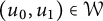 $(u_0,u_1)\in \mathcal {W}$
. By the definitions of
 $E(t)$
,
 $\sigma (s),$
and
 $I(u)\ge 0$
, we get
 $$ \begin{align} E(0)\ge &E(t)+\int_{0}^{t}\sigma(\|\nabla u\|_2^2)\|u_{s}(s)\|_2^2\mathrm{d}s\ge \frac{1}{2}\|u_{t}\|_{2}^{2}+J(u)+a\int_0^t\|u_s\|_2^2\mathrm{d}s\nonumber\\ \ge&\frac{1}{2}\|u_{t}\|_{2}^{2}+\frac{q-2}{2q}\|\Delta u\|_{2}^{2}+\frac{q-p}{pq}\|\nabla u\|_{p}^{p}+\frac{1}{q^2}\|u \|_{q}^{q}+a\int_0^t\|u_s\|_2^2\mathrm{ d}s. \end{align} $$
Equation (4.23) and
 $E(0)\le d$
yield
 $$ \begin{align} \|u_{t}\|_{2}^{2}\le2d, \quad\|\Delta u\|_{2}^{2}\le\frac{2qd}{q-2}, \quad\|\nabla u\|_{p}^{p}\le\frac{pqd}{q-p}, \quad\int_0^t\|u_s\|_2^2\mathrm{ d}s\le\frac{d}{a}. \end{align} $$
Using Hölder’s inequality, we have
 $ \|\nabla u\|_2^2\le |\Omega |^{\frac {p-2}{p}} \|\nabla u\|_p^2\le |\Omega |^{\frac {p-2}{p}}\left (\frac {pqd}{q-p}\right )^{\frac {2}{p}}$
. Due to the continuity of
 $\sigma (s)$
in
 $[0,+\infty )$
, there exists a constant
 $\sigma _1>0$
such that
 $$ \begin{align} \sigma(\|\nabla u\|_2^2)\le\max_{0\le\|\nabla u\|_2^2\le C'}\sigma(\|\nabla u\|_2^2)\ :=\sigma_1. \end{align} $$
Now, taking
 $\phi :=u$
in (2.2) and applying (4.24) and (4.25), Young’s and Hölder’s inequalities, and
 ${\lambda _{1}}\|u\|_{2}^{2}\leq \|\Delta u\|_{2}^{2}$
, we get
 $$ \begin{align} \int_0^tI(u)\mathrm{d}s &=-\int_0^t\int_{\Omega}u_{ss}u\mathrm{d}x\mathrm{d}s-\int_0^t\sigma(\|\nabla u\|_2^2)\int_{\Omega}u_su\mathrm{d}x\mathrm{d}s\nonumber\\ &\le-\int_{\Omega}u_tu\mathrm{d}x+\int_{\Omega}u_0u_1\mathrm{d}x+\int_0^t\|u_s\|_2^2\mathrm{d}s+\sigma_1\int_{\Omega} \left|\int_0^t u_su\mathrm{d}s\right|\mathrm{ d}x\nonumber\\ &\le\frac{1+\sigma_1}{2\lambda_1}\|\Delta u\|_{2}^{2}+\frac{1}{2}\|u_t\|_2^2+\frac{1}{2}\|u_0\|_2^2+\frac{1}{2}\|u_1\|_2^2+\int_0^t\|u_s\|_2^2\mathrm{ d}s. \end{align} $$
Furthermore, using (4.24) and (4.26), we arrive at
 $$ \begin{align} \int_0^tI(u)\mathrm{d}s\le \frac{(1+\sigma_1)qd}{(q-2)\lambda_1}+d+\frac{d}{a}+\frac{1}{2}\|u_0\|_2^2+\frac{1}{2}\|u_1\|_2^2=:C_4,\quad \text{for all } 0\le t<+\infty. \end{align} $$
By the definitions of
 $J(u)$
and
 $I(u)$
, we have
 $$ \begin{align} J(u)=\frac{q-2}{2q}\|\Delta u\|_{2}^{2}+\frac{q-p}{pq}\|\nabla u\|_{p}^{p}+\frac{1}{q^2} \| u \|_{q}^{q} +\frac{1}{q}I(u). \end{align} $$
Since
 $I(u)\ge 0$
and by Lemma 2.2, there exists a constant
 $\lambda _*\ge 1$
such that
 $I(\lambda _*u)=0$
. By the definition of d and (4.28), we have
 $$ \begin{align} d&\le J(\lambda_*u)=\lambda_*^q\left(\frac{q-2}{2q}\lambda_*^{2-q}\|\Delta u\|_{2}^{2}+\frac{q-p}{pq}\lambda_*^{p-q}\|\nabla u\|_{p}^{p}+\frac{1}{q^2}\| u \|_{q}^{q}\right)\nonumber\\ &\le\lambda_*^q\left ( \frac{q-2}{2q}\|\Delta u\|_{2}^{2}+\frac{q-p}{pq}\|\nabla u\|_{p}^{p}+\frac{1}{q^2}\|u\|_{q}^{q} +\frac{1}{q}I(u)\right )=\lambda_*^qJ(u). \end{align} $$
By the definition of
 $E(t)$
,
 $I(u)\ge 0,$
and (4.28), we have
 $$ \begin{align} \frac{q-2}{2q}\|\Delta u\|_{2}^{2}+\frac{q-p}{pq}\|\nabla u\|_{p}^{p}+\frac{1}{q^2} \|u\|_{q}^{q}\le J(u)<E(t)\le E(0)\le d. \end{align} $$
It follows from (4.29) and (4.30) that
 $$ \begin{align} 1 \leq \left(\frac{d}{E(0)}\right )^{\frac{1}{q}}\leq\left(\frac{d}{E(t)}\right )^{\frac{1}{q}}< \left(\frac{d}{J(u)}\right)^{\frac{1}{q}}\le \lambda_*. \end{align} $$
On the other hand, together with (4.31), we have
 $ 0=I(\lambda _*u)=\lambda _*^qI(u)+(\lambda _*^2-\lambda _*^q)\|\Delta u\|_{2}^{2}+(\lambda _*^p-\lambda _*^q)\|\nabla u\|_{p}^{p}-\lambda _*^q\|u\|_q^q\log \lambda _*$
, which implies
 $$ \begin{align} I(u)=\frac{\lambda_*^q-\lambda_*^2}{\lambda_*^q}\|\Delta u\|_{2}^{2}+\frac{\lambda_*^q-\lambda_*^p}{\lambda_*^q}\|\nabla u\|_{p}^{p}+\|u\|_q^q\log\lambda_*. \end{align} $$
Using (4.27) and (4.32), we have
 $$ \begin{align} \int_0^t\|\Delta u\|_{2}^{2}\mathrm{d}s&\le\frac{\lambda_*^q}{\lambda_*^q-\lambda_*^2}\int_0^tI(u)\mathrm{ d}s\le\frac{\lambda_*^q}{\lambda_*^q-\lambda_*^2}C_4, \end{align} $$
 $$ \begin{align} \int_0^t\|\nabla u\|_{p}^{p}\mathrm{d}s&\le\frac{\lambda_*^q}{\lambda_*^q-\lambda_*^p}\int_0^tI(u)\mathrm{ d}s\le\frac{\lambda_*^q}{\lambda_*^q-\lambda_*^p}C_4, \end{align} $$
 $$ \begin{align} \int_0^t\| u\|_{q}^{q}\mathrm{d}s&\le\frac{1}{\log\lambda_*}\int_0^tI(u)\mathrm{d}s\le\frac{C_4}{\log\lambda_*}. \end{align} $$
Due to the monotonicity of
 $E(t)$
, we conclude that
 $ \frac {\mathrm {d}}{\mathrm {d}t}[ (L+t)E(t)]\le E(t)$
. By integration, we infer
 $$ \begin{align*} E(t)&\le\frac{1}{L+t}\left(\frac{1}{q}\int_0^tI(u)\mathrm{d}s+\frac{q-2}{2q}\int_0^t\|\Delta u\|_{2}^{2}\mathrm{d}s+\frac{q-p}{pq}\int_0^t\|\nabla u\|_{p}^{p}\mathrm{d}s\right.\\ &\left.\quad+\frac{1}{q^2}\int_0^t\| u\|_{q}^{q}\mathrm{d}s+\frac{1}{2}\int_0^t\| u_s\|_{2}^{2}\mathrm{d}s+LE(0)\right). \end{align*} $$
Hence, using
 $E(0)\le d$
, (4.24), (4.26), and (4.33)–(4.35), we get decay estimate (4.2).
Step 5. Exponential decay estimate (4.3) of energy. Define a function
 $$ \begin{align*}F(t):=E(t)+\varepsilon_3\int_{\Omega}uu_t\mathrm{d}x+\varepsilon_3\int_0^t\sigma(\|\nabla u\|_2^2)\int_{\Omega}uu_s\mathrm{d}x\mathrm{ d}s,\end{align*} $$
where
 $\varepsilon _3$
is a positive constant to be specified later. We claim that there exist two positive constants
 $C_6$
,
 $C_7$
such that
 $ C_6E(t)\le F(t)\le C_7E(t)$
for all
 $0\le t<+\infty $
. In fact, by the definition of
 $\sigma (s)$
, (4.23), (4.25), Young’s inequality, and
 ${\lambda _{1}}\|u\|_{2}^{2}\leq \|\Delta u\|_{2}^{2}$
, we compute
 $$ \begin{align*} F(t)&\ge E(t)-\frac{\varepsilon_3}{2}\|u\|_2^2-\frac{\varepsilon_3}{2}\|u_t\|_2^2-\varepsilon_3\sigma_1\int_{\Omega}\left | \int_0^tuu_s\mathrm{d}s \right | \mathrm{ d}x\\ &\ge E(t)-\frac{\varepsilon_3}{2}\|u\|_2^2-\frac{\varepsilon_3}{2}\|u_t\|_2^2-\frac{\varepsilon_3\sigma_1}{2}\|u\|_2^2\\ &\ge E(t)-\frac{\varepsilon_3(1+\sigma_1)}{2\lambda_1}\|\Delta u\|_2^2-\frac{\varepsilon_3}{2}\|u_t\|_2^2\ge C_6E(t). \end{align*} $$
Now, we choose a small positive constant
 $\varepsilon _3$
such that (4.5) holds, where
 $\beta $
will be specified later. Similar to the above procedure, we have
 $$ \begin{align*} F(t)&\le E(t)+\frac{\varepsilon_3}{2}\|u\|_2^2+\frac{\varepsilon_3}{2}\|u_t\|_2^2+\varepsilon_3\sigma_1\int_{\Omega}\left |\int_0^tuu_s\mathrm{d}s \right|\mathrm{ d}x\\ &\le E(t)+\frac{\varepsilon_3}{2}\|u_t\|_2^2+\frac{\varepsilon_3(1+\sigma_1)}{2\lambda_1}\|\Delta u\|_2^2\le C_7E(t). \end{align*} $$
Differentiating
 $F(t)$
with respect to t, using (2.2), and definitions of
 $E(t)$
and
 $\sigma (s)$
, we get
 $$ \begin{align} F'(t)&=-E'(t)+\varepsilon_3\|u_t\|_2^2+\varepsilon_3\int_{\Omega}u_{tt}u\mathrm{d}x+\varepsilon_3\sigma(\|\nabla u\|_2^2)\int_{\Omega}u_tu\mathrm{d}x\nonumber\\&=-\sigma(\|\nabla u\|_2^2)\|u_t\|_2^2+\varepsilon_3\|u_t\|_2^2+\varepsilon_3\int_{\Omega}|u|^q\log|u|\mathrm{d}x-\varepsilon_3\|\Delta u\|_2^2-\varepsilon_3\|\nabla u\|_p^p\nonumber\\&\le-\beta\varepsilon_3E(t)+\left(\frac{\beta\varepsilon_3}{2}+\varepsilon_3-a\right ) \|u_t\|_2^2+\left(\frac{\beta\varepsilon_3}{2}-\varepsilon_3 \right )\|\Delta u\|_2^2+\left(\frac{\beta\varepsilon_3}{p}-\varepsilon_3\right)\|\nabla u\|_p^p\nonumber\\&\quad+\left(\varepsilon_3-\frac{\beta\varepsilon_3}{q}\right )\int_{\Omega}|u|^q\log|u|\mathrm{d}x+\frac{\beta\varepsilon_3}{q^2}\|u\|_q^q.\nonumber\\ \end{align} $$
Now, we consider the right side of (4.36). Using (2.4), (4.24), and the embedding
 $H_{0}^{2}(\Omega )\hookrightarrow L^{q+\alpha }(\Omega )$
, we arrive at
 $$ \begin{align} \int_{\Omega}|u|^q\log|u|\mathrm{d}x&\le\frac{1}{\mathrm{e}\alpha}\|u\|_{q+\alpha}^{q+\alpha}\le\frac{B_{\alpha}^{q+\alpha}}{\mathrm{e}\alpha}\|\Delta u\|_2^{q+\alpha}\le\frac{B_{\alpha}^{q+\alpha}}{\mathrm{e}\alpha}\left(\frac{2qE(0)}{q-2}\right)^{\frac{q+\alpha-2}{2}}\|\Delta u\|_2^{2}. \end{align} $$
Similarly, we have
 $$ \begin{align} \|u\|_q^q\le B_0^q\|\Delta u\|_2^q=B_0^q\|\Delta u\|_2^{q-2}\|\Delta u\|_2^2\le B_0^q\left(\frac{2qE(0)}{q-2}\right )^{\frac{q-2}{2}}\|\Delta u\|_2^2. \end{align} $$
Since (4.37) and (4.38), equation (4.36) can be estimated by
 $$ \begin{align} F'(t) &\le\left ( \frac{\beta\varepsilon_3}{2}+\varepsilon_3-a \right ) \|u_t\|_2^2-\frac{\beta\varepsilon_3}{\mathrm{e}q\alpha}B_{\alpha}^{q+\alpha}\left (\frac{2qE(0)}{q-2}\right)^{\frac{q+\alpha-2}{2}}\|\Delta u\|_2^2 +\varepsilon_3\left(\frac{\beta}{p}-1 \right ) \|\nabla u\|_p^p\nonumber\\&\quad +\varepsilon_3\left[\frac{\beta}{2}+\frac{\beta B_0^q}{q^2}\left ( \frac{2qE(0)}{q-2}\right )^{\frac{q-2}{2}}+\frac{{B_{\alpha}^{q+\alpha}}}{\mathrm{ e}\alpha}\left(\frac{2qE(0)}{q-2}\right)^{\frac{q+\alpha-2}{2}}-1\right]\|\Delta u\|_2^2-\beta\varepsilon_3E(t).\nonumber\\ \end{align} $$
By assumption
 $E(0)<M$
, we get
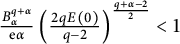 $\frac {{B_{\alpha }^{q+\alpha }}}{\mathrm {e}\alpha }\left ( \frac {2qE(0)}{q-2}\right )^{\frac {q+\alpha -2}{2}}<1$
. Meanwhile, we select small
 $\beta $
such that (4.4) holds. Choosing
 $\varepsilon _3$
such that (4.5) holds and substituting (4.4) into (4.39), we have
 $$ \begin{align} F'(t)\le-\beta\varepsilon_3E(t)\le\frac{-\beta\varepsilon_3}{C_7}F(t),\quad \text{for all } 0\le t<+\infty. \end{align} $$
Integrating (4.40) from
 $0$
to t, we have the decay estimate (4.3).
The next theorem shows the existence of blow-up solution of problem (1.1). We note that the positive constant
 $r(\alpha )$
is defined in (2.1).
Theorem 4.2 Let
 $q>p$
and the initial data
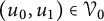 $(u_0,u_1)\in \mathcal {V}_0$
and
 $(\mathcal {H})$
hold. Denote u the weak solution as defined in Definition 2.1. If
 $E(0)<0$
, then the solution u blows up in finite time or infinite time. Moreover, if
 $T_{\max }<+\infty $
, then there are the results: (i) If
 $-(r(\alpha ))^2\le E(0)<0 $
, then u blows up in finite time in the sense of
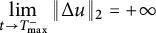 $\lim \limits _{t \rightarrow T^{-}_{\max }} \|\Delta u\|_{2}=+\infty $
. (ii) If
 $-(r(\alpha ))^2\le E(0)<0 $
and p, q satisfy
 $$\begin{align}2<q+\alpha<\left\{\begin{array}{@{}llll} \displaystyle\frac{np}{n-p},&\text{for }n>p,\\ +\infty ,&\text{for }n\le p, \end{array}\right. \end{align} $$
then u blows up in finite time in the sense of
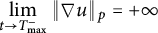 $\lim \limits _{t \rightarrow T^{-}_{\max }} \|\nabla u\|_{p}=+\infty $
.
Proof The proof is divided into two steps.
Step 1. To prove that the solution blows up in finite or infinite time, we only need to rule out the case where the solution is globally bounded, and we use the proof by contradiction for this purpose. If u was globally bounded, there exists a positive constant C independent of t such that
 $\|u_t\|_{2}^{2}+\|\Delta u\|_2^2+\|\nabla u\|_p^p\leq C$
. We define
 $K(t):=\|u\|_2^2$
and
 $ H(t):=-E(t)$
for all
 $0\le t\le T_1<+\infty $
, where
 $T_1$
denotes any of a positive constant. Using the monotonicity of
 $E(t)$
, we have
 $H'(t)=-E'(t)\ge 0$
,
 $$ \begin{align} H(t)\ge H(0)=-E(0)>0,\quad\text{for all } 0\le t\le T_1. \end{align} $$
We define
 $G(t):=\int _{\Omega }\sigma (\|\nabla u\|_2^2)uu_t\mathrm {d}x$
for
 $ 0\le t\le T_1$
. By the assumption of the global existence of the solution, there are three positive constants
 $D_1$
,
 $D_2$
, and
 $D_3$
, which are independent of
 $T_1$
, satisfying
 $$ \begin{align} \|\Delta u\|_2^2\le D_1,\quad\|\nabla u\|_p^p\le D_2,\quad \|u_t\|_2^2\le D_3,\quad\text{for all } 0\le t\le T_1. \end{align} $$
Using Hölder’s inequality, we have
 $$ \begin{align} \|\nabla u\|_2^2\le|\Omega|^{\frac{p-2}{p}}\|\nabla u\|_p^2\le|\Omega|^{\frac{p-2}{p}}D_2^{\frac{2}{p}}=:D_4. \end{align} $$
Since
 $\sigma (s)$
is continuous, we have
 $$ \begin{align} \sigma(\|\nabla u\|_2^2)\le\max_{0\le\|\nabla u\|_2^2\le D_4}\sigma(\|\nabla u\|_2^2)\ =:\sigma_2. \end{align} $$
Using (4.44), and Young’s and Hölder’s inequalities, we get
 $$ \begin{align} |G(t)|&=\left|\int_{\Omega}\sigma(\|\nabla u\|_2^2)uu_t\mathrm{d}x\right|\le\sigma(\|\nabla u\|_2^2)\|u\|_2\|u_t\|_2\nonumber\\ &\le\frac{1}{2}\sigma(\|\nabla u\|_2^2)\left ( \frac{1}{\eta}\|u_t\|_2^2+\eta\|u\|_2^2\right ) \le\frac{1}{2\eta}H'(t)+\frac{\sigma_2\eta}{2}\|u\|_2^2, \end{align} $$
where
 $\eta $
is a positive constant which will be specified later. Differentiating
 $K(t)$
directly, we obtain
 $K'(t)=2\int _{\Omega }uu_t\mathrm {d}x$
,
 $K"(t)=2\|u_t\|_2^2+2\int _{\Omega }uu_{tt}\mathrm {d}x$
. Define a function
 $y(t):=H^{1-\zeta }(t)+\varepsilon _4\int _{\Omega }uu_t\mathrm {d}x$
, where
 $\zeta $
satisfies
 $$ \begin{align} \frac{2(q-2)}{q^2}<\zeta<\frac{q-2}{2q}<\frac{1}{2}, \end{align} $$
and
 $\varepsilon _4$
will be specified later.
Next, we will estimate
 $y'(t)$
. By using (2.2) and Young’s inequality, we have
 $$ \begin{align*} y'(t) &=(1-\zeta)H^{-\zeta}(t)H'(t)+\varepsilon_4\|u_t\|_2^2+\varepsilon_4\int_{\Omega}|u|^q\log|u|\mathrm{d}x-\varepsilon_4\|\Delta u\|_2^2\\& \quad -\varepsilon_4\|\nabla u\|_p^p-\varepsilon_4\sigma(\|\nabla u\|_2^2)\int_{\Omega}u_tu\mathrm{d}x\\&\ge\left[(1-\zeta)H^{-\zeta}(t)-\frac{\varepsilon_4}{2\eta} \right ] H'(t)+\varepsilon_4\|u_t\|_2^2+\varepsilon_4\int_{\Omega}|u|^q\log|u|\mathrm{d}x\\ &-\varepsilon_4\|\Delta u\|_2^2-\varepsilon_4\|\nabla u\|_p^p-\frac{\varepsilon_4\eta\sigma_2}{2}\|u\|_2^2. \end{align*} $$
Furthermore, we introduce a constant
 $c\in (0,1)$
and the above inequality can be written by
 $$ \begin{align} y'(t)\ge&\left(1-\zeta-\frac{\varepsilon_4}{2\eta}H^{\zeta}(t)\right)H^{-\zeta}(t) H'(t)+\varepsilon_4q(1-c)H(t)+\varepsilon_4\frac{q(1-c)+2}{2}\|u_t\|_2^2\nonumber\\ & +\varepsilon_4\frac{q(1-c)-2}{2}\|\Delta u\|_2^2+\varepsilon_4\frac{q(1-c)-p}{p}\|\nabla u\|_p^p+\varepsilon_4c\int_{\Omega}|u|^q\log|u|\mathrm{d}x\nonumber\\ &+\frac{\varepsilon_4(1-c)}{q}\|u\|_q^q -\frac{\varepsilon_4\eta\sigma_2}{2}H^{-\zeta}(t)H^{\zeta}(t)\|u\|_2^2. \end{align} $$
Now, we prove
 $\int _{\Omega }|u|^q\log |u|dx\ge 0$
. In fact, by the monotonicity of
 $E(t)$
, we have
 $$ \begin{align} \frac{1}{q}\int_{\Omega}|u|^q\log|u|\mathrm{d}x\ge\frac{1}{2}\|u_t\|_2^2+\frac{1}{2}\|\Delta u\|_2^2+\frac{1}{p}\|\nabla u\|_p^p+\frac{1}{q^2}\|u\|_q^q-E(0)\ge0. \end{align} $$
Due to (4.48), the condition of Lemma 2.4 holds. Now, let us estimate the last term on the right side of (4.47). Applying Lemma 2.4, we have
 $\|u\|_{2}^{2}\le K_1\left [\left (\int _{\Omega }|u|^q\log |u|\mathrm {d}x\right )^{\frac {2}{q}}+\|\Delta u\|_{2}^{\frac {4}{q}}\right ]$
. Combining (4.41) with Young’s inequality, we obtain
 $$ \begin{align} H^{\zeta}\|u\|_2^2&\le\left(\frac{1}{q}\int_{\Omega}|u|^q\log|u|\mathrm{d}x\right )^{\zeta}\|u\|_2^2\nonumber\\ &\le {K_1}{q^{-\zeta}}\left[\left(\int_{\Omega}|u|^q\log|u|\mathrm{d}x \right )^{\frac{2}{q}+\zeta}+\left(\int_{\Omega}|u|^q\log|u|\mathrm{d}x \right )^{\frac{q\zeta}{q-2}}+\|\Delta u\|_2^2\right ]. \end{align} $$
From (4.46), it is easy to know that
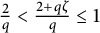 $ \frac {2}{q}<\frac {2+q\zeta }{q}\le 1$
and
 $\frac {2}{q}<\frac {q\zeta }{q-2}\le 1$
. Making use of (4.49) and Lemma 2.5, we obtain
 $$ \begin{align*} H^{\zeta}(t)\|u\|_2^2&\le {K_1}{q^{-\zeta}}\left [ 2K_2\int_{\Omega}|u|^q\log|u|\mathrm{d}x+(2K_2+1)\|\Delta u\|_2^2\right ]\\ &\le {2K_1(K_2+1)}{q^{-\zeta}}\left (\int_{\Omega}|u|^q\log|u|\mathrm{d}x+\|\Delta u\|_2^2 \right ). \end{align*} $$
Substituting the above inequality into (4.47), we have
 $$ \begin{align} y'(t)&\ge\left(1-\zeta-\frac{\varepsilon_4}{2\eta}H^{\zeta}(t)\right)H^{-\zeta}(t) H'(t)+\varepsilon_4q(1-c)H(t)+\varepsilon_4\frac{q(1-c)+2}{2}\|u_t\|_2^2\nonumber\\ &\quad+\varepsilon_4\left [ \frac{q(1-c)-2}{2}-H^{-\zeta}(t)\frac{\eta\sigma_2K_1(K_2+1)}{q^{\zeta}}\right ] \|\Delta u\|_2^2+\varepsilon_4\frac{q(1-c)-p}{p}\|\nabla u\|_p^p\nonumber\\ &\quad+\varepsilon_4\left [ c-H^{-\zeta}(t)\frac{\eta\sigma_2K_1(K_2+1)}{q^{\zeta}} \right ]\int_{\Omega}|u|^q\log|u|\mathrm{ d}x+\frac{\varepsilon_4(1-c)}{q}\|u\|_q^q.\nonumber\\ \end{align} $$
Combining (2.4), (4.42), (4.43), the definition of
 $E(t),$
and the embedding
 $H_0^2(\Omega )\hookrightarrow L^{q+\alpha }(\Omega )$
, we get
 $$ \begin{align*} H(t)&\le\frac{1}{q}\int_{\Omega}|u|^q\log|u|\mathrm{d}x\le\frac{1}{\mathrm{e}q\alpha}\|u\|_{q+\alpha}^{q+\alpha}\le\frac{B_{\alpha}^{q+\alpha}}{\mathrm{ e}q\alpha}\|\Delta u\|_2^{q+\alpha}\le\frac{B_{\alpha}^{q+\alpha}}{\mathrm{e}q\alpha}D_1^{\frac{q+\alpha}{2}}. \end{align*} $$
Then by (4.41) and (4.50), we have
 $$ \begin{align} y'(t)&\ge\left[1-\zeta-\frac{\varepsilon_4}{2\eta}\left ( \frac{B_{\alpha}^{q+\alpha}}{\mathrm{e}q\alpha}D_1^{\frac{q+\alpha}{2}} \right )^{\zeta} \right ]H^{-\zeta}(t) H'(t)+\varepsilon_4q(1-c)H(t)\nonumber\\ &\quad +\varepsilon_4\frac{q(1-c)+2}{2}\|u_t\|_2^2 +\varepsilon_4\left[ \frac{q(1-c)-2}{2}-H^{-\zeta}(0)\frac{\eta\sigma_2K_1(K_2+1)}{q^{\zeta}} \right ] \|\Delta u\|_2^2\nonumber\\ &\quad +\varepsilon_4\frac{q(1-c)-p}{p}\|\nabla u\|_p^p+\varepsilon_4\left[c-H^{-\zeta}(0)\frac{\eta\sigma_2K_1(K_2+1)}{q^{\zeta}} \right]\int_{\Omega}|u|^q\log|u|\mathrm{ d}x\nonumber\\ &\quad +\frac{\varepsilon_4(1-c)}{q}\|u\|_q^q.\nonumber\\ \end{align} $$
We choose the constants c and
 $\eta $
so small that
 $q(1-c)-p>0$
and
 $$ \begin{align*} \frac{q(1-c)-2}{2}-H^{-\zeta}(0) {\eta\sigma_2K_1(K_2+1)}{q^{-\zeta}}>0,\\ c-H^{-\zeta}(0) {\eta\sigma_2K_1(K_2+1)}{q^{-\zeta}}>0. \end{align*} $$
Once c and
 $\eta $
are fixed, we pick some of a constant
 $\varepsilon _4$
small enough that
 $$ \begin{align} \left\{\begin{array}{@{}lll} 1-\zeta-\displaystyle\frac{\varepsilon_4}{2\eta}\left( \displaystyle\frac{B_{\alpha}^{q+\alpha}}{\mathrm{e}q\alpha}D_1^{\frac{q+\alpha}{2}}\right)^{\zeta}>0,\\ H^{1-\zeta}(0)+\varepsilon_4\displaystyle\int_{\Omega}u_0u_1\mathrm{d}x>0. \end{array}\right. \end{align} $$
By (4.52), the estimate (4.51) becomes
 $$ \begin{align} y'(t)\ge C_{10}\left (H(t)+\|u_t\|_2^2+\|\Delta u\|_2^2+\|\nabla u\|_p^p+\|u\|_q^q \right )\ge0, \end{align} $$
where the positive constant
 $$ \begin{align*} C_{10} & :=\min\left \{ \varepsilon_4\frac{q(1-c)-p}{p},\ \varepsilon_4\left[\frac{q(1-c)-2}{2}-H^{-\zeta}(0)\frac{\eta\sigma_2K_1(K_2+1)}{q^{\zeta}}\right],\ \varepsilon_4\frac{1-c}{q} \right\} \\ &>0. \end{align*} $$
Hence, from (4.53),
 $y(t)$
is increasing in
 $(0,T_{\max })$
, and hence
 $ y(t)\ge H^{1-\zeta }(0)+\varepsilon _4\int _{\Omega }u_0u_1\mathrm {d}x>0$
. By the choice of
 $\zeta $
, we have
 $\zeta \in (0, {1}/{2})$
. Let
 $r:=\frac {1}{1-\zeta }$
. According to the inequality
 $|a+b|^r\le 2^{r-1}\left ( |a|^r+|b|^r \right )$
for
 $r\ge 1$
, using Hölder’s and Young’s inequalities, we have
 $$ \begin{align} y^r(t)&\le2^{r-1}\left ( H(t)+\varepsilon_4^r|\int_{\Omega}uu_t\mathrm{d}x|^r \right )\nonumber\\ &\le2^{r-1}\left( H(t)+\varepsilon_4^r\|u\|_2^r\|u_t\|_2^r\right )\nonumber\\ &\le2^{r-1}\left[ H(t)+\frac{2-r}{2}(\varepsilon_4\|u\|_2)^{\frac{2}{1-2\zeta}}+\frac{r}{2}\|u_t\|_2^2 \right ]\nonumber\\ &\le C_{11}\left(H(t)+\|u\|_2^{\frac{2}{1-2\zeta}}+\|u_t\|_2^2\right ), \end{align} $$
where
 $C_{11}:=2^{r-1}\max \left \{ 1,\frac {2-r}{2}(\varepsilon _4)^{\frac {2}{1-2\zeta }},\frac {r}{2}\right \}>0.$
Next, we estimate the second term on the right side of (4.54). It follows from (4.46) that
 $\frac {1}{2}-\zeta>\frac {1}{q}$
. Applying the inequality
 $x^{\tau }\le (1+\frac {1}{m})(m+x)$
,
 $x\ge 0$
,
 $0\le \tau \le 1$
,
 $m>0$
, and taking
 $x:=\|u\|_2^q$
,
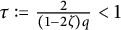 $\tau :=\frac {2}{(1-2\zeta )q}<1$
,
 $m:=H(0)$
, we obtain
 $$ \begin{align} \|u\|_2^{\frac{2}{1-2\zeta}} \le\left(1+\frac{1}{H(0)}\right)\left( H(t)+|\Omega|^{\frac{q-2}{2}}\|u\|_q^q \right )\le C_{12}\left(H(t)+\|u\|_q^q\right), \end{align} $$
where
 $ C_{12}:=\left (1+\frac {1}{H(0)}\right )\max \left \{1,|\Omega |^{\frac {q-2}{2}}\right \}>0$
. Substituting (4.55) into (4.54), we have
 $$ \begin{align*} y^r(t)\le C_{11}(1+C_{12}) \left(H(t)+\|u\|_q^q+\|u_t\|_2^2 \right)\le\frac{C_{11}(1+C_{12})}{C_{10}}y'(t), \end{align*} $$
which means
 $$ \begin{align} y'(t)\ge\frac{C_{10}}{C_{11}(1+C_{12})}y^r(t). \end{align} $$
A simple integration of (4.56) over
 $(0,t)$
yields
 $ y(t)\ge \left [y(0)^{1-r}-\frac {C_{10}(r-1)t}{C_{11}(1+C_{12})}\right ]^{\frac {1}{1-r}}$
for all
 $0\le t<T_1$
. We choose
 $T_1\ge T_* :=\frac {C_{11}(1+C_{12})y(0)^{1-r}}{C_{10}(r-1)}$
. Combining
 $r=\frac {1}{1-\zeta }>1$
and
 $y(0)>0$
, we have
 $$ \begin{align} \lim_{t \rightarrow T_*^-} y(t)=+\infty. \end{align} $$
However, we claim that there exists a positive constant
 $C_{13}$
such that
 $$ \begin{align} y(t)\le C_{13},\quad \text{for all }0\le t\le T_1. \end{align} $$
Actually, from (4.42), Young’s inequality, and
 $\lambda _1\|u\|_2^2\le \|\Delta u\|_2^2$
, we get
 $$ \begin{align*} y(t)&=H^{1-\zeta}(t)+\varepsilon_4\int_{\Omega}u_tu\mathrm{d}x\\ &=\left(\int_0^t\sigma(\|\nabla u\|_2^2)\|u_s\|_2^2\mathrm{d}s-E(0)\right )^{1-\zeta}+\varepsilon_4\int_{\Omega}u_tu\mathrm{d}x\\ &\le\left(\sigma_2\int_0^t\|u_s\|_2^2\mathrm{d}s-E(0)\right )^{1-\zeta}+\varepsilon_4\|u\|_2^2+\varepsilon_4\|u_t\|_2^2\\ &\le(\sigma_2D_3T_1-E(0))^{1-\zeta}+\frac{\varepsilon_4}{\lambda_1}D_1+\varepsilon_4D_3 =:C_{13}.\nonumber \end{align*} $$
Obviously, (4.58) is contrary to (4.57). We conclude the solution cannot remain globally bounded. Then
 $\limsup \limits _{t\rightarrow T_{\max }^{-}}\left (\|u_t\|_{2}^{2}+\|\Delta u\|_2^2+\|\nabla u\|_p^p\right )=+\infty $
. Especially, if
 $T_{\max }<+\infty $
, we obtain by Theorem 3.1 that
 $\lim \limits _{t\rightarrow T_{\max }^{-}}\left (\|u_t\|_{2}^{2}+\|\Delta u\|_2^2+\|\nabla u\|_p^p\right )=+\infty $
.
Step 2. If
 $T_{\mathrm {max}}<+\infty $
, from Theorem 3.1, we have
 $\lim \limits _{t \rightarrow T^{-}_{\mathrm {max}}} \left (\|u_t\|_2^2+\|\Delta u\|_2^2+\|\nabla u\|_p^p\right )=+\infty $
. Using the definition of
 $E(t)$
, we have
 $ \|u_t\|_2^2+\|\Delta u\|_2^2+\|\nabla u\|_p^p\le pE(0)+\frac {p}{q}\int _{\Omega }|u|^q\log |u|\mathrm {d}x$
. By the definitions of
 $E(t)$
and
 $I(u)$
, we get
 $$ \begin{align*} \frac{1}{q}I(u)\le\frac{1}{2}\|u_{t}\|_{2}^{2}+\frac{q-2}{2q}\|\Delta u\|_{2}^{2}+\frac{q-p}{pq}\|\nabla u\|_{p}^{p}+\frac{1}{q^2} \| u \|_{q}^{q} +\frac{1}{q}I(u)=E(t)\le E(0)<0. \end{align*} $$
Hence,
 $I(u)<0$
. By Lemma 2.2, we have
 $\|\Delta u\|_2>r(\alpha )>0$
. Together with the definition of
 $I(u)$
, we have
 $\frac {1}{q}\int _{\Omega }|u|^q \log |u|\mathrm {d}x>\|\Delta u\|_2^2>0 $
. By
 $-(r(\alpha ))^2\le E(0)<0$
, we have
 $E(0)+\frac {1}{q}\int _{\Omega }|u|^q \log |u|\mathrm {d}x>0$
.
(i) Using (2.4) and the embedding
 $H_0^2(\Omega )\hookrightarrow L^{q+\alpha }(\Omega )$
, we obtain
 $$ \begin{align*}\|u_t\|_2^2+\|\Delta u\|_2^2+\|\nabla u\|_p^p\le & p\left( E(0)+\frac{1}{q}\int_{\Omega}|u|^q \log|u|\mathrm{d}x\right)\\\le &p\left(E(0)+\frac{1}{\mathrm{e}q}\|u\|_{q+\alpha}^{q+\alpha}\right)\le p\left(E(0)+\frac{B_{\alpha}^{q+\alpha}}{\mathrm{e}q}\|\Delta u\|_{2}^{q+\alpha}\right).\end{align*} $$
Hence,
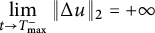 $\lim \limits _{t \rightarrow T^{-}_{\max }} \|\Delta u\|_{2}=+\infty $
.
(ii) Similarly, using (2.4) and the embedding
 $W_0^{1,p}(\Omega )\hookrightarrow L^{q+\alpha }(\Omega )$
, we obtain
 $$ \begin{align*} \|u_t\|_2^2+\|\Delta u\|_2^2+\|\nabla u\|_p^p\le p E(0)+\frac{p B_3^{q+\alpha}}{\mathrm{e}q}\|\nabla u\|_{p}^{q+\alpha}, \end{align*} $$
where
 $B_3$
is the embedding constant in
 $W_0^{1,p}(\Omega )\hookrightarrow L^{q+\alpha }(\Omega )$
. Hence,
 $\lim \limits _{t \rightarrow T^{-}_{\max }} \|\nabla u\|_{p}=+\infty $
.
5 Case
$q=p$

In this section, we will consider the global solvability of problem (1.1) under the state of the equal strength of the diffusion and the reaction (i.e.,
 $q=p$
).
Theorem 5.1 Let
 $(\mathcal {H})$
hold. If
 $q=p$
and the initial data
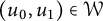 $ (u_0,u_1) \in \mathcal {W}$
, then problem (1.1) possesses a unique global solution u as defined in Definition 2.1. Moreover, the energy function
 $E(t)$
satisfies the following decay estimate:
 $$ \begin{align} E(t)\le\frac{C_{15}}{L+t},\quad \text{for all } 0\le t<+\infty, \end{align} $$
where L is a positive constant and
 $$ \begin{align*} &C_{14}:=\frac{(1+\sigma_3)pd}{(p-2)\lambda_1}+d+\frac{d}{a}+\frac{1}{2}\|u_0\|_2^2+\frac{1}{2}\|u_1\|_2^2,\\ &C_{15}:=\frac{1}{p}C_{14}+\frac{(p-2)\lambda_*^p}{2p(\lambda_*^p-\lambda_*^2)}C_{14}+\frac{C_{14}}{p^2\log\lambda*}+\frac{d}{2a}+Ld. \end{align*} $$
In particular, if
 $E(0)<M$
, then the energy functional
 $E(t)$
satisfies the exponential decay estimate
 $$ \begin{align} E(t)\le C_{16}\mathrm{e}^{-C_{17}t},\quad\text{for all } 0\le t<+\infty, \end{align} $$
where the positive constants
 $$ \begin{align*} C_{16} :=\frac{E(0)+\varepsilon_5\displaystyle\int_{\Omega}u_0u_1\mathrm{d}x}{1-\varepsilon_5-\frac{\varepsilon_5(1+\sigma_1)p}{\lambda_1(p-2)}},\quad C_{17} :=\frac{\beta\varepsilon_5}{1+\varepsilon_5+\frac{\varepsilon_5(1+\sigma_1)p}{\lambda_1(p-2)}}, \end{align*} $$
and
 $\beta _1$
is a small constant such that
 $$ \begin{align*} \beta_1<p,\quad\frac{\beta_1}{2}+\frac{\beta_1 B_0^p}{p^2}\left(\frac{2pE(0)}{p-2}\right )^{\frac{p-2}{2}}+\frac{{B_{\alpha}^{p+\alpha}}}{e\alpha}\left( \frac{2pE(0)}{p-2}\right)^{\frac{p+\alpha-2}{2}}-1<0, \end{align*} $$
and
 $\varepsilon _5$
is a small constant such that
 $$ \begin{align*} 1-\varepsilon_5-\frac{\varepsilon_5(1+\sigma_1)p}{\lambda_1(p-2)}>0,\quad \varepsilon_5+\frac{\beta\varepsilon_5}{2}-a<0,\quad E(0)+\varepsilon_5\int_{\Omega}u_0u_1\mathrm{d}x\ge0. \end{align*} $$
Proof The proof of Theorem 5.1 is divided into four steps.
Step 1. Global existence for the case of
 $(u_0,u_1)\in \mathcal {W}_1$
. Let the sequences
 $\{\omega _j\}_{j=1}^{+\infty }$
,
 $\{u_{0m}\}_{m=1}^{+\infty }$
,
 $\{u_{1m}\}_{m=1}^{+\infty }$
, and
 $\{u_{m}\}_{m=1}^{+\infty }$
be the same ones as those stated in the proof of Theorem 3.1. Multiplying both sides of (3.1) by
 $b^{\prime }_{jm}(t)$
, summing over
 $j=1,2,\ldots ,m,$
and integrating it from
 $0$
to t, for sufficiently large m, we obtain
 $$ \begin{align} E_m(t)&+\int_0^t\sigma(\|\nabla u_m\|_2^2)\|u_{ms}(s)\|_2^2\mathrm{d}s\le E_m(0)<d, \quad\text{for all } 0\le t<+\infty. \end{align} $$
 $$ \begin{align} E_m(t)&=\frac{1}{2}\|u_{mt}\|_{2}^{2}+J(u_m)\le E_m(0)<d, \quad \text{for all } 0\le t<+\infty. \end{align} $$
Next, we prove that
 $(u_m,u_{mt})\in \mathcal {W}_1$
for sufficiently large m. Similar to the proof in Theorem 4.1, we get
 $(u_m,u_{mt})\in \mathcal {W}_1$
and
 $I(u_m)>0$
for sufficiently large m and
 $0\le t<+\infty $
.
Next, by the definitions of
 $I(u)$
,
 $E(t)$
,
 $J(u),$
and
 $I(u)\ge 0$
, we obtain
 $$ \begin{align} &J(u_m)=\frac{p-2}{2p}\|\Delta u_m\|_{2}^{2}+\frac{1}{p^2}\left \|u_m\right \|_{p}^{p}+\frac{1}{p}I(u_m),\quad \text{for all } 0\le t<+\infty,\\ &E_m(t):=\frac{1}{2}\|u_{mt}\|_{2}^{2}+J(u_m)>0,\quad\text{for all } 0\le t<+\infty.\nonumber \end{align} $$
Using (5.4) and (5.5) and
 $I(u)\ge 0$
, we get
 $ \frac {p-2}{2p}\|\Delta u_m\|_{2}^{2}+\frac {1}{p^2}\left \|u_m\right \|_{p}^{p}<d$
for all
 $0\le t<+\infty $
. From the embedding
 $H_0^2(\Omega )\hookrightarrow W_0^{1,p}(\Omega )$
, we get
 $ \|\nabla u\|_p\le \overline {S}\|\Delta u\|_2\le \overline {S}\sqrt {\frac {2pd}{p-2}}$
for all
 $0\le t<+\infty $
. We observe that for
 $q=p>2$
, with (5.3)–(5.5), we obtain that
 $\left \{u_m \right \}$
is uniformly bounded in
 $L^{\infty }((0,\infty );H_0^2(\Omega ))$
,
 $\left \{u_m \right \} $
is uniformly bounded in
 $L^{\infty }((0,\infty );W_0^{1,p}(\Omega ))$
,
 $\left \{u_{mt} \right \}$
is uniformly bounded in
 $L^{\infty }((0,\infty );L^{2}(\Omega ))$
, and
 $\left \{u_{mt} \right \}$
is uniformly bounded in
 $L^2((0,\infty );L^2(\Omega ))$
. The rest of the proof can be obtained similarly to that of Theorem 4.1.
Step 2. Global existence for the case of
 $(u_0,u_1)\in \mathcal {W}_2$
. The proof can be obtained similarly to that of Theorem 4.1.
Step 3. Decay estimate (5.1) of energy. From Steps 1 and 2, we know that if
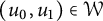 $(u_0,u_1)\in \mathcal {W}$
, then
 $(u,u_t)\in \mathcal {W}$
for
 $0\le t<+\infty $
, and
 $I(u)\ge 0$
. With the definitions of
 $E(t)$
,
 $\sigma (s),$
and
 $I(u)\ge 0$
, we have
 $$ \begin{align} E(0)&\ge E(t)+\int_0^t\sigma(\|\nabla u\|_2^2)\|u_{s}(s)\|_2^2\mathrm{d}s\ge \frac{1}{2}\|u_{t}\|_{2}^{2}+J(u)+a\int_0^t\|u_s\|_2^2\mathrm{d}s\nonumber\\&=\frac{1}{2}\|u_{t}\|_{2}^{2}+\frac{p-2}{2p}\|\Delta u\|_{2}^{2}+\frac{1}{p^2}\|u\|_{p}^{p} +\frac{1}{p}I(u)+a\int_0^t\|u_s\|_2^2\mathrm{d}s\nonumber\\&\ge\frac{1}{2}\|u_{t}\|_{2}^{2}+\frac{p-2}{2p}\|\Delta u\|_{2}^{2}+\frac{1}{p^2}\|u \|_{p}^{p}+a\int_0^t\|u_s\|_2^2\mathrm{d}s. \end{align} $$
A combination of (5.6) with
 $E(0)\le d$
yields that
 $ \|u_{t}\|_{2}^{2}\le 2d$
,
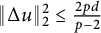 $\|\Delta u\|_{2}^{2}\le \frac {2pd}{p-2}$
,
 $\|\nabla u\|_{p}^{p}\le \overline {S}^p\|\Delta u\|_2^p\le \overline {S}^p\left (\frac {2pd}{p-2}\right )^{\frac {p}{2}}$
, and
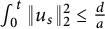 $\int _0^t\|u_s\|_2^2\le \frac {d}{a}$
. Using the inequality
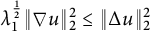 $\lambda _{1}^{\frac {1}{2}}\|\nabla u\|_{2}^{2}\leq \|\Delta u\|_{2}^{2}$
, we have
 $$ \begin{align*} \|\nabla u\|_2^2\le\lambda_1^{-\frac{1}{2}}\|\Delta u\|_2^2\le\lambda_1^{-\frac{1}{2}}\frac{2pd}{p-2}=:C". \end{align*} $$
Because
 $\sigma (s)$
is a positive continuous function on
 $[0,+\infty )$
, there is a constant
 $\sigma _3>0$
such that
 $$ \begin{align} \sigma(\|\nabla u\|_2^2)\le\max_{0\le\|\nabla u\|_2^2\le C"}\sigma(\|\nabla u\|_2^2) =:\sigma_3. \end{align} $$
The rest of the proof can be obtained similarly to that of Theorem 4.1.
Step 4. Exponential decay estimate (5.2) of energy. Let
 $$ \begin{align*}F_1(t) :=E(t)+\varepsilon_5\displaystyle\int_{\Omega}uu_t\mathrm{d}x+\varepsilon_5\displaystyle\int_0^t\sigma(\|\nabla u\|_2^2)\displaystyle\int_{\Omega}uu_s\mathrm{d}x\mathrm{d}s.\end{align*} $$
Similar to the proof of Theorem 4.1, we get the exponential decay estimate (5.2).
Unfortunately, we failed to obtain the existence of blow-up solutions in the critical case
 $p=q$
. However, we are certain that blow-up might occur when the initial data lie outside the potential well.
6 Case
$q<p$

This section is concerned with the case where the reaction is dominant (i.e.,
 $q<p$
).
Theorem 6.1 Let
 $q<p$
,
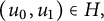 $(u_0,u_1)\in H,$
and u be the weak solution as given in Definition 2.1. If
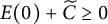 $E(0)+\widetilde {C}\ge 0$
and
 $\mu $
is a positive constant which satisfies
 $q+\mu <p$
and
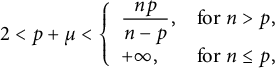 $2<p+\mu <\left \{\begin {array}{llll} \displaystyle \frac {np}{n-p},&\text {for}\ n>p,\\ +\infty ,&\text {for}\ n\le p, \end {array}\right .$
then u remains globally bounded for any
 $t\in [0,+\infty )$
, which satisfies
 $$ \begin{align} \|u_t\|_2 &\le\sqrt{2}\left (E(0)+\widetilde{C} \right)^{\frac{1}{2}},\quad \|\Delta u\|_2 \le\sqrt{2}\left(E(0)+\widetilde{C} \right)^{\frac{1}{2}}, \end{align} $$
 $$ \begin{align} \|\nabla u\|_p &\le\left[\frac{m_2p\left(E(0)+\widetilde{C}\right)}{m_2-1} \right]^{\frac{1}{p}},\quad \| u\|_q \le\left [ q^2(E(0)+\widetilde{C}) \right ]^{\frac{1}{q}}, \end{align} $$
where the positive constants are defined as
 $ m_1 :=\frac {p}{p-q-\mu }$
,
 $m_2 :=\frac {p}{q+\mu }$
,
 $\widetilde {C}:=\frac {\widetilde {S}^{m_1(q+\mu )}}{m_1(q\mathrm { e}\mu )^{m_1}}|\Omega |^{\frac {(p-q)m_1}{p+\mu }}p^{\frac {m_1}{m_2}}$
, and
 $\widetilde {S}$
is the embedding constant in
 $W_0^{1,p}(\Omega )\hookrightarrow L^{p+\mu }(\Omega )$
.
Proof Taking
 $\phi :=u_t$
in (2.2), we get
 $$ \begin{align} &\frac{1}{2}\|u_t\|_2^2+\frac{1}{2}\|\Delta u\|_2^2+\frac{1}{p}\|\nabla u\|_p^p+\frac{1}{q^2}\|u\|_q^q\nonumber\\ =&\frac{1}{2}\|u_1\|_2^2+\frac{1}{2}\|\Delta u_0\|_2^2+\frac{1}{p}\|\nabla u_0\|_p^p+\frac{1}{q^2}\|u_0\|_q^q+\frac{1}{q}\int_{\Omega}|u|^q\log|u|\mathrm{ d}x\nonumber\\ \quad&-\frac{1}{q}\int_{\Omega}|u_0|^q\log|u_0|\mathrm{d}x-\int_0^t\sigma(\|\nabla u\|_2^2)\int_{\Omega}\|u_t\|_2^2\mathrm{d}x\mathrm{d}s\nonumber\\ \le&E(0)+\frac{1}{q}\int_{\Omega}|u|^q\log|u|\mathrm{d}x. \end{align} $$
By using the embedding
 $W_0^{1,p}(\Omega )\hookrightarrow L^{p+\mu }(\Omega )$
and Hölder’s inequality, we obtain
 $$ \begin{align} \|u\|_{q+\mu}\le|\Omega|^{\frac{p-q}{(p+\mu)(q+\mu)}}\|u\|_{p+\mu}\le\widetilde{S}|\Omega|^{\frac{p-q}{(p+\mu)(q+\mu)}}\|\nabla u\|_p. \end{align} $$
As for the logarithmic term, using (2.4), (6.4), Hölder’s inequality, and the embedding
 $W_0^{1,p}(\Omega )\hookrightarrow L^{p+\mu }(\Omega )$
, we get
 $$ \begin{align*} \frac{1}{q}\int_{\Omega}|u|^q\log|u|\mathrm{d}x&=\frac{1}{q}\int_{\{{x\in\Omega||u|\le1}\}}|u|^q\log|u|\mathrm{ d}x+\frac{1}{q}\int_{\{{x\in\Omega||u|>1}\}}|u|^q\log|u|\mathrm{d}x\\ &\le\frac{1}{q\mathrm{e}\mu}\|u\|_{q+\mu}^{q+\mu}\le\frac{\widetilde{S}^{q+\mu}}{q\mathrm{e}\mu}|\Omega|^{\frac{p-q}{p+\mu}}\|\nabla u\|_p^{q+\mu}. \end{align*} $$
Finally, using Young’s inequality, we get
 $$ \begin{align} \frac{\widetilde{S}^{q+\mu}}{q\mathrm{e}\mu}|\Omega|^{\frac{p-q}{p+\mu}}\|\nabla u\|_p^{q+\mu} \le \frac{\widetilde{S}^{m_1(q+\mu)}}{m_1(q\mathrm{ e}\mu)^{m_1}}|\Omega|^{\frac{(p-q)m_1}{p+\mu}}p^{\frac{m_1}{m_2}}+\frac{1}{m_2p}\|\nabla u\|_p^p. \end{align} $$
Substituting (6.5) into (6.3), we get
 $ \frac {1}{2}\|u_t\|_2^2+\frac {1}{2}\|\Delta u\|_2^2+\left (\frac {1}{p}-\frac {1}{m_2 p}\right )\|\nabla u\|_p^p+\frac {1}{q^2}\|u\|_q^q\le E(0)+\widetilde {C}$
. Hence, from (6.1) and (6.2), the solution u of (1.1) remains globally bounded.
Acknowledgements
The authors would like to express their sincere thanks to the Editors and the Reviewers for the constructive comments to improve this article.
Competing interests
On behalf of all authors, the corresponding author states that there are no competing interests.
Data availability statement
All data generated or analyzed during this study are included in this article.



