1 Introduction
A non-well-founded proof is usually defined as a possibly infinite tree of formulas (sequents) that is constructed according to inference rules of a proof system, that satisfies possible further conditions on infinite branches. A cyclic, or circular, proof can be defined as a finite directed graph of formulas (sequents) whose unraveling yields a non-well-founded proof. These proofs turn out to be an interesting alternative to traditional proofs for logics with inductive and co-inductive definitions, fixed-point operators and similar features. For example, proof systems allowing cyclic proofs can be defined for the modal
 $\mu $
-calculus [Reference Afshari and Leigh1], the Lambek calculus with iteration [Reference Kuznetsov, Kennedy and de Queiroz13] and for Peano arithmetic [Reference Simpson, Esparza and Murawski21]. In the last case, these proofs can be understood as a formalization of the concept of proof by infinite descent.
Structural proof theory of deductive systems allowing cyclic and non-well-founded proofs seems to be underdeveloped. In [Reference Fortier, Santocanale and Della Rocca11], Fortier and Santocanale considered the case of the
 $\mu $
-calculus with additive connectives. They presented a procedure for eliminating all applications of the cut-rule from a cyclic proof that results in an infinite tree of sequents. However they didn’t show that this tree satisfies the necessary conditions for non-well-founded proofs in the
 $\mu $
-calculus.Footnote
1
In [Reference Baedel, Doumane, Saurin, Talbot and Regnier3], Doumane et al. consider non-well-founded proofs for a variant of the
 $\mu $
-calculus called
 $\mu \mathsf {MALL}$
, but their proof of the cut elimination theorem seems to rely on a semantic argument. The only paper the authors know where cut elimination is established purely syntactically for a system with non-well-founded proofs is the paper by Das and Pous [Reference Das, Pous, Ghica and Jung7], where they consider such a system for the logic of
 $\ast $
-continuous action lattices. In our paper we propose an approach for syntactically proving cut elimination for such systems using the Grzegorczyk modal logic as an example case.Footnote
2
The Grzegorczyk modal logic
 $\mathsf {Grz}$
is a well-known modal logic [Reference Maksimova14], which can be characterized by reflexive partially ordered Kripke frames without infinite ascending chains. This logic is complete w.r.t. the arithmetical semantics, where the modal connective
 $\Box $
corresponds to the strong provability operator “… is true and provable in Peano arithmetic.” There is a translation from
 $\mathsf {Grz}$
into the Gödel–Löb provability logic
 $\mathsf {GL}$
such that
 $$\begin{align*}\mathsf{Grz} \vdash A \Longleftrightarrow \mathsf{GL} \vdash A^\ast,\end{align*}$$
where
 $A^\ast $
is obtained from A by replacing all subformulas of the form
 $\Box B$
by
 $B \wedge \Box B$
.
Recently a new proof-theoretic presentation for the Gödel–Löb provability logic
 $\mathsf {GL}$
in the form of a sequent calculus allowing non-well-founded proofs was given in [Reference Iemhoff, van Eijck, Iemhoff and Joosten12, Reference Shamkanov20]. We wonder whether cyclic and, more generally, non-well-founded proofs can be fruitfully considered in the case of
 $\mathsf {Grz}$
. We consider a sequent calculus allowing non-well-founded proofs for the Grzegorczyk modal logic and present the cut-elimination theorem for the given system. In order to avoid nested co-inductive and inductive reasoning, we adopt an approach from denotational semantics of computer languages, where program types are interpreted as ultrametric spaces and fixed-point combinators are encoded using the Banach fixed-point theorem (see [Reference Baier and Majster-Cederbaum4], [Reference Escardó10], [Reference van Breugel22]). We consider the set of non-well-founded proofs of
 $\mathsf {Grz}$
and various sets of operations acting on these proofs as ultrametric spaces and define our cut-elimination operator following the lines of the Prieß-Crampe fixed-point theoremFootnote
3
(see [Reference Prieß-Crampe17]), which is a strengthening of Banach’s theorem. We believe that this approach to cut elimination can also be applied to more complicated systems such as various logics with fixed-point operators. As an application of our cut elimination result for the logic
 $\mathsf {Grz}$
, we establish that it is sufficient to consider only unravellings of cut-free cyclic proofs instead of arbitrary non-well-founded proofs in order to obtain all provable sequents. As another application, we prove the Lyndon interpolation property for the logic
 $\mathsf {Grz}$
proof-theoretically.
Recall that the Craig interpolation property for a logic
 $\mathsf {L}$
says that if A implies B, then there is an interpolant, that is, a formula I containing only common variables of A and B such that A implies I and I implies B. The Lyndon interpolation property is a strengthening of the Craig interpolation that also takes into consideration negative and positive occurrences of the shared propositional variables; that is, the variables occurring in I positively (negatively) must also occur both in A and B positively (negatively).
Though the Grzegorczyk logic has the Lyndon interpolation property [Reference Maksimova15], there were seemingly no syntactic proofs for this result. It is unclear how Lyndon interpolation can be obtained from previously introduced sequent systems for
 $\mathsf {Grz}$
[Reference Avron2, Reference Borga and Gentilini5, Reference Dyckhoff and Negri9] by direct proof-theoretic arguments because these systems contain inference rules in which a polarity change occurs under the passage from the principal formula in the conclusion to its immediate ancestors in the premises. In this article, we give a syntactic proof of Lyndon interpolation for the Grzegorczyk modal logic.
The paper is organized as follows. In §2 we recall a standard sequent calculus for
 $\mathsf {Grz}$
. In §3 we introduce the proof system
 $\mathsf {Grz}_\infty $
that allows non-well-founded proofs and prove its equivalence to the standard one. In §4 we recall basic notions of the theory of ultrametric spaces and consider several relevant examples. In §5 we state admissibility of several rules for our system that will be used later. In §6 we establish the cut elimination result for the system
 $\mathsf {Grz}_\infty $
syntactically. In §7 we prove the Lyndon interpolation property for the logic
 $\mathsf {Grz}$
. Finally, in §8 we establish that every provable sequent of
 $\mathsf {Grz}_\infty $
has a cyclic proof.
2 Preliminaries
In this section we recall the Grzegorczyk modal logic
 $\mathsf {Grz}$
and define an ordinary sequent calculus for it.
Formulas of
 $\mathsf {Grz}$
, denoted by A, B, C, are built up as follows:
 $$\begin{align*}A ::= \bot \,\,|\,\, p \,\,|\,\, (A \to A) \,\,|\,\, \Box A \;,\end{align*}$$
where p stands for atomic propositions. We treat other boolean connectives and the modal operator
 $\Diamond $
as abbreviations:
 $$ \begin{align*} \neg A := A\to \bot,\qquad\top := \neg \bot,&\qquad A\wedge B := \neg (A\to \neg B), \\ A\vee B := (\neg A\to B),&\qquad\Diamond A := \neg\Box \neg A. \end{align*} $$
The Hilbert-style axiomatization of
 $\mathsf {Grz}$
is given by the following axioms and inference rules (see [Reference Chagrov and Zakharyaschev6], §3.8):
Axioms:
-
(i) Boolean tautologies;
-
(ii)
 $\Box (A \rightarrow B) \rightarrow (\Box A \rightarrow \Box B)$
; and
-
(iii)
$\Box (\Box (A \rightarrow \Box A) \rightarrow A) \rightarrow A$
.


Rules: modus ponens,
 $A / \Box A$
.
Notice that transitivity and reflexivity of the modal operator
 $\Box $
are derivable in
 $\mathsf {Grz}$
, i.e.,
 $\mathsf {Grz}\vdash \Box A \rightarrow \Box \Box A$
and
 $\mathsf {Grz}\vdash \Box A \rightarrow A$
for any formula A.
Now we define an ordinary sequent calculus for
 $\mathsf {Grz}$
. A sequent is an expression of the form
 $\Gamma \Rightarrow \Delta $
, where
 $\Gamma $
and
 $\Delta $
are finite multisets of formulas. For a multiset of formulas
 $\Gamma = A_1,\dotsc , A_n$
, we define
 $\Box \Gamma $
to be
 $\Box A_1,\dotsc , \Box A_n$
.
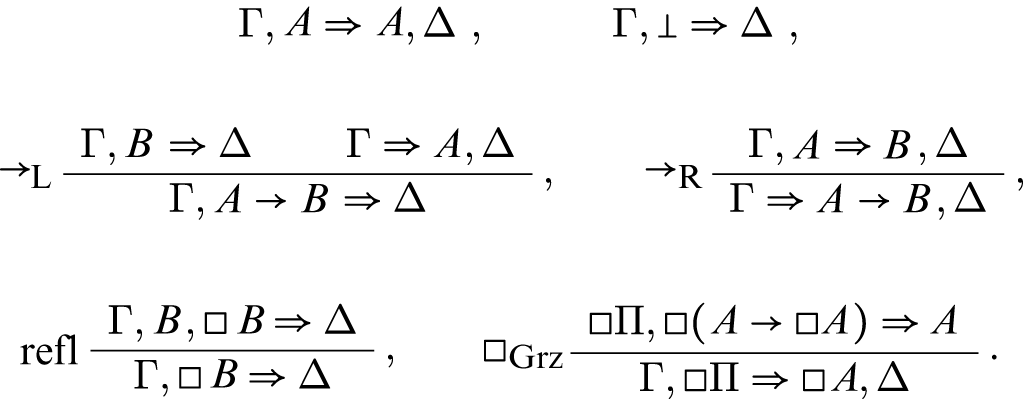
The system
 $\mathsf {Grz}_{\mathsf{Seq}}$
, which is a variant of the sequent calculus from [Reference Avron2], is defined by the following initial sequents and inference rules:
The system
 $\mathsf {Grz}_{\mathsf {Seq}}$
.

The cut rule has the form
 $$ \begin{align*}{{\mathsf{cut}}}\,\frac{{\Gamma\Rightarrow A,\Delta}\qquad {\Gamma,A\Rightarrow\Delta}}{{\Gamma\Rightarrow\Delta}} , \end{align*} $$
where A is called the cut formula of the given inference.
Lemma 2.1 (cf. Theorem 1 from [2].)
 $\mathsf {Grz}_{\mathsf{Seq}} + \mathsf {cut}\vdash \Gamma \Rightarrow \Delta $
if and only if
 $\mathsf {Grz} \vdash \bigwedge \Gamma \to \bigvee \Delta $
.
This lemma is completely standard, so we omit the proof.
Theorem 2.2. If
 $\mathsf {Grz}_{\mathsf{Seq}} + \mathsf {cut}\vdash \Gamma \Rightarrow \Delta $
, then
 $\mathsf {Grz}_{\mathsf{Seq}} \vdash \Gamma \Rightarrow \Delta $
.
A syntactic cut-elimination for
 $\mathsf {Grz}$
was obtained by Borga and Gentilini in [Reference Borga and Gentilini5]. In this paper, we will give another proof of this cut-elimination theorem in the next sections.
3 Non-well-founded proofs
In this section we introduce a sequent calculus for
 $\mathsf {Grz}$
allowing non-well-founded proofs and define two translations that connect the ordinary and non-well-founded sequent systems.
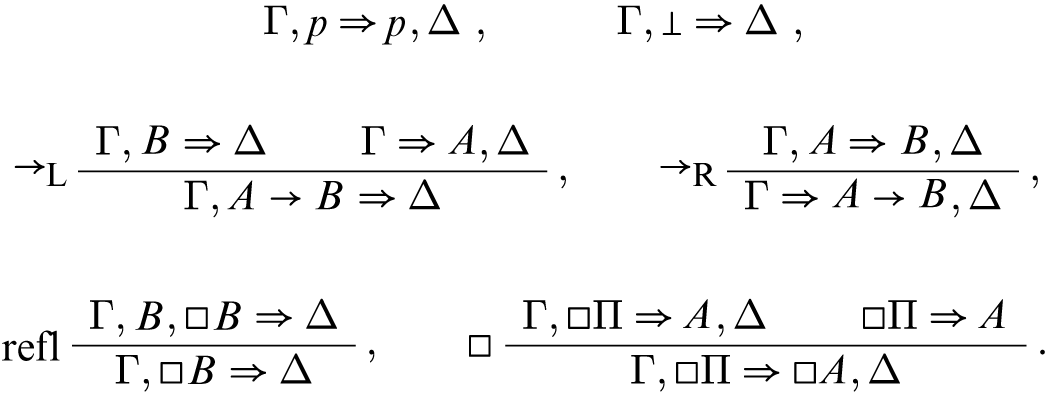
Inference rules and initial sequents of the sequent calculus
 $\mathsf {Grz}_\infty $
have the following form:
The system
 $\mathsf {Grz}_\infty $
.

The system
 $\mathsf {Grz}_{\infty }+\mathsf {cut}$
is defined by adding the rule (
 $\mathsf {cut}$
) to the system
 $\mathsf {Grz}_{\infty }$
. An
 $\infty $
-proof in
 $\mathsf {Grz}_\infty $
(
 $\mathsf {Grz}_{\infty }+\mathsf {cut}$
) is a (possibly infinite) tree whose nodes are marked by sequents and whose leaves are marked by initial sequents and that is constructed according to the rules of the sequent calculus. In addition, every infinite branch in an
 $\infty $
-proof must pass through a right premise of the rule (
 $\Box $
) infinitely many times. A sequent
 $\Gamma \Rightarrow \Delta $
is provable in
 $\mathsf {Grz}_\infty $
(
 $\mathsf {Grz}_{\infty }+\mathsf {cut}$
) if there is an
 $\infty $
-proof in
 $\mathsf {Grz}_\infty $
(
 $\mathsf {Grz}_{\infty }+\mathsf {cut}$
) with the root marked by
 $\Gamma \Rightarrow \Delta $
.
The n-fragment of an
 $\infty $
-proof is a finite tree obtained from the
 $\infty $
-proof by cutting every branch at the nth from the root right premise of the rule (
 $\Box $
), so that this premise is removed. The
 $1$
-fragment of an
 $\infty $
-proof is also called its main fragment. We define the local height
 $\lvert \pi \rvert $
of an
 $\infty $
-proof
 $\pi $
as the length of the longest branch in its main fragment. An
 $\infty $
-proof only consisting of an initial sequent has height 0.
For instance, consider an
 $\infty $
-proof of the sequent
 $\Box (\Box (p \rightarrow \Box p) \rightarrow p) \Rightarrow p$
:
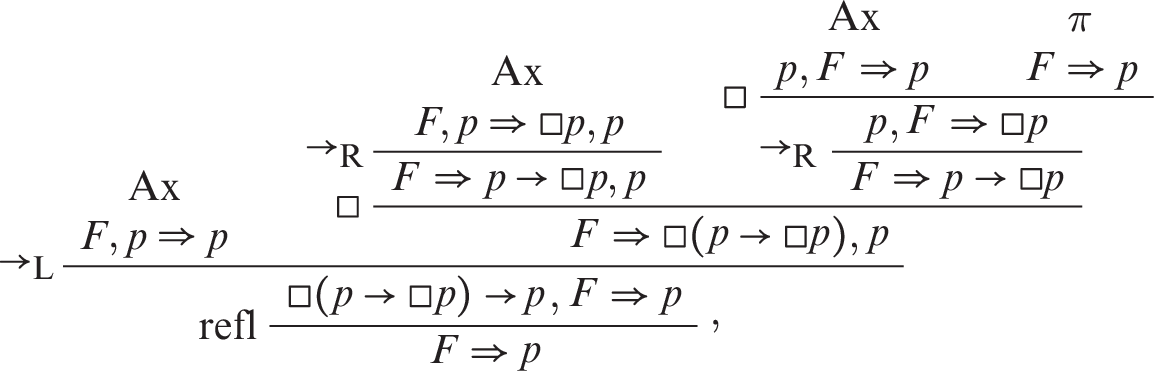
where
 $F=\Box (\Box (p \rightarrow \Box p) \rightarrow p) $
and the subtree
 $\pi $
is isomorphic to the whole
 $\infty $
-proof. The local height of this
 $\infty $
-proof equals 4 and its main fragment has the form

We denote the set of all
 $\infty $
-proofs in the system
 $\mathsf {Grz}_{\infty } +\mathsf {cut} $
by
 $\mathcal P$
. For
 $\pi , \tau \in \mathcal P$
, we write
 $\pi \sim _n \tau $
if n-fragments of these
 $\infty $
-proofs coincide. For any
 $\pi , \tau \in \mathcal P$
, we also set
 $\pi \sim _0 \tau $
.
Now we define two translations that connect the ordinary and non-well-founded sequent calculi for
 $\mathsf {Grz}$
.
Lemma 3.3. For any sequent
 $\Gamma \Rightarrow \Delta $
and any formula A we have
 $\mathsf {Grz}_{\infty } \vdash \Gamma ,A\Rightarrow A,\Delta $
.
Proof. Standard induction on the structure of A. □
Lemma 3.4. For any formula A we have
 $\mathsf {Grz}_{\infty }\vdash \Box (\Box (A \rightarrow \Box A) \rightarrow A) \Rightarrow A$
.
Proof. Consider an example of
 $\infty $
-proof for the sequent
 $\Box (\Box (p \rightarrow \Box p) \rightarrow p) \Rightarrow p$
given above. We transform this example into an
 $\infty $
-proof for
 $\Box (\Box (A \rightarrow \Box A) \rightarrow A) \Rightarrow A$
by replacing p with A and adding required
 $\infty $
-proofs instead of initial sequents using Lemma 3.3. □
Recall that an inference rule is called admissible (in a given proof system) if, for any instance of the rule, the conclusion is provable whenever all premises are provable.
Lemma 3.5. The rule

is admissible in the systems
 $\mathsf {Grz}_{\mathsf {Seq}} $
and
 $\mathsf {Grz}_{\infty } +\mathsf {cut}$
.
Proof. Standard induction on the structure (local height) of a proof of
 $\Gamma \Rightarrow \Delta $
. □
Theorem 3.6. If
 $\mathsf {Grz}_{\mathsf {Seq}}+\mathsf {cut}\vdash \Gamma \Rightarrow \Delta $
, then
 $\mathsf {Grz}_{\infty }+\mathsf {cut}\vdash \Gamma \Rightarrow \Delta $
.
Proof. Assume
 $\pi $
is a proof of
 $\Gamma \Rightarrow \Delta $
in
 $\mathsf {Grz}_{\mathsf {Seq}}+\mathsf {cut}$
. By induction on the size of
 $\pi $
we prove
 $\mathsf {Grz}_{\infty }+\mathsf {cut}\vdash \Gamma \Rightarrow \Delta $
.
If
 $\Gamma \Rightarrow \Delta $
is an initial sequent of
 $\mathsf {Grz}_{\mathsf {Seq}}+\mathsf {cut}$
, then it is either an initial sequent of
 $\mathsf {Grz}_{\infty }+\mathsf {cut}$
, or is provable in
 $\mathsf {Grz}_{\infty }+\mathsf {cut}$
by Lemma 3.3. Otherwise, consider the last application of an inference rule in
 $\pi $
.
The only nontrivial case is when the proof
 $\pi $
has the form

where
 $\Sigma ,\Box \Pi = \Gamma $
and
 $\Box A, \Lambda = \Delta $
. By the induction hypothesis there is an
 $\infty $
-proof
 $\xi $
of
 $\Box \Pi ,\Box (A\to \Box A)\Rightarrow A$
in
 $\mathsf {Grz}_{\infty }+\mathsf {cut}$
.
We have the following
 $\infty $
-proof
 $\lambda $
of
 $\Box \Pi \Rightarrow A$
in
 $\mathsf {Grz}_{\infty }+\mathsf {cut} $
:

where
 $G= \Box (A \rightarrow \Box A) \rightarrow A$
,
 $\xi ^{\prime }$
is an
 $\infty $
-proof of
 $\Box \Pi ,\Box (A\to \Box A)\Rightarrow A,A$
obtained from
 $\xi $
by Lemma 3.5, and
 $\theta $
is an
 $\infty $
-proof of
 $\Box \Pi ,\Box G \Rightarrow A$
, which exists by Lemma 3.4 and Lemma 3.5.
The required
 $\infty $
-proof for
 $\Sigma ,\Box \Pi \Rightarrow \Box A, \Lambda $
has the form

where
 $\lambda '$
is an
 $\infty $
-proof of the sequent
 $\Sigma ,\Box \Pi \Rightarrow A,\Lambda $
obtained from the
 $\infty $
-proof
 $\lambda $
by Lemma 3.5.
The cases of other inference rules being last in
 $\pi $
are straightforward, so we omit them. □
For a sequent
 $\Gamma \Rightarrow \Delta $
, let
 $Sub(\Gamma \Rightarrow \Delta )$
be the set of all subformulas of the formulas from
 $\Gamma \cup \Delta $
. For a finite set of formulas
 $\Lambda $
, let
 $\Lambda ^\ast $
be the set
 $\{\Box (A\to \Box A)\mid A\in \Lambda \}$
.
Theorem 3.7. If
 $\mathsf {Grz}_{\infty }\vdash \Gamma \Rightarrow \Delta $
, then
 $\mathsf {Grz}_{\mathsf {Seq}} \vdash \Gamma \Rightarrow \Delta $
.
Proof. First we will prove a more general statement: if
 $\mathsf {Grz}_{\infty }\vdash \Gamma \Rightarrow \Delta $
, then
 $\mathsf {Grz}_{\mathsf {Seq}} \vdash \Lambda ^\ast ,\Gamma \Rightarrow \Delta $
for any finite set of formulas
 $\Lambda $
. The statement of the theorem immediately follows by assuming the set
 $\Lambda $
to be empty.
Assume
 $\pi $
is an
 $\infty $
-proof of the sequent
 $\Gamma \Rightarrow \Delta $
in
 $\mathsf {Grz}_\infty $
and
 $\Lambda $
is a finite set of formulas. By induction on the number of elements in the finite set
 $Sub(\Gamma \Rightarrow \Delta )\backslash \Lambda $
with a subinduction on
 $\lvert \pi \rvert $
, we prove
 $\mathsf {Grz}_{\mathsf {Seq}} \vdash \Lambda ^\ast ,\Gamma \Rightarrow \Delta $
.
If
 $\lvert \pi \rvert =0$
, then
 $\Gamma \Rightarrow \Delta $
is an initial sequent. We see that the sequent
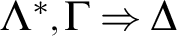 $\Lambda ^\ast ,\Gamma \Rightarrow \Delta $
is an initial sequent and it is provable in
 $\mathsf {Grz}_{\mathsf {Seq}}$
. Otherwise, consider the last application of an inference rule in
 $\pi $
.
Case 1. Suppose that
 $\pi $
has the form

where
 $A\to B,\Sigma = \Delta $
. Notice that
 $\lvert \pi ^\prime \rvert < \lvert \pi \rvert $
. By the induction hypothesis for
 $\pi ^\prime $
and
 $\Lambda $
, the sequent
 $\Lambda ^\ast ,\Gamma ,A\Rightarrow B,\Sigma $
is provable in
 $\mathsf {Grz}_{\mathsf {Seq}}$
. Applying the rule (
 $\to _{\mathsf {R}}$
) to it, we obtain that the sequent
 $\Lambda ^\ast ,\Gamma \Rightarrow \Delta $
is provable in
 $\mathsf {Grz}_{\mathsf {Seq}}$
.
Case 2. Suppose that
 $\pi $
has the form

where
 $\Sigma , A\to B = \Gamma $
. We see that
 $\lvert \pi ^\prime \rvert < \lvert \pi \rvert $
. By the induction hypothesis for
 $\pi ^\prime $
and
 $\Lambda $
, the sequent
 $\Lambda ^\ast ,\Sigma , B\Rightarrow \Delta $
is provable in
 $\mathsf {Grz}_{\mathsf {Seq}}$
. Analogously, we have
 $\mathsf {Grz}_{\mathsf {Seq}} \vdash \Lambda ^\ast ,\Sigma \Rightarrow A,\Delta $
. Applying the rule (
 $\to _{\mathsf {L}}$
), we obtain that the sequent
 $\Lambda ^\ast ,\Sigma , A\to B \Rightarrow \Delta $
is provable in
 $\mathsf {Grz}_{\mathsf {Seq}}$
.
Case 3. Suppose that
 $\pi $
has the form

where
 $\Sigma , \Box A = \Gamma $
. We see that
 $\lvert \pi ^\prime \rvert < \lvert \pi \rvert $
. By the induction hypothesis for
 $\pi ^\prime $
and
 $\Lambda $
, the sequent
 $\Lambda ^\ast ,\Sigma , A, \Box A\Rightarrow \Delta $
is provable in
 $\mathsf {Grz}_{\mathsf {Seq}}$
. Applying the rule (
 $\mathsf {refl}$
), we obtain
 $\mathsf {Grz}_{\mathsf {Seq}} \vdash \Lambda ^\ast ,\Sigma , \Box A\Rightarrow \Delta $
.
Case 4. Suppose that
 $\pi $
has the form

where
 $\Phi , \Box \Pi = \Gamma $
and
 $\Box A, \Sigma =\Delta $
.
Subcase 4.1: the formula A belongs to
 $\Lambda $
. We see that
 $\lvert \pi ^\prime \rvert < \lvert \pi \rvert $
. By the induction hypothesis for
 $\pi ^\prime $
and
 $\Lambda $
, the sequent
 $\Lambda ^\ast ,\Phi , \Box \Pi \Rightarrow A, \Sigma $
is provable in
 $\mathsf {Grz}_{\mathsf {Seq}}$
. Then we see

where the rule (
 $\mathsf {weak}$
) is admissible by Lemma 3.5.
Subcase 4.2: the formula A doesn’t belong to
 $\Lambda $
. We have that the number of elements in
 $Sub(\Box \Pi \Rightarrow A)\backslash (\Lambda \cup \{A\})$
is strictly less than the number of elements in
 $Sub(\Phi , \Box \Pi \Rightarrow \Box A, \Sigma )\backslash \Lambda $
. Therefore, by the induction hypothesis for
 $\pi ^{\prime \prime }$
and
 $\Lambda \cup \{A\}$
, the sequent
 $\Lambda ^\ast ,\Box (A\to \Box A),\Box \Pi \Rightarrow A$
is provable in
 $\mathsf {Grz}_{\mathsf {Seq}}$
. Then we have

□
4 Ultrametric spaces
In this section we recall basic notions of the theory of ultrametric spaces (cf. [Reference Schörner, Kuhlmann, Kuhlmann and Marshall19]) and consider several examples concerning
 $\infty $
-proofs.
An ultrametric space
 $(M,d)$
is a metric space that satisfies a stronger version of the triangle inequality: for any
 $x,y,z\in M$
 $$\begin{align*}d(x,z) \leqslant \max \{d(x,y), d(y,z)\}.\end{align*}$$
For
 $x\in M$
and
 $r\in (0, + \infty )$
, the set
 $B_r(x)=\{ y\in M \mid d(x,y) \leqslant r\}$
is called the closed ball with center x and radius r. An ultrametric space
 $(M,d)$
is called spherically complete if each descending sequence of closed balls
 $$ \begin{align*}B_{r_0}(x_0) \supset B_{r_1}(x_1) \supset B_{r_2}(x_2) \supset \cdots \end{align*} $$
has a common point. We recall that a metric space
 $(M,d)$
is complete if any descending sequence of closed balls, with radii tending to
 $0$
, has a common point.
Let us remark that not every complete ultrametric space is spherically complete. In particular, consider an ultrametric space
 $(\mathbb N,d_{\mathbb {N}})$
, where
 $$ \begin{align*}d_{\mathbb{N}}(m,n)= \begin{cases} 0 & \text{if } m=n,\\ 1+\max\{\frac{1}{m+1},\frac{1}{n+1}\} & \text{otherwise.} \end{cases} \end{align*} $$
We see that
 $B_{r}(x) =\{x\}$
if
 $r\leqslant 1$
. Consequently, for any descending sequence of closed balls
 $$ \begin{align*}B_{r_0}(x_0) \supset B_{r_1}(x_1) \supset B_{r_2}(x_2) \supset \cdots \end{align*} $$
with radii tending to
 $0$
, there is a natural number N such that
 $B_{r_m}(x_m) = B_{r_N}(x_N) =\{x_N\}$
for any
 $m \geqslant N$
and
 $x_N$
is a common point of the balls. The ultrametric space
 $(\mathbb N,d_{\mathbb {N}})$
is complete.
Note also
 $B_{1+ \frac {1}{1+n}}(n) = \{ m\in \mathbb {N} \mid m\geqslant n\}$
. We have a descending sequence of closed balls
 $$ \begin{align*}B_{2}(0) \supset B_{1 \frac{1}{2}}(1) \supset \cdots \supset B_{1+ \frac{1}{1+n}}(n) \supset \cdots \end{align*} $$
without a common point. Therefore the ultrametric space
 $(\mathbb N,d_{\mathbb {N}})$
is not spherically complete.
In an ultrametric space
 $(M,d)$
, a function
 $f\colon M \to M$
is called (strictly) contractive if
 $d(f(x),\ f(y)) < d(x,y)$
whenever
 $x \neq y$
.
Theorem 4.8 (Prieß-Crampe [Reference Prieß-Crampe17], Petalas and Vidalis [Reference Petalas and Vidalis16])
Let
 $(M,d)$
be a nonempty spherically complete ultrametric space. Then every strictly contractive mapping
 $f\colon M\to M$
has a unique fixed-point.
Now consider the set
 $\mathcal P$
of all
 $\infty $
-proofs of the system
 $\mathsf {Grz}_{\infty } +\mathsf {cut} $
. We can define an ultrametric
 $d_{\mathcal P} \colon {\mathcal P} \times {\mathcal P} \to [0,1]$
on
 $\mathcal P$
by putting
 $$ \begin{align*}d_{\mathcal P}(\pi,\tau) = \inf\{\frac{1}{2^n} \mid \pi \sim_n \tau\}. \end{align*} $$
We see that
 $d_{\mathcal P}(\pi , \tau ) \leqslant 2^{-n}$
if and only if
 $\pi \sim _n \tau $
. Thus, the ultrametric
 $d_{\mathcal P}$
can be considered as a measure of similarity between
 $\infty $
-proofs.
Proposition 4.9. The ultrametric space
 $(\mathcal {P},d_{\mathcal P})$
is complete.
Proof. Assume, in the given space, we a have descending sequence of closed balls
 $$ \begin{align*}B_{r_0}(\pi_0) \supset B_{r_1}(\pi_1) \supset B_{r_2}(\pi_2) \supset \cdots \end{align*} $$
with radii tending to
 $0$
. Consider a subsequence of this sequence
 $$ \begin{align*}B_{r^\prime_0}(\pi^\prime_0) \supset B_{r^\prime_1}(\pi^\prime_1) \supset B_{r^\prime_2}(\pi^\prime_2) \supset \cdots \end{align*} $$
such that
 $r^\prime _i \leqslant 2^{-i}$
for all
 $i \in \mathbb {N}$
. Trivially, we have
 $\bigcap \limits ^\infty _{i=0} B_{r_i} (\pi _i) = \bigcap \limits ^\infty _{i=0} B_{r^\prime _i} (\pi ^\prime _i)$
. Note also that
 $$ \begin{align*}\pi^\prime_0 \sim_0 \pi^\prime_1 \sim_1 \pi^\prime_2 \sim_2 \cdots.\end{align*} $$
Consequently there exists an
 $\infty $
-proof
 $\pi $
of the system
 $\mathsf {Grz}_{\infty } +\mathsf {cut} $
such that
 $\pi \sim _i \pi ^\prime _i$
for any
 $i \in \mathbb {N}$
. We shall check that
 $\pi \in B_{r^\prime _i} (\pi ^\prime _i )$
. For any
 $i,k\in \mathbb {N}$
, we have
 $$ \begin{align*}d_{\mathcal P} (\pi^\prime_i, \pi) \leqslant \max \{ d_{\mathcal P} (\pi^\prime_i, \pi^\prime_{i+k}), d_{\mathcal P} (\pi^\prime_{i+k}, \pi)\}\leqslant \max \{ r^\prime_i, d_{\mathcal P} (\pi^\prime_{i+k}, \pi)\} .\end{align*} $$
Since
 $\lim \limits _{n\to \infty } d_{\mathcal P} (\pi ^\prime _n, \pi ) =0$
, we obtain
 $d_{\mathcal P} (\pi ^\prime _i, \pi ) \leqslant r^\prime _i$
for any
 $i \in \mathbb {N}$
. It follows that
 $\pi \in \bigcap \limits ^\infty _{i=0} B_{r^\prime _i} (\pi ^\prime _i) = \bigcap \limits ^\infty _{i=0} B_{r_i} (\pi _i)$
.□
In an ultrametric space
 $(M,d)$
, a function
 $f \colon M\to M$
is called nonexpansive if
 $d(f(x),f(y)) \leqslant d(x,y)$
for all
 $x,y\in M$
. For ultrametric spaces
 $(M, d_M)$
and
 $(N, d_N)$
, the Cartesian product
 $M \times N$
can be also considered as an ultrametric space with the metric
 $$\begin{align*}d_{M \times N} ((x_1,y_1),(x_2,y_2)) = \max \{d_M(x_1,x_2), d_N(y_1,y_2) \}.\end{align*}$$
Hence, for any
 $m\in \mathbb N$
, we have an ultrametric on the set
 $M^m$
.
Let us consider another example. For
 $m\in \mathbb N$
, let
 $\mathcal F_m$
denote the set of all nonexpansive functions from
 $\mathcal P^m$
to
 $\mathcal P$
. Note that any function
 $\mathsf u\colon \mathcal P^m\to \mathcal P$
is nonexpansive if and only if for any tuples
 $\vec \pi $
and
 $\vec \pi '$
, and any
 $n\in \mathbb N$
we have
 $$\begin{align*}\pi_1\sim_n\pi^{\prime}_1,\dotsc,\pi_m\sim_n\pi^{\prime}_m\Rightarrow \mathsf u(\vec\pi)\sim_n\mathsf u(\vec\pi').\end{align*}$$
Now we introduce an ultrametric for
 $\mathcal F_m$
. For
 $\pi \in \mathcal {P}$
, recall that
 $\lvert \pi \rvert $
denotes the length of the longest branch in the main fragment of
 $\pi $
. For
 $\mathsf {a,b}\in \mathcal F_m$
, we write
 $\mathsf a\sim _{n,k}\mathsf b$
if
 $\mathsf a(\vec {\pi })\sim _n\mathsf b(\vec {\pi })$
for any
 $\vec {\pi }\in \mathcal P^m$
and, in addition,
 $\mathsf a(\vec {\pi }) \sim _{n+1}\mathsf b(\vec {\pi })$
whenever
 $\sum \limits _{i=1}^m\lvert \pi _i\rvert < k$
.Footnote
4
An ultrametric
 $l_m$
on
 $\mathcal F_m$
is defined by
 $$ \begin{align*}l_m(\mathsf a,\mathsf b)=\frac{1}{2}\inf\left\{\frac{1}{2^n}+\frac{1}{2^{n+k}}\mid \mathsf a\sim_{n,k}\mathsf b\right\}.\end{align*} $$
We see that
 $l_m(\mathsf a,\mathsf b) \leqslant 2^{-n-1}+2^{-n-k-1}$
if and only if
 $\mathsf a\sim _{n,k}\mathsf b$
.
Notice that any operator
 $\mathsf U\colon \mathcal F_m\to \mathcal F_m$
is strictly contractive if and only if for any
 $\mathsf a,\mathsf b\in \mathcal F_m$
, and any
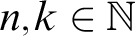 $n,k\in \mathbb N$
we have
 $$\begin{align*}\mathsf a\sim_{n,k}\mathsf b\Rightarrow \mathsf U(\mathsf a)\sim_{n,k+1}\mathsf U(\mathsf b).\end{align*}$$
Proposition 4.10. Every strictly contractive mapping
 $\mathsf U\colon \mathcal F_m\to \mathcal F_m$
has a unique fixed-point.
This proposition can be derived from Theorem 4.8 by proving that the space
 $(\mathcal {F}_m,l_m)$
is spherically complete. However we give a direct proof of this result in order to show an explicit construction of the required fixed-point.
Proof of Proposition 4.10
Since the set
 $\mathcal F_m$
is nonempty, there is a nonexpansive function
 $\mathsf {a}\in \mathcal F_m$
. For any ordinal
 $\alpha < \omega ^2$
, we recursively define a function
 $\mathsf {a}_\alpha \colon \mathcal P^m\to \mathcal P$
in the following way. We put
 $\mathsf {a}_0= \mathsf {a}$
and
 $\mathsf {a}_{\alpha +1}= \mathsf {U} (\mathsf {a}_\alpha )$
. Additionally, in the limit case, we set
 $\mathsf {a}_{\omega \cdot (n+1)}(\vec {\pi }) = \mathsf {a}_{\omega \cdot n+(\sum _{s=1}^m\lvert \pi _s\rvert ) +1}(\vec {\pi })$
for any
 $\vec {\pi } \in \mathcal P^m$
and any
 $n \in \mathbb {N}$
.
Now we check by transfinite induction up to the ordinal
 $\omega ^2$
that all functions
 $\mathsf {a}_\alpha $
are nonexpansive. The function
 $\mathsf {a}_0= \mathsf {a}$
is nonexpansive. The successor case is trivial. It remains to check the limit case. Consider a function
 $\mathsf {a}_{\omega \cdot (n+1)}$
. For all tuples
 $\vec \pi $
and
 $\vec \pi '$
we have
 $\mathsf a_{\omega \cdot (n+1)}(\vec \pi )\sim _0 \mathsf a_{\omega \cdot (n+1)}(\vec \pi ')$
by definition. If for tuples
 $\vec \pi $
and
 $\vec \pi '$
and some
 $h\geqslant 1$
we have
 $\pi _1\sim _h\pi ^{\prime }_1,\ldots ,\pi _m\sim _h\pi ^{\prime }_m$
, then
 $\sum _{s=1}^m\lvert \pi _s\rvert =\sum _{s=1}^m\lvert \pi _s'\rvert =t$
and
 $\mathsf {a}_{\omega \cdot (n+1)}(\vec {\pi }) = \mathsf {a}_{\omega \cdot n+t +1}(\vec {\pi }) \sim _h \mathsf {a}_{\omega \cdot n+t +1}(\vec \pi ')=\mathsf {a}_{\omega \cdot (n+1)}(\vec \pi ')$
, because the function
 $\mathsf {a}_{\omega \cdot n+t +1}$
is nonexpansive by the induction hypothesis. Therefore all functions
 $\mathsf {a}_\alpha $
are nonexpansive.
In this proof we will write
 $\mathsf { c}\simeq _\alpha \mathsf {d}$
if
 $\mathsf { c}\sim _{n,k} \mathsf {d}$
and
 $\alpha = \omega \cdot n +k$
. We claim that for any ordinal
 $\alpha < \omega ^2$
and any ordinal
 $\beta < \alpha $
we have
 $\mathsf {a}_\beta \simeq _\beta \mathsf {a}_\alpha $
. We check this claim by transfinite induction on
 $\alpha $
. The case
 $\alpha =0$
is trivial.
Suppose
 $\alpha = \gamma +1$
. By the induction hypothesis, we have
 $\mathsf {a}_\beta \simeq _\beta \mathsf {a}_\gamma $
for any ordinal
 $\beta < \gamma $
. If
 $\gamma =0$
, then
 $\mathsf {a}_0 \simeq _0 \mathsf {a}_1$
and the statement holds. If
 $\gamma = \gamma ^\prime +1$
, then we have
 $\mathsf {a}_{\gamma ^\prime } \simeq _{\gamma ^\prime }\mathsf {a}_{\gamma }$
by the induction hypothesis. Since
 $\mathsf {U}$
is a contractive mapping, we have
 $\mathsf {a}_\gamma = \mathsf {U}(\mathsf {a}_{\gamma ^\prime } ) \simeq _{\gamma ^\prime +1} \mathsf {U}(\mathsf {a}_{\gamma } ) = \mathsf {a}_\alpha $
. In addition, for any
 $\beta <\gamma $
we see
 $\mathsf {a}_\beta \simeq _\beta \mathsf {a}_\gamma \simeq _\gamma \mathsf {a}_\alpha $
. Hence
 $\mathsf {a}_\beta \simeq _\beta \mathsf {a}_\alpha $
and the statement holds. If
 $\gamma = \omega \cdot (n+1)$
, then
 $\mathsf {a}_{\omega \cdot n+k} \simeq _{\omega \cdot n + k} \mathsf {a}_{\omega \cdot (n+1)}$
for any
 $k \in \mathbb {N}$
. We see
 $\mathsf {a}_{\omega \cdot n+k+1} = \mathsf {U}(\mathsf {a}_{\omega \cdot n+k}) \simeq _{\omega \cdot n + k+1} \mathsf {U}(\mathsf {a}_{\omega \cdot (n+1)})=\mathsf {a}_\alpha $
for any
 $k \in \mathbb {N}$
. Thus
 $\mathsf {a}_{\omega \cdot (n+1)}(\vec {\pi }) = \mathsf {a}_{\omega \cdot n+\sum _{s=1}^m\lvert \pi _s\rvert +1}(\vec {\pi }) \sim _{n+1} \mathsf {a}_\alpha (\vec {\pi })$
for any tuple
 $\vec {\pi } \in \mathcal P^m$
. Consequently
 $\mathsf {a}_{\omega \cdot (n+1)} \simeq _{\omega \cdot (n + 1)} \mathsf {a}_\alpha $
. For any
 $\beta <\gamma $
we have
 $\mathsf {a}_\beta \simeq _\beta \mathsf {a}_\gamma \simeq _\gamma \mathsf {a}_\alpha $
. Hence
 $\mathsf {a}_\beta \simeq _\beta \mathsf {a}_\alpha $
and the statement holds.
Now suppose
 $\alpha = \omega \cdot (n+1)$
for some
 $n \in \mathbb {N}$
. From the induction hypothesis, we have
 $\mathsf {a}_{\omega \cdot n} \simeq _{\omega \cdot n} \mathsf {a}_{\omega \cdot n+k}$
for any
 $k \in \mathbb {N}$
. Hence
 $\mathsf {a}_{\omega \cdot (n+1)}(\vec {\pi }) = \mathsf {a}_{\omega \cdot n+\sum _{s=1}^m\lvert \pi _s\rvert +1}(\vec {\pi }) \sim _n \mathsf {a}_{\omega \cdot n}(\vec {\pi })$
for any tuple
 $\vec {\pi } \in \mathcal P^m$
and
 $\mathsf {a}_{\omega \cdot n} \simeq _{\omega \cdot n} \mathsf {a}_\alpha $
. Now consider any
 $\beta < \alpha $
. If
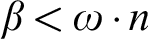 $\beta < \omega \cdot n$
, then
 $\mathsf {a}_\beta \simeq _\beta \mathsf {a}_{\omega \cdot n}$
by the induction hypothesis. We see
 $\mathsf {a}_\beta \simeq _\beta \mathsf {a}_{\omega \cdot n} \simeq _{\omega \cdot n} \mathsf {a}_\alpha $
and
 $\mathsf {a}_\beta \simeq _\beta \mathsf {a}_\alpha $
. Otherwise,
 $\beta = \omega \cdot n+k$
for some
 $k \in \mathbb {N}$
. It remains to check that
 $\mathsf {a}_{\omega \cdot n+k} \simeq _{\omega \cdot n+k} \mathsf {a}_\alpha $
. Consider any tuple
 $\vec {\tau } \in \mathcal P^m$
. We see
 $\mathsf {a}_{\omega \cdot (n+1)}(\vec {\tau }) = \mathsf {a}_{\omega \cdot n+\sum _{s=1}^m\lvert \tau _s\rvert +1}(\vec {\tau })\sim _n \mathsf {a}_{\omega \cdot n}(\vec {\tau }) \sim _n \mathsf {a}_{\omega \cdot n+k}(\vec {\tau })$
. If
 $\sum \limits _{s=1}^m\lvert \tau _s\rvert <~k$
, then
 $\mathsf {a}_{\omega \cdot n+\sum _{s=1}^m\lvert \tau _s\rvert +1} \simeq _{\omega \cdot n+\sum _{s=1}^m\lvert \tau _s\rvert +1} \mathsf {a}_{\omega \cdot n+k}$
and
 $\mathsf {a}_{\omega \cdot (n+1)}(\vec {\tau }) = \mathsf {a}_{\omega \cdot n+\sum _{s=1}^m\lvert \tau _s\rvert +1}(\vec {\tau }) \sim _{n+1} \mathsf {a}_{\omega \cdot n+k}(\vec {\tau })$
. We have checked that for any ordinal
 $\alpha < \omega ^2$
and any ordinal
 $\beta < \alpha $
we have
 $\mathsf {a}_\beta \simeq _\beta \mathsf {a}_\alpha $
.
Now we define the required fixed-point
 $\mathsf {a}_{\omega ^2}$
. We see that for any tuple
 $\vec {\pi } \in \mathcal P^m$
 $$ \begin{align*}\mathsf{a}_0(\vec{\pi}) \sim_0 \mathsf{a}_\omega(\vec{\pi}) \sim_1 \mathsf{a}_{\omega \cdot 2}(\vec{\pi}) \sim_2\mathsf{a}_{\omega \cdot 3}(\vec{\pi}) \sim_3 \cdots .\end{align*} $$
In other words, we have a descending sequence of closed balls
 $$ \begin{align*}B_{1}(\mathsf{a}_0(\vec{\pi})) \supset B_{\frac{1}{2}}(\mathsf{a}_\omega(\vec{\pi})) \supset B_{\frac{1}{4}}(\mathsf{a}_{\omega \cdot 2}(\vec{\pi})) \supset B_{\frac{1}{8}}(\mathsf{a}_{\omega \cdot 3}(\vec{\pi})) \supset \cdots \end{align*} $$
with radii tending to
 $0$
. By Proposition 4.9, there is an
 $\infty $
-proof
 $\kappa $
such that
 $ \kappa \in \bigcap \limits ^\infty _{i=0} B_{2^{-i}}(\mathsf {a}_{\omega \cdot i}(\vec {\pi }))$
, i.e.,
 $\kappa \sim _{i} \mathsf a_{\omega \cdot i} (\vec {\pi })$
for all
 $i\in \mathbb N$
. This
 $\infty $
-proof is unique since radii of the balls tend to
 $0$
. We define
 $\mathsf a_{\omega ^2} (\vec {\pi }) = \kappa $
. Let us check that the mapping
 $\mathsf a_{\omega ^2}$
is nonexpansive. If for tuples
 $\vec \pi $
and
 $\vec \pi '$
we have
 $\pi _1\sim _h\pi ^{\prime }_1,\ldots ,\pi _m\sim _h\pi ^{\prime }_m$
for some
 $h\in \mathbb N$
, then we can choose i such that
 $i>h$
. We have
 $\mathsf a_{\omega ^2}(\vec \pi )\sim _h \mathsf a_{\omega \cdot i}(\vec \pi )\sim _h\mathsf a_{\omega \cdot i}(\vec \pi ')\sim _h \mathsf a_{\omega ^2}(\vec \pi ')$
. Therefore
 $\mathsf a_{\omega ^2}(\vec \pi )\sim _h \mathsf a_{\omega ^2}(\vec \pi ')$
and the mapping
 $\mathsf a_{\omega ^2}$
is nonexpansive.
Now we claim that
 $ \mathsf {a}_{\omega ^2} =\mathsf {U}(\mathsf a_{\omega ^2})$
. It is sufficient to show that
 $\mathsf a_{\omega ^2} \simeq _{\omega \cdot i} \mathsf {U}(\mathsf a_{\omega ^2})$
for any
 $i\in \mathbb {N}$
. By the definition of
 $\mathsf a_{\omega ^2}$
, we see
 $\mathsf a_{\omega ^2} \simeq _{\omega \cdot i} \mathsf {a}_{\omega \cdot i} $
for any
 $i\in \mathbb {N}$
. It follows that
 $\mathsf a_{\omega ^2} \simeq _{\omega \cdot i} \mathsf {a}_{\omega \cdot i} \simeq _{\omega \cdot i} \mathsf {a}_{\omega \cdot i+1 }= \mathsf {U}(\mathsf a_{\omega \cdot i}) \simeq _{\omega \cdot i+1} \mathsf {U}(\mathsf a_{\omega ^2})$
. Hence
 $\mathsf a_{\omega ^2} \simeq _{\omega \cdot i} \mathsf {U}(\mathsf a_{\omega ^2})$
for any
 $i\in \mathbb {N}$
and
 $ \mathsf {a}_{\omega ^2} =\mathsf {U}(\mathsf a_{\omega ^2})$
. □
5 Admissible rules
In this section, for the system
 $\mathsf {Grz}_{\infty } +\mathsf {cut}$
, we state admissibility of auxiliary inference rules, which will be used in the proof of the cut-elimination theorem.
Recall that the set
 $\mathcal P$
of all
 $\infty $
-proofs of the system
 $\mathsf {Grz}_{\infty } +\mathsf {cut} $
can be considered as an ultrametric space with the metric
 $d_{\mathcal P}$
.
By
 $\mathcal {P}_n$
we denote the set of all
 $\infty $
-proofs that do not contain applications of the cut rule in their n-fragments. We also set
 $\mathcal {P}_0= \mathcal {P}$
.
A mapping
 $\mathsf u:\mathcal P^m\to \mathcal P$
is called adequate if for any
 $n\in \mathbb N$
we have
 $\mathsf u(\pi _1,\ldots ,\pi _m)\in \mathcal P_n$
, whenever
 $\pi _i\in \mathcal P_n$
for all
 $i\leqslant m$
.
In
 $\mathsf {Grz}_{\infty } +\mathsf {cut}$
, we call a single-premise inference rule strongly admissible if there is a nonexpansive adequate mapping
 $\mathsf {u}\colon \mathcal {P} \to \mathcal {P}$
that maps any
 $\infty $
-proof of the premise of the rule to an
 $\infty $
-proof of the conclusion. The mapping
 $\mathsf {u}$
must also satisfy one additional condition:
 $\lvert \mathsf {u}(\pi )\rvert \leqslant \lvert \pi \rvert $
for any
 $\pi \in \mathcal {P}$
.
In the following lemmata, nonexpansive mappings are defined in a standard way by induction on the local heights of
 $\infty $
-proofs for the premises. We give a detailed proof for one case of Lemma 5.12 and omit further details.
Lemma 5.11. For any finite multisets of formulas
 $\Pi $
and
 $\Sigma $
, the inference rule
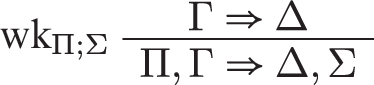
is strongly admissible in
 $\mathsf {Grz}_{\infty } +\mathsf {cut}$
.
Lemma 5.12. For any formulas A and B, the rules
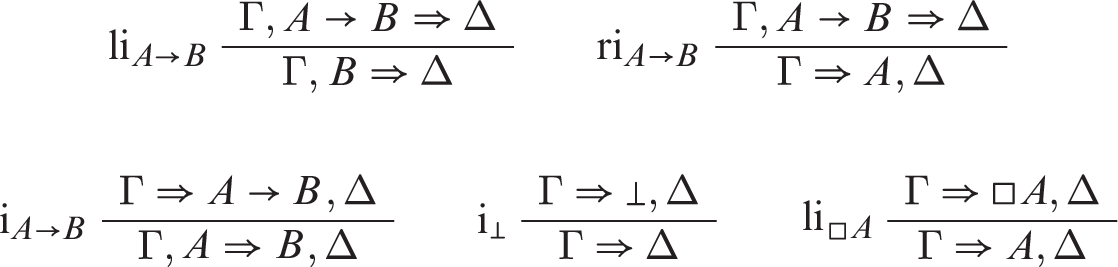
are strongly admissible in
 $\mathsf {Grz}_{\infty } +\mathsf {cut}$
.
Lemma 5.13. For any atomic proposition p, the rules

are strongly admissible in
 $\mathsf {Grz}_{\infty } +\mathsf {cut}$
.
Proof of Lemma 5.12
We define the required nonexpansive adequate mapping only for the last inference rule of Lemma 5.12 and omit other cases. Assume we have a formula A and an
 $\infty $
-proof
 $\pi $
of a sequent
 $\Sigma \Rightarrow \Upsilon $
. If
 $\Box A \notin \Upsilon $
, then we put
 $\mathsf {li}_{\:\Box A}(\pi ) =\pi $
. Otherwise, we define
 $\mathsf {li}_{\:\Box A}(\pi )$
by induction on
 $\lvert \pi \rvert $
.
If
 $\lvert \pi \rvert =0$
, then
 $\Sigma \Rightarrow \Upsilon $
is an initial sequent. We see that
 $\Sigma \Rightarrow A, \Upsilon \backslash \{\Box A \}$
is also an initial sequent and define
 $\mathsf {li}_{\:\Box A}(\pi )$
as the
 $\infty $
-proof consisting only of this sequent.
Suppose
 $\lvert \pi \rvert>0$
. We define
 $\mathsf {li}_{\:\Box A}(\pi )$
according to the last application of an inference rule in
 $\pi $
:




In these cases
 $\infty $
-proofs
 $\mathsf {li}_{\:\Box A}(\pi _0)$
(and
 $\mathsf {li}_{\:\Box A}(\pi _1)$
) are defined since
 $\lvert \pi _0 \rvert < \lvert \pi \rvert $
(and
 $\lvert \pi _1 \rvert < \lvert \pi \rvert $
).
Suppose the last inference in
 $\pi $
is an application of the rule
 $(\Box )$
with the principle formula being not
 $\Box A$
. Then we define
 $\mathsf {li}_{\:\Box A}(\pi )$
as follows:

It remains to consider the case when the last inference in
 $\pi $
has the form:

In this case we put
 $\mathsf {li}_{\:\Box A}(\pi )=\pi _0$
. The mapping
 $\mathsf {li}_{\:\Box A}$
is well-defined.
Now we claim that
 $\mathsf {li}_{\:\Box A}$
is nonexpansive. We shall check that for any
 $\infty $
-proofs
 $\pi $
and
 $\pi ^\prime $
, and any
 $n\in \mathbb N$
, we have
 $$ \begin{align*}\pi\sim_n\pi'\Rightarrow \mathsf{li}_{\:\Box A}(\pi)\sim_n \mathsf{li}_{\:\Box A}(\pi^\prime).\end{align*} $$
Assume we have two
 $\infty $
-proofs
 $\pi $
and
 $\pi ^\prime $
such that
 $\pi \sim _n\pi '$
. If
 $n=0$
, then trivially
 $\mathsf {li}_{\:\Box A}(\pi )\sim _n \mathsf {li}_{\:\Box A}(\pi ^\prime )$
. If
 $n>0$
, then the main fragments of
 $\pi $
and
 $\pi ^\prime $
are identical. Suppose the root of
 $\pi $
is marked by a sequent
 $\Sigma \Rightarrow \Upsilon $
, where
 $\Box A \notin \Upsilon $
. Then the same condition holds for the
 $\infty $
-proof
 $\pi ^\prime $
. In this case, we have
 $$ \begin{align*} \mathsf{li}_{\:\Box A}(\pi) = \pi \sim_n \pi^\prime = \mathsf{li}_{\:\Box A}(\pi^\prime).\end{align*} $$
Otherwise, the statement
 $\mathsf {li}_{\:\Box A}(\pi )\sim _n \mathsf {li}_{\:\Box A}(\pi ^\prime )$
is proved by induction on
 $\lvert \pi \rvert = \lvert \pi ^\prime \rvert $
with the case analysis according to the definition of
 $\mathsf {li}_{\:\Box A}$
. If
 $\lvert \pi \rvert =\lvert \pi ^\prime \rvert =0$
, then
 $\pi =\pi ^\prime $
and
 $\mathsf {li}_{\:\Box A}(\pi )\sim _n\mathsf {li}_{\:\Box A}(\pi ^\prime )$
.
If the last inference in
 $\pi $
is an application of the rule
 $(\to _{\mathsf {R}})$
, then
 $\pi $
and
 $\pi ^\prime $
have the following forms

where
 $\pi _0 \sim _n \pi ^\prime _0$
. By the induction hypothesis for
 $\lvert \pi _0\rvert = \lvert \pi ^\prime _0\rvert $
, we have
 $\mathsf {li}_{\:\Box A}(\pi _0)\sim _n \mathsf {li}_{\:\Box A}(\pi ^\prime _0)$
. From the definition of the mapping
 $\mathsf {li}_{\:\Box A}$
, we obtain
 $\mathsf {li}_{\:\Box A}(\pi )\sim _n \mathsf {li}_{\:\Box A}(\pi ^\prime )$
.
Consider the case when the last inference in
 $\pi $
is an application of the rule
 $({\Box })$
with the principle formula
 $\Box A$
. We have that
 $\pi $
and
 $\pi ^\prime $
have the following forms

where
 $\pi _0 \sim _n \pi ^\prime _0$
and
 $\pi _1 \sim _{n-1} \pi ^\prime _1$
. From the definition of the mapping
 $\mathsf {li}_{\:\Box A}$
, we obtain
 $\mathsf {li}_{\:\Box A}(\pi )=\pi _0 \sim _n \pi ^\prime _0 = \mathsf {li}_{\:\Box A}(\pi ^\prime )$
.
All the other cases are treated similarly, so we omit them. We have that the mapping
 $\mathsf {li}_{\:\Box A}$
is nonexpansive. Now we check that
 $\lvert \mathsf {li}_{\:\Box A}(\pi )\rvert \leqslant \lvert \pi \rvert $
for any
 $\pi \in \mathcal {P}$
.
Assume we have an
 $\infty $
-proof
 $\pi $
. Suppose the root of
 $\pi $
is marked by a sequent
 $\Sigma \Rightarrow \Upsilon $
, where
 $\Box A \notin \Upsilon $
. In this case, we have
 $\mathsf {li}_{\:\Box A}(\pi ) = \pi $
and
 $\lvert \mathsf {li}_{\:\Box A}(\pi )\rvert \leqslant \lvert \pi \rvert $
.
Otherwise, the assertion
 $\lvert \mathsf {li}_{\:\Box A}(\pi )\rvert \leqslant \lvert \pi \rvert $
is proved by induction on
 $\lvert \pi \rvert $
with the case analysis according to the definition of
 $\mathsf {li}_{\:\Box A}$
. If
 $\lvert \pi \rvert =0$
, then
 $\Sigma \Rightarrow \Upsilon $
is an initial sequent. We see that
 $\Sigma \Rightarrow A, \Upsilon \backslash \{\Box A \}$
is also an initial sequent and
 $\mathsf {li}_{\:\Box A}(\pi )$
was defined as the
 $\infty $
-proof consisting only of this sequent. We have
 $\lvert \mathsf {li}_{\:\Box A}(\pi )\rvert =0$
and
 $\lvert \mathsf {li}_{\:\Box A}(\pi )\rvert \leqslant \lvert \pi \rvert $
.
If the last inference in
 $\pi $
is an application of the rule
 $(\to _{\mathsf {R}})$
, then
 $\pi $
has the form

By the induction hypothesis for
 $\lvert \pi _0\rvert $
, we have
 $\lvert \mathsf {li}_{\:\Box A}(\pi _0)\rvert \leqslant \lvert \pi _0 \rvert $
. From the definition of the mapping
 $\mathsf {li}_{\:\Box A}$
, we see
 $\lvert \mathsf {li}_{\:\Box A}(\pi )\rvert =\lvert \mathsf {li}_{\:\Box A}(\pi _0)\rvert +1 \leqslant \lvert \pi _0 \rvert +1 =\lvert \pi \rvert $
.
Consider the case when the last inference in
 $\pi $
is an application of the rule
 $({\Box })$
with the principle formula
 $\Box A$
. We see that
 $\pi $
has the form

From the definition of the mapping
 $\mathsf {li}_{\:\Box A}$
, we obtain
 $\lvert \mathsf {li}_{\:\Box A}(\pi )\rvert =\lvert \pi _0 \rvert \leqslant \lvert \pi \rvert $
.
Cases of other inferences are treated similarly, so we omit them. We have that
 $\lvert \mathsf {li}_{\:\Box A}(\pi )\rvert \leqslant \lvert \pi \rvert $
for any
 $\pi \in \mathcal {P}$
. It remains to check that the mapping
 $ \mathsf {li}_{\:\Box A}$
is adequate.
Assume we have an
 $\infty $
-proof
 $\pi $
such that
 $\pi \in \mathcal {P}_n$
. We claim that
 $\mathsf {li}_{\:\Box A}(\pi )\in \mathcal {P}_n$
. If
 $n=0$
, then trivially
 $ \mathsf {li}_{\:\Box A}(\pi ) \in \mathcal {P}_0=\mathcal {P}$
. Suppose the root of
 $\pi $
is marked by a sequent
 $\Sigma \Rightarrow \Upsilon $
, where
 $\Box A \notin \Upsilon $
. Then we have
 $ \mathsf {li}_{\:\Box A}(\pi ) = \pi \in \mathcal {P}_n$
.
Otherwise, the assertion
 $\mathsf {li}_{\:\Box A}(\pi )\in \mathcal {P}_n$
is proved by induction on
 $\lvert \pi \rvert $
with the case analysis according to the definition of
 $\mathsf {li}_{\:\Box A}$
. If
 $\lvert \pi \rvert =0$
, then
 $\Sigma \Rightarrow \Upsilon $
is an initial sequent. We see that
 $\Sigma \Rightarrow A, \Upsilon \backslash \{\Box A \}$
is also an initial sequent and
 $\mathsf {li}_{\:\Box A}(\pi )$
was defined as the
 $\infty $
-proof consisting only of this sequent. We have
 $ \mathsf {li}_{\:\Box A}(\pi ) \in \mathcal {P}_n$
.
If the last inference in
 $\pi $
is an application of the rule
 $(\to _{\mathsf {R}})$
, then
 $\pi $
has the form

where
 $\pi _0\in \mathcal {P}_n$
. By the induction hypothesis for
 $\lvert \pi _0\rvert $
, we have
 $\mathsf {li}_{\:\Box A}(\pi _0)\in \mathcal {P}_n$
. From the definition of the mapping
 $\mathsf {li}_{\:\Box A}$
, we see
 $\mathsf {li}_{\:\Box A}(\pi )\in \mathcal {P}_n$
.
Consider the case when the last inference in
 $\pi $
is an application of the rule
 $({\Box })$
with the principle formula
 $\Box A$
. We see that
 $\pi $
has the form
where
 $\pi _0 \in \mathcal {P}_n$
and
 $\pi _1 \in \mathcal {P}_{n-1}$
. From the definition of the mapping
 $\mathsf {li}_{\:\Box A}$
, we obtain
 $\mathsf {li}_{\:\Box A}(\pi )=\pi _0 \in \mathcal {P}_n$
.
Notice that the last inference in
 $\pi $
differs from an application of the rule
 $(\mathsf {cut})$
. The remaining cases of other inferences are treated in a similar way to the case of
 $(\to _{\mathsf {R}})$
, so we omit them. □
6 Cut elimination
In this section, we construct a continuous function from
 $\mathcal {P}$
to
 $\mathcal {P}$
, which maps any
 $\infty $
-proof of the system
 $\mathsf {Grz}_{\infty } +\mathsf {cut}$
to a cut-free
 $\infty $
-proof of the same sequent.
Let us call a pair of
 $\infty $
-proofs
 $(\pi ,\tau )$
a cut pair if
 $\pi $
is an
 $\infty $
-proof of the sequent
 $\Gamma \Rightarrow \Delta ,A$
and
 $\tau $
is an
 $\infty $
-proof of the sequent
 $A, \Gamma \Rightarrow \Delta $
for some
 $\Gamma , \Delta $
, and A. For a cut pair
 $(\pi ,\tau )$
, we call the sequent
 $\Gamma \Rightarrow \Delta $
its cut result and the formula A its cut formula.
For a modal formula A, a nonexpansive mapping
 $\mathsf {u}$
from
 $\mathcal P \times \mathcal P$
to
 $\mathcal P$
is called A-removing if it maps every cut pair
 $(\pi ,\tau )$
with the cut formula A to an
 $\infty $
-proof of its cut result. By
 $\mathcal R_A$
, let us denote the set of all A-removing mappings. Now we consider the set
 $\mathcal R_A$
together with the ultrametric
 $l_2$
, which was defined in 4
Lemma 6.14. In the ultrametric space
 $(\mathcal R_A,l_2)$
, any contractive operator
 $\mathsf {U}: \mathcal R_A\to \mathcal R_A$
has a unique fixed-point.
Proof. Let us check that the set
 $\mathcal R_A$
is nonempty. Consider the mapping
 $\mathsf u_{cut}:\mathcal P^2\to \mathcal P$
that is defined as follows. For a cut pair
 $(\pi ,\tau )$
with the cut formula A, it joins the
 $\infty $
-proofs
 $\pi $
and
 $\tau $
with an appropriate instance of the rule
 $(\mathsf {cut})$
. For all other pairs, the mapping
 $\mathsf u_{cut}$
returns the first argument. Clearly,
 $\mathsf u_{cut}$
is nonexpansive and therefore lies in
 $\mathcal R_A$
.
The rest of the proof is completely analogous to the proof of Proposition 4.10 □
In what follows, we use the nonexpansive adequate mappings
 $ \mathsf {wk}_{\Pi ; \Sigma }$
,
 $\mathsf {li}_{A\to B}$
,
 $\mathsf {ri}_{A\to B}$
,
 $\mathsf {i}_{A\to B}$
,
 $\mathsf {i}_\bot $
,
 $\mathsf {li}_{\Box A}$
,
 $\mathsf {acl}_{p}$
,
 $\mathsf {acr}_{p}$
from Lemma 5.11, Lemma 5.12, and Lemma 5.13
Lemma 6.15. For any atomic proposition p, there exists an adequate p-removing mapping
 $\mathsf {re}_p$
.
Proof. Given a cut pair with the cut formula p, consider the
 $\infty $
-proof obtained by applying the corresponding instance of the cut rule. This instance of cut can be eliminated by “moving” it upwards within the main fragment of the
 $\infty $
-proof. Therefore we can define the required p-removing mapping
 $\mathsf {re}_p$
following the standard cut reductions for cuts with atomic cut formulas.
Assume we have two
 $\infty $
-proofs
 $\pi $
and
 $\tau $
. If the pair
 $(\pi ,\tau )$
is not a cut pair or is a cut pair with the cut formula being not p, then we put
 $\mathsf {re}_{p}(\pi ,\tau )=\pi $
. Otherwise, we define
 $\mathsf {re}_{p}(\pi ,\tau )$
by induction on
 $\lvert \pi \rvert $
. Let the cut result of the pair
 $(\pi ,\tau )$
be
 $\Gamma \Rightarrow \Delta $
.
If
 $\lvert \pi \rvert =0$
, then
 $\Gamma \Rightarrow \Delta , p$
is an initial sequent. Suppose that
 $\Gamma \Rightarrow \Delta $
is also an initial sequent. Then
 $\mathsf {re}_{p}(\pi ,\tau )$
is defined as the
 $\infty $
-proof consisting only of the sequent
 $\Gamma \Rightarrow \Delta $
. If
 $\Gamma \Rightarrow \Delta $
is not an initial sequent, then
 $\Gamma $
has the form
 $p,\Phi $
, and
 $\tau $
is an
 $\infty $
-proof of the sequent
 $p,p,\Phi \Rightarrow \Delta $
. Applying the nonexpansive adequate mapping
 $\mathsf {acl}_p$
from Lemma 5.13, we put
 $\mathsf {re}_{p}(\pi ,\tau ) := \mathsf {acl}_p (\tau )$
.
Now suppose that
 $\lvert \pi \rvert>0$
. We define
 $\mathsf {re}_{p}(\pi ,\tau )$
according to the last application of an inference rule in
 $\pi $
:


In these cases
 $\infty $
-proofs
 $\mathsf {re}_p(\pi _0, \cdot )$
(and
 $\mathsf {re}_p(\pi _1, \cdot )$
) are defined since
 $\lvert \pi _0 \rvert < \lvert \pi \rvert $
(and
 $\lvert \pi _1 \rvert < \lvert \pi \rvert $
). Consider the last case when the last inference in
 $\pi $
is an application of the rule
 $(\Box )$
. We set

where
 $\mathsf {re}_p(\pi _0, \mathsf {li}_{\: \Box B}(\tau ))$
is defined since
 $\lvert \pi _0 \rvert < \lvert \pi \rvert $
. The mapping
 $\mathsf {re}_p$
is well-defined.
Now we claim that
 $\mathsf {re}_p$
is nonexpansive. It sufficient to check that for any pairs
 $(\pi ,\tau )$
and
 $(\pi ^\prime ,\tau ^\prime )$
, and any
 $n\in \mathbb N$
we have
 $$ \begin{align*}\pi\sim_n\pi',\; \tau\sim_n\tau'\Rightarrow \mathsf{re}_p(\pi,\tau)\sim_n \mathsf{re}_p(\pi^\prime,\tau^\prime).\end{align*} $$
Assume we have two pairs of
 $\infty $
-proofs
 $(\pi ,\tau )$
and
 $(\pi ^\prime ,\tau ^\prime )$
such that
 $\pi \sim _n\pi '$
,
 $\tau \sim _n\tau '$
. If
 $n=0$
, then trivially
 $ \mathsf {re}_p(\pi ,\tau )\sim _n \mathsf {re}_p(\pi ^\prime ,\tau ^\prime )$
. If
 $n>0$
, then the main fragments of
 $\pi $
and
 $\pi ^\prime $
(
 $\tau $
and
 $\tau ^\prime $
) are identical. Suppose that
 $(\pi ,\tau )$
is not a cut pair or is a cut pair with the cut formula not being p. Then the same condition holds for the pair
 $(\pi ^\prime ,\tau ^\prime )$
. In this case, we have
 $$ \begin{align*} \mathsf{re}_p(\pi,\tau) = \pi \sim_n \pi^\prime = \mathsf{re}_p(\pi^\prime,\tau^\prime).\end{align*} $$
Otherwise,
 $(\pi ,\tau )$
and
 $(\pi ^\prime ,\tau ^\prime )$
are cut pairs with the cut formula p. Now the statement
 $\mathsf {re}_p(\pi ,\tau )\sim _n \mathsf {re}_p(\pi ^\prime ,\tau ^\prime )$
is proved by induction on
 $\lvert \pi \rvert = \lvert \pi ^\prime \rvert $
with the case analysis according to the definition of
 $\mathsf {re}_p$
. Let the cut result of the pair
 $(\pi ,\tau )$
(and
 $(\pi ^\prime ,\tau ^\prime )$
) be
 $\Gamma \Rightarrow \Delta $
.
If
 $\lvert \pi \rvert = \lvert \pi ^\prime \rvert =0$
, then
 $\Gamma \Rightarrow \Delta , p$
is an initial sequent. Suppose that
 $\Gamma \Rightarrow \Delta $
is an initial sequent. Then
 $\mathsf {re}_{p}(\pi ,\tau ) = \mathsf {re}_{p}(\pi ^\prime ,\tau ^\prime )$
. If
 $\Gamma \Rightarrow \Delta $
is not an initial sequent, then
 $\mathsf {re}_{p}(\pi ,\tau ) = \mathsf {acl}_p (\tau ) \sim _n \mathsf {acl}_p (\tau ^\prime ) = \mathsf {re}_{p}(\pi ^\prime ,\tau ^\prime )$
since the mapping
 $\mathsf {acl}_p $
is nonexpansive.
If the last inference in
 $\pi $
is an application of the rule
 $(\to _{\mathsf {R}})$
, then
 $\pi $
and
 $\pi ^\prime $
have the following forms

where
 $\pi _0 \sim _n \pi ^\prime _0$
. Since
 $\mathsf {i}_{B \to C}$
is nonexpansive, we have
 $\mathsf {i}_{B \to C}(\tau ) \sim _n \mathsf {i}_{B \to C}(\tau ^\prime )$
. Consequently, by the induction hypothesis for pairs
 $(\pi _0, \mathsf {i}_{B \to C}(\tau ))$
and
 $(\pi ^\prime _0, \mathsf {i}_{B \to C}(\tau ^\prime ))$
, we have
 $\mathsf {re}_p(\pi _0, \mathsf {i}_{B \to C}(\tau )) \sim _n \mathsf {re}_p(\pi ^\prime _0, \mathsf {i}_{B \to C}(\tau ^\prime ))$
. Thus we obtain
 $\mathsf {re}_p(\pi ,\tau )\sim _n \mathsf {re}_p(\pi ^\prime ,\tau ^\prime )$
.
Consider the case when the last inference in
 $\pi $
is an application of the rule
 $({\Box })$
. We have that
 $\pi $
and
 $\pi ^\prime $
have the following forms

where
 $\pi _0 \sim _n \pi ^\prime _0$
and
 $\pi _1 \sim _{n-1} \pi ^\prime _1$
. Since
 $\mathsf {li}_{\: \Box B}$
is nonexpansive, we have
 $\mathsf {li}_{\: \Box B}(\tau ) \sim _n \mathsf {li}_{\: \Box B}(\tau ^\prime )$
. Consequently, by the induction hypothesis for pairs
 $(\pi _0, \mathsf {li}_{\: \Box B}(\tau ))$
and
 $(\pi ^\prime _0, \mathsf {li}_{\: \Box B}(\tau ^\prime ))$
, we have
 $\mathsf {re}_p(\pi _0, \mathsf {li}_{\: \Box B}(\tau )) \sim _n \mathsf {re}_p(\pi ^\prime _0, \mathsf {li}_{\: \Box B}(\tau ^\prime ))$
. Thus we obtain
 $\mathsf {re}_p(\pi ,\tau )\sim _n \mathsf {re}_p(\pi ^\prime ,\tau ^\prime )$
.
All the other cases are treated similarly, so we omit them. We have that the mapping
 $\mathsf {re}_p$
is nonexpansive. It remains to check that the mapping
 $\mathsf {re}_p$
is adequate.
Assume we have a pair of
 $\infty $
-proofs
 $(\pi ,\tau )$
such that
 $\pi \in \mathcal {P}_n$
and
 $\tau \in \mathcal {P}_n $
. We claim that
 $\mathsf {re}_p(\pi ,\tau ) \in \mathcal {P}_n$
. If
 $n=0$
, then trivially
 $ \mathsf {re}_p(\pi ,\tau ) \in \mathcal {P}_0=\mathcal {P}$
. If the pair
 $(\pi ,\tau )$
is not a cut pair or is a cut pair with the cut formula being not p, then we have
 $ \mathsf {re}_p(\pi ,\tau ) = \pi \in \mathcal {P}_n$
.
Now suppose
 $(\pi ,\tau )$
is a cut pair with the cut formula p and
 $n>0$
. We proceed by induction on
 $\lvert \pi \rvert $
with the case analysis according to the definition of
 $\mathsf {re}_p$
. Let the cut result of the pair
 $(\pi ,\tau )$
be
 $\Gamma \Rightarrow \Delta $
.
If
 $\lvert \pi \rvert = 0$
, then
 $\Gamma \Rightarrow \Delta , p$
is an initial sequent. Suppose that
 $\Gamma \Rightarrow \Delta $
is an initial sequent. Then
 $\mathsf {re}_{p}(\pi ,\tau ) \in \mathcal {P}_n$
by the definition of
 $\mathsf {re}_{p}$
. If
 $\Gamma \Rightarrow \Delta $
is not an initial sequent, then
 $\mathsf {re}_{p}(\pi ,\tau ) = \mathsf {acl}_p (\tau )\in \mathcal {P}_n$
since the mapping
 $\mathsf {acl}_p $
is adequate.
Now let us consider the cases of inference rules
 $(\to _{\mathsf {L}})$
and
 $({\Box })$
. If the last inference in
 $\pi $
is an application of the rule
 $(\to _{\mathsf {L}})$
, then
 $\pi $
has the following form

where
 $\pi _0, \pi _1 \in \mathcal {P}_n$
. Since
 $\mathsf {li}_{B \to C}$
and
 $\mathsf {ri}_{B \to C}$
are adequate, we have
 $\mathsf {li}_{B \to C}(\tau )\in \mathcal {P}_n$
and
 $\mathsf {ri}_{B \to C}(\tau ) \in \mathcal {P}_n$
. Consequently, by the induction hypothesis for the pairs
 $(\pi _0, \mathsf {li}_{B \to C}(\tau ))$
and
 $(\pi _1, \mathsf {ri}_{B \to C}(\tau ))$
, we have
 $\mathsf {re}_p(\pi _0, \mathsf {li}_{B \to C}(\tau ))\in \mathcal {P}_n$
and
 $\mathsf {re}_p(\pi _1, \mathsf {ri}_{B \to C}(\tau ))\in \mathcal {P}_n$
. Thus we obtain
 $\mathsf {re}_p(\pi ,\tau )\in \mathcal {P}_n$
.
Consider the case when the last inference in
 $\pi $
is an application of the rule
 $({\Box })$
. Then
 $\pi $
has the form

where
 $\pi _0 \in \mathcal {P}_n$
and
 $\pi _1 \in \mathcal {P}_{n-1}$
. Since
 $\mathsf {li}_{\: \Box B}$
is adequate, we have
 $\mathsf {li}_{\: \Box B}(\tau ) \in \mathcal {P}_n$
. Consequently, by the induction hypothesis for the pair
 $(\pi _0, \mathsf {li}_{\: \Box B}(\tau ))$
, we have
 $\mathsf {re}_p(\pi _0, \mathsf {li}_{\: \Box B}(\tau )) \in \mathcal {P}_n$
. Thus we obtain
 $\mathsf {re}_p(\pi ,\tau )\in \mathcal {P}_n$
.
Notice that the last inference in
 $\pi $
differs from an application of the rule
 $(\mathsf {cut})$
. The remaining cases of inference rules
 $(\to _{\mathsf {R}})$
and
 $(\mathsf {refl})$
are treated in a similar way to the case of
 $(\to _{\mathsf {L}})$
, so we omit them. □
Lemma 6.16. Given an adequate B-removing mapping
 $\mathsf {re}_B$
, there exists an adequate
 $\Box B$
-removing mapping
 $\mathsf {re}_{\Box B}$
.
Proof. Given a cut pair with the cut formula
 $\Box B$
, consider the
 $\infty $
-proof obtained by applying the corresponding instance of the cut rule. By ordinary cut reductions we can “move” it upwards within the
 $\infty $
-proof arbitrarily high through the fragments. The desired result of applying the
 $\Box B$
-removing operator can be viewed as the limit of this procedure. To do it accurately we define the mapping
 $\mathsf {re}_{\Box B}$
as the fixed-point of a contractive operator
 $\mathsf G_{\Box B} \colon \mathcal R_{\Box B} \to \mathcal R_{\Box B}$
.
For a mapping
 $\mathsf u\in \mathcal R_{\Box B}$
and a pair of
 $\infty $
-proofs
 $(\pi ,\tau )$
, the
 $\infty $
-proof
 $\mathsf G_{\Box B}(\mathsf u)(\pi ,\tau )$
is defined as follows. If
 $(\pi ,\tau )$
is not a cut pair or a cut pair with the cut formula being not
 $\Box B$
, then we put
 $\mathsf G_{\Box B}(\mathsf u)(\pi ,\tau )=\pi $
.
Now let
 $(\pi ,\tau )$
be a cut pair with the cut formula
 $\Box B$
and the cut result
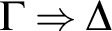 $\Gamma \Rightarrow \Delta $
. If
 $\lvert \pi \rvert =0$
or
 $\lvert \tau \rvert =0$
, then
 $\Gamma \Rightarrow \Delta $
is an initial sequent. In this case, we define
 $\mathsf G_{\Box B}(\mathsf u)(\pi ,\tau )$
as the
 $\infty $
-proof consisting only of the sequent
 $\Gamma \Rightarrow \Delta $
.
Suppose that
 $\lvert \pi \rvert>0$
and
 $\lvert \tau \rvert>0$
. We define
 $\mathsf G_{\Box B}(\mathsf u)(\pi ,\tau )$
according to the last application of an inference rule in
 $\pi $
:




Consider the case when
 $\pi $
has the form

We define
 $\mathsf G_{\Box B}(\mathsf u)(\pi ,\tau )$
according to the last application of an inference rule in
 $\tau $
. If the last inference is an application of the rule
 $\mathsf {(refl)}$
with the principal formula being not
 $\Box B$
or is an application of the rule
 ${(\Box )}$
without the formula
 $\Box B$
in the right premise, then
 $\mathsf G_{\Box B}(\mathsf u)(\pi ,\tau )$
is defined similarly to the previous cases of
 $\mathsf {(refl)}$
and
 $({\Box })$
. Cases of inference rules
 $(\to _{\mathsf {L}})$
,
 $(\to _{\mathsf {R}})$
, and
 $\mathsf {(cut)}$
are also completely similar to the previous cases of
 $(\to _{\mathsf {L}})$
,
 $(\to _{\mathsf {R}})$
, and
 $\mathsf {(cut)}$
.
If the last application of an inference rule in
 $\tau $
is an application of the rule
 $\mathsf {(refl)}$
with the principal formula
 $\Box B$
, then we put

It remains to consider the crucial case when
 $\tau $
has the form

We define
 $\mathsf G_{\Box B}(\mathsf u)(\pi , \tau )$
as

where
 $\pi '$
equals

Notice that
 $\Phi ^\prime , \Box \Pi ^\prime =\Phi ,\Box \Pi $
and
 $\Box C, \Sigma ^\prime =\Sigma $
, and
 $\Box \Pi ^\prime \backslash \Box \Pi ,\Box \Pi =\Box \Pi \backslash \Box \Pi ^\prime ,\Box \Pi ^\prime $
.
Now the operator
 $\mathsf G_{\Box B}$
is well-defined. By the case analysis according to the definition of
 $\mathsf G_{\Box B}$
, we see that
 $\mathsf G_{\Box B} (\mathsf u) $
is nonexpansive and belongs to
 $\mathcal R_{\Box B}$
whenever
 $\mathsf u \in \mathcal R_{\Box B}$
.
We claim that
 $\mathsf G_{\Box B}$
is contractive. It sufficient to check that for any
 $\mathsf u, \mathsf v\in \mathcal R_{\Box B}$
and any
 $n,k\in \mathbb N$
we have
 $$ \begin{align*}\mathsf u\sim_{n,k}\mathsf v \Rightarrow \mathsf G_{\Box B}(\mathsf u)\sim_{n,k+1}\mathsf G_{\Box B}(\mathsf v).\end{align*} $$
Assume there are two
 $\Box B$
-removing mappings
 $\mathsf u$
and
 $\mathsf v$
such that
 $\mathsf u\sim _{n,k}\mathsf v$
. Consider an arbitrary pair of
 $\infty $
-proofs
 $(\pi ,\tau )$
. By the case analysis according to the definition of
 $\mathsf G_{\Box B}$
, we prove that
 $\mathsf G_{\Box B}(\mathsf u)(\pi ,\tau )\sim _{n}\mathsf G_{\Box B}(\mathsf v)(\pi ,\tau )$
. In addition, we check that if
 $\lvert \pi \rvert +\lvert \tau \lvert <k+1$
, then
 $\mathsf G_{\Box B}(\mathsf u)(\pi ,\tau )\sim _{n+1}\mathsf G_{\Box B}(\mathsf v)(\pi ,\tau )$
.
If the pair
 $(\pi ,\tau )$
is not a cut pair or is a cut pair with the cut formula being not
 $\Box B$
, then we have
 $ \mathsf G_{\Box B}(\mathsf u)(\pi ,\tau ) = \pi =\mathsf G_{\Box B}(\mathsf v)(\pi ,\tau )$
. Otherwise, consider last inferences in
 $\pi $
and
 $\tau $
.
Suppose that the
 $\infty $
-proof
 $\pi $
has the form

Then we have
 $\mathsf {u}(\pi _0, \mathsf {wk}_{ C; \emptyset } (\tau ))\sim _n \mathsf {v}(\pi _0, \mathsf {wk}_{ C; \emptyset } (\tau ))$
. Hence,
 $\mathsf G_{\Box B}(\mathsf u)(\pi ,\tau )\sim _{n}\mathsf G_{\Box B}(\mathsf v)(\pi ,\tau )$
.
In addition, if
 $\lvert \pi \rvert +\lvert \tau \lvert <k+1$
, then
 $\lvert \pi _0\rvert +\lvert \mathsf {wk}_{ C; \emptyset } (\tau )\lvert <k$
. Thus,
 $\mathsf {u}(\pi _0, \mathsf {wk}_{ C; \emptyset } (\tau ))\sim _{n+1} \mathsf {v}(\pi _0, \mathsf {wk}_{ C; \emptyset } (\tau ))$
. We obtain that
 $\mathsf G_{\Box B}(\mathsf u)(\pi ,\tau )\sim _{n+1}\mathsf G_{\Box B}(\mathsf v)(\pi ,\tau )$
.
Now let us consider the case when
 $\pi $
and
 $\tau $
have the forms

We see that
 $\mathsf {u}(\mathsf {wk}_{B;\emptyset }(\pi ),\tau _0) \sim _n \mathsf {v}(\mathsf {wk}_{B;\emptyset }(\pi ),\tau _0)$
. Since the mapping
 $\mathsf {re}_{B}$
is nonexpansive, we have
 $$ \begin{align*}\mathsf G_{\Box B}(\mathsf u)(\pi,\tau) = \mathsf{re}_{B}(\pi_0,\mathsf{u}(\mathsf{wk}_{B;\emptyset}(\pi),\tau_0)) \sim_n \mathsf{re}_{B}(\pi_0,\mathsf{v}(\mathsf{wk}_{B;\emptyset}(\pi),\tau_0)) = \mathsf G_{\Box B}(\mathsf v)(\pi,\tau).\end{align*} $$
In addition, if
 $\lvert \pi \rvert +\lvert \tau \lvert <k+1$
, then
 $\lvert \mathsf {wk}_{B;\emptyset }(\pi )\rvert +\lvert \tau _0\lvert <k$
. Consequently,
 $\mathsf {u}(\mathsf {wk}_{B;\emptyset }(\pi ),\tau _0) \sim _{n+1} \mathsf {v}(\mathsf {wk}_{B;\emptyset }(\pi ),\tau _0)$
. Thus, we have
 $$ \begin{align*}\mathsf G_{\Box B}(\mathsf u)(\pi,\tau) = \mathsf{re}_{B}(\pi_0,\mathsf{u}(\mathsf{wk}_{B;\emptyset}(\pi),\tau_0)) \sim_{n+1} \mathsf{re}_{B}(\pi_0,\mathsf{v}(\mathsf{wk}_{B;\emptyset}(\pi),\tau_0)) = \mathsf G_{\Box B}(\mathsf v)(\pi,\tau).\end{align*} $$
Let us consider the main case when
 $\pi $
and
 $\tau $
have the forms

We have
 $\mathsf {u}\left (\pi ',\mathsf {wk}_{\Box \Pi \backslash \Box \Pi ^\prime ;\emptyset }(\tau _1)\right )\sim _n\mathsf {v}\left (\pi ',\mathsf {wk}_{\Box \Pi \backslash \Box \Pi ^\prime ;\emptyset }(\tau _1)\right )$
, and
 $\mathsf {u}(\mathsf {li}_{\Box C}(\pi ),\tau _0)\sim _{n}\mathsf {v}(\mathsf {li}_{\Box C}(\pi ),\tau _0)$
. Hence,
 $\mathsf G_{\Box B}(\mathsf u)(\pi ,\tau )\sim _{n}\mathsf G_{\Box B}(\mathsf v)(\pi ,\tau )$
.
If
 $\lvert \pi \rvert +\lvert \tau \lvert <k+1$
, then
 $\mathsf {u}\left (\pi ',\mathsf {wk}_{\Box \Pi \backslash \Box \Pi ^\prime ;\emptyset }(\tau _1)\right )\sim _n\mathsf {v}\left (\pi ',\mathsf {wk}_{\Box \Pi \backslash \Box \Pi ^\prime ;\emptyset }(\tau _1)\right )$
and
 $\mathsf {u}(\mathsf {li}_{\Box C}(\pi ),\tau _0)\sim _{n+1}\mathsf {v}(\mathsf {li}_{\Box C}(\pi ),\tau _0)$
, because
 $\lvert \mathsf {li}_{\Box C}(\pi )\rvert +\lvert \tau _0\rvert < k$
. We obtain
 $\mathsf G_{\Box B}(\mathsf u)(\pi ,\tau )\sim _{n+1}\mathsf G_{\Box B}(\mathsf v)(\pi ,\tau )$
.
All the other cases of lowermost inferences in
 $\pi $
and
 $\tau $
are treated similarly, so we omit them. We have that the operator
 $\mathsf {G}_{\Box \mathsf {B}}$
is contractive.
Now we define the required
 $\Box B$
-removing mapping
 $\mathsf {re}_{\Box B}$
as the fixed-point of the the operator
 $\mathsf G_{\Box B} \colon \mathcal R_{\Box B} \to \mathcal R_{\Box B}$
, which exists by Lemma 6.14
It remains to check that the mapping
 $\mathsf {re}_{\Box B}$
is adequate. For any
 $n,k\in \mathbb N$
, let us call a mapping
 $\mathsf u\in \mathcal R_{\Box B} (n,k)$
-adequate if it satisfies the following two conditions:
 $\mathsf u(\pi ,\tau )\in \mathcal P_i$
for any
 $i\leqslant n$
and any
 $\pi , \tau \in \mathcal P_i$
;
 $\mathsf u(\pi ,\tau )\in \mathcal P_{n+1}$
whenever
 $\pi , \tau \in \mathcal P_{n+1}$
and
 $\lvert \pi \rvert + \lvert \tau \rvert <k$
.
We claim that
 $\mathsf G_{\Box B}(\mathsf u)$
is
 $(n,k+1)$
-adequate whenever
 $\mathsf {u}$
is a
 $(n,k)$
-adequate mapping from
 $\mathcal R_{\Box B}$
. Consider an arbitrary pair of
 $\infty $
-proofs
 $(\pi ,\tau )$
and an
 $(n,k)$
-adequate mapping
 $\mathsf u\in \mathcal R_{\Box B}$
. By the case analysis according to the definition of
 $\mathsf {G}_{\Box \mathsf {B}}$
, we prove that
 $\mathsf G_{\Box B}(\mathsf u)(\pi ,\tau )\in \mathcal {P}_i$
if
 $i\leqslant n$
and
 $\pi , \tau \in \mathcal P_i$
. In addition, we check that
 $\mathsf G_{\Box B}(\mathsf u)(\pi ,\tau )\in \mathcal P_{n+1}$
if
 $\lvert \pi \rvert +\lvert \tau \lvert <k+1$
and
 $\pi , \tau \in \mathcal P_{n+1}$
.
If the pair
 $(\pi ,\tau )$
is not a cut pair or is a cut pair with the cut formula being not
 $\Box B$
, then we have
 $ \mathsf G_{\Box B}(\mathsf u)(\pi ,\tau ) = \pi $
. In this case, the required statements trivially hold. Otherwise, consider last inferences in
 $\pi $
and
 $\tau $
.
Suppose that the
 $\infty $
-proof
 $\pi $
has the form

Since the mapping
 $\mathsf {i}_{ C\to D}$
is adequate, we have
 $\mathsf {u}(\pi _0, \mathsf {i}_{ C\to D} (\tau ))\in \mathcal {P}_i$
whenever
 $i\leqslant n$
and
 $\pi , \tau \in \mathcal P_i$
. In this case, we see that
 $\mathsf G_{\Box B}(\mathsf u)(\pi ,\tau )\in \mathcal P_{i}$
.
If
 $\lvert \pi \rvert +\lvert \tau \lvert <k+1$
, then
 $\lvert \pi _0\rvert +\lvert \mathsf {i}_{ C\to D}(\tau )\lvert <k$
. Thus,
 $\mathsf {u}(\pi _0, \mathsf {i}_{ C\to D} (\tau ))\in \mathcal P_{n+1}$
whenever
 $\pi , \tau \in \mathcal P_{n+1}$
. We obtain that
 $\mathsf G_{\Box B}(\mathsf u)(\pi ,\tau )\in \mathcal P_{n+1}$
.
Suppose that
 $\pi $
and
 $\tau $
have the forms
Trivially,
 $\mathsf G_{\Box B}(\mathsf u)(\pi ,\tau )\in \mathcal P_{0} = \mathcal {P}$
. Thus consider the case when
 $\pi , \tau \in \mathcal {P}_i$
for some
 $0<i \leqslant n$
. Then we see that
 $\pi _0, \tau _0 \in \mathcal {P}_i$
and
 $\pi _1, \tau _1 \in \mathcal {P}_{i-1}$
. Since the mapping
 $\mathsf {wk}_{\Box \Pi \backslash \Box \Pi ^\prime ;\emptyset }$
and
 $\mathsf {li}_{\Box C}$
are adequate, we have
 $\mathsf {u}(\mathsf {li}_{\Box C}(\pi ),\tau _0)\in \mathcal {P}_i$
and
 $\mathsf {u}\left (\pi ',\mathsf {wk}_{\Box \Pi \backslash \Box \Pi ^\prime ;\emptyset }(\tau _1)\right )\in \mathcal {P}_{i-1}$
. Hence,
 $\mathsf G_{\Box B}(\mathsf u)(\pi ,\tau )\in \mathcal {P}_i$
.
If
 $\lvert \pi \rvert +\lvert \tau \lvert <k+1$
and
 $\pi ,\tau \in \mathcal {P}_{n+1}$
, then
 $\lvert \mathsf {li}_{\Box C}(\pi ) \rvert + \lvert \tau _0 \rvert <k$
and
 $\mathsf {u}(\mathsf {li}_{\Box C}(\pi ),\tau _0)\in \mathcal {P}_{n+1}$
. Also, we see that
 $\pi '\in \mathcal {P}_n$
and
 $\mathsf {wk}_{\Box \Pi \backslash \Box \Pi ^\prime ;\emptyset }(\tau _1) \in \mathcal {P}_n$
. Hence,
 $\mathsf {u}\left (\pi ',\mathsf {wk}_{\Box \Pi \backslash \Box \Pi ^\prime ;\emptyset }(\tau _1)\right )\in \mathcal {P}_{n}$
. We obtain
 $\mathsf G_{\Box B}(\mathsf u)(\pi ,\tau )\in \mathcal {P}_{n+1}$
.
We omit other cases of lowermost inferences in
 $\pi $
and
 $\tau $
, because they are treated similarly.
We established that
 $\mathsf G_{\Box B}(\mathsf u)$
is
 $(n,k+1)$
-adequate for any
 $(n,k)$
-adequate
 $\mathsf u\in \mathcal R_{\Box B}$
. Notice that if a mapping
 $\mathsf {u} $
is
 $(n,k)$
-adequate for all
 $k\in \mathbb N$
, then it is also
 $(n+1,0)$
-adequate. Now by induction on n with a subinduction on k, we immediately obtain that the mapping
 $\mathsf {re}_{\Box B}$
, which is a fixed-point of
 $\mathsf G_{\Box B}$
, is
 $(n,k)$
-adequate for all
 $n,k\in \mathbb N$
. Therefore the mapping
 $\mathsf {re}_{\Box B}$
is adequate. □
Lemma 6.17. For any formula A, there exists an adequate A-removing mapping
 $\mathsf {re}_A$
.
Proof. We define
 $\mathsf {re}_A$
by induction on the structure of the formula
 $A $
.
Case 1: A has the form p. In this case,
 $\mathsf {re}_{p} $
is defined by Lemma 6.15.
Case 2: A has the form
 $\bot $
. Then we put
 $\mathsf {re}_{\bot }(\pi ,\tau ):= \mathsf {i}_\bot (\pi )$
, where
 $\mathsf {i}_\bot $
is the nonexpansive adequate mapping from Lemma 5.12.
Case 3: A has the form
 $B\to C$
. Then we put
 $$ \begin{align*}\mathsf{re}_{B \to C}(\pi,\tau):=\mathsf{re}_C(\mathsf{re}_B(\mathsf{wk}_{\emptyset; C}(\mathsf{ri}_{B\to C}(\tau)),\mathsf{i}_{B\to C}(\pi)),\mathsf{li}_{B\to C}(\tau)),\end{align*} $$
where
 $\mathsf {ri}_{B \to C}$
,
 $\mathsf {i}_{B \to C}$
,
 $\mathsf {li}_{B \to C}$
are the nonexpansive adequate mappings from Lemma 5.12 and
 $\mathsf {wk}_{\emptyset ; C}$
is the nonexpansive adequate mapping from Lemma 5.11.
Case 4: A has the form
 $\Box B$
. By the induction hypothesis, there is an adequate B-removing mapping
 $\mathsf {re}_B$
. The required
 $\Box B$
-removing mapping
 $\mathsf {re}_{\Box B}$
exists by Lemma 6.16. □
A mapping
 $\mathsf {u}\colon \mathcal P \to \mathcal P$
is called root-preserving if it maps
 $\infty $
-proofs to
 $\infty $
-proofs of the same sequents. Let
 $\mathcal {T}$
denote the set of all root-preserving nonexpansive mappings from
 $\mathcal P$
to
 $\mathcal P$
.
Lemma 6.18. In the ultrametric space
 $(\mathcal T,l_1)$
, any contractive operator
 $\mathsf {U}: \mathcal T\to \mathcal T$
has a unique fixed-point.
Proof. The space is obviously nonempty, since the identity function lies in
 $\mathcal T$
. The proof is analogous to the proof of Proposition 4.10 □
Theorem 6.19 (cut-elimination)
If
 $\mathsf {Grz}_{\infty } +\mathsf {cut}\vdash \Gamma \Rightarrow \Delta $
, then
 $\mathsf {Grz}_{\infty }\vdash \Gamma \Rightarrow \Delta $
.
Proof. We construct the required cut-elimination mapping
 $\mathsf {ce}$
so it commutes with every application of inference rules except
 $\mathsf {(cut)}$
and satisfies the following condition:

In order to do this, we define a contractive operator
 $\mathsf F \colon \mathcal T \to \mathcal T$
and obtain the mapping
 $\mathsf {ce}$
as the fixed-point of
 $\mathsf F$
.
For a mapping
 $\mathsf u\in \mathcal T$
and an
 $\infty $
-proof
 $\pi $
, the
 $\infty $
-proof
 $\mathsf F(\mathsf u)(\pi )$
is defined as follows. If
 $\lvert \pi \rvert =0$
, then we define
 $\mathsf F(\mathsf u)(\pi )$
to be
 $\pi $
.
Otherwise, we define
 $\mathsf F(\mathsf u)(\pi )$
according to the last application of an inference rule in
 $\pi $
:


Now the operator
 $\mathsf F$
is well-defined. By the case analysis according to the definition of
 $\mathsf F$
, we see that
 $\mathsf F (\mathsf u) $
is nonexpansive and belongs to
 $\mathcal T$
whenever
 $\mathsf u \in \mathcal T$
.
We claim that
 $\mathsf {F}$
is contractive. It sufficient to check that for any
 $\mathsf u, \mathsf v\in \mathcal T$
and any
 $n,k\in \mathbb N$
we have
 $$ \begin{align*}\mathsf u\sim_{n,k}\mathsf v \Rightarrow \mathsf {F(u)}\sim_{n,k+1}\mathsf{F(v)}.\end{align*} $$
Assume there are mappings
 $\mathsf u$
and
 $\mathsf v$
from
 $\mathcal {T}$
such that
 $\mathsf u\sim _{n,k}\mathsf v$
. Consider an arbitrary
 $\infty $
-proof
 $\pi $
. By the case analysis according to the definition of
 $\mathsf {F}$
, we prove that
 $\mathsf F(\mathsf u)(\pi )\sim _{n}\mathsf F(\mathsf v)(\pi )$
. In addition, we check that if
 $\lvert \pi \rvert <k+1$
, then
 $\mathsf F(\mathsf u)(\pi )\sim _{n+1}\mathsf F(\mathsf v)(\pi )$
.
Let us consider the case when
 $\pi $
has the form

We have
 $\mathsf u(\pi _0) \sim _n \mathsf v(\pi _0)$
and
 $\mathsf u(\pi _1) \sim _n \mathsf v(\pi _1)$
. Thus,
 $F(\mathsf u)(\pi ) \sim _n F(\mathsf v)(\pi )$
.
If
 $\lvert \pi \rvert <k+1$
, then
 $\lvert \pi _0\rvert <k$
. We have
 $\mathsf u(\pi _0) \sim _{n+1} \mathsf v(\pi _0)$
and
 $\mathsf u(\pi _1) \sim _n \mathsf v(\pi _1)$
. Hence,
 $F(\mathsf u)(\pi ) \sim _{n+1} F(\mathsf v)(\pi )$
.
Now consider the case when
 $\pi $
has the form

We have
 $\mathsf u(\pi _0) \sim _n \mathsf v(\pi _0)$
and
 $\mathsf u(\pi _1) \sim _n \mathsf v(\pi _1)$
. Since the mapping
 $\mathsf {re}_A$
is nonexpansive, we see that
 $$ \begin{align*}F(\mathsf u)(\pi) = \mathsf {re}_A(\mathsf u(\pi_0),\mathsf u(\pi_1)) \sim_n \mathsf {re}_A(\mathsf v(\pi_0),\mathsf v(\pi_1))= F(\mathsf v)(\pi).\end{align*} $$
Moreover, if
 $\lvert \pi \rvert <k+1$
, then
 $\lvert \pi _0\rvert <k$
and
 $\lvert \pi _1\rvert <k$
. From the assumption
 $\mathsf u\sim _{n,k}\mathsf v$
, we obtain
 $\mathsf u(\pi _0) \sim _{n+1} \mathsf v(\pi _0)$
and
 $\mathsf u(\pi _1) \sim _{n+1} \mathsf v(\pi _1)$
. Hence,
 $$ \begin{align*}F(\mathsf u)(\pi) = \mathsf {re}_A(\mathsf u(\pi_0),\mathsf u(\pi_1)) \sim_{n+1} \mathsf {re}_A(\mathsf v(\pi_0),\mathsf v(\pi_1))= F(\mathsf v)(\pi).\end{align*} $$
Other cases are straightforward, so we omit them. We have that the operator
 $\mathsf {F}$
is contractive.
Now we define the required cut-elimination mapping
 $\mathsf {ce}$
as the fixed-point of the the operator
 $\mathsf F \colon \mathcal T \to \mathcal T$
, which exists by Lemma 6.18
For any
 $n,k\in \mathbb N$
, let us call a mapping
 $\mathsf u\in \mathcal T (n,k)$
-free if it satisfies the following two conditions:
 $\mathsf u(\pi )\in \mathcal P_n$
for any
 $\pi \in \mathcal P$
;
 $\mathsf u(\pi )\in \mathcal P_{n+1}$
whenever
 $\lvert \pi \rvert <k$
.
We claim that
 $F(\mathsf u)$
is
 $(n,k+1)$
-free whenever
 $\mathsf {u}$
is an
 $(n,k)$
-free mapping from
 $\mathcal T$
. Consider an arbitrary
 $\infty $
-proof
 $\pi $
and an
 $(n,k)$
-free mapping
 $\mathsf u\in \mathcal T$
. By the case analysis according to the definition of
 $\mathsf {F}$
, we prove that
 $F(\mathsf u)(\pi )\in \mathcal {P}_n$
. In addition, we check that
 $\mathsf F(\mathsf u)(\pi )\in \mathcal P_{n+1}$
if
 $\lvert \pi \rvert <k+1$
.
Let us consider the case when
 $\pi $
has the form
We have
 $\mathsf u(\pi _0) ,\mathsf u(\pi _1) \in \mathcal {P}_n$
. Hence,
 $F(\mathsf u)(\pi ) \in \mathcal {P}_n$
.
If
 $\lvert \pi \rvert <k+1$
, then
 $\lvert \pi _0\rvert <k$
. We have
 $\mathsf u(\pi _0) \in \mathcal {P}_{n+1}$
and
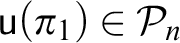 $\mathsf u(\pi _1) \in \mathcal {P}_n$
. Hence,
 $F(\mathsf u)(\pi ) \in \mathcal {P}_{n+1}$
.
Now we consider the case when
 $\pi $
has the form
We have
 $\mathsf u(\pi _0) ,\mathsf u(\pi _1) \in \mathcal {P}_n$
. Since the mapping
 $\mathsf {re}_A$
is adequate, we see that
 $F(\mathsf u)(\pi ) = \mathsf {re}_A(\mathsf u(\pi _0),\mathsf u(\pi _1)) \in \mathcal {P}_n$
.
If
 $\lvert \pi \rvert <k+1$
, then
 $\lvert \pi _0\rvert <k$
and
 $\lvert \pi _1\rvert <k$
. We obtain
 $\mathsf u(\pi _0), \mathsf {u}(\pi _1) \in \mathcal {P}_{n+1}$
. Hence,
 $F(\mathsf u)(\pi ) = \mathsf {re}_A(\mathsf u(\pi _0),\mathsf u(\pi _1))\in \mathcal {P}_{n+1}$
.
We omit the other cases of the lowermost inferences in
 $\pi $
, because they are trivial.
We established that
 $\mathsf F(\mathsf u)$
is
 $(n,k+1)$
-free for any
 $(n,k)$
-free
 $\mathsf u\in \mathcal T$
. Notice that if a mapping
 $\mathsf {u} $
is
 $(n,k)$
-free for all
 $k\in \mathbb N$
, then it is also
 $(n+1,0)$
-free. Now by induction on n with a subinduction on k, we immediately obtain that the mapping
 $\mathsf {ce}$
, which is a fixed-point of
 $\mathsf F$
, is
 $(n,k)$
-free for all
 $n,k\in \mathbb N$
. Therefore, for any
 $\infty $
-proof
 $\pi $
, the
 $\infty $
-proof
 $\mathsf {ce}(\pi )$
does not contain instances of the rule
 $\mathsf {(cut)}$
.
Now assume
 $\mathsf {Grz}_{\infty } +\mathsf {cut}\vdash \Gamma \Rightarrow \Delta $
. Take an
 $\infty $
-proof of the sequent
 $\Gamma \Rightarrow \Delta $
in the system
 $\mathsf {Grz}_{\infty } +\mathsf {cut}$
and apply the mapping
 $\mathsf {ce}$
to it. We obtain an
 $\infty $
-proof of the same sequent in the system
 $\mathsf {Grz}_{\infty }$
.□
Theorem 2.2 is now established as a direct consequence of Theorem 3.6, Theorem 6.19, and Theorem 3.7.
Corollary 6.20. For any finite multisets of formulas
 $\Gamma $
and
 $\Delta $
, the following are equivalent:
-
1.
$\mathsf {Grz} \vdash \bigwedge \Gamma \to \bigvee \Delta $
, -
2.
$\mathsf {Grz}_{\mathsf {Seq}} \vdash \Gamma \Rightarrow \Delta $
, -
3.
$\mathsf {Grz}_{\mathsf {Seq}} +\mathsf {cut}\vdash \Gamma \Rightarrow \Delta $
, -
4.
$\mathsf {Grz}_{\infty } \vdash \Gamma \Rightarrow \Delta $
, -
5.
$\mathsf {Grz}_{\infty }+\mathsf {cut} \vdash \Gamma \Rightarrow \Delta $
.


7 Lyndon interpolation
The Lyndon interpolation property for the logic
 $\mathsf {Grz}$
was established in [Reference Maksimova14] on the basis of Kripke semantics. Here we present a proof-theoretic argument for the same result.
For a formula or a multiset of formulas X, let
 $\mathit {pos}(X)$
be the set of atomic propositions that have positive occurrences in X and let
 $\mathit {neg}(X)$
be the set of atomic propositions with negative occurrences in X. For a sequent
 $\Gamma \Rightarrow \Delta $
, let
 $\mathit {pos}(\Gamma \Rightarrow \Delta )=\mathit {pos}(\Delta )\cup \mathit {neg}(\Gamma )$
and
 $\mathit {neg}(\Gamma \Rightarrow \Delta )=\mathit {neg}(\Delta )\cup \mathit {pos}(\Gamma )$
.
Recall that for a finite set of formulas
 $\Lambda $
, the set
 $\Lambda ^\ast $
is
 $\{\Box (A\to \Box A)\mid A\in \Lambda \}$
.
Lemma 7.21. For any finite sets of formulas
 $\Lambda _1$
,
 $\Lambda _2$
, if
 $\mathsf {Grz}_{\infty }\vdash \Gamma _1,\Gamma _2\Rightarrow \Delta _1,\Delta _2$
, then there exists a formula I called an interpolant of this sequent, such that
 $\mathit {pos}(I)\subset \mathit {neg}(\Gamma _1\Rightarrow \Delta _1)\cap \mathit {pos}(\Gamma _2\Rightarrow \Delta _2)$
,
 $\mathit {neg}(I)\subset \mathit {pos}(\Gamma _1\Rightarrow \Delta _1)\cap \mathit {neg}(\Gamma _2\Rightarrow \Delta _2)$
, and
 $$\begin{align*}\mathsf{Grz} \vdash \bigwedge \Lambda_1^\ast \cup\Gamma_1\rightarrow\bigvee\Delta_1 \cup \{ I\} \quad \text{and} \quad\mathsf{Grz} \vdash \bigwedge \Lambda_2^\ast \cup\{ I\} \cup \Gamma_2\rightarrow\bigvee\Delta_2\:.\end{align*}$$
Proof. Assume
 $\pi $
is an
 $\infty $
-proof of the sequent
 $\Gamma _1,\Gamma _2\Rightarrow \Delta _1,\Delta _2$
in
 $\mathsf {Grz}_\infty $
and
 $\Lambda _1$
,
 $\Lambda _2$
are finite sets of formulas. We prove the statement of the lemma by induction on the sum of cardinalities
 $\mathit {card}(Sub(\Gamma _1\Rightarrow \Delta _1)\backslash \Lambda _1 )+\mathit {card}( Sub(\Gamma _2\Rightarrow \Delta _2)\backslash \Lambda _2)$
with a subinduction on
 $\lvert \pi \rvert $
.
Suppose
 $\lvert \pi \rvert =0$
. Then
 $\Gamma _1,\Gamma _2\Rightarrow \Delta _1,\Delta _2$
is an initial sequent. If
 $\Gamma _1\Rightarrow \Delta _1$
(
 $\Gamma _2\Rightarrow \Delta _2$
) is an initial sequent, then we put
 $I:= \bot $
(
 $I:= \top $
). Otherwise, we have an atomic proposition p such that
 $p \in \Gamma _1$
and
 $p\in \Delta _2$
(
 $p \in \Gamma _2$
and
 $p\in \Delta _1$
). In this case, we put
 $I:= p$
(
 $I:= \neg p$
).
Now consider the last application of an inference rule in
 $\pi $
.
Case 1. Suppose that
 $\pi $
has the form

where
 $A\to B,\Sigma = \Delta _1, \Delta _2$
. Notice that
 $\lvert \pi ^\prime \rvert < \lvert \pi \rvert $
. If
 $A \to B \in \Delta _1$
(
 $A \to B \in \Delta _2$
), then we put
 $\Gamma ^\prime _1:= \Gamma _1 \cup \{A\}$
;
 $\Delta ^\prime _1:= (\Delta _1\backslash \{A\to B\})\cup \{B\}$
;
 $\Gamma ^\prime _2:=\Gamma _2$
;
 $\Delta ^\prime _2:=\Delta _2$
(
 $\Gamma ^\prime _2:= \Gamma _2 \cup \{A\}$
;
 $\Delta ^\prime _2:= (\Delta _2\backslash \{A\to B\})\cup \{B\}$
;
 $\Gamma ^\prime _1:=\Gamma _1$
;
 $\Delta ^\prime _1:=\Delta _1$
). We see that
 $\pi ^\prime $
is an
 $\infty $
-proof of the sequent
 $\Gamma ^\prime _1,\Gamma ^\prime _2\Rightarrow \Delta ^\prime _1,\Delta ^\prime _2$
in
 $\mathsf {Grz}_\infty $
. By the induction hypothesis for
 $\pi ^\prime $
,
 $\Lambda _1$
and
 $\Lambda _2$
, there is a corresponding interpolant
 $I^\prime $
. We set
 $I:=I^\prime $
.
Case 2. Suppose that
 $\pi $
has the form

where
 $\Sigma , A\to B = \Gamma _1,\Gamma _2$
. We see that
 $\lvert \pi ^\prime \rvert < \lvert \pi \rvert $
. If
 $A \to B \in \Gamma _1$
(
 $A \to B \in \Gamma _2$
), then we put
 $\Gamma ^\prime _1:= (\Gamma _1 \backslash \{A\to B\})\cup \{B\}$
;
 $\Gamma ^{\prime \prime }_1:= \Gamma _1 \backslash \{A\to B\}$
;
 $\Delta ^\prime _1:= \Delta _1 $
;
 $\Delta ^{\prime \prime }_1:= \Delta _1 \cup \{A\}$
;
 $\Gamma ^\prime _2:=\Gamma _2$
;
 $\Gamma ^{\prime \prime }_2:=\Gamma _2$
;
 $\Delta ^\prime _2:=\Delta _2$
;
 $\Delta ^{\prime \prime }_2:=\Delta _2$
(
 $\Gamma ^\prime _2:= (\Gamma _2 \backslash \{A\to B\})\cup \{B\}$
;
 $\Gamma ^{\prime \prime }_2:= \Gamma _2 \backslash \{A\to B\}$
;
 $\Delta ^\prime _2:= \Delta _2 $
;
 $\Delta ^{\prime \prime }_2:= \Delta _2 \cup \{A\}$
;
 $\Gamma ^\prime _1:=\Gamma _1$
;
 $\Gamma ^{\prime \prime }_1:=\Gamma _1$
;
 $\Delta ^\prime _1:=\Delta _1$
;
 $\Delta ^{\prime \prime }_1:=\Delta _1$
). We see that
 $\pi ^\prime $
and
 $\pi ^{\prime \prime }$
are
 $\infty $
-proofs of
 $\Gamma ^\prime _1,\Gamma ^\prime _2\Rightarrow \Delta ^\prime _1,\Delta ^\prime _2$
and
 $\Gamma ^{\prime \prime }_1,\Gamma ^{\prime \prime }_2\Rightarrow \Delta ^{\prime \prime }_1,\Delta ^{\prime \prime }_2$
in
 $\mathsf {Grz}_\infty $
. By the induction hypothesis for
 $\pi ^\prime $
,
 $\Lambda _1$
and
 $\Lambda _2$
, there is an interpolant
 $I^\prime $
. Analogously, by the induction hypothesis for
 $\pi ^{\prime \prime }$
,
 $\Lambda _1$
and
 $\Lambda _2$
, there is an interpolant
 $I^{\prime \prime }$
. If
 $A \to B \in \Gamma _1$
, then we set
 $I:=I^\prime \vee I^{\prime \prime }$
. Otherwise, when
 $A \to B \in \Gamma _2$
, we set
 $I:=I^\prime \wedge I^{\prime \prime }$
.
Case 3. Suppose that
 $\pi $
has the form

where
 $\Sigma , \Box A = \Gamma _1,\Gamma _2$
. If
 $\Box A \in \Gamma _1$
(
 $\Box A \in \Gamma _2$
), then we put
 $\Gamma ^\prime _1:= \Gamma _1 \cup \{A\}$
;
 $\Delta ^\prime _1:= \Delta _1$
;
 $\Gamma ^\prime _2:=\Gamma _2$
;
 $\Delta ^\prime _2:=\Delta _2$
(
 $\Gamma ^\prime _2:= \Gamma _2 \cup \{A\}$
;
 $\Delta ^\prime _2:= \Delta _2$
;
 $\Gamma ^\prime _1:=\Gamma _1$
;
 $\Delta ^\prime _1:=\Delta _1$
). We see that
 $\pi ^\prime $
is an
 $\infty $
-proof of the sequent
 $\Gamma ^\prime _1,\Gamma ^\prime _2\Rightarrow \Delta ^\prime _1,\Delta ^\prime _2$
in
 $\mathsf {Grz}_\infty $
. By the induction hypothesis for
 $\pi ^\prime $
,
 $\Lambda _1$
and
 $\Lambda _2$
, there is a corresponding interpolant
 $I^\prime $
. We set
 $I:=I^\prime $
.
Case 4. Suppose that
 $\pi $
has the form
where
 $\Phi , \Box \Pi = \Gamma _1, \Gamma _2$
and
 $\Box A, \Sigma =\Delta _1, \Delta _2$
.
Subcase 4.1: the formula
 $\Box A \in \Delta _1$
and
 $A \in \Lambda _1 $
(
 $\Box A \in \Delta _2$
and
 $A \in \Lambda _2$
). We see that
 $\lvert \pi ^\prime \rvert < \lvert \pi \rvert $
. We put
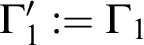 $\Gamma ^\prime _1:= \Gamma _1 $
;
 $\Delta ^\prime _1:= (\Delta _1 \backslash \{\Box A\}) \cup \{A\} $
;
 $\Gamma ^\prime _2:=\Gamma _2$
;
 $\Delta ^\prime _2:=\Delta _2$
(
 $\Gamma ^\prime _2:= \Gamma _2 $
;
 $\Delta ^\prime _2:= (\Delta _2 \backslash \{\Box A\}) \cup \{A\} $
;
 $\Gamma ^\prime _1:=\Gamma _1$
;
 $\Delta ^\prime _1:=\Delta _1$
). We see that
 $\pi ^\prime $
is an
 $\infty $
-proof of the sequent
 $\Gamma ^\prime _1,\Gamma ^\prime _2\Rightarrow \Delta ^\prime _1,\Delta ^\prime _2$
in
 $\mathsf {Grz}_\infty $
. By the induction hypothesis for
 $\pi ^\prime $
,
 $\Lambda _1$
and
 $\Lambda _2$
, there is a corresponding interpolant
 $I^\prime $
such that
 $$\begin{align*}\mathsf{Grz} \vdash \bigwedge \Lambda_1^\ast \cup\Gamma^\prime_1\rightarrow\bigvee\Delta^\prime_1 \cup \{ I^\prime\} \quad \text{and} \quad\mathsf{Grz} \vdash \bigwedge \Lambda_2^\ast \cup\{ I^\prime\} \cup \Gamma^\prime_2\rightarrow\bigvee\Delta^\prime_2\:.\end{align*}$$
If
 $\Box A \in \Delta _1$
and
 $A \in \Lambda _1 $
, then
 $\Box (A \to \Box A) \in \Lambda _1^\ast $
. Thus we have
 $\mathsf {Grz} \vdash \bigwedge \Lambda _1^\ast \rightarrow (A \to \Box A)$
. It follows that we can replace the formula A in
 $\Delta ^\prime _1$
by
 $\Box A$
and obtain
 $$\begin{align*}\mathsf{Grz} \vdash \bigwedge \Lambda_1^\ast \cup\Gamma^\prime_1\rightarrow\bigvee\Delta_1 \cup \{ I^\prime \} \:.\end{align*}$$
Note also that
 $\Gamma ^\prime _1:= \Gamma _1 $
,
 $\Gamma ^\prime _2:=\Gamma _2$
,
 $\Delta ^\prime _2:=\Delta _2$
. Hence,
 $$\begin{align*}\mathsf{Grz} \vdash \bigwedge \Lambda_1^\ast \cup\Gamma_1\rightarrow\bigvee\Delta_1 \cup \{ I^\prime \}\quad \text{and} \quad\mathsf{Grz} \vdash \bigwedge \Lambda_2^\ast \cup\{ I^\prime\} \cup \Gamma_2\rightarrow\bigvee\Delta_2\:.\end{align*}$$
We set
 $I:=I^\prime $
. The case
 $\Box A \in \Delta _2$
and
 $A \in \Lambda _2 $
is analogous.
Subcase 4.2: the formula
 $\Box A \in \Delta _2$
and
 $A \notin \Lambda _2$
(
 $\Box A \in \Delta _1$
and
 $A \notin \Lambda _1$
). We have that
 $\Gamma _1, \Gamma _2 = \Phi , \Box \Pi $
and
 $\Delta _1, \Delta _2 = \Box A, \Sigma $
. We split
 $\Box \Pi $
into two multisets
 $\Box \Pi _1 \subset \Gamma _1$
and
 $\Box \Pi _2 \subset \Gamma _2$
such that
 $\Box \Pi = \Box \Pi _1, \Box \Pi _2$
. Put
 $\Gamma ^{\prime \prime }_1:= \Box \Pi _1 $
;
 $\Delta ^{\prime \prime }_1:= \emptyset $
;
 $\Gamma ^{\prime \prime }_2:=\Box \Pi _2$
;
 $\Delta ^{\prime \prime }_2:=\{A\}$
(
 $\Gamma ^{\prime \prime }_1:= \Box \Pi _1 $
;
 $\Delta ^{\prime \prime }_1:= \{A\} $
;
 $\Gamma ^{\prime \prime }_2:=\Box \Pi _2$
;
 $\Delta ^{\prime \prime }_2:=\emptyset $
). We see that
 $\pi ^{\prime \prime }$
is an
 $\infty $
-proof of the sequent
 $\Gamma ^{\prime \prime }_1,\Gamma ^{\prime \prime }_2\Rightarrow \Delta ^{\prime \prime }_1,\Delta ^{\prime \prime }_2$
in
 $\mathsf {Grz}_\infty $
.
If
 $\Box A \in \Delta _2$
and
 $A \notin \Lambda _2 $
, then
 $\mathit {card}(Sub(\Box \Pi _1\Rightarrow )\backslash \Lambda _1 )+\mathit {card}( Sub(\Box \Pi _2\Rightarrow A)\backslash (\Lambda _2\cup \{A\})$
is strictly less than
 $\mathit {card}(Sub(\Gamma _1\Rightarrow \Delta _1)\backslash \Lambda _1 )+\mathit {card}( Sub(\Gamma _2\Rightarrow \Delta _2)\backslash \Lambda _2)$
. Hence by the induction hypothesis for
 $\pi ^{\prime \prime }$
,
 $\Lambda _1$
and
 $\Lambda _2\cup \{A\}$
there exists an interpolant
 $I^{\prime \prime }$
such that
 $$\begin{align*}\mathsf{Grz} \vdash \bigwedge \Lambda_1^\ast \cup\Box \Pi_1\rightarrow I^{\prime\prime} \quad \text{and} \quad\mathsf{Grz} \vdash \bigwedge \Lambda_2^\ast \cup \{\Box (A \to \Box A)\}\cup\{ I^{\prime\prime}\} \cup \Box \Pi_2\rightarrow A\:.\end{align*}$$
Since
 $\mathsf {Grz}\vdash \Box C \rightarrow \Box \Box C$
for any formula C, from the left condition we obtain
 $$ \begin{align*}\mathsf{Grz} \vdash \bigwedge \Lambda_1^\ast \cup\Box \Pi_1\rightarrow \Box I^{\prime\prime} \:.\end{align*} $$
Hence,
 $$ \begin{align*}\mathsf{Grz} \vdash \bigwedge \Lambda_1^\ast \cup\Gamma_1\rightarrow \bigvee\Delta_1 \cup\{\Box I^{\prime\prime} \}\:.\end{align*} $$
From the right condition we see
 $$\begin{align*}\mathsf{Grz} \vdash \bigwedge \Lambda_2^\ast \cup\{ I^{\prime\prime}\} \cup \Box \Pi_2\rightarrow (\Box (A \to \Box A) \to A)\:.\end{align*}$$
Thus,
 $$\begin{align*}\mathsf{Grz} \vdash \bigwedge \Lambda_2^\ast \cup\{ \Box I^{\prime\prime}\} \cup \Box \Pi_2\rightarrow \Box (\Box (A \to \Box A) \to A)\:.\end{align*}$$
Applying the axiom (v) of
 $\mathsf {Grz} $
we see that
 $$\begin{align*}\mathsf{Grz} \vdash \bigwedge \Lambda_2^\ast \cup\{ \Box I^{\prime\prime}\} \cup \Box \Pi_2\rightarrow \Box A\:.\end{align*}$$
Therefore,
 $$ \begin{align*}\mathsf{Grz} \vdash \bigwedge \Lambda_2^\ast \cup\{ \Box I^{\prime\prime}\} \cup \Gamma_2\rightarrow \bigvee\Delta_2 \:.\end{align*} $$
Now we can set
 $I:=\Box I^{\prime \prime }$
. In the case
 $\Box A \in \Delta _1$
,
 $A \notin \Lambda _1$
we can analogously set
 $I:=\Diamond I^{\prime \prime }$
. □
Theorem 7.22 (Lyndon interpolation)
If
 $\mathsf {Grz} \vdash A \rightarrow B$
, then there exists a formula C, called an interpolant of
 $A \rightarrow B$
, such that
 $\mathit {pos} (C) \subset \mathit {pos} (A) \cap \mathit {pos} (B)$
,
 $\mathit {neg} (C) \subset \mathit {neg} (A) \cap \mathit {neg} (B)$
, and
 $$ \begin{align*}\mathsf{Grz }\vdash A \rightarrow C , \qquad \mathsf{Grz} \vdash C \rightarrow B.\end{align*} $$
Proof. Assume
 $\mathsf {Grz} \vdash A \rightarrow B$
. By Lemma 2.1, we have
 $\mathsf {Grz}_{\mathsf {Seq}} + \mathsf {cut} \vdash A \Rightarrow B$
. Applying Theorem 3.6 and Theorem 6.19 we obtain
 $\mathsf {Grz}_\infty \vdash A \Rightarrow B$
. Applying the previous lemma with
 $\Lambda _1=\Lambda _2=\emptyset $
,
 $\Gamma _1= \{ A\}$
,
 $\Delta _2=\{ B\}$
,
 $\Gamma _2=\Delta _1=\emptyset $
, we find an interpolant for
 $A \to B$
.
□
8 Cyclic proofs
There exists a simple class of
 $\infty $
-proofs that is sufficient to derive all theorems of
 $\mathsf {Grz}_\infty $
. An
 $\infty $
-proof is called regular if it contains only finitely many nonisomorphic subtrees.
Regular
 $\infty $
-proofs have useful finite representations called cyclic (circular) proofs. A cyclic proof of a sequent
 $\Gamma \Rightarrow \Delta $
is a pair
 $(\kappa , d)$
, where
 $\kappa $
is a finite tree of sequents constructed according to the rules of
 $\mathsf {Grz}_\infty $
with the root marked by
 $\Gamma \Rightarrow \Delta $
, and d is a function with the following properties: the function d is defined on the set of all leaves of
 $\kappa $
that are not marked by initial sequents; the image
 $d(a)$
of a leaf a lies on the path from the root of
 $\kappa $
to the leaf a; a and
 $d(a)$
are marked by the same sequent; and there is a right premise of the rule
 $(\Box )$
between a and
 $d(a)$
(this premise can be a, but it can not be
 $d(a)$
). If the function d is defined at a leaf a, then we say that the nodes a and
 $d(a)$
are joined by a back-link. Here is an example of a cyclic proof for the sequent
 $\Box (\Box (p \rightarrow \Box p) \rightarrow p) \Rightarrow p$
:

where
 $F=\Box (\Box (p \rightarrow \Box p) \rightarrow p) $
.
The notion of cyclic proof determines the same provability relation as the notion of regular
 $\infty $
-proof. Obviously, each cyclic proof can be unravelled into a regular
 $\infty $
-proof. The converse is also true.
Proposition 8.23 cf. [20], Proposition 3.1. Any regular
 $\infty $
-proof of
 $\mathsf {Grz}_\infty $
can be obtained by unraveling a cyclic proof.
In the rest of the section we establish that any sequent provable in
 $\mathsf {Grz}_\infty $
has a cyclic proof.
Lemma 8.24. For any formula A, the rules

are admissible in
 $\mathsf {Grz}_{\infty }$
.
Proof. Assume
 $\pi $
and
 $\tau $
are
 $\infty $
-proofs of the sequents
 $\Gamma , A,A \Rightarrow \Delta $
and
 $\Gamma \Rightarrow A,A, \Delta $
in the system
 $\mathsf {Grz}_{\infty }$
. Let
 $\xi $
be an
 $\infty $
-proof of the sequent
 $\Gamma , A \Rightarrow A,\Delta $
in
 $\mathsf {Grz}_{\infty }$
, which exists by Lemma 3.3.
The required
 $\infty $
-proofs of the sequents
 $\Gamma , A \Rightarrow \Delta $
and
 $\Gamma \Rightarrow A,\Delta $
are defined by setting
 $ \mathsf {cl}_{A}(\pi )=\mathsf {re}_A(\xi , \pi )$
and
 $ \mathsf {cr}_{A}(\tau ) =\mathsf {re}_A(\tau ,\xi )$
, where
 $\mathsf {re}_A$
is an A-removing mapping from Lemma 6.17 Since the mapping
 $\mathsf {re}_A$
is adequate, the
 $\infty $
-proofs
 $ \mathsf {cl}_{A}(\pi )$
and
 $\mathsf {cr}_{A}(\tau )$
do not contain applications the rule
 $(\mathsf {cut})$
. □
Let
 $\mathcal {T}^\ast $
denote the set of all root-preserving mappings from the set of
 $\infty $
-proofs of
 $\mathsf {Grz}_\infty $
to itself. On the set
 $\mathcal {T}^\ast $
we can define the relation
 $\sim _{n,k}^\ast $
and the ultrametric
 $l_1^\ast $
the same way as
 $\sim _{n,k}$
and
 $l_1$
.
Lemma 8.25. In the ultrametric space
 $(\mathcal T^\ast ,l_1^\ast )$
, any contractive operator
 $\mathsf {U}: \mathcal T^\ast \to \mathcal T^\ast $
has a unique fixed-point.
Proof. The space is obviously nonempty, since the identity function lies in
 $\mathcal T^\ast $
. The proof is analogous to the proof of Proposition 4.10, but we do not need to check the nonexpansiveness here. □
An application of the modal rule
 $(\Box )$

is called slim if the multiset
 $\Pi $
here is a set. An
 $\infty $
-proof is called slim if every application of the rule
 $(\Box )$
in it is slim.
Lemma 8.26. If
 $\mathsf {Grz}_\infty \vdash \Gamma \Rightarrow \Delta $
, then the sequent
 $\Gamma \Rightarrow \Delta $
has a slim
 $\infty $
-proof in
 $\mathsf {Grz}_\infty $
.
Proof. We construct a mapping
 $\mathsf {slim}\in \mathcal T^\ast $
that maps an
 $\infty $
-proof to a slim
 $\infty $
-proof of the same sequent. This mapping is defined as the fixed-point of a contractive operator
 $\mathsf H\colon \mathcal T^\ast \to \mathcal T^\ast $
.
For a mapping
 $\mathsf u\in \mathcal T^\ast $
and an
 $\infty $
-proof
 $\pi $
, the
 $\infty $
-proof
 $\mathsf H(\mathsf u)(\pi )$
is defined as follows. If
 $\lvert \pi \rvert =0$
, then we put
 $\mathsf H(\mathsf u)(\pi )=\pi $
.
Otherwise, we define
 $\mathsf H(\mathsf u)(\pi )$
according to the last application of an inference rule in
 $\pi $
:

For a multiset
 $\Pi $
, we denote its underlying set by
 $\Pi ^S$
. The case of the modal rule is as follows:

where
 $\pi ^\prime _2$
is an
 $\infty $
-proof of the sequent
 $\Box \Pi ^S \Rightarrow A$
in
 $\mathsf {Grz}_\infty $
. This
 $\infty $
-proof exists by the admissibility of contraction rules obtained in Lemma 8.24.
Now it can be easily shown, that if
 $\mathsf u\sim _{n,k}^\ast \mathsf v$
for some
 $\mathsf u, \mathsf v\in \mathcal T^\ast $
and
 $n,k\in \mathbb N$
, then
 $\mathsf {H(u)}\sim _{n,k+1}^\ast \mathsf {H(v)}$
. Therefore the mapping
 $\mathsf H$
is a contractive operator. Thus, by Lemma 8.25 it has a fixed-point, which we denote by
 $\mathsf {slim}$
.
In an analogous way to the proofs of Lemma 6.16 and Theorem 6.19, we see that
 $\mathsf {slim}(\pi )$
is a slim
 $\infty $
-proof for any
 $\pi $
.□
Theorem 8.27. If
 $\mathsf {Grz}_\infty \vdash \Gamma \Rightarrow \Delta $
, then there is a cyclic proof for the given sequent.
Proof. Let
 $\pi $
be a slim
 $\infty $
-proof of the sequent
 $\Gamma \Rightarrow \Delta $
obtained in the previous lemma. Note that all formulas from
 $\pi $
are subformulas of the formulas from
 $\Gamma \cup \Delta $
. Consequently, the
 $\infty $
-proof
 $\pi $
contains only finitely many different sequents that occur as right premises of the rule
 $(\Box )$
in it. By k, we denote the number of these sequents.
Let
 $\xi $
be the
 $(k+2)$
-fragment of the
 $\infty $
-proof
 $\pi $
. Consider any path in
 $\xi $
starting at the root and passing through
 $k+1$
right premises of the rule
 $\Box $
. This branch contains a pair of different nodes a and b that are both right premises of the rule
 $\Box $
and are marked by the same sequent. Assuming that b is further from the root of
 $\xi $
than a, we remove the subtree with the root b and connect b, which has become a leaf, to a by a back-link. Applying the same operation to all other such paths in
 $\xi $
, we turn the
 $(k+2)$
-fragment of the
 $\infty $
-proof
 $\pi $
into a cyclic proof of the sequent
 $\Gamma \Rightarrow \Delta $
. □
Acknowledgments
This work is supported by the Russian Science Foundation under grant no. 20-41-05002.
The authors thank the anonymous reviewers for constructive comments that have helped to improve the manuscript. The second author heartily thanks his beloved wife Maria Shamkanova for her warm and constant support S.D.G.