Introduction
Policy-makers around the world are facing enormous challenges emanating from processes of urbanisation, population growth and various facets of technological and economic change. Ambitious policies for addressing these challenges usually require public support (Kachi et al. Reference Kachi, Bernauer and Gampfer2015).Footnote 1 This can particularly result in a trade-off between policy effectiveness and feasibility when policy-interventions have costly implications for a myriad, if not most, of society’s members (Kallbekken and Sælen Reference Kallbekken and Sælen2011; Cherry et al. Reference Cherry, Kallbekken and Kroll2012; Gunningham and Sinclair Reference Gunningham and Sinclair2017). Since far-reaching (i.e. costly) policies are required to solve pressing problems may fail to garner enough public support (Cherry et al. Reference Cherry, Kallbekken and Kroll2012; Gunningham and Sinclair Reference Gunningham and Sinclair2017; Pleger et al. Reference Pleger, Lutz and Sager2018), their enactment and implementation becomes drastically difficult and potentially impossible in some instances. As a result, policy-makers may then adopt policies that are preferred by the majority of people in society (Stehr Reference Stehr2015; Anderson et al. Reference Anderson, Böhmelt and Ward2017; Gunningham and Sinclair Reference Gunningham and Sinclair2017) but do not solve the problem effectively and/or efficiently (Givoni Reference Givoni2014). Ultimately, this raises the question of whether and how policy-makers could overcome this seeming trade-off between effective and popular policies.
One option for mitigating this dilemma between effectiveness in problem-solving and political feasibility (public support) is policy-packaging (Givoni et al. Reference Givoni, Macmillen, Banister and Feitelson2013; Givoni Reference Givoni2014). Appropriate combinations of different policy measures or instruments into one proposal (a policy-package) aimed at a particular policy goal can be understood as a form of policy-design (Howlett and Rayner Reference Howlett and Rayner2013; Givoni Reference Givoni2014; Sager et al. Reference Sager, Ingold and Balthasar2017). In line with previous research, we argue that such policy-packages can consist of primary measures aimed at the main policy goal, as well as ancillary measures that increase policy feasibility and strengthen the specific policy goal of the package indirectly (Givoni et al. Reference Givoni, Macmillen, Banister and Feitelson2013; Givoni Reference Givoni2014; Justen et al. Reference Justen, Fearnley, Givoni and Macmillen2014). While tighter emission labels for cars and car admission taxes are examples of primary measures, campaigns that inform the public about the rationale behind specific primary measures, or government funding for research on fuel-efficient cars, are examples of ancillary measures. In this article, we are particularly interested in whether policy-packaging along these lines could increase public support for costly policies.
Policy-packaging as a method to increase policy support is not a novel conception; in fact, it is rather common in areas where policy-makers struggle to obtain mass public support for ambitious and costly government interventions. Research on congestion pricing has argued that, compared to singular policy measures, policy-packaging increases the chances of policy implementation success (Justen et al. Reference Justen, Fearnley, Givoni and Macmillen2014; Sørensen et al. Reference Sørensen, Isaksson, Macmillen, Åkerman and Kressler2014; Andersson and Nässén Reference Andersson and Nässén2016). In one particular example of policy-packaging, the Swiss Federal Office of Transport in an attempt to enhance public and stakeholder support for a distance-related heavy vehicle levy, the policy-package earmarked revenue transfer to the cantons and provided funding for new rail links across the Alps (Balmer Reference Balmer2005; Sørensen et al. Reference Sørensen, Isaksson, Macmillen, Åkerman and Kressler2014). In the case of this policy, the allocation of revenues turned out to be crucial in making the policy-intervention politically feasible (Sørensen et al. Reference Sørensen, Isaksson, Macmillen, Åkerman and Kressler2014). Notwithstanding the seeming prevalence of policy-packaging predicated on the assumption that it increases political feasibility, research that systematically assesses the impact of policy-packaging on public support and thus political feasibility remains absent.
As mentioned above, we distinguish primary and ancillary measures and categorise primary policy instruments in command-and-control and market-based measures. With regard to primary measures, we follow the argument by Stadelmann-Steffen (Reference Stadelmann-Steffen2011) that command-and-control measures tend to receive more public support than market-based measures because the costs of the former tend to be less visible (Huber et al. Reference Huber, Wicki and Bernauer2019). While an example of command-and-control regulation is a ban on a specific product, a simple tax on such item typifies a market-based instrument. Inclusion of ancillary measures into a policy-package may directly affect its public support, but such inclusion may also mitigate the negative effect of primary measures. Altogether we maintain that ancillary measures can help offset the adverse effects of public support on primary measures and thus display a positive effect on public support for the respective policy-package.
In an attempt to empirically assess these arguments, we carried out a conjoint experiment with a representative sample of 2,034 Swiss citizens which centred on policies that reduce vehicle emissions and promote electric vehicle adoption. We presented study participants with different policy-packages which included four primary measures, three ancillary measures, earmarking of tax revenues, and the year of implementation.
Switzerland is a particularly interesting case regarding the impact of policy-packaging on the political feasibility of transportation policies. To begin with, the populace acts as a formal veto player in political decision-making through direct democratic ballots (Tsebelis Reference Tsebelis2002; Stadelmann-Steffen Reference Stadelmann-Steffen2011). Second, transportation is one of the most challenging policy areas globally, and Switzerland is not an exception. High vehicle density in Switzerland is associated with particularly high external costs of road-based transportation (accidents, environmental and health costs), which are estimated to be in the order of 8 billion Swiss francs per year (Federal Office for Spatial Development 2016).Footnote 2 Moreover, Switzerland is among the worst performers regarding vehicle emissions in Europe (European Environment Agency 2017), and its transportation sector accounts for approximately 30% of Swiss greenhouse gas emissions (Federal Office for the Environment 2017). Under these circumstances, the introduction of new transportation policies remains a challenge (Sager Reference Sager2007) despite high levels of environmental concern (Franzen and Vogl Reference Franzen and Vogl2013) and a general willingness to behave pro-environmentally (Huber et al. Reference Huber, Anderson and Bernauer2018) among Swiss citizens. Therefore, we are hereafter interested in whether policy-packaging can boost public support under such difficult conditions.
The empirical analysis confirms that command-and-control measures receive more public support than market-based instruments. Moreover, our results also indicate that the inclusion of ancillary measures directly increases public support for a policy-package. Nevertheless, we do not find evidence for the hypothesised moderating (indirect) effect of ancillary measures on the relationship between primary measures and public support for a policy-package.
The remainder of this article is structured as follows. We start by discussing the existing literature and present our theoretical arguments afterwards. Then, we outline our empirical case, transportation policies in Switzerland and present our study design thereon. All this is followed by a presentation and discussion of the empirical findings, as well as a concluding section.
What we know from existing research
Conventional wisdom holds that variation in policy-design is likely to affect public support for the respective policy. For example, push measures (e.g. threats of punishment for noncompliance, often referred to as “sticks”) are meant to discourage undesired behaviour, whereas pull measures (e.g. subsidies for facilitating policy implementation, often referred to as “carrots”) are meant to encourage desired behaviour (Vedung Reference Vedung, Bemelmans-Videc, Rist and Vedung1998; Bemelmans-Videc et al. Reference Bemelmans-Videc, Rist and Vedung2011; de Groot and Schuitema Reference de Groot and Schuitema2012). Even though this distinction between pull measures and push measures can be very helpful for various purposes, it does not allow us to distinguish policy measures by the mechanism through which they operate. This is of specific interest, as transportation economists often consider pricing schemes as the “obviously correct” solution mitigating externality problems (Bamberg and Rölle Reference Bamberg, Rölle, Schade and Schlag2003, 235). Therefore, similar to other studies, the one at hand fixates on the distinction between market-based and command-and-control instruments. Stadelmann-Steffen (Reference Stadelmann-Steffen2011), for instance, examines market-based instruments designed to create incentives for certain types of behaviour and command-and-control measures consisting of bans and rules. The findings confirm the assumption stating that voters are more likely to accept command-and-control measures, rather than market-based instruments (also see Cherry et al. Reference Cherry, Kallbekken and Kroll2012; Huber et al. Reference Huber, Wicki and Bernauer2019 for opposite findings, see Pleger Reference Pleger2017; Wicki et al. Reference Wicki, Fesenfeld and Bernauer2019).
Why should we, then, be interested in public opinion and public policy support, alongside the impact of policy-design on public policy support? The reason is that public support for policy measures, and thus public opinion, is closely related to government action (Wlezien Reference Wlezien1995; Jaensirisak et al. Reference Jaensirisak, Wardman and May2005; Cherry et al. Reference Cherry, Kallbekken and Kroll2012; Anderson et al. Reference Anderson, Böhmelt and Ward2017). Many studies indicate that policy-makers consider public attitudes and preferences and tend to adhere to them throughout the policy-making process. Political feasibility of policy interventions is thus largely a function of public support levels. Not surprisingly then, policy-makers are often more concerned about political feasibility than about maximising problem-solving effectiveness (Gunningham and Sinclair Reference Gunningham, Sinclair and Hutter1999, Reference Gunningham and Sinclair2017). Gunningham and Sinclair (Reference Gunningham and Sinclair2017, 144) argue that “if political acceptability was closely tied to evidence-based policymaking then the gap between such acceptability and effectiveness should be a relatively narrow one”. Therefore, one potential mechanism to mitigate the trade-off between problem-solving effectiveness of policies and public support is policy-packaging.
Policy-packaging can be defined in three different, yet related ways (Bemelmans-Videc et al. Reference Bemelmans-Videc, Rist and Vedung2011). First, vertical packaging combines various measures at different jurisdictional levels to implement a core intervention. Second, chronological packaging describes the combination of policy measures in a specific time order. Third, horizontal packaging involves the simultaneous deployment of two or more measures that aim at the same policy target. In this article, we are entirely concerned with horizontal packaging. Therefore, we examine how the combination of various primary and ancillary measures could enhance public support. Specifically, we follow Givoni et al. (Reference Givoni, Macmillen, Banister and Feitelson2013, 3), who argue that policy-packages are
“a combination of policy measures designed to address one or more policy objectives, created in order to improve the effectiveness of the individual policy measures, and implemented while minimizing possible unintended effects, and/or facilitating interventions’ legitimacy and feasibility in order to increase efficiency.”
In academic research, interest in policy-packaging first emerged as part of the economic policy literature on how fiscal and monetary policies interact (Mundell Reference Mundell1962; Flanagan et al. Reference Flanagan, Uyarra and Laranja2010). Ever since, policy-packaging has gained more scholarly attention. Some of the examined policy areas include agriculture (Pereira et al. Reference Pereira, Carballo-Penela, Guerra and Vence2018), air pollution (Lehmann Reference Lehmann2010), climate (Nissinen et al. Reference Nissinen, Heiskanen, Perrels, Berghäll, Liesimaa and Mattinen2015; Kern et al. Reference Kern, Kivimaa and Martiskainen2017), environment (Barton et al. Reference Barton, Benavides, Chacon-Cascante, Le Coq, Quiros, Porras, Primmer and Ring2017), resource efficiency (Bontoux and Bengtsson Reference Bontoux and Bengtsson2016; Ekvall et al. Reference Ekvall, Hirschnitz-Garbers, Eboli and Śniegocki2016), tobacco control (World Health Organization 2008; Mavrot et al. Reference Mavrot, Hadorn and Sager2018), transportation (Givoni Reference Givoni2014) and urban freight (Marcucci et al. Reference Marcucci, Gatta, Marciani and Cossu2017).Footnote 3 While this literature focuses mainly on questions of policy-design and how packaging policies might affect policy outcomes by improving policy effectiveness of single policy instruments, Givoni (Reference Givoni2014) provides an analytical framework for the study of policy-packaging essential for the development of this article. He implicitly criticises the strong focus on effectiveness of policy-design and encourages further research on the political feasibility of policies. He argues that policy-packages, especially with the inclusion of ancillary measures, can help to successfully implement policies (also see Givoni et al. Reference Givoni, Macmillen, Banister and Feitelson2013). Altogether, given that a central component of successful implementation is public support, policy-packaging is conceivably one way to increase support by combining policy instruments.
Several studies suggest that consolidating politically contested measures with more popular ones within a policy-package may facilitate adoption and implementation of the desired policy. On this topic, Milkman et al. (Reference Milkman, Mazza, Shu, Tsay and Bazerman2012) indicate that policy-packaging could help overcome loss aversion and increase political feasibility. Providing alternatives to the regulated behaviour (e.g. improving public transportation while increasing fuel taxation at the same time within the package), on the other hand, could further increase public support (Kallbekken and Aasen Reference Kallbekken and Aasen2010; Cherry et al. Reference Cherry, Kallbekken and Kroll2014). Despite perceivable benefits, the implications of policy-packaging for public support levels and, thus, political feasibility have received scarce attention thus far (Drews and van den Bergh Reference Drews and van den Bergh2016).
Among the few studies on this issue, Sørensen et al. (Reference Sørensen, Isaksson, Macmillen, Åkerman and Kressler2014) examined how the use of revenues from toll-road payment for public-transport services or new road infrastructure eased implementation. The authors qualitatively studied three examples of road pricing and associated policy-packaging: the London congestion charging package, the Stockholm congestion tax package, and the Swiss national heavy vehicle fee package. In all three examples, measures that were likely to encounter strong resistance were combined with more popular ones in order to increase overall public support (also see Banister Reference Banister2003). In the end, they highlighted the role of policy-packaging and suggested strategies to better manage the barriers associated with a lack of public support and political resistance. These strategies included combining sticks and carrots, implementing trials to create legitimacy and support, and using communication strategically. Similarly, Hysing and Isaksson (Reference Hysing and Isaksson2015) compared political stakeholder and mass public support for congestion charges in case studies of Stockholm and Gothenburg. In this case, pricing proposals were met with a lot of opposition even though this measure is widely regarded by transportation experts as an efficient demand side intervention (Schuitema et al. Reference Schuitema, Steg and Forward2010a, Reference Schuitema, Steg and Rothengatter2010b; Huber et al. Reference Huber, Wicki and Bernauer2019). They eventually find that consistency of objectives in policy-packages, communication, and marketing efforts, are key to ensuring public support for a policy-package.
On the other hand, in contrast to what one might assume, a survey among Swedish car owners in which values and policy-specific beliefs were modelled to predict support for different primary measures, individually and as packages, suggests that policy-packaging consisting of push measures and pull measures decreases support for the overall proposal (Eriksson et al. Reference Eriksson, Garvill and Nordlund2008). In other words, while car owners support pull measures, they focus on the push factors in packages, thus decreasing the overall support (Eriksson et al. Reference Eriksson, Garvill and Nordlund2008, 1126). Despite contrasting findings, their study also reveals that combining measures to improve public transportation or subsidies with higher taxes on fossil fuels tends to increase support for the overall package by 0.63 and 1.32 on a seven-point scale respectively (Eriksson et al. Reference Eriksson, Garvill and Nordlund2008, 1123). This result is in line with findings by Schade and Schlag (Reference Schade and Schlag2003), who also observe low support levels for policy-packages consisting of pull and push factors, even if the support for a package is higher than for the individual push measure.
Furthermore, additional research reveals that earmarking revenues may increase public support when a tax is included. Through a stated preference method, Bristow et al. (Reference Bristow, Wardman, Zanni and Chintakayala2010) show that support for carbon trading and carbon tax schemes can increase depending on earmarking. Likewise, a choice experiment on fuel taxation in Norway shows that, without earmarking, a majority of voters favour fuel tax reductions, whereas earmarking revenues towards environmental measures leads to a significant upsurge in support for fuel tax increases (Sælen and Kallbekken Reference Sælen and Kallbekken2011). Kallbekken and Aasen (Reference Kallbekken and Aasen2010) provide similar evidence from a focus group study in Norway, finding strong preferences to earmark revenues for environmental purposes.
Other studies, however, suggest that trials can help in increasing public support for policies. Cherry et al. (Reference Cherry, Kallbekken and Kroll2014) examine the effect of trial periods on public support for two tax schemes by constructing an experimental market. While they find significant opposition to taxes, their results show that trial runs can overcome initial tax aversion. Moreover, trial periods can also mitigate initial biases in preferences of alternative tax schemes (Cherry et al. Reference Cherry, Kallbekken and Kroll2014).
In summary, primarily based on qualitative case studies, the existing literature has focused mainly on the effects of policy-packaging on problem-solving effectiveness. Studies on how policy-packaging might affect mass public support and political feasibility are scarce. The research by Eriksson et al. (Reference Eriksson, Garvill and Nordlund2008) is thus a rare case. Additionally, few studies on policy-packaging and its effect on mass public support for policies use an experimental approach, even though this approach can help in overcoming causal inference problems plaguing research based on conventional survey data. In addressing this research gap, we use a state-of-the-art choice experiment embedded in a nationally representative survey in Switzerland. In this choice experiment, we study participants with varying combinations of different primary (command-and-control and market-based) and ancillary measures. We thus build upon and expand on the study by Eriksson et al. (Reference Eriksson, Garvill and Nordlund2008), who combine one specific push measure (taxes) with one of two specific pull measures (subsidies for renewable fuel or improved public transportation).
Arguments
Our main argument is that policy-packaging is likely to affect public support levels positively. Our focus is on four primary and three ancillary measures in particular. We consider (i) stricter energy labels (ii) registration ban on high-emission cars (iii) road pricing and (iv) emission-dependent car tax as primary measures as well as (v) accompanying information campaigns (vi) test phases for policies and (vii) experts’ involvement as ancillary measures. The selection of these seven measures was validated based on several expert interviews (for details, see Table A11 in the Supplementary material). For a brief description of each measure, refer to “Empirical study design” section of the article. Everything included, we examine how these measures affect support for the respective policy-package.
Primary measures aim directly at the main policy target, namely reducing vehicle emissions and promoting electric cars. Ancillary measures aim at increasing public support by reducing potentially adverse effects of primary measures. For example, an accompanying information campaign may have the effect of increasing support for primary measures by informing citizens about the rationale behind the primary measure, which in turn could mitigate misperceptions and prejudices. In what follows, we will discuss potential effects of primary and ancillary measures on public support, focusing on the direct effects of primary (Hypothesis 1) and ancillary (Hypothesis 2) measures as well as their interaction (Hypothesis 3).
Public support for policy-packages is likely to depend on the included (primary) policy measures. We categorised primary measures into two groups: command-and-control regulations and market-based instruments (also see Vedung Reference Vedung, Bemelmans-Videc, Rist and Vedung1998; Stadelmann-Steffen Reference Stadelmann-Steffen2011). While command-and-control measures regulate behaviour directly (i.e. emission standards for vehicles, technology standards or bans of certain products), market-based instruments (i.e. car taxes and road pricing schemes) use price mechanisms to influence the behaviour of actors (Dargusch and Griffiths Reference Dargusch and Griffiths2008; Böcher Reference Böcher2012). Although many, if not most, environmental economists regard market-based instruments as the most efficient approach (Hahn and Stavins Reference Hahn and Stavins1992; Dargusch and Griffiths Reference Dargusch and Griffiths2008), various studies show that their de facto use is limited due to insufficient public support (Stadelmann-Steffen Reference Stadelmann-Steffen2011; Cherry et al. Reference Cherry, Kallbekken and Kroll2012).
In contrast, command-and-control instruments are more common, not least because they tend to garner more support from the mass public (Felder and Schleiniger Reference Felder and Schleiniger2002; Kirchgässner and Schneider Reference Kirchgässner and Schneider2003). As Stadelmann-Steffen (Reference Stadelmann-Steffen2011) shows, voters usually prefer command-and-control policies over market-based instruments (also see Kirchgässner and Schneider Reference Kirchgässner and Schneider2003). Cherry et al. (Reference Cherry, Kallbekken and Kroll2012, 90) offer a similar conclusion, noting that voters tend to contest market-based instruments. Overall, command-and-control measures consolidate more support because their costs appear less visible as opposed to market-based instruments, which intrinsically generate monetised information about policy effects (Schulz Reference Schulz2001; Stadelmann-Steffen Reference Stadelmann-Steffen2011). Consequently, voters tend to underestimate the costs of command-and-control instruments (Kirchgässner and Schneider Reference Kirchgässner and Schneider2003; Pleger Reference Pleger2017).
Based on interviews with transportation experts (see Table A11 in the Supplementary material for more information), we concentrated on two market-based and two command-and-control measures in the area of transportation to test these expectations. While we focused on registration bans on high-emission cars and on stricter energy labels regarding car emissions for command-and-control measures, we centred on road pricing and an emission-dependent car tax for market-based instruments. Further details are provided in the “Empirical study design” section of this article. In this way, Hypothesis 1 summarizes the empirical implications of the above argument.
H1: Primary command-and-control measures receive more public support than primary market-based instruments.
When incorporating other measures to a policy-package, policy-makers must consider the relationship between those measures so as to avoid contradictions and enhance synergistic relations (Givoni et al. Reference Givoni, Macmillen, Banister and Feitelson2013). Therefore, in this article, we specifically aim our attention at how the inclusion of ancillary measures affects public support directly and how they interact with primary measures. To do so, we selected three possible ancillary measures to be included to our policy-packages: accompanying information campaigns, test phase and evaluation, and experts’ involvement. An accompanying information campaign, as conceptualised in our study, explains the content of a given policy-package and responds to possible public concerns thereby informing citizens, which may increase public support for the policy-package. Including a test phase in a policy-package indicates that the package will be reassessed after the testing-period to see whether it has achieved its goal. The subsequent assessment will then determine whether the package is permanently implemented or not, and finally, we will propose to include experts in the implementation and design phase of the package expecting this could increase public support for the package.
There are several reasons why including these ancillary measures may enhance public support directly. Departing from the supplementing information campaign, informing citizens tends to increase awareness of the policy challenge. It may as well help instil trust and lead to more public support by reducing loss aversion (Milkman et al. Reference Milkman, Mazza, Shu, Tsay and Bazerman2012). This mechanism might already occur when announcing an accompanying campaign, as citizens prefer policies that actively inform them about their implementation and thus facilitate their monitoring process. To illustrate this argument, an example of road pricing is applicable. The cities of Manchester and Edinburgh were unable to implement a pricing scheme because the policy-packages they developed were unacceptable to the public. At the same time, a similar policy was successfully implemented in London. Even though existing studies on these cases are nonexperimental and may not sufficiently control for varying boundary conditions, the public address of policy-making appears to have caused the diverging results. Unlike in Manchester and Edinburgh, the process in London focused on feasibility, proving to be critical in the implementation of the policy (Banister Reference Banister2003). More specifically, some policies in the London package aimed at increasing public support by providing additional information on the consequences of the package at hand, rather than aiming at the overall policy goal of the package (Schuitema et al. Reference Schuitema, Steg and Forward2010a; Givoni Reference Givoni2014). However, it is important to note that with the approach in this article, respondents are not exposed to the campaign directly, but rather only to the idea of its existence and thus only covers a general desire to potentially receive monitoring information about the respective policy implementation.
Aside from the expected positive effects of information campaigns, however, test phases can help the public to better understand policy functioning. Existing literature suggests that citizens are more supportive of policies once they are in place, compared to those only proposed (Schuitema et al. Reference Schuitema, Steg and Forward2010a). This is explained as test phases generate more information that may help reduce loss aversion, and evidence-based evaluation of a trial policy allows policy-makers to either revise or abandon the policy if the results are not as desired (Milkman et al Reference Milkman, Mazza, Shu, Tsay and Bazerman2012; Schuitema et al. Reference Schuitema, Steg and Forward2010a). Additionally, we expect that expert inclusion in the policy-making process will help increase policy effectiveness, and strengthening the policy’s legitimacy as a result. To the extent that citizens acknowledge such expertise and its implications, we should expect that adding expert involvement to policy-packages induces higher public support levels. Altogether, Hypothesis 2 reflects all the expected effects of the three ancillary measures we consider.Footnote 4
H2: The inclusion of ancillary measures in a policy-package tends to increase public support for the package.
As outlined above, the expected positive effect of ancillary measures in a policy-package can mitigate the potentially negative effects of primary measures on public support for policy-packages directly or indirectly. Therefore, we argue that policy-packaging may also create positive synergies between instruments (Gunningham and Sinclair Reference Gunningham, Sinclair and Hutter1999; Howlett Reference Howlett2011; Howlett and Rayner Reference Howlett and Rayner2013; Howlett et al. Reference Howlett, How and del Rio2015; Gunningham and Sinclair Reference Gunningham and Sinclair2017). Empirically speaking, interactions between primary and ancillary measures would indicate that certain combinations are more popular than others or that the positive effect of including ancillary measures is not the same for all primary measures. Thorpe et al. (Reference Thorpe, Hills and Jaensirisak2000) reflect on combinations of specific primary and ancillary measures, and he argues that well-matched combinations could increase public support for the whole package. For instance, if policy-makers seek to reduce the use of fossil-fuelled cars by providing citizens with practical alternatives to their current mode of transportation, such as improved public transportation, a potential backlash could be prevented. With such a package, citizens would not perceive a decrease in utility as large as with a simple tax increase on fossil fuels (Cherry et al. Reference Cherry, Kallbekken and Kroll2012). Similarly, Stadelmann-Steffen (Reference Stadelmann-Steffen2011) provides another example. She claims the costs of traditional command-and-control policies are less visible compared to market-based instruments (also see Schulz Reference Schulz2001). Therefore, informing individuals, via an information campaign, regarding market-based instruments might have a larger marginal positive effect on citizens’ support when compared to adding an information campaign on command-and-control measures. Thus, as loss aversion by individuals tends to be tackled more directly, we hypothesise that ancillary measures are likely to have a stronger support-increasing effect with regard to market-based instruments. In other words, we expect that individuals tend to evaluate market-based instruments more negatively as they systematically underestimate costs of command-and-control measures. Therefore, we expect a higher marginal effect of the inclusion of ancillary measures on public support for the policy-package if the latter includes market-based instruments. Hypothesis 3 summarises this hypothesised effect accordingly.
H3: Including ancillary measures in a policy-package increases public support for the package. This support-increasing effect is stronger with respect to market-based instruments than with respect to command-and-control instruments.
Empirical study design
In this section, we begin by briefly describing our empirical case and later describing the sampling strategy, the survey, and the experimental design in separate sections.
Empirical case: transportation policy in Switzerland
Our empirical analysis focuses on transportation policy in Switzerland for the following reasons: First, transportation policy in this country (as in many others) is highly contested (Sager Reference Sager2007). In contrast to policies aimed at expanding capacity for private (and public) transport, those that limit and/or increase costs of motorised private transport are highly controversial and tend to attract strong opposition. While building new roads is an example of the former (Thalmann Reference Thalmann2004), strong opposition to road pricing and fuel taxes are examples of the latter (Zaslawski Reference Zaslawski2017). As a result of these challenges, transportation is the only sector where Switzerland (as several other high-income countries) has failed to achieve a significant reduction of greenhouse gas emissions thus far. As a matter of fact, in terms of carbon dioxide (CO2) emissions of newly registered cars, Switzerland performs worst among Western European countries (European Environment Agency 2017).
Moreover, the Swiss system of direct democracy makes major policy changes subject to approval by citizens through a national vote, where the voting population acts as a formal veto player (Stadelmann-Steffen Reference Stadelmann-Steffen2011). Direct democracy in Switzerland has different instruments of direct political participation. First, proposals for constitutional amendments (also called “popular initiatives”) require initial support from 100,000 eligible Swiss voters to be brought into a national vote. Additionally, with the referenda, the population has final sovereignty over newly introduced laws by the national parliament (Linder Reference Linder2012). These forms of direct-democratic participation rights are actively exercised by the Swiss population. Between 1971 and 2018, there were a total of 402 national direct-democratic ballots at the national levelFootnote 5 (Vatter Reference Vatter2016; Federal Statistical Office 2018). Generally, this indicates that each year, the population votes on about eight democratic ballots, half of which are based on Parliament’s proposals and the other half on popular initiatives (Linder Reference Linder2012; Federal Statistical Office 2018). In political reality, direct-democratic mechanisms tend to create a status quo bias (Brunetti and Straubhaar Reference Brunetti and Straubhaar1996; Tsebelis Reference Tsebelis2002) and make government intervention more challenging (Freitag et al. Reference Freitag, Vatter and Müller2003; Sager et al. Reference Sager, Ingold and Balthasar2017). In any case, mass public policy preferences are crucial in this type of system. Our choice experiments can thus be carried out in a context where citizens are in fact likely to vote on the issues we are asking them about (Jaensirisak et al. Reference Jaensirisak, Wardman and May2005; Sørensen et al. Reference Sørensen, Isaksson, Macmillen, Åkerman and Kressler2014).
Sampling
Our conjoint experiment was embedded in a nonprobability online survey (Toepoel Reference Toepoel2015) designed by the authors and fielded by IPSOS between 8 December and 21 December 2017 (N = 2,034). The survey was carried out in all 26 cantons of Switzerland in three languages (French, German and Italian), was constructed on quota-based sampling and used three interlocked quota: (a) gender (two groups), (b) age-group (six groups) and (c) region (seven groups). In other words, our sample is representative of the population of Switzerland according to these quotas.Footnote 6 Additionally, a parallel quota for the living situation of participants was applied. This quota distinguished between urban agglomeration and rural living areas.
Survey
The survey started with questions on standard demographics such as age, gender and education. The subsequent section of the survey asks participants about their mobility behaviour. To assess potential policy framing effects, participants were then randomly assigned to two different frames: (a) promotion of electric vehicles (EV frame) and (b) reduction of emissions from cars (emission reduction frame). We employed these two policy frames because transportation policy usually focuses on one or the other. In other words, the two frames presented the same policy proposals to survey participants but framed them differently. We have no particular theory on how policy-making in the context of one or the other frame influences the treatment effects of interest here. We are interested, however, in exploring whether the general policy frame could moderate treatment effects in some way or whether our findings hold across different frames. BalancingFootnote 7 ensured that the quota was met in both framing groups. Afterwards, survey participants were introduced to the concept of a policy-package and its various contents. Attributes (i.e. contents of the policy-package) were introduced to participants before the conjoint experiment started. To establish internal validity, we described all attributes in the experiment beforehand (Carson and Hanemann Reference Carson and Hanemann2005, 898), and later, after the conjoint experiment, the survey concluded with some final questions (i.e. income).
Experiment
To assess the theoretical arguments set forth above, we used a conjoint experiment. Conjoint experiments are particularly useful for studying causal effects of multiple variables in rather complex decision-making processes (Rienstra et al. Reference Rienstra, Rietveld and Verhoef1999; Hainmueller et al. Reference Hainmueller, Hopkins and Yamamoto2014). In our setting, study participants were asked to express their preferences concerning policy-packages consisting of different policy measures (we call them attributes) whose characteristics were randomly assigned.
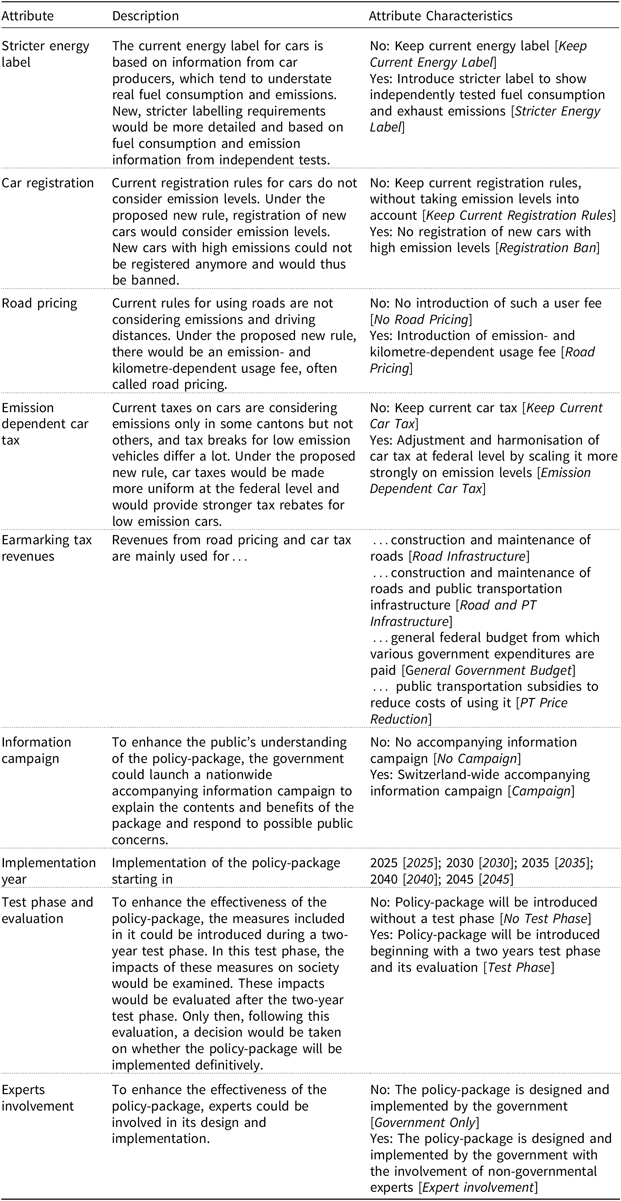
At the beginning of our conjoint experiment, we provided basic information on each of the included measures (attributes/contents of a policy-package) and continued with instructions for completing the conjoint experiment. The key part of the conjoint experiment consists of tables showing features (attributes and their possible characteristics) of different policy-packages. These are shown in Table 1. We confronted study participants with policy-packages including nine attributes (see Table A12 in the Supplementary material for the exact wording of attributes and their expressions). Specifically, policy-packages in our study consisted of three different types of instruments: primary measures, ancillary measures and other aspects of policy-design.
Conjoint experiment attributes and their characteristics

Note: This table is meant to provide an overview of attributes and their characteristics. In the survey experiment, participants first saw descriptions of the attributes, one by one (see Supplementary Tables A12 and A13 for the original version in German), and then a shorter overview that also showed the characteristics each attribute might take. The latter overview was also made available as a pop-up window during the conjoint experiment. The table shown here is a hybrid between the two. In square brackets, we show the attribute characteristics’ labels as displayed in the results section. All attributes were shown to every participant in all choice tasks. Attributes were ordered randomly for each participant; per participant, this order was then kept constant across all choice tasks. Attribute characteristics were randomly assigned for each choice task.
First, policy-packages encompassed different primary measures (in our case, stricter energy label, registration ban on high emission cars, road pricing and emission-dependent car tax).Footnote 8 Second, we included three ancillary measures (in our case, information campaign, test phase and experts’ involvement). Third, we included other aspects of policy-design which might be related to public support. We also included earmarking the revenues from road pricing and the emission-dependent car tax. The earmarking dimension identifies how policy-package revenues will be repurposed. The car tax is designed in a way that it is always present either as the status quo where Swiss cantons (the main subnational units) have different regulations or as a nationally harmonised car tax. Furthermore, we included five different years when implementation would start. We generally anticipate that respondents prefer a later implementation of far-reaching (costly) policies, as the imposed costs are more distant, and individuals have more time to adapt. This is in line with standard assumptions about discounting in economic literature.
The included attributes are listed and described in Table 1, where all attributes in every conjoint table are included, nonetheless with varying characteristics of each attribute. In other words, all respondents consistently see all attributes and their assigned attribute characteristics explicitly state whether or not this attribute is part of the policy-package.Footnote 9
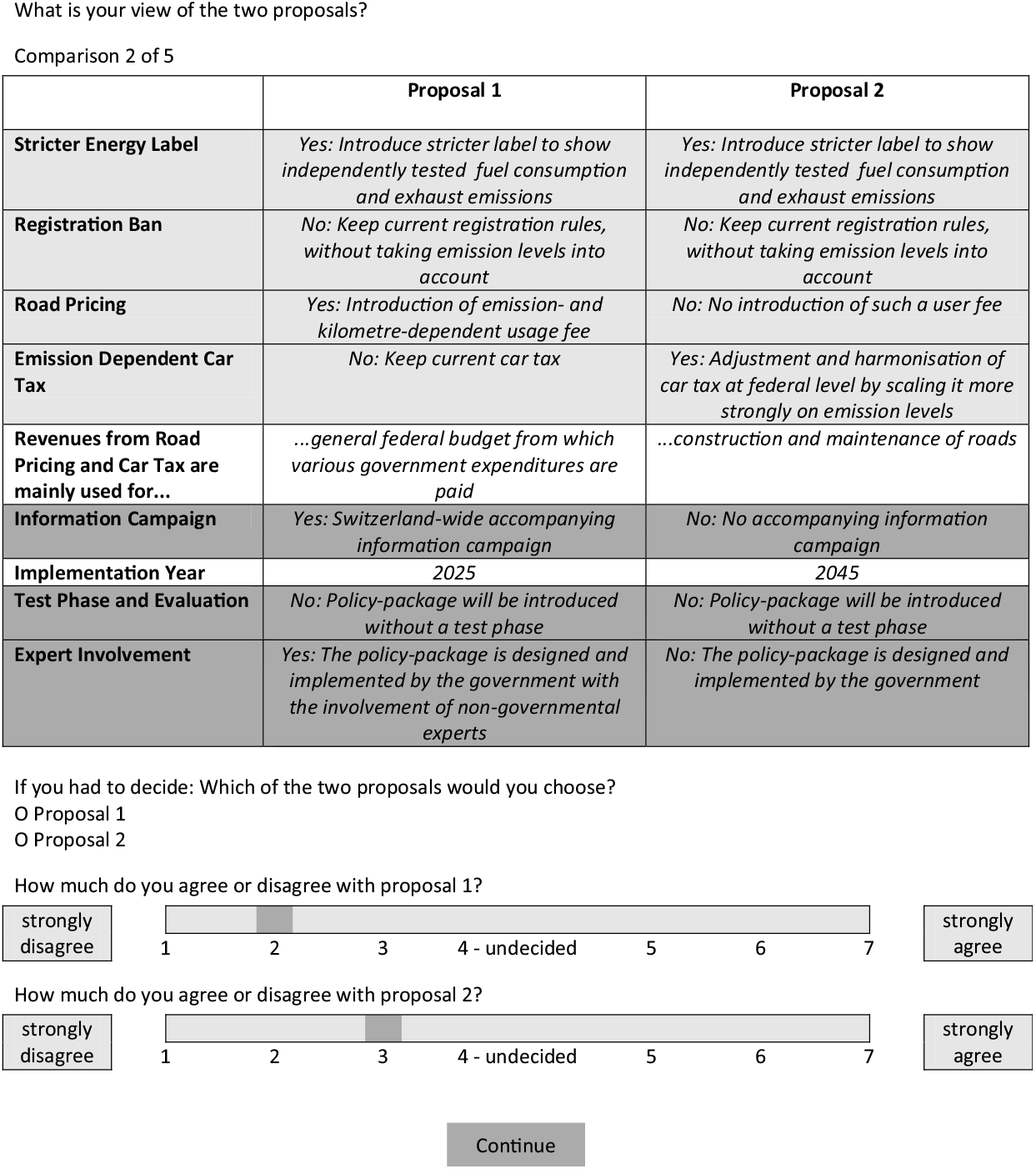
After respondents have familiarised themselves with the nine attributes and their possible characteristics, each respondent was asked to compare sets of two proposals for a policy-package shown side-by-side. Study participants were confronted with five pairs of differing policy-packages and were asked to decide which proposal they preferred within each pair. Both events appeared in a forced-choice mode and on a seven-point rating scale (see Figure 1 for an example). The values (attribute characteristics) on each attribute were inserted randomly into the tables. Since all attribute characteristics were randomly assigned, we could estimate the average marginal component effects (AMCE) (Louviere et al. Reference Louviere, Hensher and Swait2000; Hainmueller et al. Reference Hainmueller, Hopkins and Yamamoto2014). To avoid ordering effects, however, the order of the attributes was randomly assigned for each participant initially and then held constant per participant for the following four choice tasks to avoid cognitive overload. After being confronted with a pair of proposals, respondents were asked to express their preference for one or the other (binary choice task; “If you had to decide: Which of the two proposals would you choose?”) and then to rate each proposal on a scale ranging from 1 to 7 (“How much do you agree or disagree with proposal 1/2?”). The unit of observation in the resulting dataset was defined by the response variable, which was the response to each proposal. Consequently, two observations for each choice task were generated, with a total of 10 observations per participant since there are five choice tasks. For a sample of 2,034 participants, the number of observations was thus 20,340.
Conjoint task example.

As the included policy measures are rather information-heavy, it is important to address the issue of a potential masking-satisficing trade-off. Indeed, research on survey-taking indicates that more onerous survey tasks potentially lead to satisficing effects, which means that respondents adapt their response behaviour by using cognitive and time-saving shortcuts potentially degrading response quality (Krosnick Reference Krosnick1999). Thus, it is possible that empirically observable quantities diverge from those of theoretical interest (Bansak et al. Reference Bansak, Hainmueller, Hopkins and Yamamoto2019). However, Bansak et al. (Reference Bansak, Hainmueller, Hopkins and Yamamoto2019) show that there is rather limited increase in survey satisficing by testing whether up to 35 attributes can be included into a choice task. Results indicate that there is only a modest decline in the estimated causal effects of interest as the number of filler attributes rises and thus conjoint surveys can reliably recover estimates that are sensible and significant both statistically and substantively (Bansak et al. Reference Bansak, Hainmueller, Hopkins and Yamamoto2019). Still, it is important to keep in mind that the rather complex conjoint design might affect the outcome. Thus, we include analysis that tests for both satisficing effects regarding the number of rounds (Supplementary Figures A9 and A10) as well as the number of attributes present in the conjoint task (Supplementary Table A9).
The conjoint experiment was presented to study participants in one of two ways (policy frames). One is a pull frame (enabler) in which policies encourage desired travel behaviour, while the other is a push frame (deterrent) in which policies discourage non-desired behaviour (Stradling et al. Reference Stradling, Meadows and Beatty2000; Thorpe et al. Reference Thorpe, Hills and Jaensirisak2000; Steg et al. Reference Steg, Dreijerink and Abrahamse2006; Piatkowski et al. Reference Piatkowski, Marshall and Krizek2019). In our specific case, the pull frame presented policy-packages designed to promote electric vehicles (EVs), while the push frame presented policy-packages to reduce emissions from transportation. The EV promotion frame in our experiment portrayed electric vehicles as a substitute for conventional cars. The other frame, a reduction of high-emitting cars, was based on the presumption that reduced emissions are necessary to mitigate climate change.
The data analysis was based on linear mixed effects regressions to estimate the AMCE (R Core Team 2015).Footnote 10 We used individuals as tier 2 group, which was in line with a suggestion by Hainmueller et al. (Reference Hainmueller, Hopkins and Yamamoto2014) that allowed us to estimate the effects of the EV and the emission reduction frames and other covariates.
Empirical results
In this section, we present the main empirical findings from the conjoint experiment which was designed to test the three hypotheses previously outlined. The first subsection examines the direct effects of primary command-and-control and primary market-based measures as well as ancillary measures on public support (Hypotheses 1 and 2). The other subsection looks at potential interaction effects between the different attributes of a policy-package.
Direct effects of policy-package attributes
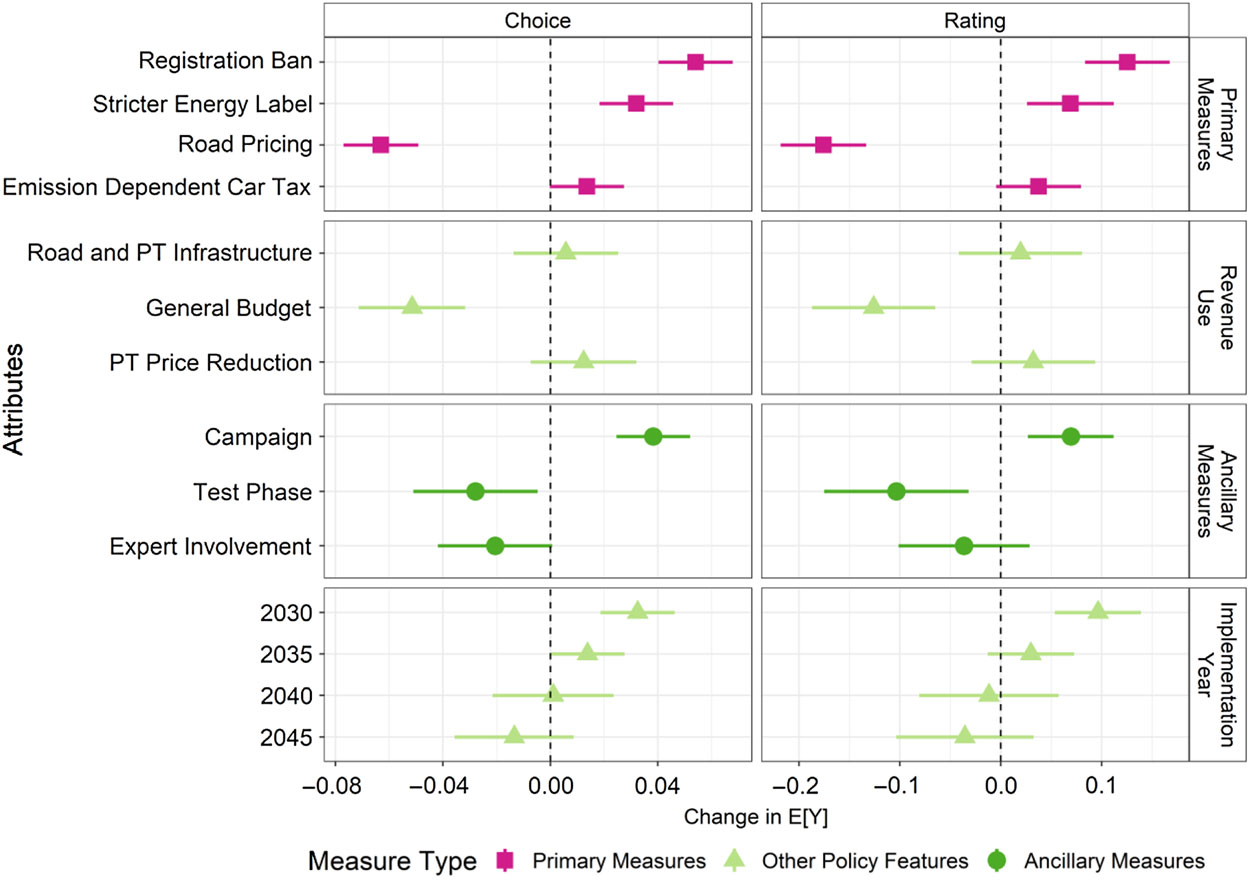
Figure 2 shows the AMCEs of all attribute values included in the policy-package for both the choice and the rating scale (see Supplementary Table A10).Footnote 11 Regarding the two market-based instruments (road pricing and car tax), road pricing has by far the most negative and significant effect of all primary measures. Packages including road pricing as a measure were significantly less likely to be selected in the choice task and rated lower in the seven-point Likert scale capturing policy support. The emission-dependent car tax has a significant and positive effect on the likelihood of selecting the policy-package in the choice task but not in the rating of the individual packages.
Estimated average marginal component effects (AMCE).

Both command-and-control measures were evaluated positively in both the choice and rating scales. The inclusion of stricter energy labels in a policy-package on average has a positive effect on public support. To implement such a label compared to the baseline of not implementing it increases the likelihood of supporting the proposal by 3% in the choice task. Including a registration ban on high-emission cars leads to significantly higher support for the policy-package. This finding is somewhat surprising since bans are presumably highly intrusive. Nevertheless, this finding lends support for Hypothesis 1, indicating that the public prefers regulatory instruments over market-based solutions. These results are in line with findings in other studies (see e.g. Huber et al. Reference Huber, Wicki and Bernauer2019) and suggest that introducing a hard (regulatory) policy measure may engender a technological change towards more sustainable engines in transportation. These findings support our expectations stated in Hypothesis 1.
The results for the three ancillary measures support our theoretical expectations stated in Hypothesis 2. Ancillary measures in a policy-package increase support for the whole package. Both the inclusion of an accompanying information campaign as well as a test phase with a subsequent evaluation increase support, both on the choice and the rating scale. The inclusion of experts in the implementation process also exhibits a positive effect, though this effect reaches conventional significance levels only in the choice task. A new finding, however, is the discovery that announcing an accompanying information campaign increases public support ahead of the implementation. This might be explained as individuals tend to favour policies which provide information in advance.
Earmarking of revenues from policy-intervention, in general, does not appear to play an important role. While allocating revenues towards the general government budget attracts more opposition, when compared to the baseline measure, neither of the other earmarking measures seems to have an impact on support for a policy-package. Moreover, the implementation date has only a minor effect with somewhat more support for earlier rather than later implementation, which is surprising given people’s tendency to discount the future costs of policy interventions. Still, the effect of implementation date is relatively small and is generally statistically insignificant.
Regarding the control variables, we observe that older participants rated policy proposals slightly lower than younger ones. The same holds for male and female study, as well as individuals with primary education and individuals with tertiary education. Not surprisingly, however, the number of days in a week a person uses a car has the strongest effect (see Supplementary Table A9). This effect is highly significant in all our models and it indicates that, on average, individuals who rely on a car rated any policy-package lower. Interestingly, we did not find a significant difference between the two policy frames, indicating that the effects of policy-packaging and the different primary and ancillary measures do not depend on the framing of the policy goal.
Policy-package size, interactions between primary and secondary measures, and public support
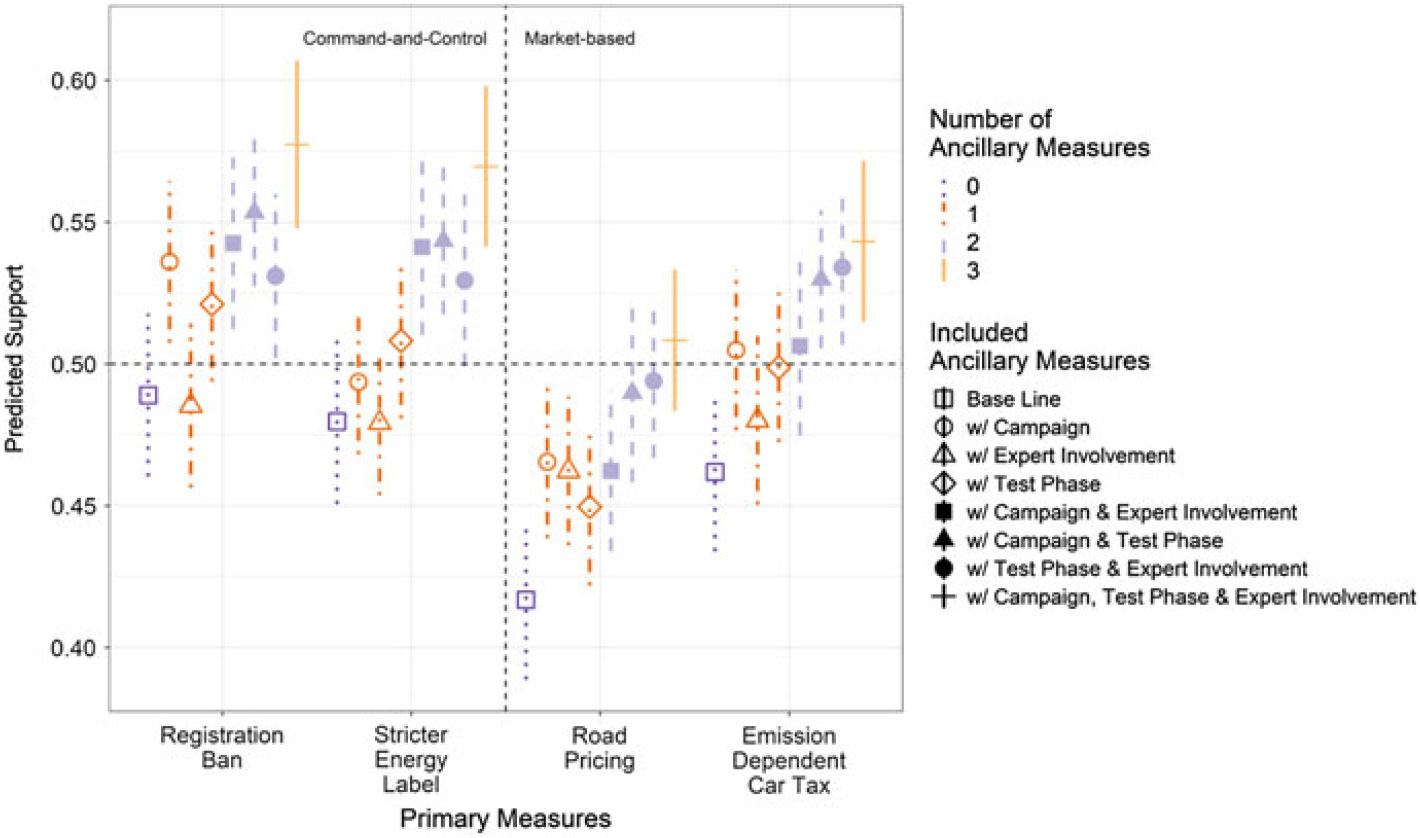
Figure 3 shows the predicted probabilities of selecting a policy-package depending on the number and types of ancillary measures that are part of the policy-packaging and distinguished by whether the four primary measures were present in the package or not. We therefore estimated models with two-way interaction effects (each primary measure with each ancillary measures), three-way interaction effects (packages with the primary and a maximum of two ancillary instruments), and, finally, all possible combinations of a specific primary measure and ancillary measures for both the rating and the choice scale.Footnote 12 The colours indicate the number of ancillary measures in the prediction, whereas the shape indicates which ancillary measures were part of the respective package. Policy-packages that exclude any ancillary measures receive less support and do not gain a majority in the predicted support.
Predicted likelihood of choosing a policy-package, by primary and ancillary measures included in the package.
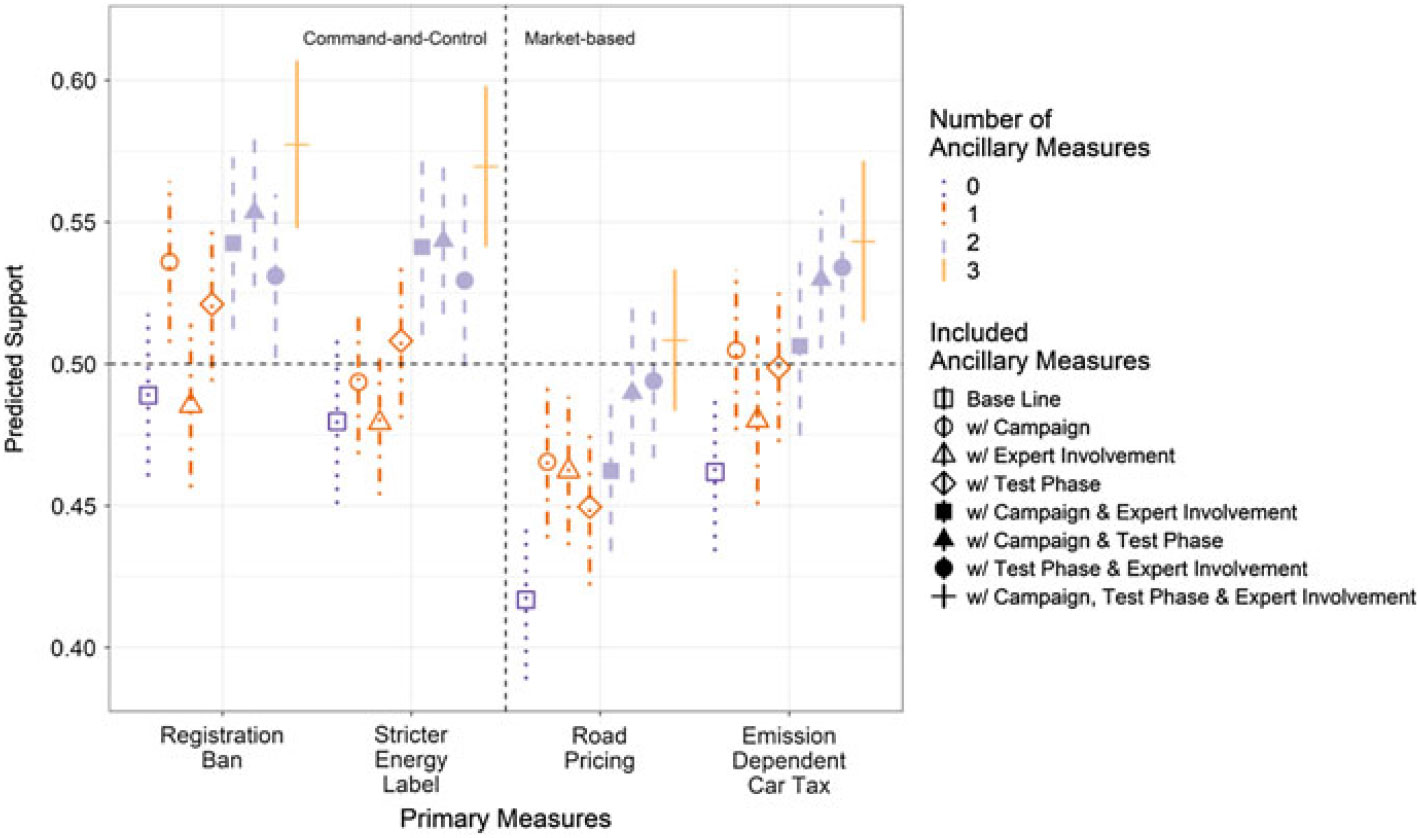
Starting with command-and-control measures (left group of predictions, Figure 3), including an accompanying campaign achieves more than 50% of the vote shareFootnote 13 for car taxes, whereas the other two ancillary measures do not lift support above 50% (see dotdashed/orange ranges on the left hand side in Figure 3). Similarly, including two ancillary measures (see dashed/violet ranges on the left hand side in Figure 3) shifts public support above 50% for both command-and-control measures. For stricter energy labels, this positive shift is the case when including experts and test phases. Including all three ancillary measures further increases support by almost 10 percentage points (see solid/yellow range in Figure 3).
Looking at market-based instruments, the inclusion of one ancillary measure tends to increase support. However, these increases are not statistically significant and never exceed 50% (see dotdashed/orange ranges on the right hand side in Figure 3). For road pricing, however, support is always significantly lower than 50%. Including two ancillary measures lifts support above 50% for two out of three cases for the car tax. The change is also significant, and support is indistinguishable from 50% for the two packages including test-phases as ancillary measure. When all three ancillary measures are added to a policy-package, packages whether including emission-dependent car taxes or road pricing receive substantially more support, and car taxes receive more than 50% support as well. Altogether, we find similar patterns regarding the predicted rating of policy-packages as shown in Supplementary Figure A4.Footnote 14 These results provide further support for Hypothesis 2 and indicate that the inclusion of ancillary measures does have a substantial positive effect on support for a package.
Supplementary Figures A1 and A2 summarise the interaction effects between the number of primary and ancillary measures to control for potential satisficing effects. For the former, no significant positive effect can be observed when including additional primary measures into the package. Thus, there appears to be no evidence of a possible count effect for the number of policies included into the policy-package. This is also supported by the results displayed in Supplementary Figures A7 and A8, where the predicted support for policy-packages including different numbers of primary measures is displayed. Thereby, only packages which include road pricing appear to be consistently less supported, whereas no significant effect is observed regarding the amount of primary measures included.
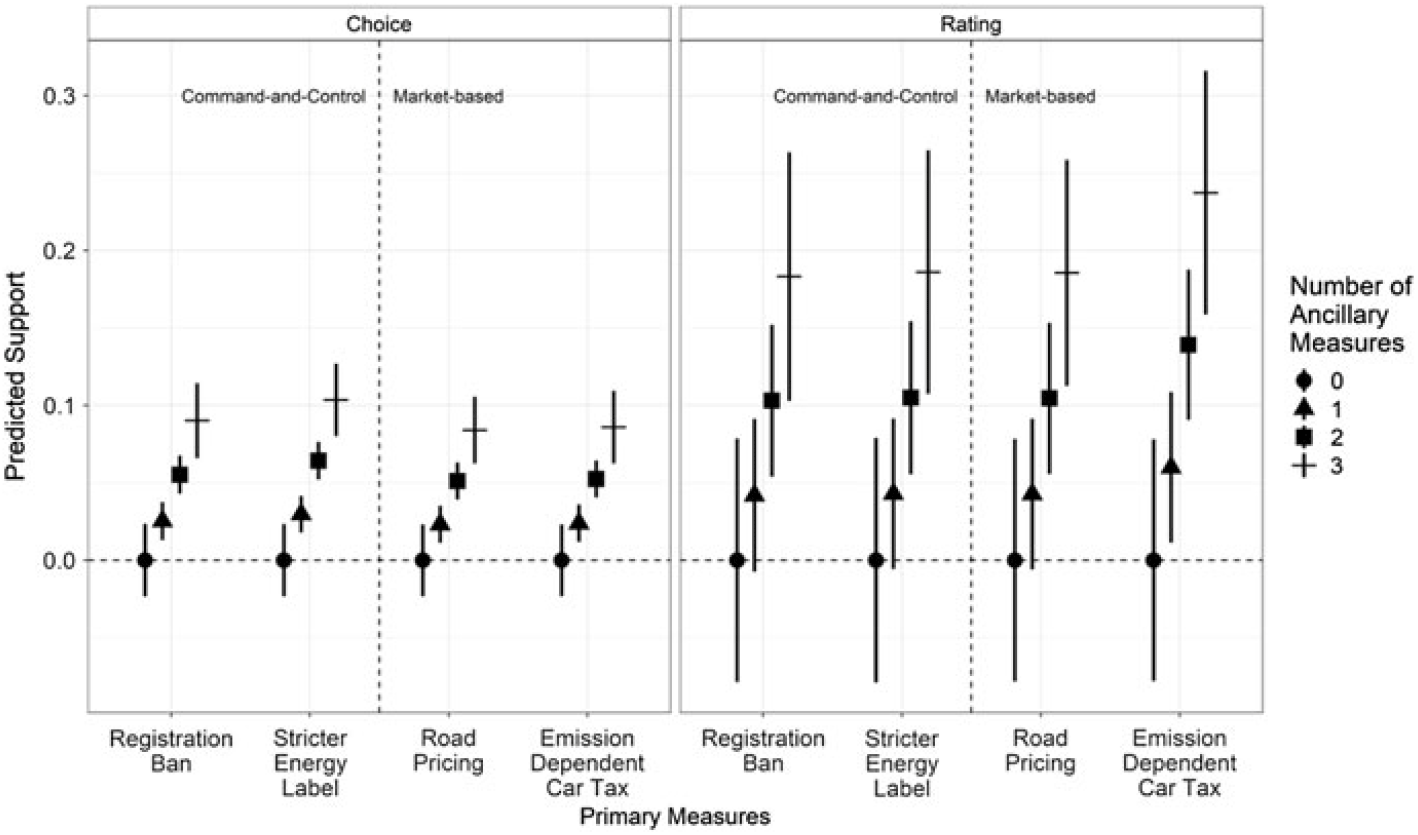
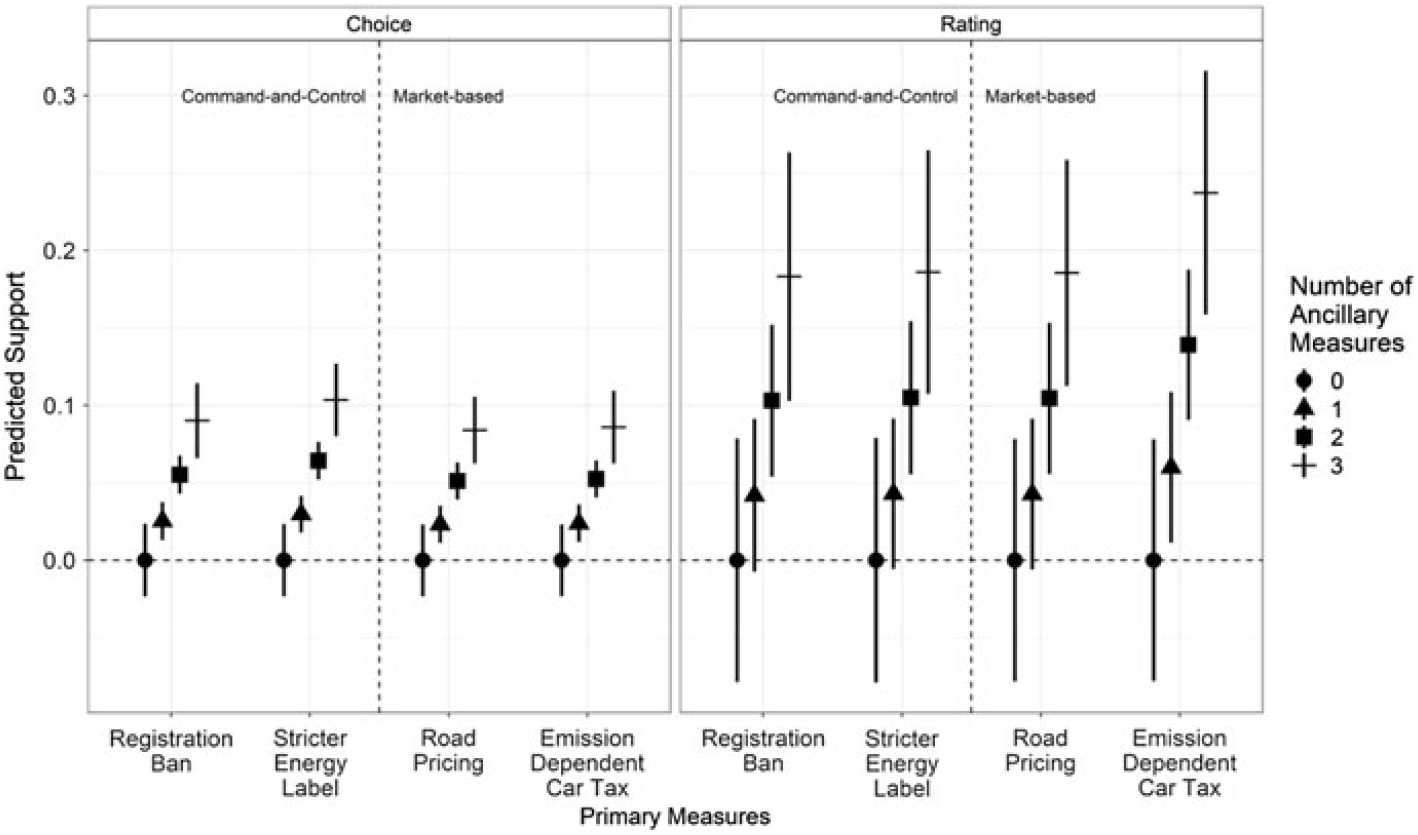
Figure 4 compares how the number of ancillary measures included in a package performs across the different primary measures.Footnote 15 We standardised support for all primary measures on zero to identify differences in additional support when including ancillary measures. We expected the effect of ancillary measures to be stronger for market-based instrument compared to command-and-control measures. Yet, the results did not indicate a significant difference between the four primary measures. If anything, the effect was strongest for command-and-control measures in the sense of stricter energy labels in the choice task and for the market-based instruments in the form of an emission-dependent car tax in the rating scale. These differences are nonetheless statistically insignificant, and thus Hypothesis 3 is not supported.
Predicted additional support of policy-packages including one of the four primary measures, depending on the number of ancillary measures included in the package.
We also tested how the number of ancillary measures and the number of primary measures included in a package affect support. In all choice models presented in Supplementary Table A9, the estimates for both the number of primary measures and the number of ancillary measures are positive, indicating that the more measures included, the higher the support for the package. While this effect is significant at the 10% level for ancillary measures in all rating scale models, we do not find a significant positive effect of the number of primary measures on the rating score. Therefore, we do not find any substantive empirical evidence for positive (or negative) interaction effects (also see Supplementary Table A10).
Discussion
In this article we examine whether assembling different policy measures into policy-packages increases public policy support and thus enhances the political feasibility of policy interventions. In our conceptualisation, such packages can include primary and ancillary measures. While the former aim directly at a given policy goal, the latter are meant to help offset or overcome potentially adverse effects of primary measures on policy support. We argue that primary command-and-control measures tend to garner more public support relative to primary market-based measures. This claim aligns with previous literature arguing that market-based policy instruments tend to be disliked by the public. Moreover, we hypothesise that ancillary measures tend to increase public support directly as well as indirectly, where the latter mitigates potential negative effects of primary measures. In other words, we conjecture that ancillary measures could help overcome political feasibility obstacles when it comes to adopting and implementing far-reaching and, thus, costly policies. Focusing on strategies against vehicle emissions in Switzerland, where policies are highly controversial and citizens are incessantly requested to voice their opinions in the ballots, we tested our theoretical arguments with data from an original and nationally representative survey experiment of 2,034 citizens.
The empirical findings provide robust support for two out of three theoretical expectations. First, command-and-control measures tend to garner more support compared to market-based measures. Most notably, public support for a ban on vehicles with high emissions is significantly stronger compared to road pricing and car taxes more strongly scaled on emissions. Second, policy-packages including ancillary measures receive significantly more support. Third, our expectation that ancillary measures can reduce loss aversion in the case of market-based instruments more than in the case of command-and-control policies is not supported by our empirical analysis.
The policy-relevance of our analysis derives from the fact that it can help inform policy-makers on whether or not to design policy-interventions in the form of larger policy-packages, and what the positive and negative implications of specific policy measures in such packages could be for political feasibility. One key finding is that ancillary measures can aid in enhancing political feasibility, particularly in the form of information campaigns, test phases and involvement of experts. Another key finding is that even highly intrusive command-and-control measures, such as bans on cars with high emissions, are more popular than market-based instruments (i.e. road pricing). This finding is broadly in line with some previous studies (Jaensirisak et al. Reference Jaensirisak, Wardman and May2005; Vonk Noordegraaf et al. Reference Vonk Noordegraaf, Annema and van Wee2014; Hansla et al. Reference Hansla, Hysing, Nilsson and Martinsson2017).
In conclusion, while this article provides valuable insights into the implementation of contested policies, it becomes imperative to identify the limitations of our study and suggest avenues for further research. The argumentation in this article followed the motivation to identify ancillary measures that can ameliorate adverse public support. Nevertheless, this argument also builds on the implicit assumption that policy-makers have enough foresight and strategic reasoning to design policy-packages which only consider ancillary measures with positive impacts, and as recent research shows, this assumption neither holds for politicians (Sheffer et al. Reference Sheffer, Loewen, Soroka, Walgrave and Sheafer2018) nor bureaucrats (Bellé et al. Reference Bellé, Cantarelli and Belardinelli2018). Therefore, to account for reality, further research could evaluate how public support for policy-packages is influenced when popular and unpopular ancillary measures are included. Additionally, the treatment specification used in this article is rather general and does thus not allow to identify what specifically drives the observed effects. Regarding the information campaign, this is an important point to consider as results presented in this article appear to only reflect the general desire of citizens to receive information about the respective policy.
Furthermore, the choice of policy instruments included in the policy-packages is confounded with the case of Switzerland, as the inclusion of information-heavy policies was only possible when including specific issues that were recently discussed and were externally valid. This realistic approach leads to some limitations of the generalisability one can make about the specific policy-package effects, as it is rather case specific. With this in mind, further research in different cases should be conducted so as to develop a comparative scope regarding the specific mechanisms behind the effect of policy-packaging on public support. In addition, it is necessary to mention the research design at hand cannot fully control for potential satisficing effects as all respondents were presented the same conjoint task. Specifically, it is not possible to fully control for potential count-effects as a counterfactual of a conjoint design with more or less attributes is missing. To test for this, future research could potentially test how the number of measures included into a policy-package affects the respective effects.
Additionally, while conjoint experiments are methodologically rigorous and allow for quite realistic choice scenarios in situations where multiple policy-attributes matter simultaneously, they also have some limitations. Our approach allowed us to obtain robust estimates of policy-design feature effects on public support for transportation policies; however, our results also yielded rough estimations of the extent to which citizens in Switzerland are likely to react to future policy interventions. Therefore, absolute support levels observed in our study need to be treated with caution, as the concrete design of a policy proposal might fundamentally differ in reality, and public discussions and campaigns for/against such a proposal may alter citizens’ assessment of specific measures or the overall package.
Moreover, we opted for a design in which all attributes always appear in the policy-package and may take on characteristics that range from no measure in particular kind to the introduction of such a measure. Future research could examine whether our main findings uphold when adding or dropping such particular attributes from the package (i.e. not showing them in the conjoint table altogether). As to which presentation is better, one that drops the attributes or one that includes all (as done in this article), remains subject to debate. Additional options for further research include the examination of policy-packaging effects in other policy-areas and other countries as well. All that being said, we hope the research presented here lays the foundation for a larger research effort centred on how policy-packaging affects public policy support and, thus, enhances the political feasibility of far-reaching policy interventions desperately needed to address the challenges of today.
Author ORCIDs
Michael Wicki, 0000-0001-8972-8468; Robert A. Huber, 0000-0001-6536-9392; Thomas Bernauer, 0000-0002-3775-6245
Supplementary material
To view supplementary material for this article, please visit https://doi.org/10.1017/S0143814X19000205
Data availiability statement
Replication materials are available in the Journal of Public Policy Dataverse at https://doi.org/10.7910/DVN/LUJC8I.
Acknowledgements
The authors would like to acknowledge valuable comments from Liam F. Beiser-McGrath, Gracia Brückmann, Lukas P. Fesenfeld, Sergio Guidon, Dennis Kolcava, Vally Koubi, Quynh Nguyen, Lukas Rudolph, Angélica Serrano, Martina Zahno and two anonymous reviewers. An earlier version of this paper has been presented at the Swiss Political Science Association’s Annual Conference in Geneva (February 2018). The research for this article was funded by the ERC Advanced Grant ‘Sources of Legitimacy in Global Environmental Governance’ (Grant: 295456) and supported by ETH Zürich.