





1 Introduction
This is one of a series of articles in which we explore the geometry of the conjugacy problem in finitely presented groups through the lens of conjugator length functions. Our purpose in this article is to construct explicit groups where these functions exhibit a range of rapid growth types. Given a group
$\Gamma $
 with a finite generating set A, we write
$u \! \sim \! v$
 when words u and v in
$A^{\pm 1}$
 represent conjugate elements of
$\Gamma $
 and define
$\mathrm {CL}(u,v)$
 to be the length of a shortest word w such that
$uw=wv$
 in
$\Gamma $
 . The conjugator length function
$\mathrm {CL} : \mathbb {N} \to \mathbb {N}$
 is defined so that
$\mathrm {CL}\left (n\right )$
 is the least integer N such that
$\mathrm {CL}(u,v) \leq N$
 for all words u and v with lengths
$|u|+|v|\le n$
 such that
$u \! \sim v$
 in
$\Gamma $
 .
We proved in [Reference Bridson and RileyBR26a, Reference Bridson and RileyBR26b] that for all
$d \in \mathbb {N}$
 , there are finitely presented groups for which
$\mathrm { CL}\left (n\right ) \simeq n^d$
 , and in [Reference Bridson and RileyBR25], we proved that the set of exponents e for which there is a finitely presented group with
$\mathrm {CL}\left (n\right ) \simeq n^e$
 is dense in
$[2, \infty )$
 . Many constructions of finitely presented groups are known that have a solvable word problem but an unsolvable conjugacy problem (e.g., [Reference MillerMil71]), and the conjugator length function of such a group is not bounded above by any recursive function. But it has proved surprisingly difficult to construct finitely presented groups with matching upper and lower bounds that are large.
The bulk of this article is dedicated to constructing the first examples of finitely presented groups where the conjugator length function is exponential.
Theorem 1.1 There exist finitely presented groups
$\Lambda $
 such that
$\mathrm {CL}\left (n\right ) \simeq 2^n$
 , for instance,

We also construct examples where the growth of the conjugator length function is comparable to the fast-growing functions
$A_k$
 , which constitute the Ackermann function
$(k,n) \mapsto A_k(n)$
 and represent the successive levels of the Grzegorczyk hierarchy of primitive recursive functions:
$A_0\left (n\right )= n+2,\ A_1\left (0\right )=0,\ A_k\left (0\right )=2$
 for
$k\ge 2$
 , and for all
$k,n\ge 0$
 ,

So
$A_1\left (n\right ) = 2n$
 ,
$A_2\left (n\right ) = 2^n$
 , and
$A_3\left (n\right )$
 is a height-n tower of powers of
$2$
 (see, e.g., [Reference RoseRos84].)
Theorem 1.2 For all k, there is a finitely presentable group
$\Gamma $
 whose conjugator length function satisfies
$A_k\left (n\right ) \preceq \mathrm { CL}_{\Gamma} \left (n\right ) \preceq A_k\left (n^2\right )$
 . Thus,
$\mathrm {CL}_{\Gamma} \left (n\right )$
 is sandwiched between a pair of fast-growing functions that are both in the k-th level of the Grzegorczyk hierarchy that grades the primitive recursive functions.
Here are outlines of our constructions.
1.1 Groups with exponential conjugator length functions
The ideas behind our construction apply to large classes of groups, but in order to minimize the many technical details and to avoid becoming overwhelmed by notation, we focus on a family of central extensions of free-by-free groups.
Let
$\phi $
 be an atoroidalFootnote
1
automorphism of the rank-m free group
$F = F(a_1, \ldots , a_m)$
 and define

Then,
$H = F\rtimes _{\phi} \mathbb {Z}$
 is a torsion-free hyperbolic group (by [Reference Bestvina and FeighnBF92, Reference BrinkmannBri00]), G is the trivial HNN-extension
$H \dot \ast _F$
 over
$F<H$
 (which decomposes as a semidirect product
$F_m\rtimes \langle s,t \rangle $
 ), and
$\Lambda ^\phi $
 is a central extension of G with center
$\langle \lambda \rangle \cong \mathbb {Z}$
 . (To see that
$\lambda \in \Lambda ^\phi $
 has infinite order, note that
$\Lambda ^\phi = (H\times \langle \lambda \rangle )\rtimes \langle s,t \rangle $
 .) We shall restrict our attention to automorphisms
$\phi $
 that have homological stretch, meaning that the action of
$\phi $
 on the abelianization of F has an eigenvalue of absolute value greater than
$1$
 ; equivalently, there is a constant
$c>1$
 so that for some
$a_i$
 the sum of the exponents on the letters in
$\phi ^n(a_i)$
 is bounded below by
$c^{|n|}$
 for all
$n\in \mathbb {Z}$
 . Such stretch always occurs when the atoroidal automorphism
$\phi $
 is positive, that is, when each
$\phi \left (a_i\right )$
 is a word in
$a_1, \ldots , a_m$
 with only positive exponents.
Theorem 1′
If
$\phi \in \mathrm {{Aut}}(F)$
 is an atoroidal automorphism with homological stretch, then
$\mathrm {CL}_{\Lambda ^\phi } \left (n\right ) \simeq 2^n.$

An example of a positive atoroidal automorphism (from [Reference Gersten and StallingsGS91, Example 3.2]) is

where
$m \geq 3$
 . The group given in Theorem 1.1 is the
$m=3$
 instance of this.
The proof of Theorem
$1'$
 occupies Sections 3–9. Throughout the proof, we will retain the notation F, H, and G, for the groups defined above. We will normally abbreviate
$\Lambda ^\phi $
 to
$\Lambda $
 .
If a and b are integers with greatest common divisor d, then Bézout’s Lemma provides integer solutions
$(x,y)$
 to the equation
$ax + by = d$
 . In Section 3, we will quantify certain variations of this situation that are needed in our proof of the upper bound
$\mathrm {CL}_{\Lambda ^\phi } \left (n\right ) \preceq 2^n$
 . Such quantifications are a recurring theme in our papers on conjugator length, where finding a short conjugator for a pair of group elements known to be conjugate hinges on finding a small solution to a system of linear Diophantine equations that is known to have some solution.
In Section 4, we discuss the structure of G in relation to its hyperbolic subgroup H and its free subgroups F and
$E = \langle s, t \rangle $
 and we establish notation for the arguments that follow. In Section 5, we prove that the distortion of the central subgroup
$\langle \lambda \rangle <\Lambda $
 is exponential
$\mathrm {Dist}_{\langle \lambda \rangle }^{\Lambda }(n) \simeq 2^n$
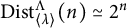 . The upper bound holds for quite general reasons, but the lower bound is specific to the structure of
$\Lambda $
 ; it relies on the assumption that
$\phi $
 has homological stretch.
In Section 6, we discuss the length of conjugators in the hyperbolic groups H and E. Centralizers of nontrivial elements in torsion-free hyperbolic groups are generated by maximal roots of those elements and, with the help of the uniformly monotone cyclics property enjoyed by torsion-free hyperbolic groups, we will estimate the lengths of those roots. In Section 7, we will promote our understanding of element-centralizers in H and E to a classification of element-centralizers in G. The need for this classification arises naturally in our analysis of conjugators in G because if
$u \sim v$
 in G and one has hold of a specific
$w_0$
 such that
$uw_0=w_0v$
 in G, then
$Z_G(u)w_0$
 is the set of all such conjugators. From this analysis, we will identify conjugators that are optimal in an appropriate sense. A key result here is Lemma 7.3, which provides bounds on conjugator lengths in G that play a pivotal role in Section 8.
With this understanding of element-centralizers in G in hand, in Section 8, we complete the proof of the upper bound
$\mathrm {CL}_{\Lambda }\left (n\right ) \preceq 2^n$
 in Theorem
$1'$
 . In outline, the argument proceeds as follows. Given words
$\overline {u}$
 and
$\overline {v}$
 representing conjugate elements in
$\Lambda $
 , we consider the images
$u,v\in G$
 of
$\overline {u}$
 and
$\overline {v}$
 and search through all words W such that
$uW =Wv$
 in G – at least one will satisfy
$\overline {u}W = W\overline {v}$
 in
$\Lambda $
 . We will be able to access all the W such that
$uW =Wv$
 in G according to our classification of element-centralizers in G from Section 7, and we can tell which are conjugators for
$\overline {u}$
 and
$\overline {v}$
 in
$\Lambda $
 by calculating whether the integer N such that
$\overline {u}W = W\overline {v} \lambda ^N$
 in
$\Lambda $
 is zero. In some instances, there is only one possible W. In other cases, we will argue that one of the quantifications of Bézout from Section 3 will guarantee that a sufficiently short W exists among the possibilities. In every case, our estimates will give that there exists a conjugator of length within the
$\preceq 2^n$
 bound.
Finally, in Section 9, we complete the proof of Theorem 1′
by exhibiting a family of pairs of words that are conjugate in
$\Lambda $
 but only via long conjugators, thus establishing the lower bound
$\mathrm { CL}_{\Lambda }\left (n\right ) \succeq 2^n$
 .
1.2 Fiber products and groups with fast growing conjugator length functions
Our examples establishing Theorem 1.2 are explained in Section 10. They come from applying a fiber-product construction from [Reference BridsonBri26] to the Hydra groups of Dison and Riley [Reference Dison and RileyDR13] – these are groups
$\Gamma _k$
 with concise finite presentations that have
$A_k$
 as their Dehn functions. As we shall explain, these presentations are aspherical, which is a feature that is needed to derive a finite presentation for the fiber product P that we consider. The difficulty of the conjugacy problem in P, as witnessed by its conjugator length function, reflects the difficulty of the word problem of the seed group
$\Gamma $
 , as witnessed by its Dehn function. The current state of knowledge does not make this relationship precise enough to determine the conjugator length function of P exactly in general. However, we can establish that
$A_k\left (n\right ) \preceq \mathrm {CL}\left (n\right ) \preceq A_k(n^2)$
 and this places
$\mathrm {CL}\left (n\right )$
 between a pair of fast-growing representatives of the same level of the Grzegorczyk hierarchy per Theorem 1.2, because for
$k \geq 3$
 , if a function is in the same level as
$A_k$
 , then precomposing that function with a polynomial does not change where in the hierarchy that function lies.
We conclude (in Remark 10.5) with comments on how a study of a variant of the Dehn function introduced in [Reference BridsonBri25] might lead to explicit examples of finitely presented groups realizing a wider variety of conjugator length functions.Footnote 2
2 Preliminaries
2.1 Words
We write
$[x,y] :=x^{-1}y^{-1}xy$
 and
$x^y := y^{-1} x y$
 . The length
$|w|$
 of a word
$w= x_{i_1}^{\mu _1} \ldots x_{i_n}^{\mu _n}$
 in an alphabet
$A = \left \{ a_1, \dots , a_n \right \}^{\pm 1}$
 is
$|\mu _1| + \cdots + |\mu _n|$
 . If A is a generating set of a group
$\Gamma $
 and
$\gamma \in \Gamma $
 , then
$|\gamma |_{\Gamma} $
 denotes the length of a shortest word representing
$\gamma $
 .
2.2 Subgroup distortion
For a finitely generated subgroup S of a finitely generated group
$\Gamma $
 , the distortion function
$\mathrm {Dist}^{\Gamma }_{S} : \mathbb {N} \to \mathbb {N}$
 , with respect to fixed finite generating sets, is

2.3 Qualitative equivalence of growth rates
We use the relation
$\simeq $
 that is standard in geometric group theory: for functions
$f,g: \mathbb {N} \to \mathbb {N}$
 write
$f \preceq g$
 when there exists
$C>0$
 such that
$f\left (n\right ) \leq Cg( Cn+C ) +Cn +C$
 for all
$n \geq 0$
 , and write
$f \simeq g$
 when
$f \preceq g$
 and
$g \preceq f$
 .
For us, pertinent consequences of this definition include (1) when
$S \leq \Gamma $
 , any choices of finite generating sets for S and
$\Gamma $
 give rise to equivalent subgroup distortion functions
$\mathrm {Dist}^{\Gamma }_{S}$
 ; (2) the cost of cyclically permuting a word has no impact on the growth of the conjugator length function up to equivalence; and (3) any two finite generating sets for a group give rise to equivalent conjugator length functions.
3 Quantifications around Bézout’s Lemma
The following elementary estimates pertaining to Bézout’s Lemma play an important role in our proof. Lemma 3.1 follows a similar account in our paper [Reference Bridson and RileyBR26a]. We add Corollary 3.2 because it will lead to a bound on
$|\sigma (w)|$
 in Lemma 7.3 that is crucial in the final case of our proof that
$\mathrm {CL}_{\Lambda }(n) \leq 2^n$
 in Section 8; Corollary 3.3 is also called upon multiple times in that proof.
Lemma 3.1 Suppose a and b are nonzero integers and the linear Diophantine equation
$ax+by=c$
 has a solution
$(x,y)$
 . Let
$d = \mathrm {gcd}(a,b)$
 . Then
$ax+by=c$
 has a solution with
$|x| \leq | \frac {b}{d}|$
 and
$|y| \leq \max \left \{|\frac {c}{b}|, |\frac {a}{d}|\right \}$
 .
Proof Because
$ax+by=c$
 has a solution,
$d = \gcd (a,b) $
 divides c, and if
$(x_0, y_0)$
 is an integer solution, then the set of all such solutions is

Therefore, there exists a solution
$(x,y)$
 with
$0 \leq x < \frac {b}{d}$
 and another with
$\frac {b}{d} \leq x < 0$
 . Now,
$y = \frac {c}{b} - \frac {a}{b} x$
 , so
$\frac {c}{b} - \frac {a}{d} < y \leq \frac {c}{b}$
 for the first of these two solutions, and
$ \frac {c}{b} < y \leq \frac {a}{d} + \frac {c}{b}$
 for the second.
If
$\frac {a}{d}$
 and
$\frac {c}{b}$
 have the same sign, then
$|\frac {c}{b} - \frac {a}{d}| \leq \max \left \{|\frac {c}{b}|, |\frac {a}{d}|\right \}$
 and so the first of our two solutions satisfies the requirements of the lemma. If they have opposite signs, then similarly the second of our two solutions works.
Corollary 3.2 Under the hypotheses of Lemma 3.1,
$ax+by=c$
 has an integer solution
$(x,y)$
 such that
$|ax| \leq \mathrm {lcm}(a,b)$
 and
$|by| \leq \max \left \{|c|, \mathrm {lcm}(a,b) \right \}$
 .
Proof This follows from Lemma 3.1 because
$\mathrm {lcm}(a,b) = ab / \mathrm {gcd}(a,b)$
 .
Corollary 3.3 Suppose the linear Diophantine equation

has a solution
$(x_1, \ldots , x_m)$
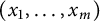 . Then it has a solution such that for all i,

Proof We prove this corollary by induction on m. If
$m=1$
 or if
$m=2$
 and one of
$a_1$
 and
$a_2$
 is zero, then the result is trivial. If
$m=2$
 and
$a_1$
 and
$a_2$
 are nonzero, then the result follows from Lemma 3.1. Let
$m \geq 3$
 . Assume
$a_1$
 , …,
$a_m$
 are all nonzero, else the result holds by induction.
The integers expressible as
$a_2 x_2 + \cdots + a_m x_m$
 for some
$x_2, \ldots , x_m \in \mathbb {Z}$
 are precisely the multiples of
$e := \gcd (a_2, \ldots , a_m)$
 . So the hypothesis of the corollary tells us that the Diophantine equation
$a_1x_1+ e y=c$
 has a solution
$(x_1, y)$
 , and Lemma 3.1 allows us to assume that
$|x_1| \leq | \frac {e}{d}|$
 and
$|y| \leq \max \left \{|\frac {c}{e}|, |\frac {a_1}{d}|\right \}$
 , where
$d = \gcd (a_1, e)$
 .
Now, for some
$x_2, \ldots , x_m \in \mathbb {Z}$
 , we have
$e y = a_2 x_2 + \cdots + a_m x_m$
 and so
$y = \frac {a_2}{e} x_2 + \cdots + \frac {a_m}{e} x_m$
 , which is a Diophantine equation because e divides each of
$a_2$
 , …,
$a_m$
 . By induction, there exist
$x_2, \ldots , x_m \in \mathbb {Z}$
 satisfying this equation with
$|x_i| \leq \max \left \{ |\frac {a_2}{e}|, \ldots , |\frac {a_m}{e}|, |y|\right \}$
 . This gives
$x_1, \ldots , x_m \in \mathbb {Z}$
 satisfying (3.1), and in combination with the above bounds on
$|x_1|$
 and
$|y|$
 , this establishes (3.2).
4 The structure of G
By way of reminder,
$F = F(a_1, \ldots , a_m)$
 is a rank-m free group,
$H = F\rtimes _{\phi} \mathbb {Z}$
 is hyperbolic, and G is the HNN-extension
$H \dot \ast _F$
 of H:

In preparation for the sections that follow, we shall describe some decompositions and retractions of G and establish useful notation.
We will work with the fixed basis
$\{ a_1, \ldots , a_m \}$
 for F, and to generate H, G, and
$\Lambda $
 , we add s, then t, and then
$\lambda $
 , respectively (paying attention to the fact that the role of t in
$\Lambda $
 is different from its role in G). Our generating set for the rank-2 free group E is
$\{ s, t \}$
 . For
$g \in \Lambda $
 , we write
$| g |_{\Lambda }$
 for the length of a shortest word in our generating set for
$\Lambda $
 representing g. We define
$| g |_E$
 ,
$| g |_F$
 ,
$| g |_G$
 , and
$| g |_H$
 likewise.
We have the semidirect product decomposition
$G = F \rtimes E$
 . We view E, F, and H as subgroups of G and will use three retractions:
-
• $G {\kern 3pt\to \kern -8pt\to \kern 3pt} H$
 killing t, denoted by
$g \mapsto g_H$
,
-
• $G {\kern 3pt\to \kern -8pt\to \kern 3pt} E$
killing
$a_1, \ldots , a_m$
, denoted by
$g \mapsto g_E$
, and -
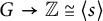
• $G {\kern 3pt\to \kern -8pt\to \kern 3pt} \mathbb {Z} \cong \langle s \rangle $
killing
$a_1, \ldots , a_m, t$
denoted by
$g \mapsto \sigma (g)$
.




Because these maps
$G {\kern 3pt\to \kern -8pt\to \kern 3pt} H$
 and
$G {\kern 3pt\to \kern -8pt\to \kern 3pt} E$
 are defined by killing certain generators,

and because they are retracts,

According to the decomposition
$G = F \rtimes E$
 , every
$g \in G$
 can be expressed uniquely as
$g_F g_E$
 for some
$g_F \in F$
 and the
$g_E \in E$
 that is defined above. Because t acts trivially on F,

Define
$E_0 := \ker ( \sigma : E \to \mathbb {Z})$
 . This is the set of elements of E that commute with every element of F.
We extend the above notation to the level of words: if w is a word in
$a_1, \ldots , a_m, s, t$
 (the generators of G), then
$w_H$
 is the word obtained from w by deleting all letters
$t^{\pm 1}$
 , and
$w_F$
 and
$w_E$
 are the reduced words on
$a_1, \ldots , a_m$
 and on
$s, t$
 , respectively, such that
$w = w_F w_E$
 in G.
5 The distortion of
$\langle \lambda \rangle $
in
$\Lambda $


Here, we prove the following proposition.
Proposition 5.1 For the H, G, and
$\Lambda $
 of Section 1, the central subgroup
$\langle \lambda \rangle $
 of
$\Lambda $
 is infinite-cyclic and
$\mathrm { Dist}_{\langle \lambda \rangle }^{\Lambda } \left (n\right ) \simeq 2^n$
 .
We noted in the introduction that one can see that
$\langle \lambda \rangle $
 is infinite by observing that
$\Lambda $
 decomposes as
$(H\times \langle \lambda \rangle )\rtimes \langle s,t \rangle $
 . The upper bound on the distortion of
$\langle \lambda \rangle $
 that we require is a special case of a well-known general fact: if
$1\to Z\to \widetilde {\Gamma }\to \Gamma \to 1$
 is a central extension of a finitely presented group
$\Gamma $
 , and Z is finitely generated, then the distortion of Z in
$\widetilde {\Gamma }$
 is bounded above by the Dehn function of
$\Gamma $
 . In our case, a standard diagrammatic argument shows that the Dehn function of G is exponential. But we give a more detailed argument (Lemma 5.2) because features of its proof give a sharper estimate that will be needed in Section 8. It also provides a useful introduction to the use of the notation established in the previous section.
Lemma 5.2 There exists a constant
$C>1$
 such that if
$\overline {W}$
 is a word in the generators of
$\Lambda $
 and W is the word obtained from
$\overline {W}$
 by deleting all letters
$\lambda ^{\pm 1}$
 , then
$\overline {W} = W_FW_E\lambda ^N$
 in
$\Lambda $
 for some
$N \in \mathbb {Z}$
 and


where
$\ell $
 is the exponent sum of the letters
$\lambda ^{\pm 1}$
 in
$\overline {W}$
 ,
$\alpha $
 is the number of letters
$a_1^{\pm 1}, \ldots , a_m^{\pm 1}$
 in
$\overline {W}$
 , and
$\Sigma \left (W\right )$
 is the maximum of
$\left |\sigma \left (W_0\right )\right |$
 among all prefixes
$W_0$
 of W.
Proof Given how
$G = F \rtimes E$
 , the words
$W = W_F W_E$
 in G and W can converted to
$W_F W_E$
 through a sequence of words all of which equal W in G by shuffling all its letters
$s^{\pm 1}$
 and
$t^{\pm 1}$
 to the right-hand end – that is, by making successive substitutions of subwords (i)
$s^{\varepsilon } a^{\mu }_i \mapsto \phi ^{-\varepsilon }(a^{\mu }_i) s^{\varepsilon }$
 and (ii)
$t^{\varepsilon } a^{\mu }_i \mapsto a^{\mu }_i t^{\varepsilon }$
 for
$\varepsilon , \mu \in \left \{\pm 1\right \}$
 – and then freely reducing.
The same sequence of substitutions, except with each type-(ii) substitution producing a central
$\lambda ^{\varepsilon \mu }$
 , converts
$\overline {W}$
 to
$W_F W_E \lambda ^N$
 in
$\Lambda $
 through a sequence of words all of which represent the same element of
$\Lambda $
 .
At an intermediate point in this shuffling process any one of the
$(|W| - |W_E|)$
 letters
$a_i^{\pm 1}$
 in W has been replaced by a subword freely equal to
$\phi ^k(a_i^{\pm 1})$
 for some k such that
$|k| \leq \Sigma (W)$
 – such a subword has length at most
$C^{\Sigma (W)}$
 for a suitable constant
$C>0$
 . Accordingly, we can bound the exponent-sum of the
$\lambda $
 that arise as the
$t^{\pm 1}$
 in W shuffle past the
$a^{\pm 1}_i$
 so as to deduce the claimed bound.
Proof of Proposition 5.1
We have already explained why
$\langle \lambda \rangle $
 is infinite.
If
$\phi $
 is any atoroidal automorphism of a free group F, then
$w\mapsto |\phi ^k(w)|$
 grows exponentially for all nontrivial
$w\in F$
 , but this is not enough to force exponential distortion in the center of
$\Lambda $
 . However, we have assumed that
$\phi $
 has homological stretch (which is automatic when
$\phi $
 is a positive automorphism), so for some
${i\in \{1,\dots ,m\}}$
 , writing
$f(n)$
 for the exponent sum of the letters in
$\phi ^n\left (a_i\right )$
 , we have
$|f(n)| \simeq 2^n$
 . And
$[t, s^{-n} a_i s^n]$
 is a word of length
$4n+4$
 that equals
$\lambda ^{f(n)}$
 in
$\Lambda $
 , so
$\mathrm {Dist}_{\langle \lambda \rangle }^{\Lambda } \left (n\right ) \succeq 2^n$
 .
The reverse bound follows from Lemma 5.2 because
$\ell =0$
 ,
$\alpha \leq |W|$
 , and
${\Sigma \left (W\right ) \leq |W|}$
 for all words W on the generators of G.
6 Conjugators in H and E
Accounts of the following proposition can be found in [Reference LysënokLys89], [Reference Bridson and HaefligerBH99, pp. 451–454], and [Reference Bridson, Riley and SaleBRS26]. The proof is a careful coarsening of an observation concerning conjugacy in finitely generated free groups: there, working with a free basis, two words represent conjugate elements if and only if they have cyclic permutations that are freely equal, which shows that the constant C of the following proposition can be taken to be
$1$
 in that setting.
Proposition 6.1 (Lysenok)
If
$\Gamma $
 is a hyperbolic group, then (with respect to any fixed finite generating set for
$\Gamma $
 ) there exists
$C>0$
 such that the conjugator length function satisfies
$\mathrm {CL}_{\Gamma }\left (n\right ) \leq C n$
 for all
$n \in \mathbb {N}$
 .
So, given that H is hyperbolic and E is free, and given the length bounds (4.1) and (4.2), we deduce the following corollary.
Corollary 6.2 There is a constant
$C>0$
 such that if
$u \sim v$
 in G and
$n := |u| + |v|$
 , then there exist
$x_0 \in E$
 and
$w_0 \in H$
 such that
$u_E x_0 = x_0 v_E$
 in E and
$u_H w_0 =w_0 v_H$
 in H (and so in G), and


We work with a torsion-free hyperbolic group H because the following well-known result – a consequence of Corollary 3.10 of [Reference Bridson and HaefligerBH99, Chapter III.
$\varGamma$
 ], for example – tells us that centralizers of elements in H have a straightforward structure. It will allow us to understand centralizers of elements in G in Lemma 7.1, which will then help us understand conjugacy.
Proposition 6.3 (Gromov)
If u is a non-identity element of a torsion-free hyperbolic group
$\Gamma $
 , then the centralizer
$C_{\Gamma }(u)$
 of u is cyclic and is generated by any maximal root of u.
We will also call on the following fact, which is of surprisingly recent origin [Reference BridsonBri25, Proposition 4.7].
Proposition 6.4 [Reference BridsonBri25]
If
$\Gamma $
 is a torsion-free hyperbolic group, then it enjoys the uniformly monotone cyclics property: there exists
$C>0$
 such that for all
$h \in \Gamma $
 and all nonzero integers r, we have
$|h^i|_{\Gamma } \leq C |h^r|_{\Gamma }$
 for all
$0 < i <|r|$
 .
In the context of G, Propositions 6.3 and 6.4 contribute to our next lemma.
Suppose u is a word on the generators of G. When
$u_E$
 ,
$u_F$
 , and
$u_H$
 are non-identity elements, Proposition 6.3 applies to each and tells us that their centralizers in E, F, and H (respectively) are generated by maximal roots
$u^{\prime }_E$
 of
$u_E$
 ,
$u^{\prime }_F$
 of
$u_F$
 , and
$u^{\prime }_H$
 of
$u_H$
 (respectively). Here, take
$u^{\prime }_E$
 to be a reduced word in
$\left \{s,t\right \}^{\pm 1}$
 ,
$u^{\prime }_F$
 to be a reduced word in
$\left \{a_1, \ldots , a_m\right \}^{\pm 1}$
 , and
$u^{\prime }_H$
 to be a geodesic word in the generators for H. The following lemma records length bounds and in the cases of
$u_F$
 and
$u^{\prime }_F$
 gives contrasting bounds on word length
$| \cdot |$
 and on the lengths
$| \cdot |_G$
 of shortest representatives in G.
Lemma 6.5 There exists a constant
$C> 1$
 such that if u is a word of length at most n on the generators of G, then (when defined as explained above)


Proof That (6.3) holds is immediate, and then (6.4) follows from Proposition 6.4. For (6.5), Lemma 5.2(5.1) and then Proposition 6.4 give that for a suitable constant C, the bounds
$|u_F| \leq C^n$
 and then
$|u^{\prime }_F| \leq C^n$
 hold. The triangle inequality applied to
${u_F = u u_E^{-1}}$
 gives (6.6):
$|u_F|_G \leq |u|_G + |u_E|_G \leq |u| + |u_E| \leq 2n$
 .
7 Centralizers and conjugators in G
Our next lemma classifies the centralizers of elements in G. Its statement (ditto Lemma 7.2 that follows) implicitly assumes that the centralizers of
$u_E \neq 1$
 in E,
$u_F \neq 1$
 in F, and
$u_H \neq 1$
 in H are cyclic, which is true by Proposition 6.3 since these three groups are hyperbolic and torsion-free.
Lemma 7.1 Suppose
$u \in G$
 . Assuming
$u_E \neq 1$
 ,
$u_F \neq 1$
 , and
$u_H \neq 1$
 (respectively), let
$u_E'$
 ,
$u_F'$
 , and
$u_H'$
 be generators for the centralizers of
$u_E$
 in E,
$u_F$
 in F, and
$u_H$
 in H (respectively). Then,
-
(a). $Z_G(u) = G$
if
$u=1$
. -
(b). $Z_G(u) = F \times \langle u_E' \rangle $
if
$u_H=1$
, but
$u \neq 1$
. -
(c). $Z_G(u) = \langle u^{\prime }_F \rangle \times E_0$
if
$u_E =1$
, but
$u_H\neq 1$
. -
(d). $Z_G(u) = \langle u^{\prime }_F \rangle \times \langle u_E' \rangle $
if
$\sigma (u) =0$
, but
$u_E \neq 1$
and
$u_H\neq 1$
. -
(e). $Z_G(u)$
is cyclic if
$u_E \neq 1$
,
$u_H\neq 1$
, and
$\sigma (u) \neq 0$
– indeed, in this case
$\sigma (u^{\prime }_H) \neq 0$
and
$\sigma (u^{\prime }_E) \neq 0$
, and if p and q are the integers such that (7.1) $$ \begin{align} p \sigma(u^{\prime}_H) = q \sigma(u^{\prime}_E) = \mathrm {lcm}\left( \sigma(u^{\prime}_H), \sigma(u^{\prime}_E) \, \right) \end{align} $$and $f \in F$
is such that
$(u^{\prime }_H)^p = f s^{p\sigma (u^{\prime }_H)}$
in H, then
$z = f (u^{\prime }_E)^q$
generates
$Z_G(u)$
.





Proof That Case (b) makes reference to
$u^{\prime }_E$
 presumes that
$u_E \neq 1$
 , which is so because it is implied by
$u_H =1$
 and
$u \neq 1$
 . Similarly, Case (c) can make reference to
$u^{\prime }_F$
 because its hypotheses
$u_E =1$
 and
$u_H \neq 1$
 imply that
$u_F \neq 1$
 . And Case (d) can make reference to
$u^{\prime }_F$
 because
$u_H = u_F s^{\sigma (u)} \neq 1$
 and
$\sigma (u)=0$
 imply
$u_F \neq 1$
 .
We will prove the five cases in turn.
(a) Is immediate.
(b) Suppose
$u_H =1$
 . If
$w = w_F w_E$
 has
$w_E \in \langle u_E' \rangle $
 , then
$w_E u_E = u_E w_E$
 . Further,
$\sigma (u) = 0$
 , and so
$\sigma (u^{\prime }_E) = 0$
 and
$u^{\prime }_E$
 commutes with all elements of F. So
$F \times \langle u_E' \rangle \leq Z_G(u)$
 , the direct product being appropriate here because
$u_E' \in E_0$
 . And the reverse inclusion holds because if
$w \in Z_G(u)$
 , then
$w_E u_E = u_E w_E$
 and so
$w_E \in \langle u_E' \rangle $
 .
(c) Suppose
$u_E =1$
 but
$u_H \neq 1$
 . Then
$u = u_F \neq 1$
 and so
$\langle u^{\prime }_F \rangle \times E_0 \leq Z_G(u)$
 . And if
$w \in Z_G(u)$
 , then
$w_H \in Z_G(u)$
 and so, because H is hyperbolic,
$w_H$
 is a power of a maximal root
$u'$
 of u in H. But
$\sigma (u)=0$
 , so
$\sigma (u')=0$
 , so
$\sigma (w_H)=0$
 , and so
$\sigma (w)=0$
 . So
$w \in F \times E_0$
 , and
$w_F \in Z_F(u_F) = \langle u^{\prime }_F \rangle $
 because all elements of
$E_0$
 commute with all elements of F.
(d) A
$w\in G$
 commutes with u if and only if
$u_F u_E \ w_F w_E = w_F w_E \ u_F u_E$
 in G. But
$\sigma (u) =0$
 implies that
$u_E \in E_0$
 and so
$u_E$
 commutes with all elements of F, as does all roots of
$u_E$
 in E. So
$w u=u w$
 in G if and only if
$u_H w_H = w_H u_H$
 in H and
$u_E w_E = w_E u_E$
 in E. That
$Z_G(u) = \langle u^{\prime }_F \rangle \times \langle h_E' \rangle $
 follows.
(e) We will argue that this follows from the special case of our next lemma where
$v=u$
 and
$x_0 = w_0 =1$
 .
Let p and q be as per (7.1). The lemma tells us that if
$z \in G$
 satisfies
$z_H = (u^{\prime }_H)^p$
 in H and
$z_E = (u^{\prime }_E)^q$
 , then
$z \in Z_H(u)$
 . These conditions define z because they necessitate that if
$f \in F$
 is such that
$z_H = f s^{\sigma (z_H)}$
 , then
$z = f z_E$
 , and (7.1) implies that this z satisfies
$z_H = (u^{\prime }_H)^p$
 .
Moreover, the lemma tells us that any
$z' \in Z_H(u)$
 has
$z^{\prime }_H = (u^{\prime }_H)^{pr}$
 in H and
${z^{\prime }_E = (u^{\prime }_E)^{qr}}$
 for some
$r \in \mathbb {Z}$
 . But
$(z^r)_H =(z_H)^r = ((u^{\prime }_H)^p)^r = (u^{\prime }_H)^{pr} = z^{\prime }_H$
 and likewise
$(z^r)_E = z^{\prime }_E$
 , and so
$z' = z^r$
 .
Lemma 7.2 Suppose
$u, v \in G$
 and that
$u_E \neq 1$
 ,
$u_H\neq 1$
 , and
$\sigma (u) \neq 0$
 . Let
$u_E'$
 and
$u_H'$
 be generators for the centralizers of
$u_E$
 in E and
$u_H$
 in H (respectively). Suppose
$x_0 \in E$
 and
$w_0 \in H$
 are such that
$u_E x_0 = x_0 v_E$
 in E and
$u_H w_0 = w_0 v_H$
 in H.
Then
$\sigma (u^{\prime }_H)$
 and
$\sigma (u^{\prime }_E)$
 are nonzero. Further,
$g \in G$
 satisfies
$ug=gv$
 in G if and only if g is represented by a word
$w = w_H s^{-\sigma (w)} w_E$
 such that
$w_H = (u^{\prime }_H)^p w_0$
 in H and
$w_E = (u^{\prime }_E)^q x_0$
 in E and p and q are integers satisfying

Proof The reason that
$\sigma (u^{\prime }_H)$
 and
$\sigma (u^{\prime }_E)$
 are nonzero is that
$\sigma (u_H) \neq 0$
 is a multiple of each.
We claim that a word
$w \in G$
 satisfies
$uw = wv$
 in G if and only if


The “only if” direction is apparent from equating the images of
$uw$
 and
$wv$
 under the map
$G {\kern 3pt\to \kern -8pt\to \kern 3pt} H$
 and then under
$G {\kern 3pt\to \kern -8pt\to \kern 3pt} E$
 . For the “if” direction, we calculate that


because (7.6)
$w_H s^{- \sigma (w)} \in F$
 and
$s^{- \sigma (u)} u_E \in E_0$
 and so they commute, (7.7) by the hypotheses (7.3) and (7.4) hold and also by
$\sigma (u) = \sigma (v)$
 , which follows from either, and (7.8)
$v_H s^{- \sigma (v)} \in F$
 and
$s^{- \sigma (w)} w_E \in E_0$
 and so they commute.
The result then follows because any w satisfying these equivalent conditions must equal
$w = w_F w_E = w_H s^{-\sigma (w_H)} w_E$
 in G and have
$w_H = (u^{\prime }_H)^p w_0$
 in H for some
$p \in \mathbb {Z}$
 and
$w_E = (u^{\prime }_E)^q x_0$
 in E for some
$q \in \mathbb {Z}$
 . Further, (7.2) must hold because
$\sigma (w_H) = \sigma (w_E)$
 .
The following lemma shows that
$\mathrm {CL}_G(u,v)$
 is at most a constant times
$(|u| + |v|)^2$
 under the hypotheses of Case (e) of Lemma 7.1. In fact,
$\mathrm {CL}_G(u,v)$
 is at most a constant times
$|u| + |v|$
 in Cases (a)–(d), and so
$\mathrm {CL}_G\left (n\right ) \preceq n^2$
 . Most of the estimates establishing this can be found within our arguments in Section 8, but it is not a result we will need, so we do not include an explicit proof.
Like in Lemma 5.2,
$\Sigma \left (w\right )$
 denotes the maximum of
$\left |\sigma \left (w_0\right )\right |$
 among all prefixes
$w_0$
 of w.
Lemma 7.3 There exists a constant
$C_0>0$
 such that for all words u and v as per Lemma 7.2, there exists a word w such that
$uw =wv$
 in G and


Proof Let C be the maximum of the constants of Corollary 6.2 and Lemma 6.5. Lemma 6.5 applies to u and, given that
$|u^{\prime }_E|_E = |u^{\prime }_E|_G$
 and
$|u^{\prime }_H|_H = |u^{\prime }_H|_G$
 , tells us that

Per Corollary 6.2, let
$x_0 \in E$
 and
$w_0 \in H$
 be such that
$u_E x_0 = x_0 v_E$
 in E and
$u_H w_0 = w_0 v_H$
 in H and

If w is any conjugator as per Lemma 7.2, then

so that
$w_H = (u^{\prime }_H)^p w_0$
 in H and
$w_E = (u^{\prime }_E)^q x_0$
 in E, and p and q are integers satisfying (7.2). And then, by the triangle inequality and then (7.13) and (7.14),


for a suitable constant
$C_1> 0$
 .
Now,
$u \sim v$
 and so there exists such a conjugator w and therefore there exist integers p and q satisfying (7.2). But then, because
$\sigma (u^{\prime }_H)$
 and
$\sigma (u^{\prime }_E)$
 are nonzero, Corollary 3.2 applies so as to tell us that there exist integers p and q satisfying (7.2) such that


Both
$\sigma (u^{\prime }_H)$
 and
$\sigma (u^{\prime }_E)$
 divide
$\sigma (u)$
 , and so
$ {\operatorname {\mathrm {lcm}} \left \{|\sigma (u^{\prime }_H)|, |\sigma (u^{\prime }_E)|\right \} \leq |\sigma (u)| \leq n}$
 . And
$|\sigma (x_0) - \sigma (w_0)| \leq |\sigma (x_0)| + |\sigma (w_0)| \leq |x_0|_G + |w_0|_G \leq (1 + C) n$
 , the last by (7.14). So

Because
$\sigma (u^{\prime }_H)$
 and
$\sigma (u^{\prime }_E)$
 are nonzero integers, (7.20) implies that

And, for a suitable constant
$C_0$
 , the conjugator w associated with this p and q per (7.15) witnesses to the bound (7.10) because of (7.17) and (7.21).
Finally, we will explain why this w witnesses to the three bounds claimed in the lemma. The bound (7.10) holds because of (7.17) and (7.21). For (7.11), first observe that any prefix
$\pi $
 of
$(u^{\prime }_H)^p$
 has
$|\sigma (\pi )|$
 at most a constant times n because of (7.20) and because
$|u^{\prime }_H|$
 is at most a constant times n by Lemma 6.5. The same holds for any prefix of
$(u^{\prime }_E)^q$
 , likewise.
So (7.11) holds because the remainder of
$w = (u^{\prime }_H)^p w_0 s^{-\sigma (w)} (u^{\prime }_E)^q x_0$
 – namely,
$w_0$
 ,
$s^{-\sigma (w)}$
 , and
$x_0$
 – has total length at most a constant times n.
8 Why
$\mathrm {CL}_{\Lambda }(n) \preceq 2^n$

We again recall the context:
$\Lambda $
 is the central extension of G constructed as

A word in
$a_1, \ldots , a_m, s, t$
 can represent an element
$g \in G$
 or
$\overline {g} \in \Lambda $
 , with
$\overline {g}$
 being a particular lift of g. Both contexts will arise in our proof and we will take care to distinguish them.
A number of constants
$C_i$
 will arise in the following proof. All will be independent of n, but they may depend on
$\Lambda $
 , m, and our choices of generating sets.
Suppose
$\overline {u}$
 and
$\overline {v}$
 are words on the generators of
$\Lambda $
 such that
$\overline {u} \sim \overline {v}$
 in
$\Lambda $
 . Let
${n = |\overline {u}| + |\overline {v}|}$
 .
Let u and v be the words obtained from
$\overline {u}$
 and
$\overline {v}$
 , respectively, on deleting all letters
$\lambda ^{\pm 1}$
 . Then
$u \sim v$
 in G and
$|u| + |v| \leq n$
 . If we write
$L_u$
 and
$L_v$
 for the exponent-sums of the letters
$\lambda ^{\pm 1}$
 in
$\overline {u}$
 and
$\overline {v}$
 , respectively, then
$\overline {u} = u \lambda ^{L_u}$
 and
$\overline {v} = u \lambda ^{L_v}$
 in
$\Lambda $
 and

Lemma 6.5 applies to both u and v (when
$u_E$
 ,
$u_F$
 ,
$u_H$
 ,
$v_E$
 ,
$v_F$
 , and
$v_H$
 are non-identity elements). We will call on the estimates it gives in what follows.
Lemma 7.1 sets out the structure of
$Z_G(u)$
 in five mutually exclusive cases. We will examine those cases in turn and find suitable upper bounds for
$\mathrm {CL}_{\Lambda }(\overline {u},\overline {v})$
 .
Case (a).
$u =1$
 in G, and so
$Z_G(u) = G$
 . In this case,
$v=1$
 in G also and
$\overline {u}$
 and
$\overline {v}$
 are central in
$\Lambda $
 , and so
$\mathrm {CL}_{\Lambda }(\overline {u},\overline {v}) =0$
 .
Case (b).
$u_H =1$
 in H and
$u \neq 1$
 in G, and so
$Z_G(u) = F \times \langle u_E' \rangle $
 . In this case,
$u=u_E$
 and
$v=v_E$
 in G and
$\sigma (u) = \sigma (v)=0$
 . And
$|u_E| \leq |u|$
 and
$|v_E| \leq |v|$
 , and so
${|u_E| + |v_E| \leq n}$
 . So, given that
$\mathrm {Dist}_{\langle \lambda \rangle }^{\Lambda } \left (n\right ) \simeq 2^n$
 (by Proposition 5.1), for a suitable constant
$C_1>0$
 , we have that in
$\Lambda $
 ,

Now,
$u_E \sim v_E$
 in E, and so by Corollary 6.2, there exists
$x_0 \in E$
 such that
${u_E x_0 = x_0 v_E}$
 in E and
$|x_0|_E \leq n$
 . Because
$Z_G(u) = \left \{ f \, (u^{\prime }_E)^q \mid f \in F, q \in \mathbb {Z} \right \}$
 , the words w such that
$uw = wv$
 in G are those expressible as
$w = f \, (u^{\prime }_E)^q x_0$
 for some
$f \in F$
 and
$q \in \mathbb {Z}$
 . For such a w, we have
$u w = wv$
 in G and so
$u w = wv \lambda ^N$
 in
$\Lambda $
 for some
$N \in \mathbb {Z}$
 . Indeed, in
$\Lambda $
 ,


where for (8.3) and (8.6), we use (8.2), for (8.4), we use that in
$\Lambda $


for some
$L \in \mathbb {Z}$
 and
$u_E$
 commutes with
$u^{\prime }_E$
 , and for (8.5), we use that
$u_e x_0 =x_0 v_E$
 in E and so in
$\Lambda $
 .
So, because
$\overline {u} = u \lambda ^{L_u}$
 and
$\overline {v} = v \lambda ^{L_v}$
 in
$\Lambda $
 , we have
$ \overline {u} w = w \overline {v}$
 in
$\Lambda $
 if and only if
${L = L_v - L_u + L^{\prime }_v - L^{\prime }_u}$
 . Because
$\overline {u} \sim \overline {v}$
 in
$\Lambda $
 , there exists
$f \in F$
 such that (8.7) holds for this value of L.
For
$i =1, \ldots , m$
 , we have
$u_E a_i = a_i u_E$
 in G because
$\sigma (u_E) = \sigma (u)=0$
 . So
${u_E a_i = a_i u_E \lambda ^{n_i}}$
 in
$\Lambda $
 for a unique integer
$n_i$
 . Let
$\alpha _i$
 be the exponent-sum of the letters
$a_i$
 in f. Then from (8.7), we get that

Because
$|u_E| \leq C n$
 by (6.4), Proposition 5.1 gives that for a suitable constant
$C_2>1$
 , for all i,

Now,
$|L| \leq C_3^n$
 for a suitable constant
$C_3>1$
 by (8.1) and (8.2). Given our quantification of Bézout of Corollary 3.3, these estimates tell us that there exist
$\alpha _1, \ldots , \alpha _m$
 satisfying (8.8) with
$|\alpha _i| \leq \max \{C_2^n, C_3^n\}$
 for all i. But then
$f = a_1^{\alpha _1} \ldots a_m^{\alpha _m}$
 satisfies (8.7) and, calling on (6.1), we get that
$w = f x_0$
 is a word of length at most
$C_4^n$
 for a suitable constant
$C_4>1$
 such that
$\overline {u} w = w \overline {v}$
 in
$\Lambda $
 , as required. (In the above analysis, the value of q in w played no role, so we can choose it to be zero.)
Case (c).
$u_E =1$
 and
$u_H \neq 1$
 , and so
$Z_G(u) = \langle u^{\prime }_F \rangle \times E_0$
 . In this case,
$u=u_F$
 and
${v=v_F}$
 in G and
$\sigma (u) = \sigma (v)=0$
 . By (6.5),
$\max \left \{ |u_F|, |u^{\prime }_F|, |v_F|\right \} \leq C_1^{n}$
 . Further, because
$|u|_G + |v|_G \leq n$
 and, by (6.6),
$\max \left \{|u_F|_G, |v_F|_G\right \} \leq C_0 n$
 , and so there exists a constant
$C_5>1$
 such that
$u = u_F \lambda ^{L^{\prime }_u}$
 and
$v = v_F \lambda ^{L^{\prime }_v}$
 in
$\Lambda $
 for some integers,

Now,
$u \sim v$
 in H and so by Corollary 6.2, there exists a
$w_0 \in H$
 such that
$u w_0 =w_0 v$
 in H (and so in G) and, for a suitable constant
$C_6>1$
 ,

Because
$Z_G\left (u\right ) = \langle u^{\prime }_F \rangle \times E_0$
 , the elements of G that conjugate u to v in G are those represented by the words
$w =\left (u^{\prime }_F\right )^p x w_0$
 for
$p \in \mathbb {Z}$
 and
$x \in E_0$
 . We calculate in
$\Lambda $
 that for such w,


because (8.12)
$u = u_F \lambda ^{L^{\prime }_u}$
 , (8.13)
$u_F$
 and
$u^{\prime }_F$
 commute and

for some
$L \in \mathbb {Z}$
 , (8.14)
$u_F w_0= w_0 v_F \lambda ^{M}$
 for some
$M \in \mathbb {Z}$
 , and (8.15)
$v = v_F \lambda ^{L^{\prime }_v}$
 . Then, because
$\overline {u} = u \lambda ^{L_u}$
 and
$\overline {v} = v \lambda ^{L_v}$
 in
$\Lambda $
 , for
$\overline {u} w = w \overline {v}$
 in
$\Lambda $
 , we must have

Now,
$|M| \leq C_7^n$
 for a suitable constant
$C_7>1$
 by Proposition 5.1 given (6.2) and that
$\max \left \{|u_F|_G, |v_F|_G\right \} \leq C_0 n$
 . In light of this, (8.1), and (8.10), equation (8.17) then tells us that for a suitable constant
$C_8>1$
 ,

Because
$E_0$
 is generated by
$\left \{s^{-i} t s^i \mid i \in \mathbb {Z} \right \}$
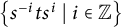 , we get the following observation.
Observation
The set
$\mathcal {L}$
 of integers L such that
$x^{-1} u_F x = u_F \lambda ^{L}$
 in
$\Lambda $
 for some
$x \in E_0$
 is the ideal
$(\mathcal {L}) \leq \mathbb {Z}$
 generated by the integers
$\left \{ L_i | i \in \mathbb {Z}\right \}$
 defined by

Claim
$\mathcal {L}$
 equals the ideal
$\mathcal {L}' = ( L_0, \ldots , L_{m-1} )$
 . For
$i=1, \ldots , m$
 , let
$\alpha _i$
 be the exponent-sum of the letters
$a_i$
 in
$u_F$
 . Let
$\Phi \in \text {GL}_m(\mathbb {Z})$
 be the
$m \times m$
 matrix of the map (with respect to the basis
$a_1$
 , …,
$a_m$
 ) induced by
$\phi : F \to F$
 on abelianizing F. Then

By the Cayley–Hamilton theorem,
$\Phi ^m$
 is a
$\mathbb {Z}$
 -linear combination of
$\Phi ^{m-1}, \ldots , \Phi , I$
 and so
$L_i \in \mathcal {L}'$
 for all
$i \geq m$
 . Indeed, the constant term of the characteristic polynomial of
$\Phi $
 is
$\text {det}(\Phi ) = \pm 1$
 . So
$\Phi $
 can be expressed as a
$\mathbb {Z}$
 -linear combination of
$\Phi ^2, \ldots , \Phi ^{m+1}$
 . So
$L_i \in \mathcal {L}'$
 for all
$i <0$
 . Therefore,
$\mathcal {L} = \mathcal {L}'$
 as claimed.
Because
$\overline {u} \sim \overline {v}$
 in
$\Lambda $
 , the L of (8.17) is in
$\mathcal {L}$
 and there exists
$x \in F$
 such that (8.16) holds.
In the light of the above claim, we learn from Corollary 3.3 that there exist
$n_0, \ldots , n_{m-1} \in \mathbb {Z}$
 such that

and for all i,

But for a suitable constant
$C_9>1$
 ,
$|L_{j}| \leq C_9^{|j|} |u_F|$
 for all
$j \in \mathbb {Z}$
 . So, for the constant
$C_{10} = C_9^{|m-1|}$
 ,

and therefore, in light also of the bounds on
$|u_F|$
 from (6.5) and on
$|L|$
 from (8.18), for a suitable constant
$C_{11}>1$
 , we have
$|n_i| \leq C_{11}^n$
 for
$i = 0, \ldots , m-1$
 . So

is an element of
$E_0$
 for which
$x^{-1} u_F x = u_F \lambda ^{L}$
 and
$|x| \leq C_{12}^n$
 for a suitable constant
${C_{12}>0}$
 . And then
$w = x w_0$
 satisfies
$ \overline {u} w = w \overline {v}$
 and, given (6.2), we learn that w is sufficiently short.
Case (d).
$\sigma (u) =0$
 ,
$u_E \neq 1$
 , and
$u_H \neq 1$
 , and so
$Z_G(u) = \langle u^{\prime }_F \rangle \times \langle u_E' \rangle $
 .
We have
$u_H \sim v_H$
 in H, and so like in Case (c), there exists
$w_0 \in H$
 such that

Also,
$u_E \sim v_E$
 in E, and so like in Case (b), there exists
$x_0 \in E$
 such that

There exists
$w \in G$
 such that
$u w =w v$
 in G, and therefore such that
$u_E w_E = w_E v_E$
 in E and
$u_H w_H =w_H v_H$
 in H. Now,
$u_E$
 is a power of
$u^{\prime }_E$
 and
$\sigma (u_E) = \sigma (u) =0$
 , and so
$\sigma (u^{\prime }_E)=0$
 . So
$\sigma (x_0) = \sigma (w_E)$
 because
$w_E^{-1} x_0 \in Z_E(u_E) = \langle u^{\prime }_E \rangle $
 . For a similar reason,
$\sigma (w_0) = \sigma (w_H)$
 . But then
$\sigma (x_0) = \sigma (w_0)$
 because
$\sigma (w) = \sigma (w_E) = \sigma (w_H)$
 .
Next, observe that
$u_H = u_F$
 and
$v_H = v_F$
 because
$\sigma (u) =0$
 . So
$u_F w_H = u_H w_H =w_H v_H = w_H v_F$
 . Then
$u_F w_H = w_H v_F$
 because
$w_H = w_F s^{\sigma (w)}$
 and
$\sigma (x_0) = \sigma (w_0)$
 .
That
$\sigma (x_0) = \sigma (w_0)$
 implies that for
$f \in F$
 , we have
$s^{-\sigma (w_0)} f s^{\sigma (w_0)} = x_0^{-1} f x_0$
 in G. So, given that
$w_0 = (w_0)_F s^{\sigma (w_0)}$
 and
$u_H w_0 =w_0 v_H$
 ,

in G. Let
$w_1$
 be a minimal-length word that equals
$(w_0)_F x_0$
 in G. Then, in G,


because (8.25) and (8.29) hold by definition, (8.26) is a consequence of
$\sigma (u_E) =0$
 , which implies that
$u_E$
 and
$(w_0)_F$
 commute, (8.27) is by (8.23), and (8.28) is by (8.24).
By definition,
$(w_1)_F = (w_0)_F$
 ,
$(w_1)_E = x_0$
 , and
$(w_0)_F = w_0 (w_0)^{-1}_E$
 . So
$(w_1)_F = w_0 (w_0)^{-1}_E$
 and by the triangle inequality,
$|(w_0)_F|_G \leq |w_0|_G + |(w_0)_E|_G$
 , which is at most
$2|w_0|_G$
 . So

where the last inequality is by (8.22) and (8.23).
Because
$Z_G(u) = \langle u^{\prime }_F \rangle \times \langle u_E' \rangle $
 , the words w such that
$uw = wv$
 in G are those expressible as
$w =(u^{\prime }_F)^p \, (u^{\prime }_E)^q w_1$
 for some
$p,q \in \mathbb {Z}$
 . Now,

because
$\sigma (u_E) = \sigma (u^{\prime }_E)=0$
 . So
$ u_E u^{\prime }_F = u^{\prime }_F u_E \lambda ^{P}$
 and
$u_F u^{\prime }_E = u^{\prime }_E u_F \lambda ^{Q}$
 for some integers P and Q, which we use in (8.33) and (8.36) of the following calculation. In
$\Lambda $
 , for such w,


where the remaining steps are explained by (8.32)
$u = u_F u_E \lambda ^{L^{\prime }_u}$
 in
$\Lambda $
 for some integer
$L^{\prime }_u$
 , (8.34)
$u_F \left (u^{\prime }_F\right )^p$
 freely equals
$\left (u^{\prime }_F\right )^{p} u_F$
 , (8.35)
$u_E (u^{\prime }_E)^q$
 freely equals
$(u^{\prime }_E)^qu_E$
 , and
$u = u_F u_E \lambda ^{L^{\prime }_u}$
 , and (8.37)
$u = u_F u_E$
 and
$u w_1 = w_1 v \lambda ^N$
 for some integer N.
Similarly to the earlier cases, because
$\overline {u} = u \lambda ^{L_u}$
 and
$\overline {v} = v \lambda ^{L_v}$
 in
$\Lambda $
 , we have
$\overline {u} w = w \overline {v}$
 in
$\Lambda $
 if and only if

and because
$\overline {u} \sim \overline {v}$
 in
$\Lambda $
 , there exist
$p, q \in \mathbb {Z}$
 satisfying this equation. Now, we claim that
$|P|, |Q|, |N + L_v - L_u| \leq C_{13}^n$
 for a suitable constant
$C_{13}>1$
 . Indeed, Lemma 5.2 applied to
$u_E u^{\prime }_F$
 , which equals
$u^{\prime }_F u_E \lambda ^{P}$
 in
$\Lambda $
 , gives that
$|P| \leq |u^{\prime }_F| C^{\Sigma \left ( u_E u^{\prime }_F \right )}$
 . And so
$|P| \leq C_{14}^n$
 for a suitable constant
$C_{13}>1$
 , because of Lemma 6.5 and because
$\Sigma \left ( u_E u^{\prime }_F \right ) \leq |u_E|$
 . Likewise, applied to
$u_F u^{\prime }_E$
 , which equals
$u^{\prime }_E u_F \lambda ^{Q}$
 in
$\Lambda $
 , it gives
$|Q| \leq |u_F| C^{\Sigma \left ( u_F u^{\prime }_E \right )}$
 . So
$|Q| \leq C_{13}^n$
 because of Lemma 6.5 and because
$\Sigma \left ( u_F u^{\prime }_E \right ) = \Sigma \left (u^{\prime }_E \right ) \leq |u^{\prime }_E|$
 . And Proposition 5.1 applied to
$v^{-1} w_1^{-1} u w_1 = \lambda ^N$
 gives that
$|N| \leq C_{13}^n$
 because of
$|u| + |v| \leq n$
 and (8.30). But then by adjusting the constant suitably, we can get
$|N + L_v - L_u| \leq C_{13}^n$
 because
$|L_u| + |L_v| \leq n$
 .
So by the quantification of Bézout in Corollary 3.3, there exist p and q satisfying (8.38) such that
$|p|, |q| \leq C_{13}^n$
 . And then
$\overline {u} w =w \overline {v}$
 in
$\Lambda $
 and the length of
$w =(u^{\prime }_F)^p \, (u^{\prime }_E)^q w_1$
 is
$|p| |u^{\prime }_F| + |q| |u^{\prime }_E| + | w_1|$
 is at most
$C_{14}^n$
 for a suitable constant
$C_{14}>1$
 , calling on Lemma 6.5 for bounds on the remaining terms.
Case (e).
$\sigma (u) \neq 0$
 ,
$u_E \neq 1$
 , and
$u_H \neq 1$
 .
Let p and q be the integers such that
$p \sigma (u^{\prime }_H) = q \sigma (u^{\prime }_E) = \mathrm {lcm}\left ( \sigma (u^{\prime }_H), \sigma (u^{\prime }_E) \, \right )$
 . Lemma 7.1 tells us that
$z = f (u^{\prime }_E)^q$
 generates
$Z_G(u)$
 , where f is the element of F such that
$(u^{\prime }_H)^p = f s^{p\sigma (u^{\prime }_H)}$
 in H. In particular,
$|p|$
 and
$|q|$
 are both at most n because
$|\sigma (u^{\prime }_H)|$
 and
$|\sigma (u^{\prime }_E)|$
 both divide n.
Applying the triangle inequality to
$(u^{\prime }_H)^p = f s^{p\sigma (u^{\prime }_H)}$
 and
$z = f (u^{\prime }_E)^q$
 gives that for a suitable constant
$C_{15}>0$
 ,


By Lemma 7.3, there exists a word w such that
$uw =wv$
 in G and
$|w|_G \leq C_0 n^2$
 and
$\Sigma (w) \leq C_0 n$
 . Then
$uw =wv \lambda ^N$
 in
$\Lambda $
 for some
$N \in \mathbb {Z}$
 and, in similar situations, in previous cases, we have called on Proposition 5.1, which would give that
$|N| \leq C_{16}^{n^2}$
 for some constant
$C_{16}>1$
 . However, we need a tighter bound and for that we look to Lemma 5.2. Let
$W = v^{-1} w^{-1} u w$
 . Observe that for any words
$\tau $
 and
$\pi $
 , we have
$\Sigma (\tau \pi ) \leq \Sigma (\tau ) + \Sigma (\pi )$
 and
$\Sigma (\tau ) = \Sigma (\tau ^{-1})$
 . So
$\Sigma (W) \leq 2\Sigma (w) + |u| + |v| \leq (2C_0 +1) n$
 and with Lemma 5.2, we get

for a suitable constant
$C_{17}>1$
 .
The set of all W such that
$u W = W v$
 in G is
$\left \{ z^r w \mid r \in \mathbb {Z}\right \}$
 .
Now, u commutes with z in G, so
$u z = z u \lambda ^M$
 in
$\Lambda $
 for some
$M \in \mathbb {Z}$
 .
By hypothesis,
$\overline {u} \overline {W} = \overline {W} \overline {v}$
 in
$\Lambda $
 for some word
$ \overline {W} \in \Lambda $
 . Let W be this
$\overline {W}$
 with all letters
$\lambda $
 deleted. Then
$\overline {u} W = W \overline {v}$
 in
$\Lambda $
 also and
$u W = W v$
 in G, and so this W must equal
$z^r w$
 in G for some
$r \in \mathbb {Z}$
 . We calculate that in
$\Lambda $
 ,


because (8.42)
$\overline {u} = u \lambda ^{L_u}$
 , (8.43) and (8.46)
$W = z^rw \lambda ^K$
 for some
$K\in \mathbb {Z}$
 , (8.44)
${uz=zu \lambda ^M}$
 , (8.45)
$uw=wv \lambda ^N$
 , and (8.47)
$\overline {v} = v \lambda ^{L_v}$
 . So
$L_v = L_u + rM + N$
 .
If
$M=0$
 , then the above calculation gives that
$\overline {u} W = W \overline {v}$
 in
$\Lambda $
 for
$W = z^rw$
 , irrespective of the value of r. So we can take
$r=0$
 and we get that
$\overline {u} w = w \overline {v}$
 in
$\Lambda $
 .
If
$M \neq 0$
 , then
$r = (L_v - L_u -N)/M$
 and because of
$|L_u| + |L_v| \leq n$
 and (8.41), we get that
$|r| \leq C_{18}^n$
 for a suitable constant
$C_{18}>0$
 .
In either case,
$|W|_G \leq |r| \cdot |z|_G + |w|_G$
 and because of
$|w|_G \leq C_0 n^2$
 and (8.40),
$|W|_G \leq C_{19}^n$
 for a suitable constant
$C_{19}>0$
 .
This completes our proof that
$\mathrm {CL}_{\Lambda }(n) \preceq 2^n$
 .
9 Why
$\mathrm {CL}_{\Lambda }(n) \succeq 2^n$

As we saw in Section 5, if we define
$f(n)$
 to be the exponent sum of the letters in
$\phi ^n\left (a_i\right )$
 , for a suitable choice of i, then
$f(n) \simeq 2^n$
 and
$[t, s^{-n} a_i s^n]$
 is a word of length
$4n+4$
 that equals
$\lambda ^{f(n)}$
 in
$\Lambda $
 . Without loss of generality, we may assume
$i=1$
 . So, if for
$n \geq 1$
 , we define
$\overline {u_n} =a_1 t \lambda ^{f(n)}$
 and
$\overline {v_n} = a_1 t $
 , then
$|\overline {u_n}|_{\Lambda } + |\overline {v_n}|_{\Lambda } \leq 4n + 8$
 and
$\overline {u_n} \sim \overline {v_n}$
 in
$\Lambda $
 because

The images
$u_n$
 and
$v_n$
 in G of
$\overline {u_n}$
 and
$\overline {v_n}$
 , respectively, are
$u_n = v_n = a_1 t$
 . A shortest word w such that
$\overline {u_n} w = w \overline {v_n}$
 in
$\Lambda $
 will contain no letters
$\lambda $
 , because
$\lambda $
 is central and will satisfy
$u_n w = w v_n$
 in G.
Case (d) of Lemma 7.1 tells us that
$Z_G \left ( a_1 t \right ) = \langle a_1 \rangle \times \langle t \rangle $
 . So, if
$u_n w = w v_n$
 in G, then
$w = a_1^p t^q$
 for some
$p, q \in \mathbb {Z}$
 .
However, not all such w will satisfy
$\overline {u_n} w = w \overline {v_n}$
 in
$\Lambda $
 . Indeed,
$\overline {u_n} w = a_1 t \lambda ^{f(n)} a_1^p t^q = a_1^{p+1} t^{q+1} \lambda ^{f(n)+p}$
 and
$w \overline {v_n} = a_1^p t^q a_1 t = a_1^{p+1} t^{q+1} \lambda ^{q}$
 . So the
$w= a_1^{p} t^{q}$
 such that
$\overline {u_n} w = w \overline {v_n}$
 in
$\Lambda $
 and those of the form
$w = a_1^{p} t^{p + f(n)}$
 for some
$p \in \mathbb {Z}$
 .
For such w,

because killing all generators other than t maps
$\Lambda {\kern 3pt\to \kern -8pt\to \kern 3pt} \langle t \rangle \cong \mathbb {Z}$
 and
$w \mapsto t^{p + f(n)}$
 . Now,
$\langle a_1 \rangle $
 is an infinite cyclic subgroup of a hyperbolic group H and as such is an undistorted subgroup of H. On account of this and that killing t and
$\lambda $
 maps
$\Lambda {\kern 3pt\to \kern -8pt\to \kern 3pt} H$
 , there exists a constant
$C>0$
 such that

So, if
$|p| < f(n)/2$
 , then
$|w|_{\Lambda } \geq f(n)/2$
 by virtue of (9.1), and otherwise
$|w|_{\Lambda } \geq C f(n)/2$
 by virtue of (9.2). That
$\mathrm {CL}_{\Lambda }\left (n\right ) \succeq 2^n$
 follows.
This completes our proof of Theorem 1′ .
10 Fiber products: Examples further up the Grzegorczyk hierarchy
We now turn our attention to a fiber product construction that yields finitely presented groups displaying a wide range of conjugator length functions. Our purpose here is two-fold: first, we want to construct specific finitely presented groups with large but computable conjugator length functions including representatives comparable to every level of the Grzegorczyk hierarchy of primitive recursive functions (Theorem 1.2); secondly, we want to describe a framework (Remark 10.5) that holds the potential to provide calculations of
$\mathrm {CL}\left (n\right )$
 for finitely presented groups in great generality.
The groups that we shall construct to prove Theorem 1.2 are obtained by following the general template for constructing “designer groups” described in [Reference BridsonBri06], which is based on refinements of the Rips Construction [Reference RipsRip82] and the 1-2-3 Theorem of Baumslag et al. [Reference Baumslag, Bridson, Miller and ShortBBMS00]. As is usual with this template, we will have to craft input groups carefully to achieve the desired output group.
We remind the reader that a group G is said to be of type
$\mathrm {{F}}_3$
 if it has a classifying space
$K(G,1)$
 whose 3-skeleton is finite.
The Rips Construction [Reference RipsRip82] associates to any finite group-presentation
$\mathcal {Q}$
 , a short exact sequence

where Q is the group presented by
$\mathcal {Q}$
 , while N is a 2-generator group and G is a torsion-free hyperbolic group that satisfies a prescribed small-cancellation condition. The 1-2-3 Theorem [Reference Baumslag, Bridson, Miller and ShortBBMS00] implies that if Q is of type
$\mathrm {{F}}_3$
 , then the fiber product

is finitely presented. Moreover, it was proved in [Reference Bridson, Howie, Miller and ShortBHMS13] that there is an algorithm that, given the presentation
$\mathcal {Q}$
 and a set of
$\mathbb {Z} Q$
 -module generators for the second homotopy module
$\pi _2\mathcal {Q}$
 (or, equivalently, a combinatorial model for the 3-skeleton of
$K(Q,1)$
 ), will output a finite presentation for P; if the presentation is aspherical, then the algorithm simplifies considerably.
A primary goal of [Reference Baumslag, Bridson, Miller and ShortBBMS00] was to construct a finitely presented subgroup of a product of hyperbolic groups such that the membership and conjugacy problems for the subgroup were unsolvable. This was done by combining the Rips Construction and the 1-2-3 Theorem as described above: if Q has an unsolvable word problem, then the fiber product
$P<\Gamma \times \Gamma $
 has the desired properties. This construction builds on an idea that originates in the work of Mihailova [Reference MihailovaMih58], who considered the case where
$\Gamma $
 is a free group. The following basic lemma from her work contains the key facts and the reader who is new to these ideas will find the exercise of proving it to be instructive.
Lemma 10.1 (Mihailova)
Let
$Q = \langle a_1, \ldots , a_n \mid r_1, \ldots , r_m \rangle $
 , let F be the free group
$F(a_1,\dots ,a_n)$
 , and let

Then, P is generated by
$ \{(a_1, a_1), \ldots , (a_n,a_n), (r_1,1), \ldots , (r_m,1)\}$
 . And for all
$w\in F$
 ,
-
(1) $w = 1$
in Q if and only if
$(w,1) \in P$
, and -
(2) provided $r \in F$
is not a proper power,
$(wrw^{-1},r) \sim (r,r)$
in P if and only if
$w=1$
in Q.


By refining the proofs of such basic results, one can establish quantified relationships between membership and conjugacy problems, on the one hand, and word problems, on the other hand, loosely speaking, the Dehn function for Q is reflected in the distortion function of
$P<\Gamma \times \Gamma $
 , and these functions together with the geometry of cyclic subgroups in Q account for the difficulty of the conjugacy problem in P. These relationships are explored in detail in [Reference BridsonBri25, Reference BridsonBri26]. In particular, the following close relationship between the Dehn function of Q and the conjugator length function of P is established in [Reference BridsonBri25], under the hypothesis that Q has uniformly quasigeodesic cyclics (UQC), meaning that there is a constant
$\lambda>0$
 such that
$|q^n|_Q\ge \lambda |n|$
 for all
$n\in \mathbb {Z}$
 and
$q\in Q\setminus \{1\}$
 .
Theorem 10.2 [Reference BridsonBri25, Corollary C]
Let
$P<\Gamma \times \Gamma $
 be the fiber product associated with an epimorphism
$\Gamma \to Q$
 , where
$\Gamma $
 is a torsion-free hyperbolic group and Q is a finitely presented group that has UQC. Then

To identify groups Q meeting the hypothesis of this theorem, we look to the following lemma.
Lemma 10.3 (See Section 4.1 of [Reference BridsonBri25])
-
(1) Torsion-free hyperbolic groups and CAT $(0)$
groups have the UQC property. -
(2) If Q is a finitely generated group with UQC, then any HNN extension of the form $Q\dot \ast _M$
has UQC.


(Here,
$Q\dot \ast _M$
 denotes the trivial HNN-extension
$\langle Q, t \mid [t,m] =1 \ \forall m \in M \rangle $
 of Q along a subgroup
$M \leq Q$
 .)
Our main interest here lies with large Dehn functions associated with groups that have useful additional properties. We would like to have concise presentations for them, as well as geometry to aid our understanding.
We first consider the function
$\Delta \left (n\right )$
 defined recursively by
$\Delta (1)=2$
 and
${\Delta (k+1)=2^{\Delta (k)}}$
 . This function arises in several settings:
$\Delta (\lfloor \log n\rfloor )$
 is the Dehn function of Higman’s group with no finite quotients [Reference HigmanHig51]

and of the Baumslag–Gersten one-relator group [Reference BaumslagBau69]

(see [Reference BridsonBri15, Reference PlatonovPla04]). Further,
$\Delta \left (n\right ) = A_3\left (n\right )$
 the third Ackermann function – see Section 1. In fact, all of the Ackermann functions
$n \mapsto A_k\left (n\right )$
 arise as Dehn functions of groups with small aspherical presentations. These Ackermann functions play a central role in the work of Dison and Riley on hydra groups [Reference Dison and RileyDR13]. They prove that
$A_k$
 is the Dehn function of the HNN extension
$Q_k = H_k\dot \ast _{L_k}$
 , where
$H_k$
 is the free-by-cyclic group
$\langle a_1,\dots ,a_k,t \mid t^{-1} a_1 t =a_1, \, t^{-1}a_i t = a_i a_{i-1} \ (i>1) \rangle $
 and
$L_k$
 is the free subgroup generated
$\{a_1t,\dots ,a_kt\}$
 :

Proof of Theorem 1.2
We want finitely presented groups whose conjugator length functions are comparable to fast-growing functions at all levels of the Grzegorczyk hierarchy. Examples with conjugator length equivalent to
$2n =A_1\left (n\right )$
 are easy to come by, and in Theorem 1.1, we constructed examples growing like
$2^n = A_2\left (n\right )$
 . So we now assume that
$k \geq 3$
 , and we want to exhibit a finitely presented group
$P_k$
 such that
$ A_k\left (n\right )\preceq \mathrm {CL}_{P_k}\left (n\right ) \preceq A_k\left (n^2\right )$
 .
Let
$\Gamma _k$
 be the group described above. It is obtained from a finitely generated free group
$F_k = F\left (a_1, \ldots , a_k\right )$
 by taking two HNN extensions, each along finitely generated free subgroups. A standard topological argument shows that the standard 2-complex of the natural presentation for any such extension is aspherical, so the group is of type
$\text {F}_3$
 . The Rips Construction provides us with a torsion-free hyperbolic group
$\Gamma _k$
 and an epimorphism
$\Gamma _k {\kern 3pt\to \kern -8pt\to \kern 3pt} Q_k$
 with finitely generated kernel, and the 1-2-3 Theorem [Reference Baumslag, Bridson, Miller and ShortBBMS00] tells us that the associated fiber product
$P_k < \Gamma _k \times \Gamma _k$
 is finitely presented.
Moreover,
$Q_k$
 is of the form
$H_k \dot \ast _{L_k}$
 , and it is shown in [Reference Dison and RileyDR13] that
$H_k$
 is the fundamental group of a compact non-positively curved space. Lemma 10.3 tells us that such groups have UQC, so Theorem 10.2 applies and we conclude that
$ A_k\left (n\right )\preceq \mathrm {CL}_{P_k}\left (n\right ) \preceq A_k(n^2)$
 .
Remark 10.4 Recently, Gillis [Reference GillisGil25] showed that the conjugator length function of the Baumslag–Gersten one-relator group (10.1) is fast-growing. He gave upper and lower bounds, which differ but both take the form of logarithmic-height towers of exponential functions.
Remark 10.5 Theorem 10.2 has an antecedent in [Reference BridsonBri25] which says that for Q a finitely presented group, and
$\Gamma {\kern 3pt\to \kern -8pt\to \kern 3pt} Q$
 an epimorphism from a torsion-free hyperbolic group, and
$P < \Gamma \times \Gamma $
 the associated fiber product,

where
$\mathrm {CL}^{G\times G}_P \left (n\right )$
 is quantified over
$u,v$
 with
$|u|_{G\times G}+|v|_{G\times G}\le n$
 rather than
$|u|_P+|v|_P\le n$
 and
$\mathrm {Dehn}_Q^c\left (n\right ):\mathbb {N}\to \mathbb {N}$
 is the rel-cyclics Dehn function,

This relationship motivates us to consider which functions arise as rel-cyclic Dehn functions
$\mathrm {Dehn}^c\left (n\right )$
 of groups of type
$\mathrm {{F}}_3$
 . This question seems amenable to attack using the many techniques developed to study Dehn functions and subgroup distortion, and this expectation lends weight to the conviction that the set of
$\simeq $
 classes of conjugator length functions of finitely presented groups is likely to be as diverse as the set of Dehn functions.Footnote
3
Acknowledgements
This article developed out of a long-running project on which Andrew Sale also worked. We are grateful to him for his insights and his companionship. We also thank an anonymous referee for their comments.


 Open access

