








1 Introduction
In 1894, the infinite matrix
 $\boldsymbol {H}=((n+k+1)^{-1})_{n, k\in \mathbb {N}}$
was introduced by Hilbert [Reference Hilbert15] in approximation theory. Here,
 $\mathbb {N}$
is the set of nonnegative integers. This matrix has been well known as the Hilbert matrix, which has applications across numerous fields, including linear algebra, numerical analysis, and operator theory (cf. [Reference Kato21, Reference Magnus26, Reference Savage and Lukacs29]). The Hilbert matrix is also a typical example of Hankel matrices whose n, k entry is a function of
 $n+k$
(cf. [Reference Widom30]). We refer to monographs [Reference Peller28, Chapters 1 and 10] and [Reference Halmos12, Chapter 5] for the theory associated with the Hilbert matrix.
The Hilbert matrix
 $\boldsymbol {H}$
can be regarded as an operator acting on sequence spaces. More precisely, given a complex sequence
 $\{a_n\}_{n\in \mathbb {N}}$
, consider
 $$ \begin{align*}\mathrm{H}:\ \ \{a_n\}_{n\in \mathbb{N}} \mapsto \left\{\sum_{k=0}^\infty \frac{a_k}{n+k+1}\right\}_{n\in \mathbb{N}}. \end{align*} $$
For
 $p>1$
, it is known that the operator
 $\mathrm {H}$
is bounded on the sequence space
 $\ell ^p$
and its operator norm is equal to
 $\pi / \sin (\pi /p)$
(see, for instance, [Reference Hardy, Littlewood and Pólya13, Theorems 286 and 323]).
Let
 $\text {Hol}(\mathbb {D})$
be the space of functions analytic in the open unit disk
 $\mathbb {D}$
of the complex plane. For
 $f(z)=\sum _{n=0}^\infty a_n z^n$
in
 $\text {Hol}(\mathbb {D})$
, by the action of
 $\boldsymbol {H}$
on the sequence of the Taylor coefficients of f, the Hilbert matrix operator
 $\mathcal H$
is given by
 $$ \begin{align} \mathcal H(f)(z)=\sum_{n=0}^\infty \left(\sum_{k=0}^\infty \frac{a_k}{n+k+1}\right)z^n, \ \ z\in \mathbb{D}, \end{align} $$
whenever the right-hand side of (1.1) makes sense for every
 $z\in \mathbb {D}$
and defines an analytic function in
 $\mathbb {D}$
.
In 2000, Diamantopoulos and Siskakis [Reference Diamantopoulos and Siskakis8] initiated the study of the Hilbert matrix operator on spaces of functions analytic in
 $\mathbb {D}$
. They proved that the Hilbert matrix operator
 $\mathcal H$
is bounded on the Hardy space
 $H^p$
for
 $p>1$
, and got an upper bound of the corresponding operator norm. Later, Dostanić, Jevtić, and Vukotić [Reference Dostanić, Jevtić and Vukotić10] obtained that this operator norm on
 $H^p$
is equal to
 $\pi / \sin (\pi /p)$
, which coincides with the norm of the operator
 $\mathrm {H}$
on the sequence space
 $\ell ^p$
. Łanucha, Nowak, and Pavlović [Reference Łanucha, Nowak and Pavlović22] investigated the operator
 $\mathcal H$
on some spaces of analytic functions. Jevtić and Karapetrović [Reference Jevtić and Karapetrović17] considered
 $\mathcal H$
on more general Besov spaces. Lindström, Miihkinen, and Wikman [Reference Lindström, Miihkinen and Wikman24] and Dai [Reference Dai5] studied the norm of
 $\mathcal H$
on Korenblum spaces. Lindström, Miihkinen, and Norrbo [Reference Lindström, Miihkinen and Norrbo23] got the exact value of the essential norm of
 $\mathcal H$
on some classical analytic function spaces. Ye and Feng [Reference Ye and Feng31] investigated the norm of
 $\mathcal H$
from logarithmically weighted Bergman spaces to the classical Bergman spaces. See [Reference Bellavita, Daskalogiannis, Stylogiannis, Ball, Tylli and Virtanen2, Reference Karapetrović, Binder, Kinzebulatov and Mashreghi20] for the surveys of the Hilbert matrix operator on spaces of analytic functions.
For
 $0<p<\infty $
and
 $\alpha>-1$
, recall that the Bergman space
 $A^p_\alpha $
consists of functions f in
 $\text {Hol}(\mathbb {D})$
such that
 $$ \begin{align*}\|f\|_{A^p_\alpha}=\left(\int_{\mathbb{D}} |f(z)|^p dm_\alpha (z)\right)^{\frac 1 p}<\infty, \end{align*} $$
where
 $dm_\alpha (z)=(\alpha +1)(1-|z|^2)^{\alpha } dm(z)$
. Here and below,
 $dm$
is the area measure on
 $\mathbb {D}$
normalized so that
 $m(\mathbb {D})=1$
; that is,
 $$ \begin{align*}dm(z)=\frac{1}{\pi} dxdy=\frac{1}{\pi} rdrd\theta, \ \ z=x+iy=re^{i\theta}. \end{align*} $$
If
 $\alpha =0$
, we write
 $A^p$
instead of
 $A^p_\alpha $
. See [Reference Hedenmalm, Korenblum and Zhu14, Reference Zhu32] for
 $A^p_\alpha $
spaces.
There are also a good number of mathematicians who have investigated the boundedness and the norm of the Hilbert matrix operator
 $\mathcal H$
on Bergman spaces. In 2004, Diamantopoulos [Reference Diamantopoulos7] proved that
 $\mathcal H$
is bounded on
 $A^p$
if and only if
 $p>2$
, and estimated the upper bound of this operator norm. For
 $p\geq 4$
, in 2008, Dostanić, Jevtić, and Vukotić [Reference Dostanić, Jevtić and Vukotić10] obtained that the exact value of the norm of
 $\mathcal H$
on
 $A^p$
is
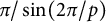 $\pi /\sin (2\pi /p)$
. For
 $2<p<4$
, in 2018, Boz̆in and Karapetrović [Reference Bozin and Karapetrović3] proved that the norm of
 $\mathcal H$
on
 $A^p$
is also
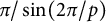 $\pi /\sin (2\pi /p)$
(see Lindström, Miihkinen, and Wikman [Reference Lindström, Miihkinen and Wikman24] for another proof of this result). For the action of
 $\mathcal H$
on
 $A^p_\alpha $
, we recall some previous results as follows.
-
(i) In 2017, Jevtić and Karapetrović [Reference Jevtić and Karapetrović16] studied the Hilbert matrix operator on a family of spaces of analytic functions. In particular, they showed that
 $\mathcal H$
is bounded on
$A^p_\alpha $
if and only if
$1<\alpha +2<p$
. See Galanopoulos, Girela, Peláez, and Siskakis [Reference Galanopoulos, Girela, Peláez and Siskakis11] for the study of a generalized Hilbert operator on
$A^p_\alpha $
spaces.
-
(ii) In 2018, Karapetrović [Reference Karapetrović18] got the lower bound
$\pi /\sin ((2+\alpha )\pi /p)$
of the norm of
$\mathcal H$
on
$A^p_\alpha $
for
$1<\alpha +2<p$
, and proved that when
$\alpha \geq 0$
and
$p\geq 2(\alpha +2)$
this lower bound is the exact value of the norm of
$\mathcal H$
on
$A^p_\alpha $
. In [Reference Karapetrović18, p. 516], Karapetrović conjectured that if
$1<\alpha +2<p$
, then the norm of
$\mathcal H$
on
$A^p_\alpha $
is
$\pi /\sin ((2+\alpha )\pi /p)$
. -
(iii) In 2021, Lindström, Miihkinen, and Wikman [Reference Lindström, Miihkinen and Wikman25] proved Karapetrović’s conjecture for
$\alpha> 0$
and
$\alpha +2+\sqrt {\alpha ^2+\frac {7}{2}\alpha +3}\leq p<2(\alpha +2)$
. -
(iv) In 2021, Karapetrović [Reference Karapetrović19] proved his conjecture for
$\alpha>0$
and
$p\geq \alpha _0$
, where
$\alpha _0$
is a unique zero of the function on the interval
$$ \begin{align*}\Phi_\alpha(x)=2x^2-(4(\alpha+2)+1)x+2\sqrt{\alpha+2}\sqrt{x}+\alpha+2\end{align*} $$
$(\alpha +2, 2(\alpha +2))$
. Using this result, he confirmed his conjecture when
$\alpha>0$
and which improves the conclusion in (iii). For
$$ \begin{align*}\alpha+2+\sqrt{(\alpha+2)^2-\left(\sqrt{2}-\frac{1}{2}\right)(\alpha+2)}\leq p<2(\alpha+2),\end{align*} $$
$-1<\alpha <0$
and
$p>\alpha +2$
, Karapetrović [Reference Karapetrović19] also gave an upper bound of the norm of
$\mathcal H$
on
$A^p_\alpha $
, which was further studied by Bralović and Karapetrović [Reference Bralović and Karapetrović4], and Norrbo [Reference Norrbo27].
-
(v) In 2023, Dmitrović and Karapetrović [Reference Dmitrović and Karapetrović9] proved Karapetrović’s conjecture for
$\alpha>0$
and
$\frac {3\alpha }{4}+2+\sqrt {\left (\frac {3\alpha }{4}+2\right )^2-\frac {\alpha +2}{2}}\leq p$
. They pointed out that this improves the best previously known result for all
$\alpha>\frac {1}{2}$
. -
(vi) In 2024, Dai [Reference Dai6] demonstrated Karapetrović’s conjecture when p and
$\alpha $
satisfy one of the following conditions: -
•
$\alpha>0$
and
$2+\frac {3\alpha }{4}+\frac {1}{4}\sqrt {9\alpha ^2+40\alpha +48}\leq p<2(\alpha +2)$
; -
•
$\alpha>0$
,
$\alpha +2<p<2+\frac {3\alpha }{4}+\frac {1}{4}\sqrt {9\alpha ^2+40\alpha +48}$
, and a nontrivial condition of p and
$\alpha $
involving a double integration and the Beta function; -
•
$0<\alpha \leq \frac {1}{47}$
and
$p>\alpha +2$
; -
•
$\alpha =1$
and
$p>3$
; -
•
$-1<\alpha <0$
and
$p\geq 2(\alpha +2)$
.
-



























The value
 $\frac {3\alpha }{4}+2+\sqrt {\left (\frac {3\alpha }{4}+2\right )^2-\frac {\alpha +2}{2}}$
in (v) is equal to the number
 $2+\frac {3\alpha }{4}+\frac {1}{4}\sqrt {9\alpha ^2+40\alpha +48}$
in (vi), which was found independently by the authors in [Reference Dai6, Reference Dmitrović and Karapetrović9].
In summary, when
 $\alpha>0$
and
 $\alpha +2<p<2(\alpha +2)$
, Karapetrović’s conjecture was not fully settled. Karapetrović’s conjecture is also open for
 $-1<\alpha <0$
and
 $\alpha +2<p<2(\alpha +2)$
.
The known results of Karapetrović’s conjecture, which were mentioned earlier, were stated based on
 $p(\alpha )$
-curves. Certainly, they can be rewritten based on
 $\alpha (p)$
-curves. In this article, we give a proof of Karapetrović’s conjecture for
 $$ \begin{align} 0\leq \alpha \leq \frac{6p^3-29p^2+17p-2+2p\sqrt{6p^2-11p+4}}{(3p-1)^2}, \end{align} $$
which is based on
 $\alpha (p)$
-curves. Throughout this article, when the value
 $\frac {6p^3-29p^2+17p-2+2p\sqrt {6p^2-11p+4}}{(3p-1)^2}$
appears, we emphasize that we always assume this value is reasonable; that is,
 $6p^2-11p+4\geq 0$
and
 $p \not = 1/3$
. Then, we will see that condition (1.2) also yields
 $p>\alpha +2$
. As recalled before, Karapetrović’s conjecture for the cases
 $0\leq \alpha \leq \frac {1}{47}$
and
 $\alpha =1$
was thoroughly answered in the literature. In Section 4, we will point out that our range of
 $\alpha $
in (1.2) is the best so far when
 $\alpha>\frac {1}{47}$
and
 $\alpha \not =1$
.
2 A result based on
$\alpha (p)$
-curves

In this section, we prove the following conclusion which is stated based on
 $\alpha (p)$
-curves and will be used to prove our main result.
Proposition 2.1 Let
 $$ \begin{align} &\max \left\{\frac{6p^3-29p^2+17p-2-2p\sqrt{6p^2-11p+4}}{(3p-1)^2}, \ 0 \right\} \nonumber \\ \leq & \ \alpha \ \leq\frac{6p^3-29p^2+17p-2+2p\sqrt{6p^2-11p+4}}{(3p-1)^2}. \end{align} $$
Then,
 $$ \begin{align*}\|\mathcal{H}\|_{A_\alpha^p}=\frac{\pi}{\sin\frac{(\alpha+2)\pi}{p}}, \end{align*} $$
where
 $\|\mathcal {H}\|_{A_\alpha ^p}$
is the norm of the Hilbert matrix operator
 $\mathcal H$
on
 $A_\alpha ^p$
.
Remark 1 In the last section, we will see that condition (2.1) in Proposition 2.1 can be replaced by the weaker condition (1.2). Recall that
 $\mathcal H$
is bounded on
 $A^p_\alpha $
if and only if
 $1<\alpha +2<p$
. We remark that condition (1.2) implies
 $p>\alpha +2$
. In fact, condition (1.2) gives
 $$ \begin{align} 2p\sqrt{6p^2-11p+4}\geq -6p^3+29p^2-17p+2. \end{align} $$
If
 $p\leq 0$
, then the left-hand side of (2.2) is non-positive and the right-hand side of (2.2) is positive, which is impossible. In other words, condition (1.2) yields
 $p>0$
. When
 $p>0$
, a direct computation gives
 $$ \begin{align*}\frac{6p^3-29p^2+17p-2+2p\sqrt{6p^2-11p+4}}{(3p-1)^2}<p-2.\end{align*} $$
Combining this with (1.2), we get
 $p>\alpha +2$
.
Denote by
 $\mathcal P$
the set of polynomials. For
 $1<\alpha +2<p$
, recall that there exists a positive constant C such that
 $$ \begin{align} \|\mathcal H(g)\|_{A_\alpha^p}\leq C \|g\|_{A_\alpha^p} \end{align} $$
for all
 $g \in \mathcal P$
. In fact, (2.3) yields that for any
 $f(z)=\sum _{n=0}^\infty a_n z^n$
in
 $A^p_\alpha $
, the right-hand side of (1.1) makes sense for every
 $z\in \mathbb {D}$
and defines an analytic function in
 $\mathbb {D}$
. This can be done similarly to [Reference Diamantopoulos7, p. 1069]. See [Reference Bao and Sun1, Lemma 2.3] for a similar conclusion about a generalized Hilbert operator on certain Banach spaces of analytic functions.
The following conclusion is from [Reference Karapetrović18], which is a reason for Karapetrović to give his conjecture.
Theorem 2.2 [Reference Karapetrović18, Theorem 1.1]
If
 $1<\alpha +2 <p$
, then
 $$ \begin{align*}\|\mathcal{H}\|_{A_\alpha^p}\geq\frac{\pi}{\sin\frac{(\alpha+2)\pi}{p}}. \end{align*} $$
For
 $p>\alpha +2>0$
, it is known that
 $$ \begin{align} \int_{0}^1\frac{t^{\frac{\alpha+2}{p}-1}}{(1-t)^{\frac{\alpha+2}{p}}}\,dt= B\left(\frac{\alpha+2}{p}, 1-\frac{\alpha+2}{p}\right)=\frac{\pi}{\sin\frac{(\alpha+2)\pi}{p}}, \end{align} $$
where B is the Beta function. Then, for
 $p>\alpha +2>0$
, the function
 $$ \begin{align} F_{p,\alpha}(r)=r^{p-4-\frac{3\alpha}{2}} \int_0^{\frac{2r}{1+r}}\frac{t^{\frac{\alpha+2}{p}-1}}{(1-t)^{\frac{\alpha+2}{p}}} \,dt - \int_{0}^1\frac{t^{\frac{\alpha+2}{p}-1}}{(1-t)^{\frac{\alpha+2}{p}}}\,dt \end{align} $$
is well defined for
 $r\in (0,1]$
.
The following property of the function
 $F_{p,\alpha }$
is useful to prove Proposition 2.1.
Lemma 2.3 Let
 $p>\alpha +2>0$
and
 $$ \begin{align} &\frac{6p^3-29p^2+17p-2-2p\sqrt{6p^2-11p+4}}{(3p-1)^2} \nonumber \\ \leq & \ \alpha \ \leq\frac{6p^3-29p^2+17p-2+2p\sqrt{6p^2-11p+4}}{(3p-1)^2}. \end{align} $$
Then,
 $F_{p,\alpha }(r)\leq 0$
for all
 $r\in (0,1]$
.
Proof For
 $r\in (0,1)$
,
 $F^{\prime }_{p,\alpha }(r)=r^{p-5-\frac {3\alpha }{2}}g(r)$
, where
 $$ \begin{align*}g(r)=\left(p-4-\frac{3\alpha}{2}\right)\int_0^{\frac{2r}{1+r}}\frac{t^{\frac{\alpha+2}{p}-1}}{(1-t)^{\frac{\alpha+2}{p}}} \,dt +\frac{(2r)^{\frac{\alpha+2}{p}}}{(1+r) (1-r)^{\frac{\alpha+2}{p}}}. \end{align*} $$
It is easy to get
 $$ \begin{align*} g'(r)=\frac{2^{\frac{\alpha+2}{p}}r^{\frac{\alpha+2}{p}-1} }{(1+r)^2 (1-r)^{\frac{\alpha+2}{p}+1}}k(r). \end{align*} $$
Here,
 $$ \begin{align*} k(r) =\left(\frac{3\alpha }{2} +5-p\right)r^2+\left( \frac{\alpha+2}{p} -1\right)r+\frac{\alpha+2}{p}+ p-\frac{3\alpha }{2}-4. \end{align*} $$
Then,
 $$ \begin{align*} k'(r)=\left (3\alpha +10-2p\right)r + \frac{\alpha+2}{p} -1. \end{align*} $$
Now, suppose
 $3\alpha +10-2p=0$
. Note that
 $p>\alpha +2>0$
. Then
 $$ \begin{align*} k(r)=\left( \frac{\alpha+2}{p} -1\right)r+\left(\frac{\alpha+2}{p}+ p-\frac{3\alpha }{2}-4\right) \end{align*} $$
is a decreasing function on
 $[0, 1]$
and
 $k(1)=\frac {2(\alpha +2)}{p}>0$
. Hence,
 $k(r)>0$
for
 $r\in [0, 1]$
.
On the other hand, let
 $3\alpha +10-2p\neq 0$
. Then, k is a quadratic function. Denote by
 $\Delta _k$
the discriminant for
 $k(r)=0$
. Then
 $$ \begin{align*}\Delta_k=\left( \frac{\alpha+2}{p} -1\right)^2-4\left(\frac{3\alpha }{2} +5-p\right)\left(\frac{\alpha+2}{p}+ p-\frac{3\alpha }{2}-4\right). \end{align*} $$
Since
 $6p^2-11p+4\geq 0$
and
 $p\not = \frac {1}{3}$
, condition (2.6) holds if and only if
 $$ \begin{align*}(3p-1)^2\alpha^2+(-12p^3+58p^2-34p+4)\alpha+(4p^4-36p^3+89p^2-44p+4)\leq0, \end{align*} $$
which is equivalent to
 $\Delta _k \leq 0$
. Combining this with
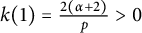 $k(1)=\frac {2(\alpha +2)}{p}>0$
, we get
 $k(r)\geq 0$
for
 $r\in [0, 1]$
.
Thus,
 $k(r)$
is always nonnegative on
 $[0, 1]$
. This gives
 $g'(r)\geq 0$
for
 $r\in (0,1)$
. Then, g is increasing on
 $(0,1)$
. Bear in mind that
 $g(0)=0$
and g is right-continuous at 0. Hence,
 $g(r)\geq 0$
when
 $r\in (0,1)$
. Consequently,
 $F^{\prime }_{p,\alpha }(r)\geq 0$
for
 $r\in (0,1)$
. So,
 $F_{p,\alpha }$
is increasing in
 $(0,1)$
. Also,
 $F_{p,\alpha }$
is left-continuous at 1 and
 $F_{p,\alpha }(1)=0$
. Hence,
 $F_{p,\alpha }(r)\leq 0$
for all
 $r\in (0,1]$
.
Let
 $1<\alpha +2<p$
. Recall that the Hilbert matrix operator
 $\mathcal {H}$
on
 $A^p_\alpha $
has an integral representation by weighted composition operators
 $T_t$
(cf. [Reference Diamantopoulos7, Reference Karapetrović18]):
 $$ \begin{align*}\mathcal{H}(f)(z)=\int_0^1 T_t(f)(z)\,dt,\ \ f\in A^p_\alpha, \end{align*} $$
where
 $T_t(f)(z)=\omega _t(z)f(\phi _t(z))$
and
 $$ \begin{align*}\omega_t(z)=\frac{1}{1-(1-t)z}, \ \ \phi_t(z)=\frac{t}{1-(1-t)z}. \end{align*} $$
Next we give the proof of Proposition 2.1.
Proof of Proposition 2.1
Let
 $f\in A^p_\alpha $
. By Remark 1,
 $p>\alpha +2\geq 2$
. Using the Minkowski inequality, it is known from [Reference Karapetrović18, pp. 520–521] that
 $$ \begin{align} \|\mathcal{H}(f)\|_{A_\alpha^p}\leq\int_0^1\|T_t(f)\|_{A_\alpha^p}\,dt, \end{align} $$
and
 $$ \begin{align*}\|T_t(f)\|_{A_\alpha^p}= \frac{t^{\frac{\alpha+2}{p}-1}}{(1-t)^{\frac{\alpha+2}{p}}}\left((\alpha+1)\int_{D_t}(g_t(z))^\alpha|f(z)|^p|z|^{p-4}\,dm(z)\right)^{\frac{1}{p}}. \end{align*} $$
Here,
 $$ \begin{align*}g_t(z)=\frac{2\mathrm{Re}z-(2-t)|z|^2-t}{(1-t)|z|^2}>0, \ \ z\in D_t, \end{align*} $$
and
 $D_t=\mathbb {D}\left (\frac {1}{2-t},\frac {1-t}{2-t}\right )$
is the Euclidean disk of radius
 $(1-t)/(2-t)$
and center
 $1/(2-t)$
. Note that
 $$ \begin{align*}g_t(z)\leq\frac{2|z|-(2-t)|z|^2-t}{(1-t)|z|^2}=\frac{1}{|z|^2}\left(1-|z|^2-\frac{(1-|z| )^2}{1-t}\right). \end{align*} $$
Because of
 $\alpha \geq 0$
, we get
 $$ \begin{align*}(g_t(z))^\alpha\leq\frac{1}{|z|^{2\alpha}}\left(1-|z|^2-\frac{(1-|z| )^2}{1-t}\right)^\alpha. \end{align*} $$
Consequently,
 $$ \begin{align} &||T_t(f)||_{A_\alpha^p} \leq \frac{t^{\frac{\alpha+2}{p}-1}}{(1-t)^{\frac{\alpha+2}{p}}} \times \nonumber \\ &\small{\left((\alpha+1)\int_{D_t}\left(1-|z|^2-\frac{(1-|z|)^2}{1-t}\right)^\alpha|f(z)|^p|z|^{p-4-2\alpha}\,dm(z)\right)^{\frac{1}{p}}.} \end{align} $$
Clearly,
 $$ \begin{align} D_t\subseteq\left\{z\in\mathbb{D}:\frac{t}{2-t}<|z|<1\right\}. \end{align} $$
Write
 $$ \begin{align*}K_{p,\alpha}(t)=2(\alpha+1) \int_{\frac{t}{2-t}}^1\left(1-r^2-\frac{(1-r)^2}{1-t}\right)^\alpha r^{p-3-2\alpha}M_p^p(r,f)\,dr, \end{align*} $$
where
 $$ \begin{align*}M_p(r,f)=\left(\frac{1}{2\pi} \int_0^{2\pi}|f(re^{i\theta})|^p\ d\theta\right)^{\frac{1}{p}}. \end{align*} $$
Then it follows from (2.8) that
 $$ \begin{align*}\|T_t(f)\|_{A_\alpha^p}\leq \frac{t^{\frac{\alpha+2}{p}-1}}{(1-t)^{\frac{\alpha+2}{p}}}(K_{p,\alpha}(t))^{\frac{1}{p}}. \end{align*} $$
This and (2.7) yield
 $$ \begin{align} \|\mathcal{H}(f)\|_{A_\alpha^p}\leq\int_0^1 \frac{t^{\frac{\alpha+2}{p}-1}}{(1-t)^{\frac{\alpha+2}{p}}}(K_{p,\alpha}(t))^{\frac{1}{p}}\,dt. \end{align} $$
Next, because
 $p>\alpha +2\geq 2$
, we consider
 $$ \begin{align} &\int_0^1 \frac{t^{\frac{\alpha+2}{p}-1}}{(1-t)^{\frac{\alpha+2}{p}}}\left((K_{p,\alpha}(t))^{\frac{1}{p}}-\|f\|_{A_\alpha^p}\right) \,dt \nonumber \\ =& \int_0^1 \frac{t^{\frac{\alpha+2}{p}-1}}{(1-t)^{\frac{\alpha+2}{p}}} \left((K_{p,\alpha}(t))^{\frac{1}{p}}-\left(J_{p,\alpha}\right)^{\frac{1}{p}}\right) \,dt, \end{align} $$
where
 $$ \begin{align*}J_{p,\alpha}=2(\alpha+1)\int_{0}^1M_p^p(r,f)(1-r^2)^\alpha r\,dr. \end{align*} $$
Recall that the following elementary inequality (cf. [Reference Hardy, Littlewood and Pólya13, p. 39])
 $$ \begin{align*}x^\beta-y^\beta\leq\beta y^{\beta-1}(x-y) \end{align*} $$
holds when
 $x>0$
,
 $y>0$
and
 $\beta \in (0,1)$
. Then, (2.11) gives
 $$ \begin{align} &\int_0^1 \frac{t^{\frac{\alpha+2}{p}-1}}{(1-t)^{\frac{\alpha+2}{p}}}\left((K_{p,\alpha}(t))^{\frac{1}{p}}-\|f\|_{A_\alpha^p}\right) \,dt \nonumber \\ \leq & \ \frac{1}{p} \left(J_{p,\alpha}\right)^{\frac{1}{p}-1} \int_0^1 \frac{t^{\frac{\alpha+2}{p}-1}}{(1-t)^{\frac{\alpha+2}{p}}} \left(K_{p,\alpha}(t)- J_{p,\alpha} \right) \,dt. \end{align} $$
By
 $\alpha \geq 0$
and
 $(1+r)^{\alpha }\geq 2^\alpha r^{\alpha /2}$
, we obtain
 $$ \begin{align*} & K_{p,\alpha}(t)- J_{p,\alpha} \nonumber \\ \leq & \ 2(\alpha+1)\int_{\frac{t}{2-t}}^1\left(1-r^2-(1-r)^2\right)^\alpha r^{p-3-2\alpha}M_p^p(r,f)\,dr \nonumber \\ &- 2^{\alpha+1}(\alpha+1)\int_{0}^1M_p^p(r,f)(1-r)^\alpha r^{\frac{\alpha}{2}+1}\,dr \nonumber \\ = & \ 2^{\alpha+1}(\alpha+1)\int_{\frac{t}{2-t}}^1\left(1-r\right)^\alpha r^{p-3-\alpha}M_p^p(r,f)\,dr \nonumber \\ &- 2^{\alpha+1}(\alpha+1)\int_{0}^1M_p^p(r,f)(1-r)^\alpha r^{\frac{\alpha}{2}+1}\,dr. \end{align*} $$
Thus,
 $$ \begin{align*} &\int_0^1 \frac{t^{\frac{\alpha+2}{p}-1}}{(1-t)^{\frac{\alpha+2}{p}}} \left(K_{p,\alpha}(t)- J_{p,\alpha} \right) \,dt \nonumber \\ \leq &\ 2^{\alpha+1}(\alpha+1)\int_0^1 \frac{t^{\frac{\alpha+2}{p}-1}}{(1-t)^{\frac{\alpha+2}{p}}}\times \nonumber \\ &\left(\int_{\frac{t}{2-t}}^1\left(1-r\right)^\alpha r^{p-3-\alpha}M_p^p(r,f)\,dr-\int_{0}^1M_p^p(r,f)(1-r)^\alpha r^{\frac{\alpha}{2}+1}\,dr\right) \,dt. \end{align*} $$
This together with the Fubini theorem gives
 $$ \begin{align*} &\int_0^1 \frac{t^{\frac{\alpha+2}{p}-1}}{(1-t)^{\frac{\alpha+2}{p}}} \left(K_{p,\alpha}(t)- J_{p,\alpha} \right) \,dt \nonumber \\ \leq& \ 2^{\alpha+1}(\alpha+1) \int_0^1 M_p^p(r,f) (1-r)^\alpha r^{\frac{\alpha}{2}+1} F_{p,\alpha}(r) \, dr, \end{align*} $$
where
 $F_{p,\alpha }(r)$
is defined as (2.5). From Lemma 2.3, we get
 $$ \begin{align} \int_0^1 \frac{t^{\frac{\alpha+2}{p}-1}}{(1-t)^{\frac{\alpha+2}{p}}} \left(K_{p,\alpha}(t)- J_{p,\alpha} \right) \,dt \leq 0. \end{align} $$
Thus, (2.4), (2.12), and (2.13) yield
 $$ \begin{align*} \int_0^1 \frac{t^{\frac{\alpha+2}{p}-1}}{(1-t)^{\frac{\alpha+2}{p}}}(K_{p,\alpha}(t))^{\frac{1}{p}}\,dt \leq \frac{\pi}{\sin\frac{(\alpha+2)\pi}{p}} \|f\|_{A_\alpha^p}. \end{align*} $$
Combining this with (2.10), we obtain
 $$ \begin{align*} \|\mathcal{H}(f)\|_{A_\alpha^p}\leq\frac{\pi}{\sin\frac{(\alpha+2)\pi}{p}} \|f\|_{A_\alpha^p} \end{align*} $$
for all
 $f\in A_\alpha ^p$
, which gives
 $$ \begin{align*}\|\mathcal{H}\|_{A_\alpha^p}\leq \frac{\pi}{\sin\frac{(\alpha+2)\pi}{p}}. \end{align*} $$
By this and Theorem 2.2, we get the desired result. The proof of Proposition 2.1 is complete.
Remark 2 The proof of Proposition 2.1 follows closely that of Theorem 3.2 in [Reference Dai6]. For the completeness, we provide all details here. But we use the more natural estimate (2.9) which is different from that in [Reference Dai6]. This yields two new functions
 $K_{p,\alpha }$
and
 $F_{p,\alpha }$
in the proof of Proposition 2.1, and a new estimate of
 $F_{p,\alpha }$
in Lemma 2.3. Hence, we get new ranges of parameters p and
 $\alpha $
, for which Karapetrović’s conjecture holds.
3 A result based on
$p(\alpha )$
-curves

From the
 $\alpha (p)$
-curve
 $$ \begin{align*}\alpha=\frac{6p^3-29p^2+17p-2+2p\sqrt{6p^2-11p+4}}{(3p-1)^2}\end{align*} $$
in Proposition 2.1, it is not easy to get the corresponding
 $p(\alpha )$
-curve by solving the equation above. In this section, applying the proof of Proposition 2.1, we obtain Proposition 3.1 which is stated based on a
 $p(\alpha )$
-curve. Proposition 3.1 improves the best previously known result in some sense, and can also be used in the next section.
Proposition 3.1 Let
 $\alpha \geq 0$
and
 $p\geq \frac {9+3\alpha +\sqrt {9\alpha ^2+30\alpha +33} }{4}$
. Then
 $$ \begin{align*}\|\mathcal{H}\|_{A_\alpha^p}=\frac{\pi}{\sin\frac{(\alpha+2)\pi}{p}}. \end{align*} $$
Proof From the proof of Proposition 2.1, it suffices to prove
 $F_{p,\alpha }(r)\leq 0$
for all
 $r\in (0,1]$
when
 $\alpha \geq 0$
and
 $$ \begin{align*}p\geq\frac{9+3\alpha +\sqrt{9\alpha^2+30\alpha+33} }{4}.\end{align*} $$
Clearly, the assumptions of this proposition imply
 $p>\alpha +2$
.
Use the same symbols as in the proof of Lemma 2.3. Recall that
 $$ \begin{align*} k(r) =\left(\frac{3\alpha }{2} +5-p\right)r^2+\left( \frac{\alpha+2}{p} -1\right)r+\frac{\alpha+2}{p}+ p-\frac{3\alpha }{2}-4, \end{align*} $$
and
 $$ \begin{align*} k'(r)=\left (3\alpha +10-2p\right)r + \frac{\alpha+2}{p} -1. \end{align*} $$
When
 $3\alpha +10-2p=0$
, we have proven that
 $k(r)>0$
for
 $r\in [0, 1]$
in Lemma 2.3. Now let
 $3\alpha +10-2p\neq 0$
. Then, k is a quadratic function.
Case 1. Consider
 $$ \begin{align} p\geq \frac{9+3\alpha +\sqrt{9\alpha^2+62\alpha+97}}{4}. \end{align} $$
Note that
 $p>0$
and
 $\alpha \geq 0$
. Then, (3.1) is equivalent to
 $k'(1)\leq 0$
. Also,
 $k'(0)< 0$
. Thus,
 $k'(r)\leq 0$
for
 $r\in [0, 1]$
, which means that k is a decreasing function in
 $[0,1]$
. Note that
 $k(1)=\frac {2(\alpha +2)}{p}>0$
. Hence,
 $k(r)>0$
for
 $r\in [0, 1]$
.
Case 2. Let
 $$ \begin{align} \frac{9+3\alpha +\sqrt{9\alpha^2+30\alpha+33} }{4} \leq p<\frac{9+3\alpha +\sqrt{9\alpha^2+62\alpha+97} }{4}. \end{align} $$
Bear also in mind that
 $p>\alpha +2$
and
 $\alpha \geq 0$
. With these ranges of p and
 $\alpha $
, (3.2) holds if and only if
 $$ \begin{align} \begin{cases} \frac{\alpha+2}{p}+ \frac{2p}{3}-\alpha-3\geq0, \\ k'(1)=9+3\alpha+\frac{\alpha+2}{p}-2 p>0. \end{cases} \end{align} $$
The assumptions of this proposition also gives
 $ p\geq \frac {3\alpha }{2}+3; $
that is,
 $$ \begin{align*}\frac{\alpha+2}{p}+ p-\frac{3\alpha }{2}-4 \geq \frac{\alpha+2}{p}+\frac{2p}{3}-\alpha-3. \end{align*} $$
Hence, the first inequality in (3.3) implies
 $$ \begin{align} k(0)=\frac{\alpha+2}{p}+ p-\frac{3\alpha }{2}-4\geq0. \end{align} $$
By (3.3), (3.4), and
 $p>\alpha +2$
, we see that
 $$ \begin{align*} \Delta_k &=\left( \frac{\alpha+2}{p} -1\right)^2-2\left(3\alpha +10-2p\right)\left(\frac{\alpha+2}{p}+ p-\frac{3\alpha }{2}-4\right) \\ &\leq\left( \frac{\alpha+2}{p} -1\right)^2+2\left(\frac{\alpha+2}{p}-1\right)\left(\frac{\alpha+2}{p}+ p-\frac{3\alpha }{2}-4\right) \\ &=\left( \frac{\alpha+2}{p} -1\right)\left(\frac{3(\alpha+2)}{p}+ 2p-3\alpha -9\right)\leq 0. \end{align*} $$
From this and
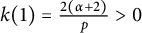 $k(1)=\frac {2(\alpha +2)}{p}>0$
, one gets
 $k(r)\geq 0$
for
 $r\in [0, 1]$
.
Thus, with the assumptions, we always have
 $k(r)\geq 0$
for
 $r\in [0, 1]$
. Next, following the proof of Lemma 2.3, we obtain
 $F_{p,\alpha }(r)\leq 0$
for all
 $r\in (0,1]$
. The proof is complete.
We finish this section by some remarks.
Remark 3 Propositions 2.1 and 3.1 cannot imply each other. For instance,
 $\alpha =9$
and
 $p=17$
satisfy conditions in Proposition 2.1, yet they fail to satisfy conditions in Proposition 3.1. On the other hand,
 $\alpha =9$
and
 $p=20$
meet the assumptions of Proposition 3.1, but they do not satisfy those in Proposition 2.1.
Remark 4 As stated in Section 1, there have been several results proving Karapetrović’s conjecture when
 $\alpha>0$
and
 $p\geq \alpha _1$
, where
 $\alpha _1$
is a number in
 $(\alpha +2, 2(\alpha +2))$
. Next, we show that for all
 $\alpha \geq \frac {-1+\sqrt {13}}{6}$
and
 $\alpha \not =1$
, the value
 $\frac {9+3\alpha +\sqrt {9\alpha ^2+30\alpha +33} }{4}$
in Proposition 3.1 improves the best previously known result.
For
 $\alpha>0$
, it is easy to see that
 $$ \begin{align*} \frac{9+3\alpha +\sqrt{9\alpha^2+30\alpha+33} }{4} &<\ 2+\frac{3\alpha}{4}+\frac{1}{4}\sqrt{9\alpha^2+40\alpha+48} \\ &=\ \frac{3\alpha}{4}+2+\sqrt{\left(\frac{3\alpha}{4}+2\right)^2-\frac{\alpha+2}{2}}. \nonumber \end{align*} $$
Recall that for
 $0<\alpha \leq \frac {1}{47}$
and
 $\alpha =1$
, Karapetrović’s conjecture was proved in [Reference Dai6]. Consequently, for
 $\alpha>\frac {1}{47}$
and
 $\alpha \not =1$
, Proposition 3.1 improves the corresponding results in (v) and (vi) stated in Section 1.
Now we compare Proposition 3.1 with the corresponding conclusion in (iv) mentioned in Section 1. Let
 $\alpha>0$
. By [Reference Karapetrović19, p. 5918], the unique zero
 $\alpha _0$
of the function
 $\Phi _\alpha $
on
 $(\alpha +2, 2(\alpha +2))$
satisfies
 $$ \begin{align*} &\alpha+2+\sqrt{(\alpha+2)^2-(\alpha+2)}\\ <& \ \alpha_0 <\ \alpha+2+\sqrt{(\alpha+2)^2-\left(\sqrt{2}-\frac{1}{2}\right)(\alpha+2)}. \end{align*} $$
Note that
 $$ \begin{align} \frac{9+3\alpha +\sqrt{9\alpha^2+30\alpha+33} }{4}\leq \alpha+2+\sqrt{(\alpha+2)^2-(\alpha+2)} \end{align} $$
if and only if
 $$ \begin{align} \sqrt{9\alpha^2+30\alpha+33}\leq \alpha-1+4\sqrt{\alpha^2+3\alpha+2}. \end{align} $$
If
 $\alpha \geq 1$
, it is clear that (3.6) holds, so does (3.5). If
 $0<\alpha <1$
, then (3.6) is equivalent to
 $$ \begin{align*}0<1-\alpha+\sqrt{9\alpha^2+30\alpha+33}\leq 4\sqrt{\alpha^2+3\alpha+2};\end{align*} $$
that is,
 $$ \begin{align*}3\alpha^3+7\alpha^2+ \alpha-2=3(\alpha+2)\left(\alpha-\frac{-1+\sqrt{13}}{6}\right)\left(\alpha-\frac{-1-\sqrt{13}}{6}\right)\geq 0. \end{align*} $$
Thus, if
 $\alpha \geq \frac {-1+\sqrt {13}}{6}$
, then (3.5) holds and hence the value
 $\frac {9+3\alpha +\sqrt {9\alpha ^2+30\alpha +33} }{4}$
in Proposition 3.1 is smaller than the zero
 $\alpha _0$
of the function
 $\Phi _\alpha $
.
In conclusion, for all
 $\alpha \geq \frac {-1+\sqrt {13}}{6}$
and
 $\alpha \not =1$
, the value
 $\frac {9+3\alpha +\sqrt {9\alpha ^2+30\alpha +33} }{4}$
in Proposition 3.1 improves the best previously known result.
Remark 5 From Theorem 3.2 in [Reference Dai6] and Corollary 1.3 in [Reference Karapetrović18], Karapetrović’s conjecture holds if
 $\alpha>0$
and either of the following conditions holds:
-
•
(3.7)
$$ \begin{align} p \geq 2+\frac{3\alpha}{4}+\frac{1}{4}\sqrt{9\alpha^2+40\alpha+48}; \end{align} $$
-
•
$\alpha +2<p<2+\frac {3\alpha }{4}+\frac {1}{4}\sqrt {9\alpha ^2+40\alpha +48}$
and (3.8)
$$ \begin{align} &\int_0^{1}\frac{t^{\frac{\alpha+2}{p}-1}}{(1-t)^{\frac{\alpha+2}{p}}}\left(\int_{t^2}^1(1-r)^\alpha r^{p-3-\alpha}\,dr\right)\,dt \nonumber \\ \leq & \ B\left(1+\alpha,2+\frac{\alpha}{2}\right) B\left(\frac{\alpha+2}{p},1-\frac{\alpha+2}{p}\right). \end{align} $$


It is not easy to use condition (3.8) to detect the values p and
 $\alpha $
for Karapetrović’s conjecture. Proposition 3.1 means that Karapetrović’s conjecture holds when
 $\alpha>0$
and
 $$ \begin{align*}\frac{9+3\alpha +\sqrt{9\alpha^2+30\alpha+33} }{4}\leq p<2+\frac{3\alpha}{4}+\frac{1}{4}\sqrt{9\alpha^2+40\alpha+48}, \end{align*} $$
which is not clear from (3.8).
Corresponding to Remarks 4 and 5, we can also understand Proposition 3.1 by Figure 1.
 $p(\alpha )$
-graph.

Proposition 3.1 confirms Karapetrović’s conjecture when
 $(\alpha , p)$
is in the purple region in Figure 1, which was not thoroughly resolved from previous results. Note that the point
 $$ \begin{align*} E \left(\frac{-1+\sqrt{13}}{6}, \frac{11+\sqrt{13}}{6}+\sqrt{\left(\frac{11+\sqrt{13}}{6}\right)^2-\frac{11+\sqrt{13}}{6}}\right) \end{align*} $$
is the intersection of curves
 $p_1(\alpha )$
and
 $p_3(\alpha )$
. When
 $\alpha \geq \frac {-1+\sqrt {13}}{6}$
and
 $\alpha \not =1$
, compared to the previous curves, the curve
 $p_3(\alpha )=\frac {9+3\alpha +\sqrt {9\alpha ^2+30\alpha +33} }{4}$
derived from Proposition 3.1 is the closest to the straight line
 $p_4(\alpha )=\alpha +2$
. Thus, the value
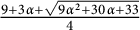 $\frac {9+3\alpha +\sqrt {9\alpha ^2+30\alpha +33} }{4}$
in Proposition 3.1 is better than previous results from the literature when
 $\alpha \geq \frac {-1+\sqrt {13}}{6}$
and
 $\alpha \not =1$
.
4 The main result
In this section, using Propositions 2.1 and 3.1, we confirm Karapetrović’s conjecture when p and
 $\alpha $
satisfy (1.2). This conclusion is better than Propositions 2.1 and 3.1. In particular, the conclusion is the best so far when
 $\alpha>\frac {1}{47}$
and
 $\alpha \not =1$
.
Let
 $\alpha \geq 0$
and
 $p> \alpha +2$
. Then
 $$ \begin{align*}p\geq\frac{9+3\alpha +\sqrt{9\alpha^2+30\alpha+33} }{4}\end{align*} $$
in Proposition 3.1 can be rewritten as
 $$ \begin{align*}\alpha \leq \frac{2p^2-9p+6}{3p-3}; \end{align*} $$
condition
 $$ \begin{align*}\alpha+2+\sqrt{(\alpha+2)^2-\left(\sqrt{2}-\frac{1}{2}\right)(\alpha+2)}\leq p\end{align*} $$
in (iv) of Section 1 holds if and only if
 $$ \begin{align*}\alpha \leq \frac{p^2-4p+2\sqrt{2}-1}{2p+\frac 1 2-\sqrt{2}}; \end{align*} $$
and condition
 $$ \begin{align*}2+\frac{3\alpha}{4}+\frac{1}{4}\sqrt{9\alpha^2+40\alpha+48}\leq p\end{align*} $$
in (v) or (vi) of Section 1 is equivalent to
 $$ \begin{align*}\alpha \leq \frac{2p^2-8p+2}{3p-1}.\end{align*} $$
Thus, the previous lower bounds of p can be translated to upper bounds for
 $\alpha $
. Figure 1 is a
 $p(\alpha )$
-graph. By these upper bounds for
 $\alpha $
and (2.1), we give an
 $\alpha (p)$
-graph (Figure 2) from which one can see how well Proposition 3.1 fills in the gap created by the lower bound in Proposition 2.1.
Proposition 2.1 proves Karapetrović’s conjecture when
 $(\alpha , p)$
is in the yellow region in Figure 2, which was not thoroughly resolved from previous results.
 $\alpha(p)$
-graph.

Note that
 $\alpha _{\mathrm{up}}$
is defined in Figure 2. When
 $$ \begin{align*}\max\left\{\frac{2p^2-9p+6}{3p-3}, \ \frac{p^2-4p+2\sqrt{2}-1}{2p+\frac 1 2-\sqrt{2}}, \ \frac{2p^2-8p+2}{3p-1} \right\} \geq \alpha \geq 0, \end{align*} $$
a direct computation yields
 $$ \begin{align} \alpha_{\mathrm{up}}(p) \geq \max\left\{\frac{2p^2-9p+6}{3p-3}, \ \frac{p^2-4p+2\sqrt{2}-1}{2p+\frac 1 2-\sqrt{2}}, \ \frac{2p^2-8p+2}{3p-1} \right\}, \end{align} $$
which is consistent with Figure 2. In fact, Figure 2 also gives us the information that Karapetrović’s conjecture holds when
 $0\leq \alpha \leq \alpha _{\mathrm{up}}(p)$
. Using Propositions 2.1 and 3.1, we will give a proof of this conclusion, which is the main result in this article. From (4.1), since Karapetrović’s conjecture holds when
 $0\leq \alpha \leq \frac {1}{47}$
and
 $\alpha =1$
, we see that the following theorem appears to be the best known so far, when
 $\alpha>\frac {1}{47}$
and
 $\alpha \not =1$
.
Theorem 4.1 Suppose
 $$ \begin{align*} 0\leq \alpha \leq \frac{6p^3-29p^2+17p-2+2p\sqrt{6p^2-11p+4}}{(3p-1)^2}. \end{align*} $$
Then
 $$ \begin{align*}\|\mathcal{H}\|_{A_\alpha^p}=\frac{\pi}{\sin\frac{(\alpha+2)\pi}{p}}. \end{align*} $$
Proof By Remark 1, we get
 $p>\alpha +2$
, which yields the boundedness of
 $\mathcal H$
on
 $A_\alpha ^p$
. Recall that
 $$ \begin{align*}\alpha_{\mathrm{low}}(p)=\frac{6p^3-29p^2+17p-2-2p\sqrt{6p^2-11p+4}}{(3p-1)^2}.\end{align*} $$
When
 $p>2$
, a calculation gives
 $$ \begin{align} \frac{2p^2-9p+6}{3p-3}> \alpha_{\mathrm{low}}(p). \end{align} $$
From Proposition 2.1, the desired result holds if
 $$ \begin{align*}\max\{\alpha_{\mathrm{low}}(p), 0\} \leq \alpha \leq \alpha_{\mathrm{up}}(p).\end{align*} $$
Then it suffices to prove the conclusion when
 $\alpha _{\mathrm{low}}(p)>0$
. For such case, (4.2) gives
 $\frac {2p^2-9p+6}{3p-3}>0$
. By Proposition 3.1, Karapetrović’s conjecture holds if
 $ 0 \leq \alpha \leq \frac {2p^2-9p+6}{3p-3}. $
Combining this with (4.2), we get that Karapetrović’s conjecture holds when
 $\alpha _{\mathrm{low}}(p)>0$
and
 $ 0\leq \alpha \leq \alpha _{\mathrm{low}}(p)$
. Also, by Proposition 2.1, Karapetrović’s conjecture holds if
 $\alpha _{\mathrm{low}}(p)>0$
and
 $\alpha _{\mathrm{low}}(p)\leq \alpha \leq \alpha _{\mathrm{up}}(p)$
. Thus, we get the desired conclusion when
 $\alpha _{\mathrm{low}}(p)>0$
. The proof is complete.
Acknowledgements
The authors thank the anonymous referee very much for his/her valuable comments.



