1 Introduction
Let X be a smooth projective variety over an algebraically closed field k of characteristic
$0$
 . For a birational map
$f:X\dashrightarrow X$
 and
$0\leq p\leq \mathrm {dim}(X)$
 , the pth dynamical degree of f is defined by

where H is an ample divisor (cf. [Reference Truong16]).
The pullback map
$f^{*}$
 and the pushforward map
$f_{*}$
 are defined as follows. For a birational map
$f:X\dashrightarrow X$
 , let
$\Gamma _f$
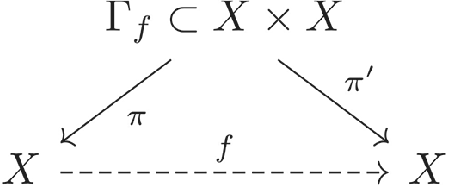
 be the closure of the graph of f (cf. Figure 1). The pullback
$f^{*}:A_{l}(X)\rightarrow A_{l}(X)$
 and the pushforward
$f_{*}:A_{l}(X)\rightarrow A_{l}(X)$
 are defined as
${f^{*}(\gamma ):={\pi }_{*}([\Gamma _f]\cdot {\pi }^{\prime *}\gamma )}$
 and
$f_{*}(\gamma ):={\pi }^{\prime }_{*}([\Gamma _f]\cdot \pi ^{*}\gamma )$
 (cf. [Reference Fulton12, Definition 16.1.2], [Reference Truong16, §3.1]), where
$\gamma $
 is an algebraic cycle on X.
In addition, the dynamical degrees are calculated as

where
$N^p(X)$
 is the group of algebraic cycles of codimension p on X modulo numerical equivalence (cf. [Reference Truong16, Reference Truong17]).
When
$k=\mathbb {C}$
 , the projective variety X can be considered as a compact Kähler manifold, the birational map f can be considered as a meromorphic map, and the dynamical degrees can be calculated as

where
$\omega _X$
 is a normalized Kähler form,
$\mathrm {H}^{p,p}(X)$
 (
$0\leq p\leq \mathrm {dim}X$
 ) is the
$(p,p)$
 -Dolbeault cohomology, and
$\|\cdot \|$
 is a norm for linear transformations (cf. [Reference Dinh and Sibony9–Reference Dinh and Sibony11]).
The values of the dynamical degrees are not less than
$1$
 and
$\unicode{x3bb} _0(f)=1$
 . When f is a morphism, the dynamical degrees of f are algebraic, since
$(f^n)^{*}=(f^{*})^n$
 . In the case of
$X=\mathbb {P}^d$
 , the rational map
$f:\mathbb {P}^d\dashrightarrow \mathbb {P}^d$
 can be written as
$f=[f_0:f_1:\cdots :f_d]$
 by the homogeneous polynomials (over k) of the same degree. Define
$\mathrm {deg}(f):=\mathrm {deg}(f_0)$
 and then the first dynamical degree of f is calculated by

The graph of a birational map
$f:X\dashrightarrow X$
 .

When
$d=2$
 , it is known that the first dynamical degree of f is always algebraic by the following theorems.
Theorem 1.1. (Cf. [Reference Diller and Favre7, Theorem 0.1, Proposition 1.18, Corollary 1.19])
Let X be a compact Kähler surface and
$f\colon X\dashrightarrow X$
 be a bimeromorphic map. Then, there exists a proper bimeromorphic morphism
$\pi :\tilde {X}\rightarrow X$
 such that the map
$\tilde {f}:=\pi ^{-1}\circ f\circ \pi $
 satisfies
$((\tilde {f})^n)^{*}=(\tilde {f}^{*})^n$
 on
$\mathrm {H}^{1,1}(\tilde {X})$
 . Moreover, the dynamical degrees
$\unicode{x3bb} _1(f)$
 and
$\unicode{x3bb} _1(\tilde {f})$
 are equal, and this is equal to the spectral radius of
$\tilde {f}^{*}$
 on
$\mathrm {H}^{1,1}(\tilde {X})$
 .
Theorem 1.2. (Cf. [Reference Diller and Favre7, Theorem 5.1(1)])
Let
$X'$
 be a compact Kähler surface and
$g\colon X'\dashrightarrow X'$
 be a bimeromorphic map with
$\rho (g^{*})>1$
 for the operator
$g^{*}$
 on
$\mathrm {H}^{1,1}(X')$
 , where
$\rho $
 is the spectral radius. Then, the operator
$g^{*}$
 has exactly one eigenvalue
$\unicode{x3bb} \in \mathbb {R}_{>0}$
 of modulus
$|\unicode{x3bb} |>1$
 , and in fact,
$\unicode{x3bb} =\rho (g^{*})$
 .
These theorems imply that
$\unicode{x3bb} _1(f)$
 is either
$1$
 or a Pisot number, or a Salem number (see definition in [Reference Bertin, Decomps-Guilloux, Grandet-Hugot, Pathiaux-Delefosse and Schreiber5]) for the case where
$d=2$
 . Salem numbers, which can be realized as
$\unicode{x3bb} _1(f)$
 for some birational map
$f:\mathbb {P}^2\dashrightarrow \mathbb {P}^2$
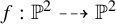 , are all determined in [Reference Uehara18, Theorem 1.1]. Pisot numbers, which can be realized as
$\unicode{x3bb} _1(f)$
 , are partially determined (cf. [Reference Kim13, Theorem C], [Reference Bedford and Kim2, §3], [Reference Blanc and Cantat6, §7] ).
In [Reference Bell, Diller, Jonsson and Krieger4], a birational map of
$\mathbb {P}^d(d\geq 3$
 ) with a transcendental first dynamical degree is constructed.
Theorem 1.3. (Cf. [Reference Bell, Diller, Jonsson and Krieger4, Theorem 1.1])
For each
$d\geq 3$
 , there exists a birational map
${f:\mathbb {P}^d\dashrightarrow \mathbb {P}^d}$
 , which has a transcendental (first) dynamical degree
$\unicode{x3bb} _1(f)$
 .
In [Reference Bell, Diller, Jonsson and Krieger4, §7.2], the specific birational map
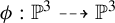
$\phi :\mathbb {P}^3\dashrightarrow \mathbb {P}^3$
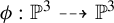 with a transcendental (first) dynamical degree is presented.
Remark 1.4. The birational map f constructed in Theorem 1.3 is of the form
$f=L_{B^{-1}}\circ h_{-I}\circ L_{B}\circ h_A$
 , where:
-
• $h_{M}:\mathbb {P}^d\dashrightarrow \mathbb {P}^d$
 is the monomial map corresponding to
$M\in \mathrm {GL}_{d}(\mathbb {Z})$
;
-
• $L_{M'}:\mathbb {P}^d\dashrightarrow \mathbb {P}^d$
is the linear transformation corresponding to
$M'\in \mathrm {GL}_{d+1}(k)$




(see the details in [Reference Sugimoto15, §2.3]); and

In addition, the specific example
$\phi :\mathbb {P}^3\dashrightarrow \mathbb {P}^3$
 in [Reference Bell, Diller, Jonsson and Krieger4, §7.2] is the case where
$d=3$
 and

In [Reference Sugimoto15, §3], we calculate the second dynamical degree of the map
$\phi $
 and confirm that
$\unicode{x3bb} _1(\phi )<\unicode{x3bb} _2(\phi )$
 . In addition, we construct another birational map
$\psi :\mathbb {P}^3\dashrightarrow \mathbb {P}^3$
 with a transcendental first dynamical degree such that
$\unicode{x3bb} _1(\psi )>\unicode{x3bb} _2(\psi )$
 (cf. [Reference Sugimoto15, §4]) by taking

It is confirmed that the second dynamical degree
$\unicode{x3bb} _2(\psi )$
 is algebraic, as follows.
Theorem 1.5. (Cf. [Reference Sugimoto15, §4])
There exists a birational map
$\psi :\mathbb {P}^3\dashrightarrow \mathbb {P}^3$
 whose dynamical degrees are

with
$291\leq \unicode{x3bb} \leq 669$
 being a transcendental number and
$a=174.6660\cdots $
 being a root of

We use this result to obtain a transcendental arithmetic degree in [Reference Sugimoto15, Corollary 4.5] by combining with the results of [Reference Matsuzawa and Wang14, Theorem B].
In this paper, we use Theorem 1.5 to resolve the next question by using the algebraicity of a.
Question 1.6. [Reference Bell, Diller, Jonsson and Krieger4, Question 1.6]
Does there exist a birational map
$f:\mathbb {P}^d\dashrightarrow \mathbb {P}^d$
 for which all intermediate dynamical degrees
$\unicode{x3bb} _1(f),\ldots ,\unicode{x3bb} _{d-1}(f)$
 are transcendental?
It is known that the intermediate dynamical degrees of an automorphism f of a compact Kähler manifold (or a projective variety over
$\mathbb {C}$
 ) are either irrational or equal to
$1$
 [Reference Bedford1, Theorem 6.1].
Theorem A. For
$d\geq 6$
 , there exists a birational map
$f:\mathbb {P}^d\dashrightarrow \mathbb {P}^d$
 (over an algebraically closed field k of characteristic
$0$
 ), whose intermediate dynamical degrees are all transcendental.
This theorem is proved in §3. In the counterexample that we found, all intermediate dynamical degrees are transcendental, but they are algebraically dependent.
Another question about dynamical degrees is presented in [Reference Bell, Diller, Jonsson and Krieger4, Question 1.6].
Question 1.7. [Reference Bell, Diller, Jonsson and Krieger4, Question 1.6]
Does there exist a birational map
$f:\mathbb {P}^d\dashrightarrow \mathbb {P}^d$
 for which
$\unicode{x3bb} _1(f)$
 is transcendental and also maximal among intermediate dynamical degrees
$\unicode{x3bb} _i(f)$
 ?
This question is resolved for the case
$d\geq 3$
 in [Reference Sugimoto15, Remark 4.6]. In addition, for the case where
$d=3$
 , we construct an example where the first dynamical degree
$\unicode{x3bb} _1(f)$
 is strictly maximal among the dynamical degrees in Theorem 1.5. However, for the case where
$d>3$
 , the first dynamical degree is not strictly maximal among the dynamical degrees in our example (see [Reference Sugimoto15, Remark 4.6]).
2 Preliminaries
There are some properties of dynamical degrees.
Proposition 2.1. Let X be an N-dimensional smooth projective variety over an algebraically closed field of characteristic
$0$
 and let
$f:X\dashrightarrow X$
 be a birational self-map. Then,

for
$0\leq p\leq N$
 .
This result is well known, but we would like to give an outline of the proof here for the convenience of the reader (cf. [Reference Sugimoto15, §2.1] in the case where
$\mathrm {dim}(X)=3$
 ).
Proof of Proposition 2.1.
The proposition is shown by the following equations:

The first equation and the fourth equation are derived from the definition of the dynamical degrees. The third equation is the definition of the pushforward and the pullback of cycles.
It remains to confirm the second equation. Denote
$\pi ,\pi ':X\times X\rightarrow X$
 by the projections to the first and the second components as in Figure 1. Let
$\Gamma _f\subset X\times X$
 be the closure of the graph of f and let
$\pi _1:X\rightarrow \mathrm {Spec}(k)$
 be the structure map. Let
$\alpha \in A_p(X)$
 and
$\beta \in A_q(X)$
 be cycles with
$p+q=\mathrm {dim}(X)$
 . We have
$f^{*}\beta :={\pi }_{*}([\Gamma _f]\cdot {\pi '}^{*}\beta )$
 and
$f_{*}\alpha :={\pi '}_{*}([\Gamma _f]\cdot \pi ^{*}\alpha )$
 by the definitions of the pullback and the pushforward (cf. [Reference Fulton12, Definition 16.1.2]). By applying the projection formula to
$\pi :X\times X\rightarrow X$
 (cf. [Reference Fulton12, Proposition 8.3]), the intersection of cycles can be calculated as

and thus the second equation in the proposition follows.
Proposition 2.2. (Cf. [Reference Dinh and Nguyên8, Corollary 1.2], [Reference Dinh and Sibony10, Corollaire 7], [Reference Truong16, Lemma 3.7])
Let X and Y be smooth projective varieties of the same dimension n over an algebraically closed field of characteristic
$0$
 . Let
$f:X\dashrightarrow X$
 and
$g:Y\dashrightarrow Y$
 be dominant rational maps, and let
$\pi :X\dashrightarrow Y$
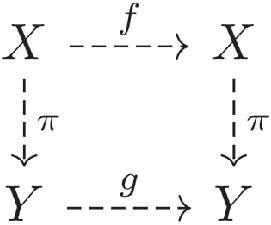
 be a birational map with
$\pi \circ f=g\circ \pi $
 (cf. Figure 2).
Birational conjugacy of maps f and g.

Then, the equation
$\unicode{x3bb} _p(f)=\unicode{x3bb} _p(g)$
 holds for all
$0\leq p\leq n$
 .
By Proposition 2.2, the dynamical degrees are invariant under a birational conjugacy and, therefore, the set

is a birationally invariant set for projective varieties for each
$0\leq p\leq \mathrm {dim}(X)$
 .
Proposition 2.3. (Cf. [Reference Dinh and Nguyên8, Example 3.7], [Reference Truong16, Theorem 1.4])
Let
$X=X_1\times X_2$
 be the product of two smooth projective varieties over an algebraically closed field k of characteristic
$0$
 , with
$\mathrm {dim}(X_i)=n_i$
 . Let
$f_1, f_2$
 be dominant rational self-maps of
$X_1, X_2$
 and define
$f:=f_1\times f_2:X_1\times X_2\dashrightarrow X_1\times X_2$
 .
Then,

3 Proof of Theorem A
In this section, we prove Theorem A. First, we prove the following proposition.
Proposition 3.1. There exists a birational map
$\Psi :\mathbb {P}^6\dashrightarrow \mathbb {P}^6$
 whose intermediate dynamical degrees are all transcendental.
Proof. Let
$\psi :\mathbb {P}^3\dashrightarrow \mathbb {P}^3$
 be a birational map, which is presented in Theorem 1.5. Then, we have

where
$\unicode{x3bb} $
 is transcendental, a is algebraic, and
$\unicode{x3bb}>a$
 .
The inverse
$\psi ^{-1}:\mathbb {P}^3\dashrightarrow \mathbb {P}^3$
 is also a birational map, and

by Proposition 2.1.
Define the birational map
$\Psi ':=\psi \times \psi ^{-1}:\mathbb {P}^3\times \mathbb {P}^3\dashrightarrow \mathbb {P}^3\times \mathbb {P}^3$
 . Then, by Proposition 2.3, we have

from
$\unicode{x3bb}>a$
 .
Define the birational map

and define
$\Psi :=\Phi \circ \Psi '\circ \Phi ^{-1}:\mathbb {P}^6\dashrightarrow \mathbb {P}^6$
 .
Since
$\Psi $
 is a birational map and by Proposition 2.2, the dynamical degrees are the same as
$\Psi '$
 ,

Now,
$\unicode{x3bb} $
 is a transcendental number and a is an algebraic integer, and thus the intermediate dynamical degrees of
$\Psi $
 are all transcendental numbers.
Proof of Theorem A.
We prove this theorem by induction on n.
If
$n=6$
 , the theorem is proved by Proposition 3.1.
Assume that the theorem holds for some integer
$n=n_0$
 . Let
$g:\mathbb {P}^{n_0}\dashrightarrow \mathbb {P}^{n_0}$
 be a birational map, whose intermediate dynamical degrees are all transcendental.
Denote
$\unicode{x3bb} _i(g)=\unicode{x3bb} _i$
 (
$0\leq i\leq n_0$
 ). The product map
$g\times \mathrm {id}$
 is a birational map and the dynamical degrees of
$g\times \mathrm {id}:\mathbb {P}^{n_0}\times \mathbb {P}^1\dashrightarrow \mathbb {P}^{n_0}\times \mathbb {P}^1$
 can be calculated by using Proposition 2.3 as

Thus, the intermediate dynamical degrees of
$g\times \mathrm {id}$
 are all transcendental. Define the birational map

and define
$g'=h\circ (g\times \mathrm {id})\circ h^{-1}:\mathbb {P}^{n_0+1}\dashrightarrow \mathbb {P}^{n_0+1}$
 . Now,
$g'$
 is a birational map and by Proposition 2.2, the dynamical degrees are the same as
$g\times \mathrm {id}$
 , and this is the case for
$n=n_0+1$
 . Therefore, all intermediate dynamical degrees of
$g'$
 are transcendental and the proof is complete.
Remark 3.2. By using the induction in the proof of Theorem A for the birational map
$\Psi :\mathbb {P}^6\dashrightarrow \mathbb {P}^6$
 constructed in the proof of Proposition 3.1, we get the birational map
${g:\mathbb {P}^d\dashrightarrow \mathbb {P}^d}$
 (
$d\geq 6$
 ) with

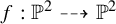
Remark 3.3. The paper [Reference Bell, Diller and Jonsson3, §1] shows that there exists a dominant rational map
${f:\mathbb {P}^2\dashrightarrow \mathbb {P}^2}$
 such that

with transcendental
$\unicode{x3bb} _1(f)$
 . By applying induction in the proof of Theorem A to the map f, there exists a dominant rational map
$\mathbb {P}^d\dashrightarrow \mathbb {P}^d$
 such that its intermediate dynamical degrees are all transcendental for any
$d\geq 2$
 .
Acknowledgements
The author thanks Professor Keiji Oguiso for providing advice on this paper. The author would also like to thank the reviewers for their helpful suggestions.