



0 Introduction
This paper is a continuation of [S3, I and II]. Let G be a connected reductive group defined over a finite field
 $\mathbf F_q$
with Frobenius map
 $F : G \to G$
, and let
 $G{}_{\mathrm {uni}}$
the unipotent variety of G. Let
 $\mathscr {N}_G$
be the set of pairs
 $(C, \mathscr {E})$
, where C is a unipotent class in G, and
 $\mathscr {E}$
is a G-equivariant simple local system on C. Let L be a Levi subgroup of a parabolic subgroup of G, and let
 $(C_0, \mathscr {E}_0) \in \mathscr {N}_L$
be a cuspidal pair on L. We assume that L is F-stable, C is F-stable, and
 $F^*\mathscr {E}_0 \simeq \mathscr {E}_0$
. For a fixed isomorphism
 , a generalized Green function
 $Q^G_{L, C_0, \mathscr {E}_0, \varphi _0}$
was defined in [L2, II], which is a
 $G^F$
-invariant function on
 $G^F_{\mathrm {uni}}$
with values in
 $\bar {\mathbf Q}_l$
. Generalized Green functions play a crucial role in the representation theory of a finite reductive group
 $G^F$
, and it is very important to compute them explicitly since the computation of irreducible characters of
 $G^F$
is essentially reduced to the computation of those generalized Green functions thanks to the theory of character sheaves [L2].
Let
 $\mathscr {N}_G^F$
be the set of
 $(C, \mathscr {E}) \in \mathscr {N}_G$
such that C is F-stable and
 $F^*\mathscr {E} \simeq \mathscr {E}$
. For any
 $j = (C, \mathscr {E}) \in \mathscr {N}^F_G$
, we choose an isomorphism
 . Note that
 $\psi $
is unique up to scalar since
 $\mathscr {E}$
is simple. Let
 $Y_j$
be the characteristic function on
 $C^F$
defined by
 $\psi $
, and we regard it as a function on
 $G{}_{\mathrm {uni}}^F$
by defining 0 outside of
 $C^F$
. Then,
 $\{ Y_j \mid j \in \mathscr {N}_G^F\}$
gives a basis of the
 $\bar {\mathbf Q}_l$
-space of
 $G^F$
-invariant functions on
 $G{}_{\mathrm {uni}}^F$
. In [L2, V], Lusztig gave an algorithm of expressing
 $Q^G_{L,C_0, \mathscr {E}_0, \varphi _0}$
as an explicit linear combination of the basis
 $\{ Y_j \mid j \in \mathscr {N}_G^F\}$
, where
 is determined from the choice of
 . (Here,
 $\varphi _0$
is chosen under a certain mild condition (see 1.2), and
 $\psi _j$
is determined uniquely from
 $\varphi _0$
(see 1.3). But note that
 $\psi _j$
is not directly computable.) Thus, the computation of the generalized Green function is reduced to the computation of those
 $Y_j$
. Here, the function
 $Y_j$
has a simple structure, up to scalar. If we choose a standard isomorphism
 , the characteristic function
 $Y_j^0$
on
 $C^F$
can be computed explicitly. There exists a scalar
 $\gamma _j \in \bar {\mathbf Q}_l^*$
such that
 $Y_j = \gamma _j Y_j^0$
for each j. Thus, the determination of generalized Green functions is reduced to the determination of those scalars
 $\gamma _j$
for each
 $j \in \mathscr {N}_G^F$
. This is a nontrivial problem
The problem of determining
 $\gamma _j$
is closely related to the problem of finding a
 $G^F$
-class in
 $C^F$
(note that
 $C^F$
has finitely many
 $G^F$
-conjugacy classes) which has a good property with respect to the Frobenius action on a certain complex associated to
 $(L, C_0,\mathscr {E}_0)$
. A priori such a good
 $G^F$
-class in
 $C^F$
depends on the choice of
 $(L, C_0, \mathscr {E}_0)$
since
 $\psi _j$
is determined from
 . For example, in the case where
 $L = T$
is a maximal torus,
 $C_0 = \{ 1\}$
, and
 $\mathscr {E}_0 = \bar {\mathbf Q}_l$
is the constant sheaf,
 $Q^G_{L, C_0,\mathscr {E}_0, \varphi _0}$
is nothing but the original Green function
 $Q^G_T$
. In that case, assuming that
 $\operatorname {ch}\ \mathbf F_q = p$
is a good prime, such a good
 $G^F$
-class was found in [BS], [S1], [S2], called a split class in
 $C^F$
(essentially, it is determined as a
 $G^F$
-class for the adjoint group G), and the Green functions for exceptional groups were computed explicitly.
Those scalars
 $\gamma _j$
were computed explicitly in [S3, I] in the case where
 $G = SL_n$
and F is of split type (for any p), F is of nonsplit type (p:large enough), and in [S3, II] in the case where
 $G = Sp_N$
or
 $SO_N$
for any p. The main discovery there is that the split class for
 $(T, \{ 1\}, \bar {\mathbf Q}_l)$
behaves well for any choice of
 $(L, C_0, \mathscr {E}_0)$
, namely, there exists a
 $G^F$
-class in
 $C^F$
which has a good property for any choice of
 $(L, C_0, \mathscr {E}_0)$
, and the image of this class to the adjoint group coincides with the split class for
 $(T, \{ 1\}, \bar {\mathbf Q}_l)$
mentioned above. Such a class is called a split class in
 $C^F$
.
Since the split class is conjecturally compatible with the isogeny, the existence of the split class is reduced to the case of simply connected groups.
 $Sp_N$
or
 $SL_n$
are simply connected, but
 $SO_N$
is not. In that case, we need to consider the spin group
 $\operatorname {Spin}_N$
. In this paper, we prove that there exists a split element in
 $\operatorname {Spin}_N$
such that its image in
 $SO_N$
is a split element in the sense of [S3, II]. We also prove the existence of the split elements in the case where
 $G = SL_n$
and F is of nonsplit type, for an arbitrary
 $p> 0$
. We determine the scalars
 $\gamma _j$
in those cases. Thus, the generalized Green functions can be computed in those cases. Since the determination of generalized Green functions is reduced to the case of simply connected, simple groups, our results imply that all the generalized Green functions are computable for any reductive group of classical type.
The main ingredients for the proof is the Frobenius version of the restriction theorem (1.8.1) proved in [S3, II]. This is especially useful in the case of
 $SL_n$
of nonsplit type. In [S3, I], the existence of split elements was proved by the aid of the graded Hecke algebras, but in that case, we need to assume that p is large enough for applying the Jacobson–Morozov theorem in
 $p> 0$
. The present proof using the restriction theorem is much simpler, and works well for any p.
1 Generalized Green functions
1.1.
Let G be a connected reductive group defined over a finite field
 $\mathbf F_q$
with Frobenius map F. Let
 $\mathbf k$
be the algebraic closure of
 $\mathbf F_q$
with
 $\operatorname {ch} \mathbf k = p$
. Let
 $\mathscr {M}_G$
be the set of triples
 $(L, C_0, \mathscr {E}_0)$
, up to G-conjugacy, where L is a Levi subgroup of a parabolic subgroup of G, and
 $\mathscr {E}_0$
is a cuspidal local system on a unipotent class
 $C_0$
of L. As in (1.2.2) in [S3, I], one can define a semisimple perverse sheaf K on G associated to a triple
 $(L, C_0, \mathscr {E}_0) \in \mathscr {M}_G$
. Let
 $\mathscr {W} _L = N_G(L)/L$
. It is known that
 $\mathscr {W}_L$
is a Coxeter group, and
 $\operatorname {End} K \simeq \bar {\mathbf Q}_l[\mathscr {W}_L]$
, K is decomposed as
 $$ \begin{align} K \simeq \bigoplus_{E \in \mathscr{W}_L^{\wedge}}E \otimes K_E, \end{align} $$
where
 $K_E \simeq \operatorname {Hom} (E, K)$
is a simple perverse sheaf associated to
 $E \in \mathscr {W}_L^{\wedge }$
.
Let
 $G{}_{\mathrm {uni}}$
be the unipotent variety of G, and let
 $\mathscr {N}_G$
the set of
 $(C,\mathscr {E})$
, where C is a unipotent class of G, and
 $\mathscr {E}$
is an irreducible local system on C. Let
 $Z_L$
be the center of L, and put
 $d = \dim Z_L$
. It is known that
 $K[-d]|_{G{}_{\mathrm {uni}}}$
is a semisimple perverse sheaf on
 $G{}_{\mathrm {uni}}$
, equipped with
 $\mathscr {W}_L$
-action, and is decomposed as
 $$ \begin{align} K[-d]|_{G{}_{\mathrm{uni}}} \simeq \bigoplus_{(C,\mathscr{E}) \in \mathscr{N}_G} V_{(C,\mathscr{E})} \otimes \operatorname{IC}(\overline C, \mathscr{E})[\dim C], \end{align} $$
where
 $V_{(C, \mathscr {E})}$
is an irreducible
 $\mathscr {W}_L$
-module if it is nonzero. It follows from (1.1.1) and (1.1.2) that there exists a map
 $\mathscr {W}_L^{\wedge } \to \mathscr {N}_G$
,
 $E \mapsto (C,\mathscr {E})$
such that
 $$ \begin{align} K_E|_{G{}_{\mathrm{uni}}} \simeq \operatorname{IC}(\overline C, \mathscr{E})[\dim C + \dim Z_L] \end{align} $$
and that
 $V_{(C,\mathscr {E})} \simeq E$
. The generalized Springer correspondence shows that this map gives a bijection
 $$ \begin{align} \bigsqcup_{(L, C_0, \mathscr{E}_0) \in \mathscr{M}_G}\mathscr{W}_L^{\wedge} \to \mathscr{N}_G. \end{align} $$
1.2.
F acts naturally on the set
 $\mathscr {N}_G$
and
 $\mathscr {M}_G$
by
 $(C, \mathscr {E}) \mapsto (F{}^{-1}(C), F^*\mathscr {E})$
,
 $(L, C_0, \mathscr {E}_0) \mapsto (F{}^{-1}(L), F{}^{-1}(C_0), F^*\mathscr {E}_0)$
. The map in (1.1.4) is compatible with this F-action. We choose
 $(L, C_0, \mathscr {E}_0) \in \mathscr {M}_G^F$
. Here, we may assume that L is an F-stable Levi subgroup of an F-stable parabolic subgroup P of G, and that
 $F(C_0) = C_0, F^*\mathscr {E}_0 \simeq \mathscr {E}_0$
. Since
 $\mathscr {E}_0$
is a simple local system, the isomorphism
 is unique up to scalar. We choose
 $\varphi _0$
by the condition that the induced map on the stalk of
 $\mathscr {E}_0$
at any point in
 $C_0^F$
is of finite order.
 $\varphi _0$
induces a natural isomorphism
 . We consider the characteristic function
 $\chi _{K,\varphi }$
of K. The restriction of
 $\chi _{K,\varphi }$
on
 $G^F_{\mathrm {uni}}$
is the so-called generalized Green function
 $Q^G_{L, C_0, \mathscr {E}_0, \varphi _0}$
(cf. [L2, II]), which is a
 $G^F$
-invariant function on
 $G^F_{\mathrm {uni}}$
with values in
 $\bar {\mathbf Q}_l$
.
1.3.
Let
 $(L,C_0, \mathscr {E}_0) \in \mathscr {M}_G^F$
be as in 1.2. Then, F acts naturally on
 $\mathscr {W}_L$
, which induces a Coxeter group automorphism
 $\sigma $
of order c. We consider the semidirect product
 $\widetilde {\mathscr {W}}_L = \operatorname {\!\langle \!} \sigma \operatorname {\!\rangle \!} \ltimes \mathscr {W}_L$
. If an irreducible representation E of
 $\mathscr {W}_L$
is F-stable, namely,
 $F(E) \simeq E$
as
 $\mathscr {W}_L$
-modules, E can be extended to a
 $\widetilde {\mathscr {W}}_L$
-module in c different ways. For each
 $E \in (\mathscr {W}_L^{\wedge })^F$
, we choose an irreducible representation
 $\widetilde E$
of
 $\widetilde {\mathscr {W}}_L$
, which is the preferred extension of E in the sense of [L2, IV, (17.2)]. Let
 be the action of
 $\sigma $
on
 $\widetilde E$
. If E is F-stable, then
 $E \otimes K_E$
is F-stable in the decomposition of K in (1.1.1), and there exists a unique isomorphism
 such that
 is the restriction of
 .
Let
 $(C,\mathscr {E}) \in \mathscr {N}_G^F$
be any pair. By the generalized Springer correspondence, there exists a unique triple
 $(L, C_0, \mathscr {E}_0) \in \mathscr {M}_G^F$
such that
 $(C, \mathscr {E})$
corresponds to
 $E \in (\mathscr {W}_L^{\wedge })^F$
under (1.1.4). Put
 $$ \begin{align} \begin{aligned} a_0 &= -\dim Z_L - \dim C, \\ r &= \dim G - \dim L + \dim (C_0 \times Z_L). \end{aligned} \end{align} $$
Then, we have
 $$ \begin{align} a_0 + r = (\dim G - \dim C) - (\dim L - \dim C_0). \end{align} $$
By (1.1.3),
 $\mathscr {H}^{a_0}K_E|_C = \mathscr {E}$
. We define an isomorphism
 , so that
 $q^{(a_0+r)/2}\psi $
corresponds to the map
 induced from
 $\varphi _E$
. For each
 $j = (C,\mathscr {E}) \in \mathscr {N}_G^F$
, we define a function
 $Y_j$
on
 $G^F_{\mathrm {uni}}$
by
 $$ \begin{align} Y_j(g) = \begin{cases} \operatorname{Tr}\,(\psi, \mathscr{E}_g) &\quad\text{ if } g \in C^F, \\ 0 &\quad\text{ otherwise. } \end{cases} \end{align} $$
1.4.
The set
 $\{ Y_j \mid j \in \mathscr {N}_G^F\}$
gives a basis of the
 $\bar {\mathbf Q}_l$
-space of
 $G^F$
-invariant functions of
 $G^F_{\mathrm {uni}}$
. In [L2, V], Lusztig gave a general algorithm of computing the generalized Green function as an explicit linear combination of various
 $Y_j$
. Thus, the determination of the generalized Green functions is reduced to the determination of
 $Y_j$
. Since
 $\mathscr {E}$
is a simple local system, the isomorphism
 is unique up to scalar. The typical isomorphism
 among them is given as follows: choose
 $u \in C^F$
, and put
 $A_G(u) = Z_G(u)/Z_G^0(u)$
. Then, F acts naturally on
 $A_G(u)$
, and the set of G-equivariant simple local systems
 $\mathscr {E}'$
on C such that
 $F^*\mathscr {E}' \simeq \mathscr {E}'$
is in bijection with the set of F-stable irreducible representations of
 $A_G(u)$
. The correspondence is given, so that the stalk
 $\mathscr {E}^{\prime }_u$
has the structure of the dual of the corresponding irreducible
 $A_G(u)$
-module. Let
 $\rho $
be the F-stable irreducible representation of
 $A_G(u)$
corresponding to
 $\mathscr {E}$
. Let
 $\tau $
be the restriction of F on
 $A_G(u)$
, and consider the semidirect product
 $\widetilde A_G(u) = \operatorname {\!\langle \!}\tau \operatorname {\!\rangle \!} \ltimes A_G(u)$
. Then,
 $\rho $
can be extended to an irreducible representation of
 $\widetilde A_G(u)$
. We choose an extension
 $\widetilde \rho $
of
 $\rho $
. Here, we consider
 $\mathscr {E}^{\prime }_u$
as an irreducible
 $\widetilde A_G(u)$
-module corresponding to
 $\widetilde \rho ^*$
, where
 $\widetilde \rho ^*$
is the dual of
 $\widetilde \rho $
.
We define
 by the condition that the induced map on
 $\mathscr {E}_u$
coincides with the action of
 $\tau $
, and define a function
 $Y_j^0 : G^F{}_{\mathrm {uni}} \to \bar {\mathbf Q}_l$
in a similar way as
 $Y_j$
, but by replacing
 $\psi $
by
 $\psi _0$
. Note that the set of
 $G^F$
-conjugacy classes in
 $C^F$
is in bijection with the set of
 $A_G(u)$
-conjugacy classes in the coset
 $A_G(u)\tau \subset \widetilde A_G(u)$
. We denote by
 $u_a$
the
 $G^F$
-class corresponding to the class
 $a\tau \in A_G(u)\tau $
. Then,
 $Y_j^0$
is explicitly given as follows:
 $$ \begin{align} Y_j^0(g) = \begin{cases} \operatorname{Tr}\,(a\tau, \widetilde\rho^*) &\quad\text{ if } g \text{ is } G^F\text{-conjugate to } u_a, \\ 0 &\quad\text{ if } g \notin C^F. \end{cases} \end{align} $$
Since
 $\psi $
can be written as
 $\psi = \gamma \psi _0$
for some
 $\gamma \in \bar {\mathbf Q}_l^*$
, we have
 $Y_j = \gamma Y_j^0$
. Thus, the determination of
 $Y_j$
is reduced to that of
 $\gamma $
. We choose
 $u_0 \in C_0^F$
, and consider
 $\widetilde A_L(u_0) = \operatorname {\!\langle \!}\tau _0\operatorname {\!\rangle \!} \ltimes A_L(u_0)$
. Let
 $\rho _0$
be the irreducible representation of
 $A_L(u_0)$
corresponding to
 $\mathscr {E}_0$
, and let
 $\widetilde \rho _0$
be its extension to
 $\widetilde A_L(u_0)$
. We can define
 by the condition that the map on
 $(\mathscr {E}_0)_{u_0}$
induced from
 $\varphi _0$
coincides with the action of
 $\tau _0$
on
 $\widetilde \rho _0$
. Thus,
 $\gamma $
depends on the choice of
 $u_0, \widetilde \rho _0, u, \widetilde \rho $
, and we denote it by
 $\gamma = \gamma (u_0, \widetilde \rho _0, u, \widetilde \rho )$
. In this paper, we shall prove the following result.
Theorem 1.5. Assume that G is a connected reductive group of classical type. For each F-stable unipotent class C of G, there exists
 $u^{\bullet } \in C^F$
satisfying the following property: for a triple
 $(L, C_0, \mathscr {E}_0) \in \mathscr {M}_G^F$
, take
 $u_0^{\bullet } \in C_0^F$
as above (applied for L), and choose an extension
 $\widetilde \rho _0 \in \widetilde A_L(u_0^{\bullet }){}^{\wedge }$
, where
 $\rho _0$
corresponds to
 $\mathscr {E}_0$
. For
 $(C, \mathscr {E}) \in \mathscr {N}_G^F$
, take
 $u^{\bullet } \in C^F$
, and let
 $\rho \in A_G(u^{\bullet }){}^{\wedge }$
be such that
 $(C, \mathscr {E}) \leftrightarrow (u^{\bullet }, \rho )$
. Then, for
 $(C,\mathscr {E})$
belonging to the series
 $(L, C_0, \mathscr {E}_0)$
, there exists an extension
 $\widetilde \rho $
of
 $\rho $
such that
 $\gamma (u_0^{\bullet }, \widetilde \rho _0, u^{\bullet }, \widetilde \rho ) = 1$
.
In particular, for such a choice of
 ,
 $Y_j$
coincides with
 $Y_j^0$
. Thus, the generalized Green functions
 $Q^G_{L, C_0, \mathscr {E}_0, \varphi _0}$
are explicitly computable for G.
1.6.
 $u^{\bullet } \in C^F$
in the theorem is called a split element, and the
 $G^F$
-conjugacy class containing
 $u^{\bullet }$
is called the split class in
 $C^F$
. Note that the split class is independent from the choice of
 $(L, C_0, \mathscr {E}_0)$
. Also note that the split class is compatible with the isogeny. (In the case where G is an adjoint group, the split class is uniquely determined for a given
 $C^F$
. In general, they are not unique; for example, see 3.2 in the case of spin groups, and 4.7 for special linear groups.)
The proof of the theorem is reduced to the case where G is simply connected, and simple. The existence of split elements (and the existence of
 $\widetilde \rho $
for the nonsplit case) was proved in [S3, I] for the case where
 $(G, F)$
is
 $SL_n$
of split type for any
 $p> 0$
, or
 $SL_n$
of nonsplit type for sufficiently large p. In [S3, II], it was proved for
 $G = Sp_N$
or
 $SO_N$
for any
 $p> 0$
. Thus, it remains to verify it for the case where G is the spin group
 $\operatorname {Spin}_N$
, or
 $SL_n$
of nonsplit type for arbitrary p. In this paper, we discuss these two cases.
1.7.
Let
 $(L, C_0, \mathscr {E}_0) \in \mathscr {M}_G$
, and let P be a parabolic subgroup of G whose Levi subgroup is L. We consider another parabolic subgroup
 $Q \supset P$
of G with the Levi subgroup
 $M \supset L$
. Then,
 $\mathscr {W}_L' = N_M(L)/L$
is in a natural way a subgroup of
 $\mathscr {W}_L$
. Let
 $u \in G,u' \in M$
be unipotent elements. We put
 $$ \begin{align} Y_{u,u'} = \{x \in G \mid x{}^{-1} ux \in u'U_Q\}. \end{align} $$
Then,
 $Z_G(u) \times Z_M(u')U_Q$
acts on
 $Y_{u,u'}$
by
 $(g, m) : x \mapsto gxm{}^{-1}$
 $(g \in Z_G(u), m \in Z_M(u')U_Q, x \in Y_{u,u'})$
. Put
 $$ \begin{align} d_{u,u'} = \frac{1}{2}(\dim Z_G(u) + \dim Z_M(u')) + \dim U_Q. \end{align} $$
It is known that
 $\dim Y_{u,u'} \le d_{u,u'}$
. We denote by
 $X_{u,u'}$
the set of irreducible components of
 $Y_{u,u'}$
of dimension
 $d_{u,u'}$
. Then,
 $A_G(u) \times A_M(u')$
acts on
 $X_{u,u'}$
. We denote by
 $\varepsilon _{u,u'}$
the corresponding permutation representation of
 $A_G(u) \times A_M(u')$
.
We denote by
 $\theta ^G$
the inverse map of (1.1.4), that is,
 $$ \begin{align} \theta^G : \mathscr{N}_G \to \bigsqcup_{(L,C_0, \mathscr{E}_0)\in \mathscr{M}_G}\mathscr{W}_L^{\wedge}. \end{align} $$
For each pair
 $(C, \mathscr {E}) \in \mathscr {N}_G$
, we choose
 $(u, \rho )$
, where
 $u \in C$
, and
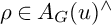 $\rho \in A_G(u){}^{\wedge }$
the irreducible representation corresponding to
 $\mathscr {E}$
. We often write it as
 $(u, \rho ) \leftrightarrow (C, \mathscr {E})$
. We denote by
 $\theta ^G_{u,\rho } \in \mathscr {W}_L^{\wedge }$
the representation E corresponding to
 $(C,\mathscr {E})$
under
 $\theta ^G$
. The generalized Springer correspondence
 $\theta ^M$
for M is defined similarly to (1.7.3). For each
 $(C',\mathscr {E}') \in \mathscr {N}_M$
, we choose
 $(u',\rho ) \leftrightarrow (C',\mathscr {E}')$
. Then,
 $\theta ^M_{u',\rho '} \in (\mathscr {W}_L'){}^{\wedge }$
. The restriction theorem [LS, 0.4, (4)] shows that
 $$ \begin{align} \operatorname{\!\langle\!} \rho\otimes \rho^{\prime *}, \varepsilon_{u,u'}\operatorname{\!\rangle\!}_{A_G(u) \times A_M(u')} = \operatorname{\!\langle\!} \theta^G_{u, \rho}|_{\mathscr{W}_L'}, \theta^M_{u',\rho'}\operatorname{\!\rangle\!}_{\mathscr{W}_L'} \end{align} $$
if
 $(u,\rho )$
and
 $(u',\rho ')$
belong to the same class
 $(L,C_0, \mathscr {E}_0)$
, where
 $\rho ^{\prime *}$
is the dual representation of
 $\rho '$
. The left-hand side is equal to zero if
 $(u,\rho )$
and
 $(u',\rho ')$
belong to a different class. Moreover, every irreducible representation of
 $A_G(u) \times A_M(u')$
which occurs in
 $\varepsilon _{u,u'}$
is obtained in this way.
1.8.
We assume that
 $L \subset P, M \subset Q$
are both F-stable. We consider
 $Y_{u,u'}$
in (1.7.1), and assume that
 $u, u'$
are F-stable. Then, F acts naturally on
 $Y_{u,u'}$
, and acts on
 $X_{u,u'}$
as a permutation of irreducible components. We have an action of F on
 $\varepsilon _{u,u'}$
. Put
 $A(u,u') = A_G(u) \times A_M(u')$
, then F acts diagonally on
 $A(u,u')$
. We define
 $\widetilde A(u,u') = \operatorname {\!\langle \!} \tau _* \operatorname {\!\rangle \!} \ltimes A(u,u')$
, where
 $\operatorname {\!\langle \!} \tau _* \operatorname {\!\rangle \!}$
is the infinite cyclic group generated by
 $\tau _*$
, and
 $\tau _*$
acts on
 $A(u,u')$
via F. Now,
 $\varepsilon _{u,u'}$
turns out to be an
 $\widetilde A(u,u')$
-module, which we denote by
 $\widetilde \varepsilon _{u,u'}$
. In turn, if we choose extensions
 $\widetilde \rho , \widetilde \rho '$
of
 $\rho , \rho '$
, respectively, they define an extension
 $\widetilde {\rho \otimes \rho ^{\prime *}}$
of
 $\rho \otimes \rho ^{\prime *}$
to irreducible
 $\widetilde A(u,u')$
-module, where
 $\tau _*$
acts on
 $\rho \otimes \rho ^{\prime *}$
as
 $\tau \otimes \tau '$
for
 $\widetilde A_G(u) = \operatorname {\!\langle \!} \tau \operatorname {\!\rangle \!} \ltimes A_G(u), \widetilde A_M(u') = \operatorname {\!\langle \!} \tau '\operatorname {\!\rangle \!} \ltimes A_M(u')$
.
On the other hand, for each
 $(C, \mathscr {E}) \in \mathscr {N}_G^F$
corresponding to
 $(u, \rho )$
, we consider the map
 constructed in 1.4, which we denote by
 $\psi _{u,\rho }$
.
 $\psi _{u,\rho }$
can be extended to
 . By comparing this with the isomorphism
 given in 1.2, we obtain an isomorphism
 such that the restriction of
 $\varphi $
on
 $V_{(u,\rho )}\otimes F^*\operatorname {IC}(\overline C,\mathscr {E})[\dim C]$
coincides with
 $\sigma _{(u,\rho )} \otimes \widetilde \psi _{(u,\rho )}$
. (Here, we write
 $V_{(C,\mathscr {E})}$
as
 $V_{(u,\rho )}$
.) Applying this to the reductive group M, and
 $(C',\mathscr {E}') \in \mathscr {N}_M^F$
, we obtain the map
 , where
 $(u',\rho ') \leftrightarrow (C', \mathscr {E}')$
. Here,
 $V_{(u,\rho )}$
is an irreducible
 $\mathscr {W}_L$
-module, and
 $V_{(u',\rho ')}$
is an irreducible
 $\mathscr {W}_L'$
-module. We can decompose
 $V_{(u,\rho )}$
as
 $$ \begin{align*} V_{(u,\rho)} = \bigoplus_{V_{(u',\rho')} \in (\mathscr{W}^{\prime}_L){}^{\wedge}}M_{\rho, \rho'}\otimes V_{(u',\rho')}, \end{align*} $$
where
 $M_{\rho , \rho '} = \operatorname {Hom}_{\mathscr {W}_L'} (V_{(u',\rho ')}$
,
 $V_{(u,\rho )}|_{\mathscr {W}_L'})$
is the multiplicity space for
 $V_{(u',\rho ')}$
. Thus, we can define an isomorphism
 such that the restriction of
 $\sigma _{(u,\rho )}$
on
 $M_{\rho ,\rho '}\otimes V_{(u',\rho ')}$
coincides with
 $\sigma _{\rho ,\rho '}\otimes \sigma _{(u',\rho ')}$
.
A variant of the restriction theorem (1.7.4) was proved in [S3, II, Cor. 1.9]. Under the notation above, the following formula holds.
 $$ \begin{align} \operatorname{Tr}\,(\sigma_{\rho,\rho'}, M_{\rho,\rho'}) = q^{-(\dim C - \dim C')/2 + \dim U_Q} \operatorname{\!\langle\!} \widetilde\varepsilon_{u,u'}, \widetilde{\rho \otimes \rho^{\prime *}}\operatorname{\!\rangle\!}_{A(u,u')\tau_*}, \end{align} $$
where for representations
 $V_1, V_2$
of
 $\widetilde A(u,u')$
,
 $\operatorname {\!\langle \!} V_1 ,V_2\operatorname {\!\rangle \!}_{A(u,u')\tau _*}$
is defined as
 $$ \begin{align*} \operatorname{\!\langle\!} V_1, V_2\operatorname{\!\rangle\!}_{A(u,u')\tau_*} = |A(u,u')|{}^{-1} \sum_{a \in A(u,u')} \operatorname{Tr}\,(a\tau_*,V_1)\operatorname{Tr}\,((a\tau_*){}^{-1}, V_2). \end{align*} $$
We note that the following fact [S3, II, Lem. 1.11] is useful for the determination of
 $\gamma $
, combined with (1.8.1).
(1.8.2) Suppose that
 $q^{-(a_0 + r)/2}\sigma _{(u,\rho )}$
makes
 $\mathscr {W}_L$
-module
 $V_{(u,\rho )}$
to the preferred extension to
 $\widetilde {\mathscr {W}}_L$
. Then, we have
 $\gamma = 1$
. In particular, in the case where F acts trivially on
 $\mathscr {W}_L$
, if
 $\sigma _{(u,\rho )}$
is
 $q^{(a_0 + r)/2}$
times identity, then
 $\gamma = 1$
.
1.9.
Let
 $Z_G$
be the center of G. For each
 $\chi \in Z_G^{\wedge }$
, we denote by
 $\mathscr {N}_{\chi }$
the set of
 $(C, \mathscr {E}) \in \mathscr {N}_G$
such that
 $Z_G$
acts on
 $\mathscr {E}$
according to
 $\chi $
. We denote by
 $A_G(u){}^{\wedge }_{\chi }$
the set of
 $\rho \in A_G(u){}^{\wedge }$
such that
 $Z_G$
acts on
 $\rho $
according to
 $\chi $
. If
 $(C, \mathscr {E}) \leftrightarrow (u,\rho )$
, then
 $(C, \mathscr {E}) \in \mathscr {N}_{\chi }$
if and only if
 $\rho \in A_G(u){}^{\wedge }_{\chi }$
. Moreover, we denote by
 $\mathscr {M}_{\chi }$
the set of
 $(L, C_0, \mathscr {E}_0) \in \mathscr {M}_G$
such that
 $Z_G$
acts on
 $\mathscr {E}_0$
according to
 $\chi $
. We have a partition
 $$ \begin{align*} \mathscr{N}_G = \bigsqcup_{\chi \in Z_G^{\wedge}}\mathscr{N}_{\chi}, \quad A_G(u){}^{\wedge} = \bigsqcup_{\chi \in Z_G^{\wedge}}A_G(u){}^{\wedge}_{\chi}, \quad \mathscr{M}_G = \bigsqcup_{\chi \in Z_G^{\wedge}}\mathscr{M}_{\chi}. \end{align*} $$
Then, the generalized Springer correspondence
 $\theta ^G$
is compatible with the action of
 $Z_G$
, namely, for each
 $\chi \in Z_G^{\wedge }$
,
 $\theta ^G$
restricts to a bijection
 $$ \begin{align} \theta^{\chi} : \mathscr{N}_{\chi} \to \bigsqcup_{(L,C_0,\mathscr{E}_0) \in \mathscr{M}_{\chi}}\mathscr{W}_L^{\wedge}. \end{align} $$
2 Preliminaries on spin groups
2.1.
First, we review the definition of spin groups. Let
 $\mathbf k$
be an algebraically closed field with
 $\operatorname {ch} \mathbf k \ne 2$
. Let V be a vector space over
 $\mathbf k$
with dimension
 $N \ge 3$
, endowed with a nondegenerate symmetric bilinear form
 $(\ ,\ )$
on V. Let
 $C(V)$
be the Clifford algebra associated to the form
 $(\ ,\ )$
. It is provided with an embedding
 $V \subset C(V)$
, and the product
 $v\cdot v'$
for
 $v, v' \in V$
satisfies the relation
 $v\cdot v' + v'\cdot v = 2(v,v')$
. Let
 $C^+(V)$
(resp.
 $C^-(V)$
) be the subspace of
 $C(V)$
spanned by products of an even number (resp. an odd number) of elements in V. Then,
 $C(V) = C^+(V) \oplus C^-(V)$
, and
 $C^+(V)$
is the subalgebra of
 $C(V)$
. The spin group
 $\operatorname {Spin} (V)$
is the subgroup of the units of
 $C^+(V)$
consisting of all products
 $v_1\cdots v_a$
with a : even, where
 $v_i \in V$
satisfy
 $(v_i,v_i) = 1$
. This is a closed subgroup of units in
 $C^+(V)$
. If
 $x \in \operatorname {Spin}(V)$
, the map
 $v \mapsto xvx{}^{-1}$
leaves V invariant, and defines an element
 $\beta (x)$
of
 $SO(V)$
; if
 $x = v_1\cdots v_a$
as above, then
 $\beta (x) = \beta (v_1)\cdots \beta (v_a)$
, where
 $\beta (v_i)(v) = -v + 2(v,v_i)v_i$
is
 $(-1)$
times the reflection with respect to
 $v_i$
. Thus, we have a homomorphism
 $\beta : \operatorname {Spin}(V) \to SO(V)$
. If we fix a basis, and identify
 $SO(V)$
with
 $SO_N$
, then we also write
 $\operatorname {Spin}(V)$
as
 $\operatorname {Spin}_N$
.
 $\beta $
is the simply connected covering of
 $SO(V)$
. We denote
 $\operatorname {Spin}(V)$
as G and
 $SO(V)$
as
 $\overline G$
.
Let Z be the center of G. If N is odd, and Z has order 2, it is generated by
 $\varepsilon = (-1)$
times the unit element in
 $C(V)$
. If N is even, and Z has order 4, it is generated by
 $\varepsilon $
and
 $\omega = v_1\cdots v_N$
, where
 $v_1, \dots , v_N$
are orthonormal basis of V. We have
 $\omega ^2 = \varepsilon ^{N/2}$
. Hence, Z is cyclic of order 4 generated by
 $\omega $
if
 $N \equiv 2\ \pmod 4$
, and
 $Z \simeq \operatorname {\!\langle \!} \omega \operatorname {\!\rangle \!} \times \operatorname {\!\langle \!} \varepsilon \operatorname {\!\rangle \!}$
is a product of two cyclic groups of order 2 if
 $N \equiv 0\ \pmod 4$
. Put
 $Z_0 = \operatorname {Ker} \beta $
. Then,
 $Z_0 = \{ 1, \varepsilon \}$
is of order 2.
2.2.
We consider the
 ${\mathbf F}_q$
-structure of G. Assume that V is defined over
 $\mathbf F_q$
with Frobenius map
 $F: V \to V$
, and that the form
 $(\ ,\ )$
is compatible with F-action, namely,
 $F(v,w) = (F(v), F(w))$
. Then,
 $C(V)$
has a natural
 $\mathbf F_q$
-structure, which induces an
 $\mathbf F_q$
-structure of G. We have the corresponding Frobenius map
 $F: G \to G$
.
 $\overline G$
has also a natural
 $\mathbf F_q$
-structure with Frobenius map F, and the map
 $\beta : G \to \overline G$
is F-equivariant. Here, F acts trivially on
 $Z_0 = \operatorname {Ker} \beta $
. Thus, F acts trivially on Z if N is odd. Assume that
 $N \equiv 0\ \pmod 4$
. The quadratic form on V associated to
 $(\ ,\ )$
is given for
 $x = \sum _ix_ie_i$
 $$ \begin{align*} (x,x) = \begin{cases} x_1^2 + \cdots + x_N^2 &\quad\text{ split case,} \\ x_1^2 + \cdots + x_{N-1}^2 + \delta x^2_N &\quad\text{ nonsplit case,} \end{cases} \end{align*} $$
where
 $e_1, \dots , e_N$
is a basis of V such that
 $F(e_i) = e_i$
, and
 $\delta \in \mathbf F_q - \mathbf F_q^2$
. Thus, in the split case,
 $v_i = e_i$
gives an orthonormal basis of V, stable by F. This implies that
 $\omega = v_1\cdots v_N$
is F-stable. In the nonsplit case,
 $v_1, \dots , v_N$
gives an orthonormal basis of V, where
 $v_i = e_i$
for
 $i = 1, \dots , N-1$
, and
 $v_N = \delta ^{1/2}e_N$
with
 $\delta ^{1/2} \notin \mathbf F_q$
. Here, we have
 $F(\delta ^{1/2}) = -\delta ^{1/2}$
, and so
 $F(v_N) = -v_N$
. This implies that
 $F(\omega ) = -\omega $
. Summing up the above argument, we have:
(2.2.1) Assume that N is odd, or
 $N \equiv 2\ \pmod 4 $
. Then, F acts trivially on Z. Assume that
 $N \equiv 0\ \pmod 4$
. If
 $(G,F)$
is of split type, then F acts trivially on Z, while if
 $(G,F)$
is of nonsplit type, then
 $F(\omega ) = -\omega $
.
2.3.
Under the generalized Springer correspondence
 $\theta ^{\chi }$
in (1.9.1), if
 $\chi |_{Z_0} = 1$
,
 $\theta ^{\chi }$
is essentially the same as the generalized Springer correspondence for
 $SO_N$
. Now, assume that
 $\chi |_{Z_0} \ne 1$
, namely that
 $\chi (\varepsilon ) = -1$
. It is known by [L1, 14] that
 $\mathscr {M}_{\chi }$
is in bijection with integers
 $d \in \mathbf Z$
such that
 $d \equiv N\ \pmod 4$
and
 $d(2d-1) < N$
. For such d, there exists a unique triple
 $(L, C_0, \mathscr {E}_0) \in \mathscr {M}_{\chi }$
with L of type
 $B_{(d-1)(2d+1)/2} + A_1 + A_1 + \cdots $
if N is odd, and of type
 $D_{d(2d-1)/2} + A_1 + A_1 + \cdots $
if N is even, where the number of factors of
 $A_1$
is
 $(N - d(2d-1))/4$
. In those cases,
 $\mathscr {W}_L \simeq W_{(N - d(2d-1))/4}$
, where
 $W_n$
is the Weyl group of type
 $B_n$
. Thus,
 $\theta ^{\chi }$
gives a bijection

2.4.
 $\beta : G \to \overline G$
gives a bijection
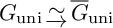 , and induces a bijection between the unipotent classes in G and those in
 $\overline G$
, which is compatible with F-action. For
 $u \in G{}_{\mathrm {uni}}$
,
 $\beta (u)$
determines a partition of N, by taking the Jordan block of
 $\beta (u)$
, which we denote by
 $\lambda (u)$
. Here, we write a partition
 $\lambda $
of N as
 $\lambda = (\lambda _1, \dots , \lambda _k)$
with
 $0 < \lambda _1 \le \lambda _2 \le \cdots \le \lambda _k$
with
 $\sum _{i=1}^k\lambda _i = N$
. We also write
 $\lambda $
as
 $\lambda = (1^{m_1}, 2^{m_2}, \ldots )$
. Note that the set of unipotent classes in
 $O_N$
are in bijection with the set
 $\widetilde X_N$
of partitions
 $\lambda $
of N such that
 $m_i$
is even for even i, by considering their Jordan types. If all the
 $m_i$
are even, the class in
 $O_N$
splits into two classes in
 $SO_N$
, otherwise any class C in
 $O_N$
gives a single
 $SO_N$
-class
 $C \cap SO_N$
.
Put
 $$ \begin{align} X_N = \{ \lambda \in \widetilde X_N \mid m_i \le 1 \text{ for odd } i \}. \end{align} $$
For an integer
 $m \in \mathbf Z$
, put
 $$ \begin{align} d(m) = \begin{cases} 0 &\quad\text{ if } m \text{ : even }, \\ 1 &\quad\text{ if } m \equiv 1 \quad\pmod 4, \\ -1 &\quad\text{ if } m \equiv -1 \quad\pmod 4. \end{cases} \end{align} $$
For
 $\lambda \in X_N$
, we define an integer
 $d(\lambda )$
by
 $d(\lambda ) = \sum _id(\lambda _i)$
. The following result was proved in [L1, Prop. 14.4] and [LS, Cor. 4.10].
Proposition 2.5. Assume that
 $\chi \in Z^{\wedge }$
is such that
 $\chi (\varepsilon ) = -1$
. Then, there exists a bijection between
 $\mathscr {N}_{\chi }$
and
 $X_N$
with the following properties:
-
(i) Let
 $(C, \mathscr {E}) \in \mathscr {N}_{\chi }$
with
$(u, \rho ) \leftrightarrow (C,\mathscr {E})$
. Then,
$\lambda (u) \in X_N$
. Under the correspondence (2.3.1),
$(C,\mathscr {E})$
is mapped to the factor of d, where
$d = d(\lambda )$
for
$\lambda = \lambda (u)$
.
-
(ii) Let
$I = \{ 1 \le i \le k \mid \lambda _i \text { : odd} \}$
. Define an integer r by Then,
$$ \begin{align*} r = \begin{cases} (|I|-1)/2 &\quad\text{ if } |I| \text{ is odd,} \\ (|I| -2)/2 &\quad\text{ if } |I| \text{ is even }> 0, \\ 0 &\quad\text{ if } |I| = 0. \end{cases} \end{align*} $$
$\rho $
is a unique irreducible representation of
$A_G(u)$
of dimension
$2^r$
such that Z acts on
$\rho $
by
$\chi $
. (More precisely, there exists a unique irreducible representation of dimension
$2^r$
on which
$\varepsilon $
acts as
$-1$
if
$|I|$
is odd, and there exists exactly two irreducible representations of dimension
$2^r$
on which
$\varepsilon $
acts as
$-1$
if
$|I|$
is even.)


2.6.
Take
 $(u,\rho ) \leftrightarrow (C, \mathscr {E}) \in \mathscr {N}_{\chi }$
as in Proposition 2.5. Following [L1, 14.2], we shall determine the structure of
 $A_G(u)$
, and construct the representation
 $\rho \in A_G(u){}^{\wedge }$
explicitly. Put
 $\beta (u) = \overline u \in \overline G$
. Then, we have
 $\beta {}^{-1}(Z_{\overline G}(\overline u)) = Z_G(u)$
.
 $\beta $
induces a natural surjective map
 $A_G(u) \to A_{\overline G}(\overline u)$
. In the case where
 $\lambda \in X_N$
,
 $\varepsilon \notin Z_G^0(u)$
, and
 $\beta {}^{-1}(Z_{\overline G}(\overline u))$
consists of two connected components. Thus,
 $A_G(u)$
is a central extension of
 $A_{\overline G}(\overline u)$
with a kernel of order 2.
This central extension can be described as follows. Let I be the set as in Proposition 2.5. We can write
 $V = \bigoplus _{i \in I}V_i \oplus V'$
, the orthogonal direct sum decomposition into
 $\overline u$
-stable subspaces, where
 $\dim V_i = \lambda _i$
for
 $i \in I$
. For each
 $i \in I$
, we consider an orthonormal basis
 $v_1^i, \dots , v_h^i$
of
 $V_i$
(here we put
 $h = \lambda _i$
). Put
 $x_i = v^i_1v^i_2\cdots v^i_h \in C(V)$
(note that h is odd). Those
 $x_i$
satisfy the relation
 $$ \begin{align} x_i^2 = \varepsilon^{\lambda_i(\lambda_i -1)/2}, \quad x_ix_{i'} = \varepsilon x_{i'}x_i. \end{align} $$
In fact, it follows from the defining relations that
 $(v^i_a)^2 = (v^i_a, v^i_a) = 1$
,
 $v^i_av^i_{a'} + v^i_{a'}v^i_a = 2(v^i_a, v^i_{a'}) = 0$
, namely,
 $v^i_av^i_{a'} = - v^i_{a'}v^i_a$
for
 $a \ne a'$
. Then, we have, for
 $i \ne i'$
,
 $$ \begin{align} x_i^2 &= (-1)^{h-1}(v^i_2\dots v^i_h)(v^i_2\dots v^i_h) = \cdots = (-1)^{h(h-1)/2}, \\ x_ix_{i'} &= (-1)^hv^{i'}_1(v^i_1\cdots v^i_h)(v^{i'}_2\cdots v^{i'}_{h'}) = \cdots = (-1)^{hh'}(v^{i'}_1\cdots v^{i'}_{h'})(v^i_1\cdots v^i_h),\nonumber \end{align} $$
where
 $h'= \lambda _{i'}$
. Since
 $h, h'$
are odd, we obtain (2.6.1).
Let
 $\widehat \varGamma $
be the subgroup of the group of units of
 $C(V)$
generated by
 $x_i$
(
 $i \in I$
). Let
 $\varGamma $
be the subgroup of
 $\widehat \varGamma $
consisting of elements which are products of an even number of generators
 $x_i$
. Then,
 $\varGamma \subset Z_G(u)$
, and the map
 $\varGamma \to Z_G(u)/Z_G^0(u)$
gives an isomorphism. The central extension
 $Z_G(u)/Z_G^0(u) \to Z_{\overline G}(\overline u)/Z_{\overline G}^0(\overline u)$
can be described by
 $\varGamma \to \varGamma /\{ 1, \varepsilon \}$
. (Note that
 $\varepsilon = x_ix_{i'}(x_{i'}x_{i}){}^{-1} \in \varGamma $
.)
Let
 $C(V_I)$
be the Clifford algebra over
 $\bar {\mathbf Q}_l$
associated to the vector space
 $V_I \simeq \bar {\mathbf Q}_l^{|I|}$
and the quadratic form
 $\sum _{i \in I}(-1)^{\lambda _i(\lambda _i-1)/2}X_i^2$
with variables
 $X_i (i \in I)$
, and
 $C^+(V_I)$
its
 $+$
-part. Let
 $\bar {\mathbf Q}_l[\varGamma ]$
be the group algebra of
 $\varGamma $
and
 $\bar {\mathbf Q}_l[\varGamma ]/\operatorname {\!\langle \!} 1 + \varepsilon \operatorname {\!\rangle \!}$
the quotient algebra of
 $\bar {\mathbf Q}_l[\varGamma ]$
by the two-sided ideal generated by
 $1 + \varepsilon $
. Then,
 $\bar {\mathbf Q}_l[\varGamma ]/\operatorname {\!\langle \!} 1 + \varepsilon \operatorname {\!\rangle \!} \simeq C^+(V_I)$
. It follows that there exists an algebra homomorphism
 $f: \bar {\mathbf Q}_l[\varGamma ] \to C^+(V_I)$
. It is known (cf. [L1, 14.3]) that,
 $C^+(V_I)$
is a simple algebra in the case where
 $|I|$
is odd with
 $\dim C^+(V_I) = 2^{|I|-1}$
, and is the direct sum of two simple components of the same dimension in the case where
 $|I|$
is even with
 $\dim C^+(V_I) = 2^{|I|-2}$
. Thus, if
 $|I|$
is odd, f gives rise to an irreducible representation
 $\rho : \varGamma \to GL(V_{\rho })$
, where
 $C^+(V_I) = \operatorname {End} (V_{\rho })$
, and if
 $|I|$
is even, it gives rise to two irreducible representations
 $\rho , \rho '$
such that
 $C^+(V_I) \simeq \operatorname {End}(V_{\rho }) \oplus \operatorname {End}(V_{\rho '})$
. Here,
 $\dim \rho = 2^{(|I|-1)/2}$
if
 $|I|$
is odd, and
 $\dim \rho = \dim \rho '= 2^{(|I|-2)/2}$
if
 $|I|$
is even.
Remark 2.7. We take
 $\chi \in Z^{\wedge }$
such that
 $\chi (\varepsilon ) = 1$
. Note that in this case
 $\chi $
is F-stable. As mentioned in 2.3, the generalized Springer correspondence
 $\theta ^{\chi }$
is essentially the same as the case of
 $SO_N$
. By [S3, II], we already know that Theorem 1.5 holds for
 $SO_N$
. Thus, for
 $(C, \mathscr {E}) \in \mathscr {N}^F_{\chi }$
, there exists a split element
 $v^{\bullet } \in \beta (C)^F$
. By Proposition 2.5, the Jordan type
 $\lambda $
of
 $\beta (C)$
is not contained in
 $X_N$
. Since
 $\beta $
gives a bijection
 , one can find
 $u \in C^F$
such that
 $\beta (u) = v^{\bullet }$
. In this case, it is known by [L1, 14.3] that
 $A_G(u) \simeq A_{\overline G}(v^{\bullet })$
. This isomorphism is compatible with F; thus,
 $A_G(u)$
is an elementary abelian two group with trivial F-action. We define a split element as
 $u = u^{\bullet } \in C^F$
, then the
 $G^F$
-class of
 $u^{\bullet }$
is uniquely determined by the split class in
 $\beta (C)^F$
. Theorem 1.5 holds for such
 $\chi \in Z^{\wedge }$
. Thus, the verification of the theorem is reduced to the case where
 $\chi (\varepsilon ) = -1$
, and to the determination of the split class in
 $C^F$
for C of Jordan type
 $\lambda \in X_N$
.
Remark 2.8. Assume that F is of nonsplit type. Then, N is even, and Z is generated by
 $\varepsilon $
and
 $\omega $
. We consider the set
 $\mathscr {N}_{\chi }$
in Proposition 2.5. Then,
 $\chi (\varepsilon ) = -1$
. Since F is nonsplit, we have
 $F(\omega ) = -\omega $
by (2.2.1). Thus,
 $$ \begin{align*} \chi(F(\omega)) = \chi(-\omega) = \chi(\varepsilon)\chi(\omega) = -\chi(\omega). \end{align*} $$
This shows that
 $\chi $
is not F-stable, and so
 $\mathscr {N}_{\chi }^F = \emptyset $
. In the nonsplit case, we do not need to consider the situation as in Proposition 2.5, and so Theorem 1.5 automatically holds.
3 Proof of Theorem 1.5—the case of spin groups
3.1.
By Remark 2.8, we may consider the case where F is of split type. So hereafter we assume that F is split. Following [S3, II], we review the definition of split elements in
 $SO_N$
. Assume that
 $\lambda \in X_N$
, and write it as
 $\lambda = (\lambda _1 \le \lambda _2 \le \cdots \le \lambda _k)$
.
-
(a) Assume that
$\lambda _j$
is odd, and put
$h = \lambda _j$
. We consider the vector space
$V_j$
over
$\mathbf k$
of
$\dim V_j = h$
with basis
$e_1^j, \dots , e_h^j$
. Put (3.1.1)We define a nondegenerate symmetric bilinear form
$$ \begin{align} \delta_j = \delta_j(\lambda) = (\lambda_j-1)/2 + j. \end{align} $$
$f_j$
on
$V_j$
by (3.1.2)and
$$ \begin{align} f_j(e^j_{h-a+1}, e_a^j) = (-1)^{\delta_j-a} \qquad (1 \le a \le h), \end{align} $$
$f_j = 0$
for all other pairs of bases. We define a nilpotent transformation
$x_j$
on
$V_j$
by
$x_j(e^j_a) = e^j_{a-1}$
with the convention
$e^j_0 = 0$
. Then,
$x_j \in \mathfrak g_j$
, where
$\mathfrak g_j = \operatorname {Lie} SO(V_j, f_j)$
.
-
(b) Assume that
$\lambda _j = \lambda _{j+1}$
is even. Put
$h = \lambda _j$
. We consider a vector space
$V_j$
of dimension
$2h = 2\lambda _j$
with basis
$e^j_1, \dots , e^j_h, e_1^{j+1}, \dots , e^{j+1}_h$
. We define a nondegenerate symmetric bilinear form
$f_j$
on
$V_j$
by (3.1.3)and
$$ \begin{align} f_j(e^j_{h-a+1}, e_a^{j+1}) = (-1)^{a-1} \qquad (1 \le a \le h), \end{align} $$
$f_j = 0$
for all other pairs of bases. We define a nilpotent transformation
$x_j$
on
$V_j$
by
$x_j(e^j_a) = e^j_{a-1}$
,
$x_j(e^{j+1}_a) = e^{j+1}_{a-1}$
, with the convention
$e^j_0 = e^{j+1}_0 = 0$
. Then,
$x_j \in \mathfrak g_j$
, where
$\mathfrak g_j = \operatorname {Lie} SO(V_j, f_j)$
.


Let
 $V = \bigoplus _jV_j$
, where the sum is taken all j such that
 $\lambda _j$
is odd, and a half of j such that
 $\lambda _j$
is even (note that
 $\sharp \{j \mid \lambda _j = h\}$
is even for even h). We define a symmetric bilinear form
 $f = \bigoplus _jf_j$
on V. Then,
 $x = \sum _jx_j\in \mathfrak g = \bigoplus _j\mathfrak g_j$
, where we can regard
 $\mathfrak g = \operatorname {Lie} SO(V, f)$
. If we assume that
 $\{ e^j_a \}$
is an
 $\mathbf F_q$
-basis of V, then f gives an F-invariant symmetric bilinear form on V, which we simply denote by
 $(\ ,\ )$
, and also write
 $SO(V)$
as
 $\overline G$
. x determines the
 $\overline G^F$
-conjugacy class of unipotent elements in
 $\overline G^F$
, which is nothing but the split class in
 $\overline C^F$
for the unipotent class
 $\overline C$
in
 $\overline G$
with Jordan type
 $\lambda $
. We denote the split class by
 $\overline C^{\bullet } \subset \overline C^F$
. We choose a split unipotent element
 $v = v^{\bullet } \in \overline C^{\bullet }$
.
3.2.
Let C be the unipotent class in G with Jordan type
 $\lambda \in X_N$
. Then,
 $\beta $
induces a bijection
 . We choose
 $u \in C^F$
such that
 $\beta (u) = \overline u = v$
. But in contrast to the case where
 $\lambda \notin X_N$
(see Remark 2.7), the set
 $\beta {}^{-1}(\overline C^{\bullet })$
is not a single
 $G^F$
-class, so the split class in
 $\overline C^F$
does not determine a unique
 $G^F$
-class in
 $C^F$
. We define the split classes in
 $C^F$
as all the
 $G^F$
-classes contained in
 $\beta {}^{-1}(\overline C^{\bullet })$
. In the following discussion, we shall show that those
 $G^F$
-classes satisfy the property of the split class.
We consider the action of F on
 $A_G(u)$
.
 $\beta $
induces a surjective map
 $\widetilde \beta : A_G(u) \to A_{\overline G}(\overline u)$
with
 $\operatorname {Ker} \widetilde \beta = \{ 1, \varepsilon \}$
. Here,
 $\widetilde \beta $
is F-equivariant, and we know that F acts trivially on
 $A_{\overline G}(\overline u)$
. For any
 $x \in A_G(u)$
,
 $\widetilde \beta {}^{-1}(\widetilde \beta (x)) = \{ x, \varepsilon x\}$
, and so
 $F(x) = x$
or
 $\varepsilon x$
. Thus,
 $F^2$
acts trivially on
 $A_G(u)$
.
We determine the action of F on
 $A_G(u)$
explicitly. By the discussion in 2.6,
 $A_G(u)$
is constructed from the orthonormal basis for
 $V_j$
with
 $\lambda _j$
: odd. So we need to convert the basis in
 $V_j$
to an orthonormal basis. We consider the following situation. Let M be a vector space of
 $\dim M = h$
(h: odd) with basis
 $e_1, \dots , e_h$
, endowed with nondegenerate symmetric bilinear form
 $(e_a, e_{h-a+1}) = (-1)^{c + a}$
for some fixed integer c. Let
 $\zeta \in \mathbf k$
be such that
 $\zeta ^2 = -1$
. Thus,
 $F(\zeta ) = \zeta $
if
 $q \equiv 1 \ \pmod 4$
and
 $F(\zeta ) = -\zeta $
if
 $q \equiv -1 \ \pmod 4$
. The following lemma can be checked by a direct computation.
Lemma 3.3. Put
 $\gamma = (-1)^{c+1}$
and
 $h = 2m+1$
. Assume that
 $F: M \to M$
is a Frobenius map with
 $F(e_i) = e_i$
.
-
(i) We define elements
$v_1', \dots , v_h'$
of M by (3.3.1)Then,
$$ \begin{align} \begin{aligned} v^{\prime}_1 &= e_1 + \frac{\gamma}{2}e_{h}, &\quad v^{\prime}_2 = e_2 -\frac{\gamma}{2}e_{h-1}, &\quad v^{\prime}_3 = e_3 + \frac{\gamma}{2}e_{h-2}, \dots \\ v^{\prime}_{h} &= e_1 - \frac{\gamma}{2}e_{h}, &\quad v^{\prime}_{h-1} = e_2 + \frac{\gamma}{2} e_{h-1}, &\quad v^{\prime}_{h-2} = e_3 - \frac{\gamma}{2}e_{h-2}, \dots \\ v^{\prime}_{m+1} &= e_{m+1}. \end{aligned} \end{align} $$
$(v^{\prime }_1, v^{\prime }_1) = (v^{\prime }_2, v^{\prime }_2) = \cdots = (v^{\prime }_{m}, v^{\prime }_{m}) = 1$
,
$(v^{\prime }_{m+1}, v^{\prime }_{m+1}) = (-1)^{m+1 + c}$
, and
$(v^{\prime }_h, v^{\prime }_h) = (v^{\prime }_{h-1}, v^{\prime }_{h-1}) = \cdots = (v^{\prime }_{m+2}, v^{\prime }_{m+2}) = -1$
. Moreover,
$F(v^{\prime }_a) = v^{\prime }_a$
for
$1 \le a \le h$
.
-
(ii) Define
$v_1, \dots , v_h \in M$
by
$v_1 = v^{\prime }_1, v_2 = v^{\prime }_2, \dots , v_m = v^{\prime }_m$
,
$v_h = \zeta v^{\prime }_h, v_{h-1} = \zeta v^{\prime }_{h-1}, \dots v_{m+2} = \zeta v^{\prime }_{m+2}$
, and
$v_{m+1} = v^{\prime }_{m+1}$
(resp.
$\zeta v^{\prime }_{m+1}$
) if
$m+1 + c$
is even (resp. odd). Then,
$v_1, \dots , v_h$
gives an orthonormal basis of M. Moreover,
$F(v_i) = v_i$
for any i if
$q\equiv 1 \pmod 4$
. If
$q \equiv -1\ \pmod 4$
, then
$F(v_1) = v_1, \dots , F(v_m) = v_m$
,
$F(v_h) = -v_h, F(v_{h-1}) = -v_{h-1}, \dots , F(v_{m + 2}) = -v_{m+2}$
, and
$F(v_{m+1}) = (-1)^{m +1 + c}v_{m+1}$
.


3.4.
Let
 $V_j$
be as in 3.1 for
 $\lambda _j = h$
: odd. Write
 $h = 2m + 1$
. Then,
 $\delta _j = m + j$
. By applying Lemma 3.3 for
 $M = V_j$
with
 $c = m + j$
, one can find an orthonormal basis
 $v_1^j, \dots , v_h^j$
of
 $V_j$
. Put
 $x_j = v_1^j\cdots v_h^j \in C(V)$
. The action of F on the basis
 $\{ v_1^j, \dots , v_h^j\}$
is given as in the lemma. In particular,
 $F(x_j) = x_j$
if
 $q\equiv 1\ \pmod 4$
. While if
 $q \equiv -1\ \pmod 4$
, we have
 $$ \begin{align} F(x_j) = (-1)^{m + 1 + \delta_j}(-1)^mx_j = (-1)^{(\lambda_j-1)/2 + 1 + j}x_j. \end{align} $$
By the discussion in 2.6,
 $A_G(u)$
is isomorphic to the subgroup of the group of units in
 $C^+(V)$
generated by an even number of products
 $x_j$
such that
 $\lambda _j$
is odd. Thus, we have the following lemma.
Lemma 3.5. If
 $q\equiv 1\ \pmod 4$
, then F acts trivially on
 $A_G(u)$
. While if
 $q\equiv -1\ \pmod 4$
, then F acts nontrivially on
 $A_G(u)$
.
3.6.
We apply the restriction formula (1.7.4) for the following case. Let M be the Levi subgroup of a parabolic subgroup Q of G such that
 $\beta (M) \simeq SL_2 \times SO_{N-4}$
. Take
 $(u,\rho ) \leftrightarrow (C,\mathscr {E}) \in (\mathscr {N}_G)_{\chi }$
, and
 $(u',\rho ') \leftrightarrow (C',\mathscr {E}') \in (\mathscr {N}_M)_{\chi }$
. Then,
 $u'$
satisfies the properties:
-
(i) The projection of
$\beta (u')$
on
$SL_2$
is regular unipotent. -
(ii) The projection of
$\beta (u')$
on
$SO_{N-4}$
corresponds to the unipotent elements of Jordan type in
$X_{N-4}$
under the correspondence
$(\mathscr {N}_{\operatorname {Spin}_{N-4}})_{\chi } \simeq X_{N-4}$
.


Put
 $\beta (M) = \overline M$
and
 $\beta (Q) = \overline Q$
. Let
 $p : \overline Q \to \overline M$
be the natural projection. Put
 $\lambda = \lambda (u) \in X_N$
and
 $\lambda (u') = \lambda ' \in X_{N-4}$
. Assume that
 $\rho \otimes \rho ^{\prime *}$
appears in
 $\varepsilon _{u,u'}$
. Then, it is known by [LS, Lemmas 4.5 and 4.8], and only the following five cases occur; there exists an integer i such that one of the following conditions is satisfied.
-
(I)
$\lambda _i$
is odd,
$\lambda _i> \lambda _{i-1} + 4$
, and
$$ \begin{align*} \lambda_j' = \begin{cases} \lambda_j - 4 &\quad\text{ if } j = i, \\ \lambda_j &\quad\text{ otherwise. } \end{cases} \end{align*} $$
-
(II)
$\lambda _i = \lambda _{i+1} \ge \lambda _{i-1} + 2$
and
$$ \begin{align*} \lambda_j' = \begin{cases} \lambda_j-2 &\quad\text{ if } j = i, i+1, \\ \lambda_j &\quad\text{ otherwise.} \end{cases} \end{align*} $$
-
(III)
$\lambda _i = \lambda _{i+1} \ge \lambda _{i-1}+ 4$
and
$$ \begin{align*} \lambda_j' = \begin{cases} \lambda_j - 3 &\quad\text{ if } j = i, \\ \lambda_j - 1 &\quad\text{ if } j = i+1, \\ \lambda_j &\quad\text{ otherwise. } \end{cases} \end{align*} $$
-
(IV)
$\lambda _{i+1} - 2 = \lambda _i \ge \lambda _{i-1} + 1$
and
$$ \begin{align*} \lambda^{\prime}_j = \begin{cases} \lambda_j - 1 &\quad\text{ if } j = i, \\ \lambda_j - 3 &\quad\text{ if } j = i+1, \\ \lambda_j &\quad\text{ otherwise. } \end{cases} \end{align*} $$
-
(V)
$\lambda _{i+2} = \lambda _{i+1} = \lambda _i + 1$
and
$$ \begin{align*} \lambda^{\prime}_j = \begin{cases} \lambda_j - 1 &\quad\text{ if } j = i, i+2, \\ \lambda_j - 2 &\quad\text{ if } j = i+1, \\ \lambda_j &\quad\text{ otherwise. } \end{cases} \end{align*} $$


3.7.
Assume that
 $(u, \rho ) \leftrightarrow (C, \mathscr {E}) \in (\mathscr {N}_G)_{\chi }$
. We choose a split element
 $u \in C^F$
, and assume that F acts nontrivially on
 $A_G(u)$
. Since
 $F^2$
acts trivially on
 $A_G(u)$
(see 3.2), the order of
 $\tau $
is equal to 2. There exist two extensions
 $\widetilde \rho , \widetilde \rho '$
of
 $\rho $
to
 $\widetilde A_G(u)$
. We need to fix an appropriate extension
 $\widetilde \rho $
of
 $\rho $
, called the split extension of
 $\rho $
. Assume given
 $(u',\rho ') \in (\mathscr {N}_M)_{\chi }$
as in 3.6, and choose a split element
 $u' \in C^{\prime \,F}$
. Recall that
 $(u_0, \rho _0) \leftrightarrow (C_0, \mathscr {E}_0)$
for the cuspidal pair in L. We assume that the split extensions
 $\widetilde \rho _0$
of
 $\rho _0$
and
 $\widetilde \rho '$
of
 $\rho '$
are already determined. We consider
 $\widetilde \varepsilon _{u, u'}$
and its subspace
 $\rho \otimes \rho ^{\prime *}$
.
 $\tau '$
acts on
 $\widetilde \rho '$
via
 $T'$
. If we fix an extension
 $\widetilde \rho $
of
 $\rho $
, where
 $\tau $
acts as T on
 $\widetilde \rho $
, then
 $\tau _*$
act as
 $T_* = T\otimes T'$
with
 $T_*^2 = 1$
.
 $\tau $
acts as
 $-T$
for
 $\widetilde \rho '$
. Since
 $\rho \otimes \rho ^{\prime *}$
is F-stable, the action of F on
 $\rho \otimes \rho ^{\prime *}$
coincides with a scalar times
 $T_*$
. If we can show that
 $F^2$
acts trivially on
 $\rho \otimes \rho ^{\prime *}$
, then by replacing
 $\widetilde \rho $
by
 $\widetilde \rho '$
if necessary, we can find an extension
 $\widetilde \rho $
of
 $\rho $
such that F acts as
 $T_*$
on
 $\widetilde {\rho \otimes \rho ^{\prime *}}$
. We call such
 $\widetilde \rho $
the split extension of
 $\rho $
. By (1.8.2), we have the following lemma.
Lemma 3.8. Assume that F acts nontrivially on
 $A_G(u)$
. If
 $F^2$
acts trivially on the subspace
 $\rho \otimes \rho ^{\prime *}$
of
 $\varepsilon _{u,u'}$
, then for the split extension
 $\widetilde \rho $
of
 $\rho $
, we have
 $\gamma = 1$
.
3.9.
Recall that
 $Y_{u,u'} = \{ g \in G \mid g{}^{-1} ug \in u'U_Q\}$
, and
 $C'$
the unipotent class in M containing
 $u'$
. Put
 $$ \begin{align} \mathcal{Q}_{u,C'} = \{ gQ \in G/Q \mid g{}^{-1} ug \in C'U_Q\}. \end{align} $$
We have a natural map
 $q: Y_{u,u'} \to \mathcal {Q}_{u,C'}$
.
 $Z_G(u)$
acts on
 $\mathcal {Q}_{u, C'}$
from the left, and the map q is
 $Z_G(u)$
-equivariant. q induces an isomorphism

If
 $u \in C^F$
,
 $u' \in C^{\prime \,F}$
, then
 $Y_{u,u'}, \mathcal {Q}_{u,C'}$
are defined over
 $\mathbf F_q$
, and the map q is F-equivariant. Put
 $\overline Q = \beta (Q)$
. We have
 $\beta (Y_{u,u'}) = \overline Y_{\overline u,\overline u'}$
, which is the variety defined with respect to
 $\overline G$
and
 $\overline M$
. Then
 $\beta : Y_{u,u'} \to \overline Y_{\overline u,\overline u'}$
gives a double covering. The variety
 $\overline {\mathcal {Q}}_{\overline u, \overline C'}$
is defined similarly to
 $\mathcal {Q}_{u,C'}$
, and a formula analogous to (3.9.2) holds for
 $\overline Y_{\overline u,\overline u'}$
. We show the following lemma.
Lemma 3.10. Assume that F acts trivially on
 $A_G(u)$
and on
 $A_M(u')$
. Assume that
 $\overline {\mathcal {Q}}_{\overline u,\overline C'}$
has finitely many
 $Z_{\overline G}(\overline u)$
-orbits, and each
 $Z_{\overline G}(\overline u)$
-orbit contains an element
 $\overline y \overline Q$
such that
 $\overline y \in \overline Y^F_{\overline u,\overline u'}$
. Then, F acts trivially on
 $\varepsilon _{u,u'}$
.
Proof Let
 $\overline y\overline Q \in \overline {\mathcal {Q}}_{\overline u,\overline C'}$
be such that
 $\overline y \in \overline Y^F_{\overline u,\overline u'}$
. Then, there exists
 $y \in G^F$
such that
 $yQ = \overline y\overline Q$
and that
 $y{}^{-1} uy \in u_1'U_Q$
for
 $u_1' \in C^{\prime \,F}$
. This implies that
 $\overline y{}^{-1} \overline u \overline y \in \overline u_1'U_{\overline Q}$
, and
 $\overline u_1'$
is
 $\overline M^F$
-conjugate to
 $\overline u'$
. Hence,
 $\overline u_1'$
is a split element in
 $\overline C'$
, and so
 $u^{\prime }_1$
is a split element in
 $C'$
. We have
 $y \in Y^F_{u, u^{\prime }_1}$
, and
 $\overline y \in \overline Y^F_{\overline u, \overline u_1'}$
. By replacing
 $u'$
by
 $u_1'$
if necessary, we may assume that
 $y \in Y^F_{u,u'}$
. Let R be the
 $Z_{\overline G}(\overline u)$
-orbit of
 $\overline y \overline Q$
in
 $\overline {\mathcal {Q}}_{\overline u,\overline C'}$
. Then,
 $q{}^{-1} R = Z_{\overline G}(\overline u)\overline y Z_{\overline M}(\overline u')U_{\overline Q}$
. Since
 $\varepsilon = -1 \in Z_G(u)$
, we can write as
 $\beta {}^{-1}(q{}^{-1} R) = Z_G(u)yZ_M(u')U_Q$
, with
 $y \in Y^F_{u,u'}$
. Then,
 $$ \begin{align*} \beta{}^{-1}(q{}^{-1} R) = \bigsqcup_{\alpha \in A_G(u), \beta \in A_M(u')} Z_G^0(u)x_{\alpha}yx^{\prime}_{\beta}Z_M^0(u')U_Q, \end{align*} $$
where
 $x_{\alpha }, x^{\prime }_{\beta }$
are representatives of
 $\alpha , \beta $
in
 $Z_G(u)$
,
 $Z_M(u')$
, respectively. Hence, the irreducible components of
 $\beta {}^{-1}( q{}^{-1} R)$
are given by
 $Z_G^0(u)x_{\alpha }yx^{\prime }_{\beta }Z_M(u')$
. Since F acts trivially on
 $A_G(u), A_M(u')$
, all those irreducible components are F-stable. Thus, F acts trivially on
 $\varepsilon _{u,u'}$
.
Proposition 3.11. Lt
 $u \in C, u' \in C'$
with
 $\lambda (u) = \lambda $
,
 $\lambda '= \lambda (u')$
. Assume that the type of
 $(\lambda , \lambda ')$
is given as in (I), (II), (IV), or (V) in 3.6. Let
 $u \in C^F$
be a split element such that F acts trivially on
 $A_G(u)$
. Then, there exists a split element
 $u' \in C^{\prime \,F}$
such that F acts trivially on
 $\varepsilon _{u,u'}$
. (For the case (III), see Remark 3.13 below.)
Proof We can identify
 $\mathcal {Q} = G/Q$
with the variety
 $\mathscr {F}$
of all two-dimensional totally isotropic subspaces of V. Then,
 $\mathcal {Q}_{u,C'}$
can be identified with the subvariety
 $\mathscr {F}_{u,C'}$
of
 $\mathscr {F}$
consisting of all
 $E \in \mathscr {F}$
such that
-
(i) E is
$\overline u$
-stable. -
(ii)
$\overline u|_E \ne 1$
. -
(iii) The Jordan type of
$\overline u|_{E^{\perp }/E}$
is
$\lambda '$
.


Let
 $u \in C^F$
be a split element such that F acts trivially on
 $A_G(u)$
. In each case of (I), (II), (IV), or (V) in 3.6, we shall find a split element
 $u' \in C^{\prime \,F}$
satisfying the assumption in Lemma 3.10. Then, the proposition follows from the lemma.
Case I. Let
 $V_i$
be the subspace of V corresponding to
 $\lambda _i$
, and
 $e_1, \dots , e_h$
be the F-stable basis of
 $V_i$
(with
 $h = \lambda _i$
) such that
 $xe_a = e_{a-1}$
for
 $x \in \mathfrak g^F$
as in 3.1 (a). Put
 $E = \operatorname {\!\langle \!} e_1, e_2\operatorname {\!\rangle \!}$
. It is easy to see that
 $\mathscr {F}_{u,C'} = \{ E \}$
.
 $SL(E) \times SO(E^{\perp }/E)$
is
 $\overline G^F$
-conjugate to
 $\overline M$
. Thus, there exists
 $\overline u' \in \overline M^F$
such that
 $\overline u'$
is
 $\overline G^F$
-conjugate to
 $(\overline u|_E, \overline u|_{E^{\perp }/E})$
. Then,
 $u' = \beta {}^{-1}(\overline u')$
is a split element in
 $C^{\prime \,F}$
. Since
 $A_G(u) \simeq A_M(u')$
with F-action, F acts trivially on
 $A_M(u')$
. One can choose
 $\overline y \in \overline G^F$
such that
 $\overline y\overline Q$
corresponds to E. Then,
 $\overline y \in \overline Y^F_{\overline u,\overline u'}$
. Thus, the assumption of Lemma 3.10 is satisfied.
Case II. Let
 $V_i$
be as in 3.1(b). We write the basis
 $e^i_1, \dots , e^i_h, e_1^{i+1}, \dots , e_h^{i+1}$
of
 $V_i$
as
 $e_1, \dots , e_h, f_1, \dots , f_h$
, where
 $h = \lambda _i = \lambda _{i+1}$
. Under the decomposition
 $V = \bigoplus _kV_k$
in 3.1, we define a subspace
 $M_i$
of V as the direct sum of
 $V_k$
such that
 $\lambda _k = h$
. Let
 $x \in \mathfrak g$
be as in 3.1. Take
 $E \in \mathscr {F}_{u,C'}$
. Then,
 $\dim (E \cap \operatorname {Ker} x) = 1$
. We choose
 $0 \ne v \in E \cap \operatorname {Ker} x$
. v is
 $G_1$
-conjugate to
 $e_1 \in V_i$
, where
 $G_1$
is a subgroup of
 $Z_{\overline G}(\overline u)$
which is isomorphic to
 $Sp(M_i)$
. So assume that
 $e_1 \in E \cap \operatorname {Ker} x$
. Then, the condition on
 $\lambda '$
implies that
 $E \subset V_i$
. We see that E is of the form
 $E = \operatorname {\!\langle \!} e_1, e_2 + \alpha f_1\operatorname {\!\rangle \!}$
with
 $\alpha \in \mathbf k$
. It follows that
 $$ \begin{align} \mathscr{F}_{u,C'} = \bigcup_{g \in G_1}g\{ \operatorname{\!\langle\!} e_1, e_2 + \alpha f_1 \operatorname{\!\rangle\!} \mid \alpha \in \mathbf k \}. \end{align} $$
We choose
 $E = \operatorname {\!\langle \!} e_1, e_2 \operatorname {\!\rangle \!}$
. Then,
 $E \in \mathscr {F}^F_{u,C'}$
. There exists
 $\overline u' \in \overline M^F$
such that
 $\overline u'$
is
 $\overline G^F$
-conjugate to
 $(\overline u|_E, \overline u|_{E^{\perp }/E})$
. Then,
 $u' = \beta {}^{-1}(\overline u') \in C^{\prime \,F}$
is a split element. Since
 $A_G(u) \simeq A_M(u')$
with F-action, F acts trivially on
 $A_M(u')$
. It is easy to see that
 $\operatorname {\!\langle \!} e_1, e_2 + \alpha f_1\operatorname {\!\rangle \!}$
is
 $Z_{\overline G}(\overline u)$
-conjugate to E. Thus,
 $\mathscr {F}_{u,C'}$
coincides with the
 $Z_{\overline G}(\overline u)$
-orbit of E. There exists
 $\overline y \in \overline Y_{\overline u,\overline u'}^F$
such that
 $\overline y\overline Q$
corresponds to E. The assumption of Lemma 3.10 is satisfied.
Case IV. Put
 $M_i = V_i \oplus V_{i+1}$
, where
 $\dim V_{i+1} = h $
and
 $\dim V_i = h-2$
. Write the bases of
 $V_{i+1}, V_i$
in 3.1 as
 $e_1, \dots , e_h$
for
 $V_{i+1}$
, and
 $e_1', \dots , e^{\prime }_{h-2}$
for
 $V_i$
. Take
 $E \subset \mathscr {F}_{u,C'}$
. Then, E must be in
 $M_i$
. Take
 $0 \ne v \in M_i \cap \operatorname {Ker} x$
. The condition for
 $\lambda '$
implies that
 $v = e_1$
up to scalar. Thus, we may assume that
 $v = e_1$
. E can be written as
 $E = \operatorname {\!\langle \!} e_1, e_2 + \alpha e_1'\operatorname {\!\rangle \!}$
with
 $\alpha \in \mathbf k$
. The condition that
 $x|_{E^{\perp }/E}$
has type
 $\lambda '$
is given by
 $$ \begin{align} ( e_2 + \alpha e_1', e_{h-1} + \alpha e^{\prime}_{h-2}) = 0. \end{align} $$
This implies that
 $(e_2, e_{h-1}) + \alpha ^2(e^{\prime }_1, e^{\prime }_{h-2}) = 0$
. Under the notation of (3.1.1), we have
 $\delta _i = \delta _{i+1}$
. Thus, by (3.1.2),
 $(e_2, e_{h-1}) = -(e^{\prime }_1, e^{\prime }_{h-2})$
, and so
 $\alpha = \pm 1$
. We have
 $$ \begin{align} \mathscr{F}_{u,C'} = \{ E = \operatorname{\!\langle\!} e_1, e_2 + e_1'\operatorname{\!\rangle\!}, E' = \operatorname{\!\langle\!} e_1, e_2 -e_1'\operatorname{\!\rangle\!} \ \}. \end{align} $$
In particular, both of
 $E, E'$
are F-stable. As in Case I, we can define
 $u' \in C^{\prime \,F}$
by using
 $(\overline u|_E, \overline u|_{E^{\perp }/E})$
. Then,
 $u'$
is a split element.
 $A_M(u')$
is obtained from
 $A_G(u)$
by removing
 $x_i$
and
 $x_{i+1}$
, under the notation in 2.6. Thus, F acts trivially on
 $A_M(u')$
. As in the previous cases, we can find
 $\overline y \in \overline Y_{\overline u,\overline u'}^F$
such that
 $\overline y\overline Q$
corresponds to E. If we choose
 $\overline y' \in \overline G^F$
such that
 $\overline y'\overline Q$
corresponds to
 $E'$
, then
 ${\overline y'}{}^{-1} \overline u \overline y' \in \overline u"U_{\overline Q}$
for some
 $\overline u" \in \overline C^{\prime \,F}$
. But then,
 $\overline u"$
is also a split element in
 $\overline C^{\prime \prime \,F}$
, and
 $\overline u"$
is
 $\overline M^F$
-conjugate to
 $\overline u'$
. By replacing
 $\overline y'$
appropriately if necessary, we find
 $\overline y' \in \overline Y^F_{\overline u,\overline u'}$
such that
 $\overline y'\overline Q$
corresponds to
 $E'$
. Thus, the assumption of Lemma 3.10 is satisfied.
Case V. Put
 $h = \lambda _{i+1} = \lambda _{i+2}$
, with h : even. Let
 $M_{i+1}$
be the subspace of V which is the direct sum of
 $V_k$
such that
 $\lambda _k = h$
. Then,
 $V_{i+1} \subset M_{i+1}$
. We write the basis of
 $V_{i+1}$
given in 3.1 (b) as
 $e_1, \dots , e_h, f_1, \dots , f_h$
, and write the basis of
 $V_i$
in 3.1 (a) as
 $e_1', \dots , e^{\prime }_{h-1}$
. Take
 $E \in \mathscr {F}_{u,C'}$
. Then,
 $E \subset M_{i+1}\oplus V_i$
. Take
 $0 \ne v \in E \cap \operatorname {Ker} x$
. Similarly to Case II, by taking the
 $G_1$
-conjugate, we may assume that
 $v \in V_{i+1} \oplus V_i$
, where
 $G_1$
is the subgroup of
 $Z_{\overline G}(\overline u)$
which is isomorphic to
 $Sp(M_{i+1})$
. Then,
 $E \subset V_{i+1}\oplus V_i$
. It follows from the condition for
 $\lambda '$
that v must be in
 $V_{i+1}$
. Then, under the conjugation by
 $Z_{\overline G}(\overline u)$
, we may assume that
 $v = e_1$
. E is given as
 $E = \operatorname {\!\langle \!} e_1, e_2 + z\operatorname {\!\rangle \!}$
with
 $z \in (V_{i+1} \oplus V_i)\cap \operatorname {Ker} x$
. So we write
 $z = \alpha f_1 + \beta e^{\prime }_1$
. Then, the condition
 $x|_{E^{\perp }/E}$
has type
 $\lambda '$
is given by
 $$ \begin{align} (e_2 + \alpha f_1 + \beta e_1', e_h + \alpha f_{h-1} + \beta e^{\prime}_{h-1}) = 0. \end{align} $$
This implies that
 $\alpha (e_2, f_{h-1}) + \alpha (f_1, e_h) + \beta ^2(e^{\prime }_1, e^{\prime }_{h-1}) = 0$
. Since
 $(e_2, f_{h-1}) = (f_1, e_h) = -1$
by 3.1 (b), we have
 $$ \begin{align} \alpha = \frac{\beta^2(e_1', e^{\prime}_{h-1})}{2}. \end{align} $$
Thus, for any
 $\beta \in \mathbf k$
, there exists a unique
 $E_{\beta } = \operatorname {\!\langle \!} e_1, e_2 + z\operatorname {\!\rangle \!} \in \mathscr {F}_{u,C'}$
given as above. In particular, if we put
 $E = \operatorname {\!\langle \!} e_1, e_2\operatorname {\!\rangle \!}$
, then
 $E \in \mathscr {F}_{u,C'}$
and
 $E_{\beta }$
is
 $Z_{\overline G}(\overline u)$
-conjugate to E. Thus,
 $Z_{\overline G}(\overline u)$
acts transitively on
 $\overline {\mathcal {Q}}_{\overline u,\overline C'}$
. Here,
 $E \in \mathscr {F}^F_{u,C'}$
, and
 $(\overline u|_{E}, \overline u|_{E^{\perp }/E})$
determines
 $u' \in C^{\prime \,F}$
. There exists
 $\overline y \in \overline Y^F_{\overline u,\overline u'}$
such that
 $\overline y\overline Q$
corresponds to E. Note our process to obtain
 $u'$
from u corresponds to the procedure,
 $$ \begin{align*} (\lambda_i, \lambda_{i+1}, \lambda_{i+2}) \mapsto (\lambda_i, \lambda_{i+1}-2, \lambda_{i+1}-2) \mapsto (\lambda_{i+1}-2, \lambda_{i+2} -2, \lambda_i), \end{align*} $$
where the second one is a rearrangement of the order of the parts. Here, the first one is
 $(\lambda _i, \lambda _{i+1}, \lambda _{i+2}) = (h-1, h, h)$
, and the last one is
 $(\lambda ^{\prime }_i, \lambda ^{\prime }_{i+1}, \lambda ^{\prime }_{i+2}) = (h-2, h-2, h-1)$
. We have
 $\delta _i = (\lambda _i -2)/2 + i$
by (3.1.1). Then,
 $\delta ^{\prime }_{i+2} = (\lambda ^{\prime }_{i+2} - 1)/2 + (i+2) \equiv \delta _i \ \pmod 2$
. It follows that
 $u' \in C^{\prime \,F}$
is a split element. Since
 $A_G(u) \simeq A_M(u')$
with F-action, F acts trivially on
 $A_M(u')$
. Thus, the assumption of Lemma 3.10 is satisfied.
Remark 3.12. In the statement in Proposition 3.11, the case (III) is not used in the later discussion, so we omitted it. Actually, in this case, the structure of
 $\mathscr {F}_{u,C'}$
is more complicated, and the splitness of
 $u' \in C^{\prime \,F}$
is not deduced from the split element
 $u \in C^F$
.
We are now ready to prove Theorem 1.5 in the case of spin groups. Note that split elements are defined in 3.2, and split extensions are defined in 3.7.
Theorem 3.13. Assume that
 $G = \operatorname {Spin}_N$
. For each
 $(C, \mathscr {E}) \in \mathscr {N}_G^F$
, let
 $u^{\bullet } \in C^F$
be a split element, and assume that
 $(C,\mathscr {E}) \leftrightarrow (u^{\bullet }, \rho )$
. For each
 $(L, C_0, \mathscr {E}_0) \in \mathscr {M}_G^F$
, let
 $u_0^{\bullet } \in C_0^F$
be a split element as above (applied for L), and assume that
 $(C_0, \mathscr {E}_0) \leftrightarrow (u_0^{\bullet }, \rho _0)$
. Let
 $\widetilde \rho _0 \in \widetilde A_L(u_0^{\bullet }){}^{\wedge }$
be an extension of
 $\rho _0$
, and for each
 $(C, \mathscr {E})$
belonging to the series
 $(L, C_0, \mathscr {E}_0)$
, let
 $\widetilde \rho \in \widetilde A_G(u^{\bullet }){}^{\wedge }$
be the split extension of
 $\rho $
associated to
 $\widetilde \rho _0$
. Then,
 $\gamma (u_0^{\bullet }, \widetilde \rho _0, u^{\bullet }, \widetilde \rho ) = 1$
.
Proof By Proposition 2.5, we may assume that
 $(C, \mathscr {E}) \in (\mathscr {N}_G)^F_{\chi }$
for
 $\chi \in Z^{\wedge }$
such that
 $\chi (\varepsilon ) = -1$
. Then, the Jordan type of
 $\overline C$
is
 $\lambda \in X_N$
. By Remark 2.8,
 $\mathscr {N}_{\chi }^F = \emptyset $
if F is of nonsplit type. Thus, we may assume that F is of split type. We define a split element
 $u = u^{\bullet } \in C^F$
as in 3.1 and 3.2. Assume that
 $N \ge 7$
, and consider an F-stable Levi subgroup M of G such that
 $\beta (M) \simeq SL_2 \times SO_{N-4}$
. Take
 $(C',\mathscr {E}') \in (\mathscr {N}_M)_{\chi }$
, and assume that
 $(C, \mathscr {E}) \leftrightarrow (u, \rho )$
, and
 $(C',\mathscr {E}') \leftrightarrow (u',\rho ')$
, where
 $\lambda = \lambda (u), \lambda ' = \lambda (u')$
. Then, the condition that
 $\rho \otimes \rho ^{\prime *}$
appears in
 $\varepsilon _{u,u'}$
is exactly that the pair
 $(\lambda , \lambda ')$
satisfies the condition (I)
 $\sim $
(V) in 3.6. Now, for a given
 $u \in C$
, one can find
 $u' \in C'$
such that
 $(\lambda , \lambda ')$
satisfies one of the conditions (I), (II), (IV), or (V). (Note that the case (III) is not necessary, since if the condition (III) is applicable for
 $\lambda _i$
, then already the condition (II) can be applied for
 $\lambda _i$
.) We choose a split element
 $u' \in C^{\prime \,F}$
. Then, by Proposition 3.11, F acts trivially on
 $\varepsilon _{u,u'}$
, and also F acts trivially on
 $A_M(u')$
. Then, by (1.8.1),
 $\sigma _{\rho , \rho '}: M_{\rho ,\rho '} \to M_{\rho ,\rho '}$
is the scalar multiplication by
 $q^{-(\dim C - \dim C')/2 + \dim U_Q}$
. By induction, we may assume that
 $\sigma _{(u',\rho ')}$
acts on
 $V_{(u',\rho ')}$
as a scalar multiplication by
 $q^{(a_0'+ r')/2}$
, where
 $a_0',r'$
are defined similarly to
 $a_0, r$
by replacing G by M. It follows that
 $\sigma _{(u,\rho )}$
acts on
 $V_{(u,\rho )}$
as a scalar multiplication by
 $q^{(a_0 + r)/2}$
, and we conclude that
 $\gamma = 1$
by (1.8.2).
It remains to consider the case where
 $N \le 6$
. If
 $N = 5$
or 6,
 $(u, \rho )$
is a cuspidal pair by [LS, Cor. 4.9]. Thus, we have
 $\gamma = 1$
. So we assume that
 $N = 4$
or 5. First, consider the case where
 $N = 5$
. In this case,
 $X_5 = \{ (5), (122)\}$
, and
 $\mathscr {N}_{\chi }$
corresponds to
 $(L, C_0, \mathscr {E}_0) \in \mathscr {M}_{\chi }$
, where L is a Levi subgroup of
 $G = \operatorname {Spin}_5$
such that
 $L \simeq SL_2$
, and for
 $(u_0, \rho _0) \leftrightarrow (C_0, \mathscr {E}_0)$
,
 $u_0$
is a regular unipotent element of L, and
 $\rho _0$
is a nontrivial character of
 $A_L(u_0) = Z_L \simeq \mathbf Z/2\mathbf Z$
. Thus, if we regard
 $X_1 = \{ (1)\}$
as the set corresponding to
 $u_0$
, we have a bijection
 $X_1 \simeq (\mathscr {N}_L)_{\chi }$
, and (1.8.1) holds for this situation. In particular, the verification of the theorem for the case
 $N = 5$
is reduced to the case
 $N = 1$
, namely the case where
 $G = SL_2$
. In this case, the assertion is already known by [S3, I, §3], and actually, it is easy to check directly. If
 $N = 4$
, then
 $X_4 = \{ (22), (13)\}$
, and
 $\mathscr {N}_{\chi }$
corresponds to
 $(L, C_0, \mathscr {E}_0) \in \mathscr {M}_{\chi }$
, where L is a Levi subgroup of
 $G = \operatorname {Spin}_4$
such that
 $L \simeq SL_2$
, (
 $u_0, \rho _0$
) is the same as above. In this case, we can regard
 $X_0 = \{ (-) \}$
as the set corresponding to
 $u_0$
, we have a bijection
 $X_0 \simeq (\mathscr {N}_L)_{\chi }$
, and (1.8.1) holds. Thus, the theorem holds also for the case where
 $N = 4$
. We have proved the theorem in the case where F acts trivially on
 $Z_G(u)$
.
Next, we assume that F acts nontrivially on
 $A_G(u)$
. But then,
 $F^2$
acts trivially on it. Thus, the theorem holds if we replace F by
 $F^2$
. By Lemma 3.8, we can find a split extension
 $\widetilde \rho $
of
 $\rho $
for each split element
 $u \in C^F$
. Thus, the theorem holds for this case. The theorem is now proved.
4 Proof of Theorem 1.5—the case of special linear groups
4.1.
In this section, we assume that
 $G = SL_n$
, and
 $\operatorname {ch} \mathbf k$
is arbitrary. Let p be the characteristic exponent of
 $\mathbf k$
, namely, write
 $p = \operatorname {ch} \mathbf k$
if
 $\operatorname {ch} \mathbf k> 0$
, and
 $p = 1$
if
 $\operatorname {ch} \mathbf k = 0$
. Let
 $F = \sigma F_0$
be a twisted Frobenius map on G, where
 $F_0$
is the standard Frobenius map, and
 $\sigma $
is the graph automorphism defined by
 $\sigma (g) = \dot w_0 {}^tg{}^{-1} \dot w_0{}^{-1}$
, where
 $\dot w_0 \in G$
is the permutation matrix corresponding to the longest element
 $w_0 \in W = S_n$
.
Let Z be the center of G. Then,
 $Z = \{ \alpha I_n \mid \alpha \in \mathbf k, \alpha ^n = 1\}$
is the cyclic group of order
 $n'$
, where
 $n'$
is the largest divisor of n which is prime to p. Let
 $u = u_{\lambda } \in G$
be a unipotent element with Jordan type
 $\lambda $
of n, and we denote by
 $C_{\lambda }$
the unipotent class in G containing
 $u_{\lambda }$
. We write
 $\lambda = (\lambda _1, \lambda _2, \dots \lambda _r) = (1^{m_1}, 2^{m_2}, \dots )$
, where
 $0 < \lambda _1 \le \lambda _2 \le \cdots \le \lambda _r$
, and put
 $I = \{ i \in \mathbf Z_{\ge 1} \mid m_i \ne 0\}$
. Let
 $\{ v_{k,j} \mid 1 \le k \le r, 1 \le j \le \lambda _k \}$
be the Jordan basis of u such that
 $(u -1)v_{k,j} = v_{k, j-1}$
with the convention
 $v_{k,0} = 0$
. For
 $i \in I$
, we define a subspace
 $V_i$
of V by
 $V_i = \operatorname {\!\langle \!} v_{k, j} \mid \lambda _k = i \operatorname {\!\rangle \!}$
. We have a decomposition
 $V = \bigoplus _{i \in I}V_i$
into u-stable subspaces, where the Jordan type of
 $u|_{V_i}$
is
 $(i^{m_i})$
. Let
 $V_i^0$
be the subspace of
 $V_i$
generated by
 $\{ v_{k,i} \mid \lambda _k = i\}$
. (Note that the notation
 $V_i$
here is different from that in 3.1.) The Levi part
 $M_u$
of
 $Z_G(u)$
is isomorphic to the subgroup of
 $\prod _i GL(V_i^0)$
given by
 $$ \begin{align} M _u = \{ g = (g_i) \in \prod_{i \in I}GL(V_i^0) \mid \prod_{i\in I} (\det g_i)^i = 1 \}. \end{align} $$
Let
 $i'$
be the
 $p'$
-part of i. Then, the condition in the right-hand side of (4.1.1) is equivalent to the condition that
 $\prod _i (\det g_i)^{i'} = 1$
. Let
 $n^{\prime }_{\lambda }$
be the greatest common divisor of
 $\{ i' \mid i \in I\}$
, and write
 $i' = i"n^{\prime }_{\lambda }$
. Thus, we have
 $$ \begin{align*} \prod_i(\det g_i)^{i'} = \biggl(\prod_i(\det g_i)^{i"}\biggr)^{n^{\prime}_{\lambda}}. \end{align*} $$
It follows that the connected component
 $M_u^0$
of
 $M_u$
is given by
 $$ \begin{align} M_u^0 = \{ g = (g_i) \in \prod_{i \in I}GL(V_i^0) \mid \prod_{i \in I}(\det g_i)^{i"} = 1\}, \end{align} $$
and
 $A_G(u) \simeq M_u/M_u^0$
is a cyclic group of order
 $n^{\prime }_{\lambda }$
. Note that
 $n^{\prime }_{\lambda }$
coincides with the greatest common divisor of
 $\lambda _1, \dots , \lambda _r, n'$
.
4.2.
Let
 $\chi \in Z^{\wedge }$
, and consider
 $A_G(u){}^{\wedge }_{\chi }$
. We have a natural map
 $\mathbf Z/n'\mathbf Z \to \mathbf Z/n^{\prime }_{\lambda }\mathbf Z$
, and
 $\rho \in A_G(u){}^{\wedge }_{\chi }$
is equivalent to the condition that
 $\chi $
is the lift of
 $\rho $
. If
 $\chi \in Z^{\wedge }$
is of order d, then
 $\rho $
is of order d also, and d is a divisor of
 $n^{\prime }_{\lambda }$
. For a given
 $\chi $
, there exists such a
 $\rho $
uniquely. Thus, we have
 $$ \begin{align} |A_G(u)_{\chi}^{\wedge}| = \begin{cases} 1 &\quad\text{ if } d \text{ divides each } \lambda_i, \\ 0 &\quad\text{ otherwise. } \end{cases} \end{align} $$
4.3.
It is known by [L1] that in the case where
 $G = SL_n$
,
 $(C, \mathscr {E})$
is a cuspidal pair for G if and only if C is the regular unipotent class, and
 $\rho \in A_G(u){}^{\wedge } = Z^{\wedge }$
has order n for
 $(u,\rho ) \leftrightarrow (C, \mathscr {E})$
. Thus, for
 $\chi \in Z^{\wedge }$
of order n, there exists exactly one cuspidal pair
 $(C_u, \mathscr {E}_{\rho })$
pertaining
 $\chi $
, where u : regular unipotent,
 $\rho \in A_G(u){}^{\wedge }_{\chi }$
.
The generalized Springer correspondence is described as follows. Fix
 $\chi \in Z^{\wedge }$
. Then, there exists a unique Levi subgroup L which has a cuspidal pair
 $(C_0, \mathscr {E}_0) \in (\mathscr {N}_L)_{\chi }$
, and this cuspidal pair is also unique. Assume that
 $\chi $
is of order d. Then,
 $L = S(GL_d \times GL_d \times \cdots \times GL_d)$
with
 $n/d$
-factors.
 $u_0 \in C_0$
is a regular unipotent element in L, and
 $\rho _0 \in A_L(u_0){}^{\wedge }$
corresponding to
 $\mathscr {E}_0$
is given as follows. We have a natural map
 $Z_{SL_d} \to Z_L(u_0)/Z^0_L(u_0)$
, which gives an isomorphism
 $Z_{SL_d} \simeq A_L(u_0)$
. Thus,
 $A_L(u_0)$
is the cyclic group of order
 $d'$
, and
 $(u_0, \rho _0)$
is uniquely determined from the cuspidal pair of
 $SL_d$
pertaining
 $\chi $
. In this case,
 $N_G(L)/L \simeq S_{n/d}$
, the cyclic group of degree
 $n/d$
. Thus, the generalized Springer correspondence pertaining
 $\chi $
is given as follows:
 $$ \begin{align} \mathscr{N}_{\chi} = \{ (u, \rho) \mid \lambda_i \text{ : divisible by } d, \rho \in A_G(u){}^{\wedge}_{\chi} \} \leftrightarrow S_{n/d}^{\wedge}, \end{align} $$
where
 $(u,\rho ) \leftrightarrow (C_{\lambda },\mathscr {E})$
. (Here,
 $\rho $
is determined uniquely from u by (4.2.1).)
By [LS, Prop. 5.2], this correspondence is given by
 $u_{\lambda } \mapsto E_{\mu } \in S_{n/d}^{\wedge }$
, where
 $\mu = \lambda /d = (\lambda _1/d, \lambda _2/d, \dots ) \in \mathscr {P}_{n/d}$
, and
 $E_{\mu }$
is the irreducible representation of
 $S_{n/d}$
corresponding to
 $\mu $
.
4.4.
We consider
 $(L, C_0, \mathscr {E}_0) \in \mathscr {M}_G$
, where L is of type
 $A_{d-1} + A_{d-1} + \cdots $
. Then, L is F-stable, and the regular unipotent class C is F-stable. The center Z of G is the set of scalar matrices, hence the action of
 $F_0$
and of F on Z are given by, for
 $z \in Z$
,
 $F_0(z) = z^q$
,
 $F(z) = z^{-q}$
. Thus, the actions of
 $F_0, F$
on
 $Z^{\wedge }$
are given by
 $\chi \mapsto \chi ^q$
,
 $\chi \mapsto \chi ^{-q}$
. Hence,
 $\chi $
is
 $F_0$
-stable (resp. F-stable) if and only if
 $d|q-1$
(resp.
 $d|q+1$
). Now, take
 $u_0 \in C_0^F$
. Then, F acts on
 $A_L(u_0)$
. We have
 $A_L(u_0) \simeq Z_{SL_d}$
, and the action of F is compatible with this isomorphism. It follows that if
 $\chi \in Z^{\wedge }$
is F-stable, then the corresponding
 $\mathscr {E}_0$
is F-stable. We have
 $N_G(L)/L \simeq S_{n/d}$
, and the action of F on
 $N_G(L)/L$
corresponds to the
 $\sigma $
-action on
 $S_{n/d}$
, namely the conjugation action by
 $w_0$
.
We shall apply the restriction formula (1.8.1) for
 $(L, C_0, \mathscr {E}_0)$
. Let Q be the F-stable parabolic subgroup of G, and let M be its F-stable Levi subgroup such that
 $M \simeq S(GL_d \times GL_{n-2d} \times GL_d)$
. Take
 $(C, \mathscr {E}) \in \mathscr {N}_G$
and
 $(C',\mathscr {E}') \in \mathscr {N}_M$
, and
 $u \in C, u' \in C'$
. Here, u is of type
 $\lambda $
and
 $u'$
is of type
 $\lambda '$
. We consider
 $Y_{u,u'}$
, and
 $\mathcal {Q}_{u,C'}$
as in 3.9. Put
 $x = u-1$
. Then,
 $\mathcal {Q}_{u,C'}$
can be identified with
 $$ \begin{align} \mathscr{F}_{u, \lambda'} = \{ (W \subset W ') &\mid \dim W = d, \dim W ' = n-d, W, W ' \text{: } x\text{-stable}, \\ &x|_{W '/W} \text{ : type } \lambda', x|_{W}, x_{V/W '} \text{: regular nilpotent} \}. \nonumber \end{align} $$
4.5.
Since
 $d|\lambda _i$
for any i, we put
 $\mu = \lambda /d \in \mathscr {P}_{n/d}$
, and similarly,
 $\mu ' = \lambda '/d \in \mathscr {P}_{n/d -2}$
. Then,
 $\mu '$
is obtained from
 $\mu $
by removing two nodes from the corresponding Young diagram.
For the pair
 $(\lambda , \lambda ')$
, there are three possibilities; we write
 $\mu : \mu _1 \le \mu _2 \le \cdots , \mu ': \mu _1'\le \mu ^{\prime }_2 \le \cdots $
.
-
(I)
$\mu _{i-1} + 2 \le \mu _i$
, and
$\mu ^{\prime }_i = \mu _i -2$
. -
(II)
$\mu _{i-1} + 1 \le \mu _i = \mu _{i+1}$
, and
$\mu ^{\prime }_i = \mu ^{\prime }_{i+1} = \mu _i-1$
. -
(III)
$\mu _{i-1} + 1 \le \mu _i$
and
$\mu _{j-1} + 1 \le \mu _j$
for
$i \ne j$
, and
$\mu ^{\prime }_i = \mu _i -1, \mu ^{\prime }_j = \mu _j -1$
.


Let
 $E_{\mu } \in S_{n/d}^{\wedge }$
and
 $E_{\mu '} \in S{}^{\wedge }_{n/d -2}$
. Then,
 $$ \begin{align} \operatorname{\!\langle\!} E_{\mu}|_{S_{n/d -2}}, E_{\mu'} \operatorname{\!\rangle\!}_{S_{n/d -2}} = \begin{cases} 1 &\quad\text{ for the case (I) or (II), } \\ 2 &\quad\text{ for the case (III).} \end{cases} \end{align} $$
We fix
 $\mu $
, and consider the possibility for the choice of
 $\mu '$
. If there exists i such that
 $\mu _{i-1} \le \mu _i -2$
, we can apply (I). If there exists i such that
 $\mu _{i-1}+1 \le \mu _i = \mu _{i+1}$
, we can apply (II). Thus, for (III), we have only to consider the case where
 $\mu _i = \mu _{i-1}+1$
for any i. But in this case, we can choose
 $\mu _i' = \mu _i-1, \mu ^{\prime }_{i+1} = \mu _{i+1}-1$
, namely, we can choose
 $i \ne j$
in (III) as
 $j = i+1$
. Moreover, all the rows have multiplicity one.
Lemma 4.6. Let
 $\lambda = d\mu \in \mathscr {P}_n, \lambda ' = d\mu ' \in \mathscr {P}_{n-2d}$
be as in 4.5.
-
(i) Assume that
$(\lambda , \lambda ')$
is in the case (I) or (II) in 4.5. Then,
$Z_G(u)$
acts transitively on
$\mathscr {F}_{u,\lambda '}$
. -
(ii) Assume that
$(\lambda , \lambda ')$
is in the case (III) in 4.5. Let
$\nu \in \mathscr {P}_{n-d}$
be the partition obtained from
$\lambda $
by replacing
$\lambda _i$
by
$\nu _i = \lambda _i-d$
, and
$\nu ' \in \mathscr {P}_{n-d}$
by replacing
$\lambda _j$
by
$\nu ^{\prime }_j = \lambda _j-d$
. Put Then,
$$ \begin{align*} \mathscr{F}^{\nu}_{u, \lambda'} &= \{ (W \subset W ') \in \mathscr{F}_{u,\lambda'} \mid u|_{V/W} \text{ : type } \nu\}, \\ \mathscr{F}^{\nu'}_{u,\lambda"} &= \{ (W \subset W') \in \mathscr{F}_{u,\lambda'} \mid u|_{V/W} \text{ : type } \nu'\}. \end{align*} $$
$\mathscr {F}_{u,\lambda '} = \mathscr {F}^{\nu }_{u,\lambda '} \sqcup \mathscr {F}^{\nu '}_{u, \lambda '}$
, and
$Z_G(u)$
acts transitively on
$\mathscr {F}^{\nu }_{u,\lambda '}$
and on
$\mathscr {F}^{\nu '}_{u,\lambda '}$
. In particular,
$\mathscr {F}_{u,\lambda '}$
has two
$Z_G(u)$
-orbits.


Proof Assume that
 $(\lambda , \lambda ')$
is in the case (I) or (II). Let
 $\mu " \in \mathscr {P}_{n/d -1}$
be the partition obtained from
 $\mu $
by replacing
 $\mu _i$
by
 $\mu _i" = \mu _i-1$
. Put
 $\lambda " = d\mu "$
. Put
 $$ \begin{align*} \mathscr{F}^{1}_{u,\lambda"} = \{ W \subset &V \mid \dim W = d, W\text{ : } x\text{-stable}, \\ &x|_W \text{ : regular nilpotent}, x|_{V/W}: \text{ type } \lambda" \}. \end{align*} $$
We have a surjective map
 $\varphi : \mathscr {F}_{u,\lambda '} \to \mathscr {F}^1_{u,\lambda "}$
,
 $(W \subset W ') \mapsto W$
. Then,
 $\varphi $
is
 $Z_G(u)$
-equivariant. It is clear that
 $Z_G(u)$
acts transitively on
 $\mathscr {F}^1_{u,\lambda "}$
(note that we may replace
 $Z_G(u)$
by
 $Z_{GL_n}(u)$
, and it is enough to consider the case where
 $d = 1$
). We choose
 $W \in \mathscr {F}^1_{u,\lambda "}$
, and put
 $\overline V = V/W$
. u acts on
 $\overline V$
, and put
 $\overline u = u|_{\overline V}$
. Then, the fiber
 $\varphi {}^{-1}(W)$
is isomorphic to the variety of subspaces
 $\overline W' \subset \overline V$
such that
 $\overline W'$
is
 $\overline u$
-stable,
 $\overline u|_{\overline W'}$
is of type
 $\lambda '$
, and
 $\overline u|_{\overline V/\overline W'}$
is regular unipotent. But this variety is the same type as
 $\mathscr {F}^1_{u, \lambda "}$
, if we consider the dual space
 $\overline V^*$
of
 $\overline V$
and a
 $\overline u$
-stable subspace
 $\overline W^{\perp } \subset \overline V^*$
. In particular,
 $Z_{\overline G}(\overline u)$
acts transitively on
 $\varphi {}^{-1}(W)$
, where
 $\overline G = SL(\overline V)$
. Thus,
 $Z_G(u)$
acts transitively on
 $\mathscr {F}_{u,\lambda '}$
.
The case
 $(\lambda , \lambda ')$
in the case (III) is dealt similarly.
4.7.
Let V be an n-dimensional vector space over
 $\mathbf k$
, with standard basis
 $e_1, \dots , e_n$
. We denote by
 $V_0$
the
 $\mathbf F_{q^2}$
-subspace of V generated by
 $\{ e_i\}$
. We consider the sesquilinear form
 $\Psi (v,w) : V_0 \times V_0 \to \mathbf F_{q^2}$
, that is,
 $\Psi (v,w) = {}^tv A \overline w$
, where we write
 ${}^tv = (v_1, \dots , v_n) \in \mathbf k^n$
,
 $\overline w = {}^t(w_1^q, \dots , w_n^q)$
, and A is the Hermitian matrix, that is,
 ${}^tA = \overline A$
. Then, A is unitary congruent to the identity matrix [G, Th. 10.3], that is, there exists
 $B \in GL_n(\mathbf F_{q^2})$
such that
 $A = {}^tB\cdot \overline B$
. It follows that any sesquilinear form
 $\Psi $
is unitary congruent to the form
 $(v, w) = \sum _{i=1}^nv_iw_{n-i}^q$
.
Let
 $\lambda = (\lambda _1, \dots , \lambda _r) \in \mathscr {P}_n$
, and let
 $C = C_{\lambda }$
be the corresponding unipotent class. Let
 $V_0$
be the
 $\mathbf F_{q^2}$
-subspace of V generated by the Jordan basis
 $\{ v_{k,j}\}$
of
 $u \in C^{F^2}$
. We define a sesquilinear form
 $(\ ,\ )$
on
 $V_0$
by
 $$ \begin{align} (v_{k, j}, v_{k', j'}) = \begin{cases} (-1)^{j + a_k} &\quad\text{ if } k = k', j + j' = \lambda_k, \\ 0 &\quad\text{ otherwise, } \end{cases} \end{align} $$
where
 $a_k = \pm 1$
. Then,
 $u \in C^{F^2}$
leaves the form
 $(\ ,\ )$
invariant, and so
 $u \in C^F$
. We call u a split element in
 $C^F$
. Thus, split elements are determined up to
 $GL_n^F$
-conjugates.
Let
 $(\lambda , \lambda ')$
be as in 4.5. We choose
 $u \in C_{\lambda }^F$
a split element. Then,
 $\mathscr {F}_{u, \lambda '}$
and
 $\mathscr {F}^{\nu }_{u,\lambda '}, \mathscr {F}^{\nu '}_{u,\lambda '}$
in Lemma 4.6 are F-stable. We show the following lemma.
Lemma 4.8. Let
 $u \in C_{\lambda }^F$
be a split element.
-
(i) Assume that
$(\lambda , \lambda ')$
is in the case (I) or (II) of 4.5. Then, there exists
$E \in \mathscr {F}^F_{u,\lambda '}$
, a split element
$u' \in C^{\prime \,F}$
, and
$y \in Y_{u,u'}^F$
such that
$yQ$
corresponds to E under the identification
$\mathcal {Q}_{u,C'} \simeq \mathscr {F}_{u,\lambda '}$
. -
(ii) Assume that
$(\lambda , \lambda ')$
is in the case (III) with
$j = i+1$
. Then, there exist a split element
$u' \in C^{\prime \,F}$
,
$E \in (\mathscr {F}^{\nu }_{u,\lambda '})^F$
,
$E' \in (\mathscr {F}^{\nu '}_{u,\lambda '})^F$
, and
$y, y' \in Y_{u,u'}^F$
such that
$yQ$
(resp.
$y'Q$
) corresponds to E (resp.
$E'$
).


Proof First consider the case (I) in 4.5. Let
 $W_0$
be the subspace of
 $V_0$
spanned by
 $v_{i,1}, \dots , v_{i,d}$
. Then,
 $W_0$
is u-stable and
 $u|_{W_0}$
is regular unipotent. We consider the flag
 $(W _0\subset W_0^{\perp })$
in
 $V_0$
. Then,
 $u|_{W_0^{\perp }/W_0}$
is of type
 $\lambda '$
and
 $u|_{V_0/W_0^{\perp }}$
is regular unipotent. Thus, if we put
 $W = \mathbf k\otimes _{\mathbf F_{q^2}}W_0, W' = \mathbf k \otimes _{\mathbf F_{q^2}}W_0^{\perp }$
, the flag
 $E = (W \subset W')$
is contained in
 $\mathscr {F}_{u,\lambda '}$
, and is F-stable. Moreover,
 $u|_{W_0^{\perp }/W_0}$
is a split element of type
 $\lambda '$
on
 $W_0^{\perp }/W_0$
. Here, M is
 $GL_n^F$
-conjugate to
 $S(GL(W) \times GL(W'/W) \times GL(V/W'))$
. Thus, there exists a split element
 $u' \in C^{\prime \,F}$
such that
 $u'$
is
 $GL_n^F$
-conjugate to
 $(u|_W, u|_{W'/W}, u|_{V/W'})$
. This implies that there exists
 $y \in Y_{u,u'}^F$
such that
 $yQ$
corresponds to E under the isomorphism
 $\mathcal {Q}_{u,C'} \simeq \mathscr {F}_{u,\lambda '}$
.
Next, consider the case (II) in 4.5. Put
 $\lambda _i = \lambda _{i+1} = h$
, and
 $x = u-1$
. Let
 $U_0$
be the subspace of
 $V_0$
spanned by
 $v_{i,h}, v_{i+1, h}$
. We define a form
 $\operatorname {\!\langle \!}\ ,\ \operatorname {\!\rangle \!}$
on
 $U_0$
by
 $\operatorname {\!\langle \!} v, w \operatorname {\!\rangle \!} = (v, x^{h-1}w)$
. Then,
 $\operatorname {\!\langle \!} v,w\operatorname {\!\rangle \!}$
is a nondegenerate sesquilinear form on
 $U_0$
. We choose
 $0 \ne v \in U_0$
such that
 $\operatorname {\!\langle \!} v, v\operatorname {\!\rangle \!} = 0$
. Let
 $W_0$
be the subspace of
 $V_0$
spanned by
 $x^{h-1}v, x^{h-2}v, \dots , x^{h-d}v$
. Then,
 $W_0$
is a u-stable subspace of
 $V_0$
with dimension d, and
 $u|_{W_0}$
is regular unipotent. We have
 $u|_{W_0^{\perp }/W_0}$
is of type
 $\lambda '$
, and
 $u|_{V_0/W_0^{\perp }}$
is regular unipotent. Thus, if we define the corresponding subspace
 $W , W'$
in V as before, we see that
 $E = (W \subset W') \in \mathscr {F}_{u,\lambda '}^F$
. Since
 $u|_{W_0^{\perp }/W_0}$
is a split element on
 $W_0^{\perp }/W_0$
, one can find a split element
 $u' \in C^{\prime \,F}$
, and
 $y \in Y_{u,u'}^F$
such that
 $yQ$
corresponds to E, similarly to the previous case.
Finally, consider the case (III) of 4.5. Put
 $h = \lambda _i$
. Write
 $v_{i,1}, \dots , v_{i,h}$
as
 $e_1, \dots , e_h$
, and write
 $v_{i+1,1}, \dots , v_{i+1, h+d}$
as
 $e_1', \dots , e^{\prime }_{h + d}$
. Let
 $W_0$
be the subspace of
 $V_0$
spanned by
 $\alpha e_1 + e_1', \dots , \alpha e_d + e^{\prime }_d$
for
 $\alpha \in \mathbf F_{q^2}$
. Then,
 $W_0$
is u-stable,
 $u|_{W_0}$
is regular unipotent,
 $u|_{W_0^{\perp }/W_0}$
is of type
 $\lambda '$
, and
 $u|_{V_0/W_0^{\perp }}$
is regular unipotent. Here, note that
 $u|_{V_0/W_0}$
is of type
 $\nu $
(resp.
 $\nu '$
) if
 $\alpha \ne 0$
(resp.
 $\alpha = 0$
). Thus, if we define
 $W, W'$
the corresponding subspaces of V for
 $\alpha \ne 0$
, we see that
 $E = (W \subset W') \in (\mathscr {F}_{u,\lambda '}^{\nu })^F$
, whereas if
 $W, W'$
are defined from
 $W_0$
with
 $\alpha = 0$
, then
 $E' = (W \subset W') \in (\mathscr {F}^{\nu '}_{u,\lambda '})^F$
. Hence, the assertion can be proved similarly. The lemma is proved.
4.9.
Assume that
 $(\lambda , \lambda ')$
is in the case (I) or (II) of 4.5. We choose a split element
 $u \in C_{\lambda }^F$
. Then, by Lemma 4.8, there exists a split element
 $u' \in C^{\prime \,F}$
and
 $y \in Y_{u,u'}^F$
. By Lemma 4.6,
 $Z_G(u)$
acts transitively on
 $\mathcal {Q}_{u,C'}$
. Thus,
 $I_0 = Z^0_G(u)yZ_M^0(u')U_Q$
is an F-stable irreducible component of
 $Y_{u,u'}$
, and all other irreducible components of
 $Y_{u,u'}$
are obtained by the action of
 $A_G(u) \times A_M(u')$
. Let
 $A_0'$
be the stabilizer of
 $I_0$
in
 $A_G(u) \times A_M(u')$
, and
 $A_0$
be the quotient group
 $(A_G(u) \times A_M(u'))/A^{\prime }_0$
(note that
 $A_G(u) \times A_M(u')$
is abelian). Then,
 $X_{u,u'}$
is in bijection with
 $A_0$
, and
 $\varepsilon _{u,u'}$
is isomorphic to
 $\bar {\mathbf Q}_l[A_0]$
as
 $A_0$
-modules. Note that F acts naturally on
 $A_0$
, and the isomorphism
 $\varepsilon _{u,u'} \simeq \bar {\mathbf Q}_l[A_0]$
is compatible with F-actions. Let
 $\rho _1$
be the irreducible character of
 $A_0$
corresponding to
 $\rho \otimes \rho ^{\prime *}$
. We assume that
 $\rho $
and
 $\rho '$
are F-stable. Then,
 $\rho _1$
is F-stable. Now, the subspace
 $\rho \otimes \rho ^{\prime *}$
of
 $\varepsilon _{u,u'}$
coincides with the subspace of
 $\bar {\mathbf Q}_l[A_0]$
on which
 $A_0$
acts via
 $\rho _1$
. Hence, this is a one-dimensional subspace spanned by
 $$ \begin{align*} z_{\rho_1} = \sum_{a \in A_0}\rho_1(a){}^{-1} a \in \bar{\mathbf Q}_l[A_0]. \end{align*} $$
Since
 $\rho _1$
is F-stable, we see that F acts trivially on
 $\rho \otimes \rho ^{\prime *} \subset \varepsilon _{u,u'}$
.
4.10.
Next, assume that
 $(\lambda , \lambda ')$
is in the case (III). We follow the notation in the proof of Lemma 4.8. By Lemma 4.6(ii), we have a partition
 $\mathscr {F}_{u,\lambda '} = \mathscr {F}_{u,\lambda '}^{\nu } \sqcup \mathscr {F}_{u,\lambda '}^{\nu '}$
. For
 $E = (W \subset W') \in \mathscr {F}_{u, \lambda '}$
, we have
 $\dim (W \cap \operatorname {Ker} x)= 1$
, and
 $W \cap \operatorname {Ker} x \subset \operatorname {\!\langle \!} e_1, e_1'\operatorname {\!\rangle \!}$
. Thus, we have a map
 $\mathscr {F}_{u,\lambda '} \to \mathbf P(\operatorname {\!\langle \!} e_1, e_1'\operatorname {\!\rangle \!}),(W \subset W') \mapsto W \cap \operatorname {Ker} x$
. Then,
 $W \cap \operatorname {Ker} x = \operatorname {\!\langle \!} v \operatorname {\!\rangle \!}$
, where
 $v = \alpha e_1 + e_1'$
for some
 $\alpha \in \mathbf F_{q^2}$
(note that
 $E \notin \mathscr {F}_{u,\lambda '}$
if
 $v = e_1$
). Here,
 $E \in \mathscr {F}^{\nu }_{u,\lambda '}$
if
 $\alpha \ne 0$
, and
 $E \in \mathscr {F}^{\nu '}_{u,\lambda '}$
if
 $\alpha = 0$
. It follows that
 $\mathscr {F}^{\nu }_{u,\lambda '}$
is open in
 $\mathscr {F}_{u,\lambda '}$
. Let
 $\mathcal {Q}^{\nu }_{u,C'}$
(resp.
 $\mathcal {Q}^{\nu '}_{u,C'}$
) be the variety corresponding to
 $\mathscr {F}^{\nu }_{u,\lambda '}$
(resp.
 $\mathscr {F}^{\nu '}_{u,\lambda '}$
), and put
 $Y_{u,u'}^{\nu } = q{}^{-1}(\mathcal {Q}_{u,C'}^{\nu })$
(resp.
 $Y_{u,u'}^{\nu '} = q{}^{-1}(\mathcal {Q}_{u,C'}^{\nu '})$
), where
 $q : Y_{u,u'} \to \mathcal {Q}_{u,C'}$
is the map defined as in 3.10. We have
 $Y_{u,u'} = Y_{u,u'}^{\nu } \sqcup Y_{u,u'}^{\nu '}$
, and
 $Y_{u,u'}^{\nu }$
is open in
 $Y_{u,u'}$
. Hence,
 $\dim Y_{u,u'}^{\nu } = d_{u,u'}$
.
 $Y_{u,u'}^{\nu }$
is stable under the action of
 $Z_G(u) \times Z_M(u')U_Q$
. If we put
 $X_{u,u'}^{\nu }$
the set of irreducible components of dimension
 $d_{u,u'}$
, then
 $X_{u,u'}^{\nu }$
is an
 $A_G(u) \times A_M(u')$
-stable (nonempty) subset of
 $X_{u,u'}$
. Thus, we have a subrepresentation
 $\varepsilon _{u,u'}^{\nu }$
of
 $\varepsilon _{u,u'}$
. We consider the representation
 $\rho \otimes \rho ^{\prime *}$
appearing in
 $\varepsilon _{u,u'}$
. By 4.5(III), the multiplicity of
 $\rho \otimes \rho ^{\prime *}$
in
 $\varepsilon _{u,u'}$
is equal to 2. Since
 $A_G(u) \times A_M(u')$
acts transitively on the set
 $X_{u,u'}^{\nu }$
, a similar argument as in 4.9 shows that
 $\rho \otimes \rho ^{\prime *}$
appears in
 $\varepsilon _{u,u'}^{\nu }$
with multiplicity one. In particular,
 $X_{u,u'}^{\nu } \ne X_{u,u'}$
, and we see that
 $\dim Y_{u,u'}^{\nu '} = d_{u,u'}$
. If we define
 $X_{u,u'}^{\nu '}$
as the set of irreducible components of dimension
 $d_{u,u'}$
, we have
 $X_{u,u'} = X_{u,u'}^{\nu } \sqcup X_{u,u'}^{\nu '}$
. Thus,
 $\varepsilon _{u,u'}$
is decomposed as
 $\varepsilon _{u,u'} = \varepsilon _{u,u'}^{\nu }\oplus \varepsilon _{u,u'}^{\nu '}$
, where
 $\rho \otimes \rho ^{\prime *}$
appears with multiplicity one in either of them. By applying the argument in 4.9, we see that F acts trivially on
 $\rho \otimes \rho ^{\prime *} \subset \varepsilon _{u,u'}^{\nu }$
, and on
 $\rho \otimes \rho ^{\prime *} \subset \varepsilon _{u,u'}^{\nu '}$
. Hence, F acts trivially on the (two-dimensional) isotypic subspace of
 $\rho \otimes \rho ^{\prime *}$
in
 $\varepsilon _{u,u'}$
.
Summing up the discussion in 4.9 and 4.10, we have the following proposition.
Proposition 4.11. Let
 $(\lambda , \lambda ')$
be as in 4.5. For a split element
 $u \in C_{\lambda }^F$
, there exists a split element
 $u' \in C_{\lambda '}^F$
such that F acts trivially on the isotypic subspace of
 $\rho \otimes \rho ^{\prime *}$
in
 $\varepsilon _{u,u'}$
.
4.12.
For each
 $(C, \mathscr {E}) \in \mathscr {N}_G^F$
, we choose a split element
 $u = u^{\bullet }\in C^F$
. Let
 $\rho \in A_G(u){}^{\wedge }$
be an F-stable irreducible representation of
 $A_G(u)$
corresponding to
 $\mathscr {E}$
. Note that
 $A_G(u)$
is abelian, and
 $\rho $
is one-dimensional. As a split extension
 $\widetilde \rho $
of
 $\rho $
, we choose a trivial extension such that
 $\tau $
acts trivially on the representation space of
 $\rho $
.
Let
 $\chi \in Z^{\wedge }$
be an F-stable irreducible character of order d. We consider the correspondence
 $\mathscr {N}_{\chi } \simeq S_{n/d}^{\wedge }$
as in (4.3.1) associated to
 $(L, C_0, \mathscr {E}_0) \in \mathscr {M}_{\chi }$
. We are now ready to prove Theorem 1.5 for
 $SL_n$
. Note that split elements are defined in 4.7.
Theorem 4.13. Assume that
 $G = SL_n$
, with F: nonsplit type. For each
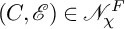 $(C, \mathscr {E}) \in \mathscr {N}_{\chi }^F$
, let
 $u^{\bullet } \in C^F$
be a split element, and assume that
 $(C,\mathscr {E}) \leftrightarrow (u^{\bullet },\rho )$
. For each
 $(L, C_0, \mathscr {E}_0) \in \mathscr {M}_G^F$
, let
 $u_0^{\bullet } \in C_0^F$
be a split element as above (applied for L), and assume that
 $(C_0,\mathscr {E}_0) \leftrightarrow (u_0^{\bullet }, \rho _0)$
. Then, for each
 $(C,\mathscr {E})$
belonging to the series
 $(L,C_0,\mathscr {E}_0)$
, we have
 $\gamma (u_0^{\bullet }, \widetilde \rho _0, u^{\bullet }, \widetilde \rho ) = 1$
, where
 $\widetilde \rho _0 \in \widetilde A_L(u_0^{\bullet }){}^{\wedge }$
(resp.
 $\widetilde \rho \in \widetilde A_G(u^{\bullet }){}^{\wedge }$
) is the split extension of
 $\rho _0$
(resp.
 $\rho $
).
Proof Take
 $(u, \rho ) \leftrightarrow (C, \mathscr {E}) \in (\mathscr {N}_G)_{\chi }^F$
with
 $C = C_{\lambda }$
. We consider an F-stable Levi subgroup M of G as in 4.4. Then, there exists
 $\lambda ' \in \mathscr {P}_{n-2d}$
such that
 $(\lambda , \lambda ')$
is in the case (I)
 $\sim $
(III) in 4.5. Take
 $(u',\rho ') \leftrightarrow (C',\mathscr {E}') \in (\mathscr {N}_M)_{\chi }^F$
. By the restriction formula,
 $\rho \otimes \rho ^{\prime *}$
appears in the representation
 $\varepsilon _{u,u'}$
. We assume that
 $u \in C^F$
is a split element. Then, by Proposition 4.11, there exists a split element
 $u' \in C^{\prime \,F}$
such that F acts trivially on the isotypic subspace of
 $\rho \otimes \rho ^{\prime *}$
in
 $\varepsilon _{u,u'}$
. Then, by (1.8.1),
 $\sigma _{\rho ,\rho '}: M_{\rho ,\rho '} \to M_{\rho ,\rho '}$
is a scalar multiplication by
 $q^{-(\dim C - \dim C')/2 + \dim U_Q}$
. By induction on n, we may assume that
 $q^{-(a_0'+ r')/2}\sigma _{(u',\rho ')}$
makes the irreducible
 $S_{n/d -2}$
module
 $V_{(u',\rho ')}$
to the preferred extension to
 $\widetilde S_{n/d - 2}$
. Then,
 $q^{-(a_0 + r)/2}\sigma _{(u,\rho )}$
makes the irreducible
 $S_{n/d}$
-module
 $V_{(u,\rho )}$
to the preferred extension to
 $\widetilde S_{n/d}$
. This implies, by (1.8.2), that
 $\gamma (u,\widetilde \rho , u_0, \widetilde \rho _0) = 1$
. It remains to consider the case where
 $n = d$
,
 $(u,\rho ) \leftrightarrow (C_{\lambda }, \mathscr {E}) \in \mathscr {N}_{\chi }$
. But in this case,
 $\lambda = (d)$
and u is regular unipotent,
 $\rho = \chi \in A_G(u){}^{\wedge } = Z^{\wedge }$
. Then
 $(C, \mathscr {E})$
is a cuspidal pair, and we have
 $\gamma = 1$
automatically. The theorem is proved.
Remark 4.14. In the proof of Theorem 4.13, we have assumed that F is of nonsplit type. But the argument there works well for the split case, under a suitable modification, and it gives a proof of Theorem 1.5 for the split case. Of course, in the split case, one can use
 $M \simeq S(GL_d \times GL_{n-d})$
, which makes the argument simpler. In any case, if we use the restriction formula (1.8.1), the discussion turns out to be much simpler compared with that used in [S3, I].


