






No CrossRef data available.
Article contents
Quantifying the role of neurons for behavior is a mediation question
Published online by Cambridge University Press: 28 November 2019
Abstract
Many systems neuroscientists want to understand neurons in terms of mediation; we want to understand how neurons are involved in the causal chain from stimulus to behavior. Unfortunately, most tools are inappropriate for that while our language takes mediation for granted. Here we discuss the contrast between our conceptual drive toward mediation and the difficulty of obtaining meaningful evidence.
Information
- Type
- Open Peer Commentary
- Information
- Copyright
- Copyright © Cambridge University Press 2019
References
Angrist, J. & Krueger, A. (2001) Instrumental variables and the search for identification: From supply and demand to natural experiments. Journal of Economic Perspectives 15(4):69–85.CrossRefGoogle Scholar
Ashida, G. & Carr, C. E. (2011) Sound localization: Jeffress and beyond. Current Opinion in Neurobiology 21(5):745–51.CrossRefGoogle ScholarPubMed
Glaser, J. I., Perich, M. G., Ramkumar, P., Miller, L. E. & Kording, K. P. (2018) Population coding of conditional probability distributions in dorsal premotor cortex. Nature Communications 9:1788.CrossRefGoogle ScholarPubMed
Jazayeri, M. & Movshon, J. A. (2006) Optimal representation of sensory information by neural populations. Nature Neuroscience 9(5):690–96.CrossRefGoogle ScholarPubMed
Kawashima, T., Zwart, M. F., Yang, C.-T., Mensh, B. D. & Ahrens, M. B. (2016) The serotonergic system tracks the outcomes of actions to mediate short-term motor learning. Cell 167, 933–46.e20.CrossRefGoogle ScholarPubMed
Klein, D. J., König, P. & Körding, K. P. (2003) Sparse spectrotemporal coding of sounds. EURASIP Journal on Advances in Signal Processing 2003;2003:902061.CrossRefGoogle Scholar
Körding, K. P., Kayser, C., Einhäuser, W. & König, P. (2004) How are complex cell properties adapted to the statistics of natural stimuli? Journal of Neurophysiology 91:206–12.CrossRefGoogle ScholarPubMed
Körding, K. P. & Wolpert, D. M. (2004) Bayesian integration in sensorimotor learning. Nature 427:244–47.CrossRefGoogle ScholarPubMed
Körding, K. P. & Wolpert, D. M. (2006) Bayesian decision theory in sensorimotor control. Trends in Cognitive Sciences 10:319–26.CrossRefGoogle ScholarPubMed
Latimer, K. W., Yates, J. L., Meister, M. L. R., Huk, A. C. & Pillow, J. W. (2015) NEURONAL MODELING. Single-trial spike trains in parietal cortex reveal discrete steps during decision-making. Science 349:184–87.Google ScholarPubMed
Perlmutter, J. S. & Mink, J. W. (2006) Deep brain stimulation. Annual Review of Neuroscience 29:229–57.CrossRefGoogle ScholarPubMed
Serruya, M. D., Hatsopoulos, N. G., Paninski, L., Fellows, M. R. & Donoghue, J. P. (2002) Instant neural control of a movement signal. Nature 416:141–2.CrossRefGoogle ScholarPubMed
Stevenson, I. H., Cherian, A., London, B. M., Sachs, N. A., Lindberg, E., Reimer, J., Slutzky, M. W., Hatsopoulos, N. G., Miller, L. E. & Kording, K. P. (2011) Statistical assessment of the stability of neural movement representations. Journal of Neurophysiology 106(2):764–74.CrossRefGoogle ScholarPubMed
Stevenson, I. H. & Kording, K. P. (2011) How advances in neural recording affect data analysis. Nature Neuroscience 14:139–42.CrossRefGoogle Scholar
Vilares, I., Howard, J. D., Fernandes, H. L., Gottfried, J. A. & Kording, K. P. (2012) Differential representations of prior and likelihood uncertainty in the human brain. Current Biology 22:1641–48.CrossRefGoogle ScholarPubMed
Wolpaw, J. R., Birbaumer, N., Heetderks, W. J., McFarland, D. J., Peckham, P. H., Schalk, G., Donchin, E., Quatrano, L. A., Robinson, C. J. & Robinson, C. J. (2000) Brain-computer interface technology: A review of the first international meeting. IEEE Transactions on Rehabilitative Engineering 8:164–73.CrossRefGoogle ScholarPubMed
Wolpert, D. H. & Macready, W. G. (1997) No free lunch theorems for optimization. IEEE Transactions on Evolutionary Computation 1:67–82.CrossRefGoogle Scholar
Wurtz, R. H. (2009) Recounting the impact of Hubel and Wiesel. Journal of Physiology 587:2817–23.CrossRefGoogle ScholarPubMed
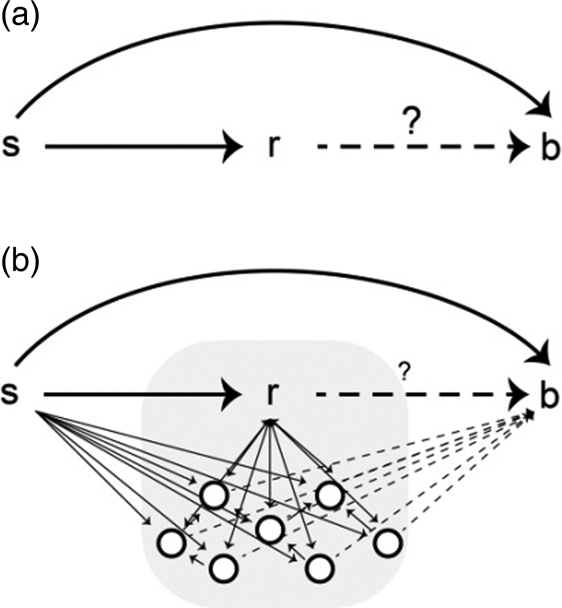
Figure 1. How should we think about mediation? (A) If we record from all the relevant mediators, then we can readily analyze mediation. (B) If we only partially record activities, then an analysis is very complicated.
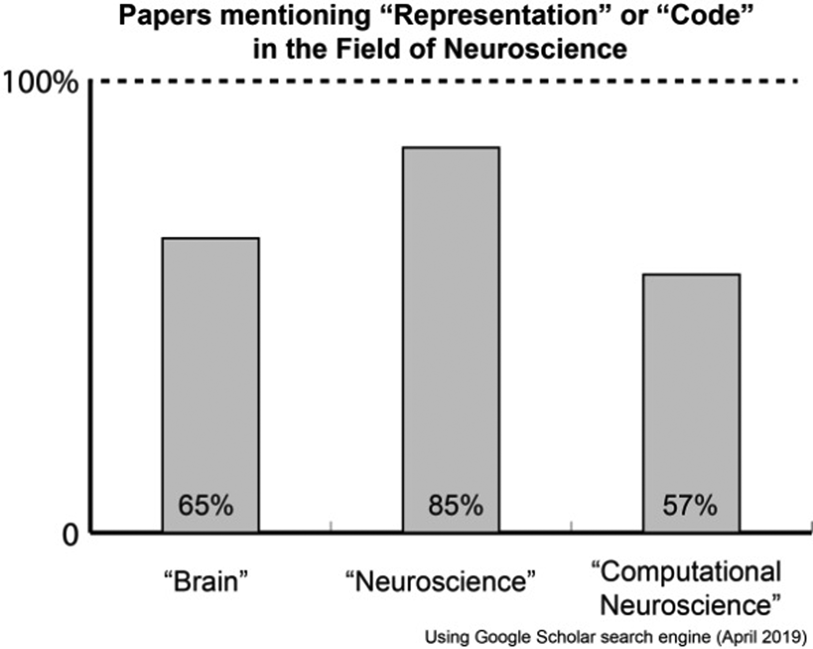
Figure 2. The use of representation and code is ubiquitous in our field.
Target article
Related commentaries (27)
Beyond Neural Coding? Lessons from Perceptual Control Theory
From mental representations to neural codes: A multilevel approach
Generative models as parsimonious descriptions of sensorimotor loops
Is information theory, or the assumptions that surround it, holding back neuroscience?
Neural codes – Necessary but not sufficient for understanding brain function
Plasticity of the neural coding metaphor: An unnoticed rhetoric in scientific discourse
Arguably the most popular question in systems neuroscience is about mediation: We want to know how neurons contribute to the translation from stimuli via groups of neurons to behaviors. Consequently, the field's review papers and discussion sections saliently talk about mediation as do our own papers (Vilares et al. Reference Vilares, Howard, Fernandes, Gottfried and Kording2012). In systems neuroscience in particular, elucidating the function or role of neurons in circuits, pathways, and networks that mediate behavior is the field's imperative. As Brette points out, neurons are said to represent stimuli with which we also mean that these neurons are important to behavior (Kording et al. Reference Körding, Kayser, Einhäuser and König2004; Stevenson et al. Reference Stevenson, Cherian, London, Sachs, Lindberg, Reimer, Slutzky, Hatsopoulos, Miller and Kording2011; Vilares et al. Reference Vilares, Howard, Fernandes, Gottfried and Kording2012). Relatedly, neurons are said to encode stimuli with which we mean that they are eventually decoded and hence have a causal impact (Brette, target article; Glaser et al. Reference Glaser, Perich, Ramkumar, Miller and Kording2018; Jazayeri & Movshon Reference Jazayeri and Movshon2006; Klein et al. Reference Klein, König and Körding2003). There are only small sections of systems neuroscience that do not aim primarily at causal descriptions. For example, Bayesian psychophysicists often do not make mechanism claims when they point out that behavior is close to optimal (Kording & Wolpert Reference Körding and Wolpert2004; Reference Körding and Wolpert2006). Similarly, neuroengineers trying to use brain activity to control a prosthetic device do not need to make causal assumptions (Wolpaw et al. Reference Wolpaw, Birbaumer, Heetderks, McFarland, Peckham, Schalk, Donchin, Quatrano, Robinson and Robinson2000). But by and large, the world of ideas in systems neuroscience is a world of mediation mechanisms and algorithms; it is a world of causality.
How should we think about mediation? (A) If we record from all the relevant mediators, then we can readily analyze mediation. (B) If we only partially record activities, then an analysis is very complicated.
When thinking about data, it is natural to think about the events that we are measuring. If we assume a typical recording-only experiment, we have a stimulus s, the activity r that is recorded, and a behavior b, we can make our mediation question clear. Does r mediate the influence of s on b? We can measure the causal effect of s on r. We can also observe the relation between s and b. When only s, r, and b are involved, the causal inference technique called instrumental variable analysis (Angrist & Krueger Reference Angrist and Krueger2001) allows us to calculate the causal influence of the activity r onto the behavior as
where the causal effect of r onto b can be determined by the ratio of measured covariances between s and b, and between s and r. For a fixed stimulus, r will have a probability distribution (p(r|s)), and the correlation of this with b allows us to estimate the causal mediation effect. The necessary criterion for this reasoning is that there are no causal paths between the variables we reason about that we cannot know. Importantly, if the rest of the brain does not exist, then this way of thinking about mediation analysis is perfectly good. We argue that the way we think about representations and encoding intuitively draws on this idea.
However, we typically record only a tiny proportion of all neurons (Stevenson & Kording Reference Stevenson and Kording2011). Confounding then makes mediation analysis impossible. Any stimulus-behavior correlation could be due to the neurons we did record or due to other neurons that we did not. Similarly, correlations between neurons can be induced by a paired interaction or indirectly by common input from other neurons. Once our assumptions of full knowledge are violated, our estimates can be arbitrarily off, and our ability to do mediation analysis is gone. We do not learn about the flow of information, or about causal chains, from the kinds of experiments popular in neuroscience.
It is possible to do experiments that get far closer to meaningful claims about mediation. There are four well-established aspects that jointly make mediation more believable.
1. Correlation: Neurons relate to the relevant stimulus aspects and behavior.
2. Necessity: If the neurons are inactivated the behavior is gone.
3. Sufficiency: if the neurons are activated the behavior occurs.
4. Exclusion: The activity is not seen in parallel streams.
Such experiments are beautiful, rare (Kawashima et al. Reference Kawashima, Zwart, Yang, Mensh and Ahrens2016), and generally not doable in typical mammalian settings. However, if we are after mediation effects, then these experiments should be done (Latimer et al. Reference Latimer, Yates, Meister, Huk and Pillow2015).
Wordings like representation and encoding implicitly suggest that we can arrive at mediation results and, so we argue, are thus popular in neuroscience (Fig 2). Brette points out that this use of language implies that there is a causal relationship between a stimulus and an encoder and between an encoder and an assumed decoder (as in our instrumental variable case). By consistently using words that imply mediation, we are depriving the field of clarity. Language affects the way we formulate models, which in turn affects the experiments we do. As such, it is not just language, but it is the core of what we do as a field.
The use of representation and code is ubiquitous in our field.
The focus of the field of mediation analysis may relate to our relative lack of real theories. Mainstream neuroscience theory subscribes to neurons influencing one another and neurons within the same area being similar to one another. But, in a way, those kinds of theories neither do justice to the complex zoo of neural properties nor make the set of possible interpretations of brain data much smaller. If we had meaningful theories, we could test their predictions. Lacking theories, we then simply go for an intuitive mediation analysis, which cannot be well supported by typical experiments. Real theory, including theory that can deal with recurrent systems with circular causality, is needed to break our conceptual reliance of ideas of mediation.
Much of what we know about brains comes from the mapping of stimulus-response curves (Wurtz Reference Wurtz2009). We were enabled to develop prosthetic devices (Wurtz Reference Wurtz2009; Serruya et al. Reference Serruya, Hatsopoulos, Paninski, Fellows and Donoghue2002) and new treatments for neurological diseases (Perlmutter & Mink Reference Perlmutter and Mink2006). However, we should not take this impressive story of success as a sign that we do not need to clearly think about what exactly these findings mean. The focus on encoding and representation, if anything, detracts from the importance of the past findings of the field and prevents it from asking how we should think about brains. Moving forward, the field needs to invest in transcending our current theories to make real testable predictions to provide greater precision and logical power to our experiments and understanding of the brain. But tuning curves by themselves can never produce an understanding. After all, we know that theory-free learning about a system is provably impossible (Wolpert & Macready Reference Wolpert and Macready1997).