Introduction
The US Army suicide rate has climbed steadily since deployments began for Operation Enduring Freedom (OEF) in 2001 and Operation Iraqi Freedom (OIF) in 2003 (Armed Forces Health Surveillance Center, 2012), doubling between 2004 and 2009 (Schoenbaum et al. Reference Schoenbaum, Kessler, Gilman, Colpe, Heeringa, Stein, Ursano and Cox2014) to exceed the matched civilian rate for the first time in documented US military history (Bachynski et al. Reference Bachynski, Canham-Chervak, Black, Dada, Millikan and Jones2012). Most hypotheses to explain this trend emphasize the importance of combat-related experiences in causing suicides (Nock et al. Reference Nock, Deming, Fullerton, Gilman, Goldenberg, Kessler, McCarroll, McLaughlin, Peterson, Schoenbaum, Stanley and Ursano2013). However, as the likelihood of such experiences varies with military occupation, military occupation would be expected to be predict suicide, especially among soldiers with a history of deployment. Yet no previous research has examined differences in Army suicides as a joint function of occupation and deployment history. Evidence for such an interaction could have important implications for targeting preventive interventions.
Research on civilian suicides has documented high suicide rates in several occupations, such as healthcare workers (Hawton & Vislisel, Reference Hawton and Vislisel1999) and farmers (Browning et al. Reference Browning, Westneat and McKnight2008), thought to have high rates of stress (Hawton et al. Reference Hawton, Clements, Sakarovitch, Simkin and Deeks2001; Hanigan et al. Reference Hanigan, Butler, Kokic and Hutchinson2012) and easy access to lethal means (toxic medications among healthcare workers, pesticides among farmers) (Yip et al. Reference Yip, Caine, Yousuf, Chang, Wu and Chen2012). Two comparable studies examined occupational differences in US military suicides. The first considered the 84 military occupations accounting for at least 1% of service-specific suicides in 1980–1992 (Helmkamp, Reference Helmkamp1996). Only two occupations, Army infantryman and Marine small-arms technicians, had significantly elevated rates, but this could have been due to the fact that the disaggregation of occupations into 84 different categories resulted in the number of people in each category being too small to identify meaningful differences that would have been detected in broader categories. The second study addressed the disaggregation problem by comparing 2001–2010 suicide rates across broader occupational groupings defined by the first two digits of the Department of Defense (DoD) six-digit occupational coding system standardized for differences in age, sex and history of combat deployment (Trofimovich et al. Reference Trofimovich, Reger, Luxton and Oetjen-Gerdes2013). Only the infantry, gun crew and seamanship specialist occupational group, which represented 24.9% of all personnel in groups having at least 25 suicides, had a significantly elevated rate.
The fact that the high-risk occupations in both these studies were combat arms occupations (i.e. occupations defined primarily by participation in combat) (Armed Forces Staff College, 1991) makes sense because combat arms occupations are those most exposed to the combat-related stresses presumed to account for the rising military suicide rate (Nock et al. Reference Nock, Deming, Fullerton, Gilman, Goldenberg, Kessler, McCarroll, McLaughlin, Peterson, Schoenbaum, Stanley and Ursano2013). However, two subsequent reports, one based on a large sample (LeardMann et al. Reference LeardMann, Powell, Smith, Bell, Smith, Boyko, Hooper, Gackstetter, Ghamsary and Hoge2013) and the other the entire population (Reger et al. Reference Reger, Smolenski, Skopp, Metzger-Abamukang, Kang, Bullman, Perdue and Gahm2015) of military personnel serving during the OEF/OIF years, called this interpretation into question by finding that deployment history was not associated with suicide deaths. Yet neither of these studies examined this association separately in the roughly one-fourth of uniformed services personnel who have combat arms occupations. It might be that the association is significant in this segment of the force even though it is not significant in the entire force. Such a specification, if it existed, would be useful in calling attention to the need for preventive interventions for deployment-related suicide in combat arms occupations. We investigate this possibility in the current report by determining whether the previously documented high suicide rate in combat arms occupations is most pronounced among the currently deployed and previously deployed and either does not exist or is attenuated among the never deployed.
Method
Sample
Analysis was based on the Historical Administrative Data System (HADS) administrative dataset of the Army Study to Assess Risk and Resilience in Servicemembers (Army STARRS) (Ursano et al. Reference Ursano, Colpe, Heeringa, Kessler, Schoenbaum and Stein2014). The HADS combined de-identified data from numerous military administrative databases for all soldiers on active duty 2004–2009 (Kessler et al. Reference Kessler, Colpe, Fullerton, Gebler, Naifeh, Nock, Sampson, Schoenbaum, Zaslavsky, Stein, Ursano and Heeringa2013). The HADS data considered in the current report came from: the DoD Defense Manpower Data Center (DMDC) Master Personnel & Transaction Files (sociodemographic and Army career characteristics); the DMDC Contingency Tracking System (activations, mobilizations, deployments); the Medical Data Repository and Theater Medical Data Store (treated mental disorders); and the Armed Forces Medical Examiner Tracking System (suicides). As our focus was on combat arms versus other occupations, analysis was limited to males because many combat arms occupations were closed to women during the years considered here. We also focused exclusively on enlisted soldiers (i.e. we excluded officers) because 92% of male suicides over the study period occurred to enlisted soldiers (Gilman et al. Reference Gilman, Bromet, Cox, Colpe, Fullerton, Gruber, Heeringa, Lewandowski-Romps, Millikan-Bell, Naifeh, Nock, Petukhova, Sampson, Schoenbaum, Stein, Ursano, Wessely, Zaslavsky and Kessler2014).
The 729 337 male enlisted Regular Army soldiers in service at some time in 2004–2009 had a mean 36.6 months in service over those years (26 694 445 person-months). The analysis focused on comparisons of variables in person-months with suicides versus other person-months. Given that there were roughly 5000 times as many non-suicide person-months as suicide person-months, we selected a random sample of non-suicide person-months stratified by sex, rank, time-in-service, deployment status and historical time equal to roughly 100 times the number of suicide person-months for the analysis in order to reduce the computational intensity of the comparisons. Each sampled non-suicide person-month was weighted by the inverse of its probability of selection to adjust for its undersampling. This subsampling and weighting approach is conventional and results in unbiased estimates of odds ratios (ORs) and confidence intervals (CIs) (Schlesselman, Reference Schlesselman1982).
We also searched for interactions between combat arms occupations and deployment in predicting suicide based on the documented existence of a ‘healthy warrior’ effect in predicting deployment: that is, a pattern whereby soldiers with prior mental disorders are less likely than other soldiers to deploy either because of early attrition or being held back (Larson et al. Reference Larson, Highfill-McRoy and Booth-Kewley2008; Wilson et al. Reference Wilson, Jones, Fear, Hull, Hotopf, Wessely and Rona2009). Previous research on the healthy warrior effect never looked for variation in this association as a function of military occupation. If the association is more pronounced among soldiers with combat arms than other occupations, it would induce an interaction between combat arms occupations and deployment predicting suicide. Such a difference could occur in either of two ways. First, the stressful nature of combat arms training might lead to psychologically vulnerable combat arms soldiers being more likely than those in other occupations either to leave service prematurely or to be detected as ineligible for deployment by their leaders. Second, leaders might weigh psychological vulnerability more heavily in selecting soldiers for deployment in combat arms than other occupations. This possible differential healthy warrior effect was evaluated using information in electronic medical records on treated mental disorders among never-deployed soldiers to investigate differential associations with subsequent deployment among soldiers with combat arms versus other occupations.
Measures
Occupation
The DMDC Active Duty Master Personnel File (ADMPF) recognized 483 enlisted soldier occupations during the study period (US Army, 2015). We focused on duty occupations (jobs performed in the month of observation). Consistent with previous work on occupational differences in soldier health (Lindstrom et al. Reference Lindstrom, Smith, Wells, Wang, Smith, Reed, Goldfinger and Ryan2006; Niebuhr et al. Reference Niebuhr, Krampf, Mayo, Blandford, Levin and Cowan2011; Gubata et al. Reference Gubata, Piccirillo, Packnett and Cowan2013), we distinguished combat arms occupations from combat support (providing operational assistance to combat arms) and combat service support (all other Army occupations) (Kirin & Winkler, Reference Kirin and Winkler1992; Layne et al. Reference Layne, Naftel, Thie and Kawata2001) occupations. Within combat arms, the five infantry occupations (e.g. indirect fire infantryman, heavy anti-armor weapons infantryman) were collapsed into a single infantry category, while cannon crewmember and M1 armor crewman occupations were collapsed into a second single category based on closely related occupational duties. One other combat arms occupation, cavalry scout, and the three under the category of combat engineer (i.e. soldiers who perform construction and demolition tasks under combat conditions) were considered separately because each contained enough soldiers to have an expected number of 10+ suicides over the study period. The remaining 28 combat arms occupations closed to women were collapsed into a residual ‘other’ category. Among the combat arms occupations open to women, we collapsed the 21 involving transportation into a single category, while the 12 remaining were collapsed into a residual ‘other’ category. These coding decisions resulted in a total of seven combat arms categories.
Combat support and combat service support occupations were organized using the Army's nine-category occupational classification system (US Army, 2015): administrative support (41 occupations); intelligence and combat support (67 occupations); arts and media (29 occupations); legal and law enforcement (seven occupations); mechanics (127 occupations); computers and technology (24 occupations); medical and emergency (44 occupations); construction and engineering (44 occupations); and transportation and aviation (15 occupations exclusive of the additional 21 transportation occupations in combat arms). Five of the broad combat support categories and six of the combat service support categories contained enough soldiers to have an expected number of 10+ suicides over the study period and were consequently examined separately along with collapsed residual categories of all other combat support and all other combat service support occupations. These coding decisions resulted in a total of six occupational categories in combat support and seven in combat service support. Although trainee occupation categories were collapsed with their non-trainee counterparts whenever possible, this could not be done for 13 non-specific training categories (e.g. unassigned trainees, active duty medical hold) that we consequently classified as part of other combat service support.
HADS sociodemographic and Army career control variables
The ADMPF and DMDC Contingency Tracking Systems were used to create a series of sociodemographic and Army career variables suggested by previous research (Bell et al. Reference Bell, Harford, Amoroso, Hollander and Kay2010; Black et al. Reference Black, Gallaway, Bell and Ritchie2011; Bachynski et al. Reference Bachynski, Canham-Chervak, Black, Dada, Millikan and Jones2012; Hyman et al. Reference Hyman, Ireland, Frost and Cottrell2012) to predict suicide. The subset of these variables found to be significant in previous HADS analyses (Gilman et al. Reference Gilman, Bromet, Cox, Colpe, Fullerton, Gruber, Heeringa, Lewandowski-Romps, Millikan-Bell, Naifeh, Nock, Petukhova, Sampson, Schoenbaum, Stein, Ursano, Wessely, Zaslavsky and Kessler2014) were included as control variables: age, sex, race–ethnicity, marital status, age at enlistment, Armed Forces Qualification Test scores at enlistment, number of years in service, Command (the major organizational subdivision of the Army), and current (in the person-month) deployment either in a combat zone or in direct support outside the combat zone of OEF/OIF. We also controlled for current deployment status, time in current deployment, number of prior deployments, length of most recent deployment, time since ending most recent deployment, and dwell time (i.e. amount of time between end of second most recent deployment and beginning of the most recent deployment).
Treated mental disorders
Information on treated mental disorders was obtained from electronic medical records in the Medical Data Repository and Theater Medical Data Store. Mental disorders were defined using International Classification of Diseases, Ninth Revision, Clinical Modification (ICD-9-CM) diagnoses 290–319. Treatment was coded for number of in-patient days and separately for number of out-patient visits in the prior 12 and 48 months.
Analysis methods
Cross-tabulations were used to calculate suicide rates within each of the 20 occupational categories. Consistent with previous HADS analyses (Gilman et al. Reference Gilman, Bromet, Cox, Colpe, Fullerton, Gruber, Heeringa, Lewandowski-Romps, Millikan-Bell, Naifeh, Nock, Petukhova, Sampson, Schoenbaum, Stein, Ursano, Wessely, Zaslavsky and Kessler2014), discrete-time survival models with person-month the unit of analysis and a logistic link function (Willett & Singer, Reference Willett and Singer1993) were used to examine joint associations of occupation, deployment status history (never deployed, currently deployed, previously deployed), and their interaction with suicide controlling for time, sociodemographics and Army career variables to determine if the higher suicide rate in combat arms occupations varied with deployment status history. We subsequently expanded the controls to include information about treated mental disorders in the prior 12 and 48 months. An additional analysis designed to study a possible differential healthy warrior effect examined whether the associations of prior treated mental disorders with subsequent first deployment among the never-deployed soldiers varied by occupation.
Consistent with standard practice in survival analysis, respondents were removed from the dataset in the month after death or termination of service. Survival coefficients and their standard errors were exponentiated to create ORs and 95% CIs. Statistical significance was evaluated using 0.05-level two-sided tests. All HADS analyses were carried out with SAS version 9.3 (SAS Institute Inc., 2010) using proc surveyfreq to estimate prevalence and proc surveylogistic to estimate discrete-time survival models.
Results
Distributions of Military Occupation Specialties (MOS) categories by deployment
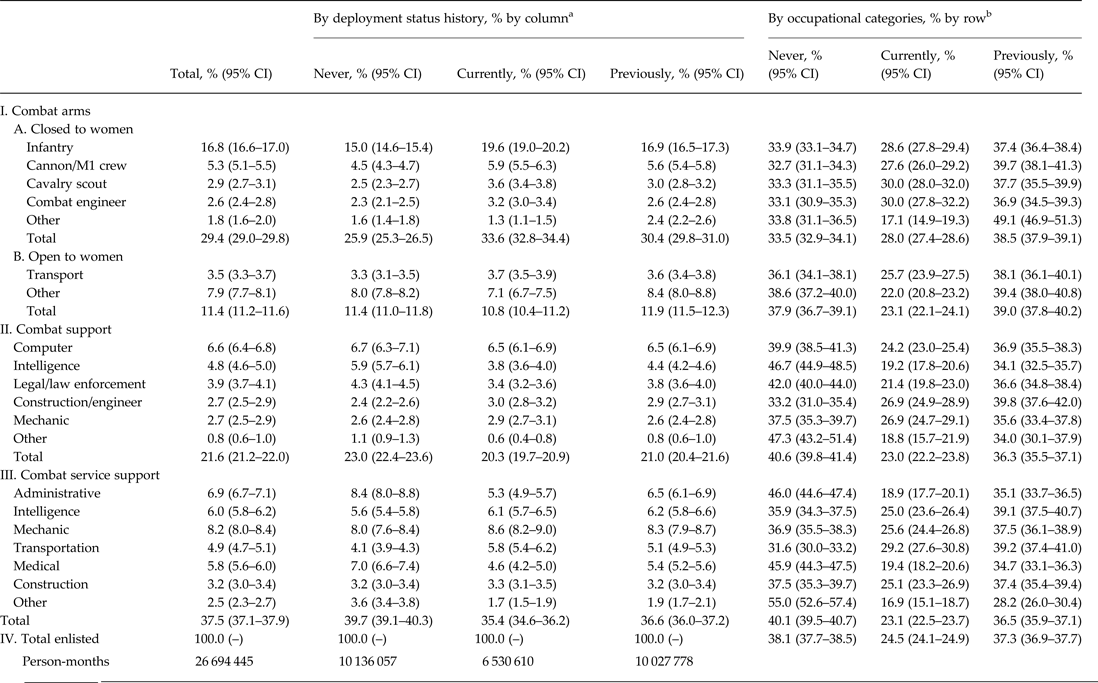
As noted above, the HADS sample consists of all suicide person-months and a representative sample of non-suicide person-months with a sum of weights equal to the 26 694 445 person-months for the 729 337 male enlisted Regular Army soldiers in the Army at some time in 2004–2009 who were on active duty. Close to one-fourth (24.4%) of the population was currently deployed in a given month over that time period, while 37.6% had previously deployed and the remaining 38.0% had never deployed. It is noteworthy that 12.1% of all enlisted male Regular Army soldiers over this time period were in their first year of service. This proportion is considerably smaller than the 38.0% of male soldiers that had never deployed, demonstrating that never-deployed soldiers are not dominated by new soldiers in training. We did not distinguish between new soldiers still in training and the other never-deployed soldiers, as this was not a relevant distinction for the current analysis. However, as noted above, we did control for time in service in the survival analysis (Table 1). The proportions of currently and previously deployed were highest among soldiers with combat arms occupations (28.0–38.5% in occupations closed to women; 23.1–39.0% in those open to women), while the proportions never deployed were highest among soldiers with combat support (40.6%) and combat service support (40.1%) occupations. Overall variation in deployment status history by occupational categories was statistically significant (χ2 38 = 167.2, p < 0.001).
Distribution of all person-months of service of male enlisted Regular Army soldiers on duty during the years 2004–2009 by collapsed occupational categories in the Army STARRS 2004–2009 Historical Administrative Data System (n = 729 337soldiers; n = 26 694 445 person-months) a

Army STARRS, Army Study to Assess Risk and Resilience in Servicemembers; CI, confidence interval.
a See the text for a discussion of case–control sampling and weighting.
b Occupation distributions differ significantly by deployment (χ2 38 = 167.2, p < 0.001).
Gross occupational differences in suicide rates
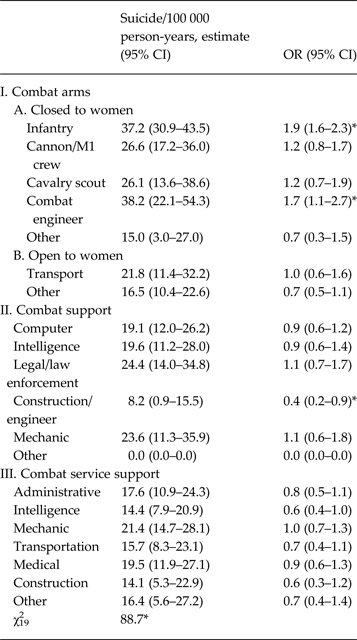
The overall suicide rate among male enlisted Regular Army soldiers over the study period was 22.4/100 000 person-years (n = 496 suicides). Only two of the 20 occupational categories considered here, both of them combat arms occupations closed to women, had suicide rates significantly higher than those of other soldiers: infantrymen (37.2/100 000 person-years; OR 1.9, 95% CI 1.6–2.3) and combat engineers (38.2/100 000 person-years; OR 1.7, 95% CI 1.1–2.7) (Table 2). Infantrymen made up 16.8% of all soldiers and accounted for 28.0% of all suicides, while combat engineers made up 2.6% of all soldiers and accounted for 4.4% of all suicides. The 10.0% of other soldiers in the remaining combat arms occupations closed to women accounted for 10.9% of all suicides.
Suicide rates (suicides/100 000 person-years) a for each collapsed occupational category and bivariate associations (OR) comparing the suicide rate in each category with the rate among all other male Regular Army enlisted soldiers in the Army STARRS 2004–2009 Historical Administrative Data System ( n = 729 337 soldiers; n = 26 694 445 person-months) a

OR, Odds ratio; Army STARRS, Army Study to Assess Risk and Resilience in Servicemembers; CI, confidence interval.
a See the text for a discussion of case–control sampling and weighting.
* Significant (p < 0.05; two-sided test).
Suicide rates by occupation and deployment status
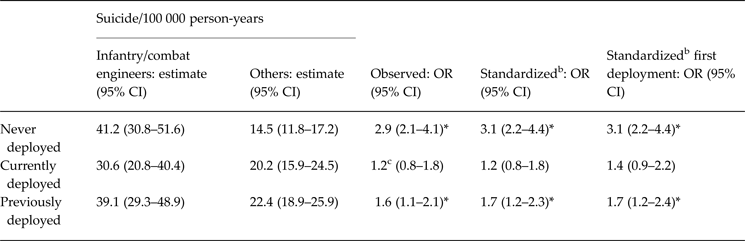
Subsequent analyses combined and compared infantrymen and combat engineers with all other enlisted soldiers. As hypothesized, a significant interaction was found between the dummy predictor variable for being either an infantryman or combat engineer and deployment status in predicting suicide (χ2 2 = 6.7, p = 0.030). However, the shape of this interaction was completely different from the one expected, as the interaction was due to the suicide rate of infantrymen and combat engineers being highest when never deployed (41.0–41.9/100 000 person-years in the two categories separately; 41.2/100 000 person-years when combined) and lowest when currently deployed (30.0–34.7/100 000 person-years in the two categories separately; 30.6/100 000 person-years when combined), whereas the suicide rate of all other soldiers combined was lowest when never deployed (14.5/100 000 person-years) and highest when currently deployed or previously deployed (20.2–22.4/100 000 person-years) (Table 3). These differences led to the OR of suicides for infantrymen and combat engineers versus other soldiers being highest among the never deployed (OR 2.9, 95% CI 2.1–4.1), lower among the previously deployed (OR 1.6, 95% CI 1.1–2.1), and non-significant among the currently deployed (OR 1.2, 95% CI 0.8–1.8). These differences were stable over time, as indicated by the ORs for infantrymen and combat engineers versus other soldiers being quite similar in 2004–2006 and 2007–2009 (2.4–3.2 among the never deployed, 1.1–1.5 among the currently deployed, and 1.4–1.7 among the previously deployed).
Observed and standardized comparisons of the suicide rates (suicides/100 000 person-years) a of infantrymen and combat engineers versus all other male Regular Army enlisted soldiers in the Army STARRS 2004–2009 Historical Administrative Data System (n = 729 337soldiers; n = 26 694 445 person-months) a

Army STARRS, Army Study to Assess Risk and Resilience in Servicemembers; CI, confidence interval; OR, odds ratio.
a Based on discrete-time (person-month) survival models. All models included control variables for calendar month to adjust for the suicide rate increasing over the study period, sociodemographics, and Army career characteristics found in previous Army STARRS analyses to be significant predictors of suicide.
b Results in the Standardized column are based on a version of the data in which the distribution of the cross-classification of treatment for mental or substance disorders in the prior 12 months and prior 48 months (in-patient, out-patient 1–5 visits, out-patient 6+ visits, none) was weighted to have the same distributions among infantrymen and combat engineers as other male Regular Army enlisted soldiers within each of the three deployment history categories. Results in the Standardized first deployment column restricted currently deployed soldiers to those in their first deployment and previously deployed soldiers to those who had only one deployment prior to standardization.
c The ratio of 30.6/20.2 = 1.5, whereas the ‘observed’ OR reported here is 1.2. This difference is more pronounced among the currently deployed than the never deployed (where the rate ratio is 2.8 compared with the OR of 2.9) or previously deployed (where the rate ratio is 1.7 compared with the OR of 1.6) because the joint associations of the control variables with occupation and suicide are stronger among currently deployed than never-deployed or previously deployed soldiers.
* Significant difference between infantrymen/combat engineers and other soldiers (p < 0.05; two-sided test).
We investigated the possibility that the higher OR of suicide among infantrymen and combat engineers versus other soldiers when never deployed than when currently deployed or previously deployed was due to pre-existing mental disorders being more strongly associated with low probability of deployment among infantrymen and combat engineers than other soldiers. Consistent with previous research, we found that never-deployed soldiers with a history of treated mental disorders (in-patient treatment and/or out-patient treatment with 6+ visits) were significantly less likely than others with the same sociodemographic and career characteristics subsequently to deploy (OR 0.7, 95% CI 0.7–0.7). This association was somewhat, but not markedly, stronger among infantrymen and combat engineers than other soldiers (with an interaction of OR 0.9, 95% CI 0.8–0.9).
In order to investigate the implications of adjusting for this small difference, we standardized the distribution of prior treatment of mental disorders to be the same for infantrymen and combat engineers as other soldiers within deployment statuses and recalculated the ORs of suicide for infantrymen and combat engineers versus other soldiers within deployment status using these standardized data. The ORs were very similar to those based on the observed data before standardization (Table 3). The same was true when we limited analysis to currently deployed soldiers in their first deployment and previously deployed soldiers with a history of exactly one deployment.
We also carried out a broader test of a possible differential healthy warrior effect by examining the OR of suicides among never-deployed infantrymen and combat engineers versus other never-deployed soldiers during the first 2 years of service. We would expect this OR to be substantially attenuated if it was caused by a differential health warrior effect because deployments typically occur only after 2 years of service. As it happened, though, the OR was significant in the first 2 years of service (OR 2.2, 95% CI 1.4–3.5) and did not differ significantly from the OR in the 3rd–4th years of service (OR 4.7, 95% CI 2.4–9.4) or 5th+ years of service (OR 2.9, 95% CI 1.3–6.2) (χ2 2 = 3.5, p = 0.17).
Discussion
This study has a number of important limitations. First, our 20-category occupational classification scheme was developed ad hoc and had too high a level of aggregation to study suicide rates in uncommon occupations. Second, further imprecision was introduced into the occupational classification scheme by the fact that the duties actually performed by soldiers are sometimes less distinct than those described in official occupational designations. This is especially true during deployment, which might at least partially account for the weaker association between occupation and suicide among the currently deployed. Third, some Army suicides might have been inaccurately classified as accidental or undetermined deaths (Carr et al. Reference Carr, Hoge, Gardner and Potter2004), although methodological research suggests that such errors are uncommon (Huguet et al. Reference Huguet, Kaplan and McFarland2014). Fourth, while the Army suicide rate turned sharply upward in 2008, HADS data were not available beyond 2009. Fifth, we were unable to study suicides of veterans after separation from the Army because we had no access to that information. This made it impossible for us to expand the analyses recently reported by Reger et al. (Reference Reger, Smolenski, Skopp, Metzger-Abamukang, Kang, Bullman, Perdue and Gahm2015) among veterans. Another noteworthy limitation is that analysis was limited to men because of our interest in combat arms occupations that were not open to women at the time of study. It is noteworthy, though, that a previous report in this journal showed that the proportional elevation in the suicide rate of Army women (regardless of MOS) during deployment compared when never deployed or previously deployed is much higher than among men (Street et al. Reference Street, Gilman, Rosellini, Stein, Bromet, Cox, Colpe, Fullerton, Gruber, Heeringa, Lewandowski-Romps, Little, Naifeh, Nock, Sampson, Schoenbaum, Ursano, Zaslavsky and Kessler2015).
Notwithstanding these limitations, the finding of significantly elevated overall suicide rates among infantrymen and combat engineers is broadly consistent with the finding of elevated suicide rates among some combat arms soldiers in the two prior studies that examined occupational differences in military suicides (Helmkamp, Reference Helmkamp1996; Trofimovich et al. Reference Trofimovich, Reger, Luxton and Oetjen-Gerdes2013). We went beyond these prior studies, though, to investigate whether these elevated suicide rates were more pronounced among the currently deployed and previously deployed than the never deployed. As predicted, we found an interaction, but the shape of the interaction was quite different from expected in that the suicide rate of infantrymen and combat engineers was highest when never deployed (41.2/100 000 person-years) compared with lowest when never deployed among other soldiers (14.5/100 000 person-years), leading to suicide ORs of infantrymen and combat engineers versus other soldiers being highest when never deployed, disappearing when currently deployed, and reappearing again when previously deployed.
Although our analysis of selection factors into deployment argued against a differential healthy warrior effect explaining the high suicide rate of infantrymen and combat engineers when never deployed, this analysis was not exhaustive. For example, we did not consider either untreated mental disorders that began subsequent to enlistment or psychological vulnerabilities not captured in psychiatric diagnoses. Nor did we consider the possibility that some risk factors for suicide that differ in prevalence among infantrymen and combat engineers versus other soldiers might differentially predict suicide depending on deployment status while not predicting probability of deployment. For example, a small literature suggests that soldiers attracted to combat arms occupations have much higher rates of sensation-seeking behaviors (impulsive, aggressive) than other soldiers (Morey et al. Reference Morey, Lowmaster, Coldren, Kelly, Parish and Russell2011; Montes & Weatherly, Reference Montes and Weatherly2014) and that soldiers with this sensation-seeking profile in situations of conscription have much greater difficulties than others adjusting to the regimentation of military training but are better able than other soldiers to adjust to the risks and uncertainties of military life during times of war (Neria et al. Reference Neria, Solomon, Ginzburg and Dekel2000; Parmak et al. Reference Parmak, Mylle and Euwema2014). These differences might help account for the suicide rate of infantrymen and combat engineers being lower when currently deployed than either never deployed or previously deployed. The more expected pattern found among other soldiers of a low suicide rate among the never deployed, highest rate among the currently deployed, and intermediate rate among the previously deployed could be explained by a combination of differential exposure to deployment-related stressors and selection processes.
The distinctive association between deployment and suicide among infantrymen and combat engineers might have intervention implications if personality factors or other individual differences could pinpoint causal mechanisms that could be used to target interventions that build resilience to the stresses associated with being never deployed and previously deployed. Future analyses of an expanded HADS database might allow us to investigate possibilities such as these, as a number of new Army administrative data systems with potentially important predictors have become available since the end of the initial HADS study period. For example, in 2009 the Army began administering an adaptive personality assessment battery to all new enlistees that has subsequently been shown to predict later treatment of mental disorders and attrition (Niebuhr et al. Reference Niebuhr, Gubata, Oetting, Weber, Feng and Cowan2013) but has not been used to differentiate occupations. In addition, the Army's Comprehensive Soldier Fitness Program (Cornum et al. Reference Cornum, Matthews and Seligman2011) began around the same time and now administers an annual self-report survey to all soldiers to assess positive and negative emotions, problem-focused coping, character strengths, and various domains of fitness (social, spiritual, family) that might be related to occupation and to suicide (Peterson et al. Reference Peterson, Park and Castro2011).
It is important to appreciate that exploration of the causal dynamics underlying the joint effects of deployment and occupation on suicide are complicated by three non-random selection processes that have not been highlighted sufficiently in recent discussions of the role of deployment in accounting for the rising military suicide rate (LeardMann et al. Reference LeardMann, Powell, Smith, Bell, Smith, Boyko, Hooper, Gackstetter, Ghamsary and Hoge2013; Bryan et al. Reference Bryan, Griffith, Pace, Hinkson, Bryan, Clemans and Imel2015; Reger et al. Reference Reger, Smolenski, Skopp, Metzger-Abamukang, Kang, Bullman, Perdue and Gahm2015). First, military occupation is self-selected at the time of enlistment based on factors that could be related to differential suicide risk. Second, the leaders of deploying units typically can select the soldiers to deploy from the larger numbers in their units based on considerations that might be related to differential suicide risk. Third, soldiers can be differentially selected out of service either before becoming eligible for deployment (e.g. due to inadequate performance, death, disability, criminal behavior) or after deployment (i.e. the decision not to re-enlist) based on factors that could be related to suicide risk.
These selection processes could generate aggregate data patterns that obscure the effects of deployment. For example, commentators on a recent Army STARRS report showing that the Army suicide rate increased since the beginning of OEF/OIF not only among soldiers who deployed but also among those who never deployed (Schoenbaum et al. Reference Schoenbaum, Kessler, Gilman, Colpe, Heeringa, Stein, Ursano and Cox2014) stated that this finding ‘clearly show(s) that deployments do not directly explain the sharp increase in suicide incidence’ (Hoge et al. Reference Hoge, Warner and Castro2014). That conclusion is premature, as it fails to take into consideration the possibilities of (i) changes in selection factors into service during the early years of OEF/OIF and (ii) an increase in the concentration of psychological vulnerability among the never deployed as the deployment rate increased during the OEF/OIF years due to the healthy warrior effect. Either of these selection processes could have led to an increase in the suicide rate of never-deployed soldiers in the presence of effects of deployment on suicide.
An indication of the possible strength of selection processes related to the healthy warrior effect can be found in a recent study of suicide among US military personnel serving between 7 October 2001 and 31 December 2007 through to the end of 2009 that found the highest rates among those who separated from service before the end of a typical 4-year first tour of duty (39.5–48.0/100 000 person-years v. 11.0–21.7/100 000 person-years after later separations) (Reger et al. Reference Reger, Smolenski, Skopp, Metzger-Abamukang, Kang, Bullman, Perdue and Gahm2015). It is likely that the vast majority of these early separations occurred to individuals who never deployed. If so, then it is noteworthy that even though these early-attrition cases contributed only 11% of all person-years to the total never deployed they accounted for nearly 28% of all suicides among the never deployed. If we consider these early-attrition person-years ineligible for deployment, the suicide rate among the remaining 93% of the never deployed becomes 14.5/100 000 person-years (rather than 17.8/100 000 among all never deployed) and the risk ratio of ever deployed versus never deployed increases from 1.06 to 1.31. However, this simple adjustment deals only with the most extreme type of selection (i.e. early attrition). Further adjustments for differences in deployment rates by occupation, service, history of treated mental disorders, and the more subtle individual difference factors that might be associated with suicide risk along with consideration of interactions of the sort documented here might yield much more compelling evidence for a significant adverse effect of deployment on suicide in important segments of the military.
Observational data of the sort available in the HADS could be used to make these adjustments for these selection processes and produce plausible causal inferences about differential effects of deployment across occupations. In the ideal case, these inferences would be based on sophisticated selection models based on plausible hypotheses about the causes of selection (Hernan & Robins, Reference Hernan and Robins2006). Research exists that could guide the development of such models on the predictors of enlistment (Kleykamp, Reference Kleykamp2006; Morey et al. Reference Morey, Lowmaster, Coldren, Kelly, Parish and Russell2011; Montes & Weatherly, Reference Montes and Weatherly2014), the predictors of selecting a combat arms occupation among enlistees (Maclean & Parsons, Reference Maclean and Parsons2010), the predictors of deployment (Wilson et al. Reference Wilson, Jones, Fear, Hull, Hotopf, Wessely and Rona2009), the predictors of mid-tour attrition (Niebuhr et al. Reference Niebuhr, Krampf, Mayo, Blandford, Levin and Cowan2011; Belisle et al. Reference Belisle, Wenke and Krueger2013; Gubata et al. Reference Hanigan, Butler, Kokic and Hutchinson2013), and the predictors of re-enlistment (Garvey Wilson et al. Reference Garvey Wilson, Messer and Hoge2009). We plan to carry out analyses of this sort in the next phase of STARRS based on the belief that thoughtful research that measures and assesses the effects of these processes has the potential to produce much more nuanced and actionable information than currently exists about the effects of Army occupation, deployment, and their interaction on suicides.
Acknowledgements and Declaration of Interest
Army STARRS was sponsored by the Department of the Army and funded under cooperative agreement number U01MH 087981 with the US Department of Health and Human Services, National Institutes of Health, National Institute of Mental Health (NIH/NIMH). The contents are solely the responsibility of the authors and do not necessarily represent the views of the Department of Health and Human Services, the NIMH, the Department of the Army or the DoD. As a cooperative agreement, scientists employed by the NIMH (L. J. Colpe and M. Schoenbaum) and Army liaisons/consultants [Col. Steven Cersovsky, M.D., M.P.H. (US Army Public Health Command; USAPHC) and K. L. Cox, M.D., M.P.H. (USAPHC)] collaborated to develop the study protocol and data collection instruments, supervise data collection, interpret results and prepare reports. Although a draft of this manuscript was submitted to the Army and NIMH for review and comment prior to submission, this was with the understanding that comments would be no more than advisory. R. C. Kessler has been a consultant over the past 3 years for J & J Wellness & Prevention, Inc., Lake Nona Institute, Ortho-McNeil Janssen Scientific Affairs, Sanofi-Aventis Group, Shire US Inc. and Transcept Pharmaceuticals Inc. and has had research support for his epidemiological studies over this time period from EPI-Q, Sanofi-Aventis Group, and Walgreens Co. R. C. Kessler owns stock in DataStat, Inc. M. B. Stein has been a consultant for Healthcare Management Technologies and had research support for pharmacological imaging studies from Janssen. The remaining authors report nothing to disclose.
Contributors
The Army STARRS Team consists of co-principal investigators: Robert J. Ursano, M.D. (Uniformed Services University of the Health Sciences) and Murray B. Stein, M.D., M.P.H. (University of California San Diego and VA San Diego Healthcare System); site principal investigators: Steven Heeringa, Ph.D. (University of Michigan) and Ronald C. Kessler, Ph.D. (Harvard Medical School); NIMH collaborating scientists: Lisa J. Colpe, Ph.D., M.P.H. and Michael Schoenbaum, Ph.D.; Army liaisons/consultants: Col. Steven Cersovsky, M.D., M.P.H. (USAPHC) and Kenneth Cox, M.D., M.P.H. (USAPHC). Other team members: Pablo A. Aliaga, M.A. (Uniformed Services University of the Health Sciences); Col. David M. Benedek, M.D. (Uniformed Services University of the Health Sciences); K. Nikki Benevides, M.A. (Uniformed Services University of the Health Sciences); Paul D. Bliese, Ph.D. (University of South Carolina); Susan Borja, Ph.D. (NIMH); Evelyn J. Bromet, Ph.D. (Stony Brook University School of Medicine); Gregory G. Brown, Ph.D. (University of California San Diego); Christina Buckley, B.A. (Uniformed Services University of the Health Sciences); Laura Campbell-Sills, Ph.D. (University of California San Diego); Catherine L. Dempsey, Ph.D., M.P.H. (Uniformed Services University of the Health Sciences); Carol S. Fullerton, Ph.D. (Uniformed Services University of the Health Sciences); Nancy Gebler, M.A. (University of Michigan); Robert K. Gifford, Ph.D. (Uniformed Services University of the Health Sciences); Stephen E. Gilman, Sc.D. (Harvard School of Public Health); Marjan G. Holloway, Ph.D. (Uniformed Services University of the Health Sciences); Paul E. Hurwitz, M.P.H. (Uniformed Services University of the Health Sciences); Sonia Jain, Ph.D. (University of California San Diego); Tzu-Cheg Kao, Ph.D. (Uniformed Services University of the Health Sciences); Karestan C. Koenen, Ph.D. (Columbia University); Lisa Lewandowski-Romps, Ph.D. (University of Michigan); Holly Herberman Mash, Ph.D. (Uniformed Services University of the Health Sciences); James E. McCarroll, Ph.D., M.P.H. (Uniformed Services University of the Health Sciences); James A. Naifeh, Ph.D. (Uniformed Services University of the Health Sciences); Tsz Hin Hinz Ng, M.P.H. (Uniformed Services University of the Health Sciences); Matthew K. Nock, Ph.D. (Harvard University); Rema Raman, Ph.D. (University of California San Diego); Holly J. Ramsawh, Ph.D. (Uniformed Services University of the Health Sciences); Anthony Joseph Rosellini, Ph.D. (Harvard Medical School); Nancy A. Sampson, B.A. (Harvard Medical School); LCDR Patcho Santiago, M.D., M.P.H. (Uniformed Services University of the Health Sciences); Michaelle Scanlon, M.B.A. (NIMH); Jordan W. Smoller, M.D., Sc.D. (Harvard Medical School); Amy Street, Ph.D. (Boston University School of Medicine); Michael L. Thomas, Ph.D. (University of California San Diego); Patti L. Vegella, M.S., M.A. (Uniformed Services University of the Health Sciences); Leming Wang, M.S. (Uniformed Services University of the Health Sciences); Christina L. Wassel, Ph.D. (University of Pittsburgh); Simon Wessely, F.Med.Sci. (King's College London); Hongyan Wu, M.P.H. (Uniformed Services University of the Health Sciences); LTC Gary H. Wynn, M.D. (Uniformed Services University of the Health Sciences); Alan M. Zaslavsky, Ph.D. (Harvard Medical School); and Bailey G. Zhang, M.S. (Uniformed Services University of the Health Sciences).