The thermal environment represents a major challenge for pasture-raised animals in tropical environments (da Silva et al., Reference da Silva, Maia, de Macedo Costa and de Queiroz2012) due to the combination of high radiation levels and air temperature. In tropical regions, solar radiation levels can exceed 1,000 Wm−2, and previous studies have shown that Holstein cows look for shading resources when it exceeds 500 Wm−2 (Oliveira et al., Reference Oliveira, de Melo Costa, Chiquitelli Neto, Dalla Costa and Maia2019). To classify the different patterns of days, Maia et al. (Reference Maia, Moura, Fonsêca, Gebremedhin, Milan, Chiquitelli Neto, Simão, Campanelli and Pacheco2023) described the InComfort Index for tropical environments, considering the correlation between physiological responses and meteorological elements, classifying days as cloudy, rainy, hot, or very hot.
High levels of short-wave radiation combined with air temperatures above 25°C result in mean radiant temperatures that are higher than the animal's body temperature, and the animal then gains thermal energy from the environment (da Silva et al., Reference da Silva, Maia, de Macedo Costa and de Queiroz2012). This gain in thermal energy causes adaptations such as an increase in respiratory rate, body temperature, heart rate and sweating rate (Pinheiro et al., Reference Pinheiro, Saraiva, Saraiva, Fonseca, Almeida, Santos, Amorim and Neto2015; Maia et al., Reference Maia, da Silva, Nascimento, Nascimento, Pedroza and Domingos2015).
The thermal comfort zone for dairy cattle ranges from 5°C to 25°C, depending on the region and the animal's genetics. Cattle are mostly diurnal animals and are exposed to challenging thermal environments (Becker et al., Reference Becker, Collier and Stone2020). The lying down and resting behaviour is essential for the good health of cattle since, in thermoneutral conditions, cattle spend between 11 and 14 hours resting and rarely rest while standing (Schütz et al., Reference Schütz, Rogers, Cox, Webster and Tucker2011; Grandin, Reference Grandin2016).
The animal's coat and integument condition are the site of interaction between the cow and its environment (Burow et al., Reference Burow, Rousing, Thomsen, Otten and Sorensen2013). Just as the coat is essential for the thermal exchange of cattle with the environment, the physical structures of the fibres are directly related to heat transfer and protection against solar radiation. The latter affects the animal's ability to lose or gain heat from the environment (Bertipaglia et al., Reference Bertipaglia, Silva, Cardoso and Maia2007). The predominance of light or dark hair influences the animal's tolerance to stress (Becker et al., Reference Becker, Collier and Stone2020). Ideally, in hot environments, the animal should have a light-coloured coat with a well-pigmented epidermis, as well as thick, medullated and short hair, as this configuration favours the transfer of latent and sensible heat in tropical environments (Maia et al., Reference Maia, da Silva and Bertipaglia2003; Pinheiro et al., Reference Pinheiro, Saraiva, Saraiva, Fonseca, Almeida, Santos, Amorim and Neto2015). However, in Holstein cows, the skin colour is the same as the coat, with long hair, which interferes with thermoregulation and adaptation (Anzures-Olvera et al., Reference Anzures-Olvera, Véliz, de Santiago, García, Mellado, Macías-Cruz, Avendaño-Reyes and Mellado2019; Isola et al., Reference Isola, Menegazzi, Busanello, Dos Santos, Agner and Sarubbi2020).
Under conditions of heat stress, animals tend to reduce their dry matter intake, while water intake increases, especially during the hottest periods of the day. This increase in water intake represents one of the main physiological responses to heat stress (Becker et al., Reference Becker, Collier and Stone2020). The provision of shade helps reduce animals' exposure to excessive heat, and it is therefore essential to provide resources that allow animals to protect themselves from adverse environmental conditions (Cardoso et al., Reference Cardoso, von Keyserlingk, Machado Filho and Hötzel2021). The protection against direct solar radiation provided by shade is a determining factor in maintaining the thermal comfort of dairy cows kept on pasture in tropical environments (Oliveira et al., Reference Oliveira, de Melo Costa, Chiquitelli Neto, Dalla Costa and Maia2019).
Trees play a strategic role in modulating the microclimate, especially in tropical regions, where environmental conditions can pose significant challenges to animal production. The presence of trees helps reduce the radiant heat load (RHL) in the environment, promoting the thermal welfare of animals in pastures. Evaporative cooling promoted by tree leaves increases relative humidity in the shaded microclimate, mitigating the effects of heat stress. These mechanisms, combined, promote improvements in thermal comfort and the sustainability of agricultural systems (Teixeira et al., Reference Teixeira, Nascimento, Mós, de Oliveira, Dos Santos, Maia, Fonsêca, Passos and Murata2022).
Artificial shading is recommended when natural shading is not available (Mós et al., Reference Mós, Teixeira, Murata, Dos Santos, de Oliveira, Steidle Neto and Nascimento2022). For example, some structures can be used to provide artificial shade for animals, and different types of materials can be used. However, some characteristics must be considered, such as the effectiveness of the material in providing shade, the animal's response to the colour of the material, the material's ability to withstand the climate, the height of the shading and the cost of the shade (Brown-Brandl et al., Reference Brown-Brandl, Chitko-Mckown, Eigenberg, Mayer, Welsh, Davis and Purswell2017).
There are several alternatives to promote shade in pastures, such as the use of trees to promote natural shade (Teixeira et al., Reference Teixeira, Nascimento, Mós, de Oliveira, Dos Santos, Maia, Fonsêca, Passos and Murata2022); the adoption of crop-livestock-forest integration systems (Deniz et al., Reference Deniz, Schmitt Filho, Hötzel, de Sousa, Pinheiro Machado Filho and Sinisgalli2020, Reference Deniz, de Sousa, Moro, Vale, Dittrich, Machado Filho and Hötzel2021); or the use of artificial structures (Oliveira et al., Reference Oliveira, de Melo Costa, Chiquitelli Neto, Dalla Costa and Maia2019; Mós et al., Reference Mós, Teixeira, Murata, Dos Santos, de Oliveira, Steidle Neto and Nascimento2022; Faria et al., Reference Faria, Maia, Moura, Fonsêca, Nascimento, Milan and Gebremedhin2023).
Some alternatives for artificial shading resources are used, such as black polypropylene nets with different levels of radiation blocking (Schütz et al., Reference Schütz, Rogers, Cox and Tucker2009; Moons et al., Reference Moons, Ampe, Sonck, Vandaele, De Campeneere and Tuyttens2015; Oliveira et al., Reference Oliveira, de Melo Costa, Chiquitelli Neto, Dalla Costa and Maia2019; Miller et al., Reference Miller, Barnes, Collins, Pannier, Aleri, Maloney and Anderson2024), galvanized coating (Barajas et al., Reference Barajas, Garces and Zinn2013; Maia et al., Reference Maia, Moura, Fonsêca, Gebremedhin, Milan, Chiquitelli Neto, Simão, Campanelli and Pacheco2023), photovoltaic panels (Maia et al., Reference Maia, Culhari, Fonsêca, Milan and Gebremedhin2020; Sharpe et al., Reference Sharpe, Heins, Buchanan and Reese2021; Faria et al., Reference Faria, Maia, Moura, Fonsêca, Nascimento, Milan and Gebremedhin2023) and reflective nets (Mós et al., Reference Mós, Teixeira, Murata, Dos Santos, de Oliveira, Steidle Neto and Nascimento2022).
Reflective nets have a lighter, pearly colour and a high capacity to reflect the sunrays. They are made of interwoven blankets with aluminized tapes that reflect part of the radiation. These nets have various applications, and, in animal husbandry, they can reduce the temperature range, that is, temperature variation, and their ability to reflect light helps to promote uniform shade. An example of this is Aluminet® (Ginegar Polysack), which blocks 80% of solar radiation and is capable of reducing the RHL by up to 16% (Mós et al., Reference Mós, Teixeira, Murata, Dos Santos, de Oliveira, Steidle Neto and Nascimento2022).
The study hypothesized that the combination of nets would provide shading similar to that of trees. Moreover, it aimed to evaluate the efficiency of an artificial shading structure made up of a combination of reflective and polypropylene nets and its effect on the meteorological, physiological and behavioural variables of dairy cows.
Material and methods
Site and shading structures
The project was approved by the Ethics Committee on Animal Use at the State University of Maringá (protocol number 9824150223). The experiment was conducted over 20 non-consecutive days between March and July 2022, in the Dairy Cattle Sector of the Iguatemi Experimental Farm (FEI, in Portuguese) of the State University of Maringá – UEM, PR, Brazil, with geographical coordinates (23º 55′ S, 52°07′ O) and an altitude of 338 m (Fig. 1a). Maringá's climate pattern, based on the subtype of the Köppen-Geiger Climate Classification System, is ‘Cfa’, classified as humid subtropical (Alvares et al., Reference Alvares, Stape, Sentelhas, de Moraes Gonçalves and Sparovek2013).
(a) Dairy Cattle Sector of the Iguatemi Experimental Farm (FEI) of the State University of Maringá (UEM); (b) used sector paddocks for the experiment. Source: Aerial image provided by GESF (in Portuguese) – Silage and Hay Study Group of the State University of Maringá.

Meteorological, physiological and behavioural samples were collected between 09:00 and 16:00. Two paddocks of similar size were used, with the paddock 1 with dimensions of 100 m × 36 m with a total area of 3,600 m2 and the paddock 2 with dimensions of 135 m × 25 m with a total area of 3,375 m2 (Fig. 1b). The drinking troughs were placed in the middle of the paddocks at a distance of 40 m from the artificial shading and 55 m from the natural shading.
Both paddocks had four Ipês (Handroanthus heptaphyllus [Vell.] Mattos) each, trees used as natural shading resources due to their presence throughout Brazil (International Union for Conservation of Nature, 2019) arranged in a line at the back of the paddock. But only in paddock 1 was artificial shade installed. The Ipês were, on average, 15 m high, providing a mean area of shade throughout the day of 10 m2 per animal. The physical dimensions of the trees were measured to estimate the shaded area and proportion, characterizing the morphology of the crown, total height, trunk height, vertical and horizontal crown radius, as proposed by da Silva (2006). The height of the trees and the trunk were measured using the geometric method described by West (Reference West2015), where a body of known length is positioned vertically at the base of the tree. The horizontal radius of the tree canopy was estimated using the Google Earth® ruler tool, and the vertical radius was measured using the same method described for the height of the tree trunk.
The artificial shading structure used was built based on the results of Mós et al. (Reference Mós, Teixeira, Murata, Dos Santos, de Oliveira, Steidle Neto and Nascimento2022) and the combination of two net materials: the upper nets, made of aluminized material (Aluminet®, Ginegar) and the lower nets, made of black polypropylene, both with 80% radiation blocking (Polysombra®, Ginegar). The structure had a dimension of 4 m × 4 m, producing a shaded area of 16 m2, and a distance of 15 cm was adopted between the nets, at a height of 2.5 m from the ground (Oliveira et al., Reference Oliveira, de Melo Costa, Chiquitelli Neto, Dalla Costa and Maia2019). The structure was sized to provide a minimum area of 4 m2 of shade per animal (Oliveira et al., Reference Oliveira, de Melo Costa, Chiquitelli Neto, Dalla Costa and Maia2019). Thus, paddock 1 had a total of 14 m2 of shade per animal and paddock 2 had 10 m2 per animal. The shadow moved from east to west, with the shadow projection inside the paddock throughout the day.
Animals
Eight multiparous Holstein dairy cows aged between 36 and 60 months, in the initial third of lactation with an average production of 25 (SD ± 3) litres of milk in a pasture system with supplementation, and an average live weight of 560 kg, were evaluated. The animals were selected by visual assessment according to their coat, characterized by the presence of at least 60% white or black coat, with four animals with predominantly white coats and four with predominantly black coats. The cows were identified individually and separated into two groups of four animals, where each group was allocated to one of the experimental paddocks, consisting of two cows with predominantly black coats and two cows with predominantly white coats.
Because they were lactating, the cows were milked two times during the day: at 07:00 and 16:00. After the first milking, the animals were contained in a pen and fed corn silage and concentrate, after which they were taken to their respective evaluation paddocks. At 16:00, the cows were led from the paddocks to the milking parlour.
Meteorological variables
Meteorological variables were measured in three places: in the shade cast by the trees, in the shade cast by the artificial shading structure, and in a place exposed to direct solar radiation. The following meteorological variables were measured at 10-minute intervals throughout the experiment: dry bulb temperature (DBT, °C), wet bulb temperature (WBT, °C), black globe temperature (Tbg), using a thermohygrometer (model Protemp-2, Criffer®) at each location evaluated. Relative humidity (RH, %) was calculated from the dry and wet bulb temperatures. The thermohygrometers recorded the data automatically every 10 minutes and were installed at a height of 1.40 m from the ground.
Based on the black globe temperature, the mean radiant temperature (MRT, °C) of the shade derived from the trees, the artificial shading structure, and the sun was calculated. The mean radiant temperature is a parameter that combines the radiant heat flux of long waves and short waves in the environment and was calculated using the equation described by da Silva and Maia (Reference da Silva and Maia2013).
 \begin{equation*}MRT = {\left[ {\frac{{{h_G}\left( {{T_G} - {T_A}} \right) + {\varepsilon _G}\sigma T_G^4}}{{{\varepsilon _G}\sigma }}} \right]^{0,25}} - 273,15,{\text{ }}^\circ C\end{equation*}
where:
ƐG is the emissivity of the black globe, equal to 0.95; TG is the temperature of the black globe, K; TA is the temperature of the air, K; σ is the Stefan–Boltzmann constant, equal to 5.67051 × 10⁻⁸ Wm−2K−4; hG is the convection coefficient of the black globe, Wm−2K−1.
Short-wave radiation (SR, Wm−2) was measured using a global solar radiation sensor (model S-LIB-M003, OnsetComp HOBO®) connected to an automatic recorder (HOBO Data Logger H21-USB), which recorded the data at 10-minute intervals. The sensor was installed in the sun between the two paddocks at a height of 1.40 m above the ground.
Thermal comfort indices
The black globe humidity index (BGHI) and the RHL (Wm−2) were calculated for the artificial shading structure, for the shade cast by the trees, and in the environment exposed to the sun. The RHL was calculated to compare the thermal comfort provided to the animals during the experimental period (da Silva and Maia, Reference da Silva and Maia2013) using the equation described by da Silva and Maia (Reference da Silva and Maia2013):
 \begin{equation*}RHL = \sigma .TM{R^4},{\text{ }}W.{m^{ - 2}}\end{equation*}
where:
σ is the Stefan–Boltzmann constant, equal to 5.67051 × 10⁻⁸ Wm−2K−4; MRT is the mean radiant temperature.
The black globe humidity index (BGHI) was calculated using the equation proposed by Buffington et al. (Reference Buffington, Collazo-Arocho, Canton, Pitt, Thatcher and Collier1981):
 \begin{equation*}BGHI = {T_{bg}} + 0.36.{\text{ }}{T_d} + 41.5\end{equation*}
where:
Tbg is the black globe temperature, °C; Td is the dew point temperature, °C.
The InComfort Index proposed by Maia et al. (Reference Maia, Moura, Fonsêca, Gebremedhin, Milan, Chiquitelli Neto, Simão, Campanelli and Pacheco2023) was used to classify the data collection days. This index was developed from a principal component analysis to relate the physiological responses of cattle managed in a tropical environment (respiratory rate and water intake) to the level of stress to which these animals are exposed. The index classifies days as rainy, cloudy, hot and very hot. Considering that solar radiation is the meteorological element that most impacts the productive, physiological and behavioural responses of animals raised on pasture in a tropical environment (da Silva et al., Reference da Silva, Guilhermino and de Morais2010), the 20 days of data collection were classified by the InComfort Index as follows: cloudy days – average daily levels of solar radiation less than or equal to 300 Wm−2; hot days – average daily levels of solar radiation between 300 and 635 Wm−2; very hot days – average daily levels of solar radiation greater than or equal to 635 Wm−2.
Physiological variables
The physiological variables measured in the Holstein cows were the surface temperature (Ts, °C) of the coat, collected at 60-minute intervals using a digital laser thermometer (TERMC, Mira Laser, Industrial Digital Laser Thermometer) starting at 9:30. Surface temperature was measured on two animals per paddock, one with a predominantly white coat and the other with a predominantly black coat. Surface temperature was measured from the dorsal region near the ilium, with measurements taken in the animal's predominant coat colour. A distance of two meters from the cows was maintained so that there was no interference with the animals' behaviour.
Rectal temperature was measured using a digital clinical thermometer (Incoterm Digital Thermometer), which was inserted into the cows' rectum until the reading stabilized. This was done in two periods: at 8:00 and 16:30, after milking, while the animals were contained in pens and fed.
Respiratory rate (RR, breaths minute−1) was measured by counting the movement of the cows' flanks over a period of 1 minute (Rashamol et al., Reference Rashamol, Sejian, Bagath, Krishnan, Archana and Bhatta2018). The RR was measured at a distance of 2 meters in two animals per paddock, one with a predominance of white coat and the other with a predominance of black coat and was collected at 30-minute intervals starting at 9:00 and ending at 16:00, with the aid of a manual counter (Analog Manual Counter – NOLL-110.0001).
The animals' water intake (WI, litres) was measured using the readings provided by water meters installed in the water troughs in both paddocks. Intake was measured for the four cows in each paddock at two intervals: between 9:00 and 12:30 and between 12:30 and 16:00.
Behavioural variables
An ethogram was drawn up to assess the cows' behaviour, including where the animals were, their body posture, and the activities they performed (Table 1). The method adopted consisted of continuous observation, in which all behavioural changes were recorded. Observation was carried out with the eight animals taking part in the study, from 9:00 to 16:00, throughout the 20 days of the study, by just one observer allocated between the paddocks.
Ethogram for the observation of Holstein cows in the Dairy Cattle Sector of the Iguatemi Experimental Farm of the State University of Maringá

Note: Adapted from Broom and Fraser (Reference Broom and Fraser2010).
Statistical analysis
Data on meteorological and physiological variables were statistically analysed using the Statistical Analysis System (SAS, version 9.2) according to Littell et al. (Reference Littell, Freund and Spector1991). This program was used to organize the files and examine the distribution of the data concerning normality, statistics of central tendency, dispersion, association and analysis of variance, based on the least squares method (Harvey, Reference Harvey1960). Significant means were split using the Tukey test at 5% significance.
The analysis of variance of meteorological variables was carried out using the following statistical model:
 \begin{equation*}{Y_{ijkl}} = \mu + {D_i} + {H_j} + {T_k} + {\left( {DT} \right)_{ik}} + {\left( {DH} \right)_{ij}} + {\left( {TH} \right)_{kj}} + {e_{ijkl}}\end{equation*}
where:
Yijkl is the lth observation of the meteorological variables (Ta, BGHI, MRT, RHL, RH, SR); µ is the parametric mean; Di is the ith classification of collection days by the InComfort Index (i = rainy days, cloudy days, hot days, very hot days); Hj is the jth collection time (j = 9,..,16); Tk is the kth site evaluated (exposed to the sun, the shade cast by trees, the shade cast by the artificial shading structure); (DT)ik is the interaction between the ith classification of collection days by the InComfort Index and the kth site evaluated; (DH)ij is the interaction between the ith classification of collection days by the InComfort Index and the jth collection time; (TH)kj is the interaction between the kth site and the jth collection time; eijkl is the random error.
The analysis of variance of physiological variables was carried out using the following statistical model:
 \begin{equation*}{Y_{ijklm}} = \mu + {D_i} + {H_j} + {T_k} + {\left( {DT} \right)_{ik}} + {\left( {DH} \right)_{ij}} + {\left( {TH} \right)_{kj}} + Al + {e_{ijklm}}\end{equation*}
where:
Yijklm is the lth observation of the physiological variables (RR, RT, Ts, WI); µ is the parametric mean; Di is the ith classification of collection days by the InComfort Index (i = rainy days, cloudy days, hot days, very hot days); Hj is the jth collection time (j = 9,..,16); Tk is the kth site evaluated (exposed to the sun, the shade cast by trees, the shade cast by the artificial shading structure); (DT)ik is the interaction between the ith classification of collection days by the InComfort Index and the kth site evaluated; (DH)ij is the interaction between the ith classification of collection days by the InComfort Index and the jth collection time; (TH)kj is the interaction between the kth site and the jth collection time; Al is random effect of cows eijklm is the random error.
Behavioural data were analysed using frequency analysis and the chi-square test at 5% probability, using the PROC FREQ routine in the Statistical Analysis System (SAS, version 9.2).
Results and discussion
Meteorological variables
The general averages, as well as the minimum and maximum values of the meteorological variables and thermal comfort indices assessed during the research, are shown in Table 2.
Means (±SD) and minimum and maximum values of meteorological variables and thermal comfort indices at the Iguatemi Experimental Farm (FEI), Maringá, PR, during the research

Since the cows were kept on pasture, they were exposed to a great deal of variation in meteorological parameters between collection days. For example, there was a variation of approximately 22°C in air temperature and approximately 1,000 Wm−2 in solar radiation, considering the respective minimum and maximum values (Table 2). In this way, all the meteorological variables differed in relation to the days and times assessed and their interaction (P < 0.0001).
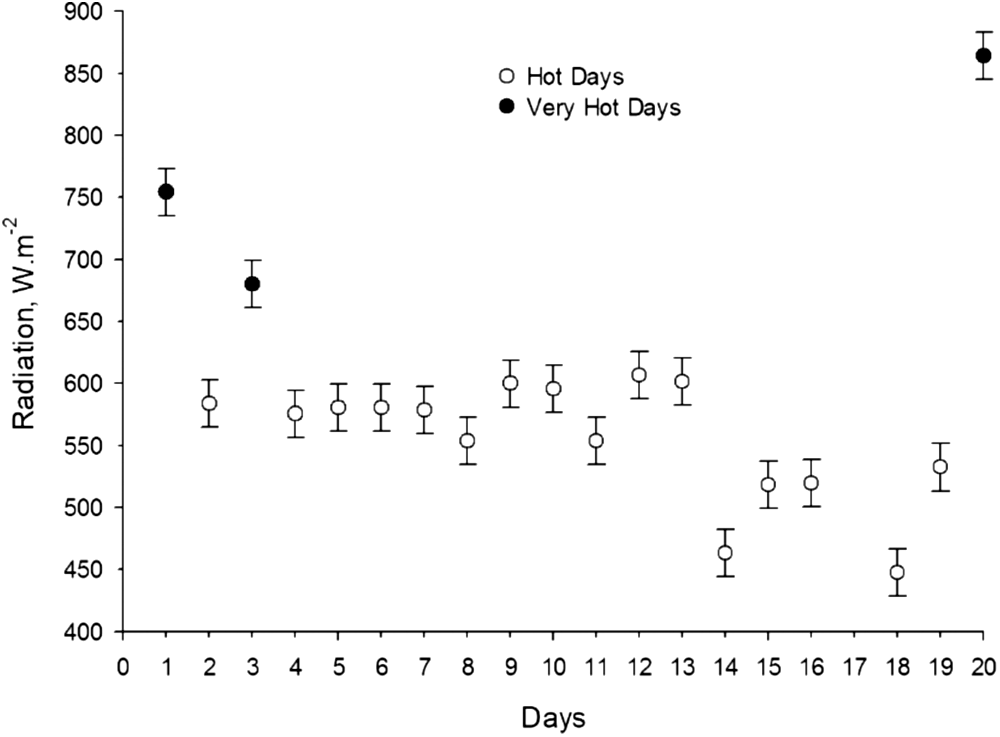
Maia et al. (Reference Maia, Moura, Fonsêca, Gebremedhin, Milan, Chiquitelli Neto, Simão, Campanelli and Pacheco2023) proposed an index based on meteorological data (InComfort Index – InCI) using principal component analysis to relate the physiological responses of cattle managed in a tropical environment (respiratory rate and water intake) to the level of stress to which these animals were exposed. The index classifies days as rainy, cloudy, hot and very hot. Considering that solar radiation is the meteorological element that most impacts the productive, physiological and behavioural responses of animals raised on pasture in a tropical environment (da Silva et al., Reference da Silva, Guilhermino and de Morais2010), the 20 days of data collection were classified by the InComfort Index as follows: rainy days – average daily levels of solar radiation less than or equal to 300 Wm−2 and mean relative humidity of 80%; cloudy days – average daily levels of solar radiation less than or equal to 300 Wm−2; hot days – average daily levels of solar radiation between 300 and 635 Wm−2; very hot days – average daily levels of solar radiation greater than or equal to 635 Wm−2. No rainy days were recorded during the experiment; one day was classified as cloudy and removed from the analysis, three days were classified as very hot, and the remaining 16 days were classified as hot days (Fig. 2).
Classification of collection days according to the InComfort Index proposed by Maia et al. (Reference Maia, Moura, Fonsêca, Gebremedhin, Milan, Chiquitelli Neto, Simão, Campanelli and Pacheco2023).

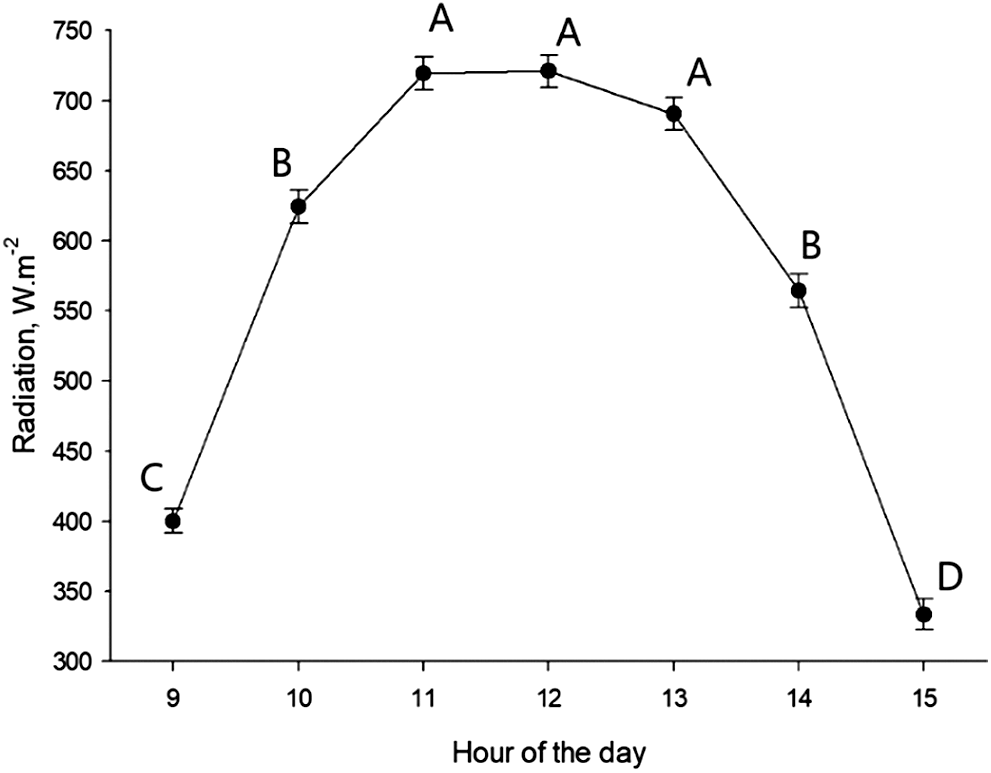
Solar radiation differed significantly between collection times (Fig. 3). It was found that between 11:00 and 13:00, the mean values were higher than 650 Wm−2, differing from the other times (P < 0.0001). Oliveira et al. (Reference Oliveira, de Melo Costa, Chiquitelli Neto, Dalla Costa and Maia2019) described that solar radiation directly interferes with the search for shade by Holstein cows and that levels above 500 Wm−2 trigger this behaviour. Therefore, considering the significant variation in solar radiation over the hours of the day and between days, it was determined how effective the artificial shading structure and the presence of trees were in reducing the heat stress to which the animals were exposed. Moreover, it was also determined whether there was a significant difference (P < 0.0001) in the behavioural and physiological responses of Holstein cows with predominantly white or black coats.
Means (±SD) of solar radiation during the hours of the day at Iguatemi Experimental Farm, Maringá, PR, Brazil. Different capital letters indicate a significant difference using the Tukey test (P < 0.05).

Air temperature and relative humidity differed significantly between the days and sites evaluated (P < 0.0001; Fig. 4). It was observed that there was a significant reduction in air temperature on hot days (P < 0.0001) between natural and artificial shading compared to very hot days and that both sites showed a reduction of approximately 1°C compared to the sunny environment (P < 0.0001).
Means (±SD) – (a) of air temperature; (b) of relative humidity – for the sites evaluated (exposed to the sun, under the artificial shading structure, under the trees) as a function of the classification of days by the InComfort Index (hot or very hot days). Different uppercase letters indicate a significant difference between the sites evaluated (sun, natural and artificial shading), and different lowercase letters indicate a significant difference between the classification of days (very hot and hot days) by the Tukey test (P < 0.05).

Relative humidity differed (P < 0.0001) between the days (Fig. 4), and regardless of the classification (hot or very hot), the highest values were measured under the trees, with values above 60%. A similar result was found by Teixeira et al. (Reference Teixeira, Nascimento, Mós, de Oliveira, Dos Santos, Maia, Fonsêca, Passos and Murata2022), who observed values of between 64.9 and 67.4% relative humidity under natural shading, which is due to the evapotranspiration capacity of the trees.
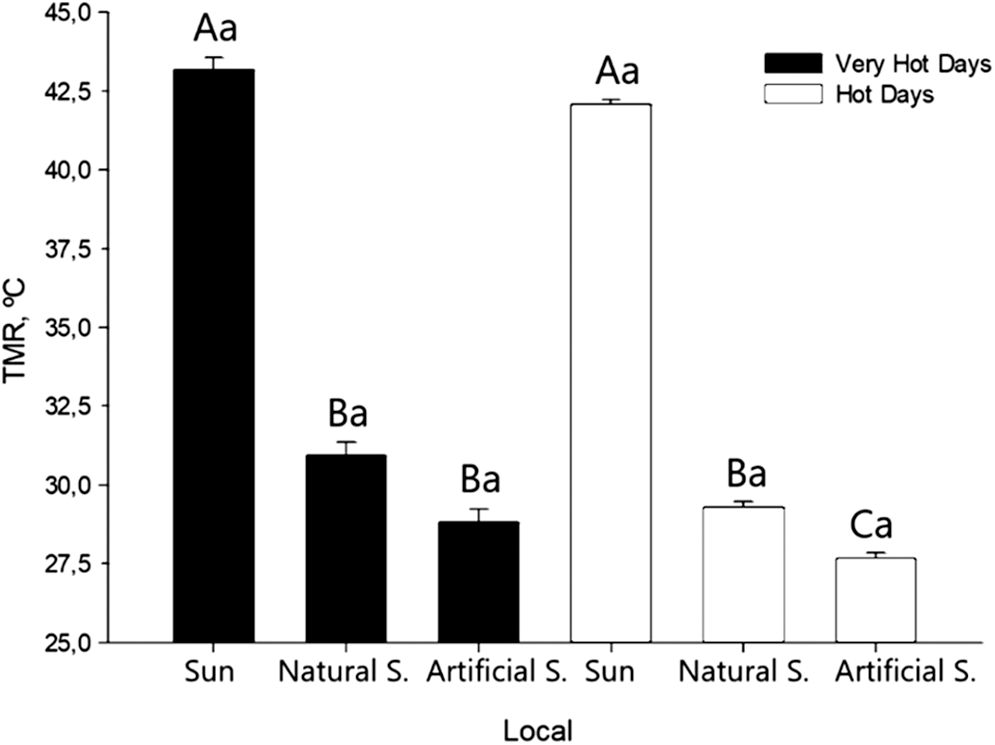
The mean radiant temperature reflects the animals' thermal sensation in a radiant environment (da Silva and Maia, Reference da Silva and Maia2013). In the study, it was observed that regardless of the classification of the days, the thermal sensation of the animals in the sun was more uncomfortable compared to the use of shading, both natural and artificial (P < 0.0003; Fig. 5). It is noteworthy that the mean radiant temperature was above 40°C for the hot and very hot days, and that the artificial shading structure made up of the combination of the reflective nets and the polypropylene nets showed the lowest values (P < 0.0001, Fig. 5). The reduction in mean radiant temperature was over 10°C for hot and very hot days (P < 0.0004), which indicates the efficiency of the structure proposed for artificial shading; this combination of nets is, therefore, a valid alternative for tropical environments. The same result was observed by Mós et al. (Reference Mós, Teixeira, Murata, Dos Santos, de Oliveira, Steidle Neto and Nascimento2022), who observed a MRT close to 30°C under the combination of nets, varying significantly from the other structures between 8:00 and 13:00.
Means (±SD) of the mean radiant temperature for the sites evaluated (exposed to the sun, under the artificial shading structure, under the trees) as a function of the classification of days by the InComfort Index (hot or very hot days). Different uppercase letters indicate a significant difference between the sites evaluated (sun, natural and artificial shading), and different lowercase letters indicate a significant difference between the classification of days (very hot and hot days) by the Tukey test (P < 0.05).

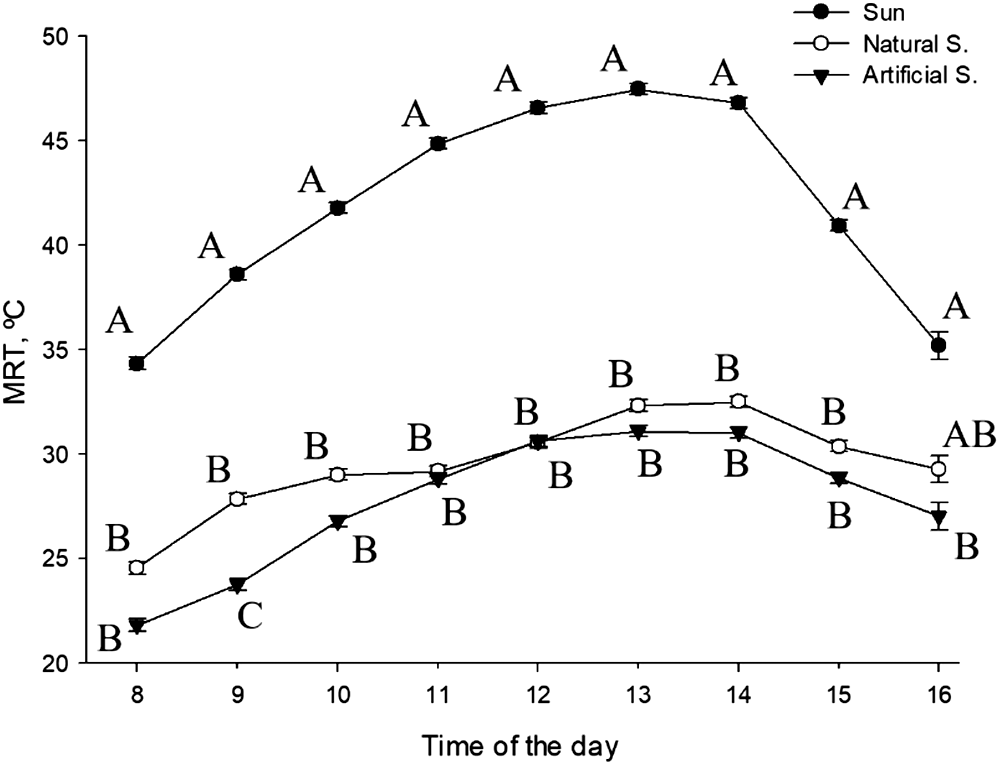
In addition, the mean radiant temperature varied significantly (P < 0.0001) for the interaction between the site evaluated and the time of day (Fig. 6). Pache et al. (Reference Pache, Rössner, Hörig and Bergfeld2007) stated that values above 36°C imply an increase in respiratory rate and rectal temperature in dairy cows, which is therefore undesirable. In the sun, the only times when the mean radiant temperature was lower than 36°C were before 9:00 or after 15:00 (Fig. 5), demonstrating the need to provide shade for the animals. Regardless of the time evaluated, the artificial shading structure had the lowest mean radiant temperatures, differing significantly (P < 0.0005) from the trees at 9:00 in the morning.
Means (±SD) of the mean radiant temperature for the sites evaluated (exposed to the sun, under the artificial shading structure, under the trees) as a function of the time of day. Different capital letters indicate a significant difference between the sites evaluated by the Tukey test (P < 0.05).

The mean radiant temperature is used to calculate the RHL, an index that allows a comparison to be made between different environments. Its application in tropical climate environments is a useful assessment tool, where it is considered that the lower the value, the better the comfort provided (Da Silva, Reference Da Silva2000; Mós et al., Reference Mós, Nascimento, Murata, Dos Santos, Neto, de Oliveira, da Silva Lisboa and de Freitas Silva2020). Significant variation was observed for the interaction between the days and sites evaluated, as well as for the interaction between sites and times of the day (Fig. 7a and 7b). It can be seen that the artificial shading structure reduced the RHL by approximately 25% compared to the sun at the hottest times of the day and did not differ from the trees (P > 0.0001; Fig. 6). The results obtained in this study are similar to those found by Mós et al. (Reference Mós, Teixeira, Murata, Dos Santos, de Oliveira, Steidle Neto and Nascimento2022), who observed the RHL under the structure with the association of nets below 487 Wm−2, but it did not differ significantly from natural shading after 15:00.
Means (±SD) of the radiant heat load – (a) for the sites evaluated (exposed to the sun, under the artificial shading structure, under the trees); (b) for the sites evaluated (exposed to the sun, under the artificial shading structure, under the trees) as a function of the time of day. Different capital letters indicate a significant difference between each of the sites evaluated by the Tukey test (P < 0.05).

Heat stress in dairy cattle is usually assessed using the BGHI. This represents climatic conditions by correlating air temperature and relative humidity. When this index has values equal to or greater than 68, it can be assumed that the animals are experiencing some degree of heat stress (McDonald et al., Reference McDonald, von Keyserlingk and Weary2020). However, as proposed by Buffington et al. (Reference Buffington, Collazo-Arocho, Canton, Pitt, Thatcher and Collier1981), values up to 74 indicate comfort; from 74 to 78, an alarming condition of stress; from 79 to 84, a dangerous condition of stress; and above 84, an emergency and severe condition of stress.
From the results obtained, the BGHI showed a significant variation (P < 0.0001) for the interactions between the days, sites assessed and observation times (Fig. 8a and 8b). It can be seen that for hot and very hot days, the BGHI values in the sun were characterized by severe stress (Buffington et al., Reference Buffington, Collazo-Arocho, Canton, Pitt, Thatcher and Collier1981). Thus, both natural and artificial shading reduced the BGHI value (P < 0.0001). Artificial shading showed the lowest values according to the classification of days (P < 0.0001) and did not differ (P > 0.2116) from natural shading throughout the times (Fig. 8a and 8b). De Masi et al. (Reference De Masi, Ruggiero, Tariello and Vanoli2021) found mean BGHI values of 76.7 during the summer, and at 8:00, this value was over 70, with the radiation level low at the start of the day at 300 Wm−2.
BGHI means (±SD) – (a) for the sites evaluated (exposed to the sun, under the artificial shading structure, under the trees) according to the classification of days by the InComfort Index (hot or very hot days); (b) for the sites evaluated (exposed to the sun, under the artificial shading structure, under the trees) according to the time of day. Different uppercase letters indicate a significant difference between the sites evaluated (sun, natural and artificial shading), and different lowercase letters indicate a significant difference between the classification of days (very hot and hot days) by the Tukey test (P < 0.05).

Physiological variables
Previous investigations carried out with a comparable number of animals to the present study, when analysing physiological and behavioural parameters in dairy cattle, have reported relevant results (Oliveira et al., Reference Oliveira, de Melo Costa, Chiquitelli Neto, Dalla Costa and Maia2019; Pereira et al., Reference Pereira, Silva, Oliveira, Nascimento and Toledo2023; Faria et al., Reference Faria, Maia, Moura, Fonsêca, Nascimento, Milan and Gebremedhin2023).
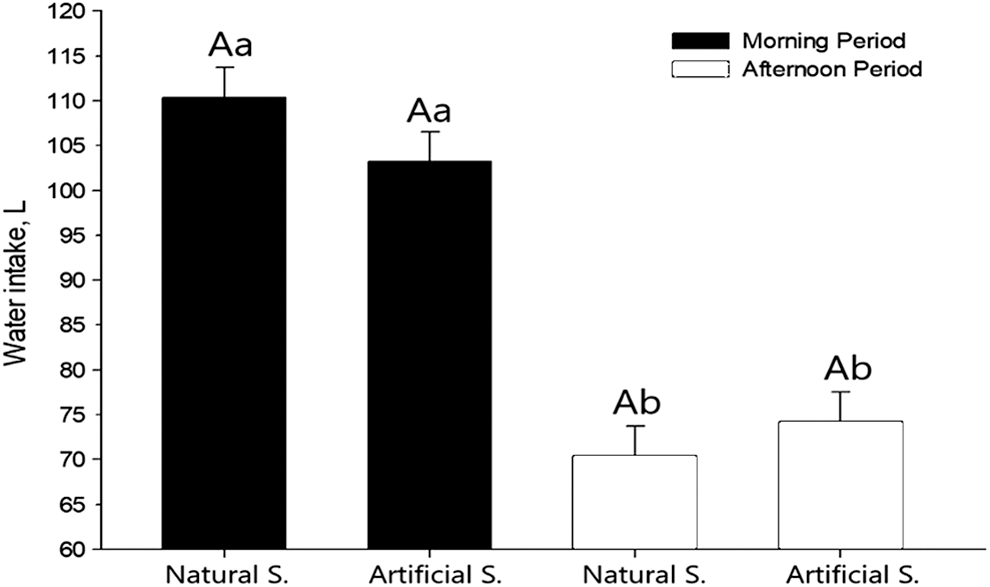
The water intake of Holstein cows did not differ (P > 0.4234) between animals with access to artificial shading and those with access to shading provided by trees. However, the animals consumed more water in the morning than in the afternoon (P < 0.0001), with a mean of 110.35 L (±SD = 4) in the morning and 73.75 L (±SD = 4) in the afternoon. This figure corresponds to the total intake of the four cows in each of the paddocks(Fig. 9).
Means (±SD) of water intake of Holstein cows grazing due to the natural or artificial shading resources for the morning and afternoon periods. Different uppercase letters indicate a significant difference between natural and artificial shading in each of the periods, and different lowercase letters indicate a significant difference in natural and artificial shading between the morning and afternoon periods by Tukey's test (P < 0.05).

McDonald et al. (Reference McDonald, von Keyserlingk and Weary2020), in a study of Holstein cows during the summer in North America, described that the peak times for water intake were between 08:00 and 12:00 and between 16:00 and 20:00. Another factor that may have influenced the higher intake in the morning is milking, since milk is made up of approximately 87% water. In addition, the intake of silage and concentrate before the animals are taken to the experimental area also increases water intake, as this is positively correlated with dry matter intake (Golher et al., Reference Golher, Patel, Bhoite, Syed, Panchbhai and Thirumurugan2021).
It should be noted that the means for water intake are in line with those described in the literature, corresponding to an intake of between 68 and 151 L of water per day (Golher et al., Reference Golher, Patel, Bhoite, Syed, Panchbhai and Thirumurugan2021). During the research, no significant difference was observed between natural and artificial shading (P > 0.4234), which demonstrates that the composition of the double nets is an efficient shading alternative for animals in tropical climates.
The surface temperature of the animals differed between the predominance of coat colour, between hot and very hot days, and between the hours evaluated (Table 3).
Means (±SD) of the surface temperature of Holstein cows due to the type of shading, the predominant colour of the body coat, and the times assessed throughout the study

Note: Different capital letters indicate a significant difference using the Tukey test (P < 0.05).
The highest mean surface temperatures observed in the early morning and between 13:00 and 14:00 coincide with the time when the animals were not using the shading resources. That is, grazing or drinking water. The lowest temperatures observed between 10:00 and 12:00 correspond to when the animals rested under the shading.
Surface temperature varies according to the amount of sunlight the body is exposed to. Consequently, an increase in surface temperature is related to an increase in blood flow to the skin through peripheral vasodilation to aid heat transfer with the environment (Rashamol et al., Reference Rashamol, Sejian, Bagath, Krishnan, Archana and Bhatta2018). Kamal et al. (Reference Kamal, Dutt, Patel, Dey, Chandran, Bharti and Barari2016) indicated that crossbred calves had lower surface temperatures in the early morning, with an increase of between 2°C and 5°C around 14:00. These results are similar to those found in this study with Holstein cows, where the surface temperature increased by more than 3°C between 10:30 and 13:30.
Surface temperature also differed (P < 0.0001) according to the animal's predominant coat colour, with predominantly black animals having a higher temperature compared to white ones (Table 3). Holstein cows, in general, are poorly adapted to the tropical environment (Becker et al., Reference Becker, Collier and Stone2020), as the colour of the epidermis follows the colour of the coat (Maia et al., Reference Maia, da Silva and Bertipaglia2003), and the areas of the animals with black colour absorb more heat through radiation (da Silva et al., Reference da Silva, La Scala Junior and Pocay2001; Maia et al., Reference Maia, da Silva and Bertipaglia2003). The absorptance of the black coat is 0.94, while that of the white coat is 0.427 (da Silva et al., Reference da Silva, Maia, de Macedo Costa and de Queiroz2012).
Maia et al. (Reference Maia, da Silva and Bertipaglia2003) observed a higher reflectance of the white coat and a higher absorptance of the black coat, so the black-coloured regions absorb more heat than the white areas. The mean difference between coats of 2.32°C observed in this study was greater than that observed by da Silva et al. (Reference da Silva, Maia, de Macedo Costa and de Queiroz2012), who described a difference between coats of 0.4°C in subtropical regions. However, this difference is lower than that found by the same authors in a semi-arid region of 4.5°C. This difference in the surface temperature of the animals can be explained by the difference in black globe temperature between the regions.
The results found in this study differ from the values reported by Anzures-Olvera et al. (Reference Anzures-Olvera, Véliz, de Santiago, García, Mellado, Macías-Cruz, Avendaño-Reyes and Mellado2019) with Holstein cows during the summer. The authors found no statistically significant difference between the coats, but they found significant differences between the regions of the body – extremities and around the eyes – as the places that vary the most in temperature according to the environmental temperature.
The respiratory rate did not differ (P > 0.0939) for the predominant coat colour of the animals, with means equal to 66 breaths min−1 for white animals and 67 breaths min−1 for black animals. Anzures-Olvera et al. (Reference Anzures-Olvera, Véliz, de Santiago, García, Mellado, Macías-Cruz, Avendaño-Reyes and Mellado2019) also found no significant difference in respiratory rate according to coat colour.
There was also no significant difference between the shading resources, with mean measurements for the trees and the artificial shading structure being 66 and 67 breaths min−1, respectively. However, the results of this study suggest that the animals had tachypnoea, a condition normally reported in Holstein cows in hot environments (da Silva et al., Reference da Silva, Maia, de Macedo Costa and de Queiroz2012), since in thermoneutral conditions, the respiratory rate is approximately 60 breaths min−1 (Kendall et al., Reference Kendall, Verkerk, Webster and Tucker2007). Animals can reach values of over 100 breaths min−1 when exposed to the sun, so shading was effective in reducing the animals' respiratory rate (Rashamol et al., Reference Rashamol, Sejian, Bagath, Krishnan, Archana and Bhatta2018).
Behavioural variables
Behavioural responses varied (P < 0.0001) on hot days between the predominance of the coat for lying body posture and resting activity in the morning, and frequency of use of natural shading in the afternoon. The other behaviours did not differ (P > 0.1175) between days, coats and periods (Table 4).
Frequency of expression of behaviour in Holstein cows due to the period of the day and the predominant colour of the body coat

Note: Different capital letters indicate a significant difference between the coats in the periods using the Tukey test (P < 0.05).
The behavioural responses to the animals' body posture showed a variation (P < 0.0005) for lying down during the morning between the predominant coat types on days classified as hot. The predominantly white animals showed a higher frequency of lying down behaviour during the mornings of hot days compared to the predominantly black animals. However, this difference was not found in the afternoon (P > 0.4308). The predominantly white animals lay down more often between 9:00 (75.86%) and 10:00 (62.50%) (P < 0.0036), and this behaviour did not differ (P > 0.2718) from 11:00 onwards. Cows try to change their posture to avoid excessive heat gain from the environment. Therefore, animals with predominantly black coats tend to spend less time lying down to reduce contact with the hot surface, reduce heat gain by conduction, and increase body area so that convection can take place (Herbut et al., Reference Herbut, Angrecka and Walczak2018).
Lying down is an important indicator of welfare (Tucker et al., Reference Tucker, Jensen, de Passillé, Hänninen and Rushen2021). Herbut et al. (Reference Herbut, Angrecka and Walczak2018) found that Holstein cattle have active behaviour until 10:00, showing lying down behaviour in the afternoon. This is in line with the data obtained in this study, where the animals were more active until 10:00 in the morning, with the predominantly black-coated animals being more active. In the afternoon, regardless of coat, the animals had a similar frequency of resting and lying down. Deniz et al. (Reference Deniz, Schmitt Filho, Hötzel, de Sousa, Pinheiro Machado Filho and Sinisgalli2020) observed the same pattern with dairy cattle in integrated crop-livestock-forestry systems (ICLFS), where the animals spent 45% of their grazing time between 9:00 and 10:00 in the morning, and the animals lay down more often in the afternoon.
Schütz et al. (Reference Schütz, Rogers, Cox and Tucker2009), in an environment with radiation levels of 582 Wm−2, observed that white-coated cows spent more time lying down compared to black-coated cows. Therefore, black-coated cows alter their behaviour to avoid heat gain. These results corroborate this study, in which the predominantly black-coated animals sought shade after 11:00 in the morning when radiation and temperature levels rose above 700 Wm−2 and 25°C, respectively. The increased frequency of use of natural shade by white-coated animals may indicate that these animals leave the shade more often to graze than black-coated animals. The latter, on the other hand, remained in the shade for longer, as they spent more of the morning grazing.
For the behavioural responses to activity, the resting behaviour varied significantly (P < 0.0016) for the hot days between the animals' coat colour, with the predominantly white-coated animals having a higher resting frequency than the predominantly black-coated animals. The predominantly white animals had a higher frequency of resting at 10:00 (54.8%) than the black animals, and this behaviour did not vary at other times of the morning (P > 0.4762).
Charlton et al. (Reference Charlton, Rutter, East and Sinclair2011) found that cows spend 58% of their time lying down, resting and ruminating, regardless of the predominance of coat colour. The time spent ruminating was similar for all animals, with a frequency close to 50% for all coats and periods of the day. Deniz et al. (Reference Deniz, Schmitt Filho, Hötzel, de Sousa, Pinheiro Machado Filho and Sinisgalli2020), studying dairy cattle in ICLFS, found that cows ruminated and rested most of the time in shaded areas, correlating this with lower air, soil and radiation temperatures in these areas.
The behavioural response for seeking out shading resources only varied for natural shading (P < 0.0067) during the afternoon on hot days, with the predominantly white animals seeking out this resource more often. However, only at 14:00 was there a statistical difference (P < 0.0328) in the search for natural shade, with the predominantly white animals responsible for 56.7% of the data recorded at this time. The difference in the frequency of use of natural shading may be related to the differences in reflectance, absorptance and transmittance values between white and black coats reported by Maia et al. (Reference Maia, da Silva and Bertipaglia2003).
Therefore, black-coated animals with higher absorptance and lower reflectance seek to graze during the hours with the lowest radiation levels to avoid heat gain through radiation, that is, before 10:00 in the morning and after 15:00.
The more frequent use of natural shading rather than artificial shading may be associated with the microclimate created by the presence of trees. Due to evapotranspiration, which maintains a lower air temperature, air humidity between 30% and 70%, and less incoming radiation, this provides a thermal environment close to the ideal for dairy cattle (Deniz et al., Reference Deniz, de Sousa, Moro, Vale, Dittrich, Machado Filho and Hötzel2021; Mós et al., Reference Mós, Teixeira, Murata, Dos Santos, de Oliveira, Steidle Neto and Nascimento2022; Teixeira et al., Reference Teixeira, Nascimento, Mós, de Oliveira, Dos Santos, Maia, Fonsêca, Passos and Murata2022).
Conclusions
The artificial shading structure with the association of nets proved to promote thermal comfort for dairy cattle regardless of the classification of the days. The results were similar to those found under natural shading, proving to be a viable shading alternative when the tree component is not present in tropical environments. Respiratory rate and water intake did not change between shading sessions, so it can be said that using artificial shading does not increase these variables. Animals with predominantly white coats have a higher resting frequency than black animals. The latter graze in the early hours of the morning to avoid excessive heat gain at times of higher radiation levels and high temperatures, as they have a higher surface temperature than white animals.
Acknowledgements
The authors would like to thank the Academic Writing Centre (Centro de Escrita Acadêmica, CEA) of the State University of Maringá (UEM) for assistance with the English language and developmental editing. The Coordenação de Aperfeiçoamento de Pessoal de Nível Superior (CAPES) provides research support.
Funding statement
This work was supported by Conselho Nacional de Desenvolvimento Científico e Tecnológico - CNPq, grant number 310990/2022-0 (Sheila T Nascimento)
Competing interests
The authors have no relevant financial or non-financial interests to disclose.
Data accessibility statement
Data are in an online repository – available at Nascimento, Sheila (2025), ‘Holstein cows’, Mendeley Data, V1, doi: 10.17632/jj3kf7x2jc.1.
CRediT authorship statement
Jardel Barcelos: writing – original draft, writing – review and editing, investigation. Kécia Lopes: writing – original draft, writing – review and editing, investigation. Ana J. Sordi: investigation. Yasmim Trevisan: investigation. Sheila Nascimento: conceptualization, data curation, formal analysis, funding acquisition, methodology, project administration, supervision, writing – original draft, writing – review and editing.