The target article “Knowledge before belief” by Phillips et al. provides a wide array of interdisciplinary research lending a considerable empirical weight in support of the hypothesis that representations of knowledge precede representations of belief. It is my aim, with this commentary, to add to these positive findings, extending the hypothesis to a further domain – that of unconscious content – suggesting that such knowledge often proceeds belief of any sort.
To more fully explore the idea that that knowledge is prior to belief, one would have to assess whether or not the following “count” as knowledge: (a) know-how knowledge, (b) acquaintance knowledge, and (c) the capacity to discriminate among stimuli. I hold that the above three “knowledge” types, no less than clear cut representational knowledge, do count as “knowledge.” This renders the question of priority to beliefs almost moot, with these three sorts of knowledge clearly preceding any manner of belief, in evolutionary, developmental, and processing terms.
However, I recognize that whether or not these three knowledge types do constitute “knowledge” is not a settled matter. Thus, and happily, the issue I raise in this commentary is far less contentious, and therefore easier to argue. Unconscious knowledge content, I aver, is often prior to any belief at all. I will offer two examples, one from clinical psychoanalytic psychotherapy, and the other from a cognitive psychology experiment. (Both are taken up in greater length in Brakel, Reference Brakel2010.)
Dr. X was my patient in thrice weekly psychoanalytic psychotherapy. He sat in a chair directly facing mine, some 6 feet apart. During one session, I fell asleep, albeit very briefly. For the rest of his session, I anticipated associations (direct or derivative) that would reveal not only that he saw me asleep, but that he had feelings about my lapse. But Dr. X continued as though nothing had changed … until the very next session. Immediately upon arriving, Dr. X reported the following dream: “I (Dr. X) fell asleep in our last session. You (Dr. B) did not seem to notice.” He added that “there was not much feeling in the dream.” I told Dr. X that his dream was clearly a reaction my having fallen asleep during our previous session; something he must've noticed. He reacted as though I were crazy, claiming with much animation: “You did not fall asleep here last time. If you had, I'd be really furious!”
Now, I was incredulous. It seemed impossible for him not to have seen me – lighting was good, line of vision clear and direct, and one's therapist is, whatever else, a salient stimulus object. The thin disguise of reversing our roles did not obscure his unconscious knowledge of the content – identical in waking life and in the dream – one person fell asleep right in front of the other. Furthermore, as Dr. X's knowledge of the content remained unconscious, he had absolutely no beliefs about the event he did not consciously experience. (Unconscious beliefs could be posited, but as Radford [Reference Radford1970, pp. 105–107] tellingly argued, this would require not only another level of inference, but more importantly the assumption that knowledge necessarily entailed belief.)
Completing the case for unconsciously knowing content proceeding any belief, consider the following: Although Dr. X did eventually believe me regarding my having fallen asleep, he never “remembered” that content. This is typical of a psychological phenomenon known as a “negative hallucination” (see Brakel, Reference Brakel1989a, Reference Brakel1989b). In negative hallucinations contents which should be supraliminal and consciously known, are clearly registered, but known unconsciously (non-consciously) only, much as subliminal stimuli. And, like subliminal stimuli, the contents of negative hallucinations are never recaptured consciously, and occasion no beliefs.
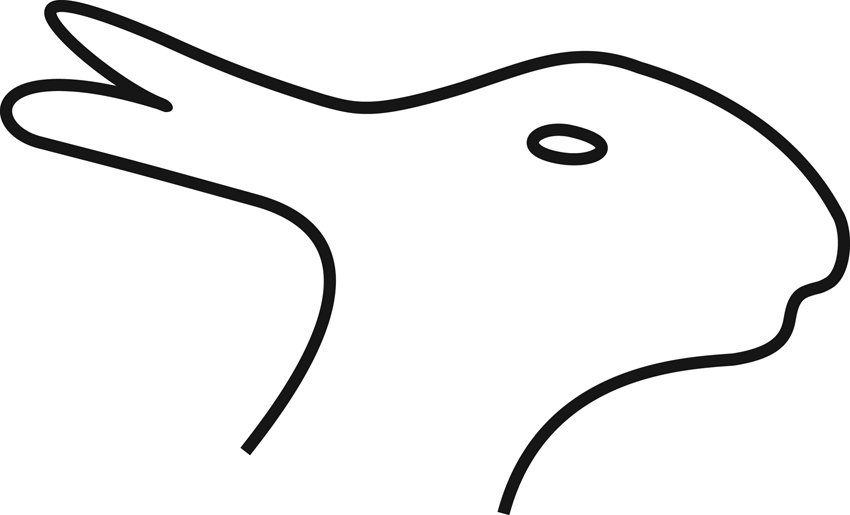
The second example comes from an experiment devised by Chambers and Reisberg (Reference Chambers and Reisberg1985). They presented a line-drawing version of the duck/rabbit ambiguous-dual figure (Fig. 1) (originally by Jastrow, Reference Jastrow1900) to a number of participants who were unfamiliar with it. Each participant was asked to form a mental image of the figure; the figure remaining in plain view until the participant indicated this task was complete. With each subject's mental image of the figure firmly in mind, the experimenters asked each one individually what they believed they had seen. All of the subjects who believed they'd seen both a duck and a rabbit were eliminated from the rest of the study.
Those indicating only a duck or only a rabbit had a number of further interventions, after each of which they were again to state what they believed they saw, reporting specifically on any changes in their mental/image. First, they were asked to consider other ambiguous figures. Next, they were given actual hints about the missing animal. Most of these participants stated that their image remained the same – those that believed they saw only a duck, stated that their mental image was of a duck; similarly for the only-rabbit participants. Finally, all the remaining one-animal participants were asked to draw their mental image. For the first time, as they regarded their own drawings, presto – both animals emerged. And, finally they believed the image was of a duck and a rabbit.
Prior to this, the only-duck participants had a belief about the duck in the image, but no belief at all about rabbits. The only-rabbit participants believed they simply saw a rabbit, but had no beliefs about ducks. However, in all of these one-animal participants, as their own drawings revealed, they undeniably had always had unconscious knowledge of the very animal about which they had no belief. After all, if you were asked to draw a duck, it would not under normal conditions, end up looking anything like a rabbit. These subjects believed only half of what they already knew.
Interestingly, this demonstrates not only that knowledge precedes belief, but also that knowledge content provides evidence for later occurring beliefs. The radical idea that knowledge provides evidence for belief, rather than the standard account that knowledge entails prior belief plus evidence, owes to Williamson (Reference Williamson2000).






 You have
Access
The target article “Knowledge before belief” by Phillips et al. provides a wide array of interdisciplinary research lending a considerable empirical weight in support of the hypothesis that representations of knowledge precede representations of belief. It is my aim, with this commentary, to add to these positive findings, extending the hypothesis to a further domain – that of unconscious content – suggesting that such knowledge often proceeds belief of any sort.
To more fully explore the idea that that knowledge is prior to belief, one would have to assess whether or not the following “count” as knowledge: (a) know-how knowledge, (b) acquaintance knowledge, and (c) the capacity to discriminate among stimuli. I hold that the above three “knowledge” types, no less than clear cut representational knowledge, do count as “knowledge.” This renders the question of priority to beliefs almost moot, with these three sorts of knowledge clearly preceding any manner of belief, in evolutionary, developmental, and processing terms.
However, I recognize that whether or not these three knowledge types do constitute “knowledge” is not a settled matter. Thus, and happily, the issue I raise in this commentary is far less contentious, and therefore easier to argue. Unconscious knowledge content, I aver, is often prior to any belief at all. I will offer two examples, one from clinical psychoanalytic psychotherapy, and the other from a cognitive psychology experiment. (Both are taken up in greater length in Brakel, Reference Brakel2010.)
Dr. X was my patient in thrice weekly psychoanalytic psychotherapy. He sat in a chair directly facing mine, some 6 feet apart. During one session, I fell asleep, albeit very briefly. For the rest of his session, I anticipated associations (direct or derivative) that would reveal not only that he saw me asleep, but that he had feelings about my lapse. But Dr. X continued as though nothing had changed … until the very next session. Immediately upon arriving, Dr. X reported the following dream: “I (Dr. X) fell asleep in our last session. You (Dr. B) did not seem to notice.” He added that “there was not much feeling in the dream.” I told Dr. X that his dream was clearly a reaction my having fallen asleep during our previous session; something he must've noticed. He reacted as though I were crazy, claiming with much animation: “You did not fall asleep here last time. If you had, I'd be really furious!”
Now, I was incredulous. It seemed impossible for him not to have seen me – lighting was good, line of vision clear and direct, and one's therapist is, whatever else, a salient stimulus object. The thin disguise of reversing our roles did not obscure his unconscious knowledge of the content – identical in waking life and in the dream – one person fell asleep right in front of the other. Furthermore, as Dr. X's knowledge of the content remained unconscious, he had absolutely no beliefs about the event he did not consciously experience. (Unconscious beliefs could be posited, but as Radford [Reference Radford1970, pp. 105–107] tellingly argued, this would require not only another level of inference, but more importantly the assumption that knowledge necessarily entailed belief.)
Completing the case for unconsciously knowing content proceeding any belief, consider the following: Although Dr. X did eventually believe me regarding my having fallen asleep, he never “remembered” that content. This is typical of a psychological phenomenon known as a “negative hallucination” (see Brakel, Reference Brakel1989a, Reference Brakel1989b). In negative hallucinations contents which should be supraliminal and consciously known, are clearly registered, but known unconsciously (non-consciously) only, much as subliminal stimuli. And, like subliminal stimuli, the contents of negative hallucinations are never recaptured consciously, and occasion no beliefs.
The second example comes from an experiment devised by Chambers and Reisberg (Reference Chambers and Reisberg1985). They presented a line-drawing version of the duck/rabbit ambiguous-dual figure (Fig. 1) (originally by Jastrow, Reference Jastrow1900) to a number of participants who were unfamiliar with it. Each participant was asked to form a mental image of the figure; the figure remaining in plain view until the participant indicated this task was complete. With each subject's mental image of the figure firmly in mind, the experimenters asked each one individually what they believed they had seen. All of the subjects who believed they'd seen both a duck and a rabbit were eliminated from the rest of the study.
Line-drawing version of the duck/rabbit ambiguous-dual figure (Chambers and Reisberg, Reference Chambers and Reisberg1985; originally Jastrow, Reference Jastrow1900).
Those indicating only a duck or only a rabbit had a number of further interventions, after each of which they were again to state what they believed they saw, reporting specifically on any changes in their mental/image. First, they were asked to consider other ambiguous figures. Next, they were given actual hints about the missing animal. Most of these participants stated that their image remained the same – those that believed they saw only a duck, stated that their mental image was of a duck; similarly for the only-rabbit participants. Finally, all the remaining one-animal participants were asked to draw their mental image. For the first time, as they regarded their own drawings, presto – both animals emerged. And, finally they believed the image was of a duck and a rabbit.
Prior to this, the only-duck participants had a belief about the duck in the image, but no belief at all about rabbits. The only-rabbit participants believed they simply saw a rabbit, but had no beliefs about ducks. However, in all of these one-animal participants, as their own drawings revealed, they undeniably had always had unconscious knowledge of the very animal about which they had no belief. After all, if you were asked to draw a duck, it would not under normal conditions, end up looking anything like a rabbit. These subjects believed only half of what they already knew.
Interestingly, this demonstrates not only that knowledge precedes belief, but also that knowledge content provides evidence for later occurring beliefs. The radical idea that knowledge provides evidence for belief, rather than the standard account that knowledge entails prior belief plus evidence, owes to Williamson (Reference Williamson2000).
Financial support
This research received no specific grant from any funding agency, commercial, or not-for-profit sectors.
Conflict of interest
None.