



1. Introduction
A shrinker
 $\Sigma ^n \subset \mathbf {R}^N$
is a submanifold so that mean curvature flow (MCF) starting from
 $\Sigma$
evolves by scaling and shrinks homothetically to become singular. The blow up at any MCF singularity is a shrinker; understanding them is crucial to understanding singularity formation [Reference HuiskenHui90, Reference IlmanenIlm95, Reference WhiteWhi97]. Shrinkers also have a variational interpretation as Gaussian minimal submanifolds.
We will prove a strong Frankel theorem for shrinkers that holds even with boundary.
Theorem 1.1. If
 $\Sigma _1^n , \Sigma _2^n \subset \overline {B_R} \subset \mathbf {R}^{n+1}$
are compact embedded shrinkers,
 $\partial \Sigma _1 , \partial \Sigma _2 \subset \partial B_R$
,
 $R \geq R_n$
, and
 $B_R \cap \Sigma _i \ne \emptyset$
, then
 \begin{align} B_{R_n} \cap \Sigma _1 \cap \Sigma _2 \ne \emptyset \, . \end{align}
The constant
 $R_n$
only depends on the dimension
 $n$
.
A classical theorem of Hadamard from 1897 proves that any two closed geodesics in a complete surface with positive curvature must intersect. In [Reference FrankelFra66], Frankel generalized this to compact minimal hypersurfaces in a manifold of positive Ricci curvature. Frankel called this the ‘Generalized Hadamard Theorem,’ but it is now known as the Frankel theorem. It has played an important role in minimal surface theory [Reference LawsonLaw70], free boundary problems [Reference Fraser and LiFL14], and MCF [Reference MramorMra20, Reference MramorMra24, Reference Mramor and WangMW20].
A consequence of Theorem 1.1 is that shrinkers are connected in all sufficiently large balls around the origin.
Corollary 1.2. If
 $\Sigma ^n \subset \mathbf {R}^{n+1}$
is a compact embedded shrinker with
 $R \geq R_n$
and
 \begin{align} \partial \Sigma \subset \partial B_{R}\quad {{and}}\quad B_{R} \cap \Sigma \ne \emptyset \, , \end{align}
then
 $B_{R} \cap \Sigma$
is connected. In particular, if
 $\Sigma$
is complete and
 $\partial \Sigma = \emptyset$
, then
 $B_{R} \cap \Sigma$
is connected for every
 $ R \geq R_n$
.
The simplest shrinkers are generalized cylinders
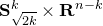 $\mathbf {S}^k_{\sqrt {2k}} \times \mathbf {R}^{n-k}$
, where the
 $k$
-sphere is centered at
 $0$
with radius
 $\sqrt {2k}$
and
 $ \mathbf {R}^{n-k}$
contains
 $0$
. Here
 $k=0, 1 , \dots ,n$
, where
 $k=0$
gives a hyperplane,
 $k=n$
gives an
 $n$
-sphere, and we allow all rotations of the Euclidean factor. Taking one of the shrinkers in Theorem 1.1 to be a generalized cylinder implies that any shrinker must intersect such a cylinder.
Corollary 1.3. If
 $\Sigma ^n \subset \mathbf {R}^{n+1}$
is a properly embedded shrinker,
 $R \geq R_n$
,
 \begin{align} \partial \Sigma \subset \partial B_{R}, \quad{\text {and}}\quad B_{R} \cap \Sigma \ne \emptyset \, , \end{align}
then
 $B_{R_n} \cap \Sigma$
intersects every
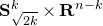 $\mathbf {S}^k_{\sqrt {2k}} \times \mathbf {R}^{n-k}$
for
 $k=0,1, \dots , n$
.
There is also a corresponding rigidity theorem (see Theorem 3.3 for a stronger version).
Theorem 1.4. If
 $\Sigma ^n \subset \mathbf {R}^{n+1}$
is a complete properly embedded shrinker that lies on one side of
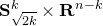 $\mathbf {S}^k_{\sqrt {2k}} \times \mathbf {R}^{n-k}$
for some
 $k$
, then
 $\Sigma = \mathbf {S}^k_{\sqrt {2k}} \times \mathbf { R}^{n-k}$
.
The case
 $k=0$
of Theorem 1.4 is a strong half-space theorem for shrinkers. The strong half-space theorem for minimal surfaces, [Reference Hoffman and MeeksHM90], states that any complete proper minimal surface in
 $\mathbf {R}^3$
that lies in a half-space must itself be a plane. Unlike the results here, the half-space theorem for minimal surfaces holds only in
 $\mathbf {R}^3$
and is a global result where it is essential that the minimal surface is complete. However, for embedded minimal disks, there is a local estimate that plays a key role in understanding embedded minimal surfaces [Reference Colding and MinicozziCM04].
Theorem 3.3 in [Reference Pigola and RimoldiPR14] gave the first half-space-type theorem for complete proper shrinkers without boundary, cf. [Reference Cavalcante and EspinarCE16, Reference BrendleBre16, Reference Choi, Haslhofer, Hershkovits and WhiteCHHW22] for other results in the complete case. Corollary 1.3 only requires a large enough piece of a shrinker and it holds for all generalized cylinders.
The proof of the classical Frankel theorem [Reference FrankelFra66] used the second variation for geodesics. This argument was extended to closed shrinkers, and more generally weighted closed minimal surfaces, in [Reference Wei and WylieWW09]. The paper [Reference Impera, Pigola and RimoldiIPR21] proved a Frankel theorem for complete noncompact shrinkers without boundary under some assumptions at infinity, this time using a Reilly formula and potential theory; see also [Reference Bernstein and WangBW17, Reference WangWan23]. In the complete case, Frankel theorems for varifold shrinkers were proven in [Reference Chodosh, Choi, Mantoulidis and SchulzeCCMS24, Reference Choi, Haslhofer, Hershkovits and WhiteCHHW22].
The approach here is different, relying on a barrier argument and strong Bernstein theorem for Gaussian stable shrinkers, possibly with boundary. It follows from [Reference Colding and MinicozziCM12a] that every properly embedded complete Gaussian minimal hypersurface
 $\Sigma ^n \subset \mathbf {R}^{n+1}$
must be Gaussian unstable (cf. [Reference Colding and MinicozziCM12b, Theorem
 $0.5$
]). The next theorem gives a strong generalization of this, allowing for boundary outside of a fixed ball (see Theorem 3.1 for a stronger result).
Theorem 1.5. If
 $\Sigma ^n \subset \mathbf {R}^N$
is a properly embedded shrinker,
 $R \geq R_n$
,
 $B_{R}\cap \Sigma \ne \emptyset$
, and
 $ B_{R} \cap \partial \Sigma = \emptyset$
, then
 $\Sigma$
is Gaussian unstable.
There are three contrasts with the classical Euclidean Bernstein theorems. First, we do not require completeness; instead, it is already possible to rule out any sufficient large piece. Second, the theorem applies in all dimensions, instead of holding just up to
 $\mathbf {R}^7$
. Finally, the theorem applies in all codimensions, while the classical Bernstein theorems do not hold already in codimension 2 since complex submanifolds are area-minimizing [Reference FedererFed69].
2. Gaussian area
We will next recall the variational characterization of shrinkers as Gaussian minimal submanifolds. It will be useful to work with more general rectifiable varifolds, rather than restricting to smooth submanifolds. As in [Reference Colding and MinicozziCM12a], define the Gaussian area, or
 $F$
functional, of an
 $n$
-dimensional rectifiable varifold
 $\Sigma ^n \subset \mathbf {R}^N$
by
 \begin{align} F(\Sigma ) = \left (4 \, \pi \right )^{ - {n}/{2} } \, \int _{\Sigma } \text {e}^{ - {|x|^2}/{4} } \, . \end{align}
The constant
 $\left (4 \, \pi \right )^{ - {n}/{2} }$
makes the Gaussian area of an
 $n$
-plane through the origin equal to one. Critical points of
 $F$
are said to be
 $F$
-stationary (see [Reference Colding and MinicozziCM12a], § 12). If
 $\Sigma$
is an immersed submanifold, then
 $F$
-stationary is equivalent to the shrinker equation
 \begin{align} \mathbf {H} = \tfrac{1}{2} \, x^{\perp } \, , \end{align}
where
 $\mathbf {H}$
is the mean curvature vector and
 $x^{\perp }$
is the perpendicular part of the position vector field.Footnote
1
More generally,
 $F$
-stationary varifolds are weak solutions of (2.2).
The simplest shrinkers are an
 $n$
-plane through the origin, where both
 $\mathbf {H}$
and
 $x^{\perp }$
vanish identically, and an
 $n$
-sphere of radius
 $\sqrt {2n}$
centered at the origin. These are the extreme cases of the generalized cylinders
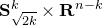 $\mathbf { S}^{k}_{\sqrt {2k}} \times \mathbf {R}^{n-k}$
, for
 $k=0, \dots , n$
.
2.1 Volume bounds for
 $F$
-stationary rectifiable varifolds

The next proposition gives local bounds on volume growth for shrinkers; the argument is adapted from global results [Reference Cheng and ZhouCZ13, Reference Cao and ZhouCZ10] for complete smooth shrinkers.
Proposition 2.1. If
 $\Sigma ^n \subset B_{\bar {R}} \subset \mathbf {R}^N$
is a proper
 $F$
-stationary rectifiable varifold and
 $\sqrt {4+2n} \lt r_1 \lt r_2 \lt \bar {R}$
, then
 \begin{align} \left ( 1 - \frac {2n}{r_2^2} \right ) \, \frac {{\text {Vol}} (B_{r_2} \cap \Sigma )}{r_2^n} & \leq \frac {{\text {Vol}} (B_{r_1} \cap \Sigma )}{r_1^n} \, ,\\[-12pt]\nonumber \end{align}
 \begin{align} \int _{B_{r} \cap \Sigma } |x^{\perp }|^2 &\leq 2\, n \, {\text {Vol}} (B_{r} \cap \Sigma ) \, . \end{align}
A rectifiable integral varifold
 $\Sigma$
has a well-defined tangent plane, and thus also an orthonormal tangent frame
 $\{ e_i \}$
, almost everywhere. Thus, given an ambient vector field
 $Y$
, we can define its tangential and normal parts
 $Y^T$
and
 $Y^{\perp }$
almost everywhere and, moreover, we can also define its divergence on
 $\Sigma$
,
 \begin{align} {\text {div}}_{\Sigma } (Y) = \sum _i \langle \nabla _{e_i} Y , e_i \rangle \, . \end{align}
The varifold is said to have mean curvature
 $\mathbf {H}$
if, for every Lipschitz
 $Y$
with compact support, we have thatFootnote
2
 \begin{align} \int _{\Sigma } {\text {div}}_{\Sigma } \, Y = \int _{\Sigma } \langle Y , \mathbf {H} \rangle \, . \end{align}
It is
 $F$
-stationary (shrinker) when
 $\mathbf {H} = \frac {1}{2} \, x^{\perp }$
in (2.6).
Lemma 2.2. If
 $\gamma : \mathbf {R} \to \mathbf {R}$
is a bounded Lipschitz function with
 $\gamma (s) = 0$
for all large enough
 $s$
, then
 \begin{align} \int _{\Sigma } \left ( n \, \gamma (|x|) + |x| \, \gamma '(|x|) \right ) = \int _{\Sigma } \left ( \frac {1}{2} \, \gamma (|x|) \, |x^{\perp }|^2 + \gamma '(|x|) \, \frac {|x^{\perp }|^2}{|x|} \right ) \, . \end{align}
If in addition
 $\gamma ' \leq 0$
, then
 \begin{align} \int _{\Sigma } \gamma (|x|) \, |x^{\perp }|^2 \leq 2n \, \int _{\Sigma } \gamma (|x|) \, . \end{align}
Proof. Note that
 $Y = \gamma (|x|) \, x$
is bounded, Lipschitz, and has compact support, and
 \begin{align} \langle Y , \mathbf {H} \rangle = \tfrac{1}{2} \, \gamma (|x|) \, |x^{\perp }|^2 \, . \end{align}
The divergence of
 $Y$
is given by
 \begin{align} {\text {div}}_{\Sigma } \, Y &= \gamma (|x|) \, {\text {div}}_{\Sigma } x + \gamma ' (|x|) \, \langle \nabla |x| , e_i \rangle \langle x , e_i \rangle = n \, \gamma (|x|) + \gamma ' (|x|) \, \langle \nabla ^T |x| , x^T \rangle \notag \\ &= n \, \gamma (|x|) + \gamma ' (|x|) \, \frac { |x^T|^2}{|x|} = n \, \gamma (|x|) + \gamma ' (|x|) \, \left ( |x| - \frac { |x^{\perp }|^2}{|x|} \right ) \, . \end{align}
The first claim follows from this and (2.6). The second claim follows from the first using that
 $\gamma ' \leq 0$
and
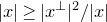 $|x| \geq {|x^{\perp }|^2}/{|x|}$
.
Proof of Proposition 2.1
. Let
 $\gamma (s)=\phi (s/R)$
, where
 $\phi : \mathbf {R} \to \mathbf {R}$
is a Lipschitz function with
 $\phi (s) = 1$
for
 $s \in [0,1/2]$
,
 $\phi ' \leq 0$
, and
 $\phi (s) = 0$
for all
 $s \geq 1$
. DefineFootnote
3
 $V(R)$
and
 $T(R)$
by
 \begin{align} V(R) &= \int _{\Sigma } \phi (|x|/R) \, ,\\[-9pt]\nonumber \end{align}
 \begin{align} T(R) &= \int _{\Sigma } |x^{\perp }|^2 \, \phi (|x|/R) \, . \end{align}
In this notation, the second claim in Lemma 2.2 gives that
 \begin{align} T(R) \leq 2\,n \, V(R) \, . \end{align}
Taking the limit as
 $\phi$
goes to the characteristic function on
 $[0,1]$
gives (2.4).
Since
 $\gamma (s) = \phi (s/R)$
and
 $\partial _R \phi (s/R) = - ({s}/{R^2}) \, \phi ' (s/R) = - ({s}/{R}) \, \gamma ' (s)$
, we have thatFootnote
4
 \begin{align} V'(R) &= - R^{-1} \, \int _{\Sigma } |x| \, \gamma ' (|x|) \, ,\\[-7pt]\nonumber \end{align}
 \begin{align} T'(R) &= - R^{-1} \, \int _{\Sigma } |x^{\perp }|^2 \, |x| \, \gamma ' (|x|) \, .\end{align}
Thus, we have that
 \begin{align} R\, V'(R) - n \, V(R) =- \frac {1}{2} \, T(R) + \int _{\Sigma } (-\gamma '(|x|)) \, \frac {|x^{\perp }|^2}{|x|} \, . \end{align}
Let
 $\rho \in [ 1/2 ,1]$
be the supremum of
 $\{ s \, | \, \phi (s ) = 1\}$
. It follows that the support of
 $\gamma '$
is on
 $[\rho \, R , R]$
and, consequently,
 \begin{align} \int _{\Sigma } (-\gamma '(|x|)) \, \frac {|x^{\perp }|^2}{|x|} \leq \frac {1}{\rho ^2 \, R^2} \, \int _{\Sigma } (-\gamma '(|x|)) \, |x^{\perp }|^2 \, |x| = \frac {1}{\rho ^2 \, R} \, T'(R) \, . \end{align}
Using this in (2.16) gives that
 \begin{align} R\, V'(R) - n \, V(R) \leq - \frac {1}{2} \, T(R) + \rho ^{-2} \, \frac {T'(R)}{ R} \, . \end{align}
Thus, we get that
 \begin{align} (R^{-n} \, V(R))' = R^{-n-1} \, \left ( R\, V'(R) - n \, V(R) \right ) \leq \left ( - \frac {1}{2} \, T(R) + \rho ^{-2} \, \frac {T'(R)}{ R} \right ) \, R^{-n-1} \, . \end{align}
Integrating this from
 $r_1$
to
 $r_2$
gives that
 \begin{align} \frac { V(r_2)}{r_2^n} - \frac { V(r_1)}{r_1^n} \leq \int _{r_1}^{r_2} \left ( \rho ^{-2} \, T'(s) \, s^{-n-2} - \frac {1}{2} \, T(s) \, s^{-n-1} \right ) \, ds \, . \end{align}
Integrating by parts on the
 $T'(s)$
term gives
 \begin{align} \int _{r_1}^{r_2} T'(s) \, s^{-n-2} \, ds &= \frac {T(r_2)}{r_2^{n+2}} - \frac {T(r_1)}{r_1^{n+2}} + (n+2) \, \int _{r_1}^{r_2} \frac {T(s)}{s^{n+3}} \, ds \notag \\ &\leq \frac {2n \, V(r_2)}{r_2^{n+2}} + (n+2) \, \int _{r_1}^{r_2} \frac {T(s)}{s^{n+3}} \, ds \, , \end{align}
where the last inequality used that
 $T(s) \geq 0$
and
 $T(s) \leq 2n \, V(s)$
by (2.13). Using this in (2.20) gives that
 \begin{align} \frac { V(r_2)}{r_2^n} - \frac { V(r_1)}{r_1^n} \leq \rho ^{-2} \, \frac {2n \, V(r_2)}{r_2^{n+2}} + \rho ^{-2} \, (n+2) \, \int _{r_1}^{r_2} \frac {T(s)}{s^{n+3}} \, ds - \frac {1}{2} \, \int _{r_1}^{r_2} \frac {T(s)}{s^{n+1}} \, ds \, . \end{align}
Since
 $r_1^2 \gt 2\, n + 4$
, we can take
 $\rho \lt 1$
large enough that
 \begin{align} \frac {\rho ^{-2} \, (n+2)}{s^2}\leq \frac {1}{2} \, , \end{align}
so that the
 $T(s)$
integrand on the right-hand in (2.22) is non-positive. It follows that
 \begin{align} \frac { V(r_2)}{r_2^n} \left ( 1 - \rho ^{-2} \, \frac {2n}{r_2^{2}} \right ) \leq \frac { V(r_1)}{r_1^n} \, . \end{align}
Taking the limit of this as
 $\phi$
goes to the characteristic function of
 $[0,1]$
and
 $\rho \to 1$
gives the first claim.
2.2 Singularities
An
 $F$
-stationary rectifiable varifold
 $\Sigma$
can be decomposed into an open set
 ${\text {Reg}} (\Sigma )$
of regular points, where
 $\Sigma$
is an embedded submanifold, together with a closed singular set
 ${\text {Sing}} (\Sigma ) = \Sigma \setminus {\text {Reg}} (\Sigma )$
.
If
 $\Sigma ^n \subset \mathbf {R}^{n+1}$
is
 $F$
-minimizing, then it is also area-minimizing for the Gaussian metric (see, e.g., [Reference Colding and MinicozziCM12a, p. 770]). Therefore, the regularity theory for area-minimizers ([Reference Schoen and SimonSS81, Theorem 4] or [Reference WickramasekeraWic14, § 18]) implies that
 \begin{align} \dim _H {\text {Sing}} (\Sigma ) \leq n-7 \, , \end{align}
where
 $ \dim _H$
is Hausdorff dimension. By [Reference Cheeger and NaberCN13, Theorem 5.8], the same bound holds for Minkowski dimension
 $\dim _M$
. Recall that the
 $\rho$
-covering number
 ${\text {Cov}}_{\rho } (S)$
of a set
 $S$
is the number of closed balls of radius
 $\rho \gt 0$
in a minimal coveringFootnote
5
of
 $S$
. A set
 $S \subset \mathbf {R}^N$
has Minkowski dimension less than
 $k$
if
 \begin{align} \lim _{\rho \to 0} \, \rho ^{k} \, {\text {Cov}}_{\rho } (S) = 0 \,. \end{align}
Since each ball has Euclidean volume comparable to
 $\rho ^N$
, an immediate consequence of (2.26) is that
 \begin{align} \lim _{\rho \to 0} \, \rho ^{k-N} \, {\text {Vol}}_{\mathbf {R}^N} (T_{\rho } (S) ) = 0 \, , \end{align}
where
 $T_{\rho } (S)$
is the Euclidean tubular neighborhood of radius
 $\rho \gt 0$
of
 $S$
. A bound on
 $\dim _M$
is stronger than a bound on the Hausdorff dimension
 $\dim _H$
and, in particular, implies capacity estimates and removability of singularities for elliptic equations.
The next lemma constructs good cutoff functions on the regular part when the Minkowski dimension of the singular set is less than
 $n-2$
.
Lemma 2.3. Let
 $\Sigma ^n \subset \mathbf {R}^N$
be a proper
 $F$
-stationary rectifiable varifold in
 $B_{R}$
with
 \begin{align} \dim _M {\text {Sing}} (\Sigma ) \lt n-2 \, . \end{align}
Given
 $\epsilon \gt 0$
, there is a Lipschitz function
 $\phi :\Sigma \to [0,1]$
that is zero on
 $\overline {B_{R-1}} \cap {\text {Sing}} (\Sigma )$
and
 \begin{align} \int _{\Sigma } |\nabla \phi |^2 \, \text {e}^{ - {|x|^2}/{4}} + \int _{\Sigma } (1- \phi ^2) \, \text {e}^{ - {|x|^2}/{4}} &\leq \epsilon \, . \end{align}
Proof. Set
 $S = \overline {B_{R-1}} \cap {\text {Sing}} (\Sigma )$
. Let
 $\delta \gt 0$
be a small constant to be chosen below. The assumption (2.28) implies that there exists
 $\rho \lt {1}/{3R}$
so that
 \begin{align} {\text {Cov}}_{\rho } (S) \lt \delta \, \rho ^{2-n} \, . \end{align}
Let
 $\{ B_{\rho } (x_i)\}$
,
 $i=1 , \dots , m$
with
 $m \lt \delta \, \rho ^{2-n}$
, be a minimal covering of
 $S$
by balls of radius
 $\rho$
. In particular, we have that every
 $x_i \in \overline {B_{R-1 + R^{-1}}}$
. Let
 $d_S (x)$
be the Euclidean distance from
 $x$
to
 $S$
and define the function
 $\phi$
by
 \begin{align} \phi (x) = \begin{cases} 0 &{\text { if }} d_S(x) \leq \rho, \\ \rho ^{-1} \, d_{S} (x) - 1 &{\text { if }} {\rho } \lt d_S(x) \lt {2}{\rho }, \\ 1 &{\text { if }} 2\, \rho \leq d_{S} (x). \end{cases} \, \end{align}
Note that
 $\phi$
maps to
 $[0,1]$
and vanishes on
 $S$
. Moreover, both
 $(1-\phi ^2)$
and
 $|\nabla \phi |$
have support in the tubular neighborhood
 $T_{2\rho }(S)$
of radius
 $2\rho$
about
 $S$
. Since
 $|\nabla \phi | \leq \rho ^{-1}$
, the exponential weight is at most one, and
 $T_{2\rho }(S)$
is contained in the union of the balls
 $B_{3\rho }(x_i)$
, it follows that
 \begin{align} \int |\nabla \phi |^2 \, \text {e}^{ - {|x|^2}/{4}} + \int (1- \phi ^2) \, \text {e}^{ - {|x|^2}/{4}} &\leq \left ( 1 + \rho ^{-2} \right ) \, {\text {Vol}} \left ( T_{2\rho }(S) \cap \Sigma \right ) \notag \\ &\leq 2\, \rho ^{-2} \, \sum _i {\text {Vol}} \left ( B_{3\rho } (x_i) \cap \Sigma \right ) \notag\\ &\lt 2\, \delta \, \rho ^{-n} \, \max _i \, {\text {Vol}} \left ( B_{3\rho } (x_i) \cap \Sigma \right ) \, . \end{align}
The shrinker equation implies that
 $\Sigma$
has mean curvature weakly in
 $L^{\infty }$
and bounded by
 ${R}/{2}$
on
 $B_R$
. Therefore, since
 $3\rho \leq {1}/{R}$
and
 $B_{{1}/{R}} (x_i) \subset B_R$
for every
 $i$
, monotonicity of volume with bounded mean curvature ([Reference Colding and MinicozziCM11, Lemma 1.18]; cf. [Reference SimonSim83, § 18]) gives a constant
 $c$
so that
 \begin{align} {\text {Vol}} \left ( B_{3\rho } (x_i) \cap \Sigma \right ) \leq c \, \left ( \frac { \rho }{ R^{-1} } \right )^n \, {\text {Vol}} (B_{ {1}/{R} } (x_i) \cap \Sigma ) \leq c\, \rho ^n \, R^n \, {\text {Vol}} (B_R \cap \Sigma ) \, . \end{align}
Using this in (2.32) gives
 \begin{align} \int |\nabla \phi |^2 \, \text {e}^{ - {|x|^2}/{4}} + \int (1- \phi ^2) \, \text {e}^{ - {|x|^2}/{4}} & \lt 2\, c\, \delta R^n \, {\text {Vol}} (B_R \cap \Sigma ) \, . \end{align}
Since
 $R$
here is fixed and
 $\Sigma$
is proper, the right-hand side of (2.34) is bounded by
 $C' \, \delta$
for a fixed constant
 $C'$
independent of
 $\delta$
. The lemma follows by choosing
 $\delta \gt 0$
sufficiently small depending on
 $\epsilon$
and
 $C'$
.
3. A strong Bernstein theorem for shrinkers
The classical Bernstein theorem for minimal surfaces gives that an entire minimal graph in
 $\mathbf {R}^3$
must be flat. This was extended to area-minimizing hypersurfaces up to
 $\mathbf {R}^7$
and shown to be false in
 $\mathbf {R}^8$
(see, e.g., [Reference SimonSim83, Reference Colding and MinicozziCM11]). The second variation of Gaussian area was introduced in [Reference Colding and MinicozziCM12a] and was used to show that there are no complete Gaussian stable hypersurfaces.Footnote
6
Wang used the second variation and a calibration argument to prove a Bernstein theorem for entire graphical shrinkers in [Reference WangWan11].
In this section, we will prove the strong Bernstein theorem, Theorem 1.5. In fact, we show the following more general theorem that allows boundary and a small set of singularities.
Theorem 3.1. If
 $\Sigma ^n \subset B_R \subset \mathbf {R}^N$
is a proper
 $F$
-stationary rectifiable varifold with
 $R \geq R_n$
and
 $\dim _M {\text {Sing}} (\Sigma ) \lt (n-2)$
, then
 $\Sigma$
is Gaussian unstable.
Theorem 3.1 has Theorem 1.5 as an immediate consequence when the singular set is empty. We will need this more general version to prove the strong Frankel theorem in high dimensions where Gaussian minimizers can have singularities.
3.1 Second variation and stability
The second variation operator
 $L$
for Gaussian area from [Reference Colding and MinicozziCM12a] ([Reference Colding and MinicozziCM12a, equation (
 $4.13$
)] for hypersurfaces, [Reference Andrews, Li and WeiAHW14, Theorem 4.1], cf. [Reference Arezzo and SunAS13, Reference Lee and LueLL15, Reference Colding and MinicozziCM20, Reference Colding and MinicozziCM23] for higher codimensions) is given on normal vector fields
 $v$
by
 \begin{align} L\,v = {\mathcal {L}}\,v + \langle A_{ij},v\rangle \,A_{ij} + \tfrac {1}{2}\,v \, . \end{align}
Here
 ${\mathcal {L}}\,v=\Delta ^{\perp }\,v-\frac {1}{2}\,\nabla ^{\perp } _{x^T}v$
,
 $\perp$
denotes the component normal to
 $\Sigma$
,
 $A$
is the second fundamental form, and
 $A_{ij}=A(f_i,f_j)$
, where
 $f_i$
is an orthonormal basis for the tangent space of
 $\Sigma$
at the given point. When
 $\Sigma$
is a hypersurface with unit normal
 $\textbf {n}$
, then
 \begin{align} L = {\mathcal {L}} + |A|^2 + \tfrac {1}{2} \, . \end{align}
An
 $F$
-stationary rectifiable varifold
 $\Sigma ^n \subset \mathbf {R}^N$
is said to be Gaussian stable if
 \begin{align} \int _{\Sigma } \langle \eta , \, L\, \eta \rangle \, \text {e}^{ - {|x|^2}/{4}} \leq 0 \end{align}
for every normal vector field
 $\eta$
with compact support on
 ${\text {Reg}} (\Sigma )$
. The inequality (3.3) is known as the stability inequality.
The next proposition gives a uniform Poincaré inequality on the regular part for Gaussian stable
 $F$
-stationary rectifiable varifolds.
Proposition 3.2. If
 $\Sigma ^n \subset \mathbf {R}^N$
is a proper Gaussian stable
 $F$
-stationary rectifiable varifold, then every function
 $w$
with compact support on
 ${\text {Reg}} ( \Sigma )$
satisfies
 \begin{align} \int _{\Sigma } w^2 \, \text {e}^{ - {|x|^2}/{4}} \leq 2 \, \int _{\Sigma } |\nabla w|^2 \text {e}^{ - {|x|^2}/{4}} \, . \end{align}
Proof. When
 $\Sigma$
is a smooth embedded hypersurface, then (3.4) follows immediately from the stability inequality with
 $\eta = w \, {\textbf {n}}$
(where
 $\textbf {n}$
is a unit normal) and integration by parts. We will show that (3.4) holds in arbitrary codimension and without smoothness or embeddedness.
Let
 $e_1 , \dots , e_{N} \in \mathbf {R}^N$
be a Euclidean orthonormal basis. For each
 $i$
, define the normal vector field
 $v_i$
by taking the perpendicular part of the constant vector
 $e_i$
,
 \begin{align} v_i = e_i^{\perp }\, . \end{align}
Since the rank of the normal bundle is the codimension
 $N-n$
, we have that
 \begin{align} \sum _{i} |v_i|^2 = N-n \, . \end{align}
By [Reference Colding and MinicozziCM12a, Theorem 5.2] (see [Reference Andrews, Li and WeiAHW14,
 $5.1$
] for the higher codimension case), each
 $v_i$
satisfiesFootnote
7
 \begin{align} L \, v_i = \tfrac {1}{2} \, v_i \, . \end{align}
Now let
 $w$
have compact support on
 ${\text {Reg}} ( \Sigma )$
and observe that
 \begin{align} L \, (w \, v_i) = ({\mathcal {L}} \, w) \, v_i + \tfrac {1}{2} \, w \, v_i + 2 \, \nabla ^{\perp }_{\nabla w} v_i \, . \end{align}
Using
 $w\, v_i$
in the stability inequality (3.3) gives
 \begin{align} \frac {1}{2} \, \int w^2 \, |v_i|^2 \, \text {e}^{ - {|x|^2}/{4}} \leq - \int _{\Sigma } \left ( w\, ({\mathcal {L}} \, w) \, |v_i|^2 + 2 \, w \, \langle v_i,\nabla ^{\perp }_{\nabla w} v_i \rangle \right ) \, \text {e}^{ - {|x|^2}/{4}} \notag \\ =- \int _{\Sigma } \left ( w\, ({\mathcal {L}} \, w) \, |v_i|^2 + w\,\langle \nabla w,\nabla |v_i|^2\rangle \right ) \, \text {e}^{ - {|x|^2}/{4}}\, . \end{align}
Summing this over
 $i$
and using (3.6) gives
 \begin{align} \frac {N-n}{2} \, \int w^2 \, \text {e}^{ - {|x|^2}/{4}} \leq - (N-n) \, \int _{\Sigma } w\, ({\mathcal {L}} \, w) \, \text {e}^{ - {|x|^2}/{4}} = (N-n) \, \int _{\Sigma } |\nabla w|^2 \, \text {e}^{ -{|x|^2}/{4}} \, , \end{align}
where the last equality used the divergence theorem.
Proof of Theorem 3.1. Let
 $R \gt \sqrt {4+2\,n}$
be a radius to be chosen large enough below. Since
 \begin{align} {\mathcal {L}} \, |x|^2 = 2\,n - |x|^2 \end{align}
by [Reference Colding and MinicozziCM12a, Lemma 3.20], the maximum principle guarantees that
 $\Sigma$
intersects the closure of
 $B_{\sqrt {2\,n}}$
.
Let
 $\eta$
be a radial (i.e. a function of
 $|x|$
) cutoff function on
 $\Sigma$
that is identically one on
 $B_{r_2-1}$
and cuts off linearly to zero from
 $r_2-1$
to
 $r_2$
. Given
 $\epsilon \gt 0$
, Lemma 2.3 gives a function
 $\phi =\phi _{\epsilon }$
that vanishes on
 $B_{r_2} \cap {\text {Sing}} (\Sigma )$
, has
 $0 \leq \phi \leq 1$
, and
 \begin{align} \int _{\Sigma } |\nabla \phi |^2 \, \text {e}^{ - {|x|^2}/{4}} &\leq \epsilon \, ,\\[-12pt]\nonumber \end{align}
 \begin{align} \int _{ \Sigma } (1- \phi ^2) \, \text {e}^{ - {|x|^2}/{4}} &\leq \epsilon \, . \end{align}
It follows that
 $w = \eta \, \phi$
has compact support in the regular part of
 $B_{r_2} \cap \Sigma$
. Since
 $\eta , \phi$
map to
 $[0,1]$
, the squared triangle inequality gives that
 \begin{align} |\nabla w|^2 \leq 2\, |\nabla \eta |^2 + 2\, |\nabla \phi |^2 \, . \end{align}
Integrating this and using that
 $|\nabla \eta | \leq 1$
vanishes inside
 $B_{r_2 -1}$
gives
 \begin{align} \int |\nabla w|^2 \, \text {e}^{ - {|x|^2}/{4} } &\leq 2\, \int |\nabla \phi |^2 \, \text {e}^{ -{|x|^2}/{4}} + 2\, \text {e}^{ - { (r_2 -1)^2}/{4}} \, {\text {Vol}} (B_{r_2} \cap \Sigma ) \notag \\ &\leq 2\, \epsilon + 2\, \text {e}^{ - { (r_2 -1)^2}/{4}} \, {\text {Vol}} (B_{r_2} \cap \Sigma ) \, , \end{align}
where all integrals are on
 $\Sigma$
and the last inequality used (3.12). On the other hand, taking
 $r_2 \gt r_1 + 1$
so that
 $\eta \equiv 1$
on
 $B_{r_1}$
, we have that
 \begin{align} \int w^2 \, \text {e}^{ - {|x|^2}/{4} } &\geq \int _{B_{r_1} \cap \Sigma } w^2 \, \text {e}^{ - {|x|^2}/{4} } = \int _{ B_{r_1} \cap \Sigma } \phi ^2 \, \text {e}^{ - {|x|^2}/{4} } \notag \\ &\geq \text {e}^{ - {r_1^2}/{4} } \, {\text {Vol}} (B_{r_1} \cap \Sigma ) - \int (1-\phi ^2) \, \text {e}^{ - {|x|^2}/{4}} \geq \text {e}^{ - {r_1^2}/{4} } \, {\text {Vol}} (B_{r_1} \cap \Sigma ) - \epsilon \, , \end{align}
where the last inequality used (3.13). If
 $\Sigma$
was Gaussian stable, then Proposition 3.2 would give that
 \begin{align} \int w^2 \, \text {e}^{ - {|x|^2}/{4}} \leq 2 \, \int |\nabla w|^2 \, \text {e}^{ - {|x|^2}/{4} } \, . \end{align}
Using the last two bounds on
 $w$
and
 $\nabla w$
, this would imply that
 \begin{align} \text {e}^{ - {r_1^2}/{4} } \, {\text {Vol}} (B_{r_1} \cap \Sigma ) - \epsilon \leq 4\, \epsilon + 4\, \text {e}^{ - { (r_2 -1)^2}/{4}} \, {\text {Vol}} (B_{r_2} \cap \Sigma ) \, . \end{align}
Since
 $\epsilon \gt 0$
is arbitrary, this gives
 \begin{align} \text {e}^{ - {r_1^2}/{4} } \, {\text {Vol}} (B_{r_1} \cap \Sigma ) \leq 4\, \text {e}^{ - { (r_2 -1)^2}/{4}} \, {\text {Vol}} (B_{r_2} \cap \Sigma ) \, . \end{align}
However, Proposition 2.1 gives that
 \begin{align} \left ( 1 - \frac {2n}{r_2^2} \right ) \, \frac {{\text {Vol}} (B_{r_2} \cap \Sigma )}{r_2^n} \leq \frac {{\text {Vol}} (B_{r_1} \cap \Sigma )}{r_1^n} \, . \end{align}
The last two inequalities are contradictory for
 $r_1$
fixed and
 $r_2$
large enough depending on the dimension
 $n$
, so
 $\Sigma$
cannot be Gaussian stable.
3.2 Proof of the strong Frankel theorem
The idea for the strong Frankel theorem is that if there are two distinct shrinkers in a large ball, then a barrier argument produces an
 $F$
-minimizer between them, violating the strong Bernstein theorem. In this subsection, we restrict to shrinkers in codimension one.
Proof of Theorem 1.1. Applying the maximum principle to
 $|x|^2$
, it follows that
 \begin{align} \overline {B_{\sqrt {2n}}} \cap \Sigma _i \ne \emptyset \quad{\text {for }} i=1,2 \, . \end{align}
Let
 $R_n$
be from Theorem 3.1. We will argue by contradiction, so assume that
 \begin{align} B_{R_n} \cap \Sigma _1 \cap \Sigma _2= \emptyset \, . \end{align}
In particular, we can find a line segment
 \begin{align} \sigma \subset \overline {B_{\sqrt {2n}}} \end{align}
that starts at a point in
 $\Sigma _1$
, ends at a point in
 $\Sigma _2$
, and is otherwise disjoint from
 $\Sigma _1 \cup \Sigma _2$
. Let
 $\Omega$
denote the component of
 $B_{R_n} \setminus (\Sigma _1 \cup \Sigma _2)$
that contains the interior of
 $\sigma$
. It follows that
 $\sigma$
has non-zero linking number with
 $\partial \Sigma _1$
in
 $\Omega$
.
Next, we solve for the
 $F$
-minimizer
 $\Gamma \subset \overline {\Omega }$
with
 $\partial \Gamma = \partial (B_{R_n} \cap \Sigma _1)$
(see, e.g., [Reference FedererFed69,
 $5.1.6$
]). The part
 $B_{R_n} \cap \Gamma$
of
 $\Gamma$
disjoint from
 $\partial B_{R_n}$
must be
 $F$
-stationary, but
 $\Gamma$
might contain pieces in
 $\partial B_{R_n}$
that do not satisfy the shrinker equation. However, the linking argument implies that
 $\Gamma \cap \sigma \ne \emptyset$
. Thus, there is a connected component
 $\Gamma _1$
of
 $B_{R_n} \cap \Gamma$
with
 \begin{align} \Gamma _1 \cap \sigma \ne \emptyset \, . \end{align}
For
 $n \leq 6$
, the interior regularity theory for area-minimizers, [Reference Schoen and SimonSS81, Theorem 4] or [Reference WickramasekeraWic14, § 18], gives that
 $\Gamma _1$
is smooth, embedded, and stable. This contradicts Theorem 1.5, completing the proof when
 $n \leq 6$
. For
 $n \geq 7$
,
 $\Gamma _1$
can have singularities, but [Reference Schoen and SimonSS81] and [Reference Cheeger and NaberCN13, Theorem 5.8] give that
 ${\text {Reg}} (\Gamma _1)$
is stable and
 \begin{align} \dim _M \, {\text {Sing}} (\Gamma _1) \leq n- 7 \, . \end{align}
This contradicts Theorem 3.1, so we conclude that
 \begin{align} B_{R_n} \cap \Sigma _1 \cap \Sigma _2 \ne \emptyset \, . \end{align}
Proof of Corollary 1.2
. Connectedness follows immediately from Theorem 1.1 by regarding the possible connected components of
 $B_R \cap \Sigma$
as distinct shrinkers with boundary in
 $\partial B_R$
.
Proof of Corollary 1.3
. This follows from Theorem 1.1 with
 $\Sigma _1 = \Sigma$
and
 $\Sigma _2$
equal to a generalized cylinder
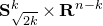 $\mathbf {S}^k_{\sqrt {2k}} \times \mathbf {R}^{n-k}$
.
Theorem 1.4 follows immediately from the following stronger effective version.
Theorem 3.3. Let
 $\Omega ^+$
and
 $\Omega ^-$
be the components of the complement of
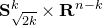 $\mathbf {S}^k_{\sqrt {2k}} \times \mathbf {R}^{n-k}$
for some
 $k \in \{ 0,1, \dots , n\}$
. If
 $\Sigma ^n \subset \mathbf {R}^{n+1}$
is a properly embedded shrinker,
 $R \geq R_n$
,
 \begin{align} \partial \Sigma \subset \partial B_{R} , \quad B_{R} \cap \Sigma \ne \emptyset,\quad {\text {and}}\quad B_R \cap \Sigma \quad{\text {intersects at most one of }} \Omega ^{\pm } \, , \end{align}
then
 $B_{R} \cap \Sigma \subset \mathbf {S}^k_{\sqrt {2k}} \times \mathbf {R}^{n-k}$
.
Proof. By assumption,
 $B_R \cap \Sigma$
lies on one side of
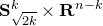 $\mathbf {S}^k_{\sqrt {2k}} \times \mathbf {R}^{n-k}$
. Since Corollary 1.3 gives that
 $B_R \cap \Sigma$
is connected and must intersect
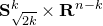 $\mathbf {S}^k_{\sqrt {2k}} \times \mathbf {R}^{n-k}$
, the strong maximum principle (for minimal hypersurfaces in a Riemannian manifold) gives that they must agree identically.
Conflicts of interest
None.
Financial support
The authors were partially supported by NSF DMS Grants 2104349, 2005345 and 2304684.
Journal information
Compositio Mathematica is owned by the Foundation Compositio Mathematica and published by the London Mathematical Society in partnership with Cambridge University Press. All surplus income from the publication of Compositio Mathematica is returned to mathematics and higher education through the charitable activities of the Foundation, the London Mathematical Society and Cambridge University Press.



