



1 Introduction
Let
$\mathbb {D}$
 be the open unit disc in the complex plane
$\mathbb {C}$
 and let
$\mathbb {T}=\partial \mathbb {D}$
 be the unit circle. We denote by
$H(\mathbb {D})$
 the space of all analytic functions on
$\mathbb {D}$
 . In this paper, we study several analytic function spaces on
$\mathbb {D}$
 whose norm is defined in terms of a sup-condition. We begin with the definition of weighted Dirichlet spaces.
For
$p>0$
 and
$t>-1$
 , we let
${\mathcal D}^p_t$
 denote the space of all functions
$f\in H(\mathbb {D})$
 such that

where
$dA$
 is area measure normalized so that the unit disc has area
$1$
 . A norm of f in
${\mathcal D}^p_t$
 is
$|f(0)|+\|f\|_{{\mathcal D}^p_t}$
 .
Two special cases of weighted Dirichlet spaces are worth mentioning. First, for
$p>0$
 and
$t>-1$
 , it follows from a Hardy–Littlewood type theorem that the space
${\mathcal D}^p_{p+t}$
 coincides with the weighted Bergman space
$A^p_t$
 , consisting of all functions
$f\in H(\mathbb {D})$
 such that

Second, by a classical Littewood–Paley theorem, the space
${\mathcal D}^2_1$
 is nothing but the Hardy space
$H^2$
 . Recall that for any
$p>0$
 , the Hardy space
$H^p$
 consists of all functions
${f\in H(\mathbb {D})}$
 such that

Recall that for any
$\alpha>0$
 , the
$\alpha $
 -Bloch space
$\mathcal {B}_\alpha $
 (see [Reference ZhuZhu2]) consists of all functions
$f\in H(\mathbb {D})$
 such that

The special case
$\alpha =1$
 results in the classical Bloch space, which we denote by
$\mathcal {B}$
 . As usual, we let BMOA be the space of functions in
$H^2$
 whose boundary function is of bounded mean oscillation on
$\mathbb {T}$
 ; see [Reference Girela and AulaskariGi].
Denote by
$\mathrm {Aut}(\mathbb {D})$
 the set of all Möbius maps (bijective analytic maps) of the unit disc. It is a group under ordinary compositions and it is called the Möbius group or sometimes the automorphism group. Every
$\sigma \in \mathrm {Aut}(\mathbb {D})$
 can be written in the form

where
$\theta $
 and t are real angles, while a and b are points in
$\mathbb {D}$
 . Here,

A subspace X of
$H(\mathbb {D})$
 endowed with a semi-norm
$\|\ \|_X$
 is said to be Möbius invariant if
$f\circ \sigma \in X$
 and
$\|f\circ \sigma \|_X \lesssim \|f\|_X$
 for all
$f\in X$
 and
$\sigma \in \mathrm {Aut}(\mathbb {D})$
 . A general construction of Möbius-invariant function spaces is as follows: let Y be any subspace of
$H(\mathbb {D})$
 endowed with a semi-norm
$\|\ \|_Y$
 and let
$M[Y]$
 consist of all functions
$f\in Y$
 such that

Then,
$M[Y]$
 is a Möbius-invariant function space with the above semi-norm and
$M[Y]$
 is also called the Möbius-invariant version of Y. For
$p>0$
 and
$t>-1$
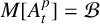
 , it is known (see [Reference Aleman and SimbotinAS, Reference AxlerAx, Reference Girela and AulaskariGi]) that
$M[A^p_t]=\mathcal {B}$
 and
$M[H^p]=\mathrm {BMOA}$
 . We refer to [Reference Arazy, Fisher and PeetreAFP] or [Reference Wulan and ZhuWZ, Ch. 1] for the general theory on Möbius-invariant function spaces.
From [Reference Rubel and TimoneyRT], the Bloch space
$\mathcal {B}$
 is maximal among all Möbius-invariant spaces with an additional mild assumption. For every
$\alpha>0$
 , is
$\mathcal {B}_\alpha $
 maximal among some family of analytic function spaces? This question was posed in [Reference ZhuZhu2] and the answer is shown to be positive by Zhao in [Reference ZhaoZ].
Recall from [Reference ZhaoZ] that for
$f\in H(\mathbb {D})$
 ,
$\sigma \in \mathrm {Aut}(\mathbb {D})$
 , and
$\alpha>0$
 , the weighted
$\alpha $
 -composition of f and
$\sigma $
 is defined by

Note that each
$\sigma \in \mathrm {Aut}(\mathbb {D})$
 is univalent, so
$\log \sigma '(z)$
 ,
$[\sigma '(z)]^\alpha =\exp [\alpha \log \sigma '(z)]$
 , and
$[\sigma '(z)]^{\alpha -1}=\exp [(\alpha -1)\log \sigma '(z)]$
 are all well-defined functions on
$\mathbb {D}$
 . A subspace X of
$H(\mathbb {D})$
 endowed with a semi-norm
$\|\ \|_X$
 is said to be
$\alpha $
 -Möbius invariant if
$f\circ _\alpha \sigma \in X$
 and
$\|f\circ _\alpha \sigma \|_X \lesssim \|f\|_X$
 for all
$f\in X$
 and
$\sigma \in \mathrm {Aut}(\mathbb {D})$
 . In 1996, Zhao [Reference ZhaoZ] proved that
$\mathcal {B}_\alpha $
 is maximal among
$\alpha $
 -Möbius invariant function spaces. In 2021, Bao and Zhu [Reference Bao and ZhuBZ] identified the minimal nontrivial
$\alpha $
 -Möbius invariant function space, and proved the existence and uniqueness of a nontrivial
$\alpha $
 -Möbius invariant semi-Hilbert space of analytic functions on
$\mathbb {D}$
 . We refer to [Reference Bao, Lou and ZhouBLZ, Reference Lou and ZhouLZ, Reference ZhouZhou] for more investigations on
$\alpha $
 -Möbius invariant function spaces.
More examples of
$\alpha $
 -Möbius invariant function spaces are
$F(p,q,s)$
 spaces. Recall that
$F(p,q,s)$
 , where
$p>0$
 ,
$q>-2$
 , and
$q+s>-1$
 , consists of functions
$f\in H(\mathbb {D})$
 such that

The spaces
$F(p,q,s)$
 were introduced and studied in [Reference ZhaoZ]. In particular,
$F(p,q,s)$
 is a subset of
$\mathcal {B}_{(q+2)/p}$
 . For
$s>1$
 , we actually have
$F(p,q,s)=\mathcal {B}_{(q+2)/p}$
 . It is worth mentioning that
$F(2, 0, s)$
 is the well-studied Möbius-invariant space
$\mathcal {Q}_s$
 (see [Reference Aulaskari, Xiao and ZhaoAXZ, Reference XiaoX1, Reference XiaoX2]). It was proved in [Reference ZhaoZ] that
$F(p,q,s)$
 is a
$(q+2)/p$
 -Möbius invariant function space. Very recently, Zhou [Reference ZhouZhou] introduced and investigated a new class of
$\alpha $
 -Möbius invariant function spaces that contains
$F(p, q, s)$
 spaces as special cases.
We also recall Campanato spaces of analytic functions, which are closely associated with
$F(p, q, s)$
 spaces. For
$p>0$
 and
$\lambda>0$
 , the Campanato space
${\mathcal {H}}^{p,\lambda }$
 consists of functions
$f\in H^p$
 such that

where the supremum is taken over all arcs
$I\subset \mathbb {T}$
 ,
$|I|$
 denotes the length of I, and
$f_I$
 is the mean of f over I with respect to
$dt$
 . We mention some special cases as follows.
-
• If $0<\lambda <1$
 , then
${\mathcal {H}}^{p,\lambda }$
is also called a Morrey space.
-
• If $\lambda =1$
, then
${\mathcal {H}}^{p,\lambda }$
is BMOA. -
• If $\lambda \in (1, 1+p]$
, then
${\mathcal {H}}^{p,\lambda }$
is the analytic Lipschitz space
$\Lambda _{(\lambda -1)/p}$
. -
• If $\lambda \in (1+p, \infty )$
, then
${\mathcal {H}}^{p,\lambda }$
contains constant functions only.


See [Reference Xiao and YuanXY, page 1003], for example. Thus, the really interesting case for us here is when
$0<\lambda <1$
 . Also,
$\mathcal {H}^{2, \lambda }$
 is equal to
$F(2, 1-\lambda , \lambda )$
 . We refer to [Reference Yuan and TongYT] for more investigations on
${\mathcal {H}}^{p,\lambda }$
 and
$F(p, q, s)$
 spaces.
In 2021, Aleman and Mas [Reference Aleman and MasAM] introduced and studied another version of Möbius invariant function spaces. For
$\beta>0$
 , a subspace X of
$H(\mathbb {D})$
 endowed with a semi-norm
$\|\ \|_X$
 is said to be Möbius invariant of index
$\beta $
 if
$W^{\beta }_\sigma f \in X$
 and
$\|W^{\beta }_\sigma f\|_X\lesssim \|f\|_X$
 for all
${f\in X}$
 and
$\sigma \in \mathrm {Aut}(\mathbb {D})$
 , where
$W^{\beta }_\sigma f=f\circ \sigma (\sigma')^\beta $
 . Roughly speaking,
$\alpha $
 -Möbius invariant spaces place many analytic function spaces defined by the derivative of functions in the same framework, such as
$\alpha $
 -Bloch spaces,
${\mathcal D}^p_{\alpha p-2}$
 spaces, and
${F(p, \alpha p-2, s)}$
 spaces. However, Möbius-invariant function spaces of index
$\beta $
 include many analytic function spaces defined without the derivative of functions. For example, as shown in [Reference Aleman and MasAM], the Hardy space
$H^p$
 is Möbius invariant of index
$1/p$
 and the Bergman space
$A^p_t$
 is Möbius invariant of index
$(2+t)/p$
 .
When a subspace X of
$H(\mathbb {D})$
 is defined by a derivative condition, it is natural to seek derivative-free characterizations of X. For instance, it is well known (see [Reference ZhuZhu1]) that an analytic function f on
$\mathbb {D}$
 belongs to the Bloch space
$\mathcal {B}$
 if and only if
$|f(z)-f(w)|\lesssim \beta (z, w)$
 for all z,
$w\in \mathbb {D}$
 , where
$\beta (z, w)$
 is the Bergman distance between z and w. See [Reference Li and StevićLS, Reference Li and WulanLW] for other derivative-free characterizations of the Bloch space. We refer to [Reference XiaoX2, Ch. 2] for a summary of derivative-free characterizations of
$\mathcal {Q}_s$
 spaces. Recently, Yang and Yuan [Reference Yang and YuanYY] gave some derivative-free characterizations of
$F(p, q, s)$
 spaces.
The notion of Carleson measures was introduced by Carleson [Reference CarlesonC1, Reference CarlesonC2] when he studied the interpolation problem and the corona problem for the space of bounded analytic functions on
$\mathbb {D}$
 . He characterized positive Borel measures
$\mu $
 on
$\mathbb {D}$
 such that
$H^p\subseteq L^p(\mathbb {D}, d\mu )$
 . Carleson measures are useful tools for studying analytic function spaces and related operators on them. In 2008, Xiao [Reference XiaoX3] studied a variation of Carleson measures for
$\mathcal {Q}_s$
 spaces (the embedding from
$\mathcal {Q}_s$
 to a certain tent-type space), which can be used to characterize the boundedness and compactness of Volterra-type operators on
$\mathcal {Q}_s$
 spaces. Pau and Zhao [Reference Pau and ZhaoPZ] further studied this variation of Carleson measures for
$F(p, q, s)$
 spaces.
In this paper, we continue to investigate
$\alpha $
 -Bloch spaces
$\mathcal {B}_\alpha $
 , Campanato spaces, and
$F(p,q,s)$
 spaces. In Section 3, we give some derivative-free characterizations of
$\mathcal {B}_\alpha $
 spaces. Some of them involve the weighted
$\alpha $
 -composition. In Section 4, we show that the characterizations of
$\mathcal {B}_\alpha $
 in Section 3 improve a conclusion in [Reference Pau and PeláezPP] and a result in [Reference Pau and ZhaoPZ]. In Section 5, we consider a variation of Carleson measures for Campanato spaces. In Section 6, we provide a derivative-free characterization and a variation of Carleson measures for
$F(p, q, s)$
 spaces.
2 Preliminaries
In this section, we collect several technical results that we need multiple times later in the paper. We begin with the following integral estimates.
Lemma 2.1. Suppose
$t>-1$
 and c is real. Then,

for all
$a\in \mathbb {D}$
 .
The result above is well known (see, for example, [Reference ZhuZhu1]).
Lemma 2.2. For
$s>-1$
 ,
$r>0$
 , and
$t>0$
 with
$r+t>s+2$
 , there is a constant
$C>0$
 such that

for all
$a,b\in \mathbb {D}$
 .
This result is slightly less known. It can be found in [Reference Ortega and FàbregaOF].
We need the following Hardy–Littlewood type theorem, which can be found in [Reference Aleman, Pott and RegueraAPR, Reference Bao, Wulan and ZhuBWZ]. Here and below, we use
$\beta (z,w)$
 to denote the hyperbolic (Bergman) metric on
$\mathbb {D}$
 . Let

for
$a\in \mathbb {D}$
 and
$r>0$
 .
Theorem 2.3. Suppose
$\omega (z)$
 is a positive weight function on
$\mathbb {D}$
 with the following properties.
-
(i) For any fixed $r>0$
, there exists a positive constant
$C_1$
such that $$ \begin{align*} C_1^{-1}\le\frac{\omega(z)}{\omega(w)}\le C_1 \end{align*} $$for all $z,w\in \mathbb {D}$
with
$\beta (z,w)<r$
.
-
(ii) There exist positive numbers $\gamma $
and
$C_2$
such that $$ \begin{align*} \int_{\mathbb{D}}\frac{\omega(u)\,dA(u)}{|1-z\overline u|^{2+\gamma}} \le\frac{C_2\omega(z)}{(1-|z|^2)^\gamma} \end{align*} $$for all $z\in \mathbb {D}$
.


Then, for any
$p>0$
 and
$f\in H(\mathbb {D})$
 , we have

Here,
$\sim $
 means that each integral is dominated by the other with a positive constant that is independent of f.
The following lemma concerns a particular class of weight functions involving the Bergman kernel.
Lemma 2.4. Suppose
$t>-1$
 ,
$\sigma <2+t$
 , and
$a\in \mathbb {D}$
 . Then, there exist positive constants
$C_1$
 and
$C_2$
 , independent of a, such that the weight function

has properties (i) and (ii) in Theorem 2.3.
Proof. For any fixed radius
$r>0$
 , it is well known (see [Reference ZhuZhu1] for example) that there exists a constant
$C>0$
 such that

for all
$z,w\in \mathbb {D}$
 with
$\beta (z,w)<r$
 . Furthermore, when
$\beta (z,w)<r$
 , we can find some
$u\in D(0,r)$
 such that
$w=\sigma _z(u)$
 , which yields

Thus,

Since u belongs to
$D(0,r)$
 (which is a Euclidean disc centered at
$0$
 with Euclidean radius
$r'$
 that is strictly less than
$1$
 ), it follows from the triangle inequality that

Consequently, there exists a positive constant C, independent of a, such that

for all
$z,w\in \mathbb {D}$
 with
$\beta (z,w)<r$
 . This verifies condition (i) in Theorem 2.3.
Next, we consider the integral

for positive
$\gamma $
 .
By Lemma 2.2, if the parameters satisfy

then there exists another constant
$C>0$
 , independent of a, such that

for all
$z\in \mathbb {D}$
 . This verifies condition (ii) in Theorem 2.3 under the assumptions
$t>-1$
 ,
$0<\sigma <2+t$
 , and
$\gamma>t$
 .
If
$t>-1$
 ,
$\sigma =0$
 , and
$\gamma>t$
 , it follows from Lemma 2.1 that

for all
$z\in \mathbb {D}$
 , which gives condition (ii) in Theorem 2.3.
If
$t>-1$
 ,
$\sigma <0$
 , and
$\gamma> -\sigma +t$
 , then we write

use the triangle inequality, and use Lemma 2.1 to estimate

for all
$z\in \mathbb {D}$
 , where the implicit constants in the above estimates are independent of the choice of a. This completes the verification of condition (ii) in Theorem 2.3 for all
$t>-1$
 and
$\sigma <2+t$
 .
Remark 2.5. It is clear that the assumption
$t>-1$
 is necessary in Lemma 2.4. Also, the condition
$\sigma <2+t$
 in Lemma 2.4 cannot be replaced by
$\sigma =2+t$
 . In fact, if
${\sigma =2+t}$
 , then by [Reference Zhang, Li, Shang and GuoZLSG, Theorem 3.1],

for all a and z in
$\mathbb {D}$
 . This shows that for
$\sigma =2+t$
 , we have

for any
$\gamma>0$
 . Thus Lemma 2.4 does not hold when
$\sigma =2+t$
 .
Some special cases of Lemma 2.4 and Theorem 2.3 were known before. By [Reference Blasi and PauBP, Lemma 2.1], if
$p>1$
 ,
$t>-1$
 , and
$\sigma \geq 0$
 with
$\sigma <2+t$
 , then

for all
$f\in H(\mathbb {D})$
 and
$a\in \mathbb {D}$
 . Our result here covers all
$p>0$
 ,
$t>-1$
 , and
$\sigma <2+t$
 .
3 Characterizations of
$\alpha $
-Bloch spaces

In this section, we consider derivative-free characterizations for
$\mathcal {B}_\alpha $
 spaces. We need the following description of
$\alpha $
 -Bloch spaces, which is a special case of [Reference Yuan and TongYT, Corollary 9] or [Reference ZhouZhou, Theorem 2].
Theorem 3.1. Suppose
$s>0$
 ,
$\alpha>0$
 ,
$p>0$
 , and
$t>p\alpha -1$
 . Then, an analytic function f on
$\mathbb {D}$
 belongs to
$\mathcal {B}_\alpha $
 if and only if

Using Lemma 2.4, and Theorems 2.3 and 3.1, we now obtain the following derivative-free characterization for
$\mathcal {B}_\alpha $
 in terms of weighted
$\alpha $
 -compositions.
Theorem 3.2. Suppose
$p>0, \alpha >0$
 , and
$f\in H(\mathbb {D})$
 . If the real parameters c and t satisfy

then
$f\in \mathcal {B}_{\alpha }$
 if and only if

Proof. By Lemma 2.4 and Theorem 2.3, if c and t satisfy the inequalities

then,

Combining this with Theorem 3.1, we conclude that
$f\in \mathcal {B}_\alpha $
 if and only if

provided that the parameters satisfy

These conditions can be regrouped as (3-1). The proof is complete.
As was mentioned in Section 1, the Bloch space
$\mathcal {B}$
 is the Möbius-invariant version of weighted Bergman spaces. More specifically, for
$p>0$
 and
$t>-1$
 , a function
${f\in H(\mathbb {D})}$
 belongs to
$\mathcal {B}$
 if and only if

It is easy to see that the condition above is equivalent to

Taking
$c=-(2+t)$
 in Theorem 3.2, we get the following result immediately, which shows that
$\mathcal {B}_\alpha $
 is the
$\alpha $
 -Möbius invariant version of weighted Bergman spaces.
Corollary 3.3. Suppose
$t>-1$
 ,
$p>0$
 , and
$\alpha>0$
 . If
$p(\alpha -1)<t+1$
 , then

for all
$f\in H(\mathbb {D})$
 .
Remark 3.4. When
$p\geq 1$
 , Corollary 3.3 is known as [Reference ZhouZhou, Lemma 2.9]. The result here covers all
$p>0$
 . For
$t>-1$
 and
$p>0$
 , if
$0<\alpha \leq 1$
 , the condition
$p(\alpha -1)<t+1$
 in Corollary 3.3 always holds. If
$\alpha>1$
 , the condition
$p(\alpha -1)<t+1$
 is best possible. In fact, the function

belongs to
$\mathcal {B}_\alpha $
 (see, for example, [Reference ZhuZhu2]). If

then

for
$f\in H(\mathbb {D})$
 and
$\sigma \in \mathrm {Aut}(\mathbb {D})$
 . Taking
$\sigma (z)=z$
 in (3-2) yields
$f'\in A^p_{p+t}$
 , which is known (see [Reference ZhuZhu3, Theorem 18]) to be equivalent to

This means
$p(\alpha -1)<t+1$
 and hence this assumption in Corollary 3.3 is necessary.
Remark 3.5. Note that for
$\alpha \le 1$
 , the conditions in (3-1) simplify to
$t>-1$
 and
$c<0$
 . The second condition in (3-1) is necessary for Theorem 3.2. In fact,
$t>-1$
 is clearly necessary, and by an analysis similar to that in Remark 3.4, the condition
${t>p(\alpha -1)-1}$
 is also necessary. We are not sure if the first condition in (3-1) is necessary for Theorem 3.2.
Finally, in this section, we prove a characterization for
$\alpha $
 -Bloch spaces based on integrals involving
$|f(z)-f(a)|^p$
 , which occurs naturally in many situations.
Theorem 3.6. Suppose that
$p>0$
 ,
$c>0$
 ,
$t>-1$
 , and
$0<\alpha \le 1$
 . Then, a function
$f\in H(\mathbb {D})$
 belongs to
$\mathcal {B}_\alpha $
 if and only if

Proof. Let us use
$I(f,a)$
 to denote the integral above. By a change of variables and a subharmonic integral estimate, there exist two positive constants c and
$c'$
 (independent of f and a) such that

This shows that the boundedness of
$I(f,a)$
 as a function of a implies that
$f\in \mathcal {B}_\alpha $
 . Note that the proof of this direction works for all
$\alpha>0$
 (instead of just
$0<\alpha \le 1$
 ).
To prove the other direction, we first consider the case
$\alpha =1$
 . If
$f\in \mathcal {B}_1=\mathcal {B}$
 , then, in terms of the Bergman/hyperbolic metric,

for all a,
$z\in \mathbb {D}$
 , where
$0<\varepsilon <\min (c,t+1)$
 . It follows from Lemma 2.1 that

Next, we assume
$0<\alpha <1$
 and
$f\in \mathcal {B}_\alpha $
 . It is well known (see [Reference ZhuZhu2] for example) that
$\mathcal {B}_\alpha =\Lambda _{1-\alpha }$
 , the analytic Lipschitz space of order
$1-\alpha $
 . Thus,

for some positive constant C and all
$z,a\in \mathbb {D}$
 . It follows from Lemma 2.1 that

This completes the proof of the theorem.
Remark 3.7. When
$p>0$
 ,
$c>0$
 ,
$t\geq 0$
 , and
$\alpha =1$
 , the conclusion of Theorem 3.6 is already known. See [Reference Li and WulanLW, Theorem 1].
Theorem 3.8. Suppose that
$p>0$
 ,
$c>0$
 ,
$t>-1$
 , and
$\alpha>1$
 . If, in addition,

then a function
$f\in H(\mathbb {D})$
 belongs to
$\mathcal {B}_\alpha $
 if and only if

Proof. Once again, let
$I(f,a)$
 denote the integral above. By the first part of the proof of Theorem 3.6, we only need to prove
$f\in \mathcal {B}_\alpha $
 implies that
$I(f,a)$
 is bounded as a function of a. To do this, we recall (see, for example, [Reference ZhuZhu2]) that for
$\alpha>1$
 , a function
$f\in H(\mathbb {D})$
 belongs to
$\mathcal {B}_\alpha $
 if and only if the function
$(1-|z|^2)^{\alpha -1}f(z)$
 is bounded on
$\mathbb {D}$
 .
Fix some
$f\in \mathcal {B}_\alpha $
 and, once again, let
$I(f,a)$
 denote the integral in question. It is clear that we have
$I(f,a)\lesssim I_1(f,a)+I_2(f,a)$
 , where

and

Since
$|f(z)|\le C(1-|z|^2)^{1-\alpha }$
 for some constant
$C>0$
 and all
$z\in \mathbb {D}$
 , we have

Since
$p(\alpha -1)<t+1$
 or
$t+p(1-\alpha )>-1$
 , it follows from Lemma 2.1 that
$I_1(f,a)$
 is a bounded function of a. Similarly,

which implies (by Lemma 2.1 and the assumption
$p(\alpha -1)<c$
 ) that
$I_2(f,a)$
 is a bounded function of
$a\in \mathbb {D}$
 . This completes the proof of the theorem.
We note that the assumption
$p(\alpha -1)<t+1$
 is necessary in Theorem 3.8. In fact, for any
$\alpha>0$
 , as was mentioned in Remark 3.4, the function

belongs to
$\mathcal {B}^\alpha $
 . For
$p>0$
 and
$t>-1$
 , it follows from [Reference ZhuZhu3, Theorem 18] that
$f\in A^p_t$
 if and only if

that is,
$p(\alpha -1)<t+1$
 . Note that if
$I(f,a)$
 is a bounded function of a, then in particular
$f\in A^p_t$
 . Consequently, the condition
$p(\alpha -1)<t+1$
 in Theorem 3.8 is necessary.
Under the assumption
$p(\alpha -1)<t+1$
 , we have

for all functions
$f\in \mathcal {B}_\alpha $
 . Therefore, the boundedness of
$I(f,a)$
 in a is equivalent to the boundedness of the function

By Lemma 2.1, the boundedness of the above as a function of a is equivalent to
$p(1-\alpha )+c>0$
 for any function
$f\in \mathcal {B}_\alpha \setminus \mathcal {B}_{\alpha ,0}$
 , where
$\mathcal {B}_{\alpha ,0}$
 is the space of functions g in
$H(\mathbb {D})$
 such that

This shows that the assumption
$p(\alpha -1)<c$
 in Theorem 3.8 is also necessary.
It is clear that Theorems 3.6 and 3.8 can be combined into a single theorem, because the additional assumption
$p(\alpha -1)<\min (c, t+1)$
 in Theorem 3.8 is automatically satisfied in the case
$0<\alpha \le 1$
 .
4 A question of Xiao’s and some related problems
In [Reference Pau and PeláezPP, page 551], Pau and Peláez obtained the following estimate: for any
$0<s<1$
 , there exists a constant
$C>0$
 such that

for all
$f\in \mathcal {Q}_s$
 . In [Reference XiaoX3, page 2080], Xiao extended this estimate from
$0<s<1$
 to
$0<s<\infty $
 . Xiao also asked in [Reference XiaoX3, page 2081] whether we actually have

By Theorem 3.6 (with
$p=2$
 ,
$c=t=s>0$
 , and
$\alpha =1$
 ),

It is well known that
$\mathcal {Q}_s=\mathcal {B}$
 for
$s>1$
 . So, the answer to Xiao’s question is positive when
$s>1$
 . However, it is also well known that (see [Reference Aulaskari, Xiao and ZhaoAXZ] for example) for
$0<s\leq 1$
 , the space
$\mathcal {Q}_s$
 is strictly contained in the Bloch space
$\mathcal {B}$
 and
$\|f\|_{\mathcal {Q}_s}\not \sim \|f\|_{\mathcal {B}}$
 . Thus, for
$0<s\leq 1$
 , the answer to Xiao’s question above is negative, that is, the relation in (4-2) does not hold. We mention that Theorem 3.6 also improves (4-1).
In [Reference Pau and ZhaoPZ], Pau and Zhao extended the estimate (4-1) to a more general family of
$F(p,q,s)$
 spaces. Recall that
$\mathcal {Q}_s=F(2,0,s)$
 for
$s>0$
 . Also, the case
$q=\alpha p-2$
 with
$\alpha>0$
 is special. In fact, it is known that (see [Reference ZhaoZ] for example)
$F(p, \alpha p-2, s)\subset \mathcal {B}_\alpha $
 for all
$s>0$
 and
$F(p, \alpha p-2, s)=\mathcal {B}^{\alpha }$
 when
$s>1$
 . Furthermore,
$F(p, \alpha p-2, s)$
 contains only constant functions if
$s+\alpha p\le 1$
 (see [Reference ZhaoZ, Proposition 2.12]). Therefore, to ensure
$F(p, \alpha p-2, s)$
 is nontrivial, we always assume
$s+\alpha p>1$
 .
It was proved in [Reference Pau and ZhaoPZ, Proposition 2.8] that, for

there exists a positive constant C such that

for all
$f\in H(\mathbb {D})$
 . It is also natural to ask whether we actually have

By Theorems 3.6 and 3.8, the left-hand side of (4-4) is finite if and only if
$f\in \mathcal {B}_\alpha $
 , provided that
$s+2p(\alpha -1)>0$
 ,
$s+p\alpha>1$
 , and

In particular, these conditions will all be satisfied if
$s+p>1$
 and
$\alpha \ge 1$
 . Also, Condition (4-5) clearly implies
$s+p>1$
 .
Consequently, when
$p>0$
 ,
$s>0$
 ,
$\alpha \ge 1$
 , and
$s+p>1$
 , we can find a positive constant C such that

for all
$f\in H(\mathbb {D})$
 , which is usually stronger than the estimate in (4-3), because for all
$s>0$
 , we have
$F(p,p\alpha -2,s)\subset \mathcal {B}_\alpha $
 with

Note here that we need the condition
$s+p>1$
 , which is stronger than
$s+p\alpha>1$
 when
$\alpha>1$
 . It is not clear what happens when

Since the parameter ranges in Theorems 3.6 and 3.8 are optimal, the Pau–Zhao estimate in the case of (4-6) is probably stating something that is not well understood by us so far!
By Theorem 3.6, when
$0<\alpha <1$
 ,
$p>0$
 ,
$s+2p(\alpha -1)>0$
 , and
$s+p\alpha>1$
 , the left-hand side of (4-3) is finite if and only if
$f\in \mathcal {B}_\alpha $
 . Since
$F(p, p\alpha -2, s)\subset \mathcal {B}_\alpha $
 in this case, we see that (4-3) also holds for
$0<\alpha <1$
 ,
$p>0$
 ,
$s+2p(\alpha -1)>0$
 , and
$s+p\alpha>1$
 .
Although Xiao’s original question on
$\mathcal {Q}_s$
 has a negative answer for
$0<s\leq 1$
 , it still leads us to some other related and interesting problems. Thus, we consider some integrals that are more general than those related to
$\mathcal {Q}_s$
 and
$F(p,q,s )$
 spaces.
Theorem 4.1. Suppose
$f\in H(\mathbb {D})$
 ,
$p>0$
 , and

Then,

Here,
$\sim $
 means that either side is dominated by the other with a positive constant that is independent of a and f.
Proof. Let
$I(f,a)$
 denote the first integral above. By a change of variables,

The inequalities in (4-7) guarantee that we can apply Lemma 2.4 to the weight functions

Thus, by Theorem 2.3,

This completes the proof of the theorem.
Remark 4.2. By Lemma 2.4 and Theorem 2.3, if
$p>0$
 ,
$t>-1$
 , and
$b<2+t$
 , then

for all
$f\in H(\mathbb {D})$
 and
$a\in \mathbb {D}$
 . Note that
$|f(z)-f(a)|$
 in (4-8) is different from
${|f(z)-f(0)|}$
 in (4-9).
5 A version of Carleson measures for Campanato spaces
In this section, we prove a certain version of Carleson measures for Campanato spaces
${\mathcal {H}}^{p,\lambda }$
 . More precisely, for a positive Borel measure
$\mu$
 on
$\mathbb {D}$
 , we investigate the embedding of
${\mathcal {H}}^{p,\lambda }$
 into the space of functions f in
$L^p(\mathbb {D}, d\mu )$
 such that

By [Reference Xiao and YuanXY, Theorem 1.1],

for
$0<\lambda <2$
 and
$p>1$
 . The space defined by (5-1) is also called a Hardy–Morrey space in the literature. Thus, it is also natural to study the so-called Bergman–Morrey space of functions
$f\in H(\mathbb {D})$
 such that

Some Bergman–Morrey spaces are special cases of
$F(p, q, s)$
 spaces. See [Reference Xie, Lin and LiuXLL, Reference Yang and LiuYL] for instance.
More generally, it is natural to study the space of functions
$f\in H(\mathbb {D})$
 such that

By the Hardy–Littlewood theorem for Bergman spaces and a change of variables, such spaces are then special cases of the family of spaces defined by the condition

By Theorem 3.1, these are in some sense generalizations of
$\alpha $
 -Bloch spaces. They obviously cover
$F(p,q,s)$
 spaces as special cases as well.
Recall that a positive Borel measure
$\mu $
 on
$\mathbb {D}$
 is called an s-Carleson measure,
$s>0$
 , if there exists a positive constant C such that
$\mu (S_I)\le C|I|^s$
 for all arcs
$I\subset \mathbb {T}$
 , where
$S_I$
 is the standard Carleson box associated to I. When
$s=1$
 , these measures are simply called Carleson measures (see [Reference CarlesonC1, Reference CarlesonC2, Reference DurenDu]).
The main result of this section is the following theorem.
Theorem 5.1. Let
$\mu $
 be a nonnegative Borel measure on
$\mathbb {D}$
 and suppose that the parameters p and
$\lambda $
 satisfy one of the following assumptions:
-
(a) $p>1$
and
$0 \leq \lambda \leq 2$
; -
(b) $p=1$
and
$0<\lambda <2$
; -
(c) $0<p<1$
and
$1-p \leq \lambda \leq p+1$
.



Then, the following two conditions are equivalent.
-
(i) There exists a constant $C>0$
such that (5-2) $$ \begin{align} &\sup_{a\in\mathbb{D}}\int_{\mathbb{D}}|f(z)-f(a)|^p\frac{(1-|a|^2)^{2-\lambda}} {|1-\overline{a}z|^{2}}\,d\mu(z)\nonumber\\ &\quad\le C \sup_{a\in \mathbb{D}}(1-|a|^2)^{1-\lambda} \|f\circ\sigma_a-f(a)\|^p_{H^p} \end{align} $$for all $f\in H(\mathbb {D})$
.
-
(ii) $\mu $
is a Carleson measure, that is, there exists a positive constant C such that
$\mu (S_I)\le C|I|$
for all arcs
$I\subset \mathbb {T}$
.


Proof. First, assume that Condition (5-2) holds for all
$f\in H(\mathbb {D})$
 . For any
$I\subset \mathbb {T}$
 with
$|I|<1/9$
 , let
$e^{i\theta }$
 ,
$\theta \in [0,2\pi )$
 , be the midpoint of I and let
$w=(1-2|I|)e^{i\theta }$
 . For any
$z\in S(I)$
 ,

It is also clear that

Therefore,

Consider the function

which also appeared in [Reference Xiao and YuanXY, Lemma 4.5] as a test function in
$\mathcal {H}^{q,\eta }$
 for
$q>1$
 and
$0<\eta <2$
 . For
$a\in \mathbb {D}$
 , we deduce that

It is well known (see [Reference Wulan and ZhuWZ]) that

Consequently, for
$p>1$
 and
$0 \leq \lambda \leq 2$
 ,

If
$p=1$
 and
$0<\lambda <2$
 , then there exists
$\epsilon>0$
 such that

It follows that

If
$0<p<1$
 and
$1-p \leq \lambda \leq p+1$
 , then

Therefore, when p and
$\lambda $
 satisfy assumptions (a), (b), or (c), we always have

Note that the assumption
$|I|<1/9$
 implies

This, together with the triangle inequality and (5-3), gives

Combining this with (5-2) and (5-4), we obtain
$\mu (S(I))\lesssim {|I|}$
 , which shows that
$\mu $
 is a Carleson measure.
Conversely, for
$f\in H(\mathbb {D})$
 and
$a\in \mathbb {D}$
 , we consider the function

It is easy to see that

If
$\mu $
 is a Carleson measure, then
$H^p$
 is continuously contained in
$L^p(\mathbb {D},\,d\mu )$
 , so there is a constant
$C>0$
 such that

for all
$a\in \mathbb {D}$
 , which gives (5-2) and completes the proof of the theorem.
In view of (5-1), Theorem 5.1 establishes a certain version of Carleson measures for Campanato spaces
${\mathcal {H}}^{p,\lambda }$
 when
$0<\lambda <2$
 and
$p>1$
 . Taking
$\lambda =1$
 in Theorem 5.1, we obtain the following special case, which is [Reference YaoYa, Theorem 2].
Corollary 5.2. Let
$\mu $
 be a nonnegative Borel measure on
$\mathbb {D}$
 and
$p>0$
 . Then, there exists a constant
$C>0$
 such that

holds for all
$f\in \mathrm {BMOA}$
 if and only if
$\mu $
 is a Carleson measure.
6 New characterizations for
$F(p,q,s)$

In this section, we obtain a derivative-free characterization and a new version of Carleson measures for
$F(p, q, s)$
 spaces.
Suppose
$p>0$
 and
$q+s>p-1$
 . Setting
$b=2s$
 and
$t=s+q-p$
 in Theorem 4.1,

provided the parameters also satisfy the assumptions in Theorem 4.1. Thus, we have the following result.
Theorem 6.1. Suppose
$p>0$
 ,
$f\in H(\mathbb {D})$
 , and
$1<2+s+q-p<2s$
 . Then,
$f\in F(p,q,s)$
 if and only if

or

or

Note that the assumptions in Theorem 6.1 imply
$s>1/2$
 . If
$p=2$
 and
$q=0$
 , then the parameter conditions in Theorem 6.1 yield
$s>1$
 . Therefore, the characterization for
$F(p,q,s)$
 spaces in Theorem 6.1 does NOT yield a new characterization for
$\mathcal {Q}_s$
 spaces when
$0<s<1$
 .
The following result shows that
$F(p,q,s)$
 spaces are the
$\alpha $
 -Möbius invariant version of weighted Dirichlet spaces.
Proposition 6.2. Suppose
$0<p, s, \alpha <\infty $
 , and
$s+p\alpha>1$
 . Then,

for
$f\in F(p,p\alpha -2,s)$
 .
Proof. For
$a\in \mathbb {D}$
 , by a change of variables,

This proves the desired result.
We also recall the following characterization for certain special
$F(p, q, s)$
 spaces; see [Reference Yuan and TongYT, Corollary 9].
Theorem 6.3. Suppose
$0<p, s, t, \alpha <\infty $
 , and
$s+p\alpha>1$
 . Then,
$f\in H(\mathbb {D})$
 belongs to
$F(p,p\alpha -2,s)$
 if and only if

Our next result below can be considered as a characterization for some version of Carleson measures for certain
$F(p, p\alpha -2,s)$
 spaces.
Theorem 6.4. Let
$\mu $
 be a nonnegative Borel measure on
$\mathbb {D}$
 and let
$0<p, s<\infty $
 with

If
$0<p\leq 1$
 or
$1<p\le 2$
 with
$s+p(\alpha -1)=1$
 or
$1<p<\infty $
 with
$s+p(\alpha -1)>1$
 , then there exists a constant
$C>0$
 such that

holds for all
$f\in F(p, p\alpha -2,s)$
 if and only if
$\mu $
 is a
$(p\alpha -p+s)$
 -Carleson measure on
$\mathbb {D}$
 .
Proof. Suppose
$\mu $
 is a
$(p\alpha -p+s)$
 -Carleson measure on
$\mathbb {D}$
 . By [Reference WuWu, Theorem 1] and [Reference Pau and ZhaoPZ, page 504],
$\mu $
 is a Carleson measure for
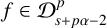
$\mathcal {D}^p_{s+p\alpha -2}$
 , that is, there exists a constant
$C>0$
 such that

for all
$f\in \mathcal {D}^p_{s+p\alpha -2}$
 .
For
$f\in F(p, p\alpha -2,s)$
 and
$a\in \mathbb {D}$
 , we consider the function

By Theorem 6.3,

Since
$p>0$
 ,
$t>p(\alpha -1)$
 ,
$s+p>1$
 , Theorem 3.8 yields

Because
$F(p,\alpha p-2,s)\subset \mathcal {B}^{\alpha }$
 ,

This implies

as
$t\geq p\alpha -p$
 . Consequently, for
$t>p(\alpha -1)$
 and
$s+p>1$
 ,

Combining this with (6-2), we see that

for all
$f\in F(p, p\alpha -2,s)$
 .
Conversely, suppose (6-1) holds. For any
$I\subset \mathbb {T}$
 with
$|I|<1/9$
 , let
$e^{i\theta }$
 ,
$\theta \in [0,2\pi )$
 , be the mid-point of I and let
$w=(1-2|I|)e^{i\theta }$
 . For
$\alpha \not =1$
 and
$b\in \mathbb {D}$
 , we consider the function

By [Reference Pau and ZhaoPZ, Lemma 2.6],

Since
$\alpha>1$
 , it follows from (6-1), (6-3), and (5-3) that

Thus,
$\mu $
 is a
$(p\alpha -p+s)$
 -Carleson measure on
$\mathbb {D}$
 .
Acknowledgements
We thank Ruhan Zhao for several useful and insightful conversations. We also thank the referee for a very careful reading of the manuscript and for several constructive suggestions that significantly improved the presentation of the paper.



