



1. Introduction
This paper concerns the following  $p$-Laplacian problem:
 \begin{equation}
\left\{\begin{array}{ll}
-\Delta_p u+\lambda |u|^{p-2}u=g(u),&\text{in }\Omega,\\
\int_\Omega |u|^p=\rho, u=0, &\text{on }\partial \Omega,
\end{array}\right.,
\end{equation}
where  $\Omega\subset\mathbb{R}^N$ is a bounded domain with
 $0\in\Omega$,
 $N\geq 3$,
 $2\leq p \lt N$ and
 $g$ is a general nonlinear term. Under some suitable assumptions on
 $g$, we investigate how the conditions on
 $\rho$ affect the existence and multiplicity of
 $(\lambda,u)\in\mathbb{R}\times W_0^{1,p}(\Omega)$ such that (1.1) holds.
When  $p=2$ and
 $\Omega=\mathbb{R}^N$, the problem (1.1) is reduced to the following problem:
 \begin{equation}
\left\{\begin{array}{ll}
-\Delta u+\lambda u=g(u),&\text{in }\mathbb{R}^N,\\
\int_{\mathbb{R}^N} |u|^2=\rho.
\end{array}\right.
\end{equation}
Since the pioneering work of Jeanjean [Reference Jeanjean13], there has been extensive attention paid to the existence of normalized solutions for (1.2), and a lot of contributions have been made. While it is impossible to list all these outstanding works, we refer, for example, the interested reader to [Reference Bartsch, Zhong and Zou3, Reference Jeanjean and Le15, Reference Jeanjean, Zhang and Zhong16, Reference Stuart27, Reference Stuart28, Reference Wei and Wu30] for the problem with combined nonlinearities, and [Reference Bartsch, Molle, Rizzi and Verzini1, Reference Ding and Zhong8, Reference Molle, Riey and Verzini19] for the problems with potentials.
In order to solve (1.2), a natural idea is to minimize the functional
 \begin{equation*}
I(u)=\frac{1}{2}\int_{\mathbb{R}^N}|\nabla u|^2-\int_{\mathbb{R}^N}G(u),
\end{equation*}
on the submanifold
 \begin{equation*}
S(\rho)=\{u\in H^1(\mathbb{R}^N),\|u\|_2^2=\rho\},
\end{equation*}
where  $G(u)$ is the primitive function of
 $g. $ This is indeed the case when
 $g$ is mass-subcritical (see [Reference Stuart27, Reference Stuart28]). However, if
 $g$ is mass-supercritical,
 $I(u)$ is unbounded from below on
 $S(\rho)$, and one may look for minimax critical point instead. During this process, one of the major difficulties is to find a bounded
 $(P.S.)$ sequence. In case
 $\Omega$ is the entire space
 $\mathbb{R}^N$, Pohozaev identity is a powerful tool in getting over this difficulty. However, when
 $\Omega$ is a general bounded domain, Pohozaev identity is not so effective due to the appearance of boundary integral terms. For this reason, there are not so many results on bounded domain compared to the case of entire space
 $\mathbb{R}^N$.
To the best of the author’s knowledge, the first contribution in this direction is credited to Noris, Tavares and Vezini [Reference Noris, Tavares and Verzini20]. Utilizing bifurcation discussions, they established two positive solutions when  $\Omega$ is a ball and
 $g$ is the pure power nonlinearity
 $|u|^{q-2}u$ with
 $2+\frac{4}{N} \lt q \lt 2^*$. Further studies on general bounded domain were carried out in [Reference Pierotti and Verzini22], where the authors established the first multiple result and claimed the existence of mountain pass solutions as well. Nevertheless, as pointed by themselves in [Reference Pierotti, Verzini and Yu23], the proof of Proposition 4.4 contained there misses the boundedness of the
 $(P.S.)$ sequence. Fortunately, in [Reference Pierotti, Verzini and Yu23], the authors successfully fixed this problem by exploiting the monotonicity argument and blow-up analysis. We note in all these papers, a change of variable is performed to move the parameter from the constraint to the equation, which seems to break down for equations with general nonlinearities. To this end, there has been some interesting works on special domains where the boundary integral terms in Pohozaev identity could be well estimated, among which, the works of Bartsch, Qi, Zou, Song [Reference Bartsch, Qi and Zou2, Reference Qi and Zou24, Reference Song and Zou25] are worth mentioning.
As far as the authors are concerned, there are not so many results known for  $p$-Laplacian problems. In case of
 $\Omega=\mathbb{R}^N, $ existence of normalized solutions are obtained in [Reference Gu, Zeng and Zhou11, Reference Li and Yan17, Reference Zhang and Zhang31]. However, little is known for the existence of normalized solutions for (1.1) on general bounded domain. The main purpose of the present paper is to study the normalized solutions for (1.1) on general bounded domains, including the existence, non-existence and multiplicities. For this, we introduce the following assumptions on
 $g:$
1.
 $(G_1)$
$g\in C^1(\mathbb{R})$,
$g'(s) \gt 0$ for
$s \gt 0$ and
$g(-s)=-g(s)$.
2.
$(G_2)$ there exists some
$(\alpha,\beta)\in \mathbb{R}_+^2$ satisfying
$p \lt \alpha,\beta \lt p^*$ such that
\begin{equation*}
\lim\limits_{s\to 0^+}\frac{g'(s)}{s^{\alpha-2}}=\mu_1(\alpha-2) \gt 0, \text{and }\lim\limits_{s\to+\infty}\frac{g'(s)}{s^{\beta-2}}=\mu_2(\beta-2) \gt 0.
\end{equation*}


Set
 \begin{equation*}S_\rho=\{u\in W_0^{1,p}(\Omega):\|u\|_p^p=\rho\}\end{equation*}
and let
 \begin{equation*}
E(u)=\frac{1}{p}\int_{\Omega}|\nabla u|^p-\int_{\Omega} G(u),
\end{equation*}
where  $G(u)$ denotes the primitive function of
 $g$. When
 $g$ is at most
 $L^p$ critical at infinity, under suitable assumptions on
 $\rho$,
 $E(u)$ is coercive on
 $S_\rho$. In this case, classical variational methods can be applied to deduce the existence and multiplicity result, yielding the following existence and multiplicity result. For the case of the semilinear systems, one may refer to Reference [Reference Noris, Tavares and Verzini21].
Theorem 1.1. Suppose  $g$ satisfies assumptions
 $(G_1)$-
 $(G_2)$ and one of the following conditions holds
(1)
$p \lt \beta \lt p+\frac{p^2}{N}$ and
$\rho \gt 0$.(2)
$\beta= p+\frac{p^2}{N}$ and
$\rho$ satisfies (3.3).


Then (1.1) admits a solution which is a global minimizer on  $S_\rho$ for
 $E(u)$. Moreover, (1.1) admits infinitely many solutions in these cases.
As it can be seen from Theorem 1.1, when  $g$ is
 $L^p$-subcritical at infinity, (1.1) admits solutions for every
 $\rho \gt 0$, each being a global minimizer of the energy functional. However, for the
 $L^p$-critical case, it is only proved that there exist solutions for
 $\rho$ suitablely small. Hence, for an arbitrary
 $\rho \gt 0$, it is natural to ask whether there exist solutions when
 $g$ is at least
 $L^p-$critical at infinity.
In the following, we consider this problem. In particular, we restrict our attention to the existence of solutions with finite Morse index, and give a negative answer to the above question. More precisely, we have the following:
Theorem 1.2. For any fixed  $k\geq 0$,
 \begin{equation*}
\mathcal{U}_k:=\{\rho \gt 0, \ (1.1) \text{ admits solution having Morse index } m(u)\leq k\}
\end{equation*}
then  $\sup\ \mathcal{U}_k=+\infty$ if and only if
 $p \lt \beta \lt p+\frac{p^2}{N}$.
Remark 1.3. We remark that under the assumption  $p \gt 2$,
 $E$ is of
 $C^2$, thus Morse index is well-defined.
Following the ideas in [Reference Pierotti, Verzini and Yu23], we will perform a blow-up analysis to deduce the conclusion. However, note that, in order to deal with general nonlinearities, the change of variable in [Reference Pierotti, Verzini and Yu23] is not applicable for generating a blow-up parameter. Instead, as in [Reference Chang, Jeanjean and Soave6, Reference Jeanjean, Zhang and Zhong16], we take the Lagrange multiplier  $\lambda$ as a natural parameter, and use
 $\lambda$ to perform a blow-up analysis. In this process, some additional difficulties need to be overcome due to the nonlinearity and degeneracy of the
 $p$-Laplace operator. This part of analysis is of independent interest. Therefore, We present the proof in the Appendix.
Recall that, under suitable assumptions on  $\rho$, we have obtained the existence of global minimizer for
 $E$ when
 $g$ is at most
 $L^p$-critical at infinity. A natural question is what happens when
 $g$ becomes
 $L^p$-supercritical. As shown in Section 2, when
 $g$ is mass-supercritical at infinity, the energy functional
 $E$ is unbounded from below on
 $S_\rho$. Consequently, it seems not feasible to look for global minimizer in this case. When considering local minimizers, it is important to find an
 $r \gt 0$ such that
 \begin{equation*}
\inf\limits_{B_{r}}E(u) \lt \inf\limits_{\partial B_{r}}E(u),
\end{equation*}
where
 \begin{equation*}
B_r:=\left\{u\in S_\rho, \int_{\Omega}|\nabla u|^p\leq r\right\},
\end{equation*}
and this is indeed the case for  $\rho$ suitably small.
Theorem 1.4. Suppose  $g$ satisfies the assumptions
 $(G_1){-}(G_2)$ and one of the following conditions holds:
(1)
$\beta \gt p+\frac{p^2}{N}$,
$\alpha\leq\beta$ and
$\rho$ satisfies (4.4),(2)
$\beta \gt p+\frac{p^2}{N}$,
$\alpha \gt \beta$ and
$\rho$ satisfies (4.5),


then (1.1) admits a solution  $u_\rho$ which is a local minimizer for
 $E(u)$.
Once the local minimizer is obtained, noting that  $\inf\limits_{u\in S_\rho}E(u)=-\infty$, it is natural to look for a second solution which is of mountain-pass type. We define
 \begin{equation*}
m:=\inf\limits_{\gamma\in \Gamma}\sup\limits_{t\in[0,1]}E(\gamma(t)) \gt \max\left\{E(u_\rho), E(v)\right\},
\end{equation*}
where
 \begin{equation*}
\Gamma:=\left\{\gamma\in C([0,1],S_\rho):\gamma(0)=u_\rho, \gamma(1)=v\right\},
\end{equation*}
and  $v$ satisfies
 $E(v) \lt 0$, whose existence is guaranteed by Lemma 4.2 below. We aim to show that
 $m$ can be attained. To do this, the main difficulty lies in finding a bounded
 $P.S.$ sequence. In order to overcome this difficulty, we adopt the so-called Struwe monotonicity arguments as in [Reference Borthwick, Chang, Jeanjean and Soave4, Reference Jeanjean14]. Roughly speaking, this argument is to introduce a family of functional
 $E_\theta$ depending on a parameter
 $\theta$, for almost every
 $\theta$,
 $E_\theta$ admits a solution
 $u_\theta$. Then by the blow-up analysis performed in Theorem 1.2,
 $u_\theta$ converges to a solution of the original problem. This strategy has been successfully applied on graphs by Chang, Jeanjean and Soave [Reference Chang, Jeanjean and Soave6], and to semilinear elliptic equation with
 $g(u)=|u|^{q-2}u$,
 $2+\frac{4}{N} \lt q\leq 2^*$ in [Reference Pierotti, Verzini and Yu23]. For general
 $p\geq 2$, we have the following multiplicity result.
Theorem 1.5. Let  $g$,
 $\rho$ satisfy the conditions in Theorem 1.4, then equation (1.1) has a second solution
 $\tilde{u}_\rho\not\equiv u_\rho$ and
 $\tilde{u}_\rho$ is of mountain pass type.
As a byproduct, we have the following result for  $p=2$.
Theorem 1.6. Let  $p=2$ and assume that
 $(G_1)-(G_2)$, then for any
 $n$, there exists
 $\rho_n \gt 0$ such that for
 $0 \lt \rho \lt \rho_n$, (1.1) has
 $n$ solutions at the level
 $c_k$,
 $k=1,\dots, n$ and
 $c_n\to+\infty$ as
 $n\to\infty$.
Our paper is organized as follows. We recall some definitions and lemmas in Section 2. In 3, we prove Theorem 1.1 and 1.2. Section 4 is devoted to the mass-supercritical case, where Theorem 1.4, 1.5 and 1.6 are proved. We put the blow-up arguments used in the proof of Section 3 in the Appendix A. This part is of independent interest, and we believe it can be used to deal with other problems related to  $p$-Laplacian equations.
2. Preliminary
In this section, let us recall some definitions and results that will be used throughout this paper, we refer interested readers to [Reference Borthwick, Chang, Jeanjean and Soave4, Reference Jeanjean14, Reference Jeanjean, Zhang and Zhong16] and references therein.
Definition 2.1. Let  $\varphi:W_0^{1,p}(\Omega)\to \mathbb{R}$ be a
 $C^2-$functional, we say that
 $\varphi'$ and
 $\varphi^{\prime\prime}$ are
 $\alpha-$Hölder continuous on bounded set if for any
 $R \gt 0$, one can find
 $M=M(R) \gt 0$ such that, for any
 $u_1$,
 $u_2\in B_R(0)$:
 \begin{equation*}
\|\varphi'(u_1)-\varphi'(u_2)\|_*\leq M\|u_1-u_2\|^\alpha, \|\varphi^{\prime\prime}(u_1)-\varphi^{\prime\prime}(u_2)\|_{**}\leq M\|u_1-u_2\|^\alpha,
\end{equation*}
where  $\|\cdot\|_*$ and
 $\|\cdot\|_{**}$ are the operator norm of
 $\mathcal{L}(W_0^{1,p}(\Omega),\mathbb{R})$ and of
 $\mathcal{L}(W_0^{1,p}(\Omega),\mathcal{L}(W_0^{1,p}(\Omega),\mathbb{R}))$ respectively.
Definition 2.2. For any  $u\in S_\rho$ and
 $\xi\geq 0$, we use
 $T_u S_\rho$ to denote the tangent space at point
 $u.$ We define the approximate Morse index and Morse index by
 \begin{align*}
\tilde{m}_\xi(u)&=\max\left\{k:\exists V\subset T_u S_\rho,\ dim(V)=k:D^2\varphi(u)(v,v) \lt -\xi \|v\|^p \text{ for all }\right.\\ &\quad \left. v\in V, v\not\equiv 0\right\},
\end{align*}
and
 \begin{equation*}
m(u)=\max\!\left\{k\,{:}\,\exists V\subset C_c^1(\Omega),\ dim(V)=k\,{:}\,D^2\varphi(u)(v,v) \lt 0\text{ for all }v\in V, v\not\equiv 0\right\}\!,
\end{equation*}
where
 \begin{equation*}
D^2\varphi(u)(v,v):=\varphi^{\prime\prime}(u)(v,v)-\frac{\langle \varphi'(u),u\rangle}{\|u\|_p^p}(p-1)\int_\Omega |u|^{p-2}|v|^2.
\end{equation*}
We will use the following more general results on functional and Morse index due to [Reference Jeanjean14].
Theorem 2.3. Let  $W$ be a Banach space equipped with the norm
 $\|\cdot\|$ and let
 $J\subset\mathbb{R}^+$ be an interval. We consider a family
 $E_\theta$ of
 $C^1-$functionals on
 $W$ of the form
 \begin{equation*}
E_\theta(u)=A(u)-\theta B(u), \theta\in J,
\end{equation*}
where  $B(u)\geq 0$,
 $\forall u\in W$ and such that either
 $A(u)\to\infty$ or
 $B(u)\to\infty$ as
 $\|u\|\to\infty$. Let us assume that there are two points
 $w_0$,
 $w_1$ in
 $S_\rho$ such that, setting
 \begin{equation*}
\Gamma=\{\gamma\in C([0,1], S_\rho), \gamma(0)=w_1, \gamma(1)=w_2\},
\end{equation*}
there holds,  $\forall \theta\in J$,
 \begin{equation*}
m_\theta:=\inf\limits_{\gamma\in\Gamma}\max\limits_{t\in[0,1]}E_\theta(\gamma(t)) \gt \max\{E_\theta(w_1), E_\theta(w_2)\}.
\end{equation*}
Then for almost every  $\theta\in J$, there is a sequence
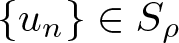 $\{u_n\}\in S_\rho$ such that
(1)
$\{u_n\}$ is bounded in
$W$.(2)
$E_\theta(u_n)\to m_\theta$ and
$E'_\theta|_{S_\rho}(u_n)\to 0$ in
$W^{-1}$.


Theorem 2.4. Let  $W$ be a infinite-dimensional Hilbert space and
 $I\subset (0,\infty)$ be an interval, consider a family of
 $C^2$ functionals
 $E_\theta$ on
 $W$ of the form
 \begin{equation*}
E_\theta(u)=A(u)-\theta B(u), \theta\in I
\end{equation*}
where  $B(u)\geq 0$ for all
 $u\in W$ and such that either
 $A(U)\to\infty$ or
 $B(u)\to\infty$ as
 $\|u\|\to+\infty$.
Suppose that  $E_\theta$ is even for every
 $\theta\in I$, and moreover
 $E_\theta'$ and
 $E_\theta^{\prime\prime}$ are
 $\alpha-$Hölder continuous on bounded sets in the sense of Definition 2.1 for some
 $\alpha\in (0,1]$. Finally, suppose that there exists a
 $k\in \mathbb{N}$,
 $k\geq 2$, given odd functions
 $\gamma_i:S^{k-2}\to S_\rho$ where
 $i=1,2$, such that the set
 \begin{equation}
\Gamma_k=\{\gamma \in C([0,1]\times S^{k-2}, S_\rho):\gamma(t,\cdot)\text{is odd }, \gamma(0,\cdot)=\gamma_0, \gamma(1,\cdot)=\gamma_1\},
\end{equation}
is non-empty and that
 \begin{equation}
c_{\theta, k}=\inf\limits_{\gamma\in \Gamma_k}\max\limits_{[0,1]\times S^{k-2}}E_\theta(\gamma(t, x)) \gt \max\limits_{x\in S^{k-2}}\{E_\theta(\gamma_1(x)), E_\theta(\gamma_2(x))\}, \forall \theta\in I.
\end{equation}
Then, for almost every  $\theta\in I$, there exists sequence
 $\{u_n\}\subset S_\rho$ and
 $\xi_n\to 0^+$ such that as
 $n\to\infty$
(1)
$\{u_n\}$ is bounded in
$W$.(2)
$E_\theta (u_n)\to c_{\theta, k}$ and
$E_\theta'|_{S_\rho}(u_n)\to 0$ in
$W^{-1}$.(3)
$\tilde{m}_{\xi_n}(u_n)\leq k$.


Moreover, under the assumptions of  $(G_1)-(G_2)$, by direct calculation, we can prove the following lemma as in [Reference Jeanjean, Zhang and Zhong16].
Lemma 2.5. Let  $N\geq 2$ and assume that
 $(G_1)-(G_2)$ hold, then
(i)
$\lim\limits_{|s|\to 0}\frac{g(s)}{|s|^{\alpha-2}s}=\mu_1$ and
$\lim\limits_{|s|\to+\infty}\frac{g(s)}{|s|^{\beta-2}s}=\mu_2$.(ii) There exists some
$C \gt 0$ such that
\begin{equation*}
|g(s)|\leq C(|s|^{\alpha-1}+|s|^{\beta-1}),
\end{equation*}and for any
$M \gt 0$ there exists some
$C_{M,1}\geq C_{M,2} \gt 0$ such that
\begin{equation*}
C_{M,2}|s|^{\alpha-2}s\leq g(s)\leq C_{M,1}|s|^{\alpha-2}s, \forall s\in [0,M].
\end{equation*}(iii) There exists
$C \gt 0$ such that
\begin{equation*}
G(s)\leq C(|s|^\alpha+|s|^\beta), s\in\mathbb{R}, \text{where }G(s):=\int_0^sg(t)dt,
\end{equation*}and for any
$M \gt 0$, there exists some
$C_{M,1}\geq C_{M,2} \gt 0$ such that
\begin{equation*}
C_{M,2}|s|^{\alpha}\leq G(s)\leq C_{M,1}|s|^\alpha, \forall s\in [0,M].
\end{equation*}(iv) If
$\alpha \gt \beta$, we have, for some
$D \gt 0$,
$G(s)\leq D|s|^\beta$,
$s\in\mathbb{R}$.


Lemma 2.6. Let  $\beta \gt p+\frac{p^2}{N}$, then there exists
 $U_k\in S_\rho$ such that as
 $k\to\infty$,
 \begin{equation*}
E(U_k)\to-\infty.
\end{equation*}
Proof. Let  $\phi\in C_c^\infty(B_1)$ with
 $\phi \gt 0$ and
 $\int_{B_1}\phi^p=1$. For
 $x_0\in\Omega$, denote
 \begin{equation*}
U_k=\rho^{\frac{1}{p}}k^{\frac{N}{p}}\phi(k(x-x_0)),
\end{equation*}
then for  $k$ large, we have
 $\text{\textit{supp} }U_k\subset B_{\frac{1}{k}}(x_0)\subset\Omega$.
Moreover for a.e.  $x\in \text{\textit{supp} }U_k$,
 $\lim\limits_{k\to\infty}G(U_k(x))/U_k(x)^\beta=\frac{\mu_2}{\beta}$, thus
 \begin{equation*}
\int_{\Omega}G(U_k)\geq \frac{\mu_2}{2\beta}\int_{\Omega}U_k^\beta=\frac{\mu_2}{2\beta}\rho^{\frac{\beta}{p}}k^{N(\frac{\beta}{p}-1)}\int_{\Omega}|\phi|^\beta.
\end{equation*}
On the other hand, direct computation shows that
 \begin{equation*}
\int_{\Omega}|U_k|^p=\rho\text{and }\int_{\Omega}|\nabla U_k|^p=\rho k^p\int_{B_1}|\nabla \phi|^p,
\end{equation*}
then as  $k\to\infty$, there holds
 \begin{equation*}
E(U_k)=\frac{1}{p}\int_{\Omega}|\nabla U_k|^p-\int_{\Omega}G(U_k)\leq\frac{\rho k^p}{p}\int_{B_1}|\nabla \phi|^p-\frac{\mu_2}{2\beta}\rho^{\frac{\beta}{p}}k^{N(\frac{\beta}{p}-1)}\int_{\Omega}|\phi|^\beta\to-\infty,
\end{equation*}
we conclude the proof.
3. Subcritical case for
$p\geq 2$ and nonexistence result

In this section, we give the proof of Theorem 1.1 and 1.2. Note that under the assumptions of Theorem 1.1,  $E$ is coercive on
 $S_\rho$, and classical variation methods may be applied, so we are able to prove Theorem 1.1 as follows.
Proof of Theorem 1.1
By Lemma 2.5 and Gagliardo-Nirenberg inequality, we have
 \begin{equation}
\begin{aligned}
E(u)\geq& \frac{1}{p}\int_{\Omega}|\nabla u|^p-C\int_{\Omega}|u|^\alpha+|u|^{\beta}\\
\geq& \frac{1}{p}\|\nabla u\|_p^p-(C_{N,\alpha}C\|u\|_p^{1-\gamma_\alpha}\|\nabla u\|_p^{\gamma_\alpha})^\alpha-(C_{N,\beta}C\|u\|_p^{1-\gamma_\beta}\|\nabla u\|_p^{\gamma_\beta})^\beta,
\end{aligned}
\end{equation}
where  $\gamma_s=N(\frac{1}{p}-\frac{1}{s})$.
Thus if  $p \lt \alpha,\beta \lt p+\frac{p^2}{N}$, we have
 $\alpha\gamma_\alpha, \beta\gamma_\beta \lt p$ and
 $E(u)$ is coercive.
In the meanwhile, by  $(iv)$ in Lemma 2.5, this is also the case when
 $\alpha\geq p+\frac{p^2}{N} \gt \beta$.
If  $\alpha \lt \beta= p+\frac{p^2}{N}$, then
 $ \beta\gamma_\beta= p$. Let
 $\rho$ satisfy
 \begin{equation*}
\left(C_{N,\beta}C\rho^{\frac{1-\gamma_\beta}{p}}\right)^\beta \lt \frac{1}{p},
\end{equation*}
then the coercivity of  $E$ holds.
On the other hand, if  $\beta= p+\frac{p^2}{N}\leq \alpha$, by
 $(iv)$ in Lemma 2.5 again, we obtain
 \begin{equation}
\begin{aligned}
E(u)\geq \frac{1}{p}\int_{\Omega}|\nabla u|^p-D\int_{\Omega}|u|^\beta \geq\frac{1}{p}\|\nabla u\|_p^p-(C_{N,\beta}D\|u\|_p^{1-\gamma_\beta}\|\nabla u\|_p^{\gamma_\beta})^\beta.
\end{aligned}
\end{equation}
Denote
 \begin{equation*}
m(\rho):=\inf \limits_{S_\rho} E(u),
\end{equation*}
then  $E$ is coercive and weakly lower semi-continuous on
 $S_\rho$ if
 \begin{equation}
\max\left\{\left(C_{N,\beta}C\rho^{\frac{1-\gamma_\beta}{p}}\right)^\beta,\left(C_{N,\beta}D\rho^{\frac{1-\gamma_\beta}{p}}\right)^\beta\right\} \lt \frac{1}{p},
\end{equation}
thus  $m(\rho)$ can be achieved.
For multiplicity, we notice if  $p \lt \alpha, \beta \lt p+\frac{p^2}{N}$, it follows from (3.1) that
 \begin{equation*}
E(u)\geq \frac{1}{p}\|\nabla u\|_p^p-\left(CC_{N,\alpha}\rho^{\frac{(1-\gamma_\alpha)}{p}}\right)^\alpha\|\nabla u \|_p^{\gamma_\alpha\alpha}-\left(CC_{N,\beta}\rho^{\frac{(1-\gamma_\beta)}{p}}\right)^\beta\|\nabla u \|_p^{\gamma_\beta\beta}.
\end{equation*}
Denote
 \begin{equation*}
\varphi(t)=\frac{1}{p}t^p-\left(CC_{N,\alpha}\rho^{\frac{(1-\gamma_\alpha)}{p}}\right)^\alpha t^{\gamma_\alpha\alpha}-\left(CC_{N,\beta}\rho^{\frac{(1-\gamma_\beta)}{p}}\right)^\beta t^{\gamma_\beta\beta},
\end{equation*}
then  $\varphi\in C(\mathbb{R}^+)$ satisfies
 $\varphi\to 0^-$ as
 $t\to 0^+$ and
 $\varphi\to +\infty$ as
 $t\to +\infty$, from which, we deduce
 $E$ is bounded from below on
 $S_\rho$. Moreover, it is easy to check that
 $E$ satisfies
 $(P. S.)$ condition for general level
 $c$.
Therefore if we define
 \begin{equation*}
\mathcal{A}:=\{A\subset W_0^{1,p}(\Omega): A\text{ is closed}, A=-A\}
\text{ and }
\Gamma_k:=\{A\in \mathcal{A}: A\subset S_\rho, \gamma(A)\geq k\},
\end{equation*}
where  $\gamma(A)$ denotes the Krasnoselskii genus. Then by Theorem 5.7 in [Reference Struwe26],
 $E$ admits infinitely many solutions
 $u_k$ at level
 $c_k:=\inf\limits_{A\in \Gamma_k}\sup\limits_{u\in A} E(u)$.
Similarly, we can prove (1.1) admits infinitely many solutions when  $\beta \lt p+\frac{p^2}{N}\leq \alpha$ or under assumption (ii) in Theorem 1.1.
Now we turn to the proof of Theorem 1.2, for this purpose, let us first study the asymptotic behavior of  $(u_n,\lambda_n)\subset W_0^{1,p}(\Omega)\times \mathbb{R}$ satisfying:
 \begin{equation}
\left\{\begin{array}{ll}
-\Delta_p u_n+\lambda_n|u_n|^{p-2}u_n=g(u_n),&\text{in }\Omega,\\
u_n=0,&\text{on }\partial\Omega,
\end{array}\right.
\end{equation}
with  $m(u_n)$ finite.
To proceed, we first consider the case when  $\lambda_n$ is upper bounded.
Lemma 3.1. Assume  $(u_n,\lambda_n)$ is a pair of solution to (3.4) and
 $\lambda_n\to -\infty$, then
 $\lim\limits_{n\to\infty}\|u_n\|_\infty=0$.
Proof. Let  $(u_n,\lambda_n)$ be a pair of solution to (3.4) with
 $\lambda_n\to -\infty$, suppose on the contrary that
 \begin{equation*}\limsup\limits_{n\to\infty}\|u_n\|_\infty=c \gt 0, \quad |u_n(x_n)|=\|u_n\|_\infty.\end{equation*}
Denote  $v_k$ the eigenfunction corresponding to
 $\mu_k$, where
 $\mu_k$ is the
 $k^{th}$ eigenvalue of Dirichlet boundary problem for the Laplace equation. Let
 \begin{equation*}\tilde{v}_k=\epsilon^{-\frac{N-2}{2}}v_k(\epsilon^{-1}(x-x_n)),\end{equation*}
then  $\tilde{v}_k=0$ outside
 $\Omega_\epsilon:=\epsilon \Omega+x_n$. Taking
 $\epsilon$ small enough, such that
 \begin{equation*}
|\nabla u_n| \lt \frac{1}{2} \text{ and }|u_n| \gt \frac{c}{2}\text{ in }\Omega_\epsilon,
\end{equation*}
we have
 \begin{equation*}
\begin{aligned}
D^2E(u_n)(\tilde{v}_k,\tilde{v}_k)=&\int_{\Omega_\epsilon}|\nabla u_n|^{p-2}|\nabla \tilde{v}_k|^2+(p-2)\int_{\Omega_\epsilon}|\nabla u_n|^{p-4}(\nabla u_n,\nabla \tilde{v}_k)^2\\
&+\lambda_n(p-1)\int_{\Omega_\epsilon}|u_n|^{p-2}\tilde{v}_k^2-\int_{\Omega_\epsilon}g'(u_n)\tilde{v}_k^2\\
\leq& (p-1)\int_{\Omega}|\nabla u_n(\epsilon x+x_n)|^{p-2}|\nabla v_k|^2\\
&+\epsilon^2\lambda_n(p-1)\int_{\Omega}|u_n(\epsilon x+x_n)|^{p-2}v_k^2-\int_{\Omega}g'(u_n(\epsilon x+x_n))v_k^2\\
\leq& \frac{p-1}{2^{p-2}}\int_{\Omega}|\nabla v_k|^2+\frac{c^{p-2}}{2^{p-2}}\epsilon^2\lambda_n(p-1)\int_{\Omega}v_k^2\\ &-\int_{\Omega}g'(u_n(\epsilon x+x_n))v_k^2\\
=&\frac{(p-1)}{2^{p-2}}\left({\mu_k}+{c^{p-2}\epsilon^2\lambda_n}\right)\int_{\Omega}v_k^2-\int_{\Omega}g'(u_n(\epsilon x+x_n))v_k^2,
\end{aligned}
\end{equation*}
taking  $\lambda_n$ negatively enough, we obtain
 $D^2 E(u_n)(\tilde{v}_k,\tilde{v}_k) \lt 0$, for
 $k=1,2,\cdots$, this is a contradiction with the fact that
 $m(u_n)$ is finite.
Lemma 3.2. Let  $M \gt 0$, then for
 $|\lambda_n|\leq M$, there exists
 $C_M \gt 0$ such that
 $\|u_n\|_\infty\leq C_M$.
Proof. Suppose on the contrary, there exists  $(\lambda_n,u_n)$ such that
 \begin{equation*}
-\Delta_p u_n+\lambda_n |u_n|^{p-2}u_n=g(u_n),\text{in } \Omega,
\end{equation*}
and  $M_n:=|u_n(x_n)|=\|u_n\|_\infty\to\infty$.
Let  $v_n(x)=\frac{1}{M_n}u_n(M_n^{-\frac{\beta-p}{p}}x+x_n)$, then we have
 $\|v_n\|_\infty=1$ and
 \begin{equation*}
-\Delta_p v_n+\frac{\lambda_n|v_n|^{p-2}v_n}{M_n^{\beta-p}}=\frac{g(M_nv_n)}{M_n^{\beta-1}},\text{in }\Omega_n:=M_n^{\frac{\beta-p}{p}}(\Omega-x_n).
\end{equation*}
By standard regularity result for  $p$-Laplacian equation, we obtain, up to a subsequence,
 \begin{equation*}v_n\to v, \text{in } C_{loc}^1(H)\end{equation*}
and  $v$ satisfies
 \begin{equation}
\left\{\begin{array}{ll}
-\Delta_p v=\mu_2 |v|^{\beta-2}v, &\text{in }H,\\
v=0,&\text{on }\partial H,
\end{array}\right.
\end{equation}
where  $H=\mathbb{R}^N$ or
 $\mathbb{R}_+^N$. Moreover, as in [Reference Esposito and Petralla9], we can prove
 $m(v)\leq\sup\limits_{n}m(v_n)\leq k$.
Now we claim that  $v\in W^{1,p}_0(H)$, then as Lemma 2.1 in [Reference Farina, Mercuri and Willem10], we have
 \begin{align*}
\left(1-\frac{1}{p}\right)\int_{B_R\cap\partial H}\left|\partial_N v\right|^p &=\int_{H\cap\partial B_R}\left[\partial_N v|\nabla v|^{p-2}\nabla v\cdot \vec{n}-\frac{|\nabla v|^p}{p}\vec{n}_N\right]\\ &\quad{} +\int_{H\cap\partial B_R}\frac{\mu_2|v|^\beta}{\beta},
\end{align*}
since  $v\in W^{1,p}_0(H)$, letting
 $R\to \infty$, we obtain
 $\partial_N v=0$ on
 $\partial H$. Thus combining with the following Pohozaev identity [Reference Guedda and Veron12]
 \begin{equation*}
\mu_2\left(1-\frac{N}{p}+\frac{N}{\beta}\right)\int_{\mathbb{R}^N_+}|v|^\beta=\left(1-\frac{1}{p}\right)\int_{\partial \mathbb{R}^N_+}x\cdot\nu \left|\frac{\partial v}{\partial n}\right|^p=0.
\end{equation*}
we deduce  $H=\mathbb{R}^N$, a contradiction with the results in [Reference Damascelli, Farina, Sciunzi and Valdinoci7].
In order to prove the claim, for  $\varphi\in C_c^1(H)$, taking
 $\psi=v\varphi^p$ as a test function in (3.5), we obtain
 \begin{equation*}
\begin{aligned}
\int_{H}|\nabla v|^p\varphi^p+p\int_{H}|\nabla v|^{p-2}\nabla v\cdot\nabla\varphi \varphi^{p-1}v=\mu_2\int_{H}|v|^{\beta}\varphi^p,
\end{aligned}
\end{equation*}
by Hölder’s inequality, we have, for any  $\epsilon \gt 0,$ there exists
 $C_\epsilon \gt 0$ such that
 \begin{equation*}
\int_{H}|\nabla v|^{p-2}\nabla v\nabla\varphi \varphi^{p-1}v\leq \epsilon\int_{H}|\nabla v|^p\varphi^p+C_\epsilon\int_{H}|\nabla \varphi|^p|v|^p,
\end{equation*}
thus
 \begin{equation}
(1-\epsilon)\int_{H}|\nabla v|^p\varphi^p\leq\mu_2\int_{H}|v|^{\beta}\varphi^p+C_\epsilon\int_{H}|\nabla \varphi|^p|v|^p.
\end{equation}
To go further, we recall that if  $v$ is a finite Morse index solution, then
 $v$ is stable outside a compact set
 $\mathcal{K}\subset H$, i.e.
 $\forall \phi\in C_c^1(H\setminus\mathcal{K})$,
 \begin{align*}L_v(\phi,\phi)&:=\int_{H}|\nabla v|^{p-2}|\nabla \phi|^2+(p-2)\int_{H}|\nabla v|^{p-4}(\nabla v,\nabla \phi)^2-\mu_2(\beta-1)\\ &\quad\times \int_{H}|v|^{\beta-2}\phi^2\geq 0.\end{align*}
For  $\varphi\in C_c^1(H\setminus \mathcal{K})$, taking
 $\phi=v\varphi^{\frac{p}{2}}$, then
 \begin{align*}
\int_{H}|\nabla v|^{p-4}(\nabla v,\nabla\phi)^2\leq\int_{H}|\nabla v|^{p-2}|\nabla \phi|^2\leq\int_{H}(1+\epsilon)|\nabla v|^p\varphi^p+C_\epsilon|\nabla\varphi|^p|v|^p.
\end{align*}
From this, we deduce by (3.6) that
 \begin{equation}
\begin{aligned}
&\quad (\beta-1)\mu_2\int_{H}|v|^\beta\varphi^p\\
&\leq (p-1)\int_{H}(1+\epsilon)|\nabla v|^p\varphi^p+C_\epsilon|\nabla\varphi|^p|v|^p\\
&\leq(p-1)(1+\epsilon)\mu_2\int_H|v|^\beta\varphi^p+C_\epsilon\int_{H}|\nabla \varphi|^p|v|^p.
\end{aligned}
\end{equation}
Since  $\beta \gt p$, taking
 $\epsilon$ small enough, we obtain
 \begin{equation*}
\int_{H}|v|^{\beta}\varphi^p\leq C\int_{H}|\nabla \varphi|^p|v|^p.
\end{equation*}
Then it yields from (3.6) that for  $\forall \varphi\in C_c^1(H\setminus\mathcal{K})$
 \begin{equation}
\int_{H}|\nabla v|^p\varphi^p+\int_{H}|v|^\beta\varphi^p\leq C\int_{H}|\nabla\varphi|^p|v|^p.
\end{equation}
Suppose  $\mathcal{K}\subset B_{R_0}$, we take
 \begin{equation*}
\psi(x)=\left\{\begin{array}{ll}
0,&\text{in }H\cap B_{R_0+1},\\
1,&\text{in }H\cap(B_R\setminus B_{R_0+2}),\\
0,&\text{in }H\cap B^c_{2R}.
\end{array}\right.
\end{equation*}
and  $\varphi=\psi^k$ as a test function in (3.8), where
 $k=\frac{\beta}{\beta-p}$, then we have
 \begin{align*}
&\int_{H}|\nabla v|^p\psi^{kp}+\int_{H}|v|^\beta\psi^{kp}\\
\leq& C\int_{H}\psi^{(k-1)p}|\nabla \psi|^p|v|^p\\
\leq&\epsilon\int_{H}\psi^{kp}|v|^\beta+C_\epsilon\int_{H}|\nabla\psi|^{pk},
\end{align*}
thus
 \begin{equation}
\int_{H}|\nabla v|^p\psi^{kp}+\int_{H}|v|^\beta\psi^{kp}\leq C\int_{H}|\nabla\psi|^{pk}\leq C+CR^{N-\frac{p\beta}{\beta-p}},
\end{equation}
letting  $R\to\infty$ and noticing
 $\|v\|_\infty=1$, we obtain
 $v\in W_0^{1,p}(H)$.
Now we focus on the asymptotic behaviour as  $\lambda_n\to+\infty$. The proof is of independent interest, thus we put it in Appendix A.
In the following, denote  $v$ a solution of
 \begin{equation}
-\Delta_p v+|v|^{p-2}v=\mu_2 |v|^{\beta-2}v, \text{in }H,
\end{equation}
where  $H=\mathbb{R}^N$ or
 $\mathbb{R}^N_+$, then we have
Proposition 3.3. Let  ${u_n}$ be a sequence of solutions of (3.4) corresponding to
 $\lambda_n\to +\infty$ and
 $m(u_n)\leq \bar{k}$, then up to a subsequence, there exist
 $P_n^1,\dots, P_n^k$,
 $k\leq \bar{k}$, so that for all
 $i,j=1,\dots,k$,
 $i\neq j$, there holds:
(1)
$|u_n(P_n^i)|=\max\limits_{\Omega\cap B_{R_n\lambda_n^{-\frac{1}{p}}}(P_n^i)} |u_n|$ for some
$R_n\to+\infty$ and
$\lambda_n^{\frac{1}{p}}|P_n^i-P_n^j|\to+\infty$ as
$n\to+\infty$.(2) For
$x\in \Omega_{n,i}:=\lambda_n^{\frac{1}{p}}(\Omega-P_n^i)$, defining
$v_{i,n}(x)=\lambda_n^{-\frac{1}{\beta-p}}u_n(\lambda_n^{-\frac{1}{p}}x+P_n^i)$, then
$v_{i,n}\to v_i$ in
$C_{loc}^1(H)$, where
$v_i$ is a bounded solution of (3.10) with
$m(v_i)\leq \bar{k}$.Moreover, for any
$q\geq p$,
(3.11)\begin{equation}
\lambda_n^{\frac{N}{p}-\frac{q}{\beta-p}}\int_{\Omega}|u_n|^q\to\sum\limits_{i=1}^k\int_{H}|v_i|^q.
\end{equation}


By (3.11), we are able to derive the asymptotic behavior of  $\{\|u_n\|_p\}$ as
 $\lambda_n\to+\infty$.
Corollary 3.4. Let  $(u_n,\lambda_n)$ be a sequence of solutions to (3.4) with
 $\lambda_n\to+\infty$, we have that
(1) if
$p \lt \beta \lt p+\frac{p^2}{N}$, then
$\|u_n\|^p_p\to\infty$.(2) if
$\beta=p+\frac{p^2}{N}$, then
$\|u_n\|_p^p\to\sum\limits_{i=1}^k\int_{H}|v_i|^p$.(3) if
$p+\frac{p^2}{N} \lt \beta \lt p^*$, then
$\|u_n\|_p^p\to 0$.


Proof of Theorem 1.2
On one side, for any fixed  $k\geq 0$, if (1.1) admits solution
 $u_n$ with
 $m(u_n)\leq k$ and
 $\|u_n\|_p\to\infty$, then
 $(u_n,\lambda_n)$ is a sequence of solution for (3.4), by Lemma 3.1, 3.2 and Corollary 3.4, we obtain
 $p \lt \beta \lt p+\frac{p^2}{N}$.
On the other side, if  $p \lt \beta \lt p+\frac{p^2}{N}$, by Theorem 1.1,
 $E(u)$ admits a global minimizer on
 $S_\rho$ for any
 $\rho \gt 0$.
Since  $W_0^{1,p}=u\oplus T_u S_\rho$, then
 $m(u)\leq1$. This completes the proof of the Theorem.
4. Supercritical case for
$p\geq 2$

As discussed in Lemma 2.6, when  $g$ satisfies
 $L^p$-supercritical growth condition at infinity, the global minimizer of
 $E$ does not exist, thus in this section, we may look for local minimizer instead.
For this purpose, let  $\lambda_1(\Omega)$ be the first Dirichlet eigenvalue of
 $-\Delta_p$ in
 $\Omega$ and for
 $r\geq \lambda_1(\Omega)$, denote
 \begin{equation*}
B_{r}:=\left\{u\in S_\rho, \int_{\Omega}|\nabla u|^p\leq r\rho\right\},\end{equation*}
and
 \begin{equation*}
\partial B_{r}:=\left\{u\in S_\rho, \int_{\Omega}|\nabla u|^p= r\rho\right\}.
\end{equation*}
Since  $B_{r}$ is weakly closed in
 $S_{\rho}$ and
 $g$ is Sobolev subcritical, it is easy to see
 $\inf\limits_{B_{r}} E(u)$ can be achieved for any
 $r\geq \lambda_1(\Omega)$, define
 \begin{equation*}
c_r=\inf\limits_{B_{r}}E(u)\text{and }\hat{c}_r=\inf\limits_{\partial B_{r}}E(u).
\end{equation*}
In order to find a solution of (1.1), it is sufficient to find  $r$ such that
 $c_r \lt \hat{c}_r$.
Proof of Theorem 1.4
We prove that for  $\rho$ sufficiently small, there exists
 $r \gt \lambda_1$ satisfying
 \begin{equation}
c_r \lt \hat{c}_r.
\end{equation}
Firstly, noting that
 \begin{equation*}
\int_{\Omega}G(u)\leq C\int_{\Omega}|u|^\alpha+|u|^\beta,
\end{equation*}
then for  $s \gt p$, letting
 $\theta_s=\frac{p*-s}{p*-p}$, we obtain
 \begin{equation*}
\int_{\Omega}|u|^s\leq \left(\int_{\Omega}|u|^p\right)^{\theta_s}\left(\int_\Omega |u|^{p^*}\right)^{1-\theta_s}\leq C_{N,s}\rho^{\theta_s}\left(\int_\Omega|\nabla u|^p\right)^{\frac{p*}{p}(1-\theta_s)},
\end{equation*}
thus we can estimate  $E(u)$ on
 $\partial B_r$ as follows
 \begin{equation}
\begin{aligned}
&\quad E(u)\\
&\geq \frac{1}{p}\int_{\Omega}|\nabla u|^p-CC_{N,\alpha}\rho^{\theta_\alpha}\left(\int_\Omega|\nabla u|^p\right)^{\frac{p*}{p}(1-\theta_\alpha)}-CC_{N,\beta}\rho^{\theta_\beta}\left(\int_\Omega|\nabla u|^p\right)^{\frac{p*}{p}(1-\theta_\beta)}\\
&\geq \frac{r\rho}{p}-CC_{N,\alpha}\rho^{\theta_\alpha}(r\rho)^{\frac{p*}{p}(1-\theta_\alpha)}-CC_{N,\beta}\rho^{\theta_\beta}(r\rho)^{\frac{p*}{p}(1-\theta_\beta)}.
\end{aligned}
\end{equation}
On the other hand, by definition
 \begin{equation*}
c_r=\min \limits_{s\in [\lambda_1, r]}\hat{c}_s\leq \hat{c}_{\lambda_1},
\end{equation*}
therefore it remains to prove that  $\hat{c}_{\lambda_1} \lt \hat{c}_r$ for
 $\rho$ sufficiently small.
To see it, denote  $\varphi_1$ the eigenfunction corresponding to
 $\lambda_1$, that is
 \begin{equation*}
-\Delta_p \varphi_1=\lambda_1\varphi_1^{p-1}\text{ and }\|\varphi_1\|_p^p=1,
\end{equation*}
then a direct calculation shows
 \begin{equation*}
\|\rho^{\frac{1}{p}}\varphi_1\|_p^p=\rho\text{ and }\|\nabla\rho^{\frac{1}{p}}\varphi_1\|_p^p=\rho\lambda_1.
\end{equation*}
Hence, we deduce
 \begin{equation*}
\hat{c}_{\lambda_1}\leq E(\rho^{\frac{1}{p}}\varphi_1)\leq \frac{\rho\lambda_1}{p}.
\end{equation*}
Next, it is sufficient to find  $r \gt \lambda_1$ such that
 \begin{equation*}
\frac{\rho\lambda_1}{p} \lt \frac{r\rho}{p}-CC_{N,\alpha}\rho^{\theta_\alpha}(r\rho)^{\frac{p*}{p}(1-\theta_\alpha)}-CC_{N,\beta}\rho^{\theta_\beta}(r\rho)^{\frac{p*}{p}(1-\theta_\beta)}.
\end{equation*}
In case of  $\alpha\leq\beta$, it is equivalent to,
 \begin{equation}
CC_{N,\alpha}r^{\frac{p*}{p}(\theta_\beta-\theta_\alpha)}\rho^{(\frac{p*}{p}-1)(1-\theta_\alpha)}+CC_{N,\beta}\rho^{(\frac{p*}{p}-1)(1-\theta_\beta)} \lt f(r):= \frac{r-\lambda_1}{r^{\frac{p*}{p}(1-\theta_\beta)}}.
\end{equation}
For the right hand, we have
 \begin{equation*}
\max\limits_{r\geq \lambda_1}f(r)=f\left(\frac{a}{a-1}\lambda_1\right)=\frac{(a-1)^{a-1}}{a^a}\lambda_1^{-(a-1)},
\end{equation*}
where  $a=\frac{p*}{p}(1-\theta_\beta)$.
For the left hand side of (4.3), noticing  $r\geq \lambda_1$, we have
 \begin{equation*}
\begin{aligned}
&CC_{N,\alpha}r^{\frac{p*}{p}(\theta_\beta-\theta_\alpha)}\rho^{(\frac{p*}{p}-1)(1-\theta_\alpha)}+CC_{N,\beta}\rho^{(\frac{p*}{p}-1)(1-\theta_\beta)}\\
\leq& CC_{N,\alpha}\lambda_1^{\frac{p*}{p}(\theta_\beta-\theta_\alpha)}\rho^{(\frac{p*}{p}-1)(1-\theta_\alpha)}+CC_{N,\beta}\rho^{(\frac{p*}{p}-1)(1-\theta_\beta)},
\end{aligned}
\end{equation*}
thus (4.1) holds if
 \begin{equation}
CC_{N,\alpha}\lambda_1^{\frac{p*}{p}(\theta_\beta-\theta_\alpha)}\rho^{(\frac{p*}{p}-1)(1-\theta_\alpha)}+CC_{N,\beta}\rho^{(\frac{p*}{p}-1)(1-\theta_\beta)} \lt \frac{(a-1)^{a-1}}{a^a}\lambda_1^{-(a-1)}.
\end{equation}
In case of  $\alpha \gt \beta,$ it can be deduced similarly, and we obtain (4.1) holds if
 \begin{equation}
CC_{N,\alpha}\rho^{(\frac{p*}{p}-1)(1-\theta_\alpha)}+CC_{N,\beta}\lambda_1^{\frac{p*}{p}(\theta_\alpha-\theta_\beta)}\rho^{(\frac{p*}{p}-1)(1-\theta_\beta)} \lt \frac{(a-1)^{a-1}}{a^a}\lambda_1^{-(a-1)},
\end{equation}
where  $a=\frac{p*}{p}(1-\theta_\alpha)$.
In the following, we will find a second solution which is of mountain pass type. For this purpose, we introduce a family of functionals
 \begin{equation*}
E_\theta(u)=\frac{1}{p}\int_{\Omega}|\nabla u|^p-\theta\int_{\Omega}G(u),
\end{equation*}
where  $\theta\in [\frac{1}{2}, 1]$. Denote
 $u_\rho$ the solution of (1.1) obtained in Theorem 1.4, then
 \begin{equation*}
E(u_\rho)=\inf\limits_{B_{r_0}}E(u) \lt \inf\limits_{\partial B_{r_0}} E(u),
\end{equation*}
for some  $r_0 \gt 0$. In the following, we first study asymptotic properties of
 $E_\theta(u)$ as
 $\theta\to 1^-$.
Lemma 4.1. For any fixed  $r \gt 0$, let
 $\partial B_{r}:=\left\{u\in S_\rho: \|\nabla u\|_p^p=\rho r\right\}$ and assumptions
 $(G_1)-(G_2)$ hold, then
 \begin{equation}
\lim\limits_{\theta\to 1^-}E_\theta(u_\rho)=E(u_\rho),
\end{equation}
and
 \begin{equation}
\lim\limits_{\theta\to 1^-}\inf\limits_{\partial B_{r}}E_\theta(u)=\inf\limits_{\partial B_{r}}E(u).
\end{equation}
Proof. We first prove (4.7). Note that  $E_\theta(u)\geq E(u)$ for all
 $\theta\in [\frac{1}{2}, 1]$. Hence, we have
 \begin{equation*}
\inf\limits_{\partial B_{r}}E_\theta(u)\geq \inf\limits_{\partial B_{r}}E(u), \forall \theta\in [\frac{1}{2}, 1].
\end{equation*}
In the following, it is sufficient to prove  $\limsup\limits_{\theta\to 1^-}\inf\limits_{\partial B_{r}}E_\theta \leq \inf\limits_{\partial B_{r}}E$.
Taking a minimizing sequence  $\{u_n\}\subset\partial B_{r}$ such that
 $\lim\limits_{n\to\infty}E(u_n)= \inf\limits_{\partial B_{r}}E$. Since
 $\{u_n\}$ is bounded in
 $W_0^{1,p}(\Omega)$, one gets
 \begin{align*}
\inf\limits_{\partial B_{r}}E_\theta\leq& \liminf\limits_{n\to\infty}E_\theta(u_n)=\lim\limits_{n\to\infty} E(u_n)+o_\theta (1)\\
=&\inf\limits_{\partial B_{r}}E+o_\theta (1),
\end{align*}
where  $o_\theta(1)\to 0$ as
 $\theta\to 1^-$. Sending
 $\theta\to 1^-$, we have
 \begin{equation*}\limsup\limits_{\theta\to 1^-}\inf\limits_{\partial B_{r}}E_\theta \leq \inf\limits_{\partial B_{r}}E,\end{equation*}
and this completes the proof to (4.7).
The proof of (4.6) is similar and much easier, thus we omit it here.
Lemma 4.2. Under the assumptions of Theorem 1.4, there exist  $\epsilon \gt 0$ and
 $v\in S_\rho\setminus B_{r_0}$ such that for
 $\theta\in[1-\epsilon, 1],$
 \begin{equation*}
m_\theta:=\inf\limits_{\gamma\in \Gamma}\sup\limits_{t\in[0,1]}E_\theta(\gamma(t)) \gt \max\left\{E_\theta(u_\rho), E_\theta(v)\right\},
\end{equation*}
where
 \begin{equation*}
\Gamma:=\left\{\gamma\in C([0,1],S_\rho):\gamma(0)=u_\rho, \gamma(1)=v\right\},
\end{equation*}
is independent of  $\theta$.
Proof. By the proof of Theorem 1.4, we have that there exists  $r_0 \gt 0$ satisfying
 \begin{equation*}
E(u_\rho)=\inf\limits_{B_{r_0}}E(u) \lt \inf\limits_{\partial B_{r_0}}E(u),
\end{equation*}
thus by Lemma 4.1, there exists  $\epsilon \gt 0$ such that for
 $\theta\in [1-\epsilon, 1]$
 \begin{equation}
E_{\theta}(u_\rho) \lt \inf\limits_{\partial B_{r_0}}E_\theta (u).
\end{equation}
Moreover, for any  $u\in S_\rho$, define
 \begin{equation}
u^t=t^{\frac{N}{p}}u(tx)\in S_\rho, t\geq 1,
\end{equation}
we have as  $t\to+\infty$
 \begin{align*}
E_\theta (u^t)=&\frac{1}{p}\int_{\Omega}|\nabla u^t|^p-\theta\int_{\Omega} G(u^t)\\
\leq&\frac{1}{p}\int_{\Omega}|\nabla u^t|^p-\frac{\mu_2}{2\beta}\int_{\Omega}|u^t|^\beta\\
=&\frac{t^p}{p}\int_\Omega|\nabla u|^p-\frac{\mu_2}{2\beta}t^{\frac{\beta N}{p}-N}\int_{\Omega}|u|^\beta\\
\to&-\infty \text{ uniformly w.r.t } \theta\in [\frac{1}{2}, 1],
\end{align*}
thus there exists  $T_0 \gt 0$ such that
 $E_\theta(u^t) \lt E_\theta(u_\rho)$ for
 $t \gt T_0$. Taking
 \begin{equation*}
T:=\max\left\{1,T_0,\frac{(\rho r_0)^{\frac{1}{p}}}{\|\nabla u\|_p}\right\},
\end{equation*}
and  $v=u^t$, by direct calculation, we have
 \begin{equation*}\|\nabla v\|_p^p=t^p\|\nabla u\|_p^p \gt \rho r_0 \text{ for } t \gt T.\end{equation*}
Then for any  $\gamma\in \Gamma $, there exists
 $t^*\in (0,1)$ such that
 $\gamma(t^*)\in \partial B_{r_0}$. Hence
 \begin{equation*}
\inf\limits_{\gamma\in \Gamma}\sup\limits_{t\in[0,1]}E_\theta(\gamma(t))\geq \inf\limits_{\partial B_{r_0}}E_\theta(u),
\end{equation*}
by (4.8), we complete the proof.
Proposition 4.3. Under the assumptions of Theorem 1.4, there exists a critical point  $u_\theta$ of
 $E_\theta$ constrained on
 $S_\rho$ at the level
 $c_\theta$ for almost every
 $\theta\in [1-\epsilon, 1]$, where
 $\epsilon$ is given by Lemma 4.2. Moreover,
 $u_\theta$ solves
 \begin{equation}
\left\{\begin{array}{ll}
-\Delta_p u_\theta+\lambda_\theta u_\theta=\theta g(u_\theta),&\text{in }\Omega,\\
u_\theta=0, \text{on }\partial \Omega,
\end{array}\right.
\end{equation}
for some  $\lambda_\theta $.
Proof. We apply Theorem 2.3 with
 \begin{equation*}
W=W_0^{1,p}(\Omega), A(u)=\frac{1}{p}\int_\Omega|\nabla u|^p, B(u)=\int_\Omega G(u).
\end{equation*}
Together with Lemma 4.2, we have for almost every  $\theta\in[1-\epsilon, 1]$, there exists a bounded
 $(P.S.)$ sequence
 $\{u_n\}\subset S_\rho$ satisfying
 \begin{equation*}E_\theta(u_n)\to c_\theta, (E_\theta|_{S_\rho})'(u_n)\to 0, \text{as } n\to\infty.\end{equation*}
Up to a subsequence, we may assume that
 \begin{equation*}
\begin{array}{ll}
u_n \rightharpoonup u_\theta& \text{weakly in } W_0^{1,p}(\Omega),\\
u_n\to u_\theta &\text{strongly in }L^q(\Omega) \text{ for }p\leq q \lt p^*,\\
u_n\to u_\theta &\text{almost everwhere in }\Omega.
\end{array}
\end{equation*}
It can be verified that  $u_\theta\in S_\rho$ is a critical point of
 $E_\theta$ constrained on
 $S_\rho$.
Let  $\lambda_\theta$ be the Lagrange multiplier corresponding to
 $u_\theta$, then
 $(u_\theta, \lambda_\theta)$ satisfies (4.10).
The proof is completed.
Denote
 \begin{equation*}
\Gamma=\{\gamma\in C([0,1], S_\rho), \gamma(0)=u_\rho, \gamma(1)=v\},
\end{equation*}
and
 \begin{equation*}
m(\rho)=\inf\limits_{\gamma\in\Gamma}\max\limits_{t\in[0,1]}E(\gamma(t)).
\end{equation*}
Next we prove  $m(\rho)$ can be obtained.
Proof of Theorem 1.5
For  $\theta\in[1-\epsilon,1]$, let
 $(u_\theta, \lambda_\theta)$ be solutions obtained in Proposition 4.3, then (4.10) is satisfied. Denote
 $(u_n, \lambda_n)$ the sequence of solutions corresponding to
 $\theta_n$, where
 $\theta_n\to 1^-$ as
 $n\to\infty$, then
 $(u_n, \lambda_n)$ satisfies (3.4), that is
 \begin{equation}
\left\{\begin{array}{ll}
-\Delta_p u_n+\lambda_n|u_n|^{p-2}u_n=\theta_n g(u_n),&\text{in }\Omega,\\
u_n=0,&\text{on }\partial\Omega,
\end{array}\right.
\end{equation}
with  $\|u_n\|_p^p=\rho$, moreover, we see that the sequence
 $\{u_n\}$ has Morse index uniformly bounded since it is made of mountain pass solutions.
Note that  $\theta_ng(u)$ satisfies assumptions
 $(G_1)-(G_2)$ with
 $\mu_1$,
 $\mu_2$ substituded by
 $\theta_n\mu_1$,
 $\theta_n\mu_2$ respectively, applying Lemma 3.1 and Corollary 3.4, we have
 $\{\lambda_n\}$ is uniformly bounded, furthermore by Lemma 3.2, there exists
 $C \gt 0$ independent of
 $n$ such that
 $\|u_n\|_\infty\leq C$.
On the other hand, multiplying  $u_n$ on both sides of (4.11), we have
 \begin{equation}
\int_\Omega|\nabla u_n|^p=\theta_n\int_\Omega g(u_n)u_n-\lambda_n\int_\Omega |u_n|^p.
\end{equation}
Since  $\|u_n\|_\infty\leq C$, it can be seen from (4.12) that the sequence
 $\{u_n\}$ is bounded in
 $W_0 ^{1,p}(\Omega)$.
Finally, as in Proposition 4.3, we conclude that the existence of  $\tilde{u}_\rho$ such that
 \begin{equation*}u_n\to \tilde{u}_\rho \text{in } W_0^{1,p}(\Omega),\end{equation*}
and  $\tilde{u}_\rho$ solves (1.1) for some
 $\lambda\in \mathbb{R}$.
Now, as in Section 3, we intend to study multiplicity of solutions in the mass-supercritical case. However, in the absence of an abstract result similar to Theorem 2.4, we only focus our attentions to the case when  $p=2$ and leave the general case of
 $p \gt 2$ to be open.
For this purpose, it remains to show the existence of  $\gamma_i$,
 $i=1,2$ such that (2.2) holds.
Lemma 4.4. Assume the hypotheses  $(G_1)-(G_2)$, then for any
 $k\geq 2$ and
 $\rho \gt 0$, there exists
 $\gamma_1:S^{k-2}\to S_\rho$ such that for any
 $u\in \gamma_1(S^{k-2})$, there holds
 \begin{equation*}
\|\nabla u\|_2^2\leq \rho\Lambda_{k-1} \text{ and }E_\theta(u) \lt \frac{1}{2}\rho\Lambda_{k-1},
\end{equation*}
where  $\Lambda_i$,
 $i=1,\dots, k$ denotes the fist k eigenvalues of the Dirichlet Laplacian in
 $\Omega$.
Proof. For  $i=1,\dots, k-1$, let
 $\varphi_i$ be eigenfunctions corresponding to
 $\Lambda_i$, moreover for
 $(a_1,\dots,a_{k-1})\in S^{k-2}$ define
 \begin{equation*}\begin{array}{ll}
\gamma_1: &S^{k-2}\to S_\rho, \{a_i\}\mapsto \sum\limits_{i=1}^{k-1}a_i\varphi_i
\end{array}
\end{equation*}
then for any  $u\in \gamma_1(S^{k-2})$
 \begin{equation*}
\begin{aligned}
E_\theta(u)=\frac{1}{2}\int_{\Omega}|\nabla u|^2-\theta\int_{\Omega} G(u)\leq\frac{1}{2}\rho\Lambda_{k-1}-C\int_{\Omega}|u|^{\alpha}.
\end{aligned}
\end{equation*}
On the other hand, since for  $2 \lt \alpha \lt 2^*$,
 \begin{equation*}
\|u\|_{\alpha}^\alpha\geq \|u\|_2^\alpha|\Omega|^{-\frac{\alpha-2}{2}},
\end{equation*}
we obtain
 \begin{equation*}
E_\theta(u)\leq \frac{1}{2}\rho\Lambda_{k-1}-C\rho^{\frac{\alpha}{2}}|\Omega|^{-\frac{\alpha-2}{2}}.
\end{equation*}
Lemma 4.5. Assume that  $(G_1)-(G_2)$, then for any
 $k\geq 2$, there exists
 $\rho_k \gt 0$ such that for any
 $0 \lt \rho \lt \rho_k$, there is
 $t_0 \gt \rho\Lambda_{k-1}$ satisfying
 $E_\theta(u)\geq\frac{1}{2}\rho\Lambda_{k-1}$ for
 $u\in S_\rho$ and
 $\|\nabla u\|_2^2=t_0$.
Proof. For any  $q\in (2,2^*)$, by the Gagliardo-Nirenberg inequality, we have
 \begin{equation*}
\|v\|_q^q\leq C_{N,q}\|\nabla v\|_2^{\frac{N(q-2)}{2}}\|v\|_2^{q-\frac{N(q-2)}{2}},
\end{equation*}
so
 \begin{equation*}
\begin{aligned}
E_\theta(u)\geq \frac{1}{2}\|\nabla u\|_2^2-CC_{N,\alpha}\|\nabla u\|_2^{\frac{N(\alpha-2)}{2}}\rho^{\frac{\alpha}{2}-\frac{N(\alpha-2)}{4}}-CC_{N,\beta}\|\nabla u\|_2^{\frac{N(\beta-2)}{2}}\rho^{\frac{\beta}{2}-\frac{N(\beta-2)}{4}}.
\end{aligned}
\end{equation*}
Denote
 \begin{equation*}
\psi(t):=\frac{1}{2}t-CC_{N,\alpha}t^{\frac{N(\alpha-2)}{4}}\rho^{\frac{\alpha}{2}-\frac{N(\alpha-2)}{4}}-CC_{N,\beta}t^{\frac{N(\beta-2)}{4}}\rho^{\frac{\beta}{2}-\frac{N(\beta-2)}{4}},
\end{equation*}
then  $\psi$ achieves its maximum at
 $t_0$ where
 $t_0$ solves
 \begin{equation}
\frac{1}{2}-CC_{N,\alpha}\frac{N(\alpha-2)}{4}t_0^{\frac{N(\alpha-2)}{4}-1}\rho^{\frac{\alpha}{2}-\frac{N(\alpha-2)}{4}}-CC_{N,\beta}\frac{N(\beta-2)}{4}t_0^{\frac{N(\beta-2)}{4}-1}\rho^{\frac{\beta}{2}-\frac{N(\beta-2)}{4}}=0,
\end{equation}
and
 \begin{equation*}
\begin{aligned}
\psi(t_0)&=\left(\frac{N(\alpha-2)}{4}-1\right)CC_{N,\alpha}\rho^{\frac{\alpha}{2}-\frac{N(\alpha-2)}{4}}t_0^{\frac{N(\alpha-2)}{4}}+\left(\frac{N(\beta-2)}{4}-1\right)\\ &\quad\times CC_{N,\beta}\rho^{\frac{\beta}{2}-\frac{N(\beta-2)}{4}}t_0^{\frac{N(\beta-2)}{4}}.
\end{aligned}
\end{equation*}
By (4.13), we have
 \begin{align*}
&\max\left\{CC_{N,\alpha}\frac{N(\alpha-2)}{4}t_0^{\frac{N(\alpha-2)}{4}-1}\rho^{\frac{\alpha}{2}-\frac{N(\alpha-2)}{4}},CC_{N,\beta}\frac{N(\beta-2)}{4}t_0^{\frac{N(\beta-2)}{4}-1}\rho^{\frac{\beta}{2}-\frac{N(\beta-2)}{4}}\right\}\\ &\quad\geq \frac{1}{4},
\end{align*}
Hence
 \begin{align*}
t_0&\geq \min\left\{\left[\frac{1}{CC_{N,\alpha}N(\alpha-2)}\rho^{\frac{N(\alpha-2)}{4}-\frac{\alpha}{2}}\right]^{\frac{4}{N(\alpha-2)-4}},\right.\\ &\quad\left.\left[\frac{1}{CC_{N,\beta}N(\beta-2)}\rho^{\frac{N(\beta-2)}{4}-\frac{\beta}{2}}\right]^{\frac{4}{N(\beta-2)-4}}\right\},
\end{align*}
therefore, we obtain
 \begin{equation}
\begin{aligned}
\psi(t_0) \gt \min&\left\{\left(\frac{N(\alpha-2)-4}{4\left[{N(\alpha-2)}\right]^{\frac{N(\alpha-2)}{N(\alpha-2)-4}}}\right)\left(CC_{N,\alpha}\rho^{\frac{\alpha}{2}-\frac{N(\alpha-2)}{4}}\right)^{-\frac{4}{N(\alpha-2)-4}},\right.\\
&\left.\left(\frac{N(\beta-2)-4}{4\left[{N(\beta-2)}\right]^{\frac{N(\beta-2)}{N(\beta-2)-4}}}\right)\left(CC_{N,\beta}\rho^{\frac{\beta}{2}-\frac{N(\beta-2)}{4}}\right)^{-\frac{4}{N(\beta-2)-4}}\right\}.
\end{aligned}
\end{equation}
Finally, note that for  $\alpha, \beta \lt 2^*$,
 \begin{equation*}
\max\left\{\frac{\alpha}{2}-\frac{N(\alpha-2)}{4},\frac{\beta}{2}-\frac{N(\beta-2)}{4}\right\} \gt 0
\end{equation*}
we may take  $\rho$ satisfying
 \begin{equation}
\begin{aligned}
\rho\Lambda_{k-1} \lt \min&\left\{\left(\frac{N(\alpha-2)-4}{2\left[{N(\alpha-2)}\right]^{\frac{N(\alpha-2)}{N(\alpha-2)-4}}}\right)\left(CC_{N,\alpha}\rho^{\frac{\alpha}{2}-\frac{N(\alpha-2)}{4}}\right)^{-\frac{4}{N(\alpha-2)-4}},\right.\\
&\left.\left(\frac{N(\beta-2)-4}{2\left[{N(\beta-2)}\right]^{\frac{N(\beta-2)}{N(\beta-2)-4}}}\right)\left(\frac{C_{N,\beta}}{\beta}\rho^{\frac{\beta}{2}-\frac{N(\beta-2)}{4}}\right)^{-\frac{4}{N(\beta-2)-4}}\right\},
\end{aligned}
\end{equation}
then we can check that  $E_\theta(u) \gt \frac{1}{2}\rho\Lambda_{k-1}$ for
 $\|\nabla u\|_2^2=t_0$ and
 $t_0 \gt \rho\Lambda_{k-1}$.
Lemma 4.6. Assume that  $(G_1)-(G_2)$, then for any
 $k\geq 2$,
 $t_0 \gt 0$ and
 $\rho \gt 0$, there exists
 $\gamma_2:S^{k-2}\to S_\rho$ such that for any
 $u\in \gamma_2(S^{k-2})$, there holds
 \begin{equation*}
\|\nabla u\|_2^2 \gt t_0 \text{ and }E_\theta(u) \lt 0.
\end{equation*}
Proof. Since  $0\in \Omega$, there exists
 $\delta \gt 0$ such that
 $B_\delta(0)\subset\Omega$. Moreover, let
 $\{x_1,\dots, x_{k-1}\}$ be any sequence of points in
 $\Omega$ satisfying
 $B_\delta(x_i)\subset\Omega$ and
 $B_\delta(x_i)\cap B_\delta(x_j)=\emptyset$ if
 $i\neq j$.
For any  $\rho \gt 0$, taking
 $\varphi\in C_c^\infty(B_\delta(0))$ with
 $\|\varphi\|_2^2=\rho$, then if
 $t\geq 1$,
 $\bar{\varphi}^t(x):=t^{\frac{N}{2}}\varphi(tx)$ satisfies
 $\|\bar{\varphi}\|_2^2=\rho$ and
 $supp~~ \bar{\varphi}\subset B_{\frac{\delta}{t}}(0)$. Denote
 \begin{equation*}
\bar{\varphi}_i=\bar{\varphi}(x-x_i),~~~~~~ i=1,\dots, k-1,
\end{equation*}
then  $\gamma_2:S^{k-2}\to S_\rho$ can be chosen as
 \begin{equation*}
\gamma_2((a_1,\dots,a_{k-1}))= \sum\limits_{i=1}^{k-1}a_i\bar{\varphi}_i.
\end{equation*}
Now we can calculate for any  $u\in \gamma_2(S^{k-2}),$
 \begin{equation*}
\begin{aligned}
E_\theta\left(\sum\limits_{i=1}^{k-1}a_i \bar{\varphi}_i\right)=&\frac{1}{2}\sum\limits_i a_i^2\int_{B_{\frac{\delta}{t}}(x_i)}|\nabla \bar{\varphi}_i|^2-\theta\sum\limits_i\int_{B_{\frac{\delta}{t}}(x_i)}G(a_i\bar{\varphi}_i)\\
\leq&\frac{t^2}{2}\sum\limits_i a_i^2\int_{B_\delta(0)}|\nabla \varphi|^2-\frac{\mu_2}{4\beta}t^{\frac{N\beta}{2}-N}\sum\limits_i |a_i|^{\beta}\int_{B_\delta(0)}|\varphi|^\beta\to -\infty,
\end{aligned}
\end{equation*}
as  $t\to +\infty$.
Thus there exists  $T_0 \gt 0$ such that for all
 $t \gt T_0$, we have
 $E_\theta(u) \lt 0$ if
 $u\in \gamma_2(S^{k-2})$. As a result, for any
 $t_0 \gt 0$, we can choose
 \begin{equation*}
T:=\max\left\{1, \frac{t^{\frac{1}{2}}_0}{\|\nabla \varphi\|_2}, T_0\right\},
\end{equation*}
then  $\gamma_2$ satisfies all the desired properties if
 $t \gt T$.
In the following, we denote
 \begin{equation*}
c_{\theta, k}=\inf\limits_{\gamma\in \Gamma_k}\max\limits_{[0,1]\times S^{k-2}}E_\theta(\gamma(t, x)),
\end{equation*}
where
 \begin{equation}
\Gamma_k=\{\gamma \in C([0,1]\times S^{k-2}, S_\rho):\gamma(t,\cdot)\text{is odd }, \gamma(0,\cdot)=\gamma_1, \gamma(1,\cdot)=\gamma_2\}
\end{equation}
and  $\gamma_1$,
 $\gamma_2$ are defined in Lemma 4.4, 4.6 respectively.
Proposition 4.7. Under the assumptions of  $(G_1)-(G_2)$, for any
 $k\geq 2$ and
 $0 \lt \rho \lt \rho_k$, there exists a critical point
 $u_{\theta,k}$ of
 $E_\theta$ constrained on
 $S_\rho$ at the level
 $c_{\theta,k}$ for almost every
 $\theta\in \left(\frac{1}{2}, 1\right]$. Moreover,
 $u_{\theta,k}$ solves
 \begin{equation}
\left\{\begin{array}{ll}
-\Delta u_{\theta,k}+\lambda_\theta u_{\theta,k}=\theta g(u_{\theta,k}),&\text{in }\Omega,\\
u_{\theta,k}=0, \text{on }\partial \Omega,
\end{array}\right.
\end{equation}
for some  $\lambda_\theta\in\mathbb{R} $ and
 $m(u_{\theta,k})\leq k+1$. Furthermore,
 $E_\theta(u_{\theta,k})\to +\infty$ as
 $k\to \infty$. In particular there are infinitely many distinct values of
 $c_{\theta,k}$.
Proof. Setting
 \begin{equation*}
A(u)=\int_{\Omega}|\nabla u|^2\text{and }B(u)=\int_{\Omega}G(u),
\end{equation*}
we have  $A(u)\to+\infty$ as
 $\|u\|\to+\infty$. Note that
 $B^{\prime\prime}$, whence
 $E_\theta^{\prime\prime}$ is
 $\min\{\alpha-2,\beta-2,1\}$-Hölder continuous on bounded sets of
 $H_0^1(\Omega)$.
By Lemma 2.8 in [Reference Carrillo, Galant, Jeanjean and Troestler5] and Remark 4.5 in [Reference Pierotti and Verzini22], we can see the set defined by (4.16) is non void. Moreover, by Lemmas 4.4–4.6, we have
 \begin{align*}
\inf\limits_{\gamma\in \Gamma_k}\max\limits_{[0,1]\times S^{k-2}}E_\theta(\gamma(t, x))\geq \inf\limits_{\|\nabla u\|_2^2=t_0}E_\theta(u) & \gt \max\limits_{x\in S^{k-2}}\{E_\theta(\gamma_1(x)), E_\theta(\gamma_2(x))\},\\ &\qquad\qquad\qquad\qquad \forall \theta\in \left[\frac{1}{2},1\right].
\end{align*}
Thus for almost every  $\theta\in \left[\frac{1}{2},1\right]$, there exists a bounded
 $ (P.S.)$ sequence
 $\{u_n\}\subset S_\rho$ and
 $\xi_n\to 0$ such that
 $\tilde{m}_{\xi_n}(u_n)\leq k$. As in the proof of Proposition 4.3, we obtain the existence of
 $u_{\theta,k}$ such that (4.17) holds, moreover,
 \begin{equation*}c_{\theta, k}=E_\theta(u_{\theta,k}) \gt \frac{1}{2}\rho\Lambda_{k-1}\to+\infty \text{ as } k\to +\infty.\end{equation*}
Since  $W_0^{1,2}(\Omega)=u_{\theta,k}\oplus T_{u_{\theta,k}}S_\rho$, we deduce
 $m(u_{\theta,k})\leq\tilde{m}_0(u_{\theta,k})+1$, now it remains to prove
 $\tilde{m}_0(u_{\theta,k})\leq k$, the proof can be deduced as Remark 2.6 in [Reference Carrillo, Galant, Jeanjean and Troestler5], for reader’s convenience, we include the details here.
Suppose by contradiction, there exists  $W_0\subset T_{u_{\theta,k}}S_\rho$ with dim
 $W_0=k+1$ such that
 \begin{equation*}
D^2E(u_{\theta,k})(w,w) \lt 0, \text{ for all }w\in W_0\setminus \{0\}.
\end{equation*}
Since  $W_0$ is of finite dimension, its unit sphere is compact and there exists
 $\xi \gt 0$ such that
 \begin{equation*}
D^2 E_\theta(u_{\theta,k})(w,w) \lt -\xi\|w\|^2, \text{ for all }w\in W_0\setminus \{0\}.
\end{equation*}
Note that  $E_\theta^{\prime\prime}$ is
 $\alpha-$Hölder continuous on bounded sets for some
 $\alpha\in (0,1]$, it follows that there exists
 $\delta \gt 0$ such that for any
 $v\in S_\rho$ satisfying
 $\|v-u_{\theta,k}\|\leq \delta$, and
 \begin{equation*}
D^2 E_\theta(v)(w,w) \lt -\frac{\xi}{2}\|w\|^2\text{ for all }w\in W_0\setminus \{0\}.
\end{equation*}
In particular, for  $n$ large enough
 \begin{equation*}\|u_n-u_{\theta,k}\|\leq \delta \text{ and }\xi_n \lt \frac{\xi}{2}.\end{equation*}
So the previous inequality implies
 \begin{equation*}
D^2 E_\theta(u_{n})(w,w) \lt -\xi_n\|w\|^2, \text{ for all }w\in W_0\setminus \{0\}.
\end{equation*}
A contradiction with  $(3)$ in Proposition 2.4.
Proof of Theorem 1.6
The proof is exactly the same as Theorem 1.5, thus we omit it here.
Funding
Gao is partially supported by NSFC (No.12201293) and Natural Science Foundation of Jiangsu Province (No.BK20220866), Guo is partially supported by NSFC (No.12271283).
Data availability statement
The research has no associated data.
Conflict of interest
The authors declare that they have no competing interest.
Appendix A. Aymptotic behavior
In this section, we focus on the asymptotic behaviour of solutions for (3.4). First, we have the following estimate on  $\|u_n\|_\infty$.
Lemma A.1. Let  $(u_n,\lambda_n)$ be a sequence of solution with
 $\lambda_n\to+\infty$, then
 $\liminf\limits_{n\to\infty}\frac{\|u_n\|_\infty^{\beta-p}}{\lambda_n} \gt 0$
Proof. We first prove  $\liminf\limits_{n\to\infty}\frac{\|u_n\|_\infty^{\beta-p}+\|u_n\|_\infty^{\alpha-p}}{\lambda_n} \gt 0$.
Denote
 \begin{equation*}M_n=|u_n(x_n)|=\|u_n\|_\infty\end{equation*}
and
 \begin{equation*}v_n(x)=\frac{1}{M_n}u_n(\lambda_n^{-\frac{1}{p}}x+x_n), \text{ for } x\in \Omega_n:=\lambda_n^{\frac{1}{p}}(\Omega-x_n),\end{equation*}
then  $v_n$ satisfies
 $|v_n(0)|=1$ and
 \begin{equation}
\left\{\begin{array}{ll}
-\Delta_pv_n+|v_n|^{p-2}v_n=\frac{g(M_nv_n)}{M_n^{p-1}\lambda_n},& \text{in}\ \Omega_n ,\\
v_n=0,&\text{on }\partial \Omega_n.
\end{array}\right.
\end{equation}
For  $M \gt \gt 1$, denote
 $\varphi=e^{-\frac{|x|}{M}}$, taking
 $v_n\varphi^p$ as a test function in (A.1), then
 \begin{align*}
\int_{\Omega_n}|\nabla v_n|^p\varphi^p+p\int_{\Omega_n}|\nabla v_n|^{p-2}\nabla v_n\nabla \varphi v_n\varphi^{p-1}+\int_{\Omega_n}|v_n|^p\varphi^p=\int_{\Omega_n}\frac{g(M_nv_n)v_n}{M_n^{p-1}\lambda_n}\varphi^p,
\end{align*}
it yields from Hölder’s inequality that
 \begin{align*}
(1-\epsilon)\int_{\Omega_n}|\nabla v_n|^p\varphi^p+\int_{\Omega_n}|v_n|^p\varphi^p\leq C_\epsilon\int_{\Omega_n}|v_n|^p|\nabla \varphi|^p+\int_{\Omega_n}\frac{g(M_nv_n)v_n}{M_n^{p-1}\lambda_n}\varphi^p.
\end{align*}
Note that
 \begin{equation*}
\int_{\Omega_n}|v_n|^p|\nabla \varphi|^p\leq \frac{1}{M^p}\int_{\Omega_n}|v_n|^p\varphi^p,
\end{equation*}
we may choose  $M$ sufficiently large such that
 $\frac{C_\epsilon}{M^p} \lt \frac{1}{2}$, thus
 \begin{equation*}
(1-\epsilon)\int_{\Omega_n}|\nabla v_n|^p\varphi^p+\frac{1}{2}\int_{\Omega_n}|v_n|^p\varphi^p\leq\int_{\Omega_n}\frac{g(M_nv_n)v_n}{M_n^{p-1}\lambda_n}\varphi^p.
\end{equation*}
Suppose on the contrary  $\liminf\limits_{n\to\infty} \frac{M_n^{\beta-p}+M_n^{\alpha-p}}{\lambda_n}=0$, then we deduce, up to a subsequence,
 \begin{equation*}
\left|\frac{g(M_nv_n)v_n}{M_n^{p-1}\lambda_n}\right|\leq \frac{M_n^{\beta-p}+M_n^{\alpha-p}}{\lambda_n}\to 0,\text{as }n\to\infty.
\end{equation*}
By Lebesgue dominated convergence theorem, we have as  $n\to\infty$
 \begin{equation*}
\int_{\Omega_n}|\nabla v_n|^p\varphi^p+\int_{\Omega_n}|v_n|^p\varphi^p\to 0,
\end{equation*}
a contradiction with  $|v_n(0)|=1$.
Now if  $\alpha\leq \beta$, the conclusion trivially holds. If
 $\alpha \gt \beta$,
 $|g(u)|\leq C|u|^{\beta-1}$, and we also obtain the desired result.
Lemma A.2. Let  $(u_n,\lambda_n)$ be a sequence of solution with
 $\lambda_n\to+\infty$, then
 $\limsup\limits_{n\to\infty}\frac{\|u_n\|_\infty^{\beta-p}}{\lambda_n}\leq M \lt +\infty$
Proof. Let us set  $M_n=|u_n(x_n)|=\|u_n\|_\infty$ and
 $v_n(x)=\frac{1}{M_n}u_n(M_n^{-\frac{\beta-p}{p}}x+x_n)$, then
 $v_n$ satisfies
 \begin{equation*}
-\Delta_p v_n+\frac{\lambda_n|v_n|^{p-2}v_n}{M_n^{\beta-p}}=\frac{g(M_nv_n)}{M_n^{\beta-1}}, \text{ in }\Omega_n.
\end{equation*}
Suppose on the contrary that  $\limsup\limits_{n\to\infty}\frac{\|u_n\|_\infty^{\beta-p}}{\lambda_n}=+\infty$, then up to a subsequence,
 \begin{equation*}v_n\to v \text{ in } C_{loc}^1(H)\end{equation*}
and  $v$ satisfies
 \begin{equation*}
-\Delta_p v=\mu_2 |v|^{\beta-2}v, \text{ in }H,
\end{equation*}
a contradiction follows as in Lemma 3.2.
Following the same pattern as in [Reference Esposito and Petralla9] and [Reference Pierotti and Verzini22], we are now in the position to give the local description of the asymptotic behaviour of  $u_n$ with bounded Morse index.
Let  $u_n$ be solution sequence of (3.4) with
 $m(u_n) \lt +\infty$. Defining
 \begin{equation*}|u_n(P_n)|=\|u_n\|_\infty \text{ and } v_n(x)=\lambda_n^{-\frac{1}{\beta-p}}u_n(\lambda_n^{-\frac{1}{p}}x+P_n),\end{equation*}
then  $v_n$ satisfies
 \begin{equation}
\left\{\begin{array}{ll}
-\Delta_p v_n+|v_n|^{p-2}v_n=\lambda_n^{-\frac{\beta-1}{\beta-p}}g(\lambda_n^{\frac{1}{\beta-p}}v_n),&\text{in }\Omega_n\\
v_n=0, &\text{on }\partial \Omega_n.
\end{array}\right.
\end{equation}
where by Lemma A.2 $, \lambda_n^{-\frac{\beta-1}{\beta-p}}g(\lambda_n^{\frac{1}{\beta-p}}v_n)\in L^\infty(\Omega_n)$, thus as before, we have
 \begin{equation*}v_n\to v \text{ in } C_{loc}^1(H)\end{equation*}
with  $H=\mathbb{R}^N$ or
 $\mathbb{R}^N_+$,
 $m(v) \lt +\infty$ and by Lemma A.1,
 $v\not\equiv 0$ solves
 \begin{equation}
\left\{\begin{array}{ll}
-\Delta_pv+|v|^{p-2}v=\mu_2|v|^{\beta-2}v,&\text{in }H\\
v=0,&\text{on } \partial H.
\end{array}\right.
\end{equation}
For later use, we collect some properties of  $v$ as follows .
Proposition A.3. Let  $v$ be a nontrivial solution to (A.3) with
 $m(v) \lt +\infty$, then
(1)
$v\in W_0^{1,p}(H)\cap C_{loc}^1(H)$.(2)
$m(v)\geq 1$, moreover, if
$m(v)=1$, then
$H=\mathbb{R}^N$.(3)
$\text{For all }\varphi\in W_0^{1,p}(H), ~~\varphi\geq 0$,
$V=|v|$ satisfies
\begin{equation*}
\int_{H}|\nabla V|^{p-2}\nabla V\nabla \varphi+\int_{H}V^{p-1}\varphi\leq \mu_2\int_{H}V^{\beta-1}\varphi,
\end{equation*}and there exist
$C$ and
$\gamma \gt 0$ such that
(A.4)\begin{equation}
V(x)\leq Ce^{-\gamma|x|}.
\end{equation}


Proof. The proof of  $(1)$ is the same as Lemma 3.2, thus we omit it here. In the following, we give a brief proof of statements
 $(2)$ and
 $(3)$.
 $(2)$ It is easy to see
 $m(v)\geq 1$ once we show
 $\#\mathcal{N}(v)\leq m(v)$, where
 $\mathcal{N}(v)$ denotes the set of nodal domains of
 $v$ and
 $\#\mathcal{N}(v)$ its cardinality.
Step 1. Let  $\omega$ be a nodal domain of
 $v$, and
 $v|_\omega$ its restriction to
 $v$, by Lemma 3.1 in [Reference Farina, Mercuri and Willem10], we see there exists a sequence
 $\{v_n\}\subset C_c^1(\omega)$ such that
(i)
$v_n\to v|_\omega$ in
$L^q(\omega)$ for
$p\leq q\leq p^*$ and everywhere in
$\omega$.(ii)
$\nabla v_n\to\nabla v|_\omega$ in
$L^p(\omega)$ and almost everywhere in
$\omega$.


Extending  $v_n$ by zero outside
 $\omega$ and taking them as test functions in (A.3), one gets
 \begin{equation*}
\int_\omega|\nabla v|^{p-2}\nabla v\nabla v_n+\int_\omega |v|^{p-2}vv_n=\mu_2\int_\omega |v|^{\beta-2}vv_n,
\end{equation*}
let  $n\to\infty$, we have
 \begin{equation*}
\int_\omega|\nabla v|^{p}+|v|^{p}=\mu_2\int_\omega |v|^{\beta}.
\end{equation*}
Step 2. Taking  $\{v_n\}$ in the linearized functional
 \begin{align*}
L_v(\phi,\phi):=&\int_{H}|\nabla v|^{p-2}|\nabla \phi|^2+(p-2)\int_{H}|\nabla v|^{p-4}(\nabla v,\nabla \phi)^2+(p-1)\int_{H} |v|^{p-2}|\phi|^2\\
&-\mu_2(\beta-1)\int_{H}|v|^{\beta-2}\phi^2,
\end{align*}
and letting  $n\to \infty$, we obtain
 \begin{equation*}
L_v[v_n,v_n]\to (p-1)\int_{\omega}(|\nabla v|^p+|v|^p)-\mu_2(\beta-1)\int_\omega |v|^\beta.
\end{equation*}
Combine this together with the results obtsined in Step 1 yield
 \begin{equation*}
L_v[v_n,v_n]\to \mu_2(p-\beta)\int_\omega |v|^\beta \lt 0,
\end{equation*}
that is, for every nodal domain  $\omega$, there is a
 $v_n$ such that
 $L_v[v_n,v_n] \lt 0$. Thus
 $\#\mathcal{N}(v)\leq m(v)$.
Step 3. Now we claim that if  $v\in W_0^{1,p}(\mathbb{R}^N_+)$ is a solution to
 \begin{equation}
-\Delta_p v+|v|^{p-2}v=\mu_2|v|^{\beta-2}v\text{in }\mathbb{R}^N_+,
\end{equation}
and  $m(v)=1$, then
 $v\equiv 0$.
In fact, since  $\#\mathcal{N}(v)\leq m(v)$, we may assume
 $v\geq 0$ if
 $m(v)= 1$.
On the other hand, by  $(1)$, we have the following Pohozaev identity
 \begin{align*}
\left(1-\frac{1}{p}\right)\int_{B_R\cap\partial \mathbb{R}^N_+}|\partial_N v|^pd\sigma=&\int_{\mathbb{R}^N_+\cap\partial B_R}\left[\partial_N v|\nabla v|^{p-2}\nabla v\cdot\nu-\frac{|\nabla v|^p}{p}\nu_N\right]d\sigma\\
&+\int_{\mathbb{R}^N_+\cap\partial B_R}\left(\frac{\mu_2|v|^\beta}{\beta}-\frac{|v|^p}{p}\right)\nu_Nd\sigma,
\end{align*}
the right hand is bounded by a function  $M(R)$ such that
 $M(R_k)\to 0$ for some sequence
 $R_k\to\infty$, thus
 $\partial_N v=0$ everywhere on
 $\partial \mathbb{R}^N_+$, which is a contradiction with the Hopf’s Lemma [Reference Vazquez29].
Thus if  $v$ is a solution of (A.5) with
 $m(v)=1$, then
 $v\equiv 0$.
 $(3)$ The proof is similar to Lemma 2.2 and Lemma 2.4 in [Reference Liu and Zhao18]. For later use, we briefly recall the proof of (A.4) there .
Step 1. By Moser’s iteration, it is standard to prove that
 \begin{equation*}
\|V\|_{L^\infty(B_1(x))}\leq C\|V\|_{L^\beta(B_2(x))}, \text{for all }x\in H,
\end{equation*}
where  $C$ is a constant independent of
 $x$, hence
 $V(x)\to 0$ as
 $|x|\to\infty$.
Step 2. Choosing  $R_0$ large enough such that
 \begin{equation*}\mu_2V^{\beta-p}(x) \lt \frac{1}{2} \text{ for } |x|\geq R_0.\end{equation*}
Then for  $R \gt R_0$, we have
 \begin{equation}
\int_{H\setminus B_R}|\nabla V|^{p-2}\nabla V\nabla \varphi+\frac{1}{2}\int_{H\setminus B_R}V^{p-1}\varphi\leq 0, \text{for all }\varphi\in W_0^{1,p}(H\setminus B_R), \varphi\geq 0.
\end{equation}
For any  $R \gt 0$, define
 $\eta_R$ as
 $\eta_R(x)=0$ for
 $|x|\leq R$,
 $\eta(x)=1$ for
 $|x|\geq R+1$ and
 $|\nabla \eta_R|\leq 2$ for
 $x\in H$. Taking
 $\varphi=\eta_R^2V$, we have
 \begin{align*}
\int_{H\setminus B_R}(|\nabla V|^p+V^p)\eta_R^2 & \leq C\left|\int_{H\setminus B_{R}}\eta_R\nabla \eta_RV|\nabla V|^{p-2}\nabla V\right|\\ &\leq C\int_{H\cap(B_{R+1}\setminus B_R)}(|\nabla V|^p+V^p).
\end{align*}
For  $R_0 \gt 0$, let
 $R_n=R_0+n$. Defining a sequence
 \begin{equation*}
a_n=\int_{H\setminus B_{R_0+n}}(|\nabla V|^p+V^p),
\end{equation*}
then  $a_{n+1}\leq C(a_n-a_{n+1})$, which implies
 $a_n\leq C\theta^n$ for
 $\theta=\frac{C}{C+1} \lt 1$. Hence
 \begin{equation*}
\int_{H\setminus B_{R}}(|\nabla V|^p+V^p)\leq Ce^{-\gamma R},
\end{equation*}
and
 \begin{equation*}
\int_{H\setminus B_R}V^\beta\leq Ce^{-\gamma R}.
\end{equation*}
Step 3. By Step 1 again, we obtain the decay estimate.
As a corollary of  $(2)$, we obtain that there exists
 $\phi_n\in C_c^1(\Omega)$ satisfying
 \begin{equation*}{supp} \phi_n\subset B_{R\lambda_n^{-\frac{1}{p}}}(P_n)\cap\Omega, R \gt 0,\end{equation*}
so that for  $n$ large
 \begin{equation}
D^2E(u_n)(\phi_n,\phi_n) \lt 0.
\end{equation}
To see this, we have by  $m(v)\geq 1$ that there is
 $\varphi\in C_c^1(H)$ with
 ${supp}\varphi$ in
 $B_R(0)\cap H$ and
 \begin{align*} &
\int_{H}|\nabla v|^{p-2}|\nabla \varphi|^2+(p-2)\int_{H}|\nabla v|^{p-4}(\nabla v,\nabla \varphi)^2+(p-1)\int_{H}|v|^{p-2}\varphi^2-\mu_2(\beta-1)\\ &\quad\times\int_{H}|v|^{\beta-2}\varphi^2 \lt 0,
\end{align*}
thus  $\phi_n=\varphi(\lambda_n^{\frac{1}{p}}(x-P_n))$ is what we are looking for.
Having a description of the local behaviour around a blow up sequence  $P_n$, we are able to analyze the global behaviour of
 $\{u_n\}$ and show Proposition 3.3.
Proof of Proposition 3.3
The proof is divided into three steps.
 $Step 1$. By the previous discussion, we obtain
 $|u_n(P_n)|=\|u_n\|_\infty.$
Denote  $P_n^1=P_n$ and consider the quantity
 \begin{equation*}
h_1(R):=\limsup\limits_{n\to\infty}\lambda_n^{-\frac{1}{\beta-p}}\max\limits_{|x-P_n^1|\geq R\lambda_n^{-\frac{1}{p}}}|u_n(x)|.
\end{equation*}
If  $\lim\limits_{R\to\infty}h_1(R)=0$, then
 $v_n^1(x):=\lambda_n^{-\frac{1}{\beta-p}}u_n(\lambda_n^{-\frac{1}{p}}x+P_n^1)\to 0$ uniformly as
 $|x|\to\infty$.
Similar as in the proof of (3) in Proposition A.3 , we can prove
 \begin{equation*}
\int_{\Omega_n^1\setminus B_R(0)}|v^1_n(x)|^q\leq C e^{-\gamma R}\text{for some }\gamma \gt 0,
\end{equation*}
where  $\Omega_n^1:=\lambda_n^{\frac{1}{p}}(\Omega-P_n^1)$. As a consequence, we have
 \begin{equation*}
\begin{aligned}
&\quad \left|\lambda_n^{\frac{N}{p}-\frac{q}{\beta-p}}\int_{\Omega}|u_n|^q-\int_{B_R(0)\cap\Omega^1_n}|v_n^1|^q\right|\\
=&\lambda_n^{\frac{N}{p}-\frac{q}{\beta-p}}\left|\int_{\Omega}|u_n|^q-\int_{\Omega\cap B_{R\lambda_n^{-\frac{1}{p}}}(P_n^1)}|u_n|^q\right|\\
=&\lambda_n^{\frac{N}{p}-\frac{q}{\beta-p}}\int_{\{|x-P_n^1|\geq R\lambda_n^{-\frac{1}{p}}\}\cap\Omega}|u_n|^q\\
=&\int_{\Omega_n^1\setminus B_R(0)}|v^1_n(x)|^q\leq C e^{-\gamma R}.
\end{aligned}
\end{equation*}
Letting  $n\to\infty$, we obtain, up to a subsequence
 \begin{align*}
\left|\lambda_n^{\frac{N}{p}-\frac{q}{\beta-p}}\int_{\Omega}|u_n|^q-\int_{B_R\cap H}|v_1|^q\right|&=\lim\limits_{n\to\infty}\left|\lambda_n^{\frac{N}{p}-\frac{q}{\beta-p}}\int_{\Omega}|u_n|^q-\int_{B_R(0)\cap\Omega^1_n}|v_n^1|^q\right|\\ &\leq Ce^{-\gamma R},
\end{align*}
taking  $R\to\infty$, we see (3.11) holds.
Step 2. Otherwise, if
 \begin{equation*}
\lim\limits_{R\to\infty} h_1(R)=4\delta \gt 0,
\end{equation*}
then for arbitrarily large  $R$, up to a subsequence, we may assume there is
 $P_n^2\in \Omega\setminus B_{R\lambda_n^{-\frac{1}{p}}}(P_n^1)$ satisfying
 \begin{equation*}
|u_n(P_n^2)|=\max\limits_{\Omega\setminus B_{R\lambda_n^{-\frac{1}{p}}}(P_n^1)}|u_n(x)|\text{ and }|v_n^1(\lambda_n^{\frac{1}{p}}(P_n^2-P_n^1))|=\lambda_n^{-\frac{1}{\beta-p}}|u_n(P_n^2)| \gt 2\delta.
\end{equation*}
On the other hand, noticing that
 \begin{equation*}v_n^1\to v \text{ in } C_{loc}^1(H) \text{ and } |v(x)|\leq \delta \text{ for } |x|\geq R \gt \gt 1,\end{equation*}
if  $\{\lambda_n^{\frac{1}{p}}|P_n^1-P_n^2|\}$ is bounded, then up to a subsequence, there is
 $R'\geq R$ such that
 \begin{equation*}
\lambda_n^{\frac{1}{p}}|P_n^1-P_n^2|\to R',
\end{equation*}
we obtain the existence of  $x'$,
 $|x'|=R'$ and
 $|v_n^1(\lambda_n^{\frac{1}{p}}(P_n^2-P_n^1))|\to |v(x')|\leq \delta$, a contradiction. Thus
 $\lambda_n^{\frac{1}{p}}|P_n^1-P_n^2|\to \infty$.
Now we claim that  $|u_n(P_n^2)|=\max\limits_{\Omega\cap B_{R_n\lambda_n^{-\frac{1}{p}}}(P_n^2)}|u_n(x)|$ for some
 $R_n\to+\infty$.
To see this, let  $\epsilon_n=|u_n(P_n^2)|^{-(\beta-p)}$ and
 $R_n^{(2)}=\frac{1}{2}\frac{|P_n^1-P_n^2|}{\epsilon_n^{\frac{1}{p}}}$, then
 $\epsilon_n\to 0$.
Moreover,  $\epsilon_n\leq (2\delta)^{p-\beta}\lambda_n^{-1}$. Thus
 \begin{equation*}
R_n^{(2)}\geq \frac{1}{2}(2\delta)^{\frac{1}{p}(\beta-p)}\lambda_n^{\frac{1}{p}}|P_n^1-P_n^2|\to+\infty,
\end{equation*}
and  $\forall x\in B_{R_n^{(2)}\epsilon_n^{\frac{1}{p}}}(P_n^2)$
 \begin{equation*}
|x-P_n^1|\geq |P_n^2-P_n^1|-|x-P_n^2|\geq \frac{1}{2}|P_n^2-P_n^1|\geq R\lambda_n^{-\frac{1}{p}},
\end{equation*}
that is
 \begin{equation*}\Omega\cap B_{R_n^{(2)}\epsilon_n^{\frac{1}{p}}}(P_n^2)\subset \Omega\setminus B_{R\lambda_n^{-\frac{1}{p}}}(P_n^1)\end{equation*}
and therefore
 \begin{equation*}|u_n(P_n^2)|=\max\limits_{\Omega\cap B_{R_n^{(2)}\epsilon_n^{\frac{1}{p}}}(P_n^2) }|u_n(x)|.\end{equation*}
Denote  $R_n:=R_n^{(2)}\epsilon_n^{\frac{1}{p}}\lambda_n^{\frac{1}{p}}$, then
 $R_n=\frac{1}{2}\lambda_n^{\frac{1}{p}}|P_n^1-P_n^2|\to\infty$ and
 \begin{equation*}|u_n(P_n^2)|=\max\limits_{\Omega\cap B_{R_n\lambda_n^{-\frac{1}{p}}}(P_n^2) }|u_n(x)|.\end{equation*}
Step 3. Iterating the above steps, we obtain  $k$ local maxima
 $P_n^1,\dots, P_n^k$ such that
 $(1)$ holds true and
 \begin{equation}
h_k(R):=\limsup\limits_{n\to\infty}\left(\lambda_n^{-\frac{1}{\beta-p}}\max\limits_{d_{n,k}\geq R\lambda_n^{-\frac{1}{p}}}|u_n(x)|\right)\text{ satisfies }\lim\limits_{R\to\infty} h_k(R):=0,
\end{equation}
where
 \begin{equation*}
d_{n,k}(x):=\min\left\{|x-P_{n}^i|,i=1,\dots, k.\right\}.
\end{equation*}
We now prove  $k\leq \bar{k}$. In fact, Noticing by (A.7) that for every
 $P_n^i$, there exists
 $\phi_n^i$ satisfying
 \begin{equation*}{supp} \phi^i_n\subset B_{R_i\lambda_n^{-\frac{1}{p}}}(P^i_n)\cap\Omega\end{equation*}
and
 \begin{equation*}
D^2E({u_n})(\phi_n^i,\phi_n^i) \lt 0, \text{ for}\ n\ \text{large},
\end{equation*}
since  $m(u_n)\leq \bar{k}$, we obtain
 $k\leq \bar{k}$.
Finally, taking  $U_n(x):=\lambda_n^{-\frac{1}{\beta-p}}|u_n(\lambda_n^{-\frac{1}{p}}x)|$, then
 \begin{align*}
\int_{\Omega_n}|\nabla U_n|^{p-2}\nabla U_n\nabla\varphi+\int_{\Omega_n}U_n^{p-1}\varphi&\leq C\int_{\Omega_n}U_n^{\alpha-1}\varphi+U_n^{\beta-1}\varphi,\text{ for all }\\ &\quad\qquad\qquad \varphi\in W_0^{1,p}(\Omega_n), \varphi\geq 0,
\end{align*}
where  $\Omega_n:=\lambda_n^{\frac{1}{p}}\Omega$.
Moreover by (A.8),  $U_n(x)\to 0$ if
 $\min\{|x-\lambda_n^{\frac{1}{p}}P_n^i|\}\to \infty$.
Similar as in Step 1, we conclude
 \begin{equation*}
\int_{\Omega_n\setminus\cup B_R(\lambda_n^{\frac{1}{p}}P_n^i)}U_n^q\leq Ce^{-\gamma R},
\end{equation*}
and (3.11) holds.



