


1.1 Language Ability versus Proficiency: Conceptual Foundation
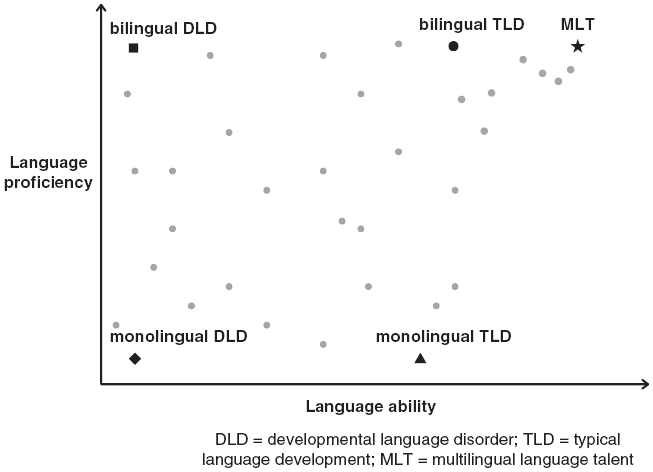
The language continuum is defined in this book by the dimensions of language ability (from language talent to language disorder) and bilingualism (from monolingual to multilingual); the latter is typically expressed by the level of language proficiency. These two language dimensions and the factors that contribute to their development (e.g., amount of exposure, frequency of use, communicative context) serve as the foundation for analyzing the relationship between language and cognitive control. Unfortunately, “language ability” and “proficiency” are often used interchangeably in the literature, particularly in studies on bilingualism, resulting in many inconsistencies. Within our conceptual framework, language ability refers to a child’s language and communication skills measured with standardized language tests that indicate the presence or absence of a language delay or disorder (see Figure 1.1). In contrast, language proficiency is defined as the overtly observable, functional language use across different domains that are specified as contexts of bilingual language use (Birdsong, Reference Birdsong2014; Jilka, Reference Jilka, Dogil and Reiterer2009). In addition to the mixed use of “language ability” and “proficiency,” the measures of these constructs are also used inconsistently. Specific tests of language ability, such as expressive and receptive vocabulary measures, have often been used to determine the level of language proficiency in bilingual children and adults without consideration of the fact that these standardized language tests were developed to assess language knowledge and not functional language use and were normed, in most cases, on monolingual participants. Moreover, the relationship among these measures is highly influenced by other factors of the bilingual experience, such as the number of years of active bilingual language use and the percentage of exposure to the second language. Bedore and colleagues (Reference Bedore, Peña, Summers, Boerger, Resendiz, Greene and Gillam2012) reported that most tests that were developed to determine language proficiency were not designed to identify children with a language disorder, and that the tests that were developed to measure children’s language ability, namely, to determine the presence or absence of a language disorder, do not provide appropriate measures of language proficiency.
Language dimensions

The use of incorrect assessment methods has negative consequences for both research and clinical outcomes. For example, English Language Learners (ELL) represent an increasing proportion of school-age children in the United States (2018, 2021, www.pewresearch.org). While the prevalence of language disorder is 7–8 percent in the general child population, almost 50 percent of ELL students were classified as having language problems (Norbury et al., Reference Norbury, Gooch, Wray, Baird, Charman, Simonoff and Pickles2016; Tomblin et al., Reference Tomblin, Records, Buckwalter, Zhang, Smith and O’Brien1997). Such rampant classification errors occur because ELL students and bilingual children with developmental language disorder (DLD) often perform similarly on traditional language tests but for different reasons. ELL students without a language disorder may perform poorly on standardized language tests because of their low language proficiency in English. In contrast, bilingual children with DLD perform poorly on the same tests because of their low language ability resulting from their language disorder. Hence, ELL students are often overdiagnosed, while bilingual children with DLD are often underdiagnosed, as it is assumed that the latter group shows difficulty on standardized language tests because of their low English-language proficiency. Thus, many ELL students receive unnecessary speech-language therapy, while they are deprived of valuable academic opportunities because of their misdiagnoses, whereas bilingual children with DLD might miss precious years of intervention. These classification and diagnostic errors have negative consequences for children’s academic careers because intervention for these two groups is vastly different and incorrect placement results in inadequate access to services.
1.2 The Language Ability Continuum
1.2.1 Language Talent
The differentiation between language ability and level of proficiency is no easier at the higher end of the language continuum. Children’s language talent (high level of language ability) is often measured by the number of languages they have acquired and by their native-like accent in a second language (Reiterer et al., Reference Reiterer, Hu, Erb, Rota, Nardo, Grodd and Ackermann2011). Even though several scholars have emphasized a distinction between proficiency and talent (e.g., Jilka, Reference Jilka, Dogil and Reiterer2009), talent is often still equated with high language proficiency in multiple languages. Using multilingualism as an indicator of language talent, however, may be misleading. Many children become multilingual because they grow up in a country where a number of languages are spoken or have parents and grandparents who come from different language backgrounds, so several languages are spoken within the family. Even children with DLD may speak two to three languages if they come from a multilingual environment. Thus, it is important to distinguish between the two language dimensions (i.e., language ability and multilingual proficiency) when defining language talent. There is no single or universal definition of talent. In the human resources literature, individuals are identified as talented if they have the potential to reach high levels of achievement (Tansley, Reference Tansley2011). Gagne (Reference Gagne, Heller, Mönks, Subotnik and Sternberg2000) argued that talent earmarks the superior mastery of abilities and knowledge in a given area of development, such as language. This notion is in line with the talent concept of the second language (L2) acquisition literature, which defines the term in reference to aptitude. Aptitude has been specified as unusual cognitive strengths that an individual demonstrates during language acquisition. Others have emphasized the effort aspect of development, pointing out that talented people excel with ease and achieve their goals without trying hard (Thorne & Pelant, Reference Thorne and Pellant2007). These definitions – potential to reach high levels of achievement, superior mastery of abilities, and exceling with ease – can be efficiently applied to language acquisition if we consider both language ability and proficiency, as well as interactions with specific environmental factors.
The idea that talent reflects the potential to achieve high levels of performance can easily be synthesized with the concept of dynamic assessment. Dynamic assessment is a testing and intervention approach that measures children’s potential to grow rather than their current knowledge in a given subject area. Although this is an approach that has often been used with children who exhibit low language proficiency and/or ability, including emerging bilingual children and children with a language disorder (Hasson & Joffe, Reference Hasson and Joffe2007; Peña et al., Reference Peña, Iglesias and Lidz2001), it has yet to be used to identify children with language talent. Lidz and Macrine (Reference Lidz and Macrine2001) applied dynamic assessment during the selection of gifted children in a school with a large number of culturally and linguistically diverse students. In previous years, when children were identified as gifted based on their achievements on standardized tests, fewer than 1 percent of the students qualified from this particular school. In contrast, the proportion of students identified in the study by Lidz and Macrine matched the proportion of gifted students across the entire school district (i.e., about 5 percent). By using dynamic assessment, they were able to enroll significantly more culturally and linguistically diverse students in gifted programs than in previous years.
The use of dynamic assessment may contribute to the reconciliation of the debate in the literature on the nature of talent. Currently, there are two distinct views in the L2 literature. Jilka (Reference Jilka, Dogil and Reiterer2009) argues that talent is independent of motivation, practice, and experience. These factors may contribute to the degree of language proficiency but not to the degree of talent. In contrast, other scholars have linked talent to different learning contexts, attitudes, and experiences (Moyer, Reference Moyer2014; Wen & Skehan, Reference Wen and Skehan2011). In this book, we take an individual-differences approach when discussing talent. We are particularly interested in those higher-level cognitive skills that contribute to efficient language acquisition along the language ability continuum.
1.2.2 Developmental Language Disorder (DLD)
DLD is a neurodevelopmental disorder. According to the Diagnostic and Statistical Manual of Mental Disorders (DSM-5), children with DLD have persistent difficulties in language use and/or comprehension, and their difficulties may impact their spoken and/or written language, as well as their sign language. The disorder often exists beyond childhood and affects children’s social lives and academic careers. Thus, the language problems are long-standing and cannot be remedied by general educational procedures (McGregor et al., Reference McGregor, Goffman, Van Horne, Hogan and Finestack2020).
In recent years, there has been a shift in terminology from specific language impairment (SLI) to DLD (Bishop et al., Reference Bishop, Snowling, Thompson and Greenhalgh2016, Reference Bishop, Snowling, Thompson, Greenhalgh, Adams and house2017), although there are diverging views on this issue (see Volkers, Reference Volkers2018). The notion that the language impairment in these children is not “specific” has been widely acknowledged in the literature. Our own research on different cognitive control functions also provides support for this idea, because children with DLD exhibit difficulties in a number of cognitive functions even when nonverbal tasks are employed (Marton, Reference Marton2008, Reference Marton2009; Marton et al., Reference Marton, Abramoff and Rosenzweig2005).Footnote 1
Although all children with a diagnosis of DLD exhibit significant language difficulties, their cognitive-linguistic profiles may differ because of the complexity of the cognitive-linguistic system and the heterogeneity of the population. There are notable variations in both the severity and pervasiveness of these children’s language disorder, including differences across language areas (phonology, morphology, syntax, vocabulary, etc.) and modalities (expressive or receptive language, or both). For classification purposes, a number of diagnostic criteria have been proposed in the literature. Some authors suggest defining the language difficulties relative to the child’s age or nonverbal intelligence (Peterson & McGrath, Reference Peterson, McGrath and Pennington2009), while others suggest considering the extent of the difficulties in language use, comprehension, and functional communication, as well as the developmental trajectory of language, including the age of onset (Reilly et al., Reference Reilly, Bishop and Tomblin2014). These criteria help researchers and clinicians to distinguish children with DLD from children with other neurodevelopmental disorders, such as autism spectrum disorder. Hearing screening is typically used to exclude children with hearing impairment, and nonverbal IQ is administered to exclude children with intellectual disabilities. Nonetheless, the definition of DLD allows dual diagnoses because children with language impairment may also exhibit attention problems (Finneran et al., Reference Finneran, Francis and Leonard2009); weaknesses in different cognitive control functions (Kapa & Plante, Reference Kapa and Plante2015); poor working memory skills (Marton & Schwartz, Reference Marton and Schwartz2003); difficulties in motor control (Zelaznik & Goffman, Reference Zelaznik and Goffman2010); and problems in social cognition (Marton et al., Reference Marton, Abramoff and Rosenzweig2005).
The prevalence of DLD is around 6–8 percent in kindergarten children, and it is more frequent (1.3:1) in males than in females (Norbury et al., Reference Norbury, Gooch, Wray, Baird, Charman, Simonoff and Pickles2016; Tomblin et al., Reference Tomblin, Records, Buckwalter, Zhang, Smith and O’Brien1997). However, the percentage of children identified with DLD varies across studies depending on the age of the participants, the cut-off point used to establish the diagnosis, and the definition adopted (Gilger & Wise, Reference Gilger, Wise, Stone, Silliman, Ehren and Apel2004). Despite the high frequency of the occurrence of DLD, there is still low awareness about the disorder in the general public, even among educators (Marton et al., Reference Marton, Abramoff and Rosenzweig2005; McGregor et al., Reference McGregor, Goffman, Van Horne, Hogan and Finestack2020). Consequently, a large number of children with DLD are unidentified and/or underserved, particularly those who speak a minority language, come from immigrant families, or belong to underrepresented minority groups (McGregor et al., Reference McGregor, Goffman, Van Horne, Hogan and Finestack2020; Morgan et al., Reference Morgan, Farkas, Hillemeier, Li, Pun and Cook2017). This is particularly worrisome in light of these children’s high risk for academic failure and mental health conditions. Children with DLD are six times more likely to have reading disabilities and spelling problems, four times more likely to exhibit weaknesses in math, and twelve times more likely to encounter difficulties in all three subject areas compared to their peers (Young et al., Reference Young, Beitchman, Johnson, Douglas, Atkinson, Escobar and Wilson2002). Different mental health issues, such as anxiety, depression, and low self-esteem, are also more common among these children (Conti-Ramsden & Botting, Reference Conti‐Ramsden and Botting2008; Marton et al., Reference Marton, Abramoff and Rosenzweig2005).
Overall, it is important to call attention to this group and raise awareness in the general public about DLD. The number of missed, underdiagnosed, and underserved children needs to be decreased drastically, particularly for children from disadvantaged families. Teachers in general education need more information about the characteristics, signs, and risk factors of language disorders. Interprofessional collaborations need to be supported among teachers, speech-language pathologists, and other therapists who provide services to children with DLD.
1.3 Language Characteristics of Children with DLD: A Cross-Linguistic Perspective
This section provides a brief overview of the major language issues of children with DLD, focusing on an area that causes these children great difficulty: morpho-syntax. Children with DLD exhibit weaknesses in marking verb inflections; in comprehending and producing complex sentence structures; and in detecting grammatical violations (e.g., Leonard et al., Reference Leonard, Eyer, Bedore and Grela1997; Norbury et al., Reference Norbury, Bishop and Briscoe2002; van der Lely, Reference Van der Lely1996). By taking a cross-linguistic perspective rather than focusing on English alone, we can highlight some general problems across languages, while also noting language-specific features. Grammatical morphology has been identified as a problem area in children with DLD across languages, and one of the most highly researched topics within morphology was tense marking. Children with DLD performed more poorly on tasks measuring tense marking than their typically developing peers in each language, even though the manifestation of the problem differed across languages (e.g., Dromi et al., Reference Dromi, Leonard, Adam and Zadunaisky-Ehrlich1999; Hansson et al., Reference Hansson, Nettelbladt and Leonard2000; Rice & Wexler, Reference Rice and Wexler1996). One predictor of the level of accuracy was the frequency of occurrence of the inflection (Lukács et al., Reference Lukács, Leonard, Kas and Pléh2009). In languages that are rich in inflectional morphology (e.g., Spanish, Italian), children with DLD often substituted one tense marker for another; in other languages, such as English, they produced the infinitives (Leonard, Reference Leonard2014).
A universal pattern was also observed with the omission of auxiliary verbs in obligatory contexts by children with DLD (Grela & Leonard, Reference Grela and Leonard2000; Hansson, Reference Hansson1997; Vukovic & Stojanovik, Reference Vukovic and Stojanovik2011). This was an aspect of language in which children with DLD differed from both their age-matched and their younger, language-matched peers. These findings indicate that this is one of the more severe problems in children with DLD, and this was further evidenced by specific data from French-speaking children. Even though French-speaking children with DLD correctly produced the preposition “a” most of the time, they performed very poorly when “a” served as the third-person past auxiliary (Pizzioli & Schelstraete, Reference Pizzioli and Schelstraete2008).
Noun morphology has received less attention in the DLD literature than verb morphology; nevertheless, the error data from a number of languages (e.g., Arabic, Hebrew, Hungarian, German, Greek, Serbo-Croatian, Spanish) indicate problems with noun inflections as well (Marton & Yoon, Reference Marton, Yoon, Brooks and Kempe2014). Children with DLD often use the singular instead of the plural form of the noun or they produce substitution errors of case (e.g., nominative instead of the accusative). The error types across languages differ and reflect an interaction between linguistic complexity and cognitive demands. In a study where we compared the interaction between linguistic complexity and working memory in English- and Hungarian-speaking children, the results revealed that linguistic complexity impacted the accuracy of working memory performance differently across languages. While in English, an increase in syntactic complexity affected verbal working memory performance, in Hungarian, an increase in morphology and not in syntax resulted in decreased accuracy for working memory performance (Marton et al., Reference Marton, Schwartz, Farkas and Katsnelson2006).
Even though there is no specific language structure that would be impaired in children who speak any certain language yet intact in young speakers of other languages, children with DLD might show salient weaknesses that vary across languages. For example, while English-speaking children experience extreme difficulty with the acquisition of tense and agreement markers, morpho-syntax is no more impaired than some other language areas in French-speaking preschoolers (Thordardottir & Namazi, Reference Thordardottir and Namazi2007). Although Spanish-speaking children with DLD make fewer errors with tense marking than their English-speaking peers, they make frequent errors with articles and clitics, adjective-agreement inflections, and number agreement of nouns (Jacobson & Schwartz, Reference Jacobson and Schwartz2002, Reference Jacobson and Schwartz2005). Cross-linguistic findings show an interesting difference in error patterns with object clitics production. While Italian and French-speaking children with DLD tend to omit object clitics, Spanish-speaking children make substitution errors but do not omit clitics. Paradis and colleagues (Reference Paradis, Crago, Genesee and Rice2003) suggest that these cross-linguistic variations reflect prosodic differences across languages. The duration difference between stressed and unstressed syllables is smaller in Spanish than in French or Italian. The omission of object clitics in French is a clinical marker for DLD.
Word-order errors also varied across languages. While word order was the most relevant cue in sentence comprehension for English-speaking children, speakers of a verb-second language, such as German or Swedish, paid only an intermediate attention to this linguistic aspect (Clahsen et al., Reference Clahsen, Bartke and Göllner1997; Hansson & Nettelbladt, Reference Hansson and Nettelbladt1995). Consequently, German-speaking children with DLD frequently violated the verb-second rule. These differences are also related to the developmental trajectories of these language features. While English-speaking children acquire the word order of their language earlier than specific forms of agreement (e.g., third person singular -s), Japanese-speaking children master word order and grammatical agreement cues simultaneously (Murao et al., Reference Murao, Ito, Fukuda and Fukuda2017). In contrast, Hungarian-speaking children acquire assorted suffixes before the word order cues. An important difference between English and Hungarian is that the latter language has more complex verb marking. Unlike English-speaking children, Hungarian children do not need to rely on word order because subjects and objects are distinguished by their case marking. Hungarian word order is therefore more variable than English, but it is not free of rules. Our study on grammatical sensitivity showed that children with DLD detected a similar amount of agreement violations and word-order violations when the errors occurred in the sentence-initial position but detected more word-order violations than agreement violations in sentence-final positions (Marton & Yoon, Reference Marton, Yoon, Brooks and Kempe2014). These findings also indicate an interaction between cognitive and linguistic functions, specifically with working memory.
These examples show that children with DLD demonstrate weaknesses in a number of areas across languages, indicating universal problems, even though the manifestation of errors can vary from language to language. In addition to the common patterns, there are some features, such as clitics or gender, that exist only in particular languages, and such forms present difficulties for children with DLD in acquiring their first language (L1). The current findings from cross-linguistic studies in children with DLD demonstrate that the most vulnerable language functions may differ across languages. Furthermore, children with DLD vary in accuracy rates and error types for given linguistic functions across languages, and these error patterns may reflect the structural features of the given language. In the future, it is critical that the linguistic characteristics of children with DLD are studied in more languages, particularly in languages that have received little or no attention in the past and that may offer new perspectives about the nature of DLD because of their unique linguistic features, such as the use of classifiers.
1.4 Language Proficiency
Within our conceptual framework, language proficiency is the functional language use that can be overtly observed and measured across different social contexts and modalities (Birdsong, Reference Birdsong2014; Jilka, Reference Jilka, Dogil and Reiterer2009). Grosjean (Reference Grosjean1989) differentiates between spoken and written modalities, including speaking and spoken language comprehension and reading and writing. Measuring language proficiency is challenging because most objective measures (e.g., standardized language tests) focus on language abilities rather than proficiency, and the subjective measures (e.g., self-reports, questionnaires) are not very reliable. Bilingual individuals often over- or underestimate their language proficiency (De Bruin, Reference De Bruin2019), particularly when parents are filling out the questionnaires for their children. They may only hear their child speaking one language at home, and they may not realize the degree of language development the child has in the other language when it is spoken only outside of the house.
Moreover, the tasks that are used interchangeably to measure language proficiency often show no or low correlations. According to the outcomes of a survey (Hulstijn, Reference Hulstijn2012), only half of the empirical studies on bilingualism included an objective proficiency measure. Likewise, an analysis by Surrain and Luk (Reference Surrain and Luk2019) revealed that out of 186 studies, only 29 percent measured proficiency using a subjective questionnaire, only 30 percent applied an objective measure, and only 17 percent included both subjective and objective measures. These findings not only show inconsistencies in the literature but also indicate that a number of studies that include bilingual speakers do not even measure their participants’ language proficiency.
One objective measure that is not a test of language abilities is the Diagnostic Language Assessment (DIALANG; Weber, Reference Weber2007). DIALANG is a free, computer-based online language proficiency task (https://dialangweb.lancaster.ac.uk/) that has been used in the L2 education literature. DIALANG was developed based on the Common European Framework of Reference for Languages (CEFR; Council of Europe, 2001) and includes six levels of proficiency: from A1 to C2, with A1 representing the lowest level and C2 the highest. Currently, this assessment tool is available for fourteen languages (e.g., English, Spanish, German) and measures five language areas: vocabulary, reading, writing, listening, and structures, with a focus on functional language use (Chapelle, Reference Chapelle2006).
Just a few studies compared the outcomes from subjective and objective measures, but they all suggested no or minimal correlation among these outcomes (Blumenfeld et al., Reference Blumenfeld, Bobb and Marian2016; Tomoschuk et al., Reference Tomoschuk, Ferreira and Gollan2019). In a study examining the relationship among different language tasks in mono- and bilingual children with and without language impairment, we also showed no or just minimal correlation among common measures of language proficiency, such as the Language Experience and Proficiency Questionnaire (LEAP-Q; Marian et al., Reference Marian, Blumenfeld and Kaushanskaya2007); the Clinical Evaluation of Language Fundamentals; and the Expressive One Word Picture Vocabulary Test (Gazman et al., Reference Gazman, Pazuelo, Scheuer, Campanelli, Ouchikh and Marton2019). These findings suggest that the various tasks that have been used to test language proficiency measure distinct underlying mechanisms. Therefore, they should not be used as alternatives to each other. One reason for this view is that language proficiency is dependent on other aspects of the bilingual experience, such as the frequency of language use, language dominance, or language exposure.
To demonstrate this interaction, we examined college students’ language proficiency outcomes in relationship to their language exposure (Gehebe et al., Reference Gehebe, Wadhera and Marton2023) on different subjective measures, such as the LEAP-Q and the American Council on the Teaching of Foreign Languages (ACTFL) performance indicators for language learners, along with objective measures including the DIALANG. Exposure was measured by the percentage to English (nonnative language) in daily life (i.e., 20–40 percent; 50–70 percent; 80–95 percent). While the proficiency outcomes across tasks and modalities strongly correlated for the participants in the high (80–95 percent) exposure group, there was only a moderate correlation among these measures for the participants in the medium (50–70 percent) exposure group; this is similar to findings by de Bruin and colleagues (Reference De Bruin, Carreiras and Duñabeitia2017). The outcomes from the low exposure group (20–40 percent) were less clear and showed only a moderate correlation. These data signal a complex interaction between language proficiency and exposure. Therefore, measures of proficiency must be chosen carefully, particularly for bilingual speakers with only medium or low daily exposure to the nonnative language.
Considering the complex interactions among components of the bilingual experience, most studies used only one to two aspects of the bilingual experience when determining the selection criteria (De Bruin, Reference De Bruin2019; Kaushanskaya & Prior, Reference Kaushanskaya and Prior2015). As a result, individuals with similarities in one bilingual component (e.g., language proficiency) were grouped together, despite their differences in a number of other aspects (amount of exposure, frequency of language use, bilingual language-switching frequency, etc.). Thus, it is important for future studies to consider the interactions among language proficiency along with other components of the bilingual experience. For example, when children speak one language at home and another language at school and during extracurricular activities after school, then the frequency of use and the amount of exposure to each language need to be taken into account when creating groups of speakers with different proficiency levels. Furthermore, if the children are not balanced bilingual speakers with high language competency in both languages, then language proficiency should be measured using both objective and subjective tasks.
1.4.1 Measuring Language Proficiency in Children with DLD
With the demographic changes in the United States and Europe, a growing number of children exhibit low language proficiency in academic settings. Despite the continuous development of new diagnostic methods, the differentiation between low proficient bilingual students and bilingual children with DLD remains a challenge for researchers, educators, and clinicians. Separating language proficiency from ability in bilingual children with DLD is difficult with objective measures because the same tests are typically used to assess both language ability and proficiency. When objective language measures – standardized tests – are employed to assess language proficiency in bilingual children with DLD, the outcomes can indicate the degree of language impairment instead of the level of bilingual proficiency. To identify language disorder in children from culturally and linguistically diverse groups, Kohnert and colleagues (Reference Kohnert, Windsor and Yim2006) recommended distinguishing between experience-based measures, such as standardized language tests, and processing-dependent measures that require minimal previous language experience, such as nonword repetition and the competing language processing task. Three groups of eight–fourteen-year-old children participated in their study: monolingual English-speaking children with DLD; monolingual typically developing children; and English–Spanish bilingual typically developing children. While the processing-dependent tasks clearly separated monolingual children with and without DLD, they did not distinguish clearly these two groups among the bilingual speakers. The results revealed that performance on the processing-dependent tasks was not independent of previous language experience. Even though these tasks were processing-dependent measures and not traditional language tests, they were still verbal tasks.
Another processing-dependent task for identifying bilingual children with DLD is sentence repetition. Although such tasks show high specificity and sensitivity in monolingual children, the findings are mixed with bilingual children (Marinis & Armon-Lotem, Reference Marinis, Armon-Lotem, Armon-Lotem, de Jong and Meir2015). Children’s performance is highly influenced by the structural characteristics of the sentences in each language. Given that bilingual children with DLD are at a disadvantage when using experience-based measures, and that the few verbal processing-dependent measures that have been used in the literature revealed inconsistent findings, we developed a series of nonverbal cognitive control tasks to distinguish between bilingual children with language impairment and typically developing bilingual children with low proficiency (i.e., ELL). Although this research is still ongoing, the first results are promising. There appears to be an interaction between bilingualism and language disorder in bilingual children with DLD when performing minimally verbal or nonverbal cognitive control tasks (e.g., N-back with single letters or abstract shapes). In simple task conditions (e.g., small set sizes, no interference), bilingual children with DLD performed similarly to typically developing monolingual children and outperformed their monolingual peers with DLD. With an increase in task complexity, however, bilingual children with DLD performed similarly to monolingual children with DLD and more poorly than monolingual typically developing children. Thus, bilingualism attenuated the negative effects of DLD in simple task conditions, but this cognitive benefit disappeared in the more complex conditions, where all children with DLD performed more poorly, regardless of the number of languages they spoke (Marton et al., Reference Marton, Gehebe and Pazuelo2019). In contrast, ELL students performed similarly to monolingual typically developing children even in the more complex conditions. More research is needed to strengthen these findings, but the data we have so far suggest that nonverbal cognitive control tasks may have the diagnostic power to differentiate between bilingual children with DLD and ELL students.
A further challenge is to determine bilingual children’s language ability separately from their language proficiency, particularly in children with DLD. To overcome the problem that results from using the same tests to measure language proficiency and language disorder in children with DLD, we used a new within-subject approach to assessing language proficiency. First, we determined the expressive vocabulary scores of children in English and in Spanish. Then, we rescaled the scores of the less proficient language as a function of the more proficient language using a ratio of the scores from the stronger and weaker languages. To do this, we applied the following formula: y = ((L2 – minimum) / (L1 – minimum)) * 100 (Little, Reference Little2013). When using this formula, we worked with children’s percentile ranks and not standard scores because the minimum of zero as a vocabulary score would not be meaningful. The same method can be applied to values from Likert scales that have been used in bilingual questionnaires (e.g., LEAP-Q). Although the power of this method has to be further evaluated using larger samples, our preliminary results have been encouraging.
1.5 Similarities in Language Development in Typically Developing Monolingual Children and Bilingual First Language (L1) Speakers
The goal for this section is to identify patterns of language acquisition that characterize children’s development, regardless of the number of languages they speak. Therefore, the focus is on monolingual children and bilingual L1 speakers who are exposed to two or more languages from birth. From the bilingual population, we concentrate on bilingual L1 children only because both monolingual children and bilingual L1 speakers acquire language early in life, when the brain is most plastic and before they have had experience with formal instructions. Bilingual L1 speakers differ from successive bilingual children, even from those who acquire their L2 early in life, in learning processes, language experiences, and in the rate of acquisition (De Houwer, Reference De Houwer and Howell2011; Meisel, Reference Meisel2011). The comparison of language development in monolingual children and bilingual L1 speakers has been criticized in the literature, suggesting that the language competencies of these bilingual L1 children should be evaluated on their own merit to avoid the implications of a deficit view (Genesee, Reference Genesee, Akhtar, Tolins, Tree, Horst and von Koss Torkildsen2019). By identifying and discussing similarities in language development, we believe that both preventing the creation of a deficit view and highlighting common features can be accomplished.
Although there are inconsistencies in the literature, primarily because of the heterogeneity of the bilingual population, there is converging evidence suggesting that the overall course and the rate of bilingual L1 and monolingual language development are remarkably similar (Genesee & Nicoladis, Reference Genesee, Nicoladis, Hoff and Shatz2007; Kovács & Mehler, Reference Kovács and Mehler2009). This does not, of course, mean that bilingual L1 speakers’ competency is exactly the same in their two languages. Even though bilingual L1 acquisition means that children are exposed to their two languages at the same time, there may be differences in the language context, the amount of exposure, and the frequency of language use (De Houwer, Reference De Houwer2009). Thus, the bilingual language experience may affect these children’s development of specific vocabulary items or structures, but it has no negative effects on the major milestones of development.
For example, both monolingual and bilingual infants produce their first words around one year of age and reach a fifty-word expressive vocabulary at around eighteen months (Kovács & Mehler, Reference Kovács and Mehler2009). Other milestones of lexical acquisition are also reached for both languages in a similar manner, as long as the bilingual child receives equal exposure. The variations in vocabulary size in children between eight and thirty months of age have been associated with individual differences in early vocabulary development and not with the number of languages a child speaks (Pearson et al., Reference Pearson, Fernández and Oller1993). Even in monolingual children, there is a wide range in the number of words they actively use at this age. In addition to the similarities in vocabulary size, the distribution of lexical categories (noun, verb, adjective, etc.) is also comparable between monolingual and bilingual children (Genesee & Nicoladis, Reference Genesee, Nicoladis, Hoff and Shatz2007). Unfortunately, even today, there are only a few bilingual language tests available (e.g., Bilingual Verbal Ability Tests; Muñoz-Sandoval et al., Reference Muñoz-Sandoval, Cummins, Alvarado and Ruef2005). Therefore, bilingual children’s vocabulary has typically been measured in only one language in the past, and then compared to monolingual children’s vocabulary (Oller et al., Reference Oller, Pearson and Cobo-Lewis2007; Umbel et al., Reference Umbel, Pearson, Fernández and Oller1992). This is not a fair comparison, however, because there are words that bilingual children may know in one language but not in the other, depending on their bilingual experience. When we assess bilingual children’s total conceptual vocabularies (i.e., every concept for which they know the word in at least one language), then we find no disadvantage for bilingual children. Their cumulative lexical knowledge may even be larger than that of their monolingual peers (Hoff, Reference Hoff2013).
With regards to grammatical structures, the findings from different language pairs also indicate similar patterns between monolingual children and bilingual L1 speakers. Both groups showed similar developmental trajectories from single-word utterances, to two-word stages, to multiple-word expressions, and finally to complex sentences (De Houwer, Reference De Houwer2009). There are, of course, language-specific features that develop at different times in the two languages, but even the morphological and syntactic errors are similar for monolingual children and bilingual L1 speakers. For example, French–English-speaking two–three-year-old bilingual toddlers acquired finite verb forms earlier in French than in English and used subject pronouns in French only with finite verbs, despite the fact that they used subject pronouns in English with both finite and nonfinite verbs (Genesee & Nicoladis, Reference Genesee, Nicoladis, Hoff and Shatz2007). These performance patterns resembled those of monolingual children acquiring either French or English. The grammatical errors in both monolingual children and bilingual L1 speakers reflect age effects and age-related individual variations rather than the impact of bilingualism (Hudson Kam, Reference Hudson Kam, Brooks and Kempe2014). Moreover, grammatical performance in bilingual English-French speaking three-year-old children was highly influenced by their exposure to each language (Thordardottir, Reference Thordardottir2015). Bilingual children with high language exposure used assorted grammatical forms in their spontaneous speech, equal to their monolingual peers. Thus, children with bilingual L1 exhibit similar individual variations, developmental patterns, age-effects, and error types as monolingual children, as long as their language exposure is also similar.
1.6 Similarities in Language Development in Monolingual and Bilingual Children with DLD
Research in bilingual children with DLD started later than in monolingual children with the main question being whether bilingualism worsens the language difficulties of children with DLD. In other words, is the language profile of bilingual children with DLD affected more strongly by their language impairment or by their bilingualism? One critical question was whether bilingual children with DLD exhibit more severe forms of language impairment than their monolingual peers. Today, we know that the linguistic profiles of monolingual and bilingual children with DLD are similar (Gutiérrez-Clellen et al., Reference Gutiérrez-Clellen, Simon-Cereijido and Leone2009; Rothweiler et al., Reference Rothweiler, Chilla and Clahsen2012). For example, English-French speaking bilingual children with DLD showed comparable performance to monolingual children with DLD in a number of morphological tasks (Paradis et al., Reference Paradis, Crago, Genesee and Rice2003). A slightly different picture emerged when the child’s second language was a minority language in their country. Such children showed a disadvantage on linguistic measures (Verhoeven et al., Reference Verhoeven, Steenge, van Weerdenburg and van Balkom2011), but only if they were tested in their weaker language. Notably, the performance gap for children with and without DLD who learned a minority language (e.g., Dutch) was no greater than the gap between monolingual children with DLD and their monolingual TD peers (Leonard, Reference Leonard2014). These findings revealed that language performance in bilingual children with DLD is more strongly affected by their language impairment than by bilingualism.
In this section we focus on children’s morpho-syntactic skills because this is the most vulnerable area of language in children with DLD who speak multiple languages. The overall findings suggest that the performance patterns of bilingual children with DLD are similar to those of monolingual children with DLD, and this is true for both simultaneous and early successive bilingual children. To examine universal patterns, the following examples include Turkish-German, Frisian-Dutch, French-English, and German-Italian language pairs.
Subject-verb agreement was studied in six-year-old German monolingual and Turkish-German bilingual children with DLD. The similarities in agreement errors in monolingual and bilingual children with DLD suggest that language impairment affects the use of grammar in each language, independently from the order of acquisition, and there is no extra cost of bilingualism (Rothweiler et al., Reference Rothweiler, Chilla and Clahsen2012). Likewise, subject-verb agreement errors in an obligatory context have been found in Dutch monolingual and Frisian-Dutch bilingual kindergarten and school-age children with DLD (Spoelman & Bol, Reference Spoelman and Bol2012). Children’s errors were divided into three main categories: omission of the agreement marker; substitutions of a plural by a singular agreement marker; and verb forms not marked for person, number, or tense. There was no difference between the monolingual and bilingual children with DLD in the total number of agreement errors, in the different agreement error types, or in the use of subject-verb agreement in an obligatory context. Furthermore, the two groups did not differ in the production and number of omission errors in intransitive and transitive structures either. Dative case marking was studied in German and German-Italian four–seven-year-old children with DLD. Spontaneous speech samples with 74 utterances containing an obligatory context for a dative case marking were analyzed for each child. Similar to previous results, there was no difference in dative case marking between the speech samples of monolingual and bilingual children with DLD (Scherger, Reference Scherger2018).
Finally, French-English bilingual children were compared to two groups of monolingual children, one speaking English and the other French. All children were around seven years of age and had a diagnosis of DLD. To examine whether bilingual children with DLD experience difficulties with the same morpho-syntactic structures as their monolingual peers, spontaneous speech samples in each language were analyzed targeting tense-bearing and nontense-bearing morphemes (Paradis et al., Reference Paradis, Crago, Genesee and Rice2003). There was no difference in accuracy scores across the groups. Thus, bilingual and monolingual children with DLD exhibited difficulties in tense marking to the same extent, and all children’s production of nontense morphemes was better than their use of tense markers. These findings suggest that bilingual children with DLD do not have more severe language impairment than their monolingual peers, an outcome further supported by data suggesting that the gap in performance between bilingual children with and without DLD is no greater than the gap between typically developing monolingual children and children with DLD (Leonard, Reference Leonard2014). The results from these different studies also show that bilingual children with DLD do not have additional problems in morpho-syntax compared to their monolingual peers.
1.7 Conclusions
In this book, we systematically differentiate between language ability and levels of language proficiency by defining the two terms, describing the groups that vary along these two language dimensions, and identifying specific measures of ability vs. proficiency. Regrettably, both the bilingualism and language impairment literatures use these terms inconsistently, often even interchangeably. As a result, a much larger proportion of bilingual children are diagnosed with language disorder, particularly among emerging bilingual children (i.e., with low language proficiency), compared to expectations based on the prevalence of DLD in the general population. There is an increasingly large amount of evidence showing that bilingualism does not have a negative effect on children’s language development, even if they exhibit a language disorder.
It is important to distinguish clearly between these language dimensions, even if the standardized language tests show some overlapping outcomes for bilingual children with DLD and for emerging bilingual typically developing children. It is critical to prevent misdiagnoses in these language groups because when children are under- or overdiagnosed, they do not receive the appropriate services and placement, so their academic careers are therefore severely hindered. These misdiagnoses may negatively affect children’s later career choices and job selections, as well as their motivation and self-esteem, possibly leading to emotional disturbances, such as depression and anxiety, as obstacles to realizing their full potential.

 Open access