1. INTRODUCTION
The study of the acceleration of electrons by intense laser fields developed in different directions in the last years. For example, in the wakefield accelerator, highly intense laser pulse is focused into an underdense plasma and a resonant ponderomotive excitation of an electron plasma wave occurs. A breakthrough has been achieved by Pukhov and Meyer-ter-Vehn (Reference Pukhov and Meyer-ter-Vehn2002) with the discovery of the so-called bubble acceleration regime. The laser pulse expels electrons ponderomotively outward from the region of highest intensity in such a way that a solitary laser-plasma cavity is formed that moves with the laser pulse.
Seifter et al. (Reference Seifter, Kyrala, Goldman, Hoffman, Kline and Batha2009) investigated implosions of high symmetry to achieve ignition for inertial confinement fusion on the National Ignition Facility. For pulsed power generators, the development of relativistic electron beam sources is important. Li et al. (Reference Li, Liu, Xu, Chen, Chang, Wan and Wen2009) proposed a carbon-fiber aluminium cathode with high-density uniform emitters that was tested in a single pulsed power generator. This is a new class of plasma cathodes that offers promising prospects for relativistic beam sources. External injection of electron bunches longer than the plasma wavelength in a laser wakefield accelerator leads to the generation of femtosecond ultra relativistic bundles with a small energy spread (Luttikhof et al., Reference Luttikhof, Khachatryan, Van Goor, Boller and Mora2009). Niu et al. (Reference Niu, He, Qiao and Zhou2008) treated theoretically and numerically the resonant acceleration of plasma electrons in combined circularly polarized Gaussian laser fields and selfgenerated quasistatic fields.
The work described so far considers the acceleration of electrons inside a plasma environment. In this paper, we only want to describe the interaction of electrons with laser fields in the vacuum. The behavior of a high-density electron beam in the field of a super-intense laser pulse was studied by Kulagin et al. (Reference Kulagin, Cherepenin, Hur, Lee and Suk2008). They considered a one-dimensional theory for the description of the interaction and found exact solutions for the equations of motion of the electrons. Mainly Salamin and Keitel (Reference Salamin and Keitel2002), Wang et al. (Reference Wang, Ho, Yuan, Kong, Cao, Shao, Sessler, Esarey, Moshkovich, Nishida, Yugami, Ito, Wang and Scheid2002), and Bahari and Taranukhin (Reference Bahari and Taranukhin2003) treated theoretically the direct acceleration of electrons by intense focused laser beams with a single frequency (stationary beams) where mostly the electrons were injected sideways into the region of high intensity and gained energy of the order of GeV. Earlier measurements related to these calculations were done by Malka et al. (Reference Malka, Lefebvre and Miquel1997).
The problem arising with the sideward injection of electrons into the focus of the beam is that the electrons get mainly reflected from the intense laser beam and cannot enter the region of high electromagnetic fields. In order to circumvent this disadvantage, we let run a laser pulse of about the length of a half wavelength over a free electron, which is an optimal condition for the acceleration. This a challenging problem in two respects: (1) A finite laser pulse carries a frequency spectrum. Therefore, in this case, we cannot apply fields with a single frequency as usually used in literature (Davis, Reference Davis1979). (2) Three-dimensional electromagnetic wave packets have to be constructed, which solve the Maxwell equations. The careful study of both aspects is the content of this paper. Until now we treated only plane electromagnetic waves (Scheid & Hora, Reference Scheid and Hora1989; Häuser et al., 1994).
In Section 2, we first consider the acceleration of an electron in general. In Section 3, we study the acceleration with plane laser pulses, and in Section 4, the action of a finite plane laser pulse. Section 5 treats the electromagnetic fields of three-dimensional finite laser pulses. In order to find results for such laser pulses, we approximate the frequency in Section 6, and give results for laser acceleration in this approximation. We restrict the energies of the electrons to TeV energies to prevent the appearance of the problems of the quantum radiation regime (Ruhl, Reference Ruhl2009).
2. ACCELERATION OF ELECTRONS IN VACUUM
The relativistic equation of motion of a free electron with velocity  in an electromagnetic field can be written as
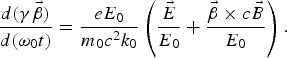
Here,  ,
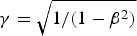 and
 is an arbitrary constant frequency, E 0 is a constant electric field strength, and
 is the acceleration parameter. A field without an electric y-component moving mainly in z-direction has the form


In order to prove the correctness of ansatz (2) for the electric field, we take the Maxwellian equations in vacuum  ,
 ,
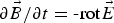 , and
 . These equations lead to the following differential equation for
 :

Therefore, we can assume E y = 0 in the following.
The parameter a 0 can be quite large. For example, for a laser with a wave number 1 (μm)−1 (wavelength λ = 2π µm) and an intensity of  we obtain
 . The resulting value of the Lorentz factor γ is proportional to
 as we will show for example in Section 3.
In the next Section, we consider plane laser pulses (only  and
 ) that are linearly polarized in x-direction and move in positive z-direction.
3. ACCELERATION BY PLANE LASER PULSES
A plane laser pulse linearly polarized in the x-direction and moving in positive z-direction has the electric and magnetic fields

Here we consider laser pulses with a mixture of frequencies. In various research (Bahari & Taranukhin, Reference Bahari and Taranukhin2003; Wang et al., Reference Wang, Ho, Yuan, Kong, Cao, Shao, Sessler, Esarey, Moshkovich, Nishida, Yugami, Ito, Wang and Scheid2002; Davis, Reference Davis1979) laser pulses with a single frequency were studied.
Then Eq. (1) has the form in components


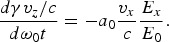
Assuming the initial conditions for t = 0:  ,
 , we can calculate the velocity, energy, and the location of the electron. With the abbreviation
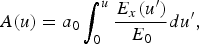
where u is given by  , we obtain (Häuser et al., 1994)



In the next section, we will calculate these integrals for a special form of the plane wave. So far no approximations are used.
4. FINITE PLANE LASER PULSE
Let us assume the electric field of the plane laser pulse as
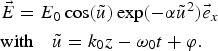
This plane pulse solves the Maxwellian equations exactly. The phase φ shifts the laser pulse in the negative z-direction. If we choose  , only about one positive arc of the cosine function survives. For the function A(u) we find

with the odd function 

The complete laser pulse has crossed the electron for  and φ ≫ 1. After crossing the integral A = A fin is given by

Therefore, we have the Lorentz factor
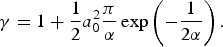
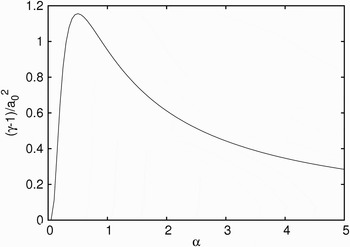
In Figure 1, we present the scaled Lorentz factor  as a function of the parameter α. The maximum of this curve is positioned at α = 0.5 with the value π exp(−1) = 1.156. We can compare the result with the case of an acceleration inside a half wavelength without the Gaussian factor in (12). This acceleration has the value (γ − 1)/a 02 = 2.
Scaled Lorentz factor as a function of α for the polarized plane wave given in Eq. (12).

To construct a laser pulse of the form with α = 0.5 running over the electron, we set φ = 3π/2 and the final value of u = u fin = −3π. For |u| > |u fin|, the electron moves with (nearly) constant velocity in z direction. At u = −3π the electron reaches a distance from  (see (11))

The first integral can be reduced to (with α = 0.5)
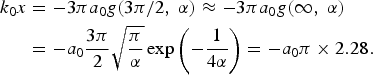
The last integral in (17) can only be solved numerically and yields for α = 0.5
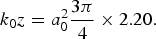
The corresponding quantities for a half-wavelength acceleration are shorter, namely k 0x = −πa 0 and k 0z = 3πa 02/4 because of the smaller extension of the halt-wavelength pulse. For a maximum intensity of I = 1022 Wcm−2 and a wave number of k 0 = 1 (μm)−1, i.e., a 0 = 0.38 × 10³, and for α = 0.5, we obtain a Lorentz factor of γ = 1.67 × 10⁵ and the acceleration lengths are x = −2.72 mm and z = 0.75 m.
5. ELECTROMAGNETIC FIELDS OF THREE-DIMENSIONAL Laser Pulses
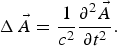
We search for the electromagnetic fields of a three-dimensional laser pulse in vacuum, which is restricted to a given region in three dimensions at a fixed time. Let us start with a vector potential  in transverse gauge where

and where  has to satisfy the wave equation
The field  can be obtained from a further vector potential
 by setting
 where
 has to obey the wave equation
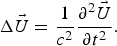
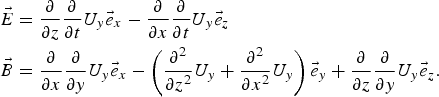
Choosing a certain three-dimensional wave packet for  , the corresponding fields of
 and
 can be calculated by differentiation. If we set
 for simplification and assume
 , we calculate
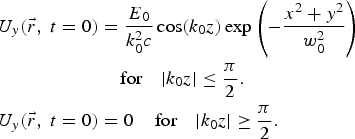
Next we introduce an ansatz for U y at time t = 0 and carry out a Fourier transformation of it:

with

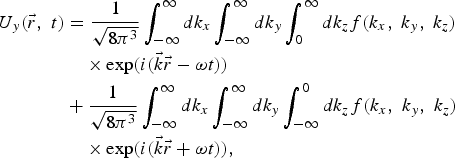
Then we find the time dependence if the wave proceeds in positive z-direction
with

It is quite easy to show that U y fulfils Eq. (22). The Fourier transformation (24) can usually be calculated and is known. However, the time-dependent function U y(x,y,z,t) needs a three-dimensional numerical integration because of the special form (27) of the frequency, This numerical integration requires a high precision since finally the electromagnetic fields are obtained by second derivatives of U y. If f(k x,k y,k z) is an even function in k z with f(k x,k y,k z) = f(k x,k y, − k z) then U y can be simplified:

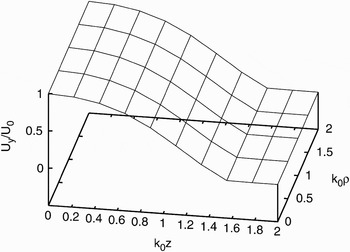
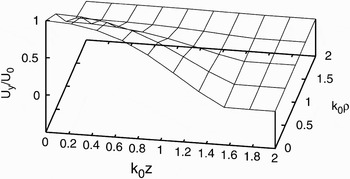
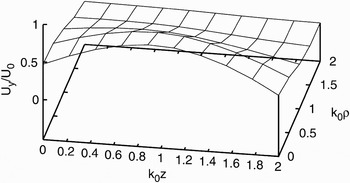
For studying those pulses, we choose a simple half wave packet restricted in the x- and y-directions by Gaussians (see Figs. 2 and 3):
The function U y/U 0 with U 0 = E 0/(k 02c) as a function of k 0z and k 0ϱ for k 0ct = 0 and k 0w 0 = 1000.

The function U y/U 0 with U 0 = E 0/(k 02c) as a function of k 0z and k 0ϱ for k 0ct = 0 and k 0w 0 = 1.

Here, we excluded and do not discuss terms including a small parameter ɛ with ɛ → 0, which eliminate the singularity in the second derivative with respect to z at |k 0z| = π/2. Then the result with k 0w 0 → ∞ for the fields is  and
 with u = k 0z − ω0t. Now we calculate the Fourier transformation of U y and obtain
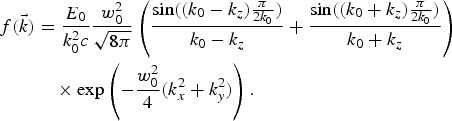
With the Fourier transform, we can calculate the wave packet  by treating the following integral where we inserted cylindrical coordinates of
 and
 and made some substitutions
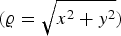 :
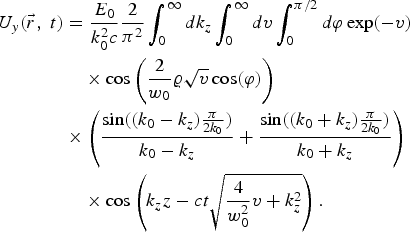
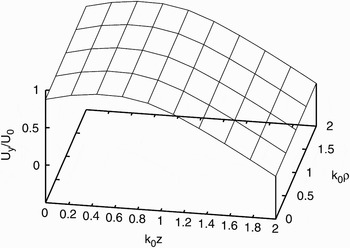
These integrals cannot be solved analytically in general; they have to be handled numerically. In Figures 2, 3, 4, and 5, we show (k 02c/E 0)U y as a function of the coordinates k 0z and k 0ϱ for fixed widths k 0w 0 = 1 and 1000. These numerical calculations are time-consuming and presently not suitable for solving the equation of motion. It is seen from the figures that the wave with k 0w 0 = 1000 runs like a plane wave whereas the wave with k 0w 0 = 1 behaves quite differently.
The function U y/U 0 with U 0 = E 0/(k 02c) as a function of k 0z and k 0ϱ for k 0ct = 0.5 and k 0w 0 = 1000.

The function U y/U 0 with U 0 = E 0/(k 02c) as a function of k 0z and k 0ϱ for k 0ct = 0.5 and k 0w 0 = 1.

6. APPROXIMATION OF FREQUENCY
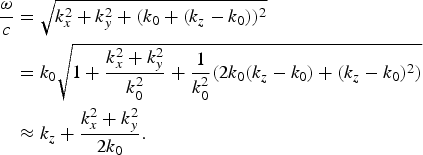
In order to be able to solve the equation of motion for the electron with finite-ranged electromagnetic pulses, we approximate the frequency ω in Eq. (27). Assuming that the wave with the initial condition (29) proceeds essentially with the wave number k 0 in z-direction, we introduce the following expansion of the square root determining the frequency ω that is true for positive k z ≈ k 0
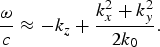
If k z is negative and about −k z ≈ k 0 we can carry out a similar expansion setting k z = −k 0 + (k z + k 0) and obtain for negative k z the frequency
If these approximations and the Fourier transform (30) are inserted into Eq. (26), we can separate the integrals over the coordinates:
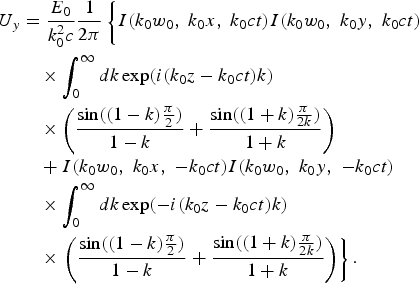
Here, the dimensionless integral I depends on three real dimensionless parameters a, b, and c. It is given by
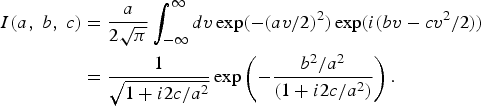
The complex integrals over k z in (34) have to be solved numerically. For further simplification, we expand the integral (35) for a 2 ≫ c, respectively, w 02 ≫ |ct/k 0|, and obtain

If this approximate expression is inserted in (34), it results
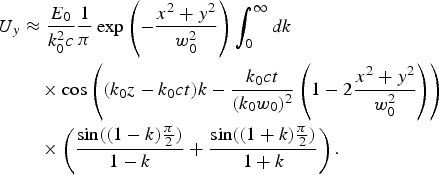
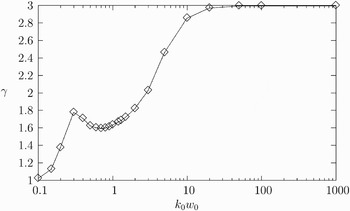
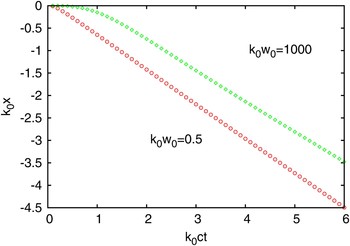
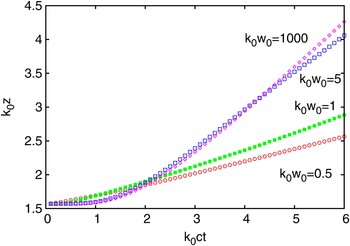
Figures 6, 7, and 8 show results obtained with the approximate U y given in Eq. (34). If the parameter k 0w 0 is large (for example, k 0w 0 = 1000), then the laser pulse behaves like a plane wave and the Lorentz factor is γ = 1 + 2a 02 = 3 for a 0 = 1 as used in all numerical calculations. For k 0w 0 = 1, the Lorentz factor is smaller, namely γ = 1.63, since the electron leaves fast the region of high intensity of the laser pulse. The same behavior one can learn from Figures 7 and 8.
The Lorentz factor γ for a 0 = 1, calculated with the approximation for U y given in Eq. (34), as a function of k 0w 0. The diamonds are calculated values.

The coordinate k 0x for a 0 = 1, calculated with the approximation for U γ given in Eq. (34), as a function of time k 0ct, for k 0w 0 = 0.5 and 1000.

The coordinate k 0z for a 0 = 1, calculated with the approximation for U y given in Eq. (34), as a function of time k 0ct, for k 0w 0.

7. SUMMARY AND CONCLUSIONS
We showed that it is possible to use very short and intense laser pulses of a length of about one half-wavelength for the acceleration of the electrons. The laser pulse overruns the electron and lets the electron back in an accelerated state. A half-wavelength laser pulse with a strength parameter  gives the electron an acceleration of γ = 1 + 2a 02 inside a longitudinal length of (3πa 02)/(4k 0) and a transverse deviation of −πa 0/k 0. For γ = 2 × 10⁶(~1 TeV electrons) we obtain the longitudinal and transverse lengths (l/k 0)0.75 × π × 106 and (1/k 0)π × 103 (=0.75 × π m and π × 10−3 m for k 0 = 106/m), respectively. This demonstrates the advantage of this acceleration that the transverse deviation of the electrons is relatively small.
In contrast to several investigations in literature (see for example (Bahari & Taranukhin, Reference Bahari and Taranukhin2003), our wave packets consist of waves with different frequencies. This makes the procedure more complex. We proposed an expansion of the frequency into the Cartesian components of the wave vector. It is clear that a direct integration of the three-dimensional integral over the three Cartesian components can be done, but presently our personal computers are too small for such a duty because a high precision for the electromagnetic fields is needed.
Further investigations for the construction of a practical accelerator have to be carried out. It is already evident that very high energy accelerators restricted to smaller length dimensions can probably only be developed with the help of intense laser pulses. More experimental facts are necessary for the near future of this research field.
ACKNOWLEDGMENTS
We thank Prof. Mulser for fruitful discussions and his great interest in this work.