From the end of World War II, British clothing retailers—most notably, Marks & Spencer (M&S)—increasingly dominated the domestic textile industry, to some extent arresting its decline. This article uses financial and archival evidence to examine the distribution of costs and benefits in the M&S vertical network. It shows that these benefits became less tangible for textile firms from around 1985, in the context of lower-cost overseas competition. We chart the visible and invisible evolution of network management, demonstrating that retailer-producer collaboration evolved from a bilateral vertical partnership model to a hybrid version that retained partnerships with leading suppliers and an emphasis on domestic sourcing, but also facilitated offshore production.
Since 1945, staple domestic industries in Western economies have been replaced with global production networks. In the United Kingdom, the cotton textile industry, and then the textile industry in general, declined in the face of increasing overseas competition. Survival strategies were based on restructuring and concentration. During a period of rapid transformation after 1960, cotton was absorbed into vertically structured textile conglomerates.Footnote 1 Still, the decline continued, and as protection was phased out, fabric and apparel manufacturing faced similar threats, although rates of decline and strategic response depended on relative position in the vertical production chain. An alternative survival strategy based on vertical partnerships was led by retailers, particularly the dominant clothing retailer Marks & Spencer (M&S).
The British example of a dominant retailer sheltering a declining industry offers unique insights for several reasons. First, it presents a potential meso, or network-level, source of competitive advantage within the macro context of decline and deindustrialization. While acknowledging the opportunity created by restructuring, the literature attributes the continued decline to, first, an absence of stable demand conditions that are required for efficient vertically integrated production and, second, a failure to integrate production and marketing.Footnote 2 Alternatively, where a downstream hub firm, such as a retailer, can organize constituent firms to achieve lower costs relative to purchasing outside the network, nonzero sum value is transferred from supplier to buyer, with risk shared between network partners.Footnote 3 These advantages are achievable where local suppliers offer greater flexibility and shorter lead times.Footnote 4
Second, and related, such competitive advantage depends on the success and sustainability of the lead firm's marketing strategy. M&S's close links with U.K.-based suppliers allowed it to develop a “buy British” marketing and ethical stance, through consumer ethnocentrism.Footnote 5 Where consumers believe domestic labor practices are superior, and prefer domestic over overseas labor, retailer support for local manufacturing capacity can enable effective marketing, as in the case of the U.S. apparel industry. In the late 1980s and early 1990s, the textile-industry group “Crafted with Pride in the U.S.A.” enlisted Walmart to support domestic manufacturers, and the campaign enjoyed some temporary success.Footnote 6 Where effective, as this article demonstrates, such strategies can create and share the rewards of competitive advantage in upstream supplier networks, suggesting a possible adaptation of Chandler's “visible hand” model and limiting the spread of specialized modular production suggested by Langlois's “vanishing hand” hypothesis.Footnote 7
Third, the literature suggests that textile firms supplying chain stores had higher sales growth and suffered lower contraction in employment than those without retail contracts and that regular contracts with M&S allowed stable and more efficient longer production batches, at least up to the early 1980s.Footnote 8 Such relationships also meant, however, that the textile industry remained larger than it might have been either in the absence of M&S altogether or without the retailer's continued success, creating a 1990s parallel of the overexpansion of cotton textiles before 1914 and the risk of a consequent and precipitous decline.Footnote 9 As a leading textile industry analyst pointed out, “M&S was the very lifeblood of the U.K. textile industry and yet it was the cause of its death.”Footnote 10
By examining the long-term evolution—from approximately 1950 to 2000—of these trends and relationships, this article contributes to the literature dealing with M&S's strategy, including its response to the significant loss of market share in 1998, and evaluates the wider impact on the British textile industry, emphasizing the relationship between production and marketing.Footnote 11 To contextualize and explain these trends, we first reconsider the literature on the decline and concentration of British textiles and the origins of the company's supplier strategy, using both contemporary and new archival evidence to explain the development of the M&S-supplier relationship.Footnote 12 To quantify the apparent benefits and costs of supplying the retailer, we compare the extent and persistence of risk and profit differentials for the firm's suppliers with those of the rest of the U.K. textile industry and of M&S itself.Footnote 13 The methods exercised by the retailer in its supplier relationships, including offshoring decisions, are also evaluated. These decisions were made in the context of macrolevel relaxation of world trading rules and consequent pressures on the company; in response, it developed new ethical sourcing principles.Footnote 14 We examine them in terms both of M&S's relationship with the supplier firms Courtaulds and Claremont Garments, during the establishment of a new facility in Morocco, and of associated processes of corporate restructuring that culminated in Courtaulds's 1998 takeover of Claremont. This article concludes with a discussion of M&S's impact on the British textile industry and the challenges of global competition for retailer-supplier networks.
U.K. Textiles and M&S
Once Britain's leading export sector, textiles—and particularly cotton textiles—declined continuously after 1920. Rising imports replaced declining exports as the main threat after 1955, coupled with the expansion of synthetic fibers.Footnote 15 The large textile manufacturer Courtaulds took over what was left of the cotton industry in 1964, while further mergers rapidly concentrated the fabric sector. During this period of rationalization the British government offered Courtaulds protection, in addition to ongoing regional assistance, which continued after 1973, when the United Kingdom entered the Multi-Fiber Arrangement (MFA).Footnote 16 Rationalization resulted in increased productivity (by 72.4 percent) while employment declined (29.2 percent) between 1963 and 1973, driven by investment in automation (open-ended spinning and shuttleless weaving) and synthetic fabrics.Footnote 17 However, the gains in productivity were unsustainable, partly due to poor integration between production and marketing and distribution.Footnote 18
Manufacturing concentration was partly intended to increase bargaining power with large retailers like M&S.Footnote 19 Integration and investment in technology by Courtaulds and other large firms—including Viyella, Carrington, and Dewhirst—had not guaranteed standardized orders for larger production runs, creating high, uncompetitive overheads.Footnote 20 For a small group of firms at first, and an increasing proportion subsequently, M&S provided an alternative survival strategy.
For many years, M&S was regarded as one of Britain's most successful companies, due in part to the close relationship it cultivated with its suppliers.Footnote 21 As the remainder of the textile industry declined, surviving firms depended increasingly on supplying to retailers.Footnote 22 There were important reasons for the increased power of retail. Wholesalers declined and imports penetrated fabric and ready-made clothing markets.Footnote 23 Retailers undermined the bargaining power of manufacturers by applying British branding to goods sourced abroad. With some exceptions, manufacturers lacked marketing and creative capacity, while they faced high risk from small changes in inventory adjustments by wholesalers and retailers.Footnote 24 A further reason was new legislation, including the prohibition of resale price maintenance, enacted in 1964.Footnote 25 As a consequence, retailers encouraged suppliers to specialize in standard garments and fabrics for the mass market.Footnote 26 Finally, acquisitions of M&S suppliers by larger groups, in tandem with rationalizations, increased net dependency on the high street giant.Footnote 27
Almost from its inception, M&S fostered close partnerships with its suppliers. Dating from the 1920s, the retailer sought direct links with suppliers to bypass the Wholesale Textile Association (WTA), a secretive organization of merchants that aimed to resist encroachments by manufacturers and retailers. Direct links allowed M&S to impose its own quality controls through cooperation with individual firms.Footnote 28 Marcus Sieff initiated this policy of cooperation, which was subsequently overseen by Simon Marks and led by Eric Kann and the merchandise development department. It was successively directed by chief executives Derek Rayner and Richard Greenbury, with the firm's directors going to great lengths to support suppliers.Footnote 29 These board-level policies were intended as support for British industry and to pursue mutually rewarding long-term relationships with suppliers.Footnote 30 From the 1960s, M&S provided consulting services to suppliers (plant layout, equipment, staff training). For the Leicester-based knitwear firm Corah, M&S offered bulk orders to undercut wholesale prices, reinvesting the difference in improving quality. M&S employed Swedish consultants to advise Dewhirst on quality improvements.Footnote 31 To avoid financing expensive inspection systems, which would result in high proportions of rejects and “seconds,” M&S insisted that its suppliers (e.g., Dewhirst) invest in statistical process control methods.Footnote 32
So important was M&S that by the 1980s it could claim that significant sectors of the British textile industry would not exist without it.Footnote 33 Partly as a result of increasing M&S dominance, further rationalizations in manufacturing were made in the 1970s and 1980s, although import penetration was also a factor.Footnote 34 M&S responded in 1984 and 1985 with new investment in a specialist coordination department, to accommodate supplier ranges with suggested modifications to those ranges made by the company's selectors. Shorter lead times allowed the retailer to introduce three fashion seasons per year instead of two; the resulting undermining of suppliers’ scale economies was counterbalanced by reductions in inventory and forced markdowns. M&S invested in expensive Gerber cutters to feed a network of satellite sewing factories.Footnote 35 In specific subsectors, such as shirt manufacture, its policy was the only reason for British manufacturers’ viability.Footnote 36 By 1989 M&S controlled approximately 16 percent of the British clothing market.Footnote 37 Its position helped ensure that retailers’ brands dominated manufacturers’ brands at a ratio of 85:15, in terms of total clothing sales. In continental Europe the ratio was exactly the reverse.Footnote 38 Of the company's share of the total contract market of £5.3 billion in 1995, 78 percent was supplied by British factories and 22 percent by imports; of its competitors’ share 86 percent was from imports and 14 percent from the United Kingdom. One leading textile analyst concluded that a firm had to be an M&S supplier to survive in the 1990s.Footnote 39
The U.K. textile sector was thus closely related both to the fortunes of M&S and to decisions made by the retailer's executives. Although never entirely visible, the hand of M&S determined the fate of its suppliers. The company took a proprietary interest in “its factories” and progressively shrank the number of its suppliers.Footnote 40 Further relaxation of world-trade rules pressured M&S executives to change strategy, which in theory meant sacrificing the coordination and trust-based advantages embedded in long-term partnerships for production-cost-efficiency gains.Footnote 41 In the 1990s, an argument based on lower costs began to gain ground. Moreover, M&S's close relationship with apparel manufacturers led to its lack of oversight of fabric producers, which could more easily be located offshore. M&S thus risked losing control of the overall product quality, which in turn impacted design.Footnote 42 From the 1980s, after it failed to open up Far Eastern supply lines using its office in Hong Kong, M&S increasingly pressured its suppliers—including Courtaulds and Dewhirst, which had both begun to develop suitable expertise—to source materials overseas. Other major M&S suppliers, including Baird and Stirling, lacked the necessary access to import facilities to enter the offshore processing trade.Footnote 43
Chairman and chief executive Greenbury believed that some shift overseas was inevitable, although opinion was sharply divided within the company, reducing the firm's actual capacity to carry out the policy.Footnote 44 Greenbury worried about response times of remote supply chains and the company's image with customers. He needed to reconcile cheaper overseas sources of upstream fabric and mass-produced textiles with the flexibility and proximity offered by British garment manufacturers.Footnote 45 To evaluate these alternatives, along with the hybrid strategy that M&S subsequently attempted, we present new evidence on relative profit and risk in the retailer's network in the next section.
Risk and Profit in the Vertical Network
As the network hub firm, M&S's policy involved balancing reward and risk for suppliers. Thus, it transferred significant risk to its suppliers, while at the same time they benefited from the network arrangement through managerial assistance. Rather than offer a particular margin on production cost, the retailer offered price points based on market conditions, which suppliers would then have to match.Footnote 46 Main suppliers, such as Baird, subcontracted work to smaller suppliers, while M&S provided financial guarantees in the event of liquidation of the contractee.Footnote 47 In effect, these were fixed-price contracts, with the implication that all risks arising from market variance were transferred to the upstream supplier.Footnote 48
M&S also provided temporary loans, calling off stocks or varying credit terms and discounts where suppliers had potential difficulties.Footnote 49 To cement relationships, M&S invested in the equity of its suppliers, owning shares in Corah, Nottingham Manufacturing Company (NMC), and other suppliers.Footnote 50 Dewhirst was directly assisted by M&S when it launched a market listing in 1972 to fund new investment.Footnote 51 Dewhirst also informed M&S of preliminary financial results and changes in senior management.Footnote 52
These arrangements involved genuine efforts by M&S to share risk with suppliers. For example, it provided financing to Dewhirst for purchases of experimental machinery aimed at productivity improvements that would benefit both parties.Footnote 53 Where factories were closed to rationalize production, the retailer provided assistance towards closure costs on a case-by-case basis.Footnote 54 In August 1985, Baird agreed to a restructuring plan at the company's instigation. The plan was a response to capacity constraints arising from M&S's orders for its autumn season and involved reorganization into product groups, led by executives known and trusted by the retail organization. This revised structure allowed M&S flexibility in determining shifts in production between different clothing types. Detailed management accounting data, by product group, was provided to M&S for review.Footnote 55
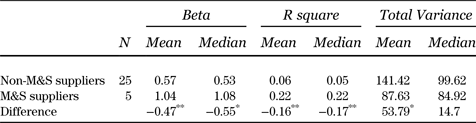
The consequences of risk sharing for firms within the M&S network are shown in Table 1. The table shows risk profiles of five M&S clothing suppliers and twenty-five non-M&S suppliers whose shares were traded for at least six years in the period from 1988 to 1999.Footnote 56 Using monthly observations, stock market risk measures were calculated for each sample subgroup. Comparative figures for average beta and R square show that changes in M&S suppliers’ returns corresponded closely with—and were to some extent explained by—general stock market movements. Non-M&S suppliers, meanwhile, had lower betas and R square averages, suggesting that their return variance was attributable to more firm-specific effects. At the same time, total variance of return was much higher, suggesting that these firms were more vulnerable to trading conditions in specialized markets that were difficult to diversify.
Risk Profiles of U.K. Textile Firms, 1988–1998

Sources: Thomson Reuters Datastream, Company Accounts and Equity Price lists (Oct. 2014), https:// www.thomsonone.com/DirectoryServices/2006-04-01/Web.Public/Login.aspx?brandname=datastream; Supplier files, 1973–2000, E5/1/15, MSCA.
Notes: Beta (β) calculated solving the ordinary least squares regression model,
R i– Rf = αi + βi (Rm – Rf) + ε i (1), where R i is the monthly return on stock i calculated using the Datastream return index (RI) at time t, RI t/RIt−1–1; Rf is the interest rate on U.K. treasury bills taken from Datastream; α and β are intercept and slope estimators; R m is the return on the Financial Times All Share Index (FTALLSH) calculated using the Datastream return index RI FTALLSH t/RI FTALLSHt−1–1; and ε is the error term. R square is the R2 statistic in model (1). Total variance is the square of the standard deviation of R i – Rf where returns are expressed in percentage equivalents.
* Indicates significance at the 0.05 confidence interval using a t-test for mean differences and a signed rank test for median differences.
** Indicates significance at the 0.01 confidence interval.
Comparing accounting rates of return, there were also large differentials for M&S suppliers, shown in Figure 1. Consistently, M&S suppliers earned significantly higher rates of return than did non-M&S textile firms in the period from 1949 to 1984. During this time, the average return from M&S suppliers was 22.1 percent, compared to 11.9 percent from non-M&S firms, a premium of 10.2 percent. Also, M&S suppliers had lower return volatility, confirming the results in Table 1.Footnote 57 These differences became less discernible after 1984; the retailer continued to provide its suppliers with similar levels of return, but non-M&S suppliers also improved their relative performance. Following the restructuring of the early 1980s, surviving companies were able to use new investment to capitalize on a rapid expansion of the domestic market.Footnote 58 Even so, between 1985 and 2000, the M&S umbrella offered a net benefit. Although return volatility increased for all firms, as Table 1 illustrates, total risk was still lower for M&S suppliers than for non-M&S suppliers.Footnote 59
Return on capital: M&S suppliers and other textile manufacturers, 1949–2000. Return on capital is defined as profit before interest and tax divided by owners’ equity plus long-term loan capital. M&S supplier sample consists of 27 firms and 485 firm-years of data. Non-M&S is the average of all firms in the U.K. textile sector up to 1984 and of all publicly quoted textile companies listed on Datastream thereafter. (Sources: Return on capital calculated from data in Cambridge/DTI Databank of Company Accounts, 1948–1990, CD-ROM file of accounting data, 10.5255/UKDA-SN-2366-1 [Oct. 2014]; Thomson Reuters Datastream, Company Accounts and Equity Price lists [1985–2000] [Oct. 2014], https:// www.thomsonone.com/DirectoryServices/2006-04-01/Web.Public/Login.aspx?brandname=datastream.)
For a substantial period—including a small window during the early 1990s, as Figure 1 suggests—dependence on M&S created a competitive advantage for U.K. manufacturers, which made M&S suppliers attractive targets for takeover. Through this process, the retailer's supplier base was steadily consolidated. In part, this was attributable to the firm Vantona, which supplied 20 percent of its output to M&S in 1984. Through a series of takeover transactions, the firm became larger, but also progressively increased its dependence on M&S. Acquisitions included Carrington Viyella (1982), F. Miller (1984), NMC (1985), Coats Paton (1986), Tootals (1991), and Corah (1994).Footnote 60 As a result, Vantona was transformed into Coats Viyella, which was supplying 50 percent of its output to M&S by 1991.Footnote 61 Supplier concentration in the early 1980s suggests that Figure 1 trends should be interpreted cautiously, as these larger firms did not immediately develop high-dependency bilateral relationships with M&S and retained significant capacity outside of the retailer's umbrella.Footnote 62 For this reason, the pattern of profitability of the M&S-supplier network more closely followed that in the rest of the industry after 1985.
M&S-supplier performance before 1984 is all the more outstanding in the context of international trading conditions. British unit labor costs in textiles were comparable to those of European competitors such as Italy, but substantially higher than in the United States and much higher than in North African countries such as Morocco and Egypt.Footnote 63 These differences did not necessarily imply that U.K. textiles should have contracted in the absence of MFA protections. The higher quality of the European workforce was widely acknowledged.Footnote 64 Further, in the early 1980s, firms in the United Kingdom benefited from a shift to shorter supply and lead times from retailers, including not only M&S but also new competitors such as Next. Similarly, in Italy, Benetton matched supply to short-run changes in demand using Electronic Point of Sale technology and warehouse automation, technologies that tended to benefit European producers rather than those in the developing world.Footnote 65
Before 1994, international trade rules boosted the advantages of local sourcing strategies for retailers, including M&S. The MFA protected markets in developed countries from cheaper labor sources through quotas, Bangladesh being one exception. Successive British governments continued these European Union–led protection policies up to 1991 through four renegotiations of the MFA.Footnote 66 However, some manufacturers—for example, Bodycote—regarded the removal of the MFA as an “outward processing” opportunity for offshoring low-value production such as garment stitching from presupplied fabric.Footnote 67 In the 1990s, Mediterranean North African countries benefited increasingly from tariff-free European Union market access under preferential trade agreements.Footnote 68 As a result of the Uruguay Round multilateral trade negotiations (1986–1994), textiles came to fall under the jurisdiction of the World Trade Organization. An important part of the wider negotiation, the Munich summit of July 1992, signaled the end of MFA quota protection for British firms.Footnote 69 The resulting Agreement on Textiles and Clothing (ATC) specified a ten-year phaseout of the MFA beginning in 1995.Footnote 70 For all firms, the announcement in 1992 and the MFA phaseout after 1995 can be clearly discerned in Figure 1. These changes represented a major threat to M&S's differentiation strategy based on partnerships with U.K. suppliers.
Figure 2 shows the profitability of M&S compared to that of its suppliers. In almost all years, its profits were greater, but the difference between M&S suppliers and non-M&S suppliers in Figure 1 suggests the retailer was prepared to share a significant proportion of its excess profits within the supplier network, thereby creating long-term stability.Footnote 71 The removal of resale price maintenance in 1964, which may have further shifted the balance of power in favor of multiple retailers, apparently did not affect the distribution of profit and risk within the M&S vertical network.Footnote 72 Again, the effects of the MFA phaseout can be discerned, partly in a widening gap between M&S and supplier profitability. The fall in its profits, in 1998, was delayed compared to the more immediate effects felt by the company's suppliers. The trends suggest that M&S began to protect its position by undermining some features of supplier collaboration such that supplier profits suffered before an equally serious and corresponding collapse for M&S some years later.
Return on capital: M&S and M&S suppliers, 1949–2000. (Sources: Return on capital calculated from data in Cambridge/DTI Databank of Company Accounts, 1948–1990, CD-ROM file of accounting data, 10.5255/UKDA-SN-2366-1 [Oct. 2014]; Thomson Reuters Datastream, Company Accounts and Equity Price lists [1985–2000] [Oct. 2014], https:// www.thomsonone.com/DirectoryServices/2006-04-01/Web.Public/Login.aspx?brandname=datastream.)
The reason for the poor results for the retailer after 1998 was the rapid rise of competitors such as Next, Gap, and Zara.Footnote 73 These companies could compete on design and price by sourcing cheaper overseas suppliers. Zara's business model was based on rapid customer-focused adaption of style within season, through a vertically integrated supply chain based on a network of small Spanish cooperative firms, with lower-end bulk and longer-shelf-life products outsourced internationally.Footnote 74 Zara thus provided a template business model that M&S could potentially adapt.
Parallel trends in the supplier network increased the feasibility of such a model for M&S. In the period leading up to the ATC, British textile firms had also begun to source more of their production overseas, and from 1996 this became much more pronounced.Footnote 75 According to press commentators, the threatened introduction of a U.K. minimum wage provided further incentive.Footnote 76 Some suppliers, such as Baird, had already been using offshore suppliers for many years, for example, basic Portuguese-sourced twill.Footnote 77
Also, as noted earlier, there were many examples of M&S procedures underpinning trust in the supplier network. Taken together, however, the trends in figures 1 and 2 suggest that distributional justice was an important reason for the buildup of such trust.Footnote 78 Before 1984, M&S redistributed the benefits of its retail dominance to its supplier network. After that, as the relative profitability of M&S suppliers dwindled, the retailer increasingly relied on procedural mechanisms.Footnote 79 By September 1998 it had adopted its global sourcing principles (GSP), designed to replicate the procedures previously applied to U.K. suppliers to a more international supply chain.Footnote 80
The mid-1990s were a crucial transition stage in M&S-supplier relations. The company now began to encourage its suppliers to set up their own production overseas.Footnote 81 As the MFA was phased out in the early 1990s, M&S could not easily guarantee profits in its network, nor could procedural templates developed over decades with British suppliers be easily refashioned in countries like Morocco. By 1992, M&S had experience working with U.K. suppliers to source goods from the Far East.Footnote 82 In 1996, the stated intention of all M&S suppliers, with encouragement from M&S, was to shift production overseas—absolving the retailer from investing directly in overseas purchasing networks where it lagged behind its competitors.Footnote 83
Thus, M&S passed the responsibility for overseas sourcing to its suppliers (to avoid any negative publicity), while benefiting from access to cheaper supplies.Footnote 84 A typical exchange was initiated by union leader Des Farrell, who accused the retail giant of encouraging suppliers to use overseas labor: “Marks & Spencer is a national institution and in the eyes of the consumer its image is one of a retailer of quality clothing made in Britain. We urge it to think again and to look at ways of encouraging manufacturing in the U.K.” A spokeswoman for M&S responded: “We have set out our targets and it is up to our suppliers, who are independent businesses, to decide how they will achieve theirs. That may mean that they decide to source more from overseas.”Footnote 85 As the evidence below suggests, these businesses were far from independent; nonetheless, the response reveals the potential public relations benefit for M&S of using British suppliers to source overseas.
Throughout the 1990s, M&S tended in public disclosures to reduce its emphasis on supporting British manufacturers. As early as 1989, the company referred to its expanding international base, while commenting on its continued support for investment by British firms. Before 1995, the chairman's statement in the annual report paid tribute to suppliers and usually quantified the amount of U.K.-manufactured merchandise it sold. For example, the 1992 statement referred to the “unique” relationship with its suppliers and that M&S “continued to support British industry,” having bought £4,533 million of British goods—four-fifths of its total purchases in 1992.Footnote 86 The chairman's statement of 1995 was the last to quantify the company's contribution along these lines, but it also referred instead to an “expanding international supply base.”Footnote 87 From 1996 only generalized references were made to international networks of suppliers. Phrases such as “close partnership” were still used with reference to suppliers in general. An example of this more generalized form of reporting can be seen in the 1998 chairman's statement, by Greenbury: “I would like to pay tribute to all suppliers of goods and services who have worked closely with us in partnership to develop the business. Once again they have done an excellent job and their continued investment and increased commitment to supplying us augers well for our combined futures.”Footnote 88
The consequence of the new approach to suppliers was to reduce British-sourced goods from 80 percent to 70 percent over the period from 1991 to 1998.Footnote 89 Meanwhile, M&S's long-term relationship with its suppliers depended on stable business conditions and its continued dominance of retail outlets. After a significant decline in profits in 1998, M&S pressured suppliers to shift more production abroad, while overstocking led to falling supplier share prices.Footnote 90 After the company adopted its new GSP, a strategic review of supplier contracts was carried out in the summer of 1999.Footnote 91 McKinsey, the management consulting firm, conducted the review and advised M&S to narrow and globalize its supply chain, using only suppliers that could manufacture garments from start to finish.Footnote 92 Although facilitated by outside advice, according to M&S, rationalization could not have been achieved without supplier cooperation.Footnote 93 The retailer completed the task of globalizing its supply chain by 2002, transferring £1.5 billion of production overseas; 70 percent of production was to remain U.K. sourced.Footnote 94
Notwithstanding the shift overseas, M&S still closely controlled its suppliers. As noted earlier, Courtaulds and Dewhirst were prepared for increased pressure from the retailer to source overseas once M&S's attempt to set up its own purchasing office in Hong Kong had failed. As early as 1979, the retailer and Courtaulds corresponded on the potential advantages of offshoring production. Courtaulds chief executive officer (CEO) Sir Arthur Knight suggested that integrating low-wage sources of supply should be part of the longer-term dialogue between the firms.Footnote 95 In 1981, Courtaulds constructed Chelco as a joint venture with Morocco's Office for Industrial Development and Moroccan private investors. The Moroccan model imported raw fibers, taking advantage of tax breaks, and then re-exported based on specifications laid down by Courtaulds's European partner—in this case, Mothercare and British Home Stores, not M&S. Benetton used a similar strategy.Footnote 96 In 1996, Coats Viyella relocated its shirt factory to Mauritius, in close consultation with M&S. Greenbury was “incensed” when the retailer was “dragged into the dispute” over the resulting closure of the factory in Rainhill, near Liverpool.Footnote 97 Even so, M&S insisted on being consulted on strategic changes carried out by supplier firms. When Noel Jervis was ousted as CEO of Courtaulds Textiles in 1996, Greenbury rebuked John Eccles, the chairman, for not having informed him in advance.Footnote 98
In summary, such interference was the price of the financial advantages that accrued to suppliers in the M&S network. Sharing profit and risk allowed the British textile sector to invest and modernize and to receive financial and managerial assistance to operate profitable contracts within the network. Nonetheless, the retailer ensured that the supplier bore the ultimate risk. In the difficult conditions of the 1990s, M&S became more active in the governance, management, and restructuring of its supply network. As the case of Courtaulds Textiles and Claremont Garments illustrates, M&S orchestrated takeover transactions affecting its supplier network, resulting in further concentration and decisions to offshore production.
Claremont Garments, Courtaulds Textiles, and M&S
As M&S concentrated orders among a smaller group of suppliers, some—including Courtaulds Textiles, Claremont Garments, and Baird—became sole suppliers of certain products. Others, including SR Gent, Dewhirst, and Coats Viyella, supplied multiple products in competition with other suppliers.Footnote 99 From 1990 to 1998 the annual value of clothing supplied to M&S by four suppliers—Baird, Courtaulds, Coats Viyella, and Dewhirst—rose from £867.2 million to £1.235 billion.Footnote 100
An important part of the concentration strategy was to exploit scale and scope economies in the supplier cost base. Once manufacturers had covered their fixed costs, small increases in volume led to large profit increases, notwithstanding price freezes or even reductions. In the “outstanding value” campaign of 1992 and 1993, for example, M&S was able to improve its own profits by 25 percent and those of its suppliers.Footnote 101
The history of Claremont Garments exemplifies important characteristics of the M&S supply chain. Claremont was formed by a demerger of the manufacturing side of Alexon Group in 1991.Footnote 102 Although Claremont had its own stock exchange listing, it sold 97 percent of its output to M&S.Footnote 103 Claremont's strong financial performance following the demerger mirrored the benefits of the M&S link, while Alexon, whose portfolio was based on the 1988 acquisition of Ellis and Goldstein, one of Britain's best-performing companies, suffered poor sales and declining profits by direct retailing of brands in high-rental locations.Footnote 104
Claremont's strategy was to acquire more firms, thereby increasing the range of goods sold to M&S. In June 1992, with M&S's approval, Claremont took over J&J Fashions, another M&S supplier, paying £26.75 million partly funded by a rights issue. Two months later, in August 1992, it paid a further £2 million for another M&S supplier, Alexander Milnes, allowing some diversification into corporate clothing.Footnote 105 In March 1994, Claremont acquired Magellan Industries for £43 million in a share-for-share deal, extending its M&S range to include lingerie and swimwear. The company invested heavily in manufacturing efficiency and computer-aided design (CAD), allowing rapid creation and review of on-screen samples, which, combined with the latest printing technology, provided the adaptability required by the retailer.Footnote 106 Claremont enhanced its design capability by hiring top fashion talent and funded its investments from M&S contracts; increased volumes more than compensated for cuts in margins.Footnote 107
In the early 1990s, Claremont established manufacturing sites in Morocco and Romania and set up an international sourcing department.Footnote 108 In 1995, M&S began sourcing coats and jackets in Lithuania and Slovakia. Following a 10 percent fall in sales, Claremont announced a restructuring program that concentrated on fewer sites and a joint venture in Morocco. It closed a factory at Pollockshaw, near Glasgow, in 1996 and disposed of Spennymoor sports clothing manufacturer Avec, followed in 1997 by Bellrise, its Stockton-based supplier to Next. Overseas sourcing had increased to 15 percent by 1997 and was set to increase to 20 percent in the following year. Notwithstanding the opening of overseas capacity, the rationalization program that included the Glasgow closure cost £7 million, with jobs transferred to other U.K. factories.Footnote 109
Claremont's establishment of Moroccan subsidiary operations was a particularly important development that impacted M&S's relationship with its supplier network. One such investment was DEV1, in Casablanca. Although a Claremont factory, DEV1 was inspected by M&S staff in 1994. M&S's resulting profile of DEV1 had revealed that the factory conformed to M&S safety and Claremont operational standards. Claremont would now invest in the factory, having satisfied M&S's requirements. The factory was regarded as inefficient, according to the inspection memorandum, but nonetheless suitable to supply garments destined for M&S. The factory employed 1,135 workers at a basic wage of 1,600 dirhams (MAD) per month—equivalent to £119. For a weekly shift of forty-five hours, workers earned the equivalent of 61p per hour on average, or close to Morocco's official minimum wage.Footnote 110 M&S rated the factory, which had a minimum age requirement of eighteen, as “Grade A.” While recognizing that wages were low, the memorandum noted that labor costs would be 25 percent lower in China and Eastern Europe.Footnote 111
The DEV1 factory subsequently became Claremont MAROC; then, following the Courtaulds takeover of Claremont in 1998, it became Courtaulds MAROC and, in March 1999, was the subject of the Sunday Mirror “Made in Morocco for Marks & Spencer” investigation, which detailed the relocation of production from northeastern England to Morocco—where Claremont had raised the number of factories to ten—and alleged that the hand of M&S was behind the resulting labor exploitation.Footnote 112 On March 12, 1999, the M&S corporate press office issued a holding statement advising store managers on how to respond to the report.Footnote 113
Although the Sunday Mirror piece attracted negative publicity for M&S, and indeed for Courtaulds, there is clear evidence that, when sourcing overseas, the retailer endeavored to retain some features of supplier partnership, including close liaison and inspection, characteristic of its traditional U.K. supplier relationships.Footnote 114 According to the Sunday Mirror, Moroccan textile wages were about £1.20 an hour and higher in the Courtaulds MAROC factory, indicating that, although well below British standards, wages had increased since the factory's original purchase in 1994. An internal memorandum indicated that M&S staff had visited the factory around 1994 and/or 1995, and a technologist had visited in June 1998 and reported that while the building was basic, health and safety standards were high.Footnote 115 Even so, the audit checklist lacked any detail, merely stating that, for quality systems and procedures, “Claremont operations manual [is] followed.” No suggestions were made for improvement, and the four years between visits would not have complied with the annual visits insisted upon by the M&S GSP adopted later, which had been under development several years previously.Footnote 116
M&S's indirect involvement in the Moroccan investments had a further dimension, revealed by the mechanics of the merger between its two suppliers. Continued rationalization costs at Claremont led to further decreases in profit, and on March 18, 1998, the share price fell by 40 percent following the announcement of an audit investigation into underpayment of duties on imports from Morocco and the Far East. Claremont also missed orders due to capacity problems following the earlier closures and rationalizations.Footnote 117 M&S, meanwhile, was concerned about poor sales of Claremont stock and high levels of returns, leading Claremont to invest in computerized monitoring software at its thirty factories.Footnote 118 Even so, speculation in the City was that Claremont would be the target of potential takeover bids from other M&S suppliers, including Dewhirst, Baird, or possibly Courtaulds Textiles, with the retailer being influential in the outcome.Footnote 119
Courtaulds had been a leading M&S supplier for many years. Like other suppliers, it received financial assistance for trade finance from M&S.Footnote 120 Since 1990, following a demerger from the Courtaulds Group as Courtaulds Textiles, its strategy was to concentrate on differentiated products in terms of response, fabric quality, design or branding, increased efficiency through automation and CAD, and reduced dependency on commodity production.Footnote 121 Rather than broaden its international base through acquisitions, it relocated its production overseas and increased reliance on own label products for M&S, such that by 1994, M&S sales accounted for 25 percent of Courtaulds's turnover.Footnote 122 Accordingly, it began to rationalize, closing spinning and weaving activities and investing in lace and other more specialist areas.Footnote 123 Courtaulds, supplying M&S mostly with lingerie, faced exposure to the retailer's policy on margins—for example, in 1991 when M&S announced that it would not pass on Value Added Tax (VAT) increases to customers.Footnote 124 Rationalizations enabled the firm to reduce debt and invest in automation, thereby strengthening its share price and paving the way for equity-funded acquisitions of branded clothing manufacturers and design.Footnote 125 The company and its share price performed well, notwithstanding adverse international trading conditions caused by high U.K. interest rates and the falling value of the dollar against European currencies.Footnote 126
Towards the end of 1992, Courtaulds accelerated its overseas sourcing program. It established production in North Africa and Turkey and entered a joint venture to build capacity in Sri Lanka for Victoria's Secret lingerie.Footnote 127 In 1993, operations were set up in the Philippines and Thailand, and in 1994, a fabrics plant was developed in Nanjing. Courtaulds disposed of underperforming units; however, this was insufficient to head off a second profit warning in May 1996, following an earlier warning in December 1995.Footnote 128 The larger firms supplying M&S, including Courtaulds, underperformed, while others, including Claremont and Dewhirst, that had been quicker to shift production overseas, performed better.Footnote 129 In June 1996, the new CEO, Colin Dyer announced a rationalization program, further U.K. factory closures, and the moving abroad of more production to countries where Courtaulds already had a presence, including Morocco, Tunisia, and Sri Lanka.Footnote 130 In the recovery that followed, sales to M&S increased, accounting for 35 percent of total Courtaulds turnover by 1997 and rising to 44 percent following the takeover of Claremont in 1998.Footnote 131
On September 14, 1998, Courtaulds announced it was in discussion with Claremont about a possible takeover. A day later it received acceptances from Claremont directors and Invesco Asset Management, giving Courtaulds 17 percent of share capital. The investment bank Warburg Dillon Read published the offer document on September 16, acting on behalf of Courtaulds. The offer—based on the closing Claremont price on September 11 of 16.5p per share—was 18p per share, valuing Claremont at £10.1 million. The deal was finalized, becoming unconditional on October 14.Footnote 132 Greenbury had encouraged the takeover, but M&S involvement went further.Footnote 133 On September 16, 1998, in the early stages of the negotiations, the M&S corporate communications department issued a holding statement expressing wholehearted support for the deal between its two long-standing suppliers.Footnote 134 A few weeks after the takeover, Courtaulds announced the closure of eight Claremont factories, after M&S had disclosed that it was encouraging its suppliers to shift production overseas. In September 1998, the retailer met with its top fifteen suppliers to discuss cost reductions through overseas sourcing.Footnote 135 Despite these changes, the Courtaulds share price remained weak, as investors deserted textiles in favor of dot-com firms, leading Dyer, the Courtaulds chairman, to dispose of the household furnishing division in March 1999.Footnote 136
Declining M&S retail sales was the reason for this shakeout. Between 1997 and 2000, M&S's share of the British retail clothing market fell from 13.9 percent to 10.9 percent and its share price dropped from 660p to 170p, representing a significant and public crisis for the firm.Footnote 137 As the squeeze on M&S sales and margins continued, the pressure on suppliers intensified. The McKinsey review was conducted between June and October 1999. As evidence of M&S's dominance of the network, suppliers were required “to provide detailed and confidential information about all aspects of their business.”Footnote 138
The review resulted in the strategic decision to concentrate on a select group of suppliers with “international expertise,” meaning three in particular: Courtaulds, Coats Viyella, and Dewhirst. Courtaulds benefited from £60 million of extra business per year, based on forty factories in northeast England that depended heavily on M&S, meaning the two firms could collaborate on further offshoring decisions.Footnote 139 Even as this deal was announced, Courtaulds launched a further round of closures of former Claremont factories acquired in the takeover. On November 24, 1999, the same day that the £60 million deal was announced, Courtaulds announced a cost-cutting program that involved shifting production overseas, with analysts expecting further shifts—from 50 percent (which also corresponded to the current level of overseas sourcing for Courtaulds) to over 70 percent for all the major M&S suppliers, including Dewhirst and Coats Viyella.Footnote 140
Notwithstanding M&S's steady shift overseas, its retention of part of the U.K. supplier base and U.K. suppliers with overseas subsidiaries allowed the company to claim that British-sourced goods remained large relative to its retail competitors and, in particular, that “the vast majority of our imports are secured through established U.K. manufacturers.”Footnote 141 An internal statement summarized the strategy as follows: “When sourcing overseas, it is our practice to use existing U.K. suppliers to manage the process. Their long-standing relationships with Marks & Spencer mean that they are well aware of the code of conduct we require relating to factory standards.”Footnote 142
However, the decision to support Courtaulds as a vehicle for offshoring supply damaged the suppliers that were dropped, including William Baird, Richard Roberts, and Daks Simpson. For Baird, although M&S contracts were less profitable than other business, the firm divested its contract sales to other retailers, preferring the guaranteed volumes offered by the retailer, which provided the basis for important investment decisions. In addition to the nineteen factories and 7,260 staff already dedicated to M&S production, the retailer had encouraged Baird only three years earlier to invest £4.2 million in a new factory in Bridgwater.Footnote 143 In September 1997 M&S induced Baird to enter into a lease until September 2002, incurring rents and redundancy costs following premature closure, and required Baird to invest in information technology systems required under the General Merchandise Terms of Business and custom-made to M&S requirements—in particular, a £246,000 computer system.Footnote 144 The Baird case, in conjunction with the evidence in Figure 2 illustrates that M&S now shared less surplus with its suppliers, and that trust was based not on distributive justice but on cooperation that followed (set) procedures.
Like Courtaulds and Claremont, Baird had begun the process of relocating some capacity offshore. The closure of sixteen Baird factories effectively ended the claim by M&S that it sourced primarily from the United Kingdom.Footnote 145 As with Claremont, there was a strong reaction both from the press and from the management and workforces of the suppliers, indicating a sense of betrayal. The assertion of an implicit contract arising from long-term agreements formed the basis of legal action against M&S. The company successfully defended its actions through the courts and in press releases, although some damage was clearly done to the perception of trust that had hitherto defined the business philosophy of M&S.
The 1999 shakeout left only three textile suppliers: Dewhirst, Courtaulds Textiles, and Coats Viyella. In 2000, Coats divested contract sales, including M&S business, through a management buyout. Coats's management argued that the investment required to remain linked to M&S no longer made financial sense.Footnote 146 The Coats decision also indicated that the trust upon which long-term relationships had been built had become less valuable to suppliers and potential suppliers, in terms of both cooperation on procedures and distribution of surplus.
Conclusion
The evidence has demonstrated that M&S operated a supplier network, which promoted higher profits for British textile firms at a time of intensifying international competition. Based on responsive and technology-driven production techniques, these relationships delivered advantages to both producer and retailer, contributing to the modernization and survival of a significant section of U.K. textile manufacture. The vertical network that emerged and, indeed, strengthened in the second half of the twentieth century provides a possible alternative to decline in the face of low-cost international competition. It also represents an alternative to the formal and scale-oriented vertical integration advocated in the literature as a response.
An important question, which is informed by the more recent history of M&S, is this: How sustainable are such models in the future? The MFA phaseout presented new opportunities for competitors with greater expertise in offshore processing than M&S's domestic supplier network had hitherto allowed. In response, M&S adopted a hybrid model of network organization based on a two-level hierarchy. At the first level, by directly encouraging takeovers within its supplier base, it created a small core of U.K. firms, based on bilateral vertical partnerships. M&S orders provided the volumes needed to support modernizing investment, as the Baird, Claremont, and Dewhirst cases indicate. At the same time, it encouraged these main suppliers to develop arm's-length outsourcing contracts with subsidiary suppliers, relocated in low-cost countries. M&S used its direct influence in the governance and management of the core firms, evidenced by the takeover of Claremont by Courtaulds to rationalize the supply chain. It then used these suppliers to operate the second level of the hybrid network and subsequently reorder production offshore, organized around open contracting and cost-based efficiencies. As the DEV1 case illustrates, savings in labor cost were significant while the transaction cost of inspection and audit were minimal.
The potential advantages of such a strategy were, first, that M&S could continue marketing on the basis of consumer ethnocentrism and simultaneously access low-cost overseas suppliers for upstream fabric production and generic apparel. It could also absolve itself of accusations faced by competing retailers—of encouraging labor exploitation in developing countries and issuing public denials of such encouragement—while reiterating its commitment to British manufacturing. The hybrid model potentially offered M&S the chance to remain price competitive and, at the same time, maintain elements of consumer ethnocentrism in its marketing strategy, modified by a slow-to-evolve but much-needed code of GSP in response to a wave of critical comment. Achieving the correct balance between design-led flexibility and low-cost mass production poses challenges for even the most successful firms, as the Zara case also demonstrates.
M&S has yet to evolve a new long-term strategy, although there are some signs for the future. Since the crisis of 1998, M&S has enjoyed mixed fortunes, and it is too early to say how a strategy based on balancing ethnocentric markets and cost will be resolved. The launch of a new “Best of British” line by Head of Design Tony O'Connor in 2013 reverted to traditional style, using British fabrics, albeit to establish market niches rather than merely to uphold the traditional policy of locally sourcing the wider product range.Footnote 147
Summarizing the period since 1950 as a whole, in terms of Chandler and Langlois, the hand of coordination was ever present within the M&S network, but its visibility varied according to circumstances, from public declarations of support at supplier company meetings to cursory and secretive audits of factories in Morocco. As demonstrated, the hand of coordination can be visible and real but, as a result of the power distribution in vertical networks, can accordingly choose to vanish when convenient.