




No CrossRef data available.
Article contents
Beyond brain regions: Network perspective of cognition–emotion interactions
Published online by Cambridge University Press: 23 May 2012
Abstract
Lindquist et al. provide a convincing case against what they call the locationist account of emotion. Their quantitative approach elegantly illustrates the shortcomings of this still-entrenched viewpoint. Here, I discuss how a network perspective will advance our understanding of structure-function mappings in general, and the relationship between emotion and cognition in the brain.
Information
- Type
- Open Peer Commentary
- Information
- Copyright
- Copyright © Cambridge University Press 2012
References
Amaral, D. G., Behniea, H. & Kelly, J. L. (2003) Topographic organization of projections from the amygdala to the visual cortex in the macaque monkey. Neuroscience
118:1099–120.CrossRefGoogle Scholar
Averbeck, B. B. & Seo, M. (2008) The statistical neuroanatomy of frontal networks in the macaque. PLoS Computational Biology
4:e1000050.CrossRefGoogle ScholarPubMed
Bechtel, W. & Richardson, R. C. (2010) Discovering complexity: Decomposition and localization as strategies in scientific research, 2nd edition. MIT Press.CrossRefGoogle Scholar
Bressler, S. L. & Menon, V. (2010) Large-scale brain networks in cognition: Emerging methods and principles. Trends in Cognitive Sciences
14:277–90.CrossRefGoogle ScholarPubMed
Damaraju, E., Huang, Y. M., Barrett, L. F. & Pessoa, L. (2009) Affective learning enhances activity and functional connectivity in early visual cortex. Neuropsychologia
47:2480–87.CrossRefGoogle ScholarPubMed
Honey, C. J., Kotter, R., Breakspear, M. & Sporns, O. (2007) Network structure of cerebral cortex shapes functional connectivity on multiple time scales. Proceedings of the National Academy of Sciences USA
104:10240–45.CrossRefGoogle ScholarPubMed
Modha, D. S. & Singh, R. (2010) Network architecture of the long-distance pathways in the macaque brain. Proceedings of the National Academy of Sciences USA
107:13485–90.CrossRefGoogle ScholarPubMed
Padmala, S. & Pessoa, L. (2008) Affective learning enhances visual detection and responses in primary visual cortex. Journal of Neuroscience
28:6202–10.CrossRefGoogle ScholarPubMed
Pessoa, L. (2008) On the relationship between emotion and cognition. Nature Reviews Neuroscience
9(2):148–58.CrossRefGoogle ScholarPubMed
Pessoa, L. (2009) How do emotion and motivation direct executive function?
Trends in Cognitive Sciences
13:160–66.CrossRefGoogle Scholar
Pessoa, L. (2010a) Emergent processes in cognitive-emotional interactions. Dialogues in Clinical Neuroscience
12:433–48.CrossRefGoogle ScholarPubMed
Pessoa, L. & Adolphs, R. (2010) Emotion processing and the amygdala: From a “low road” to “many roads” of evaluating biological significance. Nature Reviews Neuroscience
11:773–83.CrossRefGoogle Scholar
Pessoa, L. & Engelmann, J. B. (2010) Embedding reward signals into perception and cognition. Frontiers in Neuroscience
4: 17. (Electronic publication).CrossRefGoogle ScholarPubMed
Petrovich, G. D., Canteras, N. S. & Swanson, L. W. (2001) Combinatorial amygdalar inputs to hippocampal domains and hypothalamic behavior systems. Brain Reseacrh Reviews
38:247–89.CrossRefGoogle ScholarPubMed
Swanson, L. W. (2000) Cerebral hemisphere regulation of motivated behavior. Brain Research
886:113–64.CrossRefGoogle ScholarPubMed
Thompson, E. (2007) Mind in life: Biology, phenomenology, and the sciences of the mind. Harvard University Press.Google Scholar
Thompson, E. & Varela, F. J. (2001) Radical embodiment: Neural dynamics and consciousness. Trends in Cognitive Sciences
5:418–25.CrossRefGoogle ScholarPubMed
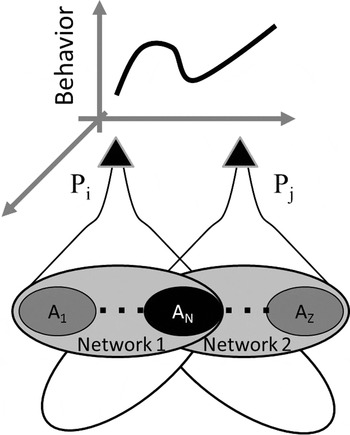
Figure 1. Structure-function mapping. Networks are dynamically formed when areas (A1, AN, Az) coalesce into temporally stable groupings. Area AN (in black) is part of multiple networks. Pi, Pj=processes (see text).
The simplest way to conceptualize the mapping between brain area and behavior is to assume a one-to-one mapping between an area and its function (e.g., amygdala <–> fear). It is readily apparent, however, that brain regions are involved in many functions, and that functions are carried out by many regions. More generally, therefore, the mapping between structure and function is both pluripotent (one-to-many) and degenerate (many-to-one). The combination of the two indicates that there are no “necessary and sufficient” brain regions. Based on these notions, I have argued elsewhere that a network perspective is needed for the understanding of the interactions between emotion, motivation, perception, and cognition (Pessoa Reference Pessoa2008; Reference Pessoa2009; Reference Pessoa2010a; Pessoa & Engelmann Reference Pessoa and Engelmann2010). Briefly, networks of brain regions collectively support behaviors (Fig. 1). Hence, the network itself is the unit, not the brain region. Processes P that support behavior are not implemented by an individual area, but rather by the interaction of multiple areas, which are dynamically recruited into multi-region assemblies.
Structure-function mapping. Networks are dynamically formed when areas (A1, AN, Az) coalesce into temporally stable groupings. Area A N (in black) is part of multiple networks. P i, P j=processes (see text).
I use the term “process” instead of “function” or “computation” because a process emerges from the interactions between regions, as in “emergent property” (Bressler & Menon Reference Bressler and Menon2010). Furthermore, a process is viewed as a useful external description of the functioning of the network, and not necessarily as a fixed internal computation implemented by the network (Thompson Reference Thompson2007; Thompson & Varela Reference Thompson and Varela2001). In this context, the suggestion by Lindquist et al. of psychological primitives is problematic, as the mind should not be viewed as constructed of atomic constituents in the manner that physicists conceive of matter, for instance.
Whereas a network perspective is needed for a fuller characterization of the mind-brain, it should not be viewed as a panacea. For one, the challenges posed by the many-to-many mapping between regions and functions is not dissolved by the network perspective. Indeed, one should not anticipate a one-to-one mapping when the network approach is adopted – counter to the recent trend of labeling networks with specific functions; see examples in Bressler and Menon (Reference Bressler and Menon2010). Additionally, decomposition of brain regions in terms of meaningful clusters, such as the ones generated by community-finding algorithms (Newman Reference Newman2010), does not by itself reveal “true” sub-networks. Given the heterarchical and multi-relational relationship among regions, multiple decompositions will offer different “slices” of the overall connectivity space. In what follows, I briefly discuss some repercussions of a network perspective to the understanding of the relationship between emotion and cognition.
First, given the extensive interactions among brain regions, the emphasis shifts from attempting to understand the brain one region at a time, to understanding how coalitions of regions support the mind-brain. Insofar as brain regions are not the unit of interest, they should not be viewed as “cognitive” or “emotional.” Traditionally, however, regions whose function involves homeostatic processes and/or bodily representations have been frequently viewed as “emotional,” whereas regions whose function is less aligned with such processes have been viewed as “cognitive.”
Second, the architectural features of the brain are such that they provide massive opportunity for cognitive-emotional interactions (Modha & Singh Reference Modha and Singh2010). These interactions are suggested to involve all brain territories. For example, extensive communication between the amygdala and visual cortex exists, and efferent amygdala projections reach nearly all levels of the visual cortex (Amaral et al. Reference Amaral, Behniea and Kelly2003). Thus, visual processing takes place within a context that is defined by signals occurring in the amygdala (as well as the orbitofrontal cortex, pulvinar, and other regions), including those linked to affective significance (Pessoa & Adolphs Reference Pessoa and Adolphs2010). Therefore, vision is never pure vision, but is affective vision – even at the level of primary visual cortex (Damaraju et al. Reference Damaraju, Huang, Barrett and Pessoa2009; Padmala & Pessoa Reference Padmala and Pessoa2008). Cognitive-emotional interactions also abound in the prefrontal cortex, which is thought to be involved in abstract computations that are farthest from the sensory periphery. More generally, given inter-region interactivity, and the fact that networks intermingle signals of diverse origin, although a characterization of brain function in terms of networks is needed, the networks themselves are best conceptualized as neither “cognitive” nor “emotional.”
Third, regions that are important for affective processing appear to be exceedingly well connected (e.g., Petrovich et al. Reference Petrovich, Canteras and Swanson2001; Swanson Reference Swanson2000). This suggests that these regions have important “quasi-global” roles and that this is an important feature of this class of region. However, regions traditionally described as “emotional” are not the only ones that are highly connected. Highly connected regions are encountered throughout the brain, including in the occipital, temporal, parietal, and frontal lobes, in addition to the insula, cingulate, thalamus, and regions at the base of the brain (Modha & Singh Reference Modha and Singh2010).
Fourth, emphasizing only interactions between brain regions that are supported by direct, robust structural connections is misleading. For one, the strength of functional connectivity is equally important, and at times will deviate from the strength of the structural connection (Honey et al. Reference Honey, Kotter, Breakspear and Sporns2007). Architectural features guarantee the rapid integration of information even when robust structural connections are not present, and support functional interactions that are strongly context dependent. This is illustrated, for example, by the “one-step” property of amygdala–prefrontal connectivity – amygdala signals reach nearly all prefrontal regions within a single connectivity step (see Averbeck & Seo Reference Averbeck and Seo2008).
Fifth, taken together, these considerations suggest that the mind-brain is not decomposable in terms of emotion and cognition. In other words, the neural basis of emotion and cognition should be viewed as governed less by properties that are intrinsic to specific sites and more by interactions among multiple brain regions. In this sense, emotion and cognition are functionally integrated systems, namely, they more or less continuously impact each other's operations (Bechtel & Richardson Reference Bechtel and Richardson2010). As suggested by Bechtel and Richardson, “The problem is then not one of isolating the localized mechanisms, but of exhibiting the organization and the constituent functions… [A]n explanation in terms of organization supplants direct localization” (p. 151).