In what follows, I will offer a view of Jerusalem through the prism of the “shtetl.” For Jews of Ashkenazic origin, the Jewish town seems to have been associated from its earliest iterations with the forsaken capital of their religious memory and imagination. Articulated in different cultural venues in the late nineteenth and throughout the twentieth centuries and analyzed extensively in scholarship of the last few decades, the “shtetl” has proved to be primordial, protean, and portable. Satire would vie with nostalgia as the topos of the “Jewish town” made its way through a century of attrition and catastrophe, finally yielding to the epic of settlement in Zion. Juxtaposing the “shtetl” as monolithic space with the “city” as heterogeneous space in literary and sociological representations, I will argue that a reciprocally nostalgic, anachronistic version of original, intimate, and exclusive space came to be imported into literary constructs of the shtetl and of Jerusalem in S. Y. Agnon's major fictions.
Kedem and the Nostalgic Inflection of Jewish Space
Jews are not alone in encoding nostalgia for Edenic points of origin into their personal and collective stories;Footnote 1 still, it is notable that Jewish eschatology is built explicitly on a return to the remembered place of innocence and cultic sovereignty: “ḥadesh yamenu ke-kedem” (restore our days as of old). Kedem, which in Biblical Hebrew means “east,” designates both place of origin—cradle of Hebrew existence, once referred to unselfconsciously as the ultimate point of orientation—and time, the very first moment of time. As a time/place or chronotope, it references the beginning, that Edenic millisecond in collective mythical consciousness before the temptation and the deception, the discord and the punishment.Footnote 2
That brief glimmer of utter innocence is the time/place to which the collective, weary with life and history, yearns to return. But the object of nostalgic projection is a site not only of temptation but also of danger: “mah she-hayah, hu she-yihyeh” (“that which has been is that which shall be,” Ecclesiastes 1:9) is as retrograde as it is forward-looking. It is this reflex that made the different forms of shivah or Return so intoxicating and complex, that accounts for the fact that so many pilgrims, over so many generations, really believed they recognized the soil and the air of ’Ereẓ Yisra'el when they disembarked in Jaffa or Haifa—and why they might have overlooked the real human beings who were inhabiting the land in the “meantime.” In S. Y. Agnon's Bi-levav yamim (In the Heart of the Seas), published in 1934 but set in an unspecified time before the advent of political Zionism, the women who are about to leave their Galician hometown of Buczacz on a pilgrimage to the Holy Land assure each other that they have already “journeyed once before to the Land of Israel” (“ḥaverti, kevar hayinu sham”).Footnote 3
Nostalgia, then, was the engine of the entire journey long before it entered Zionist nationalist precincts. For Jews of Ashkenazic origin, the shtetl came to be regarded, almost from its earliest incarnation, as the default reality of the ultimate object of nostalgia, Jerusalem. As documented in story and myth, it was synonymous with the quintessential time/place called goles (exile). But the shtetl was not only not Jerusalem; it was, simultaneously, a miniaturization, simulacrum, or placeholder of the holy city and a sign of being en route to redemption in Jerusalem itself.
Polin: The Polish Shtetl as Simulacrum of Jerusalem
The Jewish town early took on the status of a holy place—referred to in official documents as K. K. Ploni (the holy community of Such-and-Such). In his work on the “literary image of the shtetl,” Dan Miron refers to the folk etymology of the country pronounced in “Hebrew-Yiddish [as] Polin or Poyln. …” He cites Agnon's “Legends of Poland”: “Why did they call it ‘Polin’? [Because] Knesset Yisrael said to the Holy-One-Blessed-be-He, ‘Lord of the universe, if my hour of redemption has not come, let our people rest here [po lin] during the night of exile until you will bring us up to the Land of Israel.’”Footnote 4 “Thus,” writes Miron, “the aboriginal Polish shtetl was founded by a divine decree as the temporary home of the Jerusalem exiles.”Footnote 5 Although “aboriginal” may seem a bit hyperbolic as a term to designate a complex reality that evolved over centuries, it is noteworthy that this impulse continues to animate representations of Jewish history that locate an original moment in the medieval shtetl. The quote from Agnon, alongside an evocative set of holograms representing the primeval forests of tenth-century Poland, dominates the introductory space to the main exhibition of the POLIN Museum of Jewish History in Warsaw.Footnote 6 Although complex articulations of the Jewish small town and of other places of residence in Poland are represented in multiple layers and spaces throughout the museum, this mythical, “aboriginal,” point of origin is preserved as a profoundly Jewish reflex.
The problem is that the place of nostalgia is inevitably a place of homogeneity and stagnation. It is the place you leave because it is claustrophobic, but it is also the place to which you yearn to return—because you are, as Arthur Koestler put it, also claustro-philic.Footnote 7 As so often happens with the nostalgic turn of mind, and with homogenized places, the real problem with the shtetl is that in some important senses it never really existed. As Dan Miron demonstrates, the Jewish town as enshrined in twentieth-century memory was largely a literary construct invented by writers living in the city, with very different agendas—some sentimental, others comic or satiric. Miron begins his essay by citing a personal history of Sholem Aleichem's real hometown, the Ukrainian Voronke or Voronkov, which furnished the model for his tales of Kasrilevke. Written by Sholem Rabinovitz's younger brother, Volf, the memoir is striking mainly for its description of physical landscapes and sites that were effaced from the older brother's fiction—sites such as dos kloyster gesl (the church alley), so called because an old wooden church stood at one end, frequented by the Christian population of Voronke and its environs. “As we read through Volf's description we are suddenly struck by a strange realization,” Miron writes, “no reader of Sholem Aleichem's Kasrilevke stories would imagine the town possessing a street named dos kloyster gesl. Indeed, no one could imagine the town as having a church, a priest, a church warden or any other vestige of organized Christianity. Young Sholemke Rabinovitz who lived near Voronke's kloyster gesl must have been exposed to Christian ceremonies on a regular basis … and yet one would not find even a trace of Christian culture or religion in the manifold projections of Kasrilevke throughout his oeuvre.”
Of course, Miron continues, the shtetl “was a tiny Jewish island in a vast non-Jewish sea.” The goyim, as we know, existed at the very least on the margins, in the liminal spaces where Jews and non-Jews interacted on market days, in their service functions as goyim shel Shabbat or in their intrusive appearances as representatives of the ruling powers, more or less benevolent, depending on how close was the next pogrom. But what is crucial for Miron is that “the literary Kasrilevke was depicted as an exclusively Jewish enclave, an unalloyed entity…. a yidishe melukhe (a Jewish ‘state’) as a later master, L. Shapiro, ironically called the shtetl in a story which told the tale of its final disintegration and destruction.”Footnote 8
This claim too contains more than a bit of hyperbole;Footnote 9 we need go only so far as Tevye's gentile son-in-law, Chava's husband, to find the goy at the gates in Sholem Aleichem's own carefully guarded universe. Even if at the end he is banished and the family circle is restored as a Jewish space, there are certainly breaches at the boundaries. But in a way that is the point: efforts to keep such spaces sanitized of all “others” persist even as they are doomed to fail the test of history.
As I was rereading Miron's essay, I suddenly recalled the weathered shrine to the Virgin Mary—which, I had discovered on my visit to my mother's Polish “shtetl” Ostrovtse (Ostrowiec nad Kamienna) in 2009, stands right next to the town's public school; it was, however, never mentioned by my mother as she recalled her carefree childhood walks to szkolny powszechny. She was proud to have attended the public school, but her memory had more or less effaced the neighborhood's Christian landmarks.
It turns out, indeed, that such forms of effacement are not limited to literary representations. In the folk memory of generations of Jews from eastern Europe, the shtetl was their peculiar and proprietary form of life. If—as Elizabeth Herzog and Mark Zborowski claimed in their 1952 monograph on the shtetl—Life Is with People, the people one is referring to are all Jews (!). In her introduction written in 1995 for a republication of that first postwar anthropological study of eastern European Jewish culture, Barbara Kirschenblatt-Gimblett noted the tremendous popularity of this volume as an early effort to evoke not the destruction of Jewish life, but its forms of civilization—and the implications of the choice of the shtetl as both quintessentially Jewish and self-enclosed:
Encapsulated in self-contained shtetlekh, the perfection of this hermetic world was sustained, [it was] argued, by isolation, hostility, and resistance to change. So palpable was this sense of the shtetl's hermetic seal that Elizabeth Herzog … suggested that the researchers ask their informants “Were you ever curious about the world outside the shtetl? Did you ever want to go outside the shtetl and walk around?” At the same time, the shtetl lacked material reality. At one point in their discussions, Mark Zborowski … stated that the shtetl can be of any size, since it was not a place but a state of mind, a comment that echoed Louis Wirth's classic statement that “the ghetto as we have viewed it is not so much a physical fact as it is a state of mind.” “‘My shtetl’ [the authors insist] is the people who live in it, not the place or the buildings or the street….”Footnote 10
Even as the yizker bikher and more advanced scholarship by Kirschenblatt-Gimblett, Samuel Kassow, David Roskies, Steven Zipperstein, Dimitry Shumsky,Footnote 11 and others, present a far more nuanced and complex version of the shtetl and other forms of Jewish life in eastern Europe, the evocation of monolithic, nostalgia-drenched memory persists. In many fictions written before and immediately after the Shoah, during the period before the Iron Curtain collapsed and access to real places on a real map became possible again, the shtetl remained more a state of mind than a material place accurately drawn in its geophysical properties.
Again: Sholem Aleichem. Those who made the journey to America in his masterful serial novel Motl Pesi dem khazns, written over the first fifteen years of the twentieth century, included virtually all the residents of Kasrilevke. A fire will consume what is left of the shtetl but that hardly matters, since the shtetl has, as it were, been transported to New York.Footnote 12 And there is more. Even in this most “American” of his stories, and most American of big cities, and even as the Yiddish “transcribed” by nine-year-old Motl is deliciously porous and polyphonic, peppered with Yiddish-inflected English words, the actual presence of non-Jews is rare. As Larry Rosenwald argues:
Motl's vision resembles his creator's. In “Di vasershtub,” a first version of the first section of the American part of Motl's stories, Motl tells us that New York is bigger than Vienna, and that it is “a Jewish city. A city of all Jews. And speaking—what they're speaking there is what they speak with us, what all people speak. They speak in Yiddish.” (Emphasis in original.) This is preposterous but revelatory. We feel Motl's delight. He and his family are exiled from Kasrilevke by poverty and pogroms, wander from one unwelcoming European city to the next, seek refuge in New York, an ocean away from home. How surprising, how magical in fact, to think that the new city is just like the old town, is not New York but Kasrilevke, is not multicultural but exclusively Jewish, is not multilingual but exclusively Yiddish-speaking! But it isn't.Footnote 13
The same can be said of I. B. Singer's story “The Little Shoemakers,” published originally in Yiddish in 1945 and appearing in Isaac Rosenfeld's English translation in 1953; the narrative traces the transport of Abba Shuster's family from their small town of Frampol, Poland, to Elizabeth, New Jersey as a kind of marching in place—the same ellipse that invites nostalgia to penetrate the metropolises of the New World.Footnote 14
So it is not surprising to discover, when we move from fiction to “fact,” that even if a place like Ostrowiec—which had had approximately 30,000 residents after World War I, over half of whom were Jewish—is referred to in the Yizker bukh published forty years later in Israel as not only a shtetl but frequently, and more accurately, as a shtot, it is unzer shtot, “our city”; it is sometimes remembered as ‘ir ve-’em bi-Yisra'el (a biblical phrase meaning a “mother city” or metropolis in Israel)Footnote 15 —once again, conferring a sense of elastic municipal boundaries but also of the exclusivity, homogeneity, and propriety of a small town. The place of purity persists, then, as an amalgamation of memory and imagination.
Polites vs. Idiotes
But the shtetl as I am invoking it in the Jewish imaginary is also a stand-in for any such social construct—the town or village, the kibbutz, the moshav—as opposed to the city as conceptually cosmopolitan, as the site of civil society and a plurality of others. The romantic yearning for, or organic connection to, “the land” is of course a factor, particularly in early Zionist imaginings. But something even more fundamental is at stake. What is overdue, then, is a—necessarily sketchy—definition of what I mean by “city.” Since this is a subject much researched, I will merely present here my working definition, based primarily on one of the more influential of contemporary urban theorists, and one of the exponents of the “spatial turn” in the last half century, Edward Soja. Soja excavates the Greek term synoikismos, or as he calls it, synekism, which contains the word oikos for “home” or “dwelling place”—and by extension, ecology, economics—and syn, which connotes “being together.” He develops Aristotle's theory of synoikismos as a process of “political and cultural confederation around a distinctive territorial center: a polis, or metropolis.” Urban politics therefore involves the “creation of a civil society, concepts of citizenship and democracy … the foundations of city-based … civilization. Associated with this social and spatial process are many other terms that help to distinguish between the urban dweller or polites, a politically aware citizen, versus idiotes, the barbarian or rural resident, the source of Marx's often misunderstood political comment about the peasantry and the ‘idiocy of rural life.’”Footnote 16
What is important for our purposes is the heuristic distinction between the politically aware urbanite and his/her presumably “clueless” or, better, isolated and insulated, country cousin. Synekism, Soja argues, involves “living together in dense and heterogeneous urban regions” and it is this condition that, he claims, following Lefebvre, “is responsible for all social development.”Footnote 17
I bring this line of reasoning here to emphasize the dichotomy between rural and urban forms in the theory and imagination of human geography. Whether or not it is the case that most denizens of rural villages are politically unaware and most urbanites politically aware is less important than the perception in the literature I am examining. For purposes of simplification I am conflating “political” with “ethical” and arguing, in a Habermasian sort of way,Footnote 18 that the city is the place of built-in ethical dilemmas because of its heterogeneity, its dynamism, and its presumption that civil society, or the “public sphere,” is the place where conflicts are adjudicated and rights protected—and, more importantly, that it is the place from which no one is excluded or labeled as an outsider, as barbaric, defiled, mukẓe. (This is of course an ideal that few if any societies, from the Greek polis to the American urban South, with their varieties of slaves and second-class citizens, have ever achieved, but it is at least a desideratum.)
This may seem to go against common sense; Jews, after all, like other minorities, have tended to thrive in urban contexts. Although there were Jews who joined or initiated farming communities or settled in small towns in America or western Europe, the vast majority of immigrants from the cities of Vilna, Warsaw, Odessa, as well as from the shtetlach of Poland, Lithuania, Romania, etc., made their homes in metropolises like the Chicago that Carl Sandburg was celebrating as the “stormy, husky, brawling … Hog Butcher for the World … City of the Big Shoulders … City with lifted head singing / So proud to be alive and coarse and strong and cunning.”Footnote 19 Why, then, in our nostalgic mode, do we often appear so uncomfortable with the heterogeneity of urban space? Why, to take a contemporary local example, does a Hebrew writer like Aharon Appelfeld, who grew up in cosmopolitan Czernowitz, in the Bukovina region of Romania, keep retreating, especially in his later work, to the kefar—usually a remote village in the Carpathian mountains—where Jews are connected organically to the land, to each other, and to God, while the contact with goyim is minimized and externalized?Footnote 20
Although one is hard put to find irony in Appelfeld's renderings, the nostalgic gaze is often a much more complex one, and far from unidirectional. Walter Benjamin's rendering of Paul Klee's “Angel of History,” whose head faces the “wreckage” of the past as his body moves inexorably into the future, is an example of what Svetlana Boym, in her study of nostalgia, calls the “reflective minds suspicious of the retrospective gaze … a hybrid tradition of impure [or ‘critical’] modernity” with its “temporal ambivalence and cultural contradictions.”Footnote 21 One can see this complexity in recent visual renditions of the kefar—the kibbutz, the moshav, or the village—in Israeli art; in the paintings of Elie Shamir and the photography of Adi Nes, the viewer is beckoned into a nostalgic gaze that is then undermined through irony and even a hint of the grotesque.Footnote 22
All of this brings me, finally, to (back to) Jerusalem and to my main argument, which is that this city, the ultimate object of collective nostalgia, has not decided (not in our time, but maybe never) whether it is a city or a shtetl. And here the literary imagination can, I believe, have either dire or liberating consequences for the political and ethical praxis in this space. The reason is fairly simple: life as it is imagined in the village carries virtually no political responsibility.
Nostalgia was accorded the status of a medical malady in the seventeenth century. Boym says that to the best of her knowledge, the “medical diagnosis of nostalgia survived in the 20th century in one country only—Israel. (It is unclear whether this reflects a persistent yearning for the promised land or for the diasporic homelands left behind.)”Footnote 23 I submit that it is for both—and that they are, essentially, the same thing: whether or not the “Jerusalem syndrome” is consensually defined as a malady, in the popular and the literary imagination, the diasporic homeland and the Promised Land, in their distilled (Ashkenazic) form as the shtetl and as Jerusalem, become a palimpsest of nostalgia.Footnote 24
Jerusalem ≠ Tel Aviv
While Israeli cities like Tel Aviv and Haifa have a history similar to that of Chicago, Paris, Dublin, or Buenos Aires, as inscribed by writers from Baudelaire and Whitman through Joyce, Benjamin, Sandburg, and Bellow to Meir Wieseltier, Yaakov Shabtai, Yehoshua Kenaz, Dahlia Ravikovitch, and Orly Castel-Blum,Footnote 25 Jerusalem remains just outside the clashing interface of romanticism and modernism, of urban choruses and cacophonies, encounters and solitudes. The Jerusalem/Tel Aviv dichotomy is more or less a given in Israeli discourse and has been refined as object of scholarship over the past few decades.Footnote 26
Designated even in biblical texts as a city or ‘ir, seat of both human and divine sovereignty from the days of King David, Jerusalem in its earliest incarnations is also gendered, like many cities in the ancient Near East. Elaine R. Follis compares Jerusalem to Athens, as both are more or less concurrently designated in the sixth to fifth centuries BCE as “divinely favored, the centers of their respective civilizations, close to the heart of the God of heaven,” even “regarded in figurative language as the daughter of that high god.”Footnote 27 So when destruction comes, it is easy to fall into tropes that personify female grief but also depravity. “’Eikhah yashvah badad ha-‘ir rabati ‘am, hayetah ke-’almanah.” “How does the City sit solitary, that was full of people! How is she become like a widow,” is the way the book of Lamentations opens, and we visualize Jerusalem through Rembrandt's eyes, her ruined buildings smoldering in the background as the prophet Jeremiah sits desolate in the foreground with his discarded instruments of prophecy scattered around him. But the text ascribed to Jeremiah is actually a highly graphic poetic dialogue between the poet/prophet and personified Jerusalem; unlike Rembrandt's figure with his back turned to the destruction, this Jeremiah faces the city and ventriloquizes her speech. Represented as a sinful, depraved woman abandoned by her lovers, she also invokes the women who live within her “skirts” (1:9) as crazed with hunger, driven to devouring their own children (2:20; 3:10).
The male hegemony and intimacy that come with the engendered topos of Jerusalem have been written about extensively, by myself and others, but here I want to stress the ongoing political and poetic resistance in this city to the processes that have elsewhere made the modern urban context amenable to a plurality of others and otherness.
Although it is consistent with past iterations that modern Jerusalem, even (especially) before 1948 and after 1967, is represented in Israeli literature not so much in metropolitan terms as within the proprietary lexicon of “sacred space,”Footnote 28 there has been pushback from several prominent modern writers. Amos Oz in his early fiction and A. B. Yehoshua in his late novels have acknowledged Jerusalem as a quasi-political realm—though always haunted by specters of mythical others such as the Arab twins in My Michael (Hebrew, 1968) or the Arab/Jewish fight to the death on the Temple Mount in Mr. Mani (Hebrew, 1990). David Grossman and Haim Beer would refine these juxtapositions by exploring the ethnic neighborhoods of Jerusalem in the early years of statehood; later, they managed to provide ironic distance and peripheral or subterranean safe havens from the suffocating clash of religious claims—while continuing to probe the insanity at the core.Footnote 29
The poet Zelda Mishkovsky (“Zelda”), scion of an illustrious rabbinic family who lived much of her adult life in a tiny Jerusalem apartment, managed to escape the political pull of the sacred center by sanctifying space itself, combining the language of Hebrew mysticism with an Emily Dickinsonian regard for nature as purveyor of sanctity: “The moon is teaching Torah.”Footnote 30 Projecting away from the claustro-philia of a city ringed by walls and mountains, she imagines the seafarers and those who live on the seashore as porous to the wind and as able to “see eye to eye / the work of God / and sense His being / without our dividers and our diversions,” unfettered as they are “between the walls of the house, / between the walls of the street, / between the walls of the city / between the walls / of the mountains.”Footnote 31
A number of poets and popular performers, from Yehuda Amichai to Yonatan Blumenfeld, created their own porous spaces in post-67 Jerusalem through ironic constructions and juxtapositions.Footnote 32 Yet no voice was more prominent in the twentieth century than that of the writer who most consistently exhibited the problematics of representation of the city-that-is-not-a-city—the only author in the Hebrew language to have won the Nobel Prize, the quintessential citizen and storyteller of Jerusalem and arguably the greatest prose writer of modern Israel: S. Y. Agnon.
Through Agnon's Looking Glass: Buczacz and Jerusalem
Like the author himself, Agnon's narrator often assumes that the layers of Hebrew propriety over Jerusalem create a direct line between himself and his Levite ancestors who chanted their psalms on the steps of the temple. Agnon articulated this as an autobiographical “fact” in his Nobel Prize acceptance speech, with the hubris that attends claims to ancestral privilege tempered by the humility of being only the latest link in the chain of transmission and having to transform sublime poetry into prosaic lines:
In a dream, in a vision of the night, I saw myself standing with my brother-Levites in the Holy Temple, singing with them the songs of David, King of Israel, melodies such as no ear has heard since the day our city was destroyed and its people went into exile. I suspect that the angels in charge of the Shrine of Music, fearful lest I sing in wakefulness what I had sung in dream, made me forget by day what I had sung at night; for if my brethren, the sons of my people, were to hear, they would be unable to bear their grief over the happiness they have lost. To console me for having prevented me from singing with my mouth, they enable me to compose songs in writing.Footnote 33
Agnon ordained himself both recipient and conduit of this poetic tradition, albeit rendered in the default medium of prose. But the absence of a temple that renders Levite activity as a set of surrogates also liberates the writer to exercise privileges developed in two thousand years of diasporic creativity in diasporic spaces—even, it turns out, in Jerusalem.
Although he lived into the era of Jewish sovereignty, and long enough to see the city reunited with its sacred center (he died in 1970), Agnon largely avoided ethical-political discourse and dilemmas by rendering Jerusalem a version of that space where Jews may have been a majority but exercised no hegemony, thus eliding the points of inevitable friction between ethnic self and Other in the urban marketplace of ideas, of civic and commercial encounters. Like the imagined space of the shtetl, his Jerusalem is more or less devoid of Others, Christian or Muslim. When they do appear, it is as generic intruders: the British as more or less benign rulers, the “Arabs” as invaders.
The shtetlization of Jerusalem appears in Agnon's writing before 1948. In Tmol shilshom (Only Yesterday), published in 1945–46, the political dimension is represented satirically within the municipal bounds of Jaffa-Tel Aviv, where, in cafes and street corners, Zionist debates and public figures are showcased and parodied. That is, Tel Aviv, as burgeoning urban center, supports all the encounters and cacophonies of the modern city. There are in this weighty novel scathing representations of cultic life and internecine clashes in the religious districts of Jerusalem as well, and most critics regard Isaac Kumer's decision to marry the modest Shifra and live in Me'ah She‘arim as a retreat into that benighted world. My reading, however, parses Isaac's retreat as different in kind—as, essentially, a return to the shtetl he left behind when he embarked on his Zionist journey and an attempt to make amends for having abandoned his father and his siblings to their poverty. But even more than that, it is a retreat into the Edenic place (his private kedem) identified with his mother, the primordial object of his nostalgia and isomorphic with Jerusalem in her personified form as the ultimate maternal figure.Footnote 34
Isaac finds a room and family comforts in the home of a woodcarver who “carves his figures and engraves images of Jerusalem on them and inscribes on them the name of Jerusalem,” and then exports these simulacra of the Holy City “all over the Diaspora.” Isaac sits in his adopted home and holds one of the woodcarver's children on his lap, imagining his own siblings: “Isaac ponders to himself, My father and my brothers and my sisters live in Diaspora and I dwell in Jerusalem. Isaac looks all around, Am I really in Jerusalem? And in his mind's eye emerges a host of early visions he had envisioned when he was in Diaspora. And two loves, the love of Jerusalem in the vision and the love of Jerusalem in reality, come and mate and give birth to a new love, which has some of the former and some of the latter.”Footnote 35 Jerusalem and the vision of Jerusalem entertained in the shtetl have “mated,” merged, in Isaac's mind into that palimpsest of nostalgia I referred to earlier. The shtetl is not only the source of such dreams but also the simulacrum of Jerusalem—and, in the endless cyclical move of the nostalgic mind and diasporic practice, the souvenir simulacra of Jerusalem, of its holy places, made in Jerusalem, find their way back to the shtetl.
At the end of ’Oreaḥ natah la-lun (A Guest for the Night), published six years earlier, on the eve of World War II but reflecting the ravages of World War I, the narrator peers through the keyhole as he prepares to leave the town of Shibush, the fictional version of Agnon's birthplace, Buczacz. The lost world, encompassed within the orb of his eye, will be redeemed when the key is brought to Jerusalem and the shtetl itself implicitly restored. In the novella Ha-siman (The Sign), first published in 1944, the narrator receives the news that his town (explicitly identified now as Buczacz) has been destroyed; it is, therefore, up to him to reconstitute his hometown within the confines of the beit midrash where he sits in Jerusalem: “I closed my eyes and asked my city to rise before me, with all its inhabitants, and with all its houses of prayer. I put every man in the place where he used to sit and where he studied, along with his sons, sons-in-law, and grandsons—for in my town everyone came to prayer.”Footnote 36 This elegiac vision recurs in many of Agnon's narratives written after 1948. It reflects not only his nostalgic penchant vis-à-vis his birthplace, which occludes the cosmopolitan aspects of Buczacz itself as well as the many years he spent in the metropolises of Berlin and Bad Homburg. Even more consequentially, this gaze reflects Agnon's reluctance to engage the political realities and ethical challenges of contemporary Jerusalem.
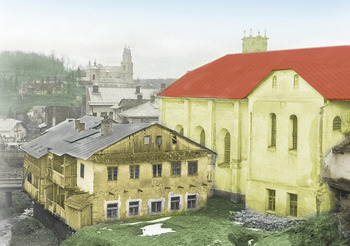
Agnon's Buczacz: the Great Synagogue and Beit Midrash. Colorized by the S. Y. Agnon Library at the Toby Press and used by permission.

That neither the author nor his various narrators were particularly interested in affairs of state, in statecraft, or in “civil society” in Jerusalem, we have already seen with reference to Tmol shilshom. But there is, eventually, the more tricky matter of borders and sovereignty. The armistice lines of 1948 established at least the idea of partition, of political and municipal boundaries in Jerusalem without Israeli hegemony over East Jerusalem and its holy sites—and of a resolution to the Arab-Israeli conflict. One way of avoiding this geopolitical challenge—and, I would say, the challenge of political sovereignty generally—is by placing narrated events in pre-48 Jerusalem, which Agnon does fairly consistently in narratives written between 1948 and 1967—often involving anachronisms that strain credibility. Elsewhere, I have explored such narratives as “Tehilah,” “‘Ido ve-‘Enam,” the novel Shirah, and the posthumously published “Li-fenim min ha-ḥomah,” and “Kisuy ha-dam”—and the historical problems that are circumvented by narrative sleight of hand; I will only allude to them here in order to highlight common threads in Agnon's representation of Jerusalem as anachronistic in time and diasporic in space. In these fictions, Jerusalem is “a protean whole that contains all its synecdoches—and is always larger than the sum of its parts—while remaining portable for ritualistic and poetic purposes.”Footnote 37
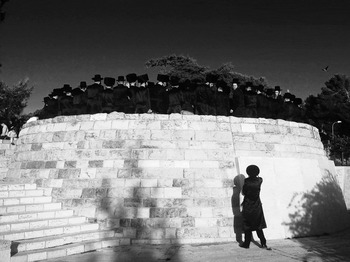
Mt. Scopus, Jerusalem. Courtesy of Jan Kuehne.

Generally speaking, political upheavals in the modern era do not determine Agnon's fictional timelines, and even the Holocaust and the birth of the State of Israel are inscribed less as events than as continuous with processes already in place. At times this strains credibility considerably, as in the enigmatic story “Li-fenim min ha-ḥomah” (Within the walls), which traces the wanderings of two characters in the Old City of Jerusalem after 1948 and before 1967—when such access would have been impossible to Jews; when he finally acknowledges the hermeneutic problem he has created, the narrator says that he and his companion must have entered a dreamscape where “time was as it should be” and the “land was still whole and Jerusalem was not divided.”Footnote 38
Thus the problem of sovereignty is rendered irrelevant to Agnon's Jerusalem; if anything, it is a detraction or distraction from “time as it should be” and the presumed literary license to enter such precincts.
Anachronism, like nostalgia, is a common reflex binding Jewish exilic habitations with Jerusalem. Moving back and forth in time, a practice sanctioned by the talmudic argument that “there is no early or late in the Bible,” is matched by the diasporic practice of moving back and forth in space, of creating simulacra of the temple, its practices and accouterments.
Nostalgia, Anachronism, and Mimesis
Agnon's representations of Jerusalem are, then, variations on several impulses bred in the Diaspora, all of which are connected with messianic projection and the elasticity of time and space: the nostalgic turn, the anachronistic reflex, and mimetic practice. Although they would seem to feed into either political messianism and/or secular forms of political utopia, it is precisely these that Agnon avoids.
Agnon's tradition-saturated yearning for proximity to the sacred is accompanied by a built-in eschatological indifference to national boundaries and the earthly exercise of power. His ambivalence towards that very power seems mitigated by certain public acts, such as his signing the Manifesto of the Movement for the Greater Israel after 1967 and composing the Prayer for Peace, which includes a reference to the State of Israel as “the beginning of our redemption”—though both acts, when scrutinized, were tempered by Agnon's abiding suspicion of Jewish hegemony.Footnote 39
There remain at least two other texts in the Agnon canon that would seem to contradict my claims that the shtetl is paradigmatic Jewish space, and that the two focal points of Agnon's life and writing, Buczacz and Jerusalem, reflect each other in their relative isolation and carefully constructed homogeneity: ‘Ir u-melo'ah (A City in Its Fullness) and Perakim le-sefer ha-medinah (The Orange Peel and Other Satires). Both collections of stories have recently been published in English translation, edited and introduced by Jeffrey Saks and Alan Mintz. I would argue that close scrutiny reveals, however, that these texts also reflect the nostalgia, anachronism, and mimesis that are at the heart of Agnon's fictional project.
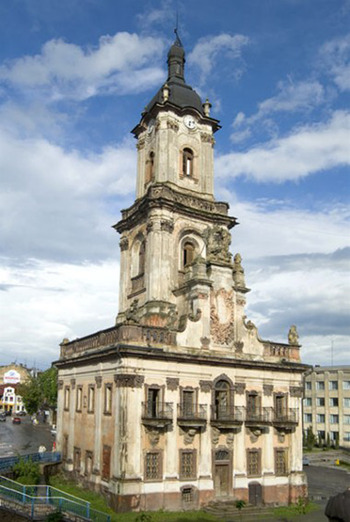
Buczacz town hall. http://faqindecor.com/. Used by permission.

In his foreword to the translated volume of the posthumously published collection of stories of Buczacz, A City in Its Fullness, Mintz reinforces the prevailing practice of referring to Buczacz as a shtetl; he traces three stages in the representation of the Ashkenazic town in modern Hebrew literature: in early fiction of the late nineteenth and early twentieth century, “the shtetl had been figured as a place of spiritual exhaustion and communal venality.” After the Shoah, however, “the vector of judgment was reversed in the abundance of memorial volumes for destroyed communities, which tended to present an idealized picture of a vanished way of life.” What Agnon added to this over decades of compiling the profile of his hometown was, Mintz argues, “a variegated vitality bubbling up from an organically Jewish life … [constituting a project with] epic ambitions.” These stories spanned the period from the middle of the seventeenth to the middle of the nineteenth century, before processes of modernization and nationalism would combine to “erode[ ] the authority that the Torah and the community exerted on the everyday lives of Jews.”Footnote 40
The very fact that the Hebrew title is “‘Ir u-melo'ah,”—“A City in Its Fullness”—rather than ‘ayarah, which would denote the shtetl and small-town Jewish life, is itself telling, and justifies the common critical eliding of these terms. “I am building a city,” Agnon wrote to Baruch Kurzweil in reference to this text.Footnote 41 City or town? Metropolis or shtetl? Indeed, the elision is widespread: Buczacz, like Ostrovtse, is referred to by former Jewish inhabitants on the “virtual shtetl” section of the website of the Museum of the History of Polish Jews in Warsaw interchangeably and unselfconsciously as unzer shtot (our city) and unzer shtetl (our shtetl).Footnote 42 Before the Shoah, Buczacz had around 15,000 inhabitants, about half of whom were Jews. “The city [sic] was Buczacz, and it was located very far from Zion in both time and place,” continues Mintz.Footnote 43 I am arguing that, like many comparable places in many other imaginative evocations, this city is not only not “far from Jerusalem”—it is actually often synonymous with Jerusalem/Zion. But in order to maintain the anachronistic premise of homogeneity without straining credibility to its limit, Agnon had indeed to retreat to a premodern template—or, as in the case of Guest for the Night and “The Sign,” to a postcatastrophe fantasy of restoring the shtetl in Jerusalem.Footnote 44
The final counterexample would seem to be Perakim le-sefer ha-medinah (Chapters from the book of the state), published in English as The Orange Peel, after the title of one of its stories; it is a collection of political satires that reflect a number of institutions of ha-medinah (the state) without giving it a name or specific geopolitical status—although it is generally assumed that the reference is to the Israeli state-in-the-making. The text comprises chapters written and published separately in the early 1940s, to which an introduction and last chapter were added in 1950 when the text was published as a whole.Footnote 45 (It may be that the Kaddish for the fallen at the end of the text was also added in order to mitigate the satiric nature of the stories themselves.)Footnote 46
What is most significant about these stories, when compared to the satires familiar to Western readers from Aristophanes through Swift, and to Yiddish and Hebrew readers from S. Y. Abramovitch through Hanoch Levin, is that they are not exercises in antiutopian social-political vision; that is, one cannot derive the “utopia” by inverting the dystopic descriptions of human foibles. There is messianism here, but it is not political messianism. One might argue, as Hannan Hever does, that the principle of “deferred messianism” is so central to Agnon's theological vision that Zionist institutions and politicians cannot even approximate it.Footnote 47 I would go even further to argue that for this writer the default “utopia” exists only in the “mind of God” and is therefore not only deferred but also inscrutable. Adumbrated in the opening paragraph of his earliest, “signature” story, “‘Agunot,”Footnote 48 the vision of a perfect world as a perfectly woven prayer shawl gives way to the imperfect human world that commences when one thread inevitably comes loose—Agnon's own poetic version of Eden (kedem) lost. With perhaps only one exception, Agnon avoids any vision of sustained harmonious human coexistence in historical-political time: the exception is the lost world under the benign aegis of Emperor Franz-Josef, as recalled in a number of fictional and nonfictional passages.Footnote 49
Jerusalem's Old City from Mt. Scopus. Courtesy of Jan Kuehne.

So one can conclude that although Agnon's satire lies in the realm of inevitable human imperfection, including but not limited to the imperfection of Jewish politics and the Jewish state, his representations of the Jewish town—Buczacz or Jerusalem—managed to create a shield against the incursions of politics and power. That is, through whatever poetic acrobatics, Agnon enlarged upon the dispensation that Jews might have enjoyed or imagined that they enjoyed in their small towns from grappling with the ethical dilemmas that come with political sovereignty and urban cacophonies.
There is surely a danger in resting on Agnon as synecdoche for Jewish Israeli discourse generally—particularly since, as we have seen, there are other writers engaged in more complex encounters; and because Agnon himself struggled more than is commonly acknowledged with the dangers of mixing religion with power anywhere, and went to such lengths vis-à-vis Jewish sovereignty in the Holy City as to create significant problems of credibility in his own fiction. But if the “shtetlization” of Jerusalem in Israel's most iconic writer seems to shield its inhabitants from the temptations, dangers, and opportunities of exercising or sharing sovereignty in multiethnic spaces, it also feeds the collective self-image of the city's Jewish residents and diminishes the possibilities for political resolution. If and when the citizens of Jerusalem decide that theirs is a city and not a shtetl, we will all have come a long way towards solving one of the world's most intractable political and human conflicts.