





No CrossRef data available.
Article contents
Western jurisprudence and criminal justice systems as superstitious belief
Published online by Cambridge University Press: 10 July 2026
Abstract
Western punitive justice systems persist despite weak evidence that they reduce crime. We argue that they function as WEIRD cultural superstitions: punishment intuitively feels effective even when it fails. Drawing on Singh’s framework, historical evidence of punishment’s dominance origins, and our own experiments, we show how subjective selection sustains maladaptive punitive institutions – ultimately raising the question, intuitively effective to whom?
Information
- Type
- Open Peer Commentary
- Information
- Copyright
- © The Author(s), 2026. Published by Cambridge University Press
References
Alam, R., & Rai, T. S. (2025). Profitable third-party punishment destabilizes cooperation. Proceedings of the National Academy of Sciences, 122(34), e2508479122.CrossRefGoogle ScholarPubMed
Boyd, R., Gintis, H., & Bowles, S. (2010). Coordinated punishment of defectors sustains cooperation and can proliferate when rare. Science, 328(5978), 617–620.CrossRefGoogle ScholarPubMed
Carlsmith, K. M. (2006). The roles of retribution and utility in determining punishment. Journal of Experimental Social Psychology, 42(4), 437–451.CrossRefGoogle Scholar
Chalfin, A., & McCrary, J. (2017). Criminal deterrence: A review of the literature. Journal of Economic Literature, 55(1), 5–48.CrossRefGoogle Scholar
Dunbar, G. (2018). Codifying discrimination: The status of women, slaves and freedmen in the ancient near east. Armstrong Undergraduate Journal of History, 8(1), 84–89. (new edition). https://armstronghistoryjournal.wordpress.com/2018/04/19/codifying-discrimination-the-status-of-women-slaves-and-freedmen-in-the-ancient-near-east/
CrossRefGoogle Scholar
Durose, M. R., & Antenangeli, L. (2021). Recidivism of prisoners released in 34 states in 2012: A 5-year follow-up period (2012–2017). Bureau of Justice Statistics.Google Scholar
Fehr, E., & Fischbacher, U. (2004). Third-party punishment and social norms. Evolution and Human Behavior, 25, 63–87.CrossRefGoogle Scholar
Fehr, E., & Gächter, S. (2002). Altruistic punishment in humans. Nature, 415, 137–140.CrossRefGoogle ScholarPubMed
Henrich, J., & Gil-White, F. J. (2001). The evolution of prestige: Freely conferred deference as a mechanism for enhancing the benefits of cultural transmission. Evolution and Human Behavior, 22(3), 165–196.CrossRefGoogle ScholarPubMed
Henrich, J., Heine, S. J., & Norenzayan, A. (2010). The weirdest people in the world? Behavioral and Brain Sciences, 33(2–3), 61–83.CrossRefGoogle ScholarPubMed
Henrich, J., McElreath, R., Barr, A., Ensminger, J., Barrett, C., Bolyanatz, A., … & Ziker, J. et al. (2006). Costly punishment across human societies. Science, 312, 1767–1770.CrossRefGoogle ScholarPubMed
Johnson, D. (2008). Racial prejudice, perceived injustice, and the Black-White gap in punitive attitudes. Journal of Criminal Justice, 36(2), 198–206.CrossRefGoogle Scholar
Mathew, S., & Boyd, R. (2011). Punishment sustains large-scale cooperation in prestate warfare. Proceedings of the National Academy of Sciences of the U.S.A., 108, 11375–11380.CrossRefGoogle ScholarPubMed
Mills, L. G., Barocas, B., Butters, R. P., & Ariel, B. (2019). A randomized controlled trial of restorative justice-informed treatment for domestic violence crimes. Nature Human Behaviour, 3(12), 1284–1294.CrossRefGoogle ScholarPubMed
Muhammad, K. G. (2022). The foundational lawlessness of the law itself: Racial criminalization & the punitive roots of punishment in America. Daedalus, 151(1), 107–120.CrossRefGoogle Scholar
Nagin, D. S. (2013). Deterrence in the twenty-first century. Crime and Justice, 42(1), 199–263.CrossRefGoogle Scholar
National Research Council, Nagin, D. S., & Pepper, J. V. (2012). Deterrence and the death penalty. National Academies Press.Google Scholar
Potter, G. (2013). The history of policing in the United States. EKU School of Justice Studies, 1, 16.Google Scholar
Rai, T. S., & Fiske, A. P. (2011). Moral psychology is relationship regulation: Moral motives for unity, hierarchy, equality, and proportionality. Psychological Review, 118(1), 57.CrossRefGoogle ScholarPubMed
Sherman, L. W., Strang, H., Mayo-Wilson, E., Woods, D. J., & Ariel, B. (2015). Are restorative justice conferences effective in reducing repeat offending? Findings from a campbell systematic review. Journal of Quantitative Criminology, 31(1), 1–24.CrossRefGoogle Scholar
Sheth, D. (2016). Incentives matter: The not-so-civil side of civil forfeiture. FEDERAL LAW, 46–47.Google Scholar
Sidanius, J., & Pratto, F. (1999). Social dominance theory. Handbook of Theories of Social Psychology, 2, 418–438.Google Scholar
Singh, M., & Hoffman, M. (2022). Individualist moral principles and the expansion of the moral circle. SocArXiv Papers. https://doi.org/10.31235/osf.io/pqem7 (Last accessed 12/09/2024).CrossRefGoogle Scholar
Strang, H., Sherman, L. W., Mayo-Wilson, E., Woods, D., & Ariel, B. (2013). Restorative justice conferencing (RJC) using face-to-face meetings of offenders and victims: Effects on offender recidivism and victim satisfaction. A systematic review. Campbell Systematic Reviews, 9(1), 1–59.Google Scholar
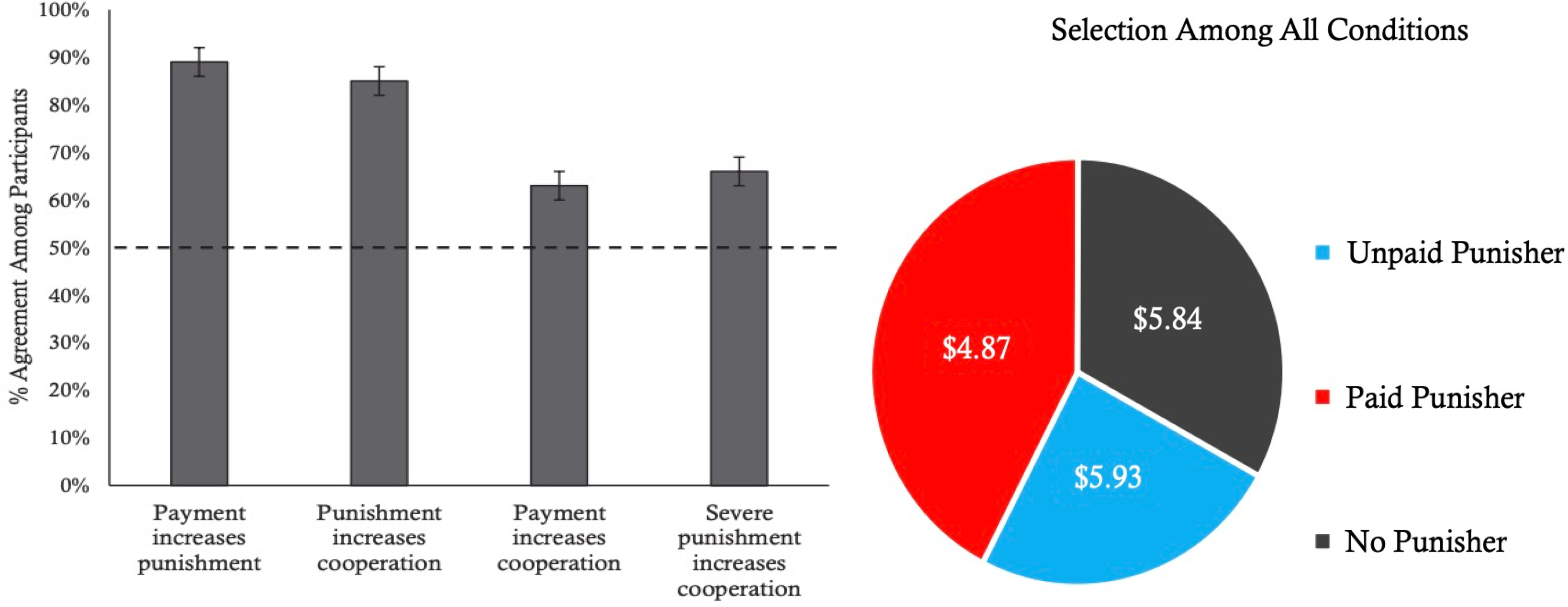
Figure 1. The left panel shows lay intuitions about incentives and punishment, while the right panel shows the proportion of participants who choose to play in different game conditions and the expected values of their choices. From Alam and Rai (2025).
Target article
Related commentaries (27)
Language is a super-attractor: Does it evolve through subjective selection?
Silent forces: How normative ecologies reshape super-attractors
Subjective selection needs socially transmitted goals and culturally evolving problems
 You have
Access
It might seem obvious to a secular person raised in a WEIRD culture (Henrich et al., Reference Henrich, Heine and Norenzayan2010) that a Mentawai water spirit does not actually punish people for failing to share food (Singh, target article). Singh argues these beliefs and practices culturally evolve within groups because they make intuitive sense to individuals, regardless of causal relations or objective outcomes. Yet, the article would benefit from turning this subjective selection lens on itself: What are examples of WEIRD practices that do not accomplish their purported goals but nevertheless persist because they are intuitive? Where do these intuitions come from? And which group members have them?
Western punitive justice systems offer such an example. Many scholars argue that third-party punishment – the imposition of costs on selfish actors by unaffected, often institutionalized, parties – is essential to the emergence and stability of large-scale human cooperation (Boyd, Gintis, & Bowles, Reference Boyd, Gintis and Bowles2010; Fehr & Gächter, Reference Fehr and Gächter2002, Reference Fehr and Fischbacher2004; Henrich et al., Reference Henrich, McElreath, Barr, Ensminger, Barrett, Bolyanatz and Ziker2006; Mathew & Boyd, Reference Mathew and Boyd2011). However, outside of theoretical models and laboratory experiments, evidence for this claim is weak. Meta-analyses consistently find that harsher penalties, such as “three strikes” laws, or even the death penalty, do not reliably reduce crime (Chalfin & McCrary, Reference Chalfin and McCrary2017; National Research Council, Nagin, & Pepper, Reference Nagin and Pepper2012; Nagin, Reference Nagin2013), and in the United States, 82% of people released from prison are rearrested within a decade (Antenangeli & Durose, Reference Durose and Antenangeli2021). Nonpunitive approaches such as restorative justice conferences – structured dialogues among offenders, victims, and community members – reduce recidivism relative to conventional criminal-justice processing (Sherman et al., Reference Sherman, Strang, Mayo-Wilson, Woods and Ariel2015; Strang et al., Reference Strang, Sherman, Mayo-Wilson, Woods and Ariel2013), yet do not receive the same level of support in WEIRD countries.
How do we reconcile the widespread emergence and persistence of harsh punitive institutions in WEIRD societies with their limited efficacy? Singh’s framework provides an answer: punishment feels like it ought to improve cooperation to WEIRD people, which is consistent with our own data. In our experiments, we document economic game conditions under which the inclusion of punishment is actively detrimental to cooperation (Alam & Rai, Reference Alam and Rai2025). These games were designed to mimic real-world conditions in which punishment can sometimes be profitable for punishers – for example, by extracting fines or resources from those they sanction (Sheth, Reference Sheth2016). Critically, we also find that people will choose to play in economic game conditions that incentivize severe punishment even as it reduces their own payouts (Alam & Rai, Reference Alam and Rai2025). When asked about their expectations, most believed that the presence of punishers would increase cooperation, and that paying punishers to engage in severe punishment would be most effective (Figure 1).
The left panel shows lay intuitions about incentives and punishment, while the right panel shows the proportion of participants who choose to play in different game conditions and the expected values of their choices. From Alam and Rai (Reference Alam and Rai2025).
Why do WEIRD participants subjectively feel like punishment should increase cooperation? According to Singh, subjective selection operates by targeting proximate psychological goals. In the context of punishment, retribution may be the proximate goal of punishment rather than deterrence (Carlsmith, Reference Carlsmith2006). Yet, it is unclear whether these proximate retributive sentiments culturally evolved for the ultimate goal of inducing cooperation, or whether Western punishment practices may have culturally evolved for exploitation and domination. The earliest written legal codes, such as the laws of Ur-Nammu and Hammurabi in Mesopotamia, reserve the harshest penalties for women and slaves who harmed free men (Dunbar, Reference Dunbar2018). In the antebellum South, slave patrols maintained racial hierarchies by violently punishing enslaved people who attempted to escape or resist (Potter, Reference Potter2013). After abolition, these practices were transformed into convict leasing, in which Black Americans were criminalized en masse and forced into labor camps (Muhammad, Reference Muhammad2022). Echoes of this dominance function persist: for example, Black defendants are significantly more likely to receive a death penalty, especially if they are convicted of murdering a White victim (Sidanius & Pratto, Reference Sidanius and Pratto1999).
Thus, the modern belief in punishment as necessary for cooperation may reflect a process of subjective selection even as punishment itself culturally evolved for hierarchical purposes. This would suggest that explaining subjective selection in terms of intuition is incomplete without also taking into account the socio-historical conditions that make different explanations more cognitively accessible and socially motivated. In the context of western punishment, one possible explanation is that once Enlightenment ideals of liberty and equality became the preferred social-relational model for organizing legal relations in WEIRD societies, explaining that punishment served hierarchy became less cognitively accessible and carried reputational costs (Rai & Fiske, Reference Rai and Fiske2011; Singh & Hoffman, 2025).
Singh’s framework also invites a deeper question that remains unaddressed: intuitive to whom? The intuitive appeal of punitive justice is unevenly distributed (Johnson, Reference Johnson2008), and this may be due to poor perspective-taking. In one experiment, we asked participants to imagine themselves in different roles in a dictator game (Alam & Rai, Reference Alam and Rai2025). Those who imagined themselves as dictators, who might be subject to punishment, were more skeptical of punishers and their motives than players who were not subject to punishment. Dictators were also more likely to believe in the importance of never punishing fair behavior, while other players focused on the importance of always punishing selfish behavior. The same punitive system thus felt different depending on where people imagined themselves within it – either as potential targets or bystanders beyond its reach. This perspective gap may help explain why White voters often support “tough on crime” policies (Johnson, Reference Johnson2008) without considering what those policies signal to the minority communities they disproportionately target, where trust in law enforcement is low. Crucially, the people for whom it feels intuitive that punishment fosters cooperative are also those with disproportionate cultural and political influence – allowing the intuition to shape institutions and endure despite its empirical weakness. Singh’s account, therefore, could be strengthened by clarifying whose intuitions shape which cultural practices persist. However, doing so might force the theory to integrate subjective selection with the kinds of prestige, dominance, and conformity-based cultural transmission pathways that Singh seeks to distinguish subjective selection from (Henrich & Gil-White, Reference Henrich and Gil-White2001).
Financial support
This research received no specific grant from any funding agency, commercial, or not-for-profit sectors.
Competing interests
None.