




No CrossRef data available.
Article contents
Realizing the Now-or-Never bottleneck and Chunk-and-Pass processing with Item-Order-Rank working memories and masking field chunking networks
Published online by Cambridge University Press: 02 June 2016
Abstract
Christiansen & Chater's (C&C's) key goals for a language system have been realized by neural models for short-term storage of linguistic items in an Item-Order-Rank working memory, which inputs to Masking Fields that rapidly learn to categorize, or chunk, variable-length linguistic sequences, and choose the contextually most predictive list chunks while linguistic inputs are stored in the working memory.
Information
- Type
- Open Peer Commentary
- Information
- Copyright
- Copyright © Cambridge University Press 2016
References
Ames, H. & Grossberg, S. (2008) Speaker normalization using cortical strip maps: A neural model for steady state vowel categorization. Journal of the Acoustical Society of America
124:3918–36.CrossRefGoogle ScholarPubMed
Boardman, I., Grossberg, S., Myers, C. & Cohen, M. (1999) Neural dynamics of perceptual order and context effects for variable-rate speech syllables. Perception and Psychophysics
6:1477–500.CrossRefGoogle Scholar
Cohen, M. A. & Grossberg, S. (1986) Neural dynamics of speech and language coding: Developmental programs, perceptual grouping, and competition for short-term memory. Human Neurobiology
5:1–22.Google Scholar
Grossberg, S. (1973) Contour enhancement, short-term memory, and constancies in reverberating neural networks. Studies in Applied Mathematics
52:213–57.Google Scholar
Grossberg, S. (1978a) A theory of human memory: Self-organization and performance of sensory- motor codes, maps, and plans. In: Progress in theoretical biology, volume 5, ed. Rosen, R. & Snell, F., pp. 233–74. Academic Press.Google Scholar
Grossberg, S. (1978b) Behavioral contrast in short-term memory: Serial binary memory models or parallel continuous memory models?
Journal of Mathematical Psychology
3:199–19.CrossRefGoogle Scholar
Grossberg, S. (1986) The adaptive self-organization of serial order in behavior: Speech, language, and motor control. In: Pattern recognition by humans and machines, vol. 1: Speech perception, ed. Schwab, E. C. & Nusbaum, H. C., pp. 187–94. Academic Press.Google Scholar
Grossberg, S. (2003) Resonant neural dynamics of speech perception. Journal of Phonetics
31:423–45.Google Scholar
Grossberg, S. (2013) Adaptive resonance theory: How a brain learns to consciously attend, learn, and recognize a changing world. Neural Networks
37:1–47.Google Scholar
Grossberg, S., Boardman, I. & Cohen, C. (1997) Neural dynamics of variable-rate speech categorization. Journal of Experimental Psychology: Human Perception and Performance
23:418–503.Google Scholar
Grossberg, S. & Kazerounian, S. (2011) Laminar cortical dynamics of conscious speech perception: A neural model of phonemic restoration using subsequent context in noise. Journal of the Acoustical Society of America
130:440–60.Google Scholar
Grossberg, S. & Myers, C. W. (2000) The resonant dynamics of speech perception: Interword integration and duration-dependent backward effects. Psychological Review
107:735–67.Google Scholar
Grossberg, S. & Pearson, L. (2008) Laminar cortical dynamics of cognitive and motor working memory, sequence learning and performance: Toward a unified theory of how the cerebral cortex works. Psychological Review
115:677–32.Google Scholar
Kazerounian, S. & Grossberg, S. (2014) Real-time learning of predictive recognition categories that chunk sequences of items stored in working memory. Frontiers in Psychology: Language Sciences. doi: 10.3389/fpsyg.2014.01053.Google Scholar
Silver, M. R., Grossberg, S., Bullock, D., Histed, M. H. & Miller, E. K. (2011) A neural model of sequential movement planning and control of eye movements: Item-order-rank working memory and saccade selection by the supplementary eye fields. Neural Networks
26:29–58.Google Scholar
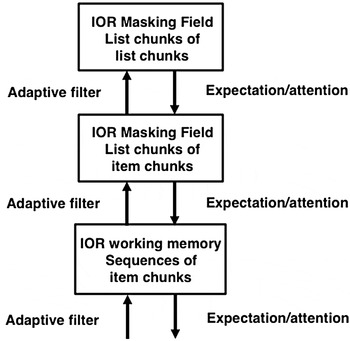
Figure 1 (Grossberg). Speech hierarchy. Each processing level in this hierarchy is an Item-Order-Rank (IOR) working memory that can store sequences with repeated items in short-term memory. The second and third IOR working memories are, in addition, multiple-scale Masking Fields (MF) that can chunk input sequences of variable length, and choose the sequence, or sequences, for storage that receive the most evidence from its inputs. Each level receives its bottom-up inputs from an adaptive filter and reads-out top-down expectations that focus attention on the feature patterns in their learned prototypes at the previous level. The first level stores sequences of item chunks. The second level stores sequences of list chunks. The individual list chunks of the third level thus represent sequences of list chunks at the second level, including sequences with repeated words, like “DOG EATS DOG.” During rehearsal, each chunk at a higher level can read out its learned sequence through its top-down expectation with the support of a volitional signal that converts the top-down modulatory signals into signals that are capable of fully activating their target cells.
 You have
Access
Key goals that Christiansen & Chater (C&C) propose for language processing have already been realized by real-time neural models of speech and language learning and performance, notably:
1. C&C write in their abstract about a Now-or-Never bottleneck whereby the brain compresses and recodes linguistic input as rapidly as possible; a multilevel linguistic representation; and a predictive system, which ensures that local linguistic ambiguities are dealt with Right-First-Time using Chunk-and-Pass processing.
2. At the beginning of paragraph 2 of section 3.3, C&C note that predictions for higher-level chunks may “run ahead” of those for lower-level chunks, as when listeners answer “two” in response to the question “How many animals of each kind did Moses take on the Ark?”
Neural models of speech and language embody design principles and mechanisms that automatically satisfy such properties. Introduced in Grossberg (Reference Grossberg, Rosen and Snell1978a; Reference Grossberg1978b), they have progressively developed to the present time. Two key contributions are as follows: (a) a model for short-term storage of sequences of language items that can include repeated items, called an Item-Order-Rank (IOR) working memory. The working memory inputs via an adaptive filter to (b) a model for learned unitization, categorization, or chunking of variable-length sequences of items that are stored in working memory, called a Masking Field (MF). An MF clarifies how the brain rapidly learns to categorize, or chunk, variable-length linguistic sequences, and uses recurrent competitive interactions to choose the most predictive sequence chunk, or list chunk, as linguistic inputs are processed in real time by the working memory. The MF, in turn, sends predictive top-down matching signals to the working memory to attentively select item sequences that the winning chunks represent.
Both IOR and MF networks are realized by recurrent on-center, off-surround networks whose cells obey the membrane equations of neurophysiology; that is, shunting dynamics (Grossberg Reference Grossberg1973). These working memory and chunking networks have been used to explain and simulate many challenging properties of variable-rate variable-speaker speech and language data: for example, Ames and Grossberg (Reference Ames and Grossberg2008), Boardman et al. (Reference Boardman, Grossberg, Myers and Cohen1999), Cohen and Grossberg (Reference Cohen and Grossberg1986), Grossberg (Reference Grossberg, Schwab and Nusbaum1986; Reference Grossberg2003), Grossberg et al. (Reference Grossberg, Boardman and Cohen1997), Grossberg and Myers (Reference Grossberg and Myers2000), and Grossberg and Pearson (Reference Grossberg and Pearson2008). Most recently, such working memories and chunking networks have been incorporated into the cARTWORD hierarchical laminar cortical model of speech learning and recognition (Grossberg & Kazerounian Reference Grossberg and Kazerounian2011; Kazerounian & Grossberg Reference Kazerounian and Grossberg2014).
The Item-Order-Rank working memory clarifies data such as in Goal 2 cited above because sufficient subsets of working memory items can choose a predictive chunk, even if there are incongruent sequence elements. A Masking Field clarifies data such as in Goal 1, above, because the most predictive list chunks are chosen in real time as linguistic data are processed in working memory.
An IOR working memory (WM) stores a temporal stream of inputs through time as an evolving spatial pattern of content-addressable item representations. This WM model is called an IOR model because its nodes, or cell populations, represent list items, the temporal order in which the items are presented is stored by an activity gradient across nodes, and the same item can be repeated in different list positions, or ranks. A primacy gradient stores items in WM in the correct temporal order, with the first item having the highest activity. Recall occurs when a basal ganglia rehearsal wave activates WM read-out. The node with the highest activity reads out fastest and self-inhibits its WM representation. Such inhibition-of-return prevents perseveration of performance. Both psychophysical and neurophysiological data support this coding scheme; see Grossberg (Reference Grossberg2013), Grossberg and Pearson (Reference Grossberg and Pearson2008), and Silver et al. (Reference Silver, Grossberg, Bullock, Histed and Miller2011).
These circuits were derived by analyzing how a WM could be designed to enable list chunks of variable length to be rapidly learned and stably remembered through time, leading to postulates which imply that all working memories – linguistic, motor, and spatial – have a similar design, with similar data patterns across modalities, and that there exists an intimate link between list chunking and WM storage. Grossberg (Reference Grossberg2013) reviews supportive data.
An MF is a specialized IOR WM. The “items” stored in an MF are list chunks that are selectively activated, via a bottom-up adaptive filter, by subsequences of items that are stored in an item WM. As items are stored in item WM, an adaptive filter activates the learned list chunks that represent the most predictive item groupings at any time, while suppressing less-predictive chunks. In order for an MF list chunk to represent lists (e.g., syllables or words) of multiple lengths, its cells interact within and between multiple spatial scales, with the cells of larger scales capable of selectively representing item sequences of greater length, and of inhibiting other MF cells that represent item sequences of lesser length (“self-similarity”).
MFs solve the temporal chunking problem, which asks how a chunk for an unfamiliar list of familiar speech units – for example, a novel word composed of familiar subwords – can be learned under unsupervised learning conditions. What mechanisms prevent familiarity of subwords (e.g., MY, ELF, and SELF), which have already learned to activate their own list chunks, from forcing the novel longer list (e.g., MYSELF) to always be processed as a sequence of these smaller familiar chunks, rather than as a newly learned, unitized whole? How does a not-yet-established word representation overcome the salience of already well-established phoneme, syllable, or word representations to enable learning of the novel word to occur? This solution implies the properties of Goal 1, as well as psychophysical data like the Magical Number Seven and word superiority effects.
Lists with repeated words can be coded by a three-level network (Fig. 1): The first level contains item chunks that input to a Masking Field through an adaptive filter. This MF inputs to a second MF through an adaptive filter that compresses “items” from the first MF into list chunks. These “items” are, however, list chunks. Thus, the second MF's list chunks represent sequences of list chunks. Because it is also an IOR working memory, it can store sequences with repeated list chunks, including sequences with repeated words – for example, “DOG EATS DOG” – thereby providing the kind of multilevel, multiscale, predictive hierarchy that the authors seek.
Speech hierarchy. Each processing level in this hierarchy is an Item-Order-Rank (IOR) working memory that can store sequences with repeated items in short-term memory. The second and third IOR working memories are, in addition, multiple-scale Masking Fields (MF) that can chunk input sequences of variable length, and choose the sequence, or sequences, for storage that receive the most evidence from its inputs. Each level receives its bottom-up inputs from an adaptive filter and reads-out top-down expectations that focus attention on the feature patterns in their learned prototypes at the previous level. The first level stores sequences of item chunks. The second level stores sequences of list chunks. The individual list chunks of the third level thus represent sequences of list chunks at the second level, including sequences with repeated words, like “DOG EATS DOG.” During rehearsal, each chunk at a higher level can read out its learned sequence through its top-down expectation with the support of a volitional signal that converts the top-down modulatory signals into signals that are capable of fully activating their target cells.