









1 Introduction
Throughout this work, for each
 $i=1,\ldots ,k$
, let
 $\mathbb {X}_i$
denote an arbitrary but fixed (nonzero) Banach space with the norm
 $\| \cdot \|$
. For
 $ p\in [1, \infty ]$
, let
 $\mathbb {X}= \mathbb {X}_1\oplus _p \dots \oplus _p \mathbb {X}_k$
denote the
 $\ell ^p$
-sum of Banach spaces
 $\mathbb {X}_1,\ldots ,\mathbb {X}_k$
. Recall that (see [Reference Bhunia and Mal10, Reference Chmieliński, Khurana and Sain15]),
 $\mathbb {X}= \mathbb {X}_1\oplus _p \dots \oplus _p \mathbb {X}_k$
is a normed linear space of all vectors
 $(x_1,\ldots ,x_k)$
, where
 $x_i\in \mathbb {X}_i$
and the norm
 $\|(x_1,\ldots ,x_k)\|_p=\left ( \sum _{i=1}^k\|x_i\|^p\right )^{1/p}.$
Let
 $A=[A_{ij}]_{i,j=1}^k$
be a
 $k\times k$
block matrix, where
 $A_{ij}\in \mathcal {L}(\mathbb {X}_j, \mathbb {X}_i)$
is a bounded linear operator from
 $\mathbb {X}_j$
to
 $ \mathbb {X}_i$
. Then,
 $A\in \mathcal {L}(\mathbb {X})$
is a bounded linear operator on
 $\mathbb {X}$
and is defined as
 $$ \begin{align*}Ax=\left(\sum_{j=1}^kA_{1j}x_j, \ldots, \sum_{j=1}^kA_{kj}x_j\right) \quad \text{ for all } x=(x_1,\ldots,x_k)\in \mathbb{X}.\end{align*} $$
The induced
 $\ell ^p$
-operator norm of a
 $k\times k$
block matrix
 $A\in \mathcal {L}(\mathbb {X})$
is defined as follows.
Definition 1.1 Let
 $A\in \mathcal {L}(\mathbb {X})$
. The
 $\ell ^p$
-operator norm of A, denoted by
 $\|A\|_{\ell ^p}$
, is defined as
 $$ \begin{align*}\|A\|_{\ell^p}= \sup\left\{ \frac{\|Ax\|_p} {\|x\|_p}: x\in \mathbb{X}, \ x\neq 0 \right\}= \sup\left\{ {\|Ax\|_p} : x\in \mathbb{X}, \ {\|x\|_p}=1 \right\}. \end{align*} $$
In particular, if A is a
 $k\times k$
scalar matrix, then the
 $\ell ^p$
-operator norm
 $\|A\|_{\ell ^p}$
reduces to the p-norm of the matrix A, which was studied in [Reference Bouthat, Khare, Mashreghi and Morneau-Guérin14] by Bouthat, Khare, Mashreghi, and Morneau-Guérin.
For the case
 $p=2$
,
 $\|A\|_{\ell ^2}=\|A\|= \sup \left \{ {\|Ax\|} : x\in \mathbb {X}, \|x\|=1 \right \}$
is the usual operator norm.
The main aim of this work is to study the
 $\ell ^p$
-operator norm inequalities for
 $k\times k$
block matrices, where the entries are bounded linear operators defined on Banach spaces. By applying these inequalities, we study the p-numerical radius (an extended numerical radius, which is defined below) and spectral radius bounds for
 $k \times k$
block matrices.
The study of the numerical radius of a bounded linear operator goes back at least to Toeplitz [Reference Toeplitz30] and Hausdorff [Reference Hausdorff18] (see also [Reference Halmos17]). In fact, it goes back even earlier to Rayleigh quotients in the 19th century. In recent years, the numerical radius has seen widespread usage through applications in functional analysis, numerical analysis, operator theory, systems theory, quantum information theory, and quantum computing. We refer the reader to [Reference Bhunia, Dragomir, Moslehian and Paul7] for more on this.
Recall that the numerical radius of a bounded linear operator A on a complex Hilbert space
 $\mathbb {H}$
is defined as
 $$ \begin{align*}w(A)=\sup \{ |\langle Ax,x\rangle|: x\in \mathbb{H}, \|x\|=1\}.\end{align*} $$
The numerical radius defines a norm on
 $\mathcal {L}(\mathbb {H})$
and satisfies the relation [Reference Gustafson and Rao16, Theorem 1.3-1]:
 $$ \begin{align} \frac{1}{2}\|A\| \leq w(A) \leq \|A\|. \end{align} $$
These inequalities are sharp, the first inequality becomes equality if
 $A^2=0$
and the second inequality becomes equality if A is normal.
It is well-known that
 $w(A)= \sup _{\theta \in \mathbb {R}}\left \|\frac 12 \left (e^{i\theta }A+ e^{-i\theta }A^*\right )\right \|,$
where
 $A^*$
denotes the Hilbert adjoint of
 $A.$
For more information on numerical radius of bounded linear operators and block matrices, we refer to [Reference Bhunia, Dragomir, Moslehian and Paul7, Reference Wu and Gau31].
Due to the importance of the numerical radius, over the years, many researchers have been studying many extensions of it (see [Reference Abu-Omar and Kittaneh2, Reference Bhunia4, Reference Bhunia, Feki and Paul8, Reference Bhunia, Moslehian and Zamani11, Reference Kittaneh and Zamani26, Reference Saddi28, Reference Sain, Bhunia, Bhanja and Paul29]).
In this work, we introduce a new generalization of the numerical radius, called the p-numerical radius of
 $A=[A_{ij}]_{i,j=1}^k\in \mathcal {L}(\mathbb {H})$
, where
 $\mathbb {H}= \mathbb {H}_1\oplus _p \dots \oplus _p \mathbb {H}_k$
, and
 $\mathbb {H}_1,\ldots ,\mathbb {H}_k$
are complex Hilbert spaces.
Definition 1.2 Suppose
 $A=[A_{ij}]_{i,j=1}^k\in \mathcal {L}(\mathbb {H})$
, where the entries
 $A_{ij}\in \mathcal {L}(\mathbb {H}_j, \mathbb {H}_i)$
. The p-numerical radius of A, denoted by
 $w_p(A)$
, is defined as
 $$ \begin{align*}w_p(A)= \sup_{\theta\in \mathbb{R}}\left\|\frac12 \left(e^{i\theta}[A_{ij}]_{i,j=1}^k+ e^{-i\theta}[A_{ji}^*]_{i,j=1}^k\right)\right\|_{\ell^p}.\end{align*} $$
Here, we mention the following remarks.
-
(1) In particular, setting
 $p=2$
in Definition 1.2, we have
$w_2(A)=w(A)$
is the classical numerical radius of
$A=[A_{ij}]_{i,j=1}^k\in \mathcal {L}(\mathbb {H})$
, where
$\mathbb {H}= \mathbb {H}_1\oplus _2 \dots \oplus _2 \mathbb {H}_k$
.
-
(2) If
$A=[a_{ij}]_{i,j=1}^k\in {M}_k(\mathbb {C})$
is a
$k \times k$
matrix, then from Definition 1.2, we have (1.2)
$$ \begin{align} w_p(A)= \sup_{\theta\in \mathbb{R}}\left\|\frac12 (e^{i\theta}[a_{ij}]_{i,j=1}^k+ e^{-i\theta}[\overline{a_{ji}}]_{i,j=1}^k)\right\|_{\ell^p}. \end{align} $$


Over the years, many inequalities involving operator norm and numerical radius for block matrices were studied in the literature (see [Reference Abu-Omar and Kittaneh1, Reference Bhunia3, Reference Bhunia5, Reference Bhunia and Paul13, Reference Hirzallah, Kittaneh and Shebrawi19, Reference Hou and Du23, Reference Kittaneh and Sahoo25]). Among the many inequalities, we mention here the following:
 $$ \begin{align} \left\| [A_{ij}]_{i,j=1}^k \right\| \leq \left\| [a_{ij}']_{i,j=1}^k \right\|, \quad \textit{where }a_{ij}'=\|A_{ij}\| \end{align} $$
and
 $$ \begin{align} w\left( [A_{ij}]_{i,j=1}^k \right) \leq \left\| \left[w\left(\begin{bmatrix} 0& A_{ij}\\ A_{ji}&0 \end{bmatrix} \right)\right]_{i,j=1}^k \right\|, \end{align} $$
where
 $[A_{ij}]_{i,j=1}^k\in \mathcal {L}(\mathbb {H}_1\oplus _2 \dots \oplus _2 \mathbb {H}_k)$
(see [Reference Abu-Omar and Kittaneh1, Reference Hou and Du23]).
In this article, we develop the
 $\ell ^p$
-operator norm and p-numerical radius inequalities for
 $k \times k$
block matrices defined on the
 $\ell ^p$
-sum of Banach spaces, which extend the existing inequalities (1.3) and (1.4). In particular, we deduce a p-numerical radius bound for the Kronecker product
 $A\otimes B$
(where
 $A\in {M}_k(\mathbb {C})$
and
 $B\in \mathcal {L}(\mathbb {H})$
is a bounded linear operator on a complex Hilbert space
 $\mathbb {H}$
), which improves and generalizes the bound
 $w(A\otimes B)\leq w(A)\|B\|$
, given by Holbrook [Reference Holbrook20]. Again, using the
 $\ell ^p$
-operator norm inequalities, we derive a spectral radius bound for block matrices.
Furthermore, we develop lower bounds for the p-numerical radius of complex matrices
 $A\in M_k(\mathbb {C})$
, which refine and extend the classical lower bound in (1.1). In addition, a complete characterization for the equality
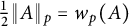
 $ w_p(A)=\frac {1}{2}\|A\|_{\ell ^p}$
is deduced.
2 Main results
We begin our study with a twofold extension of (1.3). We work on any Banach spaces (real or complex) instead of complex Hilbert spaces and on the
 $\ell ^p$
-sum instead of the direct sum.
Theorem 2.1 Let
 $\mathbb {X}_1,\ldots ,\mathbb {X}_k$
be Banach spaces (real or complex) and
 $\mathbb {X}= \mathbb {X}_1\oplus _p \dots \oplus _p \mathbb {X}_k$
. Let
 $[A_{ij}]_{i,j=1}^k\in \mathcal {L}(\mathbb {X})$
be a
 $k\times k$
block matrix, where
 $A_{ij}\in \mathcal {L}(\mathbb {X}_j, \mathbb {X}_i)$
. Then,
 $$ \begin{align*}\left\|[A_{ij}]_{i,j=1}^k\right\|_{\ell^p} \leq \left\| [\|A_{ij}\|]_{i,j=1}^k \right\|_{\ell^p}.\end{align*} $$
Proof Let
 $A=[A_{ij}]_{i,j=1}^k$
and
 $x=\begin {pmatrix} x_1, \ldots , x_k \end {pmatrix} \in \mathbb {X}.$
Then, we have
 $$ \begin{align*} \|Ax\|_p =& \left\| \left( \sum_{j=1}^kA_{1j}x_j, \sum_{j=1}^kA_{2j}x_j, \ldots, \sum_{j=1}^kA_{kj}x_j \right) \right\|_{p}\\ =& \sqrt[p]{ \left\| \sum_{j=1}^kA_{1j}x_j\right\|^p+ \left\| \sum_{j=1}^kA_{2j}x_j\right\|^p+ \cdots+ \left\| \sum_{j=1}^kA_{kj}x_j\right\|^p }\\ \leq& \sqrt[p]{ \left( \sum_{j=1}^k \|A_{1j}\| \|x_j\|\right)^p+ \left( \sum_{j=1}^k\|A_{2j}\|\|x_j\|\right)^p+ \cdots+ \left( \sum_{j=1}^k\|A_{kj}\|\|x_j\|\right)^p }\\ =& \left\| [\|A_{ij}\|]_{i,j=1}^k |x| \right\|_{p} \quad \\ \leq& \left\| [\|A_{ij}\|]_{i,j=1}^k \right\|_{\ell^p} \|x\|_p, \quad \text{ where }|x|= \begin{pmatrix} \|x_1\|,\ldots,\|x_k\| \end{pmatrix} \in \mathbb{R}^k. \end{align*} $$
Hence, the desired inequality follows by taking the supremum over
 $\|x\|_p=1.$
Next, using Theorem 2.1, we derive the p-numerical radius bound for block matrices that extends the bound (1.4). To achieve this, we first need the following two lemmas.
Lemma 2.2 Let
 $A=[a_{ij}]_{i,j=1}^k$
and
 $B=[b_{ij}]_{i,j=1}^k$
be two matrices with
 $0\leq a_{ij}\leq b_{ij} $
for all
 $i,j=1,\ldots ,k$
. Then,
 $$ \begin{align*}\|A\|_{\ell^p}\leq \|B\|_{\ell^p}.\end{align*} $$
Proof Take
 $x=\begin {pmatrix} x_1, \ldots , x_k \end {pmatrix} \in \mathbb {C}^k$
with
 $\|x\|_p=1$
. We see that
 $$ \begin{align*} \|Ax\|_p=& \left\| \left( \sum_{j=1}^ka_{1j}x_j, \sum_{j=1}^ka_{2j}x_j, \ldots, \sum_{j=1}^ka_{kj}x_j \right) \right\|_p \\ =& \sqrt[p]{\sum_{i=1}^k \left| \sum_{j=1}^ka_{ij}x_j \right|{}^p}\\ \leq& \sqrt[p]{\sum_{i=1}^k \left( \sum_{j=1}^k a_{ij} |x_j| \right)^p } \\ \leq& \|A\|_{\ell^p}, \end{align*} $$
where the last inequality follows, since
 $(|x_1|, \ldots , |x_k|)\in \mathbb {R}^k$
with
 ${\|(|x_1|, \ldots , |x_k|)\|_p=1.}$
This implies that there exists a vector
 $x=\begin {pmatrix} x_1, \ldots , x_k \end {pmatrix} \in \mathbb {R}^k$
with
 $x_i\geq 0$
for all
 $i=1,2,\ldots ,k$
and
 $\|x\|_p=1$
such that
 $\|Ax\|_p=\|A\|_p.$
This and the condition
 $0\leq a_{ij}\leq b_{ij}$
for all
 $i,j$
imply
 $\|A\|_{\ell ^p}=\|Ax\|_p\leq \|Bx\|_p\leq \|B\|_{\ell ^p}.$
The second lemma is well-known and can be found in [Reference Abu-Omar and Kittaneh1].
Lemma 2.3 Let
 $\mathbb {H}_1, \mathbb {H}_2$
be complex Hilbert spaces and let
 $A_{ij}\in \mathcal {L}(\mathbb {H}_j, \mathbb {H}_i)$
. Then,
 $$ \begin{align*}w\left( \begin{bmatrix} 0& A_{12}\\ A_{21}& 0 \end{bmatrix}\right)=\frac{1}{2}\sup_{\theta \in \mathbb{R}}\|e^{i\theta}A_{12}+ e^{-i\theta}A_{21}^*\|.\end{align*} $$
In particular, for
 $\mathbb {H}_1= \mathbb {H}_2$
and
 $A_{12}=A_{21}=A$
,
 $$ \begin{align*}w\left( \begin{bmatrix} 0& A\\ A& 0 \end{bmatrix}\right)= \frac12 \sup_{\theta \in \mathbb{R}}\|e^{i\theta}A+ e^{-i\theta}A^*\|=w(A).\end{align*} $$
Now, we are in a position to present the p-numerical radius bound.
Theorem 2.4 Let
 $\mathbb {H}_1, \ldots , \mathbb {H}_k$
be complex Hilbert spaces and
 $\mathbb {H}=\mathbb {H}_1 \oplus _p \dots \oplus _p \mathbb {H}_k$
. Let
 $[A_{ij}]_{i,j=1}^k\in \mathcal {L}(\mathbb {H})$
be a
 $k\times k$
block matrix with
 $A_{ij}\in \mathcal {L}(\mathbb {H}_j, \mathbb {H}_i)$
. Then,
 $$ \begin{align*}w_p\left([A_{ij}]_{i,j=1}^k \right) \leq \left\| \left[ w\left(\begin{bmatrix} 0& A_{ij}\\ A_{ji}&0 \end{bmatrix} \right) \right]_{i,j=1}^k \right\|_{\ell^p}.\end{align*} $$
(Notice that the diagonal entries
 $ w\left (\begin {bmatrix} 0& A_{ii}\\ A_{ii}&0 \end {bmatrix} \right ) =w(A_{ii})$
, which follow from Lemma 2.3.)
Proof Let
 $A=[A_{ij}]_{i,j=1}^k$
and
 $\theta \in \mathbb {R}.$
Then, we have
 $$ \begin{align*} & \left\| \frac{e^{i\theta}[A_{ij}]_{i,j=1}^k+ e^{-i\theta}[A_{ji}^*]_{i,j=1}^k}{2} \right\|_{\ell^p}\\ \leq &\left\| \left[ \frac{ \| e^{i\theta} A_{ij}+ e^{-i\theta}A_{ji}^* \| }{2} \right]_{i,j=1}^k \right\|_{\ell^p} \quad (\text{by Theorem}~{2.1})\\ \leq& \left\| \left[ \sup_{\theta \in \mathbb{R}} \frac{ \| e^{i\theta} A_{ij}+ e^{-i\theta} {A}_{ji}^* \| }{2} \right]_{i,j=1}^k \right\|_{\ell^p} \quad (\text{by Lemma}~({2.2}))\\ =& \left\| \left[ w\left(\begin{bmatrix} 0& A_{ij}\\ A_{ji}&0 \end{bmatrix} \right) \right]_{i,j=1}^k \right\|_{\ell^p} \quad (\text{by Lemma}\ {2.3}). \end{align*} $$
Taking the supremum over
 $\theta \in \mathbb {R}$
and using
 $\underset {{\theta \in \mathbb {R}}}{\sup } \left \| \frac {e^{i\theta }[A_{ij}]_{i,j=1}^k+ e^{-i\theta }[A_{ji}^*]_{i,j=1}^k}{2} \right \|_{\ell ^p}=w_p([A_{ij}]_{i,j=1}^k),$
we get the desired inequality.
Setting
 $k=2$
in Theorem 2.4, we deduce the following corollary.
Corollary 2.5 Let
 $\mathbb {H}_1, \mathbb {H}_2$
be complex Hilbert spaces and
 $\mathbb {H}=\mathbb {H}_1 \oplus _p \mathbb {H}_2$
. Let
 $[A_{ij}]_{i,j=1}^2\in \mathcal {L}(\mathbb {H})$
with
 $A_{ij}\in \mathcal {L}(\mathbb {H}_j, \mathbb {H}_i)$
. If
 $w(A_{11})=w(A_{22}),$
then
 $$ \begin{align*}w_p\left( [A_{ij}]_{i,j=1}^2 \right) \leq w(A_{11})+ w\left(\begin{bmatrix} 0& A_{12}\\ A_{21}& 0 \end{bmatrix} \right).\end{align*} $$
Proof The proof follows from the fact that
 $\begin {bmatrix} a&b\\ b&a \end {bmatrix}$
(where
 $a,b\geq 0$
) is a circulant matrix and
 $ \left \| \begin {bmatrix} a&b\\ b&a \end {bmatrix}\right \|_p=a+b$
(see [Reference Bhunia, Damase and Khare6, Reference Bouthat, Khare, Mashreghi and Morneau-Guérin14]).
Again, using Theorem 2.4, we deduce the p-numerical radius bound for the Kronecker product
 $A\otimes B$
, where
 $A=[a_{ij}]_{i,j=1}^k\in {M}_k(\mathbb {C})$
is a
 $k\times k$
complex matrix and
 $B\in \mathcal {L}(\mathbb {H})$
is a bounded linear operator on a complex Hilbert space
 $\mathbb {H}$
. Recall that the Kronecker product of A and B is defined as
 $A\otimes B= [a_{ij}B]_{i,j=1}^k$
, which is a
 $k\times k$
block matrix (see [Reference Bhunia, Damase and Khare6]).
Corollary 2.6 Let
 $A=[a_{ij}]_{i,j=1}^k\in {M}_k(\mathbb {C})$
and
 $B\in \mathcal {L}(\mathbb {H})$
be a bounded linear operator on a complex Hilbert space
 $\mathbb {H}.$
Then,
 $$ \begin{align*}w_p(A\otimes B) \leq \left\|\left[ w\left(\begin{bmatrix} 0& a_{ij}\\ a_{ji}&0 \end{bmatrix} \otimes B \right) \right]_{i,j=1}^k \right\|_{\ell^p}.\end{align*} $$
(Notice that the diagonal entries
 $w\left (\begin {bmatrix} 0& a_{ii}\\ a_{ii}&0 \end {bmatrix} \otimes B \right )= |a_{ii}|w(B)$
, which follow from Lemma 2.3.)
Proof Setting
 $A_{ij}=a_{ij}B$
in Theorem 2.4, we get the desired inequality.
It is well-known that if
 $A=[a_{ij}]_{i,j=1}^k\in {M}_k(\mathbb {C})$
with all
 $a_{ij} \geq 0$
, then
 $$ \begin{align} w(A)=\frac12 w\left({A+A^*}\right)=\frac12 \rho\left({A+A^*}\right), \end{align} $$
where
 $\rho (\cdot )$
denotes the spectral radius (see [Reference Horn and Johnson22, p. 44] and [Reference Bhunia, Jana and Paul9]). This and the spectral radius monotonicity of matrices with non-negative entries imply (see [Reference Horn and Johnson21, p. 491]) that for
 $A=[a_{ij}]_{i,j=1}^k$
and
 $ A'=[a^{\prime }_{ij}]_{i,j=1}^k \in {M}_k(\mathbb {C})$
,
 $$ \begin{align} w(A) \leq w(A')\quad \text{whenever } 0 \leq a_{ij} \leq a^{\prime}_{ij} \text{ for all }i,j. \end{align} $$
Using the above arguments, we show that Corollary 2.6 refines and extends Holbrook’s bound
 $w(A\otimes B)\leq w(A)\|B\|$
(see [Reference Holbrook20]).
Remark 2.7 Suppose
 $A=[a_{ij}]_{i,j=1}^k\in {M}_k(\mathbb {C})$
and
 $B\in \mathcal {L}(\mathbb {H})$
is a bounded linear operator on a complex Hilbert space
 $\mathbb {H}.$
Setting
 $p=2$
in Corollary 2.6, we get
 $$ \begin{align} w(A\otimes B) \leq w\left( \left[ w\left(\begin{bmatrix} 0& a_{ij}\\ a_{ji}&0 \end{bmatrix} \otimes B \right) \right]_{i,j=1}^k \right). \end{align} $$
This bound was also recently given in [Reference Bhunia, Damase and Khare6, Theorem 1.3]. If all
 $a_{ij}\geq 0$
, then using the above Holbrook’s bound, we have
 $w\left (\begin {bmatrix} 0& a_{ij}\\ a_{ji}&0 \end {bmatrix} \otimes B \right ) \leq w\left (\begin {bmatrix} 0& a_{ij}\\ a_{ji}&0 \end {bmatrix} \right ) \| B\|= \frac {a_{ij}+a_{ji}}{2}\|B\| $
when
 $i\neq j$
and
 $w\left (\begin {bmatrix} 0& a_{ii}\\ a_{ii}&0 \end {bmatrix} \otimes B \right ) = a_{ii} w(B) \leq a_{ii} \|B\|$
. Therefore, using (2.1) and (2.2), we get
 $$ \begin{align*}w\left( \left[ w\left(\begin{bmatrix} 0& a_{ij}\\ a_{ji}&0 \end{bmatrix} \otimes B \right) \right]_{i,j=1}^k \right) \leq w\left( \left[ c_{ij}\right]_{i,j=1}^k \right) \leq w\left( \left[ a_{ij} \|B\|\right]_{i,j=1}^k \right) =w(A)\|B\|,\end{align*} $$
where
 $c_{ij}=\frac {a_{ij}+a_{ji}}{2}\|B\|$
if
 $i\neq j$
and
 $c_{ij}=a_{ii}w(B)$
if
 $i=j$
. Thus, the bound (2.3) refines Holbrook’s bound
 $w(A\otimes B)\leq w(A)\|B\|$
, when all entries A are non-negative.
Our next aim is to present a spectral radius inequality for
 $k\times k$
block matrices, which is a twofold extension of the existing inequality in [Reference Hou and Du23]. For this purpose, we first develop the following
 $\ell ^p$
-operator norm inequalities.
Lemma 2.8 Let
 $\mathbb {X}_1,\ldots ,\mathbb {X}_k$
be Banach spaces (real or complex) and
 $\mathbb {X}= \mathbb {X}_1\oplus _p \dots \oplus _p \mathbb {X}_k$
. Let
 $[A_{ij}]_{i,j=1}^k\in \mathcal {L}(\mathbb {X})$
be a
 $k\times k$
block matrix, where
 $A_{ij}\in \mathcal {L}(\mathbb {X}_j, \mathbb {X}_i)$
. Then,
 $$ \begin{align*} \max_{1\leq i, j\leq k}\|A_{ij}\| \, \leq \, \left\|[A_{ij}]_{i,j=1}^k \right\|_{\ell^p} \leq & \left( \max_{1\leq i\leq k}\sum_{j=1}^k\|A_{ij}\|\right)^{1/q} \left( \max_{1\leq j\leq k}\sum_{i=1}^k\|A_{ij}\|\right)^{1/p} \\ \leq& k \max_{1\leq i, j\leq k}\|A_{ij}\|, \end{align*} $$
where
 $\frac {1}{p}+\frac 1q=1 $
.
Proof Let
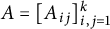 $A=[A_{ij}]_{i,j=1}^k$
. Take
 $x=(x_1,0,\ldots ,0)\in \mathbb {X}.$
We have
 $$ \begin{align*} \| Ax\|_p =& \left( \sum_{i=1}^k \| A_{i1}x_1\|^p\right)^{1/p} \geq \|A_{i1}x_1\|, \end{align*} $$
for each
 $i=1,\ldots , k.$
Taking the supremum over
 $\|x_1\|=1,$
we get
 $\| A\|_{\ell ^p} \geq \|A_{i1}\|.$
Similarly, we can show that
 $\| A\|_{\ell ^p} \geq \|A_{ij}\|$
for all
 $i,j=1, \ldots , k.$
This gives the first inequality. The third inequality follows, as
 $$ \begin{align*} &\quad \left( \max_{1\leq i\leq k}\sum_{j=1}^k\|A_{ij}\|\right)^{1/q} \left( \max_{1\leq j\leq k}\sum_{i=1}^k\|A_{ij}\|\right)^{1/p} \\ &\leq \left( k \max_{1\leq i, j\leq k}\|A_{ij}\| \right)^{1/q} \left( k \max_{1\leq i, j\leq k}\|A_{ij}\| \right)^{1/p} \\ &= k \max_{1\leq i, j\leq k}\|A_{ij}\|. \end{align*} $$
We now show the second inequality. Let
 $p\in [1,\infty ).$
Take
 $x=(x_1,\ldots ,x_k)\in \mathbb {X}$
. We have
 $$ \begin{align*} \| Ax\|_p^p=& \left\| \left( \sum_{j=1}^kA_{1j}x_j, \sum_{j=1}^kA_{2j}x_j, \ldots, \sum_{j=1}^kA_{kj}x_j \right) \right\|_p^p\\ =& \sum_{i=1}^k \left\| \sum_{j=1}^kA_{ij}x_j \right\|^p\\ \leq& \sum_{i=1}^k \left( \sum_{j=1}^k \|A_{ij}\| \left\| x_j \right\|\right)^p\\ =& \sum_{i=1}^k \left( \sum_{j=1}^k \|A_{ij}\|^{1/q} \|A_{ij}\|^{1/p} \|x_j\| \right)^p \quad (\text{where }1/p+1/q=1) \\ \leq& \sum_{i=1}^k \left(\sum_{j=1}^k \|A_{ij}\|\right)^{p/q}\left( \sum_{j=1}^k \|A_{ij}\| \|x_j\|^p \right) \quad (\text{by H\"older's inequality}) \\ \leq& \left( \max_{1 \leq i \leq k} \sum_{j=1}^k \|A_{ij}\| \right)^{p/q} \sum_{i=1}^k\left( \sum_{j=1}^k \|A_{ij}\| \|x_j\|^p \right) \\ \leq& \left( \max_{1 \leq i \leq k} \sum_{j=1}^k \|A_{ij}\| \right)^{p/q} \left( \max_{1 \leq j \leq k} \sum_{i=1}^k \|A_{ij}\| \right)^{} \sum_{j=1}^k\|x_j\|^p\\ =& \left( \max_{1 \leq i \leq k} \sum_{j=1}^k \|A_{ij}\| \right)^{p/q} \left( \max_{1 \leq j \leq k} \sum_{i=1}^k \|A_{ij}\| \right)^{}\|x\|^p_p. \end{align*} $$
Take the pth root, divide by
 $\| x \|_p$
(
 $x \neq 0$
), and take the supremum over all
 $x \neq 0$
, to obtain
 $$ \begin{align*} \| A\|_{\ell^p} \leq \left( \max_{1 \leq i \leq n} \sum_{j=1}^k \|A_{ij}\| \right)^{1/q} \left( \max_{1 \leq j \leq k} \sum_{i=1}^k \|A_{ij}\| \right)^{1/p}. \end{align*} $$
The case
 $p=\infty $
follows by a limiting argument
 $p\to \infty $
and
 $q\to 1$
.
Using Lemma 2.8, we obtain a spectral radius bound, which is a twofold extension of the existing inequality (see [Reference Hou and Du23])
 $$ \begin{align*}\rho\left( [A_{ij}]_{i,j=1}^k\right) \leq \rho\left( [\|A_{ij}\|]_{i,j=1}^k \right),\end{align*} $$
where
 $[A_{ij}]_{i,j=1}^k\in \mathcal {L}(\mathbb {H})$
and
 $\mathbb {H}= \mathbb {H}_1\oplus _2 \dots \oplus _2 \mathbb {H}_k$
. Here, we study the above spectral radius inequality in the setting of Banach spaces (real or complex) instead of complex Hilbert spaces and the
 $\ell ^p$
-sum instead of the direct sum.
To present this result, we need the submultiplicative property of the norm
 $\|\cdot \|$
on
 $\mathcal {L}(\mathbb {X})$
. This follows as
 $\|ABx\| = \|A (Bx/\|Bx\|)\| \|Bx\|\leq \|A\| \|B\|$
if
 $Bx\neq 0$
and the inequality
 $\|ABx\| \leq \|A\| \|B\|$
holds trivially if
 $Bx=0$
.
Theorem 2.9 Let
 $\mathbb {X}_1,\ldots ,\mathbb {X}_k$
be Banach spaces (real or complex) and
 $\mathbb {X}= \mathbb {X}_1\oplus _p \dots \oplus _p \mathbb {X}_k$
. Let
 $[A_{ij}]_{i,j=1}^k\in \mathcal {L}(\mathbb {X})$
be a
 $k\times k$
block matrix with
 $A_{ij}\in \mathcal {L}(\mathbb {X}_j, \mathbb {X}_i)$
. Then,
 $$ \begin{align*}\rho\left( [A_{ij}]_{i,j=1}^k\right) \leq \rho\left( [\|A_{ij}\|]_{i,j=1}^k \right).\end{align*} $$
Proof Let
 $A=[A_{ij}]_{i,j=1}^k$
. Let
 $n\in \mathbb {N}$
and the
 $(i,j)$
-entry of a matrix B be
 $(B)_{ij}.$
Then, we have
 $$ \begin{align*}(A^n)_{ij}=\sum_{1\leq i_1,\ldots,i_{n-1}\leq k}A_{ii_1}A_{i_1i_2}\ldots A_{i_{n-2}{i_{n-1}}}A_{i_{n-1}j}\end{align*} $$
and
 $$ \begin{align*}\left(\left([\|A_{ij}\|]_{i,j=1}^k\right)^n\right)_{ij}=\sum_{1\leq i_1,\ldots,i_{n-1}\leq k}\|A_{ii_1}\| \|A_{i_1i_2}\|\dots \|A_{i_{n-2}{i_{n-1}}}\| \|A_{i_{n-1}j}\|. \end{align*} $$
Using the inequalities in Lemma 2.8, we obtain
 $$ \begin{align*} \rho(A)=&\lim_{n\to \infty}\|A^n\|^{1/n}_p \\ \leq& \lim_{n\to \infty} \left\{k^{1/n} \max_{1\leq i,j\leq k} \| (A^n)_{ij}\|^{1/n} \right\}\\ =& \lim_{n\to \infty} \left\{\max_{1\leq i,j\leq k} \| (A^n)_{ij}\|^{1/n} \right\}\\ =& \lim_{n\to \infty}\left\{\max_{1\leq i,j\leq k} \left\| \sum_{1\leq i_1,\ldots,i_{n-1}\leq k}A_{ii_1}A_{i_1i_2}\ldots A_{i_{n-2}{i_{n-1}}}A_{i_{n-1}j} \right\|^{1/n} \right\}\\ \leq& \lim_{n\to \infty}\left\{\max_{1\leq i,j\leq k} \left( \sum_{1\leq i_1,\ldots,i_{n-1}\leq k} \|A_{ii_1}\| \|A_{i_1i_2}\|\dots \|A_{i_{n-2}{i_{n-1}}}\| \|A_{i_{n-1}j} \| \right)^{1/n} \right\}\\ & (\textit{using the triangle inequality and submultiplicative property of norm }\|\cdot \|)\\ =& \lim_{n\to \infty} \left\{ \max_{1\leq i,j\leq k} \left\| \left( \left([\|A_{ij}\|]_{i,j=1}^k\right)^n \right)_{ij} \right \|^{1/n} \right\}\\ \leq& \lim_{n\to \infty} \left\{ \left\| \left([\|A_{ij}\|]_{i,j=1}^k\right)^n \right \|^{1/n} \right\}\\ =& \rho\left( [\|A_{ij}\|]_{i,j=1}^k \right).\\[-34pt] \end{align*} $$
Setting
 $k=2$
in Theorem 2.9, we obtain the following spectral radius bound.
Corollary 2.10 Let
 $\mathbb {X}_1,\mathbb {X}_2$
be Banach spaces (real or complex) and
 $\mathbb {X}= \mathbb {X}_1\oplus _p \mathbb {X}_2$
. Let
 $[A_{ij}]_{i,j=1}^2\in \mathcal {L}(\mathbb {X})$
, where the entries
 $A_{ij}\in \mathcal {L}(\mathbb {X}_j, \mathbb {X}_i)$
. Then,
 $$ \begin{align*}\rho\left( [A_{ij}]_{i,j=1}^2\right) \leq \frac{1}{2}\left( \|A_{11}\|+\|A_{22}\|+\sqrt{( \|A_{11}\|-\|A_{22}\|)^2+4\|A_{12}\|\|A_{21}\| } \right).\end{align*} $$
2.1 Lower bounds for the p-numerical radius of complex matrices
In this section, we obtain lower bounds for the p-numerical radius of
 $k\times k$
complex matrices. For this purpose, we need the following inequality for vectors
 $x,y$
in a normed linear space
 $\mathbb {X}=(\mathbb {X}, \| \cdot \|),$
given by Maligranda [Reference Maligranda27]:
 $$ \begin{align} \|x+y\| \leq \|x\|+\|y\|-\left( 2- \left\|\frac{x}{\|x\|}+\frac{y}{\|y\|} \right\|\right)\min \left(\|x\|, \|y\| \right). \end{align} $$
Let
 $A\in {M}_k(\mathbb {C})$
. Then,
 $A=\Re (A)+i \Im (A)$
is the Cartesian decomposition of A, where
 $\Re (A)=\frac {1}{2}(A+A^*)$
and
 $\Im (A)=\frac {1}{2i}(A-A^*)$
. Using this decomposition, we present a lower bound for the p-numerical radius of A.
Proposition 2.11 Let
 $A\in {M}_k(\mathbb {C})$
. Then,
 $$ \begin{align*} \frac{1}{2}\|A\|_{\ell^p}+ \mu_p(A) \leq w_p(A), \end{align*} $$
where
 $\mu _p(A)=\frac 12 \left (2-\left \|\frac {\Re (A)}{\| \Re (A)\|_{\ell ^p}}+ i \frac {\Im (A)}{\| \Im (A)\|_{\ell ^p}} \right \|_{\ell ^p} \right ) \min \left ( \| \Re (A)\|_{\ell ^p}, \| \Im (A)\|_{\ell ^p} \right )$
.
Proof Setting the normed linear space
 $\mathbb {X}=({M}_k(\mathbb {C}), \|\cdot \|_{\ell ^p})$
and vectors
 $x=\Re (A)$
and
 $y=i \Im (A)$
in (2.4) and then using the inequalities
 $\|\Re (A)\|_{\ell ^p}\leq w_p(A)$
and
 $\|\Im (A)\|_{\ell ^p}\leq w_p(A)$
(which follow from (1.2)), we obtain the desired inequality.
Remark 2.12 (i) Setting
 $p=2$
in Proposition 2.11, we get
 $$ \begin{align} \frac{1}{2}\|A\|+ \mu(A) &\leq w(A), \end{align} $$
where
 $\mu (A)=\frac 12 \left (2-\left \|\frac {\Re (A)}{\| \Re (A)\|}+ i \frac {\Im (A)}{\| \Im (A)\|} \right \| \right ) \min \left ( \| \Re (A)\|, \| \Im (A)\| \right ).$
(ii) Clearly, (2.5) refines the classical numerical radius inequality
 $\frac {1}{2}\|A\| \leq w(A).$
To show proper refinement, we take a simple example
 $A=\begin {bmatrix} 1&0\\ 0&i \end {bmatrix}.$
We see that
 $$ \begin{align*}\frac{1}{2}\|A\|=\frac{1}{{2}} < 1= \frac{1}{2}\|A\|+\mu(A).\end{align*} $$
(ii) Similar to Proposition 2.11, we can also obtain
 $$ \begin{align} \frac{1}{4}\|A^*A+AA^*\| + \nu(A) \leq\ & w^2(A), \end{align} $$
where
 $\nu (A)=\frac 12 \left (2-\left \|\frac {\Re ^2(A)}{\| \Re (A)\|^2}+ i \frac {\Im ^2(A)}{\| \Im (A)\|^2} \right \| \right ) \min \left ( \| \Re (A)\|^2, \| \Im (A)\|^2 \right ).$
This refines the well-known Kittaneh’s inequality
 $\frac {1}{4}\|A^*A+AA^*\| \leq w^2(A)$
(see [Reference Kittaneh24]).
(iii) Note that the numerical radius bounds (2.5) and (2.6) can also be deduced from (2.4) for any bounded linear operator
 $A\in \mathbb {B}(\mathbb {H})$
defined on a complex Hilbert space
 $\mathbb {H}.$
Finally, we deduce a complete characterization of the equality
 $\frac {1}{2}\|A\|_p= w_p(A)$
. This characterization, for
 $p=2$
, was given by Bhunia and Paul [Reference Bhunia and Paul12, Theorem 2.4].
Proposition 2.13 Suppose
 $A\in {M}_k(\mathbb {C})$
. Then,
 $ \frac {1}{2}\|A\|_p = w_p(A)$
if and only if
 $\|\Re (e^{i\theta }A)\|_{\ell ^p}=\|\Im (e^{i\theta }A)\|_{\ell ^p}= \frac {1}{2}\|A\|_{\ell ^p}$
for all
 $\theta \in \mathbb {R}$
.
Proof The sufficient part is trivial; we only prove the necessary part. Following the definition of the p-numerical radius, for every
 $\theta \in \mathbb {R},$
we have
 $$ \begin{align*} w_p(A) \geq\ & \max \{ \|\Re(e^{i\theta}A)\|_{\ell^p}, \|\Im(e^{i\theta}A)\|_{\ell^p}\}\\ =\ & \frac{1}{2}(\|\Re(e^{i\theta}A)\|_{\ell^p}+ \|\Im(e^{i\theta}A)\|_{\ell^p})+ \frac{1}{2}|\|\Re(e^{i\theta}A)\|_{\ell^p}- \|\Im(e^{i\theta}A)\|_{\ell^p}|\\ \geq\ & \frac{1}{2}(\|\Re(e^{i\theta}A)+i \Im(e^{i\theta}A)\|_{\ell^p})+ \frac{1}{2}|\|\Re(e^{i\theta}A)\|_{\ell^p}- \|\Im(e^{i\theta}A)\|_{\ell^p}|\\ =\ & \frac{1}{2}\|A\|_{\ell^p}+ \frac{1}{2}|\|\Re(e^{i\theta}A)\|_{\ell^p}- \|\Im(e^{i\theta}A)\|_{\ell^p}|. \end{align*} $$
Thus,
 $ \frac {1}{2}\|A\|_{\ell ^p} = w_p(A)$
implies
 $\|\Re (e^{i\theta }A)\|_{\ell ^p}= \|\Im (e^{i\theta }A)\|_{\ell ^p}$
for every
 $\theta \in \mathbb {R}.$
Acknowledgements
I thank the referee for his/her valuable comments and suggestions.
Competing interest statement
The author declares that data sharing is not applicable to this article as no datasets were generated or analyzed during the current study. The author states that there is no competing interest.



