






No CrossRef data available.
Article contents
Frozen cultural plasticity
Published online by Cambridge University Press: 09 March 2016
Abstract
We discuss cultural group selection under the view of the frozen plasticity theory and the different explanatory power and predictions of this framework. We present evidence that cultural adaptations and their influence on the degree of cooperation may be more complex than presented by Richerson et al., and conclude with the gene-environment-culture relationship and its impacts on cultural group selection.
Information
- Type
- Open Peer Commentary
- Information
- Copyright
- Copyright © Cambridge University Press 2016
References
Acemoglu, D., Johnson, S. & Robinson, J. A. (2001) The colonial origins of comparative development: An empirical investigation. American Economic Review
91(5):1369–401. doi: 10.1257/aer.91.5.1369.CrossRefGoogle Scholar
Acemoglu, D., Johnson, S. & Robinson, J. A. (2002) Reversal of fortune: Geography and institutions in the making of the modern world income distribution. The Quarterly Journal of Economics
117(4):1231–94. doi: 10.1162/003355302320935025.Google Scholar
Acemoglu, D., Johnson, S. & Robinson, J. A. (2005) Institutions as a fundamental cause of long-run growth. In: Handbook of economic growth, vol. 1, Part A, ed. Philippe, A. & Steven, N. D., pp. 385–72. Elsevier.Google Scholar
Akey, J. M. (2009) Constructing genomic maps of positive selection in humans: Where do we go from here?
Genome Research
19(5):711–22. doi: 10.1101/gr.086652.108.CrossRefGoogle Scholar
Ashraf, Q. & Galor, O. (2013) The “Out of Africa” hypothesis, human genetic diversity, and comparative economic development. American Economic Review
103(1):1–46. doi: 10.1257/aer.103.1.1.Google Scholar
Boldrin, M. & Levine, D. K. (2008) Against intellectual monopoly. Cambridge University Press.Google Scholar
Brooks, B. A., Hoff, K. & Pandey, P. (2014) Insult versus accident: Caste culture and the efficiency of coordination. Available at: http://faculty.chicagobooth.edu/workshops/micro/past/pdf/brooksinsultvsaccident.pdf.Google Scholar
Chanda, A., Cook, C. J. & Putterman, L. (2014) Persistence of fortune: Accounting for population movements, there was no post-Columbian reversal. American Economic Journal: Macroeconomics
6(3):1–28. doi: 10.1257/mac.6.3.1.Google Scholar
Cook, C. J. (2014) The role of lactase persistence in precolonial development. Journal of Economic Growth
19(4):369–406. doi: 10.1007/s10887-014-9109-5.Google Scholar
Flegr, J. (2010) Elastic, not plastic species: Frozen plasticity theory and the origin of adaptive evolution in sexually reproducing organisms. Biology Direct
5(1):2. doi: 10.1186/1745-6150-5-2.CrossRefGoogle Scholar
Gintis, H. (2008) Punishment and cooperation. Science
319(5868):1345–46. doi: 10.1126/science.1155333.Google Scholar
Glaeser, E., La Porta, R., Lopez-de-Silanes, F. & Shleifer, A. (2004) Do institutions cause growth?
Journal of Economic Growth
9(3):271–303. doi: 10.1023/B:JOEG.0000038933.16398.ed.Google Scholar
Havlíček, J. & Roberts, S. C. (2013) The perfume-body odour complex: An insightful model for culture–gene coevolution? In: Chemical signals in vertebrates 12, ed. East, M. L. & Dehnhard, M., pp. 185–95. Springer.Google Scholar
Herrmann, B., Thöni, C. & Gächter, S. (2008) Antisocial punishment across societies. Science
319(5868):1362–67. doi: 10.1126/science.1153808.Google Scholar
Iannaccone, L. R. (1998) Introduction to the economics of religion. Journal of Economic Literature
36(2):1465–95.Google Scholar
Kuběna, A. A., Houdek, P., Lindová, J., Příplatová, L. & Flegr, J. (2014) Justine effect: Punishment of the unduly self-sacrificing cooperative individuals. PLoS One
9(3):e92336. doi: 10.1371/journal.pone.0092336.Google Scholar
Norenzayan, A., Shariff, A. F., Gervais, W. M., Willard, A. K., McNamara, R. A., Slingerland, E. & Henrich, J. (2016) The cultural evolution of prosocial religions. Behavioral and Brain Sciences
39. doi: 10.1017/S0140525X14001356.Google Scholar
Olsson, O. & Paik, C. (2013) A western reversal since the Neolithic? The long-run impact of early agriculture. University of Gothenburg Working Papers in Economics.Google Scholar
Prietula, M. & Conway, D. (2009) The evolution of metanorms: Quis custodiet ipsos custodes?
Computational and Mathematical Organization Theory
15(3):147–68. doi: 10.1007/s10588-009-9056-4.CrossRefGoogle Scholar
Spolaore, E. & Wacziarg, R. (2013) How deep are the roots of economic development?
Journal of Economic Literature
51(2):325–69. doi: 10.1257/jel.51.2.325.Google Scholar
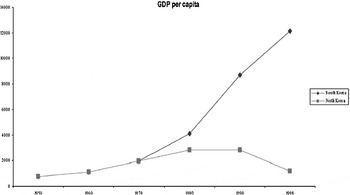
Figure 1 (Houdek & Novakova). Gross domestic product (GDP) per capita in North and South Korea, 1950–98. Reprinted with permission from Acemoglu et al. (2005).
Richerson et al. present compelling evidence for cultural group selection acting as a major constituent of human cooperation; however, we argue that it would be more beneficial to view cultural evolution in light of more complex evolutionary models, such as the punctuated equilibrium theory or the frozen plasticity theory (Flegr Reference Flegr2010): frequency-dependent selection of cultural norms and, mostly, punctuated equilibrium pattern of cultural evolution (in contrast to the simple gradualist approach in Richerson et al.'s target article).
The frozen plasticity framework takes into account the relations between the cultural norms, which are seldom unrelated to each other (a cultural trait can be a positive norm in one context, but a harmful one in another context). The result could be that the more institutions a culture develops, the more “frozen” it becomes as the traits interact, and it becomes increasingly difficult for any new (better) variant to become established, especially if the culture is isolated.
An example of our point consists in thriving Neolithic agricultural societies, which formed large and successful autocratic cultures, but in which high power inequality and rent-seeking emerged. These factors eventually became barriers to their further development and prevented efficient cooperation, as the magnitude of relationships between various institutions grew so large that any change would require too large a restructuralization of the status quo (Olsson & Paik Reference Olsson and Paik2013). Major institutional changes are likely only after the occurrence of large-scale events or disasters – natural as well as socioeconomic. (An example of this is that, in the aftermath of World War II, Japan ended state Shintoism and hundreds of religious groups sprang up in a very quick succession; Iannaccone Reference Iannaccone1998.) But there is no place for such developments in Richerson et al.'s framework; in their view, societies implement cooperative norms and irreversibly move toward prosperity.
We would like to stress that adjustment toward better-performing norms (“cultural plasticity”) is more intricate than Richerson et al. suggest. We show this in the following sections.
The unbearable lightness of good institutions
Culture adoption elasticity is highly dependent on the geographical, historical, and intragroup factors and on development of competing cultures, but the direction of influence is not straightforward (Acemoglu et al. Reference Acemoglu, Johnson, Robinson, Philippe and Steven2005). For example, Europeans were more likely to introduce extractive colonial regimes in relatively richer societies or regions where they could not settle. These regions struggle with poverty now. On the contrary, in relatively poor regions Europeans settled in large numbers and implemented institutions that encourage prosperity today (Acemoglu et al. Reference Acemoglu, Johnson and Robinson2001; Reference Acemoglu, Johnson and Robinson2002). Richerson et al. would view the story in terms of pure natural selection, but their general theory does not distinguish among factors such as culture and institutions versus human capital (Chanda et al. Reference Chanda, Cook and Putterman2014; Glaeser et al. Reference Glaeser, La Porta, Lopez-de-Silanes and Shleifer2004) versus genetic diversity (Ashraf & Galor Reference Ashraf and Galor2013; Cook Reference Cook2014), which co-influence intergroup competition.
Moreover, similar types of culture originating from one ancestral culture may choose similar environments to colonize, thereby creating a logically consistent phylogenetic tree while not excluding the evoked culture hypothesis. The character of natural environment may have influenced the relative ability of different cultures to expand and prevail over others; thus institutional variation could be only a derivative force in intergroup competition (Spolaore & Wacziarg Reference Spolaore and Wacziarg2013).
(Mal)adaptivity of institutions and norms in cooperation
Richerson et al. neglect to stress that some norms can be beneficial on a certain level and harmful on another by moving a culture to the non-cooperative equilibrium. They mention the benefits of institutionalized norms like honor and bravery to intergroup warfare; however, these can act harmfully at the intragroup level. The culture of honor within high castes in India is related to a low degree of coordination (Brooks et al. Reference Brooks, Hoff and Pandey2014).
Norms that had become “frozen” may have a detrimental effect in many modern societies, expressed, for instance, in the higher prevalence of antisocial punishment (Kuběna et al. Reference Kuběna, Houdek, Lindová, Příplatová and Flegr2014) in countries whose strong emphasis on traditions may have been beneficial previously (Gintis Reference Gintis2008; Herrmann et al. Reference Herrmann, Thöni and Gächter2008). While some norms could have played an essential role in forming human cooperation, many likely ceased fulfilling this role due to the decreased adaptivity of the trait-network. Important examples of these phenomena could be religious norms (Norenzayan et al. Reference Norenzayan, Shariff, Gervais, Willard, McNamara, Slingerland and Henrich2016).
Selection forces acting on meta-norms
Richerson et al. establish the government as an intelligent designer. Their examples include patent law and antimonopoly law. However, these traits are more in accord with our argument that social norms become “frozen” in time. They persist largely due to powerful special interest groups, even if they become harmful for the society. Patent law in its current form impedes rather than promotes innovation (Boldrin & Levine Reference Boldrin and Levine2008), and antimonopoly law is often a tool of adjustment of government politics (Armentano Reference Armentano1986) or a product of lobby groups' pressure.
The meta-norms (i.e., norms promoting punishment of defectors and punishment-shirkers alike) are subject to selection as well. Prietula and Conway (Reference Prietula and Conway2009) note that an established or internalized meta-norm could easily become a “trap” and stop being beneficial.
Gene-culture coevolution
Genetic diversity has greater effects on comparative development than Richerson et al. admit. Genetic make-up can influence aspects of cultural evolution, which along with resource accessibility may in turn give advantage to bearers of certain genetic markers in a gene-culture coevolutionary process, for example, in the interaction of scents and genetic make-up (Havlíček & Roberts Reference Havlíček, Roberts, East and Dehnhard2013). Loci related to olfaction, immunity, and metabolism (connected to subsistence strategies) are among those most positively selected in recent human history (Akey Reference Akey2009).
Conclusion
We fully support cultural selection as the principal explanation for the degree of cooperation among humans (see a contemporary example in our Fig. 1: North and South Koreans shared the same history and cultural, linguistic, and geographic roots, but institutional differences dramatically diverged the development of their countries). Nevertheless, we suggest a rigorous analysis of the political and population structure of societies throughout their history to assess whether “cultural bottlenecks” and founder effects influence the plasticity of cultural traits and can explain human cooperation in greater detail.
(Houdek & Novakova). Gross domestic product (GDP) per capita in North and South Korea, 1950–98. Reprinted with permission from Acemoglu et al. (Reference Acemoglu, Johnson, Robinson, Philippe and Steven2005).