








1 Introduction
Let
$F \in \mathbb Z[x, y]$
 be a binary form of degree
$d \geq 3$
 and nonzero discriminant. For a fixed nonzero integer
$m$
 , consider the Diophantine equation

Such an equation is called the Thue equation, and it is named after the Norwegian mathematician Axel Thue, who proved in 1908 that the number of solutions to (1.1) is finite, provided that
$F$
 is irreducible [Reference Thue9]. Over the course of the 20th century Thue equations had been studied quite extensively. In 1933, assuming that
$F$
 is irreducible, Mahler [Reference Mahler4] established the existence of a number
$C$
 , dependent only on
$F$
 , such that the number of primitive solutions to (1.1), – that is, solutions with
$x$
 and
$y$
 coprime, – does not exceed
$C^{1 + \omega (m)}$
 , where
$\omega (m)$
 denotes the number of distinct prime divisors of
$m$
 . It was conjectured by Siegel that the number of primitive solutions to (1.1) should not depend on the coefficients of
$F$
 . In 1984, Evertse [Reference Evertse3] proved that the number of primitive solutions to (1.1) does not exceed
$2\cdot 7^{d^3(2\omega (m) + 3)}$
 , thus establishing Siegel’s conjecture. This estimate got significantly improved by Bombieri and Schmidt [Reference Bombieri and Schmidt2], who proved that there exists an absolute constant
$C$
 such that the number of primitive solutions to (1.1) does not exceed
$Cd^{1 + \omega (m)}$
 . In 1991, this result was further refined by Stewart [Reference Stewart8], who managed to replace
$\omega (m)$
 with
$\omega (g)$
 , where
$g$
 is some “large” divisor of
$m$
 .
In what follows, we restrict our attention to Thue equations

Let
$a$
 be a nonzero integer. Then for

the Thue equation
$F(x, y) = 1$
 has at least
$d$
 solutions, namely,
$(1, 1)$
 ,
$(1, 2)$
 , …,
$(1, d)$
 . This example demonstrates that, in general, it is impossible to remove the dependency of the number of solutions on
$d$
 . However, for certain families of Thue equations, an absolute bound on the number of solutions can be obtained, as it was done, for example, by Mueller and Schmidt [Reference Mueller and Schmidt7], who proved that there exists an absolute constant
$C$
 such that the number of solutions of
$|F(x, y)| = 1$
 does not exceed
$C(s - 1)^2$
 , where
$s$
 is the number of nonzero coefficients of
$F$
 . Thus, for example, an absolute bound can be established for binomial and trinomial Thue forms. In general, solving a Thue equation is a quite challenging computational task, and it is usually done using the algorithm of Tzanakis and de Weger [Reference Tzanakis and de Weger10] in combination with effective bounds obtained with methods from the theory of linear forms in logarithms.
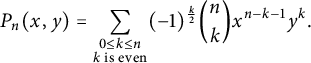
In this article, we present the family of binary forms
$P_n$
 , and completely solve their associated Thue equations (1.2). For a positive integer
$n$
 , define

Notice that
$P_n$
 is a binary form for odd
$n$
 , and it is not a binary form for even
$n$
 . However,
$R_n = xP_n$
 is a binary form for every positive integer
$n$
 , and this binary form was studied in [Reference Mosunov5]. We restrict our attention to odd
$n$
 , when
$P_n$
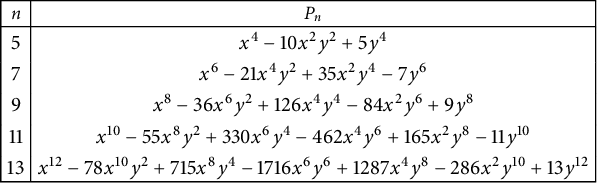
 is a binary form. See Table 1 for the list of
$P_n$
 for
$n = 5, 7, 9, 11, 13$
 . Notice that
$P_n$
 has integer coefficients, degree
$n - 1$
 , and content one (i.e., the greatest common divisor of the coefficients of
$P_n$
 is equal to one). From [Reference Mosunov5], we deduce the factorization of
$P_n$
 :

where
$c_{m}(x, y)$
 is the homogenization of the minimal polynomial of
$\cot \frac {\pi }{m}$
 . In the special case when
$n$
 is an odd prime, we find that
$P_n(x, 1)$
 is the minimal polynomial of
$\cot \frac {\pi }{2n}$
 , and so the binary form
$P_n$
 is irreducible over the rationals. We prove the following theorem.
Binary forms
$P_n$
 for
$n = 5, 7, 9, 11, 13$
 .

Table 1 Long description
The table consists of two columns labeled n and P sub n.
* Row 1: n equals 5. P sub n is x super 4 minus 10 x squared y squared plus 5 y super 4.
* Row 2: n equals 7. P sub n is x super 6 minus 21 x super 4 y squared plus 35 x squared y super 4 minus 7 y super 6.
* Row 3: n equals 9. P sub n is x super 8 minus 36 x super 6 y squared plus 126 x super 4 y super 4 minus 84 x squared y super 6 plus 9 y super 8.
* Row 4: n equals 11. P sub n is x super 10 minus 55 x super 8 y squared plus 330 x super 6 y super 4 minus 462 x super 4 y super 6 plus 165 x squared y super 8 minus 11 y super 10.
* Row 5: n equals 13. P sub n is x super 12 minus 78 x super 10 y squared plus 715 x super 8 y super 4 minus 1716 x super 6 y super 6 plus 1287 x super 4 y super 8 minus 286 x squared y super 10 plus 13 y super 12.
Theorem 1.1 Let
$n \geq 5$
 be an odd integer and let
$P_n$
 be as in (1.3). Then the Thue equation
$P_n(x, y) = 1$
 has exactly two solutions, namely,
$(1, 0)$
 and
$(-1, 0)$
 . In turn, the Thue equation
$P_n(x, y) = -1$
 has no solutions.
The result is of importance because all roots of
$P_n(x, 1)$
 are real, making the curves
$P_n(x, y)= \pm 1$
 as far from being compact in
$\mathbb R^2$
 as possible. Further, as the number of nonzero coefficients of
$P_n$
 is
$s_n = \frac {n + 1}{2}$
 , for
$n \rightarrow \infty $
 the bound
$C(s_n - 1)^2$
 established by Mueller and Schmidt approaches infinity, whereas the actual bound is
$2$
 . The proof of Theorem 1.1 can be found in Section 2 and it follows from the famous result of Bilu et al. [Reference Bilu, Hanrot and Voutier1] on Lucas sequences. This proof was inspired by the response of the user MCipu to the MathOverflow post, who answered in the affirmative that for every
$n> 3$
 and every non-unit Gaussian integer
$z$
 , the number
$z^n \pm z$
 is a rational integer if and only if
$z$
 is a rational integer [Reference Mosunov6].
2 Proof of Theorem 1.1
Let
$n \geq 5$
 be an odd integer and let
$R_n$
 and
$J_n$
 be binary forms such that

It follows from [Reference Mosunov5, Proposition 2.1] that
$R_n = xP_n$
 and so

Setting
$z = x + yi$
 , we find that

Since the quantity on the right-hand side is purely imaginary, we conclude that

Rearranging, we get

The above expression requires that
$z + \overline {z} \neq 0$
 , or equivalently that
$x \neq 0$
 . In the case when
$x = 0$
 , we have
$P_n(0, y) = (-1)^{\frac {n - 1}{2}}ny^{n - 1}$
 .
Now, suppose that there exists a pair
$(x, y) \in \mathbb Z^2$
 such that
$P_n(x, y) = \pm 1$
 . Then
$x \neq 0$
 because the Diophantine equations
$P_n(0, y) = \pm 1$
 have no solutions. Further,
$x$
 and
$y$
 are coprime and

Suppose that
$z = (1 + i)z'$
 , where the norm of the Gaussian integer
$z'$
 is odd. Observe that the exponent of
$1 + i$
 in the factorization of
$z$
 in the ring of Gaussian integers
$\mathbb Z[i]$
 cannot be larger than one, since
$(1 + i)^2 = 2i$
 , which would imply that
$x$
 and
$y$
 share a factor of two in common. Notice that

Thus,

Thus,
$(1 + i)$
 divides
$1$
 , which is impossible. We conclude that either
$x$
 or
$y$
 is even, which means that the norm of
$iz = -y + xi$
 is odd. Consequently, the numbers
$iz + \overline {iz} = -2y$
 and
$\left (iz\right )\left (\overline {iz}\right ) = x^2 + y^2$
 are coprime. Suppose that
$z \notin \{\pm 1,\ \pm i,\ 1 \pm i,\ -1 \pm i\}$
 , so that
$iz/\overline {iz}$
 is not a root of unity. Then
$(\alpha , \beta ) = \left (iz, \overline {iz}\right )$
 is a Lucas pair, and

is the
$n$
 -th Lucas number. A prime number
$p$
 is a primitive divisor of
$u_n(\alpha , \beta )$
 if
$p$
 divides
$u_n$
 but does not divide
$(\alpha - \beta )^2u_1\ldots u_{n - 1}$
 . In our case,

and since
$u_n = \pm 1$
 , we see that
$u_n$
 has no primitive divisors, which means that the pair
$(\alpha , \beta )$
 is a so-called n-defective Lucas pair. It follows from the famous result of Bilu et al. that
$n \leq 30$
 [Reference Bilu, Hanrot and Voutier1, Theorem 1.4].
Now, two Lucas pairs
$(\alpha _1, \beta _1)$
 and
$(\alpha _2, \beta _2)$
 are equivalent if and only if
$\alpha _1/\alpha _2 = \beta _1/\beta _2 = \pm 1$
 . Since
$n$
 is odd and
$n \leq 30$
 , the result of Voutier [Reference Voutier11] tells us that, up to equivalence, all
$n$
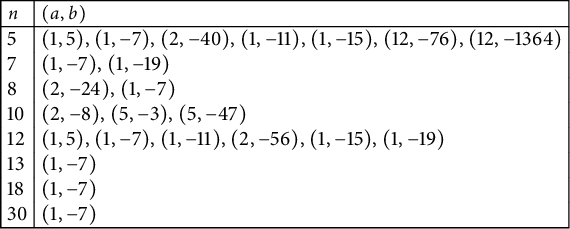
 -defective Lucas pairs are of the form
$(a \pm \sqrt b)/2$
 , where
$(a, b)$
 are given in Table 2. As it was remarked by the anonymous referee, for each
$(a, b)$
 either the real part of
$(a \pm \sqrt b)/2$
 is half-integral or its imaginary part is non-integral. Consequently, no such pair has the form
$x \pm yi$
 for some integers
$x$
 and
$y$
 , which means that we reach a contradiction. Therefore, it must be the case that
$z \in \{\pm 1,\ \pm i,\ 1 \pm i,\ -1 \pm i\}$
 , or equivalently that

$n$
 -defective Lucas pairs (up to equivalence) for
$4 < n \leq 30$
 and
$n \neq 6$
 .

Table 2 Long description
The table consists of two columns. The first column is labeled n and the second column is labeled (a, b).
* Row 1: n is 5. The pairs are (1, 5), (1, -7), (2, -40), (1, -11), (1, -15), (12, -76), and (12, -1364).
* Row 2: n is 7. The pairs are (1, -7) and (1, -19).
* Row 3: n is 8. The pairs are (2, -24) and (1, -7).
* Row 4: n is 10. The pairs are (2, -8), (5, -3), and (5, -47).
* Row 5: n is 12. The pairs are (1, 5), (1, -7), (1, -11), (2, -56), (1, -15), and (1, -19).
* Row 6: n is 13. The pair is (1, -7).
* Row 7: n is 18. The pair is (1, -7).
* Row 8: n is 30. The pair is (1, -7).
It remains to determine which of the above eight pairs (if any) are solutions. From (1.3), we have

Thus,
$(1, 0)$
 is a solution to
$P_n(x, y) = 1$
 and it is never a solution to
$P_n(x, y) = -1$
 . Since
$P_n(-1, 0) = (-1)^{n - 1}P_n(1, 0)$
 and
$n$
 is odd, we find that
$(-1, 0)$
 is also a solution to
$P_n(x, y) = 1$
 , and it is not a solution to
$P_n(x, y) = -1$
 .
Next, from (1.3), we also have

We see that
$(0, 1)$
 is never a solution to (1.2). Since
$P_n(0, -1) = (-1)^{n - 1}P_n(0, 1)$
 and
$n$
 is odd, we see that
$(0, -1)$
 never satisfies
$P_n(x, y) = \pm 1$
 .
Finally, from (2.1), we have

We see that
$\left |\frac {(1 + i)^n + (1 - i)^n}{(1 + i) + (1 - i)}\right | = 1$
 if and only if
$n = 1$
 . Since
$n \geq 5$
 , we see that the pairs
$(1, 1)$
 ,
$(1, -1)$
 ,
$(-1, 1)$
 , and
$(-1, -1)$
 never satisfy
$P_n(x, y) = \pm 1$
 .
Acknowledgements
The author is indebted to the anonymous user MCipu on MathOverflow for their valuable insight, as well as to Prof. Cameron L. Stewart and the anonymous referee for their suggestions on how to improve the article.






 Open access

