


Highlights
-
• Patients evaluated by telestroke prior to endovascular thrombectomy (EVT) had longer onset-to-treatment delays and more proximal occlusions.
-
• Telestroke patients had worse functional outcomes, likely attributable to longer onset-to-EVT times, as telestroke was primarily used at remote hospitals.
-
• Workflow optimisation for patients evaluated by telestroke prior to EVT is critical.
Introduction
For every 30-minute delay in reperfusion after onset of an ischaemic stroke, the odds of achieving a good outcome decrease by 26%.Reference Ribo, Molina and Cobo1 Telestroke allows rapid assessment of patients presenting with acute stroke symptoms for reperfusion therapies including intravenous thrombolysis and endovascular thrombectomy (EVT). Telestroke consists of a real-time assessment with videoconferencing and a system for accessing medical imaging, which has been shown to be superior in decision-making for thrombolysis than a telephone consultation.Reference Meyer, Raman and Hemmen2 Canadian stroke guidelines state that a telestroke network should be in place to ensure equitable access to acute stroke care across Canada.Reference Heran, Lindsay and Gubitz3 This applies primarily to hospitals lacking stroke experts for assessment, diagnosis and treatment, including the decision to perform thrombolysis or transfer for thrombectomy.Reference Heran, Lindsay and Gubitz3 A systematic review and meta-analysis of 1863 patients demonstrated no difference in rates of symptomatic intracerebral haemorrhage (sICH), 90-day mortality and 90-day functional independence between telemedicine-guided and stroke centre thrombolysis.Reference Kepplinger, Barlinn, Deckert, Scheibe, Bodechtel and Schmitt4 Furthermore, several studies highlight the benefits of a telestroke programme in rural areas, with an increase in the number of thrombolysis cases and an improvement in clinical outcomes.Reference Lazarus, Permana, Nugroho, Audrey, Wijaya and Widyahening5,Reference Audebert, Schenkel, Heuschmann, Bogdahn and Haberl6
Prompt administration of thrombolysis is an advantage of telestroke.Reference Kurunawai, Chen and Willcour7 Although the safety and efficacy of telestroke services for the delivery of intravenous thrombolysis have been well established,Reference Schwab, Vatankhah and Kukla8,Reference Zaidi, Jumma and Urra9 evidence on EVT decision-making, patient workflow and outcomes is scarce. Some data suggest an increase in the use of thrombectomy through telestroke implantation.Reference Wilcock, Schwamm and Zubizarreta10 Potential roles of telestroke in the thrombectomy decision include patient selection, facilitated access to remote brain imaging and upstream preparation of the neurointerventional team.Reference Akbik, Hirsch and Chandra11 Despite this, patients transferred for EVT experience significant delays from the time they were last seen normal to the initiation of EVT.Reference Katsanos, Poppe and Swartz12 Our overall objective was to assess the impact and safety of telestroke evaluation in all patients undergoing thrombectomy, regardless of transfer status, as compared to those not assessed with telestroke. Because telestroke evaluation is primarily used to assess patients at a referring centre prior to transfer for EVT, we also performed a sub-analysis of telestroke utilisation exclusively for those patients transferred from a non-EVT centre to an EVT centre (“drip and ship” model).
Methods
We analysed data from Optimising Patient Treatment In Major Ischaemic Stroke with EVT (OPTIMISE), a prospective quality improvement registry, designed to support EVT implementation in Canada.
OPTIMISE was initiated in Canada in 2018 to facilitate the development of quality assurance and improvement programmes at participating sites that would support them in providing timely, guideline-based EVT, while capturing patient outcomes. Twenty EVT centres across seven provinces (British Columbia, Manitoba, New Brunswick, Nova Scotia, Ontario, Quebec, Saskatchewan), comprising 91% of all EVT centres in Canada, participated in OPTIMISE.Reference Katsanos, Poppe and Swartz12
OPTIMISE is managed by the Canadian Stroke Consortium under the direction of a Steering Committee composed of neurologists and neurointerventionalists with expertise in the management of acute ischaemic stroke patients.
We assessed for unadjusted differences in baseline characteristics, time metrics, procedural and functional outcomes between patients with stroke treated with EVT who received telestroke evaluation (telestroke group) and those who didn’t (non-telestroke group). In this registry, telestroke was defined as video-based assessment of the patient with remote access to neuroimaging. The telestroke group was comprised of patients who were not only evaluated at a primary stroke centre but also included patients presenting after-hours directly to an EVT centre but first evaluated by telestroke. Conversely, the non-telestroke group was comprised of patients evaluated in-person at a primary stroke centre prior to transfer or in-person directly at the EVT centre.
The primary analysis included all cases in the registry. A sub-analysis was performed on transferred cases only, using the same methodology, considering that telestroke is primarily used for patients first evaluated at primary stroke centres. The sub-analysis compared patients transferred to an EVT centre after having a telestroke evaluation at a primary stroke centre to those who were evaluated in-person at a primary stroke centre and then transferred for EVT.
The main outcomes in the unadjusted analysis included successful reperfusion, defined as a thrombolysis in cerebral infarction (TICI) score ≥ 2b; sICH; good functional outcome at discharge and at 90 days, defined as a modified Rankin Scale (mRS) score of 0–2; and all-cause mortality at discharge and at 90 days.
After assessing the normality of distributions by the Shapiro–Wilk test, continuous variables were expressed as mean ± SD or median (interquartile range) and compared with the Student t or Mann–Whitney U tests as appropriate. Categorical variables were reported as frequencies and percentages and were compared using Pearson X2 or Fisher exact. We used mixed-effects logistic regression models to compare the likelihood of sICH, good functional outcome (mRS 0–2) and all-cause mortality at discharge and at 90 days between the two groups. Outputs from regression analyses are provided with the corresponding odds ratio (OR). Regression models were also adjusted for predefined confounders, including age at stroke onset, whether the patient was transferred or not, National Institutes of Health Stroke Scale (NIHSS) score obtained at the EVT centre prior to EVT (baseline NIHSS), baseline Alberta Stroke Program Early CT Score (ASPECTS), onset-to-groin puncture time, final TICI score, anaesthesia type, intravenous thrombolysis use, carotid stenting and EVT centre. In the multivariable model, we added the EVT centre as a random effect intercept to see if the outcomes differed by centre. All statistical analyses were performed using R software V2023.03.0 and SPSS Version 29.0.1.1(244).
All participating centres obtained approval for use of OPTIMISE data from their local Research Ethics Boards. Individual participant consent was waived due to the anonymised, noninterventional nature of the registry. The data that support the findings of this study may be available from the corresponding author upon reasonable request by a qualified investigator and after approval from the OPTIMISE steering committee.
Results
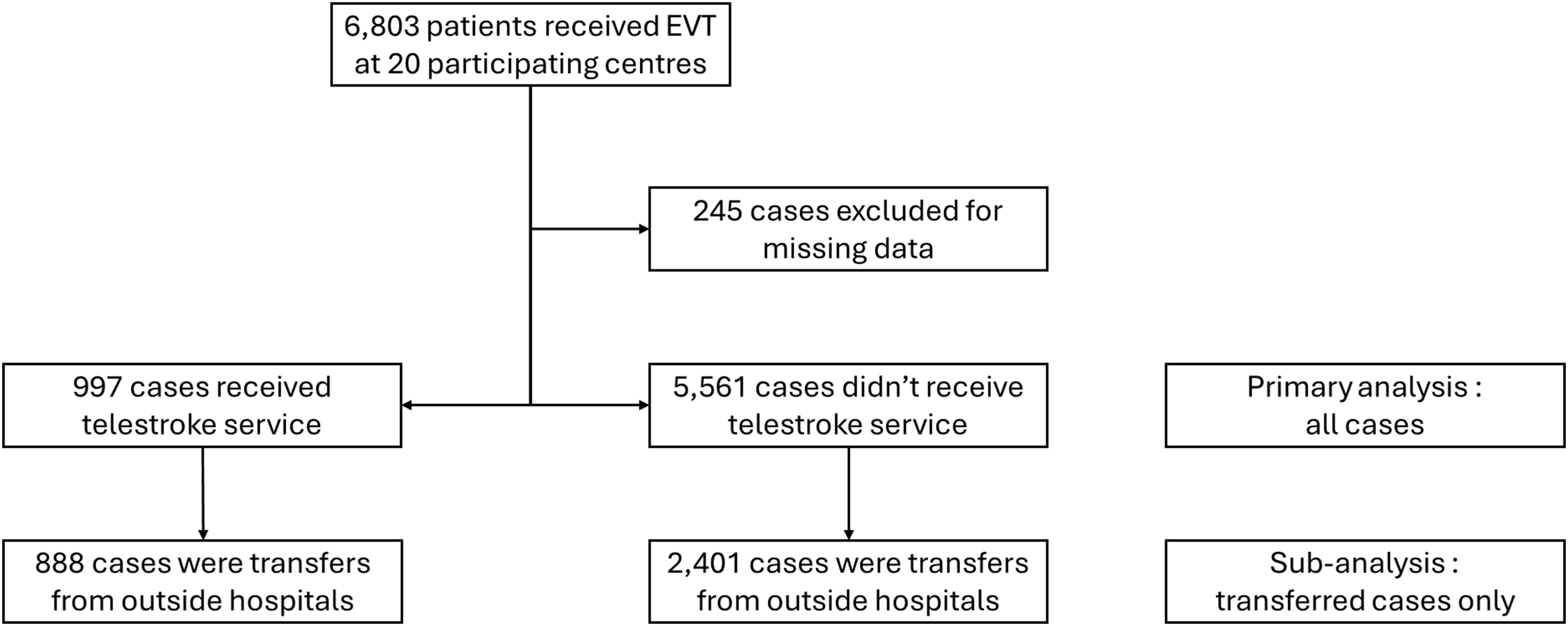
Between 1 January 2018 and 31 December 2021, a total of 6803 patients received EVT at 20 participating centres (median age 73 years, 50.1% women, 49.4% treated with intravenous thrombolysis). 245 cases were excluded due to missing data (Figure 1). A total of 997 patients (15.2%) were treated by telestroke, and 5561 (84.8%) patients were treated without telestroke. The use of telestroke was fairly stable over the timeframe of the study, with a marginal increase after 2019 (Supplementary Figure). The two groups differed with regard to certain baseline characteristics, including the use of intravenous thrombolysis, type of anaesthesia and thrombectomy technique. Telestroke patients had greater proportions of carotid terminus occlusion (23.9% vs. 14.3%, p < 0.001), similar proportions of M1 and basilar occlusion and higher proportions of other occlusions (14.5% vs. 7.6%, p < 0.001) compared to non-telestroke patients. Door-to-needle times were longer in the telestroke group compared to the non-telestroke group (41 vs. 35 minutes, p = 0.017). Telestroke patients had longer door-to-needle times, onset-to-door times, onset-to-needle times and onset-to-groin puncture times but shorter door-to-groin puncture times compared to the non-telestroke group. No differences in groin puncture-to-reperfusion times, successful reperfusion (TICI 2b-3) (86.4% vs. 85.3%, p = 0.385) or adverse periprocedural events were found between the two groups. The telestroke group had a similar proportion of patients with good functional outcome at discharge (discharge mRS 0–2; 24% vs. 25.1%, p = 0.522), but a smaller proportion of patients with good functional outcome at 90 days (90-day mRS 0–2; 35.6% vs. 40.6%, p < 0.001) and a higher proportion of all-cause mortality at 90 days (39.9% vs. 27.5%, p < 0.001) compared to the non-telestroke group (Tables 1 and 2).
Flow diagram of patients included in the study. EVT = endovascular thrombectomy.

Baseline clinical and procedural characteristics for all patients

Table 1. Long description
The table compares baseline clinical and procedural characteristics for patients treated with telestroke and non-telestroke. It has 25 rows and 5 columns. The columns are labeled Telestroke (997), Non-telestroke (5561), and p-value. The rows include Age in years (median [IQR]), Sex (Male %, Female %, Undetermined %), Intravenous thrombolysis (%), Hospital arrival method (Transfer from outside hospital %), Baseline ASPECTS (median [IQR]), CTA collaterals (Good %, Intermediate %, Poor %, Not assessed %), Baseline NIHSS (median [IQR]), Onset-to-door time (min) (median [IQR]), Onset-to-needle time (min) (median [IQR]), Door-to-needle time (min) (median [IQR]), Door-to-groin puncture time (min) (median [IQR]), Onset-to-groin puncture (min) (median [IQR]), Groin-to-reperfusion time (min) (median [IQR]), Site of occlusion (Carotid terminus %, M1-MCA %, M2-MCA %, BA %, Other %), Anaesthesia (GA %, CS %, None %), Mechanical thrombectomy technique (SR alone %, Aspiration alone %, Combined technique %, Other %), and Carotid stenting (%). Notable trends include longer door-to-needle times in the telestroke group and differences in the site of occlusion and anaesthesia types between the two groups.
ASPECTS = Alberta Stroke Program Early CT Score; BA = basilar artery; CS = conscious sedation; CTA = CT angiography; GA = general anaesthesia; IQR = interquartile range; M1-MCA = M1 segment of middle cerebral artery; M2-MCA = M2 segment of middle cerebral artery; NIHSS = National Institutes of Health Stroke Scale; SR = stent-retriever.
*Patients may have had multiple occlusion sites, and each occlusion site was counted individually; thus, total counts may exceed 100%.
Procedural and clinical outcomes for all patients

Table 2. Long description
A table comparing procedural and clinical outcomes for telestroke and non-telestroke patients. The table has 16 rows and 4 columns. Column headers are Telestroke (997), Non-telestroke (5561), and p-value. Row labels include Final TICI score, Successful reperfusion (TICI ≥ 2b), SICH, Procedural complications, Dissection, Perforation, Arterial access or groin complication, Embolisation in new territory, Others, Discharge mRS, Discharge mortality, 90-day mRS, and 90-day mortality. Each row provides percentages for telestroke and non-telestroke patients, along with p-values indicating statistical significance. Notable trends include higher SICH and discharge mortality rates in the telestroke group, but similar successful reperfusion rates between the two groups.
mRS = modified Rankin Scale; sICH = symptomatic intracerebral haemorrhage; TICI = thrombolysis in cerebral infarction.
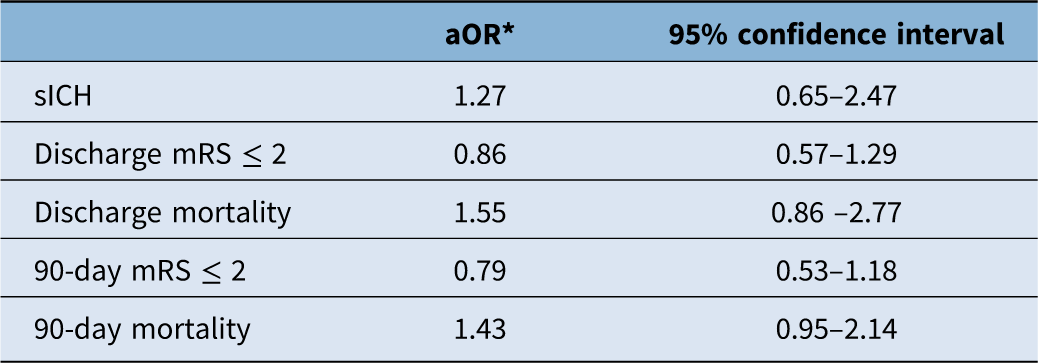
A mixed-effects logistic regression model, after adjustment for transfer status, age, baseline ASPECTS, baseline NIHSS, onset-to-groin puncture time, anaesthesia type, intravenous thrombolysis, carotid stenting and EVT centre, showed no difference between two groups for adjusted OR (aOR) of sICH (aOR 1.27; 95% confidence interval [CI] 0.65–2.47), discharge mRS ≤ 2 (aOR 0.86; 95% CI 0.57–1.29), 90-day mRS ≤ 2 (aOR 0.79; 95% CI 0.53–1.18), discharge mortality (aOR 1.55; 95% CI 0.86–2.77) and 90-day mortality (aOR 1.43; 95% CI 0.95–2.14) (Table 3).
Mixed-effects logistic regression model in all telestroke cases

Table 3. Long description
A table comparing adjusted odds ratios (aOR) and 95% confidence intervals for different outcomes in a mixed-effects logistic regression model. The table has 5 rows and 3 columns. Column headers are aOR, 95% confidence interval. Row labels are sICH, Discharge mRS ≤ 2, Discharge mortality, 90-day mRS ≤ 2, 90-day mortality. Row 1: sICH, aOR 1.27, 95% confidence interval 0.65–2.47. Row 2: Discharge mRS ≤ 2, aOR 0.86, 95% confidence interval 0.57–1.29. Row 3: Discharge mortality, aOR 1.55, 95% confidence interval 0.86–2.77. Row 4: 90-day mRS ≤ 2, aOR 0.79, 95% confidence interval 0.53–1.18. Row 5: 90-day mortality, aOR 1.43, 95% confidence interval 0.95–2.14.
aOR = adjusted odds ratio; mRS = modified Rankin Scale; sICH = symptomatic intracerebral haemorrhage.
*Adjusted for age, transfer status, baseline Alberta Stroke Program Early CT Score, baseline National Institutes of Health Stroke Scale, onset-to-groin puncture time, final thrombolysis in cerebral infarction, anaesthesia type, intravenous thrombolysis, carotid stenting and endovascular thrombectomy centre.
The sub-analysis restricted to patients transferred from a non-EVT centre to an EVT centre included 888 patients in the telestroke group and 2401 patients in the non-telestroke group. It did not demonstrate major differences in baseline characteristics, though the telestroke group included more men (53.5% vs. 49.3%, p = 0.075) and a lower baseline ASPECTS (7 vs. 8, p < 0.001). Outcomes of successful reperfusion and functional outcome were similar between the telestroke and the non-telestroke groups. Among transferred patients, those assessed by telestroke had longer onset-to-puncture times (355 vs. 310 minutes, p < 0.001), higher sICH proportions (6.8% vs. 3.3%, p < 0.001) and higher proportion of all-cause mortality at 90 days (39.6% vs. 29.4%, p < 0.001), compared to patients who did not receive telestroke consultation (Supplementary Tables 1 and 2). These differences did not persist after multivariate adjustment, including onset-to-puncture time (Supplementary Table 3).
Discussion
The literature on telestroke focuses primarily on time parameters and outcomes in the context of intravenous thrombolysis. Some data suggest higher odds of receiving thrombolysis but prolonged treatment times, including door-to-needle time, in patients evaluated by telestroke compared to those without telestroke.Reference Stamm, Whitney and Royan13 Few studies have addressed the value of telestroke evaluation prior to thrombectomy. A Spanish study compared three groups of patients undergoing thrombectomy in unadjusted analyses: those evaluated directly at an EVT centre and those transferred to an EVT centre with or without prior use of telestroke.Reference Pedragosa, Alvarez-Sabín and Rubiera14 Contrary to our findings, this study found poorer functional outcomes in the non-telestroke group compared to patients with telestroke. However, this study was conducted prior to the pivotal EVT trials in 2015 and included only 119 patients treated at a single thrombectomy centre.
The use of videoconferencing is superior to telephone consultation for more appropriate thrombolysis decision-making, higher rates of thrombolysis administration, better data collection and a lower rate of intracerebral haemorrhage.Reference Meyer, Raman and Hemmen2 From these experiences, potential advantages can be extrapolated to the use of telestroke for thrombectomy decision-making prior to transfer, including more detailed history with the patient and relatives, better explanation of the risks and benefits of thrombectomy and a more nuanced and precise neurological examination. That said, in-person assessment should still be favoured when possible, with telestroke remaining an option for centres lacking local expertise in vascular neurology.Reference Worthmann, Winzer, Schuppner, Gumbinger and Barlinn15
Using OPTIMISE, a prospective, national EVT registry in Canada, we found that patients assessed with telestroke services prior to EVT had longer treatment times than those not evaluated with telestroke. Some significant differences were observable between the two groups, justifying the use of a multivariate model. The higher risk for unfavourable outcomes in the telestroke group did not persist after adjustment for confounders, including treatment time, suggesting that delays to EVT among telestroke patients may be driving worse outcomes. Delays in reperfusion time metrics are well known to be associated with worse outcomes, with every 15-minute decrease door-to-needle time associated with better long-term functional outcomes and lower mortality among patients receiving thrombolysis and EVT.Reference Man, Solomon and Mac Grory16 Worse functional outcomes among telestroke patients treated with EVT are therefore likely attributable to longer onset-to-EVT delays owing to prolonged transport times from more remote referring centres, rather than issues stemming from telestroke evaluation itself. Continued efforts are needed to decrease transfer delays, including door-in-door-out times at referring sites and interfacility transport times. Other novel strategies such as rural mobile stroke units, in-ambulance video-based teletriage or increasing the number of non-urban EVT centres have been explored but still require further study.Reference Kate, Jeerakathil and Buck17–Reference Maas, van der Zee, Buskens, Uyttenboogaart and Lahr19
Some EVT centres may treat more transferred patients than other centres, which could reasonably influence local practices, including the use of thrombolysis and the choice of anaesthesia. To mitigate this potential source of bias, in the multivariate model, we controlled for the EVT centre by treating it as a random effect.
The main strengths of this study are the predefined protocol for data collection in a large prospective registry comprised of a nationally representative sample of EVT centres, both academic and non-academic. However, our study has some limitations.
First, the primary analysis comparing the telestroke and non-telestroke groups included a heterogeneous patient population. The telestroke group was predominantly composed of transferred patients (89.1%), whereas the non-telestroke group included a large proportion of patients evaluated directly in a thrombectomy centre (56.7%). The higher proportion of patients with terminal carotid occlusions in the telestroke group may suggest that stroke specialists accepting transfer for thrombectomy favoured patients at higher risk of poor outcomes. In Canada, telestroke is primarily used for primary stroke centres without onsite neurology coverage that are geographically remote from large urban areas, while centres closer to EVT hospitals are generally staffed by neurologists and thus do not rely on telestroke. The use of telestroke is in large part a marker of greater transfer distances for EVT, and the associations found in our unadjusted results are therefore likely largely driven by the longer delays to reperfusion in the telestroke group. Unfortunately, we do not have detailed geographic information or transfer distances between referring hospitals and EVT centres in our registry. Only 10.9% of patients assessed by telestroke presented directly to a thrombectomy centre, and this approach of off-hours telestroke evaluation by the EVT site is only rarely used in Canada.Reference Ho and Fawcett20 This use of telestroke was stable over time, and a single site accounted for 72.5% of patients in this group. The small number of patients in this group precluded any meaningful analyses for this distinct approach to stroke evaluation at EVT sites. Second, in Canada, telestroke services are designed and implemented at the provincial level, which results in heterogeneity regarding indications for telestroke use, technologies for video-assessment and remote access to imaging. For instance, we do not have information regarding how often neurologists at the EVT site had access to imaging among patients transferred without telestroke. Third, as an EVT registry, OPTIMISE does not include patients who may have been transferred to an EVT centre but did not ultimately receive EVT (so-called futile transfers because of recanalization or severe deterioration during transport).Reference Regenhardt, Awad and Kraft21 Finally, data included in OPTIMISE are site-reported and not subjected to central adjudication.
Conclusion
In Canada, patients assessed with telestroke prior to EVT had longer treatment times and are likely to have more proximal occlusions than those not evaluated with telestroke. The higher risk for unfavourable outcomes among telestroke patients did not persist after adjustment for confounders, including treatment time, suggesting that longer onset-to-treatment times and patient characteristics among telestroke patients may be driving worse outcomes, as opposed to workflow issues encountered once patients reach the EVT centre. While these delays are inherent to telestroke being used primarily for more geographically remote primary stroke centres, there remains a strong need to optimise the delivery of EVT for patients evaluated at telestroke centres.
Supplementary material
The supplementary material for this article can be found at https://doi.org/10.1017/cjn.2026.10676.
Acknowledgements
AY holds a National New Investigator Award from the Heart and Stroke Foundation of Canada.
AHK holds a McMaster University Department of Medicine Career Research Award and a National New Investigator Award from the Heart and Stroke Foundation of Canada.
Author contributions
JB: Literature review. Manuscript writing. Results analysis. MAT: Results analysis. GJ: Results analysis. AY: Comments and suggestions on the manuscript. MKSH: Comments and suggestions on the manuscript. GS: Comments and suggestions on the manuscript. AYP: Revision of the manuscript. AK: Revision of the manuscript. All other co-authors: Data collection within the OPTIMISE registry.
Funding statement
None.
Competing interests
RHS holds grants from the Canadian Institutes of Health Research, participated on a data safety monitoring board of Hoffmann-La Roche Ltd. and owns stocks of FollowMD Inc.
JM holds grants from the Canadian Stroke Consortium.
LC reports grants from the Canadian Institutes for Health Research (CIHR) and Hamilton Health Sciences Foundation.
JS holds a grant and honoraria from Medtronic.
AY holds a Canada Research Chair (Tier 2) in data-driven design of stroke systems and has received operating grants from the Ontario Ministry of Colleges and Universities’ Early Researcher Award programme, CIHR, Heart and Stroke and the Brain Canada Foundation outside of the current study.
MDH holds grants to the Canadian Stroke Consortium and Medtronic and internal funding from the Canadian Stroke Consortium to support the OPTIMISE registry, grants from NoNO Inc., CIHR, Medtronic and Boehringer-Ingelheim GmbH for other trials, consulting fees from Sun Pharma BrainsGate Inc., patents licenced to Circle NVI, participation on a Data Safety Monitoring Board for Oncovir Hiltonel trial (end 2023), DUMAS trial (end 2023), ARTESIA trial (end 2023), BRAIN-AF trial (end 2023) and LAAOS-4 trial (ongoing). He is the president of the Canadian Federation for Neurological Sciences. He holds stocks in Circle Inc. and Basking Biosciences.
MS reports grants from Bayer and BMS/Janssen; consulting fees from Bayer, Regeneron, Anthos and Novartis; speaker’ honoraria from Bayer; and participation as an advisory board member for Bayer and Regeneron.
AMD reports grant from Medtronic to the Canadian Stroke Consortium, consulting fees from Hoffman-La Roche, honoraria for Continuing medical education lectures for Medtronic, stocks and patents for imaging software with Circle CVI, Data Safety and Monitoring Board membership for Philips TRUST and Lumosa stroke trials and the position of chair of the board of directors for the Canadian Stroke Consortium.
AYP has received research funding from Heart and Stroke Canada, Brain Canada and the CIHR.
AHK has received research funding from Heart and Stroke Canada, Brain Canada and the CIHR and consulting fees from Bayer, AbbVie and DiaMedica.






Target article
Use of Telestroke Prior to Endovascular Stroke Treatment in Canada: Results from the OPTIMISE Registry
Related commentaries (1)
Reviewer Comment on Barrette et al. “Use of Telestroke Prior to Endovascular Stroke Treatment in Canada: Results from the Optimise Registry”