





No CrossRef data available.
Article contents
Egalitarianism and the social mind
Published online by Cambridge University Press: 02 October 2026
Abstract
There is a three-way fit between: humans’ evolutionary ecology, which is deeply social; the turn towards fundamentally social understandings of human cognition; and the target article’s reframing of egalitarianism in terms of process rather than outcome. Here, I outline this three-way fit, and how it might inform a rethinking of the idea of an “open” society.
Information
- Type
- Open Peer Commentary
- Information
- Copyright
- © The Author(s), 2026. Published by Cambridge University Press
References
Habermas, J. (1984). The theory of communicative action, volume I: Reason & the rationalization of society (translated by T. McCarthy). Beacon.Google Scholar
Humphrey, N. (1976). The social function of intellect. In Bateson, P., & Hinde, R. (Eds.), Growing points in ethology (pp. 303–317). CUP.Google Scholar
Ignatieff, M., & Roch, S. (Eds.) (2018). Rethinking open society: New adversaries & new opportunities. CEU Press.CrossRefGoogle Scholar
Krasnow, M., Delton, A., Tooby, J. & Cosmides, L. (2013). Meeting now suggests we will meet again: Implications for debates on the evolution of cooperation. Scientific Reports, 3, 1–8.CrossRefGoogle ScholarPubMed
Mahr, J., & Csibra, G. (2018). Why do we remember? The communicative function of episodic memory. Behavioral & Brain Sciences, 41, e1.CrossRefGoogle Scholar
Mercier, H., & Landemore, H. (2012). Reasoning is for arguing: Understanding the successes and failures of deliberation. Political Psychology, 33(2), 243–258.CrossRefGoogle Scholar
Scott-Phillips, T. (2022). Biological adaptations for cultural transmission? Biology Letters, 18, 20220439.CrossRefGoogle ScholarPubMed
Scott-Phillips, T. (2023). Human nature & the open society. In Royer, C., & Matei, L. (Eds.), Open society unresolved: The contemporary relevance of a contested idea (pp. 23–37). CEU Press.Google Scholar
Scott-Phillips, T. (2025). Why do humans have linguistic intuition? Cadernos de Linguística, 6(3), e868.CrossRefGoogle Scholar
Simmel, G. (1908/1950). The stranger. In Wolf, K. (Ed.), The sociology of Georg Simmel (pp. 401–408). The Free Press.Google Scholar
Singh, M., & Glowacki, L. (2022). Human social organization during the Late Pleistocene: Beyond the nomadic-egalitarian model. Evolution & Human Behavior, 43(5), 418–431.CrossRefGoogle Scholar
Singh, M., Wrangham, R., & Glowacki, L. (2017). Self-interest and the design of rules. Human Nature, 28(4), 457–480.CrossRefGoogle ScholarPubMed
Starmans, C., Sheskin, M., & Bloom, P. (2017). Why people prefer unequal societies. Nature Human Behaviour, 1(4), 0082.CrossRefGoogle Scholar
Stokes, G. (1995). Politics, epistemology and method: Karl Popper’s conception of human nature. Political Studies, 43(1), 105–123.CrossRefGoogle Scholar
Sznycer, D. (2019). Forms and functions of the self-conscious emotions. Trends in Cognitive Sciences, 23(2), 143–157.CrossRefGoogle ScholarPubMed
Williams, D. (2021). Socially adaptive belief. Mind & Language, 36(3), 333–354.CrossRefGoogle Scholar
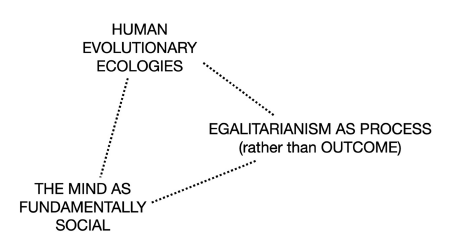
Figure 1. A three-way fit: the human evolutionary ecology, which is deeply social; our current understanding of the mind, as social in a basic, fundamental way; and the target article’s reframing of egalitarianism in terms of process rather than outcome.
Target article
Related commentaries (30)
Advantageous inequality aversion as a motivational component in egalitarian processes
Equity, equality, and egalitarianism: A context-dependent framework for resource allocation
Gender is critical to understanding how egalitarianism works
Harnessing the potential of egalitarian processes requires a psychology of inequality
 You have
Access
Over the past 20 or so years, many distinctive aspects of human cognition have been explained and, in some cases, reinterpreted as having ultimately social functions. These include not only those aspects of human cognition that are plainly social, such as those that govern cooperation and communication, but also many others that, on first appearances, may not appear social at all. Examples include reasoning, episodic memory, linguistic intuitions, belief formation, the supposedly “self conscious” emotions such as pride and anger, and maybe even consciousness (e.g. Graziano, Reference Graziano2013; Singh, Wrangham, & Glowacki, Reference Singh, Wrangham and Glowacki2017; Mahr & Csibra, Reference Mahr and Csibra2018; Sznycer, Reference Sznycer2019; Williams, Reference Williams2021; Scott-Phillips, Reference Scott-Phillips2022, Reference Scott-Phillips2025; inter alia). As one specific example, while reasoning may intuitively seem to be targeted at the abstract understanding of reality, it is better understood and explained as a tool for persuading others in interaction and argumentation (Mercier & Landemore, Reference Mercier and Landemore2012). In this case and others, detailed investigation has revealed how important aspects of the mind may be best explained in terms of how they allow individuals to navigate the social world.
Put more simply, what the modern sciences of evolution and the mind have revealed is how human minds do not seem to be geared directly towards logic and problem-solving, contrary to a common and intuitive assumption. Humans can do these things, but they do not seem to be essential functions of the mind. Human cognition is rather geared towards effectiveness in a world of repeated interpersonal engagement. If we are “rational,” then it is as socially smart, critically minded communicators (Humphrey, Reference Humphrey, Bateson and Hinde1976; Habermas, Reference Habermas1984; Mercier & Sperber, Reference Mercier and Sperber2017; Scott-Phillips, Reference Scott-Phillips, Royer and Matei2023).
This turn toward a social understanding of the mind aligns with our understanding of human evolutionary ecologies, which involve an especially delicate balance of cooperation, competition, and mutual interdependence. Human social organization is diverse, but one general constant is that our interactions are not independent (Krasnow et al., Reference Krasnow, Delton, Tooby and Cosmides2013; Singh & Glowacki, Reference Singh and Glowacki2022). That is to say, the people that humans interact with are people they have interacted with before, or if not, then they know someone who has. As many sociologists have pointed out, the concept of a “stranger” is largely modern (e.g. Simmel, Reference Simmel and Wolf1908/Reference Simmel and Wolf1950). This is why humans care greatly about what others know, think, and believe: because these psychological states are sources of both profound risk and huge possibility. This is also why, among other things, we have a predilection for gossip, why a loss of respect and dignity is so psychologically painful, and why our relations with others are governed by concepts such as responsibility, ownership, leadership, commitment, merit, and so on. The key point here is not the obvious truth that humans like to socialize, it is that a main evolutionary niche for the human mind – perhaps even the main evolutionary niche – is other minds. In which case, just as the human skeleton is specifically adapted for the possibilities and the demands of bipedal locomotion, we should expect the human mind to be specifically adapted to the particular demands of repeated interactions involving perpetual cooperation and competition.
These insights from the cognitive and anthropological sciences concord with and hence help to further justify the target article’s reframing of egalitarianism in terms of process rather than outcome (Figure 1). For they seem to imply that human minds should operate in ways that prioritise and place the most heavy weight not directly on meeting material needs (food, housing, and wealth), nor on relative levels of material possession, but rather on the generation and maintenance of one’s standing in the minds of others – which can be leveraged to meet material needs in turn. Hence, the most egalitarian societies will be those that maintain not equality of material resources as such, but rather equality of opportunity for the achievement and advancement of one’s standing within a community. Or, as the target article puts it, egalitarian societies are those that enable individuals to “successfully secure their own resource access, social status, and autonomy.” My point here is that such societies go with the grain of what human cognitive capacities are for, and they align with what is most psychologically valued. Indeed, our current best data suggest that to the extent that this equality of opportunity clashes with equality of resources, people tend to prioritise the former over the latter (Starmans, Sheskin, & Bloom, Reference Starmans, Sheskin and Bloom2017).
A three-way fit: the human evolutionary ecology, which is deeply social; our current understanding of the mind, as social in a basic, fundamental way; and the target article’s reframing of egalitarianism in terms of process rather than outcome.
One possible term to describe such societies is open. The notion of “open society” has been conceived in a handful of ways, all of which were informed by their authors’ readings and assumptions about cognition and anthropology. The term was first coined by Bergson, who conceived of the contrast between open and closed mostly in terms of morality and compassion: open societies driven by a moral universalism versus closed societies driven more by tribal belonging (Reference Bergson1932). The most influential use of “open society” is due to Popper, for whom openness meant a recognition of fallibility, leading to piecemeal social engineering via democratic means and institutional safeguards against tyranny (Reference Popper1952). Popper’s arguments in favour of this model were based in part on his analysis of humans as problem solvers, which he justified with reference to the theory of natural selection and what he believed it implied for humanity (Stokes, Reference Stokes1995).
In the same spirit of fallibility, we can now revisit the notion of open society in light of more recent political developments and current scientific knowledge (Ignatieff & Roch, Reference Ignatieff and Roch2018; Scott-Phillips, Reference Scott-Phillips, Royer and Matei2023). The target article makes a considerable contribution to this goal. By showing how egalitarianism is best understood in terms of process rather than outcome, it implies that an open society will be, among other things, a society that provides ample opportunity for individuals to attain resources, status and autonomy while leaving open the path of how exactly they might do this. Or to put the point very simply, we can view an open society as one that allows, and even facilitates, egalitarianism as process. An important future challenge at the intersection of cognitive science and political philosophy is to spell out in detail what such a society might look like in practice, and how it might differ from other, past conceptions of the open society.
Financial support
The author reports no funding sources.
Competing interests
The author declares no competing interests.