



1 Introduction
The convergence rate of the law of large numbers plays an essential role in probability theory, which is closely related to the large deviation theory (see [Reference Breiman4, Reference Kostka29, Reference Nagaev39, Reference Siegmund45, Reference Steinebach46]), concentration of measure phenomenon (see [Reference Ledoux34]), Markov chains (see [Reference Chen, Randrianantoanina and Xu5, Reference Landers and Rogge32, Reference Pitman41, Reference Rosenblatt44]), and related areas (see [Reference Chung9, Reference Lagodowski and Rychlik30]). One of the most fundamental results in this area, known as the Baum–Katz theorem, which is stated as follows.
Theorem 1.1 (Buam–Katz–Chow)
Let
 $\left \{X, X_n, n \geq 1\right \}$
be a sequence of i.i.d. random variables and
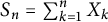 $S_n=\sum _{k=1}^n X_k$
for
 $n \geq 1$
. For
 $r \geq 1$
,
 $p>0,$
and
 $r/p>1/2$
, the following statements are equivalent:
-
(1)
 $ \mathbb {E}|X|^{p}<\infty ;$
-
(2)
$\sum _{n=1}^{\infty } n^{r-2} \mathbb {P}\left \{\left |S_n-n b\right |>\varepsilon n^{r/p}\right \}<\infty ,\mbox { for all }\varepsilon>0;$
-
(3)
$\sum _{n=1}^{\infty } n^{r-2} \mathbb {P}\left \{\max _{1 \leq m \leq n}\left |S_m-m b\right |>\varepsilon n^{r/p}\right \}<\infty , \mbox { for all }\varepsilon>0$
,



where
 $b=0$
if
 $r/p>1$
and
 $b=\mathbb {E}[X]$
if
 $1/2<r/p\leq 1$
.
The equivalence between (1) and (2) was proved by Baum and Katz [Reference Baum and Katz2], and that between (1) and (3) was by Chow [Reference Chow and Lai8]. Since then, a great deal of effort has been devoted to generalizing the Baum–Katz theorem to general sequences and sharpening the parameters in the theorem. We refer to [Reference Hao and Liu14, Reference Huang, Jiang and Zhang18, Reference Lanzinger and Stadtmüller33, Reference Li, Zhang and Rosalsky36, Reference Thành50] for more details. Notably, if there are no independence assumptions on the sequence
 $\{X_{n}\}_{n=1}^{\infty }$
, condition (3) is strictly stronger than (2). Hence, in the sequel, we will only investigate the equivalence between (1) and (3) in the noncommutative framework.
Motivated by the study of operator algebras and noncommutative analysis, numerous significant probability inequalities in the noncommutative case have been developed in the past decades. One of the most critical developments in this area is the Burkholder–Gundy inequality for noncommutative martingales established by Pisier and Xu [Reference Pisier and Xu40]. Since then, fundamental martingale inequalities, such as the Doob maximal inequality [Reference Junge24] and the Burkholder/Rosenthal inequality [Reference Junge and Xu25, Reference Junge and Xu26], have been well developed in the noncommutative setting, leading the noncommutative martingale theory into an attractive area in probability theory. We refer to [Reference Choi and Ji6, Reference Book3, Reference Hong, Junge and Parcet16, Reference Jiao, Osekowski and Wu20, Reference Jiao, Randrianantoanina, Wu and Zhou21, Reference Randrianantoanina42] for more information. In the present article, we aim to continue the fruitful line of investigating noncommutative deviation inequalities.
In 2009, Stoica [Reference Stoica48, Theorem 1] adapted the method of Katz [Reference Katz27, Theorem 2(a)] and provided a noncommutative extension of Theorem 1.1 for successively
 $i.i.d.$
sequence with
 $1/2<r/p\leq 1$
. However, it was stated by Stoica that his approach cannot tackle the case for
 $r/p>1$
(see [Reference Stoica48, p. 321]), leaving it as an open problem. In the present article, we apply the weak-type asymmetric maximal inequality for noncommutative martingales to establish a noncommutative Baum–Katz theorem for
 $r/p>1$
, settling the problem of Stoica.
To state our results precisely, we begin with recalling basic concepts and notations from noncommutative analysis. By a noncommutative probability space
 $(\mathcal {M},\tau )$
, we mean that
 $(\mathcal {M},\tau )$
is a tracial von Neumann algebra equipped with a normal faithful tracial state
 $\tau $
. Let
 $L_{0}(\mathcal {M})$
be the
 $\ast $
-algebra of all
 $\tau $
-measurable operators with respect to
 $(\mathcal {M},\tau )$
. The noncommutative counterpart of the maximal column tail probability introduced in [Reference Konwerska28] is stated as follows, which is closely related to the almost uniform convergence in
 $L_{0}(\mathcal {M})$
. For a sequence
 $(x_n )_{n\geq 1}\subseteq L_{0}(\mathcal {M})$
and
 $t>0$
, define

where
 $\mathcal {M}_{\pi }$
stands for the lattice of projections in
 $\mathcal {M}$
. Our noncommutative Baum–Katz theorem for successively independent sequence (see the definition in Section 2) is stated as follows.
Theorem 1.2 Suppose that
 $ \{x_k\}_{k\geq 1} $
is a sequence of successively independent random variables in
 $L_0(\mathcal {M})$
, which have the same distribution of
 $x\in L_{0}(\mathcal {M})$
. Let
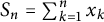 $S_n=\sum _{k=1}^{n} x_{k}$
be the partial sum. For
 $r\geq 1$
and
 $p>0$
with
 $r/p>1/2$
, let
 $\psi :\mathbb {R}^{+}\to \mathbb {R}^{+}$
be a continuous increasing function with
 $\psi (t)= O(t^{r-1+ {r}/{p}})$
for each
 $t>0$
such that
 $\{ {\psi (n)}/{n^{r/p}}\}_{n=1}^{\infty }$
forms an increasing sequence and
 $$ \begin{align} \sum_{n=1}^{\infty} n^{r-1}\tau \left[e_{(\psi(n),\infty)}{(|x|)}\right]<\infty. \end{align} $$
Then, we have
 $$ \begin{align} \sum_{n=1}^{\infty} n^{r-2} \tau \left[e_{( \varepsilon \psi(n),\infty)}{(|S_n-nb|)}\right]<\infty, \quad \forall \varepsilon>0, \end{align} $$
and
 $$ \begin{align} \sum_{n=1}^{\infty} n^{r-2}\mathrm{Prob}_{\tau}^c\left\{\sup_{1 \leq m \leq n} \left|S_m-mb\right|>\varepsilon \psi(n)\right\}<\infty, \quad \forall \varepsilon>0, \end{align} $$
where
 $b=0$
if
 $r/p>1$
and
 $b=\tau \left (x\right )$
if
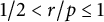 $1/2<r/p\leq 1$
.
From [Reference Jiao, Sukochev and Zhou23, Remark 3.4], we see that (1.3) implies (1.2). It is worthwhile to mention that Theorem 1.2 is a noncommutative Baum–Katz theorem under a more general integrability condition, which enables one to deal with
 $\psi $
with
 $n^{r/p}\leq \psi (n)\leq n^{r-1+r/p}$
for sufficiently large
 $n\geq 1$
. In particular, if
 $\psi (n)=n^{r/p}$
, (1.1) goes back to Theorem 1.1 (1). Thanks to the noncommutative Borel–Cantelli lemma, we get the following noncommutative strong law of large numbers by Łuczak [Reference Łuczak37, Theorem 3.6] by applying Theorem 1.2.
Corollary 1.3 Let
 $0<p<2$
and
 $\{x_k\}_{k\geq 1}\subseteq L_p(\mathcal {M})$
be a successively independent identically distributed sequence. Then,
 $$ \begin{align*}n^{-1/p} \sum_{k=1}^n\left(x_k-b \mathbf{1}\right) \stackrel{\text { a.u. }}{\longrightarrow} 0 \,\, \,{\text{as}} \,\, \, n \rightarrow \infty,\end{align*} $$
where
 $b=0$
for
 $0<p<1$
and
 $b=\tau \left (x_1\right )$
for
 $1 \leq p<2$
.
Note here that, for the case
 $\psi (n)=(n\log n)^{r/p}$
, the Baum–Katz theorem holds only for
 $r>1$
in the commutative setting. For the case
 $r=1$
, the estimate
 $\mathbb {P}\left \{ \left |S_n\right |>\varepsilon (n\log n)^{1/p}\right \}$
is called the moderate deviation, which was first studied by Davis [Reference Davis11] and later generalized by Rohatgi [Reference Rohatgi43]. Hence, the second main result of the present article is the noncommutative moderate deviation inequality stated as follows.
Theorem 1.4 Let
 $ \{x_k\}_{k \geq 1} \subseteq L_p({\mathcal { M}})$
be a sequence of successively independent random variables with the same distribution of
 $x\in L_{p}(\mathcal {M})$
. Let
 $S_n=\sum _{k=1}^{n} x_{k}$
for each
 $n\geq 1$
. Then, for any
 $\varepsilon>0$
, we have
-
(1) for
$p=2$
,
$$ \begin{align*}\sum_{n=1}^{\infty}\frac{\log n}{n}\tau \left( e_{ (\varepsilon (n\log n)^{1/2},\infty)} \left(\left|S_n-n\tau(x)\right| \right) \right) <\infty,\end{align*} $$
-
(2) for
$1<p<2$
,
$$ \begin{align*}\sum_{n=1}^{\infty}\frac{\log n}{n}\mathrm{Prob}_{\tau}^c\left\{\sup_{1 \leq m \leq n} \left|S_m-m\tau(x)\right|>\varepsilon (n\log n)^{1/p}\right\}<\infty.\end{align*} $$


It is worthwhile to mention that for the case
 $p=2$
, we apply the noncommutative Fuk–Nagaev inequality in the proof of Theorem 1.4, rather than the symmetrization method used in Davis’ original approach [Reference Davis11]. Moreover, motivated by the law of the iterated logarithm [Reference Davis12], we adapt the proof of Theorem 1.4 (1) to obtain a corresponding result for
 $\mathbb {P}\left \{ \left |S_n\right |>\varepsilon (n\log \log n)^{1/2}\right \}$
in Corollary 3.11.
Remark 1.5 The original proof of the equivalence between (1) and (2) in Theorem 1.1 relies on the Levý inequality. However, the noncommutative version of the Levý inequality is not yet to be well-developed, which is one of the main obstructions in our approach of proving the noncommutative analog of Theorem 1.1 in full generality.
Motivated by the recent development of noncommutative martingale theory, we also extend the Baum–Katz theorem to the noncommutative martingale framework. In the commutative setting, it has been pointed out by Lesigne and Volný [Reference Lesigne and Volný35] that
 $\mathbb {P}\left (\left |S_n\right |>\varepsilon n\right )=O\left (n^{-p / 2}\right )$
if
 $\sup _{k \geq 1} \mathbb {E}\left |X_k\right |{}^p<\infty $
with
 $p \geq 2$
, and the exponent
 $p / 2$
is optimal, even for strictly stationary and ergodic sequences of martingale differences. Thus, for the martingale case, the Baum–Katz theorem does not hold without additional assumptions.
Following Chung [Reference Conde-Alonso and Parcet10], we consider a non-decreasing function
 $f:[0, \infty ) \rightarrow \mathbb {R}^{+}$
such that
 $$ \begin{align} \sum_{n=1}^{\infty} \frac{1}{f\left(2^n\right)}<\infty. \end{align} $$
Specifically, if
 $f(t)=\left ( \log ^+ |t|\right ) ^{1+\varepsilon }$
,
 $t\in [0,\infty ),$
and
 $\varepsilon>0$
, it is easy to see that f fulfills (1.4). Hence, the following results contain several important examples in studying the law of large numbers. Suppose that
 $\{X_{j}\}_{j=1}^{\infty }$
is a sequence of random variables fulfilling the uniform moment condition:
 $\sup _{j\geq 1}\mathbb {E}[|X_{j}|^{p}f(|X_{j}|)]<\infty $
. Chung [Reference Conde-Alonso and Parcet10, Corollary 1] derived the Marcinkiewicz–Zygmund strong law of large numbers for independent random variables
 $\{X_{j}\}^{\infty }_{j=1}$
satisfying the uniform moment condition. Later, under the same condition, Chung’s result was further extended by Stout [Reference Stout49] and Balka et al. [Reference Balka and Tómács1] in related areas. The following two theorems extend results in [Reference Balka and Tómács1] to noncommutative martingales.
Theorem 1.6
(Noncommutative martingales with
$1<p<2$
)

For
 $1<p<2$
and
 $r\geq 1$
or
 $r=p=1$
, let
 $\left \{dx_i\right \}_{i \geq 1}$
be a martingale difference sequence satisfying
 $\sup _{i \geq 1} \tau \left (\left |dx_i\right |{}^p f\left (\left |dx_i\right |\right )\right )<\infty $
, where f fulfills (1.4). Then, the following holds:
 $$\begin{align*}\sum_{n=1}^{\infty} n^{r-2}\mathrm{Prob}_{\tau}^c\left\{ \sup_{1\leq k\leq n}\left|\sum_{i=1}^{k}dx_i\right|>\varepsilon n^{r/p}\right\}<\infty,\quad \forall \varepsilon>0. \end{align*}$$
Theorem 1.7
(Noncommutative martingales with
$p \geq 2$
)

For
 $p\geq 2$
and
 $r/p>1/2$
, let
 $q=2p(r-1) /(2r-p)$
and
 $\left \{dx_i\right \}_{i \geq 1}$
be a martingale difference sequence satisfying
 $\sup _{i \geq 1} \tau \left (\left |dx_i\right |{}^q f\left (\left |dx_i\right |\right )\right )<\infty $
, where f fulfills (1.4). The following holds:
 $$\begin{align*}\sum_{n=1}^{\infty} n^{r-2}\mathrm{Prob}_{\tau}^c\left\{ \sup_{1\leq k\leq n}\left|\sum_{i=1}^{k}dx_i\right|>\varepsilon n^{r/p}\right\}<\infty,\quad \forall \varepsilon>0. \end{align*}$$
Remark 1.8 It was pointed out in [Reference Conde-Alonso and Parcet10] implicitly that the uniform moment condition mentioned in the previous theorems is necessary even for commutative martingales. More precisely, the series in Theorems 1.6 and 1.7 diverge whenever (1.4) fails.
A direct consequence of Theorem 1.6 is the following law of large numbers for noncommutative martingales, which extends the result of Łuczak [Reference Łuczak37, Theorem 3.6] (see also Corollary 1.3) at some points.
Corollary 1.9 Let
 $1\leq p<2$
and
 $\left \{x_n\right \}_{n \geq 1} $
in
 $ L_0(\mathcal { M})$
be a martingale difference sequence such that
 $\sup _{n \geq 1} \tau \left (\left |x_n\right |{}^p f\left (\left |x_n\right |\right )\right )<\infty $
, where f fulfills (1.4). Then,
 $$ \begin{align} \sum_{k=1}^{n}x_k / n^{1/p} \stackrel{\text { a.u. }}{\longrightarrow} 0 \,\, \,{\text{as}} \,\, \, n \rightarrow \infty. \end{align} $$
Recently, it has been shown by Ricard and Hong [Reference Hong and Ricard17] that the noncommutative
 $L_{p}$
martingales need not be convergent uniformly whenever
 $1\leq p<2$
. Thus, Corollary 1.9 is of independent interest in studying the convergence theorem for noncommutative martingales.
Inspired by the recent work on noncommutative large deviation inequalities of Jiao et al. [Reference Jiao, Luo and Zhou19], we obtain the following result on moderate deviation, extending [Reference Stoica47, Theorem 1] of Stoica to the noncommutative martingales.
Theorem 1.10 Let
 $p>4$
and
 $ \{dx_i\}_{i \geq 1}$
be an
 $L_p$
-bounded noncommutative martingale difference sequence. Then,
 $$\begin{align*}\sum_{n=1}^{\infty} \frac{\log n}{n} \mathrm{Prob}_{\tau}^c\left\{\sup_{1 \leq k \leq n} \left|\sum_{i=1}^{k}dx_i\right|>\varepsilon (n\log n)^{1/2}\right\}<\infty, \quad \forall \varepsilon>0. \end{align*}$$
For the case
 $1\leq p\leq 4$
, it has been pointed out by Miao, Yang, and Stoica in [Reference Miao, Yang and Stoica38, Theorem 2.4] that Theorem 1.10 fails in general. Furthermore, by applying more specific calculations in the proof of Theorem 1.10, we obtain a slight variant of Theorem 1.10 in Corollary 4.9.
Our article is organized as follows. In Section 2, we collect necessary materials from noncommutative analysis, such as noncommutative Lebesgue spaces, the noncommutative independence, and noncommutative martingales. In Section 3, we provide detailed proofs of the noncommutative Baum–Katz-type theorem and the noncommutative moderate deviation inequality for successively independent sequences. In Section 4, we extend results obtained in the previous section from the successively independent case to the noncommutative martingales case. In Section 5, as an application of our result, we conclude the article with a noncommutative Marcinkiewicz–Zygmund-type strong laws of large numbers.
Throughout the article, let
 $(\mathcal {M}, \tau )$
be a fixed noncommutative probability space. We write
 $A \lesssim _p B$
to mean that
 $A \leq C_p B$
with a positive constant
 $C_{p}$
depending only on the parameter p, and we ignore the subscript when the constant is universal.
2 Preliminaries
2.1 Noncommutative
$L_p$
-spaces

Let
 $L_0(\mathcal {M})$
denote the topological
 $\ast $
-algebra of measurable operators with respect to
 $(\mathcal {M}, \tau )$
. Equipping
 $L_{0}(\mathcal {M})$
with the topology induced by the convergence in measure makes
 $L_{0}(\mathcal {M})$
a topological vector space, and the elements in
 $L_{0}(\mathcal {M})$
are called (noncommutative) random variables. In the sequel, all random variables are noncommutative if no confusions arise. Given
 $0<p<\infty $
, the noncommutative
 $L_p$
space is defined by

equipped with (quasi-) norm  for
 $x\in L_{p}(\mathcal {M})$
. As usual, we let
 and
 $\|\cdot \|_{\infty }$
is the operator norm on
 $\mathcal {M}$
.
For
 $x \in L_0(\mathcal {M})$
, its distribution function is defined by
 $$\begin{align*}\lambda_s(x)=\tau\left(e_s^{\perp}(|x|)\right), \quad \forall s>0, \end{align*}$$
where
 $e_s^{\perp }(|x|)=e_{(s, \infty )}(|x|)$
is the spectral projection of
 $|x|$
associated with the interval
 $(s, \infty )$
. For any
 $s,t>0$
and
 $x,y\in L_0(\mathcal { M})$
, their distribution functions satisfy that
 $$ \begin{align} \lambda_{s+t}(|x+y|)\leq \lambda_{s}(|x|)+\lambda_{t}(|y|). \end{align} $$
For
 $x\in L_{p}(\mathcal {M})$
with
 $0<p<\infty $
, we have the Chebyshev inequality
 $$ \begin{align} \lambda_s(x) \leq \frac{\|x\|_p^p}{s^p}, \quad \forall s>0. \end{align} $$
The concept of almost uniform convergence was introduced by Lance [Reference Lance31], which can be viewed as a noncommutative substitution of the almost everywhere convergence in
 $L_{0}(\mathcal {M})$
.
Definition 2.1 A sequence
 $\{x_{n}\}_{n\geq 1}\subseteq L_{0}(\mathcal {M})$
is said to converge almost uniformly (a.u. in short) to
 $x\in L_{0}(\mathcal {M})$
, if for any
 $\varepsilon>0,$
there is a projection
 $e \in \mathcal {M}$
such that
 $$\begin{align*}\tau\left(\mathbf{1}-e\right)<\varepsilon \quad \text { and } \quad \lim _{n \rightarrow \infty}\left\|\left(x_n-x\right) e\right\|_{\infty}=0. \end{align*}$$
Moreover,
 $\{x_{n}\}_{n\geq 1}$
is said to converge bilaterally almost uniformly (b.a.u. in short) to x if for any
 $\varepsilon>0,$
there is a projection
 $e \in \mathcal {M}$
such that
 $$\begin{align*}\tau\left(\mathbf{1}-e\right)<\varepsilon \quad \text { and } \quad \lim _{n \rightarrow \infty}\left\|e\left(x_n-x\right) e\right\|_{\infty}=0. \end{align*}$$
It is obvious that the a.u.convergence implies the b.a.u. convergence. When
 $(\mathcal {M},\tau )$
is commutative, the Egorov theorem entails that the a.u. convergence coincides with the a.e. convergence in
 $L_{0}(\mathcal {M})$
.
We conclude this section by introducing the column weak space
 $\Lambda _{p,\infty }(\mathcal {M};\ell ^{c}_{\infty })$
, which is deeply connected with the probability of
 $\mathrm {Prob}_{\tau }^c\left ({\sup _{n\geq 1}}|x_n|>t\right )$
. The space
 $\Lambda _{p,\infty }(\mathcal {M};\ell ^{c}_{\infty })$
is defined as the sequences
 $\left (x_n\right )_{n \geq 1}$
satisfying that
 $$\begin{align*}\left\|\left(x_n\right)_{n \geq 1}\right\|_{\Lambda_{p, \infty}\left(\mathcal{M}; \ell_{\infty}^c\right)}=\sup _{\lambda>0} \inf _{q \in \mathcal{M}_\pi}\left\{\lambda \tau((\mathbf{1}-q))^{\frac{1}{p}}: \left\|x_{n} q\right\|_{\infty} \leq \lambda \text { for all } n \geq 1\right\}<\infty, \end{align*}$$
where
 $\mathcal { M}_{\pi }$
is the lattice of projections in
 $\mathcal { M}$
. One can also define the row space by taking adjoints.
2.2 Noncommutative Orlicz spaces
Let
 $\Phi $
be an Orlicz function on
 $[0, \infty )$
. We say
 $\Phi $
satisfies the
 $\triangle _2$
-condition if
 $\Phi (2 t) \leq C \Phi (t)$
for all
 $t>0$
and some
 $C>0$
. It is not hard to check that
 $\Phi $
satisfies the
 $\triangle _2$
-condition if and only if for any
 $\alpha>0$
, there is a constant
 $C_{\alpha }>0$
such that
 $\Phi (\alpha t) \leq C_{\alpha } \Phi (t)$
for all
 $t>0$
. For
 $1 \leq p \leq q<\infty $
, we say that
 $\Phi $
is p-convex if the function
 $t \mapsto \Phi \left (t^{1 / p}\right )$
is convex, and is q-concave if the function
 $t \mapsto \Phi \left (t^{1 / q}\right )$
is concave. In addition,
 $\Phi $
satisfies the
 $\Delta _2$
-condition if and only if it is q-concave for some
 $q<\infty $
. For
 $x \in L_0(\mathcal {M})$
, we have (see, e.g., [Reference Fack and Kosaki13, Corollary 2.8])
 $$ \begin{align} \tau(\Phi(|x|))=\int_0^{\infty} \Phi(t) \mathrm{d} \tau\left(e_t\right), \end{align} $$
where
 $\tau (e_t)=\tau (e_{(-\infty ,t)}(|x|))$
is the spectral measure. For
 $\left (x_i\right )_{i=0}^n \subset L_0(\mathcal {M}, \tau )$
,
 $\lambda _i \in (0,1)$
with
 $\sum _{i=0}^n \lambda _i \leq 1$
, we have the following Jensen’s inequality (see, e.g., [Reference Fack and Kosaki13, Theorem 4.4]):
 $$ \begin{align} \tau\left[\Phi\left(\left|\sum_{i=0}^n \lambda_i x_i\right|\right)\right]\leq \sum_{i=0}^n \lambda_i \tau\left(\Phi\left(\left|x_i\right|\right)\right). \end{align} $$
The noncommutative Orlicz space
 $L_{\Phi }(\mathcal {M})$
is defined by
 $$\begin{align*}L_{\Phi}(\mathcal{M})=\left\{x \in L_0(\mathcal{M}):\tau\left[\Phi\left(\frac{|x|}{c}\right)\right]<\infty, \mbox{ for some }c>0 \right\}, \end{align*}$$
equipped with the norm
 $$\begin{align*}\|x\|_{\Phi}=\inf \{c>0: \tau(\Phi(|x| / c))\leq1\}. \end{align*}$$
2.3 Noncommutative martingales
The following materials on noncommutative martingales are standard. Let
 $\left \{\mathcal {M}_n\right \}_{n \geq 0}$
be an increasing sequence of von Neumann subalgebras of
 $\mathcal {M}$
such that the union of the
 $\mathcal {M}_n$
is
 $w^*$
-dense in
 $\mathcal {M}$
. For every
 $n \geq 0$
, let
 $\mathcal {E}_n$
be the conditional expectation from
 $\mathcal {M}$
onto
 $\mathcal {M}_n$
satisfying:
-
(1)
$\mathcal {E}_n(x y)=\mathcal {E}_n(x) y, \mathcal {E}_n(y x)=y \mathcal {E}_n(x), n \geq 0,$
and
$y \in \mathcal {M}_n$
; -
(2)
$\mathcal {E}_n \mathcal {E}_m=\mathcal {E}_n$
for
$m \geq n$
; -
(3)
$\tau \left (\mathcal {E}_n(x)\right )=\tau (x), n \geq 0$
.



The noncommutative martingale is a sequence
 $x=\{x_{n}\}_{n \geq 1}$
in
 $L_1(\mathcal {M})$
satisfying
 $\mathcal {E}_n\left (x_{n+1}\right )=x_n$
for all
 $n\geq 1$
. The martingale differences sequence
 $\left (d x_k\right )_{k \geq 1}$
is defined by
 and
 with
 $k\geq 1$
. Given a martingale x in
 $L_{p}(\mathcal {M})$
, its
 $L_{p}$
norm is given by
 . If
 $\|x\|_{ p}<\infty $
, x is called an
 $L_p$
-bounded martingale. More generally, given an Orlicz function
 $\Phi $
, we say that
 $x=(x_n)_{n\geq 1}$
is an
 $L_{\Phi }$
-bounded martingale if
 $\|x\|_{\Phi }=\sup _{n \geq 0}\left \|x_n\right \|_{\Phi } <\infty $
.
Now, we introduce an important noncommutative weak-type asymmetric maximal inequality taken from [Reference Hong, Junge and Parcet15, Theorem A(ii)].
Theorem 2.1 For every
 $n\geq 0$
, let
 $\mathcal {E}_n$
be the conditional expectation defined as above. For
 $1\leq p\leq 2$
, we have
 $$\begin{align*}\left\|\left(\mathcal{E}_n(x)\right)_{n \geq 1}\right\|_{\Lambda_{p, \infty}\left(\mathcal{M}; \ell_{\infty}^c\right)} \leq c_p\left\| \left(\sum_{n \geq 1}\left|d x_n\right|{}^2\right)^{1 / 2}\right\|_{L_p(\mathcal{ M})}, \end{align*}$$
where
 $c_{p}>0$
is a constant depending only on p.
2.4 Noncommutative independence
Recall the noncommutative independences of Junge and Xu (see [Reference Junge and Xu26]) as follows.
Definition 2.2 Assume that
 $\{\mathcal {M}_k\}_{k\geq 0}$
are von Neumann subalgebras in
 $\mathcal {M}$
.
-
(1) We say that
$\{\mathcal M_k\}_{k\geq 0}$
are independent with respect to
$\tau $
, if
$\tau (xy)=\tau (x)\tau (y)$
holds for each
$x\in \mathcal M_k$
and y belongs to the von Neumann algebra generated by
$\{\mathcal M_j\}_{j\neq k}$
. -
(2) We say that
$\{\mathcal M_k\}_{k\geq 0}$
are successively independent with respect to
$\tau $
, if
$vN\left (\mathcal M_0, \ldots , \mathcal M_{k-1}\right )$
and
$ vN\left (\mathcal M_k\right ) $
are independent for each
$k \geq 1$
, where
$vN\left (\mathcal M_0 \ldots , \mathcal M_{k-1}\right )$
denotes the von Neumann subalgebra generated by
$\mathcal M_0, \ldots , \mathcal M_{k-1}$
. -
(3) We say that the random variables sequence
$\{x_k\}_{k\geq 0} $
is independent or successively independent, if for each
$k\geq 0$
, the unital von Neumann subalgebras
$\mathcal M_k$
generated by
$x_k$
are independent or successively independent with respect to
$\tau $
.


Remark 2.2 Assume that
 $\{\mathcal {M}_k\}_{k\geq 0}$
are von Neumann subalgebras in
 $\mathcal {M}$
.
-
(1) Let
$\{\mathcal {M}_k\}_{k\geq 0}$
be independent with respect to
$\tau $
. Then,
$\{\mathcal {M}_k\}_{k\geq 0}$
are successively independent with respect to
$\tau $
(see [Reference Junge and Xu26, Lemma 1.2]). -
(2) Let
$\left (\mathcal { M}_k\right )_{k \geq 0} $
be successively independent with respect to
$\tau $
. Then, for each
$k \geq 0$
, [Reference Junge and Xu26, Remark 1.1] yields that
$$ \begin{align*}\mathcal{E}_{vN\left(\mathcal M_0, \ldots, \mathcal M_{k}\right)}\left(x\right)=\tau\left(x\right), \quad x\in \mathcal{ M}_j, \,j> k, \end{align*} $$
where
$ \mathcal {E}_{vN\left (\mathcal M_0, \ldots , \mathcal M_{k}\right )}$
is the conditional expectation from
$\mathcal { M}$
to
$ vN\left (\mathcal M_0, \ldots , \mathcal M_{k}\right )$
. Therefore, if
$x_k \in L_p\left (\mathcal {M}_k\right )$
with
$\tau \left (x_k\right )=0$
, then
$\{x_k\}_{k\geq 0} $
is a martingale difference sequence with respect to the filtration
$\left (vN\left (\mathcal M_0, \ldots , \mathcal M_{k}\right )\right )_{k \geq 0}$
.



We say
 $\{x_{n}\}_{n\geq 1}$
is identically distributed if the distribution functions
 $\tau \left (e_s^{\perp }(|x_{n}|)\right )$
are identical for all
 $n\in \mathbb {N}$
.
We conclude the preliminaries section with the noncommutative Rosenthal inequality established by Junge and Xu [Reference Junge and Xu26, Theorem 2.1], which is one of the key ingredients in our proof of Theorem 1.2.
Theorem 2.3 (Junge–Xu)
Let
 $2 \leq p<\infty $
,
 $\{x_k\}_{k\geq 1} \in L_p\left (\mathcal { M}\right )$
with
 $\tau \left (x_k\right )=0$
. If
 $\{x_k\}_{k\geq 1}$
is successively independent, then
 $$\begin{align*}\frac{C}{p^2}\left\|\sum_{k\geq 1} x_k\right\|_p \leq \max \left\{ \left(\sum_{k\geq 1}\left\|x_k\right\|_p^p\right)^{\frac{1}{p}}, \left(\sum_{k\geq 1}\|x_k\|_2^2\right) ^{\frac{1}{2}}\right\} \leq 2\left\|\sum_{k\geq 1} x_k\right\|_p, \end{align*}$$
where C is an absolute constant.
3 Noncommutative Baum–Katz theorem and moderate deviation inequality
3.1 Noncommutative Baum–Katz theorem
This section is devoted to proving Theorem 1.2. We now begin with a sequence of elementary lemmas on the estimate of the maximal tail probabilities. The first lemma is the weak-type asymmetric maximal inequality associated with a convex function.
Lemma 3.1 Let
 $\Psi $
be a
 $2$
-convex, p-concave Orlicz function with
 $2\leq p<\infty $
and
 $x=(x_n)_{n\geq 1}$
be an
 $L_{\Psi }$
-bounded martingale. Then, for any
 $\lambda>0$
,
 $$ \begin{align*}\Psi(\lambda)\mathrm{Prob}_{\tau}^c \left\lbrace \sup_{n\geq 1}\left|x_n\right|>\lambda \right\rbrace \leq c_p\tau \left(\Psi\left( |x| \right) \right),\end{align*} $$
where
 $c_p$
is a constant depending only on p.
Proof By [Reference Jiao, Randrianantoanina, Wu and Zhou21, Lemma 5.4], it follows that for a
 $1$
-convex, r-concave Orlicz function
 $\Phi $
with
 $1\leq r <\infty $
, there exists a projection q such that
 $\sup _n\|qx_nq\|\leq t$
for any
 $t>0$
, and
 $$ \begin{align} \Phi(t)\tau(1-q)\leq c_r\tau(\Phi(|x|)). \end{align} $$
On the other hand, we have
 $$ \begin{align*} &\sup_{ \lambda>0}\inf_e\left\lbrace\Psi(\lambda)\tau(1-e): \sup_{n\geq 1}\left\|x_ne\right\|_{\infty}\leq \lambda\right\rbrace\\ &\quad =\sup_{ \lambda >0}\inf_e\left\lbrace\Psi(\lambda^{1/2})\tau(1-e): \sup_{n\geq 1}\left\|e|x_n|^2e \right\|_{\infty}\leq \lambda\right\rbrace \\&\quad\leq\sup_{ \lambda >0}\inf_e\left\lbrace\Psi(\lambda^{1/2})\tau(1-e): \sup_{n\geq 1}\left\|e\mathcal{E}_n(|x|^2)e \right\|_{\infty}\leq \lambda\right\rbrace, \end{align*} $$
where we use
 $\mathcal {E}_n(x)^*\mathcal {E}_n(x)\leq \mathcal {E}_n(x^*x)$
in the inequality (
 $\mathcal {E}_n $
is the conditional expectation from
 $\mathcal { M}$
to
 $\mathcal { M}_n$
). By (3.1), we deduce that for any
 $\lambda>0$
,
 $$ \begin{align*}\Psi(\lambda)\mathrm{Prob}_{\tau}^c\left\lbrace \sup_{n\geq 1}\left|x_n\right|>\lambda\right\rbrace \leq c_p\tau \left(\Psi\left( \left( \mathcal{E}_n(|x|^2)\right)^{1/2} \right) \right) \leq c_p\tau \left(\Psi\left( |x| \right) \right),\end{align*} $$
which completes the proof.
Lemma 3.2 Let
 $\left (x_n\right )_{n \geq 1}$
and
 $\left (y_n\right )_{n \geq 1}$
be sequences of random variables. Then, for any
 $t>0$
, we have
 $$ \begin{align} \mathrm{Prob}_{\tau}^c\left\lbrace \sup_{n\geq1}\left|x_n+y_n\right|>t\right\rbrace \leq\mathrm{Prob}_{\tau}^c\left\lbrace \sup_{n\geq 1}\left|x_n \right|>t/2\right\rbrace + \mathrm{Prob}_{\tau}^c\left\lbrace \sup_{n\geq 1}\left| y_n\right|>t/2\right\rbrace. \end{align} $$
Proof For projections
 $p_{1}$
and
 $p_{2}$
satisfying
 $ \| x_n p_1\|\leq t/2$
and
 $\| y_n p_2\|\leq t/2$
for all
 $n\geq 1$
, we set
 $ p=p_1 \wedge p_2$
. Then, the triangle inequality yields that
 $$\begin{align*}\|(x_n+y_n)p\|_{\infty}\leq \|x_np\|_{\infty}+\|y_np\|_{\infty}= \|x_np_1p\|_{\infty}+\|y_np_2p\|_{\infty}\leq t. \end{align*}$$
Hence, we have
 $$\begin{align*}\mathrm{Prob}_{\tau}^c\left\lbrace \sup_{n\geq 1}\left|x_n+y_n\right|>t\right\rbrace \leq \tau(1-p_1)+\tau(1-p_2), \end{align*}$$
and the desired estimate follows by taking the infimum on the right-hand side of the inequality.
Lemma 3.3 Let
 $\left (x_n\right )_{n \geq 1}$
be a sequence of random variables. Assume that there exists a projection q such that
 $x_n q =x_n$
holds for each
 $n \geq 1$
. Then, we have
 $$ \begin{align} \mathrm{Prob}_{\tau}^c\left\lbrace \sup_{n\geq 1}\left|x_n\right|>t\right\rbrace \leq \tau\left(q\right)\quad\mbox{for}~t>0. \end{align} $$
Proof It suffices to observe that
 $\left \| x_n \left ( 1-q \right )\right \|_{\infty }=0<t$
.
The following four technical lemmas regarding the estimate of the distribution for noncommutative random variables are essential in our proof of Theorem 1.2.
Lemma 3.4 Let
 $r\geq 1$
,
 $p>0,$
and
 $1/2<r/p\leq 1$
. Let
 $x\in L_{0}(\mathcal {M})$
and
 $\psi :\mathbb {R}^{+}\to \mathbb {R}^{+}$
be a continuous increasing function with
 $\psi (t)=O(t^{r-1+ {r}/{p}})$
for each
 $t>0$
such that
 $\{ {\psi (n)}/{n^{r/p}}\}_{n=1}^{\infty }$
forms an increasing sequence and (1.1) holds. Then,
 $$ \begin{align*}n \tau\left( x e_{(\psi(n),\infty)}{(|x|)} \right)/\psi(n) \rightarrow 0, \quad n \rightarrow \infty. \end{align*} $$
Proof Recall that the generalized inverse
 $\psi ^{-1}$
is defined by
 $$ \begin{align*}\psi^{-1}(s)=\inf \{t>0: \psi(t)>s\},\quad \forall s>0,\end{align*} $$
with  almost everywhere. Thus, by (1.1),
 $$ \begin{align*}\left\|\psi^{-1}(|x|) \right\|_r^r\lesssim \sum_{n=1}^{\infty}n^{r-1}\tau\left( e_{( n,\infty)}{ \left( \psi^{-1}\left( |x|\right) \right) } \right) <\infty.\end{align*} $$
By the functional calculus of
 $|x|$
, we have
 $$ \begin{align*}\left| \tau\left (xe_{(\psi(n),\infty)}{(|x|)}\right)\right| \leq \tau\left(\big{|}x e_{(\psi(n),\infty)}{(|x|)}\big|\right)\leq \tau\left( |x| e_{(\psi(n),\infty)}{(|x|)}\right). \end{align*} $$
Since
 $\{\psi (n)/n^{r/p}\}_{n\geq 1}$
is increasing,
 $$ \begin{align*} n \left| \tau\left( x e_{(\psi(n),\infty)}{(|x|)} \right)\right| /\psi(n) &\lesssim n^{1-r/p}\tau\left( |x| e_{( n,\infty)}{ \left( \psi^{-1}\left( |x|\right) \right) } \right)\\ &< \tau\left( \left(\psi^{-1}(|x|) \right) ^{1-r/p} |x| e_{( n,\infty)}{ \left( \psi^{-1}\left( |x|\right) \right) } \right). \end{align*} $$
We claim that
 $ \left (\psi ^{-1}(t) \right ) ^{1-r/p} t\lesssim \left ( \psi ^{-1}(t)\right )^r$
for each
 $t>0$
. Indeed, this is equivalent to that
 $ \psi \left ( t^{p/(rp+r-p)}\right )\lesssim t$
, i.e.,
 $\psi (t)=O\left ( t^{r-1+r/p}\right ).$
Hence, by the fact
 $\left \|\psi ^{-1}(|x|) \right \|_r <\infty $
, it follows that
 $$\begin{align*}n \left| \tau\left( x e_{(\psi(n),\infty)}{(|x|)} \right)\right| /\psi(n) \lesssim \tau\left( \left(\psi^{-1}(|x|) \right) ^r e_{( n,\infty)}{ \left( \psi^{-1}\left( |x|\right) \right) } \right)\rightarrow 0, \quad n \rightarrow \infty. \end{align*}$$
Lemma 3.5 Let
 $r\geq 1$
,
 $p>0,$
and
 $r/p>1$
. Let
 $x\in L_{0}(\mathcal {M})$
and
 $\psi :\mathbb {R}^+\rightarrow \mathbb {R}^+$
be a function such that
 $\{ {\psi (n)}/{n^{r/p}}\}_{n=1}^{\infty }$
forms an increasing sequence and (1.1) holds. Then,
 $$\begin{align*}n \tau\left( x e_{(0,\psi( n)]}{(|x|)} \right)/\psi(n)\rightarrow 0, \quad n \rightarrow \infty. \end{align*}$$
Proof By the functional calculus of
 $|x|$
, for any
 $1\leq N\leq n$
, we have
 $$ \begin{align*} \left| \tau\left (xe_{(0, \psi(n) ]}{(|x|)}\right)\right| &\leq \tau\left(\big{|}x e_{(0, \psi(n) ]}{(|x|)}\big|\right)\leq \tau\left( |x| e_{(0, \psi(n) ]}{(|x|)}\right)\\ &=\tau\left(|x|e_{(0, \psi(N) ]}{(|x|)}\right)+ \sum_{i=N+1}^n \tau\left( |x| e_{(\psi(i-1),\psi(i)]}{(|x|)}\right). \end{align*} $$
It is clear that
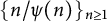 $\{n/\psi (n) \}_{n\geq 1}$
is decreasing. Therefore,
 $$ \begin{align*} \psi(n)^{-1} n \tau\left( |x| e_{(0, \psi(n) ]}{(|x|)}\right) \lesssim& n^{1-r/p} \psi(N) + \psi(n)^{-1} n \sum_{i=N+1}^n \psi(i) \tau\left( e_{(\psi(i-1),\psi(i)]}{(|x|)}\right) \\ \leq& n^{1-r/p} \psi(N) + \sum_{i=N+1}^n i \tau\left( e_{(\psi(i-1),\psi(i)]}{(|x|)}\right). \end{align*} $$
By (1.1), i.e.,
 $ \sum _{i=2}^{\infty }i\tau \left ( e_{(\psi ({i-1}),\psi (i)]}{(|x|)}\right )= \sum _{i=1}^{\infty } \tau (\left (e_{( \psi (i),\infty )}{(|x|)}\right )<\infty $
, the desired convergence follows from taking
 $n\rightarrow \infty $
and
 $N\rightarrow \infty $
.
Lemma 3.6 For
 $r\geq 1$
and
 $p\geq 2$
, let
 $x\in L_{0}(\mathcal {M})$
and
 $\psi :\mathbb {R}^+\rightarrow \mathbb {R}^+$
be a function such that
 $\{ {\psi (n)}/{n^{r/p}}\}_{n=1}^{\infty }$
forms an increasing sequence and (1.1) holds. Then,
 $$\begin{align*}n\tau\left(|x|^2e_{(0, n^{r/p}]}{(|x|)}\right)/\psi(n)^2 \leq C_r n^{{1-2r/p}}. \end{align*}$$
Proof Put
 $\psi (0)=0$
and we have
 $$ \begin{align*} \tau\left(|x|^2 e_{\left(0, \psi(n)\right]}(|x|)\right)&=\sum_{k=1}^n \tau\left(|x|^2 e_{\left(\psi(k-1), \psi(k)\right]}(|x|)\right)\\ &\leq \sum_{k=1}^n \psi(k)^2 \tau\left(e_{\left(\psi(k-1), \psi(k)\right]}(|x|)\right). \end{align*} $$
For the positive increasing sequence
 $\left \{\psi (n) n^{-r/p}\right \}_{n \geq 1}$
, it follows that
 $$\begin{align*}\psi(k) / \psi(n) \leq(k/n)^{r/p} \end{align*}$$
for any
 $1 \leq k \leq n$
. Therefore,
 $$\begin{align*}n \tau\left(|x|^2 e_{\left(0, \psi(n)\right]}(|x|)\right)/\psi(n)^{2} \leq n^{1-2 r / p} \sum_{k=1}^n k^{2 r / p} \tau\left(e_{\left(\psi(k-1), \psi(k)\right]}(|x|)\right). \end{align*}$$
It follows from
 $p\geq 2$
that

which yields the desired result.
Lemma 3.7 For
 $r\geq 1$
,
 $p>0$
, and
 $s>p$
, let
 $x\in L_{0}(\mathcal {M})$
and
 $\psi :\mathbb {R}^+\rightarrow \mathbb {R}^{+}$
be a function such that
 $\{ {\psi (n)}/{n^{r/p}}\}_{n=1}^{\infty }$
forms an increasing sequence and (1.1) holds. Then,
 $$\begin{align*}\sum_{n=1}^{\infty} n^{r-1} \tau\left(|x|^s e_{(0, \psi(n) ]}{(|x|)}\right)/\psi(n)^{s} <\infty. \end{align*}$$
Proof Observe that
 $$\begin{align*}\tau\left(|x|^s e_{(0, \psi(n)]}{|x|}\right)=\sum_{k=1}^n\tau\left(|x|^s e_{(\psi(k-1), \psi(k)]}{(|x|)}\right)\leq\sum_{k=1}^n \psi(k)^s\tau\left( e_{(\psi(k-1), \psi(k)]}{(|x|)}\right). \end{align*}$$
Hence,
 $$ \begin{align*} \sum_{n=1}^{\infty} n^{r-1}\tau\left(|x|^s e_{\left(0, \psi(n)\right]}|x|\right)/\psi(n)^{s}&=\sum_{k=1}^{\infty} \psi(k)^s \tau\left(e_{\left(\psi(k-1), \psi(k)\right]}(|x|)\right) \sum_{n=k}^{\infty} n^{r-1} /\psi(n)^{ s}\\ &\leq\sum_{k=1}^{\infty} k^{s r / p} \tau\left(e_{\left(\psi(k-1), \psi(k)\right]}(|x|)\right) \sum_{n=k}^{\infty} n^{r-1-s r / p}\\ &\lesssim_{r, p, s}\sum_{k=1}^{\infty} k^r \tau\left(e_{\left(\psi(k-1), \psi(k)\right]}(|x|)\right) \\ &\lesssim_{r, p, s} 1+r 2^{r-1} \sum_{k=1}^{\infty} k^{r-1} \tau\left(e_{\left(\psi(k), \infty\right)}(|x|)\right)<\infty, \end{align*} $$
where the first inequality is due to the fact
 $\psi (k)/\psi (n)\leq (k/n)^{r/p}$
for any
 $n\geq k$
.
Now, we are ready to prove Theorem 1.2.
Proof of Theorem 1.2
It suffices to show that (1.1) implies (1.3). By Lemmas 3.4 and 3.5, (1.3) is equivalent to
 $$\begin{align*}\sum_{n=1}^{\infty} n^{r-2}\mathrm{Prob}_{\tau}^c\left\{\sup _{1 \leq m \leq n}\left|\sum_{k=1}^m\left(x_k-\tau\left( x_k e_{(0,\psi(n)]}{|x_k|} \right)\right)\right|>\varepsilon \psi(n)\right\}<\infty, \quad \forall \varepsilon>0. \end{align*}$$
Thanks to (3.2), it follows that
 $$\begin{align*}\mathrm{Prob}_{\tau}^c\left\{\sup _{1 \leq m \leq n}\left|\sum_{k=1}^m\left(x_k-\tau\left( x_k e_{(0,\psi(n)]}{(|x_k|)} \right)\right)\right|>\varepsilon \psi(n)\right\}\leq A_n+B_n, \end{align*}$$
where

and

Applying Lemma 3.3, we get
 $$\begin{align*}A_n\leq \tau\left(\overset{n}{\underset{k=1} {\bigvee}}e_{(\psi(n),\infty)}{(|x_k|)}\right)\leq\sum_{k=1}^n\tau\left(e_{(\psi(n),\infty)}{(|x_k|)}\right). \end{align*}$$
From (1.1), it is immediate that
 $\sum _{n=1}^{\infty }n^{r-2}A_n<\infty $
. It now remains to show that
 $\sum _{n=1}^{\infty } n^{r-2} B_n <\infty $
. For any
 $s \geq 2$
, it follows from Remark 2.2 (2) and Lemma 3.1 with
 $\Psi (t)=t^{s}$
for all
 $t\geq 0$
that
 $$ \begin{align*} B_n&\lesssim_{s,\varepsilon} \psi(n)^{-s} \left\| \sum_{k=1}^n\left(x_ke_{(0,\psi(n)]}{|x_k|}-\tau\left( x_k e_{(0,\psi(n)]}{|x_k|} \right)\right) \right\|_s^s. \end{align*} $$
Note here that
 $\{x_ke_{(0,\psi (n)]}{|x_k|}-\tau \left ( x_k e_{(0,\psi (n)]}{|x_k|} \right )\}_{k\geq 1}$
is a mean zero sequence, then it follows from Theorem 2.3 that
 $$ \begin{align*} &\left\| \sum_{k=1}^n\left(x_ke_{(0,\psi(n)]}{|x_k|}-\tau\left( x_k e_{(0,\psi(n)]}{|x_k|} \right)\right) \right\|_s^s \\& \quad \lesssim_{s,\varepsilon}\left( \sum_{k=1}^{n}\left\| x_ke_{(0,\psi(n)]}{(|x_k|)} \right\|_s^s +\left(\sum_{k=1}^{n}\left\|x_ke_{(0,\psi(n)]}{|x_k|} \right\|_2^2\right)^{s/2} \right)\\&\quad \lesssim_{s,\varepsilon} n \tau\left( |x|^se_{(0,\psi(n)]}{(|x_k|)}\right)+\left( n \tau\left( |x|^2e_{(0,\psi(n)]}{(|x_k|)}\right)\right)^{s / 2}. \end{align*} $$
Therefore, the following inequality holds:

For
 $p \geq 2$
, let
 $s>(p-p/r)/(1-p/2r)$
(i.e.,
 $r-2-s r/p+s / 2<-1$
). Then, it follows from Lemma 3.6 that
 $$ \begin{align*} \psi(n)^{-s} \left( n \tau\left( |x|^2e_{(0,\psi(n)]}{(|x_k|)}\right)\right)^{s / 2}&=\left(\psi(n)^{-2}\cdot n\tau\left( |x|^2e_{(0,\psi(n)]}{(|x_k|)}\right)\right)^{s / 2}\\ &\lesssim n^{-sr/p+s/2}. \end{align*} $$
Thus,
 $I_2 \lesssim \sum _{n=1}^{\infty } n^{r-2-sr/p+s / 2}<\infty $
. Note that
 $s>(p-p/r)/(1-p/2r)>p$
. Then, it follows from Lemma 3.7 that
 $I_{1}<\infty $
. For
 $0<p<2$
, let
 $s=2$
and note that
 $I_{1}=I_{2}$
in this case. Hence, Lemma 3.7 implies that
 $I_1=I_2<\infty $
, which completes our proof in full generality.
3.2 Moderate deviation inequality
In this section, we provide a proof of Theorem 1.4, and the following two lemmas are needed in our approach. Lemma 3.9 is a noncommutative analog of [Reference Davis11, Lemma 1].
Lemma 3.8 Let
 $1<p<\infty $
and
 $x\in L_p({\mathcal { M}})$
. Then,
 $$ \begin{align*}{n^{1-1/p}(\log n})^{-1/p}\tau\left( xe_{[(n\log n)^{1/p},\infty)}(|x|)\right) \rightarrow0,\quad n\rightarrow\infty.\end{align*} $$
Proof Since
 ${n^{1-1/p}(\log n})^{-1/p}\leq (n\log n)^{1-1/p}$
for
 $n\geq 3$
, we have
 $$ \begin{align*} {n^{1-1/p}(\log n})^{-1/p}\left| \tau\left( xe_{[(n\log n)^{1/p},\infty)}(|x|)\right)\right| &\leq (n\log n)^{1-1/p}\tau\left( \left| x\right| e_{[(n\log n)^{1/p},\infty)}(|x|)\right)\\ &\leq \tau\left( \left| x\right|{}^p e_{[(n\log n)^{1/p},\infty)}(|x|)\right). \end{align*} $$
The desired result follows from the assumption
 $x\in L_p(\mathcal {M})$
.
Lemma 3.9 Let
 $1\leq p<\infty $
and
 $x\in L_p({\mathcal { M}})$
. Then,
 $$\begin{align*}\sum_{n=1}^{\infty} n^{p-1}(\log n)^p \tau\left( e_{(n\log n,\infty)}(|x|)\right)<\infty. \end{align*}$$
Proof It is clear that the function
 $t\mapsto t\log t$
is an increasing convex function on
 $[1,\infty )$
, and let
 $\varphi $
be its inverse function, that is,
 $\varphi (t\log t)=t$
for all
 $t\geq 1$
. For
 $y=\varphi (|x|)$
, we have
 $$ \begin{align*} \sum_{n=1}^{\infty} n^{p-1}(\log n)^p\tau\left( e_{(n\log n,\infty)}(|x|) \right) &= \sum_{n=1}^{\infty} n^{p-1}(\log n)^p \tau\left( e_{(n,\infty)}(y)\right) \\ &\lesssim \sum_{k=1}^{\infty} \tau\left( e_{(k,k+1]}(y)\right)\sum_{n=1}^k n^{p-1}(\log n)^{p}\\ &\lesssim\sum_{k=1}^{\infty}(k \log k)^p \tau\left( e_{(k,k+1]}(y)\right)\\ &\lesssim \|y\log y\|_p^p=\|\varphi^{-1}(y)\|^{p}_{p}=\|x\|^{p}_{p}, \end{align*} $$
which completes the proof.
Now, we give the proof of Theorem 1.4 for
 $1<p<2$
.
Proof of Theorem 1.4 (2)
Let
 $a_n=n\log n$
for
 $n\geq 1$
. By Lemma 3.8, it suffices to prove that
 $$ \begin{align*}\sum_{n=1}^{\infty} \frac{\log n}{n}\mathrm{Prob}_{\tau}^c\left\{ \sup_{1 \leq m \leq n} \left|\sum_{k=1}^{m}\left(x_k-\tau\left( x_ke_{(0, a_n ^{1/p})}(|x_k|)\right) \right) \right|>\varepsilon a_n ^{1/p}\right\} <\infty, \quad \forall \varepsilon>0.\end{align*} $$
It follows from (3.2) and Lemma 3.3 that
 $$ \begin{align*}\mathrm{Prob}_{\tau}^c\left\{ \sup_{1 \leq m \leq n} \left|\sum_{k=1}^{m}\left(x_k-\tau\left( x_ke_{(0,a_n ^{1/p}}(|x_k|)\right) \right) \right|>\varepsilon a_n ^{1/p}\right\}\leq n\tau\left( e_{[a_n ^{1/p},\infty)}(|x_k|)\right)+C_n,\end{align*} $$
where

From Lemma 3.9,
 $\|x\|_p<\infty $
implies that
 $\sum _{n=1}^{\infty }\log n \tau \left ( e_{[a_n ^{1/p},\infty )}(|x|)\right )<\infty .$
It remains to show that
 $\sum _{n=1}^{\infty } \left ( {\log n}/{n}\right ) C_n<\infty .$
Applying Lemma 3.1 with
 $\Psi (\cdot )=(\cdot )^2$
and the orthogonality of martingale differences yields that
 $$ \begin{align*}C_n\lesssim (a_n)^{-2/p}\sum_{k=1}^{n}\left\|x_ke_{(0,a_n ^{1/p})}(|x_k|) \right\|_2^2\leq (a_n)^{-2/p}n \left\|x e_{(0,a_n ^{1/p})}(|x |) \right\|_{2}^{2}.\end{align*} $$
Therefore,
 $$ \begin{align*} \sum_{n=2}^{\infty}\frac{\log n}{n} C_n&\lesssim \sum_{n=2}^{\infty} n^{-2 / p}(\log n)^{1-2 / p} \sum_{i=2}^na_i^{2 / p} \tau\left( e_{[a_{i-1}, a_i)} (\left|x \right|{}^p) \right)\\ & = \sum_{i=2}^{\infty}a_i^{2 / p} \tau\left( e_{[a_{i-1}, a_{i})} (\left|x \right|{}^p) \right) \sum_{n=i}^{\infty} n^{-2 / p}(\log n)^{1-2 / p}\\ &\lesssim \sum_{i=2}^{\infty} a_i \tau\left( e_{[a_{i-1}, a_i)} (\left|x \right|{}^p) \right)<\infty, \end{align*} $$
where the last inequality follows from
 $\|x\|_p<\infty $
. Hence, we complete the proof.
For the case
 $p=2$
, Davis’ symmetrization method heavily relying on the Levý inequality, which is not yet well developed in the noncommutative setting. Instead, our approach relies on the following modified noncommutative Fuk–Nagaev inequality.
Lemma 3.10 Let
 $ \{x_k\}_{k \geq 1}\subseteq L_2({\mathcal { M}})$
be a sequence of successively independent self-adjoint random variables, which have the same distribution of
 $x\in L_{2}(\mathcal {M})$
such that
 $\tau (x)=0$
. Let
 $S_n=\sum _{k=1}^{n} x_{k} $
for each
 $n\geq 1$
. Then, for any
 $t_1,t_2>0$
,
 $$ \begin{align*} \tau\left(e_{[t_1,\infty)}(|S_n|) \right)&\leq n \tau\left(e_{[t_2,\infty)}(|x|) \right)+2 \left(\frac{ en \|x\|_2^2}{n \|x\|_2^2+t_1t_2}\right)^{t_1/t_2}\\ &\leq n \tau\left(e_{[t_2,\infty)}(|x|) \right)+2 \left(\frac{en \|x\|_2^2}{t_1t_2}\right)^{t_1/t_2}. \end{align*} $$
Proof By the proof of [Reference Chow7, Theorem 2], it is clear that
 $$ \begin{align*} &\tau\left(e_{[t_1,\infty)}(S_n) \right)\leq n\tau\left(e_{[t_2,\infty)}(x) \right)\\&\quad +\exp \left\{\frac{t_1}{t_2}-\left[\frac{1}{t_2}\left(t_1-n\tau(xe_{(0,t_2]}(|x|)) \right)+ \frac{n\|x\|_2^2}{t_2^2} \right]\log \left(\frac{t_1t_2}{n \|x\|_2^2}+1\right)\right\}. \end{align*} $$
Since x is a self-adjoint element in
 $L_{2}(\mathcal {M})$
and
 $\tau (x)=0$
, we get that
 $$\begin{align*}\left| \tau(xe_{(0,t_2]}(|x|)) \right|=\left|\tau(xe_{(t_{2},\infty)}(|x|))\right| \leq \|x\|_{2}\tau(e_{(t_{2},\infty)}(x))^{1/2}\leq \|x\|^{2}_{2}/t_{2}, \end{align*}$$
where we used the Cauchy–Schwarz inequality in the first inequality and the Chebyshev inequality
 $\tau (e_{(t_{2},\infty )}(|x|))\leq \|x\|^{2}_{2}/t^{2}_{2}$
in the last inequality. Therefore, we have
 $$ \begin{align*}\frac{1}{t_2}\left(t_1-n\tau(xe_{(0,t_2]}(|x|)) \right)+ \frac{n\|x\|_2^2}{t_2^2} \geq t_1/t_2\end{align*} $$
and
 $$ \begin{align*}\tau\left(e_{[t_1,\infty)}(S_n) \right) \leq n\tau\left(e_{[t_2,\infty)}(x) \right)+ e^{t_1/t_2}\left(\frac{n \|x\|_2^2}{n \|x\|_2^2+t_1t_2}\right)^{t_1/t_2}.\end{align*} $$
By replacing x with
 $-x$
and
 $x_k$
with
 $-x_k$
, the desired result follows.
Now, we give the proof of Theorem 1.4 for the case
 $p=2$
.
Proof of Theorem 1.4 (1)
For the case
 $\{x_k\}_{k\geq 1}$
are self-adjoint, we apply Lemma 3.10 with parameters
 $t_1=\varepsilon \sqrt {n \log n}$
and
 $ t_2=\varepsilon \sqrt {n \log n} / 3$
to get that
 $$ \begin{align*} \sum_{n\geq 2} \frac{ \log n }{n}\tau\left(e_{[\varepsilon \sqrt{n \log n} ,\infty)}(|S_n-n\tau(x)|) \right)&\lesssim \sum_{n\geq 2} \log n\tau\left(e_{[\varepsilon \sqrt{n \log n} / 3,\infty)}(|x-\tau(x)|) \right)\\ &+\sum_{n\geq 2} \frac{1}{n(\log n)^2}. \end{align*} $$
Note that the fact
 $x\in L_{2}(\mathcal {M})$
implies the convergence of the series. For general random variables, it suffices to split the sequence into the complex combination of two self-adjoint sequences and apply the triangle inequality of the distribution function (2.1) to conclude the proof.
It is easy to derive the convergence rate for the law of the iterated logarithm as follows.
Corollary 3.11 Let
 $ \{x_k\}_{k \geq 1}\subseteq L_2({\mathcal { M}})$
be a sequence of successively independent self-adjoint random variables, which have the same distribution of
 $x\in L_{2}(\mathcal {M})$
. Let
 $S_n=\sum _{k=1}^{n} x_{k}$
for each
 $n\geq 1$
. Then, for any
 $\varepsilon>0$
, we have
 $$\begin{align*}\sum_{n=3}^{\infty}\frac{1}{n\log n}\tau \left( e_{ (\varepsilon (n\log \log n)^{1/2},\infty)} \left(\left|S_n-n\tau(x)\right| \right) \right)<\infty. \end{align*}$$
Proof Let
 $a_n=n\log \log n$
for
 $n\geq 3$
. Applying Lemma 3.10 with
 $t_1=\varepsilon \sqrt {a_n}$
and
 $ t_2=\varepsilon \sqrt {a_n} / 2$
yields that
 $$ \begin{align*} \sum_{n\geq 3} \frac{1}{n \log n} \tau\left(e_{[\varepsilon \sqrt{a_n} ,\infty)}(|S_n-n\tau(x)|) \right) &\lesssim \sum_{n\geq 3} \frac{1}{\log n} \tau\left(e_{[ \sqrt{a_n} / 2,\infty)}(|x-\tau(x)|) \right) \\ & + \sum_{n\geq 3} \frac{1}{n \log n(\log \log n)^2}. \end{align*} $$
Observe that
 $$ \begin{align*} \sum_{n\geq 3} \frac{1}{\log n} \tau\left(e_{[ \sqrt{a_n} ,\infty)}(|x-\tau(x)|) \right) = & \sum_{k\geq 3}\left( \sum_{3\leq n \leq k} \frac{1}{\log n}\right) \tau\left(e_{[ {a_n} , {a_{n+1}} )}(|x-\tau(x)|^2) \right) \\ \leq &\sum_{k\geq 3} a_k\tau\left(e_{[ {a_n} , {a_{n+1}} )} (|x-\tau(x)|^2) \right) \lesssim \left\|x \right\|_2^2. \end{align*} $$
Hence, we complete the proof.
4 Baum–Katz theorem and moderate deviation inequality for noncommutative martingales
4.1 Baum–Katz theorem for noncommutative martingales
This section is devoted to establishing a Baum–Katz-type theorem for noncommutative martingales. We begin with recalling the following technical fact from Balka and Tómács [Reference Balka and Tómács1].
Fact 4.1 Suppose that f is a positive non-decreasing function defined on
 $[0,\infty )$
with
 $\sum _{n=1}^{\infty } \frac {1}{f\left (2^{cn}\right )}<\infty $
for some
 $c>0$
. Then, the following holds:
-
(1)
$\sum _{n=1}^{\infty } 1 /\left (n f\left (n^c\right )\right )<\infty $
for some
$c>0$
; -
(2)
$\sum _{n=1}^{\infty } 1 /\left (n f\left (\varepsilon n^c\right )\right )<\infty $
for all
$\varepsilon , c>0$
.


Remark 4.2 In what follows, we may assume that
 $\lim _{n\rightarrow \infty } f(2^{n+1})/f(2^n)=1$
if
 $\sum _{n=1}^{\infty } \frac {1}{f\left (2^{n}\right )}<\infty $
. Indeed, if f satisfies
 $\sum _{n=1}^{\infty } \frac {1}{f\left (2^{n}\right )}<\infty $
, then by [Reference Balka and Tómács1, Corollary 3.2] there exists a positive non-decreasing function g defined on
 $[0,\infty )$
such that
 $\sum _{n=1}^{\infty } \frac {1}{g\left (2^{n}\right )}<\infty $
,
 $\limsup _{t\rightarrow \infty } g(t)/f(t)\leq 1,$
and
 $\lim _{n\rightarrow \infty } g(2^{n+1})/g(2^n)=1$
. It now suffices to replace f by g in the proof.
Lemma 4.3 [Reference Balka and Tómács1]
Suppose that f is a positive non-decreasing function defined on
 $[0,\infty )$
with
 $\sum _{n=1}^{\infty } \frac {1}{f\left (2^n\right )}<\infty $
. Then, the following holds:
-
(1) for all
$p>0,$
there is a
$c_p>0$
such that the function
$h_p(x)=x^{-p} f(c_px)$
is decreasing for
$x \geq 1$
; -
(2) for all
$q\geq 1,$
there is a convex increasing function
$f_q:[0, \infty ) \rightarrow \mathbb {R}^{+}$
and
$N_q>0$
such that
$f_q$
is affine on
$\left [0, N_q\right ]$
and
$f_q(x)=x^q f(\sqrt {x})$
for
$x \geq N_q$
.


The following lemma is elementary and we omit its proof.
Lemma 4.4 Let
 $\left \{x_n\right \}_{n \geq 1}$
be a sequence of random variables in
 $L_0(\mathcal { M})$
. Let
 $\phi , \rho :[0, \infty ) \rightarrow \mathbb {R}^{+}$
be non-decreasing functions such that
 $\limsup _{t\rightarrow \infty }\rho (t)/\phi (t)<\infty $
. Then,
 $\sup _{n\geq 1} \tau \left (\phi \left (\left |x_n\right |\right )\right )<\infty $
implies that
 $\sup _{n\geq 1} \tau \left (\rho \left (\left |x_n\right |\right )\right )<\infty $
.
Before showing the proof of Theorem 1.6, we need the following weak-type asymmetric maximal inequality, which can be viewed as a suitable substitute of the weak-type
 $(1,1)$
Doob inequality.
Lemma 4.5 Let
 $\left (x_k\right )_{k \geq 1}$
be a noncommutative martingale in
 $L_{1}(\mathcal { M})$
. Then, for any positive integer n, the following holds:
 $$\begin{align*}\operatorname{Prob}_\tau^c\left\lbrace \sup _{1 \leq k \leq n}\left|x_k\right|>t\right\rbrace \leq \frac{C}{t} \sum_{k=1}^n\left\|dx_k\right\|_1, \quad \forall t>0, \end{align*}$$
where C is an absolute constant.
Proof Applying Theorem 2.1 with
 $p=1$
and Minkowski inequality, it follows that for each
 $t>0$
and any positive integer n, there exists a projection e such that
 $\sup _{1 \leq k \leq n}\left \|x_k e\right \|_{\infty } \leq t$
and
 $$ \begin{align*} t \tau(1-e) &\leq C\left\|\left(\sum_{k=1}^n\left|d x_k\right|{}^2\right)^{1 / 2}\right\|_{1}= C \left\|\sum_{k=1}^n\left|d x_k\right|{}^2 \right\|_{1/2}^{1/2}\\ &\leq C \sum_{k=1}^n\left\| \left|d x_k\right|{}^2 \right\|_{1/2}^{1/2}= C\sum_{k=1}^n\left\| d x_k \right\|_1. \end{align*} $$
We now provide the proof of Theorem 1.6.
Proof of Theorem 1.6
We assume that
 $\sup _{i \geq 1} \tau \left (\left |dx_i\right |{}^p f\left (\left |dx_i\right |\right )\right )=C<\infty $
with
 $x_k=\sum _{i=1}^{k}dx_i$
for each
 $1\leq k \leq n$
and
 $n\geq 1$
. For each
 $1\leq i\leq n$
, we define
 $$ \begin{align*} & y_{i, n}=dx_i e_{(0,n^{r/p}]}{(\left|dx_i\right|)} - \mathcal{E}_{i-1}\left(dx_i e_{(0,n^{r/p}]}{(\left|dx_i\right|)} \right),\\ & z_{i, n}=dx_i e_{( n^{r/p},\infty)}{(\left|dx_i\right|)} - \mathcal{E}_{i-1}\left(dx_i e_{( n^{r/p},\infty)}{(\left|dx_i\right|)} \right). \end{align*} $$
Let
 $A_k^n=\sum _{i=1}^k y_{i, n}$
and
 $B_k^n=\sum _{i=1}^k z_{i, n}$
for all
 $1\leq k \leq n$
and
 $n\geq 1$
. It is easy to see that both
 $\{A_k^n\}_{1 \leq k \leq n}$
and
 $\{B_k^n\}_{1 \leq k \leq n}$
are martingales and
 $x_k=A_k^n+B_k^n$
. By Lemma 3.2, we have

To estimate
 $x,$
we apply Lemma 4.5 to obtain
 $$ \begin{align} \mathrm{II}_{n}\lesssim \left( (\varepsilon/2) n^{r/p}\right)^{-1}\sum_{i=1}^{n}\|z_{i,n}\|_1\lesssim n^{-r/p} \sum_{i=1}^n \tau\left(|dx_i| e_{( n^{r/p},\infty)}{(\left|dx_i\right|)}\right). \end{align} $$
It follows from the Borel functional calculus for
 $|dx_i|$
that
 $$ \begin{align} \begin{aligned} \tau\left(|dx_i| e_{( n^{r/p},\infty)}{(\left|dx_i\right|)}\right) & \leq\frac{\tau\left(\left|dx_i\right|\left|dx_i\right|{}^{p-1} f\left(\left|dx_i\right|\right) e_{( n^{r/p},\infty)}{|dx_i|}\right)}{n^{(p-1)r/p} f\left(n^{r/p}\right)} \\ &=\frac{n^{ r/p-r}}{f\left(n^{r/p}\right)} \tau\left(\left|dx_i\right|{}^p f\left(\left|dx_i\right|\right)\right)\lesssim \frac{n^{ r/p-r}}{f\left(n^{r/p}\right)}. \end{aligned} \end{align} $$
Combining (4.1), (4.2), and Fact 4.1(1) entails that
 $$\begin{align*}\sum_{n=1}^{\infty} n^{r-2}\mathrm{II}_{n}\lesssim \sum_{n=1}^{\infty} \frac{1}{n f\left(n^{r/p}\right)}<\infty. \end{align*}$$
To estimate
 $I_{n}$
, we apply Lemma 3.1 with
 $\Psi (t)=t^{2}$
for all
 $t\geq 0$
to get
 $$ \begin{align*} \mathrm{I}_{n}& \lesssim \left( {\varepsilon^2} n^{2 r/p}\right)^{-1} \tau\left(|A_n^n|^2\right) =\frac{1}{\varepsilon^2} n^{-2r/p} \sum_{i=1}^n \tau\left( |y_{i, n}|^2\right) \\&\lesssim \left( {\varepsilon^2} n^{2 r/p}\right)^{-1} \sum_{i=1}^n \tau\left(|dx_i|^2 e_{(0,n^{ r/p}]}{(\left|dx_i\right|)}\right). \end{align*} $$
Let
 $q=(2-p)r /p $
and it follows from (2.3) that

where
 $$\begin{align*}I_i^1=\int_0^{ 1} t^2 i^{-q-1} \mathrm{~d} \tau(e_t),~I_i^2=\int_{1}^{i^{r/p}} t^2 i^{-q-1} \mathrm{~d}\tau(e_t),~I_i^3=\int_{i^{r/p}}^{\infty} t^{p-p/r} \mathrm{~d} \tau(e_t). \end{align*}$$
Note here that
 $ \sum _{i=1}^{\infty }I_i^1\leq \sum _{i=1}^{\infty } i^{-q-1}<\infty. $
It follows from Lemma 4.3 (1) that
 $t^{p-2} f(c_pt)$
is non-increasing for
 $t \geq 1$
and some
 $c_p>0$
. Combining that
 $t^{p/r} f(c_pt)$
is non-decreasing yields that
 $$ \begin{align*}I_i^2 \leq i^{-q-1} \int_{1}^{i^{r/p}} t^2 \frac{t^{p-2} f(c_pt)}{i^{(p-2)r/p} f\left(c_pi^{r/p}\right)} \mathrm{d} \tau(e_t),~ I_i^3\leq\int_{i^{r/p}}^{\infty} t^{p-p/r} \frac{t^{p/r} f(c_pt)}{i f\left(c_pi^{r/p}\right)} \mathrm{d} \tau(e_t). \end{align*} $$
By Remark 4.2 and Lemma 4.4, we have
 $$\begin{align*}\int_{0}^{\infty} t^p f(c_pt) \mathrm{d} \tau(e_t) = {\tau\left(\left|dx_i\right|{}^p f\left(c_p\left|dx_i\right|\right)\right)} \lesssim {C}. \end{align*}$$
Notice that Fact 4.1(2) implies
 $\sum _{i=1}^{\infty }\left ( I_i^2+I_i^3 \right ) \lesssim \sum _{i=1}^{\infty }{C}/\left ( {i f\left (c_pi^{r/p}\right )}\right ) <\infty. $
Hence,
 $$\begin{align*}\sum_{n=1}^{\infty} n^{r-2}\mathrm{I}_{n}\lesssim \sum_{i=1}^{\infty}\left(I_i^1+I_i^2+I_i^3\right)<\infty. \end{align*}$$
Finally,
 $$ \begin{align*} \sum_{n=1}^{\infty} n^{r-2}\mathrm{Prob}_{\tau}^c\left\lbrace \sup_{1\leq k\leq n}|x_{k }|>\varepsilon n^{r/p}\right\rbrace & \leq \sum_{n=1}^{\infty} n^{r-2} \mathrm{I}_{n} +\sum_{n=1}^{\infty} n^{r-2}\mathrm{II}_{n}<\infty, \end{align*} $$
which yields the desired conclusion.
To show the case for
 $p\geq 2$
, we recall the following noncommutative Burkholder–Gundy inequality for Orlicz norms [Reference Jiao, Sukochev, Zanin and Zhou22, Theorem 7.2].
Theorem 4.6 Let
 $\Phi $
be a 2-convex and q-concave Orlicz function for some
 $2\leq q<\infty $
and
 $\left (x_k\right )_{k \geq 0}$
be a sequence martingale differences that is bounded in
 $ L_{\Phi }(\mathcal {M})$
. Then,
 $$ \begin{align*}\tau\left(\Phi\left(\left|\sum_{k \geq 0} x_k\right|\right)\right) \approx_{\Phi} \max \left\{\tau\left(\Phi\left[\left(\sum_{k \geq 0}\left|x_k\right|{}^2\right)^{1 / 2}\right]\right), \tau\left(\Phi\left[\left(\sum_{k \geq 0}\left|x_k^*\right|{}^2\right)^{1 / 2}\right]\right)\right\}. \end{align*} $$
Lemma 4.7 Let f be the function fulfilling (1.4). Then, for any
 $q\geq 2$
, we can modify f to obtain a
 $2$
-convex and s-concave function
 $\Phi _{q}$
for some
 $2\leq s<\infty $
.
Proof By Lemma 4.3 (2), there is an increasing convex function
 $f_{q / 2}:[0, \infty ) \rightarrow (0, \infty )$
and positive numbers
 $N_q$
, such that
 $f_{q / 2}$
is linear on
 $[0, N_q]$
, and
 $f_{q / 2}(t)=t^{q / 2} f(\sqrt {t})$
for all
 $t\geq N_q$
. Define
 $\Phi _q:[0, \infty ) \rightarrow [0, \infty )$
by setting
 $\Phi _q(t)=f_{q / 2}\left (t^2\right )$
. Obviously,
 $\Phi _q$
is increasing and 2-convex. Clearly,
 $\Phi _q(0)=0$
and
 $\Phi _q(t)=c t^2$
for
 $t \in [0, \sqrt {N_q}]$
with some constant
 $c>0$
. For
 $t \geq \sqrt N_q$
we have
 $\Phi _q(t)=t^q f(t)$
. It follows from Remark 4.2 that
 $\Phi _q$
satisfies the
 $\Delta _{2}$
-condition. Hence, there exists an
 $s\in [2,\infty )$
such that
 $\Phi _q$
is s-concave.
Now, we give the proof of Theorem 1.7.
Proof of Theorem 1.7
Assume without loss of generality that
 $x_k=\sum _{i=1}^{k}dx_i$
is self-adjoint for each
 $k\in \mathbb {N}^+$
. Since
 $q=\frac {2p(r-1)}{2r-p}\geq 2$
, it follows from Lemmas 4.7 and 4.4 that there exists a
 $2$
-convex and s-concave function
 $\Phi _{q}$
for some
 $2\leq s<\infty $
with
 $$\begin{align*}\sup _{i \geq 1} \tau \left(\Phi_q\left(\left|dx_i\right|\right)\right)\lesssim\sup_{ i\geq 1} \tau\left(\left|dx_i\right|{}^q f\left(\left|dx_i\right|\right)\right)<\infty. \end{align*}$$
Let
 $K=\sup _{i \geq 1} \tau \left (\Phi _q\left (\left |dx_i\right |\right )\right )$
and we apply Lemma 3.1 to the finite martingale
 $\{x_{k}/\sqrt {n}\}_{1\leq k\leq n}$
to get that
 $$\begin{align*}\mathrm{Prob}_{\tau}^c\left\lbrace \sup_{1\leq k\leq n}|x_k|>\varepsilon n^{r/p}\right\rbrace \lesssim_{r} \frac{\tau \left[\Phi_q\left( | x_n/\sqrt{n}| \right)\right]}{\Phi_q\left(\varepsilon n^{r/p-1 / 2}\right)}. \end{align*}$$
It follows from Theorem 4.6 that
 $$\begin{align*}\tau \left[\Phi_q\left(|x_n|/\sqrt{n}\right)\right] \lesssim \tau\left(\Phi_q\left[\left( \sum_{i=1}^{n}\left|d x_i\right|{}^2/ n\right)^{\frac{1}{2}}\right]\right) = \tau\left(f_{q / 2}\left( \sum_{i=1}^n \left|d x_i\right|{}^2 / n \right)\right). \end{align*}$$
Applying the Jensen inequality (2.4) to the convex function
 $f_{q/2}$
yields that
 $$ \begin{align*}\tau\left(f_{q / 2}\left( \sum_{i=1}^n \left|d x_i\right|{}^2 / n\right)\right) \leq (1/n) \sum_{i=1}^n \tau \left(f_{q / 2}\left(\left|d x_i\right|{}^2\right)\right) = (1 / n) \sum_{i=1}^n \tau \left(\Phi_q\left(\left|dx_i\right|\right)\right) \leq K.\end{align*} $$
For
 $ \varepsilon n^{r/p-1 / 2}\geq \sqrt {N_q}$
, that is,
 , we have
 $$ \begin{align*} \mathrm{Prob}_{\tau}^c\left\lbrace \sup_{1\leq k\leq n}|x_k|>\varepsilon n^{r/p}\right\rbrace &\leq \frac{K}{\Phi_q\left(\varepsilon n^{r/p-1 / 2}\right)}\\ &=\frac{ K}{\varepsilon^q n^{q(r/p-1 / 2)} f\left(\varepsilon n^{r/p-1 / 2}\right)}=\frac{Kn^{1-r}}{\varepsilon^{q}f\left(\varepsilon n^{r/p-1 / 2}\right)}. \end{align*} $$
Hence, taking the sum over all
 $n\in \mathbb {N}^+$
and applying Fact 4.1(2) yield that
 $$\begin{align*}\sum_{n\geq n_0} n^{r-2}\mathrm{Prob}_{\tau}^c\left\lbrace \sup_{1\leq k\leq n}|x_k|>\varepsilon n^{r/p}\right\rbrace \lesssim \sum_{n\geq n_0} \frac{K}{\varepsilon^{q}nf\left(\varepsilon n^{r/p-1 / 2}\right)}<\infty. \end{align*}$$
For general martingales, it suffices to apply the Hermitian dilation technique to reduce to the self-adjoint martingale case.
4.2 Moderate deviation inequality for martingale differences
Before showing the proof of Theorem 1.10, we need to recall the following deviation inequality for noncommutative martingales taken from [Reference Jiao, Luo and Zhou19, Lemma 4.3].
Lemma 4.8 Let
 $1<p<\infty $
, and
 $\left (x_k\right )_{k \geq 1}$
in
 $ L_p(\mathcal { M})$
be a noncommutative martingale. Suppose that
 $\sup _k\left \|d x_k\right \|_p \leq K$
for some
 $K>0$
. Then, there exists
 $C_p>0$
such that
 $$ \begin{align*}\left\|x_n\right\|_p \leq C_p n^{\frac{\max \{2, p\}}{2p}} K, \quad \forall n\geq 1. \end{align*} $$
We now provide the proof of Theorem 1.10 as follows.
Proof of Theorem 1.10
For each
 $1\leq i\leq n$
and some
 $a>0$
, we define
 $$ \begin{align*} & u_{i, n}=dx_i e_{(0,(\log n)^a]}{(\left|dx_i\right|)} - \mathcal{E}_{i-1}\left(dx_i e_{(0,(\log n)^a]}{(\left|dx_i\right|)} \right),\\ & v_{i, n}=dx_i e_{( (\log n)^a,\infty)}{(\left|dx_i\right|)} - \mathcal{E}_{i-1}\left(dx_i e_{( (\log n)^a,\infty)}{(\left|dx_i\right|)} \right). \end{align*} $$
Let
 $M_k^n=\sum _{i=1}^k u_{i, n}$
and
 $N_k^n=\sum _{i=1}^k v_{i, n}$
for all
 $1\leq k \leq n$
and
 $n\geq 1$
. It is easy to see that both
 $\{M_k^n\}_{1 \leq k \leq n}$
and
 $\{N_k^n\}_{1 \leq k \leq n}$
are martingales. Denoted by
 $x_k=\sum _{i=1}^{k}dx_i$
for
 ${1\leq k\leq n}$
, it follows that
 $x_k=M_k^n+N_k^n$
. By Lemma 3.2, we have

Applying Lemma 3.1 with
 $\Psi (t)=t^{2}$
for
 $t>0$
, it follows from the orthogonality of martingale differences that
 $$ \begin{align*}II^*_n\lesssim (n\log n)^{-1} \sum_{i=1}^{n}\left\| v_{i,n}\right\|_2^2\lesssim (n\log n)^{-1} \sum_{i=1}^{n} \tau\left( |dx_i|^2 e_{( (\log n)^a,\infty)}{(\left|dx_i\right|)} \right).\end{align*} $$
By the Hölder inequality and Chebyshev inequality (2.2),
 $$ \begin{align*}\tau\left( |dx_i|^2 e_{( (\log n)^a,\infty)}{(\left|dx_i\right|)} \right)\leq \left\| |dx_i|^2\right\| _{p/2}\left\| e_{( (\log n)^a,\infty)}{(\left|dx_i\right|)}\right\| _{p/(p-2)}\lesssim (\log n)^{(2-p)a}.\end{align*} $$
Hence, we have
 $II^*_n\lesssim (\log n)^{(2-p)a-1}.$
For some
 $q>2$
, applying Lemma 4.8 to
 $\left ( M_k^n\right )_{1\leq k\leq n}$
with
 $K= (\log n)^a$
, it follows that
 $$ \begin{align*}\left\| M_n^n\right\|_q \lesssim n^{1/2}(\log n)^{a}.\end{align*} $$
By Lemma 3.1, we obtain that
 $$ \begin{align*}I_n^*\lesssim (n\log n)^{-q/2}\left\| M_n^n\right\|_q^q\lesssim (\log n)^{aq-q/2}.\end{align*} $$
Therefore,
 $$ \begin{align*}\sum_{n=2}^{\infty}\frac{\log n}{n}\mathrm{Prob}_{\tau}^c\left\lbrace \sup_{1\leq k\leq n}\left|x_{k } \right|>\varepsilon (n\log n)^{1/2}\right\rbrace \lesssim \sum_{n=2}^{\infty}\frac{ (\log n)^{aq-q/2+1}}{n}+ \sum_{n=2}^{\infty}\frac{(\log n)^{(2-p)a} }{n}.\end{align*} $$
The series converges for the range
 $p>4$
,
 $q>\frac {4(p-2)}{p-4}$
, and
 $\frac {1}{p-2}<a<\frac {q-4}{2 q}$
.
Inspired by Zeng’s result [Reference Zeng51], we study the convergence rate of the iterated logarithm for noncommutative martingales.
Corollary 4.9 Let
 $p>2$
and
 $ \{dx_i\}_{i \geq 1}$
be an
 $L_p$
-bounded noncommutative martingale difference sequence. Then, for any
 $\varepsilon>0$
, we have
 $$\begin{align*}\sum_{n=3}^{\infty}\frac{1}{n\log n}\mathrm{Prob}_{\tau}^c\left\lbrace \sup_{1 \leq k \leq n} \left|\sum_{i=1}^{k}dx_i\right|>\varepsilon (n\log \log n)^{1/2}\right\rbrace <\infty. \end{align*}$$
Proof By the same arguments used in the proof of Theorem 1.10, for some
 $a>0$
and
 $q>2$
, we have
 $$ \begin{align*} &\sum_{n=3}^{\infty}\frac{1}{n\log n}\mathrm{Prob}_{\tau}^c\left\lbrace \sup_{1 \leq k \leq n} \left|\sum_{i=1}^{k}dx_i\right|>\varepsilon (n\log \log n)^{1/2}\right\rbrace\\ \lesssim&\sum_{n=3}^{\infty} \frac{(\log \log n)^{a q-q / 2}}{n \log n}+ \sum_{n=3}^{\infty} \frac{(\log \log n)^{(2-p) a-1}}{n \log n}. \end{align*} $$
The series converges by taking
 $0<a<(q-2) / 2 q$
.
It is worthwhile to mention that for
 $1\leq p\leq 2$
, there exists an
 $L_p$
-bounded martingale difference sequence such that the series in Corollary 4.9 diverges (see [Reference Miao, Yang and Stoica38, Theorem 2.4]).
5 Marcinkiewicz–Zygmund strong law of large numbers
In 1947, Chung [Reference Conde-Alonso and Parcet10] proved the following extension of the Marcinkiewicz–Zygmund strong law of large numbers for independent random variables.
Theorem 5.1 Let
 $1\leq p<2$
and
 $\left \{X_n\right \}_{n \geq 1}$
be a sequence of mean-zero independent random variables such that
 $\sup _{n \geq 1} \mathbb {E}\left (\left |X_n\right |{}^p f\left (\left |X_n\right |\right )\right )<\infty $
, where f fulfills (1.4). Then,
 $\lim _{n \rightarrow \infty } \sum _{k=1}^{n}X_k / n^{1/p} =0$
almost surely.
Stout later extended Theorem 5.1 to the cases of martingale differences (see [Reference Stout49, Theorem 3.3.9 and Corollary 3.3.5]). In this section, we further extend Stout’s results to the noncommutative framework. Recall the a.u convergence of sequences from Definition 2.1, and the following lemma is a noncommutative analog of the Borel–Cantelli lemma enabling one to derive an a.u. convergence result from the convergence of specific series of tail probabilities.
Lemma 5.2 (Noncommutative Borel–Cantelli lemma [Reference Konwerska28])
Suppose
 $\{I_{n}\}_{n=1}^{\infty }$
is a sequence of integers such that
 $\cup _{n=1}^{\infty } I_{n}=\left \{k \in \mathbb {N}: k\geq n_0\right \}$
for some
 $n_{0} \in \mathbb {N}$
. Let
 $\left (z_n\right )$
be a sequence of random variables. If for any
 $\delta>0$
,
 $$\begin{align*}\sum_{n \geq n_0} \mathrm{Prob}_{\tau}^c\left\lbrace \sup _{m \in I_n} |z_m |> \delta\right\rbrace <\infty, \end{align*}$$
then
 $$\begin{align*}z_n \stackrel{\text { a.u. }}{\longrightarrow} 0 \,\, \,{\text{as}} \,\, \, n \rightarrow \infty. \end{align*}$$
It is worthwhile to mention that a slight modification in the proof of Lemma 5.2 ensures the validity of the conclusion if the following series
 $$\begin{align*}\sum_{n \geq n_0} \mathrm{Prob}_{\tau}^{c}\left\{\sup _{m \in I_n} \left( \left| z_m /\left( \sup I_n\right) ^a\right| \right)>\delta\right\} \end{align*}$$
converges for some
 $a>0$
.
Proof of Corollary 1.9
Let
 $r=1$
in Theorem 1.6 and note that the series
 $$\begin{align*}\sum_{n=2}^{\infty}\frac{1}{n\log n}=\infty. \end{align*}$$
It follows that there exists a positive constant C such that
 $$\begin{align*}\mathrm{Prob}^{c}_{\tau}\left\{\sup _{1 \leq m \leq n}\left|S_m \right|>\varepsilon n^{1/p}\right\}\leq \frac{C}{\log n },\quad\mbox{for all}~n\in \mathbb{N}. \end{align*}$$
Therefore, we obtain
 $\sum _{n=1}^{\infty }\mathrm {Prob}^{c}_{\tau }\left \{\sup _{1 \leq m \leq 2^{2^n}}\left |S_m \right |>\varepsilon 2^{2^n/p}\right \}<\infty $
. By Lemma 5.2,
 $ \sum _{k=1}^{n}x_k / n^{1/p} $
converges to
 $0$
almost uniformly.
Remark 5.3 The proof of Corollary 1.3 is analogous to the proof of Corollary 1.9, and we left the details for readers. In the commutative martingale setting, Chung [Reference Chung9] pointed out that the uniform boundedness condition in our results is the best possible, i.e., (1.5) diverges whenever (1.4) diverges. In addition, if we take
 $f(t)=\left ( \log ^+ |t|\right ) ^{1+\epsilon }$
for
 $t\geq 0$
and
 $\varepsilon>0$
in Corollary 1.9, we will see that the logarithmic factor compensates for weakening the assumption concerning independence and identical distributions compared to the classical Marcinkiewicz–Zygmund law.
Acknowledgements
We are grateful to the referee’s constructive suggestions which substantially improve the article.



